The poor condition of vehicles and roads are among the main causes of accidents in Cuba.
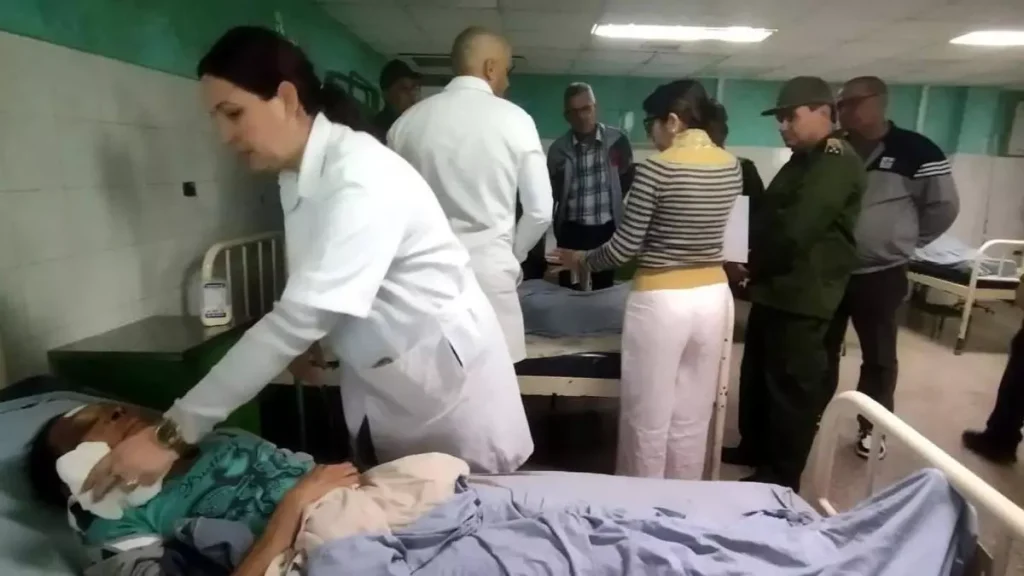
 14ymedio, Havana, 13 February 2026 — A serious traffic accident on Thursday on the national highway, near the Zaza bridge in Sancti Spíritus, left at least four people dead and 17 injured, two of them in critical condition. The accident involved a Diana bus travelling between Havana and the east of the country.
It occurred at around 11:36 p.m. According to official reports published by the provincial media outlet Escambray, the driver lost control for reasons that are “under investigation,” a common phrase that rarely translates into verifiable information for the public.
The authorities identified the four fatalities in the accident as Edilberto Aldana García, 23, a resident of Vertientes, Camagüey; Conrado Peña López, 58, a native of Santiago de Cuba; Niurka de la Caridad Argelí Ladisté, 56, also a native of that province; and Ualter Chávez Galán, 30, a resident of the municipality of Cauto, in Granma province.
As for the injured, two remain in critical condition in the Intensive Care Unit. One of them underwent surgery after suffering severe head trauma with a frontal fracture, while the other has a right haemothorax and a liver laceration. The rest of the injured are progressing favourably, although they remain under hospital observation. Among them is a five-year-old boy, who did not suffer serious injuries and was transferred to the provincial paediatric hospital for specialised follow-up. continue reading
The latest figures on road accidents confirm a worrying increase
The accident occurred in virtually deserted streets, with much of the transport system paralysed. The measures adopted by the government in response to the loss of its main benefactor, Venezuela, and the impact of US President Donald Trump’s executive order on oil shipments to Cuba, have reduced mobility to historic lows.
The latest figures on road accidents confirm a worrying increase. In 2025, Cuba recorded 7,538 traffic accidents and 750 deaths, representing an 18.2% increase in deaths compared to 2024, when 634 deaths were reported. The number of injuries also rose slightly, from 6,613 to 6,718, according to data from the National Road Safety Commission.
But the most revealing statistic – and also the one most silenced by official discourse – is that 31% of drivers involved in crashes did not have a driving licence. This figure exposes a structural flaw in road safety control and training mechanisms which, far from being corrected, is worsening amid institutional deterioration and constant improvisation.
These vehicles operate for long hours, with minimal technical inspections and under pressure to meet increasingly unfeasible schedules.
Even more worrying is that, within this group of licences withdrawn for drink-driving, 98% belonged to state drivers. In other words, drivers of vehicles belonging to public institutions are over-represented in these accidents, a fact that rarely appears clearly in official reports or subsequent analyses.
Diana buses, assembled on the island from Chinese components, have been repeatedly singled out by passengers and drivers for technical problems, poor maintenance and overuse on long-distance routes. In a country where travelling between provinces has become an odyssey, these vehicles operate for long hours, with minimal technical inspections and under pressure to meet increasingly unfeasible schedules.
Added to this is the deterioration of the national motorway, with poor lighting, almost non-existent signage and asphalt damaged by years of neglect. It is no coincidence that many of the most serious accidents occur at night, when visibility is minimal and driver fatigue combines with poor road conditions.
Translated by GH
____________
COLLABORATE WITH OUR WORK: The 14ymedio team is committed to practicing serious journalism that reflects Cuba’s reality in all its depth. Thank you for joining us on this long journey. We invite you to continue supporting us by becoming a member of 14ymedio now. Together we can continue transforming journalism in Cuba.