The head of U.S. diplomacy in Cuba says there is a “Delcy Rodríguez” on the Island and that negotiations should bear fruit within weeks
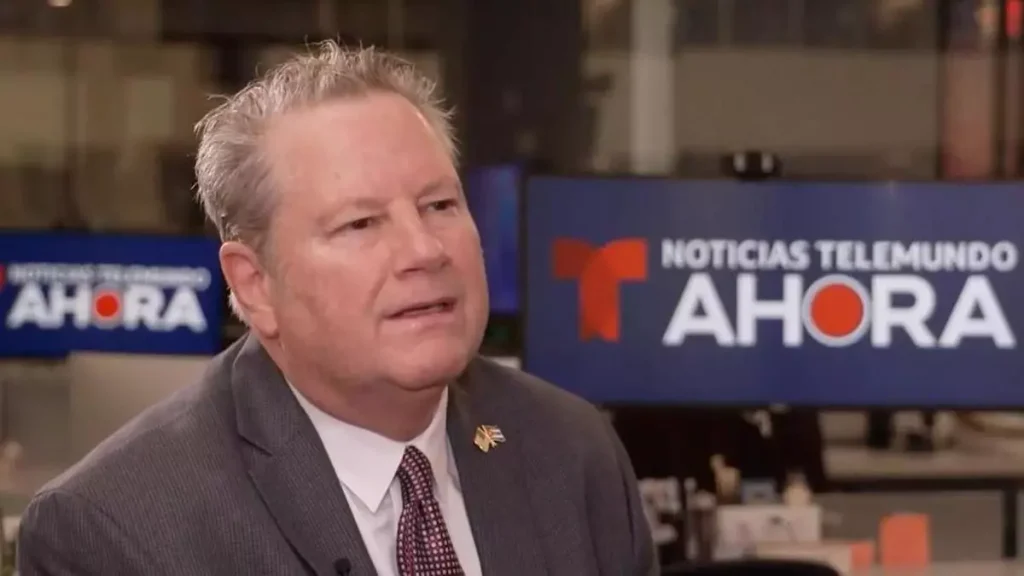
 14ymedio, Madrid, February 11, 2026 – The head of the U.S. Diplomatic Mission, Mike Hammer, insisted this Tuesday in an interview with Telemundo in Miami that talks are taking place with representatives of the Cuban government and even hinted that parts of the regime are unaware of them. The diplomat went so far as to claim that Washington already has a Delcy Rodríguez on the Island.
“Obviously there are conversations with some very high-ranking people within the regime. Others may not be aware,” Hammer said. “There are some who come out and make a statement: ‘No, no, no, there’s nothing.’ And then suddenly, a day or two later, they say: ‘Well, I mean, this has to be done the way we’re doing it.’ I’ll just give you the example of Venezuela,” he emphasized.
The idea aligns with what U.S. President Donald Trump himself has repeatedly insisted. In mid-January and just a few days ago, the president maintained that dialogue was underway and that there would be news soon. On both occasions, the Cuban regime responded by denying that anything was being discussed beyond the usual matters on which both nations regularly exchange views: migration and drug trafficking.
“Good question, I appreciate it. A good journalist, we’re not going to get into… Yes, there is a Delcy Rodríguez,” he stated bluntly
Cuba’s deputy foreign minister, Carlos Fernández de Cossío, has maintained in several interviews with international media that there is a willingness to talk, but based on mutual respect, and has asserted that Washington’s comments about possible negotiations are malicious, intended to sow distrust. “If it is being suggested that there is fragmentation within the Cuban government (…) and a willingness by a small group to surrender Cuba’s sovereign rights and give in to pressure (…) that is a mistaken interpretation,” he told EFE last week. The Spanish newspaper ABC had just reported, citing sources in Mexico, that dialogue does exist and that the intermediary is General Alejandro Castro Espín, son of Raúl Castro.
Hammer declined to confirm any names, even when Telemundo journalist Damià Bonmatí pressed him to identify who the Cuban Delcy Rodríguez might be. “Good question, I appreciate it. A good journalist, we’re not going to get into that… Yes, there is a Delcy Rodríguez,” he said flatly. “I’m not even going to touch the subject in that sense, just that anyone within the leadership who sees that their children and grandchildren no longer want to be in Cuba because the situation is so miserable, that they go abroad to study, that they’re living the good life in other countries… they know this is coming to an end,” he concluded.
Asked about the timeframe for these talks and how long he believes the Cuban regime has left, Hammer avoided committing to specifics, although his reference to the Venezuelan case and his renewed mention of 2026 as a horizon made clear that the U.S. is thinking in terms of months. “If it doesn’t move forward in weeks, there will be a Plan B,” he said. The diplomat recalled that last November Trump offered dialogue to Nicolás Maduro and talks took place that led nowhere. “There was a call with Maduro and six weeks later he fell. We have to imagine similar timelines,” he noted.
The diplomat also declined to specify what alternatives might exist if the alleged talks do not succeed, but said the priority is to find a “peaceful solution.” “No one wants to see bloodshed, but it is very important that change takes place and that the rest of the world also wake up and help move this process forward,” he asserted.
“No one wants to see bloodshed, but it is very important that change takes place and that the rest of the world also wake up and help move this process forward”
Bonmatí also asked Hammer to what extent the United States bears responsibility for Cuba’s extreme weakness since it has been prevented from acquiring oil, but the diplomat spoke of prior deterioration and avoided any mention of recent weeks. The executive order signed by Trump on January 29 to impose tariffs on countries that deliver oil to the Island has led the Cuban regime to adopt emergency measures.
“The embargo does not place any restrictions on food. The embargo does not place any restrictions on medicine. Cuba can trade with any country in the world, and it does. You go to any of the markets run by SMEs—small and medium-sized enterprises, as they say—and you can buy whatever you want there,” he insisted. Nevertheless, those goods are beginning to remain stranded in ports due to a lack of fuel for distribution.
The diplomat insisted that the U.S. helps the population and cited food shipments valued at three and six million dollars sent by Washington and distributed through Caritas for those affected by Hurricane Melissa. Cuban authorities have described it as “hypocritical to apply draconian coercive measures that deny basic economic conditions to millions of people and then announce soup and canned goods for a few.”
Hammer said that in a potential democracy there could be reconstruction plans in Cuba with the help of emigrants and other foreign investors—plans that will be very costly to finance, since the electrical system alone requires some $10 billion and, as the interviewer reminded him, money does not spring from the ground in Cuba as it does in Venezuela.
Finally, Hammer spoke about his personal situation and the acts of repudiation he has faced from government supporters, as well as the warmth of the population who receive him and share their problems with him.
Translated by Regina Anavy
____________
COLLABORATE WITH OUR WORK: The 14ymedio team is committed to practicing serious journalism that reflects Cuba’s reality in all its depth. Thank you for joining us on this long journey. We invite you to continue supporting us by becoming a member of 14ymedio now. Together we can continue transforming journalism in Cuba.