IAPA condemns arrests of Ernesto Medina and Kamil Zayas, members of El4tico project
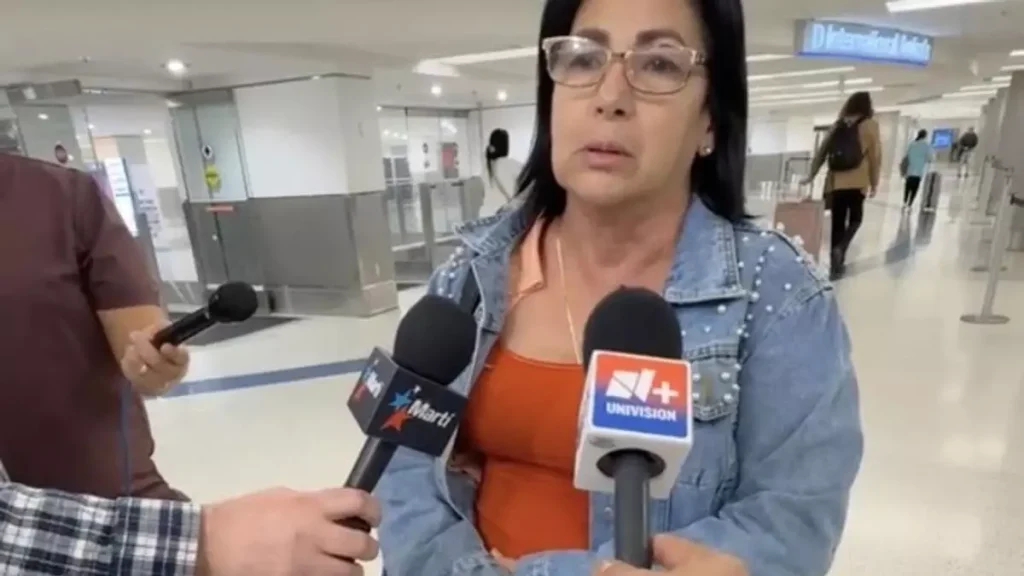
 14ymedio, Miami, 9 February 2026 — Lady in White Leticia Ramos was forced to return to the United States on Monday after the Cuban regime denied her entry to the island. The activist, who had travelled to Cuba accompanied by her mother, whom she was unable to say goodbye to, arrived at Miami Airport (Florida) without her suitcase, which had been confiscated in Havana, and was visibly upset. “It’s unfair that they won’t let me into my own country, that they treat you like you’re an animal, a nobody, that you have no rights,” she commented to several media outlets waiting for her at the terminal.
In that same impromptu appearance, she said that upon arriving in Havana, immigration authorities sent her “to a small room” and told her she had “problems” with her documents, which she denied. “If I had had problems with my documents, the American government would not have let me through immigration,” she explained.
According to her account, she had a heated “exchange of words” with the State Security officers who attended to her, which escalated to the point where they threatened to sedate her if she did not “shut up”.
“They didn’t even let me kiss my mother goodbye,” said the activist, on the verge of tears. “That’s something you have to experience; I’m still in a lot of pain.”
After being informed that she would not be allowed to enter her country, Ramos asked to say goodbye to her mother, Amada Rosa Herrería, who at 86 is the oldest Lady in White in the opposition organisation, but she was not allowed to do so. “They didn’t even let me kiss my mother goodbye,” said the activist, on the verge of tears. “That’s something you have to experience. I’m still in a lot of pain,” she added.
The political police also prevented her from taking her belongings with her. “They took everything,” she complained, pointing to her handbag and saying, “This is all I have. They didn’t let me take my luggage. It was very frustrating, very difficult and very hard.”
When asked why she wanted to return to the island, given the critical fuel shortage that is forcing the government to take drastic measures to save fuel, Ramos said: “Anyone who knows me knows that I have wanted to return for days. I want to be in my country for whatever happens, I want to be part of that change, of that freedom we so long for.”
After nine years of restrictions, unable to leave the island, the Lady in White received a five-year humanitarian visa last year to seek treatment in the US for health problems. “I was here for treatment and, thank God, I have improved a lot,” she also told reporters. “If I had stayed in Cuba, I might not be telling this story now, because there they gave me a different diagnosis.”
“I want to be in my country for whatever happens, I want to be part of that change, of that freedom we so long for.”
However, she reiterated her desire to return to her country, refusing to use the word “exiled”. “I am not going to seek asylum or refuge,” she said. “I am going to demand and protest for my right to return to my country, because that is where I am going to live.”
Ramos is convinced that “change is coming” and stated that “they”, referring to the regime, are trying by all means to prevent anyone who could be an obstacle to them on the island from entering.
In the midst of an unprecedented energy crisis in the country, the regime has responded by stepping up repression. One example was the operation carried out by the police and State Security last Friday in Holguín to arrest Ernesto Medina and Kamil Zayas, members of the independent digital project El4tico.
The arrests of these young people were denounced on Monday by the Inter-American Press Association (IAPA), which stated that the arrests constitute “a new violation of the human right to freedom of expression” and called for “the immediate release and cessation of persecution against those who peacefully exercise their right to inform, express their opinions and promote critical thinking on the island”.
“Repression is not a good backdrop for negotiations.”
For its part, the Cuban Human Rights Observatory (OCDH) also condemned in a statement the repression of the founders of El4tico, as well as the ongoing harassment of Berta Soler, leader of the Ladies in White.
“The repression of freedom of expression, demonstration and religion must cease,” urged the Madrid-based NGO. “Repression is not a good backdrop for negotiations. Cuba can no longer be a prison island. International solidarity is essential to stop this tyranny now.”
In its most recent report, corresponding to January 2026, the OCDH recorded at least 390 repressive actions against the civilian population, including 42 arbitrary detentions, 112 police raids on homes, 85 threats and 78 police summonses. This upturn, the organisation concludes, “reflects the regime’s hysteria in the face of the economic and social crisis”.
Translated by GH
____________
COLLABORATE WITH OUR WORK: The 14ymedio team is committed to practicing serious journalism that reflects Cuba’s reality in all its depth. Thank you for joining us on this long journey. We invite you to continue supporting us by becoming a member of 14ymedio now. Together we can continue transforming journalism in Cuba.