Airlines commit to repatriating thousands of tourists stranded on the island due to the suspension of fuel supplies to aircraft
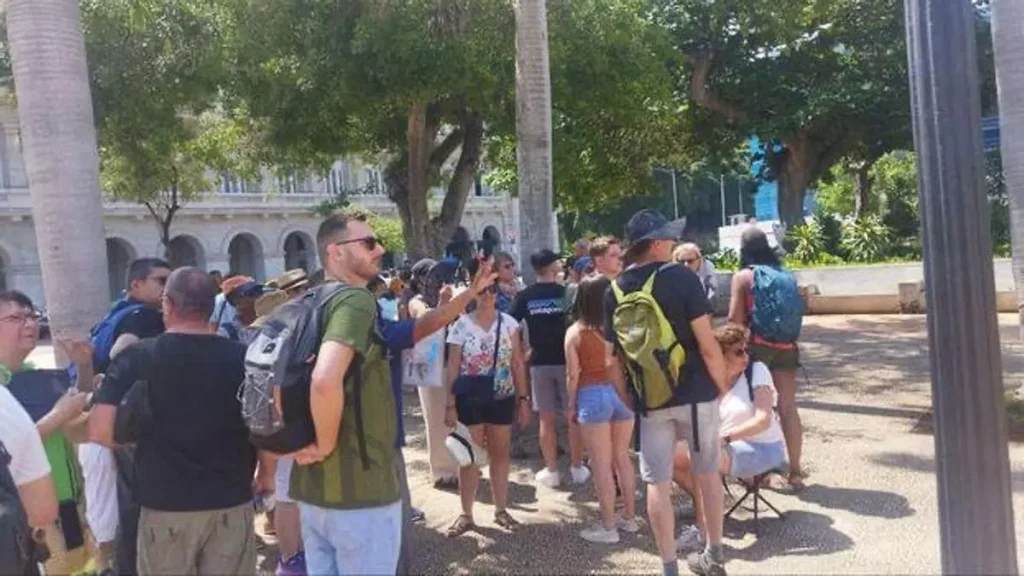
Despite the decline, Canadian tourists remained the main nationality travelling to Cuba. / 14ymedio
 “It’s total chaos.” That’s how the owner of a travel agency in Lamèque, in the east of the country, described the situation of Canadian tourists in Cuba on Monday. “We didn’t think it would come to this, but the worst nightmare happened last week when we started getting calls from customers who said they had seen on social media that hotels were closing,” said agent Lisette Cormier-Noël in an interview with local broadcaster Radio-Canada.
As he explained, Air Canada announced to workers in the sector on Friday that some flights would be cancelled, and the reaction was unstoppable. “People were calling us; it was total panic. ‘What do we do? Should I go? Shouldn’t I go?'” Things got worse on Monday after Cuba issued a NOTAM (Notice to Airmen) explaining that there would be no jet fuel for international flights for at least a month. All Canadian operators have already cancelled the high season and beyond.
Air Canada’s announcement of cancellations – stating that it was prepared to repatriate some 3,000 tourists – by 1 May was followed hours later by Air Transat (until 30 April) and WestJet and Sunwing (both until 25 April).
Air Canada’s announcement of cancellations – stating that it was prepared to repatriate some 3,000 tourists – until 1 May was followed hours later by Air Transat (until 30 April) and WestJet and Sunwing (both until 25 April).
The first of these began with a more optimistic message. Despite being forced to cancel two flights on Monday, to Holguín and Varadero, Air Canada’s initial reaction was to state that it intended to maintain its service. Within a few hours, there was a change of heart. “Due to the shortage of jet fuel announced by the Cuban authorities and the recent developments in the situation, Air Transat is temporarily suspending all flights to Cuba until 30 April 2026. Air Transat will contact all affected customers directly. We understand how important your travel plans are and sincerely apologise for this disruption,” the company said on its website shortly after 8:30 p.m.
The airline said that those who had planned to travel to the island on the affected dates will receive a full refund, while those who are stranded in Cuba will be repatriated in the coming days under a plan yet to be finalised. “We understand that this situation can be worrying and we want to assure you that our top priority is to get you home,” they stressed.
For their part, WestJet and Sunwing – both belonging to the same group – stated this morning that operations would continue. “All flights will carry sufficient fuel to ensure a safe departure without relying on local fuel availability. At this time, there are no safety concerns for our guests.” But they also changed their minds.
“To ease pressure on local resources, starting today, WestJet will depart Canada with empty aircraft to support the organised return of travellers currently on holiday in Cuba,” the airline wrote in a statement in the evening.
The situation is not surprising. Canadian operators have released a list of the hotels they work with that are affected by the closures in order to save resources. Three of them are in Cayo Santa María (Valentin Perla Blanca, Sol Cayo Santa María and Melia Buenavista), five in Cayo Coco (Iberostar Origin Playa Pilar, Gran Muthu Imperial Cayo Guillermo, Iberostar Origin Daiquiri, Tryp Cayo Coco and Hotel Mojito), one in Varadero (El Patriarca) and another in Holguín (Gran Muthu Ensenada).
In addition, tour operators have had to organise a flexible booking and cancellation plan that allows travellers to reschedule their trip or change their destination with financial assistance. “At least they have implemented measures to ensure that customers do not lose their money,” said Cormier-Noël, who recognises a much worse situation: that of the citizens. “There are people who have no electricity, no food and no drinking water,” he admits.
On social media, travel agents are overwhelmed and ask customers for patience as hundreds of customers try to contact them without success. Requests for patience and thanks for it alternate with complaints against Donald Trump – whom they accuse of preventing oil from reaching the island – and apologies to Cubans. “I am devastated for all of us who love Cuba and have no idea how to support the people,” said one customer. “If the airlines are flying, no one should cancel. Cuba needs us now more than ever,” said another, before learning of Air Transat’s final decision.
“I am devastated for all of us who love Cuba and have no idea how to support the people,” said one customer.
And yet there are those who, despite everything, remain ignorant of the geopolitical context. “We’re leaving tomorrow morning and I’m really looking forward to it,” Eric and Francine, a Canadian couple, told Radio-Canada before the cancellation of all flights was announced. The couple travel to the island every year, which means they are among the 754,010 tourists who chose the island from Canada in 2025, the main nationality, although 12.4% less than the previous year. In the first two months of the year alone, Cuba welcomed 176,611 Canadians – 88,980 in January and 87,631 in February – although this was already significantly lower than the same period last year, when there were 261,009. The number of tourists currently in Cuba has not been disclosed, and it is not known exactly how they will return home, but there are thousands scattered across various parts of the island.
These figures have been affected by warnings from the Canadian government, which in October 2023 raised its travel alert for Cuba from green to yellow – the second level of risk out of five possible levels – and just last week warned that “the situation is unpredictable and could worsen, affecting the availability of flights at short notice”. However, Eric and Francine remained undeterred yesterday. “We’re not too concerned about the oil shortage. It’s a bit stressful to think about whether or not we’ll have to return. But whatever happens, happens. And we’ll come back if we have to. It’s not the end of the world,” they said. Before the measures announced at the last minute were, surely, the end of their holiday.
Translated by GH
____________
COLLABORATE WITH OUR WORK: The 14ymedio team is committed to practicing serious journalism that reflects Cuba’s reality in all its depth. Thank you for joining us on this long journey. We invite you to continue supporting us by becoming a member of 14ymedio now. Together we can continue transforming journalism in Cuba.