Cuban Santeros Predict Disease and an Increase in Crime in 2024

Among other predictions is a decrease in the birth rate and more marital breakdowns. (EFE)

14ymedio biggerEFE (via 14ymedio), Havana, 1 January 2024 — The Yoruba Cultural Association of Cuba fortells for 2024 an increase in disease, crime, alcohol and drug use, and it drew attention to the increase in “abuse of women” on the Island, according to its predictions released this Monday.

A group of priests from the Cuban Santería or “babalawos” met on New Year’s Eve at the headquarters of the Association in Havana, as is tradition, and on January 1 they published the well-known Letter of the Year, one of the traditions rooted in practitioners and believers on the Island.

The predictions of the oracle of Afro-Cuban religions foreshadow, among other things, a decrease in the birth rate, an increase in criminal activities and more marital breakdowns.

Priests advise “to take precautions with belongings during national trips

Also diseases of the lower abdomen, genetic ailments, the increase of neurological ailments and skin conditions. continue reading

The priests advised Cubans “to pay more attention to agricultural productivity and the use of land” and “to take precautions with belongings during national trips,” in addition to asking the “corresponding authorities for preventive work on the intake of alcoholic beverages and the consumption of narcotics, especially among young people.”

In Santeria, one of the most widespread syncretic cults in Cuba, each letter or sign includes a history of the deities or the “orishas” of the Yoruba pantheon, who speak for it and implicitly carry a teaching or a general recommendation.

In 2024, among the recommendations are to ” not leave children in the care of anyone, as they can be harmed, and be careful with them even in your own home

In 2024, among the recommendations are to “not leave children in the care of anyone, as they can be harmed, and be careful with them even in your own home” and to “be respectful of the differences between human beings to avoid conflicts and unnecessary disagreements.”

The syncretic cults arrived in Cuba with the African slaves in the colonial era, and their practices are transmitted by oral tradition from one generation to another through prayers, rites, spells, magic formulas, sayings, dances, songs, sacrifices and liturgies.

Santería uses divination as one of its main practices, and among its elements are snail shells for the act of consultation and the use of the so-called “foundation necklaces,” made with beads of the colors that characterize each deity.

Translated by Regina Anavy 

____________

COLLABORATE WITH OUR WORKThe 14ymedio team is committed to practicing serious journalism that reflects Cuba’s reality in all its depth. Thank you for joining us on this long journey. We invite you to continue supporting us by becoming a member of 14ymedio now. Together we can continue transforming journalism in Cuba.
Cuban Gasoline Set to Rise to 200 Pesos a Liter, 250 for Diesel, while Service Stations Await the Go-Ahead

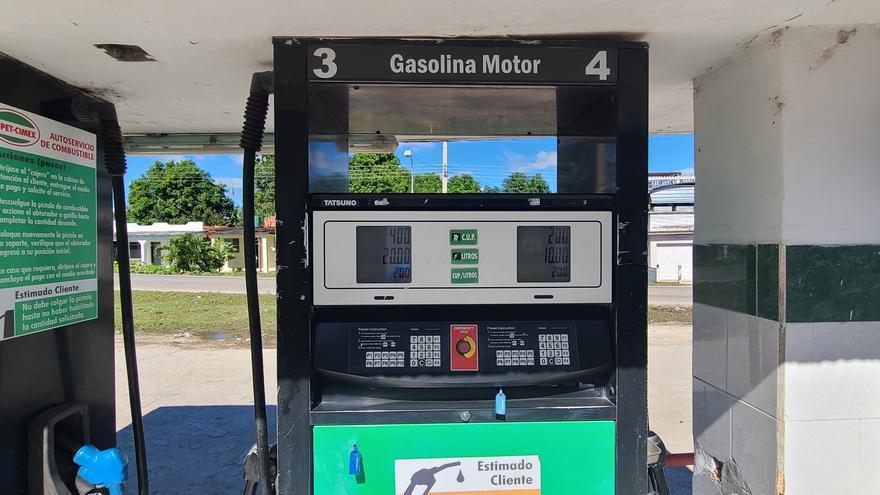
Gas pumps still display the old prices while a filling station manager in Camajuaní awaits instructions from his bosses before charging the new prices.

14ymedio bigger14ymedio, Pedro Espinosa and Juan Matos, Camajuaní/Manzanillo | 2 January 2024 — The impacts of the new macro-economic readjustment measures that the government announced at the end of the year have yet to be felt at Cuban filling stations. During visits to several of the island’s gas stations, reporters from 14ymedio found that employees of the Cuba Petroleum Union (Cupet) were still waiting for instructions from officials, who have ordered them not to allow customers to take photos of the new prices or the facilities.

That is the case at a filling station in Camajuaní, a village on the outskirts of Villa Clara. Though the pumps still display the old prices, a company source has confirmed that the cost of a liter of gas will rise from 25 to 250 pesos. The station’s  manager is still waiting for confirmation from his bosses before charging the new price. When asked about sales to tourists, he says he is unable to answer the question but refers the reporter to the town’s other gas station, in the direction of Cayería Norte, which is already operating under the new guidelines.

What is clear to the employee is the ban by the local government and police on taking photos of gas pumps. “The DTI (Directorate of Intelligence) chief was just here to pass along that information,” says the worker, casting a sideways glance at the police station located a few yards from the gas station.

The situation is much the same at filling stations in Manzanillo. “Prices haven’t changed but there’s still not much gas to be had,” explains a Cupet employee to a driver at the Celia Sanchez Hospital’s gas station. continue reading

Meanwhile, the gas station at the corner of Boyeros and Ayestarán, one of the most important in Havana, had not a single car parked next to its pumps. In addition to the strange absence of a line at the establishment is the lack of employees to answer customers’ questions and concerns. Expectations are that the Cuban government’s economic readjustment plan will be devastating for Cubans but we won’t know until the holiday lull is over.


During visits to several of the island’s gas stations, reporters from 14ymedio found that employees of the Cuba-Petroleum Union (Cupet) were still waiting for instructions from the officials before implementing the new 2024 fuel prices.   — 14ymedio 

In yet another change in economic direction, Havana announced a series of austerity measures that include a sharp increase in prices for fuel, electricity, water and food.

Government leaders feel some urgency to implement the plan, which they have stressed is not intended to further impoverish the population but rather to make those who spend the most pay more. It is keeping Cubans in suspense, worrying that the package will significantly affect their daily cost of living.

One Cuban economist who has criticized the plan is Pedro Monreal, who claims, “An economic package does not necessarily have to be neo-liberal to have affects similar to those of a traditional neo-liberal package” 

Prime Minister Manuel Marrero likened past several years of crisis to  a “war economy,” which he claimed is caused by “waste.” This stands in contrast to the dozens of ships loaded with fuel that were seen docked in the nation’s ports in 2023.

Since the plan was announced, the government of Miguel Díaz-Canel has taken pains to point out that it is neither a “neo-liberal* package” nor a “crash program.” This claim, which has been a constant refrain in recent days, is in response to accusations from some in the opposition that these measures are similar to those adopted in recent decades by other, mostly right-wing, governments in the region, including that of the Argentina’s new libertarian president, Javier Milei.

One Cuban economist who has criticized the plan is Pedro Monreal, who claims, “An economic package does not necessarily have to be neo-liberal* to have affects similar to those of a traditional neo-liberal package.”

*Translator’s note: A term used to refer to market-oriented reform policies such as eliminating price controls, deregulating capital markets, lowering trade barriers and reducing — especially through privatization and austerity — state influence in the economy. (Source: Wikipedia)

____________

COLLABORATE WITH OUR WORKThe 14ymedio team is committed to practicing serious journalism that reflects Cuba’s reality in all its depth. Thank you for joining us on this long journey. We invite you to continue supporting us by becoming a member of 14ymedio now. Together we can continue transforming journalism in Cuba.

The Great Depression 2023 Threatens to be Repeated in 2024 in Cuba

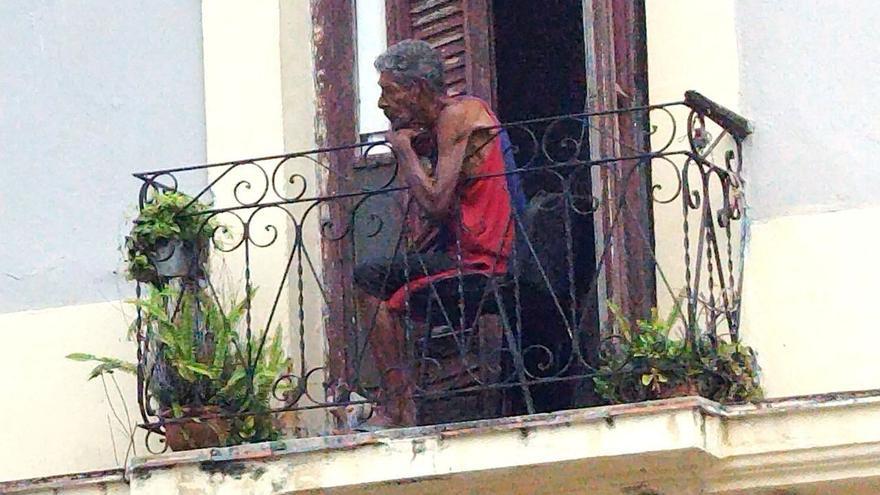
This year, cases of homeless elderly became more visible in Cuba. (14ymedio)

14ymedio bigger14ymedio, Havana, 1 January 2024 — There was no reason to think it would be better, after all 2023 had been preceded by disaster. The economic crisis had already given clear signs of having become chronic in Cuba, the mass exodus marked the bleeding of families escaping to anywhere, the official discourse maintained its commitment to continuity and, in prisons, around a thousand political prisoners served their sentences or awaited trial. Nothing indicated that this was going to be a good year, but hope always clings to the smallest signs.

After twelve months of experiments, failures and difficulties, this can only be defined as another time that we Cubans have spent in “limbo.” Neither the necessary economic reforms arrived, nor did the social protests against inflation and the rising cost of living took to the streets. While the regime approached Vladimir Putin’s Russia in its speech and gestures, it also did not stop winking at the US Administration of Joe Biden. A single egg began to cost more than 100 pesos on the streets of this Island, but micro, small and medium-sized businesses (MSMEs) filled their shelves with candy, beer and frozen chicken at prices unaffordable for the majority of the population.

The clamor of the protests of July 2021 faded away with the repression and the departure of a good part of the potential protesters from the country

The clamor of the protests of 11 July 2021 faded away with the repression and the departure from the country of a good part of those who might have been the potential protesters of the next outbreak. The universities were left with open arms waiting for many students, with good grades, who preferred to put aside their dreams of having a diploma, waiting for an internal change, or for a plane to take them out of here. Countless women postponed pregnancy waiting for “things to get better” and, among the exiles, there were many who, after a trip to the Island or a conversation with their relatives, postponed their schedule to return waiting for “a new scenario.” continue reading

Something similar happened to tourism. “We’d better go to the Dominican Republic,” “Cancun would be easier,” said thousands of travelers who planned vacations throughout this year. The financial collapse, the low quality standards in Cuban accommodation and the anxiety of being caught in a popular outbreak made many opt for other destinations. That did not discourage, however, the Cuban leaders, who continued building four or five star hotels and fracturing the profile of Havana with their defiant Tower K Hotel construction.

Agriculture also remained in no man’s land at this time. The state giant Acopio was not buried, nor did the producers comply with the agreed plans for the delivery of milk, meat and food. Anyone who could put in less effort did so. Anyone who could steal more resources from the State resorted to that quick and traditional way of filling their pockets. The Cuban peso was not even the reference currency. With the dollar running ahead, some 270 times faster, according to the informal exchange rate this December, the national currency could not withstand the barrage of its loss of value, the collapse of ATMs and the failed financial policy of the Central Bank.

Once the Covid-19 pandemic is over, it has not even helped the health authorities to remember that the Island has several of its own vaccines against the coronavirus – none validated by the World Health Organization – to justify the lack of basic medicines in the network of state pharmacies. There are millions of doses of Abdala to sell to other countries, but there is a lack of drugs for high blood pressure, diabetics and those who suffer from an infection for which they need antibiotics.

In that zone of “there is and there is not” Cuban legislation was also installed which, in addition to the steps taken by the new Family Code, continued to assist, undaunted and incapable, the wave of femicides that hit the Island. The cases of children abandoned by their families, who cannot support them, mothers who sleep on the streets with their children and chronically ill people who must resort to social networks to complete their pharmaceutical treatment became more visible.

No one won in 2023. Independent journalism lost, within Cuba, numerous voices that emigrated throughout these months

No one won in 2023. Independent journalism lost, within Cuba, numerous voices that emigrated throughout these months, while the official press desperately published its advertisements again and again to fill positions that few are interested in due to the low salaries and required ideological conditioning.

The most complete representation of this limbo are the “pre-migrants,” all those Cubans who have stopped their lives waiting to leave the Island. Nobody counts them among the numbers of the mass exodus but, while still inside the country, they act as if they no longer inhabit it. Many certainly do not even have the possibility of taking a plane, nor the resources to do so. But the day they decided that they no longer wanted to continue here, they also began a process of disengagement that turned them into beings from nowhere.

They are those who do not get married, do not accept a new job, do not commit to anyone, refuse to continue studying, do not watch official television, but do not have the freedom to choose their own news sources. They do not protest so as to avoid reprisals, and act with the opportunism they learned as children, so as not to jeopardize their visa, parole or political asylum case in another country. They are the children of the limbo that exists in Cuba. The most complete expression of 2023 that ended and threatens to extend into 2024.

____________

COLLABORATE WITH OUR WORKThe 14ymedio team is committed to practicing serious journalism that reflects Cuba’s reality in all its depth. Thank you for joining us on this long journey. We invite you to continue supporting us by becoming a member of 14ymedio now. Together we can continue transforming journalism in Cuba.

Cuba’s Independent Yorubas Dedicate the Year to Elegba, Protector of Private Enterprises

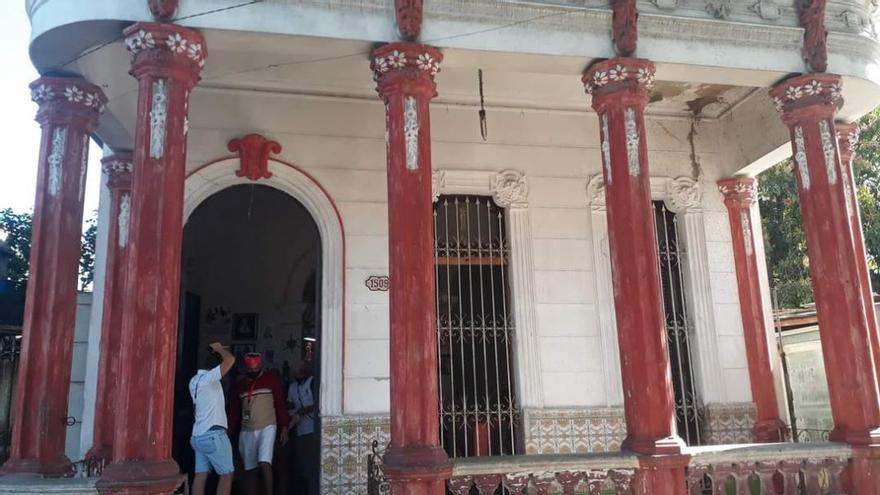
Headquarters of the Miguel Febles Padrón Independent Commission, in Diez de Octubre, Havana. (Facebook)

14ymedio bigger14ymedio, Havana | 2 January 2024 — Devoid of the critical tone against the Regime that characterized it in another era, the Letter of the Year of the independent Cuban Yorubas, published this Tuesday in Havana by the Miguel Febles Padrón Commission, focuses on international trade and on requesting “the prompt sanitation of the country.” After the announcement ceremony, presided over by the priest Gaspar Mesa, the organization insisted that its prediction – contrary to the one signed this Monday by the ruling Yoruba Cultural Association – is the legitimate Letter.

As in 2023, the text came out a day late with respect to officialdom’s Letter. Faced with the claims of the believers, the commission asked for patience and assured that the predictions would be revealed this Tuesday morning, during a press conference in the Yoruba temple of the municipality of Diez de Octubre.

Among the advice of social interest, the independent santeros [priests of the Santería religion] asked to “respect trade agreements” and “increase imports,” and announced an “increase in foreign financing,” although they avoided specifically alluding to the regime’s allies, such as Russia, which have marked the Island’s trade in recent months. Hence, the year, they explained, is consecrated to Elegba, an Afro-Cuban orisha or deity that protects “shopkeepers and merchants.”

However, they devoted several points of the Letter to commenting on the unhealthiness of the country and predicted “an increase in insect and rodent pests.” In addition, there will be “an increase in homicides,” robberies, divorces and disagreements among couples. The santeros predict continue reading

multiple child abandonments and call for a higher birth rate.

The containment of disease, on which the commission is thorough, will depend on removing the piles of garbage

The containment of disease, on which the commission is thorough, will depend, they add, on “removing the piles of garbage: cerrestravascular, bacterial and parasitic, respiratory and infectious diseases, and diabetes with danger of mutilation of the extremities.” Finally, they recommended going to the “godparents” in search of “specific guidelines,” which the brief message cannot offer.

This Monday, the Yoruba Cultural Association – to which a militant complicity with the regime is attributed – also published its Letter. Focused on the increase in “abuse of women,” the consumption of alcohol and drugs, and crime, the text was more incisive with the situation of the Island than that of the independents.

The Letter of the Year, a tradition that orthodox believers resort to as much as the occasional ones, faces once again the schism in the leadership of Cuban Santería. The division between officials and independents results in the issuance of two texts, with different series of advice, prophecies and ruling divinities.

Inside Santería, the divided loyalties of their babalawos or priests and the emigration of thousands of religious Cubans – who aspire to take their practices with them, adapting them to the country of emigration – causes, in practice, a serious confusion among practitioners, who prefer to go to their personal “godfathers.”*

*Translator’s note: In Santería, the “godfather” (or “godmother”) is the one who initiates and guides the new devotee.

Translated by Regina Anavy

____________

COLLABORATE WITH OUR WORKThe 14ymedio team is committed to practicing serious journalism that reflects Cuba’s reality in all its depth. Thank you for joining us on this long journey. We invite you to continue supporting us by becoming a member of 14ymedio now. Together we can continue transforming journalism in Cuba.

The UN Points Out Spain, Qatar and Italy for the ‘Dubious’ Hiring of Cuban Workers

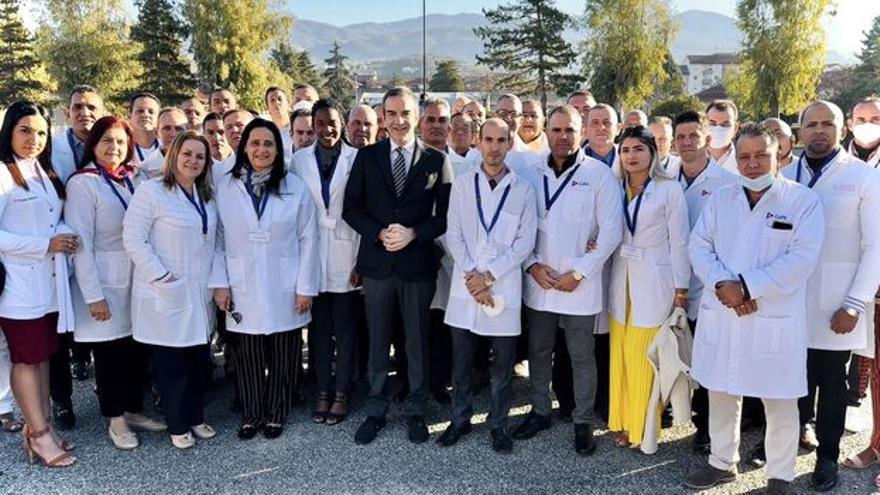
Roberto Occhiuto, president of the Calabria region in Italy, with the first contingent of 50 health workers who arrived in January 2022. (Facebook/Roberto Occhiuto)

14ymedio bigger14ymedio, Havana | 2 January 2024 — On Tuesday, the organization Prisoners Defenders (PD) announced a letter signed by the United Nations Special Rapporteur for Contemporary Forms of Slavery, in which several governments are denounced for hiring, under “dubious conditions,” workers from Cuba. According to the text, signed by Tomoya Obokata on November 2, Spain, Italy, Qatar, in addition to the cruise company MSC Malta Seafarers, received a request from their office to clarify the situation. So far, none has responded.

According to PD, for months it has secretly helped the Rapporteur’s administration in the collection of information on the cases of exploitation of Cubans by the Government of Havana and the level of complicity of the countries mentioned in these contracts. The document was also sent to the authorities in Doha, Rome and Madrid, who were asked to respond within 60 days.

What is new is the accusation against the Spanish Government, which the Rapporteur indicates for hiring, at the local level – through companies, municipalities or autonomous communities – “athletes, artists, musicians, dancers and other Cuban professionals” in “precarious working conditions and exploitation.” The document also alleges that a part of their salaries is retained by companies on the Island that mediate the hiring.

For its part, PD says that many of the testimonies it managed to gather in Spain involved Cubans. It explains that they ended up applying for asylum, and Madrid had to grant it for “the conditions of slavery and evidence they presented.” One of these stories that was made public was that of the Basque handball player Lisandra Lima, who abandoned her delegation while competing in 2018 in Barcelona. continue reading

The Government of Spain has not taken measures to control the working conditions of the workers and the artistic, technical and sports personnel who arrive in the country

“However, the Government of Spain has not taken measures to control the working conditions of the workers and the artistic, technical and sports personnel who arrive in the country through intermediaries from the Cuban Government and its companies,” says PD.

In the case of Calabria, an Italian region that hired Cuban health workers in 2022 through the state Commercialization of Cuban Medical Services, the complaints revolve around the “insufficient” salaries of the professionals. “It is stipulated that the total salary amount per medical person is 4,700 euros, but 3,500 euros are transferred from the Government of Calabria to the Marketing Company (…). Only an amount of 1,200 euros is given to each medical worker. That gross income is considered insufficient to survive in Italy,” the Rapporteur stressed.

In similar conditions are the health workers hired in Qatar, who are only given 10% of what the country pays for them (between $5,000 and $13,000 per person). The salary, the letter alleges, is not enough for them to live, so “many of the Cuban professionals who work in the country depend on a subsidy called an ’Index’, granted by the Government of Qatar.”

The report also denounced that Cubans hired in this country work an average of 64 hours a week and are closely monitored by their supervisors, to whom they must report each romantic relationship they establish, in addition to their movements outside their homes and intentions to travel or meet family and friends.

MSC Malta Seafarers Company Limited, one of the largest maritime tourism companies in the world, was also accused of exploitation by the Rapporteur. The company, based in Geneva (Switzerland), hires sailors through the Cuban state-owned Selecmar and takes away their passports “during the trip and in the countries where they touch port, to prevent the Cuban workers from ’escaping’.” According to the document, Selecmar receives up to 80% of the salaries paid by the Maltese for the Cubans, while the foreign company has the power to fine those who are “absent” up to $10,000.

A similar case came to light in Cuba years ago, when Alexander Morales, from Havana, complained that the Greek company Northsouth Maritime owed him 60,000 dollars as compensation

A similar case came to light in Cuba years ago, when Alexander Morales, from Havana, complained that the Greek company Northsouth Maritime owed him 60,000 dollars as compensation for injuring himself on one of their ships while doing excessive work. Selecmar then mediated his hiring with the foreign company, which continues to withhold the payment.

Other violations denounced by the UN were the prohibition of entry into the country for eight years to Cubans who leave missions abroad, the conditions of harassment or sexual violence to which they are often subjected and the label of “traitors” and “deserters” that is given to those who breach the contracts.

So far, none of the governments cited by the Rapporteur has responded to the complaints. Dita Charanzová, vice president of the European Parliament, did express her concern about the report: “This United Nations accusation brings to light very serious violations, from forced labor, contemporary slavery, harassment, sexual violence and threats, to physical violence. Once again, it is evident that the Cuban regime systematically and with impunity violates the human rights of its people,” said the MEP.

Translated by Regina Anavy

____________

COLLABORATE WITH OUR WORKThe 14ymedio team is committed to practicing serious journalism that reflects Cuba’s reality in all its depth. Thank you for joining us on this long journey. We invite you to continue supporting us by becoming a member of 14ymedio now. Together we can continue transforming journalism in Cuba.

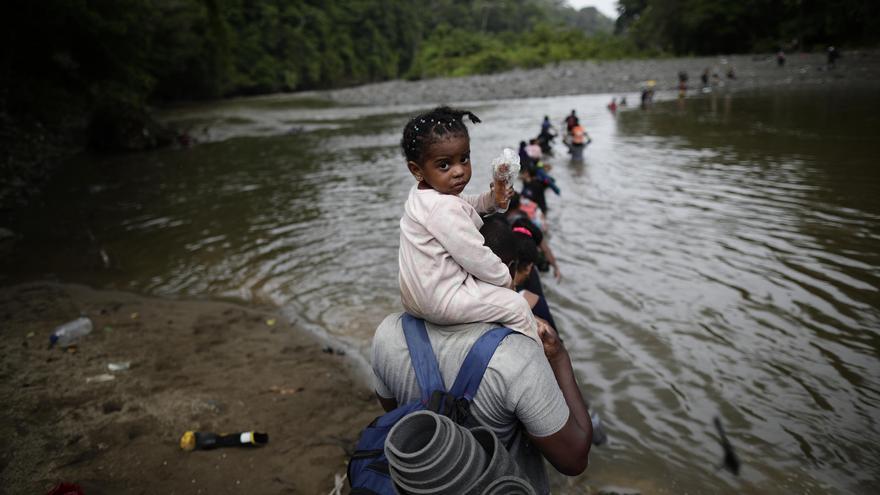
More than 520,000 Migrants Crossed the Darien Jungle in 2023. 120,000 Were Minors

Migrants cross the Turquesa River, in the Darién (Panama), in an archive photograph. (EFE/Bienvenido Velasco)

14ymedio biggerEFE (via 14ymedio), Panama, 2 January 2024 — Panamanian authorities said on Monday that 2023 closed with 520,085 migrants having crossed the Darién jungle, of which 120,000 were minors, a record figure compared to the 248,283 migrants in 2022, who followed this dangerous route to North America in pursuit of better horizons.

Venezuelans, 328,667; Ecuadorians, 57,222; Haitians, 46,558; and Chinese, 25,344, “were the most recurring nationalities this year to cross” the jungle border with Colombia and arrive in Panama, the Panamanian Ministry of Public Security (MINSEG) reported on its social networks.

Similarly, the report provides figures that report a “significant decrease” in the entry of migrants through the dense Darién jungle in the months of October, November and December 2023, with 49,256, 37,231, and 24,626, respectively.

The report provides figures that show a “significant decrease” in the entry of migrants through the dense Darién jungle in the months of October, November and December

The new registration of transit of migrants by Darién to North America at the end of 2023 leaves behind that of previous years: in 2020 8,594 immigrants crossed the Dariíen jungle; in 2021, 133,726; and 2022, 248,283, according to MINSEG. continue reading

Thus, this year the record of more than 500,000 migrants in transit through the Darién, the jungle that connects the isthmus and South America, has been broken, a figure that doubles last year’s record and includes a marked increase in minors.

This 2023 “has been a year in which a record has been broken. More than 100,000 children and adolescents have passed through, 50% of whom are under 5 years old,” the gender-based expert of the United Nations Children’s Fund (UNICEF), Johana Tejada López, told EFE in mid-December.

Most of the families that migrate are from Venezuela, Haiti, Ecuador and Colombia, Tejada López explained in the Lajas Blanca shelter which, as in Bajo Chiquito, is the scene of numerous families with children and adolescents.

The UNICEF expert also warned of an increase in the arrival of minors separated from their parents during the crossing and of adolescents who were traveling “alone.”

The migrants arrive first in Bajo Chiquito after crossing the jungle, where the authorities record their data and they spend the night. The next day they take canoes (paid for by them) that take them on the Tuquesa River to one of the two existing hostels in Darién.

There are several organizations that offer humanitarian and medical aid as well as the Panamanian authorities, which provide food assistance in an operation in which they have invested about 70 million dollars in recent years

 There, known by migrants as ’the UN,’ there are several organizations that offer humanitarian and medical aid as well as the Panamanian authorities, which provide food assistance in a single operation on the continent in which the Government has invested about 70 million dollars in recent years, according to official data.

From the Darién, the migrants must board a bus – at their own expense  – to neighboring Costa Rica.

The restrictions announced by several of the transited countries, such as the deportations of irregular migrants with a criminal record by Panama, or by the United States, which has put in place more obstacles to accessing asylum, do not stop the migratory flow.

Translated by Regina Anavy

____________

COLLABORATE WITH OUR WORKThe 14ymedio team is committed to practicing serious journalism that reflects Cuba’s reality in all its depth. Thank you for joining us on this long journey. We invite you to continue supporting us by becoming a member of 14ymedio now. Together we can continue transforming journalism in Cuba.

Cubans to Pay More for Gasoline in 2024 While Tourists Will Pay in Dollars

Customers waiting in line to buy gas at a service station at San Rafael and Infanta streets in Havana in September. (14ymedio)

14ymedio biggerEFE (via 14ymedio), Havana, 2 January 2024 — One of Cuba’s biggest economic reform measures in decades will take effect in 2024, raising prices for energy, water, natural gas and petroleum and ending the universal food subsidy.

While stressing that its plan will not affect the poorest segments of the population, the government has highlighted the urgent need to address the economic crisis afflicting the country, which has seen a shortage of basic goods, a drop in gross domestic product (GDP) of between 1% and 2 % in 2023, and a fiscal deficit close to 19%.

The plan has sparked criticism from independent economists and opposition figures, however, who have pointed out that it will only exacerbate the island’s already obvious economic inequalities. Rather than an economic adjustment plan, they claim the reforms are little more than cosmetic changes with little substance.

One example is electricity, the cost of which will rise 25% this year for the top 6% of income earners

After making a surprise end-of year announcement of the so-called Macro-economic Stabilization Plan to the National Assembly, Prime Minister Manuel Marrero claimed that, given the “war-time economy” the country is facing, the state could no longer afford to waste money on certain subsidies. continue reading

One example is electricity, the cost of which will rise 25% this year for the top 6% of income earners.

Another change is that tourists will now have to pay for gasoline in hard currency while everyone else will see fuel prices rise. The government does not anticipate that this increase will apply to transport workers such taxi drivers, however.

Meanwhile, water bills will triple for those whose service is not metered while the price of liquified gas will increase 25%.

One of the most notable features of the government’s measure is an end to the subsidy which allows all Cuban consumers to purchase products at heavily discounted prices using a ration card, which has been around for over sixty years.

The other measures have a similar purpose. Given the severe liquidity crisis, the  government says it will attempt to prioritize subsidies for people it considers to be economically vulnerable.

It pointed out that this does not mean the end of the ration book, only that prices for rationed goods will be based on an individual’s income.

Alejandro Gil tacitly acknowledged the island’s social differences, saying that “not everyone is in the same state of economic solvency”

In an interview on state television, economics minister Alejandro Gill was asked if it was feasible to maintain the same level of subsidy on products for the entire population when “not everyone is in the same state of economic solvency,” a tacit acknowledgement of the island’s social differences.

The ration system costs Cuba around 1.6 billion dollars a year at a time when the government lacks all the foreign reserves it needs to access the international market, which it relies on to supply 80% of the food the country consumes.

Cuba will adopt a new currency exchange rate, which for businesses transactions has been set at twenty-four Cuban pesos (CUP) to the dollar since 2021, when monetary reforms did away with the convertible peso (CUC), whose value was at parity to the dollar.

Independent economists have criticized that policy, pointing out that the elimination of the country’s dual-currency system almost three years ago has encouraged the growth of currency exchange on the black market where, as of Monday, the rate was 265 CUP to the dollar.

The government itself has admitted that this reform measure did not meet its objectives.

“Among the measures being proposed is one to restore state control of foreign exchange earnings. Part of what is happening today is that there is less supply in the state sector and more supply in the private sector because the private sector is, in some way acquiring hard currency through the informal market, the illegal market, and those currencies are not finding their way into the national financial system,” Gil explained.

Since the plan was announced, the government of Miguel Díaz-Canel has taken pains to point out that it is not a “neo-liberal package” or a “crash program”

Since the plan was announced, the government of Miguel Díaz-Canel has taken pains to point out that it is neither a “neo-liberal* package” nor a “crash program.”

This government’s claim, which has been a constant refrain in recent days, is a response to accusations from some in the opposition that these measures are similar to those adopted in recent decades by other, mostly right-wing, governments in the region.

Officials argue that this is merely an attempt to correct a handfull of economic “distortions” and that the objective is for the state to retake the reins and make corrections.

One Cuban economist who has criticized the plan is Pedro Monreal, who claims, “An economic package does not necessarily have to be neo-liberal to have affects similar to those of a traditional neo-liberal package.”

Translator’s note: A term used to refer to market-oriented reform policies such as eliminating price controls, deregulating capital markets, lowering trade barriers and reducing — especially through privatization and austerity — state influence in the economy. (Source: Wikipedia)

____________

COLLABORATE WITH OUR WORKThe 14ymedio team is committed to practicing serious journalism that reflects Cuba’s reality in all its depth. Thank you for joining us on this long journey. We invite you to continue supporting us by becoming a member of 14ymedio now. Together we can continue transforming journalism in Cuba.

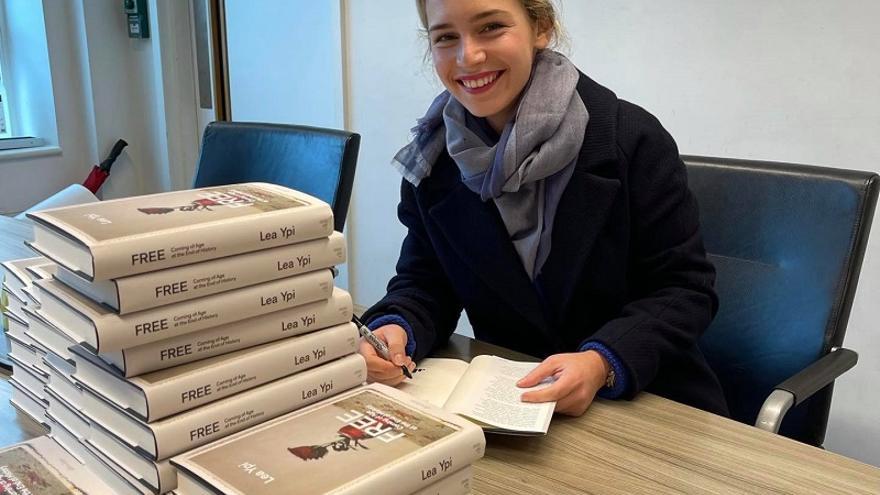
The Albanians Ended Communism and Were Left Hungry

Ypi believes that communism and liberalism have a coincidence: “Both fail to understand the complexity with which ideas and history are mixed.” (@lea_ypi))

14ymedio bigger14ymedio, Rosa Pascual, Madrid, 1 January 2024 — Lea Ypi has not written a book to make friends. Free [Libre], memoirs of the childhood and adolescence of an author who enters adulthood at the same time that her country, Albania, makes the leap to democracy, is a diptych as harsh with the lack of freedoms of the communism of her childhood as with the broken promises of a liberalism that tasted like disappointment. “In 1990 we had nothing but hope. In 1997 we lost that too.”

“I never asked myself what freedom meant until the day I hugged Stalin.” With that powerful phrase, which was in all the drafts of the first (and, for now, only) novel by this Albanian born in 1979, the first part of the book unfolds with the subtitle The challenge of growing up at the end of history. The author, a political scientist at the London School of Economics, says that she sat down to write a philosophical essay about the overlap of the concept of the word freedom in communist and liberal societies, but “ideas ended up becoming people.”

Thanks to this turn, Ypi has created a novel that — better than any history book — relates the process of transition of her country from the dictatorship of Enver Hoxa to the rebellion that was about to lead to civil war. The lives – absolutely normal – of her characters, Lea’s family, friends and neighbors, paint a fresco of the daily life of communist society like no essay will.

The first ten chapters of the book are dedicated to this, with scenes in which readers who lived under the same system will soon recognize themselves.

The first ten chapters of the book are dedicated to this, with scenes in which readers who lived under the same system will soon recognize themselves. The lines to do the shopping, the start of classes shouting “pioneers of Enver,” the valuta stores for foreigners – where dreams come true – with their nylon stockings and Bic pens; the empty Coca-Cola can – a memorable chapter to which the book cover makes a nod – as a status continue reading

symbol…

But, above all, the codes. Little Lea grows up hearing talk at home about how the biographies of her acquaintances had determined their studies, identified with an initial. Although, luckily, most ended up graduating, some ended up expelled. “I’m so sorry, it’s terrible,” is said in those cases. Starting in 1990, she discovered that the letter designated a prison, to be discharged was to be released and expulsion meant death.

Lea grows up in an apparently normal family, with civil servant parents moderately critical of the regime and an intriguing grandmother – the most interesting character in the novel and to whom it is dedicated – who, without being French, speaks French. The propaganda has taken strong root in her and she is, of all those who live in the house, the one who most fervently expresses her faith in the system, to the point of insisting, as her parents told her, that there were no photos of ‘Uncle Enver’ in their house because they were looking for a nice frame.

But at age eleven her life changes completely. “It was like the moment when they tell you that Santa Claus does not exist. We had built, for the children, a myth to explain the world. Now it was necessary to know the truth,” she has said in interviews.

Lea reaches adolescence and her world suddenly falls apart – “I was one person and then I became another.” Everyone she trusted had lied to her, everything she believed in was a lie. Her family history, her biography, had also determined her seemingly unremarkable existence, dating back to her great-grandfather (former Prime Minister Xhafer Ypi), whose last name was not, as she was led to believe, a coincidence; to her religion, Muslim, to the fact that she embraced it, along with her books, to find refuge in a dark adolescence.

That is the second part of the book, the one that will disappoint those who expected an ode to the benefits of liberalism and capitalism.

That is the second part of the book, which will disappoint those who were expecting an ode to the benefits of liberalism and capitalism and which rhymes with the author’s own disappointment.

“I had always thought that there was nothing better than communism. Every morning of my life I woke up wanting to do something to make it come more quickly. But in December 1990 the same people who had participated in the marches celebrating socialism and its advance towards communism took to the streets to demand its end,” she recalls in the novel.

Lea entered 1991 trying to join the democratic enthusiasm of her parents and trembled with the first free elections. She travels for the first time outside of Albania, to Greece where her grandmother Nini was born, and on the plane she sees something hitherto unheard of: “a colored plastic bag.” And she remembers perfectly the day when her mother brought home the first issue of the first opposition newspaper, whose motto was: The freedom of the individual guarantees the freedom of all.

But she soon discovers that when the words that the regime imposed on them disappeared – dictatorship, proletariat, bourgeoisie – only another omnipresent word remains: freedom. “It appeared in all the speeches on television, in all the slogans shouted angrily in the streets. When freedom finally arrived it was as if you were served frozen food: we chewed a little, swallowed quickly and were left hungry. Some asked if they had given us leftovers, others said they were just cold starters,” she writes.

Things happen before her eyes that she did not expect. Among them is the mass exodus of Albanians to Italy, repressed by the governments of both countries. “What value does the right to leave one country have if there is no right to enter another?” she asks, which in the case of many young women her age only served to cause them to be sexually exploited. Also the new business culture, which forces her father to order massive layoffs – “structural reforms” according to the new foreign businesspeople – or the great pyramid scheme that led the country to ruin and almost ended up unleashing a civil war.

But for teenage Lea, what hurts the most is the intimate thing, the conflict with parents who deny her the right to complain. “They had the feeling that they had always wanted this new world, but now they could no longer live it. It was my responsibility, they told me, to do everything that they could not do,” the author, explains, describing that stage of confusion, violence, insecurity, conflict and trauma that her parents previously disdained. “You’re not in prison, you’re not working in a mine, nor are they persecuting you. What are you complaining about?” they told her.

Ypi left Albania in the summer of 1997. She crossed the Adriatic and entered the Faculty of Philosophy and Literature at the Sapienza University in Rome. She had broken the promise she made to her father to distance herself from Marx – she is an expert in Marxism, among other things – and her CV is brilliant, but she lives with boredom having to explain in Western Europe the lack of freedoms of communism, and in Albania and other countries in the Soviet orbit the defects of a capitalism she believes “only emancipate a few.”

At university she made new friends who “declared themselves socialists” and spoke of Trotsky or Guevara “as if they were secular saints”

At university she made new friends who “declared themselves socialists” and spoke of Trotsky or Guevara “as if they were secular saints.” She was bothered when sharing her childhood stories with them and they, paternalistically, told her that this was not “true socialism (…)” without being able to hide their irritation. “The socialism of my university classmates was clear, bright and with a future. Mine was confusing, bloody and from the past.”

But she makes no concessions to his new reality. “Liberalism was synonymous with unfulfilled promises, with the destruction of solidarity, with the right to inherit privileges, with turning a blind eye to injustice,” she says.

Ypi believes that communism and liberalism have an overlap: “Both fail to understand the complexity with which ideas and history are mixed.” Her book has the potential to anger everyone, and yet, in such a polarized time, it has united critics and audiences in praise of it. And that is already good news.

____________

COLLABORATE WITH OUR WORKThe 14ymedio team is committed to practicing serious journalism that reflects Cuba’s reality in all its depth. Thank you for joining us on this long journey. We invite you to continue supporting us by becoming a member of 14ymedio now. Together we can continue transforming journalism in Cuba.

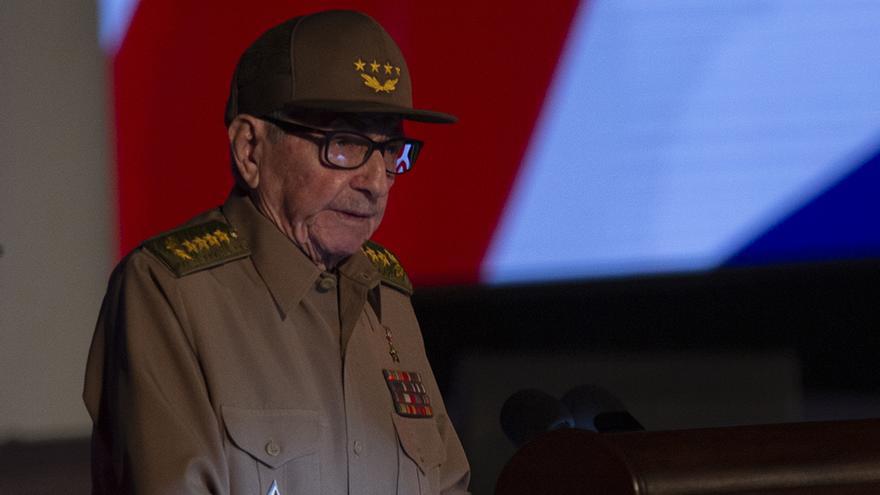
Raul Castro Denies the Existence of ‘Generational Contradictions Within the Cuban Revolution’

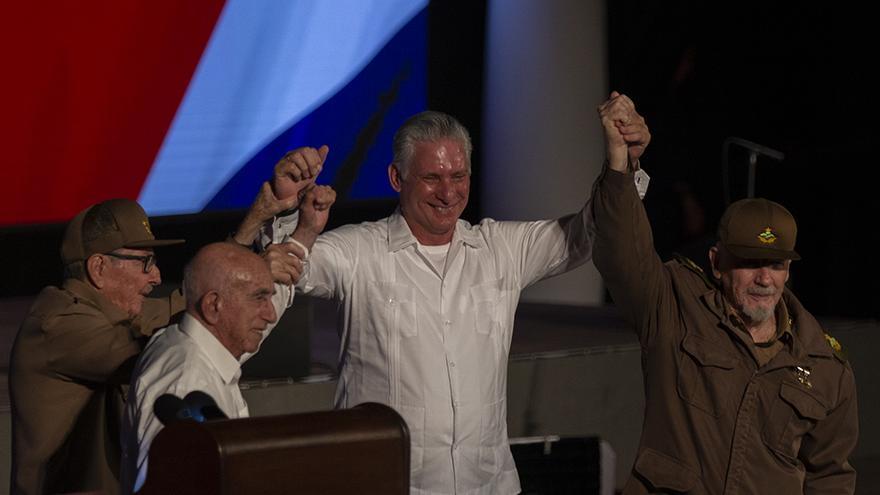
Raúl Castro, 92, wanted to support his successor this Monday, the 65th anniversary of the Revolution. (Cubadebate)

14ymedio bigger14ymedio/EFE, Havana, 2 January 2024 — Former President Raúl Castro reappeared this Monday to lead the celebrations of the 65th anniversary of the Revolution in Santiago de Cuba, in one of his most important public speeches in months. He called for unity within the Communist Party (PCC) and confidence in the new generation of leaders who have succeeded the historical leaders.

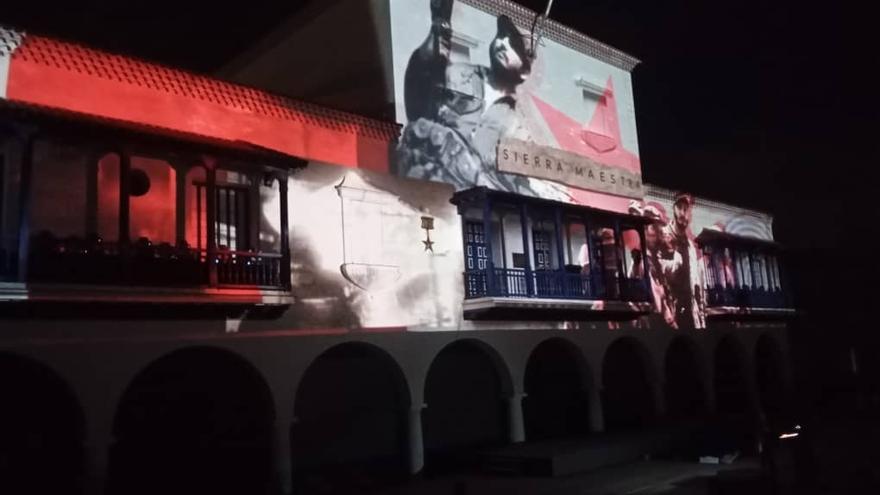
The former leader, 92-years-old, closed the annual ceremony commemorating the triumph of the guerrillas who came to power on the Island led by the late Fidel Castro (1926-2016), who was also presented, through technology, at the event. “No thieves, no traitors, no interventionists. This time it is the Revolution,” the deceased Commander was heard saying through a hologram.

His younger brother and successor in office made a speech in which he reiterated the need to close ranks within the ruling party as the “main strategic weapon” of the Revolution and the PCC. “It has allowed this small island to succeed in facing challenges. Let’s treat unity as something to be cherished,” he advised.

Fidel Castro fue omnipresente a través de las pantallas este lunes en el acto de Santiago de Cuba. (Cubadebate)
Fidel Castro was omniprsent through screens this Monday, in an event in Santiago de Cuba (Cubadebate)

Against that unity, “all the subversive plans of the enemy will fail once again,” he added.

“Today I can affirm with satisfaction that the Cuban Revolution, after 65 years of existence, far from weakening has strengthened, as I said a decade ago, on a day like today and in this very place, [and has done so] without continue reading

commitment to anyone at all, except to the people,” the former president claimed.

“I know that I express the feeling of the historical generation by ratifying confidence in those who today occupy leadership responsibility in our party and Government,” he said, in clear allusion to the current administration, led by his successor and current president of the country, Miguel Díaz-Canel, who is also the first president on the Island who was not part of the armed struggle in 1959.

Castro also emphasized that “there are no generational contradictions within the Revolution, because there is no envy or desire for power among its children,” a quote he attributed to Fidel Castro.

He also asked leaders who “because of insufficient capacity, lack of preparation or simply because they are too tired to be at the height that the moment demands,” to step aside.

Díaz-Canel spoke before Castro and was full of praise for the Revolution: “It was a libertarian act of continental projection, which not only freed the country from a servile, repressive and corrupt dictatorship, but very soon untied the knots of economic dependence on Yankee transnationals and liquidated the cruelest expressions of human exploitation that had been naturalized in the bosom of Cuban society, such as child labor, prostitution and the semi-slavery of Haitian emigrants.”

The current president highlighted what, in his opinion, have been the great pillars of Cuba after 1959: agrarian reform, education and public health. “These were works of profound and sustained social escalation that in a few years transformed a poor and backward country into a world benchmark in education, health, sports and culture,” he said.

Díaz-Canel junto a Raúl Castro en el parque Carlos Manuel de Céspedes, de Santiago de Cuba. (EFE)
Díaz-Canel with Raúl Castro in Carlos Manuel de Céspedes Park, in Santiago de Cuba. (EFE)

With that in mind, he emphasized “the makers” of the Revolution who “have brought it undefeated” and, therefore, “deserve the greatest recognition,” the main one being that the following generations will be “loyal to the history,” he added.

“This is the Revolution that after having lost 3,000 doctors due to a politically induced exodus in the 60s of the last century built one of the most formidable and prestigious health systems of our time and today has half a million workers at all levels who guarantee universal coverage and free assistance for all Cubans. At the same time, during these six decades, 600,000 Cuban health professionals have collaborated in 165 countries,” he said, with no mention of the health workers who are currently in exile due to low wages and poor working conditions in Cuba.

Cuba enters 2024 plunged into a serious economic crisis, after a fall in 2023 GDP of 1% to 2% and a fiscal deficit of 19%, in addition to a shortage of basic products such as food, medicines and fuel.

Translated by Regina Anavy

____________

COLLABORATE WITH OUR WORKThe 14ymedio team is committed to practicing serious journalism that reflects Cuba’s reality in all its depth. Thank you for joining us on this long journey. We invite you to continue supporting us by becoming a member of 14ymedio now. Together we can continue transforming journalism in Cuba.

After Three Years in Prison, the ‘Young Man With the Placard’ Goes to a Work Camp in Cuba

Robles called his mother from prison to give her the news. (Facebook/Yindra Elizastigui)

14ymedio biggerEFE (via 14ymedio), Havana, 1 January 2024 — Luis Robles, a Cuban protester imprisoned since December 2020, has received a prison permit to serve the rest of his five-year sentence in a correctional labor camp, his mother, Yindra Elizastigui, confirmed to EFE on Sunday.

Robles, considered by the Inter-American Commission on Human Rights (IACHR) as a political prisoner, as well as by organizations such as Prisoners Defenders (PD), based in Madrid, was sentenced on the Island for the crimes of enemy propaganda and disobedience.

According to Elizastigui, the 31-year-old has been transferred to a special area of the Combinado del Este, a penitentiary center on the outskirts of Havana, where he was before.

He welcomed this transfer happily because it was expected. It’s been four months since he was told that it had been approved

“Luis called us on Friday at half past five in the afternoon (to inform us of the decision). He welcomed this transfer happily because it  was expected. It’s been four months since he was told that it had been approved.” continue reading

The transfer comes days after Elizastigui went on a hunger strike to request her son’s transfer into minimum security. After meeting with the “director general” of Prisons, she was told that “the procedure on Luis’s file was quite advanced and that the final verdict would soon be announced.”

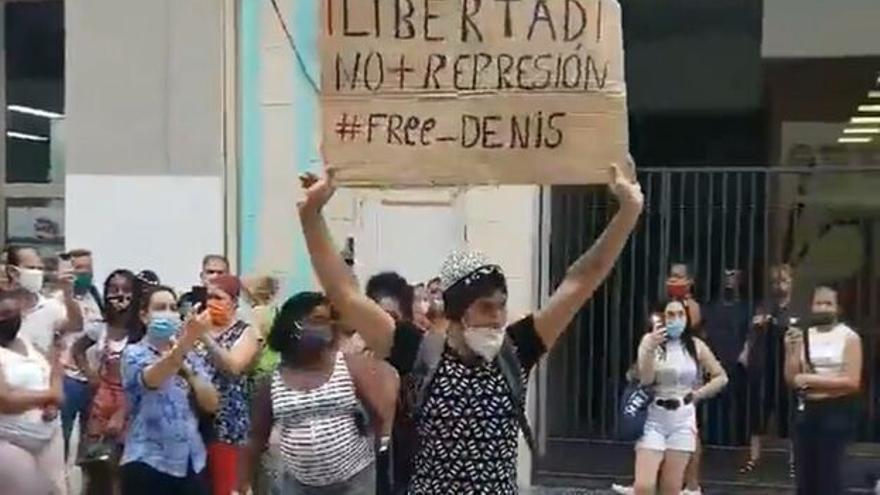
Robles, also known as the “young man with the placard,” was noticed after demonstrating alone with a sign on a central pedestrian promenade in the Cuban capital in which he asked for the release of dissident rapper Denis Solís, who had been sentenced to eight months for contempt.

The protester was arrested after holding his placard for several minutes. On that occasion, Televisión Cubana justified the arrest by claiming that Robles had resisted and engaged in a “frank act of provocation.”

For his mother, the transfer to the correctional work center is a “big step” so that he later “gets his parole”

 For his mother, the transfer to the correctional work center is a “big step” so that he later “gets his parole.”

She also said that her son “actually shouldn’t have gone through all that. They should release him because he is unjustly imprisoned. Let’s hope that in 2024 God will finally grant me the grace of my son being free.”

Translated by Regina Anavy 

____________

COLLABORATE WITH OUR WORKThe 14ymedio team is committed to practicing serious journalism that reflects Cuba’s reality in all its depth. Thank you for joining us on this long journey. We invite you to continue supporting us by becoming a member of 14ymedio now. Together we can continue transforming journalism in Cuba.

Nurse Nurisbel Guerra Was Murdered by Her Husband in the Cuban Town of Cauto Cristo

Nurisbel Guerra was a nurse and worked on a medical mission in Venezuela. (Facebook/Nurisbel Guerra)

14ymedio bigger14ymedio, Havana | 2 January 2024 — Although the year has ended, the number of women killed in 2023 continues to grow after the confirmation, this Monday, of the femicide of Nurisbel Guerra, allegedly perpetrated by her husband on December 24 in the province of Granma. There are now 87 victims counted by the independent media and observatories.

The Guerra’s murder was initially reported by YouTuber Niover Licea, who shared on his social networks details about the case, which occurred in the Granma municipality of Cauto Cristo, halfway between Bayamo and Holguín.

Her husband, identified as Oreste Tamayo, a worker of the Electric Company of the province and from whom she intended to separate, murdered her

Guerra, whose age is unknown, served as a nurse on a medical mission in Venezuela, from which she had returned for a short period. Her husband, identified as Oreste Tamayo, a worker of the Electricity Company of the province and from whom she intended to separate, murdered her. After cutting her throat, the alleged murderer committed suicide.

This December, the official press broke its usual silence to report on the femicide of Ohanis Soto in the town of Lincoln, in the province of Artemisa. During a “domestic fight,” which occurred at 6:00 pm on December 28 and “ended fatally,” Soto was stabbed several times by her partner, Osmar Frómeta. continue reading

According to the newspaper El Artemiseño, after killing Frómeta, he surrendered to the police to avoid an alleged “settling of accounts” by Soto’s family.

A recent report published by the EFE agency uses the independent records of femicides in 2023 to draw up a profile of the victims of violence against women on the Island. A 37-year-old woman, mother and resident in a rural area is the most common image of victims of femicides. In most cases, the women were killed by their former partners.

The data also revealed that this year an average of one woman was killed every four and a half days. That is to say: on the Island there were just over seven victims of gender-based violence every month.

The data also revealed that this year on average, a woman was murdered every four and a half days

The figures are even more terrifying if we consider that, due to the lack of information and the refusal of the Government to reveal official figures, many cases of femicides are not known. This is a reality denounced by platforms such as Alas Tensas and Yo Sí Te Creo en Cuba, which are still trying to verify several femicides that allegedly occurred in 2023, so it is likely that, if information is obtained during the first days of 2024, femicides will continue to be added to last year’s record.

For its part, the Government’s promises to establish policies to protect against violence against women have fallen apart. Months ago, the authorities announced that a recently created Observatory would be in charge of monitoring this type of situation in the country in real time. However, so far they have not begun to perform the task.

Translated by Regina Anavy

____________

COLLABORATE WITH OUR WORKThe 14ymedio team is committed to practicing serious journalism that reflects Cuba’s reality in all its depth. Thank you for joining us on this long journey. We invite you to continue supporting us by becoming a member of 14ymedio now. Together we can continue transforming journalism in Cuba.

Cuban Nostalgia

The December 31 dinner is an opportunity to get together with family and close friends. (14ymedio)

14ymedio bigger14ymedio, Pedro Corzo, Miami, December 31, 2023 — The common denominator of exiles and emigrants is to have left behind their country of birth and, most likely, to share the longings for the past, which for both can be overwhelming, although different. It’s worth saying that I learned this a very short time ago.

Nostalgia is one of the most personal and complex feelings. I experienced it a year ago, in a restaurant where I had dinner with my wife and with my brothers Morera and Xiomara and their wives, Kemel and Cristina.

I assimilated my nostalgia with difficulty. A Castro singer-songwriter had just died. I call him that because his songs, as Jose A. Albertini wrote, helped to silence the firing squads who were executing people. The music of this notable artist is admired by many compatriots, and one of those fans proposed to the entertainers that they perform a song in his memory.

It is worth saying that I was very upset, although I understood the situation when everyone told me, “those are his memories of that singer, try to understand, what you remember as bitter can be sweet for someone else.” This is the irreducible truth, because sometimes you remember something as charming until it becomes dangerous. continue reading

Art in general, along with sports, have been used by Island totalitarianism to manipulate the population and spread a smokescreen over the events in Cuba. In addition, artistic manifestations have been used to repress authors, as happened to Meme Solís. The performers I remember the most are Los Cinco Latino, The Platter and Luis Aguilé, a very Cuban Argentinian.

Art in general, along with sports, have been used by Island totalitarianism to manipulate the population and spread a smokescreen over the events in Cuba

Terror devoured us. The political situation was so demonic that a song entitled Adiós Felicidad (Goodbye Happiness) by Ela O’Farrill was considered counter-revolutionary. The author was arrested and humiliated, denounced by a communist professor, a friend of the family, for having composed a counterrevolutionary ballad, an accusation that determined her exile.

Christmas, from the 1960s, began to take place very discreetly. People stopped congratulating each other, or they did it privately. At the same time, there was very little to give away, and groceries were conspicuous by their absence or their prohibitive prices. However, the worst thing was that Christmas celebrations were politically incorrect, but not New Year’s Eve, which heralded the advent of the New Man.*

On January 6, the Three Kings Day celebration also went to jail or into exile. Toys, according to government propaganda, were regulated so that all children had them. The regime replaced customs and traditions. It transformed everything so that Fidel Castro could take over the collective imagination. More than a government, a new creed was imposed in Cuba.

I admit that, at Christmas, the homesickness is more severe. It is a period that, without being religious, imprisons me and puts me in a time machine that leads to sharing again with those who are no longer there in place and time and who will never return.

My last Christmas in Cuba was in 1980. On the Island it was practically banned. Somes churches discreetly decorated in accordance with the date. I remember a temple that did open its doors, located on Trista Street in the unforgettable Santa Clara.

Castroism arranged that the Christmas holidays were celebrations without devotional connotation for the people. The festivities would take place on July 25, 26 and 27

Castroism arranged for the Christmas holidays to be celebrations without a devotional connotation for the people, something that is spreading a lot today. The festivities would take place on July 25, 26 and 27, as part of its policy of destroying the national roots and transmuting the date of the assault on the Moncada barracks as the focal point of the new religion that was winning over Cubans.

The Christmas I remember the most is that of 1958, a year before the strategy of the Three Cs was put into practice – “zero cinemas, zero purchases (compras), zero cabarets” – and Fidel Castro’s July 26, with its rhythm of bombs and personal attacks that imposed terror, a situation that would drastically worsen months later.

The country was virtually at war. We were all frightened by the extreme violence on both sides. However, no one could imagine the magnitude of the coming disaster. The Republic, the whole nation, was nearing extinction: the work of the Castro brothers.

*Translator’s note: ’Che’ Guevara, in 1964, said that a revolutionary society (based on Marxism) needed to create a New Man with a “revolutionary consciousness” who wouldn’t rely on material incentives.

Translated by Regina Anavy

____________

COLLABORATE WITH OUR WORKThe 14ymedio team is committed to practicing serious journalism that reflects Cuba’s reality in all its depth. Thank you for joining us on this long journey. We invite you to continue supporting us by becoming a member of 14ymedio now. Together we can continue transforming journalism in Cuba.

Cuban Parliament Rends Its Garments over State Corruption and the Financial Crisis

The day’s agenda included reports on the state of domestic trade and foreign investments. (X/Parlamento)

14ymedio bigger14ymedio, Havana, 20 December 2023 — Corruption in grocery stores and soup kitchens, corruption in sports and educational institutions, corruption in the state sector and in small businesses. The numbers do not add up and Cuban officials were unable to avoid the word (it had been taboo among government leaders for decades) during presentations to Cuba’s parliament, the National Assembly of People’s Power, on Tuesday.

The day’s agenda included reports on the state of domestic trade and foreign investments, on the Ministry of the Interior’s eradication of marijuana crops in the eastern provinces, on measures being taken to mitigate the educational crisis and the exodus of athletes, and a closing speech — in his usual scolding tone — by National Assembly president Esteban Lazo.

The vice-minister of Foreign Trade and Investment, Ana Teresita Gonzalez, offered the day’s most optimistic figures. She reported that some 343 businesses from forty countries were interested in investing in the island and that their applications had been approved by the government. Of those businesses, 181 are “international economic association contracts,” 106 are public-private partnerships and 56 will operate completely under foreign management.

Gonzalez indicated that, despite the fact that most of these companies are in the tourism, mining and agriculture sectors, the ministry is “dissatisfied”

Gonzalez was filling in for her boss, Ricardo Cabrisas, who has been noticeably absent during these sessions. She indicated that, despite the fact that most of these companies are in the tourism, mining and agriculture sectors, the ministry is “dissatisfied” at not being able to import all the products it wanted and had to make do with the basics: beer, soft drinks, water, flour and meat. continue reading

The other parliamentary committees did not have much to celebrate either. The battered industrial, construction and energy sectors had to acknowledge that, despite government audits, there were multiple shortcomings. These included shortages of cement, steel, electric cables, plumbing fixtures and millwork; a lack of financing and oversight; and breach of contract by some of parties involved in the process.

National Assembly delegates claimed the solution is to increase financing and provide additional subsidies to those who are economically disadvantaged provided Lazo and a group of key ministers agree to directly oversee the process. The delegates present were immediately met with an angry rebuke from Ramiro Valdés, with Cubadebate providing its customary photo of him making angry gestures.

'Cubadebate' publicó la ya habitual fotografía de Ramiro Valdés increpando, con gestos de enojo, a los presentes. (Cubadebate)
‘Cubadebate’ published the now usual photograph of Ramiro Valdés rebuking those present, with angry gestures. (Cubadebate)

But it is in the retail and food service sectors where corruption is the main course. Under the watchful eye of Prime Minister Manuel Marrero, Interior Commerce Minister Betsy Diaz Velazquez and Lazo himself, the parliamentarians addressed the topic of deficiencies in the family care system and island’s precarious soup kitchens.

According to official statistics, there are 1,445 such establishments in Cuba on which, as Diaz pointed out, some 59,687 rely every day for basic rationed goods, food donations and food modules. Faced with the massive theft of resources and food (Marrero euphemistically attributed the problem to “poor management”), administrators have had to introduce digital inventory controls. Lazo asked that attention also be given to another issue common to soup kitchens: systematic popular control of programs which offer resources to economically vulnerable people to evaluate their effectiveness

The quality of service in the banking and financial system was found to be lacking.

In a presentation to a parliamentary sub-commitee, the president of the Central Bank of Cuba, Joaquin Alonso, was not too enthusiastic about recent efforts to digitize the banking system. The policy known as bancarización, which took effect in August, is intended to address the country’s shortage of foreign reserves, as has been reported on national television on numerous occasions.

“The quality of service in the banking and financial system has been found to be lacking,” he stated. “This finding is based on public perceptions of the banking services offered by our institutions.” The outlook, in his opinion, is alarming.

He concluded, “Some, though not all, of the most common complaints involve long lines, organizational inefficiencies in some offices, misinformation from poorly trained staff, slow and cumbersome procedures, failures in communication and technological systems, and service disruptions during power outages.”

The directors of the Institute of Sports, Physical Education and Recreation reported an unprecedented wave of “crime, corruption and illegalities” in the sector, to say nothing of the recent stampede of athletes leaving the country. They believe athletes must be protected from the temptation of “big money” from international events.

The day ended with a report on drugs and crime provided by the Ministry of the Interior. Colonel Juan Carlos Poey alluded to the rise in fentanyl consumption in the region and pointed out that Cuba is no exception. He added, however, that the most widely produced drug in the country – especially in Granma, Holguín, Guantánamo, Las Tunas and Santiago provinces – is marijuana.

Crimes were also committed in Cuban prisons, where 165 “incidents” were recorded. There were also thirty-two “findings” (of objects that the prisoners should not have had in their cells) which were linked to thirty-one relatives of inmates. On the international front, he added that Interpol has issued red notices for twelve Cubans. “This means that, when a country finds any of them, it will detain them and we will have them extradited. We have identified 301 Cuban criminal organizations operating overseas in fifteen countries” he stated.

At the end of his speech Poey predicted that, given the “adverse situation”  in the country, it is very likely that “crime will evolve into a higher level of organization,” more complex than gangs or small trafficking networks. Luckily, he added, by the time that happens, the police will already know what to do.

____________

COLLABORATE WITH OUR WORKThe 14ymedio team is committed to practicing serious journalism that reflects Cuba’s reality in all its depth. Thank you for joining us on this long journey. We invite you to continue supporting us by becoming a member of 14ymedio now. Together we can continue transforming journalism in Cuba.

Cuba Extends the Tariff Exemption for Food, Medicines and Other Products

The import of duty-free food and medicines was approved in July 2021. (Cubadebate)

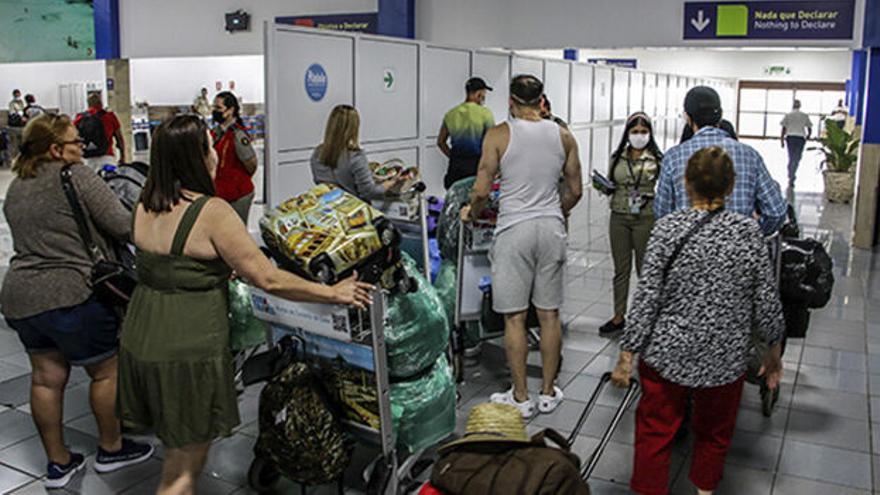
14ymedio biggerEFE (via 14ymedio), Havana, December 31, 2023 — The Cuban authorities announced this Saturday a new extension – until March 31 – to the tariff exemption for food, toiletries, medicines and even generators that travelers can bring to the Island for non-commercial purposes.

As a novelty of the measure taken in 2021 and prolonged several times, “the non-commercial import above the value established by the route of air, sea, mail and courier shipments of generators with a power greater than 900 watt-hour,” is allowed, according to the Ministry of Finance and Prices.

For the extension of the measure, “the persistence of the conditions that gave rise, in 2021, to its implementation” has been considered, according to the source.

Therefore, the tariff benefit will be maintained, which authorizes exceptionally, the non-commercial import, without limits in its value and exempt from the payment of customs duties, food, toiletries and medicines, through passengers as accompanied luggage. continue reading

The tariff benefit will be maintained, which exceptionally authorizes, the non-commercial import, without limits in its value and exempt from the payment of customs, food, toiletries and medicines

The import of food and medicines without tariff limits was a measure put into effect after the anti-government protests of 11 July 2021, which had as its main causes the scarcity and shortage of those basic products.

The law in force in Cuba on the import of luggage consists of a complex system of points and weight limits that establishes tariffs on excess items brought by travelers.

In the case of medicines, up to 22 pounds are allowed to be introduced into the country.

The economic crisis in Cuba was aggravated by the pandemic, the economic sanctions imposed by the United States and the failures in internal macroeconomic management.

Translated by Regina Anavy

____________

COLLABORATE WITH OUR WORKThe 14ymedio team is committed to practicing serious journalism that reflects Cuba’s reality in all its depth. Thank you for joining us on this long journey. We invite you to continue supporting us by becoming a member of 14ymedio now. Together we can continue transforming journalism in Cuba.

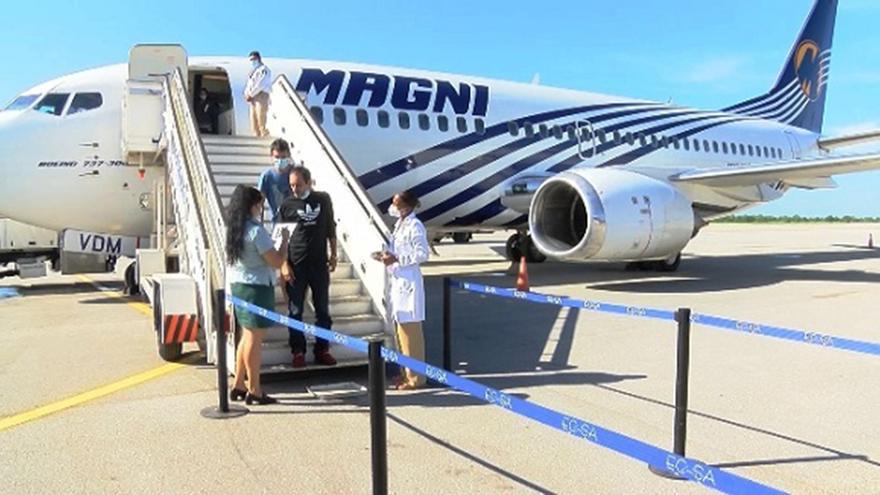
More Than 5,200 Cubans Were Deported to the Island in 2023 From Different Countries

The first flight of this year with deported Cubans arrived in Havana on April 24, with 123 people. (Cubadebate)

14ymedio bigger14ymedio/EFE, Havana, December 31, 2023 — A few hours before the end of 2023, the Ministry of the Interior reported that, in the last 12 months, 5,253 Cubans have been deported by air and sea from different countries in the region. Last Thursday, the U.S. Coast Guard returned nine rafters to Cuba on the ship Charles David Jr.

Among these deportations are those carried out by the United States. The most recent transfer flight to José Martí International Airport was last Thursday, with 31 Cubans who were arrested at the border.

According to Prensa Latina, in this group, made up of two women and 29 men, there were three people who had left the country illegally by sea. The rest, it reported, did so legally but “then took irregular routes to the U.S. border.”

Under the bilateral agreement between Cuba and the United States to return to the Island those who arrive by sea, eight transfers occurred to repatriate 426 Cubans since last April, when air expulsions resumed. continue reading

This year, Cuba has also received repatriated migrants from the Bahamas, Belize, the Cayman Islands, the Dominican Republic and Mexico

The first flight with this type of deportees arrived in Havana on April 24, with 123 people. On the last day of November, 37 Cubans were deported. Yoan Enríquez, who had a probation form I-220B, was one of the passengers who had to leave his wife and a three-month-old baby in Florida.

During the current fiscal year, which began on October 1, 2022, more than 6,800 Cubans have been intercepted by the U.S. Coast Guard on trips to Florida, according to official data.

This year, Cuba has also received migrants repatriated from the Bahamas, Belize, the Cayman Islands, the Dominican Republic and Mexico.

According to what was revealed to this newspaper, Cuba accepted the returns of its nationals from the month of October from Mexico, as long as the transfer expenses were covered by the Government of Andrés Manuel López Obrador. “A cost of 4,000 pesos (237 dollars) is handled for each migrant,” said lawyer José Luis Pérez.

Since Mexico resumed flights to Havana, it used the services of the airline Viva Aerobús. In total, it has transferred 435 Cubans in five connections. “Migration has a budget item for deportations. It’s not a new expense,” the official said.

Mexico also has a bilateral agreement with Venezuela for the deportation of migrants. This Sunday, a group of 122 migrants was returned to Venezuelan territory on the second repatriation flight, for a total of 329 people if you add the 207 who arrived in the early hours of this Saturday.

Since Mexico resumed flights to Havana, it used the services of the Viva Aerobús airline. In total, it has transferred 435 Cubans in five connections

The flight was carried out through the Vuelta a la Patria (Return to the Homeland) plan, a government program launched in 2018 to facilitate the return of migrants who were victims of xenophobia, according to the Venezuelan Government.

On X (formerly Twitter), the Ministry of the Interior, Justice and Peace pointed out that the migrants were received by a “comprehensive care command” in charge of verifying their data and providing medical assistance.

The Mexican government reported this Saturday the renewal of the repatriation flights of Venezuelans who are arrested on their way to the U.S. border.

It also indicated that they are working on the implementation of social programs in Venezuela, which will benefit, among others, repatriated people by linking them to productive projects and paid internships in workplaces.

Translated by Regina Anavy

____________

COLLABORATE WITH OUR WORKThe 14ymedio team is committed to practicing serious journalism that reflects Cuba’s reality in all its depth. Thank you for joining us on this long journey. We invite you to continue supporting us by becoming a member of 14ymedio now. Together we can continue transforming journalism in Cuba.