A tricycle driver’s unexpected response to an inspector writing down names on his attendance list for Cuba’s May Day events
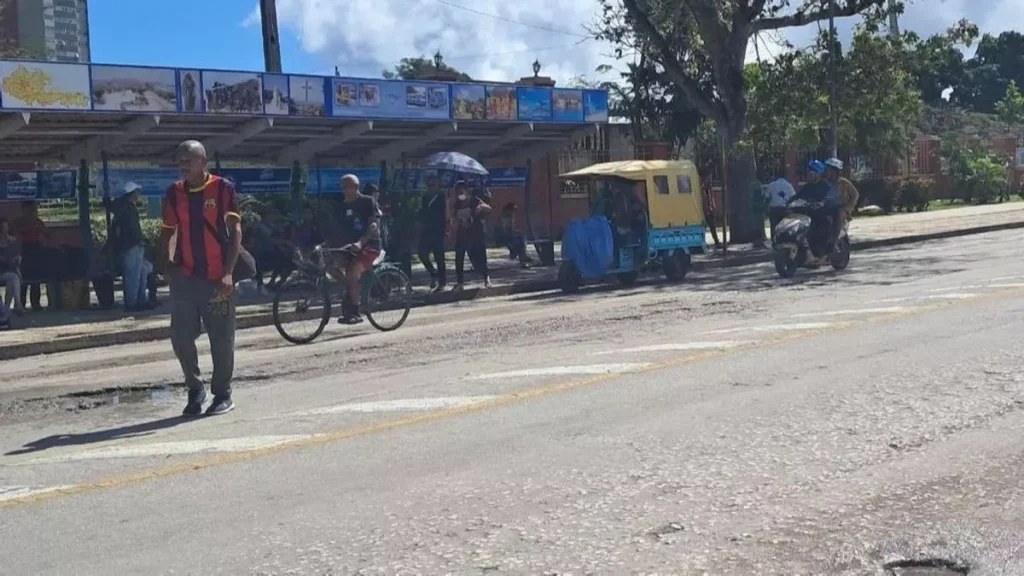
 14ymedio, Miguel García, Holguín, April 30, 2026 / A private driver in Holguín thought it was just another inspection. He was at the taxi stand near the surgical hospital when a transportation official approached him, asked for his name, and pulled out a piece of paper. The driver prepared to show his documents, license, or vehicle registration. But it wasn’t a traffic ticket or a routine inspection.
“It turns out the man was handing out a political pamphlet or a call to action for the May Day parade,” recounts a passenger who witnessed the events. According to the passenger, the official was asking if the drivers were going to sign their “willingness” to participate in the demonstration.
The scene unfolded at one of the electric tricycle taxi stands that have been authorized in Holguín in recent months to transport passengers, amidst the collapse of public transportation and the energy crisis. In February, provincial authorities began issuing temporary permits allowing cargo tricycles and mopeds to carry passengers as well, a practice previously punishable by fines and even vehicle impoundment.
“Transport inspectors are going around to the bus stops collecting information on the tricycles with the special cargo and passenger permits that are required to participate in the parade.”
The measure was presented as an emergency solution for a city increasingly paralyzed by fuel and bus shortages. But it also placed these drivers under a system of registration, permits, designated taxi stands, and administrative controls. Now, according to testimony, that same structure is being used to incorporate them into the May 1st political machine.
“The transport inspectors are going around the established taxi stands in the city, collecting the information on the tricycles that were given special cargo and passenger permits to go to the parade,” the passenger explained to this newspaper.
The driver refused to sign. And he did so with a phrase that, just a few years ago, few Cubans would have dared to utter in public, much less before a state official with the power to inspect or penalize their livelihood: “He told them, ‘I’m not going to parade in anything that has to do with communism.’” The inspectors didn’t press the issue and continued on their way.
“He told them, ‘I’m not going to parade in anything that has to do with communism.’”
The complaint coincides with a moment of intense political mobilization in Cuba. The Cuban Workers’ Federation (CTC), the only authorized union on the island, called for the May Day parade under the slogan “The Homeland Defends Itself,” amidst an official campaign seeking to portray the march as a demonstration of unity against the oil blockade imposed by the US and the alleged threats of a military attack. In Holguín, the provincial CTC announced that it expects to gather around 200,000 workers in the main square.
That figure helps to understand the pressure, since mass demonstrations are never left to spontaneity. Workers and students are coerced with meetings, lists, commitments, assembly points, and attendance checks.
“They knock on the door with a piece of paper and you have to write your name, your surname, your ID number and sign it.”
But the pressure isn’t limited to workplaces, universities, or transportation hubs. Another report received from the Diez de Octubre municipality, in Havana, points to the use of vector control fumigators to collect signatures door-to-door in support of the official campaign “My Signature for the Fatherland.”
“Yes, the mosquito control people came, they got them for that purpose,” a neighbor recounts. “They knock on the door with a piece of paper and you have to write your name, your last name, your ID number, and sign it.” According to her, no one in her household agreed to join the campaign: “Of course, no one in my house signed.”
The scene ended with a conversation among the workers sent to collect signatures. “Another colleague arrived, who seemed to have been with her, and he said to her, ‘Are you finished yet?’ And he replied, ‘No, not at all, three people have already slammed the door in my face. Nobody wants to sign this.’” The tension was summed up in a curt phrase, directed at a bricklayer who refused to sign the official document: “If you’re not going to sign it, don’t mess it up.”
______________________
COLLABORATE WITH OUR WORK: The 14ymedio team is committed to practicing serious journalism that reflects Cuba’s reality in all its depth. Thank you for joining us on this long journey. We invite you to continue supporting us by becoming a member of 14ymedio now. Together we can continue transforming journalism in Cuba.