The peace petition campaign took center stage at the event, while official rhetoric alternated between calls for dialogue and threats of bloodshed and violence.
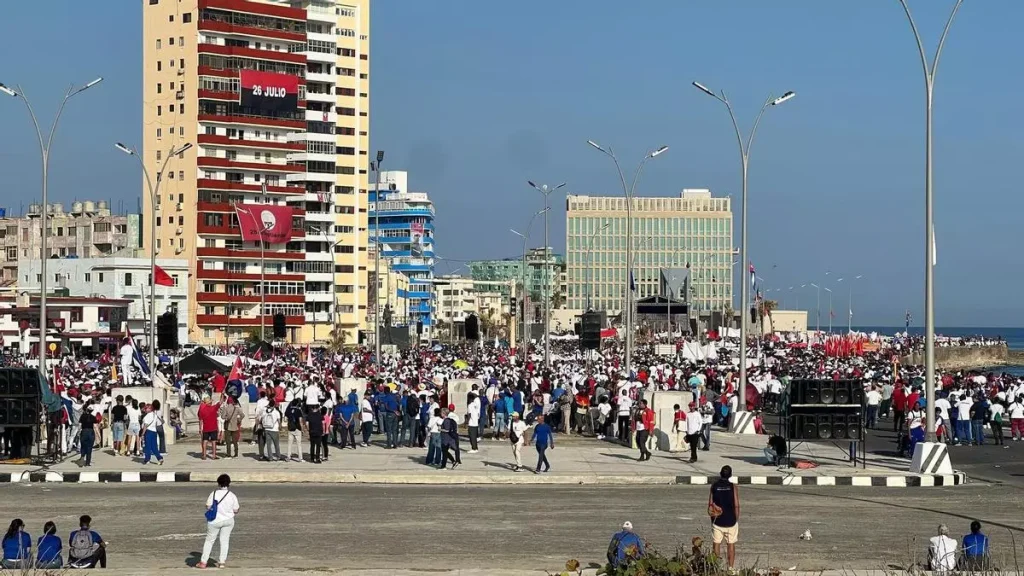
 14ymedio, Dario Hernandez, Havana, May 1, 2026 / “Practically half the people had already left when it started,” says an attendee at the May Day parade in Havana. The José Martí Anti-Imperialist Tribune, in front of the U.S. Embassy, was once again this year the stage chosen by the government to represent a unanimity that is increasingly difficult to maintain.
The change of venue, traditionally the Plaza of the Revolution, was justified by the authorities as due to the energy crisis. But the new location also offers the advantage of being more manageable for cameras, less risky in the event of low attendance, and easier to transform, through close-ups and enthusiastic narration, into a picture of massive support.
The event revolved around two obsessions: the fear of a US intervention and the desperate need to demonstrate popular support. Under the slogan “The homeland defends itself,” repeated ad nauseam, and with the centennial celebration of Fidel Castro’s birth as a backdrop, thousands of workers were mobilized from dawn toward Havana’s Malecón. The parade was presented by the official press as a combative, patriotic, and voluntary march. On the street, however, the scene resembled more of an obligation and a logistical operation than a display of civic fervor.
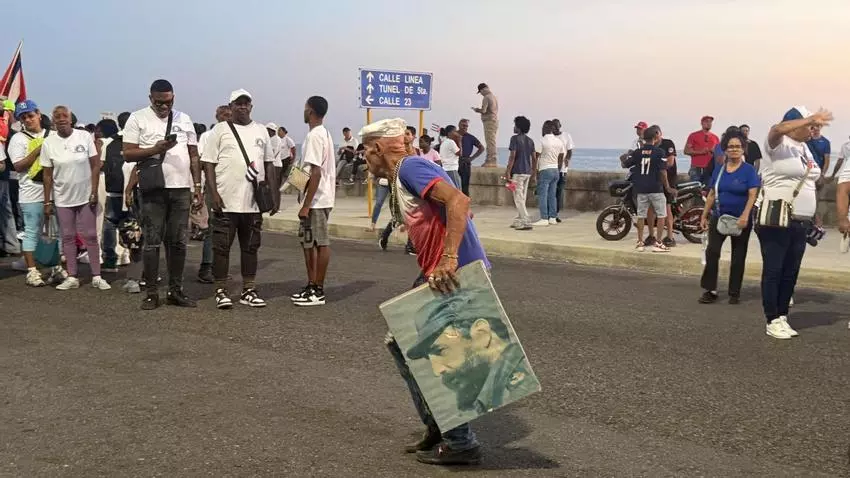
The demonstration had been organized from four points in Havana, culminating at la Tribuna. One of the attendees, who left from the gathering on Infanta Street around 6:30 a.m., described his experience to this newspaper: “There were mostly conga lines. I counted about five. The usual. Lots of shirts from state-run schools, and a ton of military personnel.” According to what he heard from the participants, many people had been called as early as 2:00 or 3:00 a.m.
When the main event began at 8:15 a.m., many of those invited had already left. “By the time it all started, after listening to Silvio Rodríguez’s entire discography, with the sun already beating down, easily half the people had left,” recounts one attendee. During the speeches, he adds, participants continued to leave. “When the groups came down and gathered on the stage, they stood there for almost an hour. And people were already exhausted.”
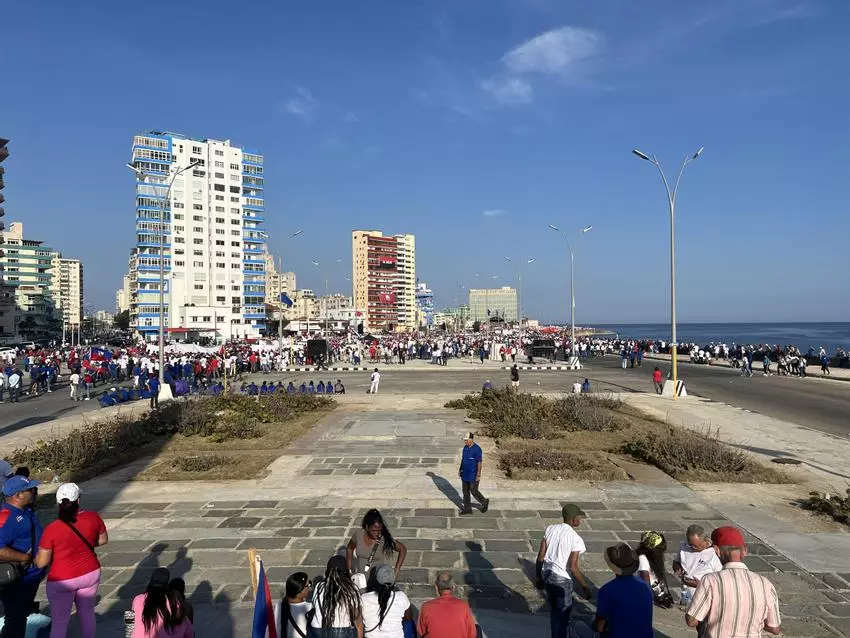
Despite this, official media announced the presence of 500,000 workers in the capital. However, the images do not support this figure. The density visible in photos and videos, the gaps in the crowd, the spaciousness of the side areas, and the very layout of the location do not correspond to half a million people concentrated in that area, unless they spread out much more massively along adjacent avenues.

“The government needed half a million. The images show considerably less,” one observer summarized. And, above all, they show something more damaging to the official narrative, because the crowd no longer seems convinced to even stay until the end.
Buses, work summonses, union orientations, and administrative pressure are all part of a familiar choreography at every political event of this magnitude. The ability to mobilize people remains one of the few organizational skills the state apparatus retains, even amidst the energy crisis and when daily public transportation continues to be a nightmare for millions of Cubans.
“Lots of people were drinking alcohol, ignoring the event,” the source said. In some sections, the honking horns seemed to be trying to compensate for the lack of enthusiasm with noise. “The avenue was empty, with the horns blaring,” the attendee summarized.
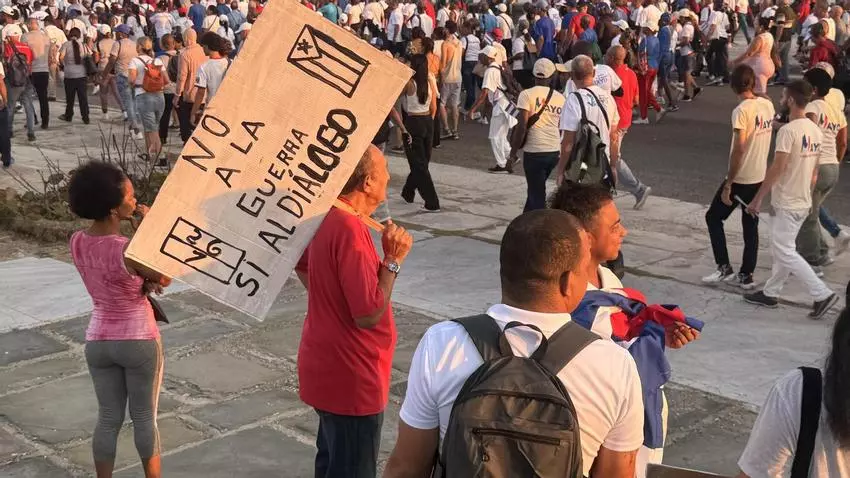
The central moment of the event was the symbolic presentation to Raúl Castro and Miguel Díaz-Canel of the signatures collected in the “My Signature for the Fatherland” campaign, which, according to the state registry, totaled 6,230,973 signatures “for peace and sovereignty.” The figure was celebrated as proof of national unity. However, according to testimonies gathered, this support was not as voluntary as the propaganda proclaimed. “My neighbors and I have been practically harassed all week to sign. They came by three times in the last three days,” complained a resident of Diez de Octubre.
State television repeatedly insisted that the rally represented the true Cuba, in stark contrast to the discontent visible on Facebook, in independent media, at civic protests, and in recent polls. “On social media, they’re attacking the Revolution, but that’s not reality; this is reality,” said a commentator on Canal Caribe, while anticipating that criticisms would later emerge claiming that the attendees had been forced to go.
The official discourse inadvertently acknowledged the deep divide. “Everyone here is struggling: there’s no transportation, sometimes there’s not enough bread, but people keep persevering,” one commentator remarked. The statement was intended to extol resilience, but it ended up describing failure. In a country with prolonged blackouts, inflation, decimated wages, precarious transportation, impoverished retirees, and mass emigration that empties neighborhoods and families, calling on workers to celebrate their day feels somewhat mocking.
The day was also marked by a police crackdown on critical voices. The offices of this newspaper in Havana were surrounded by a police operation from the early hours of the morning to prevent journalists Yoani Sánchez and Reinaldo Escobar from leaving their homes on May 1st. This action confirms that, while the government attempted to project an image of popular support at the Anti-Imperialist Tribune, it was keeping independent journalists and dissenting citizens under surveillance and control.
The biggest contradiction lay in the language. The white shirts were presented as a symbol of peace, and the signatures as support for dialogue and sovereignty. But this pacifist appeal coexisted with a bellicose rhetoric of “the people’s war,” sacrifice, blood, and rifles. “They spoke of peace, of dialogue, and at the same time of saying the people are willing to die, ‘Give me my rifle,’ that they’ll collect blood. The discourse was quite incoherent,” the attendee concluded.
May Day parade in Havana: fewer people and more tiredness under the sun
______________________
COLLABORATE WITH OUR WORK: The 14ymedio team is committed to practicing serious journalism that reflects Cuba’s reality in all its depth. Thank you for joining us on this long journey. We invite you to continue supporting us by becoming a member of 14ymedio now. Together we can continue transforming journalism in Cuba.