Jamaica Prosecutes 10 Cuban Rafters Who Landed in a Luxury Hotel

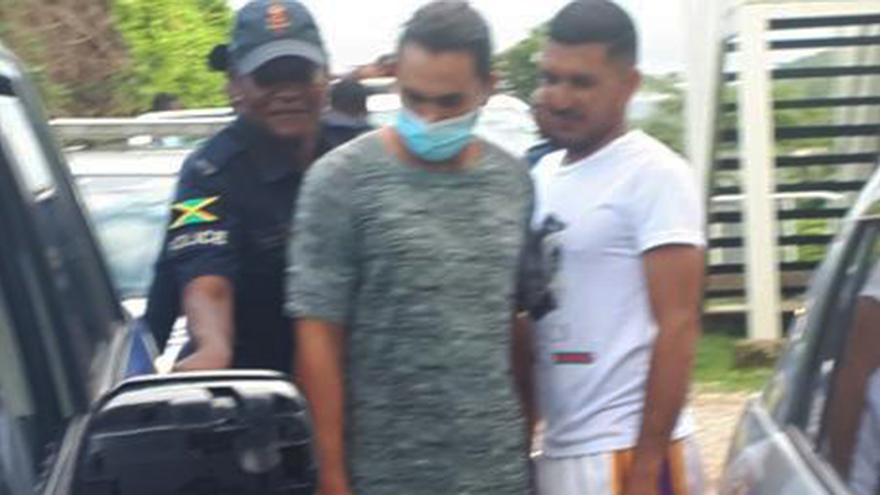
The group of Cuban rafters have been detained since January 4 in Jamaica. (The Gleaner/Leon Jackson)

14ymedio bigger14ymedio, Havana, 8 January 2024 — A group of 10 Cuban rafters has been detained since January 4 in Jamaica for illegally entering the country. The migrants are waiting for a second hearing, next Thursday, before the Duncans Parish Court. In the first hearing, they pleaded “not guilty” before Judge Paula Hall, according to the newspaper The Gleaner.

The rafters, with support from interpreter Kimberly Watt, said that on December 29 they left the Island on a raft with the intention of reaching Florida. However, the bad weather damaged the raft and forced them to disembark at the Excellence Resort.

According to the Jamaican Embassy in Cuba, the inhabitants of the Island require a tourist visa, which costs 30 euros. continue reading

The rafters, with the support of interpreter Kimberly Watt, said that on December 29 they left the Island on a raft with the intention of reaching Florida

Since March 2023, Jamaica has required a visa for every Cuban who transits the country. The measure was taken in the face of the lack of control of people from the Island, who took advantage of the passage through Kingston to travel to Nicaragua and from there continue their journey to the United States.

Officials of the Passport, Immigration and Citizenship Agency confirmed to The Gleaner that “hundreds of Cubans traveled from the Island in the last three years to secure passage to Central and North America.”

The Government of Cuba maintains a close relationship with Jamaica. Last November, the Cuban Ophthalmological Care Program resumed with the sending of 18 specialists, after its suspension during the COVID-19 pandemic. These health workers joined the nine who arrived in July 2023 and are working in the Kingston public hospital.

Cuba’s ambassador to Jamaica, Fermín Quiñones, highlighted in May the bilateral relationship between the two countries in both health and education. Despite the fact that there is a considerable deficit of teachers in Cuba, agreements are maintained for the sending of teachers to Honduras, Mexico and Jamaica.

Translated by Regina Anavy

____________

COLLABORATE WITH OUR WORKThe 14ymedio team is committed to practicing serious journalism that reflects Cuba’s reality in all its depth. Thank you for joining us on this long journey. We invite you to continue supporting us by becoming a member of 14ymedio now. Together we can continue transforming journalism in Cuba.
In Cuba, Even the Ration Books Are Scarce Due to Lack of Paper

Tamara Castillo, State director of Commerce in Matanzas, said that the delivery of the documents “will be assumed on a transitory basis.” (14ymedio)

14ymedio bigger14ymedio, Havana, 8 January 2024 — For the third consecutive year, the distribution of the ration books in Cuba is delayed. The reason is the same again: the lack of paper to make them. In some neighborhoods of Havana, the distribution has been intermittent. In Luyanó, in the municipality of Diez de Octubre, they have arrived, but in other areas, such as Cayo Hueso, in Central Havana, they have not.

They had already warned Olga in December, when, after losing the document on the street, she had to go and renew it from her corresponding Office of the Consumer Registry. “The employee told me not to worry because they weren’t going to give out the books anyway,” the old woman tells 14ymedio. “She didn’t know if it was going to be in January, in February or if it would actually happen, because they were ’very late.’”

In Nuevo Vedado, a municipality of the Plaza de la Revolución, the ration store clerk told his customers that “it will arrive next month.” Meanwhile, they are writing down the orders on the January sheet of the 2023 ration book. “For the little they give, there is plenty of paper,” Roberto, a resident of the place, protests with sarcasm.

Although the panorama is similar in other provinces – they have not given out the ration books in Sancti Spíritus, in Mayabeque, in Villa Clara, in continue reading

Santiago de Cuba or in Holguín, to mention some examples that this newspaper has been able to confirm – only the government of Matanzas has pronounced itself on the matter.

The solution proposed by the officials while they replenish stocks is the one proposed by the ration store clerk of Nuevo Vedado, which coincides with last year’s proposal and that of the previous year

“From the State Directorate of Commerce in Matanzas it is reported that financial limitations caused a delay in the import of the raw material for the fabrication of the ration books, which resulted in too much of a delay in their printing and distribution to make the changes for the 2024 ration books,” the agency acknowledged this Sunday on Facebook.

The solution proposed by the officials while they replenish stocks is the one proposed by the ration store clerk of Nuevo Vedado, which coincides with last year’s proposal and that of the previous year: write down the new products in the old ration book.

Tamara Castillo, State director of Commerce in Matanzas, said that the delivery of the documents “will be assumed on a transitory basis” and explained that “once the books for 2024 have been delivered to consumers, the retail establishment must update the annotations in them from the sales made previously,” a process that must be completed before this coming March 30.

The lack of “raw material” for fabricating the ration books has already stopped being surprising, but this year, the uncertainty about rationing lingers on. Among the economic measures announced for 2024 in the second ordinary session of the National Assembly last December, although without a specific date, was the end of the universal subsidy to the basic food basket.

“It’s not fair that those who have a lot receive the same as those who have very little. Today we subsidize the same thing to an old pensioner as to the owners of large private businesses who have a lot of money,” argued the Prime Minister of the Island, Manuel Marrero.

Translated by Regina Anavy

____________

COLLABORATE WITH OUR WORKThe 14ymedio team is committed to practicing serious journalism that reflects Cuba’s reality in all its depth. Thank you for joining us on this long journey. We invite you to continue supporting us by becoming a member of 14ymedio now. Together we can continue transforming journalism in Cuba.

Cuba: Good Bye, Fernando

The Minister of Culture, Alpidio Alonso, together with the then Vice Minister Fernando Rojas, during the attack on some artists who were peacefully protesting, on 27 January 2021. (Screen capture)

14ymedio bigger14ymedio, Yunior García Aguilera, Madrid, 10 January 2024 — These days the dismissal of Fernando Rojas, the vice minister of Culture, has been in the news. There are many who have publicly celebrated the end of the career of one of the cultural commissioners who arouses the most antipathy. There have also been many, too many, affected by the exclusive and abusive cultural policy that the regime has carried out for decades.

But Fernando has been one of the most enthusiastic and visible executioners. He never refused to spearhead a cancellation. And despite all his efforts to show himself worthy of occupying the highest position in the ministry of censorship and ultimatum, better known as Mincult, no one trusted him enough to be the standard bearer.

We have both been antagonists in several of the most recent episodes, so I think it is pertinent to give my opinion. I do not intend to add to the insults, which are already many, and which contribute little, beyond personal relief. I will try to give the most honest view possible about someone who has just lost the little power he had left and whose life is definitely going downhill. continue reading

I will try to give the most honest view possible about someone who has just lost the little power he had left and whose life is definitely going downhill

The first time I exchanged words with Fernando was during a small reception that the ministry offered to Antón Arrufat. They told the playwright that he could bring some friends and I was among his guests. Suddenly, amidst rum and Soviet jokes, Abel Prieto made an unexpected confession: he was retiring from the position. So he told the younger ones: “Go out and smoke with Fernando, because he will be the next minister.” I remember that Fernando took out his tobacco, he paused and appeared as if he had already received the official appointment.

A short time later the news would come out, but nothing about Fernando being named. The new minister was a certain Rafael Bernal. He would only last two years in office, being dismissed after an art theft scandal. Once again, Fernando was left quietly in his chair. The appointee was then Julián González, and this time it would be Rojas himself who would be in charge of sawing the floor for his new boss. His appointment seemed inevitable, but… not even! Abel Prieto himself would be brought out of his sweet retirement to resume his position until 2018. By that year, Díaz-Canel was betting on a closer friend: Alpidio Alonso.

When in 2016, during a meeting of the Hermano Saíz Association (AHS), I asked Luis Torres Iríbar 15 uncomfortable questions , it would be Fernando Rojas’ turn to answer me. His answers must be recorded somewhere. Fernando lamented that we Cubans could travel without an exit permit, buy a cell phone or a computer, or buy and sell our own houses. For him, all those decisions were painful and must be temporary. From that moment on, I think he began to see me as an annoying intestinal pimple every time we met at those useless AHS or Uneac assemblies.

He even visited me at my house on a couple of occasions, concerned about the direction my Facebook posts were taking

However, I dare to speculate that, despite everything, Fernando appreciated me. It took it personally to try to keep me in the “uncomfortable artist” zone and not cross that invisible line where you are considered “incorrigibly counter-revolutionary.” He even visited me at my house a couple of times, concerned about the direction my Facebook posts were taking.

But November 27th arrived. That day, we both held a long and tense telephone negotiation, until the protesters were able to enter the ministry, well into the night. The false dialogue would be broken two months later, with a simple slap of the hand and an unjustifiable beating .

The last time we saw each other was at the Argos Teatro headquarters, after a performance of one of my plays. In the dressing room, I told him: “Before we start discussing our differences, tell me how your son is doing.” Fernando burst into tears for about ten minutes straight. Apparently, no one in his camp had asked him about the boy’s health after a domestic incident.

I’m delusional if I think he really appreciated me. He did not hesitate to go house to house of some colleagues to publish videos against me. He didn’t hesitate for a second to close my group and ban all my works. He applauded the lynching that my family suffered in the same house that he himself visited one day.

Fernando is already ancient history, but the worst of all is that those who replace him today are made of the same material.

____________

COLLABORATE WITH OUR WORKThe 14ymedio team is committed to practicing serious journalism that reflects Cuba’s reality in all its depth. Thank you for joining us on this long journey. We invite you to continue supporting us by becoming a member of 14ymedio now. Together we can continue transforming journalism in Cuba.

Cuba’s Minister of Culture’s Aggression Against Artists Sparks International Condemnation (Article from 2021)

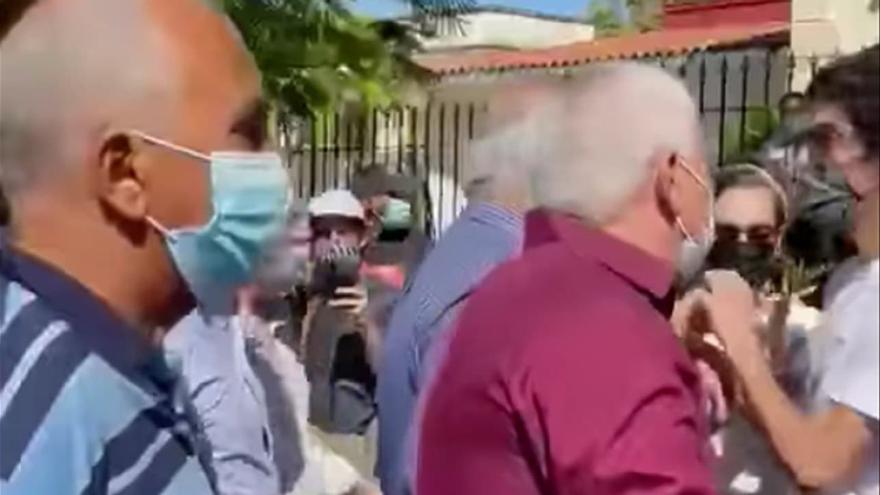
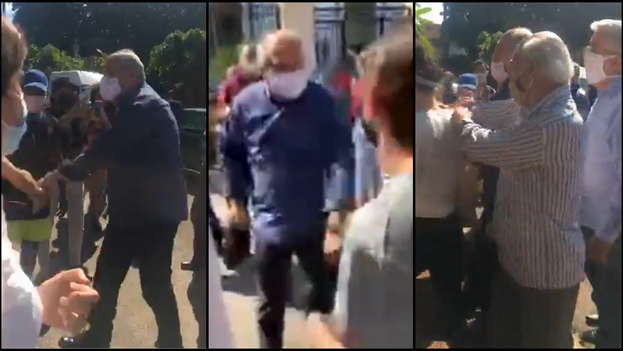
Alpidio Alonso (wearing a dark blue shirt) approached the group and physically attacked the independent journalist Mauricio Mendoza. (collage)

14ymedio bigger14ymedio, Havana, 27 January 2021 [Readers please note, this article is from 2021 and only recently translated] — The day of arrests and protests of artists that took place this Wednesday in front of the Ministry of Culture has not taken long to receive condemnation from several international organizations, among which stands out the Cuban Observatory for Human Rights (OCDH), based in Madrid, that has asked the European Union and the United States for sanctions against Alpidio Alonso, Minister of Culture, who attacked the protesters yesterday.

The police violently broke up the sit-in held by several artists who managed to reach the Ministry after paying tribute to José Martí on the eve of the 168th anniversary of his birth. Alonso approached the group and physically attacked the independent journalist Mauricio Mendoza, which led to an exchange of slaps between officials and artists, who were quickly surrounded and stripped of their cell phones.

The OCDH condemned the “repressive action” and denounced that “then, the government mob, made up of officials from the Ministry of Culture, attacked the rest of the protesters in the vicinity of the Ministry in Havana.”

continue reading

The organization has proposed that the European Union “urgently” prohibit the entry of Alonso Grau and Vice Minister Fernando Rojas to the Schengen area and that both be “sanctioned”

The organization has proposed that the European Union “urgently” prohibit the entry of Alonso Grau and Vice Minister Fernando Rojas to the Schengen area and that both be “sanctioned” according to the newEuropean regime on human rights, in addition to their exclusion in any bilateral dialogue. In addition, it also demanded sanctions from the United States for both of them for their “direct participation in violent acts that violate the human rights of intellectuals and artists in Cuba.”

“In a normal country, Mr. Alonso Grau should have resigned. The images of the minister physically attacking people who are demonstrating peacefully in a public space is another example of the intolerance of the officials of the Cuban regime,” says Alejandro González Raga. , director of the OCDH.

The event at the door of the ministry resulted in several arrests. “They took them all away on a bus. They didn’t let me pass, they detained me almost upon arrival, there was a police cordon on every corner,” playwright Yunior García Aguilera told 14ymedio. The artists Solveig Font and Julio Llopiz-Casal tried to intervene so that García could gain access to the Ministry, but was unable to do so. “In the end a bus arrived, they did a kind of act of repudiation and took them all away,” he added.

Fernando Rojas even told those who participated in the protest, as heard in some videos recorded by themselves, that they could go to the institution’s headquarters, but the young people demanded the withdrawal of the police officers who were surrounding them before entering.

“There are police officers and people with guns, who come to strike and you know it, we are just artists,” Maykel Castillo Osorbo is heard saying. “Why such a level of repression with art,” claimed the rapper.

During the morning, the independent journalist Camila Acosta, the artists Tania Bruguera and Camila Lobón, and the writer Katherine Bisquet were arrested when they were preparing to attend the tribute and released hours later. The Inter American Press Association (IAPA) denounced these arrests, as well as the surveillance of the homes of journalists Iliana Hernández, a collaborator of CiberCuba, and Luz Escobar, of 14ymedio.

“We condemn the worsening of repression, threats and censorship against independent media and journalists, activists and citizens” by the Government

“We condemn the worsening of repression, threats and censorship against independent media and journalists, activists and citizens” by the Government, said Jorge Canahuati and Carlos Jornet, presidents of the IAPA and the Commission on Freedom of the Press and Information of the entity, respectively. Both added that the Government uses the Penal Code and archaic decrees to punish them and silence the right to freedom of expression and asked the international community to “immediately raise its voice and denounce the atrocities and violations of human rights on the Island.”

This January 27, several members of the 27N artist group had called for a tribute to José Martí near the Ministry of Culture. Some of them took advantage of the queue in a store to camouflage themselves and be able to be in the place without being previously detained.

Among them were Llopiz-Casal, Font, Osorbo, Mijail Rodríguez, Ulises Padrón, Víctor Alfonso, Mauricio Mendoza, Carolina Cabrera, Reynier Leyva Novo, Sinder Riverí, and Miryorli García. The group that managed to arrive in front of the Ministry paid tribute to Martí in a bust located on the corner of 21st and 2nd in Vedado, where a statement transmitted through social networks was read.

“We gather again to cultivate and offer our white rose,” they say in their address. “That of peace, that of dialogue, that of civic friendship, that of reconciliation, that of forgiveness, that of transparency, that of kindness, that of good and beauty, that of poetry. A white rose for friends and for those who consider themselves enemies, as Martí proposed to us, because we believe in the importance of building Cuba with everyone and for the good of all, from the values ​​of our apostle and poet.

From there they went to the Ministry, where Fernando Rojas demanded that they leave the area, citing the danger of coronavirus infection.

“It is a lie that they want dialogue, to be in a situation and call the foreign press and put on a little media show. They do not want any dialogue, they were invited several times to come in and they did not want to come in. We are not going to allow this here in the Ministry of Culture. They do not respect the entire artistic movement of this country, which is revolutionary. If they come in a challenging and provocative tone like now, they will find an energetic response from our people,” Alonso said before a group of officials from his ministry who, at the end, applauded him and shouted slogans like “fuerza Cuba” and “viva Fidel.”

The Ministry of Culture also issued an official note where it described the artists’ action as a provocation and referred to them as a “small group of people” related “to media paid by US federal agencies.” As the statement explains, those present were asked to leave on several occasions due to the “risk posed by the Covid-19 epidemic in crowds in public spaces.”

“The Ministry of Culture ratifies its willingness to dialogue with honest creators on any issue related to the cultural policy of the Cuban Revolution and reiterates its refusal to accept provocations or dialogue with mercenaries”

According to the official version, the Ministry of Culture workers “decided to react immediately” by urging them to leave, but “they confronted them and evicted them from the place” due to their refusal. “The Ministry of Culture ratifies its willingness to dialogue with honest creators on any issue related to the cultural policy of the Cuban Revolution and reiterates its refusal to accept provocations or dialogue with mercenaries,” the note concludes.

President Miguel Díaz-Canel has expressed himself along the same lines. “He who hides behind art to provoke by besieging institutions and public officials, while the nation fights tooth and nail against blockade, pandemic and death, is not honest. Our ministries are not media platforms. Hard work is done there,” the president wrote on Twitter .

The repressive actions against activists and artists come just two months after more than three hundred people gathered outside the Ministry of Culture on November 27 to demand the end of censorship and greater creative freedoms on the Island starting the arrests against members of the San Isidro Movement. After several hours of tension, caused by a significant deployment of police and State Security agents to stop the arrival of more artists, the authorities accepted that a group of representatives access the building.

During the call this Wednesday, the members of 27N released a statement. “Today we come, once again, to insist on dialogue, but also to demand to be heard, to exercise our freedom as citizens, and to celebrate the unity, serenity and perseverance that we have maintained around the events of 27 November 2020,” adds the statement. “We will not give up the demands of that night.”

The declaration goes on to demand the “right to have rights,” the recognition of civil society as an interlocutor and an end to harassment, repression and censorship. The official press, which has pointed to them and accused them of being counterrevolutionaries and mercenaries, could stop the defamation campaigns against them and put a “stop to hate speech.”

The group demands a channel of dialogue that leaves ideologies aside and focuses on Cuba and the well-being of its citizens and defends its commitment to a free, inclusive and democratic society. “We invite all Cubans not to be indifferent to suffering and pain, to not be apathetic to the reality that is offered to us as an opportunity for change.”

____________

COLLABORATE WITH OUR WORKThe 14ymedio team is committed to practicing serious journalism that reflects Cuba’s reality in all its depth. Thank you for joining us on this long journey. We invite you to continue supporting us by becoming a member of 14ymedio now. Together we can continue transforming journalism in Cuba.

Cuban TV Documentary on Mariel Masters the Art of Turning Setbacks into Victories

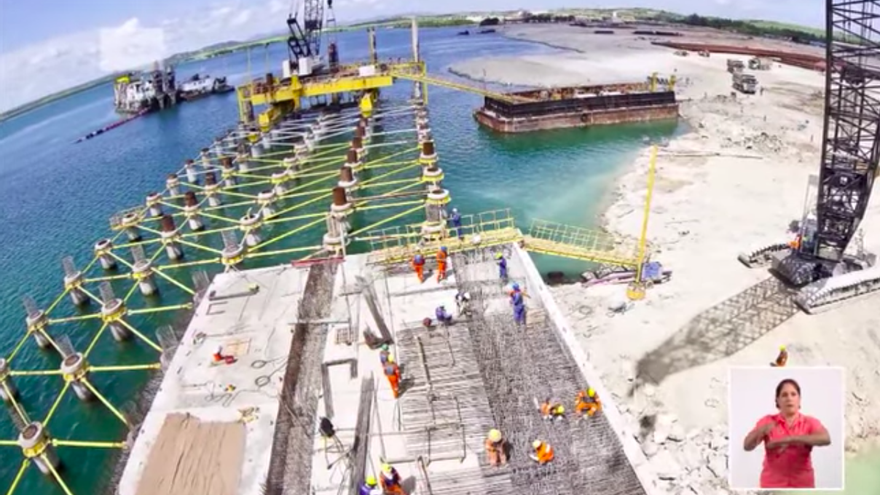
Raul Castro promised the “mighty” terminal would deliver a prosperous, socialist future. (Screen capture)

14ymedio bigger14ymedio, Havana, January 5, 2024 — “Fresh currency.” For more than ten years that has been the slogan of the Mariel Special Development Zone (ZEDM). Its directors, senior Cuban officials and foreign investors bluntly admit it in “Prow to the Future,” a documentary taped using Geocuba drones and accompanied by an original score from the musical duo Buena Fe (Good Faith).

The 28-minute video presents the ZEDM, which began operations in 2013, as the Cuban revolution’s greatest economic achievement, exalting its logistical capabilities. The stated purpose of the documentary, which was broadcast last Tuesday on Cuban television, is to attract foreign investment and commemorate the regime leaders who came up with the idea, from Fidel Castro to its current and “hardest-working” supervisor, Ramiro Valdés, the current vice-president of the Council of State.

But the mastermind behind ZEDM, the interviewees insist, was General Julio Casas Regueiro, the former government minister for the Armed Forces, who died of a heart attack in 2011, two years after its opening. They add, however, there were two other people who closely oversaw its development: the recently deceased Luis Alberto Rodriguez Lopez-Calleja, head of the military-run GAESA business conglomerate, and his former father-in-law, Raul Castro. continue reading

Osvaldo Bravo, director of the Mariel Engineering Services company, remembers personally seeing “Luis Alberto” every week during the feasibility phase of the project. The documentary includes a lot of images of Lopez-Calleja meeting with other senior officials over the years.

Lopez-Calleja, Raul Castro and Ramiro Valdés, ZEDM’s “hard-working” supervisors. (Screen capture)

Later came an “accelerated investment process” to create what Lopez-Calleja and Casas Regueir had seen in other countries, particularly in Panama. The first feature of the project was the port of Aguas Profundas [Deep Waters], completed in 2013 “despite no previous experience,” boasted Bravo.

If they were in a rush to finish the project, it was to make a good impression on the other Latin American heads-of-state who would be attending the second summit of Community of Latin American and Caribbean States (CELAC), which was being held in Havana in January 2014. All the stars of 21st century socialism — among them, Nicolas Maduro, Dilma Rousseff and Evo Morales — were there to kick off ZEDM. The launch was successful; the more lasting failure came later.

The Mariel construction company that employed, and still retains, 3,000 workers was also in charge of complementary projects such as the container terminal and two railway lines that access the site. Raul Castro claimed the “mighty” terminal would ensure a “prosperous, socialist future” for Cuba

Some eleven kilometers of roadway and four bridges are part of a “robust” network of access routes into and out of ZEDM, the documentary points out. The canal that provides an outlet to the sea is 200 meters wide and 18.3 meters deep. The bay was dredged in 2022 to accomodate Neopanamax ships, the largest in the world, explained Martín Jose Spini, director general of the logisitics conglomerate PSA International, a company based in Singapore

The dredging, Spini adds, was a strategy used to gain a competitive advantage. Other ports in the region do not have the capacity to accomodate large vessels of the Neopanamax variety. Cuba does. The fact that Mariel has this feature makes it the preferred option among Caribbean terminals.

Its directors emphasize that everything goes through Mariel, from the parts for the new Parranda beer factory to rationed consumer goods. Technology for Mexico’s Richmeat’s sausage factory, as well as the raw materials to make its products, have passed through the port.

The chain of command at ZEDM is clear. Orders come from the Council of Ministers via the Rector’s Office and its deputy director, Yanet Vázquez. If an overseas company wants access to what the zone has to offer, it must go through the one-stop shop that handles all requests. At the moment, there are sixty-four businesses operating in the zone.

The Mariel construction company has been in charge of building other complementary projects such as the container terminal. (Screen Capture)

The Mariel construction company has been in charge of building other complementary projects such as the container terminal. (Screen Capture)

“We didn’t have to knock on Cuban officials’ doors,” says Arnoud Van Shaik, who is director of the public-private partnership Cervecería Cubana and is also in charge of Latin American operations for Bavaria, a Colombian company.

Luis Alberto Gonzalez Hernandez, the president of Richmeat, is of the same opinion. His company, which has been operating at ZEDM since 2019, hopes to produce about 7,000 tons of food annually within three years. Additionally, he would like to have closer ties to Cuban producers, especially those who could provide locally sourced raw materials.

Alexandre Carpenter — the president of Brascuba, a tobacco company which produces H. Upmann and Fresh cigarettes — admitted that investing in Cuba has had its “problems and challenges” but added, “The country is changing a lot.”

The Guajaibón solar farm, as well as Vietnam’s Thai Binh adult diaper factory and Suchel TBV are other businesses expected to expand this year. Suchel’s Vietnamese directors have said they will produce 70,000 tons of powdered laundry detergent and 20,000 tons of the liquid detergent annually. One Spanish, one Portuguese and two Vietnamese companies will share 119 hectares of the Mariel VI Industrial Park, which is now “ready for occupancy.”

ZEDM has one little-known feature: a plan to house workers’ families in the nearby town of Caguaarán at the rate of 130 homes per year. Dozens of buildings have already been built.

Getting Mariel off the ground cost three billion dollars, paid in large part by Brazil, which explains why Dilma Roussef cut the ribbon at the opening ceremony, as Cuban president Miguel Diaz-Canel points out. Despite the documentary’s upbeat tone, the project’s history is actually a string of disasters.

In 2022, Mariel barely earned 18 million dollars in exports. It pulled in about 13 million in the first half of 2023. Since the ZEDM began operations ten years ago, it has managed to bring in just 3.5 billion dollars in total, not the 2.5 billion annually that was forecast.

Some eleven kilometers of roadway and four bridges are part of a “robust” network of access routes into and out of ZEDM, the documentary points out.

Some eleven kilometers of roadway and four bridges are part of a “robust” network of access routes into and out of ZEDM, the documentary points out.

Mariel’s business portfolio continues to grow. It now has 729 projects, twenty-one more than in 2022, for a total investment of nearly $34.5 billion dollars. However, the instability of the Cuban economy led to the failure of sixty-three planned projects in for 2023. Typically, the regime’s expectations for ZEDM have little to do with reality.

Several of the businessmen who now vehemently defend the ZEDM have had problems dealing with its bureaucracy. One of the most notorious examples involved Suchel TBV, whose Vietnamese managers halted its factory’s operations in early 2023 due to difficulties importing its machinery. The expected results, which are highlighted in the documentary, came to nothing.

Ten years later, all hopes for the regime’s survival remain pinned on Mariel and ZEDM. They are still following Raul Castro’s grandiose mandate: “Keep on building.”

____________

COLLABORATE WITH OUR WORKThe 14ymedio team is committed to practicing serious journalism that reflects Cuba’s reality in all its depth. Thank you for joining us on this long journey. We invite you to continue supporting us by becoming a member of 14ymedio now. Together we can continue transforming journalism in Cuba.

Cuban Authorities Announce Price Increases of More Than 500 Percent for Regular Gasoline and Diesel

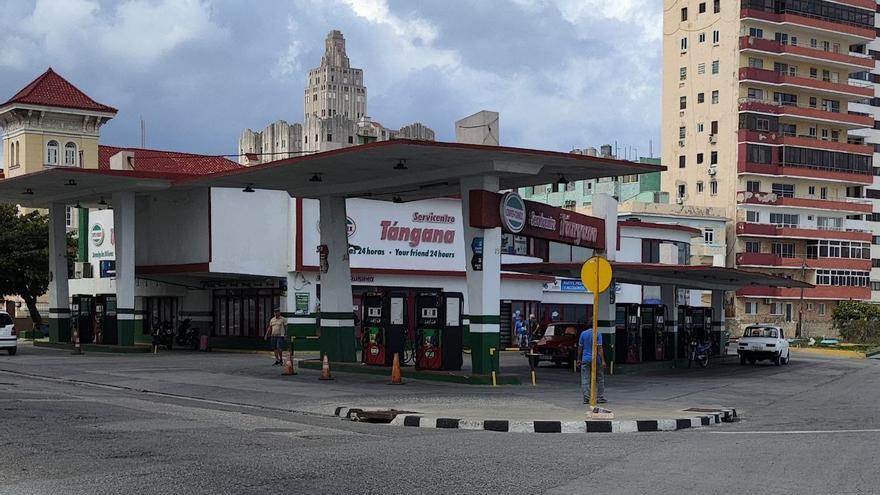
Fuel prices will go up on February 1st. (14ymedio)

14ymedio bigger14ymedio, Madrid, 9 January 2024 — Fuel on the Island will quintuple in price starting February 1st. But Cubans, always thinking ahead, are more afraid of the dangers to come. These include even larger price increases on the black market and shortages at service centers, especially for those paying in Cuban pesos (CUP) rather than hard currency (MLC).

Vladimir Regueiro Ale, Vicente da la O Levy and Tania Danay Vives Alfonso — the respective heads of the ministries of Finance, Prices, Energy and Mines, and the deputy CFO of Cimex — sat down for a television interview on Monday to explain some of the most widely feared changes that were announced as part of a series of economic reform measures. These include increases in the prices of fuel, electricity and natural gas. In the case of fuel, the price will rise from 25 to 132 pesos, an increase of 528%.

Similarly, the price of premium gasoline will go from 30 pesos a liter to 156 (or 1.30 dollars at the official exchange rate) while premium diesel will go from the current price of 27.5 pesos to 150 (1.25 dollars). The price has yet to reach 200 pesos, a source with Cuba Petroleo told 14ymedio last week, but, continue reading

for now at least, the increases will be about 520% and 546% repectively.

Inflation in the month of February is certain. There will be a 428% increase in the wholesale price of regular gasoline, which will impact other prices and fees

Increases in retail prices will be less significant. Regular gas will go from the current price of 16.46 pesos to 24.30 pesos. Meanwhile the price of premium will go from 17.37 to 26.00 pesos and diesel from 15.12 to 28.00. The overall effect will be an increase in February’s consumer price index (CPI), says economist Pedro Monreal on his X account. “Inflation in the month of February is certain. There will be a 428% increase in the wholesale price of regular gasoline, which will impact other prices and fees. Until now, higher fuel costs have never had an impact on the CPI,” he points out.

However, the factor that most worries the public it seems, judging from comments made on information websites and social media, is not so much the high prices themselves but their potential impacts. The government has based its decision on the need to increase foreign reserves in order to replenish supplies. To achieve this, it is creating a network of twenty-eight service stations that will only accept payment in dollars.

The idea has little novelty. On the contrary, it has brought to the minds of citizens the moment when, during the Special Period — after the collapse of the Soviet Union and the loss of its subsidies to Cuba — dollar stores and their national equivalent, the CUC (Cuban Convertible Peso), were created, which marked the border between those who had access to that currency and could buy better products and those who did not have it and had to settle for the undersuppied stores in pesos. The situation was later replicated with the shops in freely convertible currency (MLC), and now it reaches the gas stations.

“Having in the same gas station the sale in foreign currency and national currency will only generate greater corruption and enrichment than the current one, which is already enough, among those who work in stations and the supply chain, because they will easily say that they have no fuel in CUP to force people to pay in foreign currency,” writes a reader of Cubadebate.

“I can imagine the dialogue,” another jokes.

“There is no fuel for CUP.”

“I don’t have MLC on my card. How can I do it?”

“Easy, give me 270 for each MLC and I’ll give you my card.”

The problem is that the clerk then pays with his card in CUP because the user has no idea if there is fuel in CUP and no one finds out.”

Vives Alfonso explained that the new gas stations in dollars are not just for tourists but for anyone who has a means of payment regardless of nationality. The accepted cards will be Visa, Mastercard, MIR (a Russian card), prepaid issued by Bandec, the ICE card, the Traveler card and the new Classic card, which will be purposely issued by the exchange houses soon. In no case will cash payments  be accepted.

The Minister of Energy and Mines explained that so far Cubans are subsidizing tourists, since when they arrive in the country they buy 120 pesos with a dollar, but gasoline is at the official exchange of 24 pesos for a dollar. “There we can see the subsidy to tourism, to the foreigner, to that person who pays for gasoline at 1.30 dollars and here pays for it for at 30 pesos,” he said.

De la O Levy gave several data about the situation of fuel on the Island and the cost of acquiring it. In 2023, 203,000 tons of gasoline were imported (almost twice as much as in 2021), but the need is 360,000. “The enemy has blocked our access to fuel and there is no doubt about that,” he said. “A relentless persecution of fuel, ships, crossings, partners and allies has been applied… day after day,” he insisted.

Cuba requires about 1.8 billion dollars to be able to cover its annual needs, but last year it was only able to cover a third: 600 million dollars for 609,000 tons

The minister said that the majority of gasoline goes to the private sector, compared to diesel, which mostly goes to industries and transport, and whose imports were also small. Cuba requires about 1.8 billion dollars to be able to cover the annual needs, but last year it was only able to cover a third: 600 million dollars for 609,000 tons.

The new measures, he said, will “gradually achieve a stable supply,” although he let drop the worst fear by stating that “a good provision in both chains of service centers cannot be guaranteed from the first day of implementation.”

One of the sectors most affected by the changes is transport, which will have to reflect the increases by increasing costs, although for the moment no details have been offered for discussion. In the case of the industry, the increases are planned and will be supported with the budgets, but on a new episode of State TV’s Round Table program the officials warned of new announcements about the means of transport without a date in sight, “where it will be possible to explain rate by rate per service.”

Both private and state centers will be able to obtain the fuel at wholesale prices, they said.

In the coming days there will be campaigns for preparing workers and informing users in the service centers, and “there will be signage that shows the customer how to easily acquire the fuel by any of these means of payment. If there is a problem with any of them, there are other ways; at no time will the service be paralyzed because there is no connection or because it is not possible at that time to make a payment,” said the Cimex official.

Translated by Regina Anavy

____________

COLLABORATE WITH OUR WORKThe 14ymedio team is committed to practicing serious journalism that reflects Cuba’s reality in all its depth. Thank you for joining us on this long journey. We invite you to continue supporting us by becoming a member of 14ymedio now. Together we can continue transforming journalism in Cuba.

Colombia Cannot Prevent Exiled Cuban Baseball Players From Playing Because It Is a ‘Private Event’

The Cuban Professional Baseball Federation announced its team last October at a press conference in Miami. (Fepcube)

14ymedio bigger14ymedio, Madrid, January 10, 2024 —   The Cuban Government has embarked on a diplomatic struggle against a private competition and has enrolled in the task its ally, the Colombian Government, whose Ministry of Sport issued a statement on Tuesday in which it detaches itself from the Intercontinental Professional Baseball Series, which begins in Barranquilla on January 26 with the participation of FepCube, the Cuban-American team founded in Miami last year.

The Ministry reported yesterday in a joint statement with the Colombian Olympic Committee that the organizer of the event “of a private and invitational nature” is Team Rentería USA, so the tournament “is not continue reading

organized by the Colombian Baseball Federation, nor is it part of the events of the World Baseball and Softball Confederation, the only organization endorsed by the International Olympic Committee.”

The statement indicates that Team Rentería USA sent a proposal to the Ministry to contribute to its financing, but the project was rejected for not having complied with the formal requirements

The statement indicates that Team Rentería USA sent a proposal to the Ministry to contribute to its financing, but the project was rejected for not having complied with the formal requirements. According to the Colombian rule, for this type of public-private collaboration to exist, plans must be submitted to the national sports federations, something that was not done in this case.

So far, the arguments of the Colombian Government are limited to the facts, but they end up taking a step to the political by ruling on the possibility that FepCube can compete using “the name, representation and national symbols of the Republic of Cuba, without the respective authorization of the competent body of the country.”

The response specifies that “they reject the actions and demonstrations of the Cuban Professional Baseball Federation” in its claim to make use of those elements “without having the recognition of the Colombian Government” or its sports authorities.

“The use of these symbols would be interpreted as a clear violation of the constitutional and sports rights of the Republic of Cuba,” says the statement, which concludes by making an exclusive and legitimate recognition of the Cuban Baseball and Softball Federation.”

The document has been disseminated by the official Cuban press, both sports and national, “because of its importance,” the media point out. The ruling party itself is confirmed as well as the main promoter of an event to which it is giving prominence precisely when it tries to detract from it.

The tournament will be the presentation of the FepCube team – if nothing prevents it – made up of exiled Cuban baseball players and competing with the nickname Patria y Vida

Team Rentería is a private company, founded in Colombia in 1989, in order to organize, market and develop professional baseball in the country. In its 35 years of life it has promoted different tournaments and events at the national level or with teams and private sports entities from Latin American countries and other parts of the world.

In the case of the Intercontinental Professional Baseball Series, heir to the Latin American Series that was played between 2013 and 2020, players from countries such as Japan and South Korea are now incorporated and will compete with Colombians, Americans, Curaçaoans and Cuban Americans until the first of February.

The tournament will introduce the FepCube team – if nothing prevents it – made up of exiled Cuban players and competing with the nickname Patria y Vida. The Cuban Government, visibly upset, has decided to deploy a campaign against the private group whom it has called “a monstrosity” and has not hesitated to carry out a diplomatic offensive, leading Colombia to pronounce on what should be a brief league between voluntarily associated entities.

Translated by Regina Anavy

____________

COLLABORATE WITH OUR WORKThe 14ymedio team is committed to practicing serious journalism that reflects Cuba’s reality in all its depth. Thank you for joining us on this long journey. We invite you to continue supporting us by becoming a member of 14ymedio now. Together we can continue transforming journalism in Cuba.

The Mother of an ’11J’ Political Prisoner Stands Up To Demand That Her Son Be Taken to a Hospital

Migdalia Gutiérrez Padrón is “planted” outside prison 1580 in the municipality of San Miguel del Padrón in Havana. (Cortesía)

14ymedio bigger14ymedio, Havana, January 10, 2024 — Migdalia Gutiérrez Padrón, mother of political prisoner Brusnelvis Cabrera Gutiérrez, has planted herself outside prison 1580 in the municipality of San Miguel del Padrón in Havana. The woman demands medical attention for her son — sentenced to 10 years in prison for participating in the protests of 11 July 2021 — who has felt sick for weeks.

Gutiérrez Padrón refuses to move from the place until her son is transferred to a hospital center, since the young man feels depressed and has lost a lot of weight, according to what she told the Cuban Observatory for Human Rights. “Even if I’m alone, I’m not leaving until they take him to a hospital,” the woman said.

Brusnelvis Cabrera Gutiérrez, 24 years old, was transferred to the maximum security prison last August. “That prison is also called ’the dryer’ because everyone there is very skinny and hungry. In all prisons in Cuba there is 99.9% hunger, but in that one you suffer 100%,” the mother told this newspaper.

The change of prison occurred several days after the young man refused to eat or wear the prison uniform in the Combinado prison of east Havana. The mother saw the move with suspicion: “I don’t expect anything good from the dictatorship. The dictatorship doesn’t give anything good and we don’t want it,” she told 14ymedio at the time. “I see that it is a prison with many continue reading

complications. There is nothing favorable in this transfer.”

Cabrera Gutiérrez was initially sentenced to 15 years in prison for allegedly demonstrating in the popular protests of 11 July 2021

Cabrera Gutiérrez was initially sentenced to 15 years in prison for allegedly demonstrating in the popular protests of 11 July 2021 (’11J’), a participation that both the young man and his family emphatically deny. Last year, his sentence was reduced to 10 years after an annulment verdict.

Migdalia Gutiérrez Padrón has been one of the mothers of the 11J prisoners who has maintained a constant complaint in public spaces and social networks. In July 2022,  the day of the first anniversary of the protests, she was detained for a few hours for wearing white.

Gutiérrez Padrón also alleges that the evidence against her son is spurious. During the first trial, which took place in March last year, the image of a young man on a motorcycle who, with the movement of his arm, summoned the demonstrators, was enough for the Court to condemn him, despite the fact that the mother has insistently refuted that he was her son: “The boy in the photo has no tattoos on his arm and my son is full of tattoos”

Now, Migdalia Gutiérrez Padrón is carrying out a new battle, and this time she is demonstrating outside the prison.

The concept of “planting yourself” began to be used in Cuba from 1959, when the first political prisoners were convicted after Fidel Castro came to power. Many of those inmates, the plantados, refused to accept rehabilitation in prison, to wear the prison uniform and to perform forced labor. For the relatives of the inmates, the concept means protesting and remaining intransigent until the prison authorities improve the prisoner’s situation or release him.

Translated by Regina Anavy

____________

COLLABORATE WITH OUR WORKThe 14ymedio team is committed to practicing serious journalism that reflects Cuba’s reality in all its depth. Thank you for joining us on this long journey. We invite you to continue supporting us by becoming a member of 14ymedio now. Together we can continue transforming journalism in Cuba.

Cuba Recommends Wearing Masks in Crowds, but Does Not Require Tourists To Take Covid Tests

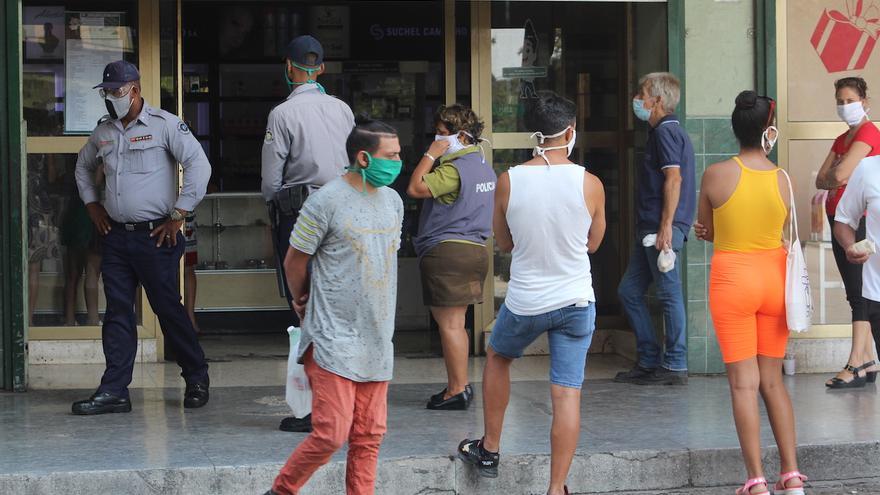
Image in Havana in August 2020, during the covid-19 pandemic (14ymedio/File)

14ymedio biggerEFE (via 14ymedio), Havana, 9 January 2024 — The Cuban Public Health Ministry this Tuesday recommended that people use masks in crowds and keep to the program of vaccination against covid-19.

The request, issued in an article from the Minister of Public Health, José Ángel Portal Miranda, came out just after the country kept to its position of not requiring covid-19 tests for tourists coming to the island, at the start of the economically-important high tourist season.

Portal Miranda affirmed that his ministry maintains “active” epidemiological and microbiological surveillance in its health system to detect the presence of respiratory viruses and new variants of covid-19.

He stressed that in Cuba “the current increase in these infections is not significant”, although he cited the recent alert issued by the World Health Organization (WHO) in view of the world-wide increase in respiratory diseases caused by covid-19, influenza and other viruses during the last few weeks. continue reading

However, he drew attention to the “need to comply with health protection measures, especially in vulnerable groups” during the coldest time of the year, which coincides with the seasonal period of acute respiratory infections.

So far in 2024 the most frequent covid-19 subvariants on the island are XBB 1.5, XBB.1.9 and XBB.1.16, classified by the WHO as being of interest or under surveillance

The health authority pointed out the importance of using masks “in places with high concentrations of people; the need to go to the doctor when respiratory symptoms appear, and to keep the anti-covid-19 vaccination schedule up to date”.

In this regard, he said that as part of the country’s health protocols, vaccination against covid-19 has continued to be carried out, with “special emphasis” on children from two years of age, pregnant women and people identified as vulnerable, who are receiving booster shots.

The Ministry of Public Health (Minsap) reported that as 0f January 5, 90.9% of the population (10,044,217 people) had received the complete schedule of the three Cuban-made anti-covid-19 vaccines: Soberana 02, Soberana Plus and Abdala.

Portal Miranda stated that control of the circulation of the covid-19 virus has been achieved on the island and that in 2023, of the more than 121,800 tests performed, only 2.5% were positive.

He added that in the last two months of 2023 and so far in 2024 the most frequent covid-19 subvariants on the Island are XBB 1.5, XBB.1.9 and XBB.1.16, classified by the WHO as being of concern or under surveillance.

A recent publication by the Ministry of Public Health explains that international travelers “do not have to present any negative test for covid-19” upon arrival on the island and pointed out that only those who present or are detected with respiratory symptoms will undergo a rapid test or PCR sample collection.

Recommendations to visitors include the use of face masks in airplanes and air terminals, as well as in crowds and on public transportation.

Translated by GH

____________

COLLABORATE WITH OUR WORKThe 14ymedio team is committed to practicing serious journalism that reflects Cuba’s reality in all its depth. Thank you for joining us on this long journey. We invite you to continue supporting us by becoming a member of 14ymedio now. Together we can continue transforming journalism in Cuba.

The Wealthy Districts of the Cuban Capital Enjoy VIP-Level Cleaning Services

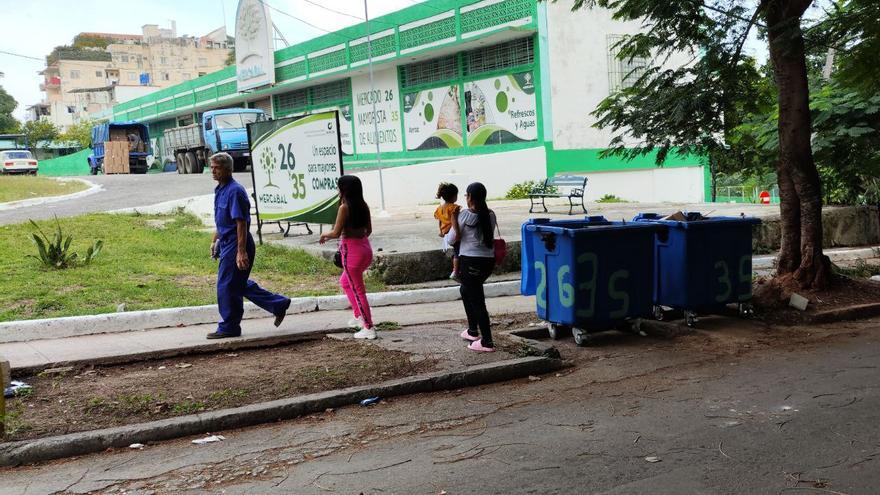
Perhaps what stands out most in this neighborhood are the garbage containers: spotless and emptied, without the mountains of garbage around them that can be seen in so many corners of the city (14ymedio).

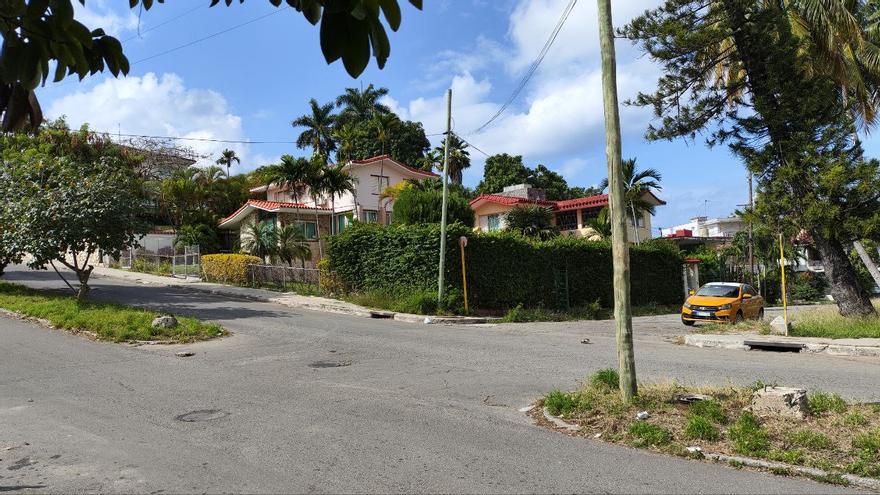
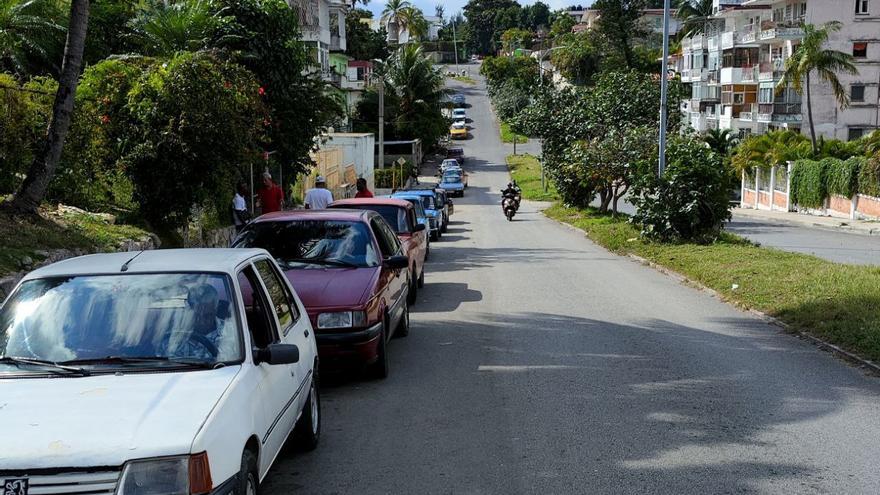
14ymedio bigger14ymedio, Juan Diego Rodríguez, Havana, 8 January 2024 — Beyond Nuevo Vedado, past the Colón cemetery and the zoo, on the border between Playa and Plaza de la Revolución, passers-by can admire a landscape that does not exist in the center of the capital. Wide, tree-lined streets, huge, well-kept houses, well-dressed people, some of them with bags full of food, modern cars. Here, on Kohly Avenue, you can´t hear shouting or arguing, and the only queue that can be seen, at the Acapulco gas station, moves forward in an orderly fashion.

It is the other face of the Cuban capital, far removed from the chaos of Central Havana or Old Havana, not to mention poorer municipalities such as Cerro, La Lisa or Diez de Octubre, where decay and dirt leave little room for beauty. Surprisingly, and as a significant indicator, there are ATMs, such as those of the Banco Metropolitano at 26 and 32, with money, without queues and working properly.

Wide, tree-lined streets, huge, well-kept houses, well-dressed people, some of them with bags full of food, modern cars (14ymedio).

But perhaps what are most noticeable in this neighborhood are the garbage containers: spotless and emptied, without the mountains of garbage around them that can be seen in so many corners of the city, and that sometimes, give rise to dangerous fires. The Community Services people can be seen working in these streets.

n Kohly Avenue, you can´t hear shouting or arguing, and the only queue to be seen is at the Acapulco gas station, moving forward in an orderly fashion.

Kohly illustrates the inequalities that the Revolution, far from solving, accentuated. A normal well-preserved and civilized city, inside another city, which is neglected and where the law of the jungle prevails… reserved for those who do not have a share of power on the island.

Translated by GH

____________

COLLABORATE WITH OUR WORKThe 14ymedio team is committed to practicing serious journalism that reflects Cuba’s reality in all its depth. Thank you for joining us on this long journey. We invite you to continue supporting us by becoming a member of 14ymedio now. Together we can continue transforming journalism in Cuba.

A Mother of Four Children Killed by Her Partner in Holguin, Cuba

In 2023, the independent platforms and media confirmed the murder of 87 women. (EFE/Ernesto Mastrascusa/file)

14ymedio bigger14ymedio, Havana, January 10 2024 – Independent platforms  Alas Tensas y Yo Sí Te Creo in Cuba this Wednesday confirmed the second femicide of the year, which had hardly started. This was Yanilsa Zamora Miranda, a 48 year old housewife. It is understood that she was killed by her partner this Tuesday in her house in calle Guarro, in Santiesteban Department, Holguín.

The first news of the crime was given by an official Facebook profile, Cazador-Cazado, calling it a “passionate murder.” The brief text said, without referring to the victim, that “in the early hours of the morning” the individual Yusniel Arevalo Mora presented himself at the 3rd Police Station of the eastern city to declare that “he had taken the life of his partner”, which, it stated, “was corroborated by the authorities.”

In the early hours of the morning” the individual, Yusniel Arevalo Mora,  presented himself at the 3rd Police Station in the eastern city to declare that “he had killed his partner.”

Zamora Miranda leaves three daughters and a son, two of them still minors.

Just two days ago, both Alas Tensas and Yo Sí Te Creo included in their records the murder of Diana Rosa Cervantes Mejías, the first femicide of 2024, which had been confirmed by the independent press on January 3.

As detailed in La Hora de Cuba, the 29-year-old victim was brutally beaten by the alleged assailant, who was out on bail and awaiting trial at the time of the crime, for having assaulted “a co-worker with a machete.”

In 2023, independent platforms and media confirmed the murder of 87 women, more than double the 36 recorded the previous year.

Translated by GH

____________

COLLABORATE WITH OUR WORKThe 14ymedio team is committed to practicing serious journalism that reflects Cuba’s reality in all its depth. Thank you for joining us on this long journey. We invite you to continue supporting us by becoming a member of 14ymedio now. Together we can continue transforming journalism in Cuba.

Former Cuban Soldiers Call for ‘Overthrowing the Current Mafia Regime’

The Military Objectors of Conscience ask their former colleagues not to obey their superiors. (EFE/Ernesto Mastrascusa)

14ymedio bigger14ymedio, Madrid, January 8, 2024 — The Military Objectors of Conscience (MOC), founded in 2021 by former Cuban officers in exile, says that the Communist Party does not actually govern in Cuba, but rather a “new oligarchic class” – formed by the Castro Espín and Gaesa family, through the control of national wealth – that only defends their own interests and against whom “rebellion is a current constitutional right.”

In a statement released this Sunday, the group affirms that the Cuban people are suffering “the totalitarian dictatorship of a mafia, a parasitic and irresponsible oligarchy that only defends their own interests.” The MOC believes that the military surrounding the Castro clan controls 70% of the country’s wealth and 95% of the financial transactions, abandoning the population and its basic needs, such as food, health, housing, education and security.

This network, they say, believes that Raúl Castro will die this year and is preparing to liquidate any “potential leader” who stands in the way of their maintaining control of the country

This network, they say, believes that Raúl Castro will die this year and is preparing to liquidate any “potential leader” who stands in the way of their maintaining control of the country. “In 2024 there is the possibility of a new dawn for our homeland or an even darker stage than what we have now,” highlights the statement, which warns that neither the repression after the anti-government protests of 11 July 2021, known as ’11J’, nor the stimulation of emigration will be able to contain a new social explosion. continue reading

“The army must protect the population with their weapons, not shoot at it,” the soldiers urge their former comrades, and they point out that Military Counterintelligence will attempt to organize a purge “to take out of the middle those who, due to their historical trajectory, prestige, level of information and/or command of troops, can interfere with their purposes.”

The MOC addresses the active Cuban military and appeals to them not to obey their superiors if they follow orders from that “oligarchic caste” and not from the citizenry.

“There is no ’order and command’ owed to those superiors in rank who call for attacking the people. Helping to get this group of thieves out of power is a merit, not a betrayal,” they insist.

The text appeals to the Constitution of 2019, which in Article 4 calls on citizens to use all means “including armed struggle, when no other recourse is possible, against anyone who tries to overthrow the established political, social and economic order,” and it asks the population to speak out against the institutions.

The group affirms that it is not asking for a “military coup, but for actions within the Law.”

We do not want violence or call for it, but the way in which the change occurs will depend on the oppressors, not the oppressed. They can choose the Czechoslovakia and Poland way or that of Romania

“We do not want violence or call for it, but the way in which the change occurs will depend on the oppressors, not the oppressed. They can choose the Czechoslovakia and Poland way or that of Romania,” the statement adds. In the case of Romania, the dictator Nicolás Ceaucescu and his wife were shot on Christmas Day after a citizen rebellion in 1989.

“It is legitimate for the Cuban military and the citizenry to constitute a National Salvation Committee and invoke Article 4 of the virtually defunct Communist Constitution of 2019 to overthrow the current mafia regime and put an end to the long night of totalitarianism in Cuba,” the text continues.

According to the MOC, when the current regime is removed, a commission will prepare free elections and draft a new constitution that must be validated in a referendum by the Cuban people. The political prisoners will be released, and full freedom and economic initiatives will be promoted for all Cubans without exclusions.” Food recovery, health, protection of the vulnerable and other urgent tasks will depend on them.

“Liberation from the totalitarian regime will allow the country to develop with the most modern technologies and thus finally incorporate Cuban society into the new era of information of the 21st century,” concludes the text, ending with the phrase “Homeland and Life.”

Translated by Regina Anavy

____________

COLLABORATE WITH OUR WORKThe 14ymedio team is committed to practicing serious journalism that reflects Cuba’s reality in all its depth. Thank you for joining us on this long journey. We invite you to continue supporting us by becoming a member of 14ymedio now. Together we can continue transforming journalism in Cuba.

Child Beggars, a Growing Problem in the Cuban City of Holguin

Children enter and leave a private business during the day and at night. (14ymedio)

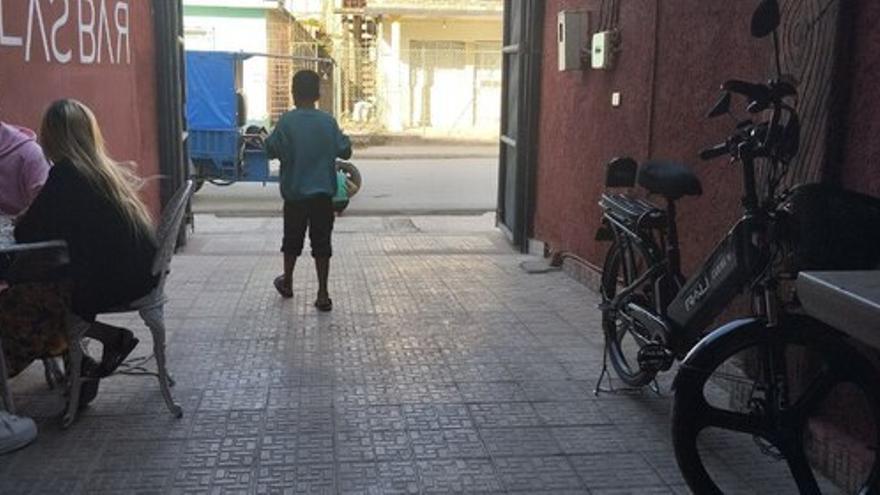
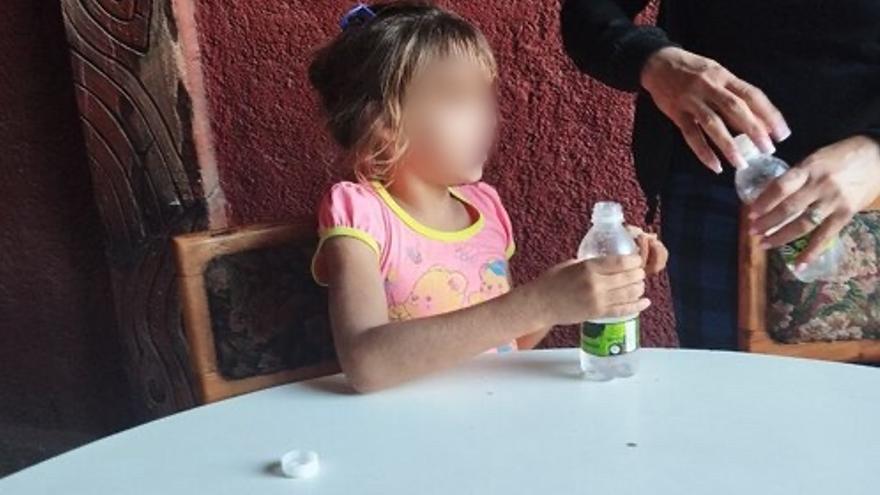
14ymedio bigger14ymedio, Miguel García, Holguín, January 6, 2024 — The youngest is called El Gatico [The Kitten] because he can sneak through any hole, jumps over walls and appears in the most unexpected places. She responds to the name of Rosita, and from the age of five she has been asking for money on the streets of Holguín. She and other children have formed a group who wander in the cafes, bars and restaurants.

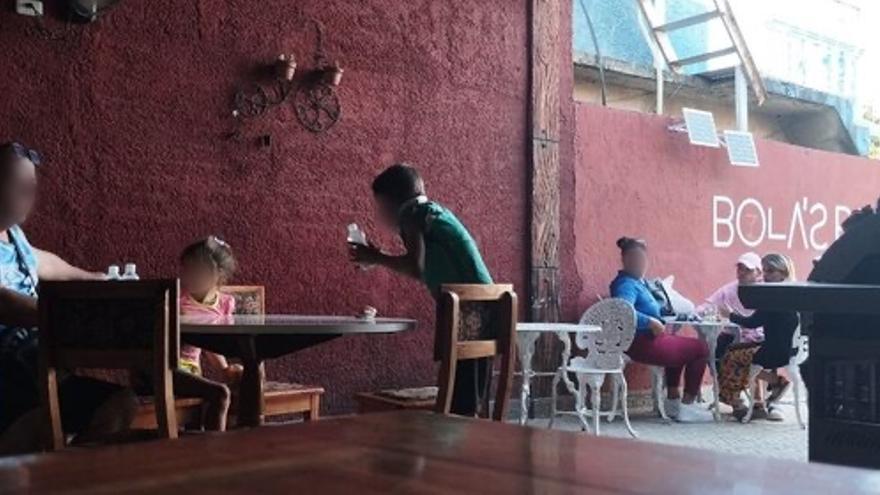
In the private Bolas Bar, located in the popular neighborhood of Pueblo Nuevo, they move between the tables, get on top of the customers begging them to share some of their food or, instead, to slip some bills in their hands. Rare is the day when these children with emaciated bodies and worn clothes, undermined by malnutrition, do not appear in the area.

Despite their young ages, which range from six to 14 years old, the children who make up this group sleep many nights on the street. Their parents, some alcoholics, others ill with HIV and all very poor, urge them to look outside their homes for everything that can help them survive on a day-to-day basis. Food, money, some clothes torn from a clothesline or a light bulb stolen from a doorway: everything works for them.

Sometimes, those who are there eating and drinking give them a soft drink. (14ymedio)

“This is one of the most critical cases in Holguín, and the State does nothing about it despite the reports we have made,” says Marcia, a social worker who investigated the situation of the children and presented a report on their vulnerability. “These children have been in this situation for years; the girl has been begging on the street since she was five years old. At first they were with an adult, but now that she is 11, she goes alone.” continue reading

“Someone passed through Pueblo Nuevo and took a photo of Rosita sleeping on the street after midnight. She goes to elementary school, but in the afternoons and evenings she dedicates herself to begging. Many times she goes barefoot because she doesn’t even have shoes,” says the social worker. “In these days when the temperatures dropped, they were without coats, with very few clothes.”

Several complaints to the local authorities have ended in evasive and bureaucratic responses. “Once they fined Rosita’s mother, but that’s not what needs to be done. She is also a victim. What is needed is to help that family, support them and get that girl and everyone else off the streets before a tragedy occurs,” the woman points out.

Several complaints to the local authorities have ended in evasive and bureaucratic responses

As the days go by, some try to help by buying the children in the group some food or giving them some Cuban pesos, but the fear of the majority is that “their numbers are increasing,” says a neighbor of Pueblo Nuevo. “The one you see there has already formed his own group of children to ask for money; before he belonged to the one his brother created,” he explains to this newspaper. “That other one is not from this neighborhood but arrived and now sleeps in the doorways.”

Children between six and 14 years old are in this situation of begging. (14ymedio)

“They don’t want people to take photos because they obviously don’t want to be identified. They climb the balconies of the buildings. The Directorate of Attention to Minors of the Ministry of the Interior and the Prosecutor’s Office know about these cases, because the social workers have denounced this a lot, and both the Communist Party and the local government are aware,” says Marcia.

“The life that Rosita and El Gatico are leading, in addition to the other children, is known to everyone, but there’s a lot of talk and little action,” she says bitterly. Between the walls, wine red, of the Bolas Bar, a little one stretches his hand and asks for a soft drink from a customer who is eating there with his family. After receiving a bottle of lemon soda, the child takes a long drink and runs away.

Translated by Regina Anavy

____________

COLLABORATE WITH OUR WORKThe 14ymedio team is committed to practicing serious journalism that reflects Cuba’s reality in all its depth. Thank you for joining us on this long journey. We invite you to continue supporting us by becoming a member of 14ymedio now. Together we can continue transforming journalism in Cuba.

Six Former Cuban Intelligence Commanders Warn About the Actions of the Cuba’s Agents in the World

The spy Ana Belén Montes, when she was awarded by the then director of the CIA, George Tenet. (Capture)

14ymedio bigger14ymedio, Madrid, 29 December 2023 — The Cuban regime is a “threat” to security not only for citizens within the Island but for all democracies. This warning comes from six former dissident officers of the Armed Forces and the Ministry of the Interior in a letter that they made public this Friday through the organization Cuba Archive on the occasion of the 65th anniversary of the Revolution.

Signed by Orlando Brito, José Cohen, Rafael del Pino, Enrique García, Alcibíades Hidalgo and Máximo Omar Ruiz, former senior commanders of the Security Forces, who defected and went into exile between 1987 and 2011, the missive warns that the Cuban intelligence services have a large number of agents spread all over the planet “whose alleged loyalties do not arouse suspicion” and that they aim to “serve the interests of the Cuban dictatorship.”

“They operate within their governments, parliaments, media, universities, churches, cultural institutions, companies and other sectors of society, even at the highest levels,” they say, based on the fact that, as former officers of the Armed Forces, the Ministry of the Interior, the Government and the Communist Party of Cuba, they know “from the inside their objectives and methodologies.”

Thus, they point out that what happened in recent years with the spies Víctor Manuel Rocha – arrested just this December; Ana Belén Montes – just released after serving two decades in prison; and Kendall Myers – who was an official of the State Department, is only the “tip of the iceberg.” “They are not isolated cases or relics of the Cold War, as some have declared; on continue reading

the contrary, they are the result of a work of decades whose exponential returns are difficult to imagine,” they say.

For these former soldiers, that of the Cuban regime is an “aggressive job” whose main task is to go against the United States and “defeat democracies and their values   

For these former soldiers, that of the Cuban regime is an “aggressive job” whose main task is to go against the United States and “defeat democracies and their values.” To do this, “it has a gigantic state apparatus dedicated to disinformation, propaganda and influence supported by virtually all government officials, including diplomats, journalists, academics and artists” that “receives a priority allocation of resources regardless of the great needs suffered by the people.”

The signatories ask the United States to examine “carefully” the impact caused by Rocha “in his long career as an agent of Cuba,” in addition to urging educational institutions to “objectively teach the history of communism and the Cuban Revolution, the impact of Cuban internationalism and the advance of Marxism.”

Among the measures they urge all democratic governments in the world to take to counteract the actions of Cuban Intelligence are “controlling the number of Cuban diplomats accredited in their national territory, as well as their access and geographical projection” and “establishing appropriate controls to deny visas and entries through border points to senior Cuban officials and repressors.”

Translated by Regina Anavy

____________

COLLABORATE WITH OUR WORKThe 14ymedio team is committed to practicing serious journalism that reflects Cuba’s reality in all its depth. Thank you for joining us on this long journey. We invite you to continue supporting us by becoming a member of 14ymedio now. Together we can continue transforming journalism in Cuba.

At Just 12 Years Old, the Youngest Baseball Player in the Gurriel Family Leaves Cuba for the United States

Luis Enrique Gurriel, cousin of the players Lourdes Jr. and Yuli Gurriel, has been in the Dominican Republic for a few days after leaving Cuba.

14ymedio bigger14ymedio, Havana, January 9, 2024 — The chances of the youngest of the Gurriel dynasty, at only 12 years old, of being hired by a Major League team are focused on the 2027-2028 Draft, according to At Bat. However, the talent scouts could first incorporate him into one of the training schools. “He has physical and technical potential,” said journalist Francys Romero. “Several experts believe that his skill with the bat is the most developed right now. He is a player who must continue to increase his athletic biotype.”

Romero also pointed out that the players who leave the Island are getting younger and younger. “From the last Cuba U-12 team (February 2023), five 12-year-old players have left the country.” Before Luis Enrique Gurriel Jr. there were Mario Serra, Kendry Abreu, Gabriel Tito Mustelier and Yondel Sajoni Cárdenas.

During his stay on the Island, Gurriel Jr. was part of the Granma team that participated in the Little Leagues in the summer. In the U-12 World Cup in Aguascalientes (Mexico), he recorded a batting average of .412, with two home runs and four runs.

Last year, the exit trend was marked by the U-15 athletes. Of the players who represented the Island in Mexico in 2022, only Yordan Rodríguez, Yaidel Ruíz and Maikol Rodríguez remain. The list of those who are looking for a better future outside is made up of Alejandro Cruz, Alex Santiago, Pedro Danguillecourt, Jaider Suárez, Dulieski Ferrán, Ernest Machado, continue reading

Yosniel Menéndez, Roberto Peña, Segian Pérez, Alejandro Prieto, Danel Reyes, Ronald Terrero, Jonathan Valle, Yunior Villavicencio, Cristian Zamora and Mailon Batista.

Edislandy Monteagudo salió de la Isla con destino a México, desde donde buscará llegar a las Grandes Ligas de EE UU. (X/@francysromeroFR)
Edislandy Monteagudo left the Island bound for Mexico, from where he will seek to reach the US Major Leagues. (X/@francysromeroFR)

In December of last year, pitcher Edislandy Monteagudo also emigrated. This 21-year-old athlete, originally from Isla de la Juventud, settled in Mexico, where he will undergo an appropriate training to present himself to Major League organizations.

With the Pirates of the Island Monteagudo received an opportunity to play in some games of the 62 National Series, for an average of 3.1 innings. Among his characteristics, his power as a pitcher stands out.

At 6 feet 8 inches, he is able to throw a straight line of 92-93 miles, which could increase with a more specialized professional training that contributes to improving his throwing mechanics.

In 2023, more than 100 players emigrated from Cuba, in all categories and ages.

This Monday it was confirmed that after several months in Mexico, the former baseball player, Gerardo Miranda, arrived in the United States. On the Island he joined the teams of Havana and Artemisa. “His father Gerardo, a prominent outfielder of the 80s and 90s, still lives in Cuba,” Francys Romero said.

Translated by Regina Anavy

____________

COLLABORATE WITH OUR WORKThe 14ymedio team is committed to practicing serious journalism that reflects Cuba’s reality in all its depth. Thank you for joining us on this long journey. We invite you to continue supporting us by becoming a member of 14ymedio now. Together we can continue transforming journalism in Cuba.