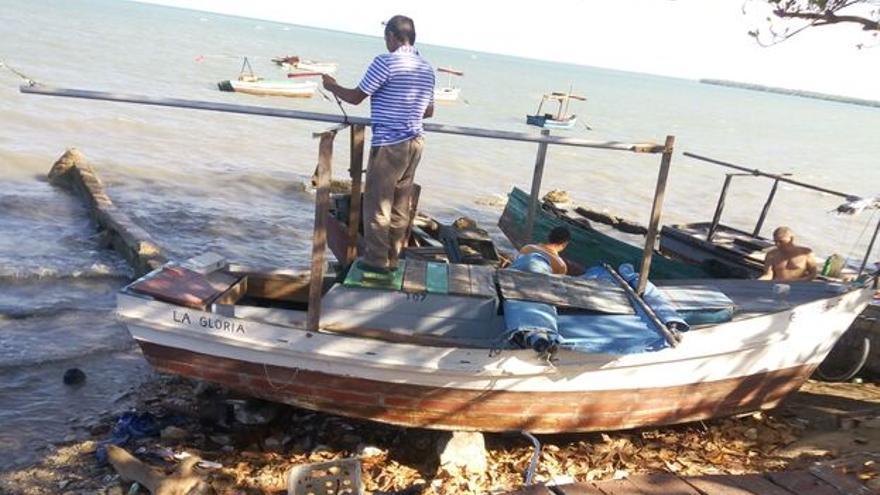

The State Buys Fish from Us for One Peso per Pound, Individuals Pay Two Hundred

Although fishing is his great passion, Chucho does not go out to sea as much as before. (14ymedio)

14ymedio bigger14ymedio, Juan Matos, Manzanillo (Cuba), 28 January 2024 —  As he talks, Chucho likes to “pass his hand” over the boat he uses to go fishing. A crust of salt disfigures its sides, the hull is patched with pieces of aluminum and it is not uncommon for the engine to stall while at sea. It is a hard life and it pays little, but he and the other fishermen in Manzanillo, a town in Granma province, have a motto: “We cannot stay on land.”

At sea there is food, even though it is hard get. On land – besides the problems of living in one of the poorest towns in Cuba — they wait for the inspectors, the fishing industry bureaucrats and the local townspeople, who come to the beach on bicycle, hoping to buy fish directly from the people who catch them.

Buying and selling on the informal market, and making deals with private business owners, while avoiding raids by inspectors are the only ways to survive. “When you do business with the state, they always win, explains Chucho. “The Fishing Combine pays us less than 2,000 pesos for every ton of fish we catch. And one ton is 2,200 pounds,” he calculates. “It’s a total rip-off. The state pays less than a peso for each fish.”

“We’re forced to sell to private individuals, who pay us 200 pesos a pound. Then they resell it.” There are those who manage to make a good deal with a small business owner who buys the entire catch from them. “It’s a good way to get the merchandise out quickly,” admits Chucho, but delivering it requires speed and agility. And sometimes, he complains, the boats’ puny continue reading

engines do not cooperate.

“Your paperwork has to be up to date at all times because, on the coast, the inspectors issue harsh fines over the ’engine issue,’ but we are very careful.” The engine issue is the Achilles heel of the fishing industry in a country on edge due to the authorities’ obsession with controlling “illegal” departures. Although located on the southern coast, Manzanillo is not immune from bureaucratic rigidity and surveillance. “We fish up to eight kilometers from the coast,” says Chucho. That is the boundary of the official preserve, though he adds, “The border guards have never put limits on us.”

Without hiding his passion for his craft, Chucho describes his technique. “We fish with nets that we make ourselves. We catch mackerel and mullet while the smaller fish slip through the net. We throw the line and catch fish up to 80 or 100 pounds. We also fish for Spanish mackerel, sawfish, redfish and snook.”

There are boats that have been sitting here for years because their owners do not have the money to fix them

Chucho is speaking next to a strip of beach with unused boats lying amid mangroves and palms. “There are boats that have been sitting here for years because their owners do not have the money to fix them. It doesn’t matter that we are in love with the sea. When something breaks, we have to figure out how to fix it.”

Each fisherman pays a security guard forty pesos a month to keep an eye on their boats. “He is a serious person,” explains Chucho. Trust is essential and, after working at it for several years, the man has earned it. “It’s been years since we had any theft here and he knows his job is secure.”

Despite the obstacles the state puts in their way and the challenges of the profession, Manzanillo benefits from the fisherman. Several establishments in the town carry signs offering pompano and mackerel, both for 260 pesos a pound.

As it has for centuries, the profession has other cards to play: luck and the tricks a fisherman has learned out on the ocean. “The sea is very hard. You know when to leave but you never know if you’re going to see your family again. We have learned to live the real danger of not returning,” says Chucho.

Others spend their whole lives working. Their hands are worn from abrasions and salt water. “After all these years, I haven’t even been able to build even a nice little cabin,” complains Chucho. Experience has taught him not to trust the promises of officials. Eating, supporting one’s family, surviving. Those are the only things that matter in Manzanillo.

“They, the state, have their fleets but we, the little guys, have to keep plugging along. The way things are — with an engine that costs an arm and a leg, and all the juggling we have to do with the paperwork — sometimes we’d rather just leave the boats on land and not go out.” The boat cemetery on the beach is a fitting testament to that final sense of resignation. Lying on the sand, with no one to “pass their hands” over them, the boats languish like the elegant colonial mansions in the old town center, ruins created by apathetic officials of a city whose glory days were made possible by its port.

____________

COLLABORATE WITH OUR WORKThe 14ymedio team is committed to practicing serious journalism that reflects Cuba’s reality in all its depth. Thank you for joining us on this long journey. We invite you to continue supporting us by becoming a member of 14ymedio now. Together we can continue transforming journalism in Cuba.

Even Honey, Cuba’s Star Product and a Great Source of Foreign Exchange, Suffers a Collapse

In 2021, Cuba produced more than 10,500 tons of honey, a figure not seen since 1962, when it produced 10,215 tons. (Capture)

14ymedio bigger14ymedio, Havana, January 30, 2024 — Despite the declared optimism of the Cuban authorities about the potential of beekeeping, honey production is no longer free from the general collapse of the national economy and registered data lower than official forecasts in 2023.

According to the information published by the newspaper of Las Tunas, this province recorded a production of 275.7 tons last year, less than half of the production for 2020 and barely 53% of what was planned.

Cuban honey and derived products are recognized for their high quality. It is estimated that this is a unique product due to its condition, and, in addition, the Government knows how to obtain notable revenues through its commercialization. The farmers sell it to the Cuban Beekeeping Company (Apicuba), which evaluates the quality and determines the price. continue reading

Honey receives better remuneration than other products, but the payment to producers is not exempt from prolonged delays of up to six months

Thanks to the embargo by the United States and the loss of the Soviet aid which had flooded the Cuban field with agrochemicals, national honey producers have developed biofertilizers and biopesticides, allowing them to get rid of the pests that are killing the bee colonies in much of the world.

Honey receives better remuneration than other products, but the payment to producers is not exempt from prolonged delays of up to six months, and the amount is still negligible in relation to the economic benefit that the regime obtains. While the Cuban State pays 600 in foreign currency per ton of honey to the producer, it sells it on average for more than 4,000 euros and, in some cases, for 20,000 euros per ton.

In 2021, Cuba produced more than 10,500 tons of honey. According to official figures, the Island has not known a similar figure since 1962, when it produced 10,215 tons.

That year, the Island’s authorities indicated that they were among the main honey-producing countries in the world, occupying the 15th position. Revenues from exports reached about 20 million dollars, and projections for 2030 suggest exports close to 50 million dollars annually.

It is a product that is successfully exported given the demand for Cuban honey in Europe. The most interested buyers are German, Dutch, French and Spanish.

On the other hand, official sources pointed out, in other areas of the same sector, such as wax, pollen and propolis, the initial expectations were more than met and even set records

As has happened for decades and repeatedly, to explain the decline of once successful sectors such as sugar and coffee, it was indicated that the causes of the poor results in Las Tunas had to do, on the one hand, with the intense drought in the first of the year and, on the other, with the loss of 311 hives due to the June rains in the southern municipalities.

On the other hand, in other areas of the same sector, such as wax, pollen and propolis [a resin bees produce to seal gaps in the hives], initial expectations were more than met and even set records. Likewise, the regime celebrated the advances in the production of organic honey and Melipona bees with the genetic improvement program, an obsession that accompanies the regime from the time of the prodigious White Udder cow.

Regarding the number of hives, the claim is that 2023 concluded with 300 more hives than in 2022 in Las Tunas, and this year it will reach 12,530, adding 730 more. The focus will be on enhancing the training of beekeepers, sanitary standards and planting flowers for honey production. In any case, the projections for 2024 are modest and below the 2020 production.

Translated by Regina Anavy

____________

COLLABORATE WITH OUR WORKThe 14ymedio team is committed to practicing serious journalism that reflects Cuba’s reality in all its depth. Thank you for joining us on this long journey. We invite you to continue supporting us by becoming a member of 14ymedio now. Together we can continue transforming journalism in Cuba.

Cuban Authorities Blame the ‘Human Factor’ for the Increase in Deaths From Road Crashes

Last October, the Minister of Transport admitted that he does not have the equipment or funds to repair the roads. (ICRT)

14ymedio bigger14ymedio, Havana, January 30, 2024 — When reporting the causes of traffic crashes, the Cuban authorities have two big favorites: the violation of the right of way by drivers and lack of attention to the vehicle. In both cases, the driver is always responsible while the poor condition of the roads – denounced again and again by the population – does not even appear among the main causes of crashes and is mentioned as a secondary factor.

“The frequency and dynamics of occurrence of traffic crashes in the country continues to be marked by the irresponsibility of drivers and pedestrians, with the human factor being responsible for 91% of these events,” said the official newspaper Granma in January, which placed the number of accidents in 2023 at 8,556, with 729 deaths and 5,938 people injured.

The overall figure is lower than that of 2022, when the number of crashes was 9,848; however, the number of deaths increased by 24 from one year to the next. continue reading

Granma recognizes, although obliquely, the precarious condition of the roads, caused by “the limitations on investments for their improvement”   

Granma recognizes, although obliquely, the precarious condition of the roads, caused by “the limitations on investments for their improvement.” The same thing was declared last October by the Minister of Transport on Cuban Television, when he alleged that the roads deteriorate faster than the State is able to repair them. To this is added the limited availability of raw materials and parts for the asphalt factories, which are currently working at a minimum to cope. According to official data from last July, 75% of the Island’s roads were in average or poor condition.

Interviewed by the newspaper, Roberto Rodríguez Fernández, head of the Specialized Traffic Body of the Police, also admitted that “the economic situation and the deficit of parts and pieces continue to have a negative impact on the technical status of the vehicles” and that, although the crashes caused by this factor registered a decrease, the number of deaths increased. “Accidents accounted for 10% of the total” deaths in 2023, he said.

This January, an article published in the newspaper of Las Tunas, Periódico 26, again drew attention to the indiscipline of both drivers and pedestrians. “The unfavorable state of the roads in the province is one of the causes in Las Tunas for the poor condition  of vehicles, and drivers are urged to use caution to safeguard life,” the media said, without pointing out that repairing the roads could reduce the number of crashes.

According to the media, in 2023 the province had on average “one accident per day, one death for every 15 accidents and 33 accidents every month,” which translates into 373 accidents and a mortality rate of 4.6 per 100,000 inhabitants.

The only discordant note in the official speech was given last March by the newspaper of Ciego de Ávila, Invasor, which questioned why, with more than 65% of the roads in the province in regular or bad condition, the authorities of the region preferred to dedicate their resources to the roads of the tourist enclaves.

“Prioritizing tourist spots was not the only reason why the rest of the provincial territory was not paved”   

“Prioritizing tourist spots was not the only reason why paving was not done in the rest of the provincial territory. The  plan of 56.1 million pesos for investment was carried out by only 53%, roughly due to the lack of fuel, specifically for the contracted forces,” said the newspaper. It also pointed out that the causeway bridges leading to Jardines del Rey and the keys of Villa Clara require constant repair and million-dollar investments due to the batterings of the sea.

In the same period, the runway of the Cayo Coco airport in Ciego de Ávila was paved with 11,000 tons of asphalt. Meanwhile, for the critical four-mile stretch of the Central Highway between this province and Camagüey, where cracks and landslides were reported, barely 4,000 tons were used, far from what is necessary to definitively repair the road.

The same thing happened, the newspaper reported, with many of the potholes and cracks in the roads that, in the absence of resources and attention, ended up being filled with gravel, debris and ash from the sugar mills.

Translated by Regina Anavy

____________

COLLABORATE WITH OUR WORKThe 14ymedio team is committed to practicing serious journalism that reflects Cuba’s reality in all its depth. Thank you for joining us on this long journey. We invite you to continue supporting us by becoming a member of 14ymedio now. Together we can continue transforming journalism in Cuba.

The Mysterious Visit of the Belarus Defense Minister to Cuba

The Belarus Minister of Defense, Víktor Jrenin, with his Cuban counterpart, Álvaro López Miera, in El Cacahual, Havana. (Government of Belarus)

14ymedio bigger14ymedio, Madrid, January 29, 2024 — The Minister of Defense of Belarus, Lieutenant General Víktor Jrenin, is on an official visit to Cuba, although it is not very clear why. The soldier has been on the island since Saturday, as reported by his Government, but it was not until this Monday that the official Cuban press commented on the matter. He was received by his Cuban counterpart, the Minister of the Armed Forces, Álvaro López Miera.

“For the Republic of Belarus, Cuba is an important partner in the international arena and a strategic ally in the Western Hemisphere,” said the Belarusian minister in statements to official journalists. The messages spread on the networks by his Government were not very clear: “Despite the geographical distance and cultural differences, our countries are very similar. And we are similar in that we defend freedom and independence, social justice and cooperation equality with other countries. We are similar in that we do not fear difficulties, we do not give up on our objectives. We are proud of the chosen development path and we do not impose it on anyone. In the situation that has developed in the world and in our countries, people began to understand the importance of such simple concepts as stability, tranquility and peace.” continue reading

Despite geographical distance and cultural differences, our countries are very similar. And we are similar in that we defend freedom and independence

The official agency does not say a word related to the field of both ministers, but the Belarusian Government highlights in its statement some words from President Alexandr Lukashenko in this regard: “Unfortunately, today military force has become the basis of political relations between countries. Therefore, it is important that defense departments establish relationships that respond to the requests of our people, so that people feel safe.”

Two months ago, the Ministry headed by Khrenin announced that the Havana regime was interested in purchasing Polonez-M missiles from Belarus, with a range of 300 kilometers and reputation for being “the most dangerous artillery system in Europe.” In a statement, they said that the acquisition of the weapons, actually manufactured by China, would be under negotiation outside of a cooperation agreement with Minsk that the island’s military agreed upon during a meeting held in Havana. Cuban authorities, meanwhile, remained silent on the issue.

The Belta agency affirmed in those days that this arms purchase was part of a bilateral plan that would be executed starting this year.

____________

COLLABORATE WITH OUR WORKThe 14ymedio team is committed to practicing serious journalism that reflects Cuba’s reality in all its depth. Thank you for joining us on this long journey. We invite you to continue supporting us by becoming a member of 14ymedio now. Together we can continue transforming journalism in Cuba.

Cuban Boris Arencibia, Promoter of the Santa Maria Music Fest, Is Prosecuted in Miami for Money Laundering

Boris Arencibia, a former judo champion of the Island, ’escaped’ in Puerto Rico in 1993, and was the organizer of the Santa Maria Music Fest, last August. (Capture)

14ymedio bigger14ymedio, Madrid, January 29, 2024 — Boris Arencibia, a Cuban resident in Miami, is in a prison in this city, accused of money laundering and conspiracy to illicitly distribute pharmaceutical products. As reported by América TeVé, the businessman, promoter of the controversial Santa María Music Festival on the Island, faces up to 40 years in prison for these charges.

The Federal Prosecutor’s Office of the Southern District of Florida, according to the note published by the American network, accused Arencibia, Stephen Manuel Costa and Ángel Caminero Álvarez, of “having falsified documentation and labels of adulterated drugs, and of having carried out financial transactions with funds from illegal activities,” in Miami and Puerto Rico, between 2013 and 2019.

Arencibia was arrested by the FBI early Saturday morning, and the next day he was presented before the Federal Court. The scoop was given by influencer Alexander Otaola, who had previously announced that the businessman was being investigated by the US federal agency. continue reading

Otaola commented that Arencibia, with restrictions on leaving US territory, had been seen accompanying boxer Floyd Joy Mayweather to take a private plane to Cuba

In his program that same Saturday, Otaola commented that Arencibia, who was restricted from leaving United States territory, had been seen accompanying boxer Floyd Joy Mayweather to take a private plane to the Island.

As Lessner Gómez, director of the Cuban Tourism Bureau in Toronto (Canada), announced on his social networks, the boxer is at The One Gallery hotel, located in Cayo Santa María, to promote those islands belonging to the province of Villa Clara.

Former judo champion of the Island, Arencibia  escaped during a competition in Puerto Rico in 1993, and was the organizer of last August’s Santa Maria Music Fest, which had as one of its main guests the rapper Tekashi 6ix9ine – also arrested, ago a few weeks, in his case in Santo Domingo for violence against his romantic partner, the Dominican rapper and reggaeton singer Yailín la Más Viral.

The festival in the North Key of Villa Clara was harshly criticized at the time. For example, Cuban reggaeton artist Lenier Mesa could not sing, despite having been announced on the poster. Lack of transportation, crowds, confusion in booking accommodation and inattention on the part of hotel staff were other complaints from attendees.

____________

COLLABORATE WITH OUR WORKThe 14ymedio team is committed to practicing serious journalism that reflects Cuba’s reality in all its depth. Thank you for joining us on this long journey. We invite you to continue supporting us by becoming a member of 14ymedio now. Together we can continue transforming journalism in Cuba.
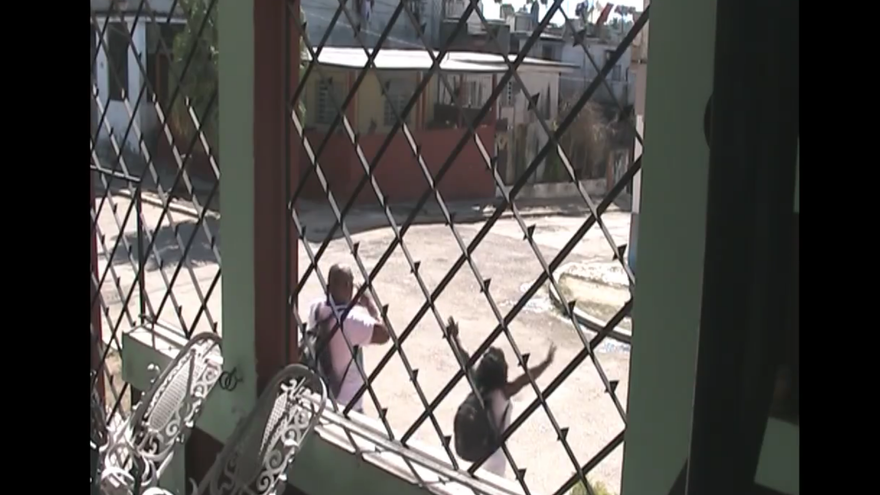
The Cuban Authorities Arrested a Dozen Ladies in White, Says Berta Soler

Ángel Moya and Berta Soler at the exit of the headquarters of the Ladies in White this Sunday, when they were arrested by the police. (Facebook)

14ymedio biggerEFE (via 14ymedio), Havana, January 30, 2024. — The leader of the Cuban opponents Damas de Blanco [Ladies in White] Berta Soler, denounced on Monday that she was arrested for hours along with her husband, former political prisoner Ángel Moya, and a dozen other members of the group in Havana and Matanzas. Soler reported on social networks the arrest of a member of the Ladies in White in the Havana neighborhood of Calabazar and others in Perico and Colón.

For his part, Moya posted a note on Facebook accompanied by a video in which he said that they were “intercepted and arrested” after leaving the headquarters of the Ladies in White on Sunday morning, in the Havana neighborhood of Lawton, which he counted as the “72nd repressive Sunday” against the collective.

Then, according to his account, they were transferred separately to the police stations of the El Cotorro and Guanabacoa municipalities, where they remained until almost 7:00 a.m. on Monday morning. Soler was fined 150 Cuban pesos. continue reading

Soler was fined 150 Cuban pesos

The Ladies in White  is a women’s movement that emerged on the initiative of several women relatives of the 75 dissidents and independent journalists – including Moya – who received long sentences in 2003 during the repressive wave known as the Black Spring.

Since then, this group, composed of wives, mothers and relatives of the prisoners, has been identified by always being dressed in white and holding Sunday marches after attending mass in a Catholic church to ask for the release of political prisoners.

The European Union and the NGOs Human Rights Watch and Amnesty International criticized the wave of arrests and convictions, calling them political. The Cuban authorities alleged that the accused dissidents violated national sovereignty under orders from the United States.

In 2005, the Ladies in White received the Sakharov Prize for Freedom of Conscience from the European Parliament.

Translated by Regina Anavy

____________

COLLABORATE WITH OUR WORKThe 14ymedio team is committed to practicing serious journalism that reflects Cuba’s reality in all its depth. Thank you for joining us on this long journey. We invite you to continue supporting us by becoming a member of 14ymedio now. Together we can continue transforming journalism in Cuba.
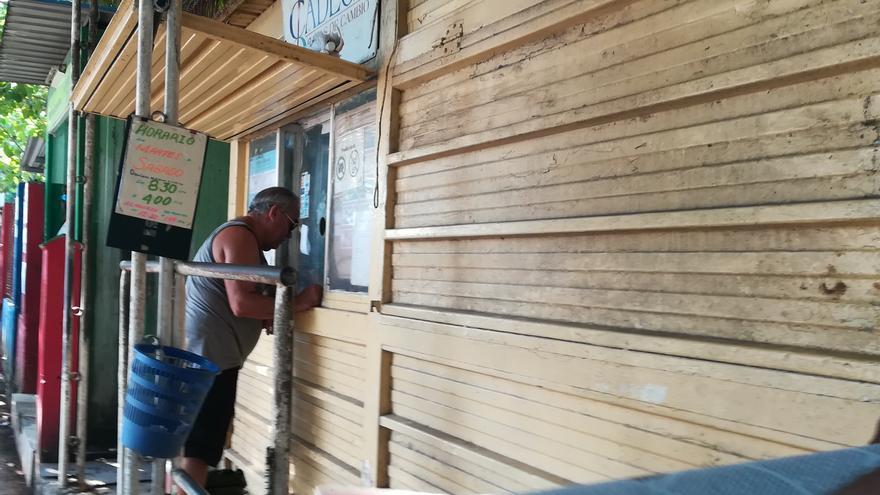
As the Dollar Approaches 300 Pesos, the Cuban Government Talks About ‘Intervening’ in the Informal Market

The Government is preparing measures for February to control the foreign exchange market. (14ymedio)

14ymedio bigger14ymedio, Madrid, 30 January 2024 — Economic reforms are coming together for the Cuban Government, which is expected to announce changes in the foreign exchange market this February. In the first Council of Ministers session held this year, the Minister of Economy, Alejandro Gil, set an immediate date on a priority issue for the country, although the words he chose for the announcement sowed more doubts than clarifications.

“It is said that the Cuban Government’s projections include intervention ’from the’ informal foreign exchange market, but it is not clear if it meant intervention ’in’ the market. Perhaps it expresses a confusion between intervention and exchange policy,” Cuban economist Pedro Monreal wrote in his X account.

In Monreal’s opinion, expressed in a second message, “intervention (an instrument) can be useful to contain fluctuations in the exchange rate and stabilize it, but it is not effective for making permanent changes in rates resulting from an exchange rate policy that is not compatible with general macroeconomic policy.” continue reading

A lot of work is being done on this because of the impact it has on promoting a productive stimulus”

Gil announced that regulations will be announced in February to “reorder local development projects” and decentralize the price approval of natural and traditional medicine. Then he talked about what is really important. “In that month, progress will also be made in the presentation of proposals to restructure the foreign exchange market, intervene in the informal market and control the type of exchange in the country, which includes the determination of the exchange rate and the formation of prices. A lot of work is being done on this because of the impact it has on the promotion of a productive stimulus,” the minister said.

A month ago, during the joint television appearance of Gil and the Minister of Finance and Prices, Vladimir Regueiro Ale, to announce the first changes of the complicated package to stabilize the economy, the official had already referred to the great importance of the foreign exchange market, which he considers “one of the main distortions that the economy is facing.”

The ministers specified that private individuals buy foreign currency in a parallel market that allows them to import goods while the State sector is left without that currency. But they didn’t mention that State companies have access to the official exchange rate (1 dollar x 120 pesos), while those who are forced to resort to the illegal market find the dollar being paid at almost 300 pesos.

“Why is the State sometimes not able to be an offerer of goods and services as it should be? Some of those currencies move in the other circuit. If there were for both… But there isn’t. (…) That has to be corrected,” said Gil, who neither then nor now said anything that could allow us to glimpse the measures to be taken.

“Why is the State sometimes not able to be an offerer of goods and services as it should be? Some of those currencies move in the other circuit. If there were for both… But there isn’t”

In September 2023, two extensive articles published in Cubadebate and signed by an official of the Ministry of Economy, Joel Ernesto Marill Domenech, addressed the economic situation and launched a series of proposals that could help – or not – the authorities, if they allowed themselves to be advised by these experts. The specialist suggested a national currency flotation system similar to the model applied with the euro, although Monreal considered at that time that the idea was “unviable” because the country has no foreign exchange reserves or production to support its own currency.

Monreal’s proposal was, rather, a foreign exchange market of “two levels: business operations with banks and retail operations in Cadeca [currency exchanges] (using the official exchange rate)” and a mobile parity regime (which combines a fixed nominal value that is adjusted by factors such as inflation and a floating rate). In his opinion, that would allow more flexibility to control the small devaluations that occur.

The two experts clashed over a main issue. For Marill, it was essential to stabilize the economy before proceeding with the exchange rate reform, while Monreal considered this dangerous because of the delay it could entail.

The Government seems inclined not to let more time pass than already has. However, the economist also warned of something: “The first step of the sequence should be to support the transformation of the small private commercial production component of the agricultural system into a more diversified private component with the greater weight of national capital. Without an increase in the national food supply, there can be no material backing of the national currency. The rest would be like pouring water into baskets,” he said. None of that is being done.

That idea has come, without being experts in economics, to many readers of Cubadebate, who have reminded the Government that no measure will work in the current supply conditions and they even remind readers that the inflation rate – which is expected to increase as soon as fuel prices rise in two days – gets worse almost by the hour. In the words of one of them: “When someone from the Government said that the State would recover the exchange rate, which was supposedly in the hands of the online site El Toque*, the dollar was quoted at around 270 pesos. It is already quoted at around 280. In a few days, Health and Education workers have lost the increase that has not yet reached them.”

*Translator’s note: El Toque is an independent digital newspaper that provides daily  exchange rates for the Cuban peso in all markets, including that of cryptocurrency.

Translated by Regina Anavy

____________

COLLABORATE WITH OUR WORKThe 14ymedio team is committed to practicing serious journalism that reflects Cuba’s reality in all its depth. Thank you for joining us on this long journey. We invite you to continue supporting us by becoming a member of 14ymedio now. Together we can continue transforming journalism in Cuba.
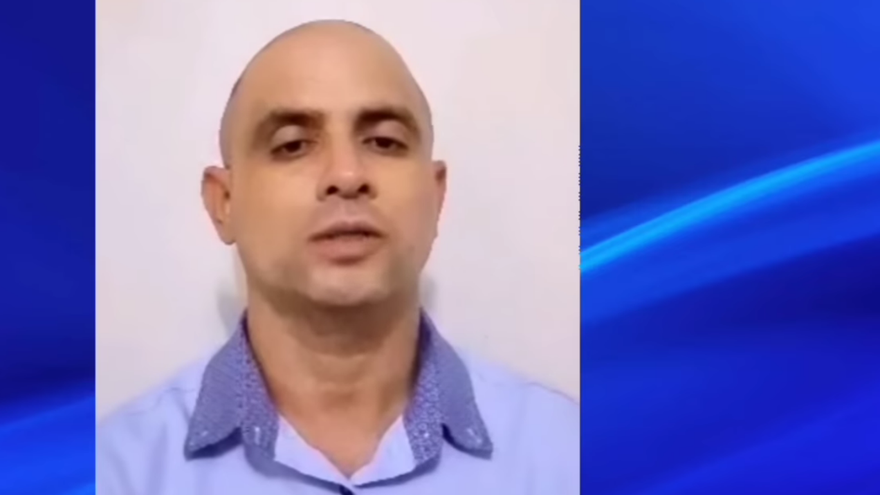
The Cuban Doctor Convicted of Negligence Points Out That the Patient’s Death Was Inevitable

Ristian Solano is sentenced to three years of deprivation of liberty and disqualification. (Capture)

14ymedio bigger14ymedio, Madrid, January 30, 2024 — Ristian Solano, the doctor at the Carlos Manuel de Céspedes hospital in Bayamo (Granma) who was sentenced to three years of deprivation of liberty for negligence resulting in death, has broken his silence. His penalty is the highest of those imposed on the six health workers tried in this case, in which only one of those involved, radiologist Elizabeth Silvera, was acquitted.

The doctor has been disappointed by the lack of support from the Ministry of Health, when he and his colleagues denounced their poor working conditions for lack of resources and when they were convicted in a procedure that was full of irregularities.

Solano says that three commissions participated in the investigation to clarify the facts – one from the Provincial Directorate of Health, another from Manzanillo and, finally, the National Health Commission. They determined that from the time of his admission to the hospital, the patient had “elements incompatible with life regardless of medical action. This patient, unfortunately, was condemned to a sad outcome.” continue reading

Solano says that three commissions participated in the investigation, which determined that from the time of his admission to the hospital, the patient had “elements incompatible with life”

The doctor describes in great detail, as his colleagues also did, what happened two years ago when the now deceased patient entered the emergency room. His name has never been revealed, but at the time of his arrival, he was accompanied by another person who could speak and answer questions. The 23-year-old patient did not actively cooperate in the interrogation, not because of disability but because he had participated in an illegal race and did not want to have problems.

At that time, when the patient barely revealed that he had fallen off a motorcycle, he had a back injury that was assessed with an apparently normal x-ray and ultrasound. However, he was sent to the multipurpose room to coordinate more specialized tests, two of them (thorax plate and tomography) were declined by radiology due to lack of film and technical defects. A puncture was chosen as an alternative, which could not be done normally either due to the lack of a bladder catheter that, finally, was delivered through coordination with the Urology service. In addition, all the specialists in that unit were busy with surgeries, so they could not perform the test.

“All these inconveniences, so to speak, are reflected in a chart for this purpose,” says Solano, who considers that the patient was adequately cared for within the limitations, and they even explained the situation to him.

Everything changed completely when “around 12:45 in the afternoon a family member brought me the ultrasound result – apparently performed at 8:50 in the morning – in the emergency room, where I was on duty. I reviewed the report and was diametrically opposed to the conclusion.” The doctor explained that he quickly went with the relative to where the patient was while explaining the changes that were seen between the tests. On arrival the patient showed normal vital signs and no problems physically, while now the ultrasound indicated the need for an urgent intervention because of an intra-abdominal injury.

It was at that moment, when he was being prepared for the operation, that the patient confessed to the anesthesiologist that he had participated in a race at 100 miles per hour

It was at that moment, when he was being prepared for the operation, that the patient confessed to the anesthesiologist that he had participated in a race at 100 miles per hour and was thrown over the motorcycle, landing on the curb. According to Solano, the tests carried out by the anesthesiologists revealed normality, with the exception of a ” bilateral decrease in the vesicular murmur in both lung fields.” The injury observed during the surgery was finally located in the kidney.

The autopsy performed subsequently revealed the cause of death as a gastric perforation with a subsequent peritonitis of approximately 20 ounces of free gastric content in the cavity, in addition to ischemia of the tail end of the pancreas. According to Solano, this condition is fatal in 98% of cases, and the patient had already arrived at the hospital with those elements, so nothing could have been done to save him.

The doctor says that the reports confused the terms “polycontusioned”, as the patient was classified, with “polytraumatized,” his real condition, judging by the results of the autopsy. “The elements that the patient provided once he arrived at the Carlos Manuel Céspedes hospital,” along with a “completely negative physical examination” that did not suggest injuries like those found later, made his outcome unpredictable.

Solano says that everything that happened, detailed in the patient’s medical history, damaged the image of the hospital “and, consequently, the image of the department and of the Provincial Directorate of Health, and it was not permissible for one of the doctors to say all this.”

The doctor again points out Dr. Ingris Porto Mateo (allegedly a relative of the deceased) as responsible for a “totally misguided and superficial investigation”

The doctor again points out Dr. Ingris Porto Mateo (allegedly a relative of the deceased) as responsible for a “totally misguided and superficial investigation,” contrary to any scientific basis, and of “encouraging and disclosing falsehoods” against the medical team in charge of the patient “in order to divert attention to what we had actually raised in the first place; that is, the shortcomings of institutional resources that interfere with adequate patient care.”

The doctor ends the video, delivered to Ernesto Morales, regretting that the many pieces of evidences he and his colleagues provided to clarify the situation have been ignored and dismissed. “But, above all, the main irregularity that this process presented is the lack of support from the Ministry of Health, which simply avoided this whole process until it reached the present dimensions. Not because of their lack of support but because they looked the other way.”

The five convicted – along with Solano, Rafael José Sánchez and Henry Rosales Pompa sentenced to two years; Yoandra Quesada Labrada, sentenced to one year and six months; and William Pérez Ramírez, sentenced to one year – will be disqualified for the same period of time that the sentence lasts, although they still have the option to appeal, something they have announced that they will do and for which they have the support of many doctors.

Translated by Regina Anavy

____________

COLLABORATE WITH OUR WORKThe 14ymedio team is committed to practicing serious journalism that reflects Cuba’s reality in all its depth. Thank you for joining us on this long journey. We invite you to continue supporting us by becoming a member of 14ymedio now. Together we can continue transforming journalism in Cuba.
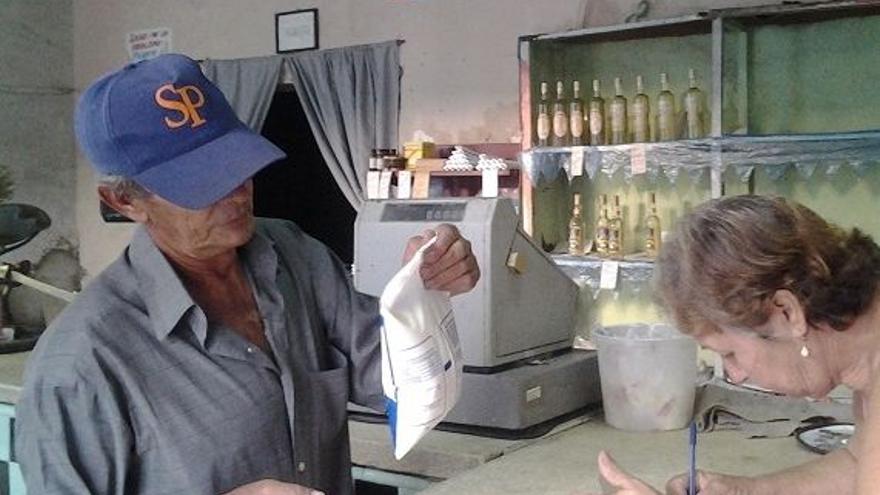
The Official Press Blames the Cuban Leaders for the Shortage of Milk in Sancti Spiritus

The authorities explained that milk will continue to be sold, but it will be distributed “when it arrives.” (Escambray)

14ymedio bigger14ymedio, Havana, 29 January 2024 — For months, the dairy industry of Sancti Spíritus has not been able to cover the more than 5,280 gallons per day needed by those who require a special diet. This, added to the deficit of 2,900 million gallons with which they closed 2023, affects thousands of patients, pregnant women and parents who get the product from the bodegas (ration stores). This Monday, the official press delivers the culprit on a platter: “the managers of the dairy and commercial companies is where the greatest lack of control is usually manifested.”

According to Escambray, “the debts with deliveries to the State by Agriculture,” the “failures with the distribution of the family basket,” the “distributions at the wrong time and the consequent effects on consumers” are just the tip of the iceberg of the dairy industry in the province, whose authorities fail to “control” the producers. The “effects” already reach more than 70,000 patients, pregnant women and children from six months to seven years old in Trinidad and the provincial capital alone.

Marina, a 61-year-old woman from Sanct Spíritus, who receives milk on a medical diet, tells 14ymedio that the situation is even more serious than the authorities reveal. “I should get milk 10 days a month, but so far in January I have only received it twice. I don’t know what the leaders want me to do with so little,” she says. continue reading

“On top of that, the milk is getting more and more watered down. You put it on the stove and it doesn’t boil. It keeps evaporating  as if it were water”

“The distributions in the bodega are divided according to the groups of children, the pregnant and the sick – A, B and C – and I belong to C. If the milk arrives only for the A, that means that I don’t get it that day. They also sometimes deliver, for example, only half a gallon instead of a whole gallon. This is how they create the illusion that they are handing out milk when in reality they aren’t. On top of that, the milk is getting more and more watered down. You put it on the stove and it doesn’t boil. It keeps evaporating as if it were water,” says the woman.

“It’s true, as they say, that other provinces have not even had medical diets for a long time and that some distribute half a gallon to children instead of the whole gallon they should get. This happens in a province that, by the figures, is the second highest milk producer in Cuba,” which also exports to three other provinces, reports Escambray.

The solution, according to Escambray, is to treat the farmers better, so they will deliver the milk to the State and not sell it in the informal market. “Yes, there is milk, but we lack follow-up, because a lot of pizza, cheese and yogurt are still marketed and at high prices by the self-employed and on the street, and the milk is not always imported, it comes out of the milk that is not delivered,” Norge Yero, director of the Provincial Delegation of Agriculture, told the newspaper.

In the current situation, Escambray reports, it is evident that “neither the improvement in purchase prices as a result of the 93* measures to enhance production, nor the dozens of meetings that have been held to resolve the matter, nor the knocking on doors asking the producers to deliver milk (to the State), nor the authorization to the owners to sell the over-fulfillments where they want” have given results.

Nor have the penalties that fined the cooperatives 10 pesos for every gallon they do not deliver, a measure that, according to the media, the farmers themselves mock. “Last year about 400 farmers did not deliver what was agreed and did not complain about the fine that comes from private sales, where the gallon is quoted at up to 150 pesos and yogurt and cheese, more.”

Last year about 400 farmers did not deliver what was agreed and did not complain about the fine that comes from private sales

The fines, the ” confiscation of animals” and “rescinding the land from systematic non-compliants also seem to be cosmetic,” the media says. This January, and counting on the delivery of “the overfulfillers,” the industry in the province has only collected 80% of what was planned. If it continues like this, this year’s plan – 9,246 million gallons – seems unattainable.

The authorities, however, have assured that milk deliveries will be maintained according to the capabilities of the province. The sale “has not been suspended nor will it be suspended,” explained Alberto Cañizares, director of the Río Zaza Dairy Company, but “there is no guarantee for the diets, and the milk will be distributed when it arrives.”

The population, however, is tired of excuses and has begun to ask the local authorities for solutions. “Why do they take milk from seven-year-olds to give them yogurt? Now no milk or yogurt. What do those children have for breakfast or for a snack at school?” asked a user in the Comments section.

The answer, Norma, 32, from Las Tunas province, tells 14ymedio, is in the private sellers or “on the left.” “In my house, when no one gets milk from the libreta (ration book), we buy it directly from the farmers. Right now we pay 80 pesos a gallon and 1,000 for a package of milk powder, and it’s cheap because we live in the countryside and buy it first-hand,” she says.

In Havana, Roberto pays almost twice as much for the same amount, if he can find milk with a private individual. “I buy the milk from a woman who sells the one she gets from the libreta for her two children. I’m sorry to think about what those children will be having for breakfast, but if I don’t buy it, she’ll sell it to someone else,” he says.

Buying the product on the street, however, has its down side, says José Luis from Holguín. “We know that when we buy milk from the sellers it will always come with a little water, because that way they ’stretch’ it and sell more, and the last two times it tasted strange.” According to José Luis, the milk that his “usual” suppliers sell has begun to show an irregular consistency that, when boiled, leaves “something like sand” at the bottom of the pot.

“Several people have ventured to say that they are putting cassava starch in the milk. I don’t know what they are mixing it with, but my wife and I decided not to buy it anymore,” says the holguinero, who adds: “As much as we need it, I’m not risking giving it to my children.”

*Translator’s note: There are “93 measures” for sugar cane, and “63 measures” for food production.

Translated by Regina Anavy

____________

COLLABORATE WITH OUR WORKThe 14ymedio team is committed to practicing serious journalism that reflects Cuba’s reality in all its depth. Thank you for joining us on this long journey. We invite you to continue supporting us by becoming a member of 14ymedio now. Together we can continue transforming journalism in Cuba.

In the Middle of January, Cuba Has the Same Energy Deficit It Had in August

In the middle of January, the energy deficit reaches levels not seen since summer. (14ymedio)

14ymedio bigger14ymedio, Madrid, 29 January 2024 — “The blackouts are aggressive and extreme.” The population reacts to the energy deficit announced for this Monday with astonishment and anger, like this resident from Sancti Spíritus. “They are turning it off twice a day, in the morning and at night. According to the frequency that is planned in ’the blocks’ but in those time slots. It’s unforgiving, like it’s the middle of August. In my neighborhood I’m fine, but  some people are experiencing blackouts of nine and ten hours.”

In the middle of January, with temperatures that dropped again this morning, the Electric Union of Cuba (UNE) has once again foreseen a deficit of almost 1,000 megawatts (MW), on the third consecutive day. The official journalist Lázaro Manuel Alonso elaborated this Sunday: “The breakdowns in several units and the lack of fuel continue to be the causes. In the last days of January the effects are similar to those reported last summer.”

This highlights the seriousness of the energy situation on an Island that no longer needs to wait for hellish heat to have 12 to 14 hours of blackouts. But now, in the month when greater relief is expected, the figures are unprecedented. continue reading

Despite this, the deficit during yesterday’s peak time was 975 MW, above the 952 MW that had been predicted

The situation was aggravated on Sunday. The Antonio Guiteras thermal power plant, in Matanzas, the most important in the west of the country, was synchronized with the National Energy System (SEN). Despite this, the deficit in yesterday’s peak time was 975 MW, above the 952 MW that had been expected.

For Monday, the UNE announced that 991 MW will be missing, even with the entrance for the peak hours of unit 4 of Energas Varadero and the distributed generation engines that were stopped for maintenance and those that have been authorized for support. According to the state company, unit 5, the Diez de Octubre power plant, in Nuevitas (Camagüey) and the 2 of Lidio Ramón Pérez, in Felton (Holguín), are out of service, while unit 6 of the Máximo Gómez thermoelectric plant, in Mariel, is under maintenance.

The joint exit from the system of the two main thermoelectric plants of the east and west of the Island (Felton and Antonio Guiteras), one due to breakdown and the other for scheduled maintenance, was key. On Friday, after several days of complaints reported in several provinces, the record of electricity deficit was announced, with 1,010 MW planned for peak time, which finally reached 1,032 MW.

On Saturday the prediction dropped to 890 MW, but once again, the reality was worse than imagined, with 959 MW of deficit.

The return of the Antonio Guiteras, which on Sunday around 1 p.m. properly synchronized with the system, suggested that the most recent episode of blackouts had passed. But the announcement that the plant was contributing about 200 MW to the SEN was not reflected in the comments of customers from all over the Island, outraged once again with the favored treatment they consider to exist towards Havana, the province least affected by the lack of electricity.

What kind of math are the bosses of the Energy and Mines cartel applying to give such a high indicator?”   

“Sancti Spíritus is at the forefront of the blackouts while the capital enjoys a sweet croquette,” said one user. The few optimists who dared to vigorously congratulate “the Revolution” received a flood of criticism. “The same Revolution that gives you 8 hours of blackout,” one wrote. “What Revolution? Its meaning is to revolutionize something, to move forward. What progress is there in this country? Where is the restored electrical system, when today the whole day has been spent without power, with practically more blackouts than electricity?” added another, indignant.

The hope that the situation would calm down today, which began with cool temperatures in much of the Island, was frustrated when, after 10 in the morning, the state company announced its forecast, again close to 1,000 MW of deficit.

“What kind of math are the bosses of the Energy and Mines cartel applying to give such a high indicator? Why is there only Nuevitas, that breaks down every day, and Felton 2. Speak clearly and say that it’s because there is no oil, so that we can understand,” wrote a user of the many who complained to the UNE. Another joked with resignation: “We have continuity, we remain in the dark.”

Translated by Regina Anavy

____________

COLLABORATE WITH OUR WORKThe 14ymedio team is committed to practicing serious journalism that reflects Cuba’s reality in all its depth. Thank you for joining us on this long journey. We invite you to continue supporting us by becoming a member of 14ymedio now. Together we can continue transforming journalism in Cuba.
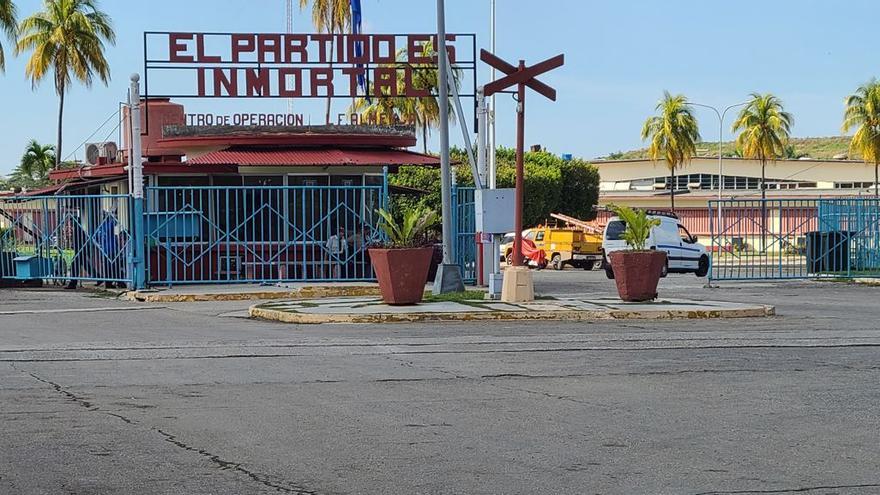
Desperate for More Workers, Cuba’s Electric Company Holds a Job Fair

The electric company’s facilities on Independence Avenue in Havana’s Boyeros district, are well maintained. The sign reads: “The Party Is Immortal”. (14ymedio)

14ymedio bigger14ymedio, Pedro Espinosa/Juan Izquierdo, Havana, 21 January 2024 — The Cuban Electrical Union (UNE) needs operators, linemen, inspectors, economists, dispatchers and meter readers. However, attendees at Thursday’s job fair, sponsored by the state-owned enterprise in an effort to alleviate its worker shortage, were not met with promises of good salaries. Instead, they were greeted by a rusty sign over the gate to its operations center that read, “The Party is Immortal.”

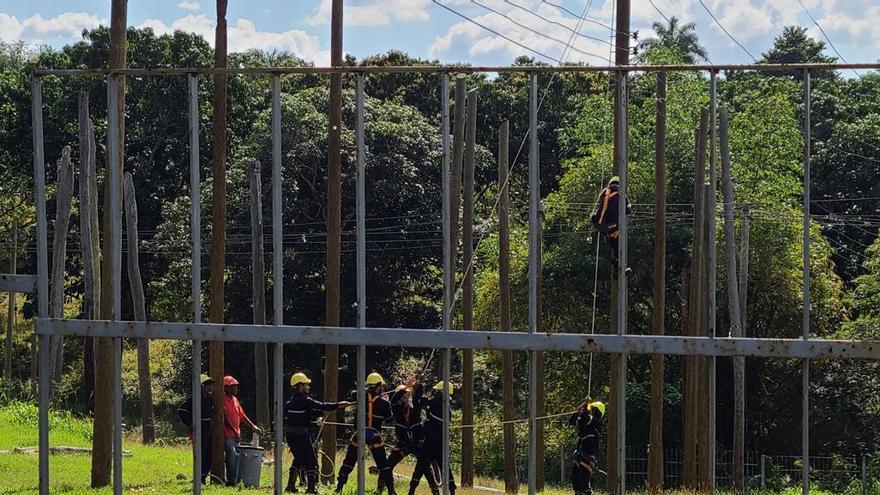
The company’s Havana facilities, located on Independence Avenue in the Boyeros district, are well maintained. Several repair vehicles loaded with equipment and ladders are parked next to the main building. Also adjoining the premises is a training center for linemen where, on Thursday, several uniformed apprentices could be seen climbing poles and using training cables.

“All the state-owned companies are desperately looking for people because no one wants to work for them given how little they pay,” says one of the candidates for a lineman position. continue reading

All the state-owned companies are desperately looking for people because no one wants to work for them given how little they pay

Despite UNE’s need to increase staffing, company representatives at the fair did not go out of their way to tout the benefits of working for the company. Essential questions about the nature of the work were met with obfuscation, hemming and hawing, and “misdirection.” Shrugging her shoulders, the building’s receptionist apologized when asked about the pay. “I lost the salary schedule,” she replied.

After an expedited hiring process, the lineman positions — the best paid but also the most dangerous — were quickly filled. For those interested less risky positions, such as those for computer engineers or operators, the news was disappointing.

“The pay is 4,000 a month plus a performance bonus,” explained a department head to an applicant who had already been shuffled from one office to another. “If you exceed your target, you can earn between 9,000 and 12,000 pesos.” Hardly a tempting offer considering a police officer can make up to 15,000 pesos.

Adjoining the company’s offices is a training center for linemen where, on Thursday, uniformed apprentices could be seen climbing poles and handling training cables.  (14ymedio)

Not yet convinced, the candidate was told that transportation was provided for employees. Also needed are inspectors and meter readers, as well as security and protection workers, who require a higher level of certification than the average technician.

Those attending the fair, however, were able to confirm at least one thing. At the electric company, where blackouts are expected and excuses are made for the country’s energy crisis, every office is air conditioned and the place is amply lit. “Blackouts don’t happen here,” said one candidate as he exited under the same Communist Party sign that greeted him when he came in.

With its jobs becoming increasingly less attractive, and with little to offer potential employees, the public sector is running out of workers. The most recent strategy to improve the situation is to organize job fairs, which have proliferated throughout the country since December. Company directors highlight the advantages of working for the state: stability, more reliability and lots of job openings

Job-fair fever has spread throughout the island as officials from the Ministry of Labor and Social Security continue boasting of their success

The last point has proved to be an easy sell. The stampede to the private sector combined with the high level of emigration has meant that organizers of a single job fair last December in Guantanamo province were able to offer candidates more than 2,200 positions.

Job-fair fever has spread throughout the island as officials from the Ministry of Labor and Social Security continue boasting of their success. The ideal candidates, according state media, are those who are “not studying or not currently employed,” and who live in “vulnerable communities.”

One of the workplaces that has worked hardest to recruit Cubans “excited” to work for the state is Cubadebate, the flagship — along with Granma — of official state media. After an attempt to add more journalists to its payroll , the online news outlet received more than a few sardonic responses, some in the form of a query. One example: “Can journalists write their own articles or do they have to wait for the Communist Party to dictate them?”

____________

COLLABORATE WITH OUR WORKThe 14ymedio team is committed to practicing serious journalism that reflects Cuba’s reality in all its depth. Thank you for joining us on this long journey. We invite you to continue supporting us by becoming a member of 14ymedio now. Together we can continue transforming journalism in Cuba.
Multiple Gangs ‘Implement Terror’ in Santiago de Cuba, Admits the Ministry of the Interior

The lieutenant colonel stressed that the assault had ended with several wounded. (Capture)

14ymedio bigger14ymedio, Havana, 27 January 2024 — Young people, armed with knives and machetes, and organized into violent gangs. These are the members of the multiple “groups” that, according to a lieutenant colonel of the Ministry of the Interior during a recent public appearance, “implement terror” in Santiago de Cuba.

video of the meeting, released by independent journalist Yosmany Mayeta, shows dozens of neighbors of the Abel Santamaría neighborhood in Santiago listening to the officer’s speech, surrounded by other police agents. The purpose was to report on the arrest of five young members of a gang who, wielding knives, assaulted a cafeteria in the early morning of January 7.

The lieutenant colonel stressed that it was an “organized group,” and that the assault ended with an employee – from whom they took clothes and money – receiving minor injuries, and a customer whose “right hand was amputated” while trying to escape from the assailants with another person. The mutilated person – whom the officer does not identify – is, according to Mayeta, a lineman from the Santiago Empresa Eléctrica, David Enrique Perdomo Álvarez. According to the recording, “he is still recovering.” continue reading

For the soldier, this “unfit behavior” of the five gang members is shared with many other criminals from Santiago de Cuba

For the soldier, this “unfit behavior” of the five gang members is shared, he insisted, with many other criminals from Santiago de Cuba. “We know who they are and we are going to get them,” he promised, speaking on behalf of “all the organs” of the Ministry of the Interior that accompanied him. He added that, after the interrogation of the five detainees, they gathered more information about “the different groups that operate in these places” and “beyond, in the city of Santiago.”

The lieutenant colonel spared no promise to the population. “We can’t keep having this type of thing. We are going to act severely. They will be sanctioned, have confidence,” he said, before a woman interrupted his speech to take the floor and say that her confidence in the police was only “up to a point.” She then told the story of her son, a university professor who lacks a leg, and who on May 7, 2023 was assaulted by two hooded people. “They covered him with a sheet, tied it around his neck and pulled him” out the door of his house, she said.

“Until now, no one has ever come to my house to tell me ’this has been done, that has been done,’” complained the woman, who said she had taken the case to the Prosecutor’s Office, in the face of the inaction of the police. “I come back and repeat: I trust [the authorities], but right now I don’t even know what to say,” she finished.

That was “a negative experience,” minimized the lieutenant colonel, who muttered that he had no knowledge of the situation and promised to review the case. The woman’s response to the officer’s promise was categorical: “Right now I don’t believe anyone.”

“They have not solved the cases that have happened; how do they expect the people to trust them?”

In his comment on the video, Mayeta claims to have interviewed one of the attendees at the meeting in Abel Santamaría, a Public Health worker who asked not to be identified, and who affirmed that in that area “there is not only one gang but several.” “They have not solved the cases that have happened; how do they expect the people to trust them?” Mayeta asked.

The escalation of violence in Cuba has gotten out of the hands of the authorities, who opt in most cases for inaction and establish zones of “tolerance” for crime in the cities, where patrols do not dare to circulate.

On January 5, when the police celebrated the anniversary of its founding, the deputy head in Sancti Spíritus asked that, in order to face the “current context of the country,” the State provide the officers with “new instruments, equipment, vehicles and technologies to perfect the mechanisms of the surveillance and patrol system.” Similar requests were made in acts of tribute to the police throughout the country.

The growing insecurity on the streets of the Island is impossible to disguise and demands more and more space in the official press. Curfews are a reality in several locations, despite the fact that the police deny it. In Alquízar, in the province of Artemisa, the authorities denied that people had to stay inside after midnight. However, this newspaper gathered multiple testimonies about the prohibition and confirmed that patrols circulated through the municipality to make sure it was respected.

However, the curfew is increasingly a self-preservation measure by the neighbors themselves. Whether or not the police recommend it, no Cuban dares to walk the streets alone in the early morning hours.

Translated by Regina Anavy

____________

COLLABORATE WITH OUR WORKThe 14ymedio team is committed to practicing serious journalism that reflects Cuba’s reality in all its depth. Thank you for joining us on this long journey. We invite you to continue supporting us by becoming a member of 14ymedio now. Together we can continue transforming journalism in Cuba.

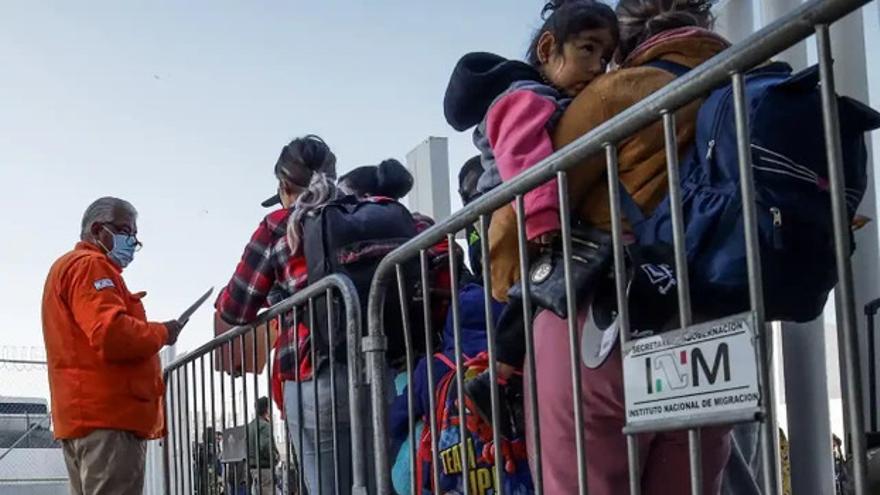
Migrants Pay Up to $40,000 for Amparos – Protection Orders – To Reach the Northern Border of Mexico

The amparos (protection orders) do not exempt illegal travelers from being arrested by the immigration authorities. (EFE)

14ymedio biggerEFE (via 14ymedio), Tijuana, 27 January 2024 — Authorities on the northern border of Mexico warn that at least 8,000 migrants a month pay up to 40,000 dollars to coyotes (traffickers) for a “package of amparos” (protection orders) with the promise to protect them from deportation for free transit through the country.

David Pérez Tejada, head of the National Institute of Migration (INM) in Baja California, said in an interview with EFE that the number of people who arrived with these amparos rose in the last quarter of 2023, with a monthly trend of 8,000 on average; that is, about 300 people per day.

The representative of Migration in the state, bordering California, explained that these amparos are usually promoted in Tabasco, Veracruz and other cities in the center of the country.

There, the coyotes trap them with the idea of an “all-inclusive” package to reach border cities, such as Tijuana, and from there to cross irregularly to the United States. continue reading

He explained that some people, after crossing the southern border of Mexico, “already have this kind of package, as if it came from a travel agency.”

“They now fly them from their country of origin to a jungle they must pass through and promise that they will protect them when they cross the border irregularly,” he said.

These packages include a plane ticket from Tapachula or from Mexico City to Tijuana

He added that these packages include a plane ticket from Tapachula, on the border with Guatemala, or from Mexico City to Tijuana.

Once they arrive at this border city, he said, they show the protection order for their free transit to an “alleged taxi or Uber driver, who takes them to a safe house or somewhere else to accommodate them for 24 hours or less. The next day they are already on their way to the United States.”

Investigations show that “each package has a different cost depending on the situation of the migrants.”

“If it is a family nucleus, if they bring minors, if they come alone, depending on this and the place of origin, the method and rate change. For example, those from Uzbekistan pay up to 40,000 dollars, the Chinese 20,000, those from Central America 7,000 dollars and the Ecuadorians 10,000,” he said.

Pérez Tejada pointed out that those who most come to Tijuana with these amparos are the Uzbeks and the Chinese.

But the representative of the INM warned that, although they have this legal instrument, that does not exempt them from an administrative procedure if the agents intercept them, in which they must comply with a maximum of 36 hours detention before their release.

Even if they have this legal instrument, that does not exempt them from an administrative procedure

For the INM delegate, this situation represents “a problem” because it complicates the work of the immigration authorities.

“They are the ones who are crossing irregularly (to the United States) and we want to know how to approach them with the help of lawyers, legal associations and research institutes so that we can see how to deal with this protection order,” he said.

The arrival of migrants under amparos had its peak in November last year, when the INM in Baja California registered 13,600 protected migrants. The number has decreased in this January.

Nicole Ramos, director of the organization Al Otro Lado (To The Other Side) in Tijuana, responded to EFE in writing that “it is questionable for the delegate (of Migration) to send the message that the only way to cross (to the United States) is through CBP-One,” the official American application for migrants.

“We all know that it is used to limit the number of asylum seekers who can cross and that CBP (the Office of Customs and Border Protection) refuses to prosecute asylum seekers when they arrive without an appointment, regardless of the person’s circumstances,” he said.

He added that “telling immigrants to use CBP-One, while actively helping the United States to violate the law, is a bit dishonest.”

“We wouldn’t see unscrupulous lawyers in Mexico or organized crime profiting from the desire of migrants to have safe transit to the border to seek asylum if Mexico didn’t act as a watchdog for the U.S. Government,” he said, accusingly.

Translated by Regina Anavy

____________

COLLABORATE WITH OUR WORKThe 14ymedio team is committed to practicing serious journalism that reflects Cuba’s reality in all its depth. Thank you for joining us on this long journey. We invite you to continue supporting us by becoming a member of 14ymedio now. Together we can continue transforming journalism in Cuba.
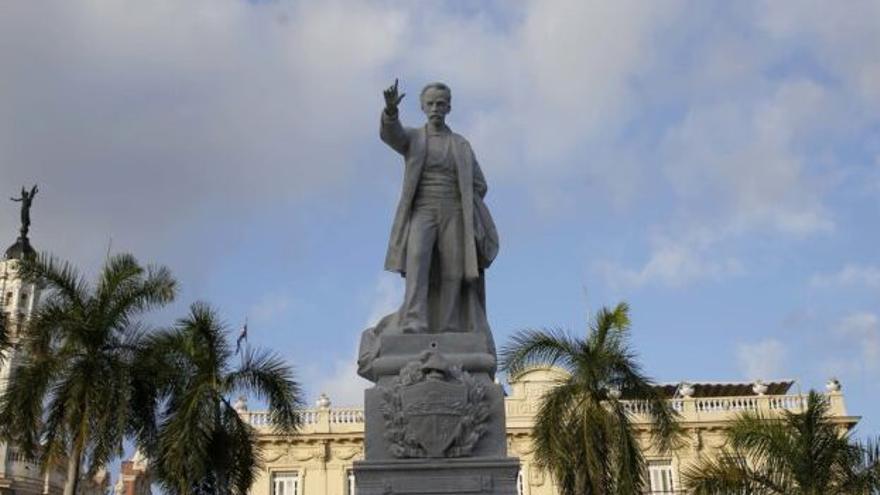
Jose Marti, in the 21st Century

The statue located in the Central Park of Havana, was the first erected in Cuba in honor of José Martí. (Trabajadores)

14ymedio bigger14ymedio, Pedro Corzo, Miami, 28 January 2024 — To mark an anniversary of the birth of the most notable of all Cubans, Jose Martí (January 28, 1853), many of us who honor that gentleman do everything possible to remember such a great date, based on an unwritten commitment that we have contracted.

That tradition was partly carried out by the Pen Club of Cuban Writers in Exile, chaired by the writer Luis de la Paz, celebrated with the participation of Santiago Cárdenas and Emilio Sánchez, two notable intellectuals who have a profound knowledge of Martí’s work. Both were assisted by two other great admirers of the apostle, Julio Estorino and Sara Martínez Castro, who read Martí’s poems.

Martí’s first action in his struggle for independence is not associated with war, as happened with most of our heroes. His activities began by publishing writings against Spain and by calling a fellow student who had enlisted in the Spanish Army to fight the Mambises of the Ten Years’ War a traitor. For that reason he went to prison and was later exiled to Spain.

It must be recognized that most of the notable personalities who fought for the independence of Spain, members of a glorious and abundant heritage in which Simón Bolívar and Jose de San Martin stand out, patricians of strong continue reading

national convictions, leadership and indisputable military talent, left indelible traces by establishing the foundations of several republics in the hemisphere.

Martí, we all know, was not a warrior but, by far, the most important promoter of Cuba’s independence from Spain

That glorious group is mainly made up of men of arms. However, we must include other heroes who, although they did not stand out for their talent as warriors, were great thinkers and efficient organizers, capable of cementing new republics, as was the case of José Martí, a hero whose life’s work led Cuba to independence.

Martí, we all know, was not a warrior, but, by far, the most important promoter of Cuba’s independence from Spain and the most notable organizer of the “just and necessary war,” an expression which shows that he conceived of military conflict as the only way to achieve emancipation of the homeland.

He fell in his first fight, facing the sun, as he had requested in his Versos Sencillos, contrary to the most distinguished military leaders in the hemisphere who did not die in the heat of the battle. His death in Dos Ríos, at only 42 years old, left the Cuban independence fighters orphaned by their most lucid thinker, the only man, as history has shown, capable of working in a republic “with everyone and for the good of all.”

Despite his early death, he left a vast and profound work that remains current and valid. Reading Martí in the present is to access a fresh and contemporary knowledge. All his work exudes sensitivity and neighborly love, as he wrote in another simple verse: “I cultivate a white rose in July as in January, for the sincere friend who gives me his hand freely, and for the cruel one who tears out the heart with which I live, neither thistle nor arugula do I grow, I cultivate a white rose.”

Reading Martí in the present is to access a fresh and contemporary knowledge, which is that all his work exudes sensitivity and neighborly love

Martí’s thought is deeply human. “There is no better homeland, Cubans, than the one that is won with one’s own effort. The foreign sea is made of blood. No one loves or forgives if not our country,” he wrote.

Martí’s work retains relevance and validity. It has not lost strength; it has not aged; it remains as vibrant as ever. “Whoever wants a secure homeland must fight for it. Whoever doesn’t will live under threat of whip and banishment, considered a wild beast, thrown from one country to another, smiling before charity, earning the disdain of free men and the death of his soul.”

And in these times in which the fragmentation of our rights and the respect that both minorities and majorities deserve are appreciated, what is better than this: “Man does not have any special rights because he belongs to one or another race; call him a man and all his rights are already given. The black man, by being black, is not inferior or superior to any other man: the white man who calls me a black man sins by being redundant; the black man who calls me a white man sins by being redundant. Everything that divides men, everything that specifies, separates or encloses them, is a sin against humanity.”

Translated by Regina Anavy

____________

COLLABORATE WITH OUR WORKThe 14ymedio team is committed to practicing serious journalism that reflects Cuba’s reality in all its depth. Thank you for joining us on this long journey. We invite you to continue supporting us by becoming a member of 14ymedio now. Together we can continue transforming journalism in Cuba.
Cuban Police Dismantle an Illegal Sale of Fuel a Few Steps From a Gas Station

Photo of the police operation released by State Security. (El Cubano Fiel/Facebook)

14ymedio bigger14ymedio, Havana, January 28, 2024 — The sale of fuel has become a picturesque business in the Havana municipality of Guanabacoa but, above all, an illegal trade that, in plain view, has grown. This Saturday, a “Cupet house” was dismantled by State Security and the police. An individual, identified as Ángel, was engaged in the resale of gasoline and diesel. The arrest happened a few days after 14ymedio pointed out multiple irregularities in the management of the gas stations.

“He thought he had a gas station in his house and could continue to profit from the needs of the people, but the police pounced on him,” El Cubano Fiel (the Faithful Cuban) published on his Facebook page, managed by State Security, and this was later reposted by the Council of the Municipal Administration of Guanabacoa.

“Neighbors on San Francisco Street between Máximo Gómez and Corral Falso commented that Ángel wanted to continue selling the fuel illegally, and when he loaded the fuel as usual in a vehicle, the police arrived and stopped him.” continue reading

Ángel “was wheeling and dealing for a while, selling fuel ’on the left’ without standing in the annoying lines at the gas stations like other drivers,” says State Security. The post also shows photos of police officers in the home of the reseller, who had “a large amount of fuel and plastic containers for storage.” You can also see some sealed boxes guarded by police officers, but no more details of the arrest have been offered.

Ángel “was wheeling and dealing for a while, selling fuel ‘on the left’ without standing in the annoying lines at the gas stations like other drivers”

The text, in addition, was shared on Telegram by Esther, the boss of the Guanabacoa gas stations, in charge of organizing the fuel line and the subject of several 14ymedio reports. The drivers, in order to buy fuel, must be noted down on a detailed list that the local government ordered prepared during the June 2023 crisis, she said.

For Esther herself, as for the hundreds of Guanabacoa customers, Ángel’s arrest is not a surprise. On the same Telegram channel, several customers complained that the workers at the gas station ignore the endless line of drivers, and that “they have accepted money even from tourists, mocking those who stay there” night and day said one customer last week.

But the illegalities start from the same list that Esther manages. For example, in the document that collects the more than 3,600 customers of the Los Paraguas gas station, on January 11, this newspaper found that 114 are repeated up to four times and 77 do not have a license plate – a requirement that the woman always demands. In the case of the Corral Falso service center, where almost 3,000 names were registered, there are 168 that are repeated up to four times and 40 without a plate. About 1,003 customers appeared on both lists.

According to Esther herself, days later, “the government of Guanabacoa took control of the line” after there “were too many profiteers, plus no one denounced them.” The organization was reactivated shortly before the announcement of the increase in fuel prices, which will come into force next week.

The price of gasoline and diesel on the Island will be five times greater from February 1. The cost of premium, gasoline will go from 30 pesos per liter to 156 ($1.30, at the official exchange rate) while the diesel will rise from the current 27.5 pesos to 150 ($1.25). Vicente La O Levy, Minister of Energy and Mines, said that the new measures will “gradually achieve a stable supply,” although he added that “it cannot be insured from the first day of implementation.”

Translated by Regina Anavy

____________

COLLABORATE WITH OUR WORKThe 14ymedio team is committed to practicing serious journalism that reflects Cuba’s reality in all its depth. Thank you for joining us on this long journey. We invite you to continue supporting us by becoming a member of 14ymedio now. Together we can continue transforming journalism in Cuba.