The Collapse of Tourism in Cuba Puts Canadian Airline Air Transat in Difficulty

The company had to suspend its flights due to a lack of jet fuel, as many others did, although U.S. airlines have maintained their routes


The airline has avoided discussing a possible return to Cuba. / Prensa Latina

14ymedio bigger14ymedio, Madrid, September 11, 2026 – The indefinite suspension of flights to Cuba is costing Canadian airline Air Transat millions. The cancellation of its operations on the Island, adopted in February amid an alert over a lack of jet fuel at Cuban airports, has resulted in a cumulative drop in revenue of 116 million Canadian dollars (about 85 million U.S. dollars) for the first half of 2026 and the final quarter of 2025, when the company still had flights (the fiscal year runs from November 1 to October 31).

The company released data this Thursday for the third quarter, covering May through July, indicating that the absence of the Cuban market reduced the company’s revenue by 25.6 million U.S. dollars in a destination that historically represented 9% of its capacity.

This worsens an extremely poor set of results attributed fundamentally to rising oil prices, which increased 56% year over year between May and July. This generated an additional cost of 128 million U.S. dollars. Although Air Transat managed to increase its total revenue by 3% quarterly to 581 million U.S. dollars thanks to an increase in passengers, the uncontrolled rise in operating costs prevented it from absorbing the impact, which is strongly reflected in the final balance sheet.

“Our third-quarter results were significantly affected by persistently high fuel prices, which remained elevated far above what was anticipated”

The company reported a net loss of 78 million U.S. dollars this quarter, deepening the negative balance from the previous quarter, when it recorded approximately 56 million U.S. dollars. The figure contrasts with the previous year’s figure, when the company posted a net profit of 399.8 million Canadian dollars – including an extra 345.1 million from the cancellation of a long-term debt. This represents a loss of $2.60 per share, compared with the $9.97 profit continue reading

in the previous period.

“Our third-quarter results were significantly affected by persistently high fuel prices, which remained elevated far above what was anticipated and were the main factor behind the lower profitability,” said its chief executive officer, Annick Guérard.

The executive said Thursday that the company chose not to pass the costs on to passengers by raising ticket prices because of aggressive competition from other domestic companies. Guérard admitted that an attempt was made, but demand fell drastically as soon as they tried to apply fuel surcharges, while other companies flooded the market with discounts. “We had never seen such a highly competitive network. There was one promotion after another throughout the summer,” she added. Air Canada, however, was able to raise prices.

Air Transat has once again had to turn to the Canadian Government as a lifeline to guarantee its operational continuity and maintain liquidity, which had fallen to 243 million Canadian dollars at the end of July. After completely exhausting the 150 million Canadian dollar credit from the federal air-sector resilience program, the airline secured an additional 250 million emergency loan through the state-owned Canada Enterprise Emergency Funding Corporation, to give it room to maneuver until energy prices stabilize.

The executive avoided discussing a possible resumption of flights to Cuba. “We remain focused on restoring Air Transat’s profitability,” she said, adding that the airline will continue taking measures to reduce costs and improve productivity; a loyalty program will be launched by the end of the year, and cabin interiors will be modernized to expand its premium offering in the second half of 2027.

The executive avoided discussing a possible resumption of flights to Cuba. “We remain focused on restoring Air Transat’s profitability”

Air Transat was one of the first airlines to announce the suspension of flights to Cuba after the lack of fuel at the Island’s international airports became known. The company – like other Canadian and Russian airlines, which opted for this course almost immediately – had to evacuate thousands of tourists during the month of February as their stays on the Island came to an end, according to the article.

On June 5, the company announced the “indefinite suspension” of flights due to “the current geopolitical situation in Cuba.”

This decision, which was also taken by Air Canada and WestJet Airlines, has devastated the statistics for Canadian tourists in Cuba, previously the main market by far. Through July, barely 127,645 Canadians had traveled to the Island, 70% compared with 2025 levels. In addition, the vast majority arrived in January, with nearly 100,000, while 24,559 arrived in February. Since then, visitors from that country have arrived only in dribs and drabs, as there is not a single direct flight to the Island.

Translated by Regina Anavy

______________________

COLLABORATE WITH OUR WORK: The 14ymedio team is committed to practicing serious journalism that reflects Cuba’s reality in all its depth. Thank you for joining us on this long journey. We invite you to continue supporting us by becoming a member of 14ymedio now. Together we can continue transforming journalism in Cuba.

‘Estancias,’ a Collective Exhibition of Contemporary Cuban Art

Venue: Galleria Continua, Jesús María 103, between Damas and Cuba, Old Havana, Havana.

Start date: 09-12-2026

The exhibition proposes an encounter between practices ranging from photography and installation to drawing, painting and other forms of visual experimentation.

14ymedio, September 9, 2026

The collective exhibition Estancias brings together in Old Havana works by Alina Águila, Balada Tropical, Ariamna Contino, José Miguel Costa, Susana Pilar Delahante, Alberto Domínguez, Leandro Feal, Diana Fonseca, Carlos Garaicoa, Álex Hernández, Luis López Chávez and José Mesías, a roster that combines artists of different generations and languages within contemporary Cuban creation.

Presented as a “special project,” the exhibition proposes an encounter between practices ranging from photography and installation to drawing, painting and other forms of visual experimentation. Among the participants are creators with extensive international careers, such as Carlos Garaicoa, whose work has for decades addressed architecture, urban planning, memory and political utopias, and Susana Pilar Delahante, known for a body of work focused on the body, identity, violence and the experiences of Black women.

Also participating are artists of later generations such as Leandro Feal, Diana Fonseca, Álex Hernández, Luis López Chávez and José Mesías, whose works have explored everything from the urban landscape and historical memory to the social and political tensions of contemporary Cuba.

Translated by GH

______________________

COLLABORATE WITH OUR WORK: The 14ymedio team is committed to practicing serious journalism that reflects Cuba’s reality in all its depth. Thank you for joining us on this long journey. We invite you to continue supporting us by becoming a member of 14ymedio now. Together we can continue transforming journalism in Cuba.

The Castro Regime’s ‘Me Too, But Worse’ Every September 11

Bruno Rodríguez boasts of a “clean record” on terrorism that doesn’t hold up to a look at the archives

Cuban propaganda uses September 11 every year to present itself as “the country that has suffered the most terrorist attacks for the longest time.” / Wikimedia Commons

14ymedio bigger14ymedio, Madrid Yunior García Aguilera, September 11, 2026 / This September 11, as the 25th anniversary is marked of the attacks that left nearly 3,000 dead in the United States, Cuba’s official press once again practiced one of its specialties, the “me too, but worse.” The choreography, repeated to the point of exhaustion, begins with condolences, is quickly followed by a “but,” and within a few paragraphs Cuba is already competing for first place among the greatest victims of terrorism since the days of Cain and Abel.

Prensa Latina recalled the Twin Towers, but quickly jumped to Salvador Allende, to Cuban diplomat Félix García Rodríguez, murdered in New York on September 11, 1980, and to Washington’s guilt. Cuba’s official state newspaper Granma spoke of “the long shadow of terrorism against Cuba,” while Miguel Díaz-Canel took advantage of the date to call U.S. sanctions “state terrorism.”

Bruno Rodríguez Parrilla contributed the diplomatic version of the same exercise. The foreign minister recalled the “tragic and regrettable terrorist acts” of 2001 and, in the following paragraph, turned his gaze toward the island. Cuba, he wrote, has been “a victim of terrorism for more than six decades” and maintains a “firm and unwavering” rejection of all its forms. Months earlier he had gone even further, proclaiming that the country has “a clean record when it comes to terrorism, organized international crime and violence.” The phrase deserves to be framed.

In 1958, when the Revolution had not yet come to power, there already existed within the 26th of July Movement a structure called, without much concern for euphemisms, Action and Sabotage

Six years ago, Granma had already drafted another headline without its cursor trembling. “Cuba, the country that has suffered the most terrorist attacks for the longest time.” They did not even use the typical “modesty aside” to present themselves as “one of the most” punished. No. They are the absolute champions, the gold medal of historical suffering. One expects the rest of the standings to follow – Afghanistan in second place, Iraq with the bronze, perhaps Colombia fighting for an Olympic diploma. But the comparative study never appears. Not a single international statistic, not a table that would allow the superlative to be verified. The final had already been fixed by the Central Committee’s scriptwriters.

The figures used by Havana come from its own accounting and lump together under the heading of terrorism very different phenomena, ranging from bombings and sabotage to armed incursions and episodes of military confrontation. Cuba has suffered real terrorism and its victims need no exaggeration to exist. What is hard to sustain is the claim that no other country has suffered it more, or for longer, especially when international databases have for decades placed Afghanistan, Iraq, Pakistan, Nigeria or Syria at magnitudes that make the competition organized by Granma look rather provincial. continue reading

But let us accept, for a moment, Havana’s generous definition, and apply it retroactively as well. In 1958, when the Revolution had not yet come to power, there already existed within the 26th of July Movement a structure called, without much concern for euphemisms, Action and Sabotage. There were bombs, attacks and kidnappings. On June 26 of that year, troops under Raúl Castro held ten Americans and two Canadians from a mining company in Oriente. The following day they kidnapped another 24 American servicemen who were on leave outside the Guantánamo Naval Base. The operation ended up involving dozens of foreigners.

On July 13, 1994, state vessels chased and rammed the tugboat 13 de Marzo in Havana Bay, on which dozens of people were trying to flee Cuba. Forty-one people died, among them ten children

There was also the so-called Night of the Hundred Bombs, in November 1957, when the clandestine apparatus of the 26th of July Movement set off numerous devices in Havana. Decades later, similar methods used against the new regime would receive a far less romantic name.

The record then has a chapter written directly by the State. On July 13, 1994, state vessels chased and rammed the 13 de Marzo tugboat in Havana Bay, on which dozens of people were trying to flee Cuba. Forty-one people died, among them ten children. The Inter-American Commission on Human Rights attributed responsibility to the Cuban State.

Less than two years later, on February 24, 1996, MiG fighter jets of the Cuban Air Force shot down two civilian light aircraft belonging to Brothers to the Rescue. Carlos Costa, Armando Alejandre, Mario de la Peña and Pablo Morales were killed. The International Civil Aviation Organization concluded that the aircraft were shot down outside Cuban airspace. It is hard to fit either episode into the impeccable anti-terrorist biography that Bruno Rodríguez now claims.

Outside the island, the record does not remain spotless either. In May 1967, four Cuban military personnel landed near Machurucuto, Venezuela, alongside guerrillas seeking to bolster the insurgency against a democratically elected government. Declassified U.S. documents described the episode as further proof of Havana’s sponsorship of subversion. Fidel Castro, far from hiding his sympathy for such operations, publicly claimed the “revolutionary moral duty” to help Latin American guerrillas.

For decades, Joanne Chesimard, known as Assata Shakur, lived in Cuba; convicted of the murder of New Jersey police officer Werner Foerster, she became the first woman included by the FBI on its list of most wanted terrorists

Now let us swap the flags for a moment. Imagine four American military personnel landing clandestinely on a Cuban beach with weapons and guerrillas ready to overthrow Fidel Castro. There is no need to even write Granma’s headline. We all know what the main word would have been.

Colombia offers another chapter. The M-19, which in 1980 seized the Dominican Republic’s embassy in Bogotá and held numerous diplomats hostage for 61 days, had a documented relationship with Cuba. U.S. intelligence reports estimated that around 200 members of the organization received training on the island before returning to Colombia. There are also documents linking Cuban officials to operations to transfer weapons intended for the group.

The dictionary worked its wonders once again. When Havana’s enemies kidnapped people, they were terrorists. When friendly guerrillas did the same, they could be revolutionary fighters.

And then there is the matter of refuge. For decades, Joanne Chesimard, known as Assata Shakur, lived in Cuba; convicted of the murder of New Jersey police officer Werner Foerster, she became the first woman included by the FBI on its list of most wanted terrorists. Fidel Castro granted her asylum, and she remained there until her death in Havana, in September 2025.

“If we devoted ourselves to terrorism, we would certainly be efficient at it”

William Morales, an explosives maker for the Puerto Rican FALN, also found refuge on the island. And other fugitives wanted in the United States for murders, kidnappings or political violence were sheltered for years by a Government that denounces as complicity any American protection of violent enemies of the Castro regime.

None of this makes imaginary the bombings of Cuban hotels, the destruction of Cubana Flight 455 – still not entirely clarified – or the murder of Félix García. These were acts of terrorism and their victims deserve to be remembered without self-serving nuances. What proves harder is keeping that “clean record” intact.

Perhaps that is why, among all the quotes the Revolution has produced on the subject, none proves as useful as one from Fidel Castro himself. He said it on June 6, 1976, during an event marking the anniversary of the Ministry of the Interior. “If we devoted ourselves to terrorism, we would certainly be efficient at it.” He then assured, with a mischievous smile, that the Revolution had never practiced it. And he added, “That doesn’t mean we’re giving it up – consider yourselves warned!”

Translated by GH.

______________________

COLLABORATE WITH OUR WORK: The 14ymedio team is committed to practicing serious journalism that reflects Cuba’s reality in all its depth. Thank you for joining us on this long journey. We invite you to continue supporting us by becoming a member of 14ymedio now. Together we can continue

A Shipment of Humanitarian Aid from the United States Arrives in Santa Clara

The bishop explained that there are many people in need and acknowledged that they will only be able to assist “the most urgent cases and the most painful situations.”

Arturo González Amador and the director of Caritas Santa Clara, Vanesa Hernández Toledo, at Abel Santamaría Airport receiving the shipment. / Caritas Cuba

14ymedio biggerEFE/14ymedio, Havana, September 11, 2026 – A shipment of humanitarian aid sent by the U.S. Government arrived this Thursday in the city of Santa Clara, with 700 food and hygiene product modules intended for disadvantaged families, the Catholic organization Caritas Cuba reported.

This shipment was received at Abel Santamaría Airport by the bishop of the Diocese of Santa Clara, Arturo González Amador, and the director of Caritas in Villa Clara province, Vanesa Hernández.

Caritas explained on social media that the Diocese of Santa Clara and Diocesan Caritas will be responsible for the direct delivery of the donation to the most disadvantaged families in the parish communities of Quemado de Güines and Rancho Veloz, with the support of volunteers and religious personnel to “effectively guarantee this process.”

González Amador explained that there are “many poor and needy people and families. We would like to reach all of them, but that is impossible.”

The bishop acknowledged that they will only be able to assist “the most urgent cases and the most painful situations,” because “this is humanitarian aid; it is not a permanent social assistance project.”

“We hope that this aid will benefit our people, that it will be carried out with harmony and serenity, and that for everyone it will be a reason to rejoice with the families who continue reading

benefit from it. We ask for everyone’s cooperation and, of course, for prayers for this mission that we as a Church are undertaking,” the prelate added.

Arrival of the U.S. donation managed by Caritas in Santa Clara. / Caritas Cuba

He recalled that following the impact of Hurricane Melissa on several provinces in the eastern part of the Island last October, the Trump Administration sent aid worth nine million dollars for those affected by the weather event, in the form of food, personal hygiene modules, and some household items.

This new shipment of U.S. humanitarian aid is part of a $100 million package announced last May by Secretary of State Marco Rubio.

Of that amount, the Catholic Church, through Caritas Cuba and with the collaboration of the U.S. organization Catholic Relief Services, will coordinate the delivery of $60 million in kits containing basic products.

The modules in this donation include rice, beans, oil, sugar, spaghetti, sardines and tuna, as well as soap, toothpaste and toothbrushes, water purification tablets, sanitary pads, containers and rechargeable lamps.

The arrival of these donations has generated strong controversy between the two nations. The U.S. maintained from the first announcement of the aid following Hurricane Melissa that it would deliver it only if the Cuban Government did not have access to it. The regime said it agreed to have an intermediary manage it, but insisted that any assistance should be carried out under international cooperation standards and without political conditions.

The Cuban Government calls the U.S. attitude hypocritical, accusing it of offering this aid while hindering, through sanctions, the country’s ability to prosper on its own. It has also protested the slowness with which the shipments have been carried out, although the Church itself has indicated from Miami that the lack of fuel is one of the reasons why, once the shipments arrive at the airport, they cannot be distributed efficiently.

Translated by Regina Anavy

______________________

COLLABORATE WITH OUR WORK: The 14ymedio team is committed to practicing serious journalism that reflects Cuba’s reality in all its depth. Thank you for joining us on this long journey. We invite you to continue supporting us by becoming a member of 14ymedio now. Together we can continue transforming journalism in Cuba.

Protests Against Government Efforts to Regulate the Installation of Private Solar Panels

Users are also distrustful of the offer to connect individuals to the electrical grid so they can sell their excess renewable energy.

The installation of solar panels is subject to safety regulations. / UNE

14ymedio bigger14ymedio, Madrid, September 11, 2026 – The private installation of solar panels has become a source of controversy. The second such controversy so far this year comes courtesy of Armando Rodríguez Batista, head of the Ministry of Science, Technology and Environment, despite the fact that his intention was precisely to call for calm. On Wednesday, the minister published an elaborate post on his Facebook account reminding people, in an educational manner, of the importance of complying with existing regulations for installing these devices.

For this purpose, he cited Dania González Couret, an architect and professor at the Technological University of Havana, as well as founder of the National Board of Directors of Cuba Solar. The specialist began by celebrating the opportunity presented by the mass installation of panels in cities. “I am happy because I have been saying for a long time that large photovoltaic parks on the outskirts of cities are taking land away from food cultivation. In cities there are roofs, lots of roofs,” she maintained. The expert added an extra reason: the devices contribute to the thermal insulation of buildings by creating a better layer that buffers the heat they receive.

Her words contained a piece of advice: to increase the panel’s efficiency, it is best to install it at an inclination angle of between 15 and 20 degrees. Vertical panels on walls work only at high latitudes, where the sun is very low, not here, in the tropics, where it is almost vertical. Only thin-film photovoltaic-cell technology, which is not what we use in Cuba — and which works with diffuse radiation — does not depend on orientation or position,” she instructed.

The catch came later, when she expressed concern about the number of improperly installed systems. “It is a business, and many people charge for it without having all the necessary knowledge. Things are being done badly,” González Couret warned. continue reading

The minister recalled that there are regulations that must be followed for safety reasons, bringing back the earlier controversy, which occurred in April of this year, when the National Institute of Territorial and Urban Planning announced the guidelines. The first step is to begin the process at the Physical Planning offices, which are responsible for forwarding the request to an architect so that the architect can prepare a technical project evaluating the load-bearing capacity of the property and the most appropriate location for the equipment. Once the documentation and approval are in hand, the institution has ten business days to issue the official authorization, which costs 68 pesos.

The regulations recognize roofs, terraces, patios, garages, and porches as areas where panels may be installed, provided they are private spaces and do not inconvenience neighbors. However, in the case of multifamily buildings, residents must give their approval, and space is more limited. In addition, the condition of the buildings complicates matters, since the panels could damage the waterproofing membranes on the roof, potentially causing leaks. The biggest problem, apart from bureaucracy and its slowness, is the cost of the architectural project, which can rise to 700 or 1,500 pesos. That is only one or two dollars on the informal currency market, but more than one-third of Cuba’s minimum wage.

That announcement generated a wave of criticism, but the installation of panels has continued to proliferate without generally following the rules, hence the minister’s insistence, with his message repeated by the official press. Rodríguez Batista insists that “a punitive approach” has not been applied and that those who already had installations outside the regulations have not been fined, but that it is important to inform those installing them now and “communicate the requirements in a unified manner so that people do not encounter fragmented criteria in different municipalities.”

He also ended the message on a positive note from González Couret, who praised the way people have learned to install the panels leaving space between them and the ground, which creates shade, allows the space to be used, and better protects the building from heat. “It is never too late if the outcome is good. What we should do is take advantage of it, do it properly, and follow up on it to perfect the practice, and not abandon it when the electricity supply situation improves,” she added.

But the population did not welcome the post favorably. Many demonstrated in their comments that they were unaware of the previous regulations and reacted vehemently to what they consider new obstacles to installations. “Please, it is every man for himself in practice, as declared by the same Government. And now they are promoting regulations whose only result will be obstacles and other forms of business and corruptible administrative permits. Don’t make things so difficult that people, who need to solve their own problem because the State does not, are prevented from doing so. What is being promoted here is nothing but regulating, regulating, and regulating, pure administrative bureaucracy to obstruct things,” complained one user. More than one person took to invoking, through a children’s song, the idea that their house’s patio is private “and so is the roof.”

But another grievance has been added to the main source of discontent. The minister took the opportunity to recall that the Government approved new incentives for those who sell their panels’ surplus electricity to the Unión Eléctrica, at 90 pesos for each kilowatt supplied, in addition to eliminating the income tax on earnings from these transactions. González Couret points out that most people who bought panels years ago connected them to the grid, a practice that has been abandoned because they would be left without power when the grid was disconnected. “That is why most people are doing it independently,” the expert acknowledges, while pointing to the drawbacks of this situation. “Independent systems are more expensive, require batteries whose life cycle raises environmental concerns, and do not allow the electrical grid to be used as storage.” For this reason, she hopes that if grid conditions improve, people will once again turn to panels connected to it.

“Independent systems are more expensive, but they give you freedom. No one with enough money to buy a photovoltaic system is going to wait five years or who knows how long for the SEN to recover,” one user comments. “You have to be crazy to invest in a solar system and connect to the SEN supposedly to sell the surplus when the System’s frequency is so unstable. Don’t even think about it,” adds another. Commenters on the publication of the news by Cubadebate have been even harsher. “Does Citma even exist?” “But how are they going to take into account the opinion of an entity whose disappearance was approved the other day?” they joked, referring to the Ministry of Science, Technology and Environment, whose dissolution was recently announced.

Translated by Regina Anavy

______________________

COLLABORATE WITH OUR WORK: The 14ymedio team is committed to practicing serious journalism that reflects Cuba’s reality in all its depth. Thank you for joining us on this long journey. We invite you to continue supporting us by becoming a member of 14ymedio now. Together we can continue transforming journalism in Cuba.

The Cuban Government Expands Dollarization and Allows Private Businesses To Charge in Foreign Currency in Cash

The new regulation eliminates prior authorization to open accounts abroad and relaxes financial operations with foreign countries.

The amendment expands, in practice, the spaces in which the dollar and other foreign currencies can legally circulate within the private economy. / 14ymedio

14ymedio bigger14ymedio, Havana, September 10, 2026 – The Cuban Government took a new step toward dollarizing the economy this Thursday by authorizing private actors to accept payments in foreign currency in cash and deposit them directly into their bank accounts. The measure is part of a new package of regulations that, barely nine months after the rules approved in December 2025, eliminates several restrictions on operating with foreign currency.

Official Gazette number 76, published this Thursday, includes two resolutions, one from the Central Bank of Cuba (BCC) and another from the Ministry of Economy and Planning, intended to regulate foreign-currency bank accounts and the system for managing, controlling and allocating foreign currency in the economy. Both replace provisions adopted at the end of last year.

One of the main changes directly affects micro, small and medium-sized enterprises (mipymes), cooperatives, agricultural producers, artists, creators and other non-state economic actors. From now on, their foreign-currency accounts may receive cash deposits from lawful income generated by their own economic activity.

The new rules also allow private actors to withdraw cash in foreign currency from their accounts, although the possibility will be conditioned on the “availability and commercial policy of the banks”

Resolution 103 goes even further and establishes that non-state actors may accept payments in foreign currency in cash “at the customer’s decision”. That money may be deposited into foreign-currency tax accounts or converted into Cuban pesos at the exchange rate in effect in the corresponding segment.

The amendment expands, in practice, the spaces in which the dollar and other foreign currencies can legally circulate within the private economy, even when the establishment does not formally operate as a retail business authorized to sell exclusively in foreign currency.

The new rules also allow private actors to continue reading

withdraw cash in foreign currency from their accounts, although the possibility will be conditioned on the “availability and commercial policy of the banks”. In this way, the right to withdraw dollars, euros or other currencies will ultimately depend on whether the financial institution physically has them available.

Another significant new feature is the elimination of prior authorization from the Central Bank to open foreign-currency accounts. Resolution 102 establishes that individuals and legal entities may do so directly at banks without first obtaining the institution’s approval.

Resolution 103 establishes that economic actors subject to the regulation may open them both in Cuba and abroad without prior authorization

The Government is also relaxing international operations. Non-state actors may use their accounts to make payments abroad for imports of goods and services, financing and other lawful purposes linked to their economic activity.

The new wording does not expressly mention the obligation to make those payments through authorized importing companies, although it does not by itself represent a complete liberalization of imports, since it requires that the operations comply with the rest of the legislation in force.

Even more significant is the possibility of maintaining accounts abroad. Resolution 103 establishes that economic actors subject to the regulation may open them both in Cuba and outside the country without prior authorization. In the case of foreign accounts, they will only have to notify the Central Bank and the National Office of Tax Administration.

The possibility of operating accounts abroad also raises a question about the means of payment that private businesses will be able to use. Since June, Visa and Mastercard cards have stopped working in Cuba after the foreign bank that processed those operations broke off relations with Fincimex, the financial company linked to the military conglomerate Gaesa. The new regulation could make it easier for a private company to seek international payment-processing services directly linked to an account abroad, without necessarily going through the Cuban banking system.

Having an account outside the Island does not turn a Cuban establishment into a foreign business for Visa or Mastercard purposes

However, having an account outside the Island does not turn a Cuban establishment into a foreign business for Visa or Mastercard purposes. Both networks take into consideration the location where the business actually operates and, in face-to-face transactions, the country where the payment is made. Therefore, the new regulation does not by itself imply the return of those cards to Cuban terminals.

The possibility also remains for professionals who export services through state entities to receive foreign currency directly into their accounts, in accordance with what is stipulated in their contracts.

The paradox is once again written into the legislation itself. While the authorities insist on restoring the Cuban peso as the center of the monetary system, the new rules expand the businesses, accounts and operations in which it is possible to do without it.

Translated by Regina Anavy

______________________

COLLABORATE WITH OUR WORK: The 14ymedio team is committed to practicing serious journalism that reflects Cuba’s reality in all its depth. Thank you for joining us on this long journey. We invite you to continue supporting us by becoming a member of 14ymedio now. Together we can continue transforming journalism in Cuba.

A Judge Gives the Green Light to Lawsuit That Could Regularize Cubans with I-220A

Judge Jacqueline Becerra rejected the DHS motion to dismiss, confirming that the court has jurisdiction over the case.

Attorney Mark Prada, in front of the Wilkie D. Ferguson Jr. Federal Courthouse this Thursday, in Miami. / EFE/Alberto Boal

14ymedio bigger14ymedio/EFE, Miami, September 10, 2026 – A federal judge in Miami ruled Thursday that she has jurisdiction over a lawsuit seeking to regularize the status of up to half a million Cubans in the U.S. who entered with I-220A permits. The attorneys in the case described the decision as an “important victory” and a key step toward reopening the doors of the Cuban Adjustment Act to them.

“The judge decided that she has jurisdiction to proceed with the case. That is the most important thing of all,” attorney Mark Prada, who is leading the lawsuit, said as he left the courthouse.

Judge Jacqueline Becerra, of the Southern District of Florida, rejected the motion to dismiss filed by the Department of Homeland Security (DHS), confirming that the court has jurisdiction over the case.

However, she gave DHS attorneys one week to modify their request.

The background to the case is a lawsuit brought by 992 Cubans who entered through the Mexican border and were left in legal limbo after receiving the order for conditional release represented by the I-220A form when they were released by immigration authorities. The plaintiffs are seeking recognition by the United States of their legal status and eligibility under the Cuban Adjustment Act, which for decades allowed Cuban nationals to obtain legal residency after living in the country for continue reading

one year.

“We want to clarify that they meet the requirements to apply for Cuban Adjustment and that afterward each individual can pursue their application”

Following the judge’s preliminary decision, the court must determine whether to certify the lawsuit as a nationwide “class action,” which would protect all Cubans in similar situations, and define what legal remedy applies.

Prada explained to the media that they seek to include all Cubans who lack a document known as parole (humanitarian immigration relief) in order to “open the door to applying for Cuban Adjustment to as many people as possible.”

“We want to clarify that they meet the requirements to apply for Cuban Adjustment and that afterward each individual can pursue their application; that people who already have a deportation order can ask an immigration judge to reopen their case,” he continued.

The central issue will focus on demonstrating that immigration authorities processed and released these citizens with incorrect documentation at the border, when legally they were entitled to that historic form of immigration relief, enacted in 1966 by U.S. President Lyndon B. Johnson, which provides a special and simplified procedure for Cuban citizens to obtain permanent residence in the United States.

Attorney Claudia Cañizares, for her part, emphasized the “impatience” of the Cuban community over a case of “great impact,” and noted that the judge herself urged that the process be expedited.

The case is unfolding amid the immigration crackdown by the Trump administration, which has multiplied migrant arrests and drastically reduced the granting of residency permits.

The majority of Cubans with I-220A are people who fled the Island following the massive antigovernment protests of 2021

The majority of Cubans with I-220A are people who fled the Island following the massive antigovernment protests of 2021, in what was one of the largest exoduses, along the “volcano route,” heading to Nicaragua.

After traveling through Central America, thousands of them crossed the border between Mexico and the U.S., the vast majority seeking to reach Florida. Many sold their properties on the Island, their homes and their vehicles, to finance the journey through several countries and pay the coyotes.

A little more than a year later, in the face of that unstoppable exodus, the Biden administration established humanitarian parole and, with it, the possibility of traveling to the U.S. legally and without the risks of the overland journey through Central America and Mexico. But those with I-220A did not receive this benefit.

In September 2023, the U.S. Board of Immigration Appeals rejected the possibility that migrants who entered that country with the I-220A form could make use of the Cuban Adjustment Act to apply for residency, forcing people to process their political asylum claims through the ordinary court system.

Translated by Regina Anavy

______________________

COLLABORATE WITH OUR WORK: The 14ymedio team is committed to practicing serious journalism that reflects Cuba’s reality in all its depth. Thank you for joining us on this long journey. We invite you to continue supporting us by becoming a member of 14ymedio now. Together we can continue transforming journalism in Cuba.

No Explanation from the Regime for the Chinese Exodus at the Guantánamo Solar Park

El Algarrobo was inaugurated this week, with only Cuban specialists, following “the unexpected departure of the Chinese technicians”

Inauguration of the Guantánamo solar park, with Minister Vicente de la O Levy in attendance. / Venceremos

14ymedio bigger14ymedio, Madrid, September 10, 2026 / The El Algarrobo solar park in Guantánamo, put into operation last August, is receiving unusual attention for being just one of more than 50 facilities of its kind already on the island. This past Tuesday, the state press announced its inauguration by none other than the Minister of Energy and Mines himself, Vicente de la O Levy.

On both occasions, official circles insisted on the fact that this is the first photovoltaic plant “whose startup and synchronization was handled solely by domestic specialists.” In other words, no Chinese hand was involved, as had been the case in all previous instances until now. Behind the heroic prose, they let slip a troubling reason: “The circumstance arose following the unexpected departure of the Chinese technicians who were providing assistance to the project.”

Both this past August, when the synchronization of the park to the National Energy System (SEN) was announced, and at this inauguration, official statements indicated that “the reasons for that departure have not been specified,” and that “Cuban specialists then had to take over the programming and adjustment of the Chinese-made equipment installed at the park.” Construction of the park had begun in February 2025.

They did report that after the sudden departure of the Chinese, “the process required nearly a month of work to achieve synchronization of the first inverter.” In total, they explain, there are seven inverters

They did report that after the sudden departure of the Chinese, “the process required nearly a month of work to achieve synchronization of the first inverter.” In total, they explain, there are seven inverters. continue reading

El Algarrobo, in any case, according to the official media report, is part of the cooperation program with China to incorporate a total of 92 photovoltaic parks by 2028, which would amount to a generation capacity of 2,000 megawatts (MW). According to official data, as of March there were 52 completed solar installations on the island, which together contribute more than 1,000 MW, accounting for up to 38% of the electricity “consumed during daytime hours at times of peak solar output,” according to authorities.

Like most of its kind on the island, El Algarrobo has no storage system, so it only delivers its output — 21.8 MW — during daylight hours, and only when there are no clouds.

The fanfare-filled announcement of the plant’s inauguration in Guantánamo coincides with accusations from Foreign Minister Bruno Rodríguez against the United States for extending the energy blockade to photovoltaic parks. “Now shipping companies are being threatened not to bring in solar panels and batteries for the new photovoltaic parks that we have learned to install in 45 days,” the Minister of Foreign Affairs said via his X account this past Monday.

In the same post, Rodríguez — who that same day had presented to friendly press a report “on the blockade” estimating the value of damages from U.S. sanctions between March 2025 and February 2026 at more than 8 billion dollars — referred to the rest of the pressures stemming from the executive order signed by U.S. President Donald Trump on January 29, 2026, following the intervention in Venezuela that ended with the capture of Nicolás Maduro. “If fuel and diesel could be imported for the distributed generation generator sets, the blackout could be reduced to a minimum, but the fuel blockade prevents importing them,” the Foreign Minister wrote.

If fuel and diesel could be imported for the distributed generation generator sets, the blackout could be reduced to a minimum, but the fuel blockade prevents importing them,” the Foreign Minister wrote

The Minister did not say a single word about China or its departure, but it is a fact that, at least until early last month, both countries displayed their usual cordiality. On August 7, for example, the Asian giant delivered the first batch of materials corresponding to another 5,000 photovoltaic systems for isolated homes. The ceremony included Hua Xin and Deputy Prime Minister and Minister of Foreign Trade Óscar Pérez-Oliva Fraga. The Chinese Embassy presented the operation as further evidence of the speed of its cooperation with Cuba.

The delivery took place after the new U.S. sanctions announced this year and the July measures against Cuban entities related to foreign trade and ports. So far, Havana has not publicly identified any specific shipping company that has refused to transport solar panels, nor has it detailed what cargo may have been held up as a direct result of those pressures.

What is documented is that the problems with the photovoltaic program begin at the ports. In January 2025, difficulties became known during the construction of Ciego Norte, one of the first major parks in the Chinese program. Cuban workers acknowledged at the time that they were barely able to complete two structures per day and that the assembly required far more precision than anticipated.

China had to send operators after some of its machines began breaking down, having been subjected by the Cuban side to stresses greater than those for which they had been designed. The Asian specialists also imposed a work pace that the official report itself described as far higher than usual among local brigades.

The lack of materials at that time was also not attributable to a U.S. ban on panels. Some 200 containers with inverters, transformers, and other components had not arrived on time, while workers complained that they could have started months earlier if they had had the resources “on site.”

Translated by GH.

______________________

COLLABORATE WITH OUR WORK: The 14ymedio team is committed to practicing serious journalism that reflects Cuba’s reality in all its depth. Thank you for joining us on this long journey. We invite you to continue supporting us by becoming a member of 14ymedio now. Together we can continue transforming journalism in Cuba.

The Unfinished Jihad: 9/11 Twenty-Five Years On

The Unfinished Jihad: 9/11 Twenty-Five Years On

The CubanAmerican Voice, Julio M. Shiling, September 10, 2026  / This September 11 marks the twenty-fifth anniversary of a barbaric attack on the United States and the broader West. Nearly three thousand innocents were murdered in a meticulously planned spectacle of mass death. Airliners became missiles. Office towers became tombs. The images remain seared into collective memory: the fireballs, the collapsing steel, the desperate leaps into empty air. It was not merely a crime. It was a declaration.

That declaration was not issued by a random collection of criminal fanatics operating in a vacuum. The men who steered those planes were enacting, at a more spectacular and public level, the long-standing dictums of an ideology called Islam. Employing the Koran-sanctioned ideological war known as jihad—a continuous campaign of conquest that has persisted, in one form or another, since the seventh century—Islamists have sought to reorder the world according to their “sacred” texts. The Al-Qaeda brigades that executed the 2001 attacks, like Hamas, the Taliban, ISIS, various Shiite caliphate aspirants, and a host of other Muslim fundamentalist organizations, share a common denominator that summons them to war against the West: the Judeo-Christian civilization that still, however imperfectly, upholds individual conscience, limited government, and the separation of the sacred from the coercive power of the state. That threat has not expired. It is ever present.

History supplies the necessary context. Within a century of Muhammad’s death in 632, the Islamic conquests had violently transformed the political and religious geography of the Christian world. Through successive military campaigns, Muslim armies swept across predominantly Christian territories in Syria, Palestine, Egypt, North Africa, and much of the Iberian Peninsula. They brought under Islamic rule lands that had been Christian for centuries and that contained some of Christianity’s oldest churches, patriarchates, theological centers, and communities. By the early eighth century, an enormous portion—arguably approaching two- thirds—of the principal Christian territories surrounding the Mediterranean and extending into the Near East had been conquered and occupied by Islamic powers. The speed and scale of this expansion were unprecedented: in little more than a century, the sword continue reading

of Islam had severed vast regions from the Christian world and placed them under Muslim political domination.

The pattern did not end in the eighth century. It merely changed tactics when direct military supremacy became unavailable. Today not every methodology of conquest is openly violent. Some rely on softer instruments: demographic weight, legal activism, and the systematic refusal to assimilate. Large-scale Muslim immigration into Western countries has too often functioned less as an invitation to join an existing liberal order than as a deliberate project to transform that order—its laws, its traditions, its political models, and its cultural self-understanding. Parallel societies form. Demands for sharia accommodations multiply. Free speech is progressively constrained by the fear of offense or violence. The long historical project continues by other means.

Compounding the danger is the contemporary marriage between Islamism and Western Marxism. Both reject liberal democracy, pluralism, and basic civil liberties as bourgeois illusions or as obstacles to the final victory of the “righteous.” One supplies the eschatological energy of pseudo-religious absolutism; the other supplies the language of systemic oppression and the tactics of institutional capture. Together they form a united front against the open society. Universities, media organizations, and portions of the political class have proven remarkably susceptible to this alliance, treating any frank discussion of Islamic doctrine or jihadist continuity as evidence of bigotry rather than as an elementary exercise in self-preservation.

Twenty-five years after the towers fell, the West still struggles to name the threat accurately. Official commemorations prefer the anodyne language of “extremism” or “hate,” as if the problem were a free-floating psychological disorder rather than a coherent ideological system with “sacred” texts, historical precedents, and living institutions. The result is strategic confusion. Policy oscillates between military campaigns that degrade specific networks and domestic arrangements that expand the demographic and cultural space in which those networks recruit and operate. The enemy is simultaneously bombed abroad and accommodated at home.

The 2001 attacks were not an aberration. They were a particularly successful raid in a longer war. The ideology that animated the nineteen hijackers continues to inspire successive generations of militants, from the killers of Charlie Hebdo to the perpetrators of the October 7 massacre to the countless plots disrupted or successful across Europe and North America. The soft-power variant of the same project advances through migration patterns, birth rates, and the quiet rewriting of social norms under the banner of diversity. Both fronts matter. Both are expressions of the same underlying claim: that the political and moral order of the West is illegitimate and must ultimately yield.

An honest accounting on this anniversary requires more than ritual mourning. It requires the recovery of historical memory and the willingness to speak plainly about the doctrinal sources of the conflict. Jihad is not a metaphor. It is a program. The territories lost in the seventh and eighth centuries were not recovered by wishful thinking or by appeals to shared humanity. They were lost by the sword and held by the sword. The modern West retains advantages the Byzantine and Visigothic worlds did not possess—technological superiority, institutional resilience, and a still- functioning tradition of critical inquiry. Those advantages are useless if the will to defend them is eroded by sentimentality or by the fear of being called names or of offending.

September 11 should therefore be remembered not as a closed chapter of tragedy but as a permanent reminder. The jihad waged by those perpetrators twenty-five years ago is still ongoing. The methods evolve. The ultimate objective does not. A civilization that refuses to recognize an existential challenge will eventually cease to be a civilization at all. Clarity is the first requirement of survival. On this anniversary, that clarity remains overdue.

© The CubanAmerican Voice. All rights reserved.

Author Julio M. Shiling

The Cuban Government Approved the Entry of US Capital Into the Mining Sector, According to the Miami Herald

The newspaper reveals how Cuban American legislators derailed an agreement between Trump and the Castro regime to supply fuel in exchange for US control of Cupet

The nickel mines in Moa, Holguín, were operated by Canada’s Sherritt International. / Cubadebate

14ymedio bigger14ymedio, Madrid, September 10, 2026 / The Cuban regime has given the green light for a US company to acquire the stake held by Canada’s Sherritt International in Cuban mines, according to a source familiar with the negotiations who spoke to the Miami Herald on condition of anonymity given the sensitivity of the matter. The outlet does not reveal which of the two contenders vying to replace the mining giant would have come out on top.

Competing for the gap left by Sherritt’s departure from Cuba in May — forced by Donald Trump’s sanctions — are Gillon Capital, owned by the family of Ray Washburne, a former adviser to President Donald Trump and one of the leading donors to his campaign, which went on to sign a preliminary agreement with the Canadian company that same May, and an international group backed in the United States by the giant Glencore.

The information appears in a Miami Herald exclusive that lays out details, now revealed by its source, about the negotiations between Cuba and the United States, allegedly derailed by Cuban American politicians. Since the talks leaked in February, there has been a constant back-and-forth between the positions of President Donald Trump, more inclined to reach a deal, and Florida’s Republican representatives, who need to satisfy an exile community that wants nothing to do with pacts with the Castro regime. Caught in the middle is Marco Rubio, pushed to satisfy both sides.

Caught in the middle is Marco Rubio, pushed to satisfy both sides

That idea, shared by many, is now confirmed by the Miami newspaper’s source, which lays out chronologically how the talks stalled, dating back to the start of the year, when the US administration offered Cuba an energy deal. The plan involved guaranteeing the island oil and fuel in exchange for the privatization of Cupet, which would be acquired by one or more US companies. Part of the plan included Miguel Díaz-Canel’s departure from the top of the government, though no further political changes are mentioned.

That was the offer conveyed to Raúl Guillermo Rodríguez Castro, grandson of the former president and known as El Cangrejo (The Crab), just after the capture of Nicolás Maduro on January 3, with the threat of an end to the flow of oil from the Venezuela hanging over continue reading

their heads. Experts calculated that this, along with the oil blockade Washington introduced afterward, would leave the island without reserves within weeks, forcing them to accept.

According to the Herald, the permission granted in February for US companies to sell to private parties in Cuba was a goodwill gesture on the part of the United States, just as authorizing private individuals to import it was on Cuba’s part. But the regime was not satisfied with the Americans wanting to take full control of its reserves through Cupet. That is why Trump’s envoys offered an alternative: acquiring the company jointly with the Cuban government and bringing in investors from other countries. One condition, however, was resolving ExxonMobil’s ownership claims against the state oil company.

According to the sources, the Cuban regime began weighing this offer, which would help solve the population’s problems and, by extension, its own. With growing power shortages, the economy had no chance of recovering either, and discontent did it no favors. But then Axios leaked the negotiations and the exile community cried foul.

According to the Herald, Cuban American representatives could not believe that Rubio — who had always voiced the same views as them toward the Castro leadership — was brokering deals with Raúl Castro’s favorite grandson. Some even dismissed the talks as false, and many expressed, both openly and quietly, their fear that things would play out as they did in Venezuela, where the population has seen the Americans take control of its oil while leaving Chavismo in power.

Cuban American representatives could not believe that Rubio — who had always voiced the same views as them toward the Castro leadership — was brokering deals with Raúl Castro’s favorite grandson

“The Cuban people deserve freedom, not another deal to keep the same regime in power. I made it clear: no negotiations with the Castro family to preserve a dictatorship. Cuba’s future must be decided by its people, not a dynasty,” said María Elvira Salazar.

Although Havana agreed — reluctantly, according to the source — to reforms liberalizing the economy in some respects, it insisted there was a red line. Rodríguez Castro himself reportedly said that, “with his grandparents’ blessing, he was open to all kinds of economic reforms and agreements with the United States, but that the US government could not dictate how Cubans should be governed.”

The source also described El Cangrejo as an “unpredictable element” and said that his newfound prominence had not done the favorite grandson any good. His days of enjoying luxury with a degree of anonymity had apparently come to an end, much to his displeasure. To make matters worse, Díaz-Canel began taking up more space, adopting a defiant rhetoric to appease the hardliners.

In the end, “the Cubans were not ready yet,” the Herald’s source says.

What followed was Washington’s abandonment of its conciliatory strategy, which ended in a wave of sanctions and the indictment of Raúl Castro over the shootdown of the Brothers to the Rescue planes.

In recent months, the talks have apparently stalled, something Foreign Minister Bruno Rodríguez also stated when presenting the report on the damage caused by the US “blockade.” Nevertheless, fuel continues to reach private businesses, and the contract to enter the mining sector shows that something is still moving.

Translated by GH

______________________

COLLABORATE WITH OUR WORK: The 14ymedio team is committed to practicing serious journalism that reflects Cuba’s reality in all its depth. Thank you for joining us on this long journey. We invite you to continue supporting us by becoming a member of 14ymedio now. Together we can continue transforming journalism in Cuba.

“We Still Don’t Have a Date”: Isle of Youth Remains Cut Off Two Days Later Due to Damage to Its Maritime Links

The special municipality remains an island within another island, without mobile service and with landlines limited to local calls.

The Isle of Youth once again discovers the literal dimension of its double insularity. / Facebook/ Isla de la Juventud

14ymedio bigger14ymedio, Havana, September 10, 2026 – Two days after the two main telecommunications routes connecting the Isle of Youth with the rest of Cuba were damaged, the special municipality remains practically cut off. Mobile phones remain without service, and functioning landlines only allow local calls, while the state telecommunications monopoly, Etecsa, has still not explained what happened or when it expects to fully restore the connection.

The uncertainty even reaches those who call the company directly seeking information. This newspaper contacted Etecsa’s customer service this Thursday to ask when communications with the Isle of Youth would be restored. “We still don’t have a date; stay informed through the official channels,” an operator responded.

The outage turns the territory into an island within another island, this time digitally as well. Its residents can communicate with one another through the landlines that remain operational, but cannot call the rest of the country. They also have no mobile telephone service, and internet access has been interrupted.

The disconnection came, moreover, after local authorities had boasted about a modest expansion of internet access. The Citizen’s Portal of the Isle of Youth celebrated the installation of a new Wi-Fi zone in Nueva Gerona, in a park next to the roundabout on 41st Street, as a way to “increase internet connectivity options for the islanders.” Shortly afterward, the breakdown left the entire territory without mobile service.

The company limited itself to specifying that they are “maritime links” and that its specialists are working together with Geocuba employees to repair them under “complex conditions”

Etecsa reported this Tuesday that “the two main connection routes” linking the special municipality to the national network had suffered damage. The company limited itself to specifying that they are “maritime links” and that its specialists are working together with Geocuba employees to repair them under “complex conditions.” The state monopoly said it had enabled alternative connections to keep local authorities in communication, but announced no similar solution for the population.

The situation has also prompted criticism on social media. “If there is an outage and the problem is even greater, what alternatives are there for this type of problem? There aren’t any, it’s that simple, because they base telecommunications on only one type of infrastructure,” wrote Arian Cáceres on Facebook, calling for the population to be authorized to use other forms of access to communications. “That would be an alternative,” he added.

Many of the complaints multiplying on social media come from Cubans living abroad or outside the Isle of Youth who suddenly lost communication with their relatives. They are the ones asking most insistently when calls and internet access will return, faced with the impossibility of even knowing how their relatives are doing.

The isolation is even more paradoxical because the rest of Cuba does not exactly enjoy good communications either. Power outages have now become internet and telephone outages in numerous territories. Etecsa has acknowledged that electrical failures and difficulties with the backup generators supporting its facilities are causing increasingly serious disruptions to the mobile network.

In 2008, Etecsa connected the Isle of Youth to the national network through a submarine fiber-optic cable

The current disconnection also contrasts with what happened exactly 18 years ago. In 2008, Etecsa connected the Isle of Youth to the national network through a submarine fiber-optic cable. The infrastructure went into operation practically on the eve of Hurricane Gustav, which struck the territory on August 30 of that year as a Category 4 storm, with winds exceeding 200 kilometers per hour.

Gustav devastated the island. It knocked down utility poles, communications towers, homes, and electrical networks, leaving devastation that the authorities themselves compared at the time to a nuclear explosion. However, the new fiber connection made it possible to maintain the link with the rest of the country amid the disaster. The official press celebrated the success with an unequivocal headline: “Communication Never Failed.”

Now a Gustav was not necessary. With no cyclone over the Gulf of Batabanó and no comparable weather event, the two main maritime routes have been damaged. The company has not explained how it happened, whether both failures have the same cause, or what kind of redundancy exists between the connections.

Both episodes present a disturbing picture of the vulnerability of infrastructure that should be considered strategic

The fragility of communications adds to another recent blow against an essential infrastructure facility in the special municipality. Last week it became known that unknown individuals had stolen all the equipment from the Isle of Youth’s seismological station, inaugurated in 2024 and linked to Cuba and the Caribbean’s earthquake and tsunami monitoring system.

The thieves took the solar panels, batteries, seismometer, digitizer, and the rest of the equipment. “They left nothing,” lamented Enrique Arango Arias, head of the National Seismological Service, who went so far as to ask that the incident not be considered a simple theft but rather sabotage because of the consequences for an alert system of national importance.

There is so far no evidence linking that looting to the current telecommunications failure. Both incidents, however, present a disturbing picture of the vulnerability of infrastructure that should be considered strategic.

Eighteen years after the official press celebrated that not even Gustav had managed to cut communications, the Isle of Youth once again discovers the literal dimension of its double insularity.

Translated by Regina Anavy

______________________

COLLABORATE WITH OUR WORK: The 14ymedio team is committed to practicing serious journalism that reflects Cuba’s reality in all its depth. Thank you for joining us on this long journey. We invite you to continue supporting us by becoming a member of 14ymedio now. Together we can continue transforming journalism in Cuba.

In Havana, Water Now Arrives Faster on Wheels Than Through the Pipes

While breakdowns and blackouts disrupt pumping, a 1,000-liter tank delivered to your home can cost up to 15,000 pesos.

Water dispensers on Nueva del Pilar Street, in the Cerro municipality of Havana. / 14ymedio

14ymedio bigger14ymedio, Juan Diego Rodríguez, Havana, September 9, 2026 – There has been a great deal of activity since early morning on Nueva del Pilar Street, in Havana’s Cerro municipality. There, at giant dispensers, tanks are being filled that are now the capital’s main source of water supply. Whether by water trucks or electric tricycles, a service is being provided that blackouts and breakdowns have prevented from being delivered normally through the pipes for months.

This method is not cheap. A 1,000-liter tank delivered to a home costs between 10,000 and 15,000 pesos, and a 250-liter one costs between 2,500 and 3,000. If the water has to be pumped up to an elevated tank, the modern-day water carriers connect a motor and charge another 5,000 pesos.

At the Cerro water-supply point, however, private individuals can fill up for free, with the only requirement being to get a turn. “The enormous line that sometimes forms,” says Marilyn, a resident of Luyanó, who has gone several times knowing that this way she does not have to pay anything. “It’s outrageous that they want to charge that just for sending the water to people’s homes.”

If the water has to be pumped up to an elevated tank, the modern-day water carriers connect a motor and charge another 5,000 pesos. / 14ymedio

The mother of two teenagers says that in her neighborhood the situation is unsustainable because of the irregularity of the water pumping. “Before, you knew which day the water was scheduled, but now anything can happen, from them not turning it on the day it is supposed to come to going several days without receiving a drop.”

When it arrives, she says, the area “turns into a swarm of bottles and buckets going back and forth, because it comes with little pressure and not everyone gets any, only those who are in a lower position.” The latter, being luckier, help those who have none, to such an extent that their homes fill up with people carrying containers of every size. “The shortage is so severe that there are people who have already adapted to bathing with just one bottle of water,” Marilyn laments. “My aunts, for example, have gone to live together to help each other, and they wash themselves with the water that drips from the air conditioner.” continue reading

This is not a scene exclusive to Luyanó. On the streets of Havana, it is now a common sight to see people carrying buckets filled to the brim with both hands.

A 1,000-liter water tank, priced between 10,000 and 15,000 pesos. / 14ymedio

The water crisis, the severity of which the authorities acknowledged months ago, now frequently occupies the pages of the official press. This Tuesday, reported Cubadebate, Miguel Díaz-Canel himself “followed up” on the issue, visiting El Gato, the capital’s main water source, in Mayabeque. The system, with 17 wells, supplies almost 30% of the city, specifically the municipalities of Regla, Guanabacoa, San Miguel del Padrón, Habana del Este, Cotorro, and Diez de Octubre.

In his usual voluntaristic prose, the president, accompanied by half a dozen senior officials – including the Minister of the Armed Forces, Álvaro López Miera, the Minister of Energy and Mines, Vicente de la O Levy, and Deputy Prime Minister Inés María Chapman – assured that there is an “investment and maintenance program” that includes the “elimination of leaks in the well field and pipelines,” the “completion of pumping equipment,” and “actions to guarantee electrical stability.”

In a first stage, the official website reports, “we are trying to coordinate the electrical supply, so that we can provide generators to prevent a blackout from causing an interruption in the service, and at the same time we are working on the sites to move toward the definitive stage, which is with renewable sources.”

Referring to the economic measures announced last June, he said that “many possibilities are opening up as a result of the transformations that the country has proposed in economic and social matters,” but then objected: “That truth will not bear fruit on its own.” For this to happen, he explained – assigning responsibility to private individuals – “it depends, among other premises, on the boldness and creativity of those who are in charge of some undertaking.”

Taking advantage of the trip to Mayabeque, he also visited the Boris Luis Santa Coloma sugar mill, in Madruga, without mentioning that, like all the sugar mills on the Island, it is shut down. In San José de las Lajas, he went to the Amistad Cubano Vietnamita Basic Business Unit (UEB), dedicated to the genetic improvement of chickens.

At this last stop, there was also no shortage of praise for renewables, which are insufficient to offset the unprecedented fuel crisis: “Solar panels have also been installed there, because energy autonomy is one of the great battles of those who seek, right now, to move forward in any worthwhile undertaking.”

At the Cerro water-supply point, however, private individuals can fill up for free, with the only requirement being to get a turn. / 14ymedio

Referring to the economic measures announced last June, he said that “many possibilities are opening up as a result of the transformations that the country has proposed in economic and social matters,” but then objected: “That truth will not bear fruit on its own.” For this to happen, he explained – assigning responsibility to private individuals – “it depends, among other premises, on the boldness and creativity of those who are in charge of some undertaking.”

Taking advantage of the trip to Mayabeque, he also visited the Boris Luis Santa Coloma sugar mill, in Madruga, without mentioning that, like all the sugar mills on the Island, it is shut down. In San José de las Lajas, he went to the Amistad Cubano Vietnamita Basic Business Unit (UEB), dedicated to the genetic improvement of chickens.

At this last stop, there was also no shortage of praise for renewables, which are insufficient to offset the unprecedented fuel crisis: “Solar panels have also been installed there, because energy autonomy is one of the great battles of those who seek, right now, to move forward in any worthwhile undertaking.”

Translated by Regina Anavy

______________________

COLLABORATE WITH OUR WORK: The 14ymedio team is committed to practicing serious journalism that reflects Cuba’s reality in all its depth. Thank you for joining us on this long journey. We invite you to continue supporting us by becoming a member of 14ymedio now. Together we can continue transforming journalism in Cuba.

Eight People From Las Tunas, Cuba, Are Condemned to Seven and Eight Years in Prison for “Destabilizing” on Social Media

The trial was held last June 30 at the Las Tunas Provincial Prison, due to “lack of fuel,” the Court said.

Carlos Alberto McDonald Ennis is being prosecuted on bail because of the serious deterioration of his health, due to a cancerous maxillary tumor / Facebook

14ymedio bigger14ymedio, Havana, September 9, 2026 – After more than two years in provisional detention without a trial, the Provincial Popular Court of Las Tunas imposed prison sentences of seven and eight years on eight dissidents from Las Tunas for the crime of “propaganda against the constitutional order.” The sentence, handed down last September 1, was revealed Tuesday by the legal advisory center Cubalex.

The longest sentence was imposed on Guillermo Carralero López, who was sentenced to eight years in prison. The other seven sentenced –Javier Reyes Peña, Maikel Hill Ramírez, Carlos Manuel Santiesteban Saavedra, Carlos Alberto McDonald Ennis, Enrique González Infante, Pedro Carlos Camacho Ochoa and Adisbel Mendoza Barroso– each received seven years in prison. In the case of McDonald Ennis, he is being prosecuted on bail because of the serious deterioration of his health, due to a cancerous maxillary tumor that was detected in August of last year, while he was already in prison.

According to the sentence, the opponents –whom the regime links to Cuba Primero, a group considered by Havana to be “terrorist” and “criminal,” based in the United States, “which organizes, finances, provides means and carries out actions against the security of the Cuban State”– participated in the recording of videos and the publication of content on social media continue reading

linked to the organization, whose objective was to “destabilize the constitutional order and overthrow the Cuban political system.”

There were restrictions on access for relatives and observers, “effectively turning it into a closed-door trial”

The trial was held last June 30 at the Las Tunas Provincial Prison, known as El Típico, according to the organization’s report. At that time, there was a large deployment of State Security agents and other regime forces, and there were restrictions on access for relatives and observers, “effectively turning it into a closed-door trial and violating the principle of publicity governing criminal proceedings.” That day, the Court justified holding the trial inside the prison due to a “lack of fuel.”

Originally, the Prosecutor’s Office had requested sentences ranging from six to nine years, arguing at the time, in addition, assessments of the defendants’ “moral and social conduct,” such as being “in disagreement with the revolutionary process,” elements that – Cubalex denounced at the time– reinforce the “ideological, stigmatizing and discriminatory nature of the accusation.” Furthermore, the accusation did not contain a single line describing acts of or calls for violence.

“We warn about the use of the criminal justice system to criminalize dissent and restrict freedoms of expression and association. Sentences of up to eight years in prison for actions linked to activism and the expression of critical opinions demonstrate the severity with which any form of opposition in Cuba is punished,” Cubalex condemned.

“We warn about the use of the criminal justice system to criminalize dissent and restrict freedoms of expression and association”

“These sanctions deepen the persecution and seek to generate fear in order to inhibit other expressions of dissent and political participation,” the organization added.

The case, it said, reflects “repeated patterns of criminalization of the exercise of fundamental rights, such as freedom of expression, association and political participation.” Regarding the application of the crime of “propaganda against the constitutional order,” formulated broadly and ambiguously, it “allows the State to punish peaceful expressions of dissent and nonviolent civic activism,” the legal advisory center stressed.

According to the organization Prisoners Defenders’ most recent report, in July there were 1,327 people behind bars in Cuban prisons for political reasons, representing a record number of prisoners, in a month marked by the fifth anniversary of the mass protests of 11 July 2021.

Translated by Regina Anavy

______________________

COLLABORATE WITH OUR WORK: The 14ymedio team is committed to practicing serious journalism that reflects Cuba’s reality in all its depth. Thank you for joining us on this long journey. We invite you to continue supporting us by becoming a member of 14ymedio now. Together we can continue transforming journalism in Cuba.

Dollars Don’t Save Viazul from the Deterioration of Transportation

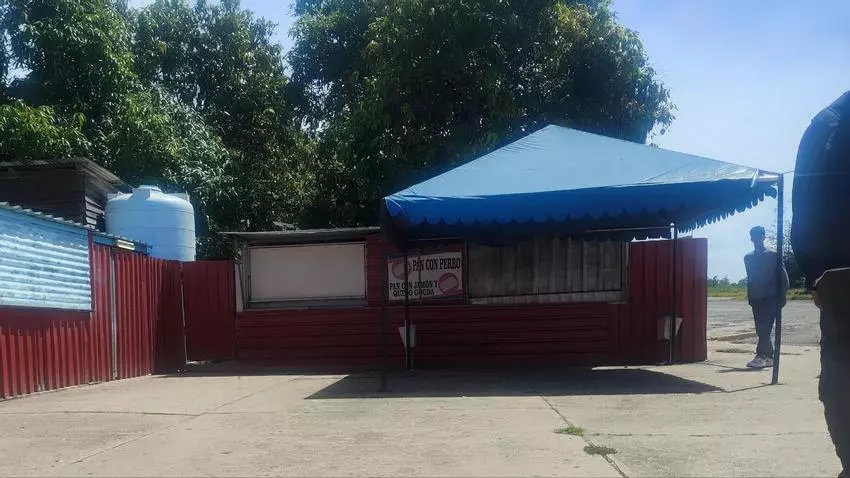
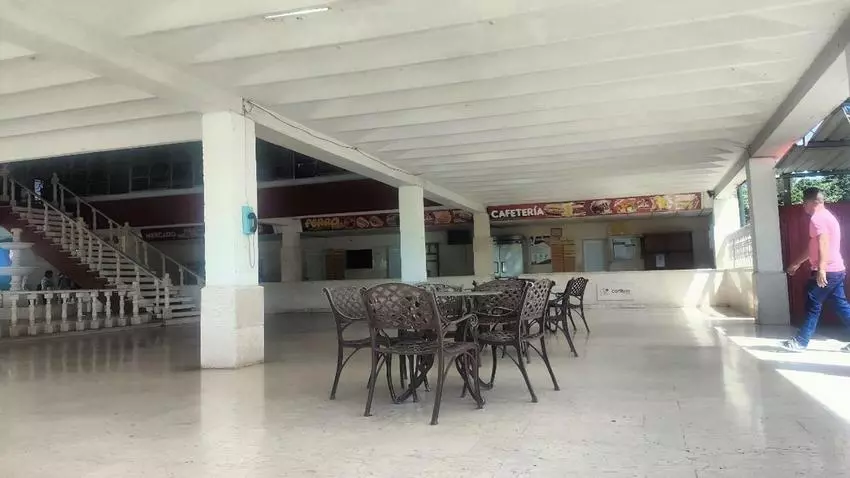
Broken-down buses, replacement vehicles that take hours to arrive, and closed snack bars now accompany interprovincial trips.

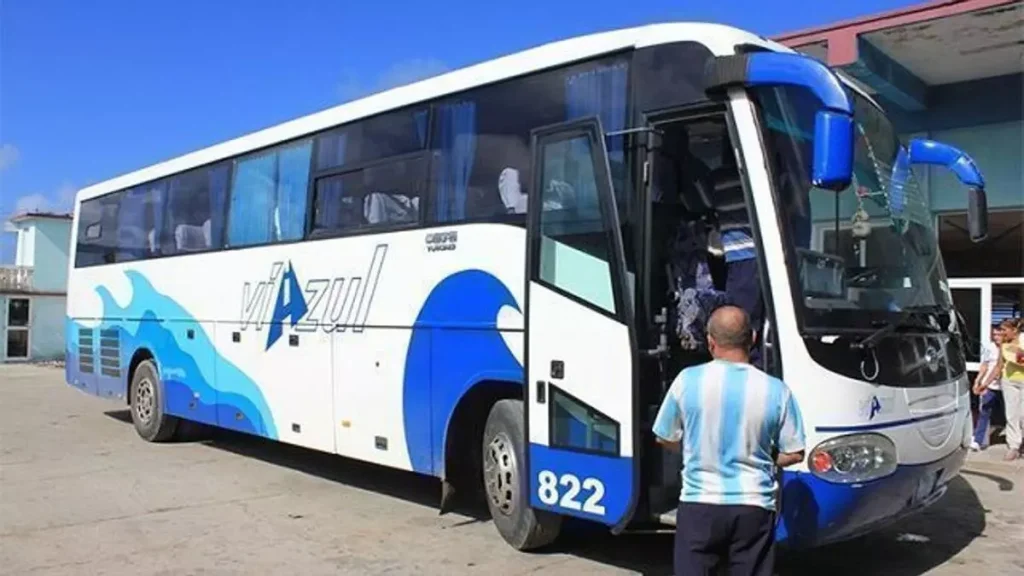
For years, Viazul was an expensive but fairly reliable alternative for traveling between provinces. / Mesa Redonda

14ymedio bigger14ymedio, Mercedes García, Sancti Spíritus, September 8, 2026 – In the Viazul waiting room in Havana, the information windows are deserted, and on the highways, the state company’s white-and-blue buses continue to circulate, but the polished exterior image is deceptive. Behind the service that charges in dollars, breakdowns, delays, and vehicles whose deterioration has turned every trip into a gamble are piling up.

For years, Viazul was an expensive but fairly reliable alternative for traveling between provinces. Created primarily for foreign tourists, it offered air-conditioned buses, routes with defined schedules, and punctuality that contrasted with the battered state transportation system used by Cubans. Now, amid the energy crisis and the reduction of other options, it has also become a lifeline for nationals.

However, buying a ticket requires foreign currency and access to payment methods that a large part of the population does not have. Hence, its customers include many Cubans residing abroad who visit the Island and people who live in the country but have relatives abroad who can pay for their ticket.

Yutong buses “rescuing” passengers stranded on a broken-down Viazul. / 14ymedio

“On the trip to Havana, the Viazul bus broke down in Jagüey Grande,” a customer from Sancti Spíritus who frequently uses the company tells 14ymedio. The bad experience was repeated on the return trip. “It broke down leaving Mayabeque and we had to continue reading

wait more than two hours. It’s now unusual for a trip to go by without some kind of failure.”

Each leg between Sancti Spíritus and Havana cost him 29 dollars. Despite the breakdowns and the time lost, he did not receive a cent in reimbursement. The price retains the standard of a service designed to bring in foreign currency, but the amenities increasingly resemble those of the transportation paid for in Cuban pesos.

The deterioration does not end with the vehicles. The traditional roadside stops also reflect the collapse. “Before, the driver would stop so that passengers could eat something, but now many of those snack bars are closed because of all the problems with fuel and supplies,” the man from Sancti Spíritus explains.

In Aguada de Pasajeros, the famous Conejito offers a telling scene: tables and chairs remain empty in front of a closed cafeteria. / 14ymedio

In Aguada de Pasajeros, the famous Conejito offers a telling scene. Tables and chairs remain empty in front of a closed cafeteria, with signs for pizzas, snacks, and soft drinks still advertising a nonexistent abundance. “There was nothing on offer, just flies,” the traveler sums up.

When a Viazul bus breaks down, another uncertainty begins as well: finding a replacement vehicle. Sometimes a Yutong appears to pick up some of the passengers, while luggage and travelers have to be reorganized on the fly. Other times, the wait lasts for hours.

For two Italian tourists, a breakdown had much more costly consequences. Last week they missed their flight to Madrid after the Viazul that was supposed to take them to Terminal 3 of José Martí Airport was delayed two hours because of a technical problem. The replacement vehicle also failed to arrive in time to take them to Havana.

There is little left in the company’s waiting rooms of the distinction that for years separated Viazul from ordinary transportation. / 14ymedio

The breakdowns are compounded by roads increasingly battered by potholes, lack of maintenance, and poor nighttime lighting. Vehicles subjected to constant wear and tear must travel hundreds of kilometers over that pavement, in a country where obtaining spare parts, tires, and fuel has become an everyday problem. Traffic accidents add another element of insecurity to interprovincial journeys.

The paradox is especially visible because Viazul continues to be a company designed to bring in hard currency. The traveler pays in dollars, but can no longer take for granted either punctuality, comfort, or even that the same bus will complete the entire journey.

There is little left in the company’s waiting rooms of the distinction that for years separated Viazul from ordinary transportation. There are cafeterias without food, half-empty waiting rooms, darkened screens, and passengers listening for any strange noise the engine might make before setting off.

Translated by Regina Anavy

______________________

COLLABORATE WITH OUR WORK: The 14ymedio team is committed to practicing serious journalism that reflects Cuba’s reality in all its depth. Thank you for joining us on this long journey. We invite you to continue supporting us by becoming a member of 14ymedio now. Together we can continue transforming journalism in Cuba.

Three Wheels Are Not Enough to Solve Transportation in Matanzas, Cuba

Electric tricycles are multiplying on the city’s streets, but their fares put many passengers off.

In Matanzas, getting around has become a daily negotiation between one’s wallet, necessity, and patience. / 14ymedio

14ymedio bigger14ymedio, Julio César Contreras, Matanzas, September 8, 2026 – Early on, when the sun is still shining sideways through the streets of Matanzas, the tricycles begin going up Contreras and down Milanés. They pass by the José Luis Dubrocq Pre-University School, some with Lada steering wheels, others with solar panels on the roof, and many covered with tarps that only partially protect against the heat. Within a few blocks, various models, colors, and modifications can be seen. They are already part of the landscape of a city where getting around has become a daily negotiation between one’s wallet, necessity, and patience.

There is no shortage of passengers. Small groups form on the sidewalks, waiting for a bus, a taxi, or anything with wheels that will bring them closer to their destination. However, some tricycles pass by with empty seats. Their drivers prefer not to stop halfway because, according to their logic, they would have to charge less. Without slowing down, they claim that they have been hired or that they are turning at the next corner, an updated version of that old habit among state-owned cars of justifying why they did not pick anyone up.

Small groups form on the sidewalks, waiting for a bus, a taxi, or anything with wheels that will bring them closer to their destination. / 14ymedio

“Back there, on América Street, they have a pickup point. They are charging 125 pesos to Versailles and 250 to Peñas Altas. Anyone who gets off at an intermediate point has to pay as if they were going all the way to the end,” complains one customer. For a day’s work, the woman from Matanzas earns less than it costs to get home in one of these three-wheeled contraptions. continue reading

Inside, the passengers look like contortionists. Their legs brush against one another, more bodies are squeezed onto the hard seats than can comfortably fit, and they sweat beneath a tarp that trembles with every pothole. The advantage, however, is obvious: in the face of the crisis in state transportation, these vehicles have taken over streets and routes abandoned by other means of transportation.

“They are charging 125 pesos to Versailles and 250 to Peñas Altas. Anyone who gets off at an intermediate point has to pay as if they were going all the way to the end”

On the other side are the drivers, dealing with maintenance, taxes and, in the hybrid models, fuel. “When I arrive at the pickup point and see that there are 20 drivers ahead of me, I think that I have to find money for my household and, in addition, pay the commission owed to the owner because this tricycle isn’t mine,” Yordanis tells 14ymedio.

The young self-employed worker drives a six-seat vehicle. There are days when he barely manages to fill it three or four times. He therefore prefers hired trips to outlying areas. “For a trip to Pastorita, Cañímar or Gelpis, they are charging between 5,000 and 10,000 pesos, depending on the departure point and the time of day.” A service like that, he says, can make up for an entire week of poor earnings.

In Milanés, meanwhile, the sun climbs higher and those waiting press themselves against the walls, looking for the narrow strip of shade. An elderly man with knee problems watches the tricycles go by and does his calculations. “Don’t they realize that if they lower the price a little, they have a better chance of people being able to afford it and, therefore, of making more trips?”

The tricycles occupied the space, but the price did not decrease: the trip costs more than before, when it was made at greater speed and in more comfortable seats

The almendrones, shared taxis, that until a few months ago traveled the streets near the Pre as far as Peñas Altas have retreated to other routes. The tricycles occupied the space, but the price did not decrease: the trip costs more than before, when it was made at greater speed and in more comfortable seats.

The elderly man raises his hand and asks a driver if he can drop him off six blocks farther for 50 pesos. The driver refuses. The electric vehicle continues silently with half of its seats empty, while the frustrated customer remains leaning against the pole.

Translated by Regina Anavy

______________________

COLLABORATE WITH OUR WORK: The 14ymedio team is committed to practicing serious journalism that reflects Cuba’s reality in all its depth. Thank you for joining us on this long journey. We invite you to continue supporting us by becoming a member of 14ymedio now. Together we can continue transforming journalism in Cuba.