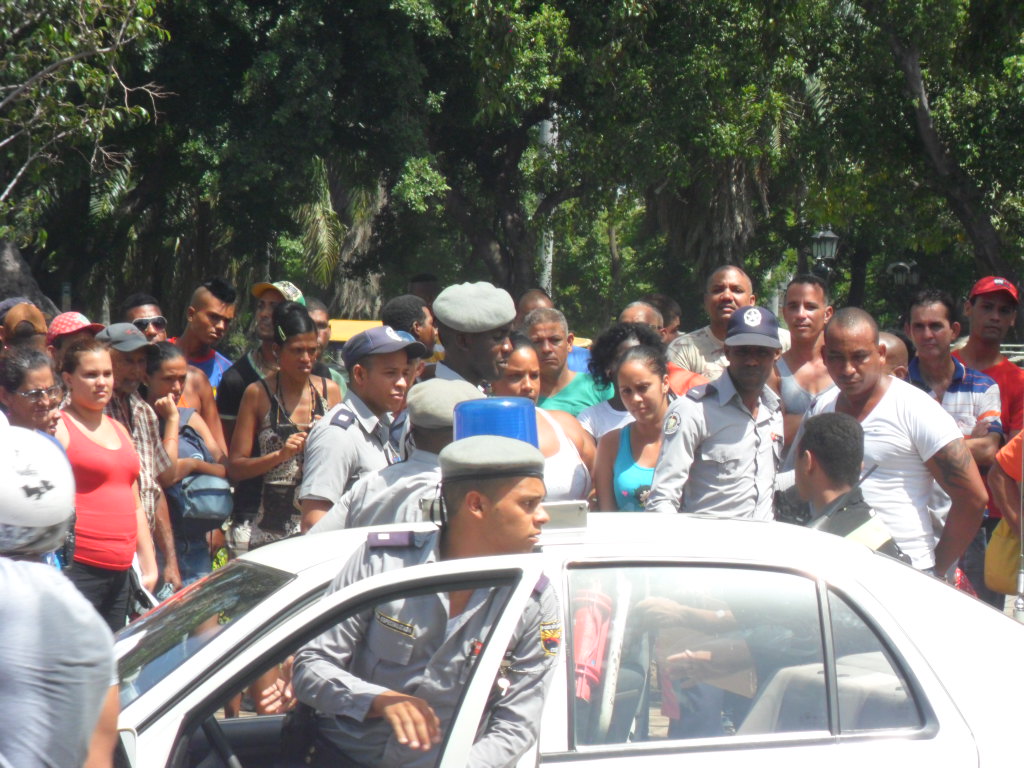
Police Taking Demonstrators. Photo: Victor Ariel Gonzalez
HAVANA, Cuba, 19 August 2013, Víctor Ariel González / www.cubanet.org.- Last Saturday, August 17 at midday, a peaceful protest — pro Human Rights and against the Castro regime — took place in Fraternity Park, next to the Capitol Building in Havana.
At the time of this writing, this reporter did not know to which group the opposition protesters, about four people, belonged. The activists carried two signs made of cardboard and written in pen, where you could read the slogans: DOWN WITH THE DICTATORSHIP and LONG LIVE HUMAN RIGHTS. They also proclaimed similar phrases.
During the brief period of the event, before being repressed by the police, a crowd of onlookers stopped in front of the Island of Cuba store, where the event occurred. Many of them took the opportunity to document it on their mobile phones or digital cameras.
The deployment of law enforcement officers was disproportionate to the number of activists and the nature of the demonstration. They received no verbal or physical abuse in public, but were handcuffed and taken away in police cars almost immediately.
Along the central corridor of the prison, an inmate walks with his shoeshine box, to shine the shoes of the soldiers. They put their boots on the prisoner’s box, , as a gesture of arrogance, and he immediately starts to spread some dye and bitumen, provided by his family. The soldiers don’t pay him for his work, it’s not allowed to pay the prisoners. I ask the bootblack why he does it, what does he gain from it, and he looks at me seriously.
“For two reasons,” he answers me. “One, to get out of the barracks, to escape for a bit that foul space, of constant quarrels, intrigues and hunger.”
Seeing a guard approach, he shuts up, and continues talking when he leaves.
“The second is because, in consideration, they give me a little more than my share of food,” he says, shrugging his shoulders. “Political, you can’t survive here with the tiny amount of food.”
I pat his shoulder and leave.
When I pass through Barracks 6, an inmate is waiting for me pressed against the bars.
“I’m taking a stand, Political,” he tells me with teary eyes. “They won’t let me make a phone call to find out how ill my son is. I’ve talked with all the soldiers and they’ve rudely refused to let me. I’ve resolved to die of hunger.”
“What will you solve with that?” I say to him. “Your son need get out of here healthy, not dead: it’s the only way you have to help him.”
He nods his head, accepting.
“You only have months before being released, so be patient, bear up, this is the hardest part.”
His eyes are still damp and he thanks me. Later we part, each going to his own barracks to wait for justice to come.
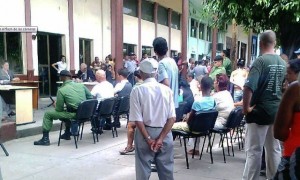
CIENFUEGOS, Cuba, August, www.cubanet.org- As if it were serialized novel, the Public Prosecutions in the city of Cienfuegos just started what we could say is their third season, when on August 6 two citizens were processed and convicted in one of those covens — taking as its amphitheater the crowded Calzada de Dolores Avenue — for having stoned a passenger bus.
The practice of punishing presumed lawbreakers outside the courtroom is not new; it goes back to the beginning of the communist government in the late fifties, when elements linked to the repressive apparatus of the Batista dictatorship, first, and political opponents emanating from the ranks of the rebel army or organizations related to the July 26 Movement later.
Trials were held in public plazas so that the enraged masses could frenetically shout: “Paredón*! Paredón!”; trials without the benefit of the most basic procedural safeguards. The fact is that this did not matter then and does not matter now, as the main task of this process is to instill revolutionary terror in a particular sector of the population, not justice.
During the decade of the ’90s, the repressive tool was unsheathed again, this time seeking to silence popular dissent following the growing hunger, extreme shortages and endless blackouts that darkened the island from one end to another in what has been known as the “Special Period.”
Dozens of individuals, seeking an outlet, threw stones against the windows of shops, passenger buses, or simply damaged to public telephones; they were then paraded like animals in a fair before an audience far less effusive and committed to the powers-that-be, people who were limited to looking on silently, not daring to announce their disagreement with the way the revolutionary process was going.
The just concluded trial is part of the new government campaign calling for us to combat social indiscipline; it was given a push after Raul Castro’s speech last July 26. Since then, there has been a marked interest in reviving old methods of social coercion directed, not only at damming the waters not only of legitimate discontent, but especially the downright antisocial behaviors that are on the rise due to the loss of values that afflict our society. And in this strategy, Public Prosecutions play a fundamental according to the ideologues of the Castro regime.
I’m not trying, here, to justify unhealthy behaviors such as damaging a bus, obviously a social good, especially if those who carry it out have extensive criminal records and admit to having acted motivated by alcohol and the heat of a fight.
It is about understanding that justice must have as a priority the social rehabilitation of the individual, as a last resort isolating them from the community to which they cause injury, without taking on, as an additional burden, character assassination of those who commit crimes.
In short, if we think carefully we will see that this distorted form of administering justice involves more than a demeaning form of prosecution. It is not only that the procedural guarantees of the accused are weak, or that holding a trial in a public street in front of hundreds of bystanders involves additional punishment outside the framework of laws stipulating penalties, at the moral cost of infringing on the process, and on those who haven’t yet been judged.
The presumption of innocence is thrown into the trash, because I know of no similar experience in which those implicated have ultimately been declared innocent. What it’s really about is sending a clear message that is heard loud and clear in society, so that people can understand the risk of any attempt to undermine the Socialist order.
The treatment in this case is the same for career criminals, as for those who offend from necessity; for the discontented subject who breaks a window or posts a dissident sign as a single act of relief, as for the political opponent who systematically disobey laws that violate universally recognized human rights.
And this is well understood by the population. It is not by chance that one of those present at the scene told me, disgusted, “These are the ones who are making us starve. Why didn’t they hold similar trials for the corrupt Felipe Perez Roque and Carlos Lage? Why when a Party First Secretary is fired from his job for stealing is he not given the same treatment?”
The major emphasis of the lawyers is to try to prove the “Revolutionary” character of those they are defending, to ask for mercy because they were affiliated with the Committees for the Defense of the Revolution and paid their dues.
They were content to base their efforts on an attempt to gain the favor of the “magnanimous revolutionary justice.” There was nothing of a brilliant defense or calling out suspicious allegations. Everything following a predetermined script. The defendants, before passing through that avenue to have their blind date with the scales of justice, knew that they were already condemned.
ABOUT THE AUTHOR
Alejandro Tur Valladares. Cienfuegos. Independent journalist since 2005. He founded the Cubanacan Press Agency, directed also by José Moreno. He has collaborated with various media such as Misceláneas de Cuba, Primavera, Radio Martí, Radio República. He is the director of the Jagua Press agency.
*Translator’s note: “Paredón” — To the wall — was the shout of the mob demanding the prisoners be executed.
You must have nearly suicidal courage to accuse Cuban State Security, an offshoot of the Soviet KGB which has thousands of officials and millions of collaborators on and off the island, of a double murder.
The accusation comes from Madrid, from Ángel Carromero, of the youth wing of the People’s Party, who was extradited from Havana and is still serving a four-year sentence, having been accused of the deaths of Oswaldo Payá and Harold Cepero, the leaders of the opposition Christian Liberation Movement (MCL), who were his passengers on July 22nd, 2012, along with the Swedish Christian Democrat Aron Modig (who like Carromero was not injured at all).
Modig was deported to Sweden a few days after the incident, and he remembers only that he was asleep at the time, although he has asserted his confidence in the Spaniard’s version of events. Carromero related his story to The Washington Post and El Mundo, as well as on the radio and television. He also confessed all in person to Payá’s daughter, the human rights activist and new leader of the MCL, Rosa María Payá.
According to Carromero, the collision was not an accident (as he had initially claimed on video, coerced and injected with as yet unknown substances). According to him another car pushed them off the road in the east of Cuba, and uniformed and plain-clothes men took the two foreigners by force to a hospital in Bayamo. Hours later, both Cubans were corpses. The Cuban State has never explained who took them all to the hospital.
Although he has no evidence other than some text messages sent from the hospital, his conscience wouldn’t leave him in peace, and Carromero broke a tacit pact with the secret power of Castroism: its State Security. The easiest thing would have been to incriminate himself of “involuntary manslaughter” with his silence. But not even that would have saved him as long as he was a witness: he would still have been a dead-man-walking.
Now, thanks to his voice and Rosa María Payá’s, the world is coming together to call for an international investigation into the violent deaths of two peaceful human beings with no criminal records. The truth will set us free. Thank you, on behalf of Cuba, Ángel Carromero.
I was riding on the P9-route bus, listening to music playing at a reasonable volume, a song by the Mexican Marco Antonio Solís, in which one verse is repeated several times: “Where are we going to stop?” I liked the catchy chorus and mentioned it to my colleague Julio Ferrer who was traveling with me, when I heard a woman who, in response to the insistent jostling of several school kids trying to get off the bus, told me “It is true, where are we going to stop? I am professor of mathematics, physics, and chemistry” (without mentioning at which school).
What became clear during our brief chat is that we are deficient in everything related to formal education, social discipline, human values, and standards of conduct; she also mentioned rights and obligations at all levels. Obviously I agreed with her comments. She, my colleague, and I remember a topic in our fundamental standards called Civic Education, which our parents learned and taught us, and which we are still fortunate to have, as we are reminded repeatedly day after day.
The Congress of the Federation of University Students (FEU) recently met. Its Conclusions, Recommendations and Work Strategies addressed the issue of reintroducing Civic Education into our educational system. In my opinion this should be done at the earliest grades and ages possible. As a subject (theory) it is quite feasible, and the need is urgent, because it also generates respect for all our true, necessary, and legitimate rights and obligations.
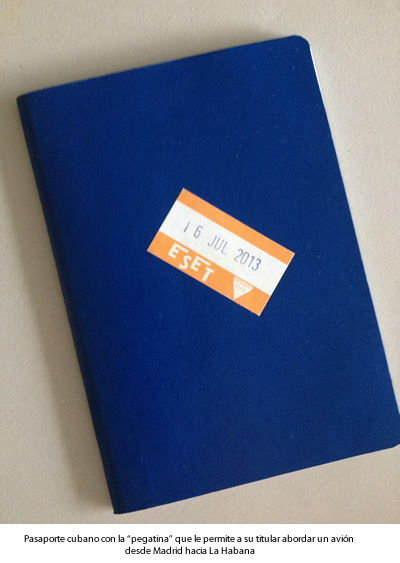
Cuban passport with the “sticker” that allows its holder to board a plane from Madrid to Havana
Of all the check-in lines at the Barajas Airport there is one that is longer and slower. This is the Air Europe flight that leaves from Madrid for Havana. After Iberia cancelled its service to the Island, Cubans living in Spain have been left with only one direct option for their travel home. Here they are, carts loaded with suitcases, filled with presents they have accumulated over months for their families waiting on their native soil.
Two airline employees intercept the line at one point. They have a trained eye to detect tourists going on vacation. If you weren’t born in Cuba you can continue to the ticket counter to hand over your luggage.
But if you have the blue passport with the lone palm shield, then the treatment is different. For natives of the largest of the Antilles, airports are never easy expeditious sites through which they pass and continue on their way. Rather, each border is a heartache; each migratory process is twice as complicated as for other nationalities. The inspection of documents is slow, meticulous.
The Air Europe workers must guarantee that no Cuban boards the plane without permission to enter his own country. If they make a mistake, the airline itself will have to bear the cost of expatriating the passengers. So they take their time to make sure that the customer completes all the requirements before being letting him board the plane.
Most likely they have passed a special training, because they immediately look for the pages of the passport called “enabled”: authorization to enter for exiled Cubans. If everything is in order, they place a small sticker on the cover of the document. Without this scrap of paper you will never pass through the departure gate.
With the new Immigration Reform, which came into effect on January 14, the pre-flight inspection has become more complex. Now airlines flying to Cuba have to check if the passenger is within the range of a 24-month stay abroad allowed by the current law. For those who emigrated in previous years, everything is even more difficult.
The person could belong to the large group of those who are prohibited from entering the Island. Almost always for ideological reasons. Having made critical statements about the government, being a member of an opposition party, engaging in independent journalism, making a complaint to some international organization, deserting from an official mission, or being a target of the whims of power, are some of the causes that block the entry of thousands of our compatriots.
A few days ago, the case of Blanca Reyes, a member of the Ladies in White who lives in Spain, jumped into the headlines when she was denied the possibility of visiting her own country. With a 93-year-old father and a family she hasn’t seen in more than five years, Blanca requested an entry permit for the country where she was born. At the Cuban Consulate in Madrid the reply was terse: “denied.” So her passport was left without that other sticker of shame known as “enabled.” On the corresponding page there is no stamp on the watermarked paper that would allow her to return to Guayos, her little village in the central province of Santci Spíritus.
Without an “enabled” document, Blanca will not pass the scrutiny of those Air Europe employees, nor of any other airline flying to Cuba. For her, the longer and slower line at the Barajas Airport is an unattainable dream. As long as this absurd migratory restriction remains in force, she will have to stay — in the distance — accumulating presents and hugs to take to her family.
From the same instant in which General Raul Castro was enthroned as President, he hasn’t stopped warning that “The battle against crime and corruption has no room for doubt.” On many occasions he has been seen at the podium exhorting publicly the members of his cabinet to maintain an “implacable” conduct against the mentioned scourge.
It’s difficult to convince that popular body that for lack of confidence, without realizing it, passed from alarming sloth to heartless hibernation.
In order to execute his crusade and give veracity to his words, in the year 2009 he created the Controller General of the Republic of Cuba, an organ that until today has carried out audits on all the State institutions and brought before tribunals those accused of economic crimes and corruption, a good number of functionaries, employees and directors of state enterprises, an ex-minister and an ex-vice minister of the food industry, foreign businessmen, an ex-son-in-law of the above-mentioned General President and family members who, confused, wealthy or followers of a lucrative ideology, one day swore loyalty to the revolutionary process.
For some citizens, the General represents a Caribbean Grim Reaper with a collapsible neck, who, with an olive-green cowl and a scythe in his hand will put an end to the kleptocracy. “The struggle against corruption” is an epic banner that the First Secretary of the Communist Party decided to raise, and to hoist it more, he named as gonfalonieri his son the Colonel, a middle-aged man who is a specialist in judging everything and an expert in looking after personal objectives.
Certainly, the law is the only form of giving an effective and round answer to the problem of corruption; but sadly, the publicized content is one more myth, which isn’t precisely destined to eradicate the matter from the Cuban horizon, but rather will concentrate the country’s resources and total power of the State in the hands of the most corrupt, most restricted, most faithful, and even most compromised group belonging to the Castro Espin clan.
Why didn’t the General say anything when the Cuban government was discovered attempting to transport military materiel through the Panama Canal hidden under tons of sugar in a North Korean ship?
If this isn’t muddy, then there’s the possibility that before the unpolluted island ruler, neither was it corruption that a group of “cooperating Cubans” engaged in bringing in contraband diamonds from Ghana and Namibia to Havana, stones that later were sent by air to a beautiful port city in northeast Belgium, Amberes, casually known as the world center of diamond trafficking and commerce. How could that happen without the approval of the State that sees everything, like Big Brother?
I also recall very well that some years ago, in 1989, a group of high military officers were punished for similar acts. And look here, curiously, these trafficking specialists, whom the Cuban government feigns not to know, are all ex-military man and civil workers of the army that works for ANTEX S.A., an anonymous society of Cuban capital located on the African continent, with offices in Angola, whose initials mean strangely (and excuse me for the use and intentional abuse of these adverbs) the name of General ANTonio Enrique (Lusón) EXportations. A Raulista convert who not only is corrupt but also basks in it.
In giving new names to things that already exist, we Cubans in the last century were profligate. We began by getting rid of the original names of various businesses and commercial establishments, and replacing them with a letter and number code that no one understood. For example, a bodega which had always been called La Complaciente was renamed Establishment E-14. This brilliant initiative used up all the letters of the alphabet, combining them with numbers. These coded labels were part of larger entities, labeled “consolidated,” that encompassed everything. There was Consolidated Meat (notable for its absence), Consolidated Leather (ditto), Consolidated Bread, Consolidated Beverage and so on. Over time the changes continued, leading to unions, complexes, groups, chains and more.
The problem has always been an unwillingness to call things by their well-known and widely recognized names. Thus, the economic crisis became the “Special Period,” failures became “corrections,” reforms became “updates,” an independent worker became “self-employed,” corruption became “resource diversion,” a prostitute became a “hustler,” a restaurant became a “paladar,” an opposition figure became a “mercenary,” a private farming business became an “agricultural co-operative,” a small private business became a “non-agricultural co-operative” or “a new type of co-operative,” a client became a “user,” and so on to infinity.
How easy it would be to use the Spanish language correctly! This way, we would all understand each other better and foreign visitors would not have to work so hard trying to understand all this strange terminology. By refusing to call bread “bread” and wine “wine,” you end up with linguistic obfuscation.
Like water — try as one might to impede its flow, one way or another it always finds its own level — sooner or later this absurd terminology will be a thing of the past and forgotten, obviating the need for a Dictionary of the New Cuban Language. Then a crisis will be a crisis, a failure will be a failure, a reform a reform, a worker a worker, a business a business, and so on. Let’s go back to speaking and understanding each other in Spanish!
Not the disdain of the English-speaking animal rights activists nor the anti-bullfight stance of dozens of people and communication media stop the explosion of jubilation, fear and tension of the million people who run before the bulls in the streets of Pamplona, from Saturday, July 6th to Sunday the 14th.
Once again the city of Pamplona, ancient capital of Kingdom of Navarra, fills with pilgrims from half the world who dress in red and white, sing the original hymns of protection to San Fermin, with his image they make a hour-and-a-half long procession, after which they head toward the streets of the running of the bulls, where men and beasts enclosed in “the fences,” nurses and police “transit” to the Plaza de Toros.
The running of the bulls start at 8:00 in the morning, and passes from the corrals of Santo Domingo to the Plaza de Toros de Pamplona, a distance of 850 meters that demands training and puts courage, nerves, and abilities to the test to avoid goring or fatal falls in the middle of so much euphoria and collective passion. It seems that a few minutes of enclosure link men and beasts. They meet again in the plaza hours later, the bulls in front of the bull fighter, the humans from the stands.
Los Sanfermines, the singular and sovereign festival of revelry; is the ultimate party, a test between life and death; maybe the best expression of the tragicomic sense of the Spanish, friend of extreme and ritualistic challenges put in question by modernity. Los Sanfermines is also a hedonistic scene, a friendly and familiar orgy that attracts nearly one million tourists who dust off the old routine, strange and fascinating Pamplona, whose historical hoof-print multiplies its cultural and commercial options, while its inhabitants trip over alcoholic foreigners who distort the bullfighting meaning of the event.
These Sanfermines attracts figures such as Joselito Adame, Alejandro Talavante, Morante, el Juli, Perera, Fandino, and others famous in the ring contracted by the Bullfight Commission of the House of Mercy. The bulls are put up by the livestock businesses Cebada Gago, Dolores Aguirre and Fuente Imbro. The Navarrian government receives more than one million euros in taxes.
Bull fighting is not a sport but a spectacle with deep roots in Spain and counties in the Americas such as Mexico, Colombia and Peru. Behind the spectacle are the ranchers, the professionals of challenge, the fans, the bull fighting plazas and the hundreds of local governments that promote the running in the streets during the summer, from the great Madrid to the small Vall de Uixo, in Hispanic Levante.
Perhaps the Sanfermines, this festival of passion and challenge, is the greatest traditional spectacle in Spain; followed by the celebrated and multitudinous Fallas de Valencia, the Festival of Pilar in Zaragoza, Holy Week and the Fair in April in Sevilla — which exalt the Andalusian culture — the Carnivals of Tenerife and Cadiz, the first sumptuous, the second satirical and mocking; the monumental Hoguera de San Juan in Alicante, the Celebration of Moors and Christians, especially that of Alcoy; the Viking Festival in Catoira (Galicia), San Isidro in Madrid and the less festive and atypical Day of San Jordi in Cataluna, where the running of the bulls was prohibited.
In the Dominican Republic and scattered throughout the world, many friends await, who tried to protect me when I still hadn’t detailed the gross “stories” which later led to the accusations against me. They inferred what would happen to me. They predicted a future I didn’t want to see or that I didn’t care to suffer.
In 2008, when I last traveled abroad months before opening my blog The Children Nobody Wanted, Rafael Lantigua, the Secretary of Culture, a position which in Cuba would have been the Minister, tried to tell me not to return, and introduced me to his personal attorney to arrange the paperwork for me so that I could stay his country.
On the other hand, the poet and narrator Camilo Venegas took me into his home like another son his mother never had. He begged me not to return, envisioning what would happen to me later. Finally I left, with a promise I was not able to keep: I would be back soon.
Pequeño, after receiving me in his home, entertaining me along with his wife and children, addresses himself, through another Cuba, to getting me a job in a subsidiary of an important publisher in that country, with the intention that I would not return to Cuba.
My sister Mary, from Miami, promised to send money to support me, until I had gotten settled.
Freddy Ginebra offered that his Casa de Teatro would hire my partner, in her work as an actress, once again fulfilling his mission as a protector of Cubans.
Lilo Vilaplana called on the phone to offer me passage via Colombia.
Amir Valle, through chat, opened his arms to receive me in Germany.
I left that half-island, leaving behind, probably, my immediate tranquility; but I did not conceive, and I still can’t conceive, abandoning my country and leaving it in the grip of the Castro brothers’ dictatorship.
The only pain prison causes me if the suffering of these people from knowing I am a prisoner; because if the situation were reversed I would be making the same cries, demanding justice, that I hear today; because disgracefully, it is a characteristic of totalitarianism to impose force against those who disagree with their policies.
In any event, as incredible as it may seem, I am comply as a good Cuban, with what I believe to be reason and rights.
My thanks to all of you from this great Dominican land, and for those scattered around the world, who tried to protect me, but within me I had the dream of José Martí lighting my path.
Hugs, Ángel
Prison 1580. July 2013
Translator’s note: This is another of the posts Ángel wrote from Prison 1580 before he was transferred to his current prison where he is being held incommunicado.
Article 129.1 – Property confers on the title holder the possession, use, enjoyment of and disposal of the assets, in accordance with its intended socio-economic use.
Rolando González Camacho received from his grandfather Eufemio González Martínez a property situated at Apartment 4 of building 19213a, fronting onto Avenue 81 between 102 and 194, Alturas de la Lisa Neighborhood, Havana.
The said property was awarded, according to Deed number 1120 by way of Gift, issued in the City of Havana the 25th August 2009 before Licenciado Uber Rae Arias Rodríguez who was Notary at 4604, 37th Street in the Playa Municipality.
Rolando, in spite of his 30 years of age, is legally represented by his mother and stepfather, as he suffers from hepatitis C, partial epilepsy symptomatic of the frontal lobe, neuroblastic migration disorder and bronchial asthma; according to a medical certificate issued 23rd June 2013 by Dr. Víctor Raúl Frades García of the neurological consultancy at the Havana Salvador Allende Hospital.
His infirmities do not limit his conversational ability, given that when I turn up at his house, he speaks happily and expresses his regret that his grandfather left him a property in which he couldn’t even cook since the next door neighbour María del Pilar Olivera Delgado, taking advantage of a period when the property was empty, broke down a dividing wall and taking over a part of his property.
He says he has spoken to María del Pilar Olivera Delgado asking that she remove herself, because he doesn’t want problems with his parents and is afraid of the police.
In August 2009, Rolando issued a SPECIAL POWER, before a notary in the name of his stepfather Jorge Luis García Casañas, his legal representative. García Casañas has made claims in relation to all stages of the proceedings, in order to get them out of his property, not just the person who in August 2011 broke the wall and illegally entered Rolando’s home, but also another two people who joined María del Pilar Olivera Delgado in this unbelievable violation.
Furthermore, the failure of the relevant bodies in this case has been contradictory and completely lacking in clarity.
The legal absurdity of giving support to illegalities committed in his home, has caused Rolando González Camacho damage which may be irreparable, given the effects he is experiencing in his health.
The obvious question therefore is: who takes responsibility for the situation of this fellow countryman who is suffering torture in his own home?