Residents of Guanabo demand solutions in front of the People’s Power headquarters, and in Santiago de Cuba, the house-museum of “martyr” Orlando Pantoja is set on fire.
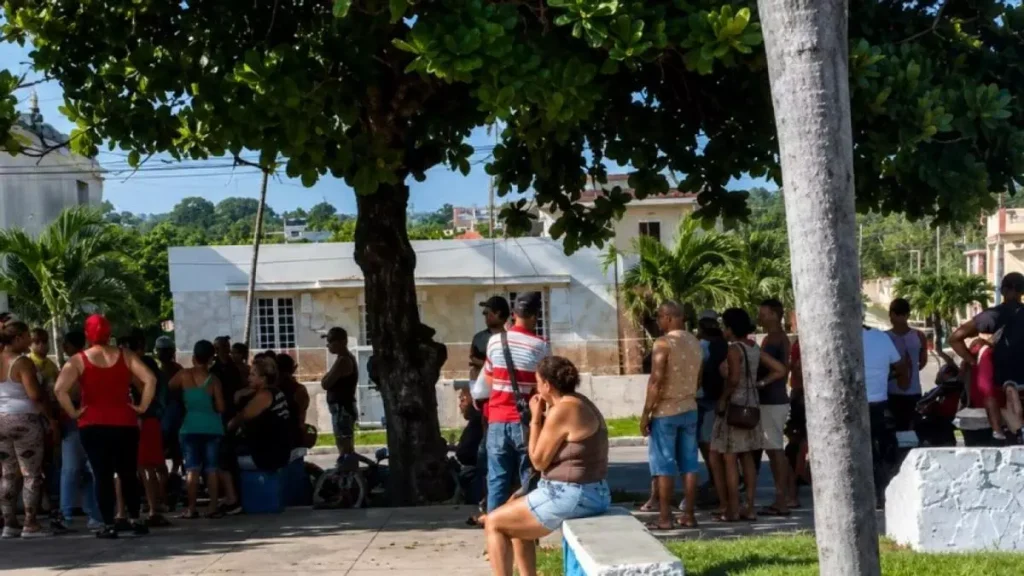
 14ymedio, Havana, June 23, 2026 / The wave of protests against blackouts, water shortages, and the worsening crisis continues to spread throughout Cuba. Pot-banging protests are now a common sight in neighborhoods, even in broad daylight, but the discontent has also begun to reach government buildings, where a growing number of citizens are demanding explanations for the deterioration of their living conditions.
This Monday, dozens of residents of Guanabo, in East Havana, gathered in front of the People’s Power headquarters to demand solutions to their “unsustainable” situation, after weeks of unanswered complaints. The residents managed to meet with officials, but the outcome was equally disappointing.
“The people of Guanabo are uniting to demand answers because what they are doing to us is abusive,” wrote Sisi Aguilera, a user who posted a video on social media showing a large group of neighbors talking about the situation affecting them. They denounced that it is not simply the lack of electricity, which the whole country suffers from, but also basic things like a motor that doesn’t work and has left them without drinking water for weeks, among other issues.
One of the participants, activist María Elena Mir, told the independent media outlet Cubanet about the reasons for the accumulated discontent and details of the meeting in front of the government building. One of the main causes of the discontent is the inequality between protected and unprotected circuits. Guanabo is divided into two such areas, although even that is no longer a guarantee of anything.
In the circuit subject to cuts in basic services, the affected area includes essential services such as healthcare facilities, banks, the post office, and other public utilities. The most critical case is the emergency room of the polyclinic, which operates using solar panels and whose backup for the intensive care unit was not provided by the government but purchased by local residents. “It was the community that solved the problem,” Mir explains, adding that residents had to pool their money to buy an EcoFlow system after serious incidents related to the power outages.
Residents are denouncing the lack of public transportation, gas, and water supplies, which are compounded by 45-hour consecutive power outages. “The population, exasperated, tired, exhausted, and dehydrated, gathered at the location,” stated one resident, where the police were also present.
“I had to clarify that what we were protesting were social and human issues, not political ones. Nevertheless, the police arrived,” Mir recounted. “I was on the front line and I knew that if I took out my phone they could take it from me.”
After several hours in the sun, the residents received a frustrating response from officials, who claimed to be unaware of the magnitude of the problems reported – even though the residents had brought documents as evidence of their complaints for days – and promised to meet with provincial authorities before offering solutions.
After the meeting ended, there was a brief flash of electricity. The water, however, still hadn’t appeared. “There’s nothing else to ask for. There’s no way to go on living like this,” Mir concluded.
The protest in Guanabo adds to the wave of pot-banging demonstrations reported in recent days in numerous Havana neighborhoods. Early Tuesday morning, there were also pot-banging protests and burning of trash in El Vedado, although nothing as striking as what happened on Sunday in Santiago de Cuba, when residents of the Santiago municipality of Contramaestre set fire—according to videos circulating on social media—to the Orlando Pantoja Tamayo House-Museum, an institution administered by the Communist Party in honor of one of its “martyrs.” In the videos, slogans such as “Turn on the electricity!”, “Freedom!”, and “Contramaestre doesn’t want any more communism” can be heard.
______________________
COLLABORATE WITH OUR WORK: The 14ymedio team is committed to practicing serious journalism that reflects Cuba’s reality in all its depth. Thank you for joining us on this long journey. We invite you to continue supporting us by becoming a member of 14ymedio now. Together we can continue transforming journalism in Cuba.