U.S. Airport Authorities Invited Another Cuban Delegation for a New Visit

According to a document obtained by Martí Noticias, the Foreign Ministry requested four visas for a business trip and the signing of a “Letter of Agreement” on air traffic control


Luggage security checks at Miami International Airport / MIA

14ymedio bigger14ymedio, Madrid, 25 June 2024 – The US Federal Aviation Administration (FAA) invited Cuban officials to visit the Miami Air Route Traffic Control Center in Florida, “as part of the Operation Miami/Havana and Houston/Havana Agreement.” The information was revealed on Monday by Martí Noticias, which had access to a document from the Ministry of Foreign Affairs of Cuba requesting a visa from the U.S. Embassy in Havana for the four people who traveled. The exact date of the visit is unknown, since, although the FAA itself confirmed that the meeting took place and was in May, it would be necessary to “contact the Cuban authorities to obtain information about their itineraries,” says Martí Noticias. The Cuban Foreign Ministry eluded answering the questions of the media, based in Miami.

In the visa application document, the Ministry of Foreign Affairs indicates that the reason for the trip is to hold a working meeting and sign a “Letter of Agreement” on air traffic control between the Federal Aviation Commission and the Cuban Institute of Civil Aeronautics. In addition, Eddie Pérez, manager of the Miami flight control center, is indicated as a reference contact, and it is specified that the costs of the visit will be borne by the Cuban side.

It is also specified that the departure was scheduled for May 12 “with entry through one of the authorized ports (IAD and JFK).” The first is Dulles International Airport, in Washington DC, while the second is John F. Kennedy, in New York City. continue reading

It is also specified that the departure was scheduled for May 12 “with entry through one of the authorized ports (IAD and JFK)”

According to Martí Noticias, the officials who were sent to the United States are Orlando Nevot González (former director of Air Navigation of the Institute of Civil Aeronautics of Cuba), Michel Mederos Reigoza (former supervisor of the Traffic Control Center of Cuba), Jorge Fermín Centella (worker of the Cuban Company of Airports and Services) and Jorge Luis Martínez Rizo (of the Institute of Civil Aeronautics).

A delegation of 15 U.S. officials, including managers from the airports of Miami and Houston, received the Cubans. According to media sources, the purpose was to “address the continuous, safe and efficient movement of aircraft” between the terminals of both countries.

The visit took place almost parallel to the one that at the end of May raised a strong controversy in Florida, also from Cuban officials, for a “exchange of knowledge” with their colleagues from the Transportation Security Administration of Miami International Airport.

That meeting was denounced to Diario de Las Américas by a source who complained about “letting the agents of the Cuban dictatorship into those facilities, letting the Castro spies enter the heart of the airport.” Some workers shared with this informant their doubts about the possible access of Cuban officials to “sensitive information, a practice reserved for representatives of allied countries.”

On that occasion, the Cuban side had “direct access to the new three-dimensional X-ray technology, among whose objectives is the identification of explosives to prevent terrorist groups from introducing them into the cabin of an airplane and other sensitive places. “It is inconceivable, absurd, unjustifiable and very dangerous,” said the source, who insisted that “opening the door of our security to Cuban officials means also having opened the door to Iran, North Korea, Venezuela, Russia and other regimes that are enemies of American democracy.”

After the visit, Republican politicians Marco Rubio and Carlos A. Giménez, who chairs the Subcommittee on National Security for Transport and Maritime of the House of Representatives, presented the  Secure Airports From Enemies (SAFE) Act before the Senate and the House of Representatives of the United States, respectively.

Giménez described it as “incredible” that agents of a regime that is on the list of countries that sponsor terrorism were invited to visit the U.S. facilities

Giménez described it as “incredible” that agents of a regime that is on the list of countries that sponsor terrorism were invited to visit the U.S. facilities.

“We must make sure that this Administration does not allow foreign agents to know about our security measures aimed at keeping Americans safe,” Rubio said.

Washington and Havana maintain a cooperation program on security issues that provides for actions such as visiting institutions, exchanging information and working together, for example, to prevent terrorist attacks and drug trafficking operations. Over the years, there have been several meetings of this type.

Translated by Regina Anavy

____________

COLLABORATE WITH OUR WORKThe 14ymedio team is committed to practicing serious journalism that reflects Cuba’s reality in all its depth. Thank you for joining us on this long journey. We invite you to continue supporting us by becoming a member of 14ymedio now. Together we can continue transforming journalism in Cuba.
A Network of Corruption That Destroyed a Company in Guantánamo, Cuba, Is Dismantled

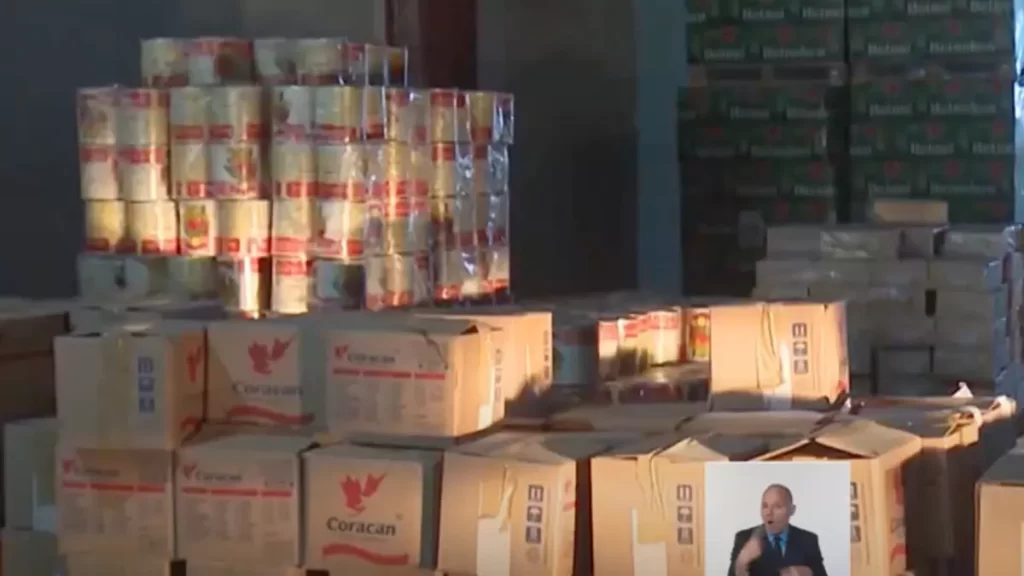
Part of the merchandise shown on Canal Caribe to condemn the corruption in Guantánamo. / Canal Caribe

14ymedio bigger14ymedio, Madrid, June 25, 2024 – Corruption has completely devastated the municipal company of Gastronomy of Guantánamo, after the diversion of products worth seven million pesos ended with its “total decapitalization,” according to information released on Monday by Canal Caribe.

The case affects a large “number of people who have been charged,” as well as companies and state entities that took part in it, said Major Juan Martínez Martínez, the examining magistrate for the case. The accused are exposed to sentences of up to 20 years in prison for crimes of embezzlement.

The soldier explains that the network was organized by “a person who had knowledge of how the company worked” and negotiated with several suppliers to “extract goods that never reached their final destination.”

The accused are exposed to sentences of up to 20 years in prison for crimes of embezzlement

The accused are exposed to sentences of up to 20 years in prison for crimes of embezzlement. Among the diverted products are, mostly, alcoholic beverages, such as rum and beer, and also others of primary necessity, such as chicken and sausages, in smaller quantities. continue reading

According to the magistrate, the appropriation of resources occurred by managers and accounting and commercial employees, through the falsification of the controls and documentation, which the accused validated in the company’s reconciliation process, dedicated to comparing the invoices with the orders and the merchandise delivered.

“The records were simply falsified. The product was diverted and the client company, that is, the municipal gastronomy of Guantánamo, paid the supplier and did not receive any benefit,” he explains. The decapitalization of the company has ended its existence, with the “consequent effect on all its workers,” he added.

Canal Caribe says that the best way to prevent situations like these is an “effective and rapid denunciation of facts,” and the report also appeals to the “moral damage” caused by this type of crime.

After decades of concealment of facts related to corruption, the official Cuban press has begun to report expeditiously on crimes of this type, as examples of what can happen. Cases are only made known when the networks are dismantled and those responsible are being investigated or subjected to a judicial process.

In May, something similar occurred in Sancti Spíritus, when the official press revealed that Alexis Fuentes de La Cruz, director of the Sancti Spíritus Municipal Commerce Company between May 2022 and July 2023, had been sentenced to eight years in prison for corruption. In his case, in addition to ignoring the warnings of a specialized committee not to buy soft drinks with a near expiration date, he proceeded to eliminate the documentation that implicated him in the crime. The newspaper added that there were 13 more cases like this in the province.

The report appeals, in addition, to the “moral damage” caused by this type of crime

The report appeals, in addition, to the “moral damage” caused by this type of crime. In February of this year, Miguel Díaz-Canel asked to combat corruption at a working meeting of the Attorney General’s Office and told officials that they should have “zero tolerance” for these cases that “lacerate” and “erode the moral basis of society.”

“Corruption can be so devastating that it can lead a country to poverty, to moral poverty and to material poverty. Corruption can destroy a country,” said the president, who added that it causes distrust in the population in addition to “delaying social development, growth and economic development.”

To date, the most significant fall from grace for an alleged case of corruption is that of the former deputy prime minister and former head of Economy and Planning, Alejandro Gil Fernández, removed from office in March 2024, without the least reason for the cause being known.

Translated by Regina Anavy

____________

COLLABORATE WITH OUR WORKThe 14ymedio team is committed to practicing serious journalism that reflects Cuba’s reality in all its depth. Thank you for joining us on this long journey. We invite you to continue supporting us by becoming a member of 14ymedio now. Together we can continue transforming journalism in Cuba.
Almost Twenty Building Collapses in Havana Cause One Death and Several Injured

In addition to Old Havana and Cerro, the glamorous neighborhoods of El Vedado and Miramar are also affected.

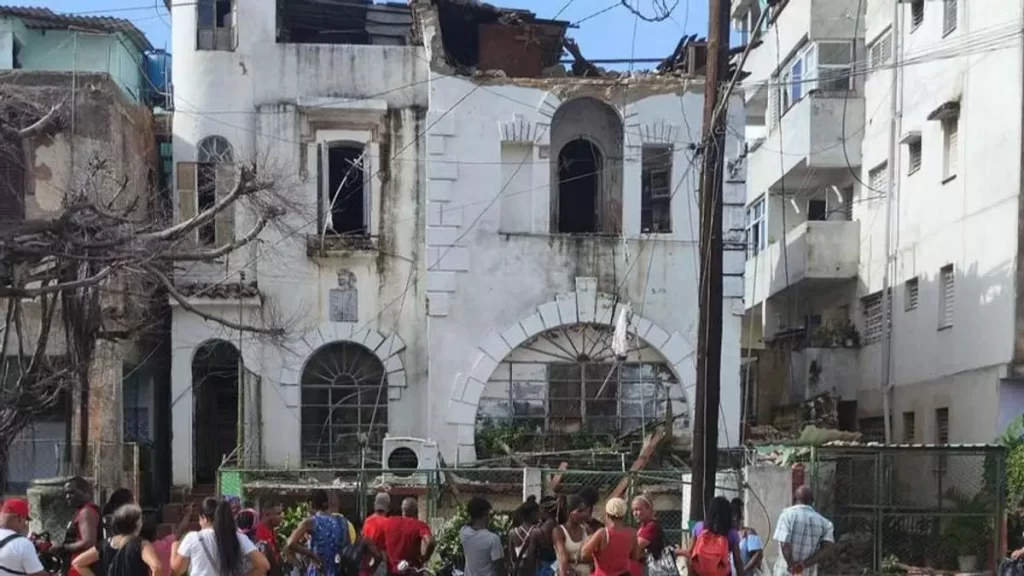
Several neighbors of the municipality of Playa in front of the building that collapsed / 14ymedio

14ymedio bigger14ymedio, Natalia López Moya, Havana, June 22, 2024 — A group of shocked and curious neighbors crowded this Friday in front of a building, in the shape of a small castle, on 26th Street between 27th and 29th Street in the municipality of Playa, Havana. A crack appeared in the building this morning while a crevice advanced on the facade, and, a bit later, part of its upper floor collapsed.

The recent rains have caused at least 19 partial collapses in the Cuban capital, according to an official source consulted by 14ymedio, who prefers anonymity. There were several injured in those incidents and even one death in the collapse of a wall on Calzada del Cerro, between Patria and Carvajal. The downpours have affected the housing infrastructure, which has lacked maintenance for decades. There has been no government investment in the residential housing stock, and families have been forced to crowd together, in an improvised way, into divided spaces.

Surrounded by an intense police and State Security operation, the perimeter around the collapse seemed, this afternoon, like a war zone. “Fortunately, no one was injured,” clarified an old woman who, close to a stall of agricultural products, had become an improvised source of information for newcomers, given the secrecy of the officials. continue reading

“I was in my house and I screamed, I thought it was a wedding, but no, it was a collapse,” said a woman who claims to have been “born and raised” in the neighborhood next to luxurious tourist accommodations, headquarters of foreign companies and foreign embassies with a meticulous garden and a freshly painted facade.

The property that suffered the collapse of part of its structure was built in the first half of the twentieth century and in an architectural style that mixes the functionality of the spaces with certain aesthetic details of grandiloquence much appreciated by the Cuban bourgeoisie that was stripped of its properties after the arrival of Fidel Castro to power.

The images transmitted on social networks show how a crack was enlarged on one side of the facade while the neighbors shouted to summon the residents of the house to leave as soon as possible. The voices expressed their concern for a girl who was among the residents who were trying to evacuate the house.

“Run, run, get the girl out!” a man and a woman are heard screaming, while the top of the structure collapses and leaves a trail of debris in front of the building. When the cloud of dust falls, neighbors of the surrounding buildings are seen leaving their homes in search of shelter. In the face of a collapse, no one feels safe. “They are major forces,” said a resident on the sidewalk right in front. Despite the widespread idea that building collapses only occur in the poorest and oldest neighborhoods of Havana, residents in the vicinity of the castle, damaged by decades of neglect, rains and weather, know that in any area of the capital buildings can fall like dominoes.

As a reminder of the day that was a turning point in the history of the Island, the nearby First of January polyclinic, honoring the official date of the beginning of the Cuban Revolution, located a few meters from the current collapsed building, suffered a collapse a little more than a year ago that forced patients and workers to relocate.

“People believe that because we live in Miramar there are no problems,” says Miriam, an employee of the clinical laboratory of the Polyclinic who lost her job when the building collapsed. “They offered me a place cleaning an apartment in another municipality but I said no, and I no longer work for the State. A fallen king, buried king. I went with the private businesses. Now I work in a cafeteria that only has one floor, and the roof is a light roof, it can’t fall down.”

This afternoon Miriam was among those who waited and watched on the street in front of the beheaded castle. “I live in a nearby room and every time I passed by here I thought about what my life would have been like to have a house like this. Now they are worse off than me; I have a roof over my head, they don’t.”

In less than a week, the collapses have affected several neighborhoods in Havana. This Thursday a balcony collapsed around 11:00 at night over the El Tablazo cafeteria, located on 1st Street, between C and D, in El Vedado. The accident occurred at a time of maximum attendance at the premises and left three injured, all adults.

A partial collapse occurred a few hours later at 425 Monte Street, between Ángeles and Águila, in Old Havana, leaving a young woman injured. The same property had claimed the life of a man three years ago, when one of its side walls fell.

Translated by Regina Anavy

____________

COLLABORATE WITH OUR WORKThe 14ymedio team is committed to practicing serious journalism that reflects Cuba’s reality in all its depth. Thank you for joining us on this long journey. We invite you to continue supporting us by becoming a member of 14ymedio now. Together we can continue transforming journalism in Cuba.

The Capture of the Sea Snail Is One of the Few Fishing Successes in Cuba

The sought-after sea snail of Camagüey is reserved for export

Capture of sea snail specimens in Camagüey / Adelante

14ymedio bigger14ymedio, Madrid, 25 June 2024 — The sea snail of Camagūey is exempt from the disastrous panorama presented by fishing in Cuba. The colorful and sought-after giant snail is reserved exclusively for export. That, at least, is evident from a praiseworthy article published on Saturday in the official press Adelante, which said that the plan of the Basic Business Unit (UEB) Pesca Nuevitas was fulfilled by 96%. It is a “meritorious” result, Adelante commends, taking into account that they only had 30% of the expected fuel and that there was bad weather in December, “causes that demanded greater effort on the part of the collective.” The lack of oil was precisely what caused the paralysis of sea snail fishing last year.

The task of the UEB, as specified to the local newspaper by Gerardo Izquierdo Rodríguez, head of Fisheries Operations, is to capture the precious mollusk , clean it and send it for processing to the Industrial Fisheries Company of Santa Cruz del Sur (Episur), in the same province, which is also responsible for its export.

State companies plan to “gradually venture” into the export of lobster, sea cucumber and sea sponge

This coming October, he continued, they will begin a new plan, until the following month of April, “with the benefit of having high level technical capabilities in the vessels.”

State companies, the official continued, plan to “gradually venture” into the export of lobster, sea cucumber and sea sponge, all products that, when marketed within the Island, are for international tourism. continue reading

In the case of lobster, they already have permission to capture three tons, an order that they will begin to fulfill in July. For sea cucumber and sea sponge, they plan to transfer specialists and biologists to the areas where they exist, “to study and propose the amount to be extracted without violating the standards of sustainable fishing.”

These are endangered marine animals, whose fishing and consumption are prohibited for individuals, but which can provide, as Izquierdo Rodríguez acknowledged in Adelante, “the collection of foreign exchange for the national economy.”

These are endangered marine animals, whose fishing and consumption are prohibited for individuals

Other areas of the fishing sector are not so lucky. An example is the fishing company of Las Tunas, Pescatun, which last week made news again due to its disastrous production. Having a target of 2,025 tons of fish by 2024, so far this year it has barely achieved a quarter of the catch plan.

It is not strange, if you take into account that of the 22 boats that make up the Pescatun fleet, only half are in working order.

Similarly, the calamitous state of fishing forced the State, last March, to allow private fishermen to freely sell their catch, except for lobster. The measure had already been provisionally approved a year earlier, but in that period there was no improvement in production. In fact, according to data from the Ministry of Food, fish consumption fell in Cuba from an annual average of 18 kilograms per person three decades ago to less than 3.8 kilograms in 2022.

Another example of a fishing disaster is that of the Zaza dam, in Sancti Spíritus, which has lowered the volume of water to critical levels due to the drought, forcing fishermen to make a frenetic catch, which will have a long-term impact on the quantities of fish that the reservoir can offer.

Translated by Regina Anavy

____________

COLLABORATE WITH OUR WORKThe 14ymedio team is committed to practicing serious journalism that reflects Cuba’s reality in all its depth. Thank you for joining us on this long journey. We invite you to continue supporting us by becoming a member of 14ymedio now. Together we can continue transforming journalism in Cuba.

The Installation of the Russian Bank Novikombank in Cuba Seeks To Avoid US Sanctions

The president of the bank pointed out that Putin “pays special attention to strengthening cooperation” between the two countries

The event was attended by the president of the Central Bank of Cuba (BCC), Juana Lilia Delgado; Ricardo Cabrisas, the Russian ambassador, Víctor Koronelli, and the head of the Russian commercial office, Sergey Baldin / Prensa Latina

14ymedio bigger14ymedio, Havana, June 23, 2024 — “Developing an independent financial infrastructure” capable of dodging United States sanctions is the main purpose of Novikombank, the first Russian bank on the Island. This was stated by Sergei Baldin, head of the Russian commercial office in Havana, who presented the bank’s objectives during its opening ceremony last Thursday at the Meliá Cohiba hotel.

“The presence here of Novikombank offers hope to fulfill development projects and investments in various areas in the future and offers confidence to the Russian business community to operate in Cuba,” the official said in front of a committee of invited businessmen from both countries and the Cuban Deputy Prime Minister, Ricardo Cabrisas, who has led the approach to the Kremlin in recent years. For Havana, the financial entity – connected to the largest state corporation in the Kremlin, Rostec – is a direct corridor through which entrepreneurs, investments and many rubles will enter.

Cabrisas dedicated many words to the friendship between the two countries and attributed the arrival of Novikombank to the “consensus reached between Presidents Vladimir Putin and Miguel Díaz-Canel.” In addition, he described the alliance as a victory against the United States’ “persecution” of the Cuban banking sector, whose most obvious expression – he considered – is the inclusion of the Island on the list of sponsors of state terrorism, drafted by the US State Department.

Cabrisas pointed out that Cuba seeks to attract foreign capital “without selling the country,” a risk that, he believes, is not run with Russia

Aware of the existence of a current of opinion within the Cuban regime that considers the rapprochement between Havana and Moscow dangerous, continue reading

Cabrisas pointed out that Cuba seeks to attract foreign capital “without selling the country,” a risk that, he believes, is not run with Russia.

As for Novikombank’s plans, the deputy prime minister assures that both governments play a key role: Havana, as a facilitator, must offer incentives to Russian business, and Moscow’s mission is to “support” the interests of that sector, although the type of aid and benefits was not clarified.

Clues about the operation of the financial institution have been offered by the Russian side. In a statement quoted by Sputnik, the president of the Board of Directors of Novikombank, Elena Georgieva, explained that this is just the first step in banking relations between the two countries, and it is expected that very soon other entities will begin to settle on the Island.

Georgieva commented on the speed of the Cuban side to allow the establishment of the bank, much earlier than planned, with which three banking entities on the Island have been working for eight years. Last March, when Cabrisas traveled to Moscow as part of an intergovernmental commission for economic-commercial and scientific-technical collaboration, talks on Novikombank began. A month later, in April, the Central Bank of Cuba granted the operating license to the company, and this June the inauguration of its headquarters – whose address remains undisclosed – became a fact.

“This is a very important event for Russian-Cuban cooperation, which we believe will continue to develop actively. Our initial task here is to guarantee stable payments between the two countries,” explained Georgieva, who stressed the special interest in this alliance of Putin, who, he added, “pays special attention to strengthening cooperation with the Republic of Cuba.”

“The opening of our representative office can contribute both in terms of advice and financing of various projects and areas of activity,” said the board, which added that other banks would also approach Havana, which will contribute to the “development of the collaboration.”

The idea was repeated last Thursday at the Meliá Cohiba by the head of the Russian commercial office, who assured that “the plans are becoming a reality,” thanks to Russia’s involvement in key areas of the Cuban economy such as energy, basic industry, metallurgy, transport, agriculture, pharmaceuticals and tourism. As he pointed out, these investments have been the basis for Russian banks to settle in Cuba and expand their activities in the future.

These investments have been the basis for Russian banks to establish themselves in Cuba and expand their activities in the future

Ties with Novikombank mark the realization of relations between Cuba and the gigantic state conglomerate Rostec, responsible for the arrival on the Island of a shipment of 15,000 LED lights last March, and the modern Ural trucks that the Armed Forces have deployed on several occasions in the streets of the capital.

Rostec, created in 2007 by Putin, is a corporation designed to control all key sectors of the Russian economy by the State, from civil engineering and medicine to the high-tech war industry. In fact, the conglomerate is especially known for its helicopters and weapons of war, very popular in the international market. Another of the sectors that Rostec controls is the oil industry, an area in which the Island is particularly interested.

Cuba has spent months preparing for the opening of Russian banking, and last December it implemented the use of Mir cards, an alternative to Visa and Mastercard for Russian tourists and businessmen, created to evade sanctions.

Relations between Havana and the Kremlin have been intense in recent weeks – since Putin’s re-election – with the visit of Cuban Foreign Minister Bruno Rodríguez to Moscow, the arrival of a Russian flotilla in Havana – including a nuclear submarine and an oil tanker with a capacity of 9,000 tons – and now the establishment of a definitive channel for money to flow between Russia and Cuba without sanctions.

Translated by Regina Anavy

____________

COLLABORATE WITH OUR WORKThe 14ymedio team is committed to practicing serious journalism that reflects Cuba’s reality in all its depth. Thank you for joining us on this long journey. We invite you to continue supporting us by becoming a member of 14ymedio now. Together we can continue transforming journalism in Cuba.
The People of Havana Hold Their Breath in the Face of a Forecast of More Rain for Sunday

This Saturday night the floods began to recede but left behind a very worrying panorama of mud, dirt and material damage.

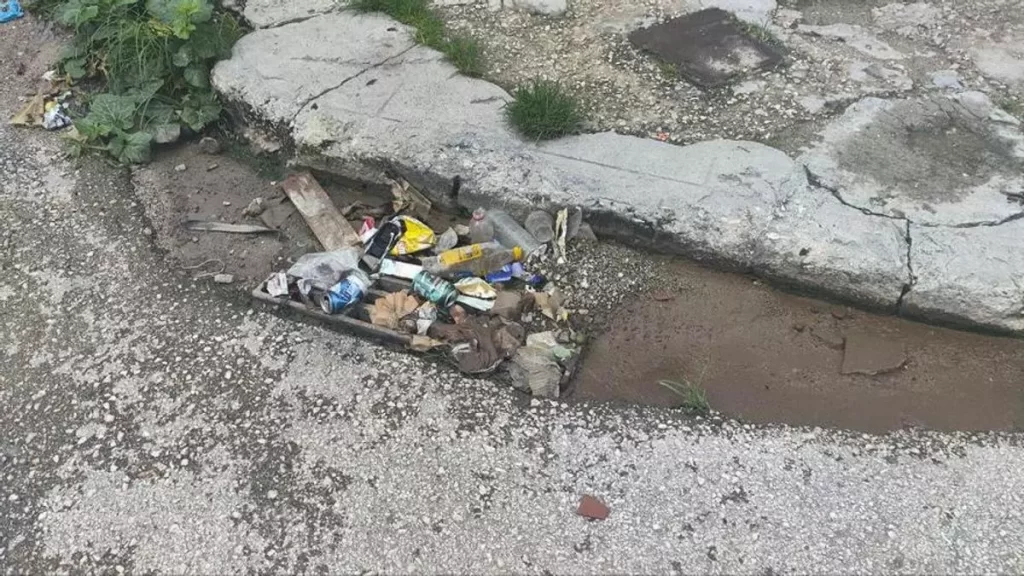
The avalanche of garbage prevents the city’s drainage from quickly releasing water. / 14ymedio

14ymedio bigger14ymedio, Natalia López Moya, Havana, June 23, 2024 — “I slept on the table because the bed got wet and I couldn’t put a sheet on the floor, it was all flooded,” this is how Leidy, age 32, a resident of the neighborhood of Los Sitios in Havana, describes her situation. The area, which is traditionally flooded with rains, has been one of the most affected by the intense downpours that this Saturday covered large areas of the Cuban capital with water.

On Saturday night the floods began to subside but left a very worrying picture. “Here everything is full of mud and garbage; the cisterns are contaminated; we don’t have electricity and many neighbors have lost everything because the water level rose very quickly; there was no time for anything,” she tells 14ymedio.

Leidy says that in her neighborhood they are “flood experts” and have put up walls at the entrances to their homes and have ways to evacuate mattresses, household appliances and to take children and the elderly to the upper floors. But this Saturday’s downpour showed that “you can believe that you have everything planned but when nature says ‘I am here’ there is no one to stop her.” continue reading

Los Sitios, like most of the neighborhoods in Havana, has gone months with mountains of garbage accumulating on the corners and waste that covers the drains, aggravating the situation. “In my house we woke up today and there is nothing to eat. Our bread got wet, water got inside the refrigerator and a mortadella that had been kept for the children was spoiled because the water inside was disgusting, with a foul smell and a lot of things floating around.”

Leidy fears the possible health repercussions of having been in those dirty waters: “It got above my waist, and I had to spend hours to take out the garbage, trying to put the furniture on top of each other. I’m still wearing the same clothes as yesterday, which can’t be very good for my health.”

“We neighbors are the ones who are cleaning the sewers with sticks, with brooms, with what we can; we are the ones uncovering the drains,” complains a neighbor of Old Havana where the water exceeded 3.4 feet in height.

In many corners of Central Havana, Old Havana and Cerro the panorama is repeated: mountains of garbage that the rain couldn’t carry away, a foul stench and water piling up. The sewer drains are clogged with plastic bags, beer cans, plastic bottles and debris.


The avalanche of garbage prevents the quick drainage of the water, as the drains are also in a very bad condition. Between 2:00 and 3:00 in the afternoon on Saturday, according to a report from the Forecast Center of the Institute of Meteorology, over two inches of rainfall was recorded at the Casablanca station in Havana.

14ymedio has documented in several articles this year how different garbage dumps remain piled high in key points of the capital and, also, how the mountains of waste in the corners of the capital keep growing.

The government authorities in Havana called on citizens to act “with prudence, discipline and responsibility,” as well as not to cross the flooded streets and take extreme hygiene and protection measures for their property.

Meanwhile, in the most affected areas, the residents are waiting for a supply of food to help them get through a day in which new rains are predicted. “So far they have not told us that they are going to bring anything. My grandmother is listening to the radio to see if they say they are going to hand out some cookies, bread or soda but they have not said anything. They are playing music and talking about the Humor Biennial, as if nothing had happened,” explains Modesto Amaury, a resident of one of the most affected areas near the Plaza de Cuatro Caminos.

Granma newspaper, the official organ of the Communist Party, does not seem to have heard about the floods in the capital of the Island either. Its cover this Sunday dedicates space to the official support for Palestine and a visit of Miguel Díaz-Canel to the municipality of Unión de Reyes, in Matanzas, but the scenes of water exceeding three feet of height in Old Havana, Cerro and Central Havana are conspicuous by their absence in Cuba’s main newspaper.

Other official news sites have problems, collapsed by the avalanche of readers who are looking for meteorological information or details of some emergency plan to distribute food, mattresses and other supplies that families have lost with the intense downpours that have been plaguing the Cuban West for more than two weeks and that, in recent days, have become stronger.

“Civil Defense did not say anything previously. The sewer drains were not cleaned, the garbage was not collected, and there was no information,” complained an elderly woman from Nuevo Vedado, in the municipality of Plaza de la Revolución, who has been practically confined to a high floor of her building because “the stairs are flooded and the elevator does not work,” she explains to 14ymedio.

“Mosquitoes have multiplied because there is a lot of accumulated water, especially in the area of the train tracks,” she says. Although the building where the woman lives was built in the 80s, “it has leaks, and yesterday I had to move the bed because a stream of water was coming through holes in the ceiling lights .”

The cloudy sky from very early predicts another day of precipitation for this Sunday. The weather forecast of the Forecast Center of the Institute of Meteorology warns again about the occurrence of numerous showers, rains and thunderstorms in much of the country, which will extend into the evening and can become strong in some locations.

The Center explained that there is currently a large low pressure center located on the southwest of the Gulf of Mexico which is generating a large area of disorganized rains and thunderstorms.

“You don’t know know what’s worse, that there is more rain or that the sun rises, because when this heats up we will see more [building] collapses,” says the elderly woman in Nuevo Vedado. While she puts containers and casserole dishes under the leaks, in other Havana neighborhoods, people try to clean the mud away and list their losses, especially those supplies and household objects that will not appear in any official report.


Translated by Regina Anavy

____________

COLLABORATE WITH OUR WORKThe 14ymedio team is committed to practicing serious journalism that reflects Cuba’s reality in all its depth. Thank you for joining us on this long journey. We invite you to continue supporting us by becoming a member of 14ymedio now. Together we can continue transforming journalism in Cuba.

‘Resistance and Conscience’, Key Words for Cuban Dissident Berta Soler of the Ladies in White

The 60-year-old dissident, who has been arrested almost every Sunday since 2022 for trying to walk to Mass in protest, says she feels that lately “the repression has intensified.”

Berta Soler speaks during an interview with EFE, on June 11, 2024, in Havana / EFE/Ernesto Mastrascusa

14ymedio biggerEFE (via 14ymedio), Madrid, 22 June 2024 — The veteran Cuban dissident Berta Soler is clear when asked why she continues to lead the Ladies in White movement for political prisoners after more than 20 years: “Resistance and conscience,” she says in an interview with EFE.

This 60-year-old Cuban, who has been arrested almost every Sunday since 2022 for trying to walk to mass in protest, says she feels that lately “the repression has intensified.”

“If you are aware of what you do and why you fight, age or illness doesn’t matter or that they put you in a dungeon, because they do this on Sundays to frighten us, so that we get tired, so that we are afraid and give up,” she says.

With that premise she states: “We will continue to take to the streets, doing our job, because if there is awareness, love for what you do, you continue.”

“I chose this path because my people need it, because the prisoners need it,” adds Soler, who intends to continue “until they are all free.” continue reading

“We are going to keep taking to the streets, doing our job, because if there is awareness, love for what you do, you continue”

For her, and for all of Cuba, she argues, the anti-government demonstrations of 11 July 2021 (11J), the largest protests in decades, meant a before and an after, and she is convinced that they could be repeated.

According to the NGO Prisoner Defenders, there are currently more than 1,100 political prisoners in Cuba, a designation that Soler defends “because they went out to demonstrate their disagreement with the regime although they didn’t belong to any dissident organization,” and, therefore, “they are political prisoners, not bandits.”

“On 11J the people went out to demand freedom, democracy and rights. The reasons that led these people to take to the streets are present and are getting worse every day,” she emphasizes, pointing to the serious crisis that the island is suffering.

Soler says that now “the people speak, express their discontent, their concern, and no one takes the step to defend this so-called revolution.” She believes that “one day they will take to the streets again.”

“At any moment there may be another 11J, but bigger,” she warns.

She says that the “harassment” she suffers from State Security, “the persecution, arrests and threats of imprisonment,” are because the authorities believe that dissidents can “take part and activate, encourage, support and guide” if a protest arises.

Regarding her own case, she says that she and her husband, former political prisoner Ángel Moya, are under “constant surveillance.” In addition to the three cameras around their house, headquarters of the Ladies in White, she reports permanent monitoring and the detention of dissidents who try to visit her.

“We don’t have a free, normal life, like other citizens. Our daily life is not so everyday,” she summarizes.

Soler explains that of the 450 Ladies in White that came to be, there are now barely 40 active. Most left the country, while others are in jail for participating in 11J, such as Aymara Nieto, Jacqueline Heredia, Sayli Navarro, Sissy Abascal and Tania Echavarría.

“After others joined us, we decided to dress in white because it signifies peace, love and purity, and we went for a walk carrying gladiolas.”

Soler was one of the first Ladies in White, a collective that emerged to demand the release of their relatives: the 75 dissidents, independent journalists and activists convicted in the repressive wave of the so-called Black Spring of March 2003.

She explained that seven women began to attend Mass on Sundays in the church of Santa Rita in Havana to “pray and advocate for the freedom” of their relatives.

“After others joined us, we decided to dress in white because it signifies peace, love and purity, and we went for a walk with gladiolas in our hands,” she recalls. Two years later they received the Sakharov Prize of the European Union (EU) for Freedom of Conscience.

Among those convicted was her husband, who after being released from prison in 2011 decided to stay in Cuba, unlike many of his peers, and she continued with her activism.

Neither Soler nor Moya contemplate leaving Cuba, although she states that State Security has proposed it to her. They would like to travel outside – their children and grandchildren live in the United States – but they fear that the authorities will not let them re-enter, and there are precedents for this.

Translated by Regina Anavy

____________

COLLABORATE WITH OUR WORKThe 14ymedio team is committed to practicing serious journalism that reflects Cuba’s reality in all its depth. Thank you for joining us on this long journey. We invite you to continue supporting us by becoming a member of 14ymedio now. Together we can continue transforming journalism in Cuba.

Cuban Athletes Who Fled in Chile in 2023 Now Work As Trainers in Sports Clubs

Lázaro Tolón, Yunia Milanés, Yordankis Méndez and Lismary González share an apartment; Yadira Guillén, Helec Carta and Jennifer Martínez were hired by the Old Reds club.

Cuban athletes are waiting for a response to their requests for refuge. They currently have temporary visas

14ymedio bigger14ymedio, Havana, 23 June 2024 — A precarious salary on the Island “that bought practically nothing, without shoes or a uniform to train,” were part of the reasons why hockey player Lázaro Tolón, 27, fled the official delegation of Cuba on May 17, 2023, in the middle of the Pan American Games in Chile. The shortages at home were drowning him. “I struggled to get to the national team, and once I arrived, they didn’t give me what I deserve. All the sacrifice I had made wasn’t worth it. That’s why I decided to leave the country,” the Cuban athlete tells the Chilean newspaper The Clinic.

Toulon and eight other Cuban athletes are waiting for a response to their requests for refuge in the country, since they fled their respective delegations in May 2023. At this time they have temporary residence visas, which are updated every eight months.

Tolón and eight other Cuban athletes are waiting for a response to their requests for refuge in the South American country

The first months of Toulon in Chile led him to work as a tinsmith, bricklayer and guard in a car workshop. He currently has three jobs, the first in a supermarket, in addition to being a trainer in the municipal gym of Lo Barnechea and a hockey coach at the Universidad Católica. There is also Yordankis Méndez, his teammate, who is part of the group of 11 athletes who defected in search of a better future. continue reading

Yunia Milanés, 29, from Havana, who was captain of the Cuban team, counted on the complicity of her boyfriend, Toulon, to escape at the Pan American Games. With more than 60 medals in her career over 10 years, the conditions for training were terrible, and her economic situation had not improved, despite being part of the national team.

In Santiago de Chile, where the Cuban sports authorities promised them “another level” accommodation in the sports complex, the conditions did not change. “There were six people per room, all squeezed together. We had only one bathroom for everyone,” Milanés told The Clinic.

The young woman, after “working ironing pajamas, as an assistant in a bakery and packing dough for empanadas and noodles,” went on to give hockey classes to children from 5 to 10 years old at the Universidad Católica club.

In the last 14 years, 30,866 foreigners have applied for refuge in Chile, according to data from the National Migration Service

With her boyfriend and her friends, Lismary González – another of the escaped athletes – and Yordankis Méndez, the athlete shares an apartment on the 32nd floor of a building in Estación Central.

In Chile, the Cubans have found alternatives. The hockey players Yadira Guillén, Helec Carta and Jennifer Martínez were “hired by the Old Reds club, made up of former students of Redland School, in Las Condes.”

The blind swimmer, Yunerki Ortega, who was part of the Paralympic team and escaped in November 2023, seeks funding to boost his sports career.

Their lawyer of Cuban origin, Mijail Bonito, trusts that these athletes will be recognized as refugees and that they will be granted permanent residence in the South American country. “Once refuge has been established, family reunification can be requested. Hence the importance of the process being fast,” the jurist told La Tercera.

In the last 14 years, 30,866 foreigners have applied for refuge in Chile, according to data from the National Migration Service, requested via Transparency. Of these, 14 are Cuban athletes who fled in 2023, 11 during the Santiago 2023 Games.

Translated by Regina Anavy

____________

COLLABORATE WITH OUR WORKThe 14ymedio team is committed to practicing serious journalism that reflects Cuba’s reality in all its depth. Thank you for joining us on this long journey. We invite you to continue supporting us by becoming a member of 14ymedio now. Together we can continue transforming journalism in Cuba.

As of June, Cuba Built Only 0.8 Percent of the Homes It Needs

The Island needs 450,000 homes, but the execution is slower than the worst forecasts. / Venceremos

14ymedio bigger14ymedio, Madrid, 19 June 2024 – The monthly meeting that Prime Minister Manuel Marrero holds with the provincial governors did not leave good news, which is not a novelty. The June meeting laid bare the painful situation of the housing program in Cuba, where by the end of May, only 3,579 homes had been completed, 0.8% of what is needed, according to data from Delilah Díaz Fernández, general director of Housing.

The account indicates that the Government needs 447,375 properties, even despite the population collapse due to the emigration of the last two years, whose numbers are unknown due to the delay in the preparation of the census due to economic reasons, according to the regime. “As a general rule, the times projected to stop the deterioration and resolve the deficit are increased,” said the official, who described the rhythms of execution as “low”

Díaz Fernández placed responsibility on the lower levels, an increasingly common practice in the Government. “This is a sign of the lack of attention to the territories,” she said. In order of severity, the problem affects Havana, Camagüey, Mayabeque, Santiago de Cuba and Isla de la Juventud. continue reading

Manufacturing achieves a miserable 0.5% of the needs in “all lines,” the official warned

This is the logical consequence of a production of materials that is still in a bad situation. Manufacturing reaches a miserable 0.5% of the needs in “all lines,” the official warned. At this point, there was no other option than to return to the issue of the use of mud and clay, which has been a constant since just a year ago when the authorities of the Ministry of Construction and the state group Geicon proposed on television to leave marble and hard materials for export for foreign exchange and take advantage of the natural resources of the Island so that “each of the regions can obtain its own materials to build.”

At that time, the first vice president of the state company, Reynolds Ramírez Vigaud, said that the figures were better in 2023 than the previous year, so it was hoped that production would improve, although “the expected results were not yet achieved, as a result of the energy situation.” In the light of the data – including, precisely, those for energy – few things have improved, although there has no information in the provincial press of successful local brick and ceramic productions thanks to the ovens, ecological or not.

“On the issue of housing, it is an objective limitation that there is no cement or steel, and in the short term there will not be a substantial change in the production of these elements. So, what can we do as a Government, with our responsibility to the people, so that a program as important as this does not stop? Doing different things from the local production of materials,” he said and then asked for more clay deposits to be sought and more furnaces to be built. “The most secure resources we are going to have are those that we are able to produce,” he finished.

“The most secure resources we are going to have are the ones we are able to produce”

In line with that idea, although in a very different area, the responsibility in the cultivation of rice was transferred to a lower level. When the national production strategy completely failed – of the 700,000 tons needed for domestic consumption, only 180,000 were produced in 2022 – the Government referred the initiative no longer to the provinces, not even to the municipalities, but to self-consumption.

“We have identified in each province and municipality a significant number of areas where the people can plant rice, and with the whole issue of self-consumption, all companies must have areas, together with those that we can assign in the territories. That’s strategic,” explained the Deputy Prime Minister, Jorge Luis Tapia Fonseca, who dropped the idea that the state is palming off the cultivation.

“We have to study the program of the harvest and the purchase of that rice, because it does not reach the prioritized destinations. That has to be controlled by the governments in the municipalities and provinces,” he said after warning that more rice must be planted and produced. He admitted, on the contrary, that there is one element that the Government must face: “the incentives to buy that rice.”

Ydael Pérez Brito, Minister of Agriculture, explained that the objective is “to increase all rice areas on small and medium scales, deliver quality seed, produce the rice that demands the self-sufficiency of producers, productive bases and companies, and increase the sale in state markets, agricultural fairs and popular councils to gradually replace its import.” In recent years, much of the country receives the basic food in its diet thanks to purchases abroad and donations from friendly countries. Among them are Vietnam and, above all, China, which in 2024 promised to send 20,408 tons, some of which initially arrived by plane, pointing out the emergency situation.

“When there is a systematic exchange with the people, when things are explained, even without having the solutions, people reason and understand”

Manuel Marrero appealed to the population, whose aging was also talked about at length at the meeting, and said that, despite the bad situation, “when there is a systematic exchange with the people, when things are explained, even without having the solutions, people reason and understand.”

“The people have to see,” he continued, “that we are accompanying them from the neighborhood [with] the truth, the simplicity, the dissatisfaction that we have with the problems that are still pending,” he reiterated.

At the end, after calling for leisure activities and supplies to be sought to have “a good summer,” Marrero asked to plan for the cyclone season and the end of the year, in addition to “guaranteeing political-cultural activities to celebrate July 26.” There is only one month left to know if there will be energy and fuel left over for that event.

Translated by Regina Anavy

____________

COLLABORATE WITH OUR WORKThe 14ymedio team is committed to practicing serious journalism that reflects Cuba’s reality in all its depth. Thank you for joining us on this long journey. We invite you to continue supporting us by becoming a member of 14ymedio now. Together we can continue transforming journalism in Cuba.

The U.S. Humanitarian Parole Has Benefited 105,000 Cubans

In May, 9,500 migrants from Cuba received the benefit of U.S. Humanitarian Parole

Cubans who obtained humanitarian parole arrive on a charter flight to the United States / / Mario Vallejo

14ymedio bigger14ymedio, Mario Vallejo, Havana, 21 June 2024 — A total of 105,000 Cubans have benefited from the humanitarian parole program promoted by the Biden government since its entry into force in January 2023. Of these, as of May 31, 98,200 are the United States, and records indicate that 9,500 Cubans arrived on flights that month. Data updated on June 20 by the Office of Customs and Border Protection (CBP) confirm that migrants from the Island are the third nationality to benefit from this program. Haitians top the list of entry approvals with 193,400, and Venezuelans with 113,400.

After ending Title 42 – a rule created by the Trump Administration for the return of migrants during the pandemic – in January 2023 Washington decided to open a special permit or humanitarian parole to applicants from Cuba, Haiti and Nicaragua, which it had previously done with Ukraine and Venezuela.

Haitians top the list of admission approvals with 193,400, followed by Venezuelans with 113,400

In May of this year, the immigration authorities of the United States denied entry into its territory to Liván Fuentes Álvarez, president of the Municipal Assembly of People’s Power on Cuba’s La Isla de la Juventud [Isle of Youth] between 2019 and 2022 and a staunch defender of the regime, despite the fact that he had been granted humanitarian parole. continue reading

He was told about the revocation of the permit before boarding a charter flight to the United States. The former official told Martí Noticias that he had resigned from his position as president of the municipal People’s Power for opposing “a group of economic and political issues” of the Cuban government. “My intervention in the events of 11 July [2021] has nothing to do with what they are blaming me for,” he said.

Díaz Canel and Fuentes speak to the press after the passage of Hurricane Ian / Screenshot of a video uploaded by the Presidency to X in 2022

Manuel Alejandro Marrero Medina, son of the Island’s Prime Minister, Manuel Marrero Cruz, was also prevented last May from traveling to the United States after he had previously been approved as a beneficiary of the humanitarian parole. On the other hand, the Customs and Border Protection Office also announced that in May 18,988 Cubans arrived in the United States, a figure higher than the 17,870 who entered in April. In the first five months of 2024 there were 100,179 migrants from the Island.

The border ports located in Tijuana and Matamoros recorded 400 appointments a day

Last May, the United States processed more than 44,500 people through appointments at the border entry points using information sent through the CBP One application, the app through which migrants can apply for asylum.

The agency stated that from January 2023 to the end of May 2024, more than 636,600 people “have successfully scheduled appointments to show up at the ports of entry instead of risking their lives in the hands of smugglers.”

The border ports located in Tijuana and Matamoros recorded 400 appointments per day, according to an official report by the Strauss Center of the University of Austin, Texas. In Reynosa, Nuevo Laredo and Piedras Negras they reported more than 200 appointments a day.

Translated by Regina Anavy

____________

COLLABORATE WITH OUR WORKThe 14ymedio team is committed to practicing serious journalism that reflects Cuba’s reality in all its depth. Thank you for joining us on this long journey. We invite you to continue supporting us by becoming a member of 14ymedio now. Together we can continue transforming journalism in Cuba.

A Cryptocurrency Platform Launches a Campaign for Latinos in the United States To Send Their Remittances / 14yMedio

Coinbase encourages the use of digital currency to eliminate bank fees

USDC is backed by US dollars and has been available since December 2023. / Coinbase

14ymedio biggerEFE (via 14ymedio), San Francisco, 21 June 2024 — On Thursday, the cryptocurrency trading platform Coinbase launched a campaign for Latinos living in the United States to choose to send free and immediate remittances through its services in the digital currency USD Coin (USDC), avoiding transfer fees.

“Too many families believe that the traditional financial system does not work for them. Products such as USDC Transfer and Coinbase Wallet have become known because they offer people a cheaper and more accessible option,” said Coinbase’s policy director, Faryar Shirzad, in a statement after the audiovisual campaign they disseminated on their networks

USDC is backed by US dollars and has been available since December 2023; Coinbase Wallet, since August 2018.

One in eight Americans currently sends remittances with a total annual expense of $12 billion in commissions

According to this company, based in San Francisco (California), one in eight Americans currently sends remittances with a total annual expense of $12 billion in commissions and facing an average waiting time of five days for the operation to be executed. continue reading

Mexico represents more than half of the money transfers sent from the United States, and the states that use them the most – California, Texas, Arizona and Florida – also have some of the largest Latino populations in the country, according to Coinbase.

The average rate for sending money abroad from the United States is 6.18%: banks charge an average of 10.8%, money transfer operators an average of 6.2%, and post offices an average of 5.5%, according to a Coinbase press release.

“Cryptocurrency offers a solution, eliminating the need for intermediaries and accelerating the process of moving money, while drastically reducing rates. Latino voters are taking note,” said the former mayor of Los Angeles and now a member of the Coinbase Global Advisory Council, Antonio Villaraigosa.

The audiovisual announcement that Coinbase disseminated through its platforms is about a young man trying to send remittances to his grandmother in Puebla (Mexico) and the rates and delays he incurs using traditional money transfer methods.

Last month, a bipartisan majority of the U.S. House of Representatives approved a bill to deregulate the cryptocurrency sector

About 75% of remittances that leave the United States to Latin America are used to cover medical, food, education or housing expenses, according to Coinbase data.

Last month, a bipartisan majority of the US House of Representatives passed a bill to deregulate the cryptocurrency sector.

Translated by Regina Anavy

____________

COLLABORATE WITH OUR WORKThe 14ymedio team is committed to practicing serious journalism that reflects Cuba’s reality in all its depth. Thank you for joining us on this long journey. We invite you to continue supporting us by becoming a member of 14ymedio now. Together we can continue transforming journalism in Cuba.

A Lawyer Denounces the Extortion of Cubans at Two Airports in Mexico / 14yMedio

The lawyer holds Mexican Migration and National Guard agents accountable

Abuses of migrants have also occurred in the state of Coahuila, bordering the United States / EFE

14ymedio bigger14ymedio, Mexico, 21 June 2024 — Cubans, Colombians and Venezuelans who try to reach the United States are charged bribes of 600 to 1,000 dollars at the airports of Tijuana and Ciudad Juárez, says lawyer José Luis Pérez Jiménez, who blames the agents of the National Institute of Migration and the National Guard for this situation.

According to Pérez Jiménez, migrants take shelter in Tapachula, a city on the border with Guatemala, to avoid being arrested. “They are allowing them to advance to Oaxaca and Cancun,” he tells 14ymedio, and, from there, those who have money buy plane tickets to Tijuana or Ciudad Juárez.

However, “upon landing, the agents of the National Guard and Migration separate them from the group, demand their documents and take them to a room for an alleged interview. After a few hours they are required to pay in exchange for the delivery of their papers and allowing them to leave the facilities.” continue reading

The lawyer has documented cases of Cubans and Dominicans who have boarded flights at Xoxocotlán International Airport in Oaxaca bound for Tijuana. “In the General Abelardo L. Rodríguez air terminal, with all brazenness, the agents demand 600 dollars in exchange for not returning them to Tabasco or Chiapas,” he says.

The lawyer says that those migrants who arrive in Cancun fly to Ciudad Juárez

The lawyer says that those migrants who arrive in Cancun fly to Ciudad Juárez. Cubans have paid up to $350 for a ticket. “At the Abraham González terminal they are charged 1,000 dollars to not be returned to the southern border of the country.”

Unlike other years, Pérez Jiménez indicates that they have stopped threatening irregular foreigners with deportation. The authorities are making illegal returns. “Article 160 of the Amparo Law and Article 111 Sec. 5 of the Migration Law prohibit it.”

The Administration of Andrés Manuel López Obrador “has turned the country into a retaining wall of the United States,” says the lawyer, who is also an activist. Chiapas has become “a laboratory of experimentation for social programs.”

Abuses of migrants have also occurred in the state of Coahuila, bordering the United States. The president of the Human Rights Commission in Monclova, Daniel González Méndez, said that at the bus terminal “they won’t sell tickets to Cubans and Venezuelans” with the argument that the authorities can imprison drivers for transferring migrants.

González Méndez explained that the terminal staff, when “noticing their accent and skin color, denies them the sale of tickets or prevents them from boarding.” The distance between Monclova and the border is 300 kilometers, and at this time, when temperatures of 43 degrees (109 Fahrenheit) have been recorded in the shade, “walking is exhausting and dangerous,” said the commissioner.

The authorities in the region maintain surveillance operations and have detained migrants for interrogation, demanding bribes of 50 and 80 dollars to let them transit.

Translated by Regina Anavy

____________

COLLABORATE WITH OUR WORKThe 14ymedio team is committed to practicing serious journalism that reflects Cuba’s reality in all its depth. Thank you for joining us on this long journey. We invite you to continue supporting us by becoming a member of 14ymedio now. Together we can continue transforming journalism in Cuba.

Amnesty International Will Hold a Meeting for the Freedom of Political Prisoners – Monday, 24 June

Cuban artists Luis Manuel Otero Alcántara and Maykel Osorbo / Facebook From 14ymedio

14ymedio bigger14ymedio, Havana, 21 June 2024 — On Monday, June 24, Amnesty International will hold a virtual meeting for the freedom of Cuban artists Luis Manuel Otero Alcántara and Maykel Osorbo.

The event will have the participation of Raudiel Peña Barrios, lawyer of Cubalex; the art curators, activists and human rights defenders Claudia Genlui and Anamely Ramos González; and Johanna Cilano, regional researcher for the Caribbean of Amnesty International..

The virtual event will be broadcast live through X, on the Amnesty International account, on Monday, June 24, at 11 am in Havana.

Translation by Regina Anavy

____________

COLLABORATE WITH OUR WORKThe 14ymedio team is committed to practicing serious journalism that reflects Cuba’s reality in all its depth. Thank you for joining us on this long journey. We invite you to continue supporting us by becoming a member of 14ymedio now. Together we can continue transforming journalism in Cuba.

With Damaged Boats, Little Fuel and Blackouts in Cuba, Las Tunas Runs Out of Fish

The province’s fishing company was only able to catch half of the fish it had planned for the semester

Many of the company’s boats are out of service / Periódico 26

14ymedio bigger14ymedio, Havana, 20 June 2024 — The Fishing Company of Las Tunas, Pescatun, is back in the news this Thursday for its disastrous production. In addition to the deficient capture, with a debt of 501 tons of fish so far in 2024, it has problems with fuel and the constant blackouts, which have forced its municipal branches to salt the fish to be able to preserve it or cook it with wood. Almost six months have gone by, but the directors of the state company already estimate that production will fall to critical levels compared to other periods.

The plan for 2024 was 2,025 tons, more or less what fishmongers need to have all year round, but of the approximately 1,000 tons that they should have for this semester, only half has been achieved. Of this amount, barely 50 tons have arrived at the shops as finished products (such as croquettes, picadillo or hamburgers).

The company does not believe that it can achieve the figure corresponding to the second semester, much less go back to balance the numbers. The cause: “the deterioration of the 22 vessels dedicated to platform fishing, of which only 11 work, and the lack of fuel, power cuts and the absence of a correct strategy in the production process,” the entity’s director, Denia Castillo, told Periódico 26. continue reading

The company does not believe that it can achieve the figure corresponding to the second semester, much less go back to balance the numbers

The direector delved into the most serious problems facing Pescatun, which currently receives only 50% of the fuel it needs for the boats. This is delivered in the second half of the month, so fishermen often lose the best catch cycles – fish runs – during the full moon, new, quarter crescent and quarter waning phases.

“Even when the catches miss the targets, the industries do not stop and make alternative lines, such as croquettes, hamburgers, picadillos and sausages, made with vegetables, MDM [boneless meat] and flour that they import and buy from non-state management forms,” says Periódico 26.

On the other hand, blackouts cause losses to the company’s 13 stores and keep the refrigerators off. For the air-conditioned warehouse of the municipal capital, Pescatun acquired a power plant, but the rest of the municipalities, which have not had the same luck, salt the fish, cook with firewood and make the products manually.

Aquaculture, the fishing that is carried out in reservoirs, also suffers from the onslaught of the crisis. “Fishing gear is scarce in a general sense and in particular what is needed for capture in full reservoirs,” the media summarized.

It is not the first time that Pescatun appears this year in the official press with bad news

It is not the first time that Pescatun appears this year in the official press with bad news. At the beginning of May, a report by Periódico 26 explained that of the 23 boats that made up the fishing fleet at that time, only eight were operating – they managed to repair three and lost one definitively – because they did not have enough spare parts to start engines and batteries. The media then clarified that due to the difficult periods suffered by the province they had gone to other territories to acquire ocean and freshwater products.

Fishing has been experiencing bad streaks throughout the country, which forced the State last March to allow private fishermen to freely sell their catch, except for lobster. The measure had already been provisionally approved a year earlier, but in that period there was no improvement in production. In fact, according to data from the Ministry of Food, fish consumption in Cuba fell from an annual average of 18 kilograms per person three decades ago to less than 3.8 kilograms in 2022.

Another example of a fishing disaster was what happened this year at the Zaza dam, in Sancti Spíritus, which has lowered the volume of water to critical levels due to drought, forcing fishermen to make a frantic catch, which will have a long-term impact on the quantities of fish that the reservoir can offer.

In an attempt to rescue the sector, state authorities scheduled for this week, throughout the country, a seminar on food and fertilization of aquariums (breeding areas) as part of their food sovereignty policy. However, the technique will be of little use if fishermen do not even have nets for capture.

Translated by Regina Anavy

____________

COLLABORATE WITH OUR WORKThe 14ymedio team is committed to practicing serious journalism that reflects Cuba’s reality in all its depth. Thank you for joining us on this long journey. We invite you to continue supporting us by becoming a member of 14ymedio now. Together we can continue transforming journalism in Cuba.

Cuban Journalist Julio Aleaga Is Fined 3,000 Pesos for His Publications on Social Networks

The political police warned him that they could seize his work equipment

Independent journalist Julio Aleaga Pesant in one of the videos he publishes on social networks / YouTube/Screen capture

14ymedio bigger14ymedio, Havana, 21 June 2024 — Independent journalist Julio Aleaga Pesant was fined 3,000 pesos this Thursday for the alleged crime of enemy propaganda. After attending a police summons, State Security questioned the reporter about his constant publications on digital platforms, in which he criticizes the lack of rights in Cuba and the repression that the regime exercises against its citizens.

The interrogation took place at the Zapata and C police station, in El Vedado, Havana, and lasted three hours, Aleaga said in an audio shared with several colleagues and friends. At first, the reporter was reprimanded by agents of the Ministry of Communications for his “work on the networks,” especially for his short videos with analysis on current issues of the Cuban reality.

In the second part of the interrogation, which Aleaga described as “childish,” he was threatened by three State Security agents who called themselves Maikel, Frank and Rodrigo, and warned him that they could seize the equipment he works with, especially his mobile phone, computer and other computer devices. continue reading

He also said that the Cuban law itself authorizes the political police “to persecute people” who raise their voices against the arbitrariness committed by the Cuban regime

The journalist said that he was threatened with “greater reprisals” if he remains active in his reporting spaces on Facebook and YouTube. He also said that the Cuban law itself authorizes the political police “to persecute people” who raise their voice against the arbitrariness committed by the Cuban regime.

Since Decree-Law 370 began to take effect, known as the “whipping law,” there have been many complaints that have circulated about the imposition of fines for publishing certain content on social networks, but most of those who report these reprisals are activists, opponents or independent journalists. An indeterminate number of citizens who have been punished in the same way choose to remain silent.

Decree-Law 370 is not the only regulation that has tried to stop citizen criticism on the Internet. In August 2021, Decree-Law 35 came into force, which penalizes those who give voice to fake news in Cuba, disseminate it, publish offensive messages or defamation that harm “the prestige of the country” and the “ethical and social damage or incidents of aggression” on social networks.

The regulations include a long list of cybersecurity incidents ranging from computer attacks and physical damage to telecommunications systems to the access and dissemination of child pornography, which only deserve the medium or high level of danger. On the other hand, the category of “social subversion,” described as actions that intend to alter public order, is considered very high risk.

Last March, Aleaga was the victim of a robbery with force in his home. A security camera located in a private cafeteria recorded the moment when a man broke into his apartment on 1st Street, between C and D, in El Vedado. About 40 minutes later, the individual left, leaving behind the broken entrance door, and taking the reporter’s personal laptop, a tablet and a bicycle.

Translated by Regina Anavy

____________

COLLABORATE WITH OUR WORKThe 14ymedio team is committed to practicing serious journalism that reflects Cuba’s reality in all its depth. Thank you for joining us on this long journey. We invite you to continue supporting us by becoming a member of 14ymedio now. Together we can continue transforming journalism in Cuba.