A building collapse forced the residents to leave their apartments and they don’t want to lose everything
The collapse of part of an apartment created a domino effect / 14ymedio
14ymedio, Natalia López Moya, Havana, 3 July 2024 — San Francisco Street at the corner of Carlos III, in Central Havana, is still closed with a yellow ribbon and an old wicker sofa that prevents the passage of vehicles. Since part of the emblematic Manzanares building collapsed on Sunday, June 23, several affected neighbors have been stationed in the surroundings to avoid the looting of their belongings. This Wednesday, the arrival of some wooden beams, to shore up the entrance, gave them some hope of being able to evacuate some clothes and appliances.
The posts, brought by the state brigade that works on the collection of the interior debris, were placed on the asphalt, very close to the facade at the number 912, a wall full of moisture that for years showed the problems that affected one of the icons of art deco in Havana. With long faces, the victims who have been watching on the street calculated whether those reused wooden beams with signs of deterioration will also be able to support the structure and allow them to access their apartments.
The victims watch on the street, calculating whether the beams, with signs of deterioration, will be able to support the structure
Inside, the panorama is much more serious than can be seen from the outside. The collapse of part of an apartment on an upper floor, which began in the patio area, created a domino effect continue reading
that dragged down the apartments on the lower floors. The mountain of debris exceeds the height of a man, and the pieces of wall piled up have dimensions that are impossible to carry without heavy machinery. A hill of stones and twisted steel blocks the passage to the rest of the building.
San Francisco Street on the corner with Carlos III, in Centro Habana / 14ymedio
Above the ruins, the sun is reflected through the hole where once there were small interior balconies where the families hung their clothes. “The question is no longer whether we will be able to return to our homes but if we will be able to save some things that remained inside,” an old woman, who claims not to have moved from the place since that fateful Sunday, told 14ymedio. “We began to feel a bit of sand falling from above and we went out. Then we heard the roar, and we lost everything: ceiling, beds, televisions and even the food we had in the refrigerators.”
Now the residents hope to arrive before the thieves, who climb rooftops, go down drain pipes and come at night
Now, the the residents hope to arrive before the thieves, who climb rooftops, go down drain pipes and come at night, approaching the wallet that was left on the table, the crucifix inherited from a grandmother that hangs on a wall or the electric pot which until two weeks ago a family used to cook rice. It is a race against the clock in which they are the ones who lose: the walls of rubble prevent them from entering what was once their home.
Translated by Regina Anavy
____________
COLLABORATE WITH OUR WORK: The 14ymedio team is committed to practicing serious journalism that reflects Cuba’s reality in all its depth. Thank you for joining us on this long journey. We invite you to continue supporting us by becoming a member of 14ymedio now. Together we can continue transforming journalism in Cuba.
The letter is signed by Leonardo Padura, Fito Páez and Fernando Pérez, among others.
Image published by Jenny Pantoja Torres with Alina Bárbara López to report her departure from the police station on the day they were both violently treated. / Jenny Pantoja Torres
EFE (via 14ymedio), Havana, July 3, 2024 — More than 220 writers and artists signed an open letter in which they denounce the “police violence” with which the intellectual Alina Bárbara López and the anthropologist Jenny Pantoja were recently treated.
The letter, released on Tuesday by the independent website CubaXCuba (CXC), is signed among others by the writer Leonardo Padura, the Argentine musician and singer-songwriter Fito Páez and the film director Fernando Pérez.
“The use of force, the criminalization of dissent and imprisonment do not solve our real problems. All Cubans have the right to propose our ideas to get out of this crisis,” the signatories said.
“All Cubans have the right to propose our ideas to get out of this crisis”
The criticism refers to the treatment received by López, a member of the board of directors of CXC, and Pantoja, during their arrest while traveling from Matanzas to Havana to make a public protest.
According to the account of both intellectuals, the police hit them, threw them to the floor, forcibly put them in the patrol car and held them for hours in a police station.
López, 58, told EFE this Wednesday, two weeks later, that she continues to suffer severe pain in one shoulder and dizziness. continue reading
The signatories of the letter emphasize that Cuban artists and intellectuals “have the right to assume their role in this context, because culture is the stage on which the problems of any society are advanced and resolved in time.”
According to CXC, among the first signatories to the complaint are those who are also recognized figures of Cuban cinema such as the filmmakers and screenwriters Ernesto Daranas and Kiki Alvarez; the actors Luis Alberto García and Héctor Noas; the professor and critic Gustavo Arcos, and the researcher and critic Juan Antonio García Borrero.
Also among the signatories are the national prize winner of Plastic Arts of Cuba, Lázaro Saavedra, and the national prize winners of Literature, Luís Álvarez and Maggie Mateo.
López, a professor, historian and editor, has been arrested on several occasions in recent months for making symbolic protests, and as a result of these actions she was sentenced at the end of last year to pay a fine for a crime of disobedience.
Also among the signatories are the national prize winner of Plastic Arts of Cuba, Lázaro Saavedra and the national prize winners of Literature, Luís Álvarez and Maggie Mateo
The intellectual has declared herself in “contempt” of the sentence and refused to pay the fine, aware that she could go to jail, as she has written in different articles on social networks.
The NGO Prisoners Defenders, based in Madrid, said that this trial “without guarantees” had “political motivations” and sought only to “repress the exercise of the fundamental rights” of López, whom they described as a “victim of conscience.”
Translated by Regina Anavy
____________
COLLABORATE WITH OUR WORK: The 14ymedio team is committed to practicing serious journalism that reflects Cuba’s reality in all its depth. Thank you for joining us on this long journey. We invite you to continue supporting us by becoming a member of 14ymedio now. Together we can continue transforming journalism in Cuba.
The ATM machine at the Metropolitan Bank of Estancia and Conill, in Havana, was a spectacle this Monday
The spontaneous offering confirmed that they had perished from breakdowns and the deficit of Cuban pesos / Cuba]
14ymedio, Natalia López Moya, Havana, 2 July 2024 — A flower on the keyboard of an ATM at the Banco Metropolitano de Estancia y Conill, in Havana, was the spectacle that greeted customers who arrived early this Monday to withdraw cash. Both ATMs were out of service, and the spontaneous offering confirmed that they had perished from breakdowns and the deficit of Cuban pesos.
Shortly thereafter, one of the ATMs was refilled, and the line grew as the morning progressed. Even the bank of Nuevo Vedado had residents coming from the nearby neighborhood of El Cerro, who walked from the vicinity of the Almendares River on 26th Avenue and some other neighborhood of the Boyeros municipality, where “there is no money in any branch,” as explained by someone who paid 200 pesos to ride in an almendrón (a shared taxi) in order to be able to collect her retirement.
The line moved very slowly. After noon, some of those who were waiting despaired and left, but workers from the nearby ministries and state agencies that abound in the area also arrived. “It’s my lunch hour, but I’m going to spend it trying to get my salary from last month,” said an employee who finally gave up in the face of the prolonged wait, aggravated by an interruption to recharge the device with cash, which forced the rapid depletion of the bills. continue reading
The murmur of customer dissatisfaction continued until a scream caught everyone’s attention: “They’re out of money!
After one o’clock in the afternoon, a scream invaded the line. Two employees of the Metropolitan Bank itself, who were in line, although they had spent most of their time inside the air-conditioned premises, came out, both with several credit cards in their hands, to extract money. “We are forbidden to take cash out of the window so we have to take it, like everyone else, from the ATM,” one of the women defended herself against the numerous complaints about the time they took with all the operations and the danger that the women would grab the few pesos that were left.
Finally, the bank workers took their dozens of bills and returned to the branch. The murmur of dissatisfaction of the customers was maintained for a while until a scream caught everyone’s attention: “They’re out of money!” A frustrated old man, standing in front of the ATM, removed his expelled magnetic card without receiving any cash. “Tomorrow will be another lost day for me,” he sighed.
The stampede wasn’t long in coming. As in those wakes where the coffee is finished and the chairs in front of the deceased’s coffin are broken or uncomfortable, people left the ATMs to rest in peace, with their screens off, their insides empty and the floral offering now withered by the passing of the hours.
Translated by Regina Anavy
____________
COLLABORATE WITH OUR WORK: The 14ymedio team is committed to practicing serious journalism that reflects Cuba’s reality in all its depth. Thank you for joining us on this long journey. We invite you to continue supporting us by becoming a member of 14ymedio now. Together we can continue transforming journalism in Cuba.
State foreign exchange shops sell the same items at more expensive prices
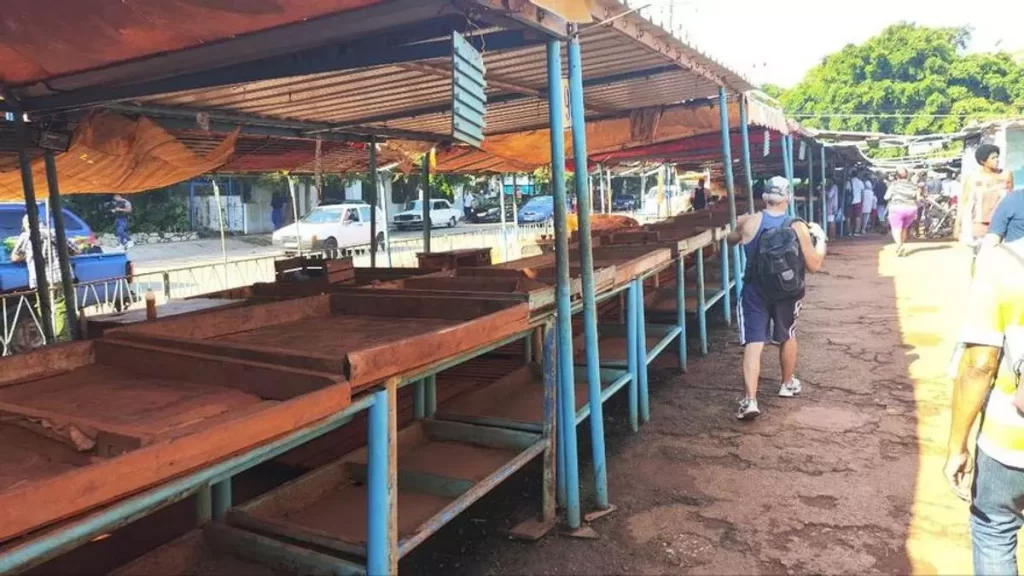
The EJT agro market at 17 and K in El Vedado, Havana, usually with very well stocked shelves, was almost empty / 14ymedio
14ymedio, Juan Diego Rodríguez/Olea Gallardo, Havana, 3 July 2024 — A day after the new measures announced by the Government on June 27, which establish a maximum profit margin of 30% on private sales to the State, it is not yet known with certainty whether or not the prices are capped for six products in private retail stores. There is only one thing certain: these basic necessities included on the list of capped prices by some municipal governments this weekend disappeared from the shelves on Tuesday.
On Saturday, the authorities of Plaza de la Revolución (Havana), Jobabo (Las Tunas) and Pinar del Río published lists of products with maximum prices for cooking oil (900 pesos per liter), chopped chicken (680 per kilogram), powdered milk (1,675 per kilo), sausages (1,045 per kilogram), pasta (835 pesos per kilo) and powdered detergent (630 pesos per kilo). But yesterday, Monday, when the regulation was supposed to come into force, in municipalities like Boyeros they said that they didn’t know anything, and among the businessmen it was all rumors and confusion.
“Does anyone know anything about the official prices? We’re confused.” The comment of Yulieta Hernández Díaz, president of Grupo de Construcciones Pilares, summed up the state of the matter well. continue reading
This Tuesday, the bewilderment of Cubans is even greater. The agro market operated by the Youth Labor Army (EJT) of the Armed Forces, at 17 and K in El Vedado, Havana, usually very well stocked, had almost all its shelves empty. The few products for sale were piled up together on the top shelves on the K Street side.
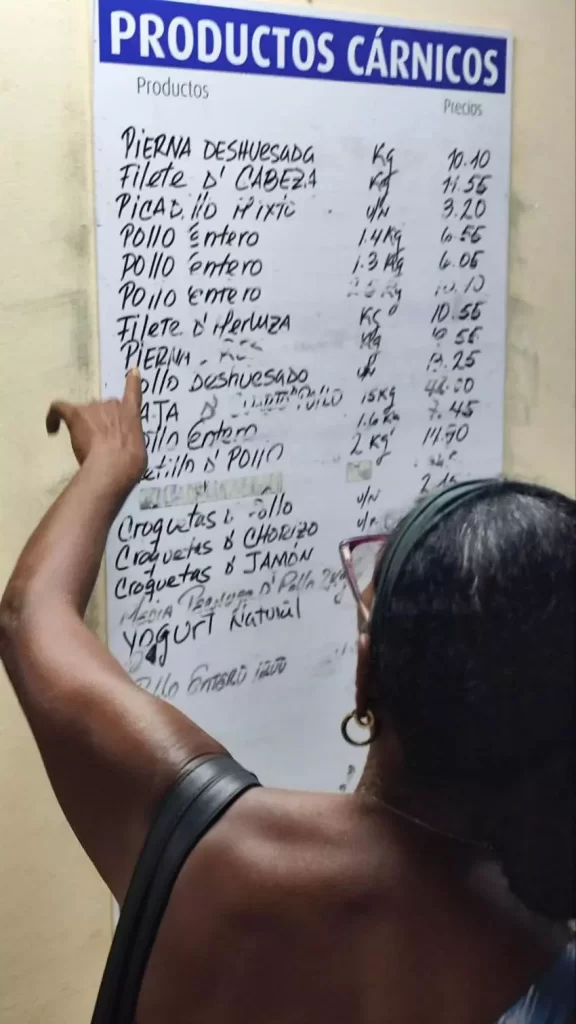
Prices of meat products in the state foreign exchange store La Época / 14ymedio
The sellers, however, responded to the surprised customers with a simple shrug of the shoulders. “They say they don’t know, but it’s clear that they must know something,” said an old woman. It was the same in the Arango market in Luyanó. “There’s nothing on the shelves; it’s dead, empty, a very strange thing,” a neighbor told this newspaper.
In the butcher shop at 17 and K, which operates as a private business, there was only chicken breast and picadillo [chopped meat]. The clerk said that he didn’t know why there were no chicken quarters or thighs, but customers could hear him talking on the phone with someone who told him that he that he had to change the blackboard: “Now I have to put the prices in kilograms.” He didn’t mention the amounts.
In the private business (MSME) Zona K’liente they weren’t selling the bird either. “There is no chicken or milk anywhere.” “There is no chicken and there won’t be,” was the forceful response of the butcher of the 19 and B market, also in El Vedado. The reason? “Because they capped the prices.” And he cried out: “Better to raise chickens at home!”
Something happened, of course, in the last three days, and the authorities were reluctant to report it. A butcher from Sancti Spíritus gave the explanation to this newspaper: yesterday he was introduced to some “comrades” of the Party along with two inspectors, who warned him of the entry into force of the regulations and “they read the prices.” They didn’t give him any citation: “It was just a verbal warning, and they told me that there could be consequences if I increased the price of those products.”
“They say they don’t know, but it’s clear that they do”
It was just what an anonymous official source had warned in an audio that spread like wildfire since Saturday, in which the “established” prices were specified. The voice, with an accent from the west of the Island, assured that “groups of confrontation” were going to go to private businesses to give them “a wake-up call.” Subsequently, it warned, there might be “a forced sale of these products or confiscations of them for the social institutions that also need these products.”
As a result of the uncertainty and the threats, private individuals have simply hidden the merchandise. Also in Sancti Spíritus, a neighbor said that he had managed to buy chicken in a nearby MSME, “just for being trustworthy”: 10 pounds at 4,000 pesos.
“Chicken cannot have disappeared from the face of the earth; it’s here in Cuba, but they hide it because they don’t want to sell it at the prices dictated by the State,” explained another Cuban, a resident of Central Havana. “It’s always the same: they capped the price of taxis, the taxis disappeared; they capped the price of malanga and the malanga disappeared. Well, now chicken has disappeared.”
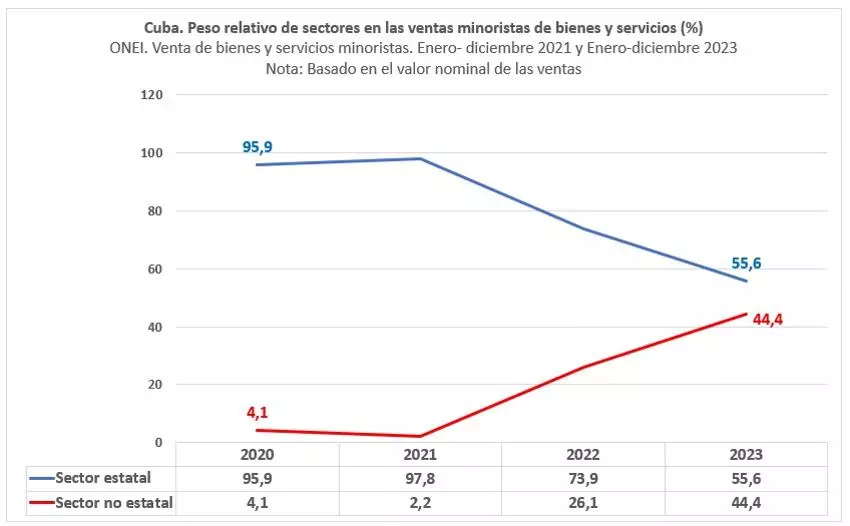
In four years, as seen in an official graph, private sector sales have gone from 4.1% of the total to 44.4% / Onei
Meanwhile, in the State stores selling in freely convertible currency (MLC), there were not only the lost products in that had been sold in pesos, but they were much more expensive. In La Época, in Central Havana, detergent of 1.5 kilos was at 5.45 dollars (1,908 pesos at the informal exchange rate), and 1.25 kilos of Argentine chicken was at 6.55 dollars (2,293 pesos).
“They’re never going to cap themselves, as you can imagine,” said a client at the doors of the MLC store.
The effort to attack the MSMEs (micro, small and medium-sized enterprise) by imposing a profit cap on them has been criticized by specialists such as Pedro Monreal, who insists that the way to contain inflation, which has not stopped growing exponentially since the entry into force of the so-called Ordering Task* (2021), is none other than the reduction of expenses.
The economist has again published a revealing post on Tuesday, based on figures published yesterday by the National Bureau of Statistics and Information (Onei) that indicate the spectacular increase in the weight of the “non-state sector” in retail sales. In four years, as observed in an official graph, private sector sales have gone from 4.1% of the total to 44.4%, while state sales went from 95.9% to 55.6%.
It remains to be seen whether prices will be discussed on State TV’s Round Table program scheduled for this Tuesday, to which “leaders of the Communist Party” are invited to “analyze partisan actions based on boosting food production in the country.” Cubans know what the end of the film is: a shortage of products and more difficulties to obtain them.
*Translator’s note: The Ordering Task was a collection of measures that included eliminating the Cuban Convertible Peso (CUC), leaving the Cuban peso (CUP) as the only national currency, raising prices, raising salaries (but not as much as prices), opening stores that take payment only in hard currency, which must be in the form of specially issued pre-paid debit cards, and a broad range of other measures targeted to different elements of the Cuban economy.
Translated by Regina Anavy
____________
COLLABORATE WITH OUR WORK: The 14ymedio team is committed to practicing serious journalism that reflects Cuba’s reality in all its depth. Thank you for joining us on this long journey. We invite you to continue supporting us by becoming a member of 14ymedio now. Together we can continue transforming journalism in Cuba.
Both Havana businesses are owned by Cuban-Americans
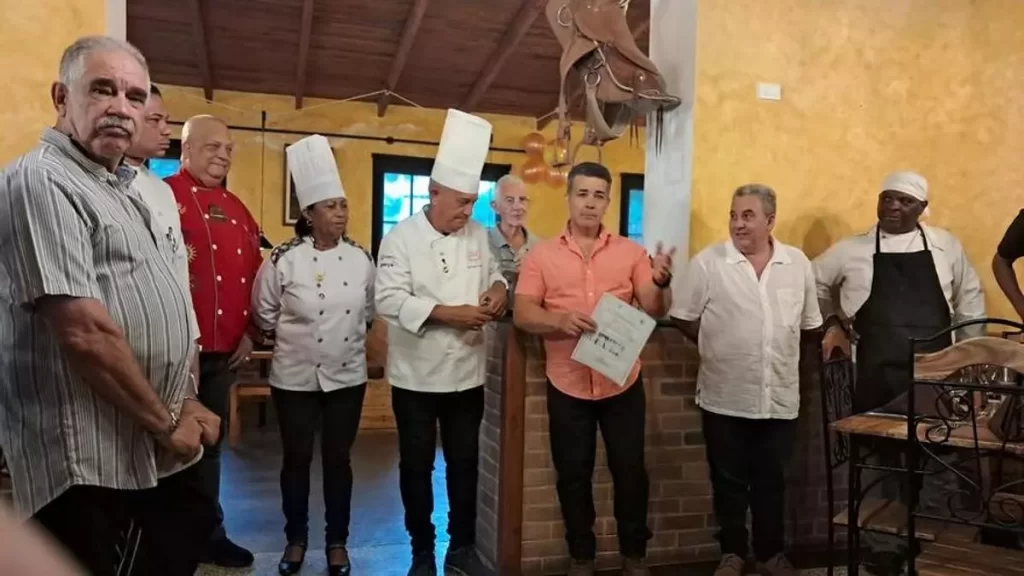
Obel Martínez (pink shirt) is the main owner of the restaurant La Carreta / Facebook of the Culinary Federation of Cuba
14ymedio, Havana, 2 July 2024 — Not all private businesses on the Island receive the same treatment by the Cuban Government. The La Carreta restaurant is one of the lucky ones. This Monday, a year after the iconic establishment reopened, now restored and in private hands, it has been recognized by the state Culinary Federation of Cuba for “promoting authentic Creole cuisine.”
In a Facebook post, illustrated with photographs, the institution highlighted the work of the owners of the premises, Obel Martínez and Ramón Feria, who “expressed their decision to make the restaurant a mandatory reference site for nationals and foreigners.” The text also says that “entrepreneurship” has rescued “the emblematic facility that had existed for 50 years before it deteriorated from the passage of time and abandonment,” not to mention the previous owner who ruined the place almost eight years ago: the State.
Since its reopening and with its rich gastronomic offer, La Carreta became a must, not only for foreigners, but also among the people of the emerging middle class with dollars to spend. However, the dazzling success of its main owner, Obel Martínez, raised suspicion. continue reading
La Carreta became a must not only for foreigners, but also among the people of the emerging middle class with dollars to spend
Just when his company was approved in Cuba, Martínez was granted U.S. nationality, specifically in December 2022. His signature is number 5,639 in the registry of private businesses with the name of Mojito Martínez, and with it he opened the Mojito-Mojito bar, in the heart of Old Havana.
“Obel fled Castroism and now makes a living from it, enjoying at the same time all the benefits and profits of the American dream: he plays a capitalist from Havana, with the support of local authorities,” an anonymous source told this newspaper at the time, who said that Martínez was still living in Miami, Florida.
As a local development project, the same source added, he had received a loan of 10 million pesos from the municipal government, specifically the 250 branch of the Banco Metropolitano, located on Línea Street, in El Vedado. As official television confirmed in a report last September, La Carreta “was recovered thanks to the close collaboration with the government of the municipality of Plaza de la Revolución.”
Martínez is one of the Cuban businessmen who emigrated to the United States and who, stealthily, for years and with the acquiescence of the regime, carry out business in Cuba. Another of them was Frank Cuspinera Medina, owner of Diplomarket, the so-called “Cuban Costco”. The past tense of the verb indicates his recent fall from grace, which contrasts with the praise received by Martínez.
Martínez is one of the Cuban businessmen who emigrated to the United States and who, stealthily, for years and with the acquiescence of the regime, carry out business in Cuba
Cuspinera was allegedly arrested, along with his wife, Camila, on June 20. The Facebook page La Tijera reported that a State Security operation had arrived at the supermarket along with “two buses” carrying auditors from Gaesa (Grupo de Administración Empresarial S.A.), the Armed Forces conglomerate.
On June 21, in the WhatsApp group managed by Diplomarket, a message announced that they were “closed until further notice,” explaining: “We have problems operating because of the commercial license that must be renewed.” Similarly, the app, which can still be visited, presents a caption: “We are out of service – Send us an email.”
Since then, there has been no news of the businessman and his wife, but there is indeed evidence that not all private individuals are equal before the law in Cuba.
Translated by Regina Anavy
____________
COLLABORATE WITH OUR WORK: The 14ymedio team is committed to practicing serious journalism that reflects Cuba’s reality in all its depth. Thank you for joining us on this long journey. We invite you to continue supporting us by becoming a member of 14ymedio now. Together we can continue transforming journalism in Cuba.
The measure was due to come into effect on Monday for chicken, sausages, oil, spaghetti, powdered milk and detergent.
A MSME in Central Havana, this Monday, sells chicken at twice the price established by some local governments / 14ymedio
14ymedio, Havana, 1 July 2024 — As of this Monday, the prices capped for micro, small and medium-sized enterprises (MSMEs) should be a reality. At least in the municipality of Plaza de la Revolución (Havana), in Jobabo (Las Tunas) and in Pinar del Río, but local administrations have backtracked after publishing the new discounted prices for six basic necessities.
The items that from July 1 would have an “officially approved” price – as the authorities now say – were chicken, sausages, oil, pasta, powdered milk and powdered detergent. The prices were the same in the three provinces, except for a liter of cooking oil, which in Plaza de la Revolución is capped at 990 pesos and in Pinar del Río at 900. A half-kilogram package of pasta is capped at 415 pesos in Havana and 350 in Pinar del Río.
A kilo of chopped chicken could not exceed 680 pesos (a pound is set at 310 and and a 20-kilogram box at 13,600); milk powder, at 1,675 (500 grams are at 840); a kilo of sausages would have a maximum price of 1,045 (500 grams at 530 pesos and 340 grams at 350); pasta at 835 pesos, and detergent powder at 630.
The figures coincided with those provided by an unknown official source through an audio that ran like wildfire through the Island’s cell phones this weekend. continue reading
In the visit this Monday to a MSME of Plaza de la Revolución, they had no news of the new prices established
On the other hand, in Plaza de la Revolución, prices for other products, such as soft drinks, cookies and even fruits and vegetables were also capped. Thus, a pound of malanga cost 150 pesos, tomatoes cost 100, plantains 70, and guava and mango were capped at 50 pesos. The Ciego Montero canned soft drinks could not cost more than 200 pesos, the Bucanero and Perla Negra malts, 260, and the “little package” of cookies, 50.
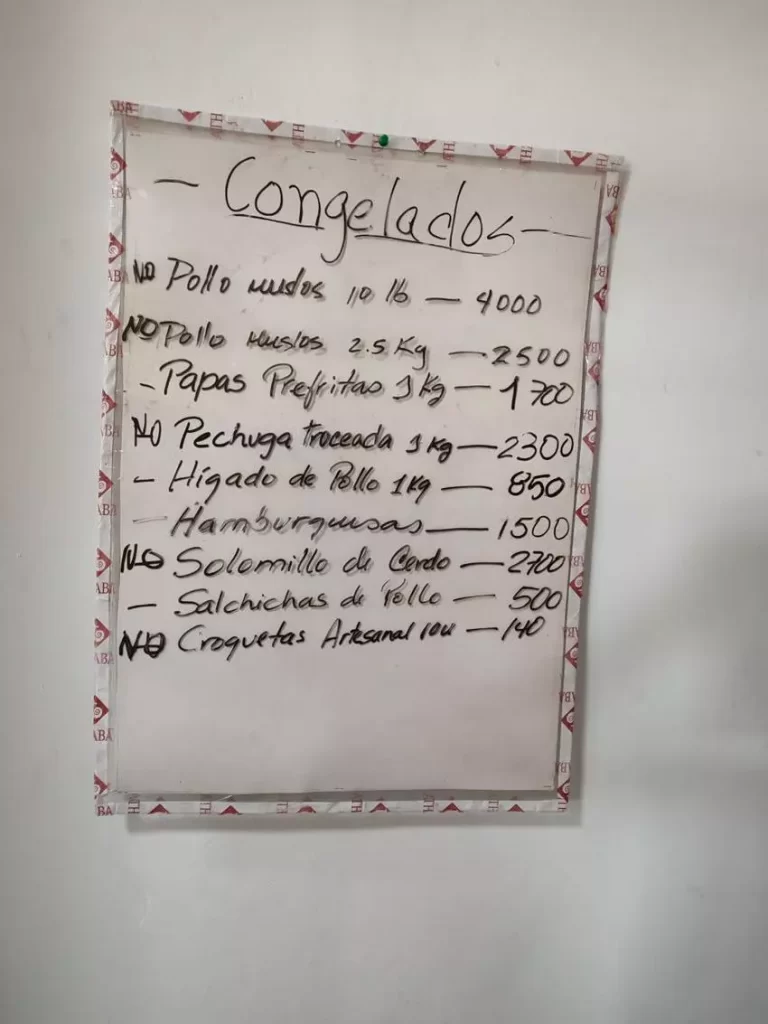
On Monday’s visit to a MSME of that same municipality in Havana, they had no news of the prices established by the Government. Ten pounds of chicken thighs cost 4,000 pesos, and a kilo of chopped chicken breast was at 2,300, even though they didn’t have those items at the moment. A kilo of powdered milk cost 2,900 pesos, far from the 1,675 established.
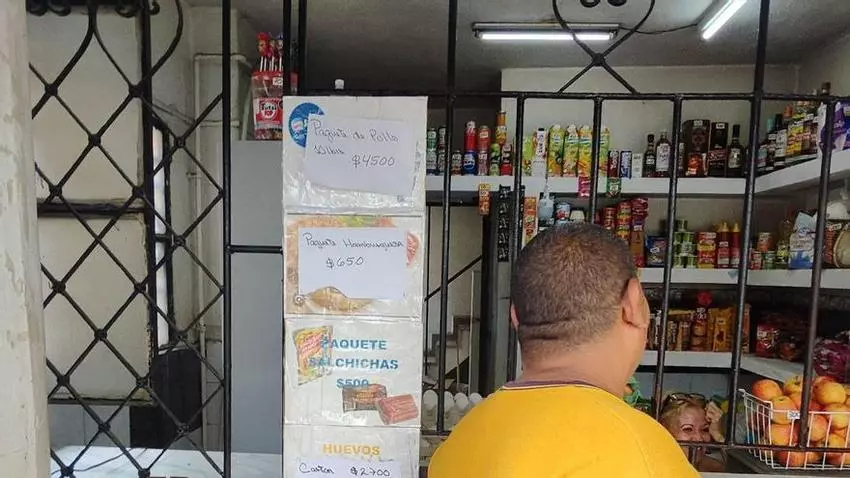
While it is true that the authorities of Central Havana had not communicated a list of maximum prices, the differences in those indicated for other municipalities was notable for the MSMEs in the neighborhood. In San Lázaro, one business sold 10 pounds of chicken at 4,000, and a kilo of chopped chicken breast at 1,750 pesos, more than double what was established in Plaza de la Revolución. In Infanta, chicken was even more expensive: 4,500 for 10 pounds.
The sign says ten pounds of chicken thighs cost 4,000 pesos and a kilo of chopped chicken breast cost 2,300, even though they didn’t have those items available / 14ymedio
The “officially established “prices were part of the new measures announced by the Ministry of Finance and Prices on June 27 in a resolution published in the Official Gazette. The text did not specify prices but stated that “state entities, in the process of economic contracting with non-state management forms for the acquisition of goods and services” would agree on “prices and tariffs whose maximum profit rate does not exceed thirty percent (30%) of the total costs and expenses.”
Similarly, the regulation gave power to the provincial and municipal councils to approve the maximum rates “for the goods and services they select,” taking into account” the “particularities of each territory.” Since then, rumors, confusion and improvisation have been the trend on the Island.
“What is known? Only that they have been evaluating prices for basic necessities and that some meetings were held with private economic actors (self-employed workers and representatives of MSMEs). Beyond that, there is only speculation and tension, overlapping and explicit. Nothing is clear; why? Because communication is not part, as it should be, of local government management, which should set out, explain, anticipate the facts and eradicate speculation and tension,” complained the official journalist of Las Tunas, Yaidel Miguel Rodríguez Castro.
This same Monday, the Provincial Board of Directors of Boyeros warned on its networks that today “the newly established prices” come into force – without specifying them – and left several phone numbers “to report violations of the established prices.” However, in a call made by this newspaper, neither of the two officials who responded – one of them identified as a “specialist” – was aware of any list of prices.
“The mango is local and in season, so the price is insane.”
Meanwhile, in neighborhood groups there have already been complaints. “I see that there are products that cost less by a few pesos, others that do not and some that even cost more. This is the legalization of abuse,” said a resident of Plaza de la Revolución.
“I think those prices were set by an owner of a MSME, because they can’t lose and the customers can’t win,” said another comment. And another user complained: “I can understand why the frozen chicken, which is imported, costs that much, but that mangos cost 50 pesos a pound doesn’t make sense. It’s a local product and in season, so the price is insane.”
For a fourth neighbor, “if the State is selling malanga at 150 a pound, I now feel defeated. A retiree like me isn’t able to eat a purée of malanga.”
The measure not only seemed alien to the majority of Cubans, who receive a salary in pesos and don’t have access to dollars, but also demonstrated a total lack of consciousness about the market. Entrepreneurs would not be able to sell imported products for less than what it costs them, unless they choose to lose money.
The inhabitants of Plaza de la Revolución also doubted how the measure was going to be supervised: “Who is going to ensure that this is fulfilled? Another body of inspectors? More people to pay a salary to? Everything is going to be more expensive for us as a country.”
“Who is going to ensure that this is fulfilled? Another body of inspectors? More people to pay a salary to?”
In the anonymous audio of this weekend, the official voice, with an accent from the west of the Island, assured that “groups of inspectors are going to go to each place,” referring to the MSMEs, and those that don’t have the established prices “will be exposed by the mass media.” The first thing that would happen is, according to the same source, “a wake-up call with fines” and “later, a forced sale of these products or their confiscation and donation to social institutions that need them.”
In addition, it was announced that the MSMEs would be exempt from the payment of tariffs for capped products, although it seemed more like confusion with the extension, until September 30, of free importation for private and non-commercial purposes of food, toiletries and medications.
The same official also recognized that “putting caps on these products won’t solve the problems of the population, because in the end they’re still expensive and not affordable for the majority,” even though the measure was taken “to prevent prices from continuing to rise.”
In the Central Havana MSMEs, chicken is more than double what it is in Plaza de la Revolución / 14ymedio
Thursday’s resolution was harshly criticized by economists such as Pedro Monreal, who pointed out that its impact, even if it works, would be very limited. Retail sales in the private sector account for just 4.1% of those of the country as a whole, said the specialist, and although it is not known what part might affect the state sector, the percentage is too trivial to have any kind of significant consequence.
“In addition to the fact that the savings for the State won’t be very big, by limiting the profit rate of non-state sales acquired by state entities, experience indicates that price caps are not effective in reducing inflation,” the expert said.
The Cuban economist insisted that the way to contain inflation, which has not stopped growing exponentially since the entry into force of the so-called Ordering Task* (2021), is to reduce expenses.
*Translator’s note: The Ordering Task was a collection of measures that included eliminating the Cuban Convertible Peso (CUC), leaving the Cuban peso (CUP) as the only national currency, raising prices, raising salaries (but not as much as prices), opening stores that take payment only in hard currency, which must be in the form of specially issued pre-paid debit cards, and a broad range of other measures targeted to different elements of the Cuban economy.
Translated by Regina Anavy
____________
COLLABORATE WITH OUR WORK: The 14ymedio team is committed to practicing serious journalism that reflects Cuba’s reality in all its depth. Thank you for joining us on this long journey. We invite you to continue supporting us by becoming a member of 14ymedio now. Together we can continue transforming journalism in Cuba.
The certification of firefighting engineers includes training to operate drones in emergency situations
Cubans were taught about “determination, loyalty to duty and the willingness to help,” Russian authorities said. / Prensa Latina
14ymedio, Havana, 1 July 2024 — Relations between Russia and Cuba seem to return more and more to the old years of the Soviet Union, with the training of professionals from the Island in the Eurasian country. This Saturday, it was announced that a group of Cubans have just graduated as fire protection engineers.
According to Prensa Latina, the qualification includes a certification to operate drones in emergency situations. In the same vein is the announcement made by the Cuban Minister of Justice, Oscar Manuel Silvera Martínez, who last week was on an official visit to Moscow and said that Cuban police and lawyers will be trained in Russian universities.
The training of lawyers and police, the minister said, after participating in the XII International Legal Forum that took place in St. Petersburg between June 26 and 28, is part of the memorandum of understanding signed last year between the two countries. It aims to promote the development of cooperation in the field of education.
“Our Cubans will be trained in police work by you,” the minister said during his visit to Russia last week
“Police and lawyers from Cuba will be trained in Russia. This is very important to strengthen the relationships between us,” Silvera Martínez stressed, without providing more details. “Our Cubans will be trained in police work by you, and they will also learn about jurisprudence in your universities.” continue reading
The Academy of State Firefighters Service, which belongs to the Ministry of Emergency Situations, was, for five years, the institution in charge of training the 18 young Cubans who graduated as firefighters this weekend. Among the subjects taught were “theory, practice and application of experiments both in laboratories and in on-site exercises.”
Most notable among what was instilled by the Government of Vladimir Putin in this group of Cubans is the “determination, loyalty to duty and the willingness to help,” explained the director of the State Firefighters Academy, Vyacheslav Butko, who reiterated in allusion to the Cuban students that “the doors of the university will be open.”
In addition to graduating as firefighters and drone pilots for work in emergency situations, Cubans received a Russian-Spanish dictionary of words related to their specialty, as reported to the Cuban news agency by Arnaldo Bombino, who recently graduated as a lieutenant.
Cooperation between Cuba and Russia on the matter of firefighting has been a constant in recent years. For example, the Russians gave advice to the regime in the case of the Matanzas supertanker fire in August 2022, and donated fire trucks a few months later (in December 2023) .
Since Russia invaded Ukraine and was rejected by most of the international community, the old relationship between Moscow and Havana has been revitalized. This has included a series of exchanges, including the sending of oil tankers to the Island in the midst of an energy crisis aggravated by the summer, as well as the visit of a naval flotilla headed by a Russian nuclear submarine this month.
Translated by Regina Anavy
____________
COLLABORATE WITH OUR WORK: The 14ymedio team is committed to practicing serious journalism that reflects Cuba’s reality in all its depth. Thank you for joining us on this long journey. We invite you to continue supporting us by becoming a member of 14ymedio now. Together we can continue transforming journalism in Cuba.
The athlete had a record of 59.85 meters prior to the Paris 2024 Olympic Games
Yulenmis Aguilar showing the gold medal she won for Spain / Instagram/yulenmis_aguilar
14ymedio, Havana, 2 July 2024 — Yulenmis Aguilar, the Cuban javelin thrower won a resounding victory in the Spanish Championship with a throw of 59.85 meters, which places her as the main figure for Spain in that specialty and shows that she is in “good shape for the Olympic Games in Paris 2024,” according to Swing Completo.
Aguilar began her participation this Sunday with a throw of 50.12 meters. Her rivals, Carmen Sánchez, who was in second position, recorded a throw of 51.86 meters, while Enya Carretero was in third place with 51.43 meters.
On April 10, the athlete received the “naturalization letter” in the Council of Ministers of the Moncloa Palace, a procedure that began at the end of 2022, opening the possibility for her to represent Spain at the Olympic Games in Paris 2024.
The double-champion (2015, 2017) Cuban javelin thrower arrived in Spain at the end of December 2020
Since Aguilar’s naturalization was confirmed, the Royal Spanish Athletics Federation (RFEA) contacted World Athletics – the governing body of athletics – to make the change of nationality for the athlete to be part of its delegation. continue reading
In the other four competitions of 2024, except for the Ibero-American Rally in Huelva, where she was fourth, Aguilar won the Iberdrola League of clubs twice (60.68 and 56.21) and the José Luis Hernández Memorial in Pamplona (56.52).
The double-champion (2015, 2017) Cuban javelin thrower arrived in Spain at the end of December 2020.
Since she has been in Spain, Aguilar has had her eyes set on Paris. “My room for improvement is incredible,” she told the newspaper Relevo at the beginning of this year. “I have been watching the throws with my coach and there is a possible improvement of 30%, at least.”
Aguilar was ignored by the Cuban national team in 2018. That was the “prize” she received after obtaining the bronze medal at the Central American and Caribbean Games in Colombia. The authorities simply told her that “they weren’t counting on her for the next season.”
“I didn’t want to know anything about the sport. I went into a depression and began to gain a lot of weight”
The athlete’s sports life became “an ordeal” in which the injuries she had on her knees, shoulders and elbows pushed her to retire for five months. “I didn’t want to know anything about the sport. I went into a depression and began to gain a lot of weight,” she told La Voz de Galicia.
The Cuban contacted coach Raimundo Fernández, who directs the Escuela de Lanzadores de A Coruña and traveled to Spain. “Her first six months here were an ordeal of physiotherapists, doctors and rehabilitators,” Fernández stressed.
The athlete recovered and last year set a record for Spain in the javelin throw with 64.17 meters, which placed her as sixth in the world ranking of the discipline. Aguilar, 27, has been living in Galicia since 2020, where she arrived with a work permit.
Translated by Regina Anavy
____________
COLLABORATE WITH OUR WORK: The 14ymedio team is committed to practicing serious journalism that reflects Cuba’s reality in all its depth. Thank you for joining us on this long journey. We invite you to continue supporting us by becoming a member of 14ymedio now. Together we can continue transforming journalism in Cuba.
Alexander Valiente was hired by the Toronto Blue Jays, while Reykelly Rubi received an opportunity with an Orioles affiliate.
Reykelly Rubi at the time of signing his contract with the Orioles / X/@francysromeroFR
14ymedio, Havana, 28 June 2024 — The baseball players Alexander Valiente and Reykelly Rubi, who left Cuba in search of a better future, have reached initial agreements with the Toronto Blue Jays and the Baltimore Orioles, respectively. With them are 21 athletes from the Island who have been “hired in the current international period” by Major League teams in the United States, reported journalist Francys Romero.
The Canadian team guaranteed Valiente, 21, a bonus of $75,000 to secure his signing. The contract will be made official on January 15, 2025. This young man was part of the Cuban U-23 team; in 2023 he asked for his leave. “I’ve decided not to play anymore for now. Please don’t ask me for an explanation,” he said at the time.
The Canadian team guaranteed Valiente, 21, a bonus of $75,000 to secure his signing
Romero attributes the departure of these athletes to the fact that baseball on the Island has become “uneven, old and without an audience.” He regrets that what used to be a game “full of brilliance now seems to be an old Development League compared to the world talent.” continue reading
Por la Goma, a publication specializing in the sport, which is considered a cultural heritage on the Island, reported last year that the loss of athletes was occurring “daily.” The massive abandonment of players is influenced by the issues of “quality [of life], remuneration and inflation.”
This Wednesday, Reykelly Rubi, who left the Island at the age of 14, received an opportunity with an Orioles affiliate. At age 18 and after a period of training at the Yuan Pino Academy in the Dominican Republic, he is considered by the talent scouts as an “intriguing arm.”
“His curveball was evaluated above the average [between 88 and 90 miles per hour], with an acceptable turning speed, which makes him a promising pitcher for the future of the Baltimore Orioles,” published the magazine Swing Completo.
This week, the 26-year-old Yosver Zulueta’s debut with the Cincinnati Reds also materialized. The athlete from Villa Clara left Cuba in October 2018. After signing with Toronto in 2019 for a million dollars, he had to undergo surgery for a knee injury that kept him away from the playing field for a year.
This week, the debut of 26-year-old Yosver Zulueta with the Cincinnati Reds also materialized
In 2022, he passed through “all levels of the Minor Leagues” to resume the pace of the game, Romero said. “In the winter of 2023 he went to the Dominican Republic with the Leones del Escogido and had a positive experience.”
Last Tuesday Zulueta debuted as part of the Cincinnati team in the Major Leagues with three strikeouts. “He was a bit nervous at first but then showed his weapons: a straight that reached 99 miles per hour and a slider (a throw that drops the ball as it approaches the batter) of 91 miles per hour.”
Translated by Regina Anavy
____________
COLLABORATE WITH OUR WORK: The 14ymedio team is committed to practicing serious journalism that reflects Cuba’s reality in all its depth. Thank you for joining us on this long journey. We invite you to continue supporting us by becoming a member of 14ymedio now. Together we can continue transforming journalism in Cuba.
Cuba’s water crisis is affected by problems with the electricity supply
In the capital, residents fill containers to face the urban drought / Radio Habana Cuba
14ymedio, Havana, 28 June 2024 — Havana continues with an intermittent water service, like that suffered by other provinces, in a water crisis that is marked by problems with the electricity supply on the Island. This Friday, if the residents of the capital turn on the faucet, they will surely find some dribbles of water that serve only perhaps, to scrub the floor and fill some containers in order to face the urban drought. The efforts of the Havana authorities to normalize the supply have not yielded the hoped-for results.
Everything dates back to Thursday of last week, when a pipe in Cuenca Sur ruptured from a power surge.
The water shortage has been aggravated these days by the effects on the electricity service, which on Thursday finally exceeded shortages of one thousand megawatts (MW). The Electric Union of Cuba (UNE) predicts for this Friday a maximum demand of 3,150 MW for an availability of 2,160 MW, which entails a deficit of 990 MW and an impact of 1,060 MW. The Antonio Guiteras plant in Matanzas, due to a breakdown in the boiler, is not providing service today, as announced by the UNE. This is nothing new; the plant has been out of service for months, and generation problems are also frequent. continue reading
Since last week the flow of water in Havana is improved by zone every fourth day
Faced with such a scenario, the Havana authorities made the decision last week to enhance the flow of water by zone every fourth days. “We are going to guarantee the service, but it will have a marked impact on the day that the water is not flowing,” the director of operations of Agua Habana, Rosaura Socarras, explained on Wednesday in a television interview.
After a meeting held on Tuesday between Havana authorities and state officials, it was reported that the water supply has not recovered its normal volume due to multiple causes; among them, the five motorized water pumping stations out of service – the 3, 4, 15,16 and Rincón 4, said the newspaper Tribuna de La Habana. In addition, the water levels have not yet recovered and are below average despite the heavy rains recorded in recent days.
The problems with the water supply (in Cuba) are not exclusive to Havana. This same Friday, the official press reported that in Villa Clara the Government has invested more than one hundred million pesos in the installation of ten kilometers (6.2 miles) of pipes. These works seek to connect the towns of Mataguá, La Yaya and Jorobada with the Paso Bonito pumping station, located in Cumanayagua, the newspaper Vanguardia reported.
Translated by Regina Anavy
____________
COLLABORATE WITH OUR WORK: The 14ymedio team is committed to practicing serious journalism that reflects Cuba’s reality in all its depth. Thank you for joining us on this long journey. We invite you to continue supporting us by becoming a member of 14ymedio now. Together we can continue transforming journalism in Cuba.
“Cuba is a country of great importance, not only for the Caribbean but for the world,” said Dennis Francis.
Dennis Francis, presidente de la Asamblea General de la ONU, junto a Miguel Díaz-Canel, este viernes / X/@UN_PGA
14ymedio, Madrid, 29 June 2024 — The official visit to Cuba of the current president of the UN General Assembly, Dennis Francis, shows that the Island has an undisputed ally in the organization. “Cuba is a country of great importance, not only for the Caribbean but for the world,” Francis said in one of his public speeches, where he also described the Cuban as a “great people.”
Through his official account on X, the diplomat, a native of Trinidad and Tobago, expanded his praise: “As a founding member of the United Nations, Cuba has always advocated for building a better, inclusive and egalitarian world. A world in which there is peace, prosperity, progress and sustainability for all. While we strive to achieve these objectives, I thank Cuba for its vision and leadership and I look forward to a future collaboration towards our shared goals.” Francis did not say, however, that the Island entered the UN under the presidency of Ramón Grau, in 1945, almost 14 years before the triumph of the Revolution.
Similarly, and according to the Minister of Public Health, José Ángel Portal Miranda, whom he met this Friday, Francis highlighted his “admiration” for the “achievements” of the Island in the health field and conveyed to the doctors “a recognition for keeping up the social conquests forged in Cuba.” continue reading
The three held a meeting with the Cuban Foreign Minister, Bruno Rodríguez, in which he highlighted “Cuba’s commitment and contribution to multilateralism
For his part, Miguel Díaz-Canel, with whom the diplomat also met yesterday, described the meeting as a “fruitful exchange.” The Cuban president thanked Francis through his networks “for his recognition of Cuba’s performance and commitment to the search for solutions to the challenges of the nations of the South during our presidency of the G-77 and China.”
Earlier, the three held a meeting with the Cuban Foreign Minister, Bruno Rodríguez, in which he highlighted “Cuba’s commitment and contribution to multilateralism,” according to the state agency Prensa Latina.
“In the countries of the South we know that this is the place where we are best heard and where, when we are united and act together, we can make the legitimate interests of humanity and the peoples prevail,” Rodríguez added at the meeting.
This Friday was the penultimate in a three-day visit by Francis to the Island.
During a speech on Friday afternoon at the University of Havana, he stressed that “the United Nations is in the DNA of Cuba” and that the Island has been a defender of “peace and respect for the sovereignty of all nations.”
He also thanked Havana for heeding the calls of the United Nations to send health personnel to countries such as Haiti and to regions such as West Africa during the Ebola crisis. There was, on the other hand, not a single allusion to the reports of several UN rapporteurs who described the conditions of Cuban doctors on the international missions as “forced labor.”
Translated by Regina Anavy
____________
COLLABORATE WITH OUR WORK: The 14ymedio team is committed to practicing serious journalism that reflects Cuba’s reality in all its depth. Thank you for joining us on this long journey. We invite you to continue supporting us by becoming a member of 14ymedio now. Together we can continue transforming journalism in Cuba.
María Werlau has been recognized by the U.S. State Department for her “valiant efforts”
María Werlau, together with the U.S. Secretary of State, Antony Blinken, on Monday, collecting the award as a “hero” against human trafficking / U.S. Department of State/ Capture
14ymedio, Madrid, June 26, 2024 — María Werlau (b. Havana 1959) says she felt “surprised and moved” to learn that the United States named her one of the ten “heroes” in the fight against human trafficking, in the 2024 report presented by the State Department on Monday. She herself collected the award, granted, according to U.S. official Cindy Dyer, “in recognition of her constant and courageous efforts to amplify the voices and stories of survivors of forced labor and exploitation in Cuba’s program of export of services, including its medical brigades.”
“I do this work out of love and moral commitment. Without boasting, I am not concerned with payments, thanks or recognitions, much less by thinking about prizes, so knowing that the work is taken into account comforts and stimulates me,” the activist replied to this newspaper’s questions.
Founder and director of the Cuba Archive Project, she has been dedicated for more than a quarter of a century to safeguarding the memory of the atrocities committed by the Cuban regime. Thus, not only has she insisted on collecting all the information regarding Cuban international missions – characterized for years by different organizations as forced labor – but also, for example, the names of those who have died from the direct fault of the State. continue reading
The most frustrating thing about her work in these years, she says, has been the “lack of resources and time to do more for the victims and survivors.” Of all the victims she has documented, she does not mention any in particular: “They all shock me and each one is the most important when you work with her or think about the consequences.” Of course, she points out, “some premeditated atrocities with treachery are almost incomprehensible.”
“The dictatorship has had more than six decades with all the resources of the totalitarian state at its disposal for propaganda, diplomacy and international influence
As a collector of data and facts that should be incontrovertible, why does she believe that, despite this information, the Cuban Revolution still has such a good press? “I work a lot researching that topic,” she replies. “The dictatorship has had more than six decades with all the resources of the totalitarian state at its disposal for propaganda, diplomacy and international influence, and its priority has been to use them to stay in power at all costs.”
Despite her efforts and work for so many years, nothing has changed substantially, and this is something that frustrates and hurts her, but that also encourages her to continue: “There is too much human suffering in the middle. Human beings deserve their freedoms. We can never accept the violence and repression with which the Cuban dictatorship abuses people.”
She says this with knowledge of facts that are personal. Her father, Armando Cañizares Gamboa, who had fought in the Sierra Maestra on the side of the rebel army and worked at the Sugar Institute, immediately realized the twisted course that the Revolution was taking and, after going into exile, was part of the 2506 Brigade that assaulted Playa Girón [the Bay of Pigs] in 1961. He died there from gunshots, but his wife, did not find out until much later, according to María Werlau, when she saw a magazine in a doctor’s office: “There was a photo of a dead brigadier. And he was my father.”
The double struggle of her father is, in a sense, that of the Cuba Archive, which not only documents the deaths of Castroism but also those of Fulgencio Batista. Almost 12,000 victims, for different reasons, are collected in its database from March 1952 to date.
Oblivious to the name of Werlau, President Miguel Díaz-Canel hurried to criticize the report prepared by the United States, which targets Cuba’s international brigades, calling it “manipulative.”
In its report, Washington places Cuba, Venezuela and Nicaragua as among the countries with the highest existence of human trafficking, since they do not meet the minimum standards or make significant efforts for its elimination.
Translated by Regina Anavy
____________
COLLABORATE WITH OUR WORK: The 14ymedio team is committed to practicing serious journalism that reflects Cuba’s reality in all its depth. Thank you for joining us on this long journey. We invite you to continue supporting us by becoming a member of 14ymedio now. Together we can continue transforming journalism in Cuba.
In Pinar del Río, inspectors detect 1,900 “illegalities” in livestock and 6,800 in land tenure
Pinar del Río only has 18 livestock control inspectors / Cubadebate
14ymedio, Havana, 26 June 2024 — Within the “exercise of control” over agricultural and livestock production carried out by the Cuban Government since March, the results for Pinar del Río, whose turn it has been these days, follow the trend of the whole country. According to the official state newspaper Granma this Wednesday, in the western province a total of 1,900 “illegalities” were recorded in the livestock sector and 6,800 in the use and ownership of land. “The main irregularities have been related to missing animals, undeclared births and people who have died and continue to appear in the records as owners of livestock,” explained Lázara García, head of the Department of Genetics and Livestock Registry of that territory. She did not detail, however, what those “irregularities” consist of.
The “serious difficulties in the control of livestock” in the municipality are due, she added, to the fact that Pinar del Río “only has 18 livestock control inspectors to serve a universe of more than 21,700 producers.” This makes one hundred percent inspection “impossible.”
“The main irregularities have been related to missing animals and undeclared births
The official explained that in the territory, according to the records, “there are 209,532 head of cattle and 71,900 horses, but in practice the figures may be very different.” Regarding land, she stressed that the main irregularities among the more than 9,600 tenants visited lie in illegal constructions, whose number is more than 4,000. continue reading
Since March 1, the Ministry of Agriculture has been carrying out a special control – which will continue until September 30 – to quantify the number of cattle in the country and thus “have a characterization of the current situation of the sector in Cuba.”
The previous control reported by the official press was in Las Tunas, where 26% of the farmers – about 20,000 – refuse to deliver their agricultural products to the State. Since the beginning of the year, progress in solving this situation has been “tiny.”
Meanwhile, data from the Government indicate that, until before this exercise, in the country there were more than 200,000 people, natural and legal, who own cattle and buffalo, and about 167,000 who have horses. To have current data, the ministry visits producers, owners and contracted workers within the sector and aspires to have an adequate counting of animal stocks, depleted by the alarming increase in theft and slaughter.
While these exercises are being carried out, slaughter and the private sale of meat are paralyzed; only deliveries contracted with the state sector are maintained
While these exercises are being carried out, slaughter and the private sale of meat are paralyzed; only deliveries contracted with the state sector are maintained. This limitation is significantly affecting the supply of beef in private businesses and on-line stores, which have more frequently resorted to imports to satisfy demand.
According to the latest Statistical Yearbook, published in 2023 with data from the previous year, there were 947,300 horses on the Island and 3,516,400 cattle, a figure that contrasts with the 6 million that were counted in the country in 1958. The next census is predicted to show poorer figures than those of last year.
Translated by Regina Anavy
____________
COLLABORATE WITH OUR WORK: The 14ymedio team is committed to practicing serious journalism that reflects Cuba’s reality in all its depth. Thank you for joining us on this long journey. We invite you to continue supporting us by becoming a member of 14ymedio now. Together we can continue transforming journalism in Cuba.
Despite the deterioration, something of its grandeur can still be appreciated.
The property, number 1360 Calzada del Cerro, suffered the collapse of part of its facade and the roof / 14ymedio
14ymedio, Havana, 26 June 2024 — The historic House of Doña Luz Godínez de Diago, marked thus on the maps, a 19th-century building in Havana, no longer exists as such. This Wednesday the property, number 1360 Calzada del Cerro, suffered the collapse of part of its facade and the roof. “It has been a relief, because that building had been in danger of collapse for years, and all of us who live nearby feared that it would end in tragedy,” a neighbor of the two-storey house tells 14ymedio. Demolition work has forced the cut-off of electrical service in the area.
“Yesterday we noticed that a bit of sand was falling, and shortly thereafter we heard the roar,” explains the woman standing in front of the house that once belonged to one of the families of the Havana aristocracy who sought refuge in the Cerro neighborhood, two centuries ago, to leave behind the intramural city, its noises and its miasmas. The house has gone through several uses in recent decades, from private to state.
“Yesterday we noticed that a bit of sand was falling, and shortly thereafter we heard the roar”
“No one lives at the front next to the facade, but behind there are several families,” the woman explains to this newspaper. This Wednesday, a demolition team, with a lift for two workers with sledgehammers to continue reading
demolish the walls, was in front of the building located between Patria and Saravia streets. “They’re going to have to hurry because it looks like a tremendous downpour is coming,” said another nearby resident.
The huge debris from the collapse occupies part of the road that leads to the famous corner of Tejas, a commercial node also fallen out of favor, then continues to Monte Street and the Capitolio of Havana. The fragments of walls and columns have an impressive size. “Incredible that they haven’t crushed a car,” added a curious person who watched the operations behind the yellow tape that closes the road.
Despite the deterioration and the hole in the facade that reveals part of the property’s interior, something of its grandeur can still be appreciated. A large portal with stylized columns supports an upper floor of pointed arches, and a balcony extends the width of the entire house. Long ago it lost the ornate railing that allowed access to the terrace where you could enjoy the cool. Lower down, another arch with Mudejar inspiration still retains part of its beauty.
The house right next to number 1360, smaller and of neoclassical style, has its portal shored up with wooden beams and has suffered some damage after the collapse of part of the nearby house. On the street, a bush is mixed into the debris, dragged from a crack in which, for years, it had grown near the roof of the old mansion of the Godínez de Diago family.
In the neighborhood they have had to cut off the electrical service to carry out the demolition work due to the line’s proximity to the building facade. The blackout has especially bothered residents in an area of Havana that has been suffering from problems with the water supply for days. They were hoping they could fill their tanks and containers this afternoon, if service is restored. Without electricity, the motors that extract water from the cisterns can’t even be turned on.
The Calzada de Cerro, one of the most important roads in the Cuban capital, connects part of the municipalities of Plaza de la Revolución and Cerro with Central Havana and Old Havana. It is a traditional route for urban buses and collective taxis, especially those who make the journey between the Parc de la Fraternidad and the areas of La Lisa and Marianao. Its closure, this Wednesday, has forced traffic to be channeled through parallel streets, narrower and with very deteriorated asphalt.
The Calzada de Cerro is one of the avenues that has suffered the most over time, due to state neglect and lack of investment in recent decades. Without the attractions of the historic center of Havana or the more modern feel of El Vedado, the street has numerous tenements where overcrowding and improvised partitions have contributed to further deterioration of the infrastructure.
“No one lives at the front next to the facade, but behind there are several families”
What was once a street with spacious portals, an infinity of vibrant shops and a great social life where people liked to stroll has languished. It is now a route that many people in Havana avoid in the face of the danger of a balcony collapse, sewer water that accumulates on the corners and mountains of garbage piled up on side streets. A sense of insecurity has taken over the surroundings, especially at night time.
The intense rains of the last few days have caused dozens of building collapses in Havana, a death and several injuries. Last Friday an official source, who preferred anonymity, informed this newspaper that in the Cuban capital, heavy rainfall had caused 19 partial collapses, but in the following days the number continued to grow.
On Sunday night, one of the most emblematic buildings in the capital, the Edificio Manzanares, suffered an interior collapse. Around 9:20 pm, a patio collapsed, dragging in its path the entire lower area of bathrooms and kitchens, at number 912 of San Francisco Street, one of the entrances of the apartment complex.
Translated by Regina Anavy
____________
COLLABORATE WITH OUR WORK: The 14ymedio team is committed to practicing serious journalism that reflects Cuba’s reality in all its depth. Thank you for joining us on this long journey. We invite you to continue supporting us by becoming a member of 14ymedio now. Together we can continue transforming journalism in Cuba.
The garbage and stagnant water favor the proliferation of the culex mosquito, which transmits the disease
Emergency Waiting Room of the Calixto García Hospital in Havana / 14ymedio
14ymedio, Havana, June 25, 2024 — In a statement issued on Monday, the Ministry of Public Health reported cases of Oropouche Fever in 23 municipalities in nine provinces: Matanzas, Mayabeque, Villa Clara, Sancti Spíritus, Ciego de Ávila, Holguín, Guantánamo, Santiago de Cuba and Cienfuegos. The text does not mention Havana, despite the fact that various reports collected by this newspaper prove the presence of the disease in the capital.
The infections were identified, says the statement citing Dr. Francisco Durán, national director of Epidemiology, after taking samples in the national reference laboratory of the Pedro Kourí Institute of Tropical Medicine (IPK), in Havana.
The clinical picture presents the infection as “mild,” according to the authorities, with an incubation period of between five and seven days, which is characterized by fever, headaches, muscle and joint pains; vomiting and diarrhea are also reported.
“Associated with the virus in a group of patients observed, on the sixth day a picture similar to the initial one appears, which leaves no aftermath and is not associated with the appearance of serious forms or deaths,” the ministry states. On June 8, Yosmany Mayeta, an independent journalist living in the United States, reported on Facebook the death of a young man who spent three days in a Santiago hospital with symptoms of Oropouche, although without specifying if he had previous conditions or the verified cause of death. continue reading
The clinical picture presents the infection as “mild,” according to the authorities, with an incubation period of between five and seven days
With the spread of the virus, the Government calls on the population to cooperate and asks them to go “immediately to the health system with the appearance of symptoms,” as well as to “support and carry out their own sanitation initiatives in homes, work centers and their surroundings.”
Conditions for stopping the Oropouche outbreak on the Island are not ideal. With the streets full of garbage, which has not been collected in days, plus the stagnant waters left by the rains and the deficient sewer system, the insect that transmits the disease, the culex mosquito, has the ideal environment for its reproduction.
“Without sweeping the streets and blocks, we will all fall victim to this phenomenon,” says Arnoldo Fernández, from Contramaestre, Santiago de Cuba, who suffers from the virus. The writer believed he could prevent it by wearing “pants, long-sleeved shirts,” but finally succumbed. “Intense headache, fever of over 100 degrees, burning in the eyes and loss of appetite,” were his symptoms.
From Matanzas, activist Annia Zamora warns of an increase in the number of cases in the province. “There are many sick people who don’t have medication. I live in a small town where there is no ambulance; the sick increase and the authorities do nothing. Between the virus and the hunger, I don’t know what will happen,” she says.
The insect that transmits the disease, the culex mosquito, has the ideal environment for its reproduction
Without giving case figures, the ministry reported that it has activated health systems on the Island, in a context of “defiant complexities,” due to the fact that, in recent weeks, an increase in the incidence rate of suspected cases of dengue has also been reported, in particular in the special municipality of Isla de la Juventud and in the provinces of Santiago de Cuba, Guantánamo, Ciego de Ávila, Camagüey, Holguín and Cienfuegos.
“In contrast to Oropouche Fever, the clinical picture of dengue can evolve into serious forms and can cause death, so people need to go to the doctor in a timely manner,” the official statement warns.
Translated by Regina Anavy
____________
COLLABORATE WITH OUR WORK: The 14ymedio team is committed to practicing serious journalism that reflects Cuba’s reality in all its depth. Thank you for joining us on this long journey. We invite you to continue supporting us by becoming a member of 14ymedio now. Together we can continue transforming journalism in Cuba.

 14ymedio, Natalia López Moya, Havana, 3 July 2024 — San Francisco Street at the corner of Carlos III, in Central Havana, is still closed with a yellow ribbon and an old wicker sofa that prevents the passage of vehicles. Since part of the emblematic Manzanares building collapsed on Sunday, June 23, several affected neighbors have been stationed in the surroundings to avoid the looting of their belongings. This Wednesday, the arrival of some wooden beams, to shore up the entrance, gave them some hope of being able to evacuate some clothes and appliances.