The United States Joins the International Call for the Freedom of José Daniel Ferrer

The White House shows “increasing concern for the health” of the opponent

José Daniel Ferrer suffers from health problems in prison / Facebook

14ymedio bigger14ymedio, Havana, 20 September 2024 — The United States Government demanded this Friday that the Cuban authorities release the political prisoner José Daniel Ferrer, as well as the more than 1,000 Cubans “unjustly detained.” Through the Undersecretary of State for the Western Hemisphere, Brian Nichols, the White House also pointed out the “rising international concern for the health” of the opponent and leader of the Patriotic Union of Cuba (Unpacu), which has been diminished by prison conditions and his recent hunger strike.

“We condemn the horrendous conditions that he and other unjustly detained political prisoners suffer. We call on the Cuban government to release Ferrer,” the official said. The complaint is added to that of the European Parliament this Thursday, which, as in 2019, again demanded that the regime release Ferrer “immediately and unconditionally,” as well as all the people “arrested arbitrarily for political reasons and for exercising their rights to freedom of expression and peaceful assembly.”

The non-binding resolution was approved with 380 votes in favor, 182 against and 51 abstentions. In the call, European deputies condemned “the torture and inhuman and degrading mistreatment inflicted against José Daniel Ferrer and the other political prisoners.” They demanded that “the families of the victims of the Regime’s persecution be immediately allowed access to them, and that the victims receive medical attention.” continue reading

The complaint is added to that of the European Parliament this Thursday, which, as in 2019, again demanded that the Regime release Ferrer immediately and unconditionally

“The repression must end,” said the members of Parliament, who asked the European Union to sanction “those responsible for the persistent violations of human rights” on the Island.

On September 7, the Archbishop of Santiago de Cuba, Dionisio García Ibáñez, and the priest Camilo de la Paz, in charge of the Penitentiary Pastoral of the diocese, visited Ferrer in prison. The meeting was announced by Nelva Ortega Tamayo, wife of the political prisoner, in statements to Martí Noticias.

Although the opponent is mentally and physically “stable,” the archbishop and his companion were worried about his health, she reported. “To be precise, his health is not good,” Ortega told the media, and she clarified that Ferrer told García Ibáñez and De la Paz that he suffered from heartburn, stomach pain and “a practically paralyzed” arm.

Similarly, on September 12, Amnesty International, in a message on X, expressed concern about Ferrer’s life

Similarly, on September 12, Amnesty International, in a message on X, expressed concern about Ferrer’s life, since “his family could not visit him for months and found that his health has seriously deteriorated under the prison’s inhumane conditions.”

Ferrer García was one of the prisoners of the so-called Black Spring of 2003, when he was sentenced to death. Then, his sentence was commuted to 25 years in prison thanks to the efforts of the Vatican and the mediation of Spain.

During his current conviction – for trying to join the ’11J’ protests of 11 July 2021 – his family, especially his wife, has denounced the Regime’s constant refusal to let him receive family and conjugal visits. On numerous occasions, due to his forced isolation, Ferrer’s family and some independent institutions have requested a proof of life for the political prisoner.

Translated by Regina Anavy

____________

COLLABORATE WITH OUR WORKThe 14ymedio team is committed to practicing serious journalism that reflects Cuba’s reality in all its depth. Thank you for joining us on this long journey. We invite you to continue supporting us by becoming a member of 14ymedio now. Together we can continue transforming journalism in Cuba.

Cuban Doctors Waiting for Certification To Practice in Spain Ask for Solutions

A health worker attends to a patient in a health center in Madrid, Spain, in a file image / EFE / Mariscal

14ymedio bigger14ymedio, Madrid, 23 September 2024 — Cuban doctors living in Spain have declared war on the bureaucratic jam of the Ministry of Universities, which prevents the certification of their degrees within a reasonable time. The doctors complain that it takes an average of two or three years to carry out this validation, when the law establishes a period of six months. Therefore, the Movement for Cuban Certification in Spain and the Association of Cuban Doctors in Spain have intensified their demands in the last year, and this Wednesday they will protest before the Congress of Deputies demanding solutions.

The work has been accumulating for too many years, which is why the Government approved in 2022 the obligation to process certification electronically, thinking that this would speed up the process. Although, according to the Fair Certification Now! platform, there was a significant reduction (from 50,677 applications in 2022 to 34,221 in 2023), the ease of submitting the documentation has also increased the number of files, so that at the end of that year, 45,000 had already accumulated, creating too many cases with the same number of officials in charge of managing them.

Although the General Secretariat of Universities issued, in February, a recommendation to order the processing of files for Spanish and European legal residents “through a specific way that allows rapid integration into the labor market,” the agony continues. According to the Fair Certification Now platform, among all the professions, there were more than 100,000 files backlogged. continue reading

From the Movement for Cuban Certification in Spain there is talk of an arbitrary paralysis of the applications for a year

Cuban doctors need to provide four documents to have their degrees certified in Spain: their degree, a certification of their grades, their work career and a certificate that guarantees that they are qualified to continue practicing their profession, all legalized by the Ministry of Foreign Affairs. However, health workers complain that the Cuban government systematically denies them the reference for their professional career, which extends the deadlines. In the Facebook group Cuban Doctors in Spain, the members advise starting to process the approval before living in the European country and “looking for a lawyer,” because the State is obliged to deliver everything that is asked of them.

Among them circulates the rumor – supposedly based on the officials of the Ministry of Universities – that Spain is considering no longer demanding the document in light of the Regime’s deliberate delays, but officially nothing has been said. From the Cuban Certification Movement in Spain, on the contrary, there is talk of an arbitrary shutdown on applications for Cuban doctors for a year, alluding to “a background check” by the Ministry.

“This selective and systematic discrimination not only harms the professional rights of these doctors, but seriously affects the Spanish health system, which currently faces challenges in the coverage of medical personnel and long waiting lists, which directly impacts patients and their families,” they denounce in a statement.

Cubans, like other non-EU workers, can join the national health system in two ways, either by taking the Medical Resident Intern entrance exam or through temporary contracts if the country’s different autonomous communities – which have health competitions – allow it. However, in both cases it is strictly necessary to have their degree certified.

According to the Community of Madrid, in that region alone there are more than 7,100 foreign doctors

According to the Community of Madrid, in that region alone there are more than 7,100 foreign doctors, most of whom are Cubans, Venezuelans and Argentinians, so the Minister of Health Fátima Matute has urged the Government of the nation to shorten the procedure. “Likewise, we ask you to help solve the situation of Cuban doctors residing in Spain who have an approved degree but who cannot practice because they lack the qualification certificate that the Cuban government denies them,” she wrote in a letter addressed to Mónica García, the Minister of Health.

The Ministry of Health approved this year an extraordinary call to approve non-EU specialists through specific exams that were held in the first quarter of the year, although they still had to have their degrees in general medicine validated.

In 2020, the worst year of the covid-19 pandemic in Spain, the Ministry of Universities certified the degrees of 134 Cubans – one of the nations with the most complete files, after Venezuela and Colombia – 82 of them during the state of alarm that was in force between March 15 and May 9 of that year, according to the department’s statistics provided to 14ymedio. A year later, in 2021, 564 doctors and 39 nurses of Cuban origin joined the Spanish health system after obtaining the relevant certifications, according to data from the Organization for Economic Cooperation and Development (OECD).

Translated by Regina Anavy

____________

COLLABORATE WITH OUR WORKThe 14ymedio team is committed to practicing serious journalism that reflects Cuba’s reality in all its depth. Thank you for joining us on this long journey. We invite you to continue supporting us by becoming a member of 14ymedio now. Together we can continue transforming journalism in Cuba.

Cuban Feminists Confirm a New Femicide, the Second in a Week

The victim is Annelis Hernández Puerto, 47, who was allegedly murdered by her partner

In the Criminal Code of Cuba, femicide is not classified as a crime, and the terms “femicide” or “sexist crime” are not used / Maykel Hernández/Facebook

14ymedio biggerEFE/14ymedio, Havana, 24 September 2024 — The independent Cuban platforms Alas Tensas and Yo Sí Te Creo confirmed this Monday a new femicide on the Island, the second in a week.

The victim is Annelis Hernández Puerto, 47, who was allegedly murdered by her partner on September 19 in her home in the municipality of Florida, in the province of Camagüey. After the fact, the aggressor committed suicide, according to the activists.

Both groups expressed their condolences to the adult son who survives, Hernández Puerto, as well as to other relatives and friends. With this death, there have been 35 femicides in Cuba so far this year, according to this newspaper’s records.

The independent platforms also indicated that they have knowledge of three other attempted femicides, and that they require access to the police investigation for six more possible cases in the provinces of Havana, Santiago de Cuba and Villa Clara. continue reading

Both groups expressed their condolences to the adult son who survives, Hernández Puerto, as well as to other relatives and friends

The groups insist on the importance of the Cuban government declaring a “state of emergency for gender violence,” and they advocate for a comprehensive law against sexist violence.

In the Cuban Penal Code, femicide is not classified as a crime, and the terms “femicide” or “sexist crime” are not used

The official Cuban Observatory on Gender Equality stated at the beginning of August that the courts identified a total of 110 women over 15 years of age murdered by their partners or ex-partners, who were tried in 2023.

A recent report by the Attorney General, Yamila Peña, reflected that 72% of the victims are between 25 and 59 years old; 84% of the perpetrators were the partner or ex-partner, and 31% had criminal records of violent acts.

Information about femicides in the Cuban press is scarce, but in recent months the ruling party has publicly recognized the dimension of the problem.

At the end of July, the government approved a national system of “registration, attention, follow-up and monitoring” of sexist violence on the island.

Translated by Regina Anavy

____________

COLLABORATE WITH OUR WORKThe 14ymedio team is committed to practicing serious journalism that reflects Cuba’s reality in all its depth. Thank you for joining us on this long journey. We invite you to continue supporting us by becoming a member of 14ymedio now. Together we can continue transforming journalism in Cuba.

Mexico Paid Cuba More Than 21 Million Euros for 610 Medical Specialists for Almost Two Years

  • Between July 2022 and 2023, three contracts were signed between both countries, the last for 1,636,308 euros per month
  • From 2022 to December of last year, 48 doctors have fled
Cuban doctors at the community hospital of Zumpango del Río, in the state of Guerrero / 14ymedio

14ymedio bigger14ymedio, Mexico City, 22 September 2024 — The Government of Mexico paid Cuba 21,590,853 euros for 610 specialists as part of three agreements signed between July 2022 and 2023. From that group of doctors hired to provide health services in rural areas, 48 doctors fled, according to an investigation by the newspaper El Universal.

The Health Services organization of the Mexican Institute of Social Security for Welfare signed three agreements with Comercializadora de Servicios Médicos Cubanos S.A. de C.V., an island company internationally accused of human trafficking. The Regime received 1,177,300 euros monthly between July 2022 and May 2023.

The Human Resources Division of the Finance and Infrastructure Coordination of the Mexican Social Security Institute (IMSS) stressed to the Mexican newspaper that they do not have detailed information about the Cuban health professionals. In addition, they claimed to be unaware of the salary they receive.

The regime received 1,177,300 euros monthly between July 2022 and May 2023

However, an official of the Institute of Health for Wellbeing (Insabi) – created by the Government of López Obrador to provide health care and free medicines – told 14ymedio in 2022 that for each of the medical specialists hired, the Mexican Government paid Cuba 2,042 dollars monthly, and 1,722 dollars for each general practitioner. continue reading

On May 11, 2023, a second agreement was signed, through which Mexico promised to pay 1,636,308 euros a month. In July, a third was closed; for five months the López Obrador Administration disbursed a total of 8,181,544 euros.

The editorial staff of this newspaper was informed in August 2022 that the payments were deposited to an account of Banco Internacional de Comercio, S.A., with a tax address in Inmobiliaria Monte Barreto, Jerusalén building, ground floor, 3rd avenue, e/ 78 and 80, Miramar, Playa, Havana, Cuba.

The president of the Prisoners Defenders association, Javier Larrondo, denounced in that same month that there were “State Security agents” among the doctors hired by the Government of Andrés Manuel López Obrador. Despite the report, Mexico has continued to hire Cuban doctors.

A group of 184 Cuban specialists was received at Felipe Ángeles Airport by Mexican and Cuban authorities / X/@EmbaCuMex

Since last August, Mexico has accelerated the arrival of Cuban specialists. The goal is to have 5,223 doctors “as soon as possible,” an official confirmed to 14ymedio. The new stage foresees the “arrival of 4,023 health workers,” a figure higher than the 3,800 that the director of the Mexican Social Security Institute, Zoé Robledo, had announced last July.

Doctors with various specialties are arriving in groups of between 198 and 200 at Felipe Ángeles International Airport (Aifa), where, according to the official, “there are scheduled flights.”

As part of the relationship with Cuba, 14ymedio confirmed that the agency in charge of the logistics of the Island’s doctors in Mexico is Neuronic Mexicana, which depends on Neuronic S.A. Cuba. This company has been the representative of the products and services of the biotechnology and pharmaceutical industry of the Island since 2018; its president is the Cuban Tania Guerra.

Translated by Regina Anavy

____________

COLLABORATE WITH OUR WORKThe 14ymedio team is committed to practicing serious journalism that reflects Cuba’s reality in all its depth. Thank you for joining us on this long journey. We invite you to continue supporting us by becoming a member of 14ymedio now. Together we can continue transforming journalism in Cuba.

‘Everyone Get Out of the House, We Have You Surrounded’

  •  Shock in a village in Villa Clara due to a mistake by a command of ’black berets’
  • Officers raided several homes in search of a cattle thief
Residents of the community of San Benigno, in Villa Clara / 14ymedio

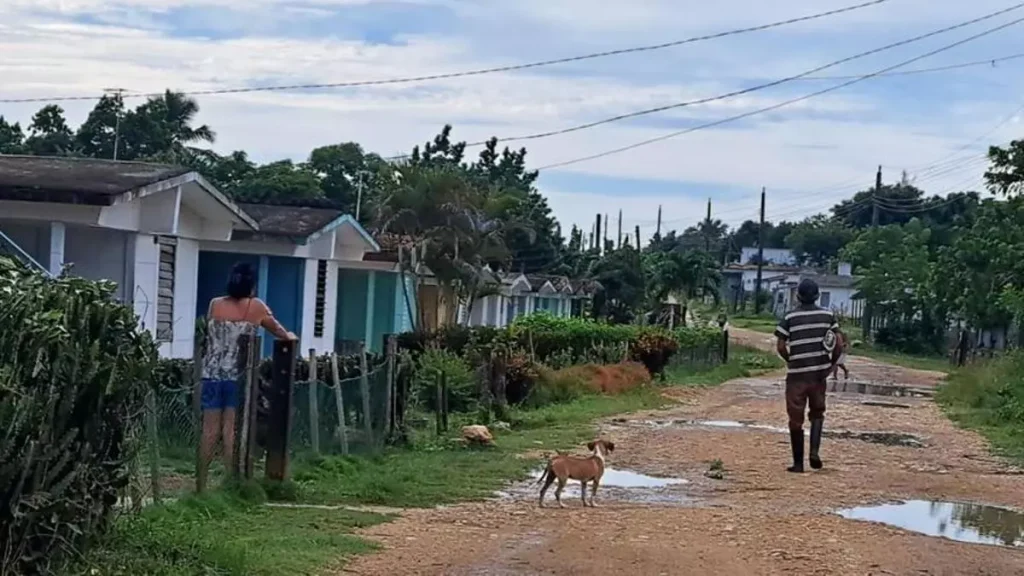
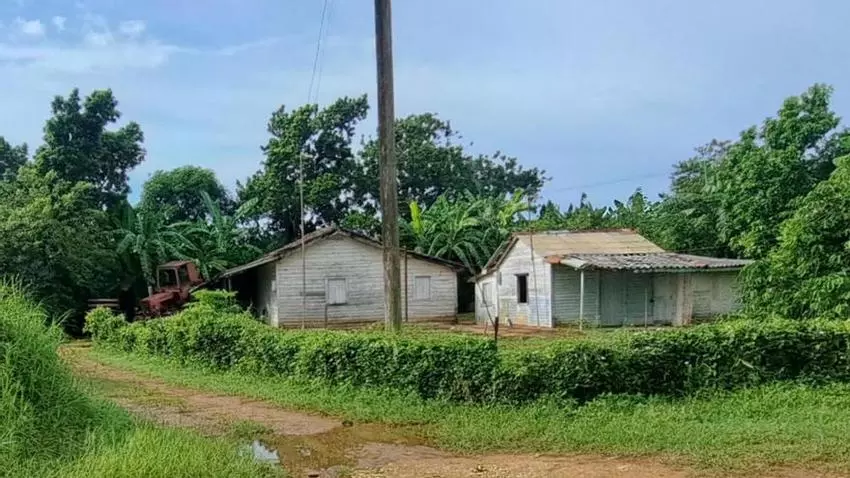
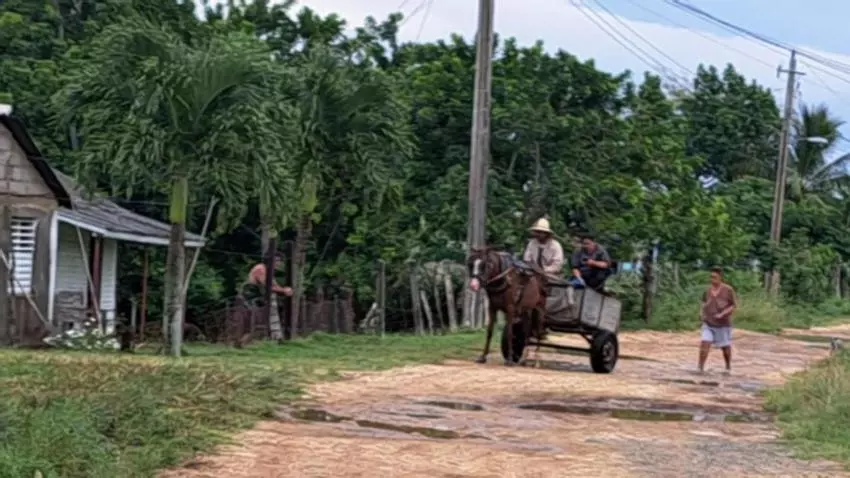
14ymedio bigger14ymedio, Yankiel Gutiérrez Faife, Camajuaní (Villa Clara), 18 September 2024 — Vicente Florit Viñales, 47, is still in a state of shock after the violent raid on his farm in San Benigno, in Villa Clara. The farmer was involved in a colossal police error, when several agents, believing that they had just caught a cattle thief, aggressively immobilized him on the floor until the head of the sector, present at the time, shouted: “He’s not the guy!”

The events occurred during the early hours of September 11, when more than 40 armed men, including members of the Special Brigade of the Ministry of the Interior – the “Black Berets” – with the head of the sector of the area in command, surrounded Vicente’s house and invaded it without prior warning.

“Everyone get out of the house, we have you surrounded,” a voice burst out around 3:00 in the morning in that peaceful village in the municipality of Camajuaní, of about 250 inhabitants who live from agriculture. Less than two minutes passed, but the impatience of the black berets overtook Vicente, who was heading towards the door at that moment. The agents opened it by force and, without saying a word, immobilized and interrogated him until the sector head spoke up and announced the mistake. continue reading

Vicente, without a word, was immobilized and interrogated until the sector head announced the mistake

However, the uniformed men did not give up and continued with their search of the house. Vicente watched stunned as the agents, accustomed to suppressing demonstrations and carrying out command actions against armed criminals, continued breaking things, including door and window handles. They stopped when a mysterious man with a long beard and crucifix-shaped earrings, about 35 years old, appeared. Faced with the farmer’s bewilderment, the agents withdrew without offering any explanation, or apologizing for the violent nocturnal intrusion and the mistake.

The ’Black Berets’ also broke into other homes / 14ymedio

The police operation aimed to arrest a well-known criminal in the area, nicknamed “Machetico,” with an extensive criminal record, who steals cattle from the farmers in the area and then kills them to sell. However, the inaccuracy in the information caused a disproportionate deployment in the wrong place.

“Someone here must have told the police that Machetico was staying at Florit Viñales’ house, because they first went straight to his house and, after seeing that he was not there, checked two other nearby houses, but they didn’t find him,” said Manuel González, a 64-year-old farmer.

The police operation aimed to arrest a well-known criminal in the area, nicknamed ’Machetico,’ with an extensive criminal record

According to some neighbors, during the afternoon some strange movements were seen, and someone apparently saw the criminal wandering around the area. “These guys don’t have a fixed address; they sleep wherever they find themselves at night,” said Ramiro, who lives nearby.

Florit Viñales was not the only one affected by the actions of the authorities. His neighbor, Dayana Espinosa Collazo, was sleeping with her husband when the Black Berets broke into her house. “I got the biggest scare of my life. They opened both doors and came in; they went from one door to the other as if they were the owners. They came screaming into my room with batons and tossed everything. We were even naked, but they didn’t care. The house was completely surrounded.”

The case sent shockwaves through the community of San Benigno and its surroundings, where Florit Viñales is known as an honest and respected worker. “It was very cruel, and we don’t know whose fault it was. Well, I trust in revolutionary justice, because I am forged under the principles of this Revolution,” says his wife, Leticia Galdona, indignantly.

The case sent shockwaves through the community of San Benigno and its surroundings, where Florit Viñales is known as an honest and respected worker

“For God’s sake, I know the farmer and his family; they are loved and respected people in this place. Do not remain silent, report this to the authorities. What’s going on? This looks like a western movie; someone has to pay for that abuse,” exclaims another neighbor, Milady Sánchez Mesa.

The neighbors, not very open to questioning the authorities, nevertheless express their astonishment. “I hope that justice is done and that the work of Alexey, the head of the community sector, who led the operation, is analyzed. When I went to talk to him, I did it with a lot of respect and decency; however, he mistreated me and didn’t let me speak. He received me with the worst rudeness you can say to a lady, even during my recovery process,” adds Florit Viñales’ wife, who is recovering from an operation for a tumor and a blood clot.

Residents of the community of San Benigno, Villa Clara / 14ymedio

Vecinos de la comunidad de San Benigno, Villa Clara / 14ymedio[/caption]

This newspaper tried to talk to the delegate of the area to get his version of the incident after Florit Viñales’ wife intervened. However, after a first contact, he stopped responding to messages and calls

Translated by Regina Anavy

____________

COLLABORATE WITH OUR WORKThe 14ymedio team is committed to practicing serious journalism that reflects Cuba’s reality in all its depth. Thank you for joining us on this long journey. We invite you to continue supporting us by becoming a member of 14ymedio now. Together we can continue transforming journalism in Cuba.

When It Gets Dark, Not Even the Police Enter the ‘Gloomy’ Las Tunas Cemetery

According to the workers and neighbors of the necropolis, looters and “fugitives” take refuge among the graves

The Vicente García cemetery lacks space to deal with the amount of remains / Periódico 26

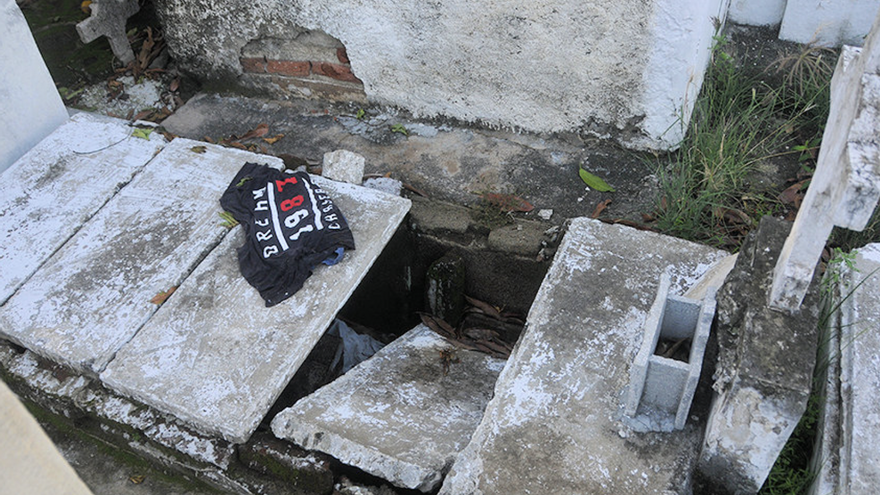
14ymedio bigger14ymedio, Havana, 20 September 2024 — “Cruel, gloomy, inexcusable.” With three adjectives, the official press summarizes this Friday the panorama of the Vicente García de Las Tunas cemetery, which has become, according to its own caregivers, a no man’s land. The necropolis is not only haunted by the typical cases of looted graves and drifting bones, but also, after five in the afternoon, when the workers leave and the darkness lends itself to misdeeds and hiding places for “fugitives,” not even the police dare to enter.

The unusual chronicle of Periódico 26 provides not only descriptions of the cemetery but also stories that could be part of a thriller. The protagonist of the article, Daysi Aguilera Santiesteban, a woman from Las Tunas who sought to move* the remains of her relatives to the Jobabo cemetery, tells the newspaper that after exhuming two brothers and their father – in a process already painful for the families – the plastic boxes where they were deposited disappeared.

Upon returning to the cemetery, the woman found the remains of the three men – all soldiers who went to Angola or participated in some campaign of the regime – scattered on the ground. There was no sign, in the pantheon of fighters where she had left them, of the funeral boxes.

“A head on one side and a bone on the other,” is how the remains spent the whole month of August, says the newspaper, “in God’s hands,” while Daysi knocked on the doors of the police, the technicians, the Prosecutor’s Office, the municipal government and even the Party. The answer was always the continue reading

same: “mistreatment” and “little sensitivity,” says Periódico 26. Only at the end of August was the woman finally able to transport the remains of her relatives.

“After 5:00 pm, this place has no security, and we are located in a very complex neighborhood”

One could think that what happened to Daisi Aguilera is excessive bad luck or an isolated case, but the confessions of the employees of the necropolis themselves – who have given up secrecy in the face of the situation – say that it is not. “After 5:00 pm, this place has no security, and we are located in a very complex neighborhood, constantly attended to by the structures of the Government and the Party,” is the first thing that Jorge Gordales Reyes, manager of Vicente García since the beginning of this year, tells Periódico 26.

The manager assures that, until recently, “many people lived in the cemetery.” He says there were “more than five workers” who have had to be separated from their positions, some “with more than 15 years of work,” for “violations and crimes.” “I can assure you that this place has not been like that for a long time. You can walk through it and not see any debris; it is clean, and we are very severe with indiscipline,” he says, although his own workers deny some of his statements.

Not only are most of the niches and graves dilapidated with slabs torn off, but two large bee hives hang from the back wall, and, faced with the problem of lack of space, the guardhouses have become depositories for the remains. “They removed the windows of the internationalists’ pantheon (guardhouse), closed it, and it’s full, because there’s no room for all the skeletons,” complains Ramón Nicolás Delgado, head of the group of custodians who also suffer from the place’s poor condition.

When the cemetery closes, the guard on duty is not only left without a place to rest but is also plunged into darkness. “The head of the sector has asked us not to have women guards at night for fear of what may happen to them. It’s totally dark here. There was a tower with spotlights focused on several perimeters, but not anymore,” he explains.

“The pantheon of the combatants, to give an example, has a 200-volt switch and can’t be used because there is no breaker. The main entrance is dark because it has not been possible to get a cable for the custodian to have light,” he summarizes. In difficult situations, such as a downpour, “the custodian takes down the flag, picks up the phone and asks the neighbors to give him shelter. And then the cemetery is unguarded, with no one here,” he says.

Many niches and graves are dilapidated, with slabs torn off/ Periódico 26

The lack of security has brought the consequent robberies. “The flower boxes, the little books, the little boxes that people buy for the remains of the family member are stolen. Many are worth 3,000 or 4,000 pesos. They empty them and resell them,” he says.

Periódico 26 also says that the workers don’t receive snacks, gloves or other basic tools for their work, and they’re not the only ones whose lives revolve around the cemetery. A neighborhood has sprouted there, full of people who live with the fetid odors and let their children play in the cemetery as if it were natural. In fact, one of the workers of the necropolis attributes the place’s destruction in part to the residents in the area.

“The children fly their kites; they start running around and when you step up and scold them, the parents fall on top of you as if you were the one invading a sacred space,” he says. He knows, however, that this is not the only reason. The Vicente García lacks maintenance, space and workers, but the employee confesses that “no one wants to work for 2,527 pesos in the midst of so many shortcomings, without lighting and in a diverse and complicated community.”

Periódico 26 reports that, not so many years ago, the provincial authorities announced the construction of another cemetery and an incinerator plant. The plans, however, never materialized despite the promotion they had then, something that the newspaper attributes to the “excess enthusiasm” of the leaders.

The land that had been planned to expand the necropolis, where the earthworks had already begun, was given to some individuals

At the moment, the Vicente García Cemetery lacks space to deal with the amount of remains, and the overexploitation of the cemetery is another reason for the poor condition of the facilities. As for the new projects, “the work on the crematorium is stopped due to lack of materials; the incinerator is already there but has not been installed, and the land planned for expanding the necropolis, where “the first earthworks had already begun, was given to some individuals,” regrets Eiser Prieto Pons, deputy director of Hygiene and Obituary in the province.

In Las Tunas, Vicente García Cemetery is not the only one in that situation. “In Puerto Padre, for example, whose main cemetery is equally overexploited, the work has stopped for bureaucratic reasons. It’s a shame, because we could comply with the rule of building this site next to the garbage dump with the distance it requires,” says the manager, without explaining the reason for the decisions that come “from above. ” However, he adds, the Party has favored the manufacture of coffins, and they will soon be able to add four hearses to the six they have for the entire province.

However, that is not enough to stop the deterioration of the province’s cemeteries like the Vicente García, which serves, according to its neighbors, as a warehouse for remains that are then sold for thousands of pesos to be used for santería rituals, depending on “which bone it is and the dead in question. If it is a child, a foreigner or a combatant, the price goes up.”

The anecdotes about fugitives and criminals who take refuge in the necropolis, the “harmful” policemen and the debacle of the cemetery, were a final point in the official chronicle, which closes without a direct allusion to the negligence of the State that has led to that environment. However, the reminder that, in one way or another, anyone can end up being part of the template of lost and dislocated remains of the cemetery does not go unnoticed in the article: “Death is the path we all take.”

Translator’s note: Cemeteries in Cuba with limited room require that families disinter remains after a given time period, and deposit them in a mausoleum to make room for new burials.

Translated by Regina Anavy

____________

COLLABORATE WITH OUR WORKThe 14ymedio team is committed to practicing serious journalism that reflects Cuba’s reality in all its depth. Thank you for joining us on this long journey. We invite you to continue supporting us by becoming a member of 14ymedio now. Together we can continue transforming journalism in Cuba.

Cuban Prime Minister Marrero Gives Lessons in Democracy and Socialist ‘Sensitivity’ With a Monologue in Gibara

“The people need things to change, but with the Revolution that Fidel and Raúl made,” was his mantra

Cuban Prime Minister Manuel Marrero [center right with beard] “thanked [the villagers] for their support for the Revolution” although their situation was critical / Manuel Marrero Cruz
14ymedio bigger14ymedio, Havana, 21 September 2024 — In a battered fiber cement shelter in Cayo Palma, a small town in Holgüín, Cuban Prime Minister Manuel Marrero demonstrated his method for democratic consultation: the monologue. The cameras of Cuban Television, which followed him on his journey through Gibara from “the first light of day,” recorded the long scolding of the prime minister to “the odd leader who does not have the sensitivity required to be able to talk to the people.”

“They are afraid to come here and be told to their faces the things that need to be said,” Marrero exploded, sweaty from the heat of September and surrounded by local authorities. The difference – he stressed – is that he is willing to “sit down” with the guajiros and ask them to give him their criticism. The first row of about twenty seats in the little school were for officials; the farmers – few and standing – waited their turn to take the floor.

Cuban Television did not devote too much time to the “dissatisfactions” in Cayo Palma, nor in Muñoz, another more populated town. Off camera, the reporter admitted that there was a notable deterioration of the “roads” to both towns and a “scarce supply of goods and services.”

One of the few televised testimonies was that of a woman to whom the authorities brought some basic supplies – cooking oil and rice – and she complained that there was “nothing constant.” It’s not easy for the continue reading

inhabitants because of all the red tape, and they gave up a long time ago when it came to getting medications.

The bread rolls are not only tiny but are also transported in dirty boxes surrounded by flies

Bread is another of the great problems of the small towns of the eastern province. The images themselves were eloquent: the rolls are not only tiny but are also transported in dirty boxes surrounded by flies. The Muñoz bakery, in addition, leaves much to be desired due to the precariousness of the facilities.

Soon the microphone returned to Marrero, who thanked the villagers for their “support for the Revolution” even though their situation was critical. “We have to end the shoddiness, the bureaucracy,” he insisted, appealing to the people themselves to make an effort. “We have to know all the problems, which are many.” The solution is another story.

To top off the “high expression of socialist democracy,” according to Cuban Television, the prime minister went to a rural school, where the Pioneers* were trained and in uniform. It was a “frank and pleasant” dialogue with the humble communities of the Cuban East, the reporter summarized, while focusing in the foreground on an old man from Gibaro with a shiny US Marine cap.

At one point on his journey, Marrero confessed that he made those exchanges as a kind of model for the accountability assemblies formerly held. Suspended since 2021, these meetings return to Cuban neighborhoods as proof – says the official press – that the Government is willing to listen to the people in the midst of the crisis. “The people need things to change, but with the Revolution that Fidel and Raúl made,” was Marrero’s mantra.

The Communist Party newspapers reproduced on Saturday similar scenes in all provinces

The Communist Party newspapers reproduced on Saturday similar scenes in all the provinces, with lower-ranking leaders. In Sancti Spíritus, for example, they have achieved a curious sample of “patriotic virtues”: the creation of an official commission to “supervise the quality of the bread for the basic basket,” which soon became the main concern of the meeting.

In Villa Clara, on the other hand, people talked about the multiple problems of garbage collection and the proliferation of crime, but Vanguardia did not offer too many details about the debate. There, the delegates also gave scoldings and celebrated their own willingness to “listen to the voters.”

The 5 de Septiembre digital news source gives the chronicle of accountability the tone of an epic. It reports that the delegates “are moving heaven, sea and earth,” and don’t accept “unfinished or unconvincing answers” from those who “harm their people,” and they should “begin the task” – the kind of war cry attributed to Antonio Maceo – every day. In every town there are “dark minds longing for blackouts” for the meeting to be suspended but, they warn, not even that can prevent the leader from being there.

As for the municipality of Segundo Frente, according to Sierra Maestra, the delegates have asked for trust in the “influence of the Party” and its first secretary in Santiago de Cuba – Beatriz Johnson Urrutia – for a solution to their problems. An undated solution, of course, because now the Government only intends to “listen.”

*Translator’s note: In 1961, the José Martí Pioneer Organization for Cuban youth was created to replace the banned Association of Cuban Scouts.

Translated by Regina Anavy

____________

COLLABORATE WITH OUR WORKThe 14ymedio team is committed to practicing serious journalism that reflects Cuba’s reality in all its depth. Thank you for joining us on this long journey. We invite you to continue supporting us by becoming a member of 14ymedio now. Together we can continue transforming journalism in Cuba.

In Search of ‘Solidarity’ and Support, Cuba’s Foreign Ministry Brings Together Emigrants in New York

“The objective of the new Migration Law is to ensure that Cubans find prosperity in Cuba”

The focus was on the new laws that affect emigrants / Minrex

14ymedio bigger 14ymedio, Havana, 21 September 2024 — Despite the impression of “frank dialogue” with emigration that Cuba’s Foreign Ministry wants to give, those who attended the fifth meeting of this type organized by the Cuban Consulate in the United States, this Saturday in New York, did so with their backs to the cameras. Very few are willing to show their faces after, in past years, they were criticized for their approach – for economic reasons, in most cases – to the regime.

The focus was on the new laws that affect emigrants – those of Foreigners, Citizenship and Migration, approved by Parliament but not yet published in the Official Gazette – whose content was described by Colonel Mario Méndez, a high official of the Ministry of the Interior, dressed in civilian clothes. The director of Consular Affairs of the Foreign Ministry, Ana González Fraga, quoted at length what President Miguel Díaz-Canel thought about emigrants. She reminded them that, despite their living with the “enemy,” the Government “waits for their return” and applauds their “triumphs.”

She celebrated the migrants related to the Government who have sent “food donations” this year and have made “pronouncements” against the embargo, in addition to participating in “caravans” in support of the regime. These are “challenging moments for the nation,” he said, in which the Government “infinitely” values any “solidarity contribution.” continue reading

The diplomats celebrated that emigrants related to the Government have sent “food donations” this year

“All those who want to contribute are welcome,” Fraga said and began shouting slogans against the blockade, which the attendees chanted en masse. Only at the end of her speech – recorded from a cell phone and transmitted on the official profile Nation and Emigration, are some of the faces of the attendees seen, applauding the official.

The meeting was also attended by the Cuban Foreign Minister, Bruno Rodríguez, who in a brief post on X reported his attendance and said he was “happy” with what was discussed there. In addition, other senior officials of the Foreign Ministry, such as Carlos Fernández de Cossío, took the floor during the meeting.

Fernández de Cossío’s intervention left a phrase that the Cuban Consulate in New York – headquarters of the event – underlined: “The objective of the new Migration Law is to ensure that Cubans find prosperity in Cuba.” The reality of the country, hit by blackouts and shortages, is diametrically opposite.

Both in Havana and in Washington or New York, the regime has been organizing meetings for several years with those who are willing to be invited

Both in Havana and in Washington or New York, the regime has been organizing meetings for several years with those who are willing to be invited. They are, according to exiled opponents, old agents planted by the Government in the United States or businessmen who, despite their departure from Cuba – the typical case is the tycoon Hugo Cancio – consider it appropriate to invest in businesses on the Island.

Last November, while the country was going through one of the worst moments of the migration crisis, Havana carried out a large logistical deployment to receive dozens of emigrants. The conference La Nación y la Emigración – the binomial that the regime coined to allude to those who left – aimed to achieve greater investment in the country through SMSEs.

After a flourishing of small and medium-sized enterprises, the Government has been putting a stop to initiatives and increasing control for months. This Saturday’s meeting in New York, along the same lines, was limited to discussing the consequences of the new laws, but left the interest in investing in the background.

The first edition of this kind of conferences took place in 1978. The official press remembered that date again last month, with a long reflection by the regime’s spokesman Elier Ramírez Cañedo.

The conversation with Cubans living in the United States has become a habit every time a senior Cuban official visits the US capital or goes to the United Nations headquarters. The objective: not to lose sight of and to “forge ties” with those in tune with the regime within the Cuban community in the United States. Havana considers them “a priority,” Fernández de Cossío said last April.

Translated by Regina Anavy

____________

COLLABORATE WITH OUR WORKThe 14ymedio team is committed to practicing serious journalism that reflects Cuba’s reality in all its depth. Thank you for joining us on this long journey. We invite you to continue supporting us by becoming a member of 14ymedio now. Together we can continue transforming journalism in Cuba.

Two Cuban Doctors Have Been Waiting a Year for the Bank To Give Them the Dollars They Earned in Angola

“Without the possibility of buying a house,” the doctors believe that the State is not repaying them for their sacrifice

Cuban health workers with officials from the Island and Angola at an event in Luanda / Cubaminrex

14ymedio bigger14ymedio, Madrid, 19 September 2024 — As if it were not enough to permanently retain more than 70% of the salaries of doctors on international “missions,” Cuban banks have denied two doctors who worked in Angola the extraction of the hard currency coming to them. The information was published this week by the official press itself, to which the couple appealed in a last attempt to obtain what is theirs.

“Acknowledgement of receipt,” a section of the newspaper Juventud Rebelde dedicated to publishing the population’s complaints, was the recipient of the claim of the married couple Eliannys Saborit Oliva and Alfredo Miguel Ramos, an anesthesiologist and an orthopedist, who live in the municipality of Bayamo, in Granma province.

After their return from Angola in 2023, where they spent three years as part of one of the health contingents that Cuba exports to many countries, the doctors earned an undisclosed amount of foreign currency for the State that was to be paid to them “after a reasonable time.” However, the Banco Popular de Ahorro de Bayamo has not paid the doctors since October 2023, claiming low availability of foreign currency. continue reading

The Banco Popular de Ahorro de Bayamo has not paid the doctors since October 2023, claiming low availability of foreign currency

Saborit Oliva and Miguel Ramos, who say they need the money to become independent, have run out of options, because as residents of Granma they can collect foreign currency only in that province. Meanwhile, their colleagues from other territories received their salaries long ago.

“Nor do they plan strategies for sending monetary aid, after almost a year of waiting to extract the cash in hard currency that is ours for having made money for the country, for representing our nation with dignity and for surgically saving lives, in adverse conditions of tuberculosis, hepatitis, HIV, malaria and Covid-19, with the sacrifice of abandoning our daughter and the rest of the family,” says the couple, who do not see their efforts being repaid.

“We have made three trips to Havana, with letters from the Council of Ministers, and the matter was transferred to the Central Bank of Cuba, which has the same answer: there is no availability,” say the doctors. They explain that they still “don’t have the money, after several complaints processed at the central banking level, without a date for delivery and without the possibility of buying a house.”

“The low availability is real, but we can’t understand, after almost one year, why they haven’t been able to resolve our demand,” the couple concludes, in their underlying criticism of the Cuban banking system.

Health workers are obliged to deposit the hard currency obtained during their missions abroad in Cuban banks, a policy implemented to try to avoid the desertion abroad of these professionals

Health workers are obliged to deposit the hard currency obtained during their missions abroad in Cuban banks, a policy implemented to try to avoid the desertion of these professionals. If they leave the mission, the health workers lose their wages, which pass to the State coffers.

This aspect of medical missions, as well as the withholding by the State of between 70% and 95% of the amounts paid by other countries for each Cuban health worker, has been pointed out by several organizations as a form of modern slavery.

Some of the health workers have even broken their silence and complained that the part of the money that Cuba leaves them to live on while they are on a mission is barely enough for basic needs. In 2023, one of the doctors of the more than 600 sent to Mexico that year told the newspaper Reforma that instead of a salary, he and his colleagues received a “stipend.” His salary, he added, minus the percentage taken by the regime, was in Cuba.

For its part, despite having a devastated health system – where there is a lack of supplies and medicines for the professionals themselves – Cuba insists that part of the money that other countries pay for Cuban doctors is reinvested in the Public Health sector of the Island.

“Doing away with this income means preventing Cuba from buying or manufacturing medicines, repairing hospitals, importing medical technology or, simply, the economic improvement of cooperating personnel and their families,” claimed Cubainformacción, a pro-Castro portal based in Spain, last February. The truth is that, as the Government of Cuba itself reports, more than 33% of the State budget goes to investments in tourism. This is reflected in the public accounts of 2023, where it is stated that the Health sector receives less than 2% of the State budget.

Translated by Regina Anavy

____________

COLLABORATE WITH OUR WORKThe 14ymedio team is committed to practicing serious journalism that reflects Cuba’s reality in all its depth. Thank you for joining us on this long journey. We invite you to continue supporting us by becoming a member of 14ymedio now. Together we can continue transforming journalism in Cuba.

The Cowardice of UNEAC, Cuba’s Writers and Artists Union

The history of the institution is a soap opera full of lynchings, expulsions, censorship and self-incriminations

Luis Morlote, former president of UNEAC, receiving congratulations from Esteban Lazo for his promotion to the Central Committee / Granma

14ymedio bigger14ymedio, Yunior García Aguilera, Madrid, 19 September 2024 — Last Sunday, Cuba’s official newspaper Granma published a pamphlet entitled “The Brave and the Cowardly.” It was obvious that the article referred to the reaction caused by the expulsion of Dr. Alina Bárbara López Hernández from the Union of Writers and Artists of Cuba (UNEAC), since several members resigned from the organization and expressed their disagreement on social networks. But the article never dared to mention her by name. It preferred to gloat, in super-worn nautical metaphors and the phraseology of José Martí taken out of context, as Yusuam Palacios, director of the Fragua Martiana Museum, usually does in his pseudo-poetic parliamentary speeches.

However, despite the fact that the text was loaded with all that revolutionary syrup frequently used by the deputy of Sagua de Tánamo, no one dared to sign it. It appeared under the authorship of “Cultural Writing,” a waste of courage. From the language used, everything indicates that it was written by a single person, a bad poet or some cadre who aspires to be the reincarnation of the Naborí Indian,* although only his “Elegy of the White Shoes” was read.

I have spoken to some UNEAC members who remain in Cuba, and they have confirmed to me that the author did not dare consult them before publishing this mock declaration. So it was something fabricated in an office from an order, or an initiative of some enthusiastic official. In summary, the article that calls itself “brave” is not able to mention the name of the person who inspires it, does not dare to affix the signature of anyone in particular and does not have the guts to consult about its content with members of the organization that is attributed to its authorship. continue reading

In the comments, a reader states that she is totally lost as to the content of the pamphlet

In the comments, a reader states that she is totally lost as to the content of the pamphlet. Mirella admits: “I am interested in having more information about what is happening at this time that brought about this statement as a consequence. I have some idea, but not enough to be able to enlighten others.” Another reader, Lázaro Numa Águila, confesses: “The editorial makes me feel that we continue to make use of speech that is often unintelligible for some; what is the reason for this reaffirmation?”

For several years I was a member of UNEAC, until I resigned, after the infamous statement that the organization published after 11J.** A few weeks before the incident, the late Corina Mestre had called me to a meeting to suggest that I voluntarily resign. I remember he said something like this: “Oh, Yunior, my son, haven’t you read the statutes?” And he was right. Article 2 clearly stated that UNEAC recognizes the Communist Party of Cuba as the superior leading force of society and the State. In other words, in no case is it a non-governmental organization that is part of civil society. Not at all. It is an institution, like all, subordinated to the single party. It is an extension of State Security, with the sole purpose of monitoring and controlling the guild of artists and intellectuals.

Believing that I was someone smart, I thought I could do something useful from within, that continuing to be part of their ranks served to raise my voice in the assemblies, denounce abuses and promote the democratic changes to which I aspired. Being totally honest, I also believed that continuing to be a member was a kind of protective shield, for the minions to think twice before siccing their dogs on me. But I was wrong. I wasn’t someone smart; I was naive and cynical. The history of UNEAC is a soap opera full of lynchings, expulsions, censorship and self-incriminations. UNEAC is not a guild fraternity, it is a minion institution. It’s not a protective shield, it’s a scaffold. From Heberto Padilla to Alina Bárbara there is a long list of convicts.

From Heberto Padilla to Alina Bárbara there is a long list of convicts

Some years ago, in Holguín, during one of those useless provincial assemblies, the troubadour Fernando Cabrejas asked: What is UNEAC for? Others, who also asked for the floor, argued that it was a cultural old folks’ home, which served to be shipwrecked on the Internet, to speed up a journey to capitalism, to drink cheap coffee and eat croquettes without having to line up or to have a bathroom to go to when walking through the city center.

UNEAC’s X Congress was scheduled for June of this year, but culture has never been a priority when it comes to authorizing budgets, nor was the oven used for pastries. In January, Luis Morlote was “promoted” and went from being president of the organization to being a second of Rogelio Polanco in the Auxiliary Structure of the Central Committee for Ideological Affairs: what a rise! Miguel Barnet praised his record as a leader; Polanco justified the decision made, not as a weakness, but as an ability of UNEAC to forge cadres, and Lazo gave a painting – according to the grotesque tradition – to the promoted cadre.

The conclave has been postponed to November. That’s why State Security is on the run threatening and cutting off heads. That is also why the entire propaganda apparatus of the regime publishes daily tomes about UNEAC, Although the note of pessimism is obvious. La Jiribilla, a weekly magazine of Cuban culture, has been repeating a litany of elegies for a week, hysterically shouting that UNEAC unites, adds, multiplies and any other mathematical operation they can think of. They are visibly desperate. They are afraid. They want the next congress to be like every other one, an inventory of complaints and promises. But they are terrified that someone will depart from the script and propose to delete Article 2 of their statutes. The Article 2 that demonstrates its absolute submission… and cowardice.

Translator’s notes:

* The Cuban poet, Jesús Orta Ruíz, was known as the “Naborí Indian.” After the defeat of the US in the Bay of Pigs, Orta Ruíz wrote the poem to commemorate the deaths of many civilians, including a boy whose white shoes were destroyed. A pair of bloody white shoes is on display in the Bay of Pigs museum, a memento of the first military defeat of the US in Latin America and the Caribbean.

** The first Vice President of UNEAC, Ernesto Limia Díaz, published a statement on Facebook on July 12, 2021, in support of the Regime’s suppression of the July 11th demonstrators.

Translated by Regina Anavy
____________

COLLABORATE WITH OUR WORKThe 14ymedio team is committed to practicing serious journalism that reflects Cuba’s reality in all its depth. Thank you for joining us on this long journey. We invite you to continue supporting us by becoming a member of 14ymedio now. Together we can continue transforming journalism in Cuba.

Cuba Siglo 21 Requests Interrogation of the Former Cuban Pilot Who Participated in the Shoot Down of the Brothers to the Rescue Planes

Cuba Siglo 21 says that the case of Luis Raúl González-Pardo, who lives in the United States, “goes beyond the migration issue”

González-Pardo was director of Terminal 2 of José Martí International Airport / Mario J. Penton

14ymedio bigger14ymedio, Havana, 17 September 2024 — The organization Cuba Siglo 21 pronounced this Tuesday on the case of the former pilot of the Cuban Armed Forces Luis Raúl González-Pardo, who has been living in the United States since April thanks to the Humanitarian Parole program. According to its report, the situation “goes beyond the immigration issue” and must be referred to the Florida Prosecutor’s Office, given the involvement of the former soldier in the shoot down of two Brothers to the Rescue planes in 1996.

The Prosecutor’s Office – argues Cuba Siglo 21 – must decide whether to proceed in trying González Pardo for being part of the group of pilots who harassed the unarmed aircraft of the humanitarian organization and killed four people (three Cubans with US citizenship and one resident). “At the very least, he should be interrogated about those facts.”

The issue in question, which the González-Pardo case once again puts into discussion, is the legal defense of “due obedience.” The international community, explains Cuba Siglo 21, does not recognize this allegation, which aims to justify ” first-degree, premeditated murder” with the statement that the person was only following orders.

Both the 13 de Marzo Tugboat sinking and the shooting down of the planes of Hermanos al Rescate were ambushed with premeditation and treachery from intelligence information

The organization gives two recent examples in Cuban history: the shoot down of the planes in 1996 – from which the former pilot cannot detach himself, although he allegedly did not shoot – and, two years earlier, the sinking of the 13 de Marzo tugboat, in which “unarmed Cuban families trying to migrate” died. continue reading

“Both the 13 de Marzo Tugboat sinking and the shooting down of the Brothers to the Rescue planes were ambushes with premeditation and treachery from intelligence information previously provided to the Cuban government by its agents and informants. They were not actions of war, but planned homicides. Both acts constitute crimes against humanity that do not expire,” the organization believes.

In the opinion of Cuba Siglo 21, those who boarded the Mig fighter jets – including González-Pardo, who was in number 22 – “left that day ready to kill.” In the recording of the radio communications of the attack, it argues, the former pilot reports that one of the Brothers to the Rescue planes was “in his sights” and that he was waiting for instructions to proceed. This action “leaves no doubt about the intentions that morning of the migrant who now lives peacefully in Jacksonville, Florida.”

“It’s not about intolerance, revenge or resentment, nor about ’settling the score’ with that pilot. What is actually urgent is to bring to trial in this case the very concept of ‘due obedience’ to criminal orders that are almost without exception raised by human rights violators in Cuba, Venezuela, Nicaragua and other similar regimes,” summarizes the statement.

This Monday, the independent journalist Mario Pentón tried to communicate with the pilot

This Monday, when independent journalist Mario Pentón tried to communicate with the pilot, González-Pardo claimed that much of what had been said about him in the media was “false.” Then, however, he hung up the phone and deleted his WhatsApp number. He had described his situation as “very difficult.” After a lifetime in the service of the Regime – first as a military pilot and then in civil aviation positions, as director of Terminal 2 of the José Martí International Airport – he had accepted the Humanitarian Parole offered by the United States. “I still haven’t decided what I’m going to do, or if I’m going to give interviews or not, mainly because of some additional situations that I have and that can affect me,” he said.

Pentón also shared this Tuesday an internal document from the US Department of State, obtained by Martí Noticias and dated 2016 – in the midst of the thaw initiated by then-President Barack Obama – in which González-Pardo asks to speed up the US consular interview to grant him a tourist visa for being a “facilitator” of high-level travel and a “key diplomatic contact” when organizing exchanges between the two countries. His visit – to “observe firsthand American culture” – was considered of interest by Washington, so his consular interview was moved up twice.

According to several sources, González-Pardo was the man who was at the controls of the Mig 29 that chased José Basulto

According to several sources, González-Pardo was the man who was at the controls of the Mig 29 that chased José Basulto – the leader of Brothers to the Rescue – to the north of the 24th parallel, in the Straits of Florida. Basulto himself confirmed this information to the military pilot Orestes Lorenzo, who escaped to the United States in 1991 and returned, despite the risks, to pick up his family.

After it became known that Washington gave the go-ahead to the former pilot, a barrage of criticism and questioning about the Cuban migrant has fallen on US authorities.

Translated by Regina Anavy

____________

COLLABORATE WITH OUR WORKThe 14ymedio team is committed to practicing serious journalism that reflects Cuba’s reality in all its depth. Thank you for joining us on this long journey. We invite you to continue supporting us by becoming a member of 14ymedio now. Together we can continue transforming journalism in Cuba.

More Than a Million Cubans Suffer Water Cuts Due to Blackouts and Other Breakdowns

Ten generators donated by China will provide 18 MW to Sancti Spíritus and Cienfuegos when there is fuel

The population relies on ’water thieves’ in the midst of a desperate situation / 14ymedio

14ymedio bigger14ymedio, Madrid, September 18, 2024 — More than a million users are now affected by water cuts in Cuba. In the first week of September the authorities admitted that the figure was about 600,000 people. A few days later, the increase was significant, with an average of 713,000, to which are added “some 300,000 people who receive water from the “pipas,” the tanker trucks, whose cycles can be more than 15 days,” explained Antonio Rodríguez, president of the National Institute of Hydraulic Resources (INRH), this Tuesday on State TV’s Round Table program.

The official explained that those who receive the supply by tanker trucks have “in some cases very extended cycles” (low frequency) and summarized the three fundamental problems: the state of the pumping equipment, the lack of electricity and the breaks in the main pipes.

“At the moment, 40% of the affectations are from broken pumping equipment and 39% from lack of electricity, and that has been happening since October,” he summarized. Rodríguez explained that they are working together with the Unión Eléctrica de Cuba (UNE) to minimize the problems caused by the lack of fuel. The main task is for the electric generators to relieve the blackouts; that’s why the INRH has increased its supply capacity from 36% to 72%, but, he says, there is not always enough fuel for them to work. continue reading

The main task is for the electric generators to relieve the blackouts; that’s why the INRH has increased its supply capacity from 36% to 72%, but, he says, there is not always fuel for them to work

In this context and after a deficit of more than 1,000 MW reported yesterday at peak hour, the authorities announced that the Communist Party of China had donated ten generators that will go to Sancti Spíritus and Cienfuegos, although they will barely provide 18 MW, and only as long as they have the required fuel.

As for the pumping equipment, the data are devastating. There are 3,674 pumping stations of which 3,381 work. There are 1,200 that are more than 10 years old, 229 that are not “in position” [due to lack of a pumping source] and 209 that “do not meet the technical requirements of expenditure and load, but they are the ones we have and that are working,” he said.

They are joined by 481 reserve pumping stations, of which only 127 work, an added problem because that prevents maintenance to the equipment with its consequent deterioration. “By not having spare pumps when the main one breaks, until we comply with the transfer cycle and take them to the workshops and repair them, all that time we have to try to supply those who receive water with the “pipas,” and we know the difficulties we have with fuel,” he stressed.

As a result, the whole country is suffering from a lack of drinking water and sanitation, with Pinar del Río, Havana, Las Tunas and Holguín in the lead, according to the Institute’s data.

Rodríguez, however, has the same hope as his partner in the battle, the Minister of Energy and Mines, and he has trust in solar power. This Tuesday he reported that between 2023 and 2024, 1,200 pumps have arrived in the country, of which 866 are “for the change in the energy matrix,” he said, referring to photovoltaics. There are 200 of them that have not yet been assembled, almost all of this type.

The whole country is suffering from a lack of drinking water and sanitation, with Pinar del Río, Havana, Las Tunas and Holguín in the lead

There are 1,312 pumping stations that need less than 10 kilowatts. There are 866 on the Island, among which 678 are in place but only 91 provide service. However, Rodríguez congratulated himself because 350,000 people are supplied thanks to them, “especially in isolated communities.”

In addition, there are 300 that use hybrid technology (fed by the National Electric Service and by solar). “Eight stations are planned for the first stage in Pinar del Río, 15 in Sancti Spíritus, 16 in Holguín and 9 in Cienfuegos. For the second stage, 15 are planned for Villa Clara and Aguas Turquino in Santiago,” he added.

The evening broadcast had a specific section dedicated to Havana, the province that concentrates not only more inhabitants but also more economic activity and political power, and, most worryingly for the regime, where protests are more easily ignited.

“On the night of 21 July 2024, an electrical failure occurred in the high tension lines that connect the Cuenca Sur reservoir with the Central System. This caused a sudden stop and, as a result, several hydraulic valves malfunctioned, which broke the driver and caused breakage in four pumping stations from the well field. This was the beginning of a complex period in the water supply service to the capital,” Rodríguez said to explain the nightmarish weeks that the capital is experiencing.

According to his calculations, there have been more than 199,000 inhabitants affected by the hydraulic network, in addition to 12,500 who receive water from “pipas,” whose cycles have lengthened due to the shortage of vehicles and fuel. “Today, the affectation from networks is 67,295 people and from lengthened “pipa” cycles, 7,551 inhabitants, for a total of 74,846 affected inhabitants,” he said. The west (La Lisa and Marianao) is the most affected part, but just this Tuesday the problems spread to East Havana, “which belongs to another system.”

According to his calculations, there have been more than 199,000 inhabitants affected by the hydraulic network, in addition to 12,500 who receive the water from “pipas”

Of the 279 stations in the capital, 22 do not have pumping equipment, and 77 do not meet the necessary requirements. Despite this, Rodríguez announced equipment installations that, he promised, will improve the situation in the very short term, in addition to medium-term investments for the same purpose. “Due to the blockade*, many times, even if we have the equipment in the ports, it is difficult for us to ship it,” he said, although Cuba has “a line of credit for the acquisition of new equipment for Havana this year.”

Judging by the data offered by Rodríguez, the economy is not at this precise moment a problem for the medium term, although the lack of workers is. “The average salary here is only 3,500 pesos, but there are four companies with salaries below 3,000 pesos, which deprives us of people who know how to operate the drivers. We are working to find a solution to this issue.”

The situation of the three factories on the Island that make water pipes is good: “We have enough raw materials and pipes for the investment program and the maintenance works,” he said, “although we have to import supplies for large drivers, mainly steel.”

“This year we have a plan of 3.2 billion pesos for investments and maintenance. At the end of August we have 119 percent compliance, and we have now received approval for 600 million pesos to add to these works. However, these plans are costing us up to 30% more than in previous years, due to the increase in the prices for products and services,” he explained.

The Island has installed 181 kilometers of water mains so far and has completed 204 works, he stressed, and he added that “there is no province in the country where we do not have some kind of action, but the problems are great.”

Rodríguez displayed the water balance with graphs showing the amount of rainfall and the filling of reservoirs on the Island, which is not a real obstacle at the moment. Authorities estimate that there are about 39,000 people affected by the drought, a small number in relation to other causes. He did consider problematic the loss of water from leaks, more than 5,000 in the country, of which 2,000 are in Havana.

*Translator’s note: There is, in fact, no US ‘blockade’ on Cuba, but this continues to be the term the Cuban government prefers to apply to the ongoing US embargo. During the Cuban Missile Crisis the US ordered a Naval blockade (which it called a ‘quarantine’) on Cuba in 1962, between 22 October and 20 November of that year. The blockade was lifted when Russia agreed to remove its nuclear missiles from the Island. The embargo had been imposed earlier in February of the same year, and although modified from time to time, it is still in force.

Translated by Regina Anavy

____________

COLLABORATE WITH OUR WORKThe 14ymedio team is committed to practicing serious journalism that reflects Cuba’s reality in all its depth. Thank you for joining us on this long journey. We invite you to continue supporting us by becoming a member of 14ymedio now. Together we can continue transforming journalism in Cuba.

’Bancarización’ — Banking Reform — and Lack of Resources Complicate Payments to State Musicians in Cuba

Every month, the members of the economic department of Sancti Spíritus face “old-fashioned” payments, with pencil and paper

The group Parranda Típica Espirituana is one of those affected by the non-payments / Escambray

14ymedio bigger14ymedio, Mercedes García, Sancti Spíritus, 18 September 2024 — A dilapidated “Frankenstein-style” computer, obsolete programs and a terrible internet connection are just the tip of the iceberg of the problems suffered by the Music and Entertainment Marketing Company in Sancti Spíritus. The bancarización [banking reform] link in the province has been broken on the weakest side: the wages of workers, who rarely receive what the State owes them on time.

The problem is not only the technological obsolescence of the company, but also its “historic debts” – 658,000 pesos of overdue wages – an even more complex panorama since mandatory electronic payments were decreed last year. Despite the fact that the musicians had to have bank cards processed by the entity, it has not even met that basic requirement. For those who do have them, payment rarely arrives on time. The summary of one of the employees is pithy: “We are always uncertain of when we will get paid.”

According to the Sancti Spíritus newspaper, Escambray, the company hit rock bottom in 2022 and since then has not raised its head, “despite showing signs of economic recovery,” which the newspaper does not define. Today, however, it can barely support its administrative expenses and pay what the contracts stipulate. continue reading

Everything has been “stumbles and falls” in the Marketing Company’s attempts to execute the State’s guidelines

These factors meant that, rather than arriving late to bancarización, it never had a chance of taking the leap requested by the Central Bank of Cuba. Since then, everything has been “stumbles and falls” in its attempts to execute the State’s directions. To give an idea, the newspaper mentions the case of Antonio Sosa, a skilled musician from Sancti Spíritus, who has not been paid for three months because the company has not sent him a bank card.

Sosa doesn’t have too many illusions about the plastic: even when it reaches his hands, he’ll have to figure out “how to get the money.” The lines to extract cash from ATMs and the numerous difficulties for its availability in the banks do not augur well for the artist.

The Marketing Company has been “very late” when it comes to applying bancarización, says Escambray. It should have prepared for the delivery of bank cards six months ago. It did not do it, it says, because of its characteristic lack of “demand.”

Interviewed by the newspaper, the leaders of the entity defend themselves. They assure that 90% of musicians have cards, despite the fact that some made mistakes entering their data into the system. To that must be added the “Frankenstein” device, an old computer with unknown parts that is not up to par – they allege – or having the national software to process wages.

Every month, the members of the economic department face “old-fashioned” payments, with pencil and paper, which delays all the procedures. The new computer will not arrive soon, because they have to “develop an investment plan that gradually meets those and other needs.” It is the problem of belonging to the State’s “business system,” concludes the economist Caridad Ruiz. “We have to finance ourselves, and today we do not have the financial coverage to assume that expense,” she regrets.

“There’s no excuse for doing the payroll by hand. Here people work under the gun”

Others, such as the deputy director of the Marketing Company, do not agree with this system and ask for more resources. “There’s no excuse for doing the payrolls by hand. Here people work under the gun. Under these conditions it’s impossible to achieve anything else. Musicians and workers demand their right to be paid on time,” he says.

Gone are the days when subsidized musicians – paid a fixed salary as a gesture of “State protection” – received their salary in the first four days of the month. Guillermo González, director of the Parranda Típica Espirituana, complains of having lost count of “the last time he was paid on time.” First, the money arrived between the 10th and the 15th. Now it’s “when they pay it.”

His group hears one justification after another from the managers, such as the lack of staff in the economic departments of artistic companies. But there are never solutions.

Among the half dozen managers interviewed by Escambray, not a single one could promise an improvement. The problem – described in detail – has no end in sight, and the bosses only know how to repeat as a litany what their superiors in Havana tell them: “We have to continue working.”

Translated by Regina Anavy

____________

COLLABORATE WITH OUR WORKThe 14ymedio team is committed to practicing serious journalism that reflects Cuba’s reality in all its depth. Thank you for joining us on this long journey. We invite you to continue supporting us by becoming a member of 14ymedio now. Together we can continue transforming journalism in Cuba.

‘It’s As if They Hate the People,’ Cubans Complain About the State Electric Company’s Blackouts

For this Tuesday, the state forecasts a deficit of 1,030 megawatts during peak hours

Many businesses, both private and State, have not been able to open in recent days / EFE

14ymedio bigger14ymedio, Madrid, September 17, 2024 — Many Cuban neighborhoods will suffer from blackouts this Tuesday. The forecast of the Cuban Electric Union (UNE) once again exceeds 1,000 megawatts (MW). This has put the citizens of the Island, who live hopelessly pending information on power cuts, on a war footing.

“This is no way to live. Yesterday they shut down the power practically all day, and for today we expect the same,” says Norma, a woman from Sancti Spíritus who lives in the provincial capital. “This hits us very hard with the heat,” she adds.

From Holguín, another city besieged by constant cuts, Ernesto tells this newspaper that lately there are few nights when he can sleep. “They cut the power from 6:00 am to 12:00 pm, from 6:00 pm to 12:00 am and then from 3:00 am to 6:00 am. This is crazy. Most of the shops in the city aren’t open, and the cafeterias that don’t have generators cannot provide service to the public,” says Ernesto, who stayed awake yesterday fanning his son so that he could rest.

Between blackouts and the suffocating heat, both Norma and Ernesto are losing hope that the situation will improve

As the days go by between the blackouts and the suffocating heat, both Norma and Ernesto lose hope that the situation will improve. “I know that today they’ll give us another story, but when you least expect it, they will take away the electricity again,” Ernesto concludes. continue reading

He’s not wrong. According to the State’s daily report, the national electricity system (SEN) gave only 45 minutes of relief yesterday. “At 7:48 a.m. yesterday morning the service was restored, and from 8:33 a.m. the service began to be affected again due to a generation capacity deficit, which it has not been possible to restore,” the UNE indicated.

If on Monday the maximum “affectation” in the peak hours – the early hours of the night – was 973 MW, this Tuesday the deficit will be 960 MW (there will be an availability of 2,240 MW compared to a maximum demand of 3,200 MW), which will finally affect a total of 1,030 MW.

The UNE also reminds the population that five units of the thermoelectric power plants are stopped due to breakdowns: unit 8 of the Máximo Gómez, in Mariel (Artemisa); unit 5 of the 10 de Octubre, in Nuevitas (Camagüey); unit 2 of the Lidio Ramón Pérez, in Felton (Holguín); unit 5 of the Renté, in Santiago de Cuba; and unit 1 of the Ernesto Guevara, in Santa Cruz del Norte (Mayabeque). However, it reports that the latter will enter the SEN in the “peak hour” with 70 MW.

Likewise, they report that 59 distributed generation plants are out of service due to lack of fuel.

With this scenario, social media users have not held back either, and this Tuesday they flooded the daily report of the UNE with almost 400 comments, most of them negative and even against the Government. “There is no fuel for thermoelectric plants, but there is fuel for [Prime Minister] Marrero’s, [President] Canel’s and [Raul Castro’s grandson] El Cangrejo’s* cars. The yachts and fleets of cars of the Castros do not lack fuel either,” said Raúl Eduardo Rojas, from Pinar del Río.

“Now all we need is the breakdown of the Guiteras plant to see how they run to get the fuel that suddenly appears,” says Amado Amed Díaz Seijo from the same province. And he wonders: “I would like to know what they have done with all the dollars for fuel collection, because it’s been a while now, and everything is the same or worse.”

Dainy Ramos has power from eight to twelve at night, and they shut it off again until after four in the morning: “What child can get up for school or what person can get up with encouragement to go to work? They are killing us,” the young woman lamented.

Bobby Cabanas, retired, also expressed himself: “They are abusing the people; it’s as if they hate the people.”

Others, for their part, called for a true, radical change: “The highest leadership of this country must resign. They have been running this country for 65 years, and there is no progress of any kind. Don’t let them cling to power; let’s have a popular referendum.”

Off the internet, at street level, the inconveniences also multiply. “There is no light anywhere,” complained a taxi driver who had spent the morning in the capital driving through large areas, such as Marianao, El Vedado and Diez de Octubre. At street crossings, the extinguished traffic lights were a sign of the crisis, with the consequent danger of accidents.

*Translator’s note: El Cangrejo, “The Crab” is the popular nickname for Raúl Castro’s grandson, who apparently is clumsy, and is also his grandfather’s bodyguard.

Translated by Regina Anavy

____________

COLLABORATE WITH OUR WORKThe 14ymedio team is committed to practicing serious journalism that reflects Cuba’s reality in all its depth. Thank you for joining us on this long journey. We invite you to continue supporting us by becoming a member of 14ymedio now. Together we can continue transforming journalism in Cuba.

Venezuela Is Heading Towards the ‘Real Socialism’ of Cuba

The control exercised by fear is inconceivable in a society in which what is not expressly allowed is a crime

People run during clashes between opponents and members of the Bolivarian National Guard, in a demonstration after the presidential elections, in Caracas / EFE

14ymedio bigger14ymedio, Pedro Corzo, Miami, 15 September 2024 — During my almost twelve years of residence in Venezuela, I had opportunities that I never enjoyed in my longed-for Cuba. There were problems, some very serious, but the framework of rights and freedoms that we all enjoyed generated spaces for rectification.

What I liked the most was freedom of the press and open discussions in a framework of cordiality and respect. Coming from the absolute social control existing in my country to an environment of tolerance without fanaticism was an invaluable change

There was no censorship, let alone self-censorship. Each scribe said what he had in mind, including those who warned of a disastrous future and were considered prophets of doom.

With the passage of time, I learned how politely inclusive Venezuelan society was. I met old guerrillas, people who had been allied with Fidel Castro to destroy national democracy, and, when they realized what that guy would bring to their country, broke with the tyrant. continue reading

Each scribe said what he thought, including those who warned of a disastrous future and were considered prophets of doom

Most were eminent leaders, such as Américo Martin and Teodoro Petkoff, among others, who did not take long to denounce and oppose Hugo Chávez’s proposal to castrate Venezuela.

There were sympathizers and allies of Castroism in the news media and many organizations. However, my journalistic collaborations were never censored, although I cannot say the same for other entities, such as the Ateneo de Caracas, where Dr. Silvia Meso was told that a documentary critical of Fidel and the Revolution would never be screened there.

There were newspapers and television stations that did not like to spread the news that the exiled Cuban community was proclaiming, and personalities who canonized Fidel Castro in life.

There were Castro supporters even in the Armed Forces, as indicated in the WLRN Opinions program by retired general Carlos Peñaloza. Hugo Chávez, said the high-ranking officer, was protected by other superior soldiers; consequently, there were few moles.

Unfortunately for Venezuelans and the hemisphere, those who warned about the fifth column of the enemies of democracy were not wrong.

Hugo Chávez, said the high-ranking officer, was protected by other superior military personnel; consequently, there were few moles

Venezuela’s present is much more chaotic than predicted, and I warn that it can be even more serious if the president-elect, Edmundo González, a refugee in Spain, does not assume the position for which he was elected by the majority of the people.

Nicolas Maduro, Diosdado Cabello and the rest of the Janissaries* will be forced to change all the government and state paraphernalia, imposing “real socialism” – the Cuban kind – as the only method that will relatively guarantee them the preservation of power.

There are few countries that have suffered a totalitarian regime with the type of real socialism established by the Soviets from 1917, even fewer than those crushed by the Castro variant, one of the cruelest that can be considered, similar to North Korea or the Albania of Enver Hoxha, another bloodthirsty tyrant who ruled his country for 41 years, almost as long as Fidel Castro at 49 years.

Totalitarianism extinguishes the most elementary notion of justice and proscribes the enjoyment of freedoms, in such a way that the most complacent and ignorant subject realizes that everything has changed after it establishes itself. I emphasize this because many citizens do not understand, until they lose them, the invaluable greatness of the insignificant spaces they enjoy – the “little things,” as Joan Manuel Serrat would say.

Totalitarianism extinguishes the most elementary notion of justice and proscribes the enjoyment of freedoms

Sectarianism and intolerance will lead society to a state of perpetual tension. Civil society organizations, including trade unions, professional groups and other associations will become part of the gigantic transmission belt that will move the new state.

Economic activity depends on political interests. The owners will become the proletariat. Repression will be a part of the new state. The control exercised by fear is inconceivable in a society in which what is not expressly allowed is a crime.

Political parties will be declared illegal; there will be no elections, but there will be votes. Education will become a weapon of intimidation and control when private and religious schools disappear, assuming the characteristics of a State theocracy, since its leaders are now the new gods.

*Translator’s note: The Janissaries were the troops who protected the Sultan in Ottoman Turkey. The term also means “devoted allies and followers.”

Translated by Regina Anavy

____________

COLLABORATE WITH OUR WORKThe 14ymedio team is committed to practicing serious journalism that reflects Cuba’s reality in all its depth. Thank you for joining us on this long journey. We invite you to continue supporting us by becoming a member of 14ymedio now. Together we can continue transforming journalism in Cuba.