Concern Grows Among Spanish Companies in Cuba Over Helms-Burton

Donald Trump’s poor relationship with Pedro Sánchez increases exposure to reprisals, especially for the hotel chain Meliá, which has 34 establishments on the Island.
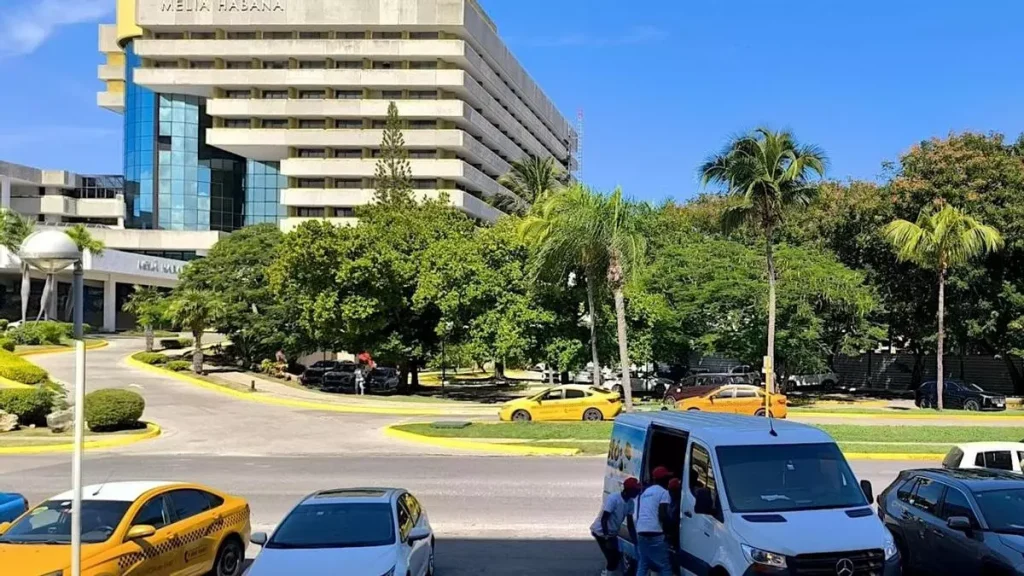

Meliá owns nearly 14,000 rooms in Cuba, but according to its latest report, it is keeping just over 700 open. / 14ymedio

14ymedio bigger

14ymedio, Madrid, May 13, 2026 — Nearly a week after the Canadian mining company Sherritt International withdrew from Cuba over the possibility of U.S. sanctions tied to its operations on the Island, attention has now turned to Meliá. The Spanish hotel chain, which manages 34 properties owned by the Cuban State, has been forced to reduce its available rooms by approximately 50%, and although it has not expressed any intention of ending its business there, warnings are coming from various quarters.

This happened last Saturday, when the U.S.-Cuba Economic and Trade Council (U.S.-Cuba Trade) published an article asking whether the Mallorca-based company would be the next to end its collaboration with the military conglomerate Gaesa due to pressure from Title IV of the Helms-Burton Act, already activated during Trump’s first term, and a possible inclusion on the SDN (Specially Designated Nationals) list of the Office of Foreign Assets Control (OFAC) of the U.S. Treasury Department. This directory includes sanctioned individuals, companies, or vessels, implying a financial blockade and a prohibition on Americans doing business with them.

Although theoretically any company could be exposed to such measures, U.S.-Cuba Trade believes there could be an additional political motivation for acting against Meliá: the stance of Spanish Prime Minister Pedro Sánchez, who prohibited the U.S. from using Spanish military bases for operations against Iran. In fact, the organization believes that Sherritt’s withdrawal may have stemmed from a similar situation involving Canadian Prime Minister Mark Carney, who has also been confrontational toward the American president. continue reading

The organization believes Sherritt’s departure may have resulted from a similar situation involving Mark Carney, Canada’s prime minister and likewise confrontational toward the American president

Meliá also has a precedent. Its CEO, Gabriel Escarrer Jaume, son of Escarrer Juliá, founder of the hotel chain and closely linked to Fidel Castro, was already sanctioned by OFAC in February 2020. Exactly six years ago, during a visit to Cuba for the Tourism Fair, the businessman said he was indifferent to the sanctions and stated that his intention was to remain on the Island for at least another three decades. “We do not tremble in the face of outside pressures we may suffer,” he insisted.

At that time, the hotel chain had already begun receiving claims under Title III of the Helms-Burton Act, although none have succeeded. Meliá relied on the European regulation known as the Blocking Statute, which prevents European Union companies from complying with extraterritorial measures. Companies based in the EU are strictly prohibited from applying legislation or court rulings from other countries listed in an annex that expressly includes the Cuban Liberty and Democratic Solidarity Act of 1996.

But now, U.S.-Cuba Trade points out, there is the possibility of being placed on the SDN list, which would mean, in addition to losing the two hotels it owns in the United States, the INNSiDE in New York and the Meliá Orlando Celebration in Florida, the possibility that banks could sever relations for fear of being affected themselves.

The Spanish newspaper ABC consulted a lawyer specializing in these matters for an article published Tuesday. “From a legal standpoint, this is a major change, because the United States is giving itself a weapon it can use however it wants. For companies operating in Cuba, their existence in the country is going to become more complicated. There will be much greater scrutiny from banks, insurers, and partners when doing business, and many companies will reconsider whether it is worth continuing,” said José María Viñals, a partner at the international law firm Squire Patton Boggs. In his view, financial institutions will have to conduct “a very exhaustive analysis and review their credit history with the Island,” and the measures discourage investment in Cuba.

ABC also spoke with Ignacio Aparicio, from Andersen Lawyers and head of Cuban affairs, who said several companies have consulted about “the validity and continuity of their contracts with entities linked to Gaesa, the personal risk to their executives regarding entry visas to the United States, and the position of their banks and insurers regarding ongoing operations.” The expert does not believe there will be a total withdrawal of Spanish companies, but he warned: “This is neither a hypothetical nor a distant nor a legally simple risk.”

Among the most visible companies potentially affected, the Madrid daily notes, are also the hotel chains Barceló and Iberostar, Banco Sabadell, and Alto Cedro, the latter linked to Banco Santander, which has a strong presence in the United States.

“Europe will have to decide whether it protects European companies and confronts the United States”

Viñals, in any case, raises an even broader issue in the conflict. “Europe will have to decide whether it protects European companies and confronts the United States,” he said. The Blocking Statute mainly functions as a tool capable of nullifying the legal effects of U.S. court decisions on European soil, but it can do little against an OFAC designation, which would exert coercive pressure on other businesses. However, the EU still has a weapon it has never used, known as the trade bazooka: the Anti-Coercion Instrument (ACI).

Created in 2023 by the European Commission, this mechanism activates direct trade reprisals if authorities determine that there is a policy attempting to influence the policies of the EU or its member states. Measures can range from tariffs to service restrictions or suspension of U.S. patents in Europe. The first time the bloc of 27 countries considered invoking it was last January, when Donald Trump threatened to take over Greenland, but given the potential for open conflict implied by its use, it was never even formally considered.

Just a week ago, French President Emmanuel Macron again brought the ACI into the spotlight when Trump threatened new tariffs on the EU. Sánchez joined the initiative, supporting its use to block measures against judges of the International Criminal Court. However, even if the EU wanted to use its “last golden bullet” against the United States, activating the measure would take months to move through Europe’s high-level institutions, compared to the immediacy of OFAC measures.

Translated by Regina Anavy

______________________

COLLABORATE WITH OUR WORK: The 14ymedio team is committed to practicing serious journalism that reflects Cuba’s reality in all its depth. Thank you for joining us on this long journey. We invite you to continue supporting us by becoming a member of 14ymedio now. Together we can continue transforming journalism in Cuba.
Opposition Is Growing Among Republican Senators Against a U.S. Military Action Against the Cuban Regime

Several lawmakers believe all efforts should be focused on Iran and that economic sanctions should be enough to force change on the Island

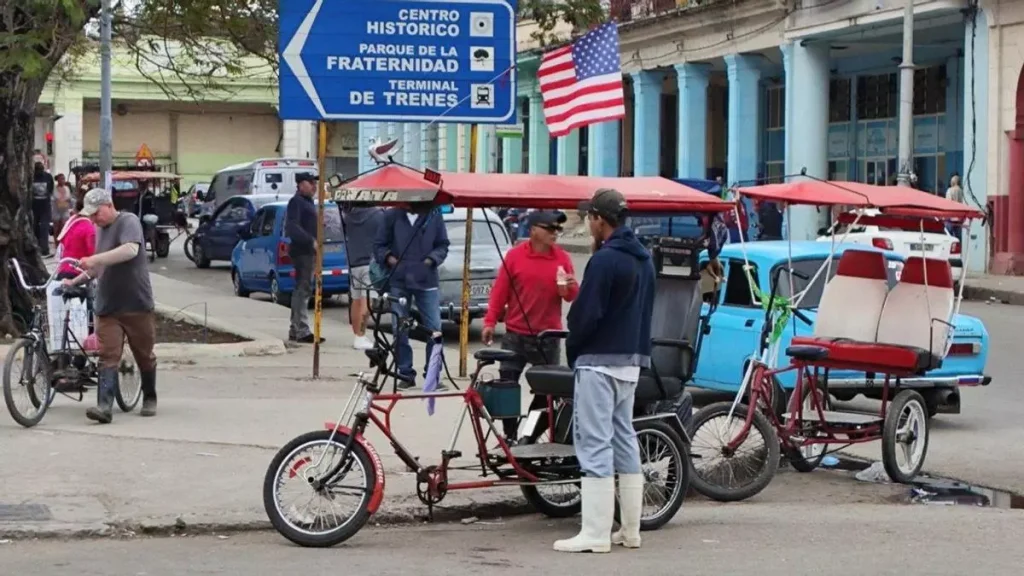
Republican U.S. senators trust that economic pressure will be enough to reach an agreement. / 14ymedio

14ymedio bigger14ymedio, Madrid, May 12, 2026 — U.S. President Donald Trump posted a message on his social network, Truth, in which he claimed that Cuba is asking for help and that he will respond through dialogue. The post makes a veiled reference to an article published Tuesday by the newspaper The Hill, which quoted several Republican senators rejecting military intervention on the Island and urging priority be given to the war with Iran.

“No Republican has ever talked to me about Cuba, a failed country that is only going in one direction: downward! Cuba is asking for help, and we are going to talk! Meanwhile, I’m going to China!” Trump exclaimed, just hours before his trip to Beijing, which begins this Wednesday and will last through Friday the 15th.

The Hill spoke with several senators from the president’s party who warned of the mistake it would be to attack Cuba while problems with Iran continue, and who called for continued economic pressure so that the Cuban regime collapses on its own.

The lawmakers are apparently concerned about the political repercussions that presidential decisions could have ahead of the midterm elections in November, when all signs point to a Democratic victory. The war against the regime of the ayatollahs is worsening the already negative polling numbers forecast for Republicans, and senators are asking for the issue to be resolved as soon as possible.

The lawmakers are apparently concerned about the political repercussions that presidential decisions could have ahead of the midterm elections in November.

“I think right now we are focused on what we should be, which is trying to open the Strait of Hormuz,” said Senate Majority Leader John Thune, who considers the matter a national priority. “I’d love to see regime change in Cuba, like everyone else,” he added, but said continue reading

that this may come through the force of events. “I think the things happening in the world are putting more pressure on many of these dictatorial-type governments. Maybe something there will happen naturally.”

James Lankford, Republican senator from Oklahoma and vice chair of the Senate Republican Conference, called for increased sanctions to try to force change, but when asked whether he would support a military operation against the Island, he was blunt: “No, I would not. There is a lot of economic pressure that can be put on Cuba that makes a huge difference by itself.”

Another firm “no” came from Susan Collins, representative from Maine and chair of the Senate Appropriations Committee. Steve Daines argued that although Cuba is “in our backyard,” he prefers “less conflict rather than more, given what’s happening in the world.”

“I trust,” he added, “the instincts of the president and Secretary Rubio. They are much closer to that situation, frankly, than I am,” highlighting the role of Secretary of State Marco Rubio.

Senator Rand Paul of Kentucky said a military operation in Cuba would be a mistake and suggested that the Cuban regime is open to reforms in exchange for investment. “I want less war, not more. I am not in favor of a war with Cuba, which right now is suffering economically from the embargo, although I think they were suffering even before that because of socialism,” he stated.

“From what I have discussed with their ambassador, I think they are open to negotiations, they are open to better relations. They have told me they are open to U.S. investment. That is really the way societies are transformed,” he argued.

Shelley Moore Capito, senator from West Virginia and chair of the Senate Republican Policy Committee, downplayed the likelihood of military action and insisted that Iran is the priority. “It’s very far down the list, even if it’s on a list. I think we have to focus on what’s happening in Iran,” she told The Hill.

“It’s very far down the list, even if it’s on a list. I think we have to focus on what’s happening in Iran,” she said.

By contrast, Axios sees more signs that Trump may be preparing military action in Cuba, in an article published Monday titled “Trump and Rubio’s escalating rhetoric shows a Cuba invasion could be imminent.” While the outlet does not provide strong indications from government sources pointing toward military intervention — they cite a White House official saying that Cuba “will soon fall, and we will be there to help them” — it does include a relevant opinion in that direction.

That opinion comes from Sebastián Arcos, interim director of the Cuban Research Institute at Florida International University, who told Axios that intervention is more plausible now that “the war with Iran is in a kind of limbo.” “I sense a reorientation toward Cuba, not only in the surveillance flights, but also in the president’s statements to Marco Rubio and the newly announced sanctions,” the specialist declared.

He does not believe the U.S. president will deploy troops on the Island, but rather “undertake a remote military action, similar to what occurred in Iran, that would shock the regime, weaken the ruling leadership, and perhaps create an opportunity for the emergence of new leadership.”

Translated by Regina Anavy

______________________

COLLABORATE WITH OUR WORK: The 14ymedio team is committed to practicing serious journalism that reflects Cuba’s reality in all its depth. Thank you for joining us on this long journey. We invite you to continue supporting us by becoming a member of 14ymedio now. Together we can continue transforming journalism in Cuba.
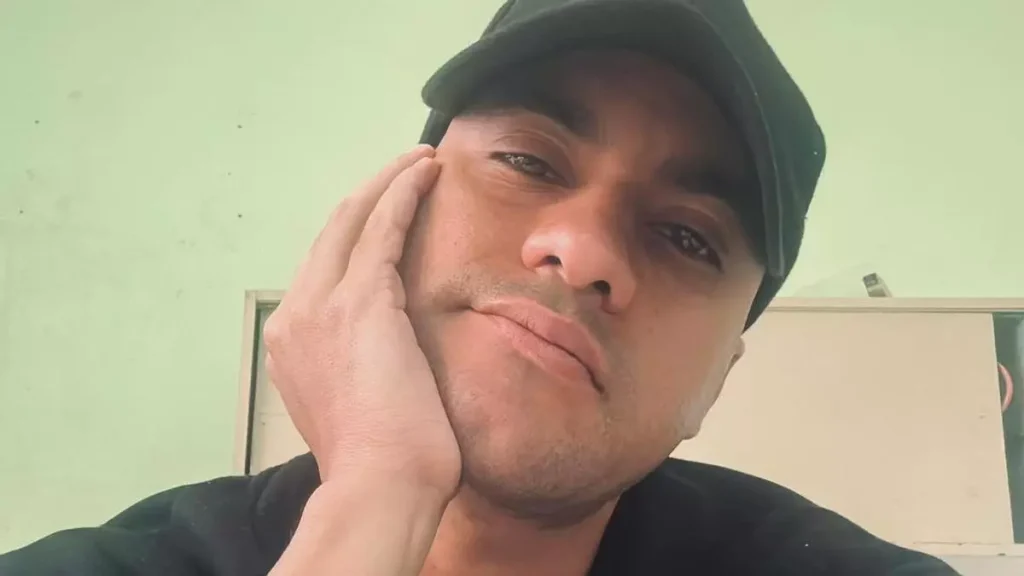
The Cuban Regime Wants To Charge Yoan de la Cruz With Financing an Alleged Sabotage Plot

The young man who broadcast the first images of the historic July 11 protests was transferred to the prison known as Técnico de Guanajay

One of the relatives assured this newspaper that Yoan de la Cruz was working and complying with the regulations imposed since his release from prison. / Facebook

14ymedio bigger14ymedio, Madrid, May 12, 2026 – Yoan de la Cruz, who livestreamed the first protests of 11 July 2021 in San Antonio de los Baños and was detained last Saturday following a police operation at his home, has been transferred to the prison known as Técnico de Guanajay (Artemisa). A relative confirmed this to 14ymedio, requesting anonymity, and explained that the authorities want to accuse the young man of having “financially helped some prisoners who were going to carry out sabotage.”

According to the same source, however, “they have not been able to link him to what they are alleging, they have not been able to tie him to anything,” so “there is a possibility they will release him soon.” During the search of his home, his relatives said, authorities not only “took his cellphone and his computer,” but also the electronic devices belonging to his mother (a cellphone and a computer) and his grandmother’s cellphone. “Punishing the whole family,” another relative remarked.

“They feel completely free to do whatever they want with Yoan,” the first source lamented. “They can take him, interrogate him, detain him whenever they want, because he is a July 11 prisoner, and his sentence continue reading

does not end until December of this year, and that’s just how it is.”

“They can take him, interrogate him, detain him whenever they want, because he is a July 11 prisoner and his sentence does not end until December”

The family, the legal organization Cubalex denounced on Monday, suffered “a severe emotional crisis,” especially his mother and his 87-year-old grandmother, “who was recently hospitalized.” The NGO stated on its social media that the young man “was returned to prison,” which demonstrates “the fragility of freedom in Cuba and the permanent risk of revocation against those persecuted for political reasons.”

On Saturday, the day of the police operation, one of the relatives told this newspaper that De la Cruz was working and complying with the regulations imposed since his release from prison. The young man was first detained on July 23, 2021, after authorities located him for broadcasting from San Antonio de los Baños the images that sparked the July 11 protests throughout the Island. In March 2022 he was sentenced to six years in prison, and just over a month later he was released after his sentence was modified to five years of imprisonment without confinement.

Presented by the authorities as an alternative to prison, the measure works in practice as supervised release. The convicted person is required to comply with restrictions, subjected to police monitoring and exposed to any alleged violation being used as grounds to send them back to prison.

Translated by Regina Anavy

______________________

COLLABORATE WITH OUR WORK: The 14ymedio team is committed to practicing serious journalism that reflects Cuba’s reality in all its depth. Thank you for joining us on this long journey. We invite you to continue supporting us by becoming a member of 14ymedio now. Together we can continue transforming journalism in Cuba.
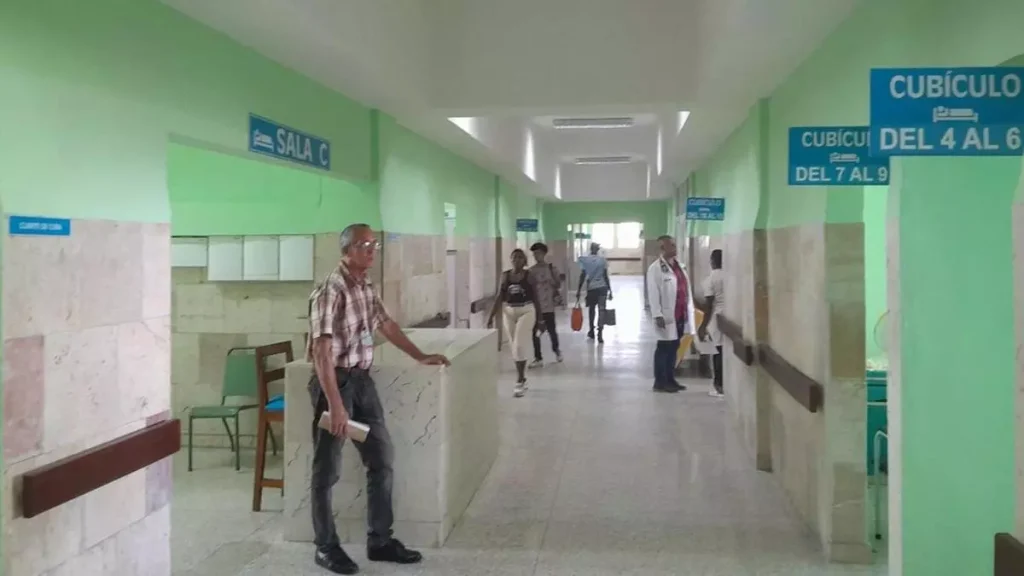
A Worker at Santiago de Cuba Provincial Hospital Sentenced to 12 Years for Stealing Fuel

The State Security Crimes Chamber sentenced him for sabotage after he stole more than 5,700 liters of diesel

The diesel was stolen from the hospital’s generator units. / Facebook/Hospital Saturnino Lora

14ymedio bigger14ymedio, Madrid, May 12, 2026 — A worker at the Saturnino Lora Provincial Hospital in Santiago de Cuba was sentenced to 12 years in prison for “embezzlement” and “sabotage.” The man was prosecuted for stealing more than 5,700 liters of diesel intended for the health center’s generator units and contaminating the reserve fuel with water, which left the generators unusable during a blackout.

According to an official statement from the Santiago de Cuba Provincial People’s Court regarding the trial, held in the State Security Crimes Chamber, the accused worked as a “Specialist B” in energy saving and rational energy use, and was the only person responsible for controlling the fuel stored to power the hospital’s generator units. Taking advantage of that responsibility, he extracted a total of 5,742 liters of diesel from the storage tanks, which he later sold on the black market.

To conceal the shortage, according to the ruling, the employee temporarily refilled the generators with reserve fuel. However, anticipating an inspection by the Energy Generation Base Business Unit, he poured a similar amount of water into the reserve tank, thereby contaminating the diesel.

The failure caused the interruption of treatment for five patients connected to mechanical ventilators in intensive care

The manipulation became evident, the official account continues, after a shutdown of the national electrical system and the hospital’s generator units failed to start operating. According to the statement, the failure affected medical services at both Saturnino Lora Hospital and the Santiago de Cuba Cardiology Center, and caused the interruption of treatment for five patients connected to mechanical ventilators in intensive care. The fuel contamination also damaged protective filters and settling devices in the generator units.

The court considered the accused guilty of the crimes of embezzlement and sabotage, established in Articles 424 and 125 of the Cuban Penal Code, and imposed a combined sentence of 12 years’ imprisonment, in addition to a ban on leaving the country and the loss of public rights. He must also assume “civil liability arising from the damages.” continue reading

The sentence comes amid a penal crackdown promoted by the Cuban Government against any disruption related to the national electrical system. In April of this year, Cuba’s prime minister, Manuel Marrero Cruz, demanded a “heavy hand” against these crimes and an increase in efforts to combat the theft of fuel and dielectric oil from transformers.

Depending on the seriousness of the act and its consequences, penalties can reach up to 30 years in prison, life imprisonment, or even the death penalty

In that context, the official press recalled that sabotage against the national electric power system is classified in the Cuban Penal Code with penalties that can reach, depending on the seriousness of the act and its consequences, up to 30 years’ imprisonment, life imprisonment, or even the death penalty.

Recently, the courts have increased the so-called “exemplary trials” for fuel thefts and crimes associated with energy infrastructure, in a way that appears intended to shift responsibility for the structural deterioration of the national electrical system onto these specific crimes. Last March, two men in Ciego de Ávila were sentenced to nine and seven years in prison for stealing bolts intended for a photovoltaic park, also under sabotage charges.

Scarcity, necessity, and the opportunities of a black market that pays what the State cannot guarantee have multiplied this year’s thefts of fuel and dielectric oil. These acts directly affect the population but also put the perpetrators themselves at risk, as some have been injured or killed during the thefts.

Translated by Regina Anavy

______________________

COLLABORATE WITH OUR WORK: The 14ymedio team is committed to practicing serious journalism that reflects Cuba’s reality in all its depth. Thank you for joining us on this long journey. We invite you to continue supporting us by becoming a member of 14ymedio now. Together we can continue

Mexico and Honduras in the Spotlight

Claudia Sheinbaum resists handing over her corrupt officials to the U.S.; in Central America, critics point to the complicity of Nasry Asfura’s new government with Washington’s interventionism

Sheinbaum and Asfura are at the center of the continent’s attention, for different reasons. / Collage

14ymedio bigger14ymedio, San Salvador, Federico Hernández Aguilar, May 11, 2026 — Two enormous scandals are currently shaking Hispanic America: the so-called Hondurasgate, in the country located at the very center of the continent, and the formal request by the United States to Mexico to extradite a group of senior officials from the ruling party, Morena, in the state of Sinaloa. Both cases are of enormous importance and could demonstrate the existence of extensive criminal networks and political clientelism in the region.

Perhaps because the media outlets that have reported Hondurasgate are clearly ideological in the way they handle the news — something I allow myself to point out with the same ease with which those same outlets label opposing media as “conservative” or “far-right” — the revelation of compromising audio recordings involving former president Juan Orlando Hernández and current Honduran president Asfura, along with other public figures in that country, has not had in Central America the impact it should have had. And that is a shame.

A media outlet’s political subjectivity is not sufficient reason to ignore everything it says, especially when it presents evidence. Nor should we be naive and think that large media conglomerates tend toward objectivity by definition. What is regrettable is that ideological tug-of-war intervenes so deeply in journalism that colleagues accuse each other of “pushing agendas,” each forgetting that free expression protects their work and that people themselves, according to their own conscience and education, will reward each outlet with their attention and preference.

A media outlet’s political subjectivity is not sufficient reason to ignore everything it says, especially when it presents evidence

In the case of Hondurasgate, for example, the recordings can be freely heard on the very platform that published them. And it is very difficult to deny the credibility of these 37 leaks. The voices of those involved are there, clear, with their unmistakable tones and inflections. In those exchanges, Hernández and Asfura appear willing to facilitate the installation of a network of U.S. and Israeli interventionism in Honduras, something that would explain why Donald Trump pardoned the former and supported the latter in the most recent presidential election.

Certainly, the shameless way in which the President of the United States supported Asfura at the end of last year’s campaign, almost at the same time continue reading

he released Hernández — sentenced to nearly half a century in prison for drug trafficking crimes — would have a real underlying reason: turning Honduras into a regional hub for systematic interventionism, including electronic surveillance, lucrative investments, political interference, and citizen control.

The matter goes much further and would prove several hypotheses. Former president Xiomara Castro, of course, would like us to buy the thesis that fraud was committed against her party, but the truth is that Libre candidate Rixi Moncada never gained traction in the polls and barely managed a distant third place, with less than 20% of the vote. No. What these conversations reveal is that the old Honduran two-party system, made up of the National Party (of Hernández and Asfura) and the Liberal Party (now in opposition), is susceptible to corruption at the highest level, involving electoral authorities, legislators, businessmen, and even gangs of drug traffickers and hitmen.

From this entire plot there would also emerge a supposed warning to Mexico, because the broader plan allegedly includes the creation of digital structures for attacks and smear campaigns against the “progressive” governments of Claudia Sheinbaum in Mexico and Gustavo Petro in Colombia. There is no doubt that Trump does not sympathize with Sheinbaum, but let us be frank: he does not need any sophisticated machinery to undermine her government. She herself seems willing to do that work without her adversaries even asking. To illustrate this, let us look at the clumsy way the president is handling her own domestic scandal.

In force since 1980, the United States and Mexico have an extradition treaty that stipulates the procedures through which criminals will be exchanged between the two nations. Using this historic bilateral agreement, a formal 34-page indictment issued by a Grand Jury in the Southern District of New York and therefore not subject to manipulation by the White House is now asking Mexico for the arrest and extradition of about ten public officials from the state of Sinaloa.

In force since 1980, the United States and Mexico have an extradition treaty that stipulates the procedures through which criminals will be exchanged between the two nations.

Just as in 2025 other alleged perpetrators of crimes related to drug trafficking, bribery, and organized crime — Ismael ‘El Mayo’ Zambada, the Treviño brothers, or Abigael González, to mention a few — were sent through the same process, today the Mexican Attorney General’s Office should proceed with the arrests of those accused without demanding any additional evidence beyond the indictment itself, because the legal cycle of accusation does not require any further element, since the evidence will naturally be presented during the corresponding trials.

But now Claudia Sheinbaum, instead of taking advantage of the opportunity to rid herself of so many discredited figures, has chosen to wrap herself in the Mexican flag, claiming sovereignty, and with a speed worthy of a better cause has backed the Attorney General’s Office over which she does have influence in demanding proof from its northern neighbor against the officials from her party who are implicated. The scandal threatens to grow and become the Watergate of Mexico’s ruling establishment.

As things appear to be unfolding, simple moral principles may end up being more decisive than stale ideologies. “Left” and “right” are merely labels, wrappers, shells… The old misery of human nature prevails.

Translated by Regina Anavy

______________________

COLLABORATE WITH OUR WORK: The 14ymedio team is committed to practicing serious journalism that reflects Cuba’s reality in all its depth. Thank you for joining us on this long journey. We invite you to continue supporting us by becoming a member of 14ymedio now. Together we can continue transforming journalism in Cuba.
Families of Political Prisoners Pay Tribute to Opposition Figure Who Died in Venezuelan State Custody

The Venezuelan Church demands that responsibilities be determined and joins the recognitions of Víctor Quero’s mother, who searched for him for months.

Families of Political Prisoners Pay Tribute to Opposition Figure Who Died in Venezuelan State Custody

14ymedio biggerEFE (via 14ymedio), Caracas, May 11, 2026 – Families of political prisoners in Venezuela paid tribute this Sunday to Víctor Quero Navas — whose death last year while in state custody was acknowledged this week by the Government after months of searching by his mother — with an activity outside the prison where, according to authorities, he was held.

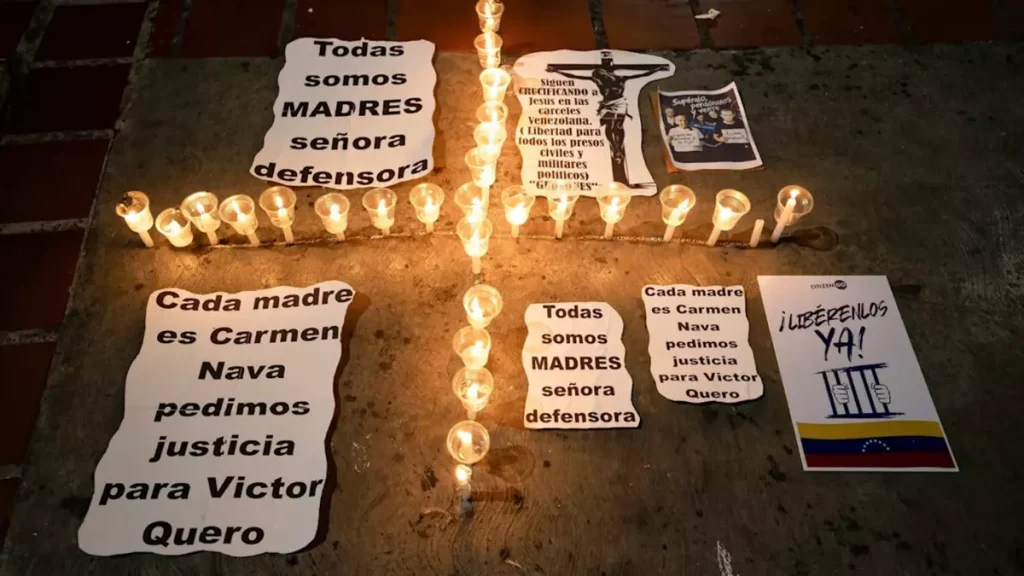
In the vicinity of the El Rodeo I penitentiary center, near Caracas, relatives and activists placed a sign in his memory highlighting that his death occurred “after remaining in forced disappearance since January” of that year.

“His mother searched for him in Rodeo I, but the authorities denied his detention, concealed his death, and destroyed evidence,” the text adds.

Around the sign were small banners with messages such as “Let no one else die in custody,” “Truth for Víctor, freedom for all,” and “No death in custody can go unpunished.”

There were small banners with messages such as “Let no one else die in custody,” “Truth for Víctor, freedom for all,” and “No death in custody can go unpunished”

On the ground they placed a couple of floral arrangements and candles in the shape of a cross, while on another part of the street asphalt they wrote in chalk “Víctor Hugo Quero present,” according to photographs published on X by the NGO Committee for the Freedom of Political Prisoners (CLIPP).

“This May 10, Mother’s Day in Venezuela, the memorial placed in the vicinity of El Rodeo I prison recalls the death in custody and demands justice,” the organization wrote on the social network.

Opposition leader and Nobel Peace Prize laureate María Corina Machado expressed that all Venezuelan women are “one in señora Carmen,” among others who “represent what it means to raise and fight for a child and demonstrate that a mother’s love never surrenders.” “Soon we will all embrace each other, with our families, in freedom,” she said. continue reading

The main opposition bloc, the Democratic Unitary Platform (PUD), greeted all the women who, with “love, strength, and sacrifice, sustain their families and keep alive the hope of a better country,” and made special mention of the mothers of political prisoners, who “face the pain of injustice and separation, but continue giving an example of dignity, fortitude, and struggle for freedom.”

“Special recognition also to the mothers who live with the distance caused by migration, persecution, or the absence of their children, without ever giving up hope,” it added.

The Primero Justicia party demanded “justice for all the mothers who, because of persecution, the search for a better future, or prison, today cannot embrace their children and grandchildren.”

The organization Encuentro Ciudadano asserted that, in Venezuela, being a mother “has also meant resisting, resisting the separation from children who emigrated, hunger, blackouts, uncertainty, and the pain of seeing a broken country.”

In Venezuela, being a mother “has also meant resisting, resisting the separation from children who emigrated, hunger, blackouts, uncertainty, and the pain of seeing a broken country”

“But today, especially, we think of the mothers of political prisoners. Of those women who cannot embrace their children, who travel through courts and prisons seeking justice, who live between anguish and hope. To them, our respect and solidarity,” it wrote on X.

The party asked that this day “not be only a celebration but also a reminder of the debt Venezuela has with so many mothers who suffer in silence.”

For its part, the NGO Venezuelan Prison Observatory (OVP) stated that hundreds of women spend their day “standing in lines outside a prison, while others wake up far from their children, locked in a cell, watching childhood pass behind a visit, a phone call, or a photograph.”

“There are mothers who travel kilometers carrying food and medicine for their imprisoned children, mothers who grow old amid searches, transfers, and institutional silence, mothers like Carmen Teresa Navas who spend months desperately searching for their children while the regime disappears, tortures, or kills them,” it said.

In that sense, it warned that the prison crisis “not only punishes those deprived of liberty; it also breaks bonds, separates families, and condemns thousands of mothers to live amid pain, uncertainty, and absence.”

The CLIPP demanded, on this “Mother’s Day, freedom for their children.” “That is the gift awaited by the mothers who continue outside the prisons. They do not ask for privileges: they demand justice, truth, and a return home,” it added.

The Venezuelan Episcopal Conference (CEV) expressed in a statement its “deep consternation and pain” over Quero’s death and demanded that criminal and administrative responsibilities be determined.

“It is imperative to determine the criminal and administrative responsibilities of those officials who, by action or omission, allowed a young Venezuelan to die in oblivion, without access to his family and deprived of due process,” it stated, and asked the Public Ministry and the Ombudsman’s Office to act “with true autonomy and independence.”

The CEV expressed solidarity with the mother, Carmen Navas, and said that she “personifies the ordeal of so many Venezuelan families.” “Her tireless search, marked by harassment and uncertainty, is a cry that reaches heaven. The Church stands in solidarity with the pain of those who seek the truth amid institutional opacity,” it said.

The CEV expressed solidarity with the mother, Carmen Navas, and said that she “personifies the ordeal of so many Venezuelan families”

In addition, the conference recalled that the State “has the inalienable moral and legal duty to guarantee the life and physical integrity of those deprived of liberty.”

On the other hand, it pointed out as “signs of a lack of transparency and probity” by the authorities that the political prisoner “died in July 2025 while the State provided contradictory information to his family.”

“The fact that his whereabouts were denied in facilities such as El Rodeo I, while he had already died, constitutes an extremely serious breach of public ethics. This deliberate concealment constitutes elements of forced disappearance, a crime that justice cannot and must not ignore,” it asserted.

Regarding the exhumation carried out on Friday, the CEV called for international experts to “validate the findings in order to clarify the truth, determine criminal responsibilities for the forced disappearance, and stop the institutional cruelty that revictimizes” the mother.

With Quero Navas, there are now 27 people detained for political reasons who have died in state custody since 2014, according to the NGOs Justice, Encounter and Forgiveness (JEP) and Provea.

According to an official statement released last Thursday, Quero died almost ten days later from “acute respiratory failure secondary to pulmonary thromboembolism.” The same day, the Ombudsman’s Office requested an exhaustive and independent investigation and the Prosecutor’s Office announced the start of inquiries.

Translated by Regina Anavy

______________________

COLLABORATE WITH OUR WORK: The 14ymedio team is committed to practicing serious journalism that reflects Cuba’s reality in all its depth. Thank you for joining us on this long journey. We invite you to continue supporting us by becoming a member of 14ymedio now. Together we can continue transforming journalism in Cuba.
Spain Allocates Half a Million Euros to Buy Food for the Cuban Population

This money comes from the 375 million euro investment fund created in exchange for forgiving Havana part of its public debt to Madrid.

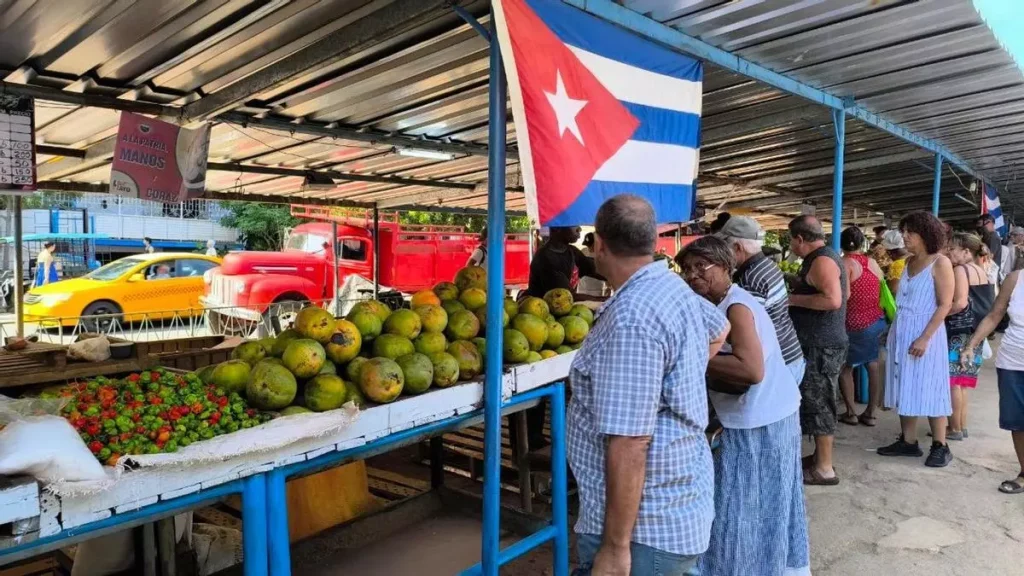
Cubans shopping at a market stall at 17 and K. / 14ymedio

14ymedio bigger14ymedio, Madrid, May 11, 2026 — The debt conversion program signed between Spain and Cuba ten years ago is being used to donate food to the Island, according to the newspaper El País this Monday. The bilateral committee managing the program authorized last February a 500,000 euro project to purchase food as urgent aid for the population, following the model of an earlier initiative in which agricultural cooperatives in the eastern region supplied schools with food.

The fund — a mechanism in which debt is forgiven in exchange for investment in projects of common interest — has a value of 375 million euros and was signed in 2016, although it was not until last year that an agreement was reached on how to channel the money. In July 2025, the Economy Ministers of both countries signed an agreement stating that the money would be used to finance sustainable development projects in sectors such as energy, water, and food security.

Technically, according to sources from the Secretariat of State for Trade speaking to El País, that money could not be used for current expenses, as this case would be considered. However, the committee decided to authorize it because of the Cuban crisis, aggravated at that time by the recent publication of the executive order through which the U.S. prevents oil shipments to the Island under threat of sanctions.

Cuba’s public debt to Spain amounts to nearly 2 billion euros, most of it originating from the former Development Aid Fund

Cuba’s public debt to Spain amounts to nearly 2 billion euros, most of it originating from the former Development Aid Fund during the 1980s and 1990s, which the European country considers impossible to recover. continue reading

In an effort to resolve the situation, different governments have signed three agreements with the Island, two during the second term of Mariano Rajoy(2015 and 2016) and a third during the first government of Pedro Sánchez (2021).

The first agreement, part of a broader pact with the Paris Club, was signed in November 2015 and consisted of a short-term debt restructuring agreement worth 201 million euros, of which 110.8 million were forgiven. Another 40 million were used to create a counterpart fund that provides grants to Spanish companies investing in Cuba for their local currency expenses. In March 2024, Spain reported that the fund had almost been fully used.

In 2016, the second agreement was signed, valued at 2.242 billion euros in medium- and long-term debt. Of that amount, 1.492 billion euros were forgiven, and another counterpart fund of 375 million euros was organized: the one now being used to donate food. The last agreement, signed in 2021, involved a reorganization of payments without debt forgiveness.

Although the decision to activate this first 500,000 euro project was made last February, El País notes that this mechanism could continue to be used, becoming an option for donating aid to the Island. On April 19, Prime Minister Pedro Sánchez, Brazilian President Luiz Inácio Lula da Silva, and Mexican President Claudia Sheinbaum signed a statement at the summit held in Barcelona calling for ways to cooperate in resolving the crisis in Cuba.

“We express our enormous concern over the grave humanitarian crisis facing the Cuban people and call for the adoption of the necessary measures to alleviate this situation and avoid actions that worsen the living conditions of the population or are contrary to international law,” the text stated.

However, private companies owed money by Cuba are not pleased, according to the newspaper. The amount of debt was estimated at around 350 million euros owed to 300 companies, according to the Catalan organization Fomento del Trabajo Nacional, although El País speaks of 316 million euros claimed by about 200 companies grouped in the Platform of Those Affected by Non-Payment by the Cuban Government.

‘El País’ speaks of 316 million euros claimed by about 200 companies grouped in the Platform of Those Affected by Non-Payment by the Cuban Government

This group, made up of 50% companies from Catalonia and 20% from the Basque Country, has criticized the move while also considering that there has been inactivity when it comes to demanding payment of the private debt from the Cuban Government. On May 5, the Senate debated a motion urging the Executive Branch to implement measures “that help Spanish companies working or trading with Cuba to collect outstanding amounts owed by the Cuban Government and Cuban state companies.”

The initiative received support from the People’s Party, a center-right opposition party with a majority in that chamber, and Catalan and Basque nationalist parties (Junts and PNV, allies of the Government), while all others abstained. During that session, the spokesperson for the Socialist Party argued that the Government pressures the Cuban state to pay but cannot use public funds to cover private defaults.

“The Secretariat of State for Trade constantly monitors the situation through the debt survey prepared by the commercial office and has made numerous claims before Cuban authorities on behalf of those companies,” he explained. “The commitment to ending non-payment by the Cuban Government is total. What we cannot support is the payment of compensation by the Spanish state as a consequence of commercial operations between private companies and the Government of Cuba. Public spending cannot be allocated to items not authorized by law.”

As a result of that session, the motion was approved, urging the Government to quantify the private debt, develop a plan to defend the interests of companies, study liquidity support instruments for affected businesses, and bring the situation before the competent bodies of the European Union in order to adopt a joint position demanding from “the Cuban Government legal certainty, respect for contracts, verifiable payment mechanisms for European companies, and real progress in freedoms, human rights, and the rule of law.”

Translated by Regina Anavy

______________________

COLLABORATE WITH OUR WORK: The 14ymedio team is committed to practicing serious journalism that reflects Cuba’s reality in all its depth. Thank you for joining us on this long journey. We invite you to continue supporting us by becoming a member of 14ymedio now. Together we can continue transforming journalism in Cuba.
Recycled Chinese Shipping Containers Provide New Homes for Hundreds of Homeless Cubans

The first beneficiaries are regime militants who lived in overcrowded conditions for many years

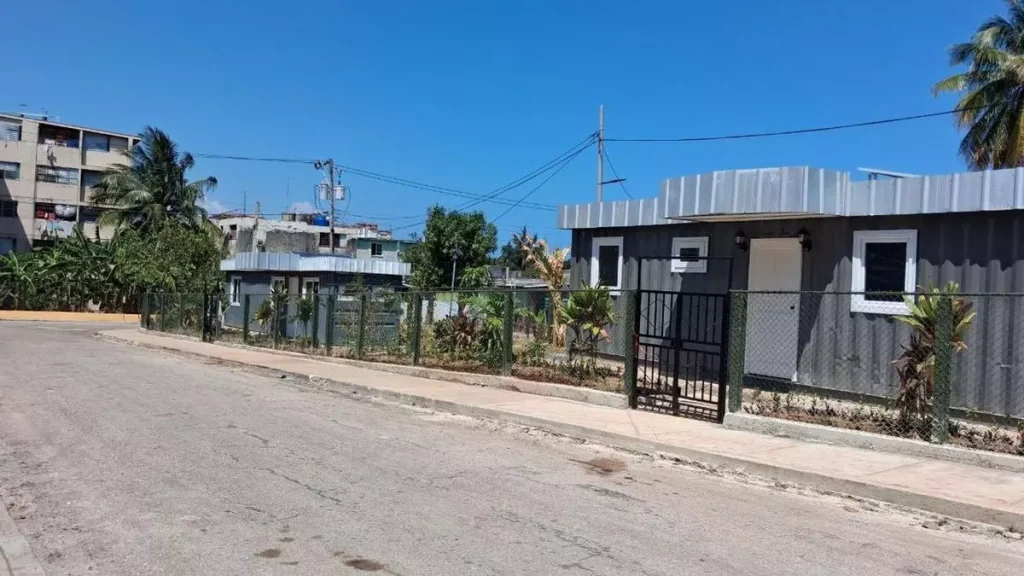
View of the two new container homes in Nuevo Vedado, Havana / 14ymedio

14ymedio bigger14ymedio, Natalia López Moya, Havana, May 8, 2026 – It is no surprise that Alina Hinojosa Cardona and Nerelys Madan Catalá are celebrating their new homes, containers converted into housing for “young working women, single mothers and heads of household,” as the official press presented them last Saturday.

The first was living, that report stated, in a “small room in poor and overcrowded conditions,” and the second, in a shelter “for more than 13 years.”

Compared to that, the two little container-houses, located in a good area of Nuevo Vedado, in Havana, near 26th Street and just a few meters from Tulipán Avenue, with a rear patio-garden that includes a wash area, a solar panel on the roof, and brand-new finishes and paint, are chalets.

In Granma’s report on the handover ceremony, carried out by none other than the ruler, Miguel Díaz-Canel, it was not specified whether the homes were privately owned or not.

In Granma’s report on the handover ceremony, carried out by none other than the ruler, Miguel Díaz-Canel, it was not specified whether the homes were privately owned or not, but 14ymedio confirmed, through one of the two brand-new tenants, that they belong to the State. The women and their families have use of them under usufruct rights.

A neighbor from the area informed this newspaper that the new houses were installed in 12 days and assures that “inside they are very beautiful.” They were delivered, she says, with several appliances, “a blender and everything.” In one of the windows, behind completely transparent glass, they placed a colorful scarf as a curtain, to avoid being seen from the outside.

No air-conditioning mechanism can be seen, however, and the iron of the containers has not been covered with any material, as happens in other parts of the world where this type of structure is converted into habitable spaces. They do, however, have a solar panel on top of the roof.

According to Granma, their construction used “leftovers from tourism investment projects and technologies developed by the Revolutionary Armed Forces.” The base consisted of maritime containers in which “parts and components for photovoltaic solar panel parks sent by the People’s Republic of China” had been imported.

No air-conditioning mechanism can be seen, and the iron of the containers has not been covered with any material. / 14ymedio

There are families living in the homes: Madan Catalá with her mother and child in one, and in the other, Hinojosa Cardona with two children. The official press presents the stories of both women while trying to offer a heroic narrative, but in reality revealing the impossibility of having decent housing even in the case of salaried employees and obedient servants of the Party. Alina, says Granma, leads the base committee of the Young Communist League at her workplace, “an organization she joined at 14 continue reading

years of age,” and Nerelys, besides being a secretary, “served as delegate for her district for two terms starting at age 22.”

Their stories, however, mainly aim to praise the virtues of recycling maritime containers into modular homes and to validate “the viability of this alternative to respond in the short term to the growing housing needs of our people,” which they insist “is an international practice.” Granma’s lengthy chronicle reported that the delivered homes “are proof that these can be built tastefully and aesthetically, integrated into communities and the urban environment, contributing to beautification, while also helping the neighborhood through induced works and serving as encouragement to women, many of them alone and responsible for their families.”

The program, they also claim, “generates enthusiasm,” but according to statements at the same event by Prime Minister Manuel Marrero, “it is not moving at the speed desired; it is being done, but it can be carried out faster.” The authorities indeed mentioned the housing deficit the country has, of more than 800,000 homes, and praised “the potential” represented by maritime containers, a “material that is generally an environmental problem,” as reasons to carry out the initiative.

Faced with this, several specialists have expressed suspicions, questioning above all whether, since they are metal structures—a strong conductor of heat—the insulation is adequate for a climate like Cuba’s. Thus, for example, engineer Yulieta Hernández, who wrote on her social media: “Even with designed passive solutions (real cross ventilation, air chambers, shading), the interior can become uninhabitable. In the colder months the opposite happens: thermal inertia is low and comfort is easily lost. An oven in summer and a freezer in winter.”

Image of one of the usufruct beneficiaries at the ceremony handing over the container homes conducted by Miguel Díaz-Canel. / Granma

The expert stated she was speaking from experience, “after having used several as temporary facilities on construction projects.” In her lengthy post she also questioned numerous elements, such as the quality of the electrical insulation: “the combination of metal structure, humidity, leaks, and improvised wiring can be dangerous if there is no proper grounding, differential protection, and rigorous execution;” the waterproofing: “critical points are visible at first glance,” “sheet metal undulations around the windows,” and “areas prone to leaks;” and the possible weakness of this type of housing against cyclones. “The roof looks like it will fly away with the first strong wind,” she states, and the materials are incompatible, since “metal is a material with high thermal expansion and contraction, so when combined with rigid finishes like ceramic or tiles, problems of adhesion, cracking, and detachment tend to appear.”

Other specialists, however, have spoken in favor, such as Abel Tablada. The architect offered his point of view, he explained, after visiting one of these container homes that form part of a group of 300 planned for installation in the area of the former Toledo sugar mill, opposite the José Antonio Echeverría Technological University of Havana (Cujae).

“We were able to verify that to reduce heat transfer, a second roof with an intermediate ventilation space was designed, and in the walls, the metal was insulated with an air layer and a plywood panel on the inside,” Tablada assures in a Facebook post that quickly filled with comments. In it he also says that “professors from Cujae measured the interior temperatures before the transformation and will return once the home is finished to validate the effectiveness of the thermal insulation measures.”

Regarding ventilation, he explains, “it is achieved through cross ventilation due to the narrowness of the container and the placement of louvered windows in each room”

Regarding ventilation, he explains, “it is achieved through cross ventilation due to the narrowness of the container and the placement of louvered windows in each room.” The home, he describes, “has a porch, a kitchen-dining room, two bedrooms, a bathroom, and a laundry area with a rear porch,” just like those observed by 14ymedio in Nuevo Vedado.

The architect states that he made several suggestions to improve this type of house, among them “completing the monitoring of interior conditions to determine whether the thermal insulation is sufficient,” “using the double roof to install solar panels so that this community not only becomes energy self-sufficient but can also feed energy into the grid,” and “painting the exterior surfaces light colors” to reduce radiation absorption, “since the eaves do not provide good coverage on the rear façade and the sides.”

His conclusion, in any case, reinforces the official narrative that the reuse of containers was not simply a temporary solution for hurricane victims, as the regime initially presented it, but was also something intended to remain permanently: “For families who have lost everything or for young people beginning adulthood without having been able to inherit anything, obtaining a container home is a considerable improvement in their lives, and this solution, despite any additional improvements it may need, is welcome.”

Translated by Regina Anavy

______________________

COLLABORATE WITH OUR WORK: The 14ymedio team is committed to practicing serious journalism that reflects Cuba’s reality in all its depth. Thank you for joining us on this long journey. We invite you to continue supporting us by becoming a member of 14ymedio now. Together we can continue transforming journalism in Cuba.
A U.S. Drone and a Secret Letter From Raúl Castro to Trump Cross the Florida Strait

The Triton flew over Cuban territory without problems while the general’s letter was intercepted at the Miami airport and its carrier returned to the Island

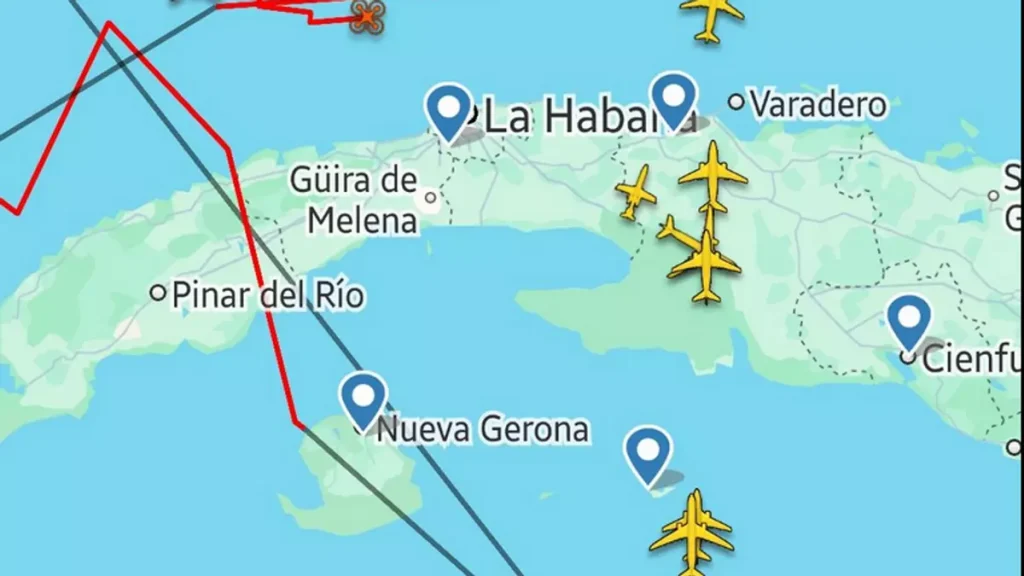
Reconnaissance flight of a U.S. drone over Cuba. / Flightradar

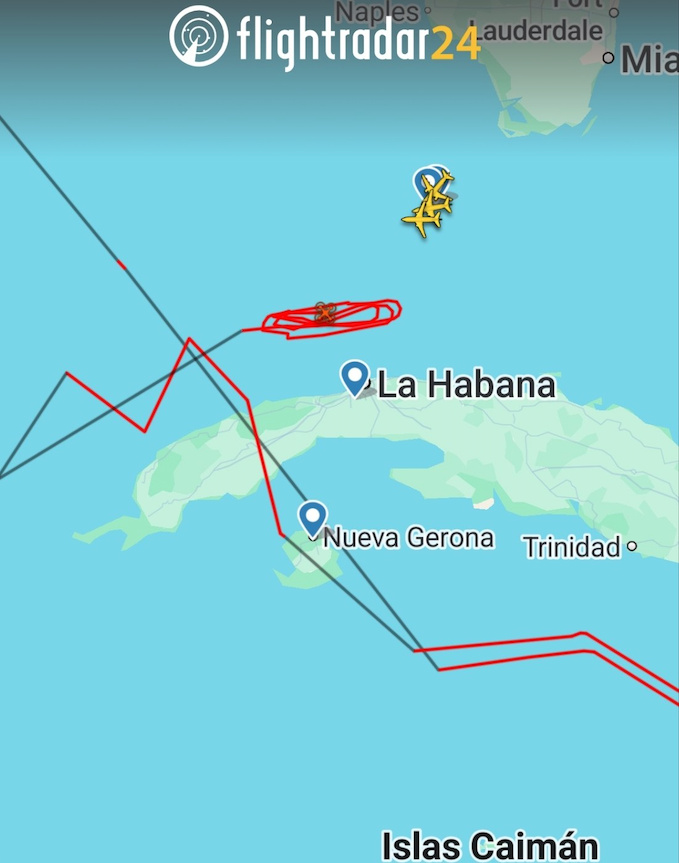
14ymedio bigger14ymedio, Madrid, April 17, 2026 – A Northrop Grumman MQ-4C Triton reconnaissance drone from the United States Army carried out a surveillance mission of more than 12 hours along both coasts of Cuba on Thursday night. The aircraft has drawn the attention of numerous intelligence analysis websites, although most identify the flight patterns as “typical of reconnaissance over the Caribbean.”

The drone flew at about 49,000 feet in altitude and crossed Cuban territory, from north to south and back again, at the level of Pinar del Río and the Isle of Youth.

The aircraft is part of the deployment that the United States began in January as part of intelligence and surveillance operations in the Caribbean, which included, along with these drones, military vessels, spy plane flights such as the RC-135 Rivet Joint, and P-8A Poseidon aircraft. In addition, in February a surveillance balloon known as the Tethered Aerostat Radar System (TARS) was added, located in the Florida Keys, about 145 kilometers from Havana and at an altitude of 2,500 meters.

The drone flew at about 49,000 feet in altitude and crossed Cuban territory, from north to south and back again, at the level of Pinar del Río and the Isle of Youth

At that time, expectations were already very high, at a moment of extreme tension between the United States and Cuba and just days after the capture in Caracas of Nicolás Maduro, which was preceded, precisely, by a continue reading

deployment with a MQ-4C Triton. These aircraft usually accompany P-8A Poseidon planes and, since the end of 2025, have carried out constant surveillance operations from Puerto Rico or Florida toward the coasts of Venezuela.

The situation repeated itself yesterday, precisely one day after reports emerged claiming that the Pentagon has intensified plans for a possible intervention in Cuba and just hours after Miguel Díaz-Canel said that U.S. “military aggression” is a real possibility.

“We do not want it, but it is our duty to prepare to avoid it and, if it were unavoidable, to win it,” said the Cuban leader in his speech this Thursday marking the anniversary of the proclamation of the socialist character of the Revolution, in which he maintained that the regime’s priority is “dialogue.”

Capture of the drone’s trajectory in the Caribbean. / Flightradar24

After the month of March, during which the idea took hold that talks between Washington and Havana were moving in the right direction, in recent weeks the signals have gone in the opposite direction. This Thursday The Wall Street Journal (WSJ) independently verified information first reported two days earlier by Martí Noticias, according to which a Cuban businessman in the luxury car rental sector and closely linked to the regime attempted to deliver a letter to the U.S. president at the request of Raúl Rodríguez Castro, El Cangrejo [The Crab], grandson of former president Raúl Castro.

According to the reports, Roberto Carlos Chamizo González arrived in Miami with a letter from Raúl Castro’s grandson in an attempt to bypass official channels and avoid the State Department. The letter, whose contents have not been seen by the media, reportedly in a format similar to a diplomatic one and with a seal, proposed economic and investment agreements, as well as the lifting of sanctions, and warned that the regime was preparing to repel a U.S. military invasion.

The WSJ could not determine why the messenger was detained, but it did confirm that a Customs agent confiscated the letter and sent him back to the Island. It has also not been able to determine whether the letter reached the White House, which declined to comment on the matter.

“The Cubans appear to be trying to bypass Rubio and send a clear message directly to Trump”

“The Cubans appear to be trying to bypass Rubio and send a clear message directly to Trump,” Peter Kornbluh, co-author of Back Channel to Cuba: The Hidden History of Negotiations between Washington and Havana, told the U.S. outlet. “This attempt suggests that they no longer trust Rubio to be an impartial interlocutor and want to appeal directly to the president to resolve the growing crisis.”

Ricardo Herrero, executive director of the Cuba Study Group, stated that “trying to bypass Rubio while he is secretary of state is foolish and doomed to fail. It is even worse to resort to an unknown person with no personal relationship with the president, which makes it seem even more absurd.”

Meanwhile, at a meeting of the Western Hemisphere subcommittee of the U.S. Congress, Michael Kozak, a senior State Department official, avoided revealing whether Washington is maintaining ongoing negotiations with Havana. Asked by Florida lawmakers on the matter, the official limited himself to responding: “If you want to get anywhere with talks of this kind, they are not conducted in public.”

Translated by Regina Anavy

______________________

COLLABORATE WITH OUR WORK: The 14ymedio team is committed to practicing serious journalism that reflects Cuba’s reality in all its depth. Thank you for joining us on this long journey. We invite you to continue supporting us by becoming a member of 14ymedio now. Together we can continue transforming journalism in Cuba.
Tens of Thousands of Cubans Will Be Able To Regularize Their Status in Spain Starting This Thursday

If the country of origin takes more than a month to provide the applicant’s criminal record, one of the concerns of citizens from the Island, the Spanish authorities will obtain it through diplomatic channels

The procedure can be requested starting April 16 electronically or at offices designated by the Royal Decree. / EFE

14ymedio bigger14ymedio, Madrid, April 15, 2026 / Tens of thousands of Cubans may benefit from the extraordinary regularization of immigrants who were living in Spain at the beginning of this year, a figure that is around 840,000. The measure, approved this Tuesday by the Government and entering into force on Thursday, April 16, will allow nearly half a million people to obtain the rights and obligations associated with temporary residence, including working, contributing to social security, and paying taxes.

It is estimated that the number of Cubans in an irregular situation in Spain is about 16,000, while 72,270 have legal or “quasi-legal” residence, which includes a large number of asylum seekers. There are currently between 45,000 and 55,000 asylum applications from Cuban citizens in process or accumulated without resolution, a wide range calculated from those already registered as such (and who have a red card) and those who only have a prior appointment. This is one of the reasons cited by Pedro Sánchez’s Government to support the reform: to provide a solution for hundreds of thousands of people who have been living in the country for months and years without rights and obligations due to administrative reasons and bureaucratic delays.

There are two new pathways for regularization: one for asylum seekers who applied for international protection before January 1, 2026 and have not yet received a response; and another for those who were residing in the country without any type of permit as of that date.

There are currently between 45,000 and 55,000 asylum applications from Cuban citizens in process or accumulated without resolution, a wide range calculated from those already registered as such (and who have a red card) and those who only have a prior appointment

In the case of the first group, the main requirement is to be of legal age and to have been in Spain continuously for at least five months prior to the application, which can be proven by any document containing the applicant’s personal data. To apply, they must provide their passport, pay the corresponding fee (38.28 euros), and have no criminal record. This is one of the points that most concerned Cubans — and other foreigners — for various reasons, including the traditional delays of the Cuban Government in continue reading

providing documentation, whether due to organizational and logistical problems or intentionally, in order to hinder procedures.

During the processing of the regulation, it was speculated that a sworn statement would replace the need to provide such records, but an opinion from the Council of State advised against it, so the situation has been resolved in an intermediate way. The applicant must request the certificate from the country of origin and be able to prove that they have done so, but if they do not receive it within a month, there is an alternative. They can submit proof of the request and a sworn statement, as well as authorize Spain to carry out the process through diplomatic channels.

If a person chooses this pathway, which is contained in Additional Provision 20, settlement for asylum seekers, it is mandatory to formally withdraw the asylum application. In return, immediate work authorization is granted, unlike the previous procedure, which required waiting six months without a response (a deadline almost always reached due to the volume of cases) to obtain permission for self-employment or employment by others. This authorization lasts one year, after which the applicant can apply for ordinary residence.

The other pathway — Additional Provision 21, extraordinary settlement — is very similar, although it is more universal in nature and is intended for those who arrived in Spain irregularly without having requested international protection. The measure also applies to those who were in the country before January 1, 2026, have been there for five months at the time of application, have no criminal record with the same rules applying if the country of origin does not provide it within a month, and are of legal age. In addition, they must demonstrate one of the three situations specified by law.

The other pathway, Additional Provision 21, extraordinary settlement, is very similar, although it is more universal in nature and is intended for those who arrived in Spain irregularly without having requested international protection

One is having worked in Spain, having a job offer or a self-employment project, which must be declared in a specific document. Another is having minor children, adult children with disabilities, or dependent parents. The last is proof of vulnerability through a report from social services or authorized private organizations of the same type.

In this case, immediate authorization to work is also granted from the start of the process for a period of one year, after which it must be converted into ordinary residence. If no response is received within three months, the application is considered denied.

A point of common interest for both pathways is that applications can be submitted simultaneously, so that in a family, all members — spouse, partner, and cohabiting children of an applicant — can submit their applications at the same time and must receive a response simultaneously.

The regulation also specifies what can be done if ordinary residence is not obtained within a year, for example in the absence of a work contract. Affected individuals may request a one-year extension if they can prove they are actively seeking employment through registration with the state public employment service, or submit a report demonstrating integration efforts, a document prepared by authorized regional bodies in which knowledge of official languages will be taken into account. For more serious cases, such as if the applicant becomes seriously ill, acquires a disability, or reaches retirement age, there will be extraordinary extensions of four years.

The Royal Decree was published this Wednesday in the Official State Gazette, which means it comes into force this Thursday. From that day, applicants can request an appointment online to begin the process, the most recommended option, although it can also be done at post offices, Social Security offices, and immigration offices to be designated.

The deadline ends on June 30, and some organizations have expressed concern to the press about the fact that the documents are not yet available on the website. “We spend the whole day checking the ministry’s website to see if the forms we will have to fill out are being published,” Mónica López, general director of the Spanish Commission for Refugee Aid (CEAR), told El País.

The measure has sparked broad debate in Spain, as it is opposed by the main opposition parties (PP, Vox, and the Catalan nationalist party Junts), which asked for it to be halted in Congress. The rest of the parties support the measure, including the Basque regionalist right, which, although it has described it as “opportunistic,” believes it will facilitate the labor integration of hundreds of thousands of workers who are currently in the informal economy.

Translated by Regina Anavy

______________________

COLLABORATE WITH OUR WORK: The 14ymedio team is committed to practicing serious journalism that reflects Cuba’s reality in all its depth. Thank you for joining us on this long journey. We invite you to continue supporting us by becoming a member of 14ymedio now. Together we can continue transforming journalism in Cuba.
The Havana Refinery Is Not Operating and All Russian Oil Was Taken to Cienfuegos

It is suspected that the Ñico López has suffered damage caused by a fire in February

The Cuban tanker Pastorita, in front of the Ñico López refinery in Havana. / 14ymedio

14ymedio bigger14ymedio, Havana/Madrid, April 14, 2026 – Almost two weeks have passed since the Anatoly Kolodkin docked in Matanzas with 750,000 barrels of Russian crude, and the Ñico López refinery in Havana, which is supposed to convert the oil into even more valuable products such as gasoline and diesel, is still not operating. This is revealed by its inactive chimney, visible across the bay from any high point in the city, and about a dozen tanker trucks parked nearby.

When asked about it, Cuban specialist from the University of Texas Jorge Piñón suspects that the plant, located in the municipality of Regla, “is inoperable as a result of a technical problem or lacks reliable and uninterrupted electrical power to operate.” Refineries, he continues, “burn oil for high-temperature heating and steam; however, they depend on electricity to power essential equipment such as pumps, compressors, fans, and automation systems.” Electricity, moreover, “also powers critical safety systems, sensors, and pumps that transport fluids during the refining process.”

This is revealed by the inactive chimney, visible across the bay from any high point in the city. / 14ymedio

He adds that this inability may be due to the fire at the facilities last February 13, whose “damage to logistics,” he says, “has not been repaired.” The large column of black smoke produced at the time, visible from numerous points in Havana, caused alarm among the population, but authorities quickly downplayed the incident, explaining that it occurred in a warehouse containing “an unused additive product” and that it did not spread to other areas, so the flames did not reach the fuel storage tanks.

What is certain is that ship geolocation services have not detected any movement from the port of Matanzas to Havana, which is “only 52 nautical miles away” (just over 96 kilometers), Piñón emphasizes. Also, in Havana’s bay, in front of the refinery, there were only two liquefied gas vessels, the Pastorita and the Emilia. The latter departed on March 12 for Cienfuegos, where it will likely load LPG produced from Russian oil. continue reading

Also heading to Cienfuegos since the Anatoly Kolodkin set sail, after unloading the crude it carried on April 4, are two tankers from Matanzas, even though it is much farther away, at 125 nautical miles (more than 230 kilometers). One is the Vilma, under Cuban flag, which, according to Piñón’s data based on its draft, received from the Russian vessel “a ship-to-ship transfer” of 414,000 barrels and arrived at the Cienfuegos refinery on April 8.

This is revealed by the inactive chimney, visible across the bay from any high point in the city. / 14ymedio

The other is the Nicos I.V. – under the flag of Saint Vincent and the Grenadines- which, the University of Texas expert estimates, carries 227,000 barrels of Urals crude and is currently located off Cape San Antonio, in Pinar del Río. The remaining 109,000 barrels needed to complete the 750,000 brought by the Anatoly Kolodkin may be aboard some of the other Cuban tankers moored in Matanzas: the María Cristina, the Lourdes, and the Alicia.

The problem with the Cienfuegos refinery, Piñón points out, is that it “does not have a vacuum tower or a catalytic cracking unit like the Havana refinery” and, therefore, is more likely to produce lower-quality fuel oil used for distributed generation engines and less of “high-value products such as gasoline and diesel.” The expert notes that the coastal vessel Prímula has been docked in Cienfuegos for two days, right after the Vilma departed, and speculates that it is “ready to transport refined products as soon as possible from the Cienfuegos refinery to a Cuban oil port yet to be determined.”

Meanwhile, maritime tracking agencies show the Russian tanker Universal, which is sanctioned by the United States and the European Union, like the Anatoly Kolodkin, loaded with 320,000 barrels of fuel and coming from the Baltic port of Vysotsk in the North Atlantic, is bound for Cuba. Its expected arrival date is April 23.

Translated by Regina Anavy

______________________

COLLABORATE WITH OUR WORK: The 14ymedio team is committed to practicing serious journalism that reflects Cuba’s reality in all its depth. Thank you for joining us on this long journey. We invite you to continue supporting us by becoming a member of 14ymedio now. Together we can continue transforming journalism in Cuba.
Díaz-Canel Calls Democracy, a Free Press, and Human Rights ‘Paraphernalia’

More details emerge from the NBC interview: the Cuban leader avoided any self-criticism, denied the existence of political prisoners, and blamed the crisis on the United States

Díaz-Canel during the interview broadcast by NBC this Sunday. / EFE/Screenshot

14ymedio bigger14ymedio, Yunior García, Madrid, April 13, 2026 – The U.S. network NBC published this Sunday the full interview with Cuban leader Miguel Díaz-Canel, conducted by journalist Kristen Welker on the program Meet the Press.

Not accustomed to facing the foreign press—until now he has moved almost exclusively among official media or international interlocutors aligned with the regime—Díaz-Canel responded harshly and took refuge in the most worn-out repertoire of Cuban power.

Over more than 50 minutes, he did not assume a single political responsibility for the country’s deterioration. On the contrary, he defended the continuity of the system, rejected any conditions from Washington, and presented himself as part of a “collective leadership” willing even to “give their lives for the Revolution.”

In the face of threats from Donald Trump, Díaz-Canel also suggests that aggressive language toward Cuba has not come solely from the U.S. president but also from other members of his administration, in a barely veiled reference to Marco Rubio, whom he avoids mentioning by name in that part of the interview.

Instead of using the space to ease tensions or outline a political solution, the president once again situates himself on the terrain of resistance, the ‘besieged plaza’, and a nation permanently on guard. A serious leader would have spoken of de-escalation, international legality, and the protection of civilians. Díaz-Canel, however, preferred the liturgy of martyrdom and the use of the population as a rear guard for the doctrine of “war of the whole people.”

In the face of threats from Donald Trump, Díaz-Canel also suggests that aggressive language toward Cuba has not come solely from the U.S. president

The Cuban leader avoids drawing parallels between Cuba and other countries and takes refuge in the Island’s historical singularity, but that caution does not erase a recent uncomfortable fact. The doctrine of “civic-military unity,” which Chavismo copied from Castroism, has already shown its most resounding failure in Caracas. continue reading

In the section devoted to fuel, Díaz-Canel admits, perhaps more clearly than at any other moment in the interview, the magnitude of Cuba’s energy precariousness. He acknowledges that the recently arrived Russian tanker “will only cover one-third of Cuba’s monthly oil needs,” that this crude still has to be refined and distributed, and that much of it will be used to recover 1,200 megawatts that have been out of service for four months.

From there he tries to wrap the Island’s dependence on Russia in the language of resistance and sovereignty, but what remains is the admission of a country that cannot sustain its economy or its electrical system without immediate external assistance.

When the journalist asks whether he assumes any responsibility for “the suffering Cubans are experiencing,” Díaz-Canel does not offer a single concrete admission of mismanagement, economic design errors, state inefficiency, or internal obstacles. He simply turns the question back: “What is the main cause of that suffering?” His answer is evasive: “It is not the Cuban government’s fault.” With that statement, he abruptly shuts down any serious examination of the State’s role in the electrical collapse, food shortages, lack of medicines, or mass emigration.

His evasiveness becomes even more evident when visible poverty in Havana, 20-hour blackouts, and the departure of hundreds of thousands of Cubans are addressed. He acknowledges that “our people are living very harsh conditions daily,” but avoids linking that suffering to a centralized, unproductive, and politically closed model.

He prefers to describe the population as resilient. “The Cuban people feel frustrated,” yes, but “the majority of the Cuban people do not blame the Cuban government.” The claim contradicts what can be observed on social media and even in the streets, where more and more citizens openly reject not only his management but also the power structure that sustains it.

When NBC lists some of the demands Washington typically puts on the table—release of political prisoners, multiparty elections, independent unions, and a free press—Díaz-Canel responds with a mix of denial and disdain. He first claims that “no one” has raised those demands with him. Then he makes it clear that, in any case, the Cuban political system and “constitutional order” are not subject to negotiation.

The most revealing moment comes when he reduces democracy, human rights, freedom of the press, and union autonomy to mere “paraphernalia” of manipulated concepts loaded with “prejudices.” That is, he does not refute the accusations, offer evidence, or address the substance of the issue. He simply discredits in advance the language used to question him. His closing escape—“we don’t have time now,” “it would take a long time to discuss it”—completes the picture of the maneuver.

NBC presses on, mentions Maykel “Osorbo,”* and places the number of those imprisoned for political reasons at more than 1,200. “It is a big lie,” the president responds.

NBC presses on, mentions Maykel “Osorbo,”* and places the number of those imprisoned for political reasons at more than 1,200. “It is a big lie,” the president responds. According to his version, in Cuba protest is not punished, but rather vandalism and subversion encouraged from abroad. But reviewing case by case the files, charges, and sentences imposed on protesters, artists, opponents, and activists shows that it is Díaz-Canel himself who distorts reality.

In the diplomatic arena, the leader presents himself as open to negotiating with the United States but under an absolute condition: that “our political system” and “our constitutional order” not be touched. He asserts that dialogue and agreements “are possible but difficult,” and lists areas of cooperation such as migration, drug trafficking, terrorism, and investments.

One of the most revealing moments comes at the end. When asked whether he would be willing to resign to “save Cuba,” Díaz-Canel responds irritably with a phrase that sums up the essence of the entire interview: “The concept of revolutionaries abandoning and resigning is not part of our vocabulary.”

*Maykel Castillo Pérez is the real name of Maykel Obsorbo, an independent musician. He co-founded the San Isidro movement in protest of Decree Law 349, which required artists to get State permission for exhibitions and performances.

Translated by Regina Anavy

_______________

COLLABORATE WITH OUR WORK: The 14ymedio team is committed to practicing serious journalism that reflects Cuba’s reality in all its depth. Thank you for joining us on this long journey. We invite you to continue supporting us by becoming a member of 14ymedio now. Together we can continue transforming journalism in Cuba.

Political Prisoner Alexander Díaz Rodríguez Is Released With Severe Malnutrition

The 11J protester, suffering from cancer, denounces lack of medical care and mistreatment in prison

The activist Alexander Díaz Rodríguez, before and after his release. / Prisoners Defenders

14ymedio bigger14ymedio, Havana, April 13, 2026 – Cuban opposition figure Alexander Díaz Rodríguez was released on April 4 in Artemisa after fully serving a four-year prison sentence for peacefully protesting on July 11, 2021. The state of physical deterioration and malnutrition he was in upon release highlights the levels of abuse to which prisoners of conscience are subjected in Cuba.

“When I saw the condition he was in, I noticed what I have seen on other occasions in prisoners leaving Cuba: they look like they’ve been rescued from a concentration camp,” Javier Larrondo, president of Prisoners Defenders, told 14ymedio, after Díaz Rodríguez contacted him via video call immediately upon leaving prison.

The photographs of the activist taken after his release, which Larrondo urges to be shared despite their harshness, speak for themselves. “I couldn’t believe it. I wanted to congratulate him, but I was speaking to a human being reduced to skin and bones, completely destroyed,” Larrondo notes.

During his imprisonment, in 2022, Díaz Rodríguez was diagnosed with advanced-stage thyroid cancer, but at no point did he receive adequate treatment. This was compounded by later suffering from hepatitis B, anemia, inflammation in his limbs, and a progressive state of malnutrition.

“We knew he was in terrible condition and we have fought for years for his life. He has requested parole on medical grounds, we have taken his case to the United Nations, but the Cuban regime continue reading

made him serve the entire sentence, in full,” adds the Prisoners Defenders president about his case.

There were numerous complaints about his deteriorating health and the irregularities surrounding the entire judicial process against him

Indeed, during the sentence of the now former prisoner, aged 45, there were numerous complaints about his deteriorating health and the irregularities surrounding the entire judicial process against him. According to relatives and independent organizations such as Justicia 11J, Prisoners Defenders, and Cubalex, the political prisoner was deprived of medication and specialized care. On several occasions he had to be urgently transferred to Abel Santamaría Hospital in critical condition, even vomiting blood, but was always returned to prison without guarantees of treatment.

Despite his condition, he was subjected to forced labor. The former political prisoner stated that he was forced to work to access a less severe prison regime, despite his physical state, and that by refusing to collaborate with State Security he lost prison benefits, including sentence reduction.

The complaints also include physical assaults: in 2024 and 2025, his mother reported that he was beaten by prison officials. Additionally, he was subjected to threats so that his family would stop denouncing the situation on social media. He also endured constant interrogations and arbitrary restrictions, such as the removal of his prison job after refusing to cooperate with State Security.

Despite his critical condition, the authorities refused to grant him medical parole. The refusal was based on his status as a “counterrevolutionary”

Despite his critical condition, authorities repeatedly refused to grant him medical parole. According to his family, the refusal was based on his status as a “counterrevolutionary,” despite meeting the medical requirements to access this benefit.

Díaz Rodríguez was detained during the 11 July 2021 protests in Artemisa and remained in pretrial detention until his trial. On December 27, 2021, the Municipal People’s Court of Artemisa sentenced him to four years in prison for contempt and public disorder.

Prisoners Defenders presented the case before the UN Human Rights Council as part of the collective complaint “1,000 Cuban Families vs. Cuban Government.”

This document claims that Díaz Rodríguez’s process was plagued with legal irregularities. Among them, the imposition of pretrial detention without judicial intervention and the lack of access to independent defense, as he was represented by lawyers from the National Organization of Collective Law Firms, subordinate to the State.

The document also points to the absence of judicial impartiality and the use of questionable evidence and testimony, mostly from State officials, as well as the complete dismissal of defense witnesses.

Cuba has consolidated itself as the country with the most convictions for arbitrary detention in the world according to the UN Working Group

The court used subjective assessments such as “poor social conduct” or “destabilizing actions” to justify the severity of the sentence, which reached the maximum limit provided. According to the complaint by Prisoners Defenders, these expressions, included in the ruling, demonstrate political bias and a lack of neutrality incompatible with international standards.

The images, circulated among activists and opposition figures, were also shared by the leader of the Patriotic Union of Cuba, José Daniel Ferrer, who publicly denounced the situation through a video on social media and recalled the situation of other prisoners of conscience who also suffer mistreatment, such as Roilán Álvarez, Luis Manuel Otero Alcántara, and Félix Navarro, among the 1,213 political prisoners that Prisoners Defenders reports to date.

Meanwhile, Cuban president Miguel Díaz-Canel, in his recent interview with NBC, has once again denied the existence of political prisoners on the Island: “That image that in Cuba, anyone who speaks against the revolution is imprisoned is a lie.”

The UN has shown that the detentions are political in nature and violate fundamental rights of expression and assembly

Prisoners Defenders reports that Cuba has consolidated itself as the country with the most convictions for arbitrary detention in the world according to the UN Working Group. The UN has shown that the detentions are political in nature and violate fundamental rights of expression and assembly.

Javier Larrondo also recalls that according to the latest report from the United Nations Committee on Enforced Disappearances, Cuba is the fourth country in the world in urgent actions for this crime, behind only Mexico, Iraq, and Colombia. Unlike these countries, he notes, in Cuba enforced disappearances are directly attributed to the State.

Translated by Regina Anavy

______________________

COLLABORATE WITH OUR WORK: The 14ymedio team is committed to practicing serious journalism that reflects Cuba’s reality in all its depth. Thank you for joining us on this long journey. We invite you to continue supporting us by becoming a member of 14ymedio now. Together we can continue transforming journalism in Cuba.

Cuba’s Only Labor Union (CTC) Calls To Celebrate May 1st ‘While Rationally Assuming the Imposed Restrictions’

With grandiloquent language and references to ‘Che’ Guevara, the CTC calls to “defend the country from the furrow, the factories, the classrooms, from every trench of combat”

In recent years, the May 1 parade has had low turnout, despite pressure. / 14ymedio

14ymedio bigger14ymedio, Madrid, April 13, 2026 – The Island’s single union, the Central de Trabajadores de Cuba (CTC), will once again adapt to circumstances and on May 1 will again celebrate its act of revolutionary reaffirmation, this time “with parades and events in every workplace collective, towns, municipalities, and provinces, rationally assuming the imposed restrictions.”

The call has gone through years of ups and downs in which the pandemic, lack of fuel, and low turnout capacity have made the traditional parades to the Plaza de la Revolución disappear. What remains unchanged is the distance from international labor movements, which dedicate the day to making demands on governments and not to applauding their own, with the exception of China, North Korea, or Vietnam.

The statement was released at the end of the most recent “voluntary workday,” held this Sunday with a focus on food production. Union leaders present at the event highlighted that these activities, called by the CTC on weekends this year, “have become a demonstration of unity alongside other organizations, reviving the creative idea championed by Che Guevara in the 1960s as a powerful tool to produce and sustain the vitality the country needs to grow and move forward in the face of the genocidal blockade.”

Union leaders present at the event highlighted that these activities, called by the CTC on weekends this year, “have become a demonstration of unity alongside other organizations, reviving the creative idea championed by Che Guevara in the 1960s

Last week, in fact, Miguel Díaz-Canel participated in one of these events in Artemisa. The president was photographed turning the soil in a furrow with a hoe, alongside about 50 people, including 18 young people to whom he handed membership cards of the Union of Young Communists. The CTC has asked that these voluntary work efforts focus, in addition to “food sovereignty,” on the installation of solar panels and the sugar harvest, although milling is halted in all sugar mills in the country due to lack of fuel.

Liván Izquierdo Alonso, first secretary of the Communist Party in Havana, and Yanet Hernández Pérez, governor of the province, accompanied by other members of the UJC and the PCC, stood alongside Osnay Miguel Colina Rodríguez, president of the organizing committee of the 22nd Congress of the CTC, who outlined the purpose of the May 1, 2026 event. Under the slogan “the Homeland is defended,” the objective will not differ from continue reading

traditional ones, although with the yearly varnish, which this time is the energy blockade.

The statement emphasizes the importance of “working together and growing as a country (…) in the face of increasing threats from the U.S. Government, reinforced by the executive order of January 29, which added an energy siege to the already intensified economic, commercial, and financial blockade imposed on us for more than 65 years simply for wanting to build a dignified, sovereign, and independent nation.”

Nor does the call differ, as is traditional, in the use of the so-called founding fathers of the nation. “Celebrating May Day (…) is to once again ‘break the corojo’* as Maceo did in Baraguá when he did not accept a peace without independence; it is to evoke the ideas of José Martí in his speech Los Pinos Nuevos, a transcendental declaration of unity of several generations of Cubans around the independence project; it is to defend, in the year of the centennial of Commander in Chief Fidel Castro Ruz, his concept expressed on May 1, 2000.”

The organization calls on workers to “defend the country from the furrow, the factories, the classrooms, scientific centers, thermoelectric plants, hospitals, culture, sports; from every trench of combat,” and invites “friends of Cuba around the world” to accompany the celebration. Last year, according to the organizers, nearly 1,000 activists from 260 organizations aligned with the regime in 39 countries traveled to the Island, including 211 Americans, the largest national delegation. Now, with a large number of international flights suspended, it remains to be seen what will happen with these foreign delegations, which normally attend the Havana event and usually take part in a tour of activities.

Now, with a large number of international flights suspended, it remains to be seen what will happen with these foreign delegations, which normally attend the Havana event and usually take part in a tour of activities

In any case, the CTC thanks in its statement the solidarity of those who wish to support them “in the midst of a real military threat” and repeats the idea that Díaz-Canel brought up last week during his interview on the U.S. channel NBC: “To die for the homeland is to live.”

The document continues by urging workers to comply with “the priorities defined by the Party,” whether it be the energy matrix shift, food, education, or health, “not out of dogma or fanaticism, but out of conviction, ideas, and action.”

Last year, the regime claimed to have gathered one million people at the May 1 parade, which was again held in the Plaza de la Revolución. Enthusiasm, however, was once again notably absent, as in the past decade. According to official data, in 2018 there were 800,000 attendees, but a year later, during the so-called energy “conjuncture,” the empty spaces were clear evidence of the lack of motivation, despite pressure. After the suspension of celebrations due to the pandemic and the last-minute cancellation in 2023, the situation was such that in 2024 the march was held at the Anti-Imperialist Tribune, with 13,000 square meters and the attendance of supposedly around 200,000 people.

*Translator’s note: The phrase “el 23 se rompe el Corojo” was used as a coded message of defiance by supporters of Maceo, setting a date (March 23) to “break the corojo,” meaning to break the agreement and resume hostilities. (AI)

Translated by Regina Anavy

______________________

COLLABORATE WITH OUR WORK: The 14ymedio team is committed to practicing serious journalism that reflects Cuba’s reality in all its depth. Thank you for joining us on this long journey. We invite you to continue supporting us by becoming a member of 14ymedio now. Together we can continue transforming journalism in Cuba.

China Replaces Canada’s Sherritt As the Main Operator in Nickel Exploitation in Cuba

The multinational has suspended its activities in Moa due to the lack of fuel, while Beijing, the leading buyer of the mineral, invests in modernizing the industry

The deterioration of Sherritt in Cuba is due both to the collapse of the international price of nickel and to the growing financial burden of its operations on the Island. / Radio Angulo

14ymedio bigger14ymedio, Havana, April 12, 2026 – The Cuban energy crisis has opened a gap in one of the country’s most sensitive industries, and China is moving to fill it. While the Canadian company Sherritt has suspended operations in Moa due to fuel shortages, the Cuban government is showcasing the arrival of Chinese technology at the Comandante Ernesto Che Guevara plant as a sign of continuity in a sector that has been operating at the limit for years. What is at stake is not just a specific investment, but a rebalancing of external influence in the exploitation and commercialization of Cuban nickel.

The official press reported this week on the installation of a Chinese-made sedimentation tank in the leaching and washing area of the Moa plant, in Holguín, framing it within a technological modernization program. It did not report how much the equipment cost, who manufactured it, under what conditions it was acquired, or how much it will increase process efficiency. In Cuba, strategic industrial investments are often announced as political gestures rather than as projects subject to public scrutiny.

The new development stands out because it comes at the most delicate moment for Sherritt in years. In February 2026, the Canadian company reported that it had reduced or halted activities in Moa due to fuel restrictions and warned that a prolonged shutdown makes any restart more expensive and complicated. Sherritt maintains its stake in the joint venture Moa Nickel S.A., but the operational crisis has reduced its visible presence on the ground and exposed the fragility of a model overly dependent on imports, subsidized energy, and logistical stability.

In 2024, China was the main destination for Cuban exports of “nickel mattes” and other intermediate nickel products, with 53.1 million dollars

In that context, China appears less and less like a distant partner and increasingly like the practical support Havana needs to sustain the industry. This is not, at least for now, a formal corporate replacement of Sherritt. It is something more gradual and perhaps more important. Beijing gains influence where the Canadian company loses room to maneuver, especially as a buyer of the mineral, supplier of equipment, and actor willing to sustain a strategic relationship with an industry that Cuba cannot allow to collapse.

China has long occupied a central place in this framework. In 2018, Cuba aimed to produce more than 50,000 tons annually of continue reading

combined nickel and cobalt. Production from the Ernesto Che Guevara plant was exported mainly to China, while that of Pedro Soto Alba, operated in association with the Canadian company Sherritt, was sent to Canada. China was, at least for a significant portion of Cuban nickel, the main destination market.

The most recent trade data from the Observatory of Economic Complexity reinforce this trend. In 2024, China was the main destination for Cuban exports of “nickel mattes” [intermediate sulfide products] and other intermediate nickel products, with 53.1 million dollars, ahead of the Netherlands, with 35.4 million. The figure confirms that the link with Beijing can no longer be described as complementary. In a key part of the business, China is now the most important buyer.

The relationship between the two countries in this sector, however, did not begin now. The most ambitious precedent dates back to 2004, when Cuba and China signed 16 cooperation agreements that included a promise of investment exceeding 500 million dollars to complete a ferronickel plant abandoned in the eastern part of the country. According to the United States Geological Survey (USGS), that package also included the supply of 4,000 tons of nickel annually to China between 2005 and 2009, and the creation of a joint venture to explore and develop mineral deposits. As has happened so many times in the Cuban economy, the gap between announcement and outcome was considerable. It was later acknowledged that the Camarioca project ended up leaving the orbit of China Minmetals.

Sherritt has not disappeared from the map, but the combination of energy crisis, production paralysis, and external dependence has weakened its immediate prominence

In statements to 14ymedio, businessman William Pitt has linked the deterioration of Sherritt in Cuba both to the collapse of the international price of nickel and to the growing financial burden of its operations on the Island. In April 2024, he warned that a metric ton of nickel was trading at 17,439 dollars, well below the 23,894 dollars of a year earlier, and argued that this drop was forcing mining companies to cut investments in Cuba. A year later, commenting on the company’s annual report, he noted that although in 2024 Sherritt extracted 30,331 tons of nickel and 2,206 of cobalt, its revenues fell to 109.9 million dollars, 29% less than in 2023.

In May 2025, moreover, the company recorded a loss of 40.6 million dollars in the first quarter, while its nickel production fell from 3,597 to 2,947 tons, its nickel sales declined from 87.8 to 75.7 million dollars, and the Cuban State kept frozen the payment of some 107 million dollars it owed the Canadian company. For Pitt, behind those losses there is not only a bad price cycle, but a combination of blackouts, fuel shortages, falling global demand, lack of personnel, and the general deterioration of the Cuban state partner.

Sherritt has not disappeared from the map, but the combination of energy crisis, production paralysis, and external dependence has weakened its immediate prominence. China, on the other hand, is strengthening its position through a less visible and more effective route. It buys, supplies equipment, sustains cooperation, and places itself at the center of an industry that the Cuban government needs to preserve in order to obtain foreign currency. According to the USGS, mineral products accounted for nearly a third of Cuban exports in 2023, a proportion too high to allow nickel to collapse without external support.

The installation of the sedimentation tank does not by itself rescue the industry nor does it amount to a major wave of investment. But it does function as a symptom. At the moment when the Canadian company slows down and the Cuban State cannot sustain the comprehensive modernization of the sector with its own resources, China occupies the available space.

Translated by Regina Anavy

______________________

COLLABORATE WITH OUR WORK: The 14ymedio team is committed to practicing serious journalism that reflects Cuba’s reality in all its depth. Thank you for joining us on this long journey. We invite you to continue supporting us by becoming a member of 14ymedio now. Together we can continue