The Venezuelan Church demands that responsibilities be determined and joins the recognitions of Víctor Quero’s mother, who searched for him for months.
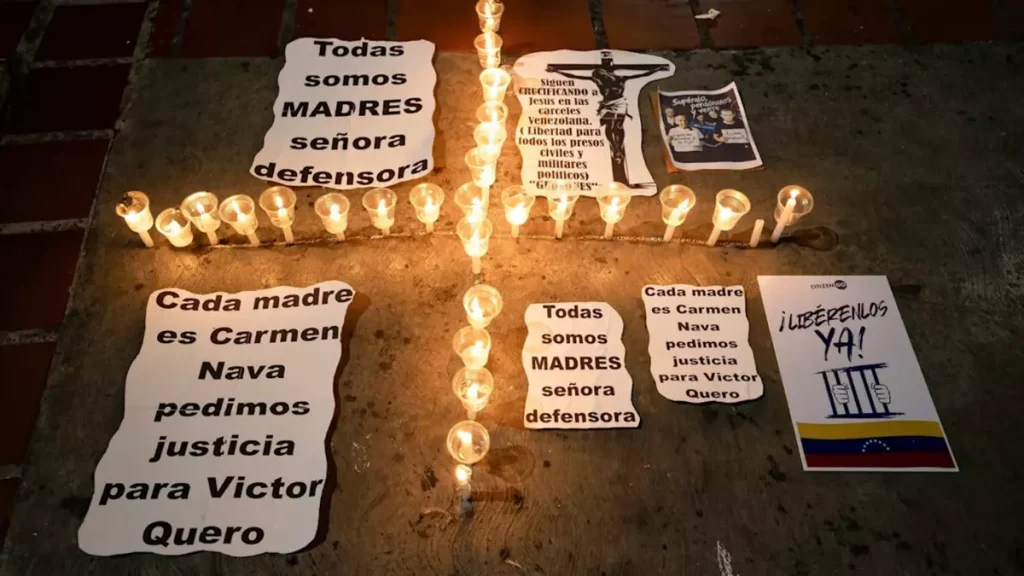
 EFE (via 14ymedio), Caracas, May 11, 2026 – Families of political prisoners in Venezuela paid tribute this Sunday to Víctor Quero Navas — whose death last year while in state custody was acknowledged this week by the Government after months of searching by his mother — with an activity outside the prison where, according to authorities, he was held.
In the vicinity of the El Rodeo I penitentiary center, near Caracas, relatives and activists placed a sign in his memory highlighting that his death occurred “after remaining in forced disappearance since January” of that year.
“His mother searched for him in Rodeo I, but the authorities denied his detention, concealed his death, and destroyed evidence,” the text adds.
Around the sign were small banners with messages such as “Let no one else die in custody,” “Truth for Víctor, freedom for all,” and “No death in custody can go unpunished.”
There were small banners with messages such as “Let no one else die in custody,” “Truth for Víctor, freedom for all,” and “No death in custody can go unpunished”
On the ground they placed a couple of floral arrangements and candles in the shape of a cross, while on another part of the street asphalt they wrote in chalk “Víctor Hugo Quero present,” according to photographs published on X by the NGO Committee for the Freedom of Political Prisoners (CLIPP).
“This May 10, Mother’s Day in Venezuela, the memorial placed in the vicinity of El Rodeo I prison recalls the death in custody and demands justice,” the organization wrote on the social network.
Opposition leader and Nobel Peace Prize laureate María Corina Machado expressed that all Venezuelan women are “one in señora Carmen,” among others who “represent what it means to raise and fight for a child and demonstrate that a mother’s love never surrenders.” “Soon we will all embrace each other, with our families, in freedom,” she said.
The main opposition bloc, the Democratic Unitary Platform (PUD), greeted all the women who, with “love, strength, and sacrifice, sustain their families and keep alive the hope of a better country,” and made special mention of the mothers of political prisoners, who “face the pain of injustice and separation, but continue giving an example of dignity, fortitude, and struggle for freedom.”
“Special recognition also to the mothers who live with the distance caused by migration, persecution, or the absence of their children, without ever giving up hope,” it added.
The Primero Justicia party demanded “justice for all the mothers who, because of persecution, the search for a better future, or prison, today cannot embrace their children and grandchildren.”
The organization Encuentro Ciudadano asserted that, in Venezuela, being a mother “has also meant resisting, resisting the separation from children who emigrated, hunger, blackouts, uncertainty, and the pain of seeing a broken country.”
In Venezuela, being a mother “has also meant resisting, resisting the separation from children who emigrated, hunger, blackouts, uncertainty, and the pain of seeing a broken country”
“But today, especially, we think of the mothers of political prisoners. Of those women who cannot embrace their children, who travel through courts and prisons seeking justice, who live between anguish and hope. To them, our respect and solidarity,” it wrote on X.
The party asked that this day “not be only a celebration but also a reminder of the debt Venezuela has with so many mothers who suffer in silence.”
For its part, the NGO Venezuelan Prison Observatory (OVP) stated that hundreds of women spend their day “standing in lines outside a prison, while others wake up far from their children, locked in a cell, watching childhood pass behind a visit, a phone call, or a photograph.”
“There are mothers who travel kilometers carrying food and medicine for their imprisoned children, mothers who grow old amid searches, transfers, and institutional silence, mothers like Carmen Teresa Navas who spend months desperately searching for their children while the regime disappears, tortures, or kills them,” it said.
In that sense, it warned that the prison crisis “not only punishes those deprived of liberty; it also breaks bonds, separates families, and condemns thousands of mothers to live amid pain, uncertainty, and absence.”
The CLIPP demanded, on this “Mother’s Day, freedom for their children.” “That is the gift awaited by the mothers who continue outside the prisons. They do not ask for privileges: they demand justice, truth, and a return home,” it added.
The Venezuelan Episcopal Conference (CEV) expressed in a statement its “deep consternation and pain” over Quero’s death and demanded that criminal and administrative responsibilities be determined.
“It is imperative to determine the criminal and administrative responsibilities of those officials who, by action or omission, allowed a young Venezuelan to die in oblivion, without access to his family and deprived of due process,” it stated, and asked the Public Ministry and the Ombudsman’s Office to act “with true autonomy and independence.”
The CEV expressed solidarity with the mother, Carmen Navas, and said that she “personifies the ordeal of so many Venezuelan families.” “Her tireless search, marked by harassment and uncertainty, is a cry that reaches heaven. The Church stands in solidarity with the pain of those who seek the truth amid institutional opacity,” it said.
The CEV expressed solidarity with the mother, Carmen Navas, and said that she “personifies the ordeal of so many Venezuelan families”
In addition, the conference recalled that the State “has the inalienable moral and legal duty to guarantee the life and physical integrity of those deprived of liberty.”
On the other hand, it pointed out as “signs of a lack of transparency and probity” by the authorities that the political prisoner “died in July 2025 while the State provided contradictory information to his family.”
“The fact that his whereabouts were denied in facilities such as El Rodeo I, while he had already died, constitutes an extremely serious breach of public ethics. This deliberate concealment constitutes elements of forced disappearance, a crime that justice cannot and must not ignore,” it asserted.
Regarding the exhumation carried out on Friday, the CEV called for international experts to “validate the findings in order to clarify the truth, determine criminal responsibilities for the forced disappearance, and stop the institutional cruelty that revictimizes” the mother.
With Quero Navas, there are now 27 people detained for political reasons who have died in state custody since 2014, according to the NGOs Justice, Encounter and Forgiveness (JEP) and Provea.
According to an official statement released last Thursday, Quero died almost ten days later from “acute respiratory failure secondary to pulmonary thromboembolism.” The same day, the Ombudsman’s Office requested an exhaustive and independent investigation and the Prosecutor’s Office announced the start of inquiries.
Translated by Regina Anavy
______________________
COLLABORATE WITH OUR WORK: The 14ymedio team is committed to practicing serious journalism that reflects Cuba’s reality in all its depth. Thank you for joining us on this long journey. We invite you to continue supporting us by becoming a member of 14ymedio now. Together we can continue transforming journalism in Cuba.