Donald Trump’s poor relationship with Pedro Sánchez increases exposure to reprisals, especially for the hotel chain Meliá, which has 34 establishments on the Island.
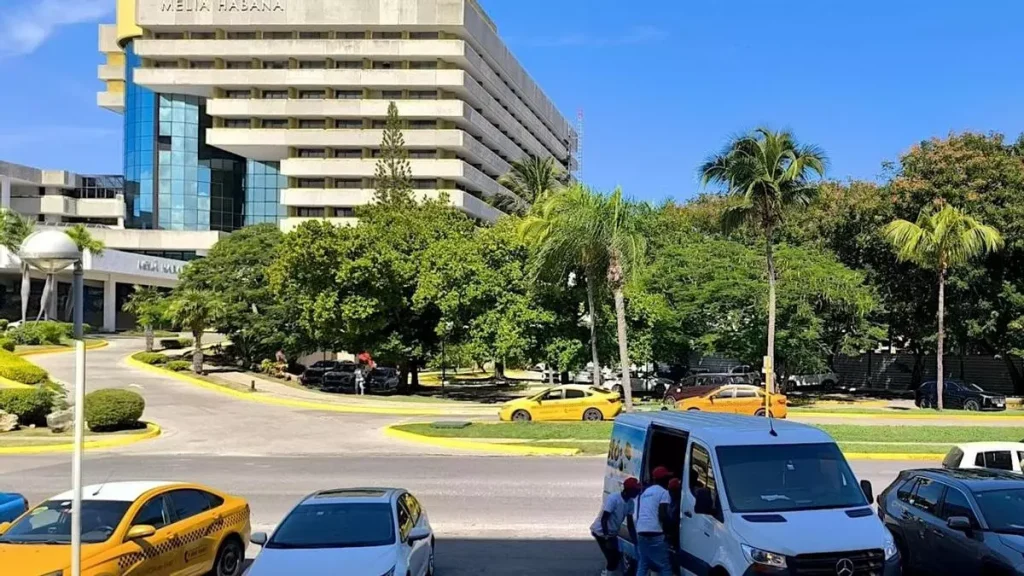

14ymedio, Madrid, May 13, 2026 — Nearly a week after the Canadian mining company Sherritt International withdrew from Cuba over the possibility of U.S. sanctions tied to its operations on the Island, attention has now turned to Meliá. The Spanish hotel chain, which manages 34 properties owned by the Cuban State, has been forced to reduce its available rooms by approximately 50%, and although it has not expressed any intention of ending its business there, warnings are coming from various quarters.
This happened last Saturday, when the U.S.-Cuba Economic and Trade Council (U.S.-Cuba Trade) published an article asking whether the Mallorca-based company would be the next to end its collaboration with the military conglomerate Gaesa due to pressure from Title IV of the Helms-Burton Act, already activated during Trump’s first term, and a possible inclusion on the SDN (Specially Designated Nationals) list of the Office of Foreign Assets Control (OFAC) of the U.S. Treasury Department. This directory includes sanctioned individuals, companies, or vessels, implying a financial blockade and a prohibition on Americans doing business with them.
Although theoretically any company could be exposed to such measures, U.S.-Cuba Trade believes there could be an additional political motivation for acting against Meliá: the stance of Spanish Prime Minister Pedro Sánchez, who prohibited the U.S. from using Spanish military bases for operations against Iran. In fact, the organization believes that Sherritt’s withdrawal may have stemmed from a similar situation involving Canadian Prime Minister Mark Carney, who has also been confrontational toward the American president.
The organization believes Sherritt’s departure may have resulted from a similar situation involving Mark Carney, Canada’s prime minister and likewise confrontational toward the American president
Meliá also has a precedent. Its CEO, Gabriel Escarrer Jaume, son of Escarrer Juliá, founder of the hotel chain and closely linked to Fidel Castro, was already sanctioned by OFAC in February 2020. Exactly six years ago, during a visit to Cuba for the Tourism Fair, the businessman said he was indifferent to the sanctions and stated that his intention was to remain on the Island for at least another three decades. “We do not tremble in the face of outside pressures we may suffer,” he insisted.
At that time, the hotel chain had already begun receiving claims under Title III of the Helms-Burton Act, although none have succeeded. Meliá relied on the European regulation known as the Blocking Statute, which prevents European Union companies from complying with extraterritorial measures. Companies based in the EU are strictly prohibited from applying legislation or court rulings from other countries listed in an annex that expressly includes the Cuban Liberty and Democratic Solidarity Act of 1996.
But now, U.S.-Cuba Trade points out, there is the possibility of being placed on the SDN list, which would mean, in addition to losing the two hotels it owns in the United States, the INNSiDE in New York and the Meliá Orlando Celebration in Florida, the possibility that banks could sever relations for fear of being affected themselves.
The Spanish newspaper ABC consulted a lawyer specializing in these matters for an article published Tuesday. “From a legal standpoint, this is a major change, because the United States is giving itself a weapon it can use however it wants. For companies operating in Cuba, their existence in the country is going to become more complicated. There will be much greater scrutiny from banks, insurers, and partners when doing business, and many companies will reconsider whether it is worth continuing,” said José María Viñals, a partner at the international law firm Squire Patton Boggs. In his view, financial institutions will have to conduct “a very exhaustive analysis and review their credit history with the Island,” and the measures discourage investment in Cuba.
ABC also spoke with Ignacio Aparicio, from Andersen Lawyers and head of Cuban affairs, who said several companies have consulted about “the validity and continuity of their contracts with entities linked to Gaesa, the personal risk to their executives regarding entry visas to the United States, and the position of their banks and insurers regarding ongoing operations.” The expert does not believe there will be a total withdrawal of Spanish companies, but he warned: “This is neither a hypothetical nor a distant nor a legally simple risk.”
Among the most visible companies potentially affected, the Madrid daily notes, are also the hotel chains Barceló and Iberostar, Banco Sabadell, and Alto Cedro, the latter linked to Banco Santander, which has a strong presence in the United States.
“Europe will have to decide whether it protects European companies and confronts the United States”
Viñals, in any case, raises an even broader issue in the conflict. “Europe will have to decide whether it protects European companies and confronts the United States,” he said. The Blocking Statute mainly functions as a tool capable of nullifying the legal effects of U.S. court decisions on European soil, but it can do little against an OFAC designation, which would exert coercive pressure on other businesses. However, the EU still has a weapon it has never used, known as the trade bazooka: the Anti-Coercion Instrument (ACI).
Created in 2023 by the European Commission, this mechanism activates direct trade reprisals if authorities determine that there is a policy attempting to influence the policies of the EU or its member states. Measures can range from tariffs to service restrictions or suspension of U.S. patents in Europe. The first time the bloc of 27 countries considered invoking it was last January, when Donald Trump threatened to take over Greenland, but given the potential for open conflict implied by its use, it was never even formally considered.
Just a week ago, French President Emmanuel Macron again brought the ACI into the spotlight when Trump threatened new tariffs on the EU. Sánchez joined the initiative, supporting its use to block measures against judges of the International Criminal Court. However, even if the EU wanted to use its “last golden bullet” against the United States, activating the measure would take months to move through Europe’s high-level institutions, compared to the immediacy of OFAC measures.
Translated by Regina Anavy
______________________
COLLABORATE WITH OUR WORK: The 14ymedio team is committed to practicing serious journalism that reflects Cuba’s reality in all its depth. Thank you for joining us on this long journey. We invite you to continue supporting us by becoming a member of 14ymedio now. Together we can continue transforming journalism in Cuba.