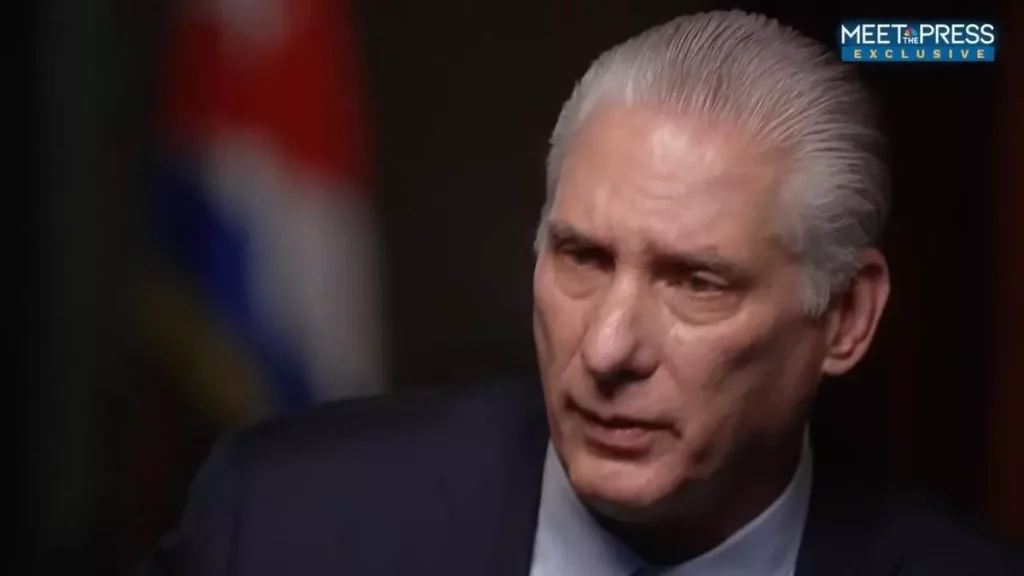
 14ymedio, Madrid, April 10, 2026 – “Resigning is not part of our vocabulary,” Miguel Díaz-Canel told Kristen Welker, host of NBC News’ Meet the Press, in a preview of an interview that will be broadcast in full next Sunday. The last time a Cuban leader was interviewed by this U.S. television network was in 1959, when Fidel Castro appeared on that very same program.
The clip begins with a moment of high tension between the president and the interviewer. “Would you be willing to resign in order to save Cuba, the Cuban people?” Welker asks. Díaz-Canel, dismissing the critical questions, spends more than a minute pushing back against the journalist, insisting on whether she asks that type of question to other presidents, whether she is doing so on behalf of the State Department, and whether she would ask it to Donald Trump, apparently ignoring the strained relationship between the U.S. president and NBC. Welker, unfazed, clarifies what everyone knows: “I ask very tough questions to the president.”
With that settled, Díaz-Canel addresses the issue. “In Cuba, the people who hold leadership and government responsibilities are not chosen by the Government of the United States, nor are they appointed by the Government of the United States. We are a sovereign, free state. We have self-determination, we have independence, and we do not submit to any dictate of the Government of the United States,” he argues.
“We are a sovereign, free state. We have self-determination, we have independence, and we do not submit to any dictate of the Government of the United States,” he argues
The president then defends his humble origins and reaffirms Cuba’s electoral system. “Any one of us, in order to hold a responsibility, must be elected at the grassroots level in an electoral district by thousands of Cubans and then the Cubans who represent those others in the National Assembly of People’s Power elect those positions through indirect voting, as happens in other countries around the world,” he repeats.
He does not clarify, however, that it is impossible to be elected if one does not belong to the Communist Party or one of the organizations endorsed by the regime. On the contrary, he defends the single-party system. “When we assume a responsibility, we do not do so out of personal ambition, nor corporate ambition, nor even for a party position, because our party is not electoral. We do it by a mandate of the people, and in the concept of revolutionaries, surrender is not an option.”
Díaz-Canel, despite being fully aware that he is not a popular leader — unlike his more charismatic predecessors — asserts that the population can show him the door. “If the Cuban people believe that I am incapable, that I am not up to their standards, that I do not represent them, they are the ones who must decide whether I should be in leadership or holding the position of president or not,” said the man who governs a country where criticizing him personally constitutes a crime of “propaganda against the constitutional order,” punishable by long prison sentences.
The president continues by saying that policy in Cuba is decided by collective bodies and that under no circumstances can the United States demand anything of him, especially given what he describes as decades of “hostile” policy toward the Island. “They do not even have the moral authority to say they are concerned about the situation of the Cuban people and that the Cuban Government is the one that has led Cuba to this situation when they bear all that responsibility,” he continues, urging Washington to take a critical look at itself and see “how much their policies have cost the Cuban people in suffering and limitations, and how much they have deprived the American people of a normal relationship with Cuba.”
Díaz-Canel has maintained, as in all his recent appearances, that the regime is willing to engage in dialogue, as long as it is not conditioned on changes to the system. “We would not demand changes to the American system, about which we have endless doubts and endless criticisms,” he argues, and he calls for talks to focus on what can unite both countries. “Once again, I repeat, to avoid confrontation and to have a future for both peoples of benefit, of relationship, of friendship, and also of solidarity,” he concludes.
The excerpt of the interview was broadcast alongside a message the president sent to the II International Conference on Unilateral Coercive Measures, held in Geneva, in which he again denounces the “strangulation” that the United States imposes on the island. “Cuba is the victim of a prolonged collective punishment that seeks to bring its people to their knees through hunger, disease, and severe shortages of basic supplies,” he said in a video.
“Cuba is the victim of a prolonged collective punishment that seeks to bring its people to their knees through hunger, disease, and severe shortages of basic supplies”
The president reviewed some of the consequences he attributes to the worsening energy situation following Trump’s oil blockade. Among them, he cited the suspension of surgeries for more than 96,000 people (including 11,000 minors), 19,000 patients who are undergoing oncology or hemodialysis treatments being at risk, shortages of gas and water, and industrial production at minimal levels. “What right does the world’s leading economic power have to commit such an abuse against a small country?” Díaz-Canel asked, describing the situation as a return to “barbarism and servitude.”
“It is impossible to quantify the physical and psychological exhaustion, the daily shortages, the postponement of dreams, and the media war that is inflicted, out of sheer malice, on a noble, resilient, and supportive people like ours,” he argued, also taking a few minutes to thank those who have chosen to stand by Cuba, such as Mexico and Russia, coinciding with the announcement that a new oil tanker from that country will arrive on the Island, although Moscow has not indicated a date.
Translated by Regina Anavy
______________________
COLLABORATE WITH OUR WORK: The 14ymedio team is committed to practicing serious journalism that reflects Cuba’s reality in all its depth. Thank you for joining us on this long journey. We invite you to continue supporting us by becoming a member of 14ymedio now. Together we can continue transforming journalism in Cuba.