The Cuban Rum Industry Is in Crisis Due to Lack of Sugar

An operator checks a bottle from the production line at the Havana Club rum factory / EFE / Alejandro Ernesto

14ymedio bigger14ymedio, Madrid, June 2, 2025 — The sugar debacle in Cuba threatens to bring down with it one the few remaining exportable products that remains: rum. Not even a month ago, the official press itself was putting forward the worst portents, talking about the state-owned company Derivados de Amancio in Las Tunas. “The current crisis of the Cuban sugar industry hit them very hard, since the drop in the production of molasses deprived them of an essential input for the manufacture of alcohols and consequently of rum, two products with which they have gained prestige inside and outside the country,” said an article published on May 13 in Periódico 26.

Now, it is a foreign newspaper, The Guardian, that has revealed the extent of the crisis, which, it says, “would have shaken Ernest Hemingway”: “The Cuban communist government has difficulty processing enough sugar to make rum for his beloved mojitos and daiquiris.”

According to the British newspaper, an industry executive who asked for anonymity said “there will be no alcohol” in the fourth quarter of the year, which will be “particularly difficult.” The foreign companies that have formed an alliance with the Cuban government for the production of alcohol – the British Diageo, the Norwegian Island Rum Company and the French Pernod Ricard and LVMH (Louis Vuitton Moët Hennessy) – will not be spared says the extensive report published last Friday, though they “have invested heavily in their respective brands”: Ron Santiago, Black Tears, Havana Club and Eminente.

Cuban rum producers cannot import because “the regulations state that all liquids must come from the island”

Luxury firms, the same source claims, are concerned. The text of The Guardian notes that Cuba, in a generalized economic crisis, has had to import sugar in recent years for the population’s consumption. However, says the executive, the rum producers cannot import because “the regulations state that all liquids must come from the island.” continue reading

The British newspaper describes the atmosphere at the Enrique Varona sugar mill in Ciego de Ávila on a recent visit: “The workers looked exhausted while turning a heavy piece of metal in the hope of keeping the large mill running.” Then they contrast it with the distillery of Pernod Ricard, south of Havana, which is “modern and elegant.”

The French beverage company was the first of the large foreign companies to arrive, recaps The Guardian, after signing an agreement with the state-owned Cuba Ron Corporation in 1993. “In exchange for an agreement not to allow entry of other competitors for 20 years, it acquired the brand Havana Club, increasing sales from 300,000 boxes to more than four million,” reports the newspaper. Luca Cesarano, former president of Ron Santiago S.A., the joint venture created between the British company Diageo and Cuba Ron to produce Ron Santiago, a competitor of Havana Club, declared: “They made a great investment at a time when nobody dared to invest in Cuba.”

Diageo arrived on the island in 2013, when he signed an agreement with Pernod Ricard. Unlike the French firm, explains the Guardian, the British one did not have its own distillery, but employed rum masters to make the drinks in the state distilleries.

The sugar harvest of 2025 is coming to an end these days, and the information published in official newspapers makes us fear the worst

“They also used historical rum collections that the masters had been storing in oak barrels for years all over the country, even as the cellar roofs were filled with holes,” says the report. Thus, “high-end products” – such as LVMH’s Eminente rum or Black Tears from the Norwegian Island Rum Company (which is named after the Lagrimas negras bolero) – have “boosted the international resurgence of rum.” With the shortage of molasses, concludes The Guardian, “all this work is threatened.”

The 2025 sugar harvest is coming to an end these days, and the information published in official newspapers makes us fear for the worst. Of the 56 sugar mills in the country, only 13 are operational, according to a recent report by Azcuba, and only six of them mill cane for sugar production. The rest is devoted to the production of molasses, just to make brandy.

In Sancti Spíritus, the authorities welcomed the fact that the only mill in operation in the territory, the Melanio Hernández, fulfilled the “sugar production plan corresponding to the present harvest, this April 30,” but a very different panorama is offered by the province of Granma. There, reported La Demajagua, just a few days ago, the Governing Council addressed in a meeting the “alarming situation of the sugar sector in the province, marked by a critical failure to comply with the established program and the approach of the hurricane season.”

Granma province produced 5,262 tons of sugar out of the more than 19,000 tons planned; that is, only 26% of what was predicted, “due to lack of fuel and industrial breakdowns.” There was also the loss of almost 150 million pesos from “fires in unharvested fields, loss of fields by invasions of weeds and non-payment to workers in several cooperatives and companies.”

It remains to be seen when the data of the present harvest will be known in the country. Last year’s was jealously guarded by the Cuban government for months and months. Finally, well into 2025, the former Minister of Economy José Luis Rodríguez let it escape in a text published by the official press: the 2023-2024 harvest totaled only 160,000 tons of sugar, an unusual figure.

The island’s once-star product, which reached 8.5 million tons in the 1980s, had fallen dramatically in 2022-2023, when 350,000 tons of sugar were achieved. That figure, which was already the worst harvest in a century, was more than double that of the most recent harvest.

Translated by Regina Anavy

____________

COLLABORATE WITH OUR WORK: The 14ymedio team is committed to practicing serious journalism that reflects Cuba’s reality in all its depth. Thank you for joining us on this long journey. We invite you to continue supporting us by becoming a member of 14ymedio now. Together we can continue transforming journalism in Cuba.

A Serious Crash in Mayarí, Cuba, Leaves Five Young People Injured, Two Critically

Drivers and passengers point to structural factors as indirect causes of crashes in Cuba / Facebook.

14ymedio bigger 14ymedio, Havana, June 2, 2025 — Five young people between the ages of 18 and 34 were injured this Sunday in a traffic accident in the municipality of Mayarí, province of Holguín.

The crash took place around 6:30 pm at the Yaya Uno descent, in the vicinity of the community of Guanina. According to preliminary reports, the vehicle in which they were traveling, a black private car, veered off the road, for reasons that are still under investigation. All occupants were injured.

According to a post on Facebook by the official journalist Emilio Rodríguez Pupo, the car was going from Mayarí in the direction of Guanina when the crash occurred. The National Revolutionary Police (PNR) is in charge of investigations to determine what caused the crash.

Two of the youths remain in critical condition

The management of the Martyrs de Mayarí hospital reported that two of the youths remain in critical condition: Anyelo Antonio López Beltrán, 20, and Abdiel Alejandro Campos Céspedes, 18.

Two others have serious injuries. Ariel Sánchez Batista, also 20 years old, suffered a traumatic brain injury and was transferred to a hospital in the continue reading

city of Holguín. The fourth injured, 34-year-old Yulio Quiala Sánchez, was also reported to be in serious condition.

The fifth injured, 18-year-old Odel Emilio Magaña Chacón (known as “Chopo”) remains under medical observation

The municipal director of public health, Anika Lao Texidó, confirmed that three ambulances were activated for emergency transfers, and a specialized vehicle was mobilized to reinforce logistical support.

The number of fatalities in Cuba has increased, with drivers representing the most affected group 

This crash adds to a worrying national trend. In the first four months of 2025, 2,377 traffic crashes were recorded in Cuba, a decrease of about 150 incidents compared to the same period last year. However, the number of fatalities increased, with drivers representing the most affected group.

Official statistics indicate that young people between 21 and 25 years of age, as well as those over 70, account for the largest number of crashes and victims. Monday and Wednesday are the days with the highest number of crashes, while Sunday and Tuesday are the deadliest. The most critical time is between 3:00 and 6:00 in the afternoon.

The most critical time is between 3:00 and 6:00 pm

According to the National Road Safety Commission, 91 per cent of crashes are due to human factors. The main causes identified are lack of attention when driving, failure to respect the right-of-way and speeding.

However, drivers and passengers point to structural factors as indirect causes of the problem: the deplorable condition of roads with potholes; dips and lack of signage; and an aging fleet with thousands of vehicles circulating with improvised parts, home-made adaptations and forced repairs due to chronic shortages of spare parts.

Translated by Regina Anavy

____________

COLLABORATE WITH OUR WORK: The 14ymedio team is committed to practicing serious journalism that reflects Cuba’s reality in all its depth. Thank you for joining us on this long journey. We invite you to continue supporting us by becoming a member of 14ymedio now. Together we can continue transforming journalism in Cuba.

A Mexican ‘Coyote’ Is Sentenced to 10 Years in Prison for Transporting 14 Cubans

Edgar “N” appealed to a summary trial to avoid a heavier sentence and pay a $78,000 fine.

The National Institute of Migration moved the Cubans to a farm in the state of Puebla / INM

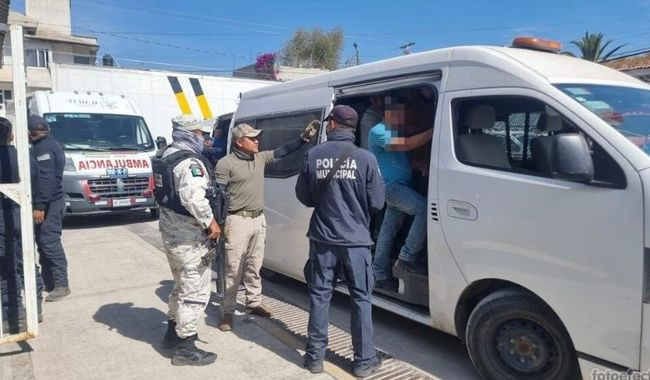
14ymedio bigger 14ymedio, Ángel Salinas, Mexico City, June 2, 2025 — Mexican smuggler (“coyote”) Edgar “N” had an abbreviated trial to reduce his sentence for the crime of “human trafficking” that he was charged with last Friday. For the transfer of 14 migrants of Cuban origin and 10 migrants from India, he was sentenced to 10 years in prison and a fine of 648,375 Mexican pesos ($33,730),” said an official from the Puebla State Attorney General’s Office who requested anonymity.

The coyote avoided “under this legal ploy a sentence of 18 years in prison and the payment of almost 1,500,000 pesos ($78,000),” regretted the same source. “It may seem illogical to us, but there are cases like this, where a judge considered human trafficking a misdemeanor. There are loopholes in the law; it must be accepted.”

The evidence provided by the authorities indicates that Edgar “N” contacted the “14 Cubans through messages and agreed to transfer them in a van” for $2,500 per person. The migrants were handed over by a truck driver after crossing a military checkpoint on the road. “Unfortunately one of the Cubans told the officers that he had a photo of the deposit he had made continue reading

through Western Union but later backed out as a witness,” said the official.

Edgar “N” contacted the “14 Cubans through messages and agreed to transfer them in a van” for $2,500 per person

The van with the migrants was intercepted by the National Guard at kilometer 112 of the Mexico-to-Puebla highway, in the municipality of Coronango. The coyote said they were part of “a group of tourists and that they were supposed to be in Mexico City.”

However, “they did not present their documents,” and the driver eventually acknowledged that they were migrants. He was paid 5,000 pesos ($260), which would be given to him upon arrival in the State of Mexico. “The whole story changed after he was put in a holding cell and asked for a lawyer. At that point he changed his mind and requested a summary trial,” the same source said.

The migrants were handed over to the National Institute of Migration, and, according to the authorities, they were transferred to the headquarters in Puebla.

“The state is a forced crossing point for migrants, but the flow has decreased considerably. Since two years ago, the shelters installed in the La Asunción and San Juan de los Lagos parishes stopped receiving mass arrivals of people who came to sleep, rest for two or three days and continue on their way.”

Also, “the movement of migrants hidden in trucks and vans was reduced, and a time came when motorcycles were used to avoid detection.”

Translated by Regina Anavy

____________

COLLABORATE WITH OUR WORK: The 14ymedio team is committed to practicing serious journalism that reflects Cuba’s reality in all its depth. Thank you for joining us on this long journey. We invite you to continue supporting us by becoming a member of 14ymedio now. Together we can continue transforming journalism in Cuba.

Recent Weeks Have Not Been Good for Venezuela’s Nicolás Maduro, and the Future Looks Bad for His Regime

Chevron’s license expired Tuesday as planned, although the company will continue to maintain Venezuelan refineries.

As Venezuelan oil production disintegrates, other neighboring countries begin to stand out / EFE

14ymedio bigger14ymedio, Frank Calzón, Miami, 31 May 2025 — At the beginning of May, Nicolás Maduro flew to Moscow, where Bashar al-Assad, the deposed Syrian satrap and his wife have been residing for months.

The details of Maduro’s talks with Vladimir Putin have not been revealed, but it is to be assumed that, in view of the serious situation in Venezuela, the alliance between the two dictators was part of the agenda. Venezuela and Syria are very different countries in different parts of the world, but the truth is that when the critical moment came, neither the Russian naval base at Tartus nor the alliance with Russia could prevent the overthrow of Assad.

A week ago, several media reported that the Trump administration would extend the license to Chevron to operate in Venezuela that had been approved by President Biden. For Maduro it was good news because of the millions of dollars it meant at a time when Caracas is facing difficulties. But it was not to be.

The US government is composed of three independent branches: the executive, the legislature and the judiciary. In the House of Representatives, a law of extreme importance to President Trump was being discussed, and several Cuban-American Republican members of Congress pressed for the non-extension of the license that was so important to the Venezuelan dictator. continue reading

The law was approved by 215 votes with the support of the Cuban-American members of Congress. The license to Chevron expired on Tuesday, as scheduled, although Chevron will continue to service Venezuelan refineries; but the US administration plans to impose high tariffs on countries that buy Venezuelan oil in the future. Things look bad for Maduro.

What happened offers a perhaps little-known insight into the functioning of American democracy: in mid-May, El Nuevo Herald reported on a 60-day extension that was to allow Chevron’s operations in Venezuela. The president of the oil company, Mike Wirth, warned in an interview with Fox Business that, if the license is not renewed, China and Russia could fill the void left by the US company, which would represent a strategic loss for the
United States.

Wirth did not comment on the benefits that this operation could represent for the government of Nicolás Maduro

However, Wirth did not comment on the benefits that this operation could represent for the government of Nicolás Maduro, nor on the situation of human rights in Venezuela or the national interest of the US in the matter. Probably he is not familiar with the popular saying that warns that “capitalists will sell the rope that hangs them.” Cuban and Venezuelan communities in south Florida expressed concern about this possibility.

A few days later, Secretary of State Marco Rubio settled the controversy by announcing on his X account: “Biden’s pro-Maduro oil license in Venezuela will expire as scheduled next Tuesday, May 27.”

The decision was not favorable for Maduro nor for his ally Miguel Díaz-Canel in Havana, especially if President Trump, as reported, increases tariffs by 25% on countries that buy Venezuelan oil.

To understand why Chevron’s license has become a strategic issue, it is useful to review recent history.

At the end of the 1990s, Venezuela produced more than three million barrels per day, consolidating itself as an energy power. However, after years of expropriations, erratic decisions and a state-run oil industry turned into political booty, production plummeted.

When Hugo Chávez died in 2013, oil production was already showing signs of deterioration.

With Nicolás Maduro, the fall was even more severe: in 2023, the average production was just 783,000 barrels per day. Although it rebounded to 921,000 in 2024, the country is still far from the almost three million that it pumped at its best times, according to OPEC figures.

In this context, the presence of Chevron in Venezuela ceased to be merely economic and acquired a political nuance.

Its permanence offered the regime a minimum of international legitimacy and, above all, a source of foreign exchange that was difficult to obtain by other means.

It is not surprising, then, that Chevron’s possible departure would cause anxiety among those who depend on this operation to keep the state apparatus afloat, at least symbolically.

As Venezuelan production disintegrates, other neighboring countries begin to stand out. One of them is Guyana, whose Atlantic coast has revealed important oil deposits.  Companies like ExxonMobil have already started exploiting them, sparking the interest and annoyance of the Venezuelan government.

Caracas insists on claiming Essequibo, a region that appears on its official maps as part of the national territory, despite the fact that the international community recognizes Guyanese sovereignty. It is no coincidence that in 2023, tensions increased when Venezuelan troops were seen near the border.

Response from Georgetown was immediate, with calls to the international community.

Washington backed Guyana with clear statements, reaffirming its commitment to regional stability.

All this is happening while Maduro is losing space.

The non-renewal of Chevron’s license, the pressure on Venezuelan oil buyers and the support for neighboring countries with stable governments and clear rules suggest a new stage. And in it, the margins to sustain an exhausted model are narrowed, with or without rope in between.

Washington backed Guyana with clear statements, reaffirming its commitment to regional stability

Meanwhile, in Cuba the blackouts continue, and the European oil companies that invested millions of dollars in search of the Cuban black gold unfortunately did not find it.

It is difficult to understand the priorities of President Díaz-Canel’s government, which has allowed the lack of maintenance and deterioration of the Cuban oil industry. There is no other country in Latin America with the continuous blackouts suffered by Cubans. Let us hope that in the future, as we have seen in Washington, the Assembly of People’s Power will not approve millions of dollars for the construction of hotels for foreigners, where there is never a lack of electricity, and will focus instead on the maintenance and repair of the country’s electrical system.

Frank Calzon is a Cuban political scientist and human rights activist.

Translated by Regina Anavy

____________

COLLABORATE WITH OUR WORK: The 14ymedio team is committed to practicing serious journalism that reflects Cuba’s reality in all its depth. Thank you for joining us on this long journey. We invite you to continue supporting us by becoming a member of 14ymedio now. Together we can continue transforming journalism in Cuba.
María Corina Machado Says That Maduro ‘Is on the Ropes’ After the Last Elections in Venezuela

In a column published in the Argentine newspaper ’La Nación’, the opponent described the event as “an orchestrated farce”

Stock photo of Venezuela’s opposition leader María Corina Machado / EFE/ Ronald Peña R

14ymedio biggerEFE (via 14ymedio), Caracas, 2 June 2025 — Venezuelan opposition leader María Corina Machado said on Sunday that the government of Nicolás Maduro “is up against the ropes” and suffered a new political defeat as there was a large abstention in the elections called for on 25 May, ahead of schedule, to renew the National Assembly and the regional governments.

In a column published in the Argentine newspaper La Nación, Machado described the event as “an orchestrated farce” to try to “turn the page on the humiliating defeat he received in the presidential elections of July 28, 2024.”

According to Machado, more than 85 per cent of citizens refused to participate despite threats of retaliation for not voting.

“What happened on May 25 was an act of massive, militant, conscious and courageous disobedience, one of the greatest in our history,”said Machado. She pointed out that this abstention is a reaffirmation of the sovereign mandate that was expressed in last year’s presidential election when Maduro was defeated, 70-30, in favor of the opposition. continue reading

“What happened on May 25 was an act of massive, militant, conscious and courageous disobedience, one of the greatest in our history”

Machado said that the regime has resorted to repressive measures to try to curb the rise of the opposition, including forced disappearances, torture and killings.

“More than 2,000 people have been subjected to forced disappearances and torture; more than 30 have been killed,” she said. She added that “the president-elect, Edmundo González, was forced to leave the country because of risk to his personal integrity.”

The opposition leader also targeted the National Electoral Council (CNE), accusing it of not having submitted the results or the minutes of the May 25 process. “In ’elections’ like these, the votes are the least of it; they aren’t counted,” she maintained.

For Machado, this day marks the fourth major victory of the Venezuelan democratic movement, along with the primary elections on October 22, 2023, the presidential elections on July 28, 2024, and the so-called “Operation Guacamaya,” in which she says hostages were released from the Argentine embassy.

“We’re at 4-0 and going into the final round,” she wrote in a defiant tone. She also highlighted the growing isolation of Maduro and the impact of international measures.

“Never as today have all the vectors in favor of the democratic transition in Venezuela been so aligned,” she said, warning that the only resource Maduro has left to stay in power is violence.

“Disobeying, resisting pressure and not going along with this farce is an immense demonstration of the courage and intelligence of the people of Venezuela”

“Disobeying, resisting pressure and not going along with this farce is an immense demonstration of the courage and intelligence of the people of Venezuela,” she affirmed.

According to the CNE, 42.63 per cent of all voters took part in the May 25 elections. Some 21.4 million citizens were called to participate in this process, and 15,736 polling stations were set up throughout the territory.

However, the anti-Chavista leader María Corina Machado said last Sunday that more than 85% of the people did not vote, and, in a video released on X, she called on the Bolivarian National Armed Forces to “open the way to transition, with order and security,” fulfilling their constitutional duty” and being “guarantors of the people’s sovereignty.”

Machado rejected the call for voting from the beginning, after denouncing the fraud in the presidential elections of July 28 last year.

Translated by Regina Anavy

____________

COLLABORATE WITH OUR WORK: The 14ymedio team is committed to practicing serious journalism that reflects Cuba’s reality in all its depth. Thank you for joining us on this long journey. We invite you to continue supporting us by becoming a member of 14ymedio now. Together we can continue transforming journalism in Cuba.
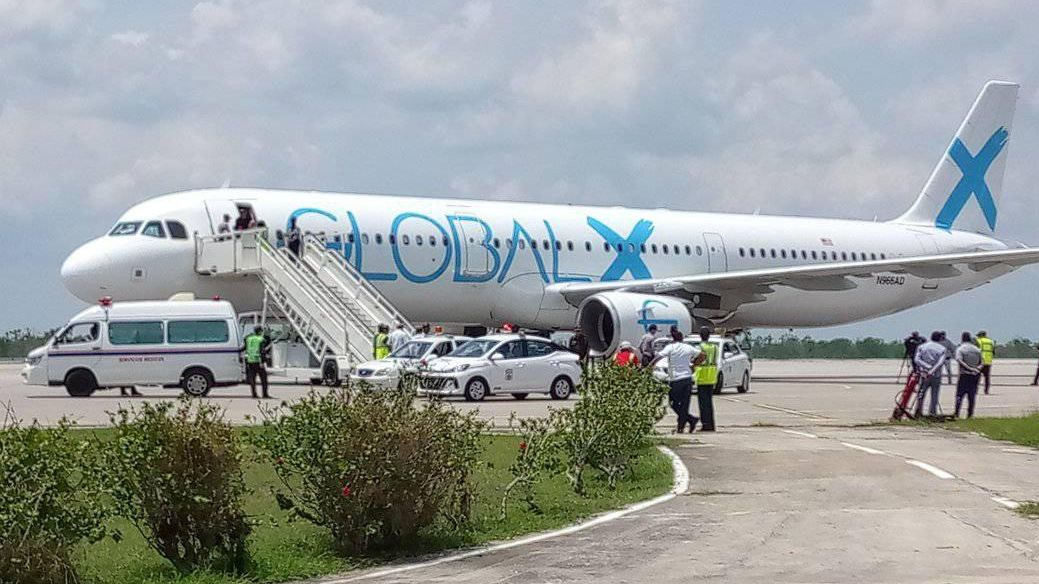
Despite the ‘Tarifazo’* Etecsa Maintains Poor Telecommunications Service in Cuba

“The worst thing is the internet connection, although the calls are also of poor quality and hard to hear”

The under-25 group is among the most affected by the measure announced last Friday by Etecsa / 14ymedio

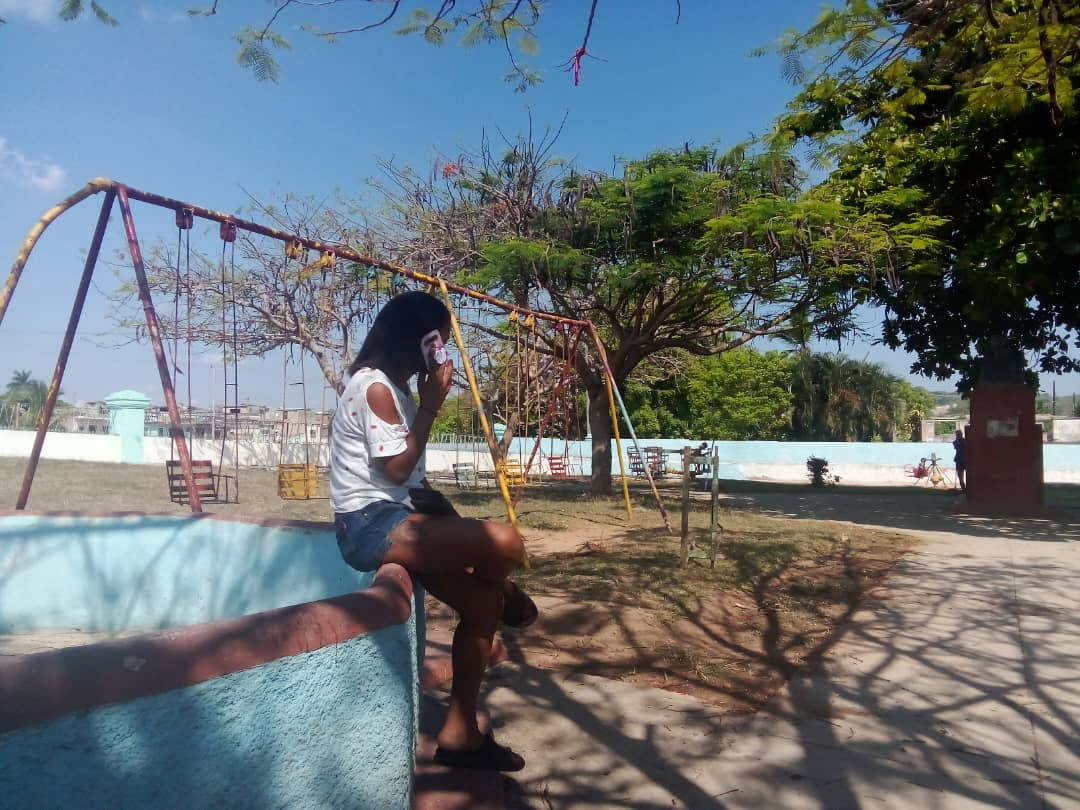
14ymedio bigger14ymedio, Julio César Contreras, Matanzas, June 2, 2025 — A single line at the top of her phone tells Mariana that she has very little coverage. Although she is outside and in a central location, the call has been cut off twice, and the voice on the other side of the line seems to come from inside a cave. Despite the new price increases announced by the state monopoly Etecsa, telecommunications are going from bad to worse in the city of Matanzas.

“They can’t provide an efficient service,” the woman, who lives in Reparto Iglesias, told 14ymedio. “The worst thing is the internet connection, although the calls are also of poor quality and hard to hear. They are cut off or simply can’t communicate with another number,” she says, listing the problems that Cubans must overcome every day to contact family and friends.

With blackouts lasting up to 20 hours a day, making calls has become an ordeal due to the lack of power backup from most telecommunications towers installed in the city. ” I change the frequency of my phone to 2G, I go up to the roof of the house, but the most I can do is send an SMS and, if I’m lucky, make a short call,” adds Mariana. Like many of Etecsa’s customers, the woman wonders whether the money raised from the new data packet prices will eventually be used for investments in the monopoly infrastructure. continue reading

“I change the frequency of my phone to 2G, I go up to the roof of the house, but the most I can do is send an SMS and, if I’m lucky, make a short call”

Román Paz Cabrera, head of the commercial department of the territorial division of Etecsa in Matanzas, was categorical in statements to the newspaper Girón about the bad moment that the company is going through. “The equipment we use is high-tech, fully imported and rapidly obsolete. Communications are affected in the country, many of them related to the electro-energy situation, because radio base stations are shut down because they do not have the necessary backup, and this affects mobile telephones.”

“I didn’t even know about the price increase, I realized when I tried to check my balance and a message arrived saying that the service was not available,” laments one young man who is among the 560,000 customers who have mobile service in the province. “I am very concerned because I need internet for almost everything, to consult the books that I’m sent to review at university, for video games and to watch movies or series.”

The young man believes that Cubans under 25 are one of the groups most affected by the measure announced last Friday by Etecsa. “Most of my friends still depend on their parents to pay for data packages, because they are studying and do not earn money.” With rising prices, “many families will no longer be able to afford to give their children access to literature or entertainment.”

Despite not being digital natives and the challenges that the use of new technologies implies, the price increase has fallen on the elderly like a jug of cold water. With an aging population due to low birth rates and the exodus of younger people, older people often rely on web connectivity to maintain a link with their children and grandchildren who have emigrated. With a monthly pension of 2,500 pesos, Ernesto, 78 years old and living in the neighborhood of Versalles, has been doing his homework since last Friday. “From now on I will only send text messages by WhatsApp,” he explains to this newspaper. If he maintains the video conferences that bring him several times a week to his daughter’s home in Hialeah, the costs would be too high, and he would not be able to afford that link that gives him “the strength to get out of bed every day.”

If he wants to have video conferences that bring him several times a week to his daughter’s home in Hialeah, the costs would be too high

For local entrepreneurs, the new costs are a real challenge. In Liberty park, Luis managed this Sunday to distribute a list on WhatsApp with offers from appliances to baby clothes. The informal trade network is increasingly using instant messaging tools to offer its products and services. “There are customers who ask me to send more photos of the goods or make a video to see how something works, but with these internet prices I find it difficult.”

In a nearby coffee shop, the employee stretches up her arm to try to improve the signal that reaches her mobile phone. The gesture has some despair because on the counter, a chocolate and vanilla cake is waiting to be moved to a birthday party, but the message with the delivery address has not arrived on the phone. “It’s bad for a business that depends on Etecsa,” concludes the woman who, after several attempts, manages to obtain the information. By the time the messenger is ready to go, the cake is already suffering from the ravages of heat and delay.

*Translator’s note re “Tarifazo.” The “azo” ending in Cuban Spanish is a ’magnifier’, so here, roughly: “the gigantic price increase thing”

Translated by Regina Anavy

____________

COLLABORATE WITH OUR WORK: The 14ymedio team is committed to practicing serious journalism that reflects Cuba’s reality in all its depth. Thank you for joining us on this long journey. We invite you to continue supporting us by becoming a member of 14ymedio now. Together we can continue transforming journalism in Cuba.
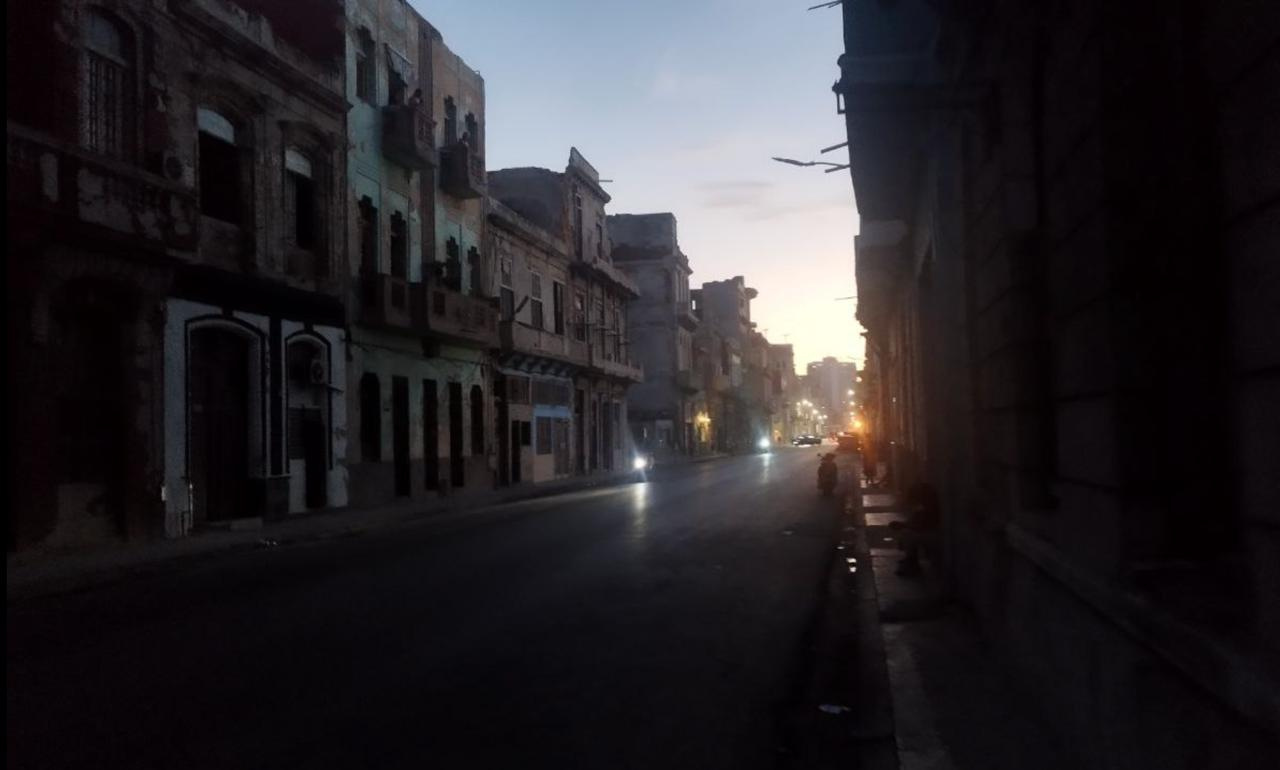
Cuba Receives 130 Irregular Migrants Deported by the United States

Another 193 people were returned by Washington to Venezuela, including eleven children.

The flight carried 106 men and 24 women / Minint Hoy/Facebook

14ymedio biggerEFE (via 14ymedio), Havana, 31 May 2025 — Cuba received on Friday 130 irregular migrants deported by the United States by air in the fifth operation of this type carried out since the second term of President Donald Trump began, on January 20 of this year. The return of 106 men and 24 women was carried out “in accordance with bilateral migration agreements” between the governments of Havana and Washington, according to a note from the Ministry of the Interior, which has been published in official media.

Among the returnees are five who “were transferred to the investigative body because they were on probation at the time they illegally left the country,” says the report. With this new operation, 19 people have been returned from different countries in the region so far in 2025, with a total of 587 people.

The Cuban authorities stressed that they remain “firm” in their commitment to “regular, safe and orderly” migration and reiterated the danger and life-threatening conditions that illegal departures from the country by sea represent. continue reading

The governments of Havana and Washington have a bilateral agreement that all migrants arriving by sea to US territory be deported to the island. Also, the deportation flights that were suspended since 2020 were resumed at the end of April 2023, mainly for Cubans considered “inadmissible” after being held on the border with Mexico.

Havana and Washington have an agreement that all migrants arriving by sea to the US territory be deported to the Island

According to data from the US Customs and Border Protection Office (CBP), during the fiscal period 2024, which ended on 30 September 2017, 217,615 Cubans arrived in the United States. In addition, a total of 8,261 Cubans were registered by the US border authorities last October, the first month of fiscal year 2025. The border agency added that more than 860,000 migrants from the island entered the territory of the US in the last four years.

In 2024, 93 returns were made from different countries in the region, with a total of 1,384 irregular migrants returning to Cuba, according to official sources.

Another 193 Venezuelan migrants deported by the United States arrived in their country on Friday, according to the Ministry of the Interior and Justice, which added that 11 minors arrived in the group. Through a post on Instagram, the ministry indicated that the Venezuelans came from Texas. “On this occasion 153 men, 29 women and 11 children returned to their country,” it added.

The ministry stated that the returning migrants were cared for by “the different organs of the Venezuelan state with the corresponding protocols on legal security, identification and health, among others.”

According to official figures, counting these 193 migrants, there are already 5,396 Venezuelans who have returned to the country, the vast majority deported by the Trump administration since last February, after an agreement signed in January by Caracas and Washington, which have been without relations since 2019.

On Thursday, a plane from the state-owned Conviasa, coming from Mexico, landed at Maiquetía Simón Bolívar International Airport in Caracas with 315 repatriated migrants, according to the Ministry of Interior and Justice. The institution noted, through Instagram, that of the total number of migrants, 146 were minors and 169 were adults.

This Friday, the US Supreme Court ruled in favor of allowing the Trump administration to withdraw the temporary legal protection granted by the previous Biden administration to 532,000 migrants from Venezuela, Cuba, Nicaragua and Haiti. The US Supreme Court has granted the emergency request by the Department of Homeland Security with a vote of seven judges in favor and two against: Sonia Sotomayor and Ketanji Brown Jackson, both Democratic appointees.

The Trump administration was trying to challenge a ruling by a federal judge — which is now without effect — of the state of Massachusetts, who considered that the government could not overturn humanitarian parole, which allowed beneficiaries to live and work temporarily in the US, without analyzing the procedure on a case-by-case basis.

Today’s is the second ruling by the Supreme Court this year in this area, after it authorized Trump 10 days ago to withdraw Temporary Protection Status (TPS) from some 350,000 Venezuelan migrants.

Translated by Regina Anavy

____________

COLLABORATE WITH OUR WORK: The 14ymedio team is committed to practicing serious journalism that reflects Cuba’s reality in all its depth. Thank you for joining us on this long journey. We invite you to continue supporting us by becoming a member of 14ymedio now. Together we can continue transforming journalism in Cuba.

Cuba’s Blackouts Are Due to a 25 Percent Drop in Electricity Production, Not to Excessive Consumption

In 2024, billed consumption was 13,985 GWh, a value close to what was produced, which makes the energy debacle even more incomprehensible.

A significant 3,742 GWh of consumption corresponds to Havana/ 14ymedio

14ymedio bigger14ymedio, Havana, May 31, 2025 — The Cuban energy debacle in the last four years fits into the 16-page report published this Friday by the National Bureau of Statistics and Information (ONEI). Among the “selected indicators” of the crisis, the fall of 25% of the national electricity generation in that period stands out, a decisive factor in the season of endless blackouts in which Cubans have been immersed for months.

In 2024, the generation of electricity in Cuba was only 14,334 gigawatt hours (GWh), a radical drop compared to what was generated in 2020, about 19,070 GWh. Of the annual total, most is produced by utilities -13,921 GWh last year- and a small percentage of only 284 GWh, which the ONEI calls self-producers – that is, non-State companies and other “independent” generators.

The other side of the coin is the invoiced consumption, whose total in 2024 was 13,985 GWh, a value close to what occurred, which makes the energy debacle even more incomprehensible. However, ONEI clarifies that the total consumption – including what is not invoiced by the Electric Company – reached 15,047 GWh. continue reading

Most of it is produced by utilities -13,921 GWh last year- and a small percentage, of only 284 GWh, by autoproducers

As was to be expected, invoiced consumption is concentrated around the country’s major cities. A significant 3,742 GWh of consumption corresponds to Havana, a figure that is not even close to Santiago de Cuba, with only 836.9 GWh.

However, Holguín (with a consumption of 1,188.4 GWh), Matanzas (1,131) and Villa Clara (1,016) are the provinces that consume the most electricity. For the remaining provinces, led by Camagüey as the largest consumer and Isla de la Juventud as the smallest (with 115 GWh), consumption is between 300 and 700 GWh.

In the whole country, it is the private sector that consumed most in 2024, with 9,414 GWh – 8,843 of them by the residential sector- while the state consumed 4,570 GWh, of which just 170 went to the deteriorated public lighting system. Considering the ridiculous number, even with stable electricity, the streets of the island would be dark.

ONEI reports that the mobile generation from the floating power plants contracted to the Turkish company Karpowership, one of which could be about to leave the island if it is confirmed that the OK cargo ship has arrived in Havana to take the Suheyla Sultan away, in 2024 provided 3,647 GWh, 19% less than the previous year, 4,493 GWh.

The report devotes an important portion to distributed generation, whose production has also fallen significantly since 2021 – when it produced more than 5,900 GWh – up to 2024, with only 2,095, between generators operating on fuel oil and those operating on diesel.

With daily blackouts of around 18 hours in most of the country, Cuba has nothing to brag about in terms of energy

With daily blackouts of around 18 hours in most of the country, Cuba has nothing to brag about in terms of energy. Miguel Díaz-Canel dedicated a chapter of his podcast, From the Presidency, to comment on the situation, without daring to hope for any improvement except a “secret” plan with Venezuela to import more oil.

The president summed up the energy problem in the very high demand of the island and its contrast with the little fuel available. ONEI’s report this Friday refutes another of Díaz-Canel’s arguments: that the blackouts are due to the excessive consumption of Cubans. With its main energy fronts in crisis, the idea of a country without blackouts is further away as the summer consolidates, a season that brings as many power cuts as excuses from leaders.

Translated by Regina Anavy

____________

COLLABORATE WITH OUR WORK: The 14ymedio team is committed to practicing serious journalism that reflects Cuba’s reality in all its depth. Thank you for joining us on this long journey. We invite you to continue supporting us by becoming a member of 14ymedio now. Together we can continue transforming journalism in Cuba.
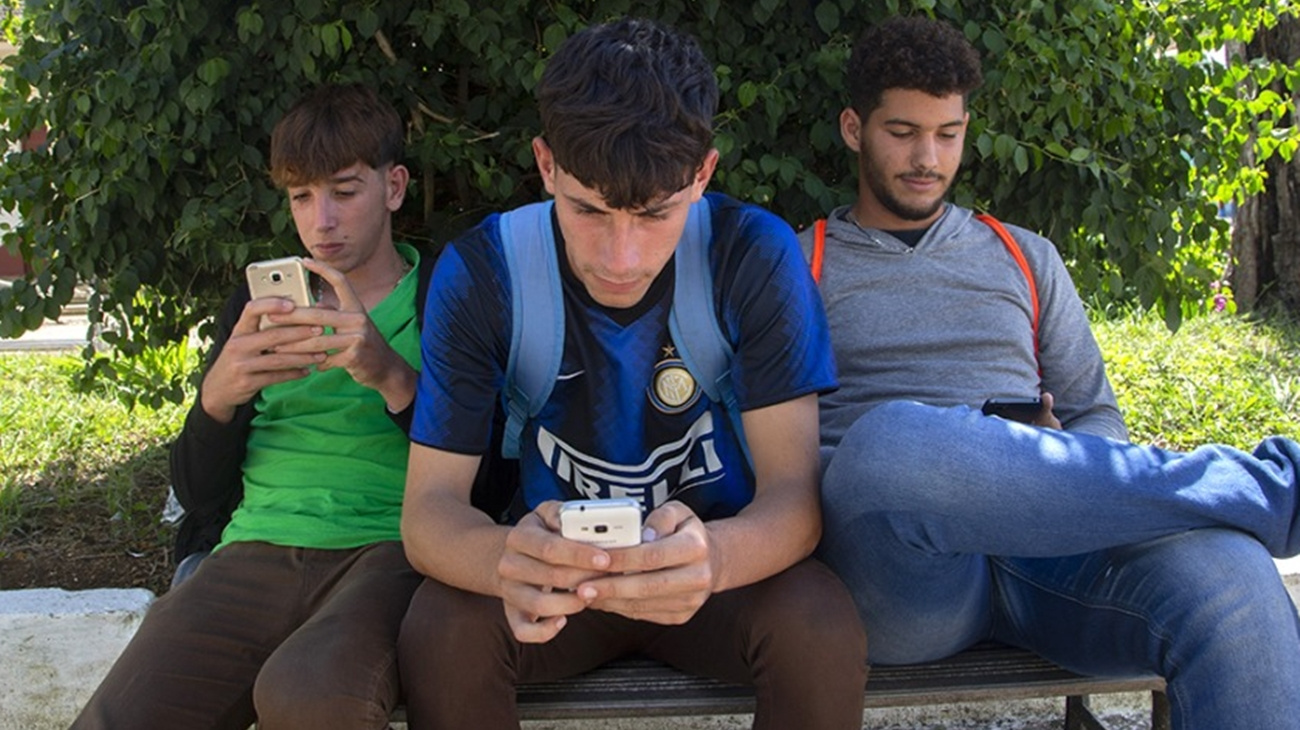
Etecsa, Cuba’s Communications Monopoly, Justifies Its ‘Tarifazo’ and Popular Indignation Increases

The president of the monopoly admits that they violated the contract to avoid “anxiety” and public action.

Various sectors of civil society and the Cuban exile are organizing a concrete response to the abusive price increase

14ymedio bigger14ymedio, Havana, 1 June 2025 — Despite the damage control operation launched by Empresa de Telecomunicaciones de Cuba S.A. (Etecsa) after announcing its latest price increase, which Cubans call the ’tarifazo’*, indignation among Cubans not only persists but has multiplied. Even official newspapers, such as the Matanzas Girón, published this Saturday an editorial with the flavor of protest. The Communist Party, with its usual arsenal of excuses, has ordered its cadres to justify the measure and organize “closed” meetings with various sectors, such as university students, in order to offer “specific solutions.”

The appearance this Saturday of the state monopoly directive on State TV’s Round Table program did not calm the waters. Randy Alonso acted more as the head of public relations for Etecsa than as a communicator. Faced with such a disconnection from reality, the regime activated plan B: Lázaro Manuel Alonso, the young face of officialdom with “license” to ask more incisive questions, although within the limits of the approved script.

The response of the president of Etecsa was a combination of corporate drama and revolutionary victimization]

“Why now?” asked the intrepid Alonso, alluding to the context of national weariness over blackouts, inflation, and a multisectoral crisis that is no longer worsening but is in its death throes. The response of Tania Velázquez Rodríguez, president of Etecsa, was a combination of corporate drama and revolutionary victimization: technological obsolescence, international frauds and unpayable debts. The full catalogue of the “good monopoly” manual in distress. continue reading

But if there is one thing that has not changed since the foundation of Etecsa, it is its financial opacity. Without competition, it can raise prices, offer questionable services and curb technological innovation without fear of retaliation. By the way, it reserves the right to cut off communications in case of protests, becoming the official fire-extinguisher of the regime. The problem is that so much abuse without competition also takes its toll, and not precisely in national currency.

Even other communist countries have preferred to open the cage a little

State monopolies like Etecsa are an endangered species. Andorra, with just 85,000 inhabitants, and Ethiopia (which has already sold 10% of its Ethio Telecom) are similar rarities. Even other communist countries have preferred to open the cage a little. Vietnam, for example, has operators like Viettel, MobiFone and Vinaphone, which compete with each other as good capitalist comrades. In China, although all companies are state-owned, they compete fiercely for the market. Even the paranoid North Korea has two operators: Koryolink (a joint venture with Orascom) and Kangsong NET, a state network launched in 2015.

Velázquez pulled out the excuse of “the cost of submarine cables.” The ALBA-1, launched in 2011 and operational since 2013, unites Cuba with Venezuela and Jamaica. Its 1,602 kilometers and 640 Gbps (gigabit per second) capacity cost 70 million dollars. More recently, the Arimao cable, 2,470 kilometers, linked the island with Martinique thanks to an agreement with the French Orange S.A. That’s a lot of fiber optics, yes, but with few visible results for ordinary Cubans who still depend on WiFi zones of the last century.

And no wonder: more than 85% of Etecsa’s infrastructure is obsolete, and more than half of its radio base stations lack energy backup. With the blackouts, the whole country can be disconnected. In addition, 10% of radio base stations have technical failures which, according to the directive, could not be resolved because of “lack of resources.”

Regarding the loss of foreign exchange, Velázquez admitted that the monopoly has ceased to capture “more than 60%” of what it used to receive from abroad. He also regretted that the “official channels” for recharging are “not being used as before.”

Velázquez, without blinking an eye, explained that this was not possible because “it would generate anxiety”

And then came the stellar moment: the justification of the violation of Etecsa’s own contract. Article 19 of the prepaid contract establishes the obligation to inform customers 30 days in advance of any price change. But Velázquez, without blinking an eye, explained that this was not possible because it “would generate anxiety” and possibly cause “actions” of the customers.

Etecsa, however, may have underestimated the reaction. This time it is not just complaints about being the last in line to buy chicken. Various sectors of civil society and the exile are organizing a concrete response. Between June 3 and 9, a campaign with the hashtags #BajenLosPreciosDeInternet, #EtecsaImpopular and #NoMasRecargasACuba will be deployed on X. The call sends a clear message: national patience is not infinite, let alone prepaid.

All this happens at the gates of summer, the season that in Cuba not only brings heat but also political commotion. If the regime has shown anything, it is that it fears a July with blackouts and disconnection more than any external sanction. What Etecsa did not calculate is that, with each rate increase, it is not only increasing its revenues, but also the chances of a new explosion.

*Translator’s note: The “azo” ending in Cuban Spanish is a ’magnifier’, in this case, roughly: “the gigantic price increase thing”

Translated by Regina Anavy

____________

COLLABORATE WITH OUR WORK: The 14ymedio team is committed to practicing serious journalism that reflects Cuba’s reality in all its depth. Thank you for joining us on this long journey. We invite you to continue supporting us by becoming a member of 14ymedio now. Together we can continue transforming journalism in Cuba.
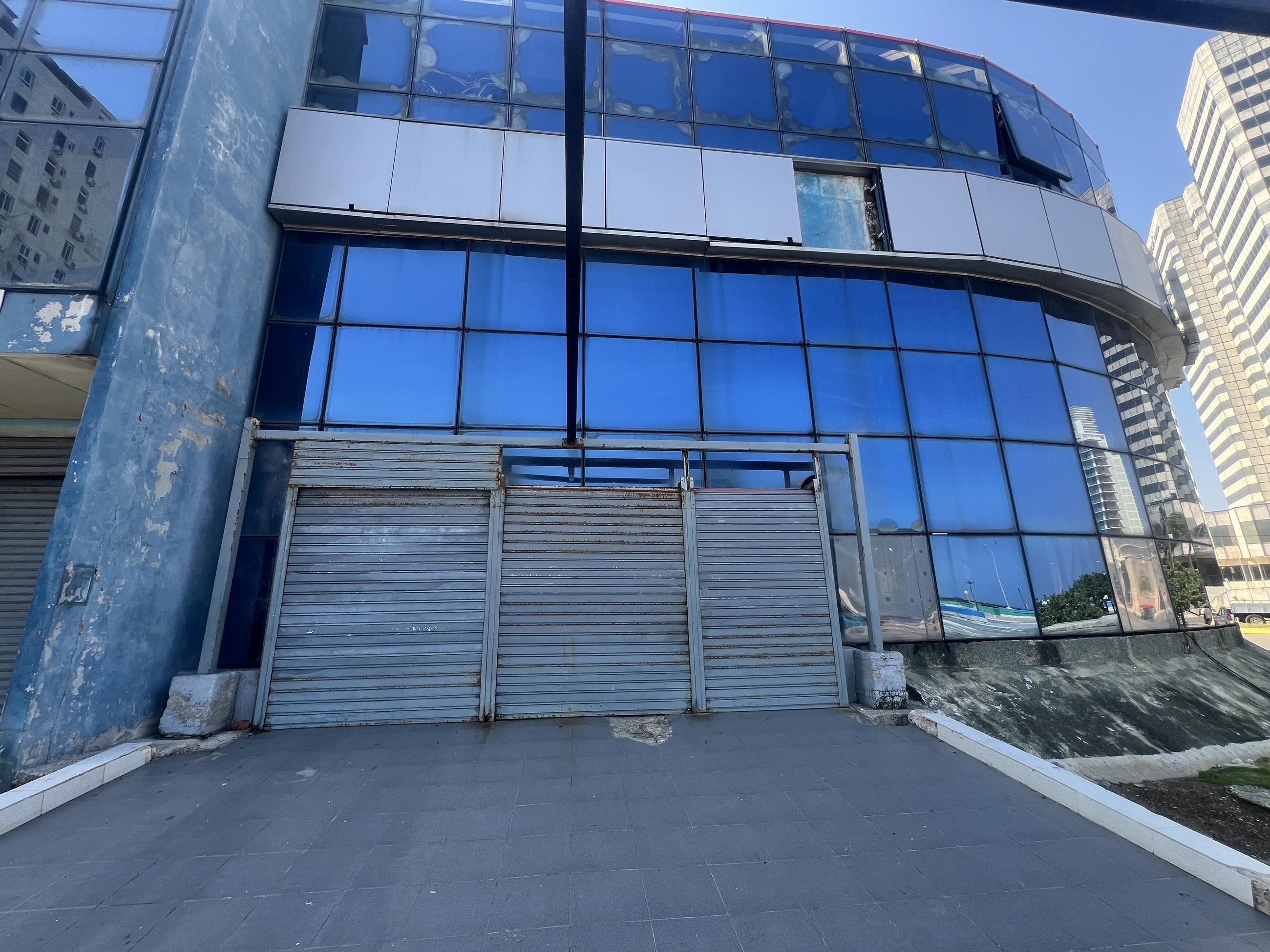
Cuba’s State Communications Company Etecsa Restricts Phone Refills in Pesos To Disguise the Dollarization of Its Services

There will be mini refills of 360 pesos for 30 days and others that cost up to 11,760 CUP.

Young Cubans using cell phones in a park / X/Etecsa

14ymedio bigger14ymedio, Natalia López Moya, 30 May 2025 — Friday started badly for customers of Etecsa, Cuba’s state telecommunications monopoly. Etecsa has implemented, beginning May 30, new commercial measures that limit the refills of minutes in Cuban pesos and increase the price of web browsing, while encouraging the purchase of mobile balances from abroad to attract foreign currency, in the midst of the deep crisis that the company is experiencing.

At a press conference, Lidia Esther Hidalgo Rodríguez, vice president of sales for Etecsa, explained that customers of the prepaid mobile service will be able to top up their main balance to reach a total amount of 360 Cuban pesos over the course of 30 days. This restriction contrasts with the possibility that Etecsa customers had, until this Thursday, of buying refills in national currency without restrictions.

With a refill of 360 pesos for 30 days, consumers will be able to purchase, at most, a package with 6 gigabytes (GB) of web browsing, 60 minutes for making calls and the possibility of sending 70 text-only messages (SMS). As an improvement, Hidalgo explained that data plans can be used from any continue reading

network, unlike before, when the packages divided the offer into 3G and 4G.

Below the package of higher price and capacity are those of 4.5 GB of Internet connection for 240 pesos; another of 2 GB + 15 min and 20 SMS for 120 pesos, and one of 4 GB + 35 min and 40 SMS for 240 pesos. “Current data-based plan offerings are improved, guaranteeing more resources for less,” the official added. Customers will keep the balance they have accumulated so far and can use it to “continue purchasing unlimited plans or make as many balance transfers as they wish.”

Hidalgo’s enthusiasm did not manage to disguise the increase in costs that this new adjustment means for Cuban pockets.

However, Hidalgo’s enthusiasm did not manage to disguise the increase in costs that this new adjustment means for Cuban pockets. Once the client has exhausted the 360 pesos of the monthly refill allowed, he will have to enter the field of the so-called “Extras” that are offered. Among those options, the prices increase significantly.

Beginning this Friday, to purchase an extra package of 3 GB of web browsing you need 3,360 pesos, while to obtain 7 GB you have to pay 6,720, a figure that exceeds the average monthly salary, which in 2024 stood at 5,839 pesos. The jewel in the crown, the 15 GB package of data to connect to the Internet, is 11,760 pesos, a price that has caused a flurry of indignant comments on the official pages of the company. The “Extras” are for data only and do not include voice or SMS.

The difference in costs is no small thing. Until yesterday, without a limit on refills or net purchases in national currency, Cubans could purchase packages for the 4G network to connect to the Internet with prices ranging from 1 GB for 100 pesos, 2.5 GB for 200 pesos, and the higher capacity, 16 GB for 950 pesos. With the new tariffs, the price of GB increases by 1,229% or, in other words, is multiplied by 13.

In Cuba the majority of Internet users access the network via mobile telephones, given the low penetration of cable connections

On the island, where most Internet users access the network via mobile telephones, given the low penetration of cable connections, the limit of 360 pesos per monthly refill and the high prices of extra packages augur a drop in the presence of Cubans in cyberspace. The complaints that from the early hours of the morning began to fill the official sites denounce, rightly, this situation.

“Did you know that there are many university students like me who need to access audiovisual materials on the Internet?” asked a young man in the comments of one of the many publications that spread Etecsa’s measures as if they were a benefit to customers. “This change forces Cubans to have someone buy a refill from abroad, but what about those who don’t have anyone out there?” another commentator complained.

The new prices have been presented as part of a strategy announced by Prime Minister Manuel Marrero Cruz during the sessions of the National Assembly of People’s Power in December. The official then commented that a series of measures had been adopted to stimulate Etecsa’s foreign currency earnings and complained that “since it gave us more business to pay for the packages in national currency,” the company had practically stopped earning foreign currency.

Hidalgo said this Friday that “all offers will keep the 300 MB of national navigation” and stressed that the three main ways to add balances remain in force: national refills in pesos, transfers of balances between individuals, and refills from abroad that are paid in foreign currency. The latter are the most important for the state monopoly, which is facing a deep crisis in its infrastructure due to low investment and lack of resources.

“There is only one extra plan with data, SMS and international minutes, although most customers make international calls through messaging platforms,” explained Hidalgo

“There is only one extra plan with data, SMS and international minutes, although most customers make international calls through messaging platforms,” explained Hidalgo. In addition, he also spread the appearance of a new menu, which is accessed by dialing *222*732# and which will allow users to know the amount of refill allowed and the date from which the customer must reload.

Etecsa’s move has not surprised anyone. In January, an employee of the state monopoly commented to 14ymedio that “What happens now is that a mobile phone customer sometimes has thousands of pesos in balance and can buy any navigation package he wants. He can even make transfers of that money to others so they can also buy a connection package, and this will be more limited.” The worker was categorical: “Etecsa can do almost nothing with those Cuban pesos. It’s a dead fund in the face of investments and for the purchase of infrastructure.”

Translated by Regina Anavy

____________

COLLABORATE WITH OUR WORK: The 14ymedio team is committed to practicing serious journalism that reflects Cuba’s reality in all its depth. Thank you for joining us on this long journey. We invite you to continue supporting us by becoming a member of 14ymedio now. Together we can continue transforming journalism in Cuba.

The Famous Paseo Galleries in Havana Are Closed, the First Step Towards a Probable Dollarization

The stores in the complex, located on the Malecón, sold in hard currency and were out of stock.

“People came from all over the country because we had everything,” recalls one employee

14ymedio bigger14ymedio, Havana, Natalia López Moya and José Lassa, 29 May 2025 — The sea is no excuse. This is well known to the residents of the Havana coast and also the customers who arrive these days at the Paseo Galleries, a few meters from the Malecón. Rust and neglect have taken over one of the most important shopping centers in the Cuban capital, a symbol of an economic upswing that fueled hopes at the beginning of this century. What’s left is a large empty store with littered floors full of rubbish.

Under this May’s sun, as hot as in August, a woman pushing a baby carriage advanced on Tuesday towards the doorway that was once full of taxi drivers, announcing trips to all the municipalities of Havana, and customers with their hands full of bags with newly purchased products. “They told me it was still open and that’s why I came,” grumbled the woman, who, instead of carrying a small child, used the carriage to carry some yuccas and a piece of pumpkin.

“This place is bare, they closed it down to fix it up and put it into hard currency,” ventures a passerby. / 14ymedio

“They closed it today because they’re fixing something with the electricity,” explained a resident in the vicinity who was passing in front of the pile of concrete and glass. “It’s empty; they also closed it for repairs and to turn it into a hard currency store,” ventured another passerby, who estimates that “before December” the new dollarized version of the store complex would be open. A few meters away, the “Magic World” sign on the old children’s store looked like it wouldn’t be able to last that long.

The closing also coincides with complaints on social networks about the poor state of the property and the shortage of goods on its premises. Images of empty refrigerators and dusty shelves raised a wave of indignation that seems to have contributed to the cancellation of service.

“It was one of the few places around here where you could still pay with MLC [freely convertible currency],” someone commented. That intangible currency, which barely a decade ago opened the doors of better-stocked markets, is now in full retreat on the island, although the authorities insist they will not eliminate it for the time being. The food market, with a butcher’s shop that alternated chorizos with pork loins, was often continue reading

frequented by the new rich who, finally, ended up packing their bags and emigrating.

Potholes forced customers heading to the market, located on the first floor, to walk carefully to avoid falls. / 14ymedio

With the same speed that the wealthiest buyers exchanged the corridors of the Galleries for the narrow airplane aisles, the building’s floor began to show gaps. The holes forced customers who went to the market, located on the first floor, to walk carefully to avoid falls. It also began to have a shortage of merchandise, and the boutiques were transformed into storehouses for ugly and smelly clothing.

But now, there is not even that. A young man emerged from his car and became another frustrated customer who came across a building that seems to have been abandoned and closed, waiting for dollarization to revive its spaces and refill its warehouses. “I came to buy some mosquito spray that they told me was here on the ground floor, but you can see that it’s not going to open today,” he said.

On the same ground floor, two decades ago, customers were delighted to see a well-stocked hardware store where the first single-handle faucets used by Cubans in their bathrooms were sold as a novelty. “People came from all over the country because we had everything,” recalls an employee who worked as a cashier in those years when the business center was synonymous with good taste and abundance. “We even had jacuzzis to sell,” she recalls.

The sliding doors, which previously only lowered when a hurricane was announced, are closed. / 14ymedio

Now, however, the sliding doors of the main entrance, which previously came down only when a hurricane was announced, are closed. The sea has left its signature on them, a rubric that is also seen on the reflective window panes that were once one of the architectural novelties of the property. Some are stained and others cracked, and the glass no longer reflects people and appliances, but only a deteriorated and empty environment.

“Home cleaning supplies,” can still be read on a part of the facade that once faced the Water and Soap chain, managed by the Italsav company throughout Cuba. The false ceiling that was partly collapsed, the completely empty shelves and not a soul inside the premises speak for themselves, even if no sign announces the closure of the business.

Contrast the fall into disgrace of this space with the central market that Berto Savina Tito, president of Italsav, has just opened; his relationship with Castroism has been known for decades. Last April, the firm opened Variedades Galiano Casalinda, in Central Havana, a showy store created by a joint venture with the Cuban state, offering “products for the home and the person” in dollars, with the Classic card or US bills.

Some stained and others cracked, the mirrored windows no longer reflect bodies or appliances, but rather the deteriorated and empty surroundings. / 14ymedio

Right in front of the hotel Cohiba, the Paseo Galleries have not yet had the luck to be able to collect hard currency, perhaps the cause of their current ruin. To go green, you need the greenbacks that have not arrived. That delay is bad news for guests of the hotel, directly across from the shopping complex, who used to cross the street to stock up at the food market or buy some sunscreen and flip-flops for the beach. Also to have fun in the evening at the Jazz Café.

But many of those travelers, who had planned to view the market from their hotel rooms, have now gone in the direction of the Dominican Republic or Cancun. And the new rich who went there now shop at Walmart or Home Depot, on the other side of the Florida Straits.

Translated by Regina Anavy

____________

COLLABORATE WITH OUR WORK: The 14ymedio team is committed to practicing serious journalism that reflects Cuba’s reality in all its depth. Thank you for joining us on this long journey. We invite you to continue supporting us by becoming a member of 14ymedio now. Together we can continue transforming journalism in Cuba.

Drought Threatens the Rice Paddies in Sancti Spíritus

The reservoir reached its lowest level in five years in May / Escambray

14ymedio bigger14ymedio, Havana, 29 May 2025 — Like last year, the Zaza reservoir is once again making headlines for its worrying storage levels, which have fallen below 12%. The disaster was seen coming from the beginning of the month, when the authorities blamed the drought for poor fishing, and, shortly after, 14ymedio reported the decline of the Yayabo river bed, which crosses the province and feeds the reservoir. Now, the official press admits, the reservoirs of the territory “are begging for water.”

Of the 1,020,000 cubic meters of water that can be stored, Zaza, the country’s largest reservoir, contains around 112,400, “the lowest figure recorded in the same period in the last five years.” In 2024 it also reached a critical 13%, but that was in June, one month later than this year.

The situation is similar throughout the province: the nine reservoirs in the territory amount to only 250.1 billion cubic meters of water, 21% of the total capacity. The authorities have been particularly concerned about the condition of the Zaza, which supplies other nearby provinces and numerous industries, as well as the rice fields of Sur del Jíbaro. continue reading

The reservoirs of Lebrije (49%), Felicidad (34%), Banao II (32%), Dignorah (22%) and Aridanes (9%) are also low in water volume

The situation is “tense,” recognizes Sancti Spíritus’ Escambray newspaper, which this Friday published the statements of Water Resources. According to José Carlos Hernández, the company’s specialist, the reservoirs of Lebrije (49%), Felicidad (34%), Banao II (32%), Dignorah (22%) and Aridanes (9%) also have low water volumes.

“Fortunately, the Tuinucú dam, which is responsible for ensuring water supply to the inhabitants of Cabaiguán and a large part of the provincial capital, stands at 73%, and the Siguaney reservoir, which is responsible for supplying the Sancti Spíritus industrial zone, shows 64% of its total capacity. Meanwhile, Higuanojo exceeds half of its total volume by 3%,” he added.

The manager called on people to save. “It is essential that people make rational use of water, given the low rainfall in the central region of Cuba.” As he explained, in Sancti Spíritus in May there has been only an average of 57.6 millimeters of rain, “when the historical number for this fifth month of the year is 176.2 millimeters,” he said.

Only two municipalities can be counted above this average: Fomento with 213.6 millimeters – even surpassing its historical May average – and Taguasco with 82.9.

The rest of the towns are in suspense, waiting for the rainy season to finally make its entrance. Especially in La Sierpe, also dedicated to the planting of rice – which requires moist land – and where not a single drop of rain has fallen this month.

At the beginning of May, another report from Escambray described the pitiful state of fishing in Zaza, which, due to drought and frenetic harvesting last year, has almost run out of fish. The situation, in turn, was a consequence of the huge drought that the reservoir suffered in 2024, to the point where on land, where there was water before, 14ymedio managed to photograph cows grazing. Then, said the press, for five years the reservoir did not open its spillway because it was not filled, even in the hurricane season.

The report published last week in 14ymedio on the Yayabo and Tuinucú rivers pointed out that with the small amount of rain, weeds and garbage have clogged the channels. The summer haze of the tropics makes them impassable, and, given the color of the water, it is unlikely that it can even be used for watering animals.

Translated by Regina Anavy

____________

COLLABORATE WITH OUR WORK: The 14ymedio team is committed to practicing serious journalism that reflects Cuba’s reality in all its depth. Thank you for joining us on this long journey. We invite you to continue supporting us by becoming a member of 14ymedio now. Together we can continue transforming journalism in Cuba.

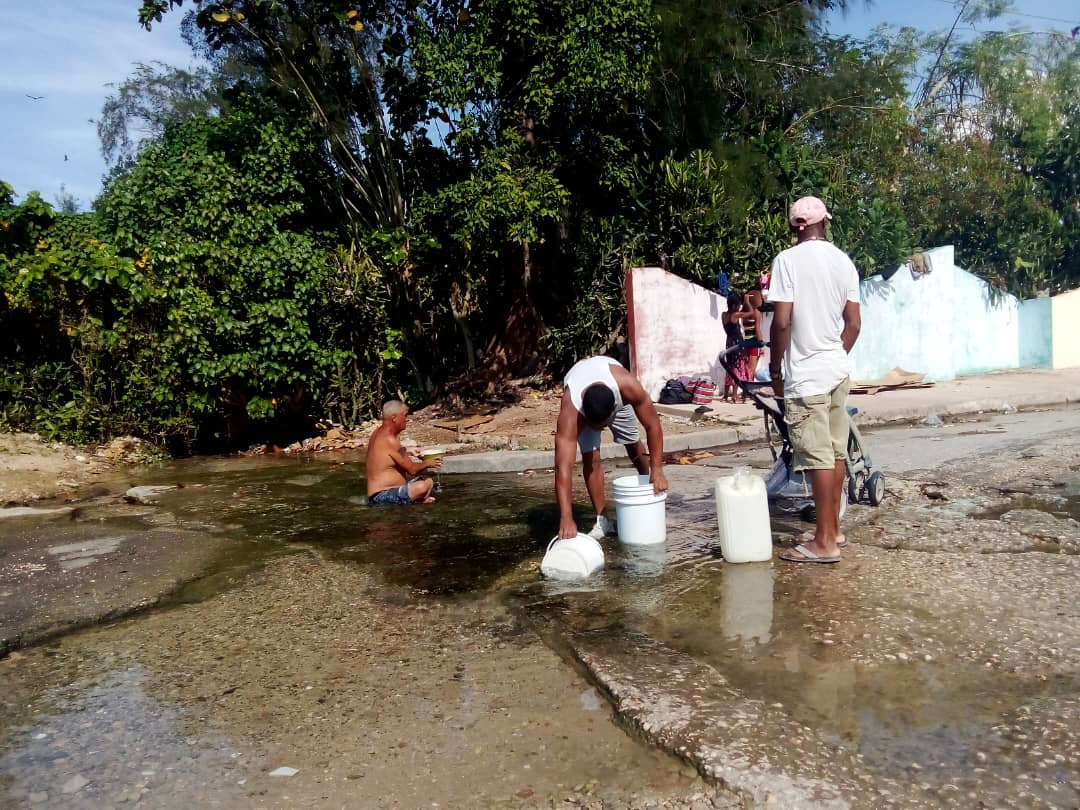
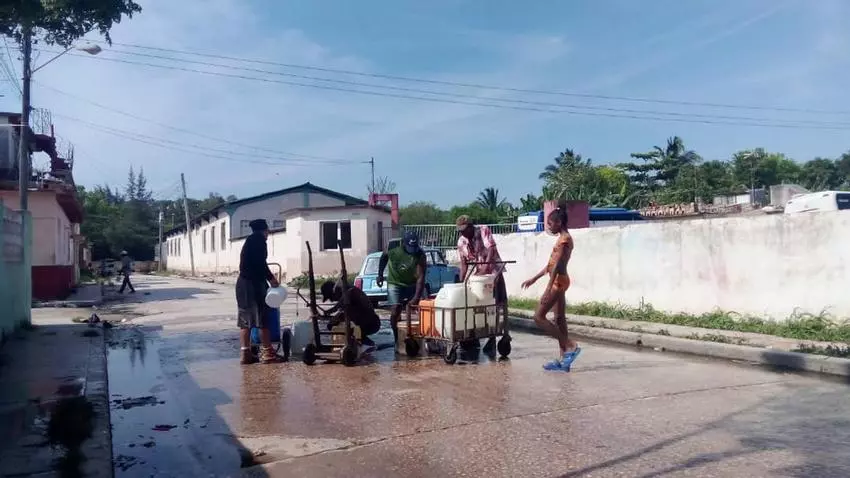
Without Electricity or Gas to Boil Water, Matanzas, Cuba Suffers a Hepatitis A Outbreak

Faced with a lack of water supply in their homes, thousands of residents fill buckets from leaking pipes in public places.

Faced with a lack of water in their homes, thousands of city residents rely on the so-called manholes. / 14ymedio

14ymedio biggerJulio César Contreras, Matanzas, 29 May 2025 — When the first signs of weakness appeared, Ana María, 68, thought it was due to the nutritional deficiencies she had been accumulating for years. Retired from the education sector, with a pension of no more than 2,000 pesos a month, this resident of the city of Cárdenas, Matanzas, didn’t immediately conclude that her discomfort was due to a virus, hepatitis A, and that it had been transmitted to her through the water.

In Ana María’s house, like in most homes in Cárdenas, the water coming through the pipes is dirty, sometimes brown in color and has an unpleasant odor. The solution families used for decades to counteract the poor quality was to boil and filter the water, but long power outages and the rising cost of cooking coal have forced them to abandon this healthy practice.

“I have a filter, one of those that claim to eliminate a lot of dirt, heavy metals, and bacteria, but it doesn’t seem to work for this,” Ana María tells 14ymedio. Despite defining herself as a “very cautious” person with everything she puts in her mouth to avoid diarrheal diseases, this time the hepatitis A virus evaded her hygiene protocols and now, from her liver, forces her to rest. continue reading

We should “consume quality drinking water, boiling it if possible,” but the lack of fuel makes this task difficult.

This retiree’s case is not an isolated one. The newspaper Girón recently confirmed the appearance of a hepatitis A outbreak in the 13 de Marzo neighborhood and the La Marina neighborhood in Cárdenas. The report warns that people should “consume quality drinking water, boiling it if possible,” but the lack of fuel makes this task difficult. Faced with the choice between using the limited amount of liquefied natural gas, firewood, or coal, which they can purchase at 1,300 pesos a sack, to heat food or water, most Matanzas residents opt for the former.

Hepatitis A, an infection transmitted through the fecal-oral route, usually through contaminated food or water, typically has a good recovery prognosis, and those who suffer from it acquire lifelong immunity. However, the aging population, malnutrition, and difficulties in resting and eating according to medical recommendations, and maintaining hygiene during illness, hinder the process of overcoming the virus.

“In this neighborhood, there’s an elderly woman who had to be taken to the hospital because she contracted hepatitis A and was already sick, bedridden, with bedsores, and alone,” explains Ana María. The exodus of children and younger relatives has left many elderly people in an extremely vulnerable situation. In the face of any health problem, they find themselves helpless, without home care, and lacking medication.

“The doctor couldn’t even give me instructions on what kind of diet I should follow because he says he knows I won’t be able to follow it.”

“They prescribed me rest and plenty of water. I know it’s a virus and there’s not much I can do, but the doctor couldn’t even give me instructions on what kind of diet I should follow because he says he knows I won’t be able to follow it.” Low fat, natural products, vegetables, lean proteins, and no alcohol complete the suggestions for those suffering from hepatitis A, precisely the food groups with the highest prices in the markets.

Others don’t even know if the fatigue they’re experiencing is due to the virus spreading through the province. Abel, 23, hasn’t been able to get out of bed for days. He blames his laziness on the water from a supply point in the city of Matanzas, across from the Transmetro bus station, a few blocks from the Simpson neighborhood. He also has intermittent fever and nausea, but the lack of reagents for the test delays the results, and he can only guess that he has hepatitis A.

The manholes are piles installed in a corner or some hole in the pipeline that spill their contents into a public space. / 14ymedio

Two of Abel’s friends have already been diagnosed with the virus. “They collect water from the small well next to Watkins Park Zoo, but it could all end up being contaminated,” warns the Matanzas resident. Faced with a lack of water supply in their homes, thousands of city residents flock to the so-called manholes, sinks installed on a street corner or a hole in the sewer that spills its contents into a public space, where they fill buckets, jugs, and tanks that they then haul back to their homes.

“The other day, a Public Health inspector, seeing us filling the buckets, warned us not to drink that water, but what can we do?” the young man reflects. His hope is that he hasn’t lost his appetite, one of the most common symptoms of hepatitis A, and that, therefore, his discomfort could be just a minor stomach infection. Acute diarrheal diseases are also hitting the province hard, and their prevalence is expected to increase as summer approaches.

“A Public Health inspector, seeing us filling the buckets, warned us not to drink that water, but what can we do?” / 14ymedio

“If I had the money, a courier would bring spring water to my doorstep,” reckons Abel, who wants to avoid future moments of uncertainty and fatigue. “What we’re doing at home is using different utensils to eat, but we’re forced to use the same bathroom, and most of the time, we don’t even have water to flush or wash our hands.”

Under the kitchen counter, Abel’s family keeps containers containing some of the water they carried for several blocks. This essential and vital liquid contains their greatest ally and perhaps their worst enemy.

____________

COLLABORATE WITH OUR WORK: The 14ymedio team is committed to practicing serious journalism that reflects Cuba’s reality in all its depth. Thank you for joining us on this long journey. We invite you to continue supporting us by becoming a member of 14ymedio now. Together we can continue transforming journalism in Cuba.

The Cuban Regime Imposes a Leader on Freemasonry and Will Freeze Their Bank Accounts if They Reject Him

Cuba’s Ministry of Justice replaces the unruly José Ramón Viñas with the ‘babalawo’ Lázaro Cuesta

José Ramón Viñas and Lázaro Cuesta, during a Masonic act in Havana / Facebook / Gran Logia de Cuba

14ymedio bigger14ymedio, Juan Izquierdo, Havana, May 29, 2025 — The man that the Ministry of Justice wants to command the Supreme Council for the 33rd Degree – the highest authority of Freemasonry in Cuba, next to the Grand Lodge – is Lázaro Cuesta Valdés. The play is unsettling. This is a veteran Masonic leader, used to getting along with the government, who is also the head of the independent Cuban Yorubas.

The proposal that the Babalawo (High Priest) Freemason take over the reins of the Supreme Council is only a side effect of the letter signed on 27 May by the Association Directorate of the Ministry. Its declared objective is to revoke the re-election of José Ramón Viñas, who has been critical of the regime and monitored by State Security for years.

The schism between the Supreme Council and the Grand Lodge has been the great internal consequence of the crisis in which, since January last year, Freemasonry has been immersed on the island. It was Viñas who blamed Mario Urquía Carreño, former leader of the Grand Lodge, for stealing $19,000 from his own institution and allowing political police interference. After a year and a half, the fraternity is still divided, the scandal remains active, and “excommunications” have not been lacking on either side. continue reading

Recently arrived at the fraternity, Cuesta seems to agree with the proposal of the Ministry of Justice

Recently arrived at the fraternity, Cuesta seems to agree with the proposal of the Ministry of Justice. A letter with his signature – the same one that usually initiates the Letter of the Year of the Miguel Febles Commission – also circulates among the Cuban Masons. If the Masons obey this external directive, the Supreme Council will have a leader willing to get on well with the regime. If they do not, the Ministry threatens to revoke their official recognition as an association and freeze their bank accounts.

The reaction of Cuesta, of total compliance with the Ministry, is surprising, given that last January – in connection with the publication of the Letter of the Year – he refused to answer CiberCuba’s questions about the Masonic crisis. “The Letter of the Year Organizing Commission does not have among its purposes the ability to deal with issues arising in institutions or organizations outside our faith. I think it would be disrespectful of me to generate criteria or opinions,” he said at the time.

On the horns of a dilemma, several members of the Supreme Council have protested. The writer and independent journalist Ángel Santiesteban, recently expelled from the Grand Lodge, attributed the move to State Security and summarized the most recent attempts by the Government to interfere in the order: the protection of Urquía Carreño after the robbery; the controversial appointment of Mayker Filema, now also in dispute, as his successor; the infiltration of numerous agents into the Masonic ranks and now the decision to recognize Cuesta as leader of the Supreme Council.

“Freemasonry has been unable to stabilize for two years because of the constant violations of laws that state agencies ignore and others get around or misinterpret, blatantly, as if Masons do not have the capacity for intelligence,” he said.

Santiesteban demanded respect for the two recent elections held by the Masons, in an attempt to resolve the schism

Santiesteban demanded respect for the two recent elections held by the Masons, in an attempt to resolve the schism: that of Alberto Kessel, on May 25, as Grand Master – a decision that Filema rejected in a statement – and that of Viñas as Commander of the Supreme Council.

Other Masons have expressed themselves, sometimes anonymously, to say that Cuesta has been a man of the regime and an “active member of the Ministry of the Interior since 1990.” Others accuse him of corruption and suspect that the same person who already leads the Miguel Febles Commission of the Yorubas aspires to lead a high Masonic body.

The Commission, initially opposed to the ruling Yoruba Cultural Association, has been dropping its critical tone under Cuesta’s leadership, and two years ago it waited for Cubadebate to publish the official Letter of the Year before releasing its own. Many have attributed the delay to complicity between the two groups.

For his part, Viñas maintains his usual public silence on matters concerning Freemasonry. As explained last year to 14ymedio, he prefers not to make statements to the independent press about a crisis whose solution he considers the province of the Masons, not suitable for “profane” debate.

The current Commander has been in office for nine years, a term that the Ministry of Justice considers excessive and illegal, so leadership must fall back, they argue, to the Masonic leader who occupied the post before Viñas, meaning Cuesta.

Translated by Regina Anavy

____________

COLLABORATE WITH OUR WORK: The 14ymedio team is committed to practicing serious journalism that reflects Cuba’s reality in all its depth. Thank you for joining us on this long journey. We invite you to continue supporting us by becoming a member of 14ymedio now. Together we can continue transforming journalism in Cuba.

Abraham Maciques Has Died: The Architect of a Parallel Economy That Kept Castroism Afloat

Maciques retired as he lived: without fuss, but with the certainty that his legacy had the friendship of Dalia Soto del Valle / Más Cuba

14ymedio bigger14ymedio, Yunior García Aguilera, Madrid, 29 May 2025 — One of the most powerful and discreetly feared men of Castroism has died: Abraham Maciques Maciques, the great administrator behind the scene. He was 95 years old and survived almost all the purges of Castroism. He died this Wednesday in Havana, after more than six decades of juggling currency, hotels, congresses and financial fugitives.

Maciques was not a minister, nor a general nor an ideologue. He was something more useful: a precision gear in the economic machinery of the regime. A bureaucrat with a head for business, without bragging or proclaiming anything, he wove networks of power through entities like Cubalse, Cubanacán S.A. and the all-powerful Palco Business Group, from where he pulled strings for the millionaires.

He was born in 1930, in Matanzas, to a family of Jewish origin. At the end of the 50s, he was a minor sub-delegate of Tourism in his province, when he crossed paths with a young bearded man who promised to redeem Cuba by shooting left and right. The chemistry was instantaneous. Fidel Castro sent him to the Ciénaga de Zapata to settle a minor matter with coal miners, and there he was surprised by the invasion of the Bay of Pigs. The fright became confidence, and the bond with Fidel and Celia Sánchez was forged. continue reading

A bureaucrat with a head for business, without bragging or proclaiming, he wove networks of power through entities like Cubalse, Cubanacán S.A. and the all-powerful Palco Business Group

From then on, Maciques became part of that small circle that did not need a uniform to exercise power. He presided over Cubalse – a kind of exclusive consumer holding for the nomenklatura – directed the construction of the Palace of Conventions and ended up as tsar of Cubanacán S.A., the spearhead of Cuban tourism in the 80s.

It was precisely at this time that Havana became the refuge of one of the most famous financial scammers of the 20th century: Robert L. Vesco, alias the pirate banker, a fugitive from the American justice system and star of the regime. “We don’t care what he did in America. We only care about his money,” said Fidel, words that should be chiseled into marble at the entrance to the Ministry of the Interior.

Vesco landed, grew a beard so he would fit in and called himself Tom Adams, as if that would erase his record. From Palco, with Maciques as a silent partner, they set up a network that included Donald Nixon Jr. – nephew of former President Richard Nixon – and José Antonio Fraga Castro – nephew of Fidel and director of Labiofam – to promote a miraculous HIV vaccine called Troxidal. They invested $30 million. It did not cure anything, but they made history: the fraud ended with Vesco sentenced in 1996 to 13 years in prison in Cuba. Maciques, of course, came out unscathed. Fidel took care of his own, especially if they knew how to keep quiet.

Maciques handled, for decades, what might be called institutionalized elitism

From his throne in Palco, Maciques handled, for decades, what could be called institutionalized elitism: exclusive hotels, houses for diplomats, restaurants invisible to the ordinary Cuban, free zones, special services for foreign companies. Palco was a lucky country within the country, a Cuba without blackouts or lines, reserved for those who were well connected.

The Soviet collapse turned those operations into pure gold. While the people lined up for bread, Maciques administered currency, international connections and incentive packages for foreign delegations. His real position never appeared in the Official Gazette, but his power was tangible: anyone who wanted to move money or set up a fat business deal had to go through him or stay out.

In June 2021, when the generals began to shake up the “historical founders without uniform,” Maciques was silently dismissed by Prime Minister Manuel Marrero Cruz. Palco was partially absorbed by Gaesa, the military emporium that devours what remains of the national economy. There was no scandal, only a dry official notice and discreet relief. Maciques retired as he lived: without fuss, but with the certainty that his legacy had the friendship of Dalia Soto del Valle, the widow of the first Castro.

The death of Maciques does not close a chapter: it closes a library

Miguel Díaz-Canel, in his usual necrological tone of ungracious official, lamented the loss and praised his “collaboration with Fidel and Celia,” as if he were remembering the receptionist of a hotel. Palco, for its part, dismissed him with honors, recognizing him as a “founder and essential figure.” No one said what he really was: the architect of a parallel economy that kept Castroism afloat when everything else was falling apart.

The death of Maciques does not close a chapter: it closes a library. He was a man who understood better than anyone else the Cuban alchemy of mixing ideology with business, confidentiality with privilege, revolution with reserve. He survived it all: Celia, Fidel, the sanctions, Vesco, sex tourism, blackouts, reforms, the Castro nephews and Gaesa itself.

His tombstone will say that he was the “founder of Palco.” In reality, he was something else: the steward of Castroism, but without the keys to the safe.

Translated by Regina Anavy

____________

COLLABORATE WITH OUR WORK: The 14ymedio team is committed to practicing serious journalism that reflects Cuba’s reality in all its depth. Thank you for joining us on this long journey. We invite you to continue supporting us by becoming a member of 14ymedio now. Together we can continue transforming journalism in Cuba.