
When the Motherland is Really a Mother

Madrid has offered Spanish nationality to political prisoners released by the Daniel Ortega’s regime in Nicaragua. (EFE)

14ymedio bigger14ymedio, Carlos Alberto Montaner, Madrid, 18 February 2023 — There is a rhetorical way of referring to Spain: “The Motherland.” But sometimes that fits reality and is said without hypocrisy. Especially, when it involves some sacrifice and a certain price has been paid. The socialist government of Spain, contradicting its minority partners in the coalition with Podemos, the communists, has offered citizenship to 222 Nicaraguan opponents. The comrades are going nuts.

That’s very good. The offer was made by José Manuel Albares, the Spanish chancellor, and there are 222 European Union passports. If the satrapy formed by Ortega and Murillo, president and vice president, (and also a married couple), planned to leave those who dared to do politics in Nicaragua without nationality, they were meticulously wrong. The Spanish passport opens the door to 27 nations. In addition, they can fly to many places without having a visa.

The Venezuelans are settled in the Salamanca neighborhood of Madrid, a place that doesn’t know trouble judging by the high price per square foot. There are, more or less, 400,000 that have settled in the Kingdom of Spain. There are hundreds of entrepreneurs who benefit from franchises or who create them. Thousands more work as clerks in the stores that serve Venezuelans.

If the flood of Dominicans, Ecuadorians and Peruvians who arrived earlier — there are one and a half million Hispanic Americans living in Spain — was characterized by poverty, with some exceptions, these Venezuelans, the rich and the poor, have skills and modernity in common. Cubans, another substantial source of emigrants, always saw Spanish destiny as a step towards their integration into the United States, which has always made things easy for Cubans.

Spain is correcting numerous mistakes. Passports have been offered to the descendants of the Sephardim (not the English who expelled the Jews in 1209, or the French in 1306). On such a significant date as 1492, from the kingdoms in which they had lived for hundreds of years, they were expelled from Castile and Aragon. A century earlier, in 1391, the popular pogroms occurred in which they killed numerous Jews and burned the Jewish quarters. continue reading

It was the classic case of shooting oneself in the foot. Suddenly, the investments dried up and the counselors to the kings of Castile and Aragon by such a distinguished community disappeared, almost in their entirety. It is uncertain how many Jews were affected by the expulsion decrees (there were two edicts), but from March 31 to July 31, 1492, apparently about 100,000 people were expelled, and they had to sell their properties at great discounts during that period. The Catholic Monarchs, while teaching Spanish to the New World, a magnificent gift that unified several hundred pre-Columbian languages and dialects, inadvertently created, with the expulsion of the Sephardim, a very special commercial network in the eastern Mediterranean.

In truth, during the Franco regime, the exiled Cuban students who came to Spain, to finish their careers interrupted by communism, were taken in. But Franco died at the end of 1975, and the exiled Cubans had the same fears as the Spaniards: that all the passions repressed since 1939 would be unleashed. Not in vain, Cuba had been strongly linked to Spain until 1898 and was the last of the American colonies that was emancipated. However, what happened was exemplary and unexpected: a surprising peaceful transition to democracy and freedoms. Certain Cubans, on and off the Island, took note. It was totally possible to break with communism without the experiment crumbling in their hands. In any case, they would have to wait until communism imploded, something that happened between 1989 and 1991.

After the news that the Caudillo had died, events began to accumulate. In 1976, Adolfo Suárez was already head of government, and the Cuban opposition depended, on the Island, on the Spanish diplomat Jorge Orueta, and outside, on Carlos Robles Piquer and his brother-in-law, Manuel Fraga Iribarne, and on his willingness to present a story, El radarista [The Radar Operator] by Commander Eloy Gutiérrez Menoyo, Hispanic-Cuban, a social democrat and one of the most important leaders of the Revolution.  Eloy had to wait in the harshest of prisons, where he was severely tortured, until Governor Felipe González released him.

Felipe González, who crossed Moncloa with the opposition to Castroism and, at the same time, called Mexican President Carlos Salinas de Gortari and asked him to listen to the opposition — for which Fidel never forgave him — was replaced by José María Aznar after exemplary elections. One of Aznar’s first diplomatic successes was to achieve a common diplomatic position on the Cuban issue within the European Union. The proposal of the “Common Position” was essentially written by Miguel Ángel Cortés in 1996, a deputy and senator for Valladolid within the Popular Party.

Aznar’s two mandates were characterized by a very clear policy against Fidel Castro and Hugo Chávez. This did not prevent Fidel from calling him on the phone to beg him to intercede for Chávez’s life during the coup in April 2002, which he did. What was not subject to any change was the Common Position, which remained inalterable. Guillermo Gortazar, historian and deputy of Alianza Popular, at the head of the Hispano-Cuban Foundation and the collection of Revista Hispano-Cubana, admirably curated by Grace Piney Roche, gives a good account of this.

The Common Position was supported by the 15 nations that were then part of the EU (today there are 27). It remained until it was not possible to sustain it within the socialist government of José Luis Rodríguez Zapatero. In June 2008, just three months after the elections that had given him a second term, Spain changed its vote. But he could not avoid the contempt of Havana for his insistence on the release from prison of the dissident Raúl Rivero (2005) and his wife Blanca Reyes, a legendary lady for having walked, Sunday after Sunday, with the Damas de Blanco [Ladies in White]. Rodríguez Zapatero defended himself against these accusations on the grounds that he had not granted citizenship to Rivero.

That was before, in the time of Zapatero. Now it’s the turn of the Nicaraguans and Sánchez. With a stroke of the pen, 222 people have been granted citizenship. That’s what a mother does. She comforts and encourages her children not to shrink from adversity.

Translated by Regina Anavy

____________

COLLABORATE WITH OUR WORKThe 14ymedio team is committed to practicing serious journalism that reflects Cuba’s reality in all its depth. Thank you for joining us on this long journey. We invite you to continue supporting us by becoming a member of 14ymedio now. Together we can continue transforming journalism in Cuba.
Actions Against the Aging of the Population That Do Not Work

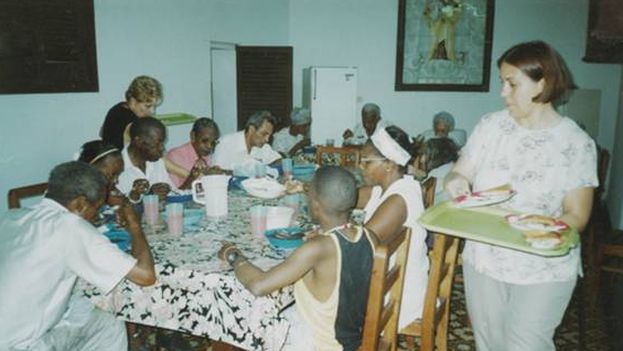
One example of the elderly care systems that exist in Havana. (Orden de Malta)

14ymedio bigger14ymedio, Elías Amor Bravo, Economist, 19 February 2023 — The actions of the Cuban communist regime to face the serious problem of accelerated aging of the population do not work and are based on an ideologized and untechnical analysis of the situation. This is the conclusion that can be obtained from a note published in the state press informing of the update in 2022 of the national policy to address demographic dynamics.

The Cuban population aged 60 and over accounted for about 21.6% at the end of 2022, being the only segment of population that is increasing in the country, with almost 2.4 million people in this category.

And as happens in many other areas of government action, the response of the communist regime to the needs of older adults has resulted in more public spending. Specifically, a state budget for 2023 of 2,113 million pesos ($88,042) has been announced, aimed at supporting actions against the accelerated demographic aging suffered by the country.

Under such conditions, strategies have been announced related to providing resources (that is, spending more) on the production of dental implants and hearing aids, nursing homes, maternal homes and grandparents’ homes.

At the same time, the central government has instructed territorial programs to give priority to sensitive issues such as the decrease in the working-age and economically active populations, the increase in urbanization (despite the decrease in the urban population) and the average number of people per household.

The Cuban demographic situation is explained by the joint evolution of fertility, mortality and internal and external migrations in response to an unproductive, inefficient and collapsed economic system. All of this significantly influences the fall in the birth rate and fertility, and the aging of the population. And here comes the error of the leaders, mixing actions and public policies, which have little to do with each other. continue reading

At this point, there are many doubts. What will the care program for the infertile couple or the modernization of equipment for assisted reproduction centers have to do with the accelerated aging of the population? What is the point of territorial governments having to allocate more resources to the construction and maintenance of childcare centers, the construction of homes for mothers with three children or more, as well as housing needs, when the urgency is in a population that is growing older?

There is the impression that the regime mixes policies, actions and resources that should have a different design for more effective execution. It doesn’t know what to do and relegates everything to public spending.

It’s not a matter of complexity of Cuban demographic dynamics, but of correctly interpreting trends and needs and providing effective and efficient solutions. There is a lot of work to do before blaming the embargo, that is what is called the blockade, for the problems of aging, which is what they always end up doing.

Fundamental aspects for the elderly population, such as active aging and unwanted loneliness, are absent and irrelevant in the solutions proposed by the communist regime. And yet, experts indicate that they determine the success of policies aimed at older people in all countries that share the same problem.

Active aging allows people to enjoy more years, with better health and physical condition. And this can happen in Cuba by reorienting the health system towards the elderly, which will require very important investments. The standard of living of older people in Cuba, with pensions of very low purchasing power, compromises the objective of active aging. The elderly are a vulnerable group, living precariously at the expense of the regime’s inefficiencies.

The extension of the working age can alleviate the situation of poverty associated with retirement. Promoting the professional figure of seniors in companies and in education and training can serve to alleviate the negative effects of aging. But there are many more things to do, and in Cuba, these solutions neither exist nor are anticipated.

As for unwanted loneliness, it is a threat that falls on the elderly in a particularly intense way. The situation in Cuba is very bad, because young family members need to leave the country in search of new horizons. They leave behind the elders, who barely survive thanks to the remittances they receive from abroad.

Those elderly who lose their family and friends experience unwanted loneliness that negatively influences their living conditions and introduces great suffering when their immediate relatives are prohibited from returning to the Island due to regime sanctions, as has happened in the recent history of Cuba. That unwanted loneliness is not discussed in the actions designed by the authorities, because offering “parents’ houses” to address this problem means they have no idea what to do.

Let no one be fooled. The Cuban communist regime’s response to the needs of older adults comes too late and is ill-conceived. The effect of the waste of public money will be practically zero, especially considering that their policies to promote the birth rate will be difficult to implement.

The leaders have to recognize the origin of the problem that grips Cuban society and face its solution with appropriate actions that don’t depend on the management of public spending. It’s not possible to allocate public spending to social policies that are directly related to the standard of living and well-being of the population; in short, the economy. The problem is that no matter what they do, it’s too late.

Translated by Regina Anavy 

____________

COLLABORATE WITH OUR WORKThe 14ymedio team is committed to practicing serious journalism that reflects Cuba’s reality in all its depth. Thank you for joining us on this long journey. We invite you to continue supporting us by becoming a member of 14ymedio now. Together we can continue transforming journalism in Cuba.
The United States Prepares a Regulation That Will Make it Difficult for Cuban Immigrants to Apply for Asylum

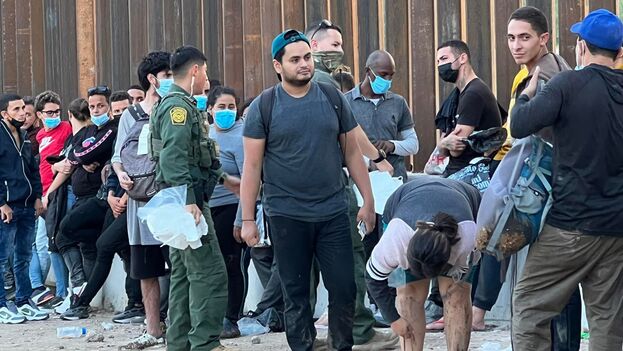
A group of migrants at the southern US border. (Marlene Guzmán/Univision Network/Facebook)

14ymedio biggerEFE/14ymedio, Washington/Havana, 21 February 2023 — The US Government is preparing a regulation that would make it difficult for thousands of people to apply for asylum, including Cuban migrants, as it would prevent those who cross the border illegally or who don’t apply for protection in other nations from entering the country.

The regulations, created jointly by the Department of National Security and the Justice Department, would make it easier for the Government to deport people who cross the border and ask for asylum, since, by doing so illegally, they would lose the right to benefit from this protection.

White House sources explained on Tuesday that the regulations are intended to “fill the legal gap” that will arise after the possible end of Title 42 next May, since Congress has not taken “any measure to guarantee the safe and humane management of migrants.”

“This Administration will simply not allow mass chaos and disorder at the border due to the lack of action by Congress,” said these sources, after the regulations were published in the Federal Registry on Tuesday and a 30-day period of arguments was opened. continue reading

Although these sources did not explain when the regulations will be applied or what will happen if Title 42 is extended again (as has happened previously), they did point out that “the intention is for the regulations to take effect when Title 42 expires and not before.”

If it enters into force, this would be one of the most restrictive immigration regulations in the entire Administration of Joe Biden, who, upon assuming the presidency in January 2021, eliminated many of the exclusionary immigration measures of the Donald Trump Administration (2017-2021).

Among them, he eliminated the controversial Asylum Cooperation Agreement (ACA) with El Salvador, Guatemala and Honduras, known as the “safe third country” agreement, which allowed the United States to deport refugees who arrived in its territory and had not asked for asylum in the first country they stepped on when they left their home country.

However, official sources of the Biden Administration wanted to distance themselves from this rule and assured that the new one is not the same.

“It is definitely different in the sense that we are offering a refutable presumption and not prohibiting access to asylum, as the previous Administration did,” they pointed out. Thus, the regulations “would allow people to apply for asylum in the United States whenever they enter through legal means,” they insisted.

Title 42 is part of the Public Health Law of 1944 and temporarily authorizes the expulsion of foreigners for health reasons.

The government of then-President Trump resorted to that rule in March 2020, at the beginning of the COVID-19 pandemic, and Biden decided to extend it on several occasions when it was about to expire.

However, with the pandemic already over, it is likely that this rule will be lifted next May, a situation that could trigger an unprecedented crisis on the southern border.

Translated by Regina Anavy

____________

COLLABORATE WITH OUR WORKThe 14ymedio team is committed to practicing serious journalism that reflects Cuba’s reality in all its depth. Thank you for joining us on this long journey. We invite you to continue supporting us by becoming a member of 14ymedio now. Together we can continue transforming journalism in Cuba.
Cuban Television Debates the Negative Effects of Debt Default on Attracting Investment

Economists insist that something is wrong when the promised foreign investment doesn’t arrive. (Granma)

14ymedio bigger14ymedio, Madrid, 22 February 2023 — Cuban economist Carola Salas surprised viewers in the program Cuadrando la caja [Squaring the Box], broadcast on Cuban Television, by saying: “We have never really received the amounts promised in foreign investment, which means that something is not going well for us.”

The expert participated in a program together with her colleagues Antonio Romero who, like Salas, belongs to the Center for Research on the International Economy, and Jorge Casals, of the Center for Research on International Policy of the Ministry of Foreign Relations. The program was dedicated to the insertion of the Island’s economy into the international panorama, and was broadcast on February 5. The program received low ratings but acquired greater importance when the official press published the transcript of the discussion on Tuesday [partially in English here].

The expert’s statement came at a time in the conversation when there was talk of financing to structurally change the national economy, a need that was expressed on several occasions during the debate. Salas noted that foreign investment has become indispensable since the 1990s and that, although it has improved a lot, “the amounts are still insufficient and the commitments that are generated are not fundamentally fulfilled.”

In addition, he urged emigrants to participate in the “development” of their country by financing enterprises. “[It] can generate something that is widely used in the world, which is the interest that a citizen who lives elsewhere in the world can have with his land, with his country of origin (…) and can then invest his money in something that implies an improvement of relations,” he suggested, emphasizing the multiple appeals that the Cuban Government has made in these years to encourage exiles.

The experts, in a program led by Rafael Montejo, began their discussion with a conscientious description of how the Cuban economy developed internationally since 1959, specifically within the Soviet camp, and how the situation broke down after the fall of the Berlin Wall. continue reading

Experts are clear about the first cause of the current problems, aside from the ‘blockade’ [i.e. American embargo]: the departure of the Island from international financial organizations, promoted by Fidel Castro in 1964 with the departure from the International Monetary Fund and, later, of the World Bank. The leader of the Revolution was also the main promoter in advocating that Third World countries not pay their debts.

Today they are experiencing the consequences, the experts now agree — although without blaming anyone. “That non-participation in international financial organizations prevents us from having a lender of last resort (…). It limits our ability to access international credits, and it raises the country’s risk to very important levels, to the point of being at the limit for divestment,” Salas summarizes.

The specialist notes that the vast majority of countries have foreign debt, but they can face it through this type of credit, either in better or worse conditions. However, Cuba does not even have that last resort, which in turn worsens the situation.

“The repeated breaches of international commitments on foreign debt, apart from hindering and lowering the country’s financial credibility, discourage investments,” he adds. The resources that the Island uses, with the lack of lenders, are discounted payments on the nominal value, the creation of funds, the exchange for investments, the conversion of debt amounts into national currency, and the issuance of bonds or debt bonds with sovereign guarantees, he mentions.

During the talk, the Island’s main trading partners are mentioned, all of them expected. According to Antonio Romero Gómez, five countries concentrate 60% of all foreign exchange: China, Venezuela, Canada, Spain and a fifth that depends on the moment and that has sometimes been Brazil. “And another country has arisen,” he adds without revealing what it is.

Cuban economists agree that it is necessary for the Island to take advantage of two areas specifically, and among them are neither China, Russia, Turkey, Algeria, nor Iran, the regime’s allies in other latitudes and to whom Miguel Díaz-Canel resorted this December to capture energy and investments. The three experts recommend looking at the nearest countries in the Caribbean and the “opportunities we have in Europe.”

“Obviously we have to transform our economic structure,” repeated Casals Llano, who, like his colleagues, believes that Cuba has become — and must accentuate its evolution — a service economy; and that the international trade industries that were once its engine of growth today are considered of little added value, in addition to having lost their primacy.

The three sectors that economists trust for development are biotechnology, the medical-pharmaceutical industry, and tourism, which should be renewed “totally under other new conditions.” Although the sale of medical services is still the most profitable position, they also agreed that computing and software have enormous potential in Cuba, where many young people already develop countless interesting applications, although they warn that they must be encouraged so that they do not migrate.

Romero Gómez closed the program with a pessimistic prediction and a cry, that, according to him, is falling on deaf ears. “I think we’re going to have a complex, very difficult year in 2023. We have to change the ways of driving our economy. I think we are going to have changes that are essential, that economists have been saying for a long time.”

Translated by Regina Anavy

____________

COLLABORATE WITH OUR WORKThe 14ymedio team is committed to practicing serious journalism that reflects Cuba’s reality in all its depth. Thank you for joining us on this long journey. We invite you to continue supporting us by becoming a member of 14ymedio now. Together we can continue transforming journalism in Cuba.
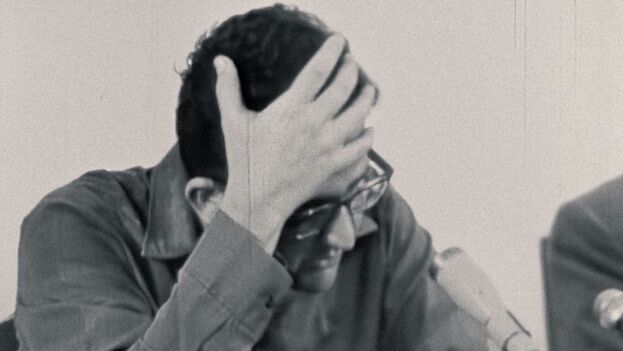
Cuban Writer Jorge Ferrer Releases the Recordings of Heberto Padilla’s ‘Confession’

In addition to Padilla’s appearance, the material includes the full remarks of other participants in the meeting, who were forced to confess their guilt. (Screen capture)

14ymedio bigger14ymedio, Havana, 18 February 2023 — On Friday, Cuban writer and translator Jorge Ferrer released several original recordings of the appearance of the poet Heberto Padilla on April 27, 1971 before a group of writers and artists in Havana. The debate prior to the release of these film archives, hidden for decades by State Security and which served as the source for the documentary El Caso Padilla [The Padilla Case] (2022), by filmmaker Pavel Giroud, had recently become a bitter controversy.

In a note on his blog El tono de la voz [The Tone of Voice], Ferrer states that he is sharing the audiovisual material with the authorization of the person who sent it to him, although he did not offer his identity. In addition, he argued the need to make the documentary available to the public. “I am obliged to share the story, which is both mine and everyone’s,” he said.

This Thursday, Ferrer, who is a translator and an expert in Russian literature living in Barcelona, revealed that he had “copies of some sections, perhaps all, of the originals that Giroud used,” and commented on the controversy about the alleged “kidnapping” of the complete archives by the director.

Ferrer shared four film files that have been digitized, from two to 40 minutes long, that record the confession which Padilla was forced to make by State Security, after being detained for several weeks. “The revolutionary government offered him a confession in exchange for his freedom,” Ferrer explains.

In addition to Padilla’s appearance, the material includes the full remarks of other participants in the meeting, who were forced to blame themselves for having held “revolutionary conversations” and for having frequently met with “enemies of the Revolution.” Among the writers who took the floor after Padilla’s extensive appearance are the poets César López, Manuel Díaz Martínez, Padilla’s own wife, Belkis Cuza, and the narrator and journalist Norberto Fuentes.

In the case of Fuentes, whom Padilla exposed during his speech as an agent of State Security and whom he accused of sharing his “counterrevolutionary opinions,” the fragments shared by Ferrer do not include continue reading

his attempt at a defense alleging an “injustice” against his person not only on the part of the poet, but also by the Government itself, which disregarded his “claims” and wouldn’t hear them.

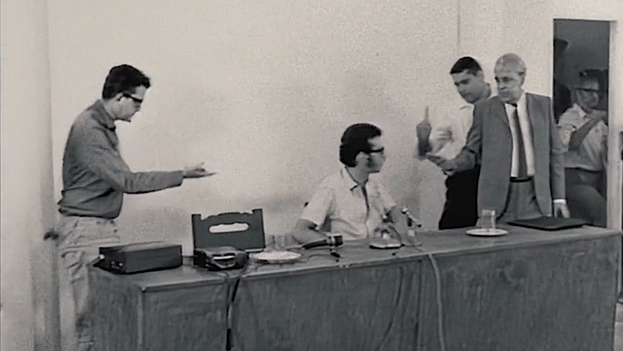
Padilla gives his seat to State Security Lieutenant Armando Quesada, who “rectifies” the intervention of Norberto Fuentes. In the background, José Antonio Portuondo. (Screen capture)

Fuentes is quickly silenced by Armando Quesada, a lieutenant of the Armed Forces and then director of the magazine El Caimán Barbudo. “I have been marginalized from the revolutionary process,” says Fuentes, but Quesada disavows the opinions of those who claimed that the Communist Party was “alienated” from the intelligentsia.

The absence of this discussion in the archives published by Ferrer, which however were used in Giroud’s film, is evidence that there are still important fragments of the archive to be delivered to the public. In recent weeks, numerous intellectuals and artists have demanded from the filmmaker the full publication of the original material, while others defend Giroud’s right to share it when he deems appropriate, after El Caso Padilla is screened at several film festivals.

The director’s response has been that the complete recording “is going to be released, but not now.” Some Cuban intellectuals have expressed their point of view on Giroud’s documentary and the context that has surrounded its projection. Orlando Luis Pardo Lazo, in Hypermedia magazine, believes that the night of Padilla’s appearance was “the longest of national cinematography.” Pardo Lazo says that “there is no right to keep the original filming a secret. By retaining it — and this is the responsibility of all those who treasure the original recording — it smells of ego or duty fulfilled in a cautionary way.”

As for Néstor Díaz de Villegas, he affirms in Yucabite that Giroud made his documentary in “collaboration with the ghost of Santiago Álvarez,” who collaborated with the original filming. That night, he points out, “Padilla emerges as one of the comic geniuses in the history of cinematographic art. It is a comedy of entanglements where apology is denunciation and delation, exegesis.”

“Giroud has decided that we still can’t remember completely,” says Carlos Manuel Álvarez in El Estornudo. Regarding the retention of the original material by the director, Álvarez comments: “I don’t know what I would have done instead; I have never had in my possession, fortunately, the memories of anyone other than me.”

Translated by Regina Anavy

Please see the links here.

An English translation of the transcript of Padilla’s Public Confession is here.

A 2021 staged reading of Padilla’s confession and other speakers, with English subtitles, is here.

____________

COLLABORATE WITH OUR WORKThe 14ymedio team is committed to practicing serious journalism that reflects Cuba’s reality in all its depth. Thank you for joining us on this long journey. We invite you to continue supporting us by becoming a member of 14ymedio now. Together we can continue transforming journalism in Cuba.
Mexican Immigration Arrests Cubans with Humanitarian Parole and Holds Them Incommunicado

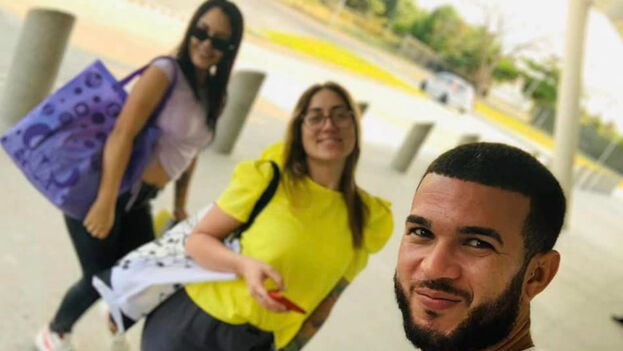
Yida, Dachel and Amehd were arrested last Thursday at the Mexico City airport.

14ymedio bigger14ymedio, Havana, 20 February 2023 — Cubans Dachel, Yida and Amehd, who have a humanitarian parole status for the United States, have been detained since February 16 at the Las Agujas immigration station, in Mexico City. According to Carmen Sardiñas, Dachel’s mother, “they took them off the plane and confiscated their passports.”

Sardiñas specified that Cubans and Venezuelans, about 10 in number, who intended to reach the United States, were taken off a plane, “put on a bus” and “taken prisoner.” All these details were reported by her daughter by cell phone. Because of this, they missed the flight and have been held “incommunicado” in Mexican Immigration.

Dachel had to pay an extortion fee to inform her mother about her detention, “which is a violation of her rights,” Carmen Sardiñas said on her social networks.

Despite the fact that the detainees insisted they had humanitarian parole granted to them by the US authorities, the agents of the National Institute of Migration (INM) told them that they “did not know” about that benefit and did not have knowledge of the “sponsorship or the flight permit or anything,” said Carlos Hernández, Yida’s father, in an interview for Telemundo. “You are illegally in Mexico,” they were told.

Hernández denied this. Relatives shared documents and the image of the humanitarian visa of one of the young women issued by the Mexican authorities, which is valid for one year. These Cubans boarded an Aeromexico flight in Tapachula to Mexico City, where they were arrested. continue reading

Immigration refused to give information to 14ymedio about the group of detainees. “Any request must be issued to the National Migration Institute,” said the person who answered the phone call.

The Las Agujas station has been highlighted by the testimonies of several Cubans as a center where agents threaten to deport them, extort them and violate their rights. In July of last year Angélica María Rodríguez Varela, Isael Meléndez Castro and Junier Blanco Hernández were allowed to leave after receiving a protection order.

Migrant defense attorney José Luis Pérez denounced the arbitrariness of the Mexican agents. Similar cases such as the three people detained in Las Agujas have occurred since the beginning of January. On January 21, Cuban Maidaly Martínez Rodríguez was arrested in Tapachula (Chiapas).

“They detained her despite the fact that she had a humanitarian visa that was given to her on January 16, which is valid for one year. She had to get a protection order to be able to board a flight from Tapachula to Mexico City and avoid being stopped.”

The lawyer reported the abuses by Migration officers in Chiapas. On January 28, “they tried to extort Mirsa Fernández Gómez at the Viva Mexico checkpoint, in Tapachula.” She left on a bus but the agents wanted to arrest her despite her “having a permit for 20 days and a protection order.” In the end, she was allowed to continue to the United States.

On Sunday, a bus in which 45 irregular migrants from Colombia, Venezuela and Central America were traveling to the U.S. border crashed on the road from Cuacnopalan to Oaxaca. It was reported that 15 people died and another 15 were transferred to the general hospital of Tehuacán (Puebla).

On Monday, the Mexican Secretary of State, Julio Huerta Gómez, announced that two of the migrants who were hospitalized have died. Regarding the accident, he indicated that the first investigations indicate that the driver lost control of the bus, and it crashed into a tree and overturned.

Last Friday, the U.S. Embassy in Cuba announced that 11,637 Cubans, Haitians, Nicaraguans and Venezuelans have benefited from the parole that allows them to receive travel authorization and stay for up to two years with a work permit.

The diplomatic headquarters reiterated that those who try to “illegally cross to the United States will be expelled and will lose the possibility of participating in this program.”

On Monday, the U.S. Coast Guard repatriated 31 rafters to the Island aboard the ship Joseph Poroo. The agency thwarted the journey of these people who were looking to reach Florida on two rustic boats.

Translated by Regina Anavy

____________

COLLABORATE WITH OUR WORKThe 14ymedio team is committed to practicing serious journalism that reflects Cuba’s reality in all its depth. Thank you for joining us on this long journey. We invite you to continue supporting us by becoming a member of 14ymedio now. Together we can continue transforming journalism in Cuba.
In Coyote Regimes

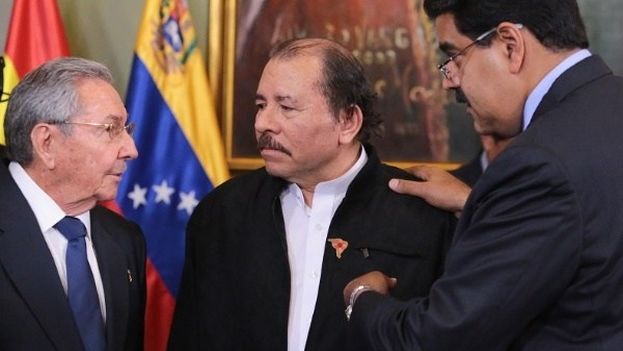
The former Cuban president, Raúl Castro, along with the president of Nicaragua, Daniel Ortega and their Venezuelan partner, Nicolás Maduro. (Twitter)

14ymedio bigger14ymedio, Pedro Corzo, Miami, 18 February 2023 — We often read about that particularly predatory human subspecies that we call “coyotes,” unscrupulous subjects who live from the despair of those who seek to have a better life for themselves and theirs.

These people have no mercy. They traffic people, making them face countless dangers, like being kidnapped, raped or killed. It’s a dirty international business of billions of dollars in which organized crime has a great participation, an entity present in more than one government in the hemisphere.

It is prudent to wonder if that activity was in principle an invention of criminal-minded governments or simple criminals who are always looking for a greater fortune. The question is a consequence of the recent decision of the Nicaraguan dictatorship to banish 222 political prisoners, an act that confirms that the tyrants of Castro-Chavismo do not even respect their own laws.

This release of political prisoners to obtain some political or economic benefit was a practice that Fidel Castro instituted in the 1960s, when he put a price on the head of each and every one of the prisoners of the 2506 Brigade*. Later, every time an influential U.S. senator traveled to Cuba and interceded for a prisoner, the dictator released some of his slaves. The same happened with the few Ibero-American political leaders who were interested in those who were in the Caribbean tyrant’s dungeons. Even the Nobel Gabriel García Márquez was rewarded by his friend Castro with a slave, the already disappeared political prisoner Reinol González.

Castro-Chavista regimes dictate particularly repressive laws whose direct results are death or imprisonment and, nevertheless, they break them extremely easily if there is any benefit involved, because all those dictators share the greed of coyotes. continue reading

Of course, these exiles, in addition to looking for economic benefits, have political gains in their sights. The Ortega-Murillo duo seeks, with the banishment of political prisoners, an approach to the government of President Joe Biden, who apparently, as former President Barack Obama did, is in favor of a rapprochement with the despots that prevail in the hemisphere, perhaps with the naive idea that the bad guys give in to good examples.

Political prisoners are a by-product of repression, the greatest hallmark of Castro-Chavism. To achieve absolute social control, punishment is essential. That’s why in Cuba, Venezuela, Nicaragua and Bolivia there are political prisoners who in most cases have not committed any crime; they have been punished for the right to think and give their opinion without hypocrisy, a crime for the autocrats who govern those countries.

The worst thing is that they use repression as an instrument of punishment, in addition to simulating changes. These regimes condemn a large number of people for no reason with the aim of breaking them, sometimes releasing them en masse and banishing them, in order to receive benefits from the government that welcomes them or, at least, making “useful idiots” think that the dictatorship is changing by exiling prisoners who did not commit crimes, as the writer José Antonio Albertini said.

The best evidence of this statement dates back to the arrival in Spain of several prisoners of Cuba’s 2003 Black Spring, something similar to what Ortega-Murillo did. On that occasion, Member of the European Parliament María Muñiz, of the Progressive Alliance of Socialists and Democrats, told Deutsche Welle: “We must appreciate this gesture of Cuba,” adding, “this will allow the European Union’s Common Position towards Cuba to be changed in the near future,” ignoring that the prisoners were unjustly sanctioned, as is the case with the banished.

It is not fair that tyrants are rewarded for rectifying their crimes. The Iranian autocrat, Ayatollah Ali Khamenei, pardoned prisoners for the protests that motivated the murder of the young Mahsa Amini and, according to some rumors, the Cuban regime will release some of the protestors arrested on July 11, 2021. These injustices should not be rewarded by democratic governments by declaring that there are changes and granting benefits, when the dictatorship is actually preparing the prisons to receive new innocents.

*Translator’s note: The 2506 Brigade was made up of Cuban exiles, and in 1961 they landed at the Bay of Pigs [known as Giron in Cuba] to overthrow Fidel Castro.

Translated by Regina Anavy

____________

COLLABORATE WITH OUR WORKThe 14ymedio team is committed to practicing serious journalism that reflects Cuba’s reality in all its depth. Thank you for joining us on this long journey. We invite you to continue supporting us by becoming a member of 14ymedio now. Together we can continue transforming journalism in Cuba.
New Stores are Born in Cuba with a Strange Alliance Between the Private and State Sectors

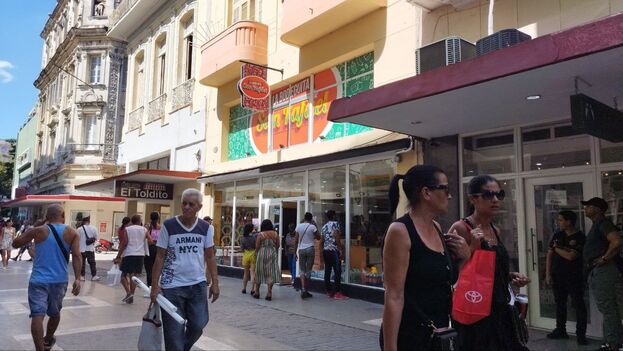
La Bodeguita de San Rafael, on the Boulevard of the same name, in Havana. (14ymedio)

14ymedio bigger14ymedio, Juan Diego Rodríguez/Olea Gallardo, Havana, 20 February 2023 — A new market in the heart of Centro Habana, a ration store with various items, a stationery store in the Miramar Trade Center, a fabric and upholstery store in El Vedado, a re-opened Italian pizzeria in the same neighborhood… these establishments have three things in common: they have recently opened or reopened in the capital, they have very high prices, and now — with a new or former name — they are in private hands.

In the middle of Boulevard de San Rafael, the colorful poster of a large and well-stocked shop, inaugurated this Saturday, La Bodeguita de San Rafael, is a surprise. “The best of all I’ve seen so far; it’s one of the most beautiful,” said a customer, surprised at what the state clothing store that used to exist in that place had become.

But what left most people speechless were the prices: 34-oz. soft drinks at 450 pesos ($19), condensed milk at 550 ($23), a small tetrapack of tomato puree at 380 ($16), a pound of lentils at 400 ($17), a kilo of wheat flour at 590 ($25), two pounds of rice at 650 ($27), a simple glass of yogurt at 120 ($5).

“A woman spent almost 33,000 pesos ($1,375) in front of me,” said another man who went shopping. “I don’t know what she had in her shopping bags.”

Inside the store, a couple, a foreigner and a Cuban woman were talking. He asked her: continue reading

“Why do you go to the store in MLC [freely convertible currency] if they sell here in pesos?” She replied: “Because the prices are much higher; they are inflated. For example, that package of rice will cost 2 MLC or $1.90, and here it costs 600 Cuban pesos ($25).”

“It looks like they are reselling things from the MLC stores, but that’s not supposed to happen because it’s not allowed,” speculated an old man.

What seems clear is that, once again, the same scheme of the recently inaugurated grocery store of the Miramar Trade Center is being repeated, the same as what happened with the branches of the Sylvain chain and before that, the Fress. A variety of businesses have now gone from state hands to private hands overnight, without competition or prior notice.

Therefore, the inauguration the same Saturday of a “sodería-hamburger” shop called Complejo Zapata y 12, in that same municipality of Plaza de la Revolución, was striking. It was attended by Luis Antonio Torres Iríbar, first secretary of the Provincial Committee of the Party, and Reinaldo García Zapata, Governor of Havana.

Tribuna de La Habana reflected the same thing in a note published this Sunday. The initiative, reports the official press, is due to the “productive chain” between the state Provincial Company of the Food Industry (EPIA) and the private company Epcc, “with one person responsible.”

In this association, the text released by the director general of the EPIA, Abdelín González Mesa, explains, “The state entity provides the premises, the labor force and the technological infrastructure, while the private company supplies all the imported raw material and is involved in the manufacturing  process.”

With this joint production, Tribuna continues, “the private actor has fewer costs and therefore can set more affordable prices for customers,” alluding to the surprising financing of the private company with public resources.

As stated with pomp, the establishment offers “several varieties of ice cream made in the unit itself, using natural fruits collected in the country and from imported components (chocolate, lemon, strawberry, orange and pineapple).” In addition, they boast that the offer “is marketed at prices lower than those currently set by other forms of private management”: the ice cream scoop costs 35 pesos ($1.45), and the simple hamburger costs 150 ($6.25).

This is one of the few occasions in which the official press publishes something related to new private businesses, whose proliferation was ratified by the meeting, last January, between Cuban President Miguel Díaz-Canel and Kremlin adviser Boris Titov.

As revealed by Russian media at the time — not by Cuban officials — both parties agreed to transform Cuba’s economy into a “private enterprise” one. For voices in exile such as the Cuba Siglo XXI ideas laboratory, this means an imminent transition from a “state-controlled economy model” to the “old elite oligarchic Soviet scheme” of taking control of numerous businesses.

Translated by Regina Anavy

____________

COLLABORATE WITH OUR WORKThe 14ymedio team is committed to practicing serious journalism that reflects Cuba’s reality in all its depth. Thank you for joining us on this long journey. We invite you to continue supporting us by becoming a member of 14ymedio now. Together we can continue transforming journalism in Cuba.
‘No One Can Be Forced to Leave Cuba as a Condition for Release’

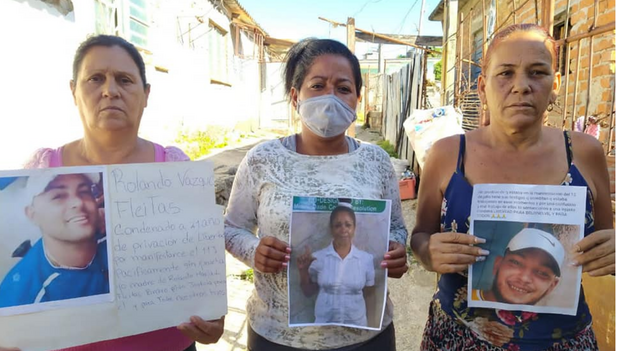
Three mothers of 11J prisoners demanding their release. (Facebook)

14ymedio biggerEFE (via 14ymedio) Madrid, 21 February 2023 — The release of detainees in Cuba due to protests such as those of the July 2021 protests should not lead to a “forced expatriation” as in Nicaragua, several Cuban human rights organizations warned on Monday.

The Cuban Observatory of Human Rights, Justice 11J and Cubalex stated that “the recent release of 222 political prisoners from Nicaragua and their immediate deportation to the United States has raised an alert in Cuban civil society about a similar ’solution’ in the current context of the Island.”

“The alert is motivated by the talks between the Cuban State and agencies such as the Catholic Church, the European Union (EU) and the Government of the United States, which have expressed positions in favor of the unconditional release of political prisoners,” says the statement, disseminated by the Cuban Observatory of Human Rights, based in Madrid.

The release of the demonstrators has become a key political issue in Cuba after Nicaragua’s precedent and the insistence on this matter by the United States, the European Union and the Vatican.

The possibility of prisoners being released for protests against the Cuban government is on the table in the context of a potential negotiation with the United States.

In this regard, these organizations recalled “antecedents” such as the release and exile in 2010 of “the majority of the political prisoners of the Black Spring” from 2003 as part of a negotiation process in the EU, and continue reading

in 2015 the release of 53 others imprisoned in this case in negotiations for the restoration of relations between Cuba and the United States.

The signatories of the statement cited that the UN Human Rights Council has denounced these “forced expatriations,” which they describe as “a systematic practice in repressive governments,” and they stated that “the Nicaraguan political prisoners did not participate in the negotiation process either” nor “were they informed that the condition for their release was forced exit from their country.”

“No person, much less in the inhumane conditions of deprivation of liberty in Cuban prisons, can be forced to leave the country as a condition of their release or of definitive freedom,” they claimed.

“Whoever negotiates with the Cuban State should request guarantees that the person deprived of his liberty will make the decision to leave the country without pressure from the organs of State Security,” they added.

In addition, they demanded “the participation of people deprived of liberty and their families in the process of negotiating the exit,” along with “minimum guarantees for those who freely and voluntarily decide to leave the country, such as facilities in the relocation process to access the legalization of their immigration status.”

“We oppose laudatory pronouncements such as those issued by the US State Department, in which a human rights violation act is presented as a ’positive success’ for the consolidation of relations between countries and the path to democracy,” they stressed.

“However, we receive with hope the idea that they will be released, in any of the possible ways,” they concluded.

Translated by Regina Anavy

____________

COLLABORATE WITH OUR WORKThe 14ymedio team is committed to practicing serious journalism that reflects Cuba’s reality in all its depth. Thank you for joining us on this long journey. We invite you to continue supporting us by becoming a member of 14ymedio now. Together we can continue transforming journalism in Cuba.
No Customs, Thank You

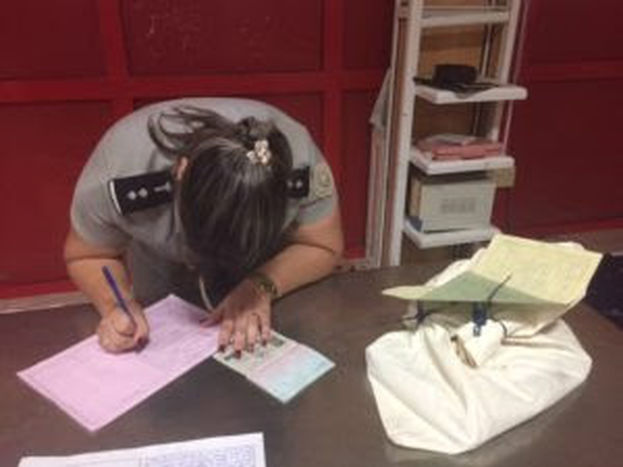
Customs Officer in the process of confiscating the belongings of Eliecer Avila. (Somos+)

14ymedio bigger14ymedio, Elías Amor Bravo, Economist, 18 February 2023 — My Cuban friends come from the Island to Europe and are amazed that when we travel to different countries when we arrive at the airports there are no “customs” or police controls. The magic of Schengen Area for Europeans (Spanish Cubans too), the disappearance of customs and controls, is one of the greatest successes of this part of the world. It wasn’t always like that.

The European Union, which was the architect of this congregation of nations that opted to eliminate barriers to the free movement of people and goods, allowed circulation through the countries of the west before the collapse of the Berlin Wall. But with the disappearance of socialism, Eastern Europeans also integrated into the Schengen area and others, those who were left out, did their best to make entrances more flexible. Customs are part of “cold-war” past, which Europeans have forgotten, as if Europe had been transformed into a kind of United States of America.

By contrast, in the Cuban case, Customs has existed for six decades, and those who return to Cuba or want to enter must face a complex and absurd barrier of entry that has been done and undone during its existence. To be honest, there are few reasons for celebration.

Shall we start?

Customs was responsible for the shameful searches that were made of people fleeing the country in the early sixties, a real dispossession of scarce, last-minute belongings that Cubans managed to remove from the terrible communist inventories of their homes.

There, in the presence of those who fled communism, boxes were available to throw all kinds of requisition objects, certainly with little or no professionalism. It was the years of militarized Customs, which created a bitter experience for those continue reading

who sadly left their lives behind. That image of a predatory and vengeful customs remained for decades, and many Cubans remember it that way.

Customs, in this case, which guards the Island, has committed terrible crimes such as the incident of the 13th of March tugboat, at a much later date, where murder was committed against young children. This work of surveillance and control of territorial waters to prevent the flight of Cubans has been a source of atrocities that have never been punished, and which in many cases are not even known.

But true, the years are passing and on February 5, General Customs turned 60, and for that reason Randy Alonso invited to his Roundtable program on State TV William Pérez, deputy head of Customs; Yamila Martínez, general director of Customs Processes; David Fernández, director of Technologies and Infocommunications and Glenda González, secretary of the Communist Youth Union.

Tremendous program. There, some keys were given to “orient” the audience on the functioning of Customs in the service of the communist regime. As a starting point, the reference to political-ideological work, “in the interest of strengthening the institutional image and strengthening the sense of belonging of workers” gives a good idea that Customs, far from being governed by technical criteria, does so by the communist party, no more or less than the rest of the inefficient monstrosity of the state.

Some facts are surprising. Of those employed, 66% are young and 70% are women. This attraction of young people is apparently attributed to a youth detachment called 60 Socialist Customs, composed of the 60 most prominent young people in the country; the development of an internal festival of amateur artists; and other communication and information actions.

For Customs managers, this web that traps young people in its service is a positive point and, as could not be otherwise, most of them come from the Comminist Youth Union, which even has a secretariat in Customs, to ensure ideological purity. The young people of Customs must be proud to be part of the “60 Socialist Customs” detachment, cited above, and must participate in the activities organized outside their specific activity in Customs by monitoring the borders.

A piece of advice to these young people. Don’t have too many illusions. No matter how efficient and quality Customs services are, this entity would have its days numbered in a democratic, free country and, of course, with another economic model, in line with what happens in other countries. The communist customs that has worked with its light and dark tones in these six decades could not remain the same in a democratic and free country. Let them think that their working lives are not going to end there.

On the Roundtable program the purposes of Customs were reported to be facilitate customs policy, consolidate the customs confrontation system (together with the Ministry of the Interior), eliminate of obstacles, simplify of procedures, and the develop the integrated system of attention to the population, which has been an important handle to perfect the work.

It was said that the employees come from the Higher Customs Technician course, which this year in its third edition graduated more than 300 people. In other words, Customs has been operating for 60 years, but only in the last three years has there been for training professional specialists. Ask yourself where the previous employees came from. They have announced for 2024 a Bachelor of Law with a Customs profile, which would promote the improvement of the labor force of that organization. For human resources and qualification, this all very recent.

And of course. Customs, following the guidelines of Díaz-Canel’s doctoral thesis, also has a sectoral program in science, technology and innovation and computerization.

From this preamble, the functions of Customs began to be defined, and the first task is border security. I remind you again, Europe does not have customs in 27 countries, and that security requirement does not exist. Something doesn’t fit here.

In this case, Customs in Cuba exists to “prevent acts of terrorism, drug trafficking, smuggling and other demonstrations that threaten the security of people and the environment. To do this, and to the extent that international crime becomes more sophisticated, the preparation of human forces has had to be improved and the borders have been equipped with new technologies.” So, what does the police, state security and the entire repressive apparatus of the communist regime do that is any different? Will we not be facing an eventual duplication of functions?

They also explained that to provide better service they are in a process of updating regulations and simplifying customs processes, which in Cuba means more bureaucracy, obstacles and obstructions. Contributions such as the Single Customs Window were cited, which they say allows the management of documents, procedures and collections for foreign trade, mainly imports and exports that are carried out digitally.

Another step of alleged flexibility is the consolidation of the Authorized Economic Operator program, conceived and promoted by the World Customs Organization, to facilitate trade. It classifies entities with high security standards in their logistics chain. In reality, these globally competitive entities have very little to do with customs processes. And Cuba is an island.

They said that, since last August, two rules have been published that have allowed the increase of the import capacity by the passenger and shipping route. These are Resolutions 175 and 176 of 2022. With these measures, it is intended to better carry out risk studies and the management of Customs to the fundamental lines of confrontation, and to not be so much concerned with counting and seeing other goods that are not of priority interest and, ultimately, to solve problems for the population. There have also been changes and new procedures with the six freight forwarders that operate cargo from non-natives. As a result, postal clearance was automated.

More bureaucratic work. The advance passenger information form in digital format was implemented, in conjunction with the Ministry of Transport and other agencies that exercise border control, and the Predespacho Pasajero APK has been developed and updated, which allows passengers to organize their luggage before arriving in Cuba.

It’s a network of controls and interventions to prevent anything from escaping the control of Customs. There are no data from surveys of citizens who are subjected to customs controls when they arrive in the country. I suggest such a quality survey because at this time they would get some surprises. And in the end, let no one be deceived, it should not be forgotten that behind the customs racket there is a collection purpose.

In fact, that collection power is the main justification for the customs that survive in the world. In particular, in the Cuban case as if it were a gracious decision of power, it was reported that the tariff benefit that authorizes, exceptionally and temporarily, the non-commercial import, without limits in its value and exempt from payment of customs duties, food, toiletries and medicines will remain in force until next June 30.

And, until March 31 of this year, the tariff benefit that exceptionally authorizes non-commercial importation, above the value established for air, sea, postal and courier shipments, of power plants with a power greater than 900 watts.

After that, it will be collected again.

It was finally reported that Customs is also being digitized in an alliance with the University of Computer Sciences that will be realized in eight projects to manage customs processes, the deployment of a tool for administrative procedures and the computerization of the Customs school. They are working on artificial intelligence projects for the integration of technologies (scanning, image and information processing) and the improvement of cybersecurity. And what about state security? Won’t it be connected? Let me know. In the program, not a single word was said about the cost of this to the state coffers and, above all, the measurement of the effectiveness of its services. Randy didn’t even ask about that. Too bad.

Translated by Regina Anavy

____________

COLLABORATE WITH OUR WORKThe 14ymedio team is committed to practicing serious journalism that reflects Cuba’s reality in all its depth. Thank you for joining us on this long journey. We invite you to continue supporting us by becoming a member of 14ymedio now. Together we can continue transforming journalism in Cuba.
Biden Extends the Ban on U.S. Ships Docking in Cuba

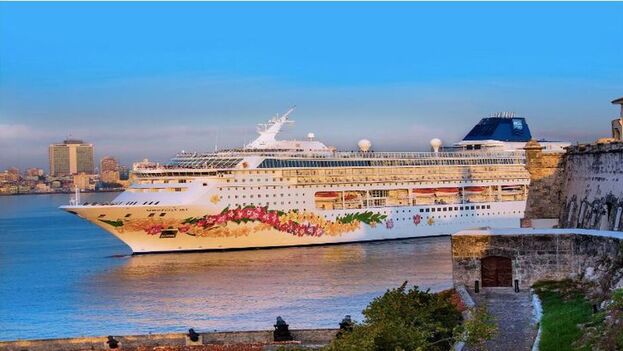
Boats registered in the United States have not been allowed to dock in the ports of Cuba since 1996. (Norwegian Cruise Line)

14ymedio bigger14ymedio, Havana, 18 February 2023 — On Friday, Joe Biden’s government extended for another year, until 2024, the ban on ships with American flags docking in the ports of Cuba. Almost three decades have passed since this measure went into effect, and Washington still considers that Havana has not demonstrated that it will refrain from the use of excessive force against its boats or aircraft.

In a note sent to Congress, Biden says that the entry of any unauthorized vessel into Cuban territorial waters “remains harmful” to US foreign policy, a fact that could facilitate irregular migration from the Island.

“Massive migration from Cuba would endanger national security by posing a disturbance or threat of disruption of U.S. international relations,” President Biden says in the note.

The United States declared a national emergency on March 1, 1996 after, on February 24 of that year, the Government of Cuba ordered a military maneuver against three civilian planes of the Brothers to the Rescue group, dedicated to spotting rafters fleeing the Island. continue reading

The Cuban Air Force used MiG fighters, who managed to shoot down two Cessna Skymaster planes from the exile organization and kill the planes’ four of the crew members. This event triggered President Bill Clinton to issue the ban, which his successors have kept in force.

At that time, Havana alleged that small planes had violated Cuban airspace, while the United States maintained that they were in international airspace, north of the island.

In the note, the US government says that the proclamation came into force 27 years ago due to the threat of disturbance caused by the “destruction” by the Cuban Government of those two unarmed civilian planes.

The state of emergency was reactivated on February 26, 2004, when the United States implemented sanctions to deny monetary and material support to the regime. The measure was softened, although not revoked, during the Barack Obama administration.

With the arrival of Donald Trump there was a new chapter in the tightening of economic measures, including sanctions for airlines and cruise ships that maintained operations in Cuban terminals.

At the end of December 2022, federal judge Beth Bloom sentenced the cruise companies Carnival, Royal Caribbean, Norwegian Cruise Line and MSC Cruises to pay more than $400 million for docking at the Havana terminal. The judge considered that companies violated Title III of the Helms-Burton Act, issued in 1996 and activated by Donald Trump in 2019. The companies have appealed that sentence.

Translated by Regina Anavy

____________

COLLABORATE WITH OUR WORKThe 14ymedio team is committed to practicing serious journalism that reflects Cuba’s reality in all its depth. Thank you for joining us on this long journey. We invite you to continue supporting us by becoming a member of 14ymedio now. Together we can continue transforming journalism in Cuba.
About to Serve in Parliament, ‘El Nino Elian’ Regrets that Everyone Receives the ‘Same Benefits’ in Cuba

Elián González (center) and his father, Juan Miguel González (right), also occupied a place in Parliament. Elián sees this “coincidence” as another responsibility to Fidel Castro. (EFE)

14ymedio bigger14ymedio, Havana, 17 February 2023 — At the age of 29, with a position as manager in a military company in Varadero and his recent appointment to be a candidate for the Cuban Parliament for Cárdenas, the once “niño” Elián González has a high concept of himself. In an interview published this Thursday in the communist youth newspaper, this father of a two-year-old girl says he is proud that the voters of Matanzas have finally noticed his “qualities.”

Clearly, González is laying his best card on the political table: the reputation given to him by the media campaign launched by Fidel Castro in 2000 to achieve the return of the “little rafter” to the Island from the United States. That episode is, for the young man, a “responsibility” that he owes to Castro, for having “mobilized” the same people who voted for him.

“I will always have Fidel and Raúl’s hand on my shoulder,” insists González, who now is enjoying in advance the “simple fact of being nominated,” even without “being a deputy” yet. Should he occupy a seat in Parliament, of which the young man has absolute certainty, he plans to “approve the most just and equitable laws,” represent the “concerns” of his territory and be “faithful” to the legacy of the Castros. Even so, González does not commit to anything: “Many times we will not have the resources nor will we have an immediate response,” he warned.

At no time in the interview did he mention Miguel Díaz-Canel or the other members of the current government. Nor did he mention that the area of Matanzas that he will have to represent has been characterized in recent years by a fall in tourism, inflation and the loss of purchasing power. In addition, it was precisely in Cárdenas where one of the most notorious popular protests in history on the Island occurred on July 11, 2021, and where police repression fell the hardest.

His appointment to occupy a seat in the National Assembly of People’s Power (ANPP) leads González, rather, to evoke the past and resurrect his obsession with Fidel, who made him a standard-bearer of the “Battle of Ideas” and forced him to be at his side in public.

His father, Juan Miguel González, also occupied a place in Parliament. Elián sees this “coincidence” as another responsibility to the regime. “I know that the training I have, the support and admiration that I enjoy from the people of Cuba, even this responsibility, I owe to Fidel,” he says. continue reading

Despite his meteoric rise in the economic administration of the Island and, soon, in the Government itself, González alleges that he never aspired to any position, although he clarifies this by saying that “I will always be willing to assume it as long as it’s required. I am proud to know that I’m going to share in a part of the historic direction; knowing that Raúl will be there redoubles my happiness,” although he regrets not being able to be “in that room” with Fidel Castro.

Both leaders, he admits, urged him on more than one occasion to follow “that path” of politics. His entry into Parliament, he says, is a sign that “I followed that path and have done it well.”

González devotes several paragraphs to reflecting on the impact that his position will have on his family. “I wouldn’t be a good Cuban if I didn’t take the problems home,” he says, while warning that the work will “steal my time.”

Asked about Cuban democracy, González avoided assessing the system in general and offered a vague answer: in Cuba there is democracy because among his friends are both “a division general” and the “president of the Council of Churches of Cuba.”

As expected, he referred to the “blockade” of the United States as the cause of all the ills of Cuba and detailed his idyllic vision of the Island, “a country [in which] there are so many gratuities [’freebies’] and social benefits.” In addition to the embargo, González assumes that the Cuban economy has a failing for allowing those who “do not contribute anything” to receive the “same benefits” in health and education. “That damages us,” he complained.

He asked that, despite the obvious economic crisis, people “do not lose confidence in their leaders” and to express their problems “without fear.” He did not clarify whether among the ways of being heard by the leaders was that of peaceful protest, for which hundreds of Cubans have been tried in recent months.

González, a member of the Union of Young Communists and with a military education, is one of the regime’s great bets to rejuvenate its image. The election of young deputies has been, at least since the last legislature of the Parliament, a way to appear updated, which echoes the traditional policy of “continuity,” the slogan of Díaz-Canel.

Victimization by the United States and “politically correct” self-criticism characterize the discourse of young people close to the regime. Despite his fifty years, the official singer Israel Rojas repeated last Tuesday in an interview the same ideas about the young people that Elián González had.

In short, Rojas said he defended “the Cuban cause, beyond the government. Because the government also fucks up.” He quickly qualified his statement and said that he did not mind being branded as an “official” musician, because “all speeches are official.”

Translated by Regina Anavy

____________

COLLABORATE WITH OUR WORKThe 14ymedio team is committed to practicing serious journalism that reflects Cuba’s reality in all its depth. Thank you for joining us on this long journey. We invite you to continue supporting us by becoming a member of 14ymedio now. Together we can continue transforming journalism in Cuba.
Medical Organizations Around the World Should Investigate Cuba’s Psychiatric Hospitals

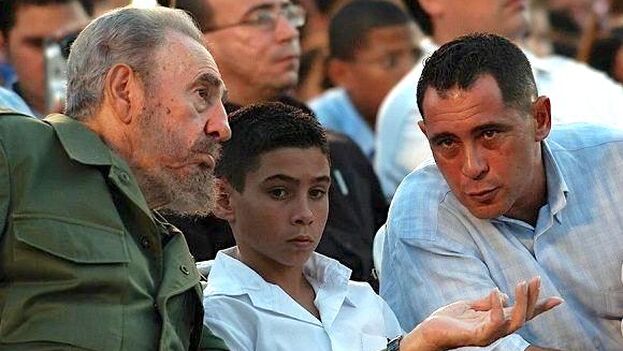
The context in which the complaints appear is worrying: the situation of public health in Cuba is precarious. (14ymedio)

14ymedio bigger14ymedio, Frank Calzón, Miami, 17 February 2023 — The complaint on social networks this week regarding 13 patients killed at the Holguín Psychiatric Hospital, if confirmed, reproduces the tragedy of 2010, when 26 Cubans died in the Mazorra Psychiatric Hospital of Havana, which, according to Granma, was due to low temperatures in the capital from a cold front.

What forced Granma to report on the matter on that occasion were the photos that arrived abroad of the victims, reminiscent of those of the Nazi death camps. We will have to wait for what independent journalists, who continue to be harassed by the regime, will report on the situation in Holguín.

But the context in which the complaints appear is worrying: the situation of public health in Cuba is precarious. The regime maintains a medical apartheid system by which foreigners are treated in air-conditioned hospitals, where they lack nothing and enjoy the necessary diet and medicines. Meanwhile, Cubans suffer from all the shortages of food and medicines.

The Island suffers from epidemics of dengue, scabies and other diseases that had been eradicated before 1959, and an extraordinary increase in pestilence, flies, mosquitoes and rats that did not occur before the Revolution, as a result of the lack of maintenance of the aqueducts and sewer systems, the rationing of food and the poor collection of garbage that piles up in the streets of the poorest neighborhoods. Meanwhile, the Government builds luxury hotels for foreigners. continue reading

That the regime has abused psychiatry for political purposes is undeniable. In 1991, the prestigious University of Rutgers published The Policy of Psychiatry in Revolutionary Cuba, a study of more than 200 pages sponsored by Freedom House and Of Human Rights, presided over by Dr. Elena Mederos and the exiled bishop Eduardo Boza Masvidal.

In a devastating introduction, Vladimir Bukovsky, the Soviet dissident and intellectual that the KGB tortured in a psychiatric hospital, wrote: “One cannot be surprised. . . Cuba in this matter is only different in that it achieved in thirty-two years what the USSR achieved in seventy-three. During a single generation, Cuba advanced from ’revolutionary justice’ to ’socialist legality’, from ’the liquidation of class enemies’ to ’political re-education’ and to ’psychiatric treatment’ of ’those disaffected with socialism’.”

Translated by Regina Anavy

____________

COLLABORATE WITH OUR WORKThe 14ymedio team is committed to practicing serious journalism that reflects Cuba’s reality in all its depth. Thank you for joining us on this long journey. We invite you to continue supporting us by becoming a member of 14ymedio now. Together we can continue transforming journalism in Cuba.
BioCubaFarma Announces a Dengue Vaccine for 2023, Already in Use Since 2015 in Other Countries

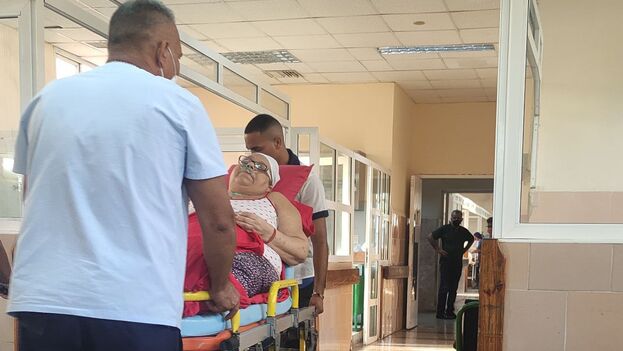
The crisis is aggravated every year by the lack of Abate pesticide, insecticides and even fumigation fuel. (Minsap)

14ymedio bigger14ymedio, Havana, 16 February 2023 — BioCubaFarma hopes that this year they will finally have the first vaccination candidate against dengue, after almost a decade of research, Eduardo Martínez Díaz, president of the state pharmaceutical group, told the official press on Thursday.

In 2013, Cuba began the first studies to develop a vaccine against the virus transmitted by mosquitoes of the Aedes aegypti species. In an interview with the official newspaper Granma, Martínez Díaz justifies the delay in the research, saying “it is a complex process,” because dengue has four serotypes and each one must be immunized against at the same time for the drug to be effective.

Although the Government in Havana reiterates that there is currently “no effective and safe vaccine,” in December 2015 the World Health Organization (WHO) approved the first dengue vaccine with the trade name of Dengvaxia, manufactured by the French company, Sanofi Pasteur. This serum has been approved in 20 countries but is not available in Cuba. WHO points out that this drug is aimed at people aged 9 to 45, living in endemic areas and who have had at least one episode of a previous infection.

Guadalupe Guzmán Tirado, director of the Research Center of the Pedro Kourí Institute of Tropical Medicine (IPK), also said that Cuban scientists have dedicated “decades of work” to controlling the disease. An example of this, she continued, is that Cuba contributed to the new classification of dengue with or without warning signs from the WHO. continue reading

The president of BioCubaFarma said that by 2023 a rapid dengue diagnosis system will also be launched, developed by the Immunoassay Center, which will identify if a patient is infected with the virus from the appearance of the first symptoms. This will facilitate a differentiated treatment for patients and prevent the worsening of the disease, the executive insisted, without committing to a date for its application.

Martínez Díaz believes that these measures “will have a significant impact” on Cuban families, overwhelmed by the lack of medications and shortages in the hospital network, which doesn’t have the supplies needed to care for patients.

The highest peaks of dengue infections occur between September and November of each year, coinciding with winter on the Island. The disease is a public health problem for most countries in Latin America and the Caribbean, although the Government maintains that dengue hemorrhagic fever was introduced in 1981 by Eduardo Arocena, a Cuban convicted of terrorism in the United States who was released in 2021 after almost 40 years in prison.

The Cuban regime kept the number of active cases on the Island a secret in 2022, but the provincial press gave clues to the severity of the disease. One of the provinces with the highest incidence  was Santiago de Cuba, which reached figures not seen in 15 years and the highest number of outbreaks from the transmitting mosquito.

The majority of confirmations of deaths associated with the virus transpired on social networks, and among the deceased there were also several health professionals. The crisis is aggravated every year by the lack of the Abate pesticide, insecticides and even fuel to fumigate or transport doctors to the areas with the greatest presence of the mosquito.

Even health care centers have not been spared the proliferation of outbreaks. A patient from the 14 de Junio Polyclinic, in Havana, told this newspaper that the rooms with electric beds, which are supposed to be dark rooms and free of infection, are populated by these insects. The woman arrived for an evaluation of her feet, but at the end of the exam “there were five mosquito marks. The mosquitoes nest in the bottom of the machines in the room. When they turn them on, they come out,” she said.

Translated by Regina Anavy

____________

COLLABORATE WITH OUR WORKThe 14ymedio team is committed to practicing serious journalism that reflects Cuba’s reality in all its depth. Thank you for joining us on this long journey. We invite you to continue supporting us by becoming a member of 14ymedio now. Together we can continue transforming journalism in Cuba.
Cuban Authorities Maintain Secrecy About Avian Flu at Havana’s 26th Avenue Zoo

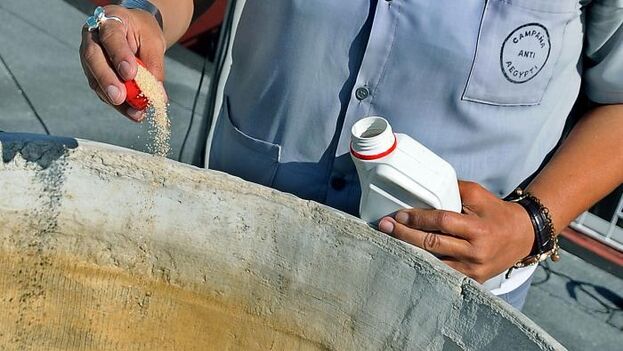
A space like the Havana Zoo could be the propitious scenario for spread between species and possible contagion to humans. (14ymedio)

14ymedio bigger14ymedio, Juan Diego Rodríguez, Havana, 16 February 2023 — “You approach and it seems nice, a green rectangle, but it immediately jumps out that it’s a place with many hidden things,” says María Elena Valdivia, designer and neighbor of the 26th Avenue Zoo in Havana, the place where lions roar and the first case of avian flu has been detected. If someone had thought about the worst point on the Island for the virus to land, reality has just surpassed it.

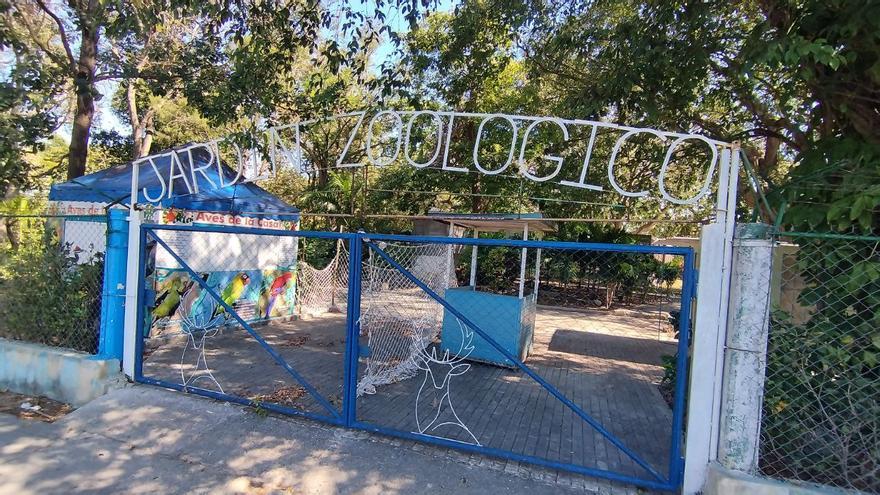
This Thursday the main entrance of the park remained closed, although the movement of workers could be seen inside. A faded poster with a painted zebra welcomes people, but there is no sign of the line of families with children that is usually nearby. The park has been in quarantine since the H5N1 subtype of avian influenza was detected in wild birds.

“This has been a health problem for our community for a long time  and we are very concerned about this,” says Valdivia, who lives a few meters from the bus stop near the main entrance of the zoo. “I grew up in this neighborhood and went to the zoo many times as a child. I have pleasant memories, but living nearby is something else; this place has to be closed.”

She lists the problems. “The animals are hungry, overcrowded and cry all the time. We live 24 hours a day with roars, bellows and bleats that make you sad. It’s very difficult to sit at your table at home and eat hearing those sounds of beings that are starving. I can’t do it anymore.”

Overcrowding and the presence of mammals near the areas intended for birds or in contact with wild birds increases the risk posed by the Havana zoo of a jump of the virus between species. The disease, first detected in 1996, has spread among free birds and those in captivity, but in recent decades it has also affected humans.

Migratory birds carry the four strains of this influenza that has already reached Central and South America. Avian influenza is still rare in people “but we cannot assume that this is always the case, and we must prepare for any change in situation,” warned the director general of the World Health Organization (WHO), Tedros Adhanom Ghebreyesus. Between 2003 and March 2022, there have been 864 cases in humans and 456 deaths. continue reading

Recently, the alarm went off even more when in Peru it was confirmed that the death of hundreds of sea lions was due to the virus, and researchers warn that there may already be contagion among mammals. “What happened in Peru is the first case in all of Latin America of massive mammal mortality,” acknowledges Víctor Gamarra-Toledo, an ornithologist and researcher in the Andean country.

A space like the Havana zoo could be the ideal scenario for the spread among species and possible contagion to humans. The authorities have not updated the situation and insist that everything is controlled, but the traditional secrecy of the official Cuban media generates more suspicion than certainty. In previous epidemics, reality has far surpassed the information disseminated by the national media.

A few years ago, the presence of the giant African snail was detected at the 26th Avenue zoo. After being closed during the COVID-19 pandemic, the park reopened with a panorama of malnourished animals, without water, with their cages full of dirt and excrement, in addition to the prominence of the snail, one of the 100 most invasive species internationally.

People focused on Covid and masks, but we have also had to live with the African snail; no one told us that they eat everything.” A neighbor close to the Zoo says that he has seen how his small garden with succulents and banana bushes has been devoured by “slow but crushing beings like the elephant.”

Apes confined in tiny cages, employees who profit by taking out lion cubs for photographs, workers who sell anything from peacock feathers to hyena excrement, in high demand in certain religious rituals: the zoo on 26th Avenue is old-style, with caged animals and lack of hygiene.

However, fears that the virus will affect national poultry production seem much lower in a country with decimated production due to the lack of animal feed, the deterioration of farms and the increasing import of chicken meat from nations in the region, especially the United States. The “disease” that seems to have ended the poultry industry on the Island does not spread among birds but is born from the inefficiency of the system.

The main fears with the current situation are focused, then, on the impact on wild birds and the possible zoonotic jump, a scenario that would aggravate the delicate situation of the public health system, which has a deficit of professionals and drugs and a very deteriorated infrastructure.

This week, private sellers of trinkets and toys have disappeared. The zoo, a state-run monopoly, is a frequent target of resellers who take advantage of their increasingly poor subsidized offers to buy and then offer those same products to the families who come to visit the premises. But between the closure and the fear of contagion, visitors are dissuaded from even approaching their kiosks.

It’s funny because you can hear a lot of birds singing, most of them passing through or wild. They like this area because of the many trees in the middle of the city,” says another neighbor whose patio is barely separated by a street from the back of the zoo. “This sound has always been there, but now with the arrival of avian flu, you notice it more because you don’t know what’s going to happen to the birds.”

Through one of the trees whose branches come out of the zoo and almost touch the roof of this resident’s house, an agile mockingbird jumps and sings his song, a melody of hope in the midst of worry.

Translated by Regina Anavy

____________

COLLABORATE WITH OUR WORKThe 14ymedio team is committed to practicing serious journalism that reflects Cuba’s reality in all its depth. Thank you for joining us on this long journey. We invite you to continue supporting us by becoming a member of 14ymedio now. Together we can continue transforming journalism in Cuba.