In the last two years, Cuba received several donations from Russia, the United States, Japan, Nicaragua and Vietnam. (Prensa Latina)
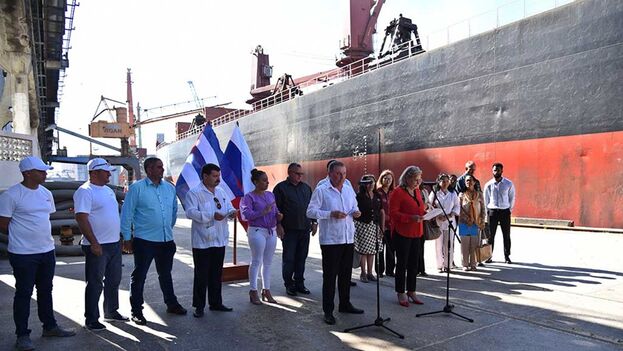
EFE (via 14ymedio), Havana, 15 February 2023 — On Wednesday, Cuba received 25,000 tons of wheat donated by the Russian Government for food production on the Island, which is going through a serious economic crisis.
The Cuban Deputy Minister of Foreign Trade and Foreign Investment, Ana Teresita González, thanked Russia for the donation, which arrived in Cuba by ship and joined other shipments from Moscow in recent months.
“This donation is a demonstration of the Russian nation’s historic support for the Cuban people in complex moments like the one our country is experiencing today,” González said in an act of gratitude at the port terminal located in Regla (Havana).
She added that the aid “reaffirms the bonds of brotherhood and the mutual commitment to strengthen economic and cooperative relations.”
Meanwhile, Russia’s ambassador to Cuba, Andrei Guskov, stressed that his country continues to “support the brotherly people of this heroic country in the extremely complex situation it is facing.” continue reading
“I am sure that this wheat, in addition to being a symbolic gesture, will be a support for many people in Cuba,” he said.
The Russian diplomat mentioned in the reception of the cargo that “the unprecedented resurgence of the inhuman and criminal blockade (embargo) imposed by Washington” is one of the causes of the crisis.
“Another negative factor is the global food and energy crisis largely caused by the unilateral and illegitimate sanctions of the West against Moscow,” he said, referring to the measures taken in retaliation for the invasion of Ukraine.
Guskov stressed that “despite everything, Russia and Cuba continue to develop their strategic relationship based on the historic foundation of friendship, solidarity and mutual sympathy.”
In this regard, he said that “Russian companies will continue to participate in bilateral projects that contribute to the fulfillment of the Island’s national economic and social development plan until 2030.”
In the last two years, Cuba received several donations from Russia, the United States, Japan, Nicaragua and Vietnam, among other countries, from both the governments of those countries and from private groups.
The island has been going through a serious crisis for more than two years due to the combination of the COVID-19 pandemic, the tightening of the US embargo and failures in national macroeconomic management.
Translated by Regina Anavy
____________
COLLABORATE WITH OUR WORK: The 14ymedio team is committed to practicing serious journalism that reflects Cuba’s reality in all its depth. Thank you for joining us on this long journey. We invite you to continue supporting us by becoming a member of 14ymedio now. Together we can continue transforming journalism in Cuba.
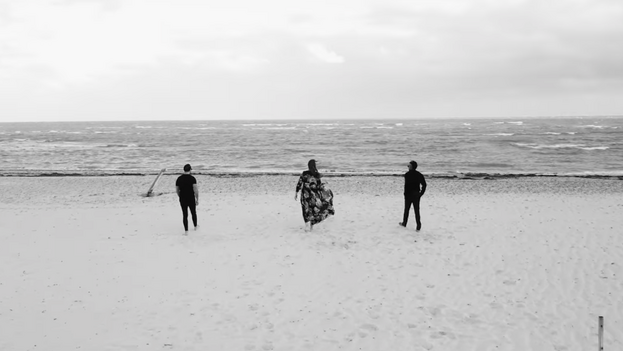
Frame from the music video for the song Te pienso [I Think of You], by Beangel, Randy Malcom and Kelvis Ochoa. (Screen capture)
14ymedio, Madrid, 15 February 2023 — Since this Tuesday, Te pienso is part of the list of songs dedicated to Cuba and its situation. Composed by the duo Beangel, formed by Beatriz César and Ángel Pututi, the theme, they say in a press release, is “a declaration of love” for the Island.
“We pay respect to the rafters, to those who never arrived and died at sea,” say the Beangel musicians, who have composed for, among other singers, Marc Anthony and the duo Gente de Zona.
Member of this ensemble and special guest in the video clip, Randy Malcom adds: “The song is dedicated to the land that I love so much and where I cannot perform.”
Cuban singer-songwriter Kelvis Ochoa, author of Hidden Havana and winner of a Goya Award in 2006 for the best original music for the film Havana Blues, also participates in the song, which is available on all digital platforms.
Translated by Regina Anavy
____________
COLLABORATE WITH OUR WORK: The 14ymedio team is committed to practicing serious journalism that reflects Cuba’s reality in all its depth. Thank you for joining us on this long journey. We invite you to continue supporting us by becoming a member of 14ymedio now. Together we can continue transforming journalism in Cuba.
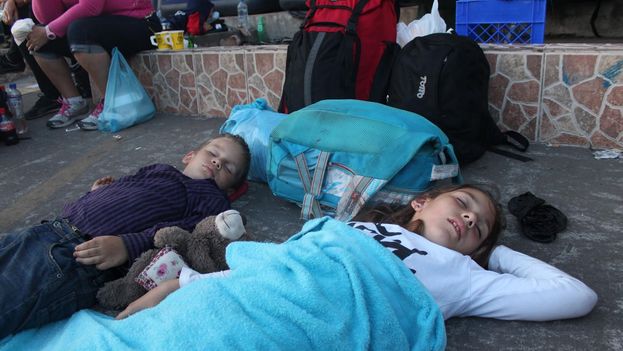
Cuban children remain with their parents in Panama to wait to continue the route to the US. (Silvio Enrique Campos, a Cuban immigrant in Panama)
14ymedio, Elías Amor Bravo, Economist, 15 February 2023 — For some time, Cuban communists have been facing a serious problem that, due to its permanence and worsening, they don’t know how to address. We are referring to the rapid demographic aging that has made Cuba, with more than 20% of the population over 65 years old, into one of the oldest countries in Latin America, and possibly in the world.
The Cuban demographic winter, the aging of the population and a simultaneous decrease in birth and growth with a fall in population is not a recent phenomenon, but has been part of a long-term dynamic in Cuba since the 1950s. That the authorities now wake up in amazement and consider doing something is anecdotal.
By the mid-twentieth century, Cuba had joined the demographics of advanced countries, without the negative consequences of today. Since then, external migration compensated for the lower internal growth. The revolution disrupted this process, and except for specific oscillations in certain years, the trend was the same again, with the aggravating circumstance that foreign migrations disappeared while the nation bled with more than two million Cubans abroad.
These guidelines have been exacerbated recently, and this has led Díaz Canel to declare that “we have to give a blow to all these issues of demographic dynamics that affect us so much.” The question is the same as always, how do they plan to do it, with the paradigm of the communist model? Failure is inevitable.
The diagnosis is clear. In 2022, demographic dynamics showed that Cuba continues with an accelerated demographic aging process, which is also present in all sectors of society, with a negative total and natural population growth, which has its origin in an increase in the number of deaths and the decrease in live births. continue reading
Indicators have caused the alarm, in the face of what is described as an increasingly complex situation (another one) in the words of Cuban Prime Minister Marrero, who, to this end, has announced the creation of a “governmental commission to look into it.”
The situation is aggravated by other coincident and surprising factors, such as the decrease in the working-age population and the economically active population, the increase in urbanization, despite the decrease in the urban population, and the increase in the average number of people per household.
The combination of factors is so negative that now the communist leaders also recognize that “in many places there is a lack of attention, beyond the absence of resources, and these are extremely sensitive issues.” There is the feeling that, once again, they arrive late for problems and will not succeed if they don’t make a 180-degree turn in their performance.
Because getting out of the demographic winter in a nation as economically committed as Cuba is not just a matter of pulling public spending and having material and financial resources incorporated into the state plan and budget, by agencies and territories. Those who think that the 2,113 million pesos, recorded in the public accounts for 2023, will be of some use are wrong.
But when you look at the destiniation of that money, the immediate question is: What does it have to do with the recovery of the population that is needed? Let’s see. There is public money for “resources for stomatological prostheses, hearing aids, care for the infertile couple and modernization of equipment for assisted reproduction centers.” Also for the training and attention to the education of the elderly, development of workshops, events and other improvement actions. Are there resources? Yes, of course, the earnings and salaries of employees who serve people. And little else. Current expenditure.
This plan of the regime coincides with the one that aroused our attention a few days ago when the recovery was announced by territorial governments of childcare centers, nursing homes, maternal homes and grandparents’ homes, the construction of homes for mothers with three children or more, as well as housing needs in rural areas, taking advantage of abandoned communist infrastructures such as schools in the countryside.
Who can think that the increase in children’s facilities can be used to increase the birth rate, when the Cuban woman knows that it makes very little sense to bring children into a country where they will have no other future than fleeing into exile when they are older? Despite the systemic waste of expenses, the regime is to blame for having only met half of the requests for childcare centers. The solution is easy: stop building hotel rooms.
The initiative of the opening of children’s homes in labor entities, that is, companies, will be subject to inequalities because it will only be possible for those workers who provide their services in those companies with the capacity to create these classrooms. Before incorporating companies into the service, availability must be ensured for everyone. Communists think of companies rather than of setting up a form of self-employment as a childcare assistant. A formula that they don’t like because they say it’s unfair according to their ideological code. One yes, the other no.
At the meeting of the authorities, an evaluation kit in geriatrics and gerontology was also presented for use in health institutions, to address aging, which contains a glucose meter, a digital equipment to take pressure and an oximeter, among others, prepared by the company Combiomed Digital Medical Technology. It is thought that this is a basic module that should exist in any population care center, because it is not only for the sick, it is also for studying population, early diagnosis and follow-up.
At the meeting, the proposal for the improvement of care schools was also presented, which will have the responsibility to train caregivers, paid or unpaid, to provide them with the knowledge, skills and aptitudes, that allow them to provide care with the highest possible quality.
Flailing around. Not one on the target. The fight against the fall of the population does not depend on these kinds of laboratory initiatives, but on the basis of a prosperous economy in which everyone takes part. Curving the depressive dynamics of the population does not depend on public spending, but on the creation of powerful and solvent private activities and sectors that pay good wages and improve the quality of life and prosperity of the people. Communists entertain themselves with their resource objectives, pecking here and there, but in this type of action, the only thing that matters is the results.
However, the leaders assure that demographic problems will be solved in the medium and long term with some euphoria, but they also say that “the fight will be difficult and discouragement must be avoided if the population patterns are to be changed” to which the governors, the mayors and the councils of the administration of municipalities and provinces must remain attentive. More work. Will it work?
Translated by Regina Anavy
____________
COLLABORATE WITH OUR WORK: The 14ymedio team is committed to practicing serious journalism that reflects Cuba’s reality in all its depth. Thank you for joining us on this long journey. We invite you to continue supporting us by becoming a member of 14ymedio now. Together we can continue transforming journalism in Cuba.
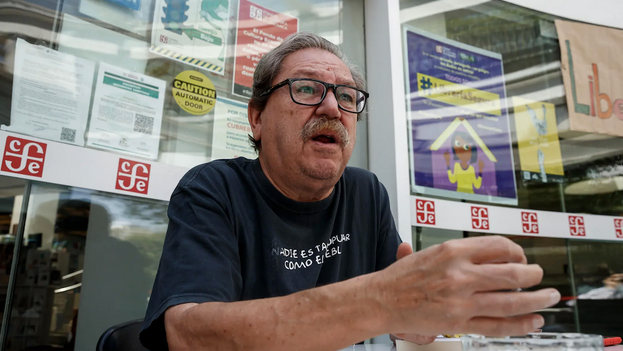
The writer and director of the Mexican publishing house Fondo de Cultura Económica (FCE), Paco Ignacio Taibo II, in Mexico City (Mexico). (EFE/José Méndez/Archive)
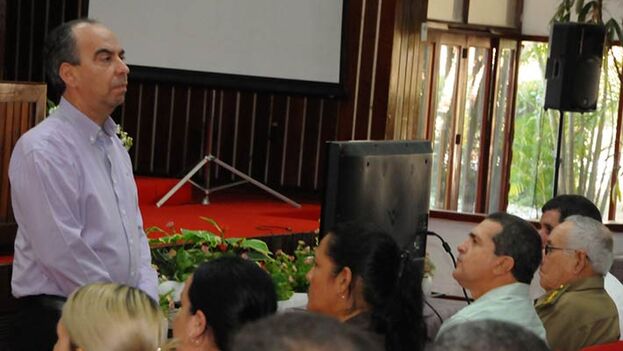
EFE/14ymedio, Havana, February 15, 2023 — The director of the emblematic Mexican state publisher Fondo de Cultura Económica (FCE), Paco Ignacio Taibo II, gave an interview to EFE in which he asked the official journalism of the Island to “increase the critical level that expresses what people say on the street.”
The writer, a militant of the Mexican left, who is in the Cuban capital within the framework of the Havana International Book Fair, considered that there is a “disconnection” between the discourse related to the Government and the vision of the common Cuban.
“We have to lose fear of critical capacity,” continued the journalist, who gave value to “the criticism to the left from the left.”
For Taibo II, author of titles such as Ernesto Guevara, también conocido como el Che [Ernesto Guevara, also known as Che], the digital transition of Island magazines, books and newspapers “has stopped” the “critical spirit” that “unfolded, for example, in the eighties.”
The Cuban Constitution establishes that the media of the Island can only be of “socialist property” and its Criminal Code punishes with up to three years in prison “whoever disseminates false news” for the purpose of “disturing international peace or endangering the prestige or credit of the Cuban State.”
Regarding the economic situation in Cuba, a country he has visited numerous times, the director of the FCE believes that it will be “very difficult to get out of” the crisis, which he directly links to the blockade (the US economic embargo) and the pandemic.
“As much as I look and see initiatives, it’s not easy at all. And I lack the Cuban perspective, which I don’t have. After all, I am a Mexican who comes to Cuba,” he told EFE. continue reading
Taibo II inaugurated last August the Tuxpan bookstore of the Economic Culture Fund in the well-known Havana area of Vedado. Originally, the opening was going to be in April, after the closing of the last Havana Book Fair, in which Mexico was the guest country of honor, but an inexplicable delay in the works also delayed the inauguration.
The director of the FCE sees the operation of the branch in the Cuban capital as a “success,” although he admits that “the only problem is to maintain it with those prices.” Unlike other foreign publishers, the Fund decided to sell its copies at affordable prices for Cubans.
This Tuesday, the writer led a talk in Old Havana about the “Vientos del Pueblo” collection, with short books with an average price of 40 Cuban pesos ($0.32 at the official exchange rate).
“I can’t see the Cuban branch as a branch to produce money. I have to find ways (to compensate for the losses),” he told EFE, the precise reasons for which previous Mexican administrations did not finish opening a Fondo bookstore in Cuba. Taibo added that for this he is looking for agreements such as the purchase of copyright translations made on the Island of books in Eastern Europe. “We are bartering, imagine,” he says, laughing.
The writer also took the opportunity to criticize foreign publishers present at this year’s Fair, such as those in Colombia — a guest of honor this time — with prices that most Cubans cannot access, even in foreign exchange. “Compadre, that’s not worth it. Do you work for buyers or for readers?” he asked.
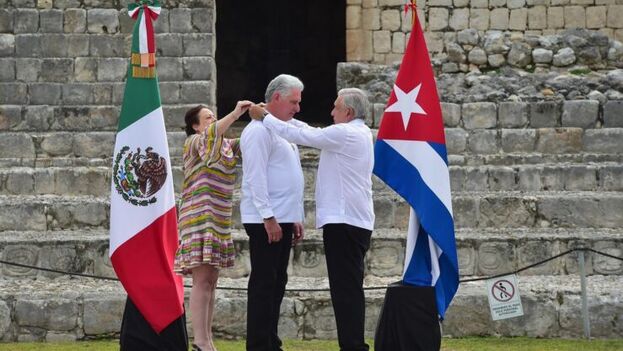
Last Saturday, López Obrador decorated his counterpart Miguel Díaz-Canel with the order of the Aztec Eagle, the Mexican State’s highest recognition of a foreigner, during the Cuban’s visit to Campeche.
The opposition National Action Party (PAN), as well as other politicians and intellectuals from the democratic left, criticized the decoration of the Cuban president, whom they described as a dictator.
“The act is deplorable and denigrating for Mexicans and Cuban citizens who live under a regime that keeps them in oppression,” said the right-wing party.
Regarding this controversy, Taibo II said that “the Mexican right no longer knows what to say.”
Translated by Regina Anavy
____________
COLLABORATE WITH OUR WORK: The 14ymedio team is committed to practicing serious journalism that reflects Cuba’s reality in all its depth. Thank you for joining us on this long journey. We invite you to continue supporting us by becoming a member of 14ymedio now. Together we can continue transforming journalism in Cuba.
A group of Cuban doctors is received in Mexico, hired by the Government of Andrés Manuel López. (IMSS)
14ymedio, Ángel Salinas, Mexico, 13 February 2022 — The Government of Mexico announced the purchase in Cuba of medicines for anesthesiology, pulmonology, ophthalmology and cancer treatment. According to the Secretary of Health, Jorge Alcocer Varela, for the “already consolidated” acquisition, the Island will receive 84,425 dollars as part of the new health agreement that was ratified with Miguel Díaz-Canel’s visit to Campeche.
This agreement also provides for the extension of the hiring of Cuban specialists. The plan, which has not yet been detailed, foresees that another 100 health workers will arrive in Mexico this year, in addition to the more than 641 doctors for which the Government of Andrés Manuel López Obrador disburses $1,308,922 per month.
The state company Comercializadora de Servicios Médicos Cubanos S.A. is in charge of managing the shipment of doctors. For each specialist, the Cuban Government receives $2,042 per month, while for the services of general practitioners, $1,722 per month enter its coffers. Health professionals are only granted a stipend in Mexico that will be kept by the Cuban Government during their year of service.
Although there are intentions to continue with the purchase of the Abdala vaccine against covid-19, this has not yet been ratified by Mexico. 14ymedio was able to confirm that, of the 9,000,000 doses already sent to Mexico, less than 3% had been used up to February 7.
About the Cuban specialists who have been distributed in various states, Foreign Minister Marcelo Ebrard proclaimed this Sunday on his social networks that thanks to these professionals “162,000 Mexican lives have been saved.” And so he said goodbye to Díaz-Canel. continue reading
However, one day before the enthusiasm of the Mexican chancellor, the data provided by the Mexican Secretary of Health, Jorge Alcocer Varela, reveal something else. Cubans had provided 242,000 services as of Friday, of which, he stressed, 110,246 were specialty consultations.
In detailing part of the activities of physicians in Mexico, Health Secretary Jorge Alcocer explained that Cubans have “coordinated laboratory services”; that is, they have taken samples for the performance of 46,191 clinical analyses and performed 41,418 X-rays for radiological studies.
The general director of the Mexican Social Security Institute, Zoé Robledo, explained that Cubans who arrived in Mexico have a specialty in internal medicine, pediatrics, general surgery, family medicine, ophthalmology, nephrology, intensive care, imaging, cardiology, dermatology and otorhinolaryngology.
Robledo mentioned that doctors are currently in large general and civilian hospitals, as well as in small community health centers “where their arrival often meant the first time there was a specialist available.”
He mentioned that they are located in the most remote areas such as La Mesa del Nayar, (Nayarit), the Costa Chica (Oaxaca), the desert of Baja California Sur, Cananea (Sonora), Tlaxcala, Colima, Tierra Caliente (Michoacán), in the Huasteca Alta (Veracruz), in Zacatecas, Morelos, Campeche and La Montaña de Guerrero, where 11 specialists arrived just this Sunday to make a total of 29.
“There are no ’acceptable left-wing dictatorships’ and ’abhorrent right-wing dictatorships’,” they said in a public statement, signed by members of the opposition party Movimiento Ciudadano, including Martha Tagle Martínez, as well as the Party of the Democratic Revolution, Cecilia Soto González, and the academics, Diego Petersen Farah, José Woldenberg, the Cuban academic based in Mexico and Armando Chaguaceda, among others.
“We condemn the president of Mexico for turning a deaf ear to the repression that the citizens of Cuba endure on a daily basis and even for hanging on the chest of the Cuban dictator the highest distinction that a foreigner can receive from our country,” the signatories endorsed.
Translated by Regina Anavy
____________
COLLABORATE WITH OUR WORK: The 14ymedio team is committed to practicing serious journalism that reflects Cuba’s reality in all its depth. Thank you for joining us on this long journey. We invite you to continue supporting us by becoming a member of 14ymedio now. Together we can continue transforming journalism in Cuba.
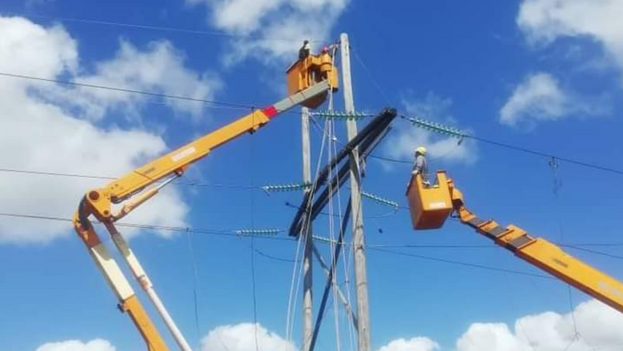
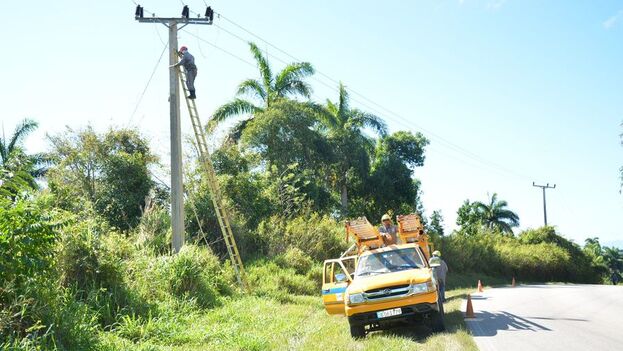
The reconnection of the National Electricity System came around 9 p.m., but total reestablishment was not planned until 11 pm. (@OSDE_UNE)
14ymedio, Madrid, 14 February 2023 — A fire in a cane field was the cause of the disconnection of the National Electricity System (SEN) that affected half of Cuba this Monday from the center to the east of the Island. The disconnection, from Ciego de Ávila to Guantánamo, occurred around 2 in the afternoon and lasted until 9 pm.
“When they burn the cane field, the air ionizes and can cause failures between the phases of the transmission lines. When the two lines left the system, the power transfer between the western-central-eastern area was cut off and caused the failure of the system from Ciego de Ávila to Guantánamo,” said a note from the Cuban Electrical Union (UNE).
The failure began to be noticed on a 220 KW line that links Sancti Spíritus and Vicente through two substations that left the network. Yoanni Acosta, director of the Electric Base Organization in the province, told the official newspaper Escambray that around 5 pm the damaged part of the system could be reconnected when the transfer from the western to the eastern part of the Island began to be restored.
The electricity company indicated that, due to the generation deficit at peak hours, “the province had 20 megawatts open,” which caused breakdowns in several circuits that remained until 8 pm. “As long as the generating plants in the east are incorporated, the impact will also progressively decrease in all the localities of those territories,” Acosta added.
After the announcement of the reconnection, several people warned on social networks that the blackout continued for them, complaints corroborated by the words of Lázaro Guerra Hernández, technical director of the UNE, who told state television that the service would recover “gradually” and that the total restoration was estimated for 11 pm. continue reading
The official added that, in addition, 240 megawatts of the generating capacity were damaged. For this Monday, in fact, an estimated electricity deficit of at least 112 MW had already been planned, reaching 182 at peak hour.
Yesterday’s blackout is the largest since September 27, 2021, after the passage of Hurricane Ian, when the National Electricity System completely collapsed and the country was left in the dark for several hours. It was the culmination of a summer of cuts that exceeded 14 and 16 hours at times and provoked protests almost daily in many municipalities.
The failures in the thermoelectric power plants, which provide most of the electricity to the Island, have been constant these months due to the lack of maintenance and obsolescence of the plants, which mostly exceed their useful life.
With the arrival of cold fronts, the fall in demand last December provided relief to the situation, to which was added the arrival of two Turkish floating power plants and the recovery of some thermoelectric units. However, the authorities have already warned that from January and, especially February, some plants would return to maintenance in an “organized” way to be ready in May and ensure an adequate volume of electricity generation.
At the moment, Unit 1 of Felton and 4 and 6 of Renté are in that situation. But to this must be added the breakdowns in blocks 6 and 7 of Mariel, 1 and 2 of Santa Cruz del Norte, 4 and 5 of Nuevitas and 2 of Felton.
The arrival in February of an eighth Turkish power plant, much more powerful than the previous ones with its 240 MW capacity, has not been enough to put an end to the instability of the system.
Translated by Regina Anavy
____________
COLLABORATE WITH OUR WORK: The 14ymedio team is committed to practicing serious journalism that reflects Cuba’s reality in all its depth. Thank you for joining us on this long journey. We invite you to continue supporting us by becoming a member of 14ymedio now. Together we can continue transforming journalism in Cuba.
The Ministry of Agriculture affirms that it cultivated 6,000 hectares this year and recognizes as a failure “the lack of inputs during the cultivation cycle.” (ACN)
14ymedio, Elías Amor Bravo, Economist, 11 February 2023 — Communist leaders bet on foreign capital rather than national capital. They admit that private entrepreneurs come to Cuba to make a profit and do business, but they prevent it for nationals. The last thing has been the expansion of the so-called Portfolio of Opportunities to attract foreign investment to the agricultural sector. It seems like a lie. Any government interested in defending the interests of its citizens would never act this way. The investment of foreigners is the last resort when all possible options have been explored with nationals. This commitment of Cuban communists to foreign capital is a sign of the distrust they have in Cuban private entrepreneurs, who are relegated to the background.
Apparently, it has now occurred to them to allow agricultural cooperatives to be associated with foreigners, but they limit the possibility to businesses of production and marketing pork, chicken, milk and others aimed at local development. Obstacles and more obstacles in a country that works at 20% of its potential due to the ideological obsession of the communist economic model.
Many of us think that the Cuban agricultural productive sector could work much better if it had the freedom to do so, if it were privatized and the means of production were directed to generate national wealth and employment. For the development of a country, foreign capital can be a good option when national investment cannot function. But in Cuba in the last 64 years, they have not wanted to explore this option, and there is a prostrate, weak, inefficient economy, controlled by the state and subject to communist interests.
Faced with this situation, Law 118 was devised, but it has not yielded the desired fruits because its definition was incorrect. It is not possible to attract foreign capital to a country if its national companies are dead, as is the case in Cuba. The regime’s efforts to increase the number of projects in the so-called Portfolio of Opportunities have not borne fruit except in very specific sectors. The vast majority of Cuban economic activities are on the margins of foreign capital and, of course, far from the real possibility of use by the Cuban private sector.
The attraction of foreign investment to the agricultural sector does not depend on the flexibility of conditions or on opening the projects to cooperatives. This works only for those who are determined to fulfill the plans but don’t care about the results. Attracting foreign capital to the cooperative sector in certain businesses goes against the very concept of a cooperative, which is an entity that organizes work activities where, coincidentally, capital takes a back seat. continue reading
You have to ask what foreign investor would want to form a cooperative with Cubans or what the point would be of opening this organizational form to capital, when its priority is the labor factor. In fact, the cooperative distributes its benefits among the workers for its own raison d’être. How can the foreign investor gain income as one more cooperative participant? Who came up with this absurd idea?
We are not against foreign capital, which is fundamental for technology, organization, finance and many aspects of the economic process. But what we are against is the regime’s policy of royalties to foreign investors from the nation’s productive capital, until now, 90% state. Wouldn’t it be more appropriate for that productive capital to be privately owned by establishing a respectable legal framework for property rights?
The Cuban economy cannot reach its potential if the assets aren’t private. There is no point in nonsense activities such as vegetal charcoal, honey, cocoa and coffee, or nature tourism. The Foreign investor wants to know with whom he will risk his money and technology, and this does not depend only on the qualification of the experienced workforce or the existence of research centers. The legal framework of property rights is fundamental, and if the multiple unknowns that exist are not clear, foreign investment will not grow.
The Cuban agricultural sector is far from attractive to the foreign investor, but if it were exploited by the private sector as a whole, the results would be very different. It is unheard of that in 2023 and with the problems of lack of food in Cuba, almost 20% of the farmland is not in use. Long-term leases have not served to grow production, because the farmer and rancher want the means of production to be their property. Why is the foreigner allowed to take over the means of production for investment while nationals are prohibited? How long can this discrimination that doesn’t exist in any other country in the world be maintained?
The regime should be aware that increasing production, reducing imports and creating more exportable resources is not achieved with foreign investment. There are the results of tourism. The national private sector must assume ownership of property rights and lead the national economy. Vietnam did it and left its famine behind.
Foreign capital doesn’t give a damn about reducing the gap between the countryside and the city, creating better living conditions in rural areas or fixing the problem of housing and infrastructure. This could be driven by an economy of private agents, oriented by private property and the market to allocate resources.
There is no alternative model because communism went into crisis after the collapse of the Berlin wall, and no one gives it the least viability. Turning 180 degrees and beginning in the Cuban countryside makes perfect sense. It would be a good way to forget about that traumatic experience of the Agrarian Reform Law and start over. It’s never too late if the ideas are the right ones.
Translated by Regina Anavy
____________
COLLABORATE WITH OUR WORK: The 14ymedio team is committed to practicing serious journalism that reflects Cuba’s reality in all its depth. Thank you for joining us on this long journey. We invite you to continue supporting us by becoming a member of 14ymedio now. Together we can continue transforming journalism in Cuba.
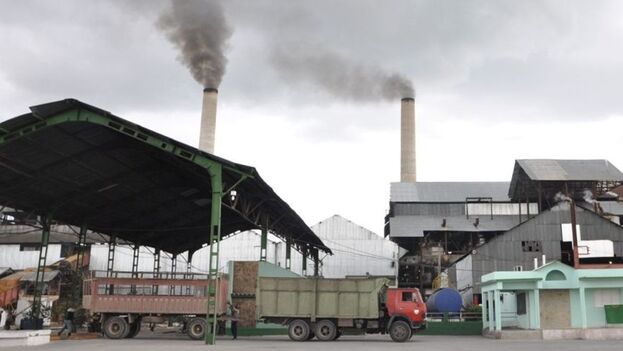
The Uruguay sugar mill, in Jatibonico, Sancti Spíritus. (Escambray)
14ymedio, Mercedes García, Sancti Spíritus, 15 February 2023 — Jatibonico’s colossus no longer roars as it used to. Instead of the rattling of its machinery, the Uruguay sugar mill is silent and prepares for the arrival of its new managers, a Russian company that will try to revitalize what in its day was one of the greatest Cuban sugar mills. Meanwhile, the neighbors are questioning whether the town will experience a new economic opportunity with the change of industry administration.
“This place is more dead than the cemetery,” Luis Manuel tells 14ymedio. He is one of the many employees who in the middle of last year lost his job due to the closure of the mill, because “technological obsolescence and lack of investment became, along with the shortage of cane, dangerous threats to the continuity of the industry,” according to the local press at the time.
“In that time the only thing that has happened here is that young people have gone to sea. The family that does not have a balsero [rafter] child is because they have two,” he says. “Now the Russians are preparing to repair the plant and start producing. They say that although they bring their own workers, there will always be some places for us.”
In October 2022, four months after this newspaper first recounted the closure of the Uruguay sugar mill, the news was confirmed by the official provincial newspaper Escambray. The article hinted that the hope for hundreds of workers who were unemployed was in Moscow, because a Russian entourage visited Jatibonico and expressed the intention to create a joint venture that would save the moribund mill town. continue reading
Of the 424 workers that the plant had at that time, 192 began to undertake repair work to make improvements, and 102 were inserted into another “eight labor groups with payment systems adjusted to activities that generate income for them and the company.” Those areas ranged from carpentry to painting, sheet metal work and preventing ice, all of them dependent on the plant.
Then, Eddy Gil Pérez, director of the Uruguay Agroindustrial Sugar Company, expressed enthusiasm with the possible Russian management: “We are among the nine sugar mills of the country chosen for these businesses,” he revealed. More than half a year later, this February, workers in the sector have been informed that the agreement has been finalized with Moscow, and the Uruguay mill should not be counted on for the current harvest because it is being remodeled.
“It all ended quickly,” admits Luis Manuel. “Those of us who were relocated, for example, in agriculture, ended up returning to our homes because there are not so many other crops in this area nor does the State pay what was promised.” After several months, the family of the former Uruguay mill employee survives thanks to an emigrated daughter and the sale of guava candy on the side of the road.
“The Russians are already here,” says an employee of the Zaza hotel, a nearby accommodation with an architectural style of the Soviet era and very similar to the so-called schools in the countryside. The place, which had been deteriorating for years, is now undergoing “capital repair,” says the woman. “The investment is great because this is made of wood, but you can see that the Russians come with resources and with their own people for repairs.”
“They arrived, signed the contract and are already working. They are staying here, and we are no longer accepting national customers,” says the accommodation worker belonging to the Islazul chain. “This place is not very nice but as it is set aside, it was cheap and close to the dam. People came here to spend a few days, but the word has already spread that we are not accepting Cuban guests.”
The idea is that the Zaza hotel will function as temporary accommodation for Russian technicians who will try to revitalize the Uruguay mill, operating since 1905, which has undergone endless transformations and repairs since its foundation. In recent years, stops due to breakdowns have multiplied, and the mill spent more months shut down for repair and maintenance work than grinding cane.
“This was the pride of our people and now it’s better not to mention it,” says María Elena, who worked at the beginning of the century in the administration of the mill, one of the largest sources of employment in the province historically. “We were like a family but all that was lost, and now no one tells us if with the Russians we are going to benefit from the Uruguay grinding again.”
Translated by Regina Anavy
____________
COLLABORATE WITH OUR WORK: The 14ymedio team is committed to practicing serious journalism that reflects Cuba’s reality in all its depth. Thank you for joining us on this long journey. We invite you to continue supporting us by becoming a member of 14ymedio now. Together we can continue transforming journalism in Cuba.
The electrical disconnection stretches from Ciego de Ávila to Guantánamo. (Twitter/@EmpresaElctric2)
14ymedio, Havana, 13 February 2022 — Half the Island is without power this Monday, as reported by the Cuban Electric Union (UNE) itself on its networks and confirmed to 14ymedio by sources in several affected provinces.
In a brief note on its Facebook account, which did not allow comments, the UNE says that “there was a failure in the 220 KW network” between Sancti Spíritus and Nuevitas that caused a “total disconnection” of the electrical system “in the Central-Eastern area, affecting the provinces from Ciego de Ávila to Guantánamo.”
Subsequently, the Ministry of Energy and Mines explained in a tweet that “the cause of the disconnection was a fire in a nearby cane field,” without specifying where it was, and said that “work is being done on the restoration of the system,” which “will take between four and five hours.”
The city of Camagüey ran out of electricity shortly after 1:00 p.m., an interruption that paralyzed life in a town that had some hope that there would be relief from the blackouts it had experienced in recent weeks.
This is the biggest breakdown in the national network since last September 27, when the National Electricity System collapsed completely and the Island was left in the dark for several hours. continue reading
After the continuous and prolonged blackouts of the second half of 2022, which provoked massive protests on the Island, the Government sold as a triumph that at the beginning of the year there were hardly any affectations to the network. But the optimism did not last long: since then, the authorities announced that between January and April there would be cuts, so that the electricity system “is prepared for the large demand during the summer.
Although the regime had promised “short” blackouts, some provinces experienced cuts of up to six hours in a row at the end of last January.
Translated by Regina Anavy
____________
COLLABORATE WITH OUR WORK: The 14ymedio team is committed to practicing serious journalism that reflects Cuba’s reality in all its depth. Thank you for joining us on this long journey. We invite you to continue supporting us by becoming a member of 14ymedio now. Together we can continue transforming journalism in Cuba.
Delivery of the Mexican Order of the Aztec Eagle, in the degree of Collar, to Díaz-Canel. (Twitter/Miguel Diaz-Canel Bermudez)
14ymedio, Mexico, 11 February 2023 — Mexicans did not welcome the reception of Miguel Díaz-Canel by his counterpart Andrés Manuel López Obrador this Saturday in Campeche, in the southeast of the country. The rejection increased when it became known that the Cuban president will be decorated with the degree of the prestigious Mexican Order of the Aztec Eagle, with the rank of Collar, which Fidel Castro also received in 1988.
“More and more Cubans are fleeing their homeland because the dictator starves them and imprisons them. López Obrador insults Cubans and Mexicans by giving the Aztec Eagle to Díaz-Canel, a human rights violator,” Mexican Senator Lilly Téllez, one of the most critical rulers in López Obrador’s administration, wrote on Twitter.
In addition, several media outlets published criticism of the visit, including journalist Manuel Lopez San Martín, of the ADN 40 chain, who pointed out: “The dictator of Cuba, Miguel Díaz-Canel, should not be welcome in Mexico. A repressor, who tramples freedoms and violates human rights, should not be decorated by our country. There is nothing to applaud or recognize in an authoritarian anti-Democratic leader.”
The Cuban president, a few minutes after deplaning in Campeche, said that he came to “ratify the will” of the Cuban people and government, “to continue strengthening and deepening relations with Mexico, not for reasons of protocol, but as an expression of the brotherhood” that unites both countries.
On his fourth trip to Mexico, since he occupied the Cuban presidency, Díaz-Canel, said that he is happy to return to meet again with his “friends” and share a few hours with López Obrador. continue reading
“We came to return in person the embrace we received in difficult times along with the material help and technical advice in vital areas and activities from the Mexican Government,” Díaz-Canel added, referring to Hurricane Ian, which left two dead in the country last September.
One of the objectives of Díaz-Canel’s visit is to supervise, together with López Obrador, the construction of the Maya Train, which passes through Campeche in the Yucatan peninsula. For the construction, rajón stone, a type of gravel extracted from a Cienfuegos quarry, will be used. The infrastructure, converted into a small lifeline for the Cuban economy, is a 900-mile railway that will connect the main tourist cities of the area. To accomplish this, it will be necessary to eventually send more than 200,000 tons of rajón per month from the Island.
In addition, the Cuban ruler said that the current relationship between Mexico and Cuba managed to concretize several programs and actions “for mutual benefit,” such as the sending of Cuban health specialists to Mexico.
“In less than a year we have complied with what was agreed, and there are results to show,” said the president, who will leave for Belize on Sunday. He was referring to the more than 500 health professionals who have arrived in Mexico to provide services as part of an agreement signed between the two governments.
For his part, López Obrador said that Díaz-Canel is a “distinguished, admired, and fraternal guest.”
The presence of hundreds of Cuban doctors in hospitals in the Mexican capital hired to combat the COVID-19 pandemic aroused a controversy in the country in 2020 because of its cost and the activities carried out.
Currently, more than 600 Cuban health workers are working in several urban health centers in Mexico, and so far it has not been revealed whether they will be transferred to hospitals in remote areas, which was the initial purpose for which they were allegedly hired by the López Obrador Administration.
At the same time, the Mexican Government has used less than 3% of the nine million Abdala vaccines purchased from Cuba for boosters, since distrust of the drug prevails among the population. It does not have the approval of the World Health Organization, nor are there studies that certify its effectiveness.
El dictador de Cuba, Miguel Díaz-Canel, NO debería ser bienvenido en México
Un represor, que atropella las libertades y violenta los derechos humanos, no debe ser condecorado por nuestro país
No hay nada que aplaudirle ni reconocerle a un autoritario antidemócrata
Text of Tweet: Cuba’s dictator, Miguel Díaz-Canel, should NOT be welcome in Mexico. A repressor, who tramples freedoms and violates human rights, should not be decorated by our country. There is nothing to applaud or recognize in an authoritarian anti-democratic leader.
Translated by Regina Anavy
____________
COLLABORATE WITH OUR WORK: The 14ymedio team is committed to practicing serious journalism that reflects Cuba’s reality in all its depth. Thank you for joining us on this long journey. We invite you to continue supporting us by becoming a member of 14ymedio now. Together we can continue transforming journalism in Cuba.
Rogelio Polanco this weekend, after being elected as a candidate by Holguín for the next elections. (@RPolancoF)
14ymedio, Madrid, 8 February 2023 — At the age of 57, the head of the Ideological Department of the Communist Party, Rogelio Polanco, feels part of what he calls the “process of gradual and orderly transfer of the main positions and responsibilities of political direction of the Revolution from the historical generation to a new generation,” and from that place he is willing to fight one of the most important battles for the regime: that of ideas.
The official spoke at great length in an interview for La pupila insomne [The Insomniac Pupil], in which he refers to the need for the transformations to be profound, but the detailed explanations make it clear that what changes, in any case, is the form, not the substance. “All our ideological commitment is aimed at reinforcing (…) the foundations of our ideology, based on the thought of José Martí, Fidel Castro and, of course, on Marxism and Leninism,” he explains.
The interview, of more than 7,000 words, leaves little room for the news. Among the few announcements that Polanco makes is the extreme intervention of the new Institute for Social Communication, created in 2021 to replace the Cuban Institute of Radio and Television (ICRT) and about which nothing is yet known. “We are proposing that at all levels and institutions the structures that are in charge of communication have to be hierarchical at the highest level of direction, because communication is a strategic resource,” he says.
Polanco also addresses the transformation that awaits the media of the Island, and that, from his words, will follow more or less the arrival of advertising in the Cuban media, although the official omits the word and prefers to talk about the experience of giving “a greater capacity to reflect the reality of Cuba and also that those media be allowed to have income for their sustainability, which guarantees the creation of better technological capabilities to face this new digital ecosystem.”
He also mentions the changes in the selection of journalism students and the importance of being “better prepared from a professional point of view and also in values,” an issue that is not really new either, since ideological adherence has always prevailed in this university career and its working reality on the Island. continue reading
However, Polanco introduces this alleged battery of measures to deal with what he calls “hybrid war,” a concept already exploited by the ruling party for months and that he develops to exhaustion in the interview. In his opinion, the United States is using the entire network to discredit its “enemies” while exporting culture and capitalism as the only model to follow. In addition, it has the necessary technology, since the companies that manage the algorithm (in clear allusion to Google or Facebook) are on its side.
On the other hand, the discomfort generated by the terrible situation of the world economy in general and Cuba in particular — part of which is induced, he argues, by the blockade [American embargo] and its effects — is used to generate chaos and cause confrontation by the people with the Government. His recipe for fighting all this is as follows: “Take those weapons away from our enemy. Learn to master them and use them for our own goals. We have to master the use of those tools.”
The objective, he says, is to strengthen political preparation at all levels so that “the people increasingly understand and accompany the leadership of the Revolution in the process of development of our nation, socialist construction and confrontation with subversive actions.”
Polanco steps on delicate ground when he talks about emigration. The official recognizes that the number of young people who have left complicates the economic and demographic situation of the country, but affirms that Cubans are migrants like those of any country in the world, who return when they improve economically, even though reality denies it.
“Today, thousands of Cubans live outside Cuba, maintain a normal bond with their homeland and return systematically. Even many actively participate in solidarity actions with their country of origin. Let’s go to what social science and demographic analysts call a circular migration,” he argues after an extensive dissertation on exiles since the 1960s, alluding to the Cuban Adjustment Act and the visas agreed upon and not delivered by the Trump Administration.
In any case, and aware that Cubans are leaving — more than 300,000 to the United States alone in 2022 — he asks that the “personal and professional realization” of young people be stimulated “without denying, of course, that anyone who wishes to emigrate can do so because it is their right.” As he explains, the Cuban Government has created working groups that can “in the short term present some projections of those policies in the field of employment, improvement, housing and other facilities especially aimed at youth,” but the economic, employment and lack of infrastructure data threaten to make any plan useless, no matter how good.
A similar case occurs with some other of Cuba’s achievements that Polanco enunciates. The official speaks of “continuing to strengthen fundamental social conquests” and accurately cites everything that is now in a situation of shipwreck, from education, which is experiencing a full exodus of teachers and students who, if they stay, must resort to a private tutor; to health, in the midst of a crisis of shortage of doctors, supplies and medications; and even sports, following Cuba’s failure in the Caribbean Baseball Series. To reach the zenith, the official exalts the “high level of democratic participation and elevated popular control” that exists on the Island.
Polanco goes into the final stretch of the interview talking about working in networks to reach a youth that is increasingly seduced by new formats rather than by books, and he calls for “generating content to infinity and in a creative way” to compete in the message. “We have to manage to be appropriate in that format,” he summarizes, before ending by making a plea in defense of the emotional, in addition to the intellectual. “Che said that a revolutionary is motivated by great feelings of love. It’s love in all its expression, so we’re still in love.”
Translated by Regina Anavy
____________
COLLABORATE WITH OUR WORK: The 14ymedio team is committed to practicing serious journalism that reflects Cuba’s reality in all its depth. Thank you for joining us on this long journey. We invite you to continue supporting us by becoming a member of 14ymedio now. Together we can continue transforming journalism in Cuba.
Mirabal goes to the Venice Biennale solo for the first time. (EFE)
EFE (via 14ymedio), Havana, 8 February 2023 — On Tuesday, Cuban plastic artist Michel Mirabal presented his exhibition project at the National Museum of Havana, on a very current theme: “migrations in the world.” He will attend the next Venice Architecture Biennial with this same project.
Mirabal, known as the painter of hands and flags, will display six large installations, six works of painting and two sculptures, in the rooms and the outdoor space of the Loredan palace, an 18th-century building located in front of the Grand Canal of the Italian city of canals.
The project of the exhibition “Architecture of a System” is based on Cuban emigration from all over the world, the artist explained to EFE.
“In recent years due to wars, the displaced have become a very strong phenomenon, and I wanted to draw attention to that. I also want it to be as raw and real as possible, without half measures,” he said.
Mirabal (b. 1974), considered one of the most important current plastic artists in Cuba, is more famous outside the Island than inside, which he says is his source of artistic inspiration, especially its problems. continue reading
In this exhibition, which is accompanied by the art video “Exoduses, causes and consequences,” Mirabal addresses an issue that also concerns his country, where there is “a brutal exodus, more than half a million people who are not there, including many friends, family and my eldest daughter. So I experience it very closely,” he says.
His return to Venice — the city that hosted him with a scholarship between 1999 and 2002 — will be, from May 16 to July 23, the first time he exhibits a solo show at the biennial.
After the exhibit, Mirabal plans a four-year journey through museums, galleries and foundations of countries in Europe, China and Israel, and he also will bring this exhibition to the National Museum of Fine Arts of the Cuban capital, produced by the Spanish company Art Logistics.
Nelson Herrera Ysla, an experienced Cuban art critic, is the curator of this project, which he described as “very complex,” especially because of the requirements of the old Loredan palace, which “has interiors that cannot be touched. This makes it very difficult to place works there.”
He says that at the entrance of the building there will be a metal sculpture made from vehicle exhaust pipes, and in the interior there will be scarecrows, white sheets hanging on barbed wire. There will also be a work that addresses the constant Cuban migration with a group of passports incorporated into paintings by the artist.
Herrera Ysla said that the video art, made by Alejandro Pérez with a soundtrack by composer and pianist Frank Fernández, brings “the image in motion and music” to the exhibition.
About what he expects from this project, Mirabal tells EFE: “I do what I like to do. I’m happy with the result of my work and my colleagues.”
His presence in this Biennial “can be a breakthrough, because I never had the opportunity to be at an event like this. All artists would love to be in Venice, and I think it’s going to be epic,” he says.
Born into a family of artists, Mirabal is a graduate of the School of Design. He studied painting at the renowned Academy of San Alejandro and began painting 20 years ago.
He has participated in more than 50 personal and collective exhibitions in Argentina, Canada, Cuba, China, the Dominican Republic, the United States, Spain, France, Great Britain, Italy, Jamaica, Haiti, Mexico, Panama and Portugal.
His works integrate collections of important cultural institutions and private exhibitions, including the Rockefeller museums; those of Fine Arts of Medellín and Bogotá, in Colombia; the Martin Luther King and Afro-American foundations of New York, and the collections of Gabriel García Márquez, Mohamed Alí, Donald Trump, Danny Glover, Quincy Jones and Carlos Santana, among others.
Translated by Regina Anavy
____________
COLLABORATE WITH OUR WORK: The 14ymedio team is committed to practicing serious journalism that reflects Cuba’s reality in all its depth. Thank you for joining us on this long journey. We invite you to continue supporting us by becoming a member of 14ymedio now. Together we can continue transforming journalism in Cuba.
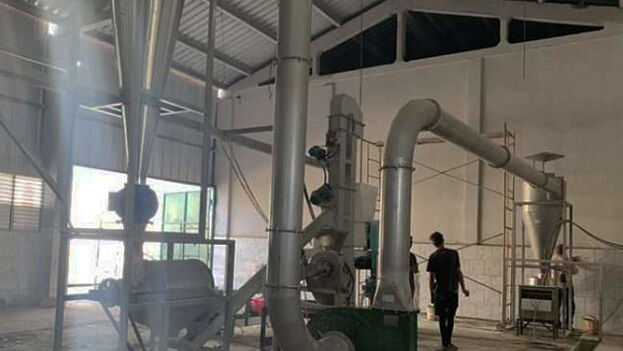
Managers expect the cassava flour plant to start operations this month. (El Artemiseño)
14ymedio, Havana, 9 February 2023 — The Ceiba Citrus Company, located in Caimito, Artemisa, has bet all its cards on the construction of a new cassava flour factory. However, despite the investment required by the plant, its managers cannot guarantee that the harvest of the tuber on the Island will live up to their expectations.
Alejandro Valdés, general director of the factory, told the provincial newspaper El Artemiseño that they are working “without rest” in the assembly of the machinery, with an initial production capacity of 440 to 2,645 pounds per day. In full operation, the manager said, the technology will allow obtaining one ton of flour for every two of fresh cassava.
The operation will require a stable supply of the tuber and, although the amount required for the premiere of the factory is assured, Ceiba does not have guarantees that the national production of cassava can keep up with it. Within a year, at least the planting of 740 acres will be required to maintain the industry, with a yield of between 16 and 20 tons per acre.
The machinery is a donation from the Sustainable Agriculture Support Project (PAAS), implemented with the support of the Swiss Development Agency and the Dutch NGO Hivos, dedicated to strengthening agricultural production on the Island. Valdés said that since June last year they have been “immersed” in the assembly, but acknowledged that there were delays because they did not have the “relevant capacity” to handle the technology, which has led to “variations throughout the process and has been a very useful learning process.” continue reading
The shortage of materials has made it difficult to meet the deadlines, added Orestes Leiva, administrator of the new industry, who expects the plant to be ready between February 15 and 20, if the entry of materials remains stable.
Valdés explained that the machines will cover the entire process, from the transport of the cassava to its cleaning in a tank where some blades will remove its skin. Then, it will be moved to a grinder and dried in an oven at about 400 degrees, in order to finally grind and pack the flour.
Cassava derivatives have served as an alternative to the scarcity and increase in the price of wheat and other cereals on the Island, mainly for the preparation of bread that is distributed in the ’normal family basket’ [through the rationing system]. Its high starch content makes it a healthy food. It’s also used by industries for pharmaceuticals and cosmetics, and can even be used to replace malt in beers.
However, its use in baking has not achieved popular acceptance, which points to breads made with a mixture of the tuber and wheat flour as less durable, with a darker dough and variations in flavor. For most consumers, the use of cassava for these purposes results in a lower quality food.
Sergio Rodríguez Morales, director of the National Institute of Tropical Food Research (Inivit) of the Ministry of Agriculture, told the official newspaper Granma that the cultivation of cassava has had several “significant advances” but insisted that it falls short in meeting the demand for human, animal and industrial consumption.
Currently, Cuba has about 111,000 cultivated hectares of cassava, the highest area in history, although the goal of the Ministry of Agriculture is to reach 494,210 acres in the “shortest possible period,” the technician said.
The article in Granma, published last November, refers to the fact that producers see more profitable income in the cassava with the sale of 220 pounds at 350 pesos. Raidel García, a farmer from Camajuaní, considers it a plant that is “irreplaceable in current times” because it is harvested throughout the year and survives without irrigation and application of fertilizers.
Translated by Regina Anavy
____________
COLLABORATE WITH OUR WORK: The 14ymedio team is committed to practicing serious journalism that reflects Cuba’s reality in all its depth. Thank you for joining us on this long journey. We invite you to continue supporting us by becoming a member of 14ymedio now. Together we can continue transforming journalism in Cuba.
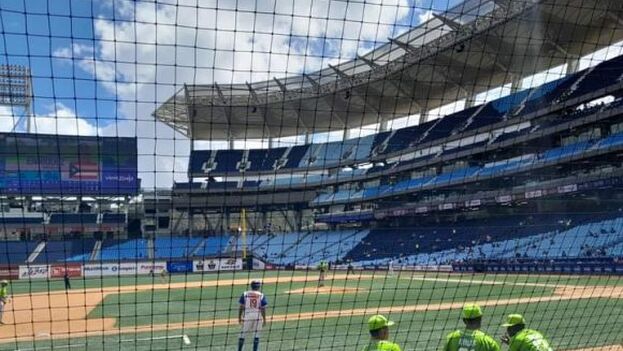
Another failure for Cuban baseball in the Caribbean Series after the Island was eliminated. (Cubadebate)
14ymedio, Havana, 7 February 2023 — Cuba is still without a compass in the 65th Caribbean Baseball Series “Gran Caracas 2023.” On Tuesday it suffered one more defeat against Puerto Rico (4-3), the fifth in a row, and was eliminated from the series that takes place in Venezuela. A single by Emmanuel Rivera to center field was enough for the Puerto Ricans to give a setback to the Island as a whole in the lower part of the ninth.
The three-run rally at the top of the second inning was useless. With singles by Yosvani Alarcón, Rafael Viñales, Carlos Benítez and Yordanis Alarcón, Cuba moved ahead 2-0. Thanks to another single by Yunieski Larduet, the Island was winning by 3-0.
In the fifth inning, Puerto Rico scored thanks to two runs after a single by Daniel Ortiz, a triple by Roberto Enríquez and another single by Bryan Torres. In the ninth inning, the triumph over Cuba took place.
Puerto Rico put the game “under protest.” Puerto Rico’s manager, Mako Oliveras, alleges that on the roster that Cuba delivered, the name of Andy Rodríguez appeared instead of Andy Vargas, although it seems that it was all a mistake. continue reading
“I am not happy about Cuba’s defeat but I knew it was going to happen, because Cuba’s performance has been embarrassing,” commented Swing Completo journalist Daniel de Malas.
There had to be four consecutive defeats of the Cuban team in the Caribbean Baseball Series, one of them 20-3 by the host Venezuela, before a pro-government news source like Cubadebate would accept that Cuba “should have been backed up with quality baseball players.”
The publication took place after the 5-4 stumble before Colombia. We must “bring no less than eight reinforcements to this club tournament; all countries go with the best,” the same medium published.
The game against Venezuela evidenced the shortcomings of a Cuban team that came to this event with confidence in its pitchers, although “they weren’t very high-profile, except César García and Leandro Martínez,” said manager Carlos Martí prior to the competition, with experience in these battles in 2017 and 2018. “We won with them in Cuba and we are going to fight here,” he proclaimed.
“You always have to be careful with the story,” journalist Francys Romero wrote on his social networks. He recalled that “Cuba’s teams in the Caribbean Series were full of stars between 1950 and 1960.”
The reporter regretted that “after six decades, these Cuban teams are drawn up to motivate a trip for a championship under the sun. They don’t even have reinforcements. It’s painful.”
The Island opened its participation in the current edition of the Caribbean Series with a triumph against Curaçao (3-1). And from there, defeats accompanied the team. The first was against the Dominican Republic (3-1) and then against Mexico (6-5). After the resounding defeat of Agricultores, the team that represents the Island in the Caribbean Series, against Los Leones de Caracas (20-3), Cuba was surpassed by Colombia (5-4), and this Tuesday by Puerto Rico (4-3).
Cuba had not suffered such an embarrassing stumble since February 8, 1977. On that occasion, the representative of the Dominican Republic (Tigres del Licey) connected with 23 hits in a Caribbean Series game, according to the statistical firm Quality Sports.
Translated by Regina Anavy
____________
COLLABORATE WITH OUR WORK: The 14ymedio team is committed to practicing serious journalism that reflects Cuba’s reality in all its depth. Thank you for joining us on this long journey. We invite you to continue supporting us by becoming a member of 14ymedio now. Together we can continue transforming journalism in Cuba.
The Dominican Republic Police arrested Cuban Alejandro David Hernández Castro, accused of committing fraud in three shops. (Facebook)
14ymedio, Havana, 9 February 2023 — The National Police of the Dominican Republic arrested Cuban Alejandro David Hernández Castro on Wednesday for defrauding businesses of 6,612 dollars (376,128 Dominican pesos). According to a report, the detainee, who posed as a baseball player, used a bottomless bank card in three establishments to pay for food and get a tattoo.
Upon learning of Hernández Castro’s arrest, the people who were scammed came to ratify the complaint. A Dominican woman, whose name was omitted, accused the detainee of “consuming food and drinks in the company of several people” in the restaurant located on Mustafá Kemal Street, in the Naco expansion. The bill was $940 (53,528.20 Dominican pesos), which he paid with a card issued in the United States.
According to the Dominican authorities, the card with which “apparently” Hernández Castro paid “is from a US financial institution in which the digital verifone (payment platform) approves payment, but the money never arrives in the account of the commercial establishment.”
The National Police said that the Department of Investigation of Crimes and High-Tech Offenses investigates this type of fraud.
Another accusation against the alleged 22-year-old baseball player was made by the owner of a nightclub. He said that Hernández Castro, in the company of several people, consumed different drinks during his stay in the club, and his bill amounted to 5,273 dollars (300,000 Dominican pesos). The scam was similar to that used at the restaurant. continue reading
A tattoo artist also identified Alejandro David as the person who entered his establishment in the Los Prados sector and presented himself as a baseball player who would be recruited by a Major League team. The alleged athlete asked him to tattoo an image on his back and ended up defrauding him of 400 dollars (22,600 Dominican pesos).
Hernández Castro was arrested while crossing 27 de Febrero Avenue at Abraham Lincoln, in the National District. At the time of the arrest he did not have any identification, and the police later found two false passports among his belongings.
It was also learned that the detainee entered illegally on a raft. The journey was from Haiti, so he was undocumented in the Dominican Republic.
The detainee is under the control of the Prosecutor’s Office of the Naco National District, for the corresponding legal purposes.
Translated by Regina Anavy
____________
COLLABORATE WITH OUR WORK: The 14ymedio team is committed to practicing serious journalism that reflects Cuba’s reality in all its depth. Thank you for joining us on this long journey. We invite you to continue supporting us by becoming a member of 14ymedio now. Together we can continue transforming journalism in Cuba.
 EFE (via 14ymedio), Havana, 15 February 2023 — On Wednesday, Cuba received 25,000 tons of wheat donated by the Russian Government for food production on the Island, which is going through a serious economic crisis.