Cuba’s State Communications Company Etecsa Restricts Phone Refills in Pesos To Disguise the Dollarization of Its Services

There will be mini refills of 360 pesos for 30 days and others that cost up to 11,760 CUP.


Young Cubans using cell phones in a park / X/Etecsa

14ymedio bigger14ymedio, Natalia López Moya, 30 May 2025 — Friday started badly for customers of Etecsa, Cuba’s state telecommunications monopoly. Etecsa has implemented, beginning May 30, new commercial measures that limit the refills of minutes in Cuban pesos and increase the price of web browsing, while encouraging the purchase of mobile balances from abroad to attract foreign currency, in the midst of the deep crisis that the company is experiencing.

At a press conference, Lidia Esther Hidalgo Rodríguez, vice president of sales for Etecsa, explained that customers of the prepaid mobile service will be able to top up their main balance to reach a total amount of 360 Cuban pesos over the course of 30 days. This restriction contrasts with the possibility that Etecsa customers had, until this Thursday, of buying refills in national currency without restrictions.

With a refill of 360 pesos for 30 days, consumers will be able to purchase, at most, a package with 6 gigabytes (GB) of web browsing, 60 minutes for making calls and the possibility of sending 70 text-only messages (SMS). As an improvement, Hidalgo explained that data plans can be used from any continue reading

network, unlike before, when the packages divided the offer into 3G and 4G.

Below the package of higher price and capacity are those of 4.5 GB of Internet connection for 240 pesos; another of 2 GB + 15 min and 20 SMS for 120 pesos, and one of 4 GB + 35 min and 40 SMS for 240 pesos. “Current data-based plan offerings are improved, guaranteeing more resources for less,” the official added. Customers will keep the balance they have accumulated so far and can use it to “continue purchasing unlimited plans or make as many balance transfers as they wish.”

Hidalgo’s enthusiasm did not manage to disguise the increase in costs that this new adjustment means for Cuban pockets.

However, Hidalgo’s enthusiasm did not manage to disguise the increase in costs that this new adjustment means for Cuban pockets. Once the client has exhausted the 360 pesos of the monthly refill allowed, he will have to enter the field of the so-called “Extras” that are offered. Among those options, the prices increase significantly.

Beginning this Friday, to purchase an extra package of 3 GB of web browsing you need 3,360 pesos, while to obtain 7 GB you have to pay 6,720, a figure that exceeds the average monthly salary, which in 2024 stood at 5,839 pesos. The jewel in the crown, the 15 GB package of data to connect to the Internet, is 11,760 pesos, a price that has caused a flurry of indignant comments on the official pages of the company. The “Extras” are for data only and do not include voice or SMS.

The difference in costs is no small thing. Until yesterday, without a limit on refills or net purchases in national currency, Cubans could purchase packages for the 4G network to connect to the Internet with prices ranging from 1 GB for 100 pesos, 2.5 GB for 200 pesos, and the higher capacity, 16 GB for 950 pesos. With the new tariffs, the price of GB increases by 1,229% or, in other words, is multiplied by 13.

In Cuba the majority of Internet users access the network via mobile telephones, given the low penetration of cable connections

On the island, where most Internet users access the network via mobile telephones, given the low penetration of cable connections, the limit of 360 pesos per monthly refill and the high prices of extra packages augur a drop in the presence of Cubans in cyberspace. The complaints that from the early hours of the morning began to fill the official sites denounce, rightly, this situation.

“Did you know that there are many university students like me who need to access audiovisual materials on the Internet?” asked a young man in the comments of one of the many publications that spread Etecsa’s measures as if they were a benefit to customers. “This change forces Cubans to have someone buy a refill from abroad, but what about those who don’t have anyone out there?” another commentator complained.

The new prices have been presented as part of a strategy announced by Prime Minister Manuel Marrero Cruz during the sessions of the National Assembly of People’s Power in December. The official then commented that a series of measures had been adopted to stimulate Etecsa’s foreign currency earnings and complained that “since it gave us more business to pay for the packages in national currency,” the company had practically stopped earning foreign currency.

Hidalgo said this Friday that “all offers will keep the 300 MB of national navigation” and stressed that the three main ways to add balances remain in force: national refills in pesos, transfers of balances between individuals, and refills from abroad that are paid in foreign currency. The latter are the most important for the state monopoly, which is facing a deep crisis in its infrastructure due to low investment and lack of resources.

“There is only one extra plan with data, SMS and international minutes, although most customers make international calls through messaging platforms,” explained Hidalgo

“There is only one extra plan with data, SMS and international minutes, although most customers make international calls through messaging platforms,” explained Hidalgo. In addition, he also spread the appearance of a new menu, which is accessed by dialing *222*732# and which will allow users to know the amount of refill allowed and the date from which the customer must reload.

Etecsa’s move has not surprised anyone. In January, an employee of the state monopoly commented to 14ymedio that “What happens now is that a mobile phone customer sometimes has thousands of pesos in balance and can buy any navigation package he wants. He can even make transfers of that money to others so they can also buy a connection package, and this will be more limited.” The worker was categorical: “Etecsa can do almost nothing with those Cuban pesos. It’s a dead fund in the face of investments and for the purchase of infrastructure.”

Translated by Regina Anavy

____________

COLLABORATE WITH OUR WORK: The 14ymedio team is committed to practicing serious journalism that reflects Cuba’s reality in all its depth. Thank you for joining us on this long journey. We invite you to continue supporting us by becoming a member of 14ymedio now. Together we can continue transforming journalism in Cuba.
The Famous Paseo Galleries in Havana Are Closed, the First Step Towards a Probable Dollarization

The stores in the complex, located on the Malecón, sold in hard currency and were out of stock.

“People came from all over the country because we had everything,” recalls one employee

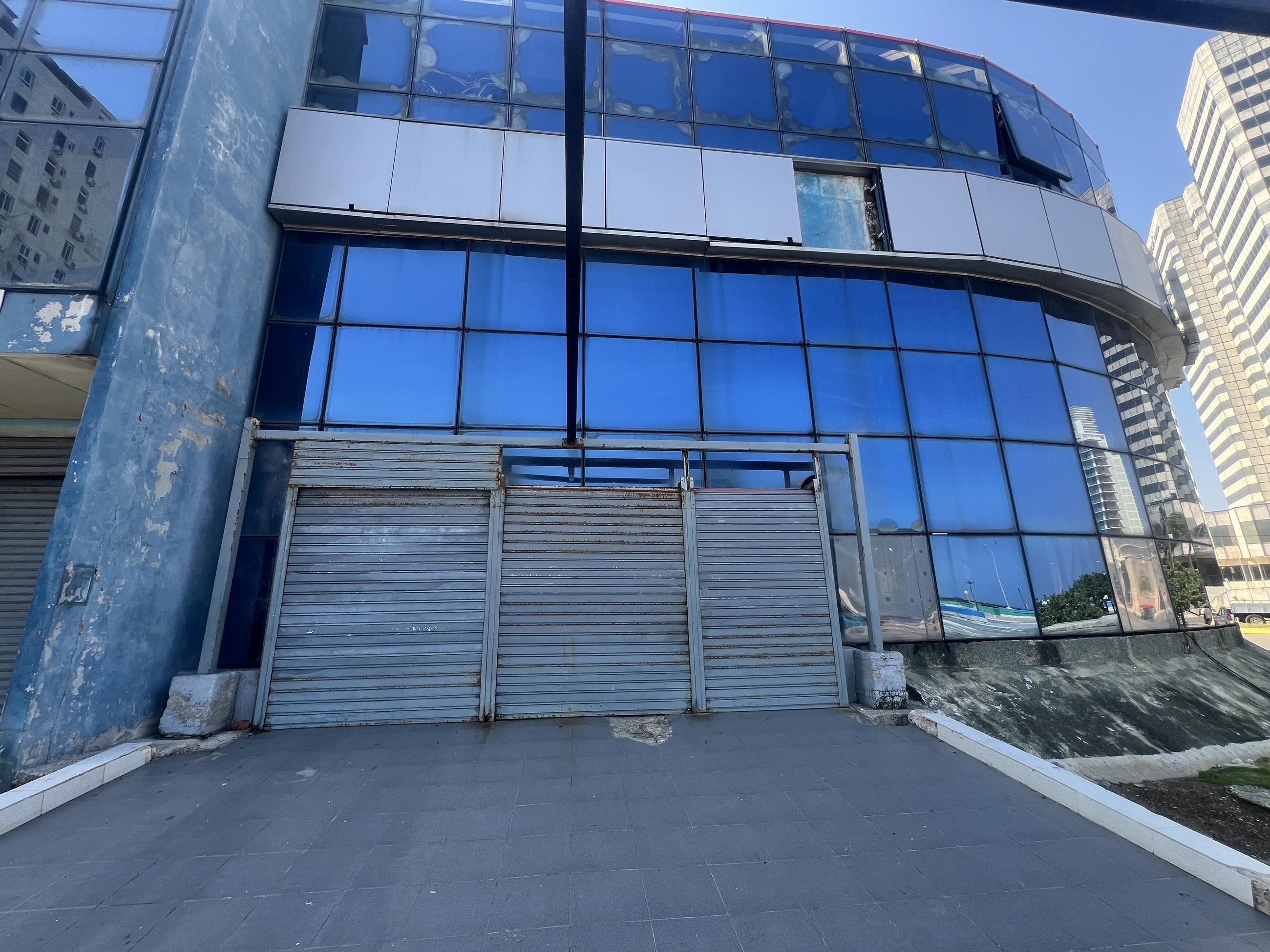
14ymedio bigger14ymedio, Havana, Natalia López Moya and José Lassa, 29 May 2025 — The sea is no excuse. This is well known to the residents of the Havana coast and also the customers who arrive these days at the Paseo Galleries, a few meters from the Malecón. Rust and neglect have taken over one of the most important shopping centers in the Cuban capital, a symbol of an economic upswing that fueled hopes at the beginning of this century. What’s left is a large empty store with littered floors full of rubbish.

Under this May’s sun, as hot as in August, a woman pushing a baby carriage advanced on Tuesday towards the doorway that was once full of taxi drivers, announcing trips to all the municipalities of Havana, and customers with their hands full of bags with newly purchased products. “They told me it was still open and that’s why I came,” grumbled the woman, who, instead of carrying a small child, used the carriage to carry some yuccas and a piece of pumpkin.

“This place is bare, they closed it down to fix it up and put it into hard currency,” ventures a passerby. / 14ymedio

“They closed it today because they’re fixing something with the electricity,” explained a resident in the vicinity who was passing in front of the pile of concrete and glass. “It’s empty; they also closed it for repairs and to turn it into a hard currency store,” ventured another passerby, who estimates that “before December” the new dollarized version of the store complex would be open. A few meters away, the “Magic World” sign on the old children’s store looked like it wouldn’t be able to last that long.

The closing also coincides with complaints on social networks about the poor state of the property and the shortage of goods on its premises. Images of empty refrigerators and dusty shelves raised a wave of indignation that seems to have contributed to the cancellation of service.

“It was one of the few places around here where you could still pay with MLC [freely convertible currency],” someone commented. That intangible currency, which barely a decade ago opened the doors of better-stocked markets, is now in full retreat on the island, although the authorities insist they will not eliminate it for the time being. The food market, with a butcher’s shop that alternated chorizos with pork loins, was often continue reading

frequented by the new rich who, finally, ended up packing their bags and emigrating.

Potholes forced customers heading to the market, located on the first floor, to walk carefully to avoid falls. / 14ymedio

With the same speed that the wealthiest buyers exchanged the corridors of the Galleries for the narrow airplane aisles, the building’s floor began to show gaps. The holes forced customers who went to the market, located on the first floor, to walk carefully to avoid falls. It also began to have a shortage of merchandise, and the boutiques were transformed into storehouses for ugly and smelly clothing.

But now, there is not even that. A young man emerged from his car and became another frustrated customer who came across a building that seems to have been abandoned and closed, waiting for dollarization to revive its spaces and refill its warehouses. “I came to buy some mosquito spray that they told me was here on the ground floor, but you can see that it’s not going to open today,” he said.

On the same ground floor, two decades ago, customers were delighted to see a well-stocked hardware store where the first single-handle faucets used by Cubans in their bathrooms were sold as a novelty. “People came from all over the country because we had everything,” recalls an employee who worked as a cashier in those years when the business center was synonymous with good taste and abundance. “We even had jacuzzis to sell,” she recalls.

The sliding doors, which previously only lowered when a hurricane was announced, are closed. / 14ymedio

Now, however, the sliding doors of the main entrance, which previously came down only when a hurricane was announced, are closed. The sea has left its signature on them, a rubric that is also seen on the reflective window panes that were once one of the architectural novelties of the property. Some are stained and others cracked, and the glass no longer reflects people and appliances, but only a deteriorated and empty environment.

“Home cleaning supplies,” can still be read on a part of the facade that once faced the Water and Soap chain, managed by the Italsav company throughout Cuba. The false ceiling that was partly collapsed, the completely empty shelves and not a soul inside the premises speak for themselves, even if no sign announces the closure of the business.

Contrast the fall into disgrace of this space with the central market that Berto Savina Tito, president of Italsav, has just opened; his relationship with Castroism has been known for decades. Last April, the firm opened Variedades Galiano Casalinda, in Central Havana, a showy store created by a joint venture with the Cuban state, offering “products for the home and the person” in dollars, with the Classic card or US bills.

Some stained and others cracked, the mirrored windows no longer reflect bodies or appliances, but rather the deteriorated and empty surroundings. / 14ymedio

Right in front of the hotel Cohiba, the Paseo Galleries have not yet had the luck to be able to collect hard currency, perhaps the cause of their current ruin. To go green, you need the greenbacks that have not arrived. That delay is bad news for guests of the hotel, directly across from the shopping complex, who used to cross the street to stock up at the food market or buy some sunscreen and flip-flops for the beach. Also to have fun in the evening at the Jazz Café.

But many of those travelers, who had planned to view the market from their hotel rooms, have now gone in the direction of the Dominican Republic or Cancun. And the new rich who went there now shop at Walmart or Home Depot, on the other side of the Florida Straits.

Translated by Regina Anavy

____________

COLLABORATE WITH OUR WORK: The 14ymedio team is committed to practicing serious journalism that reflects Cuba’s reality in all its depth. Thank you for joining us on this long journey. We invite you to continue supporting us by becoming a member of 14ymedio now. Together we can continue transforming journalism in Cuba.

Drought Threatens the Rice Paddies in Sancti Spíritus

The reservoir reached its lowest level in five years in May / Escambray

14ymedio bigger14ymedio, Havana, 29 May 2025 — Like last year, the Zaza reservoir is once again making headlines for its worrying storage levels, which have fallen below 12%. The disaster was seen coming from the beginning of the month, when the authorities blamed the drought for poor fishing, and, shortly after, 14ymedio reported the decline of the Yayabo river bed, which crosses the province and feeds the reservoir. Now, the official press admits, the reservoirs of the territory “are begging for water.”

Of the 1,020,000 cubic meters of water that can be stored, Zaza, the country’s largest reservoir, contains around 112,400, “the lowest figure recorded in the same period in the last five years.” In 2024 it also reached a critical 13%, but that was in June, one month later than this year.

The situation is similar throughout the province: the nine reservoirs in the territory amount to only 250.1 billion cubic meters of water, 21% of the total capacity. The authorities have been particularly concerned about the condition of the Zaza, which supplies other nearby provinces and numerous industries, as well as the rice fields of Sur del Jíbaro. continue reading

The reservoirs of Lebrije (49%), Felicidad (34%), Banao II (32%), Dignorah (22%) and Aridanes (9%) are also low in water volume

The situation is “tense,” recognizes Sancti Spíritus’ Escambray newspaper, which this Friday published the statements of Water Resources. According to José Carlos Hernández, the company’s specialist, the reservoirs of Lebrije (49%), Felicidad (34%), Banao II (32%), Dignorah (22%) and Aridanes (9%) also have low water volumes.

“Fortunately, the Tuinucú dam, which is responsible for ensuring water supply to the inhabitants of Cabaiguán and a large part of the provincial capital, stands at 73%, and the Siguaney reservoir, which is responsible for supplying the Sancti Spíritus industrial zone, shows 64% of its total capacity. Meanwhile, Higuanojo exceeds half of its total volume by 3%,” he added.

The manager called on people to save. “It is essential that people make rational use of water, given the low rainfall in the central region of Cuba.” As he explained, in Sancti Spíritus in May there has been only an average of 57.6 millimeters of rain, “when the historical number for this fifth month of the year is 176.2 millimeters,” he said.

Only two municipalities can be counted above this average: Fomento with 213.6 millimeters – even surpassing its historical May average – and Taguasco with 82.9.

The rest of the towns are in suspense, waiting for the rainy season to finally make its entrance. Especially in La Sierpe, also dedicated to the planting of rice – which requires moist land – and where not a single drop of rain has fallen this month.

At the beginning of May, another report from Escambray described the pitiful state of fishing in Zaza, which, due to drought and frenetic harvesting last year, has almost run out of fish. The situation, in turn, was a consequence of the huge drought that the reservoir suffered in 2024, to the point where on land, where there was water before, 14ymedio managed to photograph cows grazing. Then, said the press, for five years the reservoir did not open its spillway because it was not filled, even in the hurricane season.

The report published last week in 14ymedio on the Yayabo and Tuinucú rivers pointed out that with the small amount of rain, weeds and garbage have clogged the channels. The summer haze of the tropics makes them impassable, and, given the color of the water, it is unlikely that it can even be used for watering animals.

Translated by Regina Anavy

____________

COLLABORATE WITH OUR WORK: The 14ymedio team is committed to practicing serious journalism that reflects Cuba’s reality in all its depth. Thank you for joining us on this long journey. We invite you to continue supporting us by becoming a member of 14ymedio now. Together we can continue transforming journalism in Cuba.

Without Electricity or Gas to Boil Water, Matanzas, Cuba Suffers a Hepatitis A Outbreak

Faced with a lack of water supply in their homes, thousands of residents fill buckets from leaking pipes in public places.

Faced with a lack of water in their homes, thousands of city residents rely on the so-called manholes. / 14ymedio

14ymedio biggerJulio César Contreras, Matanzas, 29 May 2025 — When the first signs of weakness appeared, Ana María, 68, thought it was due to the nutritional deficiencies she had been accumulating for years. Retired from the education sector, with a pension of no more than 2,000 pesos a month, this resident of the city of Cárdenas, Matanzas, didn’t immediately conclude that her discomfort was due to a virus, hepatitis A, and that it had been transmitted to her through the water.

In Ana María’s house, like in most homes in Cárdenas, the water coming through the pipes is dirty, sometimes brown in color and has an unpleasant odor. The solution families used for decades to counteract the poor quality was to boil and filter the water, but long power outages and the rising cost of cooking coal have forced them to abandon this healthy practice.

“I have a filter, one of those that claim to eliminate a lot of dirt, heavy metals, and bacteria, but it doesn’t seem to work for this,” Ana María tells 14ymedio. Despite defining herself as a “very cautious” person with everything she puts in her mouth to avoid diarrheal diseases, this time the hepatitis A virus evaded her hygiene protocols and now, from her liver, forces her to rest. continue reading

We should “consume quality drinking water, boiling it if possible,” but the lack of fuel makes this task difficult.

This retiree’s case is not an isolated one. The newspaper Girón recently confirmed the appearance of a hepatitis A outbreak in the 13 de Marzo neighborhood and the La Marina neighborhood in Cárdenas. The report warns that people should “consume quality drinking water, boiling it if possible,” but the lack of fuel makes this task difficult. Faced with the choice between using the limited amount of liquefied natural gas, firewood, or coal, which they can purchase at 1,300 pesos a sack, to heat food or water, most Matanzas residents opt for the former.

Hepatitis A, an infection transmitted through the fecal-oral route, usually through contaminated food or water, typically has a good recovery prognosis, and those who suffer from it acquire lifelong immunity. However, the aging population, malnutrition, and difficulties in resting and eating according to medical recommendations, and maintaining hygiene during illness, hinder the process of overcoming the virus.

“In this neighborhood, there’s an elderly woman who had to be taken to the hospital because she contracted hepatitis A and was already sick, bedridden, with bedsores, and alone,” explains Ana María. The exodus of children and younger relatives has left many elderly people in an extremely vulnerable situation. In the face of any health problem, they find themselves helpless, without home care, and lacking medication.

“The doctor couldn’t even give me instructions on what kind of diet I should follow because he says he knows I won’t be able to follow it.”

“They prescribed me rest and plenty of water. I know it’s a virus and there’s not much I can do, but the doctor couldn’t even give me instructions on what kind of diet I should follow because he says he knows I won’t be able to follow it.” Low fat, natural products, vegetables, lean proteins, and no alcohol complete the suggestions for those suffering from hepatitis A, precisely the food groups with the highest prices in the markets.

Others don’t even know if the fatigue they’re experiencing is due to the virus spreading through the province. Abel, 23, hasn’t been able to get out of bed for days. He blames his laziness on the water from a supply point in the city of Matanzas, across from the Transmetro bus station, a few blocks from the Simpson neighborhood. He also has intermittent fever and nausea, but the lack of reagents for the test delays the results, and he can only guess that he has hepatitis A.

The manholes are piles installed in a corner or some hole in the pipeline that spill their contents into a public space. / 14ymedio

Two of Abel’s friends have already been diagnosed with the virus. “They collect water from the small well next to Watkins Park Zoo, but it could all end up being contaminated,” warns the Matanzas resident. Faced with a lack of water supply in their homes, thousands of city residents flock to the so-called manholes, sinks installed on a street corner or a hole in the sewer that spills its contents into a public space, where they fill buckets, jugs, and tanks that they then haul back to their homes.

“The other day, a Public Health inspector, seeing us filling the buckets, warned us not to drink that water, but what can we do?” the young man reflects. His hope is that he hasn’t lost his appetite, one of the most common symptoms of hepatitis A, and that, therefore, his discomfort could be just a minor stomach infection. Acute diarrheal diseases are also hitting the province hard, and their prevalence is expected to increase as summer approaches.

“A Public Health inspector, seeing us filling the buckets, warned us not to drink that water, but what can we do?” / 14ymedio

“If I had the money, a courier would bring spring water to my doorstep,” reckons Abel, who wants to avoid future moments of uncertainty and fatigue. “What we’re doing at home is using different utensils to eat, but we’re forced to use the same bathroom, and most of the time, we don’t even have water to flush or wash our hands.”

Under the kitchen counter, Abel’s family keeps containers containing some of the water they carried for several blocks. This essential and vital liquid contains their greatest ally and perhaps their worst enemy.

____________

COLLABORATE WITH OUR WORK: The 14ymedio team is committed to practicing serious journalism that reflects Cuba’s reality in all its depth. Thank you for joining us on this long journey. We invite you to continue supporting us by becoming a member of 14ymedio now. Together we can continue transforming journalism in Cuba.

The Cuban Regime Imposes a Leader on Freemasonry and Will Freeze Their Bank Accounts if They Reject Him

Cuba’s Ministry of Justice replaces the unruly José Ramón Viñas with the ‘babalawo’ Lázaro Cuesta

José Ramón Viñas and Lázaro Cuesta, during a Masonic act in Havana / Facebook / Gran Logia de Cuba

14ymedio bigger14ymedio, Juan Izquierdo, Havana, May 29, 2025 — The man that the Ministry of Justice wants to command the Supreme Council for the 33rd Degree – the highest authority of Freemasonry in Cuba, next to the Grand Lodge – is Lázaro Cuesta Valdés. The play is unsettling. This is a veteran Masonic leader, used to getting along with the government, who is also the head of the independent Cuban Yorubas.

The proposal that the Babalawo (High Priest) Freemason take over the reins of the Supreme Council is only a side effect of the letter signed on 27 May by the Association Directorate of the Ministry. Its declared objective is to revoke the re-election of José Ramón Viñas, who has been critical of the regime and monitored by State Security for years.

The schism between the Supreme Council and the Grand Lodge has been the great internal consequence of the crisis in which, since January last year, Freemasonry has been immersed on the island. It was Viñas who blamed Mario Urquía Carreño, former leader of the Grand Lodge, for stealing $19,000 from his own institution and allowing political police interference. After a year and a half, the fraternity is still divided, the scandal remains active, and “excommunications” have not been lacking on either side. continue reading

Recently arrived at the fraternity, Cuesta seems to agree with the proposal of the Ministry of Justice

Recently arrived at the fraternity, Cuesta seems to agree with the proposal of the Ministry of Justice. A letter with his signature – the same one that usually initiates the Letter of the Year of the Miguel Febles Commission – also circulates among the Cuban Masons. If the Masons obey this external directive, the Supreme Council will have a leader willing to get on well with the regime. If they do not, the Ministry threatens to revoke their official recognition as an association and freeze their bank accounts.

The reaction of Cuesta, of total compliance with the Ministry, is surprising, given that last January – in connection with the publication of the Letter of the Year – he refused to answer CiberCuba’s questions about the Masonic crisis. “The Letter of the Year Organizing Commission does not have among its purposes the ability to deal with issues arising in institutions or organizations outside our faith. I think it would be disrespectful of me to generate criteria or opinions,” he said at the time.

On the horns of a dilemma, several members of the Supreme Council have protested. The writer and independent journalist Ángel Santiesteban, recently expelled from the Grand Lodge, attributed the move to State Security and summarized the most recent attempts by the Government to interfere in the order: the protection of Urquía Carreño after the robbery; the controversial appointment of Mayker Filema, now also in dispute, as his successor; the infiltration of numerous agents into the Masonic ranks and now the decision to recognize Cuesta as leader of the Supreme Council.

“Freemasonry has been unable to stabilize for two years because of the constant violations of laws that state agencies ignore and others get around or misinterpret, blatantly, as if Masons do not have the capacity for intelligence,” he said.

Santiesteban demanded respect for the two recent elections held by the Masons, in an attempt to resolve the schism

Santiesteban demanded respect for the two recent elections held by the Masons, in an attempt to resolve the schism: that of Alberto Kessel, on May 25, as Grand Master – a decision that Filema rejected in a statement – and that of Viñas as Commander of the Supreme Council.

Other Masons have expressed themselves, sometimes anonymously, to say that Cuesta has been a man of the regime and an “active member of the Ministry of the Interior since 1990.” Others accuse him of corruption and suspect that the same person who already leads the Miguel Febles Commission of the Yorubas aspires to lead a high Masonic body.

The Commission, initially opposed to the ruling Yoruba Cultural Association, has been dropping its critical tone under Cuesta’s leadership, and two years ago it waited for Cubadebate to publish the official Letter of the Year before releasing its own. Many have attributed the delay to complicity between the two groups.

For his part, Viñas maintains his usual public silence on matters concerning Freemasonry. As explained last year to 14ymedio, he prefers not to make statements to the independent press about a crisis whose solution he considers the province of the Masons, not suitable for “profane” debate.

The current Commander has been in office for nine years, a term that the Ministry of Justice considers excessive and illegal, so leadership must fall back, they argue, to the Masonic leader who occupied the post before Viñas, meaning Cuesta.

Translated by Regina Anavy

____________

COLLABORATE WITH OUR WORK: The 14ymedio team is committed to practicing serious journalism that reflects Cuba’s reality in all its depth. Thank you for joining us on this long journey. We invite you to continue supporting us by becoming a member of 14ymedio now. Together we can continue transforming journalism in Cuba.

Cubans Pay up to 500 Euros for a Free Appointment at the Spanish Embassy

A Spanish consumer association denounces “marketing” of visa appointments and other procedures.

Queue at the Spanish embassy in Cuba last week / 14ymedio

14ymedio bigger14ymedio, Havana, May 27, 2025 — Some intermediaries are charging Cubans up to 500 euros for a free procedure at the Spanish Embassy in Cuba. One of the best-known consumer associations in Spain, Facua-Consumers in Action, denounced this practice to the Ministry of Foreign Affairs, European Union and Cooperation, which is responsible for the consulate.

Facua denounces the “slow and cumbersome” visa application process for entering Spain, which has caused discomfort among several users, including Cubans wishing to travel to the country and Spanish citizens residing on the island.

“Cubans, Spaniards, and anyone else who wants to access the services of the Consulate of Spain in Havana are experiencing constant delays in obtaining a prior appointment, which is required for completing the necessary bureaucratic procedures,” warns the association, which expresses concern about the “marketing” that the situation is generating.

“This delay in obtaining an appointment often causes the previously sent documentation to expire and lose its validity.”

Users must send the required documentation electronically to obtain an appointment. Then, the embassy generates an access code for the applicant to book his or her appointment online, but the appointments sell out in just minutes, making it difficult -if not impossible- to find available dates. “This delay in obtaining an continue reading

appointment often causes the previously sent documentation to expire and lose its validity, forcing users to start the process from the beginning,” regrets Facua.

At that moment, managers and other intermediaries step in, “taking advantage of the desperation of many users trying to obtain a visa,” demanding amounts that can reach up to 500 euros. To prevent such abuses, the association urged the Ministry to take measures to streamline the processes and make them more secure, “thus avoiding situations like those currently occurring in Cuba, where third parties exploit others’ needs for profit by managing procedures that should be free of charge.”

The association, as explained in its press release, has received a response from the undersecretary of the Ministry, who said he was confident that the new system of appointments and shifts that will soon be implemented will help to avoid problems of this type. The transition is part of the Consular Digitalization Plan, which began in 2023 and is scheduled to conclude in July, when all of Spain’s embassies will have migrated to the new platform of applications, infrastructure and content.

The Embassy in Cuba is immersed in this process, which includes the new electronic civil registry (DICIREG), which landed at the Havana headquarters this April. Although what keeps most people on tenterhooks is the implementation of the appointment platform, which will also affect applicants for Spanish nationality through the Law of Democratic Memory, whose deadline expires next October.

The diplomatic mission warned last week that on June 23, the credentials from the old system will be removed, making that the deadline for booking appointments using those credentials. Those who have not managed to do so will need to submit a new request using the new tool, which will be explained later.

“It is clarified that it is the booking operation that must be completed before June 23; however, the scheduled appointment can be set for a later date.”

“It is clarified that it is the booking operation that must be completed before June 23; however, the scheduled appointment can be set for a later date. Individuals are requested to attend their appointment with the reservation receipt,” the Consulate stated in a communiqué, also reminding that the application for Spanish nationality must be submitted before October 22, 2025, although—again—the appointment for the procedure may take place afterward.

The fever to obtain Spanish nationality has uncovered a multitude of abuses and frauds, both at the time of obtaining documents and appointments: a black market in which thousands of euros are moved.

Among the most well-known cases is the network that produced false certificates to certify Spanish ancestry for up to 2,000 or 3,000. Although cases of this kind are not uncommon, the volume of fraudulent documents in Cuba was so high that the consulate began requiring double verification from the Historical Archive of Ourense: the institution’s seal and the vicar’s signature, whereas in the rest of the world, only the seal is usually enough. The information was revealed on a local television program in the province, where a young diocesan archivist shared anecdotes about the heavy workload caused by the demand for documents, particularly from Latin America.

Translated by Gustavo Loredo

____________

COLLABORATE WITH OUR WORK: The 14ymedio team is committed to practicing serious journalism that reflects Cuba’s reality in all its depth. Thank you for joining us on this long journey. We invite you to continue supporting us by becoming a member of 14ymedio now. Together we can continue transforming journalism in Cuba.
Abraham Maciques Has Died: The Architect of a Parallel Economy That Kept Castroism Afloat

Maciques retired as he lived: without fuss, but with the certainty that his legacy had the friendship of Dalia Soto del Valle / Más Cuba

14ymedio bigger14ymedio, Yunior García Aguilera, Madrid, 29 May 2025 — One of the most powerful and discreetly feared men of Castroism has died: Abraham Maciques Maciques, the great administrator behind the scene. He was 95 years old and survived almost all the purges of Castroism. He died this Wednesday in Havana, after more than six decades of juggling currency, hotels, congresses and financial fugitives.

Maciques was not a minister, nor a general nor an ideologue. He was something more useful: a precision gear in the economic machinery of the regime. A bureaucrat with a head for business, without bragging or proclaiming anything, he wove networks of power through entities like Cubalse, Cubanacán S.A. and the all-powerful Palco Business Group, from where he pulled strings for the millionaires.

He was born in 1930, in Matanzas, to a family of Jewish origin. At the end of the 50s, he was a minor sub-delegate of Tourism in his province, when he crossed paths with a young bearded man who promised to redeem Cuba by shooting left and right. The chemistry was instantaneous. Fidel Castro sent him to the Ciénaga de Zapata to settle a minor matter with coal miners, and there he was surprised by the invasion of the Bay of Pigs. The fright became confidence, and the bond with Fidel and Celia Sánchez was forged. continue reading

A bureaucrat with a head for business, without bragging or proclaiming, he wove networks of power through entities like Cubalse, Cubanacán S.A. and the all-powerful Palco Business Group

From then on, Maciques became part of that small circle that did not need a uniform to exercise power. He presided over Cubalse – a kind of exclusive consumer holding for the nomenklatura – directed the construction of the Palace of Conventions and ended up as tsar of Cubanacán S.A., the spearhead of Cuban tourism in the 80s.

It was precisely at this time that Havana became the refuge of one of the most famous financial scammers of the 20th century: Robert L. Vesco, alias the pirate banker, a fugitive from the American justice system and star of the regime. “We don’t care what he did in America. We only care about his money,” said Fidel, words that should be chiseled into marble at the entrance to the Ministry of the Interior.

Vesco landed, grew a beard so he would fit in and called himself Tom Adams, as if that would erase his record. From Palco, with Maciques as a silent partner, they set up a network that included Donald Nixon Jr. – nephew of former President Richard Nixon – and José Antonio Fraga Castro – nephew of Fidel and director of Labiofam – to promote a miraculous HIV vaccine called Troxidal. They invested $30 million. It did not cure anything, but they made history: the fraud ended with Vesco sentenced in 1996 to 13 years in prison in Cuba. Maciques, of course, came out unscathed. Fidel took care of his own, especially if they knew how to keep quiet.

Maciques handled, for decades, what might be called institutionalized elitism

From his throne in Palco, Maciques handled, for decades, what could be called institutionalized elitism: exclusive hotels, houses for diplomats, restaurants invisible to the ordinary Cuban, free zones, special services for foreign companies. Palco was a lucky country within the country, a Cuba without blackouts or lines, reserved for those who were well connected.

The Soviet collapse turned those operations into pure gold. While the people lined up for bread, Maciques administered currency, international connections and incentive packages for foreign delegations. His real position never appeared in the Official Gazette, but his power was tangible: anyone who wanted to move money or set up a fat business deal had to go through him or stay out.

In June 2021, when the generals began to shake up the “historical founders without uniform,” Maciques was silently dismissed by Prime Minister Manuel Marrero Cruz. Palco was partially absorbed by Gaesa, the military emporium that devours what remains of the national economy. There was no scandal, only a dry official notice and discreet relief. Maciques retired as he lived: without fuss, but with the certainty that his legacy had the friendship of Dalia Soto del Valle, the widow of the first Castro.

The death of Maciques does not close a chapter: it closes a library

Miguel Díaz-Canel, in his usual necrological tone of ungracious official, lamented the loss and praised his “collaboration with Fidel and Celia,” as if he were remembering the receptionist of a hotel. Palco, for its part, dismissed him with honors, recognizing him as a “founder and essential figure.” No one said what he really was: the architect of a parallel economy that kept Castroism afloat when everything else was falling apart.

The death of Maciques does not close a chapter: it closes a library. He was a man who understood better than anyone else the Cuban alchemy of mixing ideology with business, confidentiality with privilege, revolution with reserve. He survived it all: Celia, Fidel, the sanctions, Vesco, sex tourism, blackouts, reforms, the Castro nephews and Gaesa itself.

His tombstone will say that he was the “founder of Palco.” In reality, he was something else: the steward of Castroism, but without the keys to the safe.

Translated by Regina Anavy

____________

COLLABORATE WITH OUR WORK: The 14ymedio team is committed to practicing serious journalism that reflects Cuba’s reality in all its depth. Thank you for joining us on this long journey. We invite you to continue supporting us by becoming a member of 14ymedio now. Together we can continue transforming journalism in Cuba.

Locked Up Awaiting Trial in the Combinado del Este, the Owner of the ‘Cuban Costco’ Fears For His Life

“They punished him for his success and copied the Diplomamarket model for state-owned dollar stores,” says a source close to Frank Cuspinera.

The owner of the “Cuban Costco” has been in the Combinado del Este for almost a year awaiting trial / 14ymedio

14ymedio bigger14ymedio, Havana, May 29, 2025 — Frank Cuspinera, the Cuban-American owner of the Diplomarket (known as the “Cuban Costco”), has been in the Combinado del Este prison for almost a year awaiting trial, accused of tax evasion, currency trafficking and money laundering. This newspaper has reported on the letter he sent from prison, requesting help from the international community, mentioning the arbitrary nature of the acts committed against him by State Security and saying that on June 1, he will go on a hunger strike. Now 14ymedio has received more information about his case.

It comes from a family member who requests anonymity for fear of reprisals: “We are afraid of what may happen; here anything having to do with these issues doesn’t respond well to pressure.”

According to this source – whom we will call “Luis” – Cuspinera’s wife, Camila Castro, is at liberty in Havana but also faces the same charges, as the owner of another company associated with her husband, Kmila-mart SURL. It all started, says Luis, the same day they were both arrested, on June 20 of last year, with the arrival at Diplomarket of the National Office of Tax Administration (ONAT).

“They thought it would be a matter of a misunderstanding and that they would let them open the companies after it was resolved”

“They had a complaint for tax evasion, without having done at any time a prior audit,” he says. These officials “reviewed everything,” and after them, the Technical Directorate of Investigations (DTI) was introduced. The entrepreneurs were arrested, and “immediately” their business licenses continue reading

were taken away from both Cuspinera SURL – the firm under which the supermarket operated – and Kmila-mart, leaving them “inoperable.”

For the couple it was, says Luis, a shock: “They thought it would be a matter of a misunderstanding, that they would let them open the companies after solving it and allow them to return the goods to some suppliers, or even that Frank could respond to the process on bail, but they have not agreed to any of this.” The authorities were, he says, “more severe and arbitrary as time went on.”

At the time of the arrest, the officials claimed “that the money from sales was not deposited in the bank and caused damage and discontent among the population,” says Luis. This is, in his view, “absurd,” since “neither State importers nor banks guaranteed the availability of dollars or transfers abroad for payments to suppliers even when the currency was deposited.”

“Here everyone knows that all the MSMEs engage in currency trafficking”

How is it that a successful businessman whose work was reported by the official press and who was even allowed to add his signature to ask the US president to lift the embargo, fell into disgrace? Luis dares to venture that it had to do precisely with the success achieved, and that the action of State Security demonstrates the arbitrariness they demonstrate with certain prohibitions.

“Here everyone knows that all the MSMEs* engage in currency trafficking, because when they made the law of private companies, it was done knowing that there would never be availability in the bank to obtain the currency legally. It is known that the largest percentage of everything traded in Cuba is imported products obtained with transactions in currency, because here nothing is produced, so you have to import to produce later,” he says. And he accuses them: “They let you run knowing that they have the power to take over when they don’t want you to run any more, and they choose businesses that got out of their hands in order to eliminate them.”

However, he observes, “the working model and way of operating of Diplomarket was totally copied: they implemented it in the current dollar stores, which opened in December with the store at 3rd and 70th. It was right after he gave them information at the Aldabó police unit in Boyeros about how he sold goods in dollars and maintained the replenishment cycle with his foreign suppliers by buying goods on consignment. If there is a legal way to do business in dollars with foreign suppliers, why was it forbidden to the private sector?”

What this source categorically denies is that Cuspinera was a front man for the regime

While confirming that Cuspinera had a license from the Office of Foreign Assets Control (OFAC) to export from the US to Cuba, Luis is clear: “Frank found the most legal way possible to do these transactions between Cuba and the US without going through any State institution, and that scared them and did not agree with them. Or he found the same way they use to do transactions with the US, because it is known that Cuba buys American chicken. Yes, it is possible to trade with the US directly for natural persons with a private business in Cuba, but they cannot allow it.”

What this source categorically denies is that Cuspinera was a front man for the regime or that he was associated with Raúl Guillermo Rodríguez Castro, alias El Cangrejo [The Crab], the bodyguard for his grandfather, Raúl. “They were not protected by anyone; if they were this would not have happened, but I am sure that State Security was aware of what Frank was doing,” he says.

About El Cangrejo, he speculates that, being the son of the late Luis Alberto Rodríguez López-Calleja, who was director of the Group of Business Administration (Gaesa), he could inherit his father’s business. “There are many companies that have been following the game for years, and it may be that Frank was competing with them,” he ventures. “Just imagine the parcel companies, for example, that felt threatened by a store that brings products directly from the American market. The clientele went to the Diplomarket for that reason.”

One hypothesis is that these companies, “already coupled with Gaesa to work here satisfactorily, exerted some pressure, and it was decided to dissolve Cuspinera’s business in this severe way.”

Frank has no history of illegal exit from the country or any criminal record

It is unfair, for example, to keep him in jail without bail because of the
risk that he will evade justice. “The reasons why bail was denied are absurd. Frank has no history of illegal exit from the country or any criminal record. In addition, his mother, father, uncles and wife live in Cuba. There are legal alternatives to restrict his release other than prison,” he says.

As for the lawyer Cuspinera pointed to in his letter, he says that he was not independent: “They hired him, but the lawyers here are not really committed to their client. The arrogance of the DTI and the Prosecutor made him consider that it was better to lower his head before causing trouble and losing a supposed prestige they believe he has. In addition, the laws of Cuba are designed to tie lawyers’ hands.”

In any case, the family can’t explain why, almost a year after being locked up in a maximum security prison like the Combinado del Este of Havana, “they still do not close the investigation.” They have not yet “made a report with some amount of debt that supports the crime of tax evasion.” They have not even returned what they confiscated: “They picked up everything – goods, equipment and vehicles,” which they say have been “taken” as evidence.

Luis insists to this newspaper that the “priority objective” of Cuspinera -“an American citizen since his twenties” – is to obtain international help: “He has not found another way out and fears for his life.” Luis also states that, despite the fact that the 48-year-old businessman suffers from diabetes and high blood pressure,” he still has the idea of starting the hunger strike on June 1 that he announced in his letter.”

What may await him can be serious: “At the beginning of a hunger strike, the prison first will take away his rights as a prisoner, and he won’t be able to make phone calls. They will take away his visits, which he says he has received every 21 days since February, and put him in an unventilated isolation cell without light or a bathroom, as punishment, to make him give up.” However, he is willing to go all the way: “He has decided to go on a hunger and thirst strike, which is even worse.”

*Micro, Small, Medium Enterprises [mipyme in Spanish]

Translated by Regina Anavy

____________

COLLABORATE WITH OUR WORK: The 14ymedio team is committed to practicing serious journalism that reflects Cuba’s reality in all its depth. Thank you for joining us on this long journey. We invite you to continue supporting us by becoming a member of 14ymedio now. Together we can continue transforming journalism in Cuba.

From a Prison in Cuba, the Owner of the Havana ‘Costco’ Denounces Deception and Torture

Cuban-American Frank Cuspinera accuses his lawyer of colluding with State Security to “keep me in prison, defenseless.”

Frank Cuspinera was arrested on June 20, 2024, and his Diplomarket was closed / Facebook

14ymedio bigger14ymedio, Olea Gallardo, Havana, 28 May 2025 — Almost a year after his arrest and lack of information about his whereabouts, Frank Cuspinera, owner of the Diplomarket, the “Cuban Costco” of Havana, has reappeared. He did so through a handwritten letter from prison signed on May 21, whose authenticity was confirmed by a family member this Wednesday, hours after it was broadcast by the ‘influencer’ Alexander Otaola.

In it, he makes “an appeal to the international community, to international and human rights organizations,” as well as to the United States Department of State, “to intervene with Cuban institutions for the constant violations of my rights and the denial of legal guarantees for my defense by Cuban state institutions and their representatives.”

Cuspinera says that he was manipulated by Cuban State Security (DSE) and the Cuban judicial apparatus, “which were cruelly activated against me” and which managed, with “multiple falsehoods,” to accuse me” without the right to a defense. “They have limited my access to justice. I was denied my rights to communication and legal defense from the start,” he claims in the letter. continue reading

Cuspinera announces he will go on a hunger strike on June 1

Therefore, he announces that he will go on a hunger strike -“to plantarme [stand firm]” he specifies, using the term of political prisoners – on June 1. “I will be willing to go to extreme consequences,” he says, until his rights to prompt defense and bail are guaranteed, “to be able to prove the injustice.” The Cuban-American businessman says that there was “premeditation by the DSE in conspiracy with the DTI [Technical Directorate of Investigations] and other institutions, including my defense attorney, who has worked against me.”

“Everything was planned even before my arrest, on June 20, 2024, almost a year ago,” he continues, confirming the date spread on social networks and never mentioned by the government. In those days, the La Tijera Facebook page said that a State Security operative arrived at the supermarket – located at kilometer 8 1⁄2 of the Carretera Monumenta, in the neighborhood of Berroa, more than 10 kilometers east of the center of the capital – along with two buses carrying auditors from Gaesa (Grupo de Administración Empresarial S.A.), the conglomerate of the Armed Forces and owner of the land where the establishment was located.

A day earlier, in the WhatsApp group managed by Diplomarket, a message announced that they were “closed until further notice,” explaining: “We are having problems operating because our commercial license has to be renewed.” The app could still be visited and had a caption: “We are offline. Send us an email.”

“The Frank Cuspinera and Diplomarket case was premeditated and planned because it developed the private sector and was registered as a company in the United States”

The La Tijera post pondered, referring to Raúl Guillermo Rodríguez Castro, son of the late Luis Alberto Rodríguez López-Calleja and Déborah Castro Espín, and bodyguard of his grandfather, Raúl: “It seems that now El Cangrejo [The Crab, a nickname for López-Calleja], grandson of the dictator Raúl Castro, no longer needs his Miami figurehead Frank Cuspinera Medina.” The brief text also recalled that Cuspinera Medina was vice president of Las Americas TCC Corporation, based in Pompano Beach (Florida), and that for years he had been residing in El Vedado, where he had bought “a mansion thanks to his relationship with the dictatorial elite.”

The next day, La Tijera disclosed more details of the case from an email received. According to this anonymous source, the “Cuban military forces” intervened in the business of the Cuban-American, and both he and his wife have been “incommunicado” since that day, accused of “tax evasion, currency trafficking and money laundering.” These accusations, the email claimed, were “nothing more than a pretext for the regime to appropriate their assets.”

“The authorities waited until the closing of the day to break into the company and take everything, a sale that the owners had previously authorized themselves,” continued the text. On the day after these events, “they began to confiscate all the assets of his company and distribute them among the members of the Castro elite.”

La Tijera’s source framed the operation within a “repetitive pattern” in which “the Castro regime attacks those who try to create opportunities and prosperity outside of State control.” However, this was not the case of Cuspinera, well established on both sides of the straits of Florida for years.

In his letter from prison, Cuspinera does not mention any of these names, but he states: “The Frank Cuspinera and Diplomarket case was premeditated and planned because it developed the private sector, and as a company registered in the United States with approval and federal licenses that competed with Cuban State enterprises, it brought into question the reach of the blockade.” In this regard, he also does not specify what type of license he has from the US Office of Foreign Assets Control (OFAC), without which it is impossible to trade with Cuba under the laws of the embargo.

Las Americas TCC, among other activities, was in charge of supplying Diplomarket, inaugurated at the end of 2022

Las Américas TCC, among other activities, was responsible for supplying Diplomarket, inaugurated at the end of 2022. The supermarket, which before opening was already functioning physically for online shopping, started operating discreetly until a tweet by CNN correspondent Patrick Oppmann, who did not mention its name, focused on it almost a year later.

On that occasion, this newspaper visited the business and could see the strong surveillance to which it was subjected. In a first booth, they were taking the data of vehicles at the time of entry, and later there was another guard booth, before entering the store. At the door, two individuals looked everyone up and down, and a large screen showed the movement of the security cameras, placed everywhere. A regular customer called it a “military unit.”

Not even 12 months had passed when Cuspinera fell into disgrace, in a case that recalled the former Minister of Economy Alejandro Gil Fernández, arrested in March 2024, weeks after being dismissed for “mistakes made in the exercise of his office,” and about whom nothing has been known since.

When Diplomarket came to light it was not easy to find out who owned it, as the firm was not on the list of micro, small and medium-sized enterprises (MSMEs) approved by the Ministry of Economy and Planning, and the name of Cuspinera did not appear on the supermarket’s website.

“Of the crimes they charge me with, they have manipulated contradictory statements of workers, without their knowledge and contact”

On the other hand, he was listed as vice president of Las Americas TCC. Consulting specialized pages, this newspaper verified that he had been domiciled in the United States and in El Vedado (Havana). In 2021 he appeared as a “specialist” at a meeting between self-employed workers and the National Association of Economists and Accountants of Cuba.

That same year, his name also appeared in a letter sent by several Cuban entrepreneurs to US President Joe Biden asking him to lift the sanctions against the island’s government, which were damaging to their businesses. In the letter he was not listed as a member of Las Américas TCC but rather as part of Iderod Servicios Constructivos.

This last firm was not on the list of MSMEs of the regime, although a company with its name, Cuspinera SURL LVI, is listed as dedicated to “providing services of electronic commerce platform,” as a branch of Las Americas TCC.

The businessman does not name in his letter either Las Americas or Iderod but does present himself as a “citizen, lawyer, Cuban-American entrepreneur” of Cuspinera SURL [Unipersonal Limited Liability Company], both in Florida and in Havana, “under the Diplomarket brand, known as the Cuban Costco.”

Cuspinera also states that he will not try to “evade the action of justice, but only ask that I can defend myself”

The text does not detail the charges against Cuspinera, but he claims: “Of the crimes I am accused of, they have manipulated contradictory statements of workers, outside their knowledge and contact.” The employer claims that he was accused of crimes by workers who “may have been able to leave the country.”

He says that, among other vicissitudes, “they have confiscated millions of dollars in goods, equipment, money from purchases and bank accounts,” without giving him a copy of those seizures. And he claims that the authorities “do not show evidence of alleged fraudulent goods, evasions or amounts, misrepresenting and manipulating information” which, he says, would prove his innocence. In addition, he accuses the prosecutors: “They have taken my statements by deception, trickery and torture.”

“They have denied all possibility based on an absurd social injury, without proof (there is no such danger from me to society), and by manipulating my statements and those of my employees.”

The appeal by his defense attorney to Court Complaints and Petitions was “riddled with errors, lacking in available evidence and all with the purpose of keeping me in prison, defenseless. He did not allow me access to my file and prevented other defense attorneys from being able to act.”

Giving names, he points to “instructor Yisset Oliva Betancourt,” the provincial director of the National Office of Tax Administration (ONAT), Yoandra Cruz Dovales, and his official lawyer, Luis Alberto Martínez Suárez, for having “taken unlawful actions to hold me in provisional detention unlawfully, without defense.”

Cuspinera also states that he will not try to “evade the action of justice but ask that I can defend myself through a bond so that the truth about my responsibility and that of the institutions comes out.”

Before finishing his letter, in which he also says that his mother is ill with cancer, the entrepreneur reaffirms his intention to stand firm. “I am ready to go to extreme consequences with my hunger strike to prove my innocence,” he concludes, after having warned that “the organs of the DSE” cut off “any possibility of defense.”

Translated by Regina Anavy

____________

COLLABORATE WITH OUR WORK: The 14ymedio team is committed to practicing serious journalism that reflects Cuba’s reality in all its depth. Thank you for joining us on this long journey. We invite you to continue supporting us by becoming a member of 14ymedio now. Together we can continue transforming journalism in Cuba.

The ‘Reparto’, Musical Genre of Poverty in Cuba, Annoys the Regime’s Cultural Commissars

This style, “like rumba and son before it, was marginal until the market made it profitable,” complains ’Cubadebate’

The official fear is that, the “reparto” will become the musical chronicle of a country in total crisis, just as reggaeton did in the past.

14ymedio bigger14ymedio, Havana, 25 May 2025 — As a genre, musical style, or a breeding ground for certain social attitudes—such as aggression or sexuality— the “reparto”* is under scrutiny by Cuban cultural commissioners. Several reports and ministerial meetings have taken place in recent weeks to address this “issue,” and this Wednesday, Cubadebate also brought it into the spotlight.

The official fear, spoken in whispers and acknowledged by Randy Alonso’s digital channel, is that the reparto will become the musical chronicle of a country in total crisis, just as reggaeton did in the past. Born and raised in that crisis, the singers have made it their main theme. They were born in humble environments, and now their music is “consumed” by everyone, “even high-level professionals,” laments the text.

The only thing left is the “cultural battle,” a duty to which the Ministry of Culture seems committed without a clear strategy. For now, the official press is leading the debate, arguing that reparto may have once embodied a form of “resistance” against the hardships of daily life in Cuba. However, they now claim it has become a defining trait for any young person, reflecting the environment they navigate.

“Prohibit or apprehend” are the two terms of the equation that the Center for the Research and Development of Cuban Music has put forward to deal with the reparto and, in general, with all urban music. The state entity attributes external origins to the phenomenon, especially in Puerto Rico and Panama. continue reading

The ’reparto’ imitates “foreign patterns” with simple, repetitive electronic bases.

Like reggaeton in the past, they claim, the reparto imitates “foreign patterns” with simple and repetitive electronic bases. Cubadebate points to the controversial “repartero” Chocolate MC as the father of the genre and creator of its most recognizable characteristics: a repertoire born from the orality – and even vulgarity – of Cuban slums.

These characteristics have made Chocolate – currently imprisoned in the United States and the source of countless controversies, crimes and rumors, including that of his recent faked death – a very popular figure among young people.

With a “crude, sexualized and sometimes violent” repertoire, the reparto represents the normalization of vulgar Cuban language, according to musicologist Xiomara Pedroso. “They are the reflection of a society where the daily struggle is in every verse,” she assures. As an example, Cubadebate also quotes a single mother, interviewed in Arroyo Naranjo, who summarizes her opinion on the topics addressed by the reparto: “How can we criticize that they talk about sex or money if that is what is missing at home?

The official press also reaches a problematic conclusion: The reparto is popular because it sells. However, they do not explain who is selling or what rules determine the market in a country where the music industry — if the term is applicable here — does not function the same way as in the rest of the world.

It also claims that more than 90 percent of Cuban teenagers prefer reggaeton and that there are no significant differences in musical taste between young people in cities and in rural areas. Incomprehensibly, they invoke the increased consumption of Latin music on Spotify, which Cubans cannot access, and mention the growing popularity of singers such as Bad Bunny, Karol G, and Anuel AA.

Cubadebate’s handling of the disturbing notion of “official values,” to which the reparto seems to be alien, dictates that cultural spaces such as the Houses of Culture, Cuban Television, and the Lucas Awards should promote alternatives to a problematic musical genre. However, it is paradoxically in these spaces where representatives of the reparto are most promoted.

“A genre born in the slums is now heard in the Lucas. Like rumba or son before it, the reparto was once considered marginal until the market made it profitable,” complains the media.

“The ’reparto’, ’trap’ or reggaeton are not the problem per se; they are rather reflections of complex social realities.

The fact that last Wednesday’s report in Cubadebate was written by multiple authors seems to explain the coexistence of divergent views within the text. While the first part of the text appears to take a critical approach to the Reparto, the second part — which views the Reparto as a “symptom” — is surprising for its sympathetic paragraphs about what the genre represents.

“The reparto, the trap or the reggaeton are not the problem per se; they are rather reflections of complex social realities. Their content should not be seen as a lack of values, but rather as a consequence of deeper issues: the rise in poverty, the lack of opportunities, and the emotional exhaustion that weakens the ethical foundtions of society.”

The university magazine Alma Mater took a more open approach to the subject. Several days ago, it claimed that it had no intention of defending or criticizing the Reparto, but rather of gathering situations that bear its imprint on today’s Cuba.

It was, ultimately, a sarcastic portrayal of the repartero Bebeshito—as controversial as Chocolate—in which the intention was to synthesize the entire guild. However, Alma Mater subtly hinted at what appears to be the State’s true concern regarding reparteros.

It is not just a matter of ethics or civility, but also of relationships with small and medium-sized enterprises and private businesses, which favor the performances of these musicians. However, even here, the official press does not dare to settle its differences with a musical proposal that it criticizes as an institution, despite the fact that—on a personal level, and these texts are the greatest evidence of it—all its journalists listen to and enjoy it.

*Translator’s note: In Cuban music, “reparto” refers to both an urban genre influenced by reggaeton and the working-class neighborhoods where many of its artists originate. This link between music and social identity shapes its lyrics and cultural impact.

Translated by Gustavo Loredo

____________

COLLABORATE WITH OUR WORK: The 14ymedio team is committed to practicing serious journalism that reflects Cuba’s reality in all its depth. Thank you for joining us on this long journey. We invite you to continue supporting us by becoming a member of 14ymedio now. Together we can continue transforming journalism in Cuba.
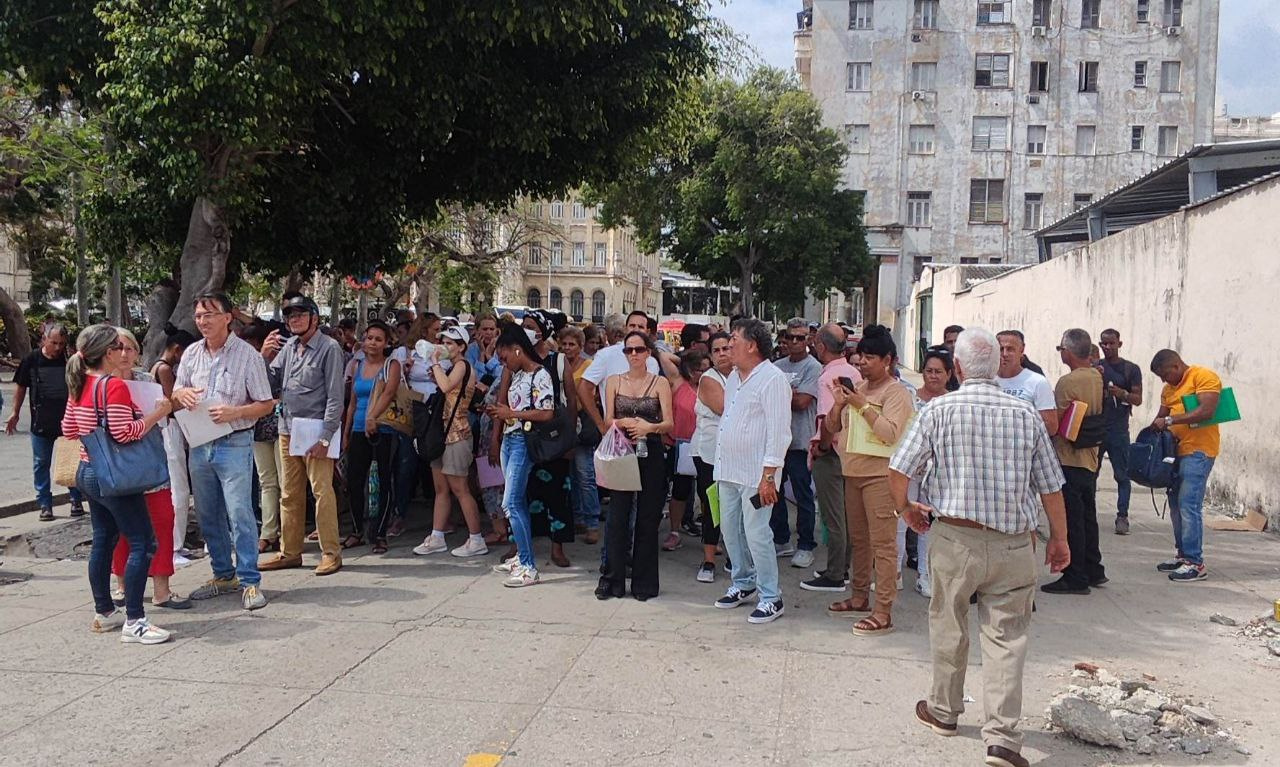
Whatever the Government Says About Tourism, ‘The Locomotive Had a Flat Tire,’ Cubans Joke

The authorities hide the net income of that sector because it is insignificant.

The population sees the evidence: streets that were once crowded with tourists are now practically empty / 14ymedio

14ymedio bigger14ymedio, Madrid, May 29, 2025 — The deployment of Randy Alonso to defend the spoiled child of the regime, tourism in its lowest hours, is worthy. For the second day in a row, State TV’s Mesa Redonda [Round Table] show spoke the once-lucrative line to underline the same idea as on Tuesday: the great “contribution to the economy of the country and its social responsibility.”

This time the protagonist was Cubasol, the group of non-hotel services and State real estate that includes transport companies (Transtur), development of complexes (Cubagolf), shows (Turare), marina and nautical (Marlin), commercial (Caracol) and services (Palmarés). In the 59 minutes of the program, not a single word of interest was said, apart from knowing what each of these divisions is devoted to and some mention of projects of little concrete responsibility, being the most sleep-inducing for any spectator who could – with permission of the blackout – watch television.

The objective, more than anything else, is to try to sell an “opinion matrix” based on fiction and to hide the reality by anecdotes and fragmented notes,” pointed out the Cuban economist Pedro Monreal, who agrees with what was stated by 14ymedio. The expert dedicated a thread to the previous day’s program, visibly annoyed, in which he accused the authorities of not taking responsibility for the “disaster” and sending “their emissaries [who] avoided the official data.”

“The situation is very bad when it has been lower ranking officials who have hurriedly come out to squirm and cover up the disaster of tourism in Cuba”

“The situation is very bad when it has been lower ranking officials who have hurriedly come out to squirm and cover up the disaster of tourism in Cuba by replacing the old and discredited image of ’locomotive’ for that of ’cash register’,” he began. In his series of eleven messages, the expert recalled the main figures of tourism, falling since 2019 and in decline since 2021. “When they tell us on television that tourism generates ’a more direct flow’ of foreign exchange, they hide the fact that it is gross income and that net continue reading

income is not published (the most relevant data), after discounting the expenditure in foreign currency to operate and invest in tourism,” he says.

Indeed, the Cuban government has always kept secret, as this newspaper has pointed out on many occasions, the real figures for tourism, since the mere expenses generated by the sector are enormous, among other reasons because of the extreme need to import everything, from food to building materials and everything else imaginable as the country’s industry and manufacturing is in a state of collapse. Covering all these expenses could use up the returns of the sector, although it is impossible to know.

Thus, as Monreal points out, in order for Tourism to still have money to contribute to sectors like Health, Education and others, it would have to obtain an exorbitant income, “something unlikely with the low level of gross income (the only published data ).” The expert also provides information on how international economists measure tourism returns (Ghosh and Leontief multipliers, used in Input-Output models), which officialism has not given, replacing them with “generic mentions” or “anecdotes.”

“It could indicate intent to deceive or incompetence (or both)”

“It could indicate intent to deceive or incompetence (or both),” concludes the expert, who believes that if officials know the multiplier data and do not disclose it, perhaps it is because it is not so positive. “If the multipliers are not calculated and used, the incompetence would be enormous,” he says.

As the population, however enthusiastic it may be, knows what it sees, the reactions of the readers of Cubadebate to the written version of the Round Table on Tuesday seem conclusive: almost no one has been convinced, and some laypeople had already reached the conclusions set out by Monreal. “I would have liked, as a citizen committed to my country, for the Round Table to explain why so many hotels were built while there was a clear trend towards a decrease in international visitors. What is the real income of tourism? What are the profits obtained?” says one reader.

“It would be more convincing to say: ’for such year there was X entry in foreign exchange thanks to tourism’. And then, explain precisely how the percentages were distributed,” adds another.

The conversation generated in the program that Randy Alonso himself directs is active

Their doubts are shared by many others who consider them, at least, timely. “When the net profit is analyzed, it must exceed by far, in my opinion, the political cost of the Cuban reality and the income that would be obtained if the resources were allocated to other sectors,” said another. The conversation generated in the program that Randy Alonso himself directs is active, and readers have also contributed ideas about what is failing to stop travelers from coming to Cuba: the blackouts, the feeling of insecurity at night due to the lack of light, the infamous accumulation of garbage and the shortages in restaurants.

“No one doubts for a second that tourism is one of our fundamental sources of MLC [freely convertible currency], or that it ensures the productive linkage with other branches of the national economy and is a strong source of employment. However, what many question is why, knowing that our financial resources are not very broad, we continue to insist on large hotel investments, when the employment rate is falling and it is becoming more difficult to maintain the insurance and maintenance of hotels that already exist,” says another commentator.

It is the line that many opinions point out, more or less elaborated: that what was said at the Round Table may be valid for tourism in many countries, but on the island, now, it is not. As another user sums up: “The locomotive had a flat tire.”

Translated by Regina Anavy

____________

COLLABORATE WITH OUR WORK: The 14ymedio team is committed to practicing serious journalism that reflects Cuba’s reality in all its depth. Thank you for joining us on this long journey. We invite you to continue supporting us by becoming a member of 14ymedio now. Together we can continue transforming journalism in Cuba.

“Tourism Solves the Essential Problems of the People,” Insists the Cuban Government

Official media try to show that the foreign currency from this sector serves to develop the country.

The Palatino pipeline, which suffered a breakdown this Tuesday, supplies the area where the new Iberostar luxury hotel, the K tower, is located / 14ymedio

14ymedio bigger14ymedio, Madrid, May 28, 2025 — When the official media announced this Tuesday the topic to be discussed on the Round Table TV program, the title chosen was ’Cuban tourism: You are the destination’. The Cuban economist Pedro Monreal took it as a joke and pointed out, before providing data on the sector, that it was typical of a bolero. In fact, it is the claim of the most recent campaign of the Ministry of Tourism, and yesterday it came to light during the television program on the lips of the officials present. In the midst of a weary population, aware that tourism drains the coffers of the State without travelers arriving to fill them, it is increasingly important to convince them that the return on investment will come and will be for their benefit.

In that sense, the long preamble of Susset Rosales Vázquez, director general of Planning and Development of the Ministry of Economy and Planning, went directly to the subject. “What the Revolution does in tourism is simply solve the essential problems of the people,” she said, quoting Fidel Castro, a convert to the sector’s virtues only after the Soviets departed with perestroika.

To sum up, Rosales Vázquez launched a battery of miracles that tourism achieves in Cuba, starting with what she called fresh currency. “It permits the balance of trade, exports and imports, and finances the main priorities of the sector itself. It also, at the same time and very importantly, allows the financing of priorities in other sectors such as health, education and infrastructure, which have direct benefits for the population, society, communities…”.

It seemed like a joke when, among all that, she mentioned roads, drinking water, cars and taxis, and, best of all, electricity

The list of blessings was endless. He mentioned agriculture (for the supply of hotels and restaurants), airports, culture, heritage conservation and natural areas… everything that is improved for tourists has an impact on the continue reading

population, he said. And it seemed like a joke when, among other things, he mentioned roads, drinking water, cars and taxis, and, best of all, electricity.

“The enemies of the Revolution know what tourism represents for the vitality of our country and also for the prosperity of our people. That is why it is constantly under attack. Tourism is an engine, a strategic pillar for the economic and social development of the country,” he insisted.

If the state of everything he mentioned is an indication of the progress of tourism, it became more than clear what the result is of having empty hotels. And vice versa. And if what he intended was that the population assume tourism as a necessary sacrifice for the compensations, it is doubtful that he accomplished it.

To illustrate with an example the wonders that tourism can bring, the Round Table was attended by the vice president of the National Institute of Hydraulic Resources, Javier Toledo Tápanes. He was the only one present who offered data, although it may not be enough for the million Cubans who do not receive water regularly. One of the main objectives of the national hydraulic plan is to “guarantee the infrastructure for the development of tourism in the country,” said the official.

Twenty-seven new drinking water and waste water pumping stations and seven waste treatment plants have been built

As this doesn’t sound very good in a country with such high instability in the supply, Toledo explained – in his own way – that when a large project is undertaken to bring water to a hotel, it benefits all the neighbors. “A comprehensive analysis is made of the whole area, of the entire community, of all the population that could have problems with the service there. And the systems are designed on that basis, with an integral view of the problem,” he said, which roughly means that if you live in a remote area, say goodbye to having a good pipeline.

Thanks to his speech, however, it became clear that the sector takes on part of the budget for these works, which he called ’induced’. “Tourism provides important funding for many of these programs, which at certain times are not available through central financing and, above all, in technological matters, pumping and chlorination equipment, even in desalination plants,” he said.

According to his speech, in the last three years more than 125 km of large-scale pipelines, which did not exist before, and more than 350 km of supply networks have been implemented in the surroundings areas. Twenty-seven new drinking water and waste water pumping stations and seven waste treatment plants have been built: a total of 300,000 beneficiaries as a result of an annual investment of $300 million. The amount is “appreciable,” added the official, although less so in comparison to the population who still have no water when they turn on the tap.

Toledo announced several other new works, including a “macro investment” – without giving figures – for a transfer in Holguín that will have around 50,000 beneficiaries, including, he said, remote communities that receive the piped water. He also mentioned the construction of housing in Santa Lucía (Camagüey), which has required an investment in hydraulic works to contribute to the exploitation of this tourist center.

“We have bought with this currency a group of facilities for the producers, so that they can work in more comfort”

Among the many other interventions that are carried out in different provinces, he referred to the Palatino pipeline (Havana), whose first phase of expansion has been completed. “Tourism has financed several pieces of equipment to strengthen and allow the stability of water pumping this summer,” he said. The example was a bad one, because hours before, the breakdown of several rotors in this great pipeline had left the municipality of Plaza de la Revolución with little pressure.

There was time for several more speeches, from the camping managers and the Gran Caribe group to William Díaz Dueñas, general director of the Fruta Selecta Marketing Company, who gave some good news. According to him, he aims for 100% of his companies to supply directly to tourism, because the currency he receives gives a return for producers, with whom, he said, they have no defaults.

“We have bought with this currency a group of facilities for the producers, so that they can work in more comfort and thus have quality productions with an added value,” he concluded, in addition to announcing the possibility of opening in the coming months “a shop for the producer, with a group of inputs that these tourism revenues generate.”

Translated by Regina Anavy

____________

COLLABORATE WITH OUR WORK: The 14ymedio team is committed to practicing serious journalism that reflects Cuba’s reality in all its depth. Thank you for joining us on this long journey. We invite you to continue supporting us by becoming a member of 14ymedio now. Together we can continue transforming journalism in Cuba.

“We Are Going To Purge All Impurity in Our Institution,” Warns the Grand Master of the Cuban Masons

  • Mayker Filema Duarte calls those who removed him on Sunday “traitors.”
  • An inside source claims it was an attempted coup by the Supreme Council against the Grand Lodge.
“We have avoided war and we have been denied peace,” said Filema / 14ymedio

14ymedio bigger14ymedio, Havana, May 27, 2025 — In a statement dated Monday, May 26, Mayker Filema Duarte rejected his impeachment as Grand Master of the Grand Lodge of Cuba (GLC), agreed last Sunday by “a little more than one hundred” Masons on the island. During an extraordinary assembly, the Upper House – one of the most important judicial authorities of the fraternity – decided to dismiss him by a unanimous vote, accusing him of holding onto his office and acting with the support of the Communist Party of Cuba (PCC). In his place, Juan Alberto Kessel Linares was provisionally appointed until the general elections, scheduled for September.

In his text, Filema described what happened as an illegal and illegitimate act. He also said that the call made by Kessel and the president of the High Academy of Masonic Studies, Manuel Valdés-Menéndez Cuesta, constitutes a “grotesque violation of everything sacred,” as well as “another media blow and discredit to the image of our GLC before the profane world.”

He added that “once again the image of the GLC was wounded in its pride in public view by actions of traitors to their oaths of discretion and respect for our laws.” In addition, he compared the situation with what happened recently in the Dominican Republic, when, he said, the Supreme Council of Grade 33 separated itself in order to operate autonomously. In Cuba, the Supreme Council, chaired by José Ramón Viñas, who is critical of the regime, has repeatedly denounced the infiltration of State Security into the Grand Lodge, which threatens a schism.

“We will not leave the destinies of the institution to the whims of one man and a group of his followers”

“We will not give in to unconstitutional pressures,” he said. “We have avoided war, and peace has been denied to us, but we will purge all impurity in our institution,” he added, and “we will not leave the destinies of the institution to the whims of one man and a group of his followers.” continue reading

Filema had canceled the Upper House meeting scheduled for May 25, citing personal threats. Despite his absence and that of his officials, the representatives decided to proceed with the meeting and voted for his dismissal. Now they await the position of the Registry of Associations, a state entity responsible for regulating compliance with the statutes of associations in Cuba. This office, which has intervened several times in the Masonic crisis since last year, has been called a tool of the regime to meddle in the internal affairs of fraternal and religious institutions.

According to data provided by an internal source, there are currently 327 lodges in the country and a total of 48,000 members. Of these, only about 20,000 remain within the island, representing an exodus of more than 50% of registered Masons.

Due to the institution’s own hermeticism, the internal conflicts that Freemasonry has been going through since 2020, as well as the State Security maneuvers to control its membership, it is difficult to get an objective view of what is really happening. The emblematic building on Carlos III Avenue, headquarters of the GLC, is guarded by security forces and a patrol from the special brigade of the Ministry of the Interior. In addition, there were reports of internet cuts in the surrounding areas.

A source, who asked for anonymity, says: “What has happened is an attempted coup. There are two bodies in conflict: the Grand Lodge of Cuba and the Supreme Council of Grade 33. And although everyone is talking about politics, here the background is more profane. It is true that the regime has always wanted to destroy Freemasonry or at least control it. They must be enjoying themselves now, from the stands, watching us destroy ourselves.”

“There is another detail that nobody talks about,” adds the source, “it is no coincidence that every time the protests in Cuba break out, a scandal like this appears to divert attention.”

Filema rose in the Masonic hierarchy to occupy the position of Deputy Grand Master under the administration of Mario Urquía Carreño. After the resignation of Urquía in August 2024, amid a scandal over the disappearance of 19 million pesos, Filema temporarily assumed leadership of the GLC. His official appointment as Grand Master took place in September of the same year, during the annual sessions of the Upper Chamber.

Filema denounced the financial irregularities of the previous administration, including the embezzlement of millions of Cuban pesos

During his administration, Filema denounced the financial irregularities of the previous administration, including the embezzlement of millions of Cuban pesos. These actions were interpreted by some as an attempt to restore the integrity of the institution and by others as a threat. According to one of the sources consulted, “this was the trigger for the new schism between the GLC and the Supreme Council.”

Filema’s refusal to call elections and his endorsement by the Ministry of Justice – in particular by the director of associations, Miriam García – raised suspicions about his closeness to the regime. Some Freemasons and external observers accuse him of being a figure imposed by the Office of Religious Affairs of the PCC’s Central Committee, which “has compromised the autonomy of Cuban masonry.”

Another source interviewed comments: “It has become common in Cuba that we all accuse ourselves of being agents of State Security. In the case of Filema, I think it’s nonsense. He is the son of political prisoners and had a very difficult childhood. Those of us who have been close know that he does not have a favorable opinion of the regime. But when you have a responsibility like his, you are obliged to deal with them.”

“They have only one goal: to divide us”

“We have to see how the regime will play it. And Filema’s enemies are going to use any support he receives to shore up their speech about him. But it is naive to think that the regime really ’supports’ one figure or another. No, man, no! They have only one goal: to divide us. And they use our own conflicts, our egos and even our rejection of the regime to create suspicion and make us fight among ourselves,” he concludes.

However, it is undeniable that Filema does not enjoy sympathy within a considerable number of Cuban Masons. Opinions against him are piling up. One of his fraternity brothers commented to 14ymedio: “It was Miriam García herself, a Ministry of Justice official, who proposed postponing the date to the 25th. Some replied that this was interference. Then she said ’they’ wanted to ’help with the transport’ to bring in the Masons. Filema used alleged vandalism as an excuse to suspend the meeting, which was shown last Sunday not to be true. He does not want to give up power because State Security is telling him not to.”

Translated by Regina Anavy

____________

COLLABORATE WITH OUR WORK: The 14ymedio team is committed to practicing serious journalism that reflects Cuba’s reality in all its depth. Thank you for joining us on this long journey. We invite you to continue supporting us by becoming a member of 14ymedio now. Together we can continue transforming journalism in Cuba.

Santiago de Cuba’s Renté Power Plant Turns 59 and Is Barely Surviving

A “brigade” of 180 workers makes the spare parts to keep it standing.

Some of the workers at Antonio Maceo are as old as their parts / 14ymedio

14ymedio bigger14ymedio, Havana, 7 May 2025 — In 1966, when the first two of the Antonio Maceo thermoelectric power plants were installed on the Renté peninsula in Santiago de Cuba, experts predicted a useful life of about 35 years. Today, with 59 years of operation and full of patches and rivets, the plant barely works thanks to the workers, who manufacture 80% of the parts that keep it standing.

In an article that applauds the “effort and sacrifice” of the 1,500 workers at Renté, the official press gave details on Monday about one of the main thermoelectric power plants in the country. The Antonio Maceo not only doubles its expected useful life, but generates just 258 megawatts (MW), half of the 500 that it delivered in the 1980s, when the Soviet subsidy still gave oxygen to the economy of the island.

Although it started with two generating units in its foundation, by its golden decade it already had six. Of these, two are now standing, and a third, unit 5, is mortally wounded, although the workers say they are trying to get it going. The other three, which are not mentioned in the press, are deactivated.

The problems to keep the plant afloat are the same as in the rest of the thermoelectric power plants in the country

The problems to keep the plant afloat are the same as in the rest of the country’s thermoelectric power plants: the absolute lack of resources, spare parts and the currency to obtain them. Hence, according to the general manager of the plant, Jesús Aguilar, the workers’ inventiveness is the continue reading

“main strength” of the plant.

Although it is a demanding and dangerous job, the plant has employees as old as its parts. Arturo Laurence Richard, 82, is a genuine relic of the plant, where he has been working since the year it was set up: “The Renté has always been able to count on me, since 1966,” says the man who worked hand in hand with the Soviet engineers.

With units 3 and 6 more or less stable, the employees of the Antonio Maceo try to get the 5 out of its permanent breakdown. This Tuesday, along with the 1,510 MW of deficit expected in the country, the Electric Union placed it among those that were under “maintenance.” To do this, they warn, they must “overcome multiple obstacles, such as financing and material resources,” and once again the responsibility falls on the 180 members of the “manufacturing and recovery brigade for spare parts, those that replace imports and save millions.”

In addition to supplying energy to the national electricity system (SEN), specific industries of the eastern region depend on the Antonio Maceo, such as “the liquefied petroleum gas filling plant, sugar mills, hydraulic networks and systems, and even food production,” says the official newspaper Granma. And although the employees add that they do their best to keep the plant running, they know that it is not just up to them.

“Many say ’follow the blackouts’, that’s true, we are aware of it, but you have to be here to see the effort and dedication of our collective, which often literally moves here until service is restored in difficult conditions,” defend the workers of the power plant.

“They also face the harshness of the times, and it is very possible that, after hours working for the electricity of others, they will reach their homes and find them, as happens to any Cuban, in the dark,” explains Granma.

Although Granma avoids the matter, employees are also not taken care of by “wills of steel” as they should be, and many pass the days without the necessary means of work and security. There have already been cases of work accidents in the Renté but none in the last 15 years. However, the workers know the feeling: “When we lose a colleague for this cause, it is terrible in the work and personal sphere.”

Much younger, built in 1988 with French technology and the latest subsidies from the USSR, the Antonio Guiteras de Matanzas is the largest thermoelectric plant in the country and another one that, like its predecessor, has exceeded its useful life. At a critical point, the plant announced that it will stop this year for a capital repair postponed for two decades.

“The Guiteras’ rotors have not opened since that breakdown in 2004. So, do the math. Since 2004, only two capital repairs have been done,” according to a statement last March by Minister of Energy and Mines, Vicente de la O Levy, about the calamitous state of the plant.

The extensive repair challenges a rule that Ecured, the Cuban imitation of Wikipedia, leaves on its website: “Planned maintenance is carried out so that, of the 8,700 hours that the year has, it remains online about 8,000.” The failure, however, is not a surprise for Cubans, accustomed to the fact that the island’s ancient thermoelectric plants leave the SEN more and more often.

Translated by Regina Anavy

____________

COLLABORATE WITH OUR WORK: The 14ymedio team is committed to practicing serious journalism that reflects Cuba’s reality in all its depth. Thank you for joining us on this long journey. We invite you to continue supporting us by becoming a member of 14ymedio now. Together we can continue transforming journalism in Cuba.

Walls in Holguín, Cuba Scream ‘Down with Communism’

To make matters worse, the affront occurred in the Lenin neighborhood and the paint used to cover the graffiti was of poor quality.

Despite its visual harshness, the Lenin neighborhood seems like an urban oasis compared to the slums surrounding it. / 14ymedio

14ymedio bigger14ymedio, Miguel Garcia, Holguín, 19 May 2025 — The phrase “Down with Communism” could recently be seen scrawled on a wall of a dilapidated Soviet-style building in Holguín’s Lenin neighborhood. As usual, local officials reflexively attempted to cover it with a layer of faded reddish paint, as thin as the argument for the system they defend. As a result, the message remains plainly visible. Ironically visible. As though the wall, tired of silence, did not want to remain completely silent.

This neighborhood, built in the 1970s as part of an urban development scheme inspired by Eastern European model, is composed of functionalist reinforced concrete buildings with the aesthetic charm of a wet shoebox. Rather than a sign of neglect, their uniform ugliness is one of the hallmarks of an ideology that for decades distrusted beauty and was suspicious of any sign of individuality. Besides housing workers and their families, these complexes were designed to be a living testament to the “New Man,” who was expected to sleep in a beehive, eat from a ration book, and applaud standing up.

Despite its visual harshness, the Lenin district looks like an urban oasis compared to the surrounding slums. Just to the north, El Nuevo Llano stretches out like a warning, characterized by dirt roads, makeshift roofs, recycled pipes, and ditches that act as drainage canals. In contrast, the Soviet buildings appear almost poetic, albeit in dull-gray.

When graffiti like this appears, authorities launch an operation worthy of a tropical CSI spinoff

When graffiti like this appears, authorities launch an operation worthy of a tropical CSI spinoff. Calligraphy experts, State Security agents, and surveillance committees show up. They study the slant of a letter, the strength of a stroke, the depth of the spray. Section 5 of the Cuban Penal Code classifies crimes like these as “enemy propaganda,” with penalties of up to fifteen years in prison. Additionally, articles 263 to 266 treat continue reading

them as crimes of public disorder, as though a wall could disrupt order more than hunger or power outages.

The official response often goes beyond the superficial. In other instances, acts of revolutionary reaffirmation have been staged in front of walls that dared to think differently. In Havana’s Santos Suárez neighborhood, for example, children in headscarves marched, officials gave impromptu speeches and people chanted well-rehearsed slogans.

The name of the neighborhood was, of course, no conicidence. It’s called Lenin. And it was not done out of some municipal whim but out of doctrinal loyalty. Though it was Stalin’s cult of personality that got most of the bad press, it is worth noting that it was Vladimir Ilyich Ulyanov, a.k.a. Lenin, who established the repressive machinery of the Soviet state. He dissolved the Constituent Assembly, suppressed all non-Bolshevik press, legalized terror as an instrument of governance and created the Cheka, the seed of all future political police forces in the Communist bloc. He was also a pioneer in the art of turning utopia into dogma and dogma into prison.

What is written in anger is rarely erased with a brush. / 14ymedio

These days, when Cuba is holding congresses for peasants, replete with speeches and admonitions, it is also worth remembering the so-called “war-time communism” implemented by Lenin in the Soviet Union, a policy of forced requisitions of food from peasants. The result was hunger, revolts like the one in Tambov, and brutal repression that became a model for future generations of enlightened authoritarianism.

Though there is no proof that Lenin himself gave the order to kill Tsar Nicholas II and his family, he unapologetically took responsibility for the clandestine execution as head of the Bolshevik government. It was not justice that was important; it was the consolidation of power. Hence his famous quote, “Everything is an illusion except power.”

So it is an act of poetic justice — or at least irony— that a sign has appeared in Holguín’s Lenin neighborhood that bluntly reads, “Down with Communism.” A simple phrase, painted quickly, like someone leaving a mark on history from a forgotten corner. The regime attempted to erase it with its usual palette of opacity and repression. But as is often the case with walls, what is written in rage is rarely erased with a brush.

____________

COLLABORATE WITH OUR WORK: The 14ymedio team is committed to practicing serious journalism that reflects Cuba’s reality in all its depth. Thank you for joining us on this long journey. We invite you to continue supporting us by becoming a member of 14ymedio now. Together we can continue transforming journalism in Cuba.