A Spanish consumer association denounces “marketing” of visa appointments and other procedures.
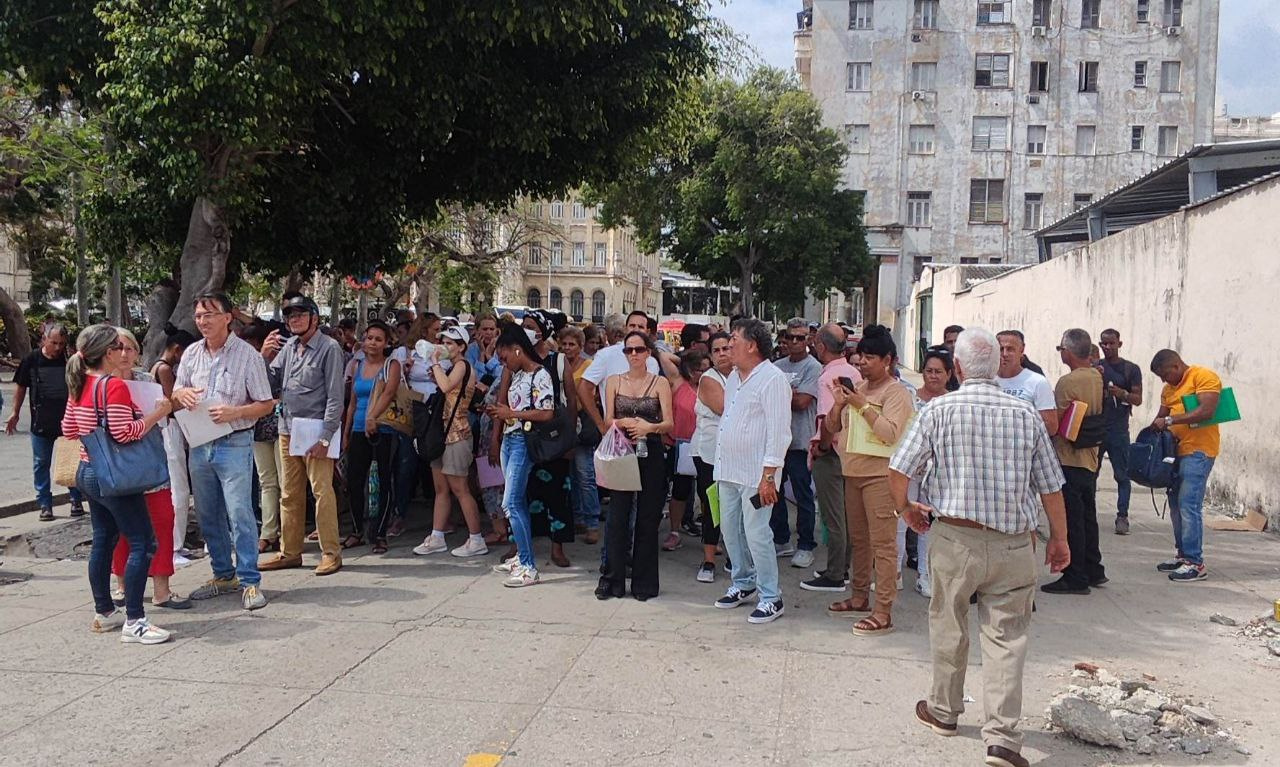
 14ymedio, Havana, May 27, 2025 — Some intermediaries are charging Cubans up to 500 euros for a free procedure at the Spanish Embassy in Cuba. One of the best-known consumer associations in Spain, Facua-Consumers in Action, denounced this practice to the Ministry of Foreign Affairs, European Union and Cooperation, which is responsible for the consulate.
Facua denounces the “slow and cumbersome” visa application process for entering Spain, which has caused discomfort among several users, including Cubans wishing to travel to the country and Spanish citizens residing on the island.
“Cubans, Spaniards, and anyone else who wants to access the services of the Consulate of Spain in Havana are experiencing constant delays in obtaining a prior appointment, which is required for completing the necessary bureaucratic procedures,” warns the association, which expresses concern about the “marketing” that the situation is generating.
“This delay in obtaining an appointment often causes the previously sent documentation to expire and lose its validity.”
Users must send the required documentation electronically to obtain an appointment. Then, the embassy generates an access code for the applicant to book his or her appointment online, but the appointments sell out in just minutes, making it difficult -if not impossible- to find available dates. “This delay in obtaining an appointment often causes the previously sent documentation to expire and lose its validity, forcing users to start the process from the beginning,” regrets Facua.
At that moment, managers and other intermediaries step in, “taking advantage of the desperation of many users trying to obtain a visa,” demanding amounts that can reach up to 500 euros. To prevent such abuses, the association urged the Ministry to take measures to streamline the processes and make them more secure, “thus avoiding situations like those currently occurring in Cuba, where third parties exploit others’ needs for profit by managing procedures that should be free of charge.”
The association, as explained in its press release, has received a response from the undersecretary of the Ministry, who said he was confident that the new system of appointments and shifts that will soon be implemented will help to avoid problems of this type. The transition is part of the Consular Digitalization Plan, which began in 2023 and is scheduled to conclude in July, when all of Spain’s embassies will have migrated to the new platform of applications, infrastructure and content.
The Embassy in Cuba is immersed in this process, which includes the new electronic civil registry (DICIREG), which landed at the Havana headquarters this April. Although what keeps most people on tenterhooks is the implementation of the appointment platform, which will also affect applicants for Spanish nationality through the Law of Democratic Memory, whose deadline expires next October.
The diplomatic mission warned last week that on June 23, the credentials from the old system will be removed, making that the deadline for booking appointments using those credentials. Those who have not managed to do so will need to submit a new request using the new tool, which will be explained later.
“It is clarified that it is the booking operation that must be completed before June 23; however, the scheduled appointment can be set for a later date.”
“It is clarified that it is the booking operation that must be completed before June 23; however, the scheduled appointment can be set for a later date. Individuals are requested to attend their appointment with the reservation receipt,” the Consulate stated in a communiqué, also reminding that the application for Spanish nationality must be submitted before October 22, 2025, although—again—the appointment for the procedure may take place afterward.
The fever to obtain Spanish nationality has uncovered a multitude of abuses and frauds, both at the time of obtaining documents and appointments: a black market in which thousands of euros are moved.
Among the most well-known cases is the network that produced false certificates to certify Spanish ancestry for up to 2,000 or 3,000. Although cases of this kind are not uncommon, the volume of fraudulent documents in Cuba was so high that the consulate began requiring double verification from the Historical Archive of Ourense: the institution’s seal and the vicar’s signature, whereas in the rest of the world, only the seal is usually enough. The information was revealed on a local television program in the province, where a young diocesan archivist shared anecdotes about the heavy workload caused by the demand for documents, particularly from Latin America.
Translated by Gustavo Loredo
____________
COLLABORATE WITH OUR WORK: The 14ymedio team is committed to practicing serious journalism that reflects Cuba’s reality in all its depth. Thank you for joining us on this long journey. We invite you to continue supporting us by becoming a member of 14ymedio now. Together we can continue transforming journalism in Cuba.