To make matters worse, the affront occurred in the Lenin neighborhood and the paint used to cover the graffiti was of poor quality.
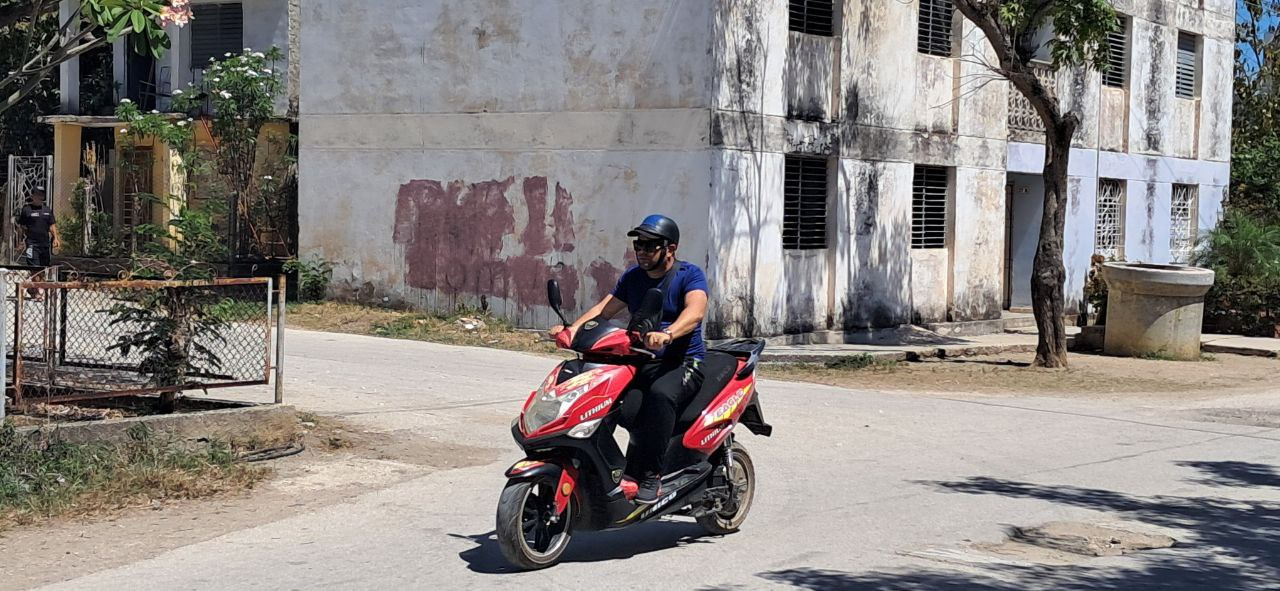
 14ymedio, Miguel Garcia, Holguín, 19 May 2025 — The phrase “Down with Communism” could recently be seen scrawled on a wall of a dilapidated Soviet-style building in Holguín’s Lenin neighborhood. As usual, local officials reflexively attempted to cover it with a layer of faded reddish paint, as thin as the argument for the system they defend. As a result, the message remains plainly visible. Ironically visible. As though the wall, tired of silence, did not want to remain completely silent.
This neighborhood, built in the 1970s as part of an urban development scheme inspired by Eastern European model, is composed of functionalist reinforced concrete buildings with the aesthetic charm of a wet shoebox. Rather than a sign of neglect, their uniform ugliness is one of the hallmarks of an ideology that for decades distrusted beauty and was suspicious of any sign of individuality. Besides housing workers and their families, these complexes were designed to be a living testament to the “New Man,” who was expected to sleep in a beehive, eat from a ration book, and applaud standing up.
Despite its visual harshness, the Lenin district looks like an urban oasis compared to the surrounding slums. Just to the north, El Nuevo Llano stretches out like a warning, characterized by dirt roads, makeshift roofs, recycled pipes, and ditches that act as drainage canals. In contrast, the Soviet buildings appear almost poetic, albeit in dull-gray.
When graffiti like this appears, authorities launch an operation worthy of a tropical CSI spinoff
When graffiti like this appears, authorities launch an operation worthy of a tropical CSI spinoff. Calligraphy experts, State Security agents, and surveillance committees show up. They study the slant of a letter, the strength of a stroke, the depth of the spray. Section 5 of the Cuban Penal Code classifies crimes like these as “enemy propaganda,” with penalties of up to fifteen years in prison. Additionally, articles 263 to 266 treat them as crimes of public disorder, as though a wall could disrupt order more than hunger or power outages.
The official response often goes beyond the superficial. In other instances, acts of revolutionary reaffirmation have been staged in front of walls that dared to think differently. In Havana’s Santos Suárez neighborhood, for example, children in headscarves marched, officials gave impromptu speeches and people chanted well-rehearsed slogans.
The name of the neighborhood was, of course, no conicidence. It’s called Lenin. And it was not done out of some municipal whim but out of doctrinal loyalty. Though it was Stalin’s cult of personality that got most of the bad press, it is worth noting that it was Vladimir Ilyich Ulyanov, a.k.a. Lenin, who established the repressive machinery of the Soviet state. He dissolved the Constituent Assembly, suppressed all non-Bolshevik press, legalized terror as an instrument of governance and created the Cheka, the seed of all future political police forces in the Communist bloc. He was also a pioneer in the art of turning utopia into dogma and dogma into prison.

These days, when Cuba is holding congresses for peasants, replete with speeches and admonitions, it is also worth remembering the so-called “war-time communism” implemented by Lenin in the Soviet Union, a policy of forced requisitions of food from peasants. The result was hunger, revolts like the one in Tambov, and brutal repression that became a model for future generations of enlightened authoritarianism.
Though there is no proof that Lenin himself gave the order to kill Tsar Nicholas II and his family, he unapologetically took responsibility for the clandestine execution as head of the Bolshevik government. It was not justice that was important; it was the consolidation of power. Hence his famous quote, “Everything is an illusion except power.”
So it is an act of poetic justice — or at least irony— that a sign has appeared in Holguín’s Lenin neighborhood that bluntly reads, “Down with Communism.” A simple phrase, painted quickly, like someone leaving a mark on history from a forgotten corner. The regime attempted to erase it with its usual palette of opacity and repression. But as is often the case with walls, what is written in rage is rarely erased with a brush.
____________
COLLABORATE WITH OUR WORK: The 14ymedio team is committed to practicing serious journalism that reflects Cuba’s reality in all its depth. Thank you for joining us on this long journey. We invite you to continue supporting us by becoming a member of 14ymedio now. Together we can continue transforming journalism in Cuba.