Filmmaker Pavel Giroud considers Colombia a great example: it went from producing two films a year to 40 thanks to a very well-structured system.
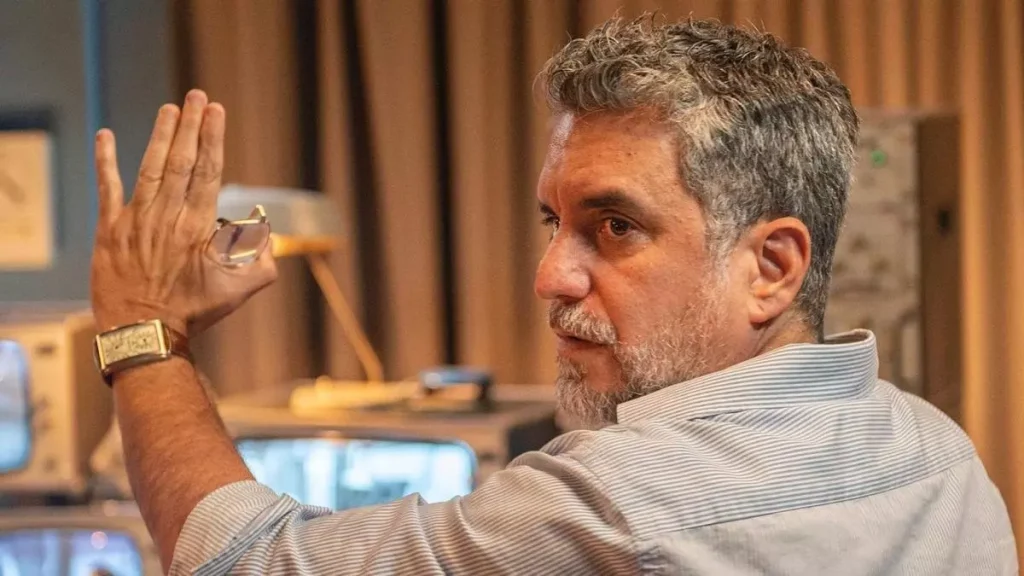
 14ymedio, Barcelona, May 24, 2026 / Born in Havana in 1973, filmmaker Pavel Giroud is known internationally for feature films such as El acompañante [The Companion] (2015) – Cuban candidate for the 2017 Oscar Awards– and El caso Padilla [The Padilla Case ](2022) – winner of the Best Documentary Film award at the 2023 Platino Awards for Ibero-American Cinema.
Giroud burst onto the Cuban film scene in the early 2000s, when the economic crisis and digital resources began to dismantle the aesthetic and institutional monopoly of the Cuban Institute of Cinematographic Art and Industry (ICAIC). Based in Madrid for the past twelve years, Giroud has become one of the most visible voices of the Cuban audiovisual diaspora, developing a filmography that is increasingly free in terms of both themes and form.
With films like The Padilla Case, which addresses the arrest and public humiliation of the poet Heberto Padilla in 1971, his political vision became more direct. His most recent feature film, Commander Fritz (2025), dismantles some of the political and sentimental myths of official history.
Giroud has openly defended the need to rebuild Cuban audiovisual production outside the logic of state control. This conversation with 14ymedio is a critical reflection on the structural collapse of Cuban cinema and the role the diaspora could play in the country’s future cultural reconstruction.
Question: What is the current state of the Cuban audiovisual sector, its principle material and human resource deficiencies, and in what moment did it began its decline?
Answer: I haven’t been to Cuba in a while, and there are very few people left there who can keep me up to date. I can only tell you about the impressions I get from a distance. The most palpable is that Cuban cinema made on the island is practically nonexistent in the Ibero-American film scene. That is a reality. Films are still being made, but they don’t leave 23rd Street [Havana Avenue where the Cuban Film Institute is located]. Very few made in Cuba films have been present at festivals and high-level events in the last decade. Today, those being made in the diaspora are having more of an impact.
In terms of humanity, I believe it is our principal patrimony
Once again, I served as a juror for the Platino Awards this year, and I was impressed by the number of films from Caribbean countries that previously produced only a trickle of them. Meanwhile, from Cuba, during the phase in which I began my judging, there was barely one documentary: the one about Pablo Milanés, directed by Fabien Pisani. And to top it all off, it’s a film that’s censored in Cuba.
In terms of people, I believe that’s our greatest asset. Since I came to live in Spain—and I’ve already made more films since moving abroad than I did in Cuba—I’ve always tried to include Cubans on my teams, and I can tell you that even the youngest newcomers are ready or have the skills to work at the highest level.
Q. If a process of opening and institutional reconstruction were to begin tomorrow in Cuba, what should be the immediate priorities for rescuing the audiovisual sector? Does it make sense to preserve institutions like ICAIC and state television by reforming them, or would it be necessary to build new structures from scratch?
R. First and foremost, the system needs to be structured with people who are qualified for it, and not just artistically. A film institute, in my opinion, should exist, but not produce films. ICAIC is a brand, and personally, I don’t care whether it keeps that name or not; but there must be an institution that regulates, protects, promotes, and strengthens filmmaking. That said, it has to be built from zero. And I’m not sure there should be public television. If there were, ideally it would be independent of the government in power, but that seems like a chimera to me.
Generally, public broadcasters serve the interests of those in power under the guise of impartiality, so paying for that, as a taxpayer, doesn’t appeal to me.
I’m not sure there should be public television. If there were, ideally it would be independent of the government in power, but that seems like a chimera to me.
Q. What legal changes would be essential to allow the emergence of a true audiovisual industry in Cuba?
I know absolutely nothing about legal matters, but a structure must be developed that establishes a framework of duties and rights, both for the production companies that are established here and for the companies that offer goods and services to the industry, or those that come from abroad to carry out this activity in Cuba. Work must also be done on fiscal policies that encourage investment by companies outside this industry.
Q. They will face the same challenges as any company in this sector worldwide. Everything will depend on each company’s profile. Some will simply aim to generate profit, and it’s already been shown that even Hollywood can’t always succeed with seemingly safe bets. Others will take greater risks, seeking artistic or creative merit. But both must have the capacity to generate, access, and develop strategies that allow them to finance these projects and fulfill every agreement that guarantees their survival.
Q. And what relationship do you think should exist between the State and audiovisual production in a democratic Cuba?
R. When we speak of subsidies for the film industry here in Spain, many tend to demonize it. Film people are portrayed as vampires who feed off public funds, and that’s a very simplistic way of analyzing it, especially when box office figures are used as a pretext for the attack. Every time someone speaks to me in those terms, I give them an assignment: the next time you go to the cinema, sit in your seat and read the entire end credits, and you’ll see how many people, how many rental companies, service providers, hospitality businesses, how many communities benefit from a single film shoot.
Investing money in film isn’t just about supporting culture, which is a valuable asset in a country like Cuba; it is also about generating cash flow and making it grow. The company that rents me the camera then reinvests in equipment—that is, it buys from the company that sells camera equipment, which in turn is supplied by another company; the catering company buys raw materials from various suppliers; and the hotels and accommodations near the filming locations fill up. Film generates money beyond box office revenue. For starters, practically half of the funding provided automatically returns to the public coffers in the form of taxes.
People don’t fear cinema because it consumes public money; they fear it because it is a powerful tool for denunciation with a great reach.
People don’t fear cinema because it consumes public money; they fear it because it is a powerful tool for denunciation with a great reach. That’s why its demonization usually originates from the political class.
There needs to be a system of subsidies, loans, and tax incentive programs for film investment created. There also needs to be a film commission created, whose strategies offer the country as an ideal filming location while simultaneously showcasing the capabilities of its technicians and filmmakers. It would also be beneficial to leverage the prestige still held by the International Film and Television School of San Antonio (EITV), despite its current state, to revitalize the island as a haven for international film education.
And it is imperative to rethink the entire system of distribution and exhibition of local and international cinema, as well as the sales and distribution of national cinema worldwide. There is much to be done.
Q. Cuban television has lost a large part of its audience and credibility. How do you envision a viable public television system in the future?
R. I am not a television consumer and the issue of media credibility is something that transcends Cuba.
The news, the messages, the editorial policy of a network depend not so much on its owners as on its sponsors. I believe that the television we know, the same one that once threatened the very existence of cinema, has its days numbered. Furthermore, as I said before, I don’t believe in public television, because it will always be subject to the government in power.
Q. What role could the Cuban diaspora play in the reconstruction of national cinema and television?
R. The Cuban diaspora will have to play an important role in the reconstruction of a new country, regardless of the means. Every scientist, economist, teacher, doctor, engineer, and athlete who has developed their profession with some success in what we might call “the real world” has much to contribute.
I believe that Cuba’s first step is for it to function with a certain degree of “normality,” even though it is a poor country, not as a planet separate from the global system.
A friend recently asked me if I would ever live in Cuba again, and I told her: “The only reason that would take me back would be to help and contribute what I have learned abroad to the construction of a new scenario.”
I believe that Cuba’s first step is that, even though it is a poor country, it functions with a certain degree of “normality,” not as a planet separate from the global system.
Q. How do you think the country’s narratives would change in a context of cultural freedom? What stories do you feel Cuban cinema has not yet been able to fully tell?
R. It will change, of course. Buried stories will come to light, and the new environment will give rise to new stories. We will enter into new forms of censorship and norms: those of the market, which increasingly prefers less controversy and delves deeper into sensitive topics.
Here in Spain there’s an apparent freedom, but any story that delves deeply into topics that could offend political and social sensibilities is best avoided, to prevent problems. Talking about Latin gangs is demonizing immigrants, talking about prostitutes is denigrating women, talking about neo-Nazi groups is a jab at the conservative sector.
Furthermore, since Cuba is not a market country, like Mexico, our stories will lose the sexy appeal that the “revolutionary epic” used to provide and that critical and dissident cinema now provides.
Q. What countries or international models could serve as a reference for rebuilding Cuban cinema and television?
R. For me, a great example is Colombia, which went from producing two films a year (ICAIC was a great ally three decades ago) to establishing a very well-structured system that produces around 40 films.
Their film development fund is supported by contributions from distributors, exhibitors, and producers. They also have Proimágenes Colombia, a public-private entity that, in addition to managing this fund, does excellent work promoting Colombian cinema internationally. They offer incentives to foreign productions with a 40% reimbursement of film service expenses and a 20% reimbursement of logistics costs. There are tax incentives for foreign companies that produce films in Colombia, and many of their production companies based there provide services to Netflix, Amazon, and Disney; others are present year after year at Cannes, Berlin, or Venice.
A great example is Colombia, which went from producing two films a year to establishing a very well-structured system that produces around 40 films.
Another nearby country that has made a significant leap forward, both quantitatively and qualitatively, is the Dominican Republic. Fifteen years ago, Dominican cinema was practically nonexistent, and today, thanks to its new laws, especially those that reward private investment in the industry, one can speak of a national film industry. Dominican companies can invest up to 25% of their Income Tax in local film projects, and for foreign productions, the credits are transferable, meaning they can be sold to local companies for an immediate return on investment. Furthermore, they have invested in infrastructure: Pinewood Dominican Republic Studios boasts, among its many impressive features, one of the most advanced water tanks for underwater filming in the world, and they continuously provide services to major platforms and studios.
______________
This article was produced in collaboration with Cuba Siglo 21 as part of the project “Cuba: Stabilize and Develop.”
______________________
COLLABORATE WITH OUR WORK: The 14ymedio team is committed to practicing serious journalism that reflects Cuba’s reality in all its depth. Thank you for joining us on this long journey. We invite you to continue supporting us by becoming a member of 14ymedio now. Together we can continue transforming journalism in Cuba.