“This place is a hotbed of informal vendors, filth and collapses, the police don’t show their faces, marginality reigns supreme.”
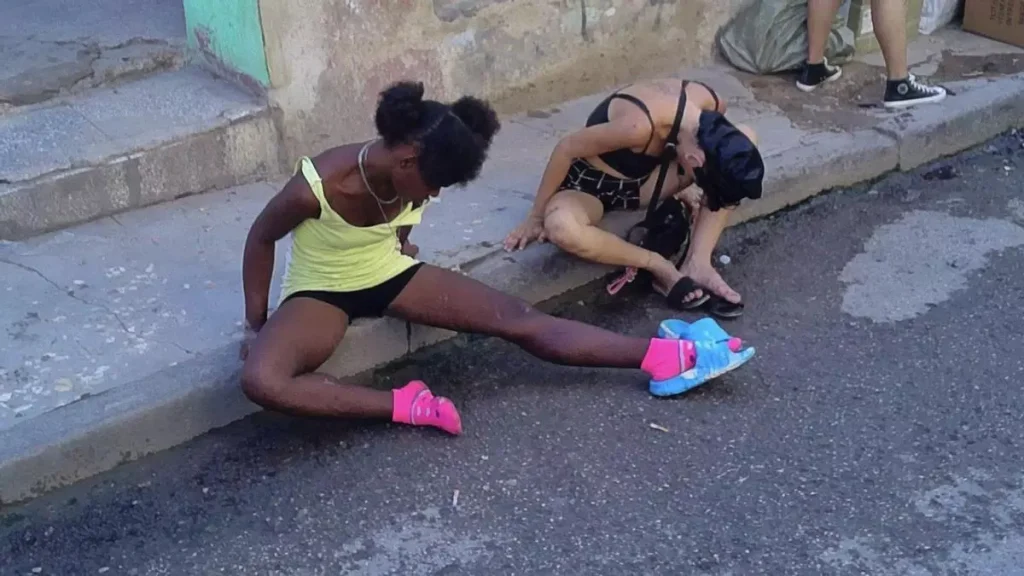
 14ymedio, Juan Diego Rodríguez, Havana, May 24, 2026 / They may be minors or simply young women shrunken by a life of malnutrition and other hardships. Sitting on the curb at the corner of Ángeles and Monte streets in Central Havana, the two—one dark-skinned and the other white, representing the country’s diverse mix—sway forward, their heads dangling so low they almost touch the ground, saliva drooling uncontrollably from their mouths. Passersby who look at them have no doubt: “That’s el químico” [the chemical].
The synthetic cannabinoid that authorities have been fighting for several years is appearing on the streets of the capital, even in the busiest areas, like this one, in broad daylight. It’s barely ten in the morning.
Surrounded by onlookers, the young women receive no help. There are no police officers to assist them either. The people who see them simply mock them: “Look, look, how the little black girl is drooling,” one woman remarked to another she was walking with.
“What can I say?” lamented an elderly witness to the scene, “this place is a hotbed of informal vendors, filth and collapses, the police don’t show their faces, marginality reigns supreme.”
Surrounded by onlookers, the young women receive no help. There are no police officers to assist them either. The people who see them simply mock them.
The regime’s efforts are largely ineffective against a drug to which it has remained blind, mute, and deaf for far too long . Last April, the General Customs Office of the Republic seized 22,800 doses of the chemical from the United States, giving it the opportunity to blame the phenomenon on its perennial enemy, claiming it is “the main source” of the substance, and to boast of its effectiveness .
The government has, however, acknowledged an increase in drug use for the past couple of years, unlike in the past, and has expressed concern about its circulation on the island, especially among young people. At the same time, it insists that the island “is neither a producer nor a transit country for illicit drugs” and that the official policy is one of “zero tolerance.”
In 2025, authorities seized a total of 507 kilograms of drugs, primarily cocaine, and arrested 174 people linked to drug trafficking. The head of the Interior Ministry’s anti-drug unit, Juan Carlos Poey, reported last December that 51 young adults and 72 minors were involved in “83 incidents of drug trafficking and consumption.” He also noted that almost all of them were teenagers between 13 and 16 years old who use the drug known as químic” (47%).
The Cuban Penal Code punishes “the possession and trafficking of illicit drugs with sentences ranging from four to 30 years in prison, including life imprisonment and even the death penalty.”
______________________
COLLABORATE WITH OUR WORK: The 14ymedio team is committed to practicing serious journalism that reflects Cuba’s reality in all its depth. Thank you for joining us on this long journey. We invite you to continue supporting us by becoming a member of 14ymedio now. Together we can continue transforming journalism in Cuba.