Cuba: Tallies and Tales of the Reforms / Vicente Botín

Vicente Botín, Annual Meeting of the Association for the Study of the Cuban Economy (ASCE), The Hilton Miami Downtown Hotel, 29 July 2016.

Once upon a time…

A female cat fell in love with a handsome young man and prayed to the goddess Aphrodite to turn her into a woman. The goddess, pitying the cat’s yearning, transformed her into a beautiful maiden, and the young man, captivated by her beauty, married her. But, on the wedding night, Aphrodite wanted to know if the cat, now a woman, had changed inside as well, and so she let loose a mouse in the bedroom. The cat, forgetting her status as a woman, rose from the bed and chased the mouse so as to devour it. At that point, the goddess, grown angry, returned her to her previous condition, turning the woman back into a cat.

With this fable, the Greek philosopher Aesop means to tell us that, “The change in status of a person does not cause her to change her instincts.” Which the wise collection of popular sayings might translate as, “You can dress up a monkey in silk, but she is still a monkey.”

“Why this eagerness to dress the monkey in silk?” I asked myself, when I saw, incredulous, the Chanel parade in Havana. The Adidas tracksuit which Fidel Castro has been sporting for years was outshone by fashion czar Karl Lagerfeld’s diamond-studded jacket and Brazilian supermodel Gisele Bündchen’s beret (albeit without the star that adorned Che Guevara’s cap in that famous photograph by Alberto Korda). continue reading

Could it be that vileness can be disguised by glamour? Is is possible to wrap in gift paper, as though it were a box of chocolates, the Penal Code in force in Cuba, which brutally punishes all forms of dissidence?

Can repression and the lack of freedoms be combined with haute couture? Is the march by the Ladies in White along Fifth Avenue compatible with the pageant of Chanel models along the Paseo del Prado?

Giusepe Tomassi de Lampedusa puts in the mouth of Tancredi, one of the characters in his novel, “The Leopard,” this utterance directed to his uncle Fabrizio, Prince Salina: “Everything must change if everything is to stay as it is.”

In political science, “leopard-like” or “Lampedusian” are descriptors for the politician who initiates a revolutionary transformation but which, in practice, alters the structures of power only superficially, intentionally keeping the essential elements of those structures.

Raúl Castro is a lot like the Lampedusian Tancredi, because he seems to want to change everything, but his intention is for everything to stay as it is.

When I arrived in Havana in early 2005 as a correspondent for Televisión Española, everything was much clearer, or, to be more exact, seemed less confused. There were no fireworks. Any glamour, for want of a better term, was provided by Fidel Castro, with his eternal olive-green uniform, and the parades were not directed by Karl Lagerfeld, but rather by the dictator himself, on the Malecón, in front of the then-US Interests Section, now the US Embassy.

Of course, then these demonstrations were called “Marches of the Embattled People.” The other marches, those of the Ladies in White, were repressed without pity, and concerts, such as those by the group “Porno para Ricardo,” were nothing like those by the Rolling Stones: they would end with their leader, Gorki Águila, in jail. There is where the dissidents could be found, the ones from the Black Spring of 2003, and other, newer ones, who were continually being thrown into the prisons.

At that time, Havana was falling to pieces. There were power blackouts, and the ration book was entirely insufficient to meet the basic needs of the population. The US was the imperialist ogre, the culprit of all the evils afflicting the country, and the spies, “The Five,” were heroes. There were no shades. Everything was black or white.

Now I ask myself, “Has all that changed? Is it all part of the past?”

When he was named the successor, and with his brother still physically present, Raúl Castro started his own trajectory. He proceeded like a good bureaucrat, without rhetoric, step by step, convinced that, in order to survive, the Revolution needed a facelift. So he pulled out of his hat a jar of makeup, a tube of lipstick and a comb, and with an oriental patience (it is not for nothing that they call him “the Chinaman”*), he began to embellish the corpse of the Revolution until he made unrecognizable… unrecognizable for the gullible who let themselves be fooled by Photoshop.

Cuba is in fashion, and the mirage of the reforms serves as a screen to cover the reality that Cubans live, or rather, suffer. Could it be that they are invisible who inhabit the Island? Do they no longer have to steal or deceive in order to survive? Do they no longer have to “resolve” their problems?

There has been too much speculation over the nature of and the time it will take to implement these reforms that have been announced so many times, like the Byzantines used to speculate, in the 15th Century, about the sex of angels, while the Ottomans were besieging Constantinople.

Could it be that the Turks are at the gates of Havana?

The Turks, probably not, but the Cubans yes, who for more than half a century have lived besieged within a fortress, commanded by an apprentice and witch doctor, who is performing a balancing act to contain the demands of a people beleaguered by penury and the lack of freedoms.

The foreign correspondents who work in Cuba confront the dilemma of rummaging through the trash or going with the flow. During the four years that I spent on the Island, I suffered all types of pressures to force me to sweeten my reports. The censors were not concerned with political criticisms, after all, the Cuban government enjoys no few sympathies throughout the world. What bothered them was the pure and simple description of the difficult living conditions of the Cuban people. The shameful condition of the hospitals, the precariousness of the housing, the cut-offs of water and power, the scarcity and bad quality of the food, the lack of transportation, and let us not mention the prostitution, as a express route to access consumer goods.

All those topics were taboo. They could not be mentioned, under threat of expulsion. The paradox is that currently, all of those problems continue, they have not disappeared, but they appear to no longer be a problem for anybody. Simply put, they are not spoken of. They are swept under the rug.

The first “reformist” measures announced by Raúl Castro provoked an effect similar to hypnosis. Like an expert prestidigitator, he exchanged the bread and circuses of the Romans for self-employment licenses, cell phones, cars, houses and microwave ovens, despite their high cost in Cuban Convertible pesos (CUC).

But Cubans, after so many “absurd prohibitions,” celebrated them joyously and, beyond that, the announcement of new promises–among them, the suppression of the double currency, the revaluation of the Cuban peso, and the end of the ration book which, in Cuba, ironically enough, is called the “provision” book.

But it is well known that the road to hell is paved with good intentions. Eight years later, those good intentions have yet to be realized, especially the suppression of the double currency, which not only has not been resolved but has become even more complex, with the application of different exchange rates.

For Raúl Castro this is the cause of “an important distortion, which will be resolved as soon as possible.” It will not be put off until the Twelfth of Never, the dictator has said, but at this rate, it will be resolved when hell freezes over.

The dual monetary system — the Cuban peso (CUP) and the Cuban Convertible peso (CUC) — is cause for no few arguments among brainy analysts who do not tire of debating over the consequences of solving that problem through a type of shock therapy or, conversely, doing it in phases.

While the dispute rages on over whether they are greyhounds or wolfhounds, until the Island’s government solves the enigma, Cubans will suffer the consequences of that distortion that suffocates them, because their salaries are paid in Cuban pesos, but they must use CUC to buy practically everything they need at a 25% markup.

The minimum salary on the Island is 225 Cuban pesos, and the median monthly salary is 625, which come out, respectively, to about 9 and 25 CUC or roughly the same in US dollars. What can one do with that amount of money? What would you be able to do with an income of $25 per month?

The cost of the products in the “basic basket,” subsidized by the government is, approximately, 10 Cuban pesos per month. It it is simply impossible, however, that one person, especially a retiree, with no other resources but his pension, can subsist all that time, with just a few pounds of rice and beans, the basic food of Cubans, to which are added a few ounces of pasta, coffee and salt.

The ration book also provides for five eggs per person per month, and a few more more for 10 pesos: a bit of oil, another bit of ground soy meat, a bar of soap… come on, it’s as if one had just come out of a war zone.

Aside from the ration book, one can purchase (also with Cuban pesos) certain unregulated products, but the true foodstuffs, beef and fish, primarily, can only be bought with CUCs.

And although the government recently lowered the price of some basic products, these continue being very high. For example, one kilo of frozen chicken costs 2.35 CUCs, and a half kilo of powdered milk, 2.65. Just these two products account for 20 percent of the median monthly salary.

In the world in which we live, it seems absurd to speak in these terms. Has any one of you ever told a guest that you cannot make her an omelet because you have already consumed your five monthly eggs?

Cubans do not live in our world. To not understand that is to turn on its head the myth of Plato’s cave and to accept that the people inhabiting Cuba, chained and in the shadows, live in the real world and we, on the other hand, in an apparent reality.

Allow me to ask you some questions. Has any one of you recently visited a house in Centro Habana? A great number of them are propped up to prevent collapse and, even so, this occurs almost daily, with a high number of fatalities.

Did you know that in the hospitals, the sick must bring their own sheets, their food and even a bottle of bleach for sanitation, due to the abysmal hygienic conditions, and that infections in the operating rooms result in a high rate of deaths?

I invite you to visit, for example, La Balear hospital in San Miguel del Padrón. It is not in Haiti, but rather in Havana, the capital of the country that publicizes its health system as one of its greatest accomplishments.

Are you aware that diabetes patients only receive, on a monthly basis, between two and five sterile, single-use syringes of insulin, and that the rest that they need they must buy them on the black market or, as recommended, boil the used ones?

Do you know that hopelessness is causing a stampede toward the United States, and the exodus to that country has quintupled in the last five years?

Do you know the number of boat people who escape to the United States for lack of a travel permit, despite the much ballyhooed migratory reform, and perish in the Florida Straits?

All of this occurs, continues to occur, while the eyes of the world are turned to the reforms that have been implemented in recent years, although it remains to be seen to what extent they will be affected by what Raúl Castro has euphemistically called “tensions” and “adverse circumstances” provoked by, among other factors, the crisis in Venezuela, which has substantially reduced the shipments of oil to the Island.

The reforms yet to come are discussed, exhaustively, in forums such as this, but there are always more questions than answers because only the government of the Island holds they key to what it will do and when.

And the Cubans? What role do they play in all this? Are they and their circumstances also an object of study?

If you allow me I will parody Shakespeare in “The Merchant of Venice” to say, “Does a Cuban not have eyes? Does a Cuban not have hands, organs, proportions, senses, affections, passions? If you prick us do we not bleed? If you poison us do we not die?”

Cubans do not have a dog in this fight. They attend, mute, to the government’s hot air and do what they have always done under the dictatorship: survive.

And surviving in the towns of the interior is much more difficult than in the capital. The living conditions of millions of Cubans are pitiful. The metaphor of Italian writer Carlo Levi would have to be employed, and say that Christ was detained in Havana, because further out from the capital, Cubans live outside of history, crushed by poverty.

But the government, insensitive to the privations of Cubans, walks and walks toward the precipice.

Among the litany of lamentations over the failure to fulfill the economic plans, during the recent sessions of the National Assembly of People’s Power, voices of alarm were heard before the possibility that the situation will deteriorate even further and produce a social outburst, with a repeat of street protests such as those of the Maleconazo of 1994. As a precaution against such incidents, the government is sharpening its knives.

But the spotlights, at present, are shining on the enormous cinematic stage which Cuba has become for the world, and especially on the proposals of the VII Congress of the Communist Party, which took place this past April.

Essentially, what was discussed there was what the government understands as the “conceptualization of the socioeconomic model,” which in reality is nothing more than the continuation of the so-called “Alignments of the Social and Economic Policy of the Party and the Revolution,” presented during the previous Congress and which, like all good resolutions have been left half-baked.

The conceptualization is now in its eighth version and only 21 percent of the 313 Guidelines have been implemented; the rest, that is, the 79 percent, is “in-process.” At this rate, it will take decades to put the well-worn guidelines into practice.

Similarly, the Mariel Special Development Zone has dropped anchor: of the 400 investment projects that were predicted, only 11 have been accepted; within a century, perhaps the rest will have been approved.

The government continues to beat around the bush and appears not to fear that it is past its prime. Meanwhile, it maintains control over the means of production, what it calls the “predominance of the property of all the people,” although in the last five years the state sector diminished, from 81 to 71 percent, while the private and cooperative sector expanded.

The government of Raúl Castro is confident in the new Foreign Investment Law’s capacity to attract capital, authorizing outside investment in all sectors of the economy, except in health, education, armed forces and communication media.

But there is much mistrust on the part of the investors regarding the guarantees they will receive on acquired properties and the transfer of utilities in foreign currency. The law is very ambiguous in this regard, as it establishes the freedom of investors to repatriate their profits, so long as doing so does not constitute, and I quote, “a danger to the sovereignty of Cuba.”

Another negative aspect is that joint ventures or enterprises funded by foreign capital will continue to not have the power to contract their employees directly; they will have to do it through government entities charged with negotiating salaries and other working conditions.

This practice was in place under the previous law and implies an infringement of the rights of workers who are without free unions to represent them.

More than a few discriminations are suffered by Cubans, without the new laws, the laws of the much -vaunted changes, protecting them.

The current Foreign Investment Law allows Cubans who reside overseas to invest in Cuba, but not those who live on the Island. They are prohibited from investing in their own country.

The executive director of Cuba Archive, María Werlau, recently made a presentation to the US Congress denouncing the repugnant business of human trafficking carried out by the Island’s government, and which has become its major source of revenue: something more than $8-billion, compared to the $3-billion produced by tourism.

According to official data (I quote María Werlau), around 65,000 Cubans work in 91 countries, with 75 percent (approximately 50,000) in the health sector. Their services are sold abroad, and the greater part of their salaries is confiscated by the Cuban government.

The violations of universal labor rights, which such a practice implies, infringes international accords signed by Cuba and by the majority of the countries where these exported workers are laboring, including conventions and protocols against the trafficking in persons, and of the ILO, the International Labour Organization.

The wage vampirism practiced by the Cuban government attains its most repulsive aspect in the trafficking of blood. The massive drives to obtain donations made voluntarily and altruistically, even using coercive methods, cover up a lucrative business, which some sources estimate brings in some $30-million per year. The government sells the blood of Cubans overseas, with no concern for the shortage of reserves in the Island’s hospitals.

The doses of capitalism which Raul Castro is introducing in Cuba ma non troppo, as the Italians might translate Castro’s slogan “without haste but without pause,” do not alter in the least the stone tablets of the current Constitution that is in force, which establishes an “irrevocable” one-party regime, of “Marxist-Leninist ideology and based on the thought of Martí,” as an “organized vanguard of the Cuban nation, primary leading force of society and of the State.” And to overlook this means to not understand what country we are talking about.

In Cuba, there are no political prisoners, according to Raúl Castro. But in fact, there are, and many. It is enough to consult the statistics put out monthly by human rights defense organizations.

Are you familiar with the Article 72 of the Penal Code? If you have read “1984,” the shocking book by George Orwell, you will recall that the “thought police” would go after “thoughtcrime,” crimes of the mind.

So, then, Article 72 of Law Number 62/87 of the Cuba of the supposed changes, is a carbon copy of the Orwellian laws.

That article says the following: “The special proclivity in which a person is found to commit crimes, demonstrated by the conduct he observes, in manifest contradiction to the norms of sociality morality, is considered a state of dangerousness.”*

In other words, the police can detain anyone suspected of hiding subversive ideas in the deepest part of of their consciousness.

The appointment of Miguel Díaz Canel, 56 years old, an “apparatchik” of the Communist Party, as first vice-president of the Council of State, and the announcement, made by Raúl Castro himself, that he would cede power in February 2018, could mean that the regime was heading towards renewal, at least generationally. But, once again, it was apparent that all was purely cosmetic.

If, in fact, Raúl Castro reiterated, during the VII Congress of the Communist Party, his intention to resign from his position as President of the Councils of State and of Ministries, he was reelected “Bulgarian style”** with 100 percent of the vote, as First Secretary of the Party for the next five years, that is through the year 2021, at which time he will or should reach, if God does not intervene, the age of 90 years.

At that time, Raúl Castro will turn over the secretariat of the Party and also, in his words, “the flags of the Revolution and of Socialism, without the least trace of sadness or pessimism, with the pride of duty accomplished.”

As Don Quixote says, “for empty words, the noise of bells.”

And what did the President of the United States try to do by going to that Island situated beyond all comprehension? Like Hank Morgan, the hero of Mark Twain’s celebrated novel, “A Connecticut Yankee in King Arthur’s Court,” Barack Obama was transported to the land of never again, convinced that normal diplomatic relations and a surge in commerce will give way, in the end, to greater liberty for Cubans.

Hank Morgan was saved from death by fire by knowing when a solar eclipse would occur, but Barack Obama, lame duck that he is, was slowly roasted over a barbeque.

For the exegetes of the Revolution, Obama did not go to Cuba, as he said, with the purpose of “burying the last remnant of the Cold War on the American continent,” but rather with more nefarious intentions. The United States, according to Raúl Castro, has changed its former hostile strategy for “a perverse strategy of political-ideological subversion that threatens the very essences of the Revolution.”

As the song says:

Not with you and not without you

are my sorrows eased

with you because you slay me

without you because I die.

The United States has taken giant steps in the normalization of its relations with Cuba, and the Island’s government is taking good advantage of this. But it has not changed its rhetoric, nor has it advanced one millimeter on the path that leads to democracy.

The rapprochement between the two countries has provoked an enormous controversy between supporters and detractors, while Raúl Castro and his minions observe the bullfight, with satisfaction, from the sidelines.

For The Washington Post, the policy of the Obama Administration toward the Cuban government has stymied the efforts of those who fight for democracy on the Island: the activists who have spent their lives struggling against the regime at enormous personal cost.

It is they, and the Cuban people, who should lay the foundations of a new nation with democracy and liberty, and not those who, illegitimately, have usurped that right and want to continue doing so through deceit.

The Cuban Revolution is a corpse, but that corpse has not yet been buried, and its stench will take time in going away. Meanwhile, Cubans continue to live inside a cage with heavy bars, which the government is now sugar-coating, like sugar-coating a pill to hide its bitterness.

As in Oscar Wilde’s gothic novel, “The Picture of Dorian Gray,” Raúl Castro shows a benevolent face, but his smile is the reverse of a mocking grimace. His tactic is tall tales; his strategy, maintaining his position in power.

Allow me to end my contribution by reading a brief poem of León Felipe, a Spanish writer exiled in Mexico after the Spanish civil war. It is entitled, “I Know All the Tales,” and I believe it reflects very well the great deceit of the Cuban government’s reforms.

It says:

 I do not know much, it is true.

 I only tell what I have seen.

 And I have seen:

 that man’s cradle is rocked by tales…

 That man’s cries of anguish

 are drowned out by tales…

 That man’s weeping is tamped down with tales…

 That the bones of man are buried with tales…

 And that the fear of man…

 has invented all the tales.

 I do not know much, it is true.

 But I have been lulled to sleep with all the tales….

 I know all the tales.

Thank you very much.

 Translator’s Notes:
*In fact, Cubans call Raul Castro not “El Chino,” as in the original text here, but “La China” — The Chinese Woman — as a slur on his parentage and his sexuality.
**”Pre-criminal dangerousness” is a crime in Cuba’s Penal Code and carries a sentence of 1-4 years in prison.
*** An expression that alludes to the former Soviet bloc, and decisions made unanimously–more out of fear or coercion than by conviction–during Communist Party meetings.

Translated by: Alicia Barraqué Ellison

Omega and Odyssey Compete for ‘Weekly Packet’ Audience / 14ymedio, Luz Escobar

With names from the epics, the two parent companies of this unique alternative attempt to capture television audience.

14ymedio bigger14ymedio, Luz Escobar, 29 September 2016 – Two young men wait on the centrally located corner of San Lazaro and San Francisco in Havana, at the door of the private business Copypack. They have in hand a hard disk to get the ‘Weekly Packet’ without knowing that through this compendium of audiovisuals a discrete battle is being fought to monopolize the public’s preferences. Who chooses the compilation called Omega and who chooses Odyssey? That is the question.

With names from the epics, which seem straight out of video games and science fiction movies, the two great parent companies of this singular television alternative are trying to capture audience. They are the germ of the channels that the island’s TV viewers will enjoy in the future, without sneaking around or standing in line to make copies to take home. continue reading

“I realized that my ‘packet’ was Odyssey because I asked for some copies of Q’Manía TV and they told me that that material only came out on Omega,” said one of the customers waiting on the sidewalk. “I was surprised, because I had no idea of those details,” he said.

The two productions houses that copy, organize and distribute around one terabyte of material every week started offering movies, series, and foreign magazines, but they have been expanding and shaping their own content. While Omega is betting more on series delivered episode by episode, Odyssey is “best for finding music and videoclips,” say their followers.

Full Copy is a business with two locations in Havana, one in Vedado and another in Lawton, that offers the Omega packet every day from 7 in the morning, or a courier will bring it to your house for 1 Cuban Convertible peso. “Every week we sell more than a thousand copies,” says Javier, an employee.

The director and producer Rolando Lorenzo, who heads one of the leading programs in the Weekly Packet, explains that when he got the first deliveries of his production ready, dedicated to promoting the history of show business and advertising private businesses, the Omega managers gave him an “exclusive” space without paying “a single centavo.”

Entrepreneurial by nature, Lorenzo appreciated the gesture that helped him when his project was just starting out. The producer believes that “quality leads to power” and his program will help Omega develop even more and of course he pushes for Q Manía TV to grow its audience.

The director says that Omega “has its privileges” and proudly says that his program is available “in many places in the packet because it is in several folders,” especially in the first one, organized alphabetically, something that he calls “a luxury” and he pushes to keep his commitment to quality.

On 26th Street, in Havana’s Plaza of the Revolution municipality, is one of the most important places in the capital for the distribution of the Weekly Packet from Odyssey. Its employees explain to 14ymedio the “daily update,” unlike Omega, along with the variety of music and TV series.

“The real difference is in Odyssey’s musical selection,” says a young messenger who is responsible for distributing both packets on his bicycle and he says that “both have daily updates.” Laughing, he says that both firms behave like “Coca Cola and Pepsi Cola, which are more similar than they want to acknowledge in public.”

Odyssey is managed by Abdel, “The Essence,” a very well-known music producer on the island. Thanks to its wide selection, many of the artists that can’t show their videoclips on the popular TV show Lucas, thanks to censorship, find a space on this audiovisual compendium. The young man doesn’t hesitate to assert that in his hands is “the best Packet of the week.”

However, Omega is no slouch and recently has created alliances with musical promoters like Eje Record or Crazy Boys to expand its variety of songs, soundtracks and videos with national singers.

Both parent companies have evolved in content distribution toward the advertising business. From the work of an artist who is just starting out, to reports focused on private businesses, the private sector determines more and more the content of the Weekly Packet.

In a country where only ideological propaganda is permitted, promoted and disseminated by the government on national television, alternative networks of distribution have filled the commercial spaces that are missing on the small screen.

Elio Hector Lopez, “The Transporter,” known for being one of the managers of the Weekly Packet, announced some months ago his intentions to mutate his company toward advertising, and recognizes the need to evolve in this sense of be able to survive in the future.

The producers who manage the Weekly Packet have a view of the future and dream that their compilation of audiovisuals will shape morning television.

More Cuban Doctors Going to Venezuela and They Are Eating Iguanas / Juan Juan Almeida

Juan Juan Almeida, 19 September 2016 — Contrary to all expectations as well as to prior agreements, the Cuban government will temporarily double the number of its health personnel in Venezuela. The sudden decision, an emergency response, is an effort to halt widespread discontent among the Venezuelan people and to garner the gratitude of the rising number of impoverished sectors within the country by sending in an army of white lab coats to augment the social program Barrio Adentro (Into the Neighborhood), one of the Venezuelan ruling party’s flagship projects. continue reading

This very humanitarian social program, whose focus is helping those most in need, began as a wonderful local initiative with citizen involvement and grassroots leadership. It has importance today, having evolved into a political tool for rescuing the Venezuelan government.

A few days ago a meeting took place in Havana at the headquarters of Chief Medical Cooperation Unit (UCCM), the group which oversees compliance with the Cuban government’s international medical cooperation commitments. The goal was to plan and implement a government new strategy. It was one of a string of grueling meetings held behind closed doors and chaired by Roberto González (Marin), head of Cuba’s medical mission in Venezuela. Government representatives of both nations also attended.

According to the latest agreement, Cuban health care workers will fly to Venezuela in small groups from Monday, August 19 through August 30. After landing, their task will be to carry out a “strategic mission” in areas identified in the signed document and designated on a map as “high priority.” These areas are the states of Miranda, Yaracuy, Aragua, Capital District, Carabobo, Barinas and Apure.

“Fewer people are leaving for Venezuela every week. These days we are only sending replacement personnel. Caracas pays daily for this service and other Cuban exports at fixed price in hard currency based on the price of a barrel of oil at the time the agreement was signed. But now there is a big difference between that price and the current price of oil. In other words, the workforce has been reduced considerably. This big new group of doctors, nurses and healthcare workers is only temporary. It’s there to support Maduro. It’s not part of the agreement. It’s what we call solidarity aid. These people must return to Cuba as soon as the crisis ends,” explains a Havana official from the Ministry of Health.

“Look, this could just be a convenient political move during a time of confusion. But I doubt it will work. What’s the point of sending more colleagues from our CDIs (Comprehensive Diagnostic Centers) when the equipment there is dilapidated and there is a shortage of drugs?” asks a Cuban healthcare worker who has been on a medical mission to a rural area.

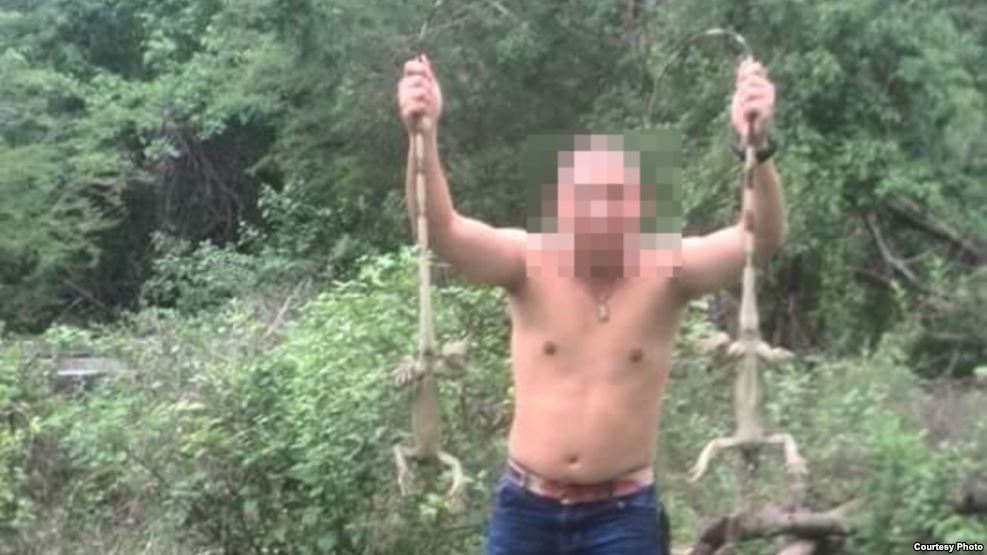
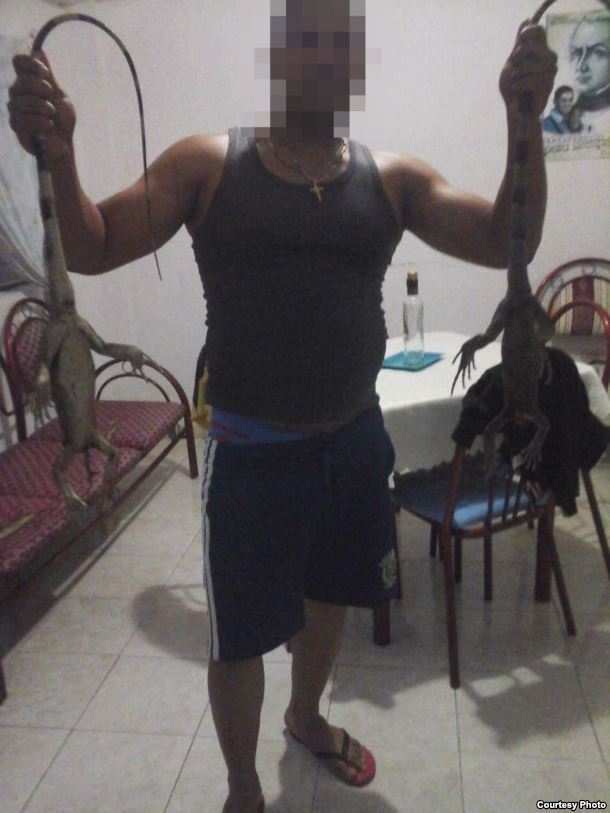
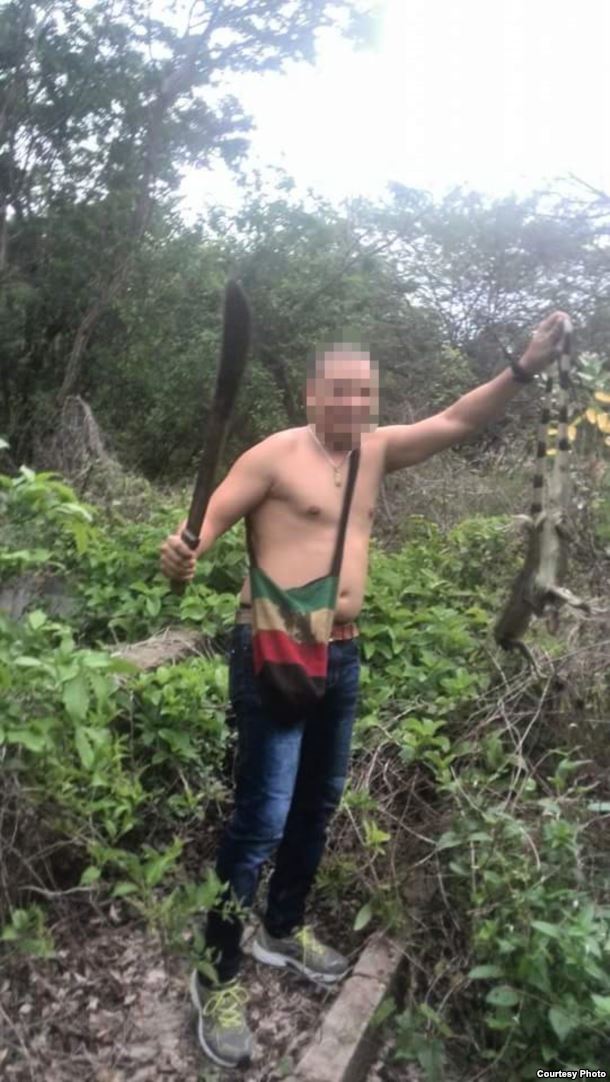
“What Venezuela needs right now,” he adds, “is food. My CDI colleagues have to hunt iguanas in order to survive. You only have to look at our Facebook profiles to see. And it is not because we are hunters. It’s because the grocery stores where Cubans shop only have rice, nothing else from the main course.

As the number of Cuban physicians in Venezuela increases, their diets are being supplemented with iguana meat, which they hunt.

The Challenge of Living Without Dollars in Cuba / Iván García

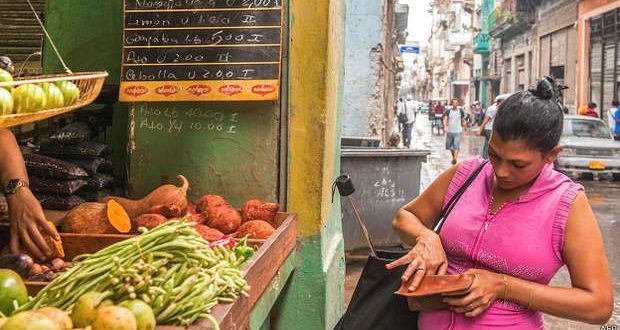
Woman buying food
Woman buying food. (Source: Panamerican World.)

Iván García, 19 September 2016 — Let’s get to know Osmel, born in Havana, in 1968. You can smell his body three yards away. He’s a carrier of HIV; he drinks alcohol and makes trouble seven days a week and doesn’t have any known residence.

He sleeps on top of some cartons in a building that threatens to fall down. He eats little and poorly and makes some money collecting old things in the dump at Calle 100, west of the capital.

His skin looks scorched, and every morning he tries to sell things on the outskirts of the Plaza Roja in La Vibora: a pair of used shoes, pieces of second-generation computers or a collection of old Bohemia magazines. continue reading

He says that Social Security “because of my advanced diabetes helps me with 140 pesos (7 dollars) a month, which more or less allows me to get what I need from the store and buy meat and medicine.”

Undoubtedly, Osmel would like to have a family, sleep in a bed and have a daily bath. “I dream about this all the time. To eat hot food, have a wife and watch television with my kids. But how can I get that if what I earn in a month by selling old junk or cutting stone doesn’t cover my needs?” he asks, and he answers himself:

“So that’s why I have to get drunk. The money left to me goes for that. Maybe it’s the fastest way to kill myself,” he says and takes a sip of murky alcohol from a plastic bottle, filtered with industrial carbon.

Like Osmel, hundreds of indigents wander through the streets of Havana, trying to survive in “the revolution of the humble, by the humble and for the humble,” as Fidel Castro once described it, which in practice has been transformed into an incipient military capitalism that benefits very few.

The Cuba of the Castro brothers happened to have a functional Social Security, sustained by the blank check that the Kremlin provided, for limited aid to retired and sick people, among others, who receive a handful of pesos that isn’t even enough to cover a third of what they need.

The big losers of the tepid economic reforms undertaken by General Raúl Castro are the old people and those at risk of social exclusion. Not all of them are beggars without a roof, like Osmel, but many are obligated to sell newspapers, nylon bags, single cigarettes and cones of peanuts in the streets, or become night watchmen for private companies or State businesses to earn some extra pesos.

The worst isn’t the present; it’s the future. Keep in mind this date: In 2025, more than 30 percent of the Cuban population will be over 60 years. With emigration soaring, finances in the red and a lack of coherent politics that offers net benefits to women and men of the third age [retired], it’s evident that Cuba will not be a good place for old people to live.

Although the old are the most affected by the new economic direction, according to Argelio, a sociologist, “almost 40 percent of the citizenry lives below the poverty line accepted by international agencies, which is measured by those who earn less than one dollar a day. For those in extreme poverty, the figure on the Island hovers around 15 percent.

Specialists consulted consider that there are many reasons for the steep fall in the level of life in Cuba. “The prolonged economic crisis, which now has lasted for 27 years, an economy with ineffective structures, sluggishness in applying efficient models of business management, the circulation of two monies, low salaries and a decrease in productive and export capacity. Except for the sale of services and tourism, in most indices, Cuba has gone backwards,” says Jorge, a professor of political economics.

Raisa, an economist, blames the disaster on “poor governmental management, the decapitalization of the country by the dual currency system and low salaries, which distorts transactions, real productivity and the buying power of the population. There are three or four types of monetary exchanges in the export business and non-agriculture cooperatives that affect economic performance. Raising salaries without a productive base is counter-productive, but earning poor salaries is even more so. The dual currency should be repealed now, although it brings with it associated short-term phenomena that could trigger social conflict.”

In October 2013, the Havana Regime announced the unification of the dual currency and put into play a group of measures that would progressively culminate with the withdrawal of the Cuban Convertible peso (CUC), leaving only the Cuban peso (CUP). But the slowness and the new state of austerity made the autocracy think twice before initiating an in-depth monetary reform.

With an average salary that doesn’t exceed 27 dollars/month, the average Cuban must get by as well as he can to have one or two hot meals a day, get soap, deodorant and detergent and buy clothing and shoes. To reach a decent standard of living, Cubans need the equivalent of 20 minimum salaries of 300 Cuban pesos a month, which would add up to the equivalent 280 dollars per capita.

And probably this isn’t enough, since the accumulation of material hardships and lack of maintenance in the homes triple these figures. Although the Government doesn’t talk about the camouflaged inflation that affects, above all, the State workers who earn in Cuban pesos, the prices in the hard-currency shops — that require Cuban Convertible pesos — reveal the real state of the situation.

Three examples: If a worker wants to buy a flat-screen television, he needs a  salary of a year and a half. To furnish his house, a salary of five years. And if he dreams of owning a modern car, at the present price in State agencies, he needs a salary of 180 years.

If this isn’t inflation, let someone show me otherwise.

Diario Las Américas, September 9, 2015.

Translated by Regina Anavy

Ethics Committee Hears Appeal From Expelled Holguin Journalist / 14ymedio, Mario Penton

Journalist Jose Ramirez Pantoja. (Facebook)

14ymedio bigger14ymedio, Mario Penton, Miami, 29 September 2016 – Today the National Ethics Commission of the Cuban Journalists Union (UPEC) will finally hear the appeal filed by Cuban journalist Jose Ramírez Pantoja, who was fired from his job at Radio Holguin last August.

Ramírez Pantoja was accused at that time of republishing on his personal blog, Verdadecuba, comments from Karina Brown, vice president of the official newspaper Granma, who had spoken publicly about the country’s situation and the possible outbreak of another ‘Maleconazo‘ – a 1994 protest that holds the record for the largest street* protest in the 60 years since the Castro brothers took over the Cuban government. continue reading

The trial was scheduled for last week, but for reasons that were not clarified by the Court of Ethics it was postponed. After the hearing, which will pass “a moral judgment on the performance of the journalist,” according to a source who spoke with this newspaper, the commission will have 10 days to issue a ruling.

According to UPEC’s on-line site, cubaperiodistas.cu, Luis Sexto, president of UPEC’s National Ethics Commission, traveled to the eastern province on 7 September to conduct an “in person” interview with Ramírez Pantoja. On that occasion, Sexto stated that despite the Provincial Ethical Commission’s having prepared a “substantial record” on the fired journalist, “the National Commission receives, analyzes, supervises, authorizes and modifies the measure taken at the provincial level.”

The president of the national commission said he was “encouraged by the spirit of justice inspired by UPEC and its Code of Ethics.” He also said he was traveling to Holguin “in a constructive spirit” and not as a “destroyer.”

Speaking to 14ymedio, Ramírez Pantoja said he did not want to make a political show of his case. However, his dismissal opened a Pandora’s Box and hardened the positions between those who defend swashbuckling journalism mentored by the Communist Party and information professionals seeking more freedoms.

Since the ruling, Aixa Hevia, UPEC’s vice president, accused Ramirez Pantoja of trying to position himself to move to the Miami media, and hinted at the possibility of expelling from the country Uruguayan journalist Fernando Ravsberg, a known sympathizer of the Cuban Revolution, who runs the alternative blog Letters from Cuba and who came to the defense of the fired professional.

The official press also lashed out in recent weeks against those media “who want to present themselves as alternatives,” in reference to the multitude of alternative sites to the official press that have arisen, especially on the initiative of young journalists who cannot find a place in the old areas controlled by the government, or who seek to augment their meager incomes. Iroel Sanchez, one of the journalists who staunchly defends communist orthodoxy, challenged professionals who in a “Cuban medium” paid homage to Che and shortly afterwards disrespected him “where they pay better.”

According to Ramirez Pantoja, the injustice committed against him led him to consider the need for a journalism that is more serious and committed to the needs of the people.

The journalist expressed his appreciation through social networks to people who have supported him in the process. His presence on social networks, however, has waned since he lost the privilege of connectivity that is granted to some official Cuban journalists.

During the two months of the impasse, waiting, the reporter has had to make a living through self-employment. He works “loading the Weekly Packet onto flash drives,” as confirmed by source close to him, and “he has also been working with a the company Codanza, on the production of the third North Atlantic Vladimer Malakhov Grand Prix Dance Contest.”

Ramirez Pantoja’s hearing takes place within a few hours of that of a complaint against another former official journalist, Maykel Gonzalez Vivero, who was expelled from Radio Sagua in Villa Clara “for collaborating with private media.”

If he loses in front of the National Ethics Commission, Ramirez Pantoja can appeal to the UPEC Congress or request an appeal to the Supreme Court.

*Translator’s note: Arguably the largest protest of all kinds by Cubans against their government is that of the hundreds of thousands of Cubans who have left the country.

Laritza Diversent, Devastated by the Police Operation Against Cubalex / Iván García

Laritza Diversent (Ivan Garcia)

Ivan Garcia, 28 September 2016 — After passing the crossing of La Palma, two kilometers from the old bus stop of Mantilla, El Calvario is found nestled, a district of one-story houses, roads without asphalt and a multitude of dogs without owners.

At the end of a narrow alley the Cubalex Center of Legal Information headquarters is located, a two-story house constructed from private resources, that also serves as the waiting room for the public on the lower floor and housing on the upper floor. continue reading

There, in the summer of 2011, the lawyer, Laritza Diversent Cambara, 36 years old, founded a law office to give legal advice to citizens without charging anything nor caring about the person’s ideological position.

“The last year we dealt with more than 170 cases. Most of the people were poor and without resources, and they felt helpless because of the State’s judicial machinery. We advised on homicides, cases of violence against women, drugs, prostitution and also for any dissident who needed it,” indicated Laritza, seated on a small roofed patio at the back of her house.

The judicial illiteracy in Cuba is lamentable. Very few know the Fundamental Law of the Republic or the proceedings that the police force must fulfill during arrests, confiscations or when they give a simple citation.

Since 2009, lawyers like Laritza Diversent has given lectures to bloggers, independent journalists and the opposition, so they would know how to act at the moment of an arrest.

But the laws in Cuba are an abstraction. They are a set of legal regulations that supposedly should be respected by the authorities. But the repressive forces are the first to violate them.

What occurred on Friday, September 23 is an example. Lartiza says that “several neighbors had warned us about an operation that State Security was preparing. About 20 uniformed agents presented themselves in the office, some with pistols in their belts, as officials of several State institutions. They brought a search warrant that didn’t comply with the requirements established by law. When we let them know it, they resorted to force and invaded the entrance of the Cubalex headquarters, which at the same time is my home.”

They destroyed the door to the patio and came into the living quarters after forcing the kitchen door. Now inside, they took away five computers, seven cell phones, a server, six security cameras, three printers, digital media, archives and money.

“They acted with total impunity and arrogance. The authorities assume they are above the law. They filmed everything. Then they stripped us one by one and body-searched us in a degrading way. It was really humiliating,” said Lartiza.

They took away and detained the lawyer, Julio Ferrer Tamayo, and the activist Dayán Alfredo Pérez, whom they freed 12 hours later. Ferrer was confined in the Zanja and Dragones police station, very close to the Chinese Quarter of Havana.

Laritza assumes that the olive-green Regime could send Julio Ferrer to prison. “From his family we found out that in a couple of days, Julio will be presented in the Second Chamber of the criminal court. We will do everything we can to prevent this.”

Ferrer Tamayo, perhaps one of the best prepared Cuban jurists, was a prosecutor in Guanabacoa and later a defense attorney. He knows like few do about the corruption, nepotism and trafficking in influence in the sewer of the legal system.

He has proof that points to several judges. When he decided to become an independent lawyer, he suffered all kinds of harassment from State Security. And in an underhanded legal plot, they sentenced him to three years in prison. But his legal knowledge obliged the olive-green autocracy to free him, without completing his sentence.

Now, everything indicates that they are going to prosecute him and incarcerate him again. The coercion of Special Services has no limits on the Island. Marienys Pavó Oñate, herself a lawyer and the wife of Ferrer, has been confined since 31 July 2012  in the women’s prison, Manto Negro, in a case that he considers a conspiracy.

Cubalex, like other law offices and groups on the State’s margins, operate in a real judicial limbo. In one form or another, they have tried to enroll in the Ministry of Justice Association’s registry. But either they haven’t received a response, or they have been denied the right to associate themselves legally.

In that regard, Laritza says that this indefinite or semi-clandestine status was the perfect pretext to launch the violent operation against Cubalex on Friday, September 23.

“At the head of the search was Lieutenant Colonel Juan Carlos Delgado Casanova and the prosecutor, Beatriz Peña de la Hoz. But to give it a veneer of legality, other officers participated, like the ones from the Institute of Physical Planning, the National Office of Tax Administration and the Integral Direction of Supervision, a body of inspection that forms part of the Council of Provincial Administration,” points out the lawyer from Havana.

The Cubalex team is worried about the legal actions that the State can take against Jorge Amado Iglesias, a collaborator of the office, since he has a license to work for himself and they can fine him 1,500 pesos. For her part, Laritza suspects that Physical Planning initiated a process in order to confiscate both the headquarters and her own home. Since it’s a process of investigation that can last for months, Cubalex cannot take on any cases.

Laritza Diversent is devastated. She believes that the operation suffered by the office, added to other cases of detentions and confiscations against opponents and alternative journalists, could be the beginning of an imminent repressive wave against the dissidence on a national level. “I never thought that by defending human rights I would have to go through all this,” she says.

And that new turn of the repressive screw brings back memories of the Black Spring of 2003. The only thing different in the modus operandi is the season of the year. To make it true, it would have to be in the fall.

Note: The photo of Laritza Diversent in her office was taken by Iván on Monday, September 26, three days after the police operation against Cubalex, which took place on the first floor of her house. In 2009, Laritza began writing as an independent journalist on the blog, Desde La Habana (From Havana). Her works from that period can be read in the folder entitled Las Leyes de Laritza (Lartiza’s Laws).

Translated by Regina Anavy

Cuba Forbids Opposition Observers from Traveling to Columbia Because President Raul Castro “Is Visiting There” / 14ymedio

Ada Lopez, a Cuban opposition activist and member of Otro18, and also a member of the independent library movement. (Source: Notes from the Cuban exile quarter)

14ymedio bigger14ymedio, Havana, 28 September 2016 – The reason put forth by the Cuban authorities to block travel to Colombia by opposition members called to be observers in the plebiscite on the that country’s agreement with the FARC, is “national security,” because “the president is already there on a visit.”

This is what a security agent, who identified himself as Ronald, told the activist Agustin Lopez, brother of Ada Lopez. The opponent described his arrest to 14ymedio, after he was detained at three in the afternoon on Monday when asking the police surrounding his house why they were there. He was released at 6:40 PM on Tuesday. continue reading

His sister, the activist Ada Lopez, had denounced a police operation around her house in Havana from the early hours of Tuesday, to keep her from going to the airport. She was due to travel to Colombia that afternoon to also participate as an observer in the plebiscite for peace that is to be held on Sunday, 2 October, but she was arrested when she left for the airport.

Ada Lopez, who is also a member of the independent library movement, received an invitation to visit Colombia as a part of the Otro18 project (Another 2018) an initiative focused on promoting new laws regarding elections, free association and political parties in Cuba.

“I was leaving my house with a suitcase to try to get to the airport,” explained Lopez, adding that the independent journalist Arturo Rojas Rodriguez, who was scheduled to travel with her, “was arrested yesterday, taken to a police station in the Capri neighborhood and subsequently transferred to a station in Cotorro, to prevent him from traveling.”

Hours later, Ada Lopez’s husband, Osmany Díaz Cristo, reported that she had been arrested the moment she left her house headed to the José Martí Airport’s Terminal Three in Havana. “The suitcase she was traveling with was thrown to the ground and she was dragged to the police car. Right now she is at the police station in Regla,” across the bay from Old Havana, he added.

Both activists were invited to participate in the plebiscite by the Election Observation Mission of Colombia (MOE), as confirmed by 14ymedio through the opponent Manuel Cuesta Morua, one of the main promoters of Otro18.

Last Sunday, Cuban President Raul Castro traveled to the city of Cartagena de Indias for the signing ceremony of the peace agreement between the Colombian government and the FARC-EP.

Cuban Writer Wendy Guerra Honored With France’s Order of Arts and Letters / 14ymedio

The writer Wendy Guerra. (EFE)

14ymedio bigger14ymedio, Havana, 28 September 2016 – Cuban writer Wendy Guerra has been named an officer of the Order of Arts and Letters by France’s Ministry of Culture. The recognition in one level higher than the Order’s knighthood, which she was awarded in 2010.

“France is my second home and the place where my voice resonates with great force despite the silence I suffer on my beloved island of Cuba,” said the novelist in her Facebook account.

Guerra is the author of several novels, including Todos se van (Everyone Leaves), 2006; Nunca fui Primera Dama (I was never First Lady), 2008; Posar desnuda en La Habana (Posing Naked in Havana), 2010 – an apocryphal diary of Anais Nin – Negra (Black Woman), 2013; and her most recent, Domingo de Revolución (Revolution Sunday).

Upon receiving news of the award, the novelist thanked her “readers, editors, translators, critics and colleagues” in France, a nation which she described as “wonderful, cultured, passionate.”

Among the Cubans who have previously received the Order of Arts and Letters, are the poet and essayist Nancy Morejon, Cuba’s Minister of Culture Abel Prieto, the writer Zoe Valdes and the novelist Leonardo Padura.

Committee to Protect Journalists Invites Journalists in Cuba to “Cross the Red Lines” / 14ymedio

A person reading the official daily Granma. (EFE / File)

14ymedio bigger14ymedio, Havana, 28 September 2016 – Dismantling the legal framework for the press and eliminating all barriers to individual access to the internet are key factors to promote a more open information environment in Cuba, according to the report Connecting Cuba: More Space for Criticism but Restrictions Slow Press Freedom Progress, published this Wednesday by the Committee to Protect Journalists (CPJ). However, the organization with headquarters in New York, highlights the progress made and suggests that “the foundations of a free press already exist” in the country.

Among other positive factors, it emphasizes the existence of “A lively blogosphere, an increasing number of news websites carrying investigative reporting and news commentary, and an innovative breed of independent reporters who are critical of, yet still support socialist ideas.” This transformation, it adds, means that it is possible to delve into issues that for a long time were treated superficially or ignored by the official press, making visible, for example, gay rights or allegations of corruption and poverty. continue reading

The report assesses the development of projects such as the site of narrative journalism El Estornudo (The Sneeze) and the in-depth articles on local issues in Periodismo de Barrio (Neighborhood Journalism), as well as “the sustained quality of 14ymedio, which provides readers with stories and perspectives that they can’t find anywhere else.”

“Space is opening up. Things are moving and the status quo is cracking,” Miriam Celaya, a contributor to 14ymedio, told CPJ. “But Cuba hasn’t changed as much as we would like.”

“The Cuban people deserve answers to numerous pressing questions,” said the organization, adding, “It would be foolish to expect that substantive answers to these questions will be forthcoming anytime soon. But they would become significantly harder to ignore if more Cuban journalists were asking them. For the sake of their country’s future, it is hoped that more Cuban journalists will decide to join those who have already crossed red lines.”

CPJ lists among the elements that hamper the progress of press freedom in Cuba “harassment and intimidation from authorities, a legal limbo caused by outdated and restrictive press laws, and limited and expensive access to the internet.”

In addition, arbitrary arrests and citations for independent journalists, according to the report, remain common despite recording a decline in recent years. “Fears of similar action or arrest prompt many independent journalists to self-censor,” journalists interviewed for the report told CPJ.

The organization believes that the restoration of diplomatic ties between Washington and Havana has made it difficult for the Cuban government to justify censorship of the press as a means to protect the country from US aggression.

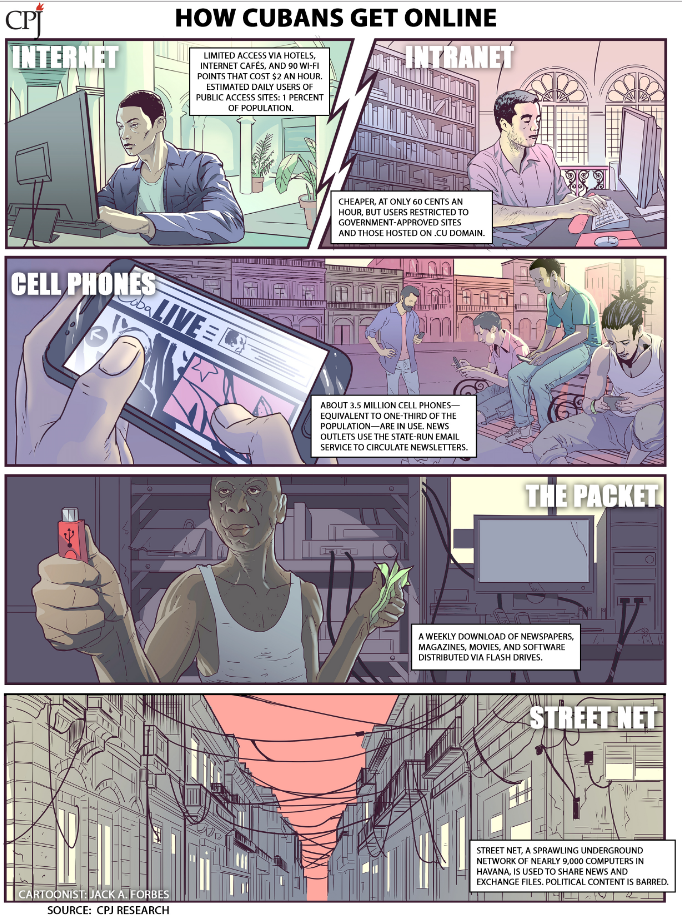
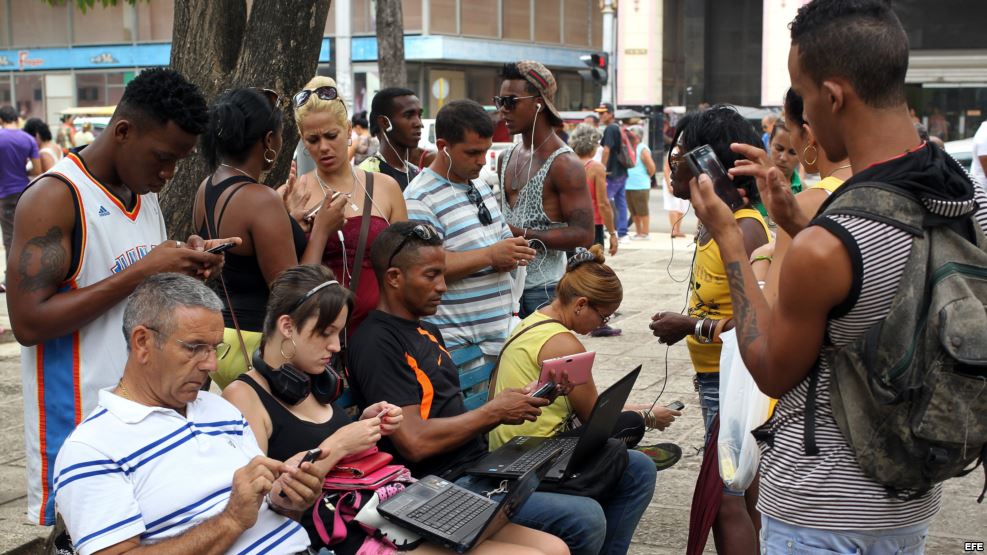
The main obstacle to the development of a free press, according to CPJ is limited access to Internet, as broadband connections are not available in most Cuban homes and the service is expensive. The low internet penetration in the country (Cuba has one of the lowest rates of internet access in the Western Hemisphere) means that the audience for new media is concentrated essentially in the US and Europe, while access to independent news sites such as 14ymedio is blocked, leaving island residents to seek alternative solutions such as the Weekly Packet.

“Despite facing many obstacles, Cuba’s journalists and bloggers have found innovative ways to distribute content, including using flash drives and underground computer networks, and sending articles via the state email system,” the report said.

The study reports that the use of Nanostations, a device that helps extend wifi signals and that is available on the black market, is also spreading.

screen-shot-2016-09-28-at-1-31-22-pm

The report concludes with a series of recommendations to the Cuban Government, among which are requests for changes in the constitutional and legal framework to ensure that journalists can carry out their work without fear and can create private or cooperative media, the promotions of a critical state media, and better access to the Internet. In addition, the organization demands an end to arrests and practices of intimidation, and asks that the UN Special Rapporteur on the promotion and protection of the right to freedom of opinion and expression be allowed in the country

The CJP asks, in addition, for the Organization of American States (OAS) to act as mediator for the visit of the Rapporteur and to consider the Cuban government’s history on human rights in its work.

Deciding to Change / 14ymedio, Reinaldo Escobar

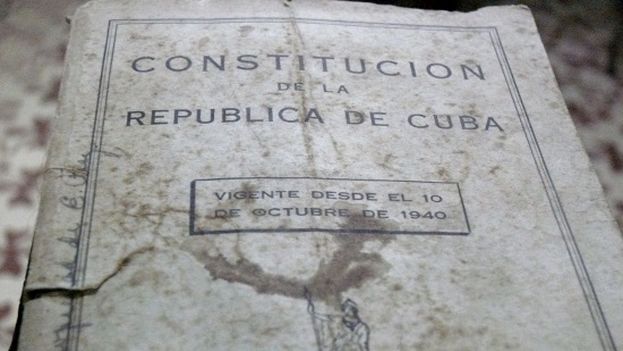
Brochure with the content of the Cuban Constitution of 1940. (Manuel Diaz Mons)

14ymedio bigger14ymedio, Reinaldo Escobar, Havana, 25 September 2016 – If there is something it is difficult to disagree with the Cuban government about, it is the permanent defense of the people’s right to decide the economic, political and social system that suits them. This principle is put forward in every international forum attended by official representatives from the island, and is shared by the majority of civilized nations.

In parallel, above all within Cuba, there is an intense campaign to fight any intention to change the existing regime in the country. Clearly, if the intentions to change “the existing regime” come from another nation and are contrary to the legitimate interests of the people, resistance to change is absolutely valid. continue reading

The question is whether that sacred right of the people “to decide” includes the option to “change” the system, regardless of whether the proposed changes coincide partly or completely, with some external proposal.

The first historical example in the case of Cuba was the change that occurred in the early twentieth century when we replaced the colonial regime, which subjected the people’s will to the will of the Spanish metropolis, to a new system in which the island became a Nation, established as a Republic. That change, imperfect, incomplete, truncated, responded on the one had to the popular will and on the other hand to the interests of a foreign nation, the United States of America.

The second example was the regime change proclaimed in April of 1961 when Cuba became “the first socialist country in the Western Hemisphere.” That substantial modification, which had not appeared clearly indicated on the revolutionary program that overthrew the brief dictatorship of Fulgencio Batista, was only submitted to citizen consultation, through a vote, 15 years later, when there was no private property left in Cuba, no entity of civil society, no independent press media and only one permitted political party.

The millions of Cubans who, with their secret and direct vote, approved the 1976 Constitution, where the new social regime was enshrined, which also coincided with the interests of a foreign nation, the Soviet Union, to support the presence of socialism “under the noses of imperialism.” The USSR did not hesitate to offer everything: food, arms, troops, oil, credits and whatever diplomatic and political support needed.

At the turn of the years to socialism in Cuba, the Republic passed away. Although no one had baptized it pseudo-socialism or mediated socialism, it has been necessary to add an “our,” at the risk of committing the revisionists’ sin.

That system approved by popular vote 40 years ago does not greatly resemble what is described today in successive guidelines issued by the only legally permitted party, but the changes introduced have only been discussed with the party membership and other representatives of certain previously chosen institutions.

Among the possible commonalities between the Party Guidelines and the interests of foreign nations, say China or the countries of the ALBA bloc, could be a sterile exercise of political speculation, especially in a globalized world where almost no country enjoys total freedom to dictate laws while turning its back on the interests of the rest of the planet.

The right of Cubans to maintain the regime is only legitimate if their right to change it is also recognized. The desire for uniqueness, the obsessive vocation of not resembling the other, of not coinciding with the interests of anyone, would be a difficult caprice to satisfy and an impossible one to pay.

Addressing regime change now, introducing changes to the regime or leaving everything as it is, requires a prior exchange of opinions and a subsequent approval. Only if there is freedom to debate and guarantees of a free vote, would it respect the sacrosanct right of the Cuban people to decide which system they wants to live under.

Internet in Cuban Homes? More Heat Than Light / Juan Juan Almeida

Juan Juan Almeida, 26 September 2016 — Although the Cuban press confirms and reiterates that the country will expand access to the internet as a public service, an untimely meeting — they call it a broad council — held on the 6th of this month, attended by the vice-ministers of the central organs of the state, put an unexpected brake on the process of computerizing Cuban society.

As a part of a strategy that pursues gimmicks rather than effectiveness, the Cuban government emphasizes that it is investing invaluable resources and unlimited efforts to bring the internet to more Cuban citizens. But an email sent by the engineer Jorge Luis Legrá, director of ETECSA (the state-run telecommunications company) Strategic Programs, addressed to Mr. Alfredo Rodriguez Diaz, a specialist in artificial intelligence and national director of Informatics and Communications of the Ministry of Public Health in Cuba, shows the opposite. continue reading

Official media say that in the project of computerizing society, the priority of the country is to extend connectivity to residential areas, and that the number of users in the Health and Education sectors with access to the internet in their homes will significantly expand.

The will may exist, although in reality I doubt it, because in this electronic missive that with ingenuity and great effort landed in my laptop, one can clearly read that at the important meeting held at the beginning of the month, where the majority of Cuban vice-ministers attended, Wilfredo Gonzalez Vidal, Vice-Minister of Communications of Cuba, reported that his entity will continue working on broadening access to the internet in navigation rooms, in the incorporation of new public sites for wifi service, in the joint development of a telecommunications law that suits the new technologies and puts an end to the current regulations and legal framework.

He also said that work was underway on internet access through cellphones and in the expansion of connectivity to national entities such as MINSAP, MININT, MINFAR, MINJUS, MES, MINED, MINCULT, MFP, MINTUR, MINAG, MITRANS, ICRT, MINREX, etc.  But he also made clear that as of this last July, an “all-powerful” decision red-lighted the much publicized plan to install ADSL to bring internet to Cuban homes, including those of health and education professionals for whom it has already been authorized.

Faced with such inexactitud, I can’t fail to mention my illustrious grandmother and her wise sayings… “lots of heat, little light,” or even better, “You can catch a lie faster than you can catch a cold.”

Scholarships, Fears And Attractions / 14ymedio, Yoani Sanchez

World Learning's scholarships are targeted to 16-18 year old students in Cuba.
World Learning’s scholarships are targeted to 16-18 year old students in Cuba.

14ymedio bigger14ymedio, Generation Y, Yoani Sanchez, 27 September 2016 – The woman approaches without fear or hesitation. “How can my son apply for one of the scholarships mentioned on television?” she asks me abruptly. It takes me a few seconds to realize what she’s talking about, for the images to come to mind of young Cuban students engaged in demonstrations called by the government to reject the programs of the World Learning organization.

She waits a few minutes, standing next to me, eager to have an email address she can write to, a bridge for her child to learn another reality. The slogans against the US NGO launched by officialdom don’t seem to have swayed her. When I ask her if she is aware of the government campaign attacking this program, which is targeted to Cuban youth between 16 and 18, she responds with a very popular phrase: “In this case, it’s all the same to me to me to be the pedestrian, or the driver who runs over him.” continue reading

Fear no longer works as it once did. A few decades ago, it was enough for any phenomenon or person to be demonized on television for the circle of silence and fear to close around them. Now, the volume at which the extremists shout is inversely proportional to the interest in the object of their animosity. Without realizing it, the Party propaganda of recent days is helping to advertise the existence of some scholarships that were known to only a tiny part of the island’s population.

The woman is not afraid. She sticks close to me for help in some details that will allow her son “to breathe other air.” Like her, thousands of parents throughout the island watch their children leave for school, where in morning assemblies they shout their rejection of the new “manipulations of imperialism.” At home, the adults move heaven and earth to inscribe their children’s names on the list for the next round of scholarships.

Cuban Government Lashes Out At Scholarships For Young Cubans In The United States / 14ymedio, Zunilda Mata

Logo of the advertising campaign for World Learning’s program for Cuban youth. (14ymedio)

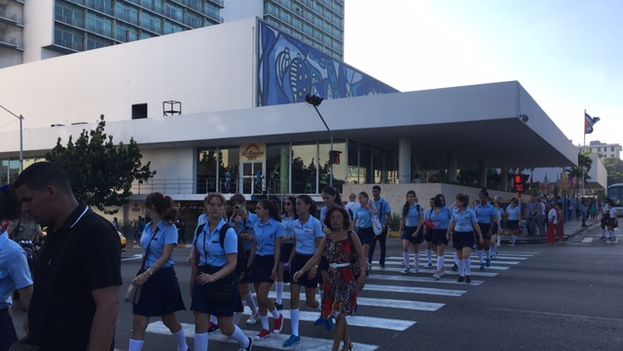
14ymedio bigger14ymedio, Zunilda Mata, Havana, 25 September 2016 — The ideological battle of officialdom has a new enemy: the scholarships offered by the American organization World Learning to young Cubans between 16 and 18 years of age. In Cuban secondary schools and universities in recent days, the morning assemblies have “condemned and protested strongly” against what the state media describe as an “imperial maneuver.”

National television has provided extensive coverage of acts of “revolutionary reaffirmation” in which it criticizes the summer program offered by the US non-profit organization for citizens living on the island. An ideological onslaught of a kind that hasn’t been seen since the campaign for the release of the five Cuban spies who were imprisoned in the United States. continue reading

For two years, World Learning has offered four-week scholarships, between July and August, for Cuban secondary and university students. The organization aims to develop young people’s “skills in areas that include public speaking, teamwork, business, developing consensus, conflict resolution, defending their own rights, and problem solving.”

An agenda that Cuba’s officialdom has called “hostile and interventionist.” The president of the Federation of Students in Intermediate Education (FEEM), Suzanne Santiesteban, called for acts of repudiation against the program in secondary and higher education schools across the country. In the coming days 460 of these rallies will be held.

During its two years of existence, the scholarship program has become very popular among Cuban teenagers and the call for applications for the 2016 session was widely distributed by alternative information networks. “Everyone talked about it in the hallways and between classes,” says Fabian, a 17-year-old high school student in the city of Pinar del Rio.

“People were very excited, because it was a chance to travel with all expenses paid and to learn about another reality,” the young man commented to this newspaper. Although he explained that he decided not to apply for a scholarship because his father is a member of the Communist Party and in meetings of the party base “they are warned them that they could lose their membership card” if they allowed their children to travel to the United States through World Learning.

Now, the official condemnation has emerged from the Party circles and extended to the classrooms, where potential applicants for the scholarships are studying. In an effort to cut short the enthusiasm about the program, Suzanne Santiesteban charges that the organization receives financing from the United States Agency for International Development (USAID), which she classifies as a “known tool of subversion.”

“We can sense their annoyance in the air,” said Yadira Machado, mother of a 16-year-old who wants to take advantage of the scholarship next summer. “I told my son to turn a deaf ear to all that, because it is the opportunity of his life,” said the woman, who lives in Havana’s 10 de Octubre district.

However, not everyone in Machado’s house shares her opinion. The young man’s grandfather believes that the US NGO is “pulling in kids to turn them into counterrevolutionaries.” An opinion consistent with the warnings from the authorities, which calls the World Learning initiative a “new strategy” by the White House focused on the younger generation.

The rejection of scholarships for young people has come with several articles in the official press that also attack Cuba’s new independent media. The “new counterrevolution needs a new press,” a well-known State Security agent declares. The ideological onslaught appears to just be getting underway.

They Married Us to a Lie… / Rebeca Monzo

Rebeca Monzo, 26 September 2016 —  It is a sign of lack of civility and decorum on the part of the Cuban regime to blame to the so-called US blockade for the shortages and difficulties, whose real cause is the inability and mismanagement of the economy, wealth and and riches of our country, by the leadership of the island. It is extremely well-known that they have “thrown everyone overboard,” dedicating their efforts and money to propaganda and proselytizing abroad, to present a completely untrue image of the internal situation. continue reading

When the Soviet “pipelines” were open to Cuba, in the media here, especially on television, there was an abundance of caricatures and ads where a popular character mocked the blockade, throwing all kinds of taunts at it.

Why now this exhausting campaign against the blockade, that exceeds all limits of popular assimilation and acceptance? Why not have the civility and honesty to recognize the inability to lead and the squandering of the income obtained from the government’s share of the family remittances from the United States and the huge business established by the government to “rent out” doctors and professionals to other countries, which bring juicy dividends to the regime and from which our doctors and specialists receive only a pittance?

In the face of this so-called “solidarity” it is the people who suffer the consequences of the lack of medically qualified professionals and specialists remaining in Cuba, in schools and hospitals. “Candle in the street, darkness in the house,” as the popular saying goes. That is, we put on a big show for the outside, while we lack everything at home.

They married us to a lie… and forced us to live with it all these years.

 Translated by Jim

Laritza Diversent: “We Have The Right To Participate In The Social And Political Life Of The Country” / 14ymedio, Reinaldo Escobar


Video: Police search of Cubalex: breaking open the gate.

14ymedio bigger14ymedio, Reinaldo Escobar, Havana, 26 September 2016 – The headquarters of the independent legal group Cubalex, this weekend, lacked the hectic bustle of the many users who normally flock to the site for legal advice, especially the families of inmates who come with thick folders of documents, appeals and demands.

When the attorney Laritza Diversent received us for this interview, the furniture had not been put back in place after an intense search that left everything “upside down” and, on the table, lay the shattered remains of a door latch, as physical proof of forced entry.

See also: Police Burst Into Cubalex Headquarters and Cuban Police Seize Legal Center’s Work Equipment

The psychological scars are fresh among team members of this organization, threatened with a legal process and forced to strip naked during the search. However, on Sunday the legal work resumed its course, thanks to the solidarity of other members of civil society who provided two computers. A few papers comprise the first evidence of a case that will demand time and expertise from Cubalex: their own complaint against the authorities who seized their belongings but could not stop their work.

14ymedio. What was the point of the raid against Cubalex?

Diversent. There were parallel purposes. On the one hand there were the architectural changes made on this house, where they were looking for the slightest violation of planning regulations. For example, they fixated on a bathroom that we put under the stairs as a service to the public. At the same time they wanted to monitor our work as an organization that provides legal services to the population. continue reading

14ymedio. Who participated in the police search?

Diversent. The prosecutor Beatriz Peña of Oz, the Attorney General of the Republic, at the head of about 20 people. Among them, a doctor, an employee of the prosecutor, Lt. Col. Juan Carlos, who led the operation from his status as an officer of the Ministry of the Interior (MININT), another prosecutor of the province and an instructor called Doralis, who made the list of the equipment that was seized.

They also brought experts who took photos, a videographer who was filming everything, and other computer experts. They had several officials from State Security, two uniformed police officers and other MININT officials wearing the uniform typical of prison guards; a representative from the National Tax Administration Office (ONAT), another of the Institute of Physical Planning and another from the Ministry of Justice.

Laritza Diversent (Source: Cubalex)

14ymedio. Why was there a representative of the ONAT present?

Diversent. It was justified with the assumption that we are undertaking an activity defined as ‘self-employment’, that we are providing a service for which we are supposedly charging people, without having the necessary permit. We explained to them in every possible way that we are a non-governmental organization (NGO) that provides a free social service, but they acted as if we hadn’t made that clear.

14ymedio. Why a repressive act of this nature at this time and against a peaceful group?

Diversent. It is very difficult to find the reasons for this action, which can be described as unconscionable. But it can be attributed to what we have done. First, our attempts to achieve the legalization of our organization, Cubalex. We have also filed complaints against official institutions such as the General Customs of the Republic, saying that books and other belongings have been seized from us at the airport without justification. That complaint we have taken to court. We have also made a policy proposal to the Communist Party of Cuba to change the electoral law.

14ymedio. So you think that is a response to these actions?

Diversent. You would have to ask them. As citizens we believe we have the right to make proposals and we have the right to participate in the social and political life of the country in which we live.

14ymedio. Did you resist the police officers who were entering the premises?

Diversent. The “resolution to enter the home” – the warrant – to undertake the search said that they were looking for “objects of illicit origin,” but it didn’t specify which ones. The law establishes that this detail must be clarified, so I denied them entrance and invoked the right to inviolability of one’s home. However, they broke the lock on the outer gate and also the one on the main door to the house.

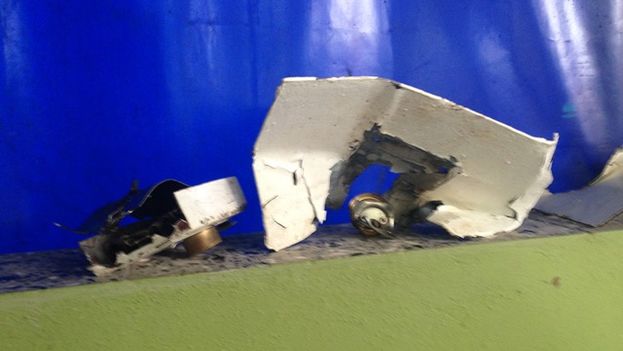
The doorknob and lock to Cubalex headquarters which was destroyed by the police to enter the premises.(14ymedio)
The doorknob and lock to Cubalex headquarters which was destroyed by the police to enter the premises. (14ymedio)

14ymedio. The law also specifies that the search must be made with at least two members of the Committee for the Defense of the Revolution [local watchdogs] as witnesses. Was that requirement met?

Diversent. The witnesses were two members of the party nucleus in the zone, who did not behave as impartial witnesses, but as partners in the operation. To the extent that they sometimes suggested to MINIT officials where they needed to search, and they constantly used the term “we” with the sense of being a part of the operation, far from their supposed function as impartial witnesses. One of them was more than 85-years-old and boasted of being an unblemished revolutionary.

14ymedio. What was the final outcome of the search?

Diversent. They seized four laptops and five desktop PCs, including a server, and three multifunctional printers. In addition they took hard drives, memory sticks, cameras and all the cell phones were taken.

14ymedio. What has been the reaction of other independent groups to this search?

Diversent. Almost all the entities of civil society have expressed their solidarity.

14ymedio. Could the information seized pose a risk to you?

Diversent. More than 200 case files that we are working were taken, many of them regarding inmates anxious to see some improvement in their status as prisoners. There is a risk that these people, in exchange for any advantage in their prison regimen, might declare something that hurts us, such as that we charge for our services. But that is in the realm of speculation.

14ymedio. What is the worst thing that could happen?

Diversent. We are very concerned because they have made specific threats against us, such as that so far this is an administrative matter but that it could become another type of process.

14ymedio. Are you thinking of not continuing the work you have been doing?

Diversent. No. Rather, what happened encourages us to keep doing what we do.