Cuban Homosexuals: Excluded From The Army And Taboo In The Dissidence / Iván García

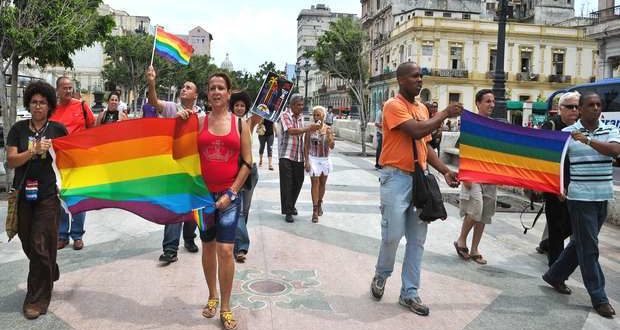
Cuban homosexuals parade with their flags on the Paseo del Prado in Havana. Taken from the Independent.
Cuban homosexuals parade with their flags on the Paseo del Prado in Havana.
Taken from the Independent.

Ivan Garcia, 30 June 2016 — “Beyoncé” — that’s what she likes to be called — prostitutes herself for less than two dollars on the outskirts of the old bus stop of Víbora, 30 minutes by car from the center of Havana.

By day she’s an “emerging teacher” in a secondary school, that is one of a class of teachers created due to the shortage of experienced teachers who begin training in the 11th grade at age 16 and take over a classroom while they’re still teenagers themselves. By night she goes out to hunt clients on the Diez de Octubre [Tenth of October] roadway, dressed as a woman. She wears a blond wig, a clinging dress, high-heeled shoes, too much makeup and a cheap, penetrating perfume that she combines with an imitation-Gucci handbag and some false eyelashes imported from Miami. continue reading

Beyoncé remembers that three years ago they summoned her to the municipal recruitment committee to take a medical exam that endorsed her admission to General Military Service.

“When I arrived dressed as a woman, an official sent me home. With an angry tone, he told me: ’You have to be dressed appropriately when you come before State institutions.’ Among other things I told the Cro-Magnon: ’Boy, and perhaps I’ll show up nude.’ Then I asked him: ’We gays don’t have the right to defend the homeland?’ The soldier turned around and left,” says the Havanan transvestite.

According to Beyoncé, the recruitment office didn’t even bother to summon her. “I don’t like military life, but it would be an interesting experience to be surrounded by so many males. You can imagine the number of men I could sleep with. They would call me ’Beyoncé the canteen’,” she says, smiling.

Serguey’s story was different. He always suspected that he was imprisoned in the wrong body. “From secondary school on I liked men. But I led a double life in order to not disgust my parents. I played basketball, I talked like a tough guy, but no woman interested me. I kept my homosexual relations hidden. When I finished pre-university, they called me for military service.”

Serguey continues remembering: “That was at the beginning of the ’90s. When the time came for the physical exam, I had to get naked and open my cheeks. Then the doctor who was there called me aside. It was like a police interrogation. I told him that yes, I was gay, but I didn’t want my family to know. They told me they wouldn’t tell, but an official told my father anyway. It’s not that I was interested in being a recruit, but I always wondered why a homosexual couldn’t be a soldier.”

Yosvany, a captain in the armed forces, points out that “according to the military regulation, gays, ex-convicts and counterrevolutionaries aren’t permitted to join the institution.”

When they ask him for the reasons, he explains: “Let’s speak clearly. Just because they tolerate homosexuals now doesn’t mean that we have to accept them everywhere. In the army as in the police, you need virility and responsible behavior. A criminal isn’t going to respect a police officer wearing feathers. And in the armed forces a gay could be more patriotic than anyone, but he’s a hindrance because of his inappropriate conduct. That’s the norm not only in Cuba. I believe there’s no army in the world that accepts gays in their ranks.”

Argelio, a former Major in the armed forces, recognizes that among the officers and recruits, “from time to time a fag slips through. It happens. I’ve been in units where there were cases of homosexual relations. But when it happens, ipso facto, the solider or officer gets a dishonorable discharge.”

Osvaldo, a historian, considers “that military institutions tend to be very retrograde. Although in the history of Cuba there are examples of revolutionary leaders with homosexual conduct or moral standards, it doesn’t agree with society. There is credible proof that José Martí, our national hero, the fruit of an extra-marital relationship with Carmen Miyares, fathered María Mantilla. Also, among some mambises (guerrilla Cuban soldiers who fought against Spain in the wars for independence) there was homosexuality. The most rumored was the supposed loving relationship of Antonio Maceo with Panchito Gómez Toro, his aide and the son of Máximo Gómez. Whether true or false, they are never going to stop being heroes of the fatherland.

Fidel Castro, a bulletproof homophobe, since his university years was the friend of the deceased Alfredo Guevara, an explicit homosexual. Carlos, a sociologist, recognizes that “the Cuban Government has taken a huge leap in recognizing the LGBT community. But it’s taking only half-measures to legalize homosexual marriage, accept gays in the army or promote government ministers who are openly homosexual.”

Norge, a retired doctor, remembers “that in the middle of the ’60s, research commissions were created to study the causes of homosexual behavior and their possible cures with hormonal medication. In the UMAP forced labor camps, many gays served as guinea pigs.”

Mariela Castro, the daughter of the autocrat Raúl Castro, who has undertaken a national and international crusade in favor of the LGBT community — if and only if they don’t dissent from the regime — hasn’t managed to get the Council of State and the one-note National Parliament to authorize homosexuals as members of the armed forces.

The intransigence toward accepting people with a different sexuality doesn’t affect only military institutions. Inside the dissidence in Cuba, explicit homosexuality is also taboo.

In a macho and homophobic society like Cuba’s, where the Government prohibits political differences, gay and lesbian opponents don’t openly reveal their homosexuality. And they bet on staying in the closet.

Translated by Regina Anavy
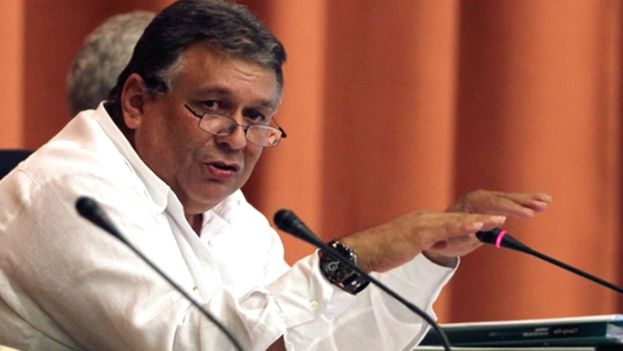
Mariano Murillo, the Marked Card Up Raul Castro’s Sleeve/ 14ymedio Reinaldo Escobar

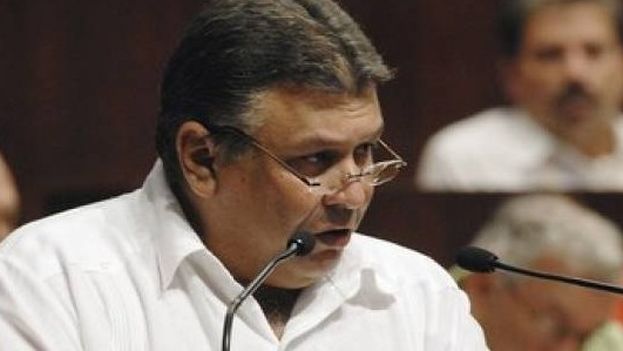
Mariano Murillo, former Minister of Economy and Planning

14ymedio bigger14ymedio, Reinaldo Escobar, Havana, 15 July 2016 — The ouster of Marino Murillo as head of the Ministry of Economy and Planning (MEP) raises the question of whether it was a fall into disgrace or an act of protection. An official statement said that Murillo would dedicate himself to the implementation of the Communist Party Guidelines and recognized his work as minister. The praise contrasts with the terrible results of the Cuban economy in the first half of this year and raises the question of whether Murillo’s removal, in reality, hides a promotion.

It is obvious that Cuba’s current situation is producing an important shuffling in the higher echelons of the government. The replacement of the first secretary of the Union of Young Communists, the untimely replacement of the Minister of Culture, and the departure of the head of Higher Education, have put the entire cabinet on notice at a time when even the official media speak of “the critical situation the country is experiencing.” continue reading

However, the “fall” of Murillo could also be interpreted as a strategy to distance him from blame for the disaster. What is more important: the management of the Ministry of Economy and Planning or the implementation of the Party guidelines? In the latter case, removing his ministerial portfolio would be a protective mantle placed over the former minister by Raul Castro himself. As if he wants to make people see that “if the economy is bad, it’s not Murillo’s fault.”

Why should he save Murillo? The answer to that question is in the future, at the end of 2017, when it will be made clear whose names will appear on the candidate list for the positions of president of the Councils of State and of Ministers, that Raul Castro will step down from in February of 2018, having come to the end of two consecutive terms.

If, finally, the current first vice president, Miguel Diaz Canel, replaces the General-President, the second echelon of these responsibilities would immediately become vacant. In a few more years, given the inevitable physical disappearance of the “historic generation,” a depleted quarry of cadres – lacking experience in power and also lacking prestige among the people – will have to take over in what will necessarily be a transition.

Since the high-level house cleaning that took place after Raul Castro took possession of the position of president, when Carlos Lage Davila, Felipe Perez Roque and Carlos Valenciaga, among other promising “younger sons,” were removed from their posts, the question of who will replace the current leaders has become more difficult to answer.

Sending Murillo out by the back door today, would be losing an unrecoverable card that has taken many years to develop. Compared with Jose Ramon Machado Ventura, the former Economy minister, he appears to be a reformer, a pragmatic politician who has spoken clearly about the need to produce wealth, and we have never heard him mention socialist emulation or moral encouragements as methods to boost production of material goods.

Murillo is a marked card which Raul Castro has kept up his sleeve all these years and he will not be discarded for the triviality of failing to deliver 50% growth in gross domestic product for this year. The so-called czar of reforms is the face that can give foreign investors confidence. Gone are the days when candidates for the throne had to make a show of their oratory, their imagination in creating new slogans or their histrionic capacity to show up for volunteer work.

Ricardo Cabrisas Ruiz, vice president of the Council of Ministers, has been named as a substitute for Marino Murillo in the MEP. His claim to fame is having convinced half of the world’s creditors to renegotiate the country’s foreign debt. Together they make a good match to try to save the shipwreck of a nation adrift.

If Murillo and Cabrisas are to steer the ship in one direction or another, they will have to conquer a faithless people and convince the Taliban that they are not betraying the legacy, or make them see that there is no choice but to start all over from the beginning.

A Phone Number for Cubans to Report Taxi Drivers Who Overcharge / 14ymedio

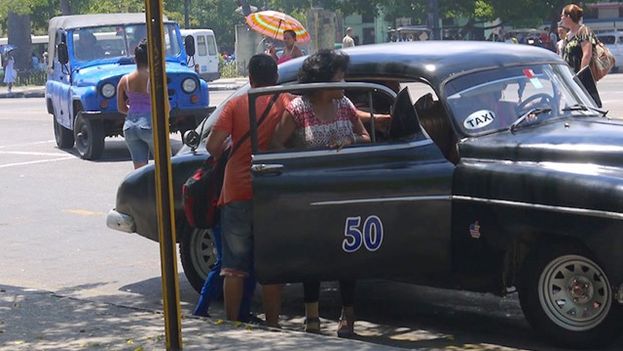
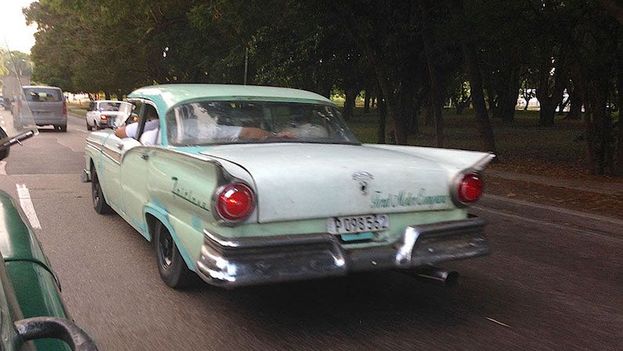
An almendrón at Fraternity Park in Havana. (14ymedio)

14ymedio bigger14ymedio, Havana, 18 June 2016 — The Directorate General of Transportation has taken a further step to freeze the fares for private transportation in Havana. Price controls take effect this coming Monday, and a phone number – 18820 – has been established for customers to denounce boteros (“boatmen” as the drivers are popularly called) who raise prices on the passengers, according to the official press.

Drivers who violate the prices agreed by the state entity will be penalized by the confiscation of their licenses to work as self-employed. A measure that has begun to raise complaints among the private drivers of passengers transport. continue reading

This Saturday, around Fraternity Park, one of the starting points of the so-called “almendrones,” opinions were being voices about the price controls. Some drovers said that they wouldn’t drive on Monday, a way to pressure the government to withdraw the measure.

“I am going to take this opportunity to do some repairs on the car and wait to see what happens with all this madness,” Luis Tamayo, driver car model popularly known as a pisi-corre (station wagon), told 14ymedio. However, the man also clarified that no agreement has been reached among those affected. “No, it’s not about a strike, but we will wait until everything calms down,” he emphasized.

The driver fears that the telephone number for complaints will be used “ to take on people who haven’t committed any violation. Anyone who has something against me, could call this command post and end by ability to make a living,” he explains.

The Provincial Director of Transportation in Havana, José Conesa González, said in a press conference, that a process of written notice to all carriers and their assistants has begun. In the document it states that prices are not to be increased higher than those “referenced as of 30 June of the current year.”

However, the drivers allege an increase in the price of fuel in the informal market, due to the cuts in the oil supply of state entities from where it is diverted to the illegal networks. The cost of a liter of fuel bought “under the table” has risen from 8 to 15 Cuban pesos (CUPs). The gas stations sell it for more (1 Cuban convertible peso, the equivalent of 24 Cuban pesos), and to few of the drivers buy it in the state service stations.

“The government has failed us all these years because it has not facilitated a wholesale price to buy oil or gasoline,” the driver a jeep who drives the route to Alamar, to the east fo the city, said on Saturday outside the capitol building.

The acting vice president of the Monitoring and Control Activity, Isabel Hamze Ruiz, said at an emergency meeting that conditions “have not changed” to justify an increase in the cost of transport and that the price of fuel is “stabilized” in the country. Nor have the fees and taxes paid by the self-employed varied, according to the official.

Customers are torn between satisfaction and alarm at the capped prices. “It will happen like it did with pork and other foods, they capped the prices and now you have to get up at the crack of dawn to get anything,” Miriam, a mother of two, complained this morning while waiting for an almendrón near the Computer Palace.

In a call to the new phone number to report drivers who violate the rules, this newspaper’s newsroom was able to confirm that it is already in service and works around the clock.

Fidel Castro, All Over the Place / Iván García

La Nacion
La Nacion

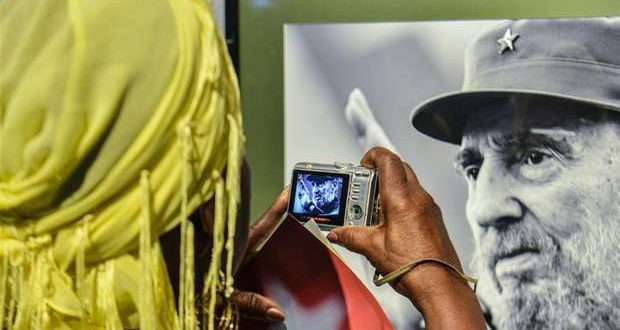
Ivan Garcia, 13 July 2016 — The bearded Castro — famous for his long speeches, sponsorship of guerrilla groups in Latin America and Africa, and utopian promises — retired for health reasons after forty-seven years in power. But like a disembodied ghost, he is apt to reappear at any moment in Cubans’ lives.

“A few days ago I was listening to a baseball game on the radio and, like a backdrop, they were playing excerpts from Fidel’s speeches between innings.” said Renato, who sells pirated DVDs in the central Havana’s Monte neighborhood. “It’s the same on TV. There’s no money in the budget for young writers but this year book publishers are going to release twenty-five works on Fidel and his life. Brother, I’m telling you, if I could, I’d fly off to the moon.” continue reading

It is a “revolutionary” offensive intended to recall and pay tribute to the “undefeated comandante.” On the shabby stage of the produce market in the Tenth of October district south of the capital a vendor, surrounded by green mangoes and holding a piece of cardboard to fan himself and keep away the flies, shouts, “Get your pineapple for eight pesos right here.” Behind him is a painting of Fidel Castro and a slogan that seems redundant: Socialism or Death.

“The billboards with sayings by Fidel, Che and Marti have become so commonplace that people don’t pay any attention to them anymore,” says the salesman. “I don’t know about the old folks, but young people don’t even remember Fidel. It’s as though he were dead. And — God forgive me for saying this — to me, he’s someone from the distant past.”

Customs become unwritten laws. For the governing communist party it is considered good form to quote Fidel Castro at the opening of a patriotic ceremony, the inauguration of a new factory or simply out of obsession.

When it comes to quotes, there is something for everyone. A la carte. His actions during the Bay of Pigs invasion are remembered, as are his accurate forecasts on the path of a hurricane or that week in the spring of 1999 when the infallible Castro coached the national baseball team — planning even the training menu — before they played against the Baltimore Orioles.

There is no shortage of his sayings on the walls of workplaces, schools or state institutions. The same man who predicted nuclear catastrophe, the end of capitalism and that Cuba would export beef and taro has returned to the scene.

It would take several volumes to categorize all of Castro’s delusions and mythomanias. We were always being sold the image of him as the most accomplished boy in the class. The one who foresaw dangers before anyone else. The smartest quarterback. The geneticist-in-chief. The outstanding basketball center. The guy who survived six-hundred CIA assassination attempts. A man for whom standards of good and evil do not apply.

Ten years after giving up power, it would seem the cult of personality crafted by the Communist Party Central Committee’s Department of Orientation and Propaganda should be diminishing. And certainly it has.

Over time those Stalinist-style slogans faded away: This is your home, Fidel; Whatever you need, Fidel, whatever you need; Commander-in-Chief, command; The Americans can’t mess with him; Cuba is lucky to have Fidel; The twentieth century’s greatest statement.

But his approaching birthday on August 13 has served as a pretext to resume and increase the frenzied propaganda, with added hints of mysticism and cheap hocus-pocus. Palo followers make sacrifices on his behalf. Santeria followers prepare new protection charms. Ñáñigos (spirit dancers), freemasons and spiritualists pray that he may live a hundred years.

The exaggerated idolatry unleashed hysterical crying and screaming at the plenary session of last May’s Communist Party Congress. It exceeded common sense when, at a conference in Bayamo entitled “I Have Nothing if I Do Not Have a Fatherland,” Reynaldo Suarez, Master of Cuban and Caribbean Studies and Doctor of Jurisprudence at Oriente University, claimed Fidel is “protected.” “His leadership is due to his ability to survive, to luck and to the orange blossom,” said Suarez. “It is beyond dialectics. He is a man with the ability to turn failures into victories, someone who was able to build the most profound and radical revolution ever known.”

It is as though we were dealing with a talented guy who enjoyed some kind esoteric protection and good fortune, as though the chosen one was declared “the heritage of the Cuban nation.”

And the commemorations continue. Conferences, discussions and cantatas dedicated to the old leader’s ninetieth birthday are scheduled until the end of the year.

More unbearable adulation. We have not yet reached North Korea’s level of lunacy. But almost.

From Diario de las Americas, July 5, 2016.


Summer 2016, Reasons Not to Leave the House / Rebeca Monzo

If you come to this neighborhood and see the filth, don’t be surprised, sometimes it’s worse!

Rebeca Monzo, 15 July 2016 — This summer is one of the hottest since 1880, according to commentators on the radio.

In addition to the punishing sun and the invasion of dust from the Sahara, in a country with almost no air conditioning, even the few hard currency stores and government offices don’t have AC and they have orders not to install it in order to save electricity, due to the terrible problems happening in the country with the supply of oil from Venezuela. continue reading

The few buses that are circulating on our streets are hugely overcrowded and “fly past” the official stops, where sweaty and disgruntled people accumulate, and where waiting an hour or more has become normal.

It is true that there is an extensive program of government-run summer recreation for kids, young people and adults, in museums and government facilities, and that all of them, indeed, are linked by government mandate to the 90th birthday of the ancient leader.

The streets are filthy, filled with potholes and sewage, the recreation facilities and movie theaters don’t have air conditioning, there is a great shortage in the supply of soft drinks, mineral water, beer, ice cream and other “goodies” in the misnamed national currency (the Cuban pesos or CUP), since most of these products, when you can find them, are sold in hard currency (Cuban convertible peso, or CUC), making them even more difficult for the majority of the population to access.

Staying home in front of the television with a fan at your side, drinking boiled water every now and then, is the other option, as long as you can watch movies and TV shows obtained on the private market [i.e. the “weekly packet“] because at least these are not “contaminated” with the repetitive and constant celebration of the 90th birthday of the “Cimarrón Mayor,” as a cultural leader recently called Fidel Castro on TV, trying perhaps to flatter him, without properly assessing the meaning of the adjective: the cimarrones were escaped slaves who abandoned their plantations and were always fleeing to hide in the mountains.

Cuban Poets: Exile, Prison and Oblivion / Luis Felipe Rojas

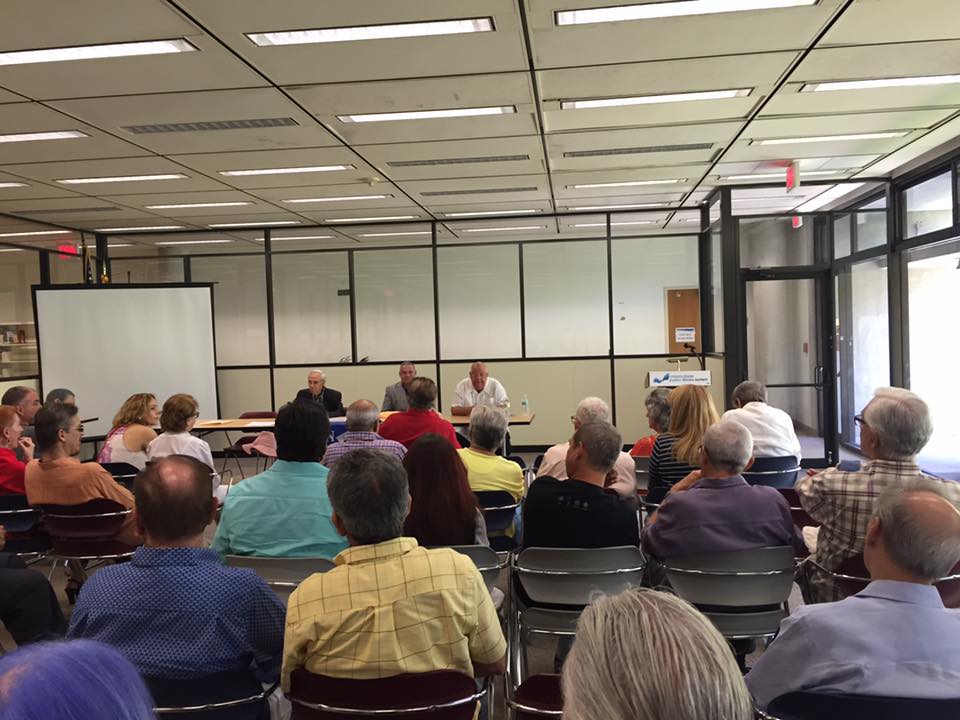
At the front, a panel composed of Ángel Cuadra, Luis De La Paz y José Abreu Felippe (left to right).

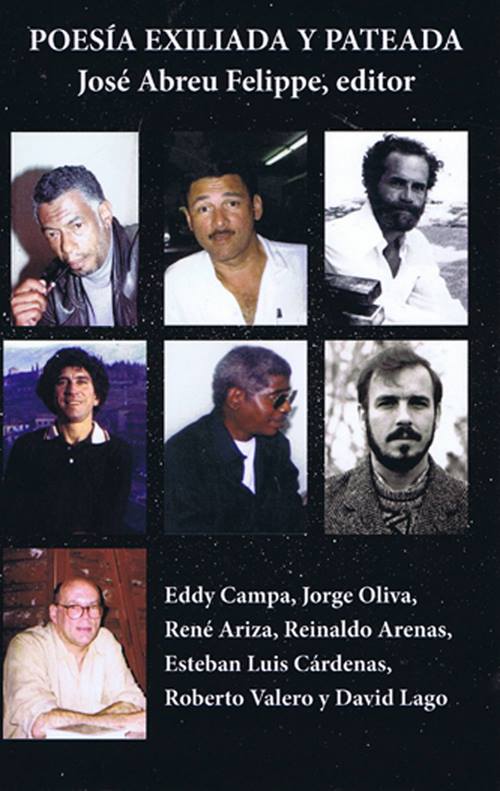
Luis Felipe Rojas, 9 July 2016 — José Abreu Felippe has become a goldsmith. He’s a guy who’s creating a city that will be lost, and he wants to change it into a jewel that we all will carry with us. Poesía exiliada y pateada (Alexandria Library, 2016) collects poems of seven Cuban writers who already have left for other worlds. They are beings with lives twisted by existence itself, and even so, they wrote in verse and kept their fingers on the trigger for generations of readers and writers to come.

They are Eddy CampaEsteban L. CárdenasRoberto ValeroReinaldo ArenasDavid LagoJorge Oliva and René Ariza. Felippe read a poem from each one in the West Dade Regional Library of Miami. There are two routes these bards took: insanity and oblivion, but in both meanings, their transfiguration of reality preserved them for us. The power that they imprinted on their verses has left them a little more beyond the popular imagery. continue reading

“What a well-made trap they have set for us / we who are the mice and the bait / the wall and the point of the sword / the funnel and its narrowest cone,” René Ariza tells us while he practices his actor’s skills, crossing toward eventual liberty or death in a sprint from the port of Mariel in 1980.

Reinaldo Arenas pierced all his narrative with lashes of poetry. Abreu affirmed it today in his presentation at the bookstore: “Rei [sic] was, above everything, a poet. A total poet. Poetry is in all his work.”

Nor is it by far the first or most complete selection of deceased poets in exile. Felippe mentioned the investigation that Felipe Lázaro has done from his headquarters of Betania in Madrid, but each brick put on this wall where we all stop to read helps… a lot.

Here many more are missing, clarifies the journalist and writer, Luis De La Paz: “….too many perhaps — among them the young suicide, Juan Francisco Pulido, and José Mario, founder of the El Puente [The Bridge] group, to mention only two — because in the background all, or almost all, poetry that has been created in exile has been birthed with pain.”

Many more are missing.

The presentation was preceded by the words of the poet and ex-Cuban political prisoner, Ángel Cuadra, President of the PEN Club of Cuban Writers in Exile, as well as by the commentary of the journalist, Luis De La Paz.

Translated by Regina Anavy
Cuban Government to Set Price Controls on Private Transport on Monday / 14ymedio

A shared fixed-route taxi, known as an "almendrón," in Havana. (14ymedio)
A shared fixed-route taxi, known as an “almendrón,” in Havana. (14ymedio)

14ymedio bigger14ymedio, Havana, 15 June 2016 — The Cuban government will apply price controls to private transport starting Monday, according to information broadcast on official television this Friday. The measure seeks to put the brakes on the rising prices of shared fixed-route taxis – the collectivos – serving various routes in Havana, due to the increase in the price of fuel which the drivers buy on the informal market.

The rates will return to the levels prior to the latest increase decreed by the drivers, who raised prices from 20 to 40 Cuban pesos (roughly from 75¢ to $1.50) on the longest trips and from 10 to 20 Cuban pesos (CUPs) on the shortest trips on the most popular routes, such as Lisa-Capitolio, Santiago de las Vegas-Fraternity Park or Virgen del Camino-Vedado. continue reading

Isabel Hanze Ruiz, acting vice president of the capital’s provincial Administrative Council, said on primetime news that the terms of the agreement made by the Council is being communicated to the drivers and compliance is mandatory.

Violation of the regulations “will be considered a very serious offense and offenders will be punished with confiscation of their license to operate privately,” the official added.

Most of the collectivo taxies, known as almendrones (after the almond-shape of the old American cars commonly used in this service), run on gas. The price at the official service stations is 1 CUC per liter (approximately 24 CUPs or roughly $4 US per gallon), but the taxi drivers primarily buy their fuel on the illegal market which is supplied by product “diverted” from State supplies.

Until the end of June, a liter of fuel on the black market cost between 5 and 8 CUPs. However, Venezuela’s economic problems and its failure to fulfill its commitments to supply oil to Cuba, has forced severe restrictions on the allocation of fuel to the state sector.

In most government run companies and institutions, delivery quotes of gasoline and oil have fallen by 30%. This decision has contributed to a reduction in the availability of fuel in the informal market, the scarcity of which has led to an increase in prices.

Some of the private taxi drivers, known as “boatmen,” have told 14ymedip that if they had to depend only on the fuel sold at state gas stations they would not be able to work, “because nobody would be able to pay the fares.”

Among the passengers who regularly use this service, there are fears that starting on Monday, 18 July, there will be a significant decrease in the number of shared fixed-route taxies on the streets of Havana.

It is not the first time this year that the government has used the policy of price caps. Some months ago, it did so in the state produce markets as well as those managed by cooperatives, which has contributed to shortages and a drop in quality of the products.

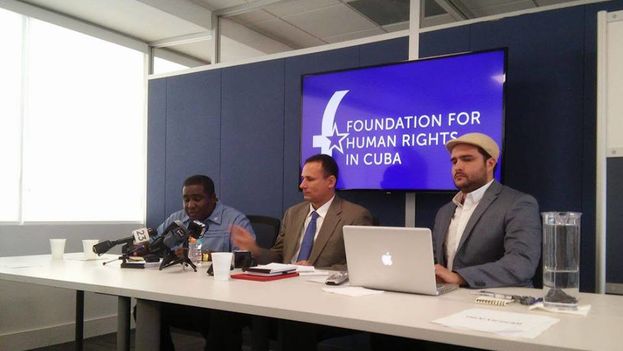
Exile Group is Creating Database Of Cuban Repressors To Share With US / EFE, 14ymedio

Presentation Thursday of the page 'Register a repressor'. (Facebook)
Presentation Thursday of the page ‘Register a repressor’. (Facebook)

14ymedio biggerEFE, 14ymedio — The Foundation for Human Rights in Cuba (FHRC) announced Tuesday in Miami the creation of a database of Cuban repressors that will be shared with governments, especially the United States.

Juan Antonio Blanco, FHRC director, told EFE that the initiative is aimed at the “Cuban repressive body” and is an opportunity for its officials to “repent in time” and to counter the rise of this violence against opponents in Cuba. continue reading

The activist said that there is an onslaught against the opposition caused both by the social and economic crisis, and by the “growing exodus,” among other factors.

The project is a way “to contribute to stopping this madness in time,” said Blanco, adding this it is not about a witch hunt or revenge.

“We do not want a truth commission in 20 or 30 years where these people are going to repent, and for what!” he said.

The project, he explained, will support an initiative undertaken by a group of lawyers in Miami, led by Wildredo Allen, that has been collecting information on these abusers for four years.

Now, this database of photos, videos, the names of the oppressors and other information will be expanded with more information through exile organizations in Miami and the opposition in Cuba, and also from individuals who want to provide evidence.

Blanco said they will only collect the information, which will be confirmed by experts in human rights from organizations such as the United Nations and the Organization of American States and many other civic groups expert in this kind of material.

The expert noted that only complaints that have been confirmed by multilateral human rights organizations because they are “credible and possible” will be entered into the database that will be shared with governments, among them the United States.

Cuba in Crisis: the Pressure is Building / Cubanet, Miriam Celaya

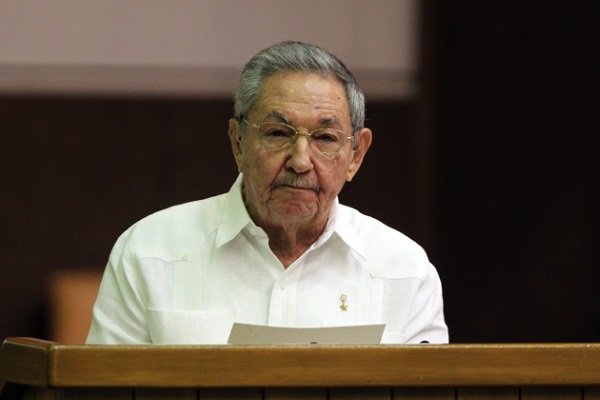
Raul Castro
Raul Castro

cubanet square logoCubanet, Miriam Celaya, Havana, 15 July 2016 — Some claim that “nothing ever happens in Cuba.” However, the signals we have been receiving of late indicate otherwise.

The price increases at the produce markets since the last quarter of 2015, accompanied by periodic (and frequent) cycles of shortages of food and other basic items in the TRDs,* accompanied by fierce raids against the self-employed – and particularly against the well-known pushcart vendors – the closing down of the only wholesale produce market in Havana, and the accumulation of problems without solutions, have been increasing the pressure inside Cuba. The most expeditious solution has been the exodus stampede, which has already turned created a crisis in some areas of South and Central America. continue reading

As if such a scenario were not enough, during the sessions of the Seventh Ordinary Period of the current legislature, the National Assembly has once again begun to thresh the usual litany of failures: lack of completion of building plans and housing repairs, aqueducts and sewage system networks, insufficient food production, the new debacle of the last sugar harvest, the insurmountable difficulties in public transportation, the drought problems, the climate’s ill turns, the chronic lack of liquidity as an essential feature of the national economy, and even the damages we are encountering because of low world prices for nickel…. and oil (!?!?).

Reports presented by ministers and other Cuban senior leaders in the ten working committees, as well as “debates” that have been taking place among deputies, are proof of the healthy and uninterrupted march towards a national debacle, under the experienced guidance Castro II.

It is a well-known fact that we are living in the midst of a disaster. What’s new is that now the dark prophecy of the impending advent of (more) difficult times is being delivered by the official spokesmen themselves, not by the ‘counter-revolutionaries’ from here and over there.

The report presented to the Economic Affairs Commission by Economy Minister Marino Murillo referred to – without much fanfare – saving measures and adjustments that have been taking place to combat what he called “a tense liquidity situation.” He noted that the expected revenue in the economic plan did not materialize for this period, and that it is unlikely that the well-heralded 2% GDP growth will take place by year-end 2016.

As usual, such “predictions” are not only made when the national drama is in full swing, but they are not accompanied by a package of solutions. Instead, the “measures” of the highest echelons of power to alleviate the crisis had preceded the omen. For several weeks they have been cutting working hours, transportation service for workers, “subsidized gasoline” and other perks, such as lunches or snacks – in the few centers that belong to “strategic sectors” the state still has – of the workplaces of the capital.

Air-conditioning service is being reduced at the TRDs, from 2 PM until closing. They have also started to increase the blackout periods in different areas of Havana.

The new savings plan includes the elimination, starting the week of July 11th, of night shifts in several orthodontic offices, including at the Orthodontic School.

Shortages in oil and regular gasoline at the gas stations (Cupet), where they are sold, is another factor being felt in the transportation systems, both state-owned and among private carriers. Assignations to the state fleet have been dramatically limited – including those intended for the transportation of goods from warehouses to the TRDs, thus aggravating the shortages – while the private service has been decreased, suggesting an upcoming transportation price hike.

Almost simultaneously, meetings have been held with the militants of numerous Cuban Communist Party (PCC) base organizations to alert them to the need for increased vigilance and support for the institutions responsible for maintaining order, and also to be ready to counter manifestations of violence, increased corruption and other criminal activities characteristic of crisis situations.

The communist base is being warned about the importance of being vigilant against any outbreak of discontent that could lead to an anti-government revolt likely to be exploited by the enemies of the Revolution. Everything indicates that what is worrying the power elite is not exactly “what’s going on” but what might happen in the short term.

And since – in direct line with the worsening crisis choking the lives of Cubans – discontent is what continues to grow most in the country right now, and militants can’t rest in their mission to safeguard the interests of olive-green caste.

Meanwhile, in the interior of the island frustration increases and the migratory stampede continues to assume cyclopean dimensions. With the capital of the masses’ faith drained to the dregs, power will be forced to multiply its spending to sustain the formidable repressive forces needed to repress an entire people, a task that will not be as easy as beating, arresting and imprisoning peaceful dissidents.

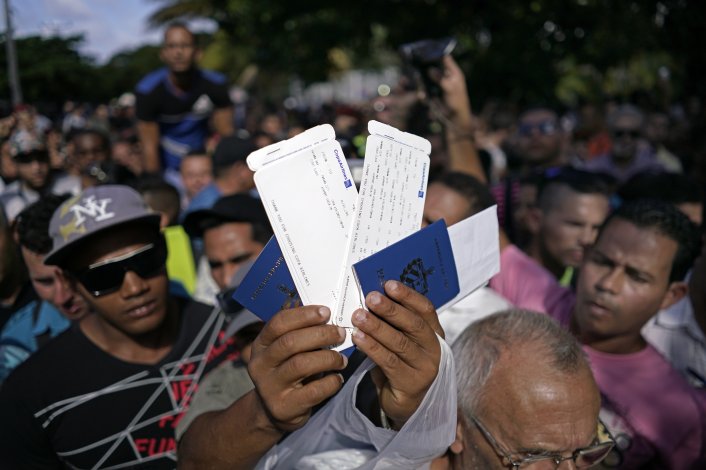
In the interior of the island frustration in creases and the migratory stampede continues to take cyclopean dimensions (photo: AP)

Paradoxically, the government’s stubbornness and political clumsiness impel the outcome it is seeking to avoid. An insistence on trying to lead the nation as if it were an army in the full campaign of war, rather than promoting a broad and deep economic opening that cleanses the domestic economy, allows the development of the potential of the private sector, and gives a break the national anoxia, shows the meanness of a caste that prefers the sacrifice of an entire people before losing power.

To accentuate the absurd, the leaders of the Palace of the Revolution have the effrontery to launch this new report of forced austerity at the same time they are debating strategies and the government’s economic plans out to the year 2030. No moderately reasonable government would announce a period of energy cuts and other unpopular measures while running a public consultation of such importance. Undoubtedly, the General-President and his claque rely excessively on the powerful social control they have exercised so far, and the gentleness of a people who have forgotten how to assert their rights.

However, although no one doubts that Cuba is navigating toward a major disaster, one cannot rely too heavily on the accuracy of official reports. Especially if there is no access by citizens and independent institutions to primary sources or macroeconomic data, which remain the secret patrimony of the State-Party-Government and its most faithful servants. This means statistical figures are not reliable even when they are unfavorable to the country’s leadership.

We can’t forget that just days before the gloomy reports of the National Assembly, official media reported optimistically the increasing numbers of foreign visitors who are bringing hard currency in the tourism industry, and rubbed their hands with glee over the numerous signings of technology exchange agreements and declarations of intent from foreign investors.

For this reason, and without denying the great influence of the Venezuelan situation on the Cuban economy – which has a profound impact on a country as dependent on aid and subsidies as is Cuba – it cannot be affirmed with a scientific certainty how much of a real urgency there is in the “complex scenario” of the island’s economy, and the political blackmail maneuvers by the Castro regime’s highest levels of power, intended to pressure the United States government, and it congress and political forces for a final lifting of the embargo, which would allow the dictatorship quick and direct access to credits, a flood of foreign investments and a flow of hard currency that would guarantee its permanence in power.

Thus, to magnify the effect of the virtual collapse of Chavismo in Venezuela and that country’s economic crisis as the main source of the current Cuban crisis is to place (once again) the causes of Cuba’s problems beyond its frontiers, when in reality the key to all our ills is found in the inefficiency of an elite of cunning bandits who have hijacked lives and property, looting the nation at will for decades.

Because with or without Venezuela – as before with or without the Soviet Union, with or without the “Socialist Camp,” with or without foreign investors – the truth is that the Castros have done more damage to Cuba than all the epidemics and wars this nation has faced throughout its history, and will continue to be a hindrance for all Cubans regardless of who remains in the seat of power.

This summer, then, promises to be very hot and not because of the greenhouse effect. The compasses of tens of thousands of Cuban continue pointing to the promising north and the stampede from the island is expected to once again take the maritime route. If this is the General-President’s strategy to ease the internal pressure and achieve his interests in perpetuity, he should know it is a risky game and could be counterproductive for everyone, especially for those who have more to lose.

At this point, we could rewrite as its inverse that bombastic phrase of a certain chimeric allegation, which could well serve as an epithet on the tomb of Castroism: “Absolve them. It doesn’t matter. History will condemn them.”**

Translator’s notes:

*”TRD” is the acronym for the official name (in Spanish) of these government stores which does not even attempt to hide their intended function: Hard Currency Collection Stores.

**Fidel Castro concluded his four-hour speech in his own defense at his trial for his leadership of the 1953 attack on the Moncada Barracks with the words: “Condemn me. It does not matter. History will absolve me.”

Translated by Norma Whiting

Marino Murillo Leaves His Ministry To Devote Himself To The Management Of Cuba’s Economic Crisis / EFE, 14ymedio

Mariano Murillo, former Minister of Economy and Planning in Cuba. (EFE)

14ymedio biggerEFE/14ymedio, Havana, 14 July 2016 – Cuba’s Council of State, at the request of president Raul Castro, has named Ricardo Cabrisas minister of the economy, replacing Marino Murillo, who remains a vice president and will chair a commission in charge of reforms to update the country’s economic model.

The change was announced Wednesday in an official note published in the official media, where it was also reported that the Minister of Higher Education, Rodolfo Alarcon, has been replaced by the department’s vice minister, Jose Saborido. continue reading

In the case of the Minister of Economy and Planning, the change reflects the need for Marino Murillo – considered Cuba’s “czar of reforms – to concentrate his efforts in the related tasks of updating the Cuban economic and social model,” according to the official note.

Cabrisas, his replacement in the Ministry of Economy and also a vice president, “has vast experience and training demonstrated in the exercise of responsibilities” in the Executive “and in undertaking important missions, including the recent process of successfully managing the restructuring of Cuba’s external debt,” the statement added.

The State Council recognized “the work done by compañero Murillo in fulfilling the duties of the office of minister” of Economy.

These changes occurred after Raul Castro’s recognition on July 8 before the National Assembly that the Cuban economy is experiencing “stress” and “adverse circumstances” caused, among other factors, by the crisis in Venezuela. The island’s main ally, Venezuela has reduced oil shipments to the island.

After rejecting speculation about the “imminent economic collapse” of the island, President Raul Castro announced at the session a plan of measures to confront the situation, which requires savings, reductions in expenses and energy use restrictions.

In the Ministry of Higher Education the new head will be Jose Saborido, who has been deputy minister for four years.

Saborido holds a PhD in Economics and until moving to the ministry held positions in education as an instructor, professor, dean, vice chancellor and provost.

In this case, the Council of State did not specify in its official note the reasons for replacing outgoing minister Rodolfo Alarcon, but recognized his “meritorious career. ” Alarcon had served in the position since 2012 and previously had served for two decades as vice minister.

The Magic Number / Fernando Dámaso

Fidel Castro will turn 90 in August.

Fernando Dámaso, 1 July 2016 — In 2016, the number “90” has taken on a major importance for Cuba’s government authorities. The unleashed hysteria of the cult of personality means that, since December of 2015 government agencies and institutions have been ordered to “dedicate absolutely all their actions” to this magic number, which represents the age that the “ancient Maximum Leader” will reach in August.

Never before in History as the celebration of such an anniversary been extended for such a length of time, an original of “socialism a la Cuba” which, certainly, should be entered into the Guinness Book of Records. continue reading

In honor of “90” forest workers have planted ninety ceders, the National Archive has organized an exhibition of “Ninety Images from a Life,” the “Art on La Rampa” Fair is dedicated to those 90 years and shows “Soldier of Ideas,” the Young Communist Union has “90 reasons to dream,” commemorating them is the main task of the unions, singers dedicated 90 songs to them, musicians ninety guitars, librarians ninety books, kids ninety smiles, old people 90 claps, and so on to total boredom.

Imbued with such a “national celebration” I suggest that, for the rest of the year, the Ministry of Public Health proposes to reach 90 cases of Zika, the National Commission on Viability and Traffic 90 car crashes, the Ministry of Agriculture’s Harvest Collection stop collecting 90 tons a month of harvested tubers, the National Hydraulic Institute ensure 90 leaks in every aqueduct, the Municipal People’s Power Administration maintain 90 active potholes, the Electric Company produce 90 blackouts in the City of Havana, and we have no less than 90 monthly building collapses.

There could be many more initiatives, the “importance” of the date merits them. Those who ordered this demented commemoration forgot that, in advertising, when the “message” saturates the receptor, it has the opposite effect. This is what is happening.

Domain Names and an Internet Debate / Regina Coyula

Regina Coyula, 30 June 2016 — For Cubans who update their home entertainment weekly with the now famous, private and anonymous Paquete (Weekly Packet), they are familiar with a subtitle in bright, greenish-yellow letters at the beginning of the movies. This inevitable “http://www.gnula.nu” which comes up so much, piqued my curiosity. It was impossible for me to recognize the country that corresponded to that extension, so I resorted to the always-useful Wikipedia.

Surprise. The country of the pirated movie site that we see at home is Niue, an atoll with airs of a small island, assigned to New Zealand. In 1996, a North American (who doesn’t live in Niue, of course) claimed rights to “.nu” and, in 2003, founded the Internet Society of Niue, which allowed the local authorities to convert the quasi-island into the first wi-fi nation of the world. They supplemented the offer with a free computer for every child. Nothing spectacular; we’re talking about a population of barely 1,300 inhabitants. continue reading

The irony is that the .nu domain generated enormous income, while the inhabitants of Niue not only didn’t enjoy those gains, but also wanted to be connected from their homes and not from the only cyber-café on the island, and they had to pay for the installation and the service.

I also discovered another curiosity. The second extension that is most used on the Internet after .com corresponds to another little place in a corner of the Pacific that few know about, a group of little islands barely 11 square kilometers in size. Tokelau is the name of the place whose domain .tk hatched in 2009, upon offering itself for free. Today it’s the virtual home of hundreds of thousands of websites of doubtful integrity, although, contrary to Niue, the administrative earnings of the island’s government have benefited the infrastructure and services.

The form in which the geographic domains are managed on a higher level (ccTLD) is very different. The Internet Corporation for the Assignment of Names and Numbers (ICANN) has left it to the discretion of each country to do what it likes. Many countries keep them privatized, although in the hands of institutions or businesses created for that purpose, while in others it’s an entity attached to a state agency.

The ccTLDs (country code top-level domains, geographic domains of a higher level, which, for better understanding, is the name that the extensions receive that identify each country or geographic region: .cu for Cuba, .ru for Russia, .mx for Mexico, etc.) are even more curious.

Both forms of operating the ccTLDs described above have advantages and disadvantages. Deregulating the extensions shifts the balance toward the higher-profit businesses to the detriment of agencies, NGOs and institutions with social and cultural goals. This diminishes the influence of the governments, which can have a negative effect on the sovereignty of countries that are economically fragile, or on young or small countries.

State-regulated administration tends to protect social and cultural interests, and successful management can increase earnings, which has a positive impact on national life. It also happens that governmental norms for buying a ccTLD can be restrictive or discriminatory, protected by a deliberatively vague regulation to be applied at the discretion of the government.

In the Latin American environment, Argentina, the only country to offer its site for free and with millions of websites with the extension .ar, decided in 2014 to charge for them. In Chile and Nicaragua, administration is through the public universities. In Guatemala, it is also through a university, but a private one.

In Uruguay, regulation is by the State through the National Association of Telecommunications (ANTEL); in Venezuela by the National Commission on Telecommunications (Conatel); and in Cuba through the Enterprise of Information Technology and Advanced Telematic Services (CITMATEL).

Colombia reflects a debate similar to what is happening in other countries. A private enterprise manages its ccTLD, and 89 percent of the owners of the .co site are foreigners located outside the country which, far from violating the national identity, internationalizes Colombia and carries its trade name to the entire world. What underlies these debates is the idea that the market is imposing itself on cultural values, and national governments can do little in defense of their intangible patrimony.

But in short, who governs the Internet?

Any recently-arrived observer would say that the United States governs it. The institutions and most of the servers destined to organize what would otherwise be chaos are located in its territory. And the well-known ICANN, located in California, which assigns domain names (DNS) to the IP addresses, has a contract with the Government.

Businesses that have a lot of influence on the Internet, like Microsoft, Google or Amazon, are also in the United States. But this concept is changing: It is expected that in September, the process of transition for the custody of IANA, the authority for the assignment of domain names, will no longer be under the U.S. Secretary of Commerce, in order to give ICANN authority and independence.

Other parties that also participate in the Internet have interests opposed to this current asymmetrical influence. International organizations like the Commerce of Intellectual Property (OIC) or the International Union of Communications have been incorporating together with ICANN. Virtual space is modifying the notion of sovereignty, with the added danger for equality and diversity, so that the term “governance” is important in the designing of policies, where governments, civil society, businesses, academics and technical innovators merge.

In the same way in which the technical innovators have guaranteed open access to the Internet from any type of device, it is up to the governance to establish policies, even when they aren’t binding, to guarantee freedom of expression and information, full access to the Internet and limited control.

Translated by Regina Anavy
“The Tentacles of Castroism Are Long” / 14ymedio, Mario Penton

Efrain Sanchez Mateo refuses to abandon his countrymen, whom he calls brothers. (14ymedio)

14ymedio bigger14ymedio, Mario Penton, Miami, 13 July 2016 — Desolate, but firm and willing to continue fighting for Cubans, whom he calls “my brothers.” Thus, Efrain Sanchez Mateo defines himself after serving a sentence of five days in jail for allegedly assaulting a police officer during the eviction of Cuban migrants camped at El Arbolito Park in Quito, Ecuador.

“That was something they were planning for a long time, but they didn’t have the courage to do it. The turning point was our protest outside the Cuban consulate in Quito,” explained Sanchez Mateo. The unprecedented march in which hundreds of migrants repudiated the statement from the embassy accusing them of trying to score points to get political asylum “frightened the regime,” added the Cuban. continue reading

“How long are we going to continue supporting the Association of Cuban Resident in Ecuador (ACURE)? How long will we continue supporting the lies of an embassy that doesn’t represent us?” he says in a reference to the accusation of the pro-Castro association that accuses them of receiving money from abroad and “serving the interests of Miami.”

“If this inhumane action and violation of human rights committed by the Ecuadorian government in collusion with Cuban State Security has made something clear, it is that nobody has sustained and supported us from the outside,” he argues.

Mateo, a coordinator of Cuban migrants, says the presence of the Mambi or “Freedom” encampment, as he called their tents in the Quito park, had authorization from the police and the Ministry of Social Inclusion and they have evidence to prove it.

“We had been promised they would not intervene. We had an organization and lived in solidarity with other Cuban brothers and many who are still there, having no place to sleep, went to work and carried on the cause,” he comments.

Ecuador’s Vice Minister of the Interior, Diego Fuentes, told the press that it wasn’t exclusively about the Cubans, but “of migratory control that affects all citizens and all nationalities.” The official also explained that these controls sustain “a regular and responsible migratory flow” that will avoid the “abuse” of Ecuador’s image of universal citizenship and open doors, something that Mateo agrees with.

“The night the camp was evacuated, the police followed the same modus operandi as they used the first time when they evacuated the migrants from the around the Mexican embassy,” he explained. “They came at midnight and about two in the morning a large group of police and anti-riot troops evacuated the place. However, this time they used migration control as a pretext, so it could not be called an eviction, but it’s clear that the motive was xenophobia against Cubans,” he says.

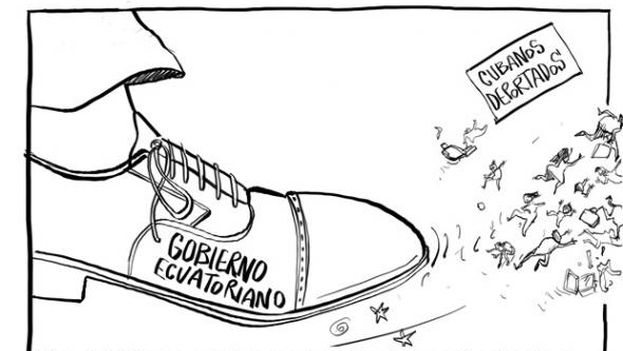
Caricature by Bonil, El Universo, 11 July.

“We men try to protect the women. We are beaten and threatened. Cuban State Security agents in plainclothes in among the Ecuadorian police tried to catch me. Every day I receive threats toward me and my family, because they believe it will make me abandon my brothers. I regret what happened, but I will not do that, neither those in Cuba nor those here,” he says.

Efrain Sanchez Mateo regrets that the Cuban community abroad has not shown their support for respect for the rights of their compatriots in Ecuador. “We have been beaten, our rights have been violated, we are trying to escape communism and they have left us on our own,” he laments.

“I call on the internal opposition in Cuba and those who fight for their freedom from exile. Do not leave the 75 Cubans who were deported to the island on their own. Do not let them fall back into the clutches of the government,” says Mateo says he is in contact with several of those who have been repatriated and has urged them to continue what they started in Ecuador.

At 3:30 am on Wednesday morning, a judge responsible for procedural rights and guarantees rejected the habeas corpus petition for 47 of the 48 Cubans being held at the Hotel Carrion. Yesterday afternoon a group of Ecuadorian and Cuban protestors demonstrated their support for the migrants with protest actions in front of the court. On Monday morning, Ecuador completed the second transfer of Cubans to their country of origin, bringing the number of those repatriated to 75.

“The Cubans in Ecuador could not possibly show more courage. We did everything possible, but the tentacles of Castroism are long,” he adds.

“They are afraid of us” / 14ymedio Reinaldo Escobar

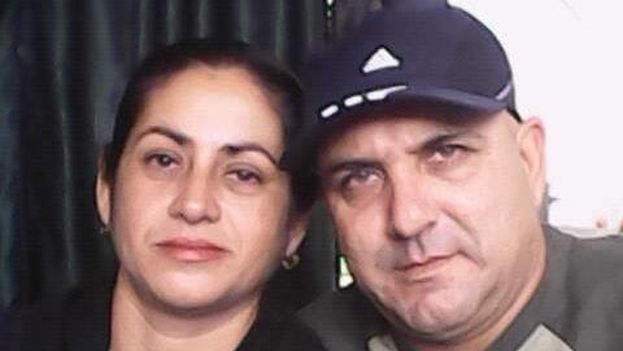
Armando Avila and his wife, Yurisleisy Pérez Calzada. (Facebook)

14ymedio bigger14ymedio, Reinaldo Escobar, Havana, 13 July 2016 — Before leaving Cuba, Armando Avila was an auto mechanic specializing in brake systems in Ciego de Avila. In December 2015, he took a flight to Ecuador with the intention of reaching the border between Mexico and the United States to invoke the Cuban Adjustment Act. On July 9 he was returned to Havana by force, in a group of 29 Cubans deported by Rafael Correa’s government.

Avila, 45, spoke with 14ymedio by telephone on Monday and said he did not feel like a deportee or a returnee, “but someone kidnapped.” The migrant, who wanted to keep his current whereabouts unknown, recalled that “the laws of Ecuador consider that no one is illegal and they can only deport those who have committed a crime.” continue reading

One day after the deportation of Avila, a new group of 46 Cubans, also repatriated from Ecuador, arrived on the island. Island authorities claimed in a note that the deportations were carried out “in strict compliance with the provisions of the legislation of both countries and existing international standards for this type of situation.”

However, Avila maintains that he had presented his case “before a legal hearing and less than one day before learning of the outcome” he was arrested. “At 2:40 in the morning they took all our belongings, I was handcuffed and put into a military plane that took us from Quito to the province of Esmeralda and from there to Cuba,” he explains.

A few hours after arriving in Havana he learned that he was acquitted at the hearing, which means that there were no “grounds for deportation,” he insists. Thus, he considers himself to have been a victim of revenge or a “policy violation,” motivated by his having exposed, in Ecuador, “the reality we experience in Cuba.”

Avila returned to Havana, despite the official press note saying that “all” of the people were taken to their “home provinces.” However, his wife, Yurisleisy Pérez Calzada, was not deported and remains in Ecuador.

Avila says he fears for his life. “Upon arrival at Jose Marti International Airport in Havana, waiting for us was a squad of riot police, several police officers and a large number of senior officers of the Interior Ministry.”

He said that the group was treated as if its members were “terrorists.” “They divided us by provinces and we were told to wait, that later we would be contacted to determine our situation,” he says.

On Monday, the defense lawyers for the Cuban migrants in Ecuador denounced the violation of a habeas corpus petition that had been submitted to avoid repatriation. The lawyers have questioned the constitutionality of the measure, because since 2008 Ecuador’s Constitution has recognized “free human mobility.”

A complaint about possible violations of the law join the accusations against the Ecuadorian police for acting violently against Cubans being held in the Hotel Carrion detention center and the Flagrancia Unit.

Avila intends, this Monday, to begin procedures at the United States Embassy to “ask for political asylum,” feeling that he has “no other option” and fearful of reprisals. “I’m afraid, because I realize that they are afraid of us.”

Minister Abelito’s Second Go-Round / 14ymedio, Ernesto Santana

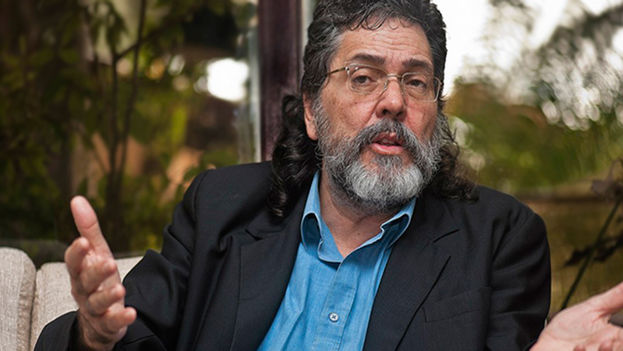
Abel Prieto returns to the post of Minister of Culture. (EFE)

14ymedio bigger14ymedio, Ernesto Santana, Havana, 11 July 2016 — At the end of his first stint as Minister of Culture (1997-2012), comments were frequently heard about Abel Prieto’s desire to leave the job. The most practical said it was due to illness, the most romantic claimed he wanted to devote himself to writing.

Now comes his second stint, and although he holds the job “provisionally,” many artists and intellectuals are already pleased because, to them, Abelito is a good person and they prefer a minister from the profession versus a simple political cadre.

Others, free from these superstitions, consider Prieto more dangerous than Armando Hart and Julian Gonzalez put together, given the great energy and fangs he demonstrated last year in command of the “rapid response brigade” – self-proclaimed as “the real Cuban civil society” – that stormed the Summit of the Americas in Panama to block the peaceful participation of the “anti-Cuban mercenaries.” continue reading

This advisor to Raul Castro has devoted himself in recent years to emphatically warning us about the advances of bad taste, the sexism of the barracks, the lack of ideas and other trashy behaviors, defining them as cultural dangers against our identity and our nation, emanating, of course, from the capitalist hell.

The announcement that Julian Gonzales was “released from the job” was made on Friday the 8th at the end of the Second Plenum of the Cuban Communist Party Central Committee, before the plenary session of the National Assembly of People’s Power. Not only was no reason given for such a sudden “release” but not time was taken to do anything more than designate Prieto as provisional minister, with the official media not mentioning the issue since then.

Prieto returns to the franchise that made him a superstar in the Revolution’s show business, but between the two stints he has been a player in significant media performances, like that of the Panama skirmish, with declarations that, if not for his desperate shamelessness, would seem like drunken jokes in game of dominos or crazy antics in the street. For example, he claimed that the Cuban government cannot legalize opposition organizations for the same reason that “Al Qaeda could not be legally registered as an association,” because, in fact, if opposition members weren’t Cubans, “they would be in cages in Guantanamo.”

He also appeared in the recent forum Culture and Nation: the Mystery of Cuba, a miniseries hastily made to counteract the enthusiasm left by the assault – brazenly starring himself – of the US president, and called for a house-by-house fumigation. The “Mystery of Obama” made clear the obsolescence of the Castro catechism, the uselessness of half a century’s anti-Yankee screaming and the poor market for the package of stories about the bogeyman who steals children.

Alarms sounded. Hysteria ensued. Abel Prieto talked about the “cultural and symbolic war,” about the problem of telling the story in “a world where entertainment, pleasure, fragmentation, amnesia, the worship of now, have been turned into pillars of the cultural hegemony industry,” while erecting the cross of “efficient socialism, de-bureaucratized, democratic, that we are creating” (sic).

We imagine his concern as a democratic socialist on talking with people about “open communication with the United States” and finding “innocence, excessive optimism, forgetfulness, childish and uncritical admiration by the superpower and, in some cases, uncontrollable desires to abandon their principles to surrender themselves to arms of Satan.”

Thus, we must put an end to the fallacy that associates “Yankee” with “modern” and with “development,” because “this Yankeephilia idealization is one of the tendencies we must confront in the war of ideas and values that must be fought.”

In the forum mentioned above, Abel Prieto proposed students be ‘vaccinated’ not with Soviet cartoons or Randy Alonso, but as tourist guides with Yankee trash like Oliver Stone and Michael Moore. Also House of Cards would serve as an antidote. And South Park should also be included. And it’s too bad that Noam Chomsky has not made entertaining tapes of his unsurpassed diatribes against his own country.

As for the inevitable “academic exchange with the United States” we have to swallow the mix of “very clear principles” in order to “avoid the glare and small-town positions.” Prieto also warned about the attempt to “foment an enemy fifth column of a new kind, with well-designed and conceived digital publications, social-democratic or ‘centrist’ ornamentation and verbiage full of euphemisms,” all this financed from abroad “in the face of the discredited traditional counterrevolution.”

Although he had to recognize that the new technologies are not to blame, he again hammered home that they serve “as a conduit and catalyst for the avalanche of disintegrating forces,” ones that deny the role of governmental institutions without which “the cultural environment would become a jungle and mediocrity would gain an irreversible preponderance.”

Referring to young people – those who launch themselves on the sea, or go to prison or to the purgatory of the streets – Prieto wants to make us believe, in all seriousness, that we must “feel and live the Revolution in all its historic journey, with passion and depth, and at the same time feeling and living and defending its continuity as the only guarantee of having a country, of having dignity.”

As the press note on the “release” of Julian Gonzalez Toledo contained no more information than the traditional tagline that he has been “assigned other tasks,” the traditional range of speculation immediately arose, including the idea of a supposed campaign to deprive first vice-president Miguel Diaz-Canel of the cronies who support his clinging to power.

There is another speculation that could have a certain logic. When Julian Gonzalez replaced then Minister of Culture Rafael Bernal Alemany in 2014, it transpired that the latter was ousted because of the outrageous theft of hundreds of pieces of art from the Museo de Bellas Artes, some of which later appeared in Miami. Now, although Gonzalez Toledo is considered “a hard-working and honest functionary,” his superiors are not content with his “lack of leadership,” mentioning again the specter of corruption.

Moreover, there are those who relate this fall to several money scandals featuring the president of the Cuban Music Institute, Orlando Vistel, and other predators of the cultural jungle. But, naturally, there is no official statement that clarifies the matter and reports on it as they should, because making the truth known continues to be seen as giving arms to the enemy.

We Cubans only need the scrapings from Abel Prieto’s brain, as he calls us to “build a digital socialism,” as he reminds us that “the main force for democratization of the new technologies in Cuba, and I believe in the world, is Fidel,” while warning that the market is a “much more terrible [censor] than the worst that existed in the time of Stalin.”

If second acts are never a good thing, in this case the first one wasn’t either. This second stint, however brief it might be and whether we like it or not, comes to save us from Uncle Sam’s cultural poison. Meanwhile, the local chupatintas (pencil-pushers) will continue to protect us from the tropical chupi chupi, from the national vulgarity and the empire’s chupacabras – that mythic animal that wants to suck our blood.

See also:

Abel Prieto Attacks The “Packet” and “Technological Nomadism” / 14ymedio, Rosa Lopez

Abel Prieto’s Travels / Orlando Luis Pardo Lazo

So Long Minister of Culture Abel Prieto / Yoani Sánchez

El Chupi Chupi and the Dilemma of Limits / Yoani Sánchez

Vulgarity as a Resource (I) / Miriam Celaya

Vulgarity as a Resource (II) / Miriam Celaya

Guilty of Singing El Chupi Chupi / Ernesto Morales Licea