
Chronology: Ten Years Without Fidel Castro / 14ymedio

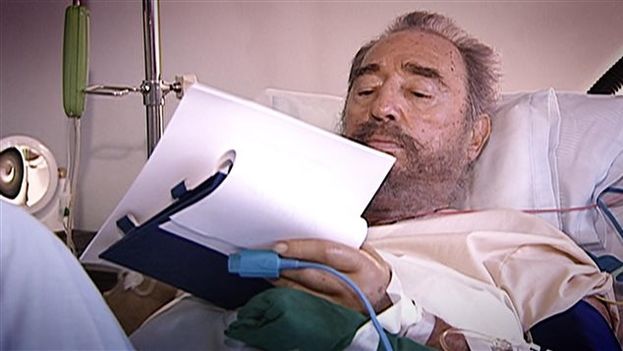
Fidel Castro signed his provisional resignation in July 2006 (Roberto Chile / Radio-Canada)

14ymedio bigger14ymedio, Havana, 31 July 2016 – Since the proclamation in which Fidel Castro temporarily delegated power on 31 July 2006, the former president has met with two popes, has received visits several European, Asian and Latin American leaders and has written hundreds of articles under the title “Reflections.”

However, his role in the daily lives of Cubans has diminished and in the political sphere control has been consolidated under the control exercised by his brother Raul Castro. To develop a chronology of these ten years is a risky and difficult task, because at the end of the day it is a portrait of the end of this era that carries the name “Fidelismo.”

2006

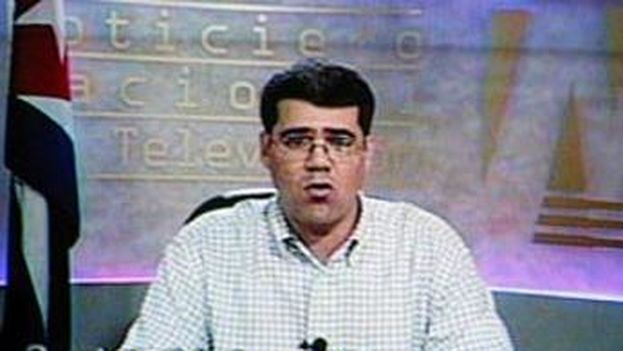
July 31: Carlos Valenciaga, member of the Council of State, read on television Fidel Castro’s proclamation provisionally delegating his responsibilities to his brother Raul and also close collaborators.

Aug. 1: The first stage of Operation Caguairán begins, with extensive military mobilization throughout the country, including the deployment of tens of thousands of active troops and reservists.

August 13: No official celebrations are held for the 80th birthday of Fidel Castro. continue reading

August 14: TV shows a video of Fidel Castro convalescing in bed while being visited by Hugo Chavez.

September 16: Fidel Castro is elected as President of the Non-Aligned Movement during its XIV Summit in Havana, despite not having been present at the meeting.

December 2: Celebrations for the 50th anniversary of the landing of the yacht Granma are held, but the tributes for the 80th birthday of Fidel Castro announced in the proclamation do not happen.

December 26: The first details on Fidel Castro’s condition are released, when the Spanish doctor Jose Luis Garcia Sabrido, head of surgery at Gregorio Maranon hospital, reveals in Madrid that he is recovering and that does not have cancer.

2007

March 28: The first of the Reflections of Fidel Castro, which continue to appear periodically in the official press, is published. The first article speaks against ethanol production from corn.

24 May: Fidel Castro breaks his silence about his health and says in a Reflection that what happened “was not just one operation but several. Initially it was not successful, and this implied a prolonged recovery.”

May 25: Fidel Castro, “will live to be 140,” said Cuban physician Eugenio Selman, who for years was part of the medical team caring for the rulers.

June 5: Cuban television broadcast an interview of Fidel Castro with journalist Randy Alonso, the first since the reading of his Proclamation temporarily ceding power.

2008

February 19: Fidel Castro announced in a text published in the Granma newspaper that ne will not accept or does he aspire to the positions of “Chairman of the State Council and Commander in Chief” and clarifies that these responsibilities require “total mobility and dedication” and he is not “in a physical position to offer it.”

24 February: Raul Castro is elected president of the Council of State State Council and as first vice president he appoints Jose Ramon Machado Ventura, a figure of the “old guard” instead of the younger Carlos Lage.

April 28: Raul Castro announces that the postponed Sixth Congress of the Cuban Communist Party will be held, and he commutes most death sentences to 30 years or life in prison. Because of delays, the Congress does not take place until April 16, 2011.

2009

March 2: Raul Castro dismisses Foreign Minister Felipe Perez Roque, and the secretary of the Executive Committee of the Council of Ministers, Carlos Lage Davila, in what many analysts characterize as a purge against “Fidel’s men.” Also dismissed are Fernando Remirez de Estenoz, head of International Relations for the Cuban Communist Party, Otto Rivero, vice president of the Council of Ministers and Carlos Valenciaga, chief of staff to Fidel Castro and the man who read Fidel Castro’s Proclamation temporarily ceding power.

March 3: Fidel Castro publishes a Reflection where he accuses Perez Roque and Lage and says that “The honey of power, for which they made no sacrifice, awoke ambitions in them that led them to an unworthy role.”

December 20: Raul Castro detailed at the National Assembly during the year that 126,000 boarders of pre-university education has been moved to cities and work was underway to move another 80,000, realizing one of the key educational goals of Fidel Castro.

2010

February 23: The political prisoner Orlando Zapata Tamayo dies after 86 days on hunger strike. Activists protest throughout the country and the government unleashes a strong crackdown.

February 24: Regime opponent Guillermo Fariñas begins a hunger strike that will last for 135 days to demand the release of political prisoners.

May 19: A meeting is held between President Raul Castro and the principal Cuban Catholic authorities: Archbishop of Havana Cardinal Jaime Ortega, and Secretary of the Conference of Catholic Bishops of Cuba, Dionisio García. Cardinal Ortega confirms that the situation of political prisoners is being addressed “very seriously” with the government.

March 16: The Ladies in White initiate several protest marches in Havana on the seventh anniversary of the conviction and imprisonment of their families. They are harshly repressed.

June 11: The Government informs the Catholic Church of the imminent release from prison for health reasons of dissident Ariel Sigler and the new transfer of six prisoners to prisons in their home provinces.

June 27: In his Reflections Fidel Castro predicts an imminent war and warns that “a catastrophe” is “rapidly” approaching and could even happen before the quarterfinals of the Football World Cup in South Africa.

July 7: The church reports in a statement the agreement between the Cuban government, the Church and representatives of the Spanish government to free the 52 prisoners of the Black Spring within a period of “three to four months.”

July 7: The first public appearance of Fidel Castro since the announcement of his convalescence, in a visit to the National Center for Scientific Research (CNIC).

July 8: Regime opponent Guillermo Farinas ends his hunger strike.

August 7: Fidel Castro addresses the National Assembly and says that “the current order established on the planet can not endure, and inevitably will collapse immediately.”

2011

April 19: Fidel Castro participates in the closing day of the Sixth Congress of the Cuban Communist Party, with his brother, who relieved him as first secretary of the party organization.

September 21: The Official Gazette publishes Decree Law 286 subordinating the Social Workers Program to the the Ministry of Labor and Social Security, giving the final blow to one of the last programs undertaken by Fidel Castro.

October 1: Enter the decree law that allows the purchase and sale of cars, one of the most anticipated action by the Cuban population and whose postponement was awarded to the express will of Fidel Castro in force.

November 10: Buying and selling homes is authorized another very missed by the Cubans and whose approval measure was unthinkable during the government of Fidel Castro.

December 23: The government of Raul Castro announces the pardon of more than 2,900 prisoners.

2012

March 28: Pope Benedict XVI meets with Fidel Castro and his family at the Nunciature of Havana during the pope’s visit to Cuba. Castro seizes the moment to ask the Bishop of Rome “What does a pope do, what is your mission?”

2013

14 January: Travel and immigration rules take effect relaxing requirements and eliminating the “exit permit” also know as the “white card.” The flexibility will allow dozens of dissidents to travel outside the country and greatly increase the numbers of Cubans emigrating

4 February: Fidel Castro appears in person to vote at a polling station in Havana during the elections to elect the 612 deputies of the National Assembly and the 1,269 provincial delegates.

24 February: Fidel Castro presides with his brother Raul at the opening of the eighth session of the National Assembly of People’s Power, after almost three years without appearing at the meetings of the Assembly.

2014

March 29: The Cuban National Assembly approves the new Law on Foreign Investment.

April 29: Cuba and the European Union meet in Havana to start negotiations to normalize bilateral relations.

December 17: Raul Castro and Barack Obama deliver public speeches where they announce that both governments have been negotiating for 18 months seeking the reestablishment of diplomatic relations.

2015

April 11: Barack Obama and Raul Castro meet during the Summit of the Americas in Panama.

July 20: Cuba opens its embassy in Washington in a ceremony headed by Foreign Minister Bruno Rodriguez.

August 14: United States Secretary of State, John Kerry, presides over the ceremony of hoisting the US flag over its embassy in Havana. Later he meets with a group of Cuban activists at the residence of US Chargé d’Affaires on the island.

September 19: Pope Francis meets Fidel Castro during his visit to Cuba, and gives him a collection of sermons of the Spanish Jesuit Amando Llorente, who was a teacher at the school where Castro studied, but who was forced to leave the island shortly after the triumph of the Revolution, after the expulsion of foreign religious.

2016

March 20-22: President Barack Obama makes an official visit to Cuba but does not met with Fidel Castro.

March 28: Fidel Castro publishes a Reflection under the title “Brother Obama” in which he castigates the speech of US president in the Gran Teatro de La Habana, for using “syrupy” words to express: ” It is time, now, for us to leave the past behind.  It is time for us to look forward to the future together — un futuro de esperanza.” [a future of hope]

April 19: Fidel Castro speaks at the closing of the VII Congress of the Communist Party of Cuba, where he recognizes that “perhaps this will be the last time” he will speak at the Palace of Conventions.
Watch Out! Cattle On The Road / 14ymedio, Jorge Guillen

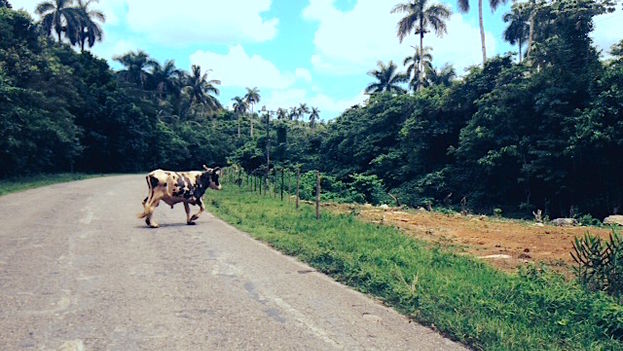
A steer on the road. (14ymedio)

14ymedio bigger14ymedio, Jorge Guillen, Candelaria, 29 July 2016 — He still shudders when he remembers that morning, when the broken glass from the windshield exploded everywhere and he had a taste of metal in his mouth. Ulises Ramirez crashed into two cows loose on the national highway as he was returning from the airport to his native Candelaria. The encounter with these animals ended up with serious damag his vehicle and head injuries for himself, but at least his life was spared. Others haven’t enjoyed the same fate.

Between 2010 and 2015 at least 1,054 accidents, resulting in 12 deaths and 279 people injured, were caused by loose cattle on the road, according to data from the official newspaper Granma. continue reading

Ramirez notes that, a few minutes before he would have arrived home, he made out in the darkness a herd walking or sleeping on the asphalt. He braked, swerved to avoid the crash and desperately sounded the horn. When he thought he would get out of unharmed, he felt a strong impact on the right side of the car. The next thing he saw was two cows lying on the road and the blood running from his head.

Although the law strictly prohibits “leading animals to graze or to water and allowing them to remain on the paved road or the surrounding areas and in conditions that allow them to access it,” the problem does not seem to have gotten better.

As a general rule, the official press blames the rancher who doesn’t keep his animals safely off the road, but the farmers say “they don’t sell us barbed wire to put up a fence to keep the cattle from escaping and causing problems on the nearby roads.” “It is very easy to impose fines and confiscate cows,” complains Hermes Amador, who calls himself “the best milk producer in Candelaria.” For this Artemisan, who has 66 acres of land leased in usufruct to support his cows, the law is not applied equally to cattle belonging to state enterprises.

“The State’s cows live on the road and nothing happens,” he complains. “At Kilometer 52, Commander Guillermo Garcia has a farm and the cattle get out every day, and what happens? Nothing happens and there have been several accidents,” he explains. Garcia’s farm belongs to the Flora and Fauna company, a state enterprise that functions as a tourist villa and allows its visitors to go horseback riding, hiking, walking and bird watching. In Cuba more than 50% of the cattle are the property of the state.

The problems faced by these cattle ranchers don’t end with difficulties in buying supplies for their farms. Gregorio Garcia, another producer in the area, has problems selling his livestock. “I’ve a spent a year going after the buyers of a livestock company trying to sell three bulls who aren’t quiet in the paddock,” he explained to this newspaper. But, still, “every month they talk about the topic at the cooperative meeting, nothing happens.” The producer says he feels sorry for “some of the neighbors whose animals have been injured” and he says they had to pay “a 500 peso a day fine for when they were out on the road.”

Cuban farmers cannot slaughter their own cattle and must deliver them “on the hoof” to the state, which deals with the slaughter and distribution of the meat. Thus, Gregorio Cabezas’ restless bulls will continue making mischief until the state slaughterer intervenes.

Santiago Alfian has had to confront the problem in his work as an inspector. He has spent 15 years trying to enforce the decree, which imposes a 500 peso fine and damages against those who graze their animals on the roads or verges of the railways. “In the case of repeat offenders the animals should be confiscated.”

“We have confiscated [cattle] from some farmers who are repeat offenders, but the problems remain,” explains Alfian, who attributes the problem to lack of wire fencing. “When the government sold a little, there was not enough for everyone and it was sold at the very high price of 600 Cuban pesos for a roll of wire,” he adds.

The inspector avoids the question of whether a state company had ever been fined for letting cattle loose on the road. “Well, everyone knows how that goes,” he responds with an eloquent smile.

Fidel Castro’s Proclamation, A List Of Unmet Instructions / 14ymedio, Reinaldo Escobar

Carlos Valenciaga, chief of staff to Fidel Castro, as he read the proclamation on the night of 31 July 2006. (TV screenshot)

14ymedio bigger14ymedio, Havana, Reinaldo Escobar, 30 July 2016 — Ten years after the Proclamation in which Fidel Castro announced his departure from power, that document continues to reveal distinctive features of a personality marked by the desire to control everything. More than an ideological legacy, the text is a simple list of instructions and it is unlikely that the official media—so addicted to the upcoming major anniversary of Fidel Castro’s 90th birthday—will offer an assessment of whether these instructions have been followed.

On 31 July 2006, the primetime news broadcast brought an enormous surprise. Around nine at night Carlos Valenciaga, a member of the Council of State, appeared in front of the cameras to read the Proclamation of the Commander in Chief to the People of Cuba, where he announced that due to health problems he felt obliged “to rest for several weeks, away from my responsibilities and tasks.” continue reading

After giving his version of the complications that plagued him and the causes that had caused them, Fidel Castro offered six basic points in this document and additionally left instructions about holding the Non-aligned Summit and about the postponement of the celebrations for his 90th birthday.

The first three points of the proclamation are dedicated to the transfer of powers to his brother Raul Castro as head of the Party, the government and the armed forces. The order for these transfers were completely unnecessary because it was already in his position to undertake these functions given that he was then in second position in both the hierarchical order of the Party and the government. It is striking that in each case he reiterated the “temporary delegation” of the transfer of responsibilities.

In the three remaining points he delegated (also on a temporary basis) his functions “as principal promoter of the National and International Public Health Program” to then Minister of Public health Jose Ramon Balaguer; the “principal promoters of the National and International Education Program” to Politburo members José Ramón Machado Ventura and Esteban Lazo Hernández; and as “main promoter of the National Energy Revolution in Cuba and collaborator with other countries in this area” Carlos Lage Davila, who was then secretary to the Executive Committee of the Council of Ministers.

In a separate paragraph he clarified that the funds for these three programs should continue to be managed and prioritized “as I have personally been doing” by Carlos Lage, Francisco Soberon, then minister-president of the Central Bank of Cuba, and Felipe Perez Roque, at that time minister of Foreign Relations.

Almost immediately after having read that proclamation there was an enormous military mobilization in the entire country, called Operation Caguairán. Shortly afterwards the former omnipresence of the Maximum Leader was reduced to some sporadic Reflections of the Commander in Chief published in all the newspapers and read on all the news shows. Twenty months later the National Assembly formally elected Raul Castro as the president of the Councils of State and of Ministers and later the 2011 Sixth Congress of the Communist Party elected him as First Secretary.

From his sickbed Fidel Castro affirmed on that 31st July that he did not harbor “the slightest doubt that our people and our Revolution will struggle until the last drop of blood to defend these and other ideas and measures that are necessary to safeguard our historic process.” In the text itself he asked the Party Central Committee and the National Assembly of Peoples Power “to strongly support this proclamation” although in previous lines he had had already dictated that the party “supported by the mass organizations and all the people, has the mission of assuming the task set forward in this Proclamation.”

A decade passed, the temporary absence of the “main driver” became permanent and four of the seven men named no longer occupied their positions. The reader of the proclamation was ousted. The programs mentioned have become part of the normal functions of the ministries in charge of these tasks and the “corresponding funds” (although no one has proclaimed it officially) are no accounted for in the nation’s budget.

While the 80th birthday wasn’t able to be held with his presence, nor the 2 December 2006 50th anniversary of the landing of the Granma, the yacht that brought the Castros and other revolutionaries from Mexico, as foreseen in his proclamation, now in 2016 all cultural events, sporting events, productive activities, have been dedicated to his 90th birthday.

The ultimate significance of that proclamation lies not in the message it contains, among other things because its author seemed to be persuaded that this was not his political testament but a “bear with me, I’ll be back in a while.”

The final results of this proclamation has been like a blinding spotlight that goes out, a permanent noise that we have become accustomed to and suddenly stops ringing, a will that ceases to give orders, the termination of an omnipresence. The absence occasioned has more connotations of relief than of a capsizing. There is nostalgia. The anxiety about the final outcome has been diluted in a fastidious tedium, like that of sitting in front of those films that stretch unnecessarily.

“I Have Not Been Able to Overcome Laura’s Death”/ Cubanet, Hector Maseda


Title on video: “The most difficult moment was when they tried to accuse me of spying…”

cubanet square logoCubanet.org, Julio Cesar Alvarez and Augusto Cesar San Martin, 29 July 2016, Havana – Hector Maseda dreamed of designing big ships and hanging his naval engineering degree where everyone could see it, but “since they only built boats here,” he graduated with a degree in electrical engineering.

His excellent grades assured him a post in the National Center for Scientific Research (CNIC) until 1980 when the Mariel Boatlift changed his life, as it did for tens of thousands of Cubans who decided to emigrate, but from a different angle.

Hector did not emigrate but lost his job at the CNIC for refusing to repudiate his colleagues who chose to leave the Island. He stopped enjoying the “political trustworthiness” indispensable for working at the center, the “father of science in Cuba.” continue reading

From a scientist with three post-graduate studies and author of several scientific articles, he became a handicrafts vendor for more than a year in order to be able to survive. After going through several different jobs he began to work in the medical devices department in the oldest functioning hospital in Cuba, the Commander Manuel Fajardo Teaching Surgical Hospital.

It was there, on Christmas of 1991, that he began the courtship of Laura Pollan, a teacher of Spanish and literature who would later become a symbol of the peaceful struggle for human rights in Cuba.

The spring of 2003 was a “Black Spring” for Hector and 74 of his colleagues (known as the Group of 75). Sentenced to 20 years in a summary trial for a supposed crime against the independence and territorial integrity of the State, he spent more than seven years in prison.

From that Black Spring emerged the Ladies in White, a group of wives and family members of the 75 dissidents. Laura Pollan, because of the arrest of Hector Maseda, quit her job as a professor in the Ministry of Education and became the founder and leader of the Ladies in White.

“From that moment, she gave up all her pleasures, all her intellectual and social inclinations, etc., and became a leading defender of human rights,” says Maseda.

But Laura would not survive long after Hector’s liberation. A strange virus ended her life in 2011, although Hector Maseda is convinced that the Cuban political police assassinated her.

President of the National Commission of Masonic Teaching and past-President of the Cuban Academy of High Masonic Studies, Hector has traveled the whole road of Cuban Freemasonry.

From apprentice to Grade 33 of the Supreme Council for the Republic of Cuba, he is one of the 25 Sovereign Grand Inspectors of the order which is composed of about 29 thousand Masons spread through more than 300 lodges around the Island.

He has worked as an independent journalist for outlets like CubaNet, Miscelaneas de Cuba and others. His book Buried Alive recounts the conditions of the Cuban political prison system and the abuses of jailers against political and common prisoners.

But he, who at age 15 was arrested and beaten by the Batista police after being mistaken for a member of the July 26 terrorist group and at age 60 psychologically tortured by Fidel Castro’s political police by being subjected to sleep deprivation in interrogations, still has not overcome the death of his wife Laura Pollan.

“I have not been able to overcome that trauma,” says Maseda.

Translated by Mary Lou Keel

Cuban Government Seeks Meat And Dairy In Paraguay / 14ymedio, EFE

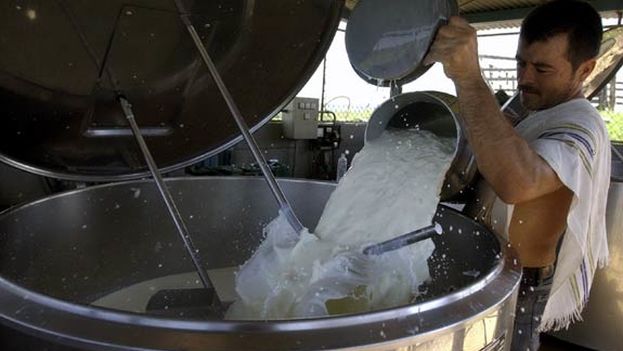
Milk factory in Cuba. (14ymedio)

14ymedio/EFE, Paraguay, 29 July 2016 – Cuban technicians will travel to Paraguay in August to study the possibilities of importing food products to the island, especially meat, dairy and soy, according to the Ministry of Industry and Commerce of Paraguay (MIC).

The delegation plans to visit two dairy plants and several refrigeration companies, where they will verify the processing of beef, pork and poultry meat.

The visit was announced by Cuba’s ambassador in Paraguay, Sidenio Acosta, who met Wednesday in Asuncion with Minister of Industry and Trade, Gustavo Leite. continue reading

At the meeting it was explained that Cuba is interested in Paraguayan cattle genetics and embryos and has already approved the authorization for the importation of soybeans, corn, wheat, rice and oil, according to a MIC.

The Cuban government also extended an invitation to Paraguayan companies to participate in future editions of multisector fairs held on the island.

Leite met last year with Vice Minister of Commerce Oscar Stark to initiate efforts to increase trade with Cuba.

According to official figures, Cuba imports products worth seven billion a year, most of which is food.

Despite the relaxations carried out by Cuban President Raul Castro since he took office in February 2008, livestock production continues to be tightly centralized on the island. In 2011, in an interview with the official weekly Workers, Omelio Borroto, director of the Institute of Animal Science (ICA), said it was “fundamental to decentralize producers and businesses” to achieve an increase in milk production.

However, four years later, at the end of 2015, the numbers pointed to a decrease in the production of cow’s milk. The numbers fell from 579 to 479.5 million liters of milk produced in the country and experts agree that the current year will show still more alarming figures due to, among other factors, the drought.

This April there was a reduction in the price of powdered milk in the hard currency stores across the island. The price of a 500-gram bag went from 2.90 to 2.80 CUC and for a one kilogram bag the price was lowered from 5.75 CUC to 5.50 CUC. This benefit has been criticized by consumers who don’t consider it significant, and has also contributed to the shortage of powdered milk on store shelves.

In the past, Cuba has imported milk from as far away as New Zealand. This situation led to Uruguayan president Tabaré Vázquez and Cuban president Raúl

Castro to commit in 2015 to studying the installation in Uruguay of a production plant for milk powder whose output would be destined for the island.

Pope Francis Asks Young Cubans “Don’t Be Afraid” / 14ymedio, Zunilda Mata

"Open up to big things. Do not be afraid," Pope Francis told young Cubans in a message released Thursday. (14ymedio)
“Open up to big things. Do not be afraid,” Pope Francis told young Cubans in a message released Thursday. (14ymedio)

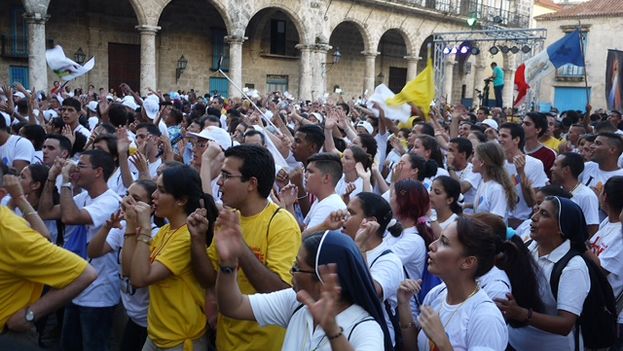
14ymedio bigger14ymedio, Zunilda Mata, Havana, 29 July 2016 – A message from Pope Francis aimed at young Cubans raised spirits Thursday in celebrations that took place in Havana simultaneously with World Youth Day held in Krakow, Poland. “Young Cubans: open yourselves to great things! Do not be afraid!” the Bishop of Rome told them in a few words that were projected on a large screen in front of more than a thousand Catholics throughout the island.

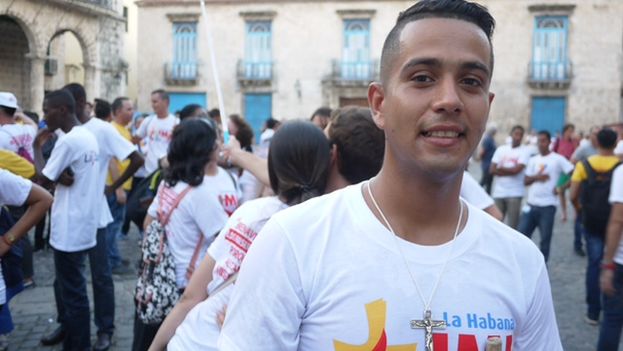
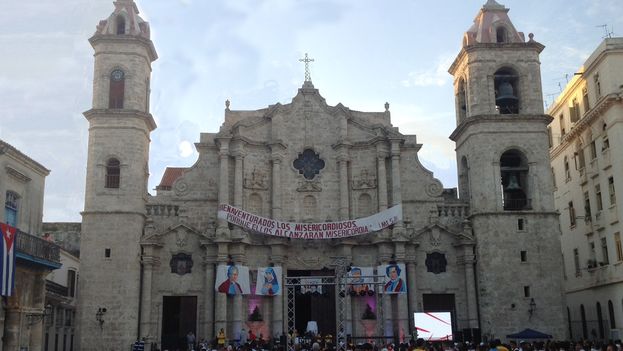
Havana’s Cathedral Square, from early Thursday morning, displayed a panorama completely different from usual. Although there was no lack of tourists, performers and, of course, the police, there were around 1,300 young Catholics from all provinces who met “in sync with Krakow,” according to the organizers. continue reading

During the early afternoon, the delegations made their cultural and pastoral presentations. The Santiago delegation accompanied the chorus of the “first diocese in Havana bringing the message of Charity”with percussion instruments. Those from Camagüey presented a choreographed dance, while those from Bayamo, Pinar del Rio and participants from every corner of the island made an effort to leave their mark on the celebration.

Among the more than 60 young people from Camagüey who attended the meeting was Dariel Hernandez, coordinator of the youth ministry in that diocese. “We come having prepared for this event for almost a year to be in sync with what is happening right now in Poland with Pope Francis. We have raised money to cover the cost of these activities,” he explained to 14ymedio.

Melisa Boga, is a second year student of Foreign Languages at the University of Cienfuegos. “We are 84 from our province; I hope and desire to know the reality of the other young people who have come here,” she said.

Around 9:00 PM, a message to young Cubans sent by Pope Francis specifically for the occasion was broadcast, interrupted with cheers and shouts of approval.

Dariel Hernandez, coordinator of youth ministry for the Diocese of Camagüey. (14ymedio)

The pontiff recalled the legacy of Father Felix Varela when he said, “You are the sweet hope of the nation.” And declared, “To be carriers of hope you need not to lose the ability to dream,” and said that someone who “doesn’t have the capacity to dream is already retired.”

“Young Cubans: open yourselves to great things! Do not be afraid!” continued Francis, while the crowd cheered and applauded. ” Dream that with you, the world can be different! Dream that Cuba, with you, can be different, and better every day. Do not give up!” he said.

“It is not necessary for us all to think in the same way. No, everyone has to join in the ‘social friendship,’ even with those who think in a different way. But we all have something in common: the wish to dream, and this love for the homeland,” said the Pope Francis. The Pope invited young Catholics to “to build bridges, to work together with the word, with the desire, with the heart.”

Message from Pope Francis to Young Cubans / 14ymedio

Celebrations this Thursday in Havana simultaneously with the World Youth Day held in Krakow, Poland. (14ymedio)

Note: The version below is the summary of the message released in English by the Vatican. 

With great hope I join with you in this moment, in which you are in harmony with the universal Church whose young heart is in Krakow. I trust that these days will be, for all, a special occasion to foster the culture of encounter, the culture of respect, the culture of understanding and of mutual forgiveness. This is about ‘making a ruckus’, about dreaming. And young people are supposed to ‘make a ruckus’!

I suggest that you live the experience of listening carefully to the Gospel and then bringing it alive in your own lives, in the lives of your family and friends. … When you pray the Via Crucis, remember that we cannot love God if we do not love our brothers. When you pass through the Holy Door, let yourself be infused with this love … and this way you will learn always to look upon others with mercy, closeness and tenderness, especially those who suffer and those who are in need of help.” continue reading

Stand before Jesus in the Blessed Sacrament; because in Him, and only in Him, will you find the strength to follow the most beautiful and constructive plan of our lives; because love is constructive, love destroys not even the enemy, love always builds up. And, when you are sent by the bishops as Witnesses of Mercy, remember that the Master’s most beautiful wish is that you will be afraid of nothing.

Boys and girls, do not be afraid of anything, be free of the bonds of this world and proclaim to all, to the elderly, the sorrowful, that the Church weeps with them, and that Jesus is able to give them new life, to revive them.”

Young Cubans: open yourselves to great things! Do not be afraid! … Dream that with you, the world can be different! Dream that Cuba, with you, can be different, and better every day. Do not give up! In this endeavor it is important that you open your heart and mind to the hope that Jesus gives. … And never forget that this hope is suffered; hope knows how to suffer to carry out a project, but likewise do not forget that it gives life, it is fruitful. And with this, hope will not be fruitless; rather, it will give life to others, it will create a homeland, a Church, it will do great things. …

Hope is instrumental in building ‘social friendship’, even though people may think differently. It is not necessary for us all to think in the same way … we must all join together in ‘social friendship’, even with those who think in a different way. But we all have something in common: the wish to dream, and this love for the homeland.

The important thing, regardless of whether we are the same or different, is to build this ‘social friendship’ with all; to build bridges, to work together. Build bridges!

https://youtu.be/PJp-aM2a-6E

Neither Brave Nor Intelligent, Much Less Fair / 14ymedio, Eliecer Avila

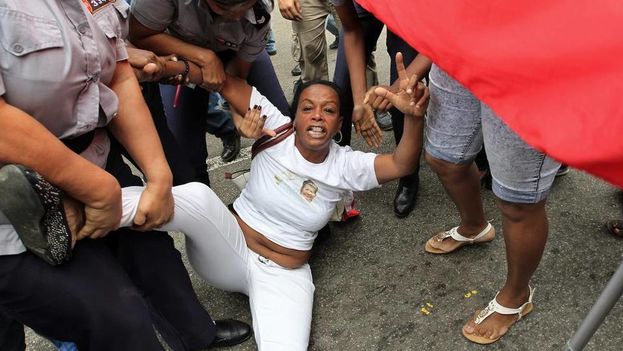
Arrest of a member of the Ladies in White in Havana. (EFE)

14ymedio bigger14ymedio, Eliecer Avila, Havana, 28 July 2016 — On numerous occasions I have had to listen to the stories of friends and colleagues who have been detained or have been interrogated by the State Security. “These people are unreal, they know everything. The day I went to see so-and-so, what I said to what’s-his-face, what time, and even that we had coffee and ate roast pork. They don’t miss a thing!”

I imagine that these people feel very impressed, because it is as if they were sitting with a fortuneteller who “divines” their past, present and can even predict their future. The difference is that the fortunetellers, or so they tell us, “have a gift,” while State Security has human and technical methods and a society completely organized to facilitate their work, such that their gifts are simply their ears and a crystal ball made of optical fiber. continue reading

How are they not going to know the exact locations of the moles on our bodies, if they can openly and brazenly invade all our privacy?

They don’t have to be super-gifted nor pass in some school to “discover” who we spend time with, what our plans are, what our means are, because in the vast majority of cases we don’t even hide these things. The reason? It is very simple, we are citizens who study in normal schools, lead normal lives, we are not trained and don’t even want to be in intelligence or counterintelligence, we speak naturally and openly about what we think and desire because we are not ashamed.

On the other side, we have something very different, military personnel, indoctrinated, with studies of all kinds, with specialized equipment, transportation, a made-to-measure judicial system, subordinated press and fearful people who offer them what they ask for to avoid becoming targets of their investigations.

Who could do a bad job with all this? The contrary would amaze me. That there would be something they don’t know.

However, to the extent that you interact with them, you realize that they have many gaps. For example, there is an important difference between what the bosses know and what they tell the field agents. There is the need for State Security to constantly convert the ordinary into the extraordinary. This is justified because each one of these agents has to constantly think they are “saving the country” and that “the people appreciate their heroism and bravery.” In the majority of cases, however, what they are doing is committing a common crime in the name of authority against natural persons unhappy with a bad government.

In this sense they are very exquisite in their internal language. There is nothing a seguroso – security agent – likes more than to be called a “combatant,” and it delights them even more when the designation “anonymous” is added, because this gives them the sensation of being a spy and makes them think they are smarter. Incidentally, before society they think they “run great risks…” OK, this is true in part, because on retirement the majority suffer back pain because they dedicated themselves to dragging people into patrol cars. Upon reflection, they should wear supportive belts to protect themselves in these dangerous maneuvers.

Surely, in times past and under other circumstances, there might have been some who did more serious things against real threats, I don’t deny it. But today. 99% of what these “combatants” “confront” are the natural rights of a people who want to peacefully change what does not work to move the country forward and above all to not continue to shipwreck it in every respect. “Confronting” this is neither brave, nor intelligent and much less just or admirable.

The work of those who have to protect the state in societies based on rights and fundamental freedoms is very different; in societies where the threats are of an extreme magnitude and it is not enough to demand an ID card so that people or companies “cooperate.”

Men and women who risk their lives and dedicate themselves to protecting their nations against the grave threats our civilization confronts will always be heroes and heroines worthy of every kind of recognition and the gratitude of their peoples. But if the terror they impose themselves in the service of a dictatorship tramples the lives of protestors to keep themselves in power at all costs, these combatants have made a mistake in the ethical and moral sense of their careers and their lives.

So they should not confuse their facile abuse with expertise or ability. Because this latter is an attribute of those who survive and express themselves, despite them.

Eduardo Mora, Another Mask Falls / 14ymedio, Claudia Collazo

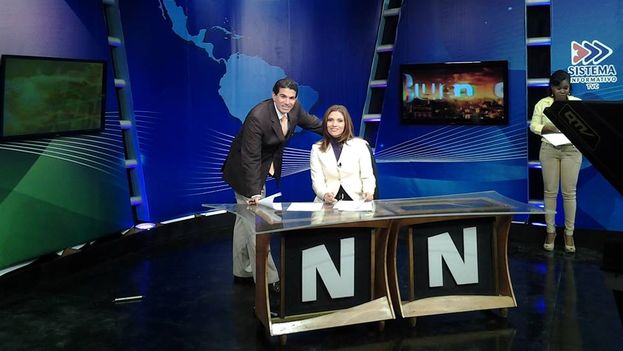
Mara Gongora, Eduardo Mora and Yisel Filiu on the set of the program “Good Morning” in 2014. (Source: Facebook)

14ymedio bigger14ymedio, Claudia Collazo, Havana, 28 July 2016 — Compelling, cheerful, with an exuberant vocabulary and a good presence, Eduardo Mora was until recently one of the main presenters on “Good Morning,” Cuba’s morning news show. Even the most boring slogans gained grace from his personal style.

Just over a month ago, in the hallways of the Cuban Institute of Radio and Television (ICRT) everyone said, each in his own way, that he had defected, that he won’t return, that he stayed abroad. In May, Mora attended the Latin American Study Association (LASA) meeting in New York as a speaker, and at the end of the sessions asked his bosses in Information Systems to extend his absence for a few more weeks, but they refused. The presenter intended to take advantage of the trip to visit his brother in Miami and to give some talks so that he would be able to buy a house in Havana with the money raised. When he did not appear in Cuba by the required date, he was fired. continue reading

Now, his colleagues comment quietly that Mora “has passed to a better life.” This expression, recognized as a synonym for death, has now become, ironically, a form of comparing the life of a Cuban who stays with that of a Cuban who leaves.

Those who knew him at Cubavision International when he was chief of information there, recall his scathing comments away from the cameras and microphones. Nothing extraordinary. The same things that are said in any bread line or on a bus crammed with people. For example: “Marino Murillo and the other leaders know how to adjust the economy, but without affecting themselves, nor the kings’ children.”

The real question is not why did Eduardo Mora stay in Miami, but why do our talented young professionals decide to leave. It is not about something as trite as a brain drain, because almost no one will offer him millions. On the contrary, they assume they can have a better life there, working as waiters, than they can exercising their profession in Cuba. The explanation is found in the mere fact that their working abroad, at anything, gives them at least the opportunity to pay for a plate of food on the table and, in some cases, for the same for their families on the island.

What concerns us is not that he stayed because with what he earned here he could never buy a house in Havana, not even from the results of his hard work, which, at times involves working more than two contracts simultaneously. The alarming thing is the chaos unleashed when someone like Eduardo Mora emigrates or decides to explore new work opportunities, as if wanting a better life is a grave failing, an unpardonable betrayal.

Cubavision International has not yet named a new chief of information; right now it takes a great deal of effort for people – and for young people it’s even worse – to assume leadership positions. Meanwhile, the hallway comments multiply. There is a joke that says if there were a ramparts or a common border with any other country, there would be no one left on this side. “Let he who does not cross cast the first stone!” says a lady, passing on the joke.

The system is collapsing not because it is “a plaza under siege by a genocidal blockade,” but because a good part of its people have decided to launch themselves on the path to emigration. Perhaps because, as José Martí is claimed to have said, “when the people emigrate… leaders are superfluous.” Something everyone knows and mumbles behind the scenes.

Cuban Civil Society, For The First Time Present In The Regional Internet Governance Forum / 14ymedio, Regina Coyula

The Regional Latin American and Caribbean Preparatory Meeting for the Internet Governance Forum, is a regional meeting prior to the upcoming global forum in Mexico. (Twitter)

14ymedio biggerRegina Coyula, Havana, 26 July 2016 — ¿Gover… what? That reaction has become increasingly familiar in a conversation discussing internet governance. Although many users who take advantage of it aren’t aware, governance is a fundamental issue for everyone when we venture out onto the World Wide Web. That our family email travels equally with the statistics of scientific research, with an online purchase, or with a bank account statement, is thanks to governance.

Behind any familiar and easily remembered address is a long string of numbers without which the internet couldn’t function. Early developers realized that the ordinary user would be unable to recall those long strings of numbers and so created a protocol to tie them to a name. Name and number indissoluble leading us unmistakably to the desired destination. These technical protocols that make our lives easier, also have to do with governance. continue reading

Governance, a term originally applied in the social sciences, has gained strength within international organizations, and in the case of the internet, seeks interactions and consensus among interested parties, or an English word that is difficult to pronounce – multistakeholders – (multiple interested parties, academia, businesspeople, leaders and civil society).

The natural result of this interaction are world forums on governance, very fruitful meetings where those who participate know each other personally and engage in discussions at committee and plenary sessions. Prior to these world forums which have been held since 2006 and which this year will take place in Guadalajara, Mexico, in December, preparatory meetings will be held by geographic region and, in some case, even national groups. The meeting for Latin America and the Caribbean will be held in San Jose, Costa Rica, between 27-29 July.

The sessions approved for the meeting include:

  1. Security and privacy – Concerns about cybersecurity and confidence in the digital environment.
  2. The situation of human rights on-line in Latin American and the Caribbean: advances, challenges and trends.
  3. Evolution, progress and challenges of the implementation of a multi-sector approach to the work of public policy and Internet governance at national and regional levels.
  4. Lessons on the development and implementation of strategies for providing access and legal initiatives on network neutrality: What are the next steps to ensure open and interoperable internet in the region?
  5. Expand understanding with regards to the responsibilities of internet intermediaries: the scope and limits of their responsibilities in the digital ecosystem.
  6. The balance between intellectual property and access to knowledge: the scope and impact of interregional trade agreements in the regulatory ecosystem.
  7. Persistent and emerging challenges for Internet access: Connecting the next billion.
  8. Integration of Internet governance with the 2030 Sustainable Development Agenda: What are the priorities of the region for digital inclusion?
  9. A multi-stakeholder perception of the digital economy.
  10. Future of Governance of the Internet Forum of Latin America and the Caribbean (LACIGF).

Undoubtedly, the meeting will address the issue of the independence of the US government’s Internet Corporation for Assigned Names and Numbers (ICANN), which will go into effect in September, and how ICANN, as a highly hierarchical international organization should guarantee the technical standards of internet quality: interoperability, scalability, and resistance to potential failures; but also the sovereignty of the virtual space, the equality of all users, the privacy of data, freedom of expression and the right to information, and also deal with cybersecurity. All of this in the context of a lack of rules for its proper use which diminish individual rights or national security, or favor some to the detriment of others.

Cuban civil society will be present at this event with a small representation, something that has no precedences but that could be very healthy for a citizenry that is just beginning to open itself to an internet that has restricted access and a censorship of opinions, and that is disregards of the rights that come solely by connecting to the world, human rights recognized as equals, in real space as in the virtual.

Affordable Vacations in Cuba / Iván García

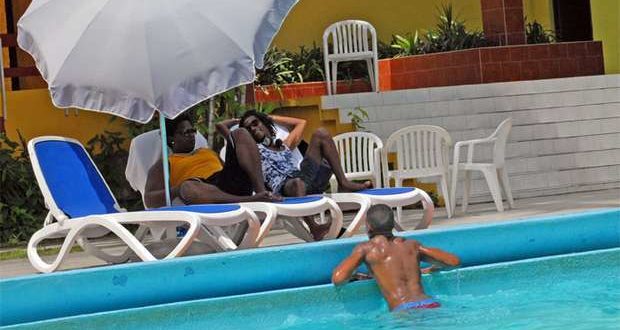
Piscina-de-un-hotel-cuba-_ab-620x330
Photo: Lorenzo Crespo Silveira, Havana Times.

Ivan Garcia, 4 July 2016 — Mayara finished ninth grade with excellent grades and the next school term she will start high school. She is thinking about going to university and getting a degree in civil engineering or architecture.

Until then, she is spending her holidays scrubbing dishes, cleaning house and helping her mother wash fifteen pounds of dirty clothes twice a week.

“I feel very bad for my daughter but I don’t have money for her to go a discotheque or a party with her friends. I cannot even afford to send her on a trip to the beach with some neighbors who have rented a bus. She’ll have to settle once again for watching television and reading books. I make 380 pesos a month (about 17 dollars) as a receptionist and that isn’t even enough to feed ourselves adequately. And I can’t rely on her father. He’s always drunk and months will pass before he gives his daughter so much as a peso,” says Mayara’s mother. continue reading

The 2016 summer vacation season in Cuba is revealing new and growing disparities. Daniel, a father of three, recalls that twenty years ago “money went further. You could rent a house on the beach or occasionally eat at a nice restaurant. There were other options that were affordable for the average worker. But not now. An all-inclusive deal at a Varadero hotel costs 300 convertible pesos for just one weekend,” notes.

“Even renting a spot at a campground has become a luxury,” he adds. “And then there are the bad streets. I’m not saying there’s violence, but young guys get bored and hang out on the corners, drinking alcohol and smoking marijuana. If you go to a nightclub, you have to shell out twenty or thirty convertible pesos. And with salaries so low, you can’t win. At least the Copa America and the Euros are being broadcast on television. And the Rio Olympics begin in August,” he adds.

Marilyn and her husband do have plans for the summer vacation season. “At the end of the month we’re going with our daughter to a sushi restaurant. We’ll also go two or three times to the pool at a tourist resort. And we’ve already reserved six nights at a hotel in Cayo Coco,” says Marilyn.

“Do you get remittances from overseas or own a small business,” I ask.

“Sort of,” Marilyn’s husband replies. “Four or five times a year I travel to Ecuador, Mexico or Panama to buy cheap merchandise and spare parts for cars and motorcycles. I spend part of the money I save on school vacations for my daughter.”

Although almost a million Cubans a year take advantage of all-inclusive package deals offered by the country’s four and five star hotels, most Havana residents take their children to the beach, the zoo or the national aquarium.

Those who do not live in the capital often have fewer options, though some provinces go to great lengths to organize special events during the months of July and August.

“I live in Hoyos, in Santiago de Cuba province. People start drinking there as soon as the sun comes up,” says Fermin, a Santeria follower visiting the capital. “Everything is more complicated in the eastern regions. There’s no money, potatoes and oranges are luxuries and drinking water is delivered every eight or nine days. All there is to do is watch television, drink, gossip with the neighbors and pray that an earthquake or a powerful hurricane doesn’t come and wipe us off the map.”

Now that the school year has ended, Havana’s landscape includes children and teenagers running through the streets late at night and groups of youths talking loudly about football or sitting on neighborhood street corners, making plans to emigrate.

Others prefer to set up a table of dominoes, take up a collection to buy some cheap rum and stay up all night arguing over the game and listening to reggaeton at full blast.

Far fewer can pay a cover charge of five to ten convertible pesos (CUC) to get into a discotheque or 1.5 CUC for an imported beer and some cheese balls at a privately owned air-conditioned bar.

There will always be cheaper options such as going to the theater, a museum, the movies or the Malecon, where you can spend time sitting and enjoying the nocturnal sea breezes with friends and an acoustic guitar.

But poor public transportation and unattractive cultural offerings discourage many young people from pursuing safe and economical forms of recreation.

For a wide segment of the Cuban population, distractions are to be found in insipid Brazilian soap operas, playing dominoes or drinking cheap liquor. It is not what they want to be doing; it is that they have to count their pennies.

No Air Conditioning and Intrusive Music / Rebeca Monzo

Rebeca Monzo, 26 July 2016 — As random comments from ordinary citizens on the streets suggest, we are going through a new Special Period, though the government repeatedly denies it in media statements, calling it “a difficult situation from which we will recover.”

For confirmation, one need only observe the bus stops crowded with people anxiously waiting for the next vehicle to take them to their jobs, the hospital or the beach. The lack of fuel and spare parts are the main causes of these “bottlenecks.” For this reason, many people feel forced to turn to boteros, or private taxis. Though expensive, they are a solution to the problems of urban mass transit, for which the government is responsible. continue reading

Another situation impacting us — apart from the unbearable heat and famous Sahara dust storms — is the shortage of consumer goods and lack of air conditioning in so-called hard currency stores.

In some of thee facilities, especially the smaller ones, the lack of air conditioning is leading to longer lines and greater dissatisfaction in the population.

The employees of these businesses, who work for eight hours a day in sweltering conditions, have to limit access to two people at a time in order to be able to wait on them. Once inside, customers run into another big hurdle: no shopping bags. This drags out the shopping process, causing discomfort and protests from those waiting their turns.

Given these circumstances, one would think that there ought to be some compensation in the form of reduced prices due to the lack of customary amenities such as air conditioning and bags in which to carry purchases home, factors which would logically affect the value of an item. Then there are the difficulties associated with the sometimes raucous reggaeton background music, a telephone customer being left on hold or, in the case of city buses, the drivers’ choice of music in vehicles overflowing with a disgruntled and sweaty public.

Three Months Later, The Residents Of Havana Still Remember Obama / Iván García

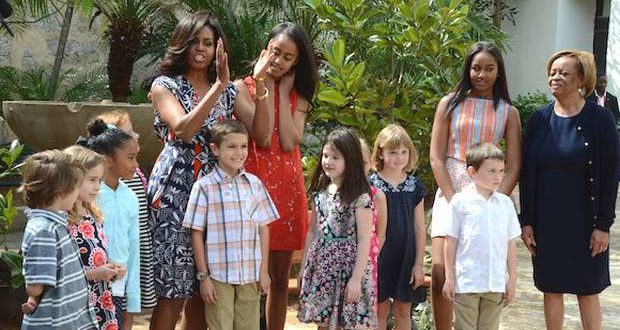
Michelle Obama, her mother, Marian Robinson, and her daughters, Malia and Sasha, pose together with a group of Cuban children after having planted two magnolia bushes, similar to the ones that bloom in the White House gardens, and after donating a wooden bench for the relaxation of visitors to the Rubén Martínez Villena library garden in Old Havana. Taken from Impacto New York. 
Michelle Obama, her mother, Marian Robinson, and her daughters, Malia and Sasha, pose together with a group of Cuban children after having planted two magnolia bushes, similar to the ones that bloom in the White House gardens, and after donating a wooden bench for the relaxation of visitors to the Rubén Martínez Villena library garden in Old Havana. Taken from Impacto New York.

Iván García , 22 June 2016 — The park at Galiano and San Rafael is a beehive of activity. At one end, several teenagers play soccer, using a school desk as the goal, while 50 men and women are connecting to the Internet, sitting on wooden benches or the ground.

Conversations with relatives or friends mix together. Here the wifi is confined exclusively to talking with family through IMO or chatting on Facebook, the island’s new virtual drug. continue reading

Of course it’s also used to flirt with a foreigner, commit camouflaged prostitution or request money from a cousin in Hialeah. Darío, an old man of indefinite age, among the hubbub and heat, sells salted peanuts at one peso a cone.

The peanut seller remembers that three months before, on Tuesday, March 22, a disproportionate police deployment in the park scared off the hustlers, prostitutes and marginal people.

“It was already known that Obama was going to give a speech in the Gran Teatro of Habana, on Prado between San Rafael and San José, beside the Capitolio. The whole zone was taken; I never saw so many security guards together. In the neighborhood they said that Obama was going to walk along the San Rafael boulevard and talk with the people. The police let pass only those who lived around there. They told people to remain at home,” recalls Darío.

Erasmo, who resells Internet cards, comments that “on that day the businesses were basically quiet. Throughout Central Havana there wasn’t a prostitute, drunk or beggar scavenging food in a garbage bin. I went up to the roof with a friend, and with my mobile phone, I recorded the moment when The Beast — Cadillac One — arrived at the San Cristóbal paladar [home restaurant], on San Rafael between Campanario and Lealtad,” he comments, and he shows his video as evidence.

“I’m never going to erase this from my phone. This was the most important day of my life,” Erasmo adds.

After crossing Galiano, the multi-colored, narrow streets of San Rafael are less agitated. Ruined shells of buildings, women always selling something and a swarm of private shops.

Roger, nicknamed “El Pali”, is an extroverted, talkative guy who sells bananas and meat in a State agro-market on the corner of San Rafael and Campanario. He confesses that he’s an “excluded.”

“I was a prisoner in the U.S. Then I was released, but I went back in the tank for a robbery in New Jersey. In any event, I’m more American than Cuban. Before they sent me back to Cuba I was in the U.S. for 22 years. I even have a son over there. The day the President arrived,” — his work buddies laughed their heads off — ” I planted myself on the balcony of a friend’s house with an American flag and yelled in English. I don’t know if Obama heard me, but before he went into the paladar, it looked like he saw me on the balcony,” said El Pali.

On the same block where the private restaurant, San Cristóbal, is located, there are seven small family businesses. Barbara rents out rooms, and in a narrow apartment which looks out on the street, Sara, an old retired woman, sells freshly-ground coffee. Just in a house next to the paladar, a poster indicates that the president of the CDR resides there.

“But the woman never does anything. She also was with the neighborhood people at the party, getting drunk with those who came to see Obama,” says a blond in denim shorts and rubber flip-flops.

In the doorway of the San Cristóbal paladar, at 469 San Rafael between Lealtad and Campanario, the doorman, a corpulent negro dressed in a red shirt and dark pants, is on the hunt for clients with a menu in his hand.

But his excessive prices horrify the average Havanan. A plate costs around 30 dollars. And a good mojito, six. “Eating there can give you a heart attack. But you have to go with a suitcase full of money,” says a neighbor.

The doorman, friendly and relaxed, was there on the night of Sunday, March 20, when Obama’s wife, two daughters and mother-in-law went to dine at San Cristóbal.

“There was tremendous intrigue in the neighborhood. The zone was full of police. In the morning some gringos came and told Raisa and Cristóbal, the owners, to reserve all the tables, that some American officials were coming for dinner that night. No one imagined that it was Obama. I saw him from the same distance that I’m talking with you. The President and his wife shook my hand. I went for a week without washing it,” he says, smiling.

Ninety days after Obama’s visit, Carlos Cristóbal Márquez Valdés’ business has benefited. “A lot of foreigners want to sit at the same table and eat the same meal as Obama. Thanks to Saint Obama, the paladar is always full,” affirms the doorman.

Walking in a straight line down San Rafael, leaving the boulevard and going down the busy street of Obispo up to Oficios, in a small garden at the back of the Rubén Martínez Villena municipal library, Michelle Obama, her daughters, Sasha and Malia, and her mother, Marian, planted two magnolia bushes.

“The magnolia is a shrub that survived the epoch of the dinosaurs. An American told me that the variety planted belongs to the Magnolia virginiana. On the morning of March 22, I had the luck to see the First Lady and her daughters when they came to plant the flowers. I was very happy, since in the late afternoon on Sunday the 20th, it rained a lot, and I couldn’t see Obama at the Plaza de Armas and the Cathedral,” relates Alberto, a used-book seller in Old Havana.

Michelle Obama, a sponsor of the Let Girls Learn project, on Monday, March 21, joined a dozen students in the Fábrica de Arte Cubano, on Calle 26 at the corner of 11th, Vedado. The meeting barely was mentioned in the press, and it wasn’t possible to identify any of the young women participants.

Although the trivialities and the sensationalism caused by President Barack Obama’s travels throughout the world also affect the people of Havana, many think the most impressive part of his visit was the speech he gave in the Gran Teatro de La Habana. And they are sure that after March 20, 2016, Cuba will not be the same.

Martí Noticias, June 20, 2016.

Translated by Regina Anavy

The Erratic Corrections of Machado Ventura / 14ymedio, Reinaldo Escobar

The only “next” is the looming return of the economic difficulties. (14ymedio)

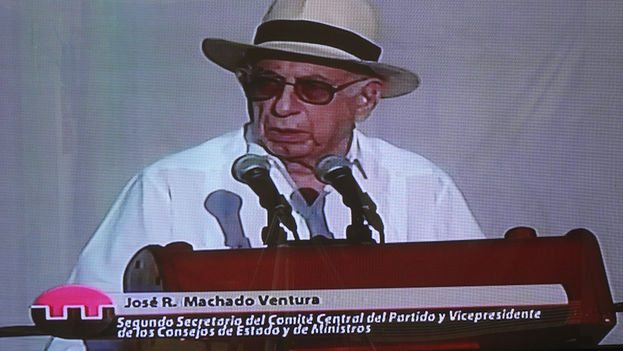
14ymedio bigger14ymedio, Reinaldo Escobar, Havana, 26 July 2016 – Sporting a hat to protect himself from the rays of the sun, Jose Ramon Machado Ventura explained in his speech for the 26th of July that the changes introduced in the Cuban model “are aimed at consolidating our socialism, to make more prospero (prosperous) and sustainable.” The keynote speaker at an event this morning in Sancti Spiritus realized immediately that he had omitted the enclitic pronoun “it” next to the verb “to make” and corrected it but introduced a new error: “To make it more proximo (next) and sustainable.”

To the cheerful confusion of those who didn’t notice the initial grammatical slip, the vice president conveyed the impression that he hadn’t meant to say prosperous, but proximo (next). The correction thus became a political problem, because if there is something Cubans know it is that the promised socialism “without haste, but without pause” could be anything or have innumerable oddities, but in no way is it “next.” continue reading

Perhaps, later on, Machado Ventura will argue that the gaffe obeyed the desires that “all revolutionaries have to reach the goal for which they have fought.” However, the subtle equivocation, which doesn’t appear in the official version of the speech published in the state newspaper Granma, may have set listeners to thinking about the controversial issue of deadlines to deliver on certain promises.

At least three generations of Cubans have witnessed, for years, the commemorations around that fateful 26th of July 1953, a tragic date that has been cataloged – brazenly – as “the happiest day in history” in a chorus of the worst tune ever.

For decades, the interminable speeches that Fidel Castro delivered on the ceremonies of those events that immolated young people were expected as the moment when he would announce “the good news.” On the podium, index finger pointing skyward, he would prophesy a luminous future for the country and convince his audience of the inevitable and imminent materialization of utopia.

However, those times have passed and today the model of socialism that is debated among “hundreds of thousands of militants of the Party and of the Union of Young Communists, and representatives from all sectors of society,” with reference to the documents of the Seventh Communist Party Congress, shows no practical signs that it will bring prosperity, nor that it will be sustainable over the long term.

Instead, what is coming “next” is only the return of the economic difficulties now classified as temporary that characterized the most difficult years of the Special Period. These material limitations, in fact, never disappeared completely from daily life, but could get worse given the collapse of Venezuela and the economic dysfunction of the national model.

Machado Ventura referred this Tuesday to these conquests which had to be “temporarily” given up in the most acute phase of the Special Period, but indicated with optimism that “today they are practically all being recovered,” while “some belonged to that historic moment and it would not be rational to reestablish them.” He also spoke about other conquests, which he did not enumerate, that “are in a quantitative and qualitative phase superior to those years.”

The most important element of the vice president’s speech lay in its omissions, more than in its affirmations. The man who is seen as a recalcitrant orthodox avoided deciphering the enigma that now torments millions of Cubans and that has been converted into history in his wishy-washy speech. Did the Special Period end, or are we just going through a less acute phase? Is the current crisis a new stage in the chronic fall of the system, or is it the evidence of the “next” – that is the imminent – end of Castroism?

Ramon Machado Evokes a 26th of July Marked By “Complex Circumstances” / 14ymedio

The vice president of the Councils of State and Ministers, Jose Ramon Machado Ventura. (Screenshot)

14ymedio bigger14ymedio, 26 July 2016 – In a total break with the optimism that Cuban leaders usually squander on every 26th of July, Jose Ramon Machado Ventura addressed this Tuesday the “difficult circumstances” the island is currently experiencing. The vice president evoked, in addition, the problems derived from the international situation whose resolution is “outside the scope” of the government.

With the first light of dawn, lasting for barely an hour and ten minutes, Sancti Spiritus hosted the main event for the 63rd anniversary of the assaults on the Moncada and Carlos Manuel de Cespedes barracks. The event was punctuated by calls for efficiency and sacrifices, and continuous references to the “economic situation,” characterized by a lack of liquidity that has obliged the government to reduce the expectations for economic growth. continue reading

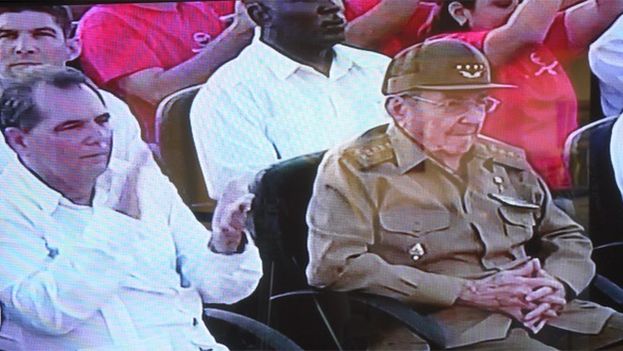
The main speech of the day fell to Machado Ventura, as has happened several times over the last decade. Sitting in the first row of the audience was president Raul Castro, who did not speak publicly and who left as soon as the ceremony concluded.

The constant references to Fidel Castro and his 90th birthday (coming up in August) also marked the event, although the former president did not send a message for the occasion and had to be remembered for his words on 26 July 1953, which he spoke in Sancti Spiritus.

Machado Ventura’s speech emphasized the words with which Castro acknowledged that Cubans had been “capable of stressing and inculcating that the first duty of the revolutionary is work.” The number two man of the Communist Party emphasized that “fulfilling the [economic] plan is not synonymous with meeting the needs of the country nor having reached the existing potential,” and appealed to the “reserves of efficiency” remaining to be tapped.

In response to those who demand faster economic and political transformations, the vice president warned that “the few changes that are necessary will be introduced at the pace we decide,” and declared that “there will be not even the slightest response to external pressures.” The affirmation coincided with what has become the slogan of Raul Castro’s regime: “Without haste, but without pause.”

Some of these pressures to accelerate the transformations on the island have, according to the orthodox leader, “the underhanded or open purpose to dismantle the work of the Revolution.” He stressed this again later when he referenced “the enemies of the country,” without specifying names or details.

Red shirts and little paper flags highlighted the morning under an enormous bronze sculpture dedicated to the patriot of independence Serafin Sanchez, in the plaza of the same name, although missing were the faces of the foreign leaders and personalities who traditionally attend these 26th of July celebrations.

Machado Ventura confirmed that the discussion of the documents of the Seventh Congress of the Communist Party will conclude in September and their final approval by the Central Committee will take place in December. The debate, he explained, involved “hundreds of thousands of militants from the Party and the Union of Young Communists (UJC), and representatives of all sectors of society.”

Raul Castro, who did not play an active part in the event, remained in the first row of the audience and left as soon as the ceremony ended. (Capture)

Machado Ventura defined the Special Period as a stage in which the conquests of the process “had to be temporarily given up, in good part” to avoid a comparison with the current situation, despite the fact that many Cubans fear a repeat of the Special Period in all its gravity.

José Ramón Monteagudo Ruiz, a member of the Central Committee and first secretary of the Party in Sancti Spiritus, said that “there are conditions in the territory to achieve more productive agriculture.” The local official spoke of “the difficulties and damages arising from the current situation,” in reference to the economic cuts and lack of liquidity in the country.

Mentions of the United States embargo were not lacking, although unlike other years the United States and “Yankee imperialism” were not central to the discourse, which was led by the need to make the domestic economy more efficient.