One Hundred Workers From India Rush To Complete Hotel In Havana

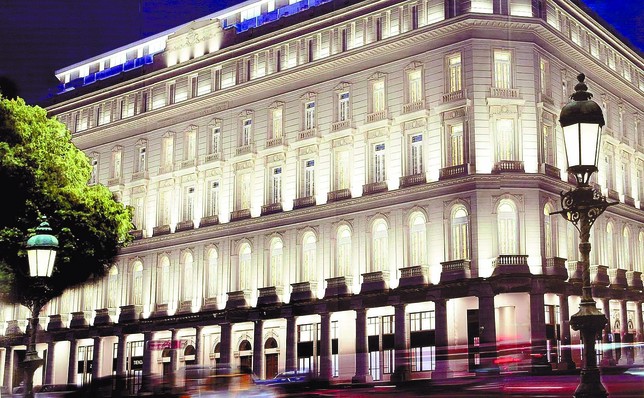
The Manzana de Gomez Hotel building today. Source: Havana Times
The Manzana de Gomez Hotel building, originally opened in 1910, prior to its renovation. Source: Havana Times

14ymedio bigger14ymedio, 21 July 2016 – Over 100 workers from India are working on the construction of the Manzana de Gomez hotel in Havana, being reconstructed by the French construction group Bouygues, according to Reuters. This is the first time there has been a massive contracting of foreign labor on the island.

The company resorted to the exception introduced by the Cuban government in the Foreign Investment Law, that authorizes “special regulations” with regards to foreign workers in “special circumstances.” continue reading

Apparently the delays experienced in the construction of the hotel, whose opening was scheduled for October 2016, in a context of high tourist demand, are the extraordinary reason, which has led to the contracting for these workers.

Although the government has not responded to questions fro Reuters, the workers interviewed by the agency and information confirmed by sources from the company, this appears to be the first time a company has passed over state workers on the island to hire their own from elsewhere.

A spokesman for the French Company, which it currently building three hotels in Cuba, says that Bouygues has plans to bring more Indian workers to the island, currently being trained, in the coming months.

Inderjeet Singh Chopra, one of the workers interviewed by Reuters, said more than a hundred of his compatriots are engaged on the island working as electricians, plumbers, carpenters and masons.

Similarly, a diplomat quoted by the agency, estimated that they are paying the Indians around 1,500 euros a month, more than ten times what a Cuban receives. “The Cuban workers are not well paid, so they have very little motivation,” he said.

A rendering of the rebuilt hotel. Source: San Cristobal UK Blog
A rendering of the hotel as it will look when it is rebuilt. Source: San Cristobal UK Blog

Travel, Whatever the Cost / 14ymedio, Marcelo Hernandez

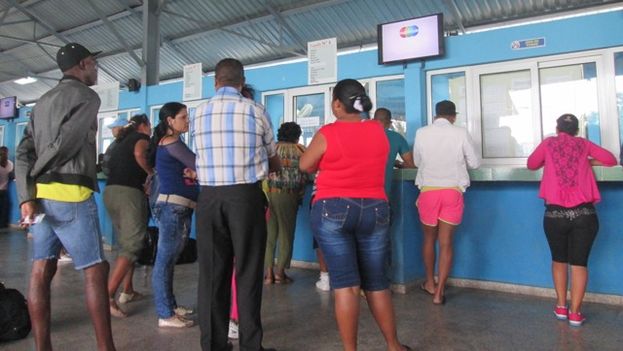
The "last minute" terminal in Havana for the purchase of interprovincial bus and train tickets. (14ymedio)
The “last minute” terminal in Havana for the purchase of interprovincial bus and train tickets. (14ymedio)

14ymedio bigger14ymedio, Marcelo Hernandez, Havana, 18 July 2016 – “Give me the suitcase, I’m off to the countryside,” says the chorus of a tune that gets more popular during the school holidays. Many families visit their relatives in rural areas, travel to tourist destinations in other provinces, or spend some days camping far from home. Interprovincial transport collapses with the high demand in July and August, while customers’ criticisms also intensify.

Under a roof of metal tiles that converts the place into a free sauna, hundreds of people are waiting this weekend to travel “last minute” or “on the waiting list” from the terminal on Puerto Avenue in Old Havana. Some of them no longer remember when they got there, because the hours have passed one after another, without hearing the good news that their number in line can board the next bus. continue reading

The expansive hall is a place where people spend a lot of time. Friendships are created there, some play cards and others take advantage of no one looking to have a sip of alcohol to help them forget the fatigue. The most impatient end up paying a private car to take them to their destination at ten times the price of the official ticket.

Iliana has worked there since they opened the new “last minute” terminal and knows that in these summer months the provinces most in demand are those in the east of the country. A situation that is repeated “at the end and beginning of the year, on some special dates such as Mother’s Day, school holiday weeks and summers.”

Near Iliana a woman dozes on a suitcase, a little boy cries because he’s hot and a furtive peanut seller manages to sell some of his merchandise. All are attentive to the monitors that announce the numbers on the waiting list that can board the next bus, but for several hours no vehicle “has seats.”

A murmur of discontent spreads among the passengers with the first numbers on the list of routes that are longest, to the east of the island. “That’s because the drivers themselves and the conductors resell free spaces before they get here,” complains a father with three kids.

The man asserts that the buses leave from the central Astro terminal, near the Plaza of the Revolution, and between there and the waiting list terminal
“the employees themselves sell the unoccupied seats, arriving at the terminal with only one or two, to be consistent with the formalities.” No other passengers join in the customer’s outraged complaint, some look at the floor and others fan themselves mechanically, their eyes glazed over.

The most prudent travelers are not at this location. They bought their tickets three months ago from the state interprovincial bus system, but such a decision takes a lot of forethought and quite a bit of risk. “I just had to be sure of getting to Morón after my wife confirmed she’d have a vacation from work,” said Raudel, who is from Ciego de Avila but has been living in Havana for the last two decades and this weekend is waiting at the “last minute” station.

Two young men in a corner of the hall decide not to wait any longer. “I’ll buy the ticket outside, because I have to be at my sister’s wedding in Palmarito del Cauto and if I don’t leave now I won’t get there in time,“ one of them tells several customers who are seated nearby. The young man will add to the 169 peso coast of a Santiago de Cuba some 15 convertible pesos – for a total of more than three times the official price – to get there.

“It won’t fail me,” he says, and he notes a connoisseur of the “mechanism” that makes things appear even when the blackboard says they’re out. “I pay and I get on the bus a few blocks from here,” he explains. “No one sees me and it’s just an agreement between the driver and me.”

Some have listened to the call to be careful. “The inspectors are everywhere,” warns a woman heading to Trinidad. There is a lot of surveillance, but it doesn’t fix the problems with transport, what they have to do is import more cars and lower the prices of the tickets which are too high,” she says.

In the recently concluded session of the National Assembly, the deputies criticized the constant violations in the itineraries in urban and interprovincial transport in the country. Also figuring into the debate were the corruption in the sale of tickets at some terminals, irregularities in the vehicle control stations, and the poor maintenance of the roads.

The deputies also mentioned the lack of comfort in the Yutong buses – from China – which operate on the interprovincial routes of the state company Astro, the lack of information for travelers, the disconnect between ticket prices and service, the overuse of the equipment and the poor cleaning standards. But this is only a distant echo for travelers who, lately, suffer firsthand the rigors of getting around the island.

Night begins to fall in the “last minute” terminal and some get comfortable in a corner planning to sleep on their luggage. “I do this twice a month, so this place is like my second home,” says a young woman who studies at the Higher Institute of Art. The rain sounds on the metal tiles and the loudspeaker emits the lucky numbers of those who will take the next bus.

Is This the Second Phase of Cuba’s Special Period? / Iván García

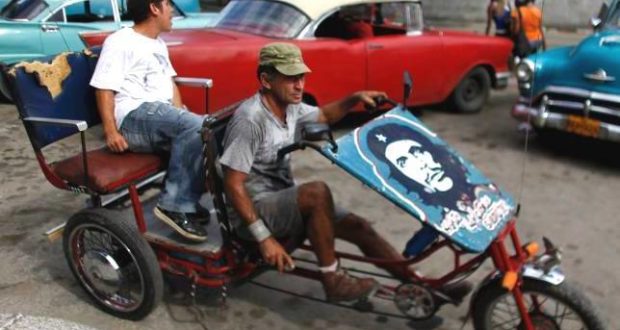
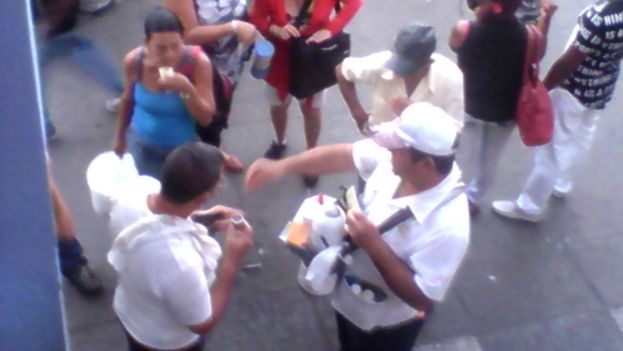
Havana bicycle taxi, from ABC.

Joel, a fifty-five-year-old engineer, remembers the summer of 1994 when, after finishing his day job, he came home to roast two or three pounds of peanuts. After packaging them in paper cones fashioned from the pages of school textbooks, he went out to sell them on the street and make a little extra money.

As a result of sudden inflation, his salary lost its purchasing power. “At first I was embarrassed,” he recalls. “I was a skilled professional, but I had to feed my children. The Special Period was terrifying. The peso’s value evaporated. My wife and I had to look for other options to survive. I sold peanuts and she became a landlady.” continue reading

Cubans over twenty-five would like to forget this period of daily twelve-hour blackouts, one meager hot meal a day and a primitive, subsistence economy. The Special Period most closely resembled a war without aerial bombardment.

Oxen replaced tractors and public transportation turned into an ordeal. Cats, frogs and pigeons became sources of protein in the family diet. Along with food shortages, Cubans had to get around by taking long walks or pedaling heavy Chinese bicycles. People lost weight. Others fainted due to malnutrition and many became ill.

The dollar soared. The exchange rate was one dollar for 150 pesos. An avocado cost 100 pesos and a pound of rice went for 120. The constant pressure of Fidel Castro’s unbending single-mindedness erupted in the so-called Maleconazo* on August 5, 1994. This mass uprising in Havana was sparked because men and women of all ages were desperate to emigrate.

Then came Hugo Chavez. He was like a Caribbean Santa Claus. An ideological ally of Fidel Castro, he hooked up the island to a petroleum pipeline.

Officially, the ongoing economic crisis in Cuba has not ended, though inflation has been reduced. Modest reforms have allowed small private businesses to open and independent farmers to sell surplus produce at market-rate prices, which have improved daily life.

But now people suspect that, given the economic, social and political crisis in Venezuela, we may once again be seeing a period of extensive blackouts, malnutrition and a 35% contraction in GDP looming on the horizon.

Sources have confirmed to Marti Noticias that, starting on July 1, a series of cuts to public services will be implemented. Luis Alberto, a bus driver in Havana’s Lawton district, says that “in the coming days the number of trips along various routes will be reduced in order to save fuel. Some drivers will be laid off and will have to join work brigades or fumigate houses in the fight against the Aedes aegypti mosquito.”

Daniela, an employee of the telecommunications monopoly ETECSA, says that “after a company meeting it was decided to make some adjustments. The amount of fuel for transport will be reduced. Air-conditioners in offices will be turned off after 2:00 PM. Some staff will see their salaries and work schedules cut by half or will be assigned to other duties. It won’t affect all branches of ETECSA, though. Crews working on the internet pilot plan in Old Havana, for example, will not see cuts.”

Nuria, an official at the electric company says, “New measures are definitely being taken to reduce fuel and electricity consumption but not to the degree that many people think. For now, there are no scheduled blackouts planned. The electrical distribution network is powered by domestically produced diesel and is not dependent on Venezuelan oil. But if fuel consumption targets in all the provinces are not met, there could be blackouts.”

A worker at CUPET, the state petroleum company, points out, “So far, there has been no reduction in the number of barrels of oil imported from Venezuela. But it is true they have taken measures to reduce fuel consumption, which has shot up, and to have a larger reserve in case there are negative developments in Venezuela.”

“And what if Nicolas Maduro and his party lose power through a recall vote and the Venezuelan opposition cancels the energy contracts? Is the Cuban government prepared to deal with the loss of this supply?” I ask him.

“I assume the government is prepared for this eventuality but I don’t have any evidence to support this,” he adds.

Conrado, an economist, does not believe this amounts to a second phase of the Special Period but the Venezuelan crisis and the contraction of the Cuban economy in 2016 are worrying signs.

“There’s no denying that, if the state of affairs in Venezuela were to change, our economy would suffer,” says the economist. “But it wouldn’t be like the years that coincided with the collapse of the USSR and the Soviet bloc in Eastern Europe. Imports and exports are more diversified now than they were then. I must add, however, that the country’s purchasing power does not allow it to buy ninety to a hundred barrels of oil a day on the world market, even with prices at less than thirty dollars a barrel. In the worst case scenario there could be significant fuel reductions in some industrial and service sectors, and blackouts might return, though they would not be as prolonged as they were before.”

For Carlos, a sociologist, the million-dollar question is whether people are prepared for a new period of shortages and blackouts.

“Since 1994, the harshest year of the Special Period, more than 800,000 Cubans have emigrated, either legally or illegally. The country has felt the impact. The emigres included professionals and, more significantly, young people. There was no sector of society — whether it be sports, culture or industry — that has not suffered significant losses due to the exodus.”

He adds, “The aging of the population and the dissatisfaction of most citizens with what they consider to be a bad government places Cuba in a different context today than it was in twenty years ago. In spite of Raul Castro’s economic reforms, emigration has increased. And another Special Period, no matter how mild, would increase social anxiety, which is already quite high. In a hypothetical situation like this, the reaction cannot be predicted.”

Faced with the silence of the official press, Havana residents often turn to the internet to communicate with family members and friends overseas and to search for information on international and independent Cuban websites. This was the case with Elvira, a sixty-six-year-old retiree who — after reading the article “Alarm in Cuba” on the Florida-based Cuban news website Cubanet — decided to look further into the alarming news.

“A few days later, I read a Reuters article about anticipated electricity and fuel cuts in Cuba,” she says. “For me this confirmed that things are serious. To be forewarned is to be forearmed. I told my children that we must be prepared for this Special Period so that we are not as unprotected as we were the last time.”

Misinformation generates rumors. Cuban state media tries to control them by offering the public clear explanations about the country’s 2016-2017 economic and financial situation.

It is the least they can do for those Cubans who who lived through the era, labelled by Fidel Castro the “Special Period in a Time of Peace,” as well as for those who are too young to remember it.

Neither Joel the engineer nor Elvira the retiree think there will be a new Special Period, barring “a time of war.” But neither do they believe the government has a Plan B to deal with the approaching storm.

Marti Noticias, July 4, 2016

*Translator’s note: A spontaneous demonstration named for the seaside promenade and avenue where it began. After Cuban authorities seized four boats headed to the United States without authorization, demonstrators attacked police, looted stores and shouted anti-government slogans. It later spread to other parts of central Havana and over one-hundred people were arrested before it was put down. It served as a prelude to a mass exodus from the country which occurred later that year.

“It Has Sparked Harsh Repression” / 14ymedio

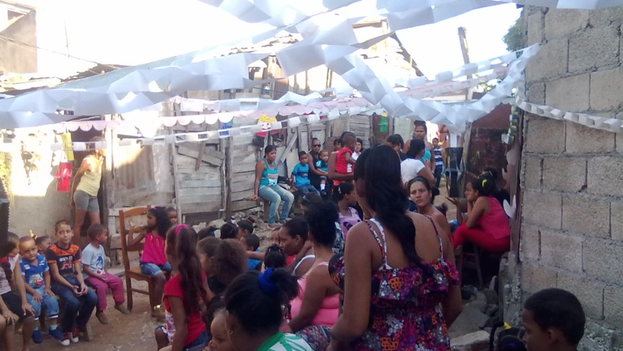
A few months ago police stormed a children’s party being hosted by UNPACU. (Twitter)

14ymedio bigger14ymedio, 21 July 2106 — The harassment against the Patriotic Union of Cuba (UNPACU) intensifies. Several activists of the opposition organization have denounced the up to five raids that took place in the early morning hours this Thursday.

Ovidio Martin Castellanos, a member of UNPACU’s Coordination Council in Santiago de Cuba, confirmed to 14ymedio that antiriot troops entered the home of Jose Maria Heredia, on 8th Street in the Mariano de la Torre neighborhood. “They mixed antiriot troops with the political police. At the front was a Major from counterintelligence who calls himself Bruno. Once inside the house, they seized and stole his possessions. continue reading

Carlos Amel Oliva, on hunger strike since last July 13 “to protest the arbitrary confiscations” experienced similar interventions to those of last night, also explained in detail the raid on the house where the Heredia cell is organized and where the father of the youth leader Carlose Oliva lives.

“The operation was led by three State Security officers known as Charles, Bruno and Julio Fonseca. The troops were assault troops, officers fully clothed in bullet-proof vests with long shotguns. They entered my house, tearing down the first door, and taking a video camera and some documents. They also went into the house of some neighbors who have shown a lot of solidarity with me in previous days and took a laptop and hard disk from them,” he said.

The operation was even extended to a kindergarten managed by UNPACU that serves 20 children, children of sympathizers of the movement. There they confiscated a laptop and “frightened the coordinator who cares for the children,” according to the activists, who were relieved that the raid occurred at dawn and that there were no children in the house.

“It has sparked a harsh repression,” says Ovidio Martin, who adds that at Yasmani Magaña’s house, in Palmarito de Cauto, various slogans were painted on the walls, including “Viva Fidel.” According to the opponent, eleven people were detained in this operation, driven approximately 10 miles away and beaten before being released far from town.

“This wave of repression comes because the regime knows the situation that is looming. They are preparing the population for a new Special Period, because people don’t want to live through that again. To us, we are determined to take to the streets and we have attracted their sympathy, and they have intensified harassment because they are afraid that people are joining and becoming activists,” he says.

Carlos Amel has taken advantage of the new wave of attacks against the organization he belongs to, to detail the reasons for his hunger strike. Despite being determined not to eat until they return his belongings, he clarifies the meaning of his words. “It is not [for] a laptop and a computer, they are things that are not worth the life of any human being, but because they arrest us when we go out. Or come into our homes and take whatever they want. This is a constant violation of our rights,” he denounces.

Oliva has shown his appreciation for the support he has received from his organization and other opposition groups such as Somos+ (We Are More) and FANTU (Anti-Totalitarian Forum), and in real solidarity with Guillermo ‘Coco’ Fariñas, on hunger strike as of this Wednesday.

“I am a little weak physically, but firm in my position,” says Oliva. “I have received many calls from abroad, from friends, from media… it is very comforting, for someone on a hunger strike this is the only source of strength.”

Fariñas Begins Hunger And Thirst Strike To Demand Dialogue With The Government / 14ymedio

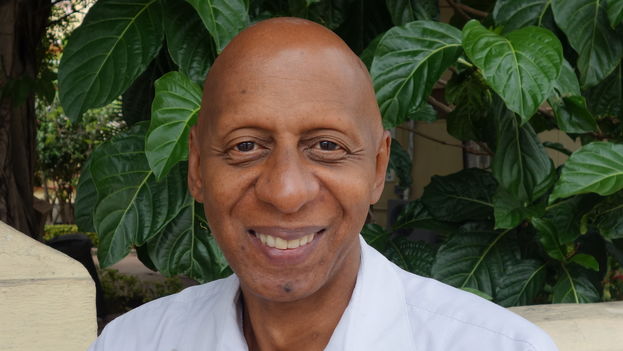
Cuban dissident Guillermo Farinas. (Wikicommons)

14ymedio, Havana, 20 July 2016 — Guillermo Fariñas, winner of the European Parliament’s Sakharov Prize for Freedom of Thought in 2010, has declared a hunger and thirst strike and as of dawn Wednesday to demand an end to the beatings of non-violent opponents in Cuba and that a dialogue be opened with government.

“It would be cynical of the Cuban government, which was a mediator in the dialog between the Colombian [FARC] guerillas and the authorities of that country, to be unable to sit down and dialog with a non-violent opposition to avoid these beatings and other outrages,” he said in a conversation with 14ymedio. continue reading

The opposition figure is asking Cuban president Raul Castro to “publically commit before national and international public opinion to cease these beatings, torture, death threats, the creation of false criminal charges against opponents, searching dissidents’ homes and confiscating the personal belongings of opponents,” and that the government “designate a vice president to meet with 12 prominent leaders of the internal opposition,” responsible for ensuring the end of the violence.

The announcement comes after Fariñas denounced, on Tuesday, a beating by police officers in Santa Clara, and would direct the Fifth Police Station to communicate with the Pinar del Rio Unit where a member of the Anti-Totalitarian Forum (FANTU) – the group Fariñas coordinates – who was arrested last Thursday.

“I offered no resistance, but they still beat me, they threw me into a patrol car, they forcefully handcuffed me, and used a strangulation technique to drag me to the patio behind the Central Fire Station in Villa Clara,” he says. The opponent said that after being transferred to the Provincial Criminal Investigation Unit in Villa Clara, they left him “handcuffed and exposed to the sun” and officials from the Special Brigade continued to beat him. “They told that this was the rigor that they would apply if I went out into the street again, better I dedicate myself to writing, because they would kill me,” he says.

Fariñas also wrote a letter to Raul Castro, in which he says he was “tortured while handcuffed by members of the Special Brigade of the Ministry of the Interior in the province of Santa Clara.” In the missive, he emphasizes that his phenomenon forms a part of the “wave of abuses, terror and violence,” that he has unleashed against “the non-violent opposition, which civilly faces totalitarianism.”

Fariñas has undertaken many hunger strikes. In 2010 he received the European Parliament’s Sakharov Prize for Freedom of Thought after 135 day strike in protest against the death of Orlando Zapata Tamayo and in a demand for better condition for 26 of the 75 prisoners of the 2003 Black Spring, who were suffering serious health problems. Finally, this strike and its media impact were decisive in the beginning of the process of negotiations that ended with the release of the 75 detained since March of 2013.

Guillermo Fariñas Letter to Raul Castro

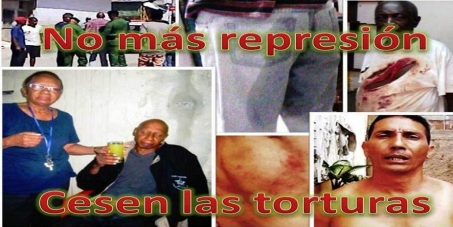
No More Repression. End the Torture.

Fariñas’ Letter to Raul Castro

Santa Clara, Cuba, 20 July 2016

General of the Army Raul Castro Ruz, President of the Councils of State and of Ministers of the Republic of Cuba

Sir:

Yesterday, on 19 July of the present year, I was tortured while handcuffed by troops of the Special Brigade of the Ministry of the Interior in the province of Santa Clara. Because of group of us, militants of the United Anti-Totalitarian Forum (FANTU), were going to the 5th Unit of the National Revolutionary Police (PNR), to inquire about our member falsely charged in the province of Pinal del Rio, Jose Rolando Casares Soto, and about a member of the Patriotic Union of Cuban (UNPACU), Carlos Amel Oliva Torres, who is on hunger strike in Santiago de Cuba.

To present oneself before an establishment of MININT is not a crime, according to current laws, if one is not carrying allusive posters, distributing propaganda, or shouting a slogan against the regime, and that was what we militants of FANTU were doing when we were violently arrested. continue reading

The above is a small sample of the wave of abuses, terror and violence that the repressive authorities of your government unleashed about 19 months ago against the non-violent opposition that civilly confronts totalitarianism.

And that can trigger an escalated violence among Cubans, resulting in a civil war, something that I do not want for my Nation and I think you do not want it either. You and the MININT Special Brigade members – Anti-riot –who tortured me when I was defenseless, and called me a Mercenary.

Let me clarify, that to be a mercenary one must meet two conditions: 1st – To be fighting outside one’s country of origin, and 2nd – To be at the service of a foreign power. I fight within Cuba and I was born in this land. I only accept having been a mercenary when I fought in Angola and was in the service of the Soviet Union, a foreign power.

With regard to the second, let me clarify, it is true that I receive material and financial support from anti-Castro exiles, something that does me honor, because these compatriots in the diaspora do not forget the suffering of the Cuban people. Something that you and your supporters have no moral authority to criticize, because when you were fighting Fulgencia Batista y Zalvidar, the exiles financed you, or where did the money come from to buy the yacht Granma, a boat financed by the exiled ex-president of Cuba Carlos Prio Socarras?

Also the heroes of independence Jose Marti and Antonio Maceo received material and monetary help from Cubans in exile. And so, General of the Army, if we are mercenaries you also were.

And I believe that neither Marti nor Maceo had been. For all the reasons detailed above, I am declaring as of today I am on a Hunger and Thirst Strike, until you declare publicly – and your words are published in the official newspaper Granma – that we opponents are not to be tortured, beaten, threatened with death, we will not be subject to spurious charges and we will not have our personal property confiscated.

Also that you designate one of your vice presidents to meet with a dozen prominent leaders of the non-violent Cuban opposition to realize the fulfillment of your promise. I hold you and your government responsible for my life and the lives of all non-violent Cuban opponents as of this moment.

General of the Army I urge you to act as a Cuban patriot and not as an ideological militant of one ideological trend. That you recognize that no Mercenary offers his life for pro-democratic ideals and that it is our right, recognized by the Universal Declaration of Human Rights, to always think differently, in a non-violent way.

Without further comment I am,

Guillermo Fariñas Hernandez, Psychologist, Winner of the European Parliament Andrei Sakharov Prize, Coordinator General of FANTU

Repression Instead of Solutions / Fernando Dámaso

almendrone
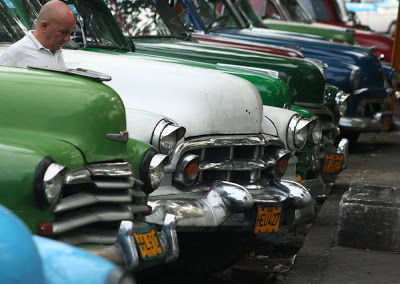
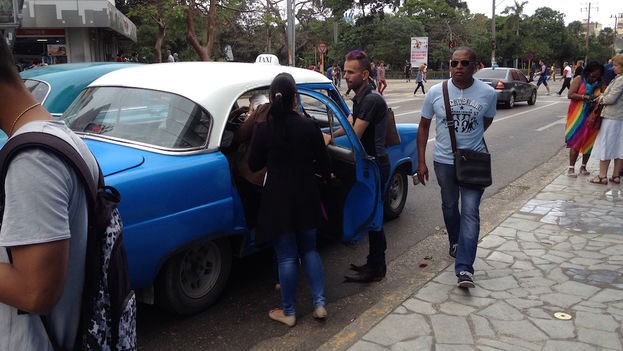
Old American cars of the kind generally used as shared fixed-route taxis in Havana.

Fernando Damaso, 19 July 2016 — The topic of discussion among Havanans today is not only the intense heat and “the evil of it,” but also the beginning of the persecution and repression against self-employed taxi drivers who have raised their prices.

Given the lack of public transport, which has been going on for a long time, the so-called “boatmen” — as the private drivers are called — have been a boon to citizen transport, helping to alleviate the problem. Taking into account the cost of their vehicles, from the high prices of fuel, the nonexistent parts for repairs, and the increased taxes they have to pay, they have raised their prices. continue reading

The response from the Council of Public Administration of the city’s People Power, a regressive and inefficient replacement for the former Mayor, has responded with controls, sanctions and withdrawal of licenses from those who violate the previous prices, all of this being applied as of this last Monday.

Cuban leaders should explain to the citizens why they destroyed the systems of public transportation that functioned efficiently at low prices prior to January 1959, and in 58 years have not been capable of creating one that works.

Repressing those who help transport citizens, in the face of the state’s inability to do so, is not a good decision, and if they don’t stop doing it the situation will become chaotic and could even become violent. The need to move from one place to another has existed since the dawn of mankind, and is not resolved with decrees or impositions, but with efficient and sufficient public transport.

Guilty! / 14ymedio, Yoani Sanchez

This summer, taxi drivers have become the government’s new public enemy. (14ymedio)

14ymedio bigger14ymedio, Yoani Sanchez, Havana, 20 July 2106 – At the beginning of the year evil was incarnated in the intermediaries, who were blamed for the high food prices in the produce markets. At the end of 2013, the boogeymen were those who worked for themselves selling imported clothes and other merchandise. In February of this year the war against the pushcart vendors reached its height, and today the enemy drives a shared taxi, a person who in common parlance is called a “boatman.”

If there is anything that has characterized the Cuban system of the last 57 years it is its ability to find a scapegoat. When the agricultural plans are not met it is the fault of the drought, the indiscipline of the workers or the poor organization dictated by some low-ranking bureaucrat. If in times of heavy precipitation the water supply remains unstable in towns and cities it is because, “the rain is not falling where it should,” as was explained to us in recent statements by an official of the National Institute of Hydraulic Resources (INRH). continue reading

Urban transport does not work well due to “vandalism” and because “the population doesn’t treat this equipment as it deserves,” they tell us. Meanwhile most road accidents are because of the “recklessness of the drivers,” and not because of the poor state of the roads and highways, the terrible signage or the inventive measures taken by drivers to keep their obsolete vehicles running.

The powers-that-be point their index fingers in all directions to accuse others, but never turn it back on themselves. From time to time, to display a certain tone of self-criticism, they come down on Communist Party members themselves, and accuse them of not voicing their opinions “in the right place and at the right time,” or they make some minister take the fall for the failed policies in the areas of public health, education or some other sector.

We citizens are the main culprits, according to what state television tells us, for the presence of the Aedes aegypti mosquito that, for years, has failed to yield to spraying or campaigns against it. Our homes are the “main foci” of the mosquito, they spit at us from the press, as if state and government entities were untainted redoubts of cleanliness and order.

Emigration is also among our sins, because we go in search of “siren songs” and let ourselves fall “into the hands of the coyotes,” declares the Castro regime’s discourse. In this script it is third parties who are always to blame; the migrants who protested in front of the Cuban embassy in Ecuador were ‘scoring points’ with the United States and some of them, once they are settled in our neighboring country to the north, will end up sending “illicit funds” to their relatives on the island to support a private business.

The easiest to find are the external enemies, like imperialism, “the criminal United States blockade,” the conspirators “from the Latin American right,” and even the “historic betrayal” of the old comrades of Eastern Europe. This scarecrow to install fear is accompanied by the demonized “counterrevolutionaries” in our own backyard, who are targeted by all the insults the rude government machinery has created over almost six decades.

If products are missing on market shelves, television reports accuse the “profiteers.” If a papaya has come to cost an entire day’s wages for a professional, it is “the fault of the unscrupulous” who want to “profit at the expense of the people,” or so they lecture us from the little screen. In this apportioning of blame we have all been placed in the center of the allegations.

Right now the government propaganda apparatus is taking on the drivers of shared taxis, but tomorrow it could be the proprietors of private restaurants, the teachers who offer private tutoring, or the water carriers who sell their precious commodity in neighborhoods where the pipes have run dry for weeks now.

There will always be an “evildoer,” an “irresponsible” or an “enemy” that keeps the system from working in all its great manual-guided humanity, its never demonstrated efficiency, or it supposed but still un-proven capacity to make Cubans happy.

But the strategy of blaming others, in waves and programmed installments, has a weak point. There comes a time when the culprits outnumber the accusers. There is a second in which, from this side, from the stigmatized, we agree with the rafters, the dissidents, the pushcart vendors, the self-employed, the taxi drivers, the ousted ministers and the vilified trinket sellers. At this point, where we have been for a long time now, we have every right to point our index fingers at the system that has condemned us to the perennial dock of the accused.

Hurricane Isidoro’s Victims Are Still Waiting / 14ymedio, Ricardo Fernandez

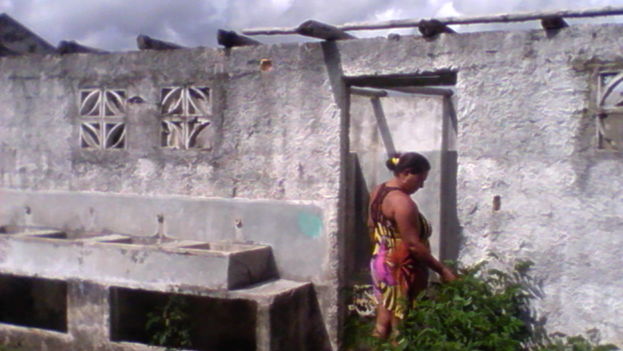
14 years after Carlos Lage’s promises, the victims of Hurricane Isidoro remain without their homes. (Ricardo Fernandez)

14ymedio bigger14ymedio, Ricardo Fernandez, Pinar del Rio, 19 July 2016 — “I pledge that very soon you will have your homes,” Carlos Lage Davila, vice president of the Councils of State and Ministers, said in 2002 to those who had lost everything and still today have not received what he promised.

Alexander Sanchez Villafranca, 33, was one of those affected by Hurricane Isidoro. “If I had listened to my mom and had cut down the mango tree, I would not be in this shelter. I never thought that the wind could pull it up by the roots,” he says. His home, at kilometer 1 in Santa Damiana, was reduced to rubble under the weight of the tree. He is among the 16 families living in shelters in Portilla in Rio Seco, in San Juan y Martinez municipality, as a result of Hurricanes Lili and Isidore. continue reading

The place, 19 kilometers from Pinar del Rio, had been a military unit of the Youth Labor Army (WCY), then in 1994 became a Battalion Task Force that housed those who came to support tobacco workers, and in 1995 it became a warehouse for oilcloth.

In 2002, after the hurricanes, they used it to receive the victims from Santa Damiana, Forteza and Rio Seco, who had no means to rebuild their own homes. Within a month of being there, they received a visit from Carlos Lage Davila, accompanied by former first secretary of the Party in the province, Maria del Carmen Concepcion, and other government and party officials.

At first, the mass organizations delivered lunch and dinner to residents, who were seen by a family doctor daily. Then-delegate Sergio Carrelegua visited them frequently and at meetings urged them to be patient and assured them that the promises would be fulfilled. “A few months later the attentions and promises disappeared,” recalls Sanchez, now married with a daughter of six who has known no other home. “Over time the roofs began to deteriorate and the solution from the delegate was to remove the roofs over the bathrooms and use them to replace the broken tiles over the bedrooms, so the toilets have no roof.”

The situation gets worse in the spring because of the rains, and for the elderly, whose health is delicate, dampness is a greater risk. “In the rainy season you have to do everything (even the physiological needs) in your bedroom,” says an old woman to illustrate the “hell” she is living in.

“I don’t know how many times I’ve gone to the municipal government to demand that they help us, but they don’t do anything,” says Arelys Rodriguez, Sanchez’s wife, while showing off the poor hygienic-sanitary conditions of the outdoor bathrooms. “I have to carry water from the neighbors’ house, because the raised tanks are uncovered and are filled with decomposing frogs, bats and even pigeons. I’d die before I drank that water,” she says with disgust.

Sanchez talks about his effort in agriculture, the work he does as a laborer, hoping that a relative living in the United States will help get her out of the hostel and he can buy a house. Meanwhile, her little daughter Thalia flits around her. That little girl, with her innate curiosity and boundless naiveté, manages to help Sanchez forget for a moment the neglect and misery that surrounds her.

Cuba: Where is the Money? / Iván García

“50 years of communist rule have yielded an unlikely product – unspoiled beachfront property and world-class golf.” A quote from a promotional site about the new Carbonera Club project in Varadero which will be dsigned with advice from British golfer Tony Jacklin and British design guru Terence Conran.
“50 years of communist rule have yielded an unlikely product – unspoiled beachfront property and world-class golf.” Quote from a promotional site for the new Carbonera Club project in Varadero which will be designed with help from British golfer Tony Jacklin and British design guru Terence Conran.

Iván García, 18 July 2016 — Two retirees, a strolling detergent vendor and a vacationing doctor, kill time in a park in south Havana, debating the surprising Portuguese victory of Cristiano Ronaldo in the European Cup. They also comment on the Regime’s new austerity measures, which presage another season of “skinny cows” [shortages].

Neither the shade of a carob tree nor a soft breeze relieves the sleep-inducing heat of July. When it seems that the topics of conversation are exhausted, a grey-haired man, a now-retired civil engineer, asks: “Does anyone know where the money in Cuba is going? And what the Government does with the millions of dollars it receives from family remittances?” continue reading

No one has an answer. On the Island, the topics of hard-currency income and defined expenses are State secrets. It’s supposed that in a normal country the government officials offer this information to its citizens.

But Cuba isn’t a normal country. It’s an anachronistic autocracy ruled by the military and a gang of friends who, 57 years ago, descended from the Sierra Maestra promising to restore the Republic and rescue democracy.

Neither one nor the other happened. For decades, the calculations on the Island have never added up. Hypothetically, taking as a reference the economic growth beginning from 2000, the national economy has shown a numeric chain of progression in its GDP that not even the so-called Asian tigers have achieved.

If we add up the growth in GDP of the last 16 years — which in some years was greater than 10 percent — we arrive at a simple conclusion: If we believe the official report, Cuba has been the nation that has grown the most on the planet.

Into what accursed black hole has this “growth” fallen? A specialist I consulted bored me with figures and macro-economic data. And finally, as always, he blamed the Yankee “blockade.”

Okay. So we can’t have highways like those in Germany, or as many cars as the United States or a State of Well-being like Norway. But according to Eduardo, an ex-official of foreign commerce, “from the concept of exporting products and services, [and the receipt of] donations and family remittances, the Government, each year, brings in around 14 to 16 billion dollars.”

“So, where is the money?” I asked him. His answer is an invitation to do the math.

“In 2015, Cuba earned 2.7 billion dollars from tourism. Although the exact figures for the export of medical and professional services is not known, it’s calculated that it must be above 9.0 billion dollars. The exports of nickel (we’re going to discount sugar, since its production has been rickety for five years), tobacco, coffee, shrimp, vegetal charcoal, bee honey and other sectors, would round off to some 1.5 billion dollars. And as far as remittances, 3.0 billion. The result adds up to some 15 billion dollars,” emphasizes the ex-official.

But it doesn’t add up. The State earns hundreds of millions of pesos in taxes just on the more than 500,000 private entrepreneurs. Add the tax on cigars and alcoholic drinks, the silent tax on the salaries of State workers and the tax — between 200 and 300 percent — on products that are sold in convertible pesos in the dollar stores.

To all these taxes we must add the petty milking of the pockets of Cuban emigrants, who must pay hundreds of dollars in order to renew their passports, the inflated price of flights from Cuba and the abusive customs fees. And although this past March the Cuban foreign minister announced that the 10 percent penalty on the U.S. dollar would be eliminated, this “revolutionary tax” once decreed by Fidel Castro continues in force.

Nor is this the only way of taxing hard currency that the Government has. If a relative abroad sends a package that weighs more than one and one-half kilograms, there is a tax established by the General Customs of the Republic, and when you go to pick it up at the post office, you have to pay 20 Cuban convertible pesos [roughly $20] for every kilogram over that weight. A veritable robbery.

Being conservative, the sum total of all these taxes in both monies surpasses 20 billion pesos. And I believe I’m cutting it short.

And the expenses? Of course, as in every country in the world, the three hungry lions that devour an important part of the GDP are education, public health and defense.

But since Raúl Castro assumed power in 2006, few new schools have been built, and the existing ones are poorly repaired. Salaries for professors and teachers don’t exceed 20 dollars per month.

Healthcare is self-financed from the export of medical services. The amount of money it generates permits the design of an efficient health system. But it doesn’t happen that way in most of the hospitals. Some well-equipped clinics exist for ministers, high-ranking military officers and foreigners.

But the majority of hospitals and polyclinics need thorough repairs, and there’s a deficit in the supply of equipment and medications. A doctor earns a salary equivalent to 60 dollars a month, and many live in precarious conditions.

For 27 years, the Government hasn’t invested in buying combat weapons. But it wastes an enormous sum maintaining the colossal apparatus of repression and social control. The Regime never offers details about this.

The hypothetical expenses for defense, education and public health can reach the sum of 6 billion dollars, another 2 billion to buy food and some 5 billion for investments in tourism and industries that generate hard currency.

For 10 years, General Raúl Castro’s administration hasn’t spent its millions on public works or on the construction of housing. Any serious calculation that would be done would always reveal a surplus.

Where does all this money end up? There are two possible scenarios. The evil-minded one is that it goes into a Swiss bank account or a fiscal paradise. If we give the Government the benefit of the doubt, we can suppose that a good part of the money goes to create an important reserve of hard currency.

Not included in the national budget is the resale of some 25 percent of the petroleum sent by Venezuela to Cuba, which can reach around 8 billion dollars a year.

With the income from exports that the Government admits it has, and the studies on the income from family remittances, about which the Regime never informs us, it’s not understood how it spends 1.9 billion dollars a year to guarantee the annual supply of petroleum.

Nor can it evade the issue of donations made by millionaires from Middle Eastern countries for renewing the networks of aqueducts and sewers, and credits from China, Russia and other countries for constructing industries, hotels or golf courses.

Cuba, financially speaking, has achieved considerable guarantees. In spite of the embargo, since 17 December 2014, after the diplomatic renewal with the United States, a dozen nations have forgiven a substantial part of its debt.

Like the retired civil engineer, many Cubans wonder what the Cuban government is doing with the money. Any hint would be very valuable.

Diario las Américas, July 16, 2016

Translated by Regina Anavy

A Conversation with Orlando Luis Pardo Lazo / Regina Anavy

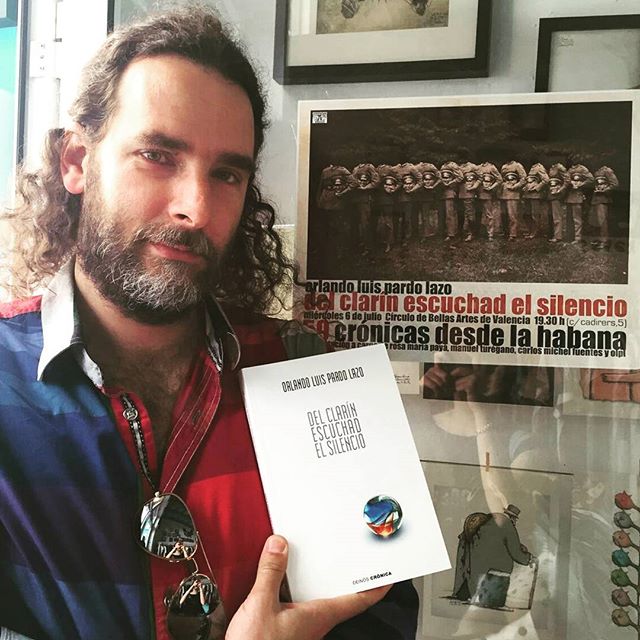
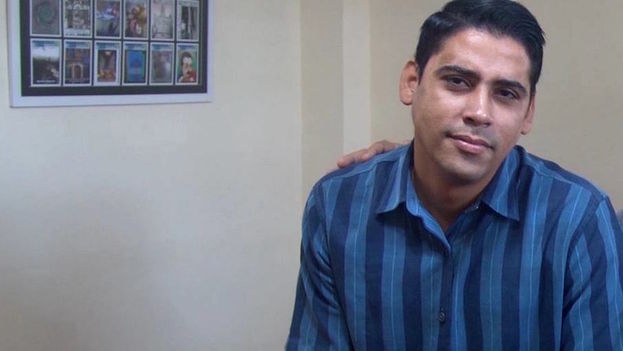
Orlando Luis Pardo Lazo with his most recent book, Del
Orlando Luis Pardo Lazo with his most recent book

Regina Anavy, Reykjavic, June 27, 2016 — Crossing paths with Orlando Luis Pardo Lazo in Reykjavic, Iceland, on June 27, 2016, I had the opportunity to have a conversation with him.

Iceland And Future Plans

Regina Anavy: I understand you are here on a special two-year grant from ICORN [International Cities of Refuge Network].

Orlando Luis Pardo Lazo: Yes. ICORN is an NGO based in Norway. They make contact with city governments. They believe that working with cities is better than working with countries. Maybe there is a conflictive immigration policy, but the cities are happy to have you. So in Europe they have dozens of cities, and I think in America now Pittsburgh is becoming an ICORN city and maybe Las Vegas. But after a year [in Iceland], I will be going back to the U.S., to enter a Ph.D. program in comparative literature at Washington University in St. Louis, Missouri.

RA: Are you going to be teaching or doing research?

OLPL: Mainly I will be a teaching assistant in the second year. continue reading

RA: Will you be teaching comparative literature in Spanish?

OLPL: I don’t know yet. I guess in both English and Spanish.

RA: Is that a five-year commitment?

OLPL: It could be up to five years to get a Ph.D. in comparative literature. It’s a special track, like a pilot program. It’s called “International Writers Track,” and writers are invited to the department. They know that we are not academics; maybe we don’t work or think as an academic, but somehow the purpose is to give us tools to understand the codes of literary criticism or academic essay. I write literary criticism, but it’s not with literary rigor; it’s my impressions. So it could be very interesting.

RA: So that will give you a Ph.D. in Comparative Literature?

OLPL: If I manage to get through to the end. There are several universities there; this is the one they call “Wash U” because it’s Washington University. I was there for a conference in January 2015. It was like a marathon. I went to an event for human rights in Chicago. There was a lady there, a professor from Poland, who had been following Cuban affairs, so when she found me on Facebook, she told me, “You need to come here. It’s a one-hour flight, and we will pay for you to go back to Brown University” [in 2015, OLPD was an Adjunct Professor of Creative Writing at Brown University]. I went there for a couple of talks, and she asked me about my future, and somehow she had the impression that my future was lost because I was not an American, and she said, “Maybe we can help you here. There is a new initiative going on.”

Finally they nominated me. I didn’t apply for this Ph.D. I mean I sent the documentation but only after I was nominated. Other universities had shown interest, but always you need to start by the phone consult, then the GRI test for mathematics, and maybe somebody assesses you there. But this process circumvented all that, and they were very kind.

They understood that I was here [in Iceland], so there is already one year deferred [for the Ph.D. program]. This is why I cannot defer any longer. So everything came together for Reykjavic and St. Louis, and I was “lost” but then suddenly had two options. I was able to manage, talking openly, to both parties. “I have this option, can I do this? Maybe not for two years, maybe for one; now’s the time to go there [Wash U.] and be a good student after being a bad boy.” I think I will be able to keep on with creative ideas for both these options and at the same time add some discipline, and the writing will be good.

The Future Of Cuba

OLPL: You know I was in Arizona, in April, at the Sedona Forum, with John McCain and the Director of National Security. I saw that they were mainly politicians, people with different positions regarding Cuba, people who have been traveling to Cuba. Usually you talk in front of human rights people who agree with you in a way, but these were people who can really change things.

I was happy to talk there on a panel with plenty of dissidents, and there were Russian dissidents and the realities were terrible, really terrible, and I was somehow trying to put some ideas into this “new cake” about Cuba and how it is not about the embargo but to make sure that we are moving into freedoms in one way or another, not just trying to make money, or like China – the Tiananmen Square Massacre. Are we moving into that or are we making sure from the beginning ….?

RA: Well, that’s what it should be, the human rights situation.

OLPL: Sometimes I become really skeptical and sometimes I push very hard.

RA: Because it’s all about business. It’s all about making money. And “Oh, the Cubans can be entrepreneurs now.” Yes, as long as the Government lets them. It could be taken away tomorrow. There’s no law.

OLPL: The legal space is very limited. Technically, you are not even an owner of your business. You have a license, and you pay a tax. But it doesn’t give you any judicial personality. You’re not registered as a trademark; you don’t have a lawyer for your business, and basically you have no rights. So you are a citizen, who maybe is making a lot of money now, because paladares [private restaurants] in Cuba are making a lot of money, but money is not [the same thing as] rights, and this is why when they close a paladar, nothing happens. Nothing. You’re not a person. But, anyway, it’s a process that is starting now.

RA: The other thing is that the money you earn in Cuba – where do you spend it? It all goes back to the Regime.

OLPL: All of it. You know, even remittances. We all need to help our relatives. We are talking of billions a year.

RA: I know. It’s one of the main things keeping the Government going.

OLPL: What is the option? There is no boycott.

RA: Are there other Cubans here besides you?

OLPL: Yes. That’s another story. The island has been conquered, completely conquered. Maybe there are over 50. I haven’t met them all, but there are stories, and, of course, not all of them are good stories about Cubans here. Legal troubles, violent troubles, our fellow countrymen. But I have met two or three families; some of them have family in Cuba. So there are beautiful stories. There is a young girl here who just had a baby, and she lived 50 meters from my place in Havana. I haven’t met her but my mother knows the family.

RA: How is your mother doing?

OLPL: She’s eager that I return to America so she can visit again, because she came once last year. She has a visa now. It’s a multiple entry visa, so she only needs to buy a plane ticket. Now it seems that shortly she will be able to buy one on American Airlines, maybe for $200. Because the prices are going down; capitalism is bringing down the prices.

RA: Did you request asylum in the U.S.?

OLPL: A green card. Let me mention something about that. The word “asylum” – I have entered America twice, since I left, before the six months, to keep the green card active, and also I have a reentry permit. It’s like a passport for non-U.S. citizens, that allows you to stay even up to a year, but I have been reentering every six months, less than six months, to avoid the bureaucracy.

And both times, it happens sometimes to residents, you are stopped; you are asked more questions. It seems when I show the reentry permit there is no problem, but suddenly something happens. Immediately they come and say, “Come with me, please.” I go to a room. That’s what I’m curious about. They ask no questions. They type all my information again.

I’m almost sure it is very governmental, like tracking a possible political activist, and then once, more than two times, there was a young girl there, a young officer. And I was trying to be gentle with her; it was a little like Cuba, and then I said to her, “May I do anything here while I am in America, because I will be reentering the country several times? Maybe I can save your time; you can save my time, if a document is missing…”

“No, no, no, no, no.” Very Latin, maybe she was telling me a little more than what she had to tell me. “It’s very likely that you will be stopped every time you reenter, but there is no reason; there is no problem, and that’s okay. Because you are a political refugee, no?” I said, “No, not at all.” But that was a bit of information. I am a normal cubanito. I didn’t know what to say so, I just said, “No, no, no, I’m a resident.” I was surprised, and maybe there is some kind of…”

RA: They’ve flagged you.

OLPL: Yes, like “This is a trouble-maker…”

RA: But why don’t you just get in and…?

OLPL: Maybe. But it was not about that. When I was in America, I obtained my residency in 2015.

RA: So you’re a resident.

OLPL: Yes I am. I have a green card. I’m not requesting…

RA: But you don’t want to become a citizen?

OLPL: I cannot do it until 2018. So Cuba will change; I will change. America will change. I don’t know exactly how. I haven’t made up my mind.

RA: Do you think Cuba’s going to change enough by 2018 that you would want to go back?

OLPL: I don’t know.

RA: I doubt it, frankly.

OLPL: Yes, but there is always a biological solution.

RA: Even so, they’re still going to be in charge.

OLPL: I know, I know. It depends also on – I mean, I have been looking for a kind of empowerment, I hate the word because it’s been used now to empower society, but, let’s say I am trying to position myself, not only as a Cuban blogger or dissident, but as something else. Let’s say I’m waiting for a book to be published or to be well-known, maybe something like a Ph.D. or this fellowship for a Ph.D. scholarship, something that makes my name known – a prize, a literary honor, so that when I decide to return, their lowest price is to ban me from reentering, but if they allow me to reenter and harass or detain me, that will have a high political cost for them.

So I am trying. I don’t know how exactly – but in my mind, the scenario is that I think Cuba is not likely to be democratic in two or three years, but I am thinking that the political cost will be high, and then I will be willing to do it, to get a ticket and be stopped. I can even do it without an entry permit. I have a passport, and my passport is good for the next four years.

RA: But you have to keep renewing it.

OLPL: Renewing is like a stamp. Not a passport, I mean. You understand that the expiration in my passport is 2020. But what they call renewal is like a stamp that you pay for, a visa for two years. I need a visa for my country with a valid passport. But even that – I can apply for it, but I am afraid that – another consideration is that you need to deliver the passport.

And Tania Bruguera [Cuban installation and performance artist] three years ago delivered her passport, and they kept it for one year before she could travel to Cuba. So when they gave the passport to her, somehow they felt, “Now you are tamed. You are low profile.” But she was one year without a passport. So I maybe need to go without any stamp and be stopped like that and show the Americans in line, or maybe they will allow me to enter. And then I will be safe from Cuba. If I can do it, every Cuban can do it.

Reykjavic

RA: Is there a Cuban Consulate in Reykjavic?

OLPL: Fortunately, not. I feel very, very, very happy. First of all, I met Cubans here, including the one who created a group Cubano Islandia. When the Ambassador comes from Cuba on holidays to visit beautiful Iceland, they prepare dinner. And one of the girls here, in one of my talks at the University of Reykjavic, was very critical. At the end she said, in English, “Okay, I know very well what I am talking about, because I am Cuban!”

When I am in public I’m not completely truthful, because somehow I know this is all about the repercussions – there were many professors there – and I said, “I’m so happy to find you, another Cuban. I wish that we could have this talk at Havana University. For five years I haven’t been invited; I haven’t been published, and you were not claiming for that right of a Cuban. We can have this conversation here, with all that anger; we can quarrel here and then shake hands and go back to our places. And nothing happens. There are no political police out there.”

So that was my answer, because you are talking in English in Iceland, and I really was surprised when she said, “I’m Cuban!” Oh my god, like “I’m Cuban, too!” And then some other friends told me that she had been organizing a dinner with the Ambassador. Everybody wants to be on good terms with the Cuban authorities.

RA: Oh, I think you gave that up a long time ago. Have there been any repercussions for your mother?

OLPL: No. Around the first year, maybe when I was making the decision to finally stay, they went to my neighborhood, to the block. They interviewed several neighbors but not my mother, of course, but my mother knew. “Maria, what’s going on with Orlandito? Something happened.” And my mother was very nervous that day, and they even pressured the young man and my friends who took me to the airport in 2013, to see if he was illegally renting the car. So it was this kind of stupid pressure; I don’t know what the purpose was.

RA: To scare them.

OLPL: And that was a tough conversation that I had with my mother, because when she called, very nervous – maybe that time they were listening – and I said very strongly, “Even if somebody shows you a piece of paper saying Orlando is dead, you don’t believe it, because you are in the hands of Evil. Where they print fake newspapers, where they talk to fake friends.“ I was very strong, and somehow she was more encouraged.

“So you say, ‘If he’s dead, he’s in the hands of God. I don’t care about any information from the Cuban Government.’ like that: ‘No, thank you!’ “ Because she was saying, “Something must have happened to you because they’re here asking.” After that, she was happy to be in America. I took her to conferences, and she was very happy to see a good environment and good people.

RA: Does she understand English?

OLPL: Very little. But at the end she was talking in the supermarket. She likes to buy stuff, food and things, and she was asking for something, and I was buying something else, and she went to a girl and said, “I want rice, white rice.” So she was getting more courageous. She doesn’t know anything, no, but she knows the word “rice,” and she said, “I want rice.” So when it comes to buying food, she was able to use English.

RA: Is there a large arts community here in Reykjavic?

OLPL: Yes, of course. And I would say everybody writes; this is crazy. Poetry, chess, readings.

RA: Are you learning Icelandic?

OLPL: Very little. I was trying to learn more but my time…. I mean, to read 10 hours a day and translate for a course I was taking, and then I said, well, I will not have one year of scholarship, I will have half a year, because I was putting a lot of energy into that, and then I quit. Maybe if I knew that I was going to be here for two years I would make an effort.

RA: It seems like it would be a difficult language to learn.

OLPL: Once you get the rudiments and you know the codes, you understand what is a verb and what is a noun. And then at some point you can incorporate new words very easily. At least I bring them from English, a lot of words. And even they don’t look like language. Many words, on the highway, the signs, because the bridges are only one-way. I don’t know the origin, the etymology.

RA: But you play with language anyway. That’s one of the things you like to do.

OLPL: Yes, I like to do that.

RA: You’re very good at making up words.

OLPL: Maybe in five years I can come here and work on a farm and teach Spanish. I wouldn’t mind being more like a hermit. Once having positioned myself in the literary field as an academic, or maybe publishing my novel that I’m finishing here, I will be more secure, and I wouldn’t mind being here for one year helping on a farm, making a little money. It would be like a spiritual experience, really, living with the landscape, but in a more permanent way than now.

RA: With this fellowship you have now, from ICORN, don’t you have to teach?

OLPL: No.

RA: Do you have to produce a certain amount of work?

OLPL: The “certain amount of work” can be one word. The application deals with reference letters and why you cannot do your work in your own country. So it is also a human rights organization. ICORN had a Congress in Paris in March this year. Some cities seem very active and push the writer to participate, but here, at the beginning, they told me, “No, you can be quiet.” I have been traveling in Europe because I have arranged that myself, but mainly I am forgotten here. They tell me, “Anything that happens, you call us; we can help.” They gave me some cards to go free to cultural centers, not all of them, but the ones that belong to the City Hall. They facilitate things here.

But I can be here for two years, and they will not be asking me to formally deliver 50 pages, even if it’s been written before. So it’s really a space and also a responsibility, because you are taking the place of someone else, and it’s a privilege. So it’s a good opportunity to move forward, even if I know that at the beginning I will be a little depressed, to be again in a city, surrounded by deadlines and people, but so far I have liked the people I have met here, and there are many reasons to remain.

RA: Is it easy to meet the local people here?

OLPL: Yes. They have a different code, but Reykjavic is really like a small city. So they are very willing to help with anything. At the same time they set limits. They help you and at the same time they say, “Okay, now it’s time to go.”

RA: Did ICORN help you find a place to live?

OLPL: No; it was granted to me. The house belongs to the City Hall. I like the place; it’s very nice. It has one room, a living room, a dining room, a kitchen and a bathroom, just in front of the City Hall.

The New Book

RA: I know you’re leaving for Spain soon to do presentations for your new book.

OLPL: Yes, Del clairín escuchad el silencio, a book of chronicles, some of my writings, my blog writing during the last five years. All of them have been published, but I rewrote every poem. I haven’t seen the book yet, because it’s very expensive to buy it and ship it to Iceland. The book costs $15 on Amazon, and then [I would] pay $30 for shipping [to Europe]. So I’ve decided to wait, but I’m very eager. I want the book.

RA: Can you buy it digitally?

OLPL: Not yet, but I want to talk to the publisher about that. It’s a very small publisher. Believe it or not, I had to buy a number of books. I managed to arrange four presentations in Spain. The publisher is Print on Demand. I said, “Maybe very few people will show up.” They said, “No, it’s vacation, maybe we can get 20 people there, maybe 30, 40.” I don’t know. But we can run out of books. This is very Cuban. So, I bought more books with my savings and forwarded them to the publisher, and those are my books, and so now I have now a packet of books that I will be moving from city to city.

RA: When are you leaving for Spain?

OLPL: Midnight. Tonight. And I will also be in London at the end of this trip, because there is a literary magazine, Litro, that is publishing a dossier of Cuban literature, and they included me. So I am little by little trying to regain the literary spaces that I lost because of politics and my blog. There is a short story by me, a very political story, fiction, and the magazine includes writers from outside and inside the island.

RA: Are you in touch with writers in Cuba?

OLPL: Many of them.

RA: I read Cuba in Splinters. Were those writers all from the island?

OLPL: There are three living mainly abroad. As time flows, that’s one of the things you can plot. You have this center of points within the island, and as time flows, they are scattered, you know? It’s a tendency, no?

RA: You write poetry, fiction, nonfiction, and you do photography.

OLPL: What I feel like writing is fiction, even if it looks like nonfiction. But I also like to write chronicles. Maybe sometimes I like to fictionalize them, or put some opinions there within the chronicle, so they are not pure chronicles.

RA: By “chronicles” you mean novels?

OLPL: No. Chronicles are like a journalistic genre, which is that you write a story, but it should be 100 percent true. I also write here and there some poetry but it’s mainly not really poetry, more like short stories, very small short stories, very narrative, but I don’t take an exalted or high tone. I do not pretend to become lyrical or create a poetic image; I try to be narrative. But the beauty is that it’s short, very well-selected and sometimes has contradictory points between the persons, and that creates an atmosphere of surprise or something that is a little unique like, what’s going on with this voice? It’s a little crazy.

RA: You’ve been compared to Cabrera Infante.

OLPL: I hope so! You know there is a tradition of Baroque writing with masters like Guillermo Cabrera Infante, Alejo Carpentier and José Lezama Lima. After them, together with them but not so well known as the Baroque writers because he wrote many things, Reinaldo Arenas, because with his novel, El mundo alucinante, The Delirious World, he mastered language. He was a guajirito, a country boy, who came to Havana, writing with grammatical and orthographic mistakes, and he wrote many things. He wrote poetry, theater; his first novels were very Baroque, and he’s part of that tradition.

So somehow my tradition is closer to those writers than to other writers that I also love, more realistic ones. So who knows? You start by imitation, by imitating what you love, and maybe little by little I will find a different point. But they used to tell me, when they wanted to criticize me, provoke me or make me nervous, “He’s like Guillermo Cabrera Infante without the talent of Guillermo Cabrera Infante.” I say, “Of course not!” What else can you say? Don’t compare me to Cabrera Infante.

RA: It’s because of the word play, the way you make up words.

OLPL: Yes, of course. Sometimes it’s anonymous commentary, but sometimes I receive that reference from writers in Cuba, who are not friends, and then I say in my mind, Yes. But when Cabrera Infante was alive, and that was until 2005, the Master was not published in Cuba. You were not defending your Master. So it’s better not to have the talent. Because if you have the talent and you are Cabrera Infante, you are talking about him now that he’s been dead for 10 years. And that’s hypocrisy. Forty years without being published in Cuba, and he’s not a genius, he’s a gusano [literally, a “worm,” what the regime called Cubans who left). He was very hated by the officials In Cuba because he was a great intellectual.

RA: I hear you have an article coming out in Smithsonian magazine.

OLPL: This is a story of the famous photo of Ché Guevara and what Ché Guevara means for Cuba. He’s become a symbol for everything, and if you go to Havana you have to take a picture with the photo in front of the Ministry of the Interior, like Obama did with a selfie. But I also tell the story of the photo, and I had to find some information about it, crazy things that happened. How Dr. Korda was not paid during decades for the photo – he managed to get some money at the end – and also about the discovery of the photo. The photo of Ché Guevara is a beautiful image, but it also represents violence and hatred.

The Exile Cuban Literary Movement

RA: How do you feel about being part of the exile Cuban literary movement? What does this mean to you?

OLPL: The last five years in Cuba, I was feeling completely exiled, and, consequently, I was feeling completely and dangerously free. It’s not only about courage, that we were brave. We were really scared of everything. But suddenly, as I started to be censored, not publishing any more with the publishing houses in Cuba, not being invited any more to publish in magazines or to be part of a literary jury, I realized that they couldn’t take anything else away from me.

And then I discovered my blog, which was like a bottle tossed into the sea, and I thought, they’re not going to read this, and I could be as provocative as I wanted, and people would be reading me. I love to be the center of events, but there is no Internet in Cuba. They [State Security] will not be reading the blog. But I got into more trouble because of the blog, thanks to the visibility that civil society and the blogosphere was having, thanks to Yoani Sánchez, so suddenly I found myself writing like an exile and living like an exile.

All my money came from donations or publications that I published abroad, 100 dollars that could last for three months. So my life depended on email, in a country without the Internet. I was trying to find a pirate connection, trying to go to hotels. I was trained to be part of an exile literary writing.

When I came outside I stayed for three years. It was not the original plan. So I have been lucky enough to organize and recover a sense of belonging that I didn’t have in Cuba. The anthology, Generation Zero, certainly needed the distance from myself in order to make the contacts, to push, to sell the story of a non-political generation to an editor in New York. It now has been published as Cuba: Année Zero in Paris, and it’s going to be published in German.

RA: Is any of your work getting into Cuba?

OLPL: Maybe. I tried to publish an anthology in Cuba, and they told me that the publishing houses were not publishing “group aesthetics.” If I wanted to organize an anthology it could be an anthology of new writers, but in many ways these anthologies, Generation Zero and Cuba in Splinters are ghettos, barricados. It’s a place were we are not censoring anyone. We are declaring ourselves and taking a position, and it’s allowed to make war against the Castros, literary war, and so this kind of political literary movement in Cuban cultural fields is not possible.

Now I have been feeling I belong and am able to help my friends and be part of this literary phenomenon much more than when I was inside the island. And besides, when I was inside the island – and this is sad – many writers somehow were considering me a political activist. I mean, State Security declares me a dissident and oppresses me, and my friends know that I am a writer.

I was even a member of the Union of Writers. Instead of saying, “Well, Orlando, I don’t know what you’re doing about politics, but I consider you a writer.” No. They are subdued by the narrative of the State that said I was a dissident, so I was feeling less close and had some hard feelings against writers when I was on the island, and now, from outside, everything goes better with those writers, because they feel safe from me, and on my side I can promote their works – not only the ones in the anthology but other writers.

RA: But can they read you in Cuba?

OLPL: No. It’s difficult. I have been sending the anthology with some of them when they travel, but it’s very limited. With this new book that I have just published, I am very proud. I think it’s our little baby, and it is not only my book but also the book of the blog, so it belongs to all of us, including translators, although it is in Spanish.

Many of these columns are already translated, and this book, although it’s not being commercialized digitally on Amazon, is going to be sent, free of course, to other contacts, including NeoClub Press and Hablemos Press. It’s going to be distributed in Cuba. So it’s a way of putting together my blog, with a cover, with my picture, and distributing it. My expectations are to re-conquer the island, and more than that: My plans are to be born again in Cuba in 2016.

There is a short story of mine in Litro, the literary magazine that is going to be published in London, together with some short stories of writers in Cuba, so when these writers take the literary magazine back to Cuba, they are taking my story there. So I am trying to recover a space that was a little lost and revive my narrative and my way of expressing myself, and my impact or influence. I want to do it again. I disappear for two years, a couple of years. Now I’m back. That’s the headline: He’s back!

RA: So the UNEAC writers will accept you?

OLPL: No, no, no. But that’s good. Let them be in conflict with me. Let Omar Pérez, a poet, take the magazine back. “Why is Orlando in here?” Why? Because he writes here; he belongs here. So it’s a movement. I’m dealing with a feeling of nostalgia, with pain and the feeling of loss. I do not project that, but it’s there. It’s a way of easing, soothing, like an act of a baby with a knife in my hand. I’m writing, I’m cutting people and cutting narrative….

RA: With a pen!

OLPL: Yes, a pen, but a penknife, with ink. So it’s dangerous. Beware: It’s dangerous. Not like the pen of an angel or a bird. It’s the pen of a bird, but with a sharp beak, ready to be a dart at some point. So I’m back. Not an angelic return. It’s like a devilish return, in a literary sense.

The Work In Progress

OLPL: By the way, I have been finishing my novel here.

RA: Yes, tell me about your novel.

OLPL: It’s going to be brief, because I believe in brief form – the post, the blog. I don’t believe in a big work. It’s about me, very biographical. I don’t believe now in the construction of characters. I don’t know what I’m going to do in the Ph.D., but I don’t believe so much in the construction of characters in literary procedure. I believe in writing about myself, even when I fictionalize myself, so it’s not biographical in a way.

I’m talking about Fidel Castro; I’m talking about Oswaldo Payá; and there are very delicate scenes there because I am narrating what happened to Oswaldo Payá. Of course I don’t know what happened. But I was at the funeral, and the novel moves from that point. I was there, and I approached the coffin only very late at night, not at the moment of mourning and giving condolences. I didn’t approach the family. At midnight, I approached his coffin, and the moment I looked at him, he started to bleed.

RA: It was an open coffin?

OLPL: You could see through the glass. And so the moment I approached at midnight, the church was empty. The next day everyone went back and the Cardinal gave a mass; so this was like a very personal moment. I was almost sure before Rosa Maria [Oswaldo Payá’s daughter] said anything. I was almost sure that certain things had happened to that man. I didn’t know what.

And then at the moment I approached, he started to bleed, red. From here, from the left of his face. And I understood that as a sign saying that something unfair, something unjust has happened. I don’t know what it is. I don’t believe in anything supernatural, but something has happened, and I can see here the traces of violence.

So it starts from there. I am trying to project the vision that if a man was killed, then a man killed him. And the man that killed him may be alive or not and is a Cuban or a foreigner.

So there is a certain issue that goes into the novel, and then the novel moves, and I move with the novel: Miami, New York, and it will end in Reykjavic. So I want it to be like a large chronicle. It was going to be entitled Alaska but now it’s not going to be like that. I don’t know exactly. I was thinking of using one Icelandic letter. Guillermo Cabrera Infante entitled once of his books “O,” only “O,” and I was thinking to use the thorn, which is a letter. It’s unpronounceable in Cuban. It’s a runic sign; it’s not commercial.

It’s almost finished. But I don’t understand the ending. I don’t know what the ending is. Or maybe the point is that there is no ending. It’s a fragment, because it’s not a thesis. Because I’m saying that I don’t know what happened. I don’t know, but it’s in my heart. So maybe I can just make the opening and the ending more diffuse. This is one chapter of 200 pages, of a novel that will never be written.

Aesthetically I’m interested in the fragmentary, in the unbalance, so let’s see, and it’s almost finished. And the last part is about Reykjavic and Bobby Fischer, the chess champion. I know he ended his life very full of hatred. He was exiled here; he’s buried here, so I have been able to go to his grave. When I was five, six, maybe seven years old in Cuba, my father talked to me about Fischer, an American hero, who had been in Russia and here in Reykjavic, and the word “Reykjavic” meant something to me as a child. So there is also something karmic.

I didn’t apply for this city. I applied to ICORN, the NGO. You don’t know where you’re going. And they were like, “Well, there aren’t too many options. There are very many applications. We have something, but I promise you won’t like it. It’s at the end of the world.” “What is it? Tell me.” “Well, there is an opportunity now in Reykjavic.”

RA: And they didn’t know that you like cold weather. Why would a Cuban want to go to Iceland?

OLPL: When I arrived the first time from New York, at 6:00 a.m., I was in tears. Now I think I will be returning to this country. Not to a city, as I told you, but to a farm, to help an old family there. I will be happy. But to do that I will need some ground under my feet to be able to have money, to be able to have a profession, to be able to publish more. At least that’s what I think right now. It’s very beautiful, and the winter was very beautiful. Twenty hours at night. I love it. Everybody was warning me: depression.

RA: Well, you sounded depressed.

OLPL: I was posting about depression, but it’s not the same. I was sad for a time. It was the distance. I was channeling that. But not because the darkness was crushing me.

RA: I thought you were having seasonal affective disorder.

OLPL: It’s logical, yes. But I didn’t feel so much like that. I mean, you read my posts and they’re schizophrenic. It’s on purpose.

RA: I won’t take your posts that seriously any more.

OLPL: I spent three days without seeing the sun. I was sleeping during the day, and I would wake up at night, but after that I felt renewed, and I walked almost all day. I was happy, euphoric. Reykjavic is still very new to me. I don’t know the city at all. And I have been traveling a little in the country and saving a lot of Iceland for the future. And in America, too. It will be more repetitive in a way, but the challenge of reading, learning, and writing will be new for me. I don’t have a humanistic education; I was trained as a biochemist. And I’m happy.

Note from Translating Cuba: Regina Anavy has been supporting this project to translate Cubans writing from the island from its earliest days, in 2008. She has translated well over 300 posts (including many that appeared on earlier sites) and has supported and continues to support the project in other ways, not least of which is hosting us in her home.
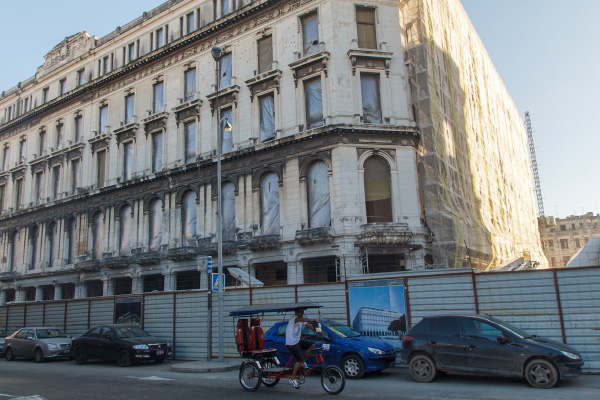
 

Commemoration or Celebration? / Rosa María Rodríguez Torrado

Rosa Maria Rodriguez, 27 June 2016 — For days now, due to the upcoming commemoration of the 63rd anniversary of the attack on the Moncada Barracks, Cuban television continues to repeat a spot with the fragment of a song from a musical group called Moncada, the chorus of which says over and over, “The 26th is the happiest day in history.”

The attack on the military fort in Santiago de Cuba, by the guerilla’s led by Fidel Castro, occurred on 26 July 1953 in coordination with the assault on the Carlos Manuel de Cespedes Barracks in Bayamo, during the dictatorship of Fulgencio Batista. Both actions failed. Lives were lost, young men were arrested and tortured — others were murdered later, according to the authorities — who should be remembered by this long-standing government with respect, not with anodyne songs that only send a signal of lack of respect for “their fallen,” hut which are an insult to their memory.

It is true I don’t remember — I never paid attention — all the words of this old song. Which such a chorus, anyone who isn’t Cuban can assume that it’s about a carnivalesque date.

The irony of the case, is that the director of the Moncada group is a deputy to the Cuban National Assembly and a nephew of one of the revolutionaries who were injured, imprisoned, tortured and later killed as a result of the assault on the Moncada Barracks.

It seems that anything goes in dictatorships and even forgive “the irreverence or the forgetting” of the dead when it is time to adulate the living. Also , it confirms that there is no exception to the rule that the authorities apply to their unconditional followers: the promotion of their works — regardless of the quality or the controversial conceptions — and convert them into a “hit parade” that plays on radio and television ad nauseam.

When this publicity material first appeared on television, I shared these opinions with Rafa, my husband, and now I share them also with my readers, because I do want someone to brand me as working to “correct errors” for friends, accomplices and/or protect those who hold us hostage and silence us.

There are no arguments to justify this TV spot and its advertising of the upcoming anniversary of those events seems farcical and sad to me. Will the approach to other cultures make them change western traditions of respect and homage to the dead? It seems that while the globe is homogenized with globalization, they insist on “deglobalizing” the world with the political-totalitarian counterculture on this continent.

Havana Impedes Progress of Obama’s Policy Toward Cuba / 14ymedio, Pedro Campos

 US president, Barack Obama, and his Cuban counterpart, Raul Castro, in March of 2016 at the Palace of the Revolution in Havana. (White House)
US president, Barack Obama, and his Cuban counterpart, Raul Castro, in March of 2016 at the Palace of the Revolution in Havana. (White House)

14ymedio bigger14ymedio, Pedro Campos, Havana, 18 July 2106 — Paradoxes of history: The United States and Cuba began a process of normalization of relations on 17 December 2014 and with the visit of President Barack Obama to Havana in March of 2016, aimed at expanding and deepening what has been achieved, came the counteroffensive of Fidel Castro to put on the brakes with his sarcastic Reflection column titled “Brother Obama.”

Since then, not only have they pushed the stop button on the process of rapprochement with the “main enemy,” difficult by nature, but they have increased the government’s repression against the opposition and those who think differently, and begun advancing positions against the reforms initiated and slowly developed since Raul Castro assumed power. continue reading

The clear moment of the halting of the process can be found in the Seventh Congress of the Cuban Communist Party (PCC), which supported the statist-wage model as the axis of the economic system, and the only party as the base of the political system, while at the same time postponing the expected renewal of the ruling elite.

Documents of the “conceptualization” and the 2030 Plan reference the stagnation and recent speeches by Raul Castro and other deputies, calling for confronting the critical situation looming with more of the same. In the most recent session of the National Assembly, they unambiguously supported the anti-reformist course.

This doubling-down on state-socialism comes accompanied by the decline in the authoritarian wave Latin America, especially the crisis in Venezuela.

Meanwhile, there is the push and pull in the US Congress for and against the policy changes toward Cuba favored by Obama. More recently, in the House of Representatives, support has grown to not loosen the strings of the embargo-blockade thanks to the Cuban government’s open reaction against the new policy out of a fear that the rapprochement will end up giving control of Cuba’s economy and society to the United States, as if the “American Dream” did not already draw a great part of the island’s population.

In this sense, Mario Diaz-Balart, a member of the Appropriations Committee of the House, told El Nuevo Herald that “there is bipartisan support in the House to strengthen sanctions against the regime and reject the policy of appeasement of the dictatorship.”

However, the counter-reform is in open contradiction with the economic policy of the island Government that is trying to benefit from money coming and expected from the exchange with the US and especially its tourism, particularly now that the Government of Venezuela is less able to continue sending oil to Cuba.

Measures have already been announced that clearly recall the worst moments of the so-called Special Period, which never ended. They want to blame imperialism “for creating the crisis in oil prices and destabilizing the Bolivarian Revolution,” when nobody doubts the Party-Government-State’s opposition to undertaking real economic reforms, to making consequent progress in the relations with the United States and to relieving the pressures of the internal political environment.

With these policies, the Cuban government is contributing to consolidating the support in the United States Congress for not loosening the embargo, which is directly proportional to Havana’s policies in support of Fidel’s faithful, reaffirming a proclamation of isolation and “anti-imperialism,” while running like the devil from the cross in the face of rapprochement, dialog and exchange.

The latest battle between the two forces just took place when the Cuban government refused to allow the United States commission charged with reviewing the conditions of the island’s airports to enter the country, and when of a group of U.S. legislators presented a bill to block travel to Cuba until the necessary security norms are met.

The United States Transportation Security Administration (TSA) said it will not allow flights to Cuba until it is convinced that island airports are as safe as those of the rest of the world.

If anyone had doubts, this event is the latest evidence of how the Cuban government, while showing a negotiating face, in practice hinders any progress in the normalization of relations. But regardless of who is at fault for the new Special Period, for the lack of progress in relations, the failure of the tourism that would save us will surely be the fault of the United States “blockade.”

More UNPACU Activists on Hunger Strike / 14ymedio

The UNPACU) youth leader, Amel Carlos Oliva. (Center for Coexistence Studies)
The UNPACU) youth leader, Carlos Amel Oliva. (Center for Coexistence Studies)

14ymedio bigger14ymedio, Havana, 18 July 2016 — The Patriotic Union of Cuba (UNPACU) reports at least twenty have been arrested in recent hours, after five activists, on Monday, joined the hunger strike started six days ago by the organization’s youth leader, Carlos Amel Oliva, to demand the return of two laptops, a cellphone and a removable hard disc confiscated by the police.

“The repression has been tough. Some 16 activists were arrested in Santiago de Cuba when they went to visit Oliva. The arrests were violent,” one of the opposition group’s coordinators, Ovidio Martin Castellanos, told 14ymedio. In addition to those arrested in the provincial capital, nine other people were intercepted in other areas of eastern Cuba, like Palmarito de Cauto, in the municipality of Mella. continue reading

Katherine Mojena Hernandez, wife of the youth leader and UNPACU member, said that Oliva is physically weakened, “but with the same fortitude with which he started the strike.” She added that the one who calls himself “Official Bruno” personally told Carlos Amel that “you are going to die of hunger” if he waits for his belongings to be returned.

Lazarus Curvelo Mejia, one of the Cubans who has been on hunger strike for four days, said he was willing to support the demand of Carlos Amel until the final consequences.

Among the five activists who have supported Oliva are two women, Zulma Lopez and Joanne Quesada.

The activist Yasmany Magaña from the province of Santiago de Cuba also joined.

UNPACU has denounced the increase in repressive actions against its organization, which it attributes to its growing membership throughout the island.

The group of hunger strikes, in addition to Oliva, includes Lazaro Curbelo Mejias, who has been on strike since the 15th of this month, Maikel Mediaceja Ramos, Zulma López Saldaña, Yoanna Quesada Masabeaux and Yasmani Magañana Díaz who have spent between 24 and 48 hours without eating.

Making a Living Off Coffee / 14ymedio, Ricardo Fernandez

Café Soler’s customers in Pinar del Rio. (14ymedio)

14ymedio bigger14ymedio, Ricardo Fernandez, Pinar del Rio, 16 July 2016 — In the early morning hours insomniacs, travelers and night watchmen are surprised to find an ode to excellence in a cup of coffee.

At 3:00 in the morning the rush to prepare the nectar begins at the clinic on 27th of November Street between Maceo and Marti in Pinar del Rio, where Luis Armando Cabrera Soler lives. His wife, the doctor Madalina, helps him to organize the thermoses, bags and harnesses he uses in providing the service. Meanwhile, the guard working on the corner is seduced by the spreading aroma. continue reading

“I have a light on my cap so the customers don’t have to walk to the spotlight when they want to buy, but then I realized it worked as a kind of promotion,” said Luis, who started selling a thermos of coffee in June of 2013 and now has increased production fivefold. “I got the idea of varying the menu preparing cortadito from a taxi driver they call loco, because I saw it in Havana. Since then I added chocolate, cappuccino and café bombón. The chocolate intensifies the flavor of the coffee and the cappuccino follows the traditional standards, the bombóm (a mix of condensed milk, chocolate and coffee) leaves a pleasant taste in the mouth.

Without his having to hawk his products, the customers come to him. “The best advertising is the quality,” he says. “When it’s a large bill and I don’t have change I just give them a free coffee. I don’t lose money because I end up winning customers,” he says.

Luis does not mince words when he talks about the origin of the coffee he serves. “I sell 100% Café Soler,” he says, while showing us the logo he designed himself, “harvested by my family, roasted and steeped by me. I don’t have that many plants so I’m not forced to deliver the coffee [to the state]; but it’s enough for me for the year,” he says, referring to the parcel he owns in Sumidero in the municipality of Minas de Matahambre.

The state monopolies are the only legal buyers of the beans and to enforce that control there is a framework of laws that equate trafficking in coffee with crimes such as theft or illegal departures from the country.

The only legal way to market coffee is to buy it in the state’s Hard Currency Collection Stores and the high prices mean the business is not viable, so the self-employed generally turn to the informal market.

“The hardest thing to get is disposable cups. There is no place to buy them, I have to rely on the good will of neighbors and friends who bring them to me from abroad,” he comments, while serving coffee.

Cabrera worked as a buyer for the Pinar del Rio Fuel Company which belongs to the Ministry of Energy and Mines, work that, out of fear, he made compatible with selling coffee. “Many are afraid to trade a job for a business. I decided to take this step as long as the earnings are stable and the work shifts didn’t interfere with sales.”

With characteristic island humor and the amiability of someone who even lights the cigarettes of those who like to smoke while they drink their coffee, Cabrera knows how to relax the disaffected and cheer up the reticent. “What series bills do you want?” he jokes with someone who rejects coins in change. “My goal is to make the customer happy even with the change,” he says.

Generally sales end at 9:00 in the morning and then the preparations begin for the next day: roasting the coffee, grinding it, cleaning the thermoses with chlorine and washing the many towels used to wipe up the drips, removing the stains from the white coat he wears while selling and, finally, doing the accounts. This ends Luis Armando Cabrera’s day, and he does not repent becoming a small businessman.