The teenager’s father accuses the authorities of deceiving and denigrating his son.
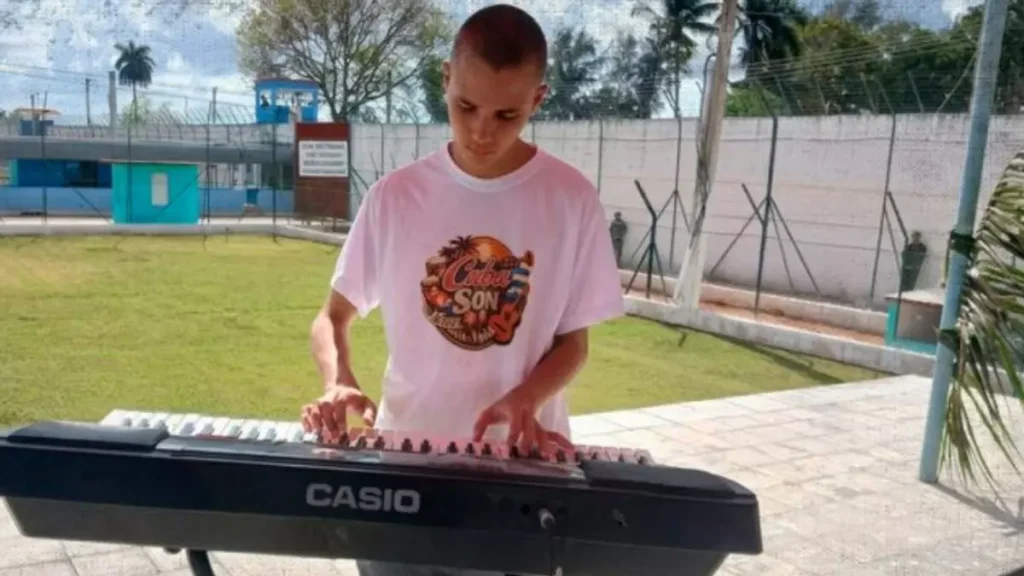
 The unease of Elier Muir Ávila, father of 16-year-old Jonathan Muir Burgos, arrested for participating in the massive demonstration in the town of Morón in Ciego de Ávila on March 13, escalated this Wednesday after seeing the use of images of the minor by the official platform Razones de Cuba, which violates Cuban law.
The platform published a photograph of the teenager in prison playing the piano on Wednesday, accompanied by a text accusing the “subversive cluster and political operatives funded by the United States government” of lying when they claim the young man is ill. “Now we ask, using logic: if he were truly so ill, if his immune system were as destroyed as they falsely claim, if he were dying of dyshidrosis, intestinal parasites, and bedbugs… How does he have the strength to be there, standing, playing the piano at a cultural event? How does a boy on the verge of death participate in a benefit concert in prison? How does he spread smiles while moving his hands with such precision?” the text stated.
In a message sent to Cubanet, the young man’s father asserts that the images were taken under false pretenses. He claims they promised him “a day of visitation as a reward.” “They used him, they took his picture, they recorded video, they even recorded his blood type to do these horrendous things. I denounce them, I denounce all of them. And this also involves the prison authorities,” Muir Ávila maintained, after calling the dissemination of the photograph “a big lie, a big fallacy.”
The father, who is a pastor at the Tiempo de Cosecha evangelical church, defended his son, describing him as someone who is held in the highest regard and with the best opinion in his neighborhood. Muir Ávila accused Cuban authorities of trying to create “a very denigrating image of him, portraying him as a delinquent, a vandal, and a criminal, in order to prosecute and incriminate him.”
“Please, I ask the whole world (…) not to allow such injustice, my child is not a criminal; my child is a teenager, a child going through adolescence who is very sick and needs to be released now to be treated,” he insisted.
Yurisel Montes de Oca, who considers himself the young man’s brother, expressed a similar sentiment, although his testimony differs slightly from Muir Ávila’s. According to his version, Jonathan plays the piano in prison, encouraged by his family “to clear his mind,” which doesn’t mean he doesn’t “desperately ask when they’re going to let him out,” or “the times that, due to the poor digestion of the terrible food they give him, he vomits and has diarrhea,” or the times he says he goes hungry. “He refused to be recorded,” he adds.
“Playing piano does not negate the truth of a chronic illness that, without treatment, can become complicated,” he argues in response to the insistence of Razones de Cuba, which mentions the word piano up to four times in the post .
According to the official platform—which ignores the fact that the young man has been in a maximum-security prison for almost two months for participating in a protest—the fact that the young man engaged in a recreational activity “demonstrates what Cuba has been denouncing for years: the subversive group and its operatives are not trustworthy and lack any credibility. They spread fake news in order to tarnish our country’s image.”
The dissemination of that photograph, in any case, contravenes four rules approved by the Government of Miguel Díaz-Canel, starting with the Constitution itself, which enshrines in article 48 the right to “privacy, honor and one’s own image,” and mentions in article 86 the duty of the State to provide protection to minors.
More specific is the Family Code, approved in 2022, which makes it clear that parents or guardians are the custodians of their children’s image and that a third party cannot disseminate it without their consent. The same principle is established in the 2023 Social Communication Law, which emphasizes the protection of minors when their image is disseminated on social media, and even in the Penal Code. This law punishes anyone who, “with the purpose of knowing, outside of cases authorized by law, or of affecting the privacy or image, voice, data, or identity of another person, without their consent, obtains, facilitates, reproduces, discloses, transmits, or keeps in their possession a recording or reproduction of sound, photo, or video, messages, data, or any other information of a personal or family nature, with the penalty being aggravated if the person is a minor.”
Just a few days ago, the state-run newspaper Cubadebate published a lengthy article accusing the media outlet Cibercuba of using images of minors to “exploit childhood as a high-impact narrative resource.” The article condemned the dissemination of photographs of children enduring hardships to earn money and, at the same time, to impose a narrative contrary to the regime. Furthermore, it made it very clear that “in light of current Cuban regulations, [this] offers strong evidence of a practice that may constitute a violation of the right to one’s image and the dignity of children and adolescents.”
______________________
COLLABORATE WITH OUR WORK: The 14ymedio team is committed to practicing serious journalism that reflects Cuba’s reality in all its depth. Thank you for joining us on this long journey. We invite you to continue supporting us by becoming a member of 14ymedio now. Together we can continue transforming journalism in Cuba.