New Outbreaks of Cholera in Santiago de Cuba / 14ymedio, Yosmani Mayeta Labrada

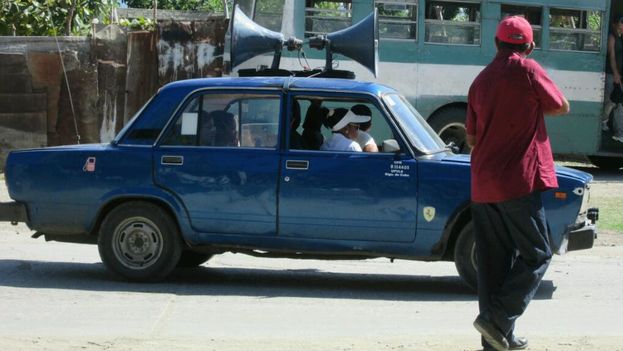
One of the cars with loudspeakers announcing the hygiene measures needed to combat cholera. (Yosmani Mayeta Labrada / 14ymedio)

14ymedio bigger14ymedio, Yosmani Mayeta Labrada, Santiago de Cuba, 4 June 2015 — In the midst of preparations for the 5th Centenary of the foundation of Santiago de Cuba, the Hygiene and Epidemiology agencies have enacted several measures to counter cholera outbreaks detected in Altamira and Venceremos in the Santiago capital. The epidemic, thought to have been controlled, has rebounded in slums such as La turbine, La Posita, La Loma de la Candela and El Barrio de los Gitanos.

Gertrudis Mendoza, a medical clinic nurse, told 14ymedio that “There are many suspected cases that came to the 28 de Septiembre clinic.” During her shift last Saturday, “More than six people showed up with diarrhea, who were then taken to a larger clinic to be tested for cholera.” continue reading

In the streets of these neighborhoods cars with loudspeakers from the Provincial Hygiene and Epidemiology Center circulate several times a day, repeating the hygiene measures needed to contain the infection. A call to boil drinking water, frequent hand washing, and avoiding eating street food, are some of the recommendations detailed by the Center’s staff.

Luz Enidia, a resident of Los Muros, says that near her house “A private snack bar was closed down because a man who ate a pizza there was diagnosed with cholera and hospitalized.” Afterwards the place was sanitized according to the protocols. “Hygiene workers came with chlorine and lime to clean everything, but even so the snack bar remains closed.

In the Labadi Home for the Aged and Disabled workers were advised of the extreme need to follow “the maximum hygiene”

In the Labadi Home for the Aged and Disabled in the Antonio Maceo neighborhood, workers were summoned to an urgent meeting to advise them of the extreme need to follow “the maximum hygiene,” so that the vibrio cholerae can’t enter the institution “because the lives of elderly and disabled people are at serious risk,” says a source of the place who requested anonymity.

Yudith Cando, the mother of a child who studies at the Alberto Paz Primary School in La Planta, states that a teacher in the school has cholera and she believes that, although she is hospitalized, the school should take appropriate measures. Like her, many local residents are demanding that the issue be handled with transparency and that public authorities make clear the city’s epidemiological situation.

However, so far the authorities have not confirmed the information and the local newspaper Sierra Maestra has not spoken of the presence of cholera in the area.

Dearest Obama / Orlando Luis Pardo Lazo

OLPresident

Barack Obama, behind, channeling the corpse of Hugo Chavez

The presidents of the USA have been a taboo subject in Cuba for 55 years. The image of the Bad Imperialist can only be authorized by the top propaganda authorities of the Communist Party (the only legal one on the island) or, when appropriate, by the very Council of State.  The idea was to depersonalize and discredit all the men of the White House (the documentary pamphleteer Santiago Alvarez embodied the vile vanguard of that mission). The external enemy has to be artificially animalized, to be slain just the same as one more internal opponent. Only in that way, by a simple media comparison for the eyes of a captive audience, would the elevated image of our Maximum Leader shine brighter in our hearts.

Fidel the future, Eisenhower the fossil; Fidel the strapping, handsome proletarian, Kennedy the bourgeois little asshole; Fidel the internationalist warrior, Johnson the international warmonger; Fidel sincere to the bone; Nixon scandalously phony; Fidel the perpetual comrade; Ford this year’s fleeting model; Fidel the pitcher, Carter the catcher; Fidel the still-young star, Reagan the nearly senile stuntman; Fidel in the “Special Period in Times of Peace,” Bush the bombings of post-perestroika; Fidel celibate, Clinton promiscuous; Fidel the horse, W. Bush the jackass; Fidel the dove who has been robbed several times of his Nobel Peace Price, Obama the white hawk with a blackbird’s feathers (the official Cuban press racistly accused him of betraying his own race). continue reading

After nearly a decade of being censored in Cuba (in spite of receiving the clear signal and being invaded by Cuban personnel), the TeleSUR channel started to be free in Cuba as a gift from Raul in the New Year. Now it’s not just the pirate patch of Walter Martinez on tape, savoring the Bolivarian mush to the illiterate and fanatics of the continent, but rather, since January 2013, it’s finally Mr. Barack Obama, live and kicking on every TV in Havana.

And, to the confusion of everyone at home, it turns out that the skinny kid from The Mulatto House in Washington doesn’t shout, nor present a threat to the public with his hooked fingers, nor wear a military uniform, nor spend hours and hours giving speeches to the millions and millions of his Babylonian nation. To top it off, the guy looks like a citizen and, as such, talks about urgent environmental concerns, about minority rights (representing the local LGBT community better than our National Assembly), or social projects that don’t need another half-century of sacrifice (while at the same time the police authorize a protest against him).

In my surveilled neighborhood of Lawton, after seeing this unheard of thing—a civilian president who does not preside in perpetuity—there were those who made the joke that the next People’s Power electoral ballot should include an extra box to check for “Deputy Obama.” I should publicize that humorous story online. OK, now I’ve done it here.

If I were the Cuban government, I would not take so lightly the symptoms of satisfaction or scorn for our socialism within the Cuban neighborhood. And, just in case, I would prepare one more chair in the Palace of Conventions. The slogan of the plebiscite of the Castros to the Castros in 2018 could well be this:

Cuba, Obamaness is coming!

Translated by: BW

11 April 2015

Massive emigration reveals the standard of living in Cuba / Hablemos Press, Eduardo Herrera

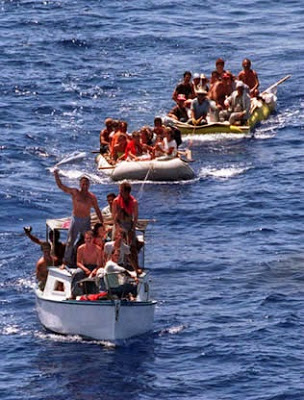
Cubans leave the country in rustic vessels.

Hablemos Press, Eduardo Herrera, 4 May 2015 — In Cuba, the constant emigration of its citizens can reveal what is the standard of living on the Island. Many of those who do not know the reality of life in Cuba should consider this fact and arrive at their own conclusions.

Cubans are willing to go live in countries supposedly poorer and with worse living conditions.

Starting in 2013, a new horizon appeared for those who wanted to emigrate: the requirement for the so-called “white card”—an exit permit for Cubans seeking to travel—was eliminated. continue reading

Even so, there are still obstacles to leaving the Island. These consist of the high prices that Cuban citizens must pay to acquire any type of documentation. Included in this is the passport, which costs about 100 dollars, while the average Cuban’s salary is 20 dollars per month.

Limiters also include the restrictions that other countries impose on Cubans arriving in their territories. Despite all this, Cubans find a way to emigrate, no matter what.

A well-known is example is that of the so-called “balseros” [rafters], who risk their lives. Sailing in rickety vessels, they try to cross the Florida Straits and reach the coasts of the United States.

Not counting those who have left the Island to settle in countries such as Ecuador, Mexico, Colombia, Peru, Angola and other. The exit strategy they most often use is an employment contract, or marriage—often arranged.

It is a great mistake when many countries recognize Cuba as providing its citizens a good standard of living. If this is so, why would so many people want to emigrate?

Many of those who leave are hopeless young people in search of a better future for themselves and their families. Those who stay behind are older—one reason that the population is aging and life expectancy appears to be high.

Thus, public opinion confuses the increase in longevity with a higher life expectancy (seen as an indicator of economic development and a measurement of health), but it is not based on reality.

Additionally, public opinion can become confused when discussing free health care and education for the entire population, without taking into considering the poor conditions of both sectors.

These and other reasons are what explain why Cubans emigrate desperately. Although many leaders and personalities may want to recognize that Cuba is doing well or is changing, we could tell them, as we say here, “There is none so blind as he who will not see.”

Translated by: Alicia Barraqué Ellison

Cuba Tries to Constrict the Summit of the Americas / Ivan Garcia

ATLAPA1-_mn-620x330Ivan Garcia, 4 April 2015 — If the 56 years of the olive-green autocracy are analyzed using statistics or tangible results that demonstrate progress, the result can be bewildering.

An inventory of the Cuban economy in the last 25 years, and a serious analysis of comparative statistics, will confirm the thesis that the olive green regime has sold us smoke.

If we believe the official data on the growth of GDP, such as those obtained for three consecutive years (11.8% in 2005, 12.5% in 2006 and 7.3% in 2008), the economic indices of Cuba would be at the level of the Asian tigers (South Korea, Hong Kong, Singapore, and Taiwan). The supposed achievements can only be seen in the daily newspaper Granma and in EcuRed, the Cuban version of Wikipedia, where we retrieved those figures. continue reading

Real life tells us the opposite. Allotted apartments without a coherent urban layout, with ugly buildings and low-quality construction. A highway under construction for 40 years with no end in sight. And a capital that is the perfect portrait of the destruction of a city.

The three achievements of Fidel Castro—idealized education, universal healthcare, and sports—are in outright decline.

“In twenty-first century Cuba we can’t even produce a toothbrush. We have to spend more than two billion dollars on imported food, despite having wide swaths of uncultivated acreage,” says Anselmo, an elderly cigar-roller.

But if the economy is a madhouse, with arbitrary constraints by the state and a mafia-like cartel which it uses to its advantage, in political matters the Castro brothers have a doctorate.

Never in the history of the world has a small, poor nation, with an army equipped with castoffs and antiques, conquered another country. In their time, England, Belgium, Holland and Portugal had powerful fleets and solid economies.

Cuba has neither. But it has been able to conquer Venezuela without firing a shot, despite the South American country having three times the population of the Island, and large oil reserves.

Ideologically speaking, the government of Nicolas Maduro is umbilically attached to the Palace of the Revolution in Havana. The Cuban regime has always been more political than economic.

It has managed to weave a web of alliances with Third World nations selling a narrative of sovereignty, providing medical services, and advising in the fields of science, sports, technology, and military.

According to Luis Manuel, a graduate of a Soviet university, “The rules of the economics game that our leaders learned in the USSR were outdated and never worked. But the legacy of the KGB and of spymaster Marcus Wolf’s STASI, served to prop up the ineffective economy. In particular the special services, experts in manipulation, in colonizing democratic spaces, and in the art of repression.”

The structures of the State—with a lockstep Parliament that has never voted against a proposal from the executive, with no free elections for president, with one party, and without independent courts or unions—are designed to prevent discord.

According to Tamara, a retired teacher, “that civil society they are now talking about in Cuba is pure gibberish.” And she’s right.

All the intellectuals, religious, and academics are integrated into associations controlled by the State. And they have become a useful tool that the government uses as a propaganda vector or in solidarity with its allies, as is the case now in Venezuela.

After receiving government approval, they launch initiatives, sign public statements, or organize gatherings and demonstrations in “support for the revolution.” Their offices belong to the state and their magazines, conferences, and meetings depend on the public purse.

The only two sectors with their own voice in Cuba, although having little impact in the country, are the opposition (la disidencia) and independent journalism. To be fashionable, Raul Castro co-opted the term “civil society” and gave the green light to dozens of “independent” organizations, which they had already enlisted, to attend the social forum in advance of the Seventh Summit of the Americas, on April 10 and 11 in Panama.

With financial support from the state and from other countries, which paid for airfare and lodging, a section of “civil society” controlled by the Castros will meet in the Panamanian capital.

It will be an interesting battle. Across the street, paid for by private foundations and the U.S. government, according to the roadmap implemented by Obama on December 17, will be a meeting, also including opposition members, who seek to publicize the repression and lack of political freedoms for more than five decades in Cuba.

It’s always healthy when conflicting sides feel free to chat without insulting each other. It is a sign of culture, tolerance, and modernity. But these debates should be held in Havana, not in another nation.

When Cubans of whatever political inclination, divided by the discourse of fear so well managed by the Castros, decide to listen to their adversaries, we can then civilly negotiate the future of our country.

If that “civil society” sponsored by the regime, resorts to insults and deaf ears against the dissidents who attend in Panama, it would signal that the Cuban government will remain committed to canceling out opposition and to mortgaging the future.

Cubans, thinking as they think and living where they live, must learn to live in harmony. And stop, once and for all, being strangers in our own land.

Iván García

Photo: Atlapa Convention Center, home of the Summit of the Americas VII, April 10 and 11, 2015, is located in the heart of Panama City, just five minutes from the airport. There are 19 soundproof meeting rooms, with multiple entries, movable walls, and interchangeable furniture. Panama’s artistic soul is present in the decoration: colorful beads made by the Guaymi Indians; drums, ritual flutes, original blouses of the Kuna Indians, and sculptures, braided jute and baskets from the mountainous regions, contribute to beautify the interiors of the main convention center in Panama. Additional press lounges, offices for organizers of events and offset copy center. An area of tourist services provides support for meetings, receptions, and registration of delegates, among other tasks. The Plaza de las Banderas, decorated with a lush tropical vegetation, can be used for exhibitions, folk performances, and other outdoor events (TQ).

What Is the General Plotting? / Cubanet, Rafael Alcides

RaulCastroquedijo1
cubanet square logoCubanet, Rafael Alcides, Havana, 26 May 2015 – From a distance I saw them arguing. They were father and son—they could not be heard, but their animated gesticulations spoke volumes. The son, already in his 60s; the father, a captain in the Sierra, who escaped from the Party a while back, is a person I’ve always gotten along with, although we are not intimate friends. Finishing the discussion, the son was telling him, as I approached, “I will not forgive you for that.” And the captain, catching up with me, replied, “Because you’re blind.”

Unexpectedly, he asked me if I believed in the sincerity with which Obama and those people from the European Union (EU) were accepting the “skeleton deal” that Raúl had sprung on them, “unless Raúl is also partaking of those magic powders of Belarmino’s,” he remarked sadly.

As he was also on his way to the farmers market, hopeful of finding a little bunch of lettuce, at least, or a carrot, and because my columns tend to focus on the national situation not from my own viewpoint but rather from what people are saying on the street, I listened to him intently. Given his age, his “Belarmino” quip might be considered a flight of senility, but in the captain’s account, it was quite realistic.

When Belarmino would arrive at a dance, some girl would soon disappear in the darkness for a while, and so would Belarmino. continue reading

A thirty-something jabao [light-skinned mixed-race man] with a gold tooth, and sporting a linen guayabera even when going down to the river to bathe, Belarmino was the proprietor of the town funeral home. The term “funeral home” here is generous, because in that little shack, nobody ever lay in state. People would come and buy the coffin—built by Belarmino himself—to take away by horse or wagon.

In the town where Belarmino was previously established, and from where he had to flee under protection from the rural police, he “damaged” fourteen teenage girls, and took to his bed everyone and their mothers for he had some magic powders that made him irresistible. In the brief time in which he resided in the captain’s town, he had no chance to use them because very soon the girls were being hidden by their parents or sent to relatives up in the hills; and a lovestricken quinceañera [a girl celebrating her 15th birthday], resisting being sent away, hanged herself. Belarmino became invisible. He was never heard from again.

Perhaps, the captain did not deny, there are in politics powders that have equal powers of seduction to those used by that Belarmino of his childhood. Why did the captain say this? He began to list the reasons:

Upon nationalization [taking possession of foreign-owned properties, businesses and industries in the Revolution’s early years], Fidel and Raúl left the Americans living in Cuba—and the priests, and most Spanish merchants, as well—without even the laces to tie their shoes. They took down God from His altar, implanted a political system that is the negation of everything that had been known in these parts, agitated the political henhouse of the region (because this America of today is not the same as in the 1950s), and now—as if none of this had taken place—suddenly, almost 60 years on, the United States gives in, the EU gives in, the Pope smiles, and Raúl continues to make demands. Besides removing Cuba from the list of state sponsors of terrorism, and reestablishing diplomatic relations, the USA now has to return the naval base in Guantánamo and lift the embargo—and maybe even indemnify it. Could this be understood?

As psychiatrists do, I responded with another question. “Where are you going with this?” And he, in psychiatric fashion, asked me if I believed in the power of Belarmino’s magic powders. He was laughing at me. In any case, for him, the situation was very clear: Whereas the super-powerful United States could impose on Cuba the “skeleton deal”—as in his straightforward way of speaking privately Raúl Roa characterized this relationship—Cuba couldn’t do the same with the US, nor with the EU. And so given that Raúl doesn’t possess anything similar to Belarmino’s magic powder, nobody here should lose hope yet. Nobody, affirmed the captain resolutely. Another thing: Hadn’t Fidel kept until the right time the secret that the Revolution was Communist?

At the farmers market there was nothing green to be found—except for some mangoes going for five pesos per pound, which were already under the effect of some evil liquid that in two hours makes them look ripe on the outside, but on the inside they are acidic and greenish, and ready for pitching into the trash 48 hours later, covered by then with a white mold resembling a sinister cobweb. The captain mourned them, recalling the mangoes of his childhood, when the best of them—the fragrant mango bizcochuelo—cost two cents, and others—including the Toledo mango—could be purchased by the bag, filled to the top, for a nickel. But he did not ask for my view on his theory regarding the Raúl-Obama-EU-Pope Francis issue. Having undergone his catharsis, what could my opinion matter to him?

Translated by: Alicia Barraqué Ellison

About the Author

461.thumbnail

 Rafael Alcides: A short biography is here.

The NBA Was Always a Reference Point in Cuba / Ivan Garcia

nash-nba-cuba-28014-_mn-620x330Miguel Frómeta, a light-skinned Afro-Cuban about six feet tall and around 50 years old, will have to follow the news about the basketball clinic to be taught in Cuba by former NBA players on April 23rd, from a dirty kitchen in Valle Grande prison on the outskirts of Havana.

30 years ago Frómeta emerged as one of the most promising small forwards in national basketball. He studied at a sports school west of the city and was a rabid fan of Kareem Abdul-Jabbar, the phenomenal center of the Los Angeles Lakers.

The NBA, just like the Beatles, was banned by the olive-green regime of Fidel Castro under the pretext of causing harmful ideological influences in a uniform and Marxist society. continue reading

Young basketball fans like Frómeta had to make do with secretly watched NBA games. In the 80s, when there was no Internet, Joel, a neighbor, remembers spending hours watching the incredible plays of guys like Larry Bird or Magic Johnson on a VCR.

During those years, in the courtyard La Vibora college prep, 25 minutes from the center of the capital, hoops fans leafed through magazines illustrated with photos and statistics of the NBA, which arrived secretly in the luggage of Cuban residents in Miami.

Every afternoon at twilight, they set up a basketball tournament under the lights, in a three-on-three format known as “guerrillas.” The court was solid cement. And up to fifty large boys took part in the improvised matches. The winning team got the right to continue playing.

The losers gathered in the shade of a leafy ceiba tree to discuss Michael Jordan’s latest moves or find out how the NBA season was progressing. All the information was oral.

The cream of the cream of Havana basketball competed in those fiery pickup games. Richard Matienzo, the power forward of the national team with the spectacular dunks, was a fixture. As was Adalberto Alvarez, Rolando Alfonso, and a dozen players from provincial and national teams.

Under a blazing sun, Luis Castellanos, a gray-haired coach who had played college basketball in the United States, trained in two sessions some thirty children and adolescents, in the methods and vision of an offensive game based on physical dominance, athleticism, aggression, and spectacle, which was a carbon copy of the basketball that is taught in the United States.

In Cuba there has always been a remarkable fan base for the sport of basketball. In the late 40s, Fidel Castro spent hours playing on the court of the stadium of the University of Havana.

Started in 1946, the NBA did not then have the same media outreach on the island as Major League Baseball. But in Havana neighborhoods such as La Vibora, Luyanó, or El Vedado, basketball of undeniable quality was played.

With the arrival of the bearded ones to power in 1959 the sport became massive. It was common for Castro to train with the national quintet in the City Sports Coliseum.

A retired basketball player says “Fidel had a good level of play. He played forward and center and was relentless on the boards. We knew about his character, at times he could be touchy, so we let him play. On average he scored 25 to 30 points. Only then would he leave happy.”

Miguel Calderón, a member of the basketball team that won the bronze medal in 1972 at Munich, and later coach of the national team, lived in La Vibora and was part of that batch of boys who became players on the neighborhood courts.

Luis, now an incurable alcoholic, recalls how in the early 90s, together with several neighbors in Santos Suarez, using a homemade antenna, they intercepted the signal of a television channel intended exclusively for foreign tourists. “Every night we followed the NBA season. I still rub my eyes when I remember those incredible moves of Michael Jordan, Johnson, or Dressler.”

Later on the court he tried to imitate those moves of that pack of great NBA players. Luis could not play at a high enough level not to be sentenced to five years in prison for “dangerousness,” a bizarre legal rule that imprisons people who the State believes “undermine the socialist society.”

In the late 1990s, Cuban television aired some tape-delayed NBA games and this led to a rebound in basketball play. In the national league tournaments interesting players emerged like Angel Oscar Caballero, Roberto Carlos Herrera, Richard Matienzo, Lazaro Borrell, and Andres Guibert, who later left the country.

Borrell and Guibert were able to break into the NBA. Right now, either by means of an illegal antenna or through matches broadcast on  Sundays by a local sports channel, basketball lovers know the NBA inside and out.

Probably Dikembe Mutombo and Steve Nash would be amazed at the large number of followers they have in Cuba, and by the deep knowledge of the NBA. LeBron James is a big deal, as are James Hardy, Curry, and the Gasol brothers, Pau and Marc.

Despite state censorship in one form or another, Cubans manage to get all kinds of sports information. You may have the impression that Cuba is more an island than ever. But thanks to popular ingenuity, increasingly we are less.

Iván García

Note – from April 23 to 26, the NBA and FIBA (International Basketball Federation) organized in Havana the first joint basketball camp for boys and girls. This agreement makes the NBA the first professional sports league in the United States to visit Cuba since last December 17, when the two countries restored diplomatic relations.

Steve Nash (pictured), twice winner of the MVP (Most Valuable Player) of the NBA; Dikembe Mutombo, international ambassador for the NBA; and Ticha Penicheiro, Portuguese legend of the WNBA (the female version of the NBA), will lead the camp and community projects in collaboration with the INDER (National Institute of Sports, Physical Education and Recreation) and the Cuban Basketball Federation, presided over by former basketballer Ruperto Herrera.

The NBA and FIBA, through the NBA Cares program, rehabilitated three basketball courts and organized youth camps in two places in Havana.

Photomontage taken from Journal Gol.

21 April 2015

Between Joy and Sadness, Cubans Celebrate Mother’s Day

Madre-cubana-con-tres-hijo-_mn-620x330Ivan Garcia, 10 May 2015 — Although the cloudy afternoon threatened a downpour in the area south of Havana, Mark came downtown to shop for some things on the eve of Mother’s Day.

In a state-owned hard-currency store he bought clearance-priced food for 43 convertible pesos for his mother, leather sandals for his wife for 24.70, and a 16-gigabyte flash memory for his mother on the black market, paying $10 CUC.

“I spent about 80 dollars. The business of selling tamales is not going well, but I saw it coming, so a month before I began to save dollars (foreign exchange). With this money I bought plenty of postcards to send to mothers of friends and relatives, three bunches of yellow flowers for my mother, my mother-in-law, and my wife, and on Sunday May 10 between a grilled snapper, a case of beer, and two or three bottles of rum, the tab was around 100 ’chavitos’ (CUCs),” Mark says, while waiting for an old state-owned taxi. continue reading

Ricardo, unemployed, has only been able to buy five postcards for a peso at the post office. “If I can sell two sacks of cement, for twenty pesos (about a dollar) I can buy a cake that they sell in the bakery. Other years I’ve been able to give better things. But now I’m ‘arrancao’ (broke). ”

For two packs of Hollywood cigarettes and a can of Nestle’s condensed milk, Yunier, an inmate at Combinado del Este maximum security prison on the outskirts of Havana, can get a fifteen-minute phone call to talk with his mother and his sisters on Sunday.

“Someone is always unavailable on Mother’s Day. Last year my husband was in jail for shoplifting. Now it’s my son, and my youngest daughter, who went to Italy with her husband. The point is that the family is never together, “says Diana, Yunier’s mother.

For various reasons, on the second Sunday of May, a day of harmony and celebration, many families in Cuba are not able to celebrate together. Emigration is one of those reasons.

People like Yosvier pay twenty-five cents (in convertible pesos) per minute at a neighborhood house where there is a cubicle for clandestine calls abroad and he can chat for a few hours with his mother who lives in Hialeah.

“In 2014 she was able to come for a visit and the whole family could celebrate together. This year she couldn’t come. My mother is saving to get me out of the country. She works two jobs in Miami so she can send a few dollars to my grandparents and me,” Yosvier says.

For Hiram, Mother’s Day is an irrefutable sign of the anthropological damage caused by 56 years of the olive-green autocracy on the island. “My mother and sister left Cuba as political refugees and as long as Fidel and Raul Castro are in power they cannot visit their homeland. It’s been eleven years since I’ve seen them. On Mother’s Day they call me by phone.”

It is harder still for Onelio. On the morning of May 10th he will go to Colon Cemetery in Vedado to place flowers at the grave of his mother, who died of an aggressive cancer two years ago.

“I’ve spent about an hour speaking quietly with her. Wherever my mother is, she is helping me and guiding me. I was raised to be a good person. That day is very sad for me. ”

As the story goes, the first celebrations of Mother’s Day date back to ancient Greece, where they paid homage to Rhea, the mother of the gods Zeus, Poseidon, and Hades.

In Norway, it is celebrated on the second Sunday of February. In Ireland and the UK on the fourth Sunday of Lent. In 1914 US President Woodrow Wilson declared the second Sunday in May as Mother’s Day, a tradition that became international in several countries, including Cuba.

Although there is not agreement among Cuban historians, it is believed that in 1920 the sports writer Victor Muñoz was the promoter of that date to also be celebrated on the island.

Despite laughable wages, shortages, and daily hardships, Cubans celebrate Mother’s Day.

The regime of Fidel Castro buried old traditions, and many meals are a distant memory, but the family unit has survived the Marxist ideological nonsense and the planned economy. Luckily.

Iván García

Photo: Mother with her three children in a Havana suburb. Courtesy of EFE-TUR Travel.

Irregularities in the Production of Medicines Affect Cancer Patients / 14ymedio

14ymedio bigger14ymedio, Havana, 1 June 2015 — The Ministry of Public Health has approved an urgent plan given the deficit in medications facing the country, among which are included some for the treatment of cancer. The details of the measures to implement the plan were offered by the head of the department Roberto Morales Ojeda during the Council of Ministers which met last Friday, according to the newspaper Granma.

The minister said that the situation is is due to delays in the importing of raw materials and the “need to shut down the plant dedicated to this vital line of treatment dies to irregularities in the production process.” Morales, however, did not detail the type of irregularities that led to the current situation. continue reading

The minister also explained that he has approved a program that includes the use of products from the reserve and the purchase of medications in countries of our region that allow for quick transportation to Cuba.

Right now the production plan for cancer medications is shut down, at the same time that construction is proceeding on a new one.

Morales Ojeda explained that, in order to be able to supply drugs in the coming months, he has approved the “required financing” and the Biocubafarma Business Group will adopt measures to improve the situation in the second half of the year.

Shortages of essential drugs has been a constant complaint of the population, particularly in the last half year. Pain relievers, anti-inflammatories, skin and antifungal creams, have sharply dropped in supply. Also on the list are products such as thermometers, elastic bands and adhesive strips, popularly known as Band-Aids.

The Second Conviction of Angel Santiesteban

Note: This post was written by Angel’s editor, who supports his blogging.

Today, April 29, 2015, we begin a new phase in which the Raul Castro dictatorship has decided to take another pass at bullfighter justice with Ángel Santiesteban-Prats.

Yesterday, the 28th, he completed serving half of his unjust sentence, the product of a trumped-up charge and a rigged trial full of irregularities.

Any Cuban prisoner has the right to “enjoy” probation upon serving half of his sentence in prison. But Ángel is NOT a common criminal but a political prisoner who was sentenced for a common crime that he did not commit, in order to hide the political motivation and at the same time portray him as a despised “criminal,” who could not “enjoy” that right, as none of them should, including the availability of residential passes, which, as I have reported, was only granted to him once, in September 2013. Since then, not only have they not let him out again, but they have been confining him in increasingly isolated places so that he has no communication with the outside. Since August 2014, he has been confined in a cage with a minimal yard and a lattice roof. continue reading

His UNEAC (National Union of Cuban Writers and Artists) colleagues had engaged in a campaign to discredit him as if he were a violent offender. Now they remain silent about Ángel, knowing and understanding the evidence of his innocence. And worse, blessing the entry of the five murderous spies to the institution as “honorary members.” This is Castro justice and the way their ideological curators work to ensure that the violation of human and civil rights of Cubans who do not lick the boots of the dictator brothers (and soon those of the heir “prince”) are trampled with impunity .

On March 14 of this year I warned that State Security was preparing a new judicial trap for Ángel to justify keeping him locked up. And unfortunately, ithas.

After a year-and-a-half delay, Castro “justice” approved Ángel’s request for a review of the trial. And by waiting to accept it until half of his sentence had been completed, he now has an open court proceeding, and he is not entitled to parole until it is resolved. And so, unfortunately, the fear we announced has come to pass.

Yesterday, April 28, Angel had served 26 months in prison, half of his sentence, and as of yesterday we begin to count the days for him to complete his new sentence: continuing to be a prisoner when he should, at a minimum, be on probation.

The regime in Havana still doesn’t know how to show that Ángel Santiesteban-Prats is a political prisoner, despite his recognition by the Commission on Human Rights and National Reconciliation, it refuses to include him on their lists.

Ángel Santiesteban-Prats is the only “common criminal” who has been repeatedly offered his freedom in exchange for giving up his political position and leaving the island. Angel is a “common criminal” who has been kept isolated in an attempt to prevent the publication of his views about the Castro dictatorship in his blog “The Children Nobody Wanted.”

Ángel has begun serving the second sentence, continuing his confinement in prison, without passes home, with one visit every three weeks, when he should already have been acquitted in a trial with all the guarantees that were denied in the first.

Just as we have done for the past two and a half years, we will not remain silent nor quiet watching them violate Ángel‘s human and prisoner rights.

We will continue to denounce, with increasing strength, each and every violation of Ángel‘s rights. And we continue to call for his immediate release,and that of ALL political prisoners.

The dictatorship also knows that thirty members of the European Parliament recently joined the clamor for freedom. It is hard to understand how they do not feel the slightest embarrassment when sitting down to negotiate with the free world while in Cuba they continue repressing and violating peaceful dissent.

Once again, we hold the dictator Raul Castro responsible for the life and safety of Ángel Santiesteban–Prats. And rest assured that history will not absolve him.

The Editor

Vandalism Worsens the Deteriorated Traffic Signs of Cuban Streets / 14ymedio, Orlando Palma

A traffic sign on the verge of disappearing. (14ymedio)

14ymedio bigger14ymedio, Orlando Palma, Havana, 28 May 2015 – As a result of vandalism and slackness affecting the deficient signage of roads and streets, drivers traveling through Cuban streets must mix expertise with a guessing game.

The lack of these important roadway elements worsens with vandalism, as stated on Thursday by officials of the National Center of Traffic Engineering speaking to Juventud Rebelde (Rebel youth) newspaper. In the first four months of this year, there were 144 acts of vandalism against road signs, of which 60 occurred in urban areas.

The provinces most affected by predation are Cienfuegos, Villa Clara and Havana, with effects ranging from the most serious – causing accidents – to generating misinformation about the locations of sites or their distance. continue reading

The lack of explanatory signs especially affects those who have no experience on the road, such as tourists who rent a car or drivers who venture into an area for the first time.

Vandalism, however, has many faces, and though none of them is justifiable, some of them point to the material shortage that the population encounters. The absence of a market where iron or steel angles, screws and metal plates can be legally acquired, leads people needing these materials to ignore ethical considerations or civilized coexistence.

The absence of a market where some materials can be legally acquired can lead to predation

There are a lot of animal pens, garages for cars or even walls and informal housing ceilings built with “recovered materials” which were once traffic signs. That is without counting the most serious damage, which with similar purpose, has been wreaked on electrical transmission towers or even on railways.

The problem affecting traffic signs is not a minor issue. The absence of a legal advertising infrastructure with commercial purposes means ads for concerts, notices of housing swaps, car sales and many other private classifieds find their space on a Yield or a No Parking sign. On the other hand, there is an inadequate policy of installation, replacement, and maintenance of these important elements by the State.

Translated by Alberto

Cuba Nostalgia / 14ymedio, Eliecer Avila

Cuba Nostalgia 2015 was held between 15 and 17 May. (danydiegonews)

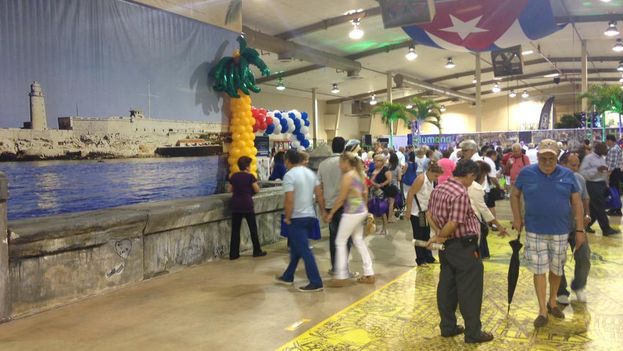
14ymedio bigger14ymedio, Eliecer Avila, 19 May 2015 – On Saturday the 16th, being in Miami, a friend invited me to visit the show Cuba Nostalgia. No one knew for sure what it was about, but the name made ​​me curious. The event took place in the outskirts of the city at the Fair Expo Center near the main campus of Florida International University (FIU).

Upon arrival, we saw a huge parking lot full of cars, from which it was common to see a young person emerge – a son or grandson – pushing a wheelchair or leading by the hand their grandparents toward a roofed space in which they reconnected with a vital part of their past.

Cuban music could be heard from afar. Once inside, the displays of old bank notes, photographs, stamps, medals, books, music albums, brand name products, hats and other attractions completely captured the attention of the visitors who, in some cases, spend a long time looking at a single piece, as if transported back in time to their childhood memories, youth, mischief in the Cuban countryside, or pranks and dancing in the cities, always hectic in those Republican years. continue reading

Dominoes also had their space. Ladies and gentlemen who seemed to be about 90 – some of them complete with cigar, guayabera, ring and hat – delighted in the slapping down their tiles to the beat of the legendary Macorina played by a band.

It might be better if they keep the memories that are etched in their minds of the Cuba they left

Others tried to locate the neighborhood where they lived on a giant map was printed on the floor.

Amid all the activity, a man walking hand-in-hand with his wife says to me, “This is good guajiro. But I’m pissed off.” “Why,” I ask him. “Chico, you come here to have an enjoyable time, and the first thing you come across is them offering you a coffin and the whole funeral service as if it were beer they were selling. What’s wrong with these people? I am not going to die just yet, so it’s going to be a while before they get a hold of my cash,” and he lets out a cackle that reminds me of some of my uncles.

Suddenly we hear the sounds of a danzon and my interlocutors say goodbye to join in the dancing. Few spectacles please me as much as seeing elderly couples moving to the sounds of Island rhythm. While I watch them, I imagine what their impression would be if they returned to Cuba and visited the villages and cities they left behind half a century ago.

I think it might be better if they keep the memories that are etched in their minds of the Cuba they left, I don’t know. What I am sure of is that these people have maintained their traditions with pride, their Cubanness, and their love for their country every day of their existence. To all of them, my affection and respect.

Warm Washcloths / Reinaldo Escobar

Arresto-Cuba-Ernesto-Mastrascusa-EFE_CYMIMA20150224_0006_17
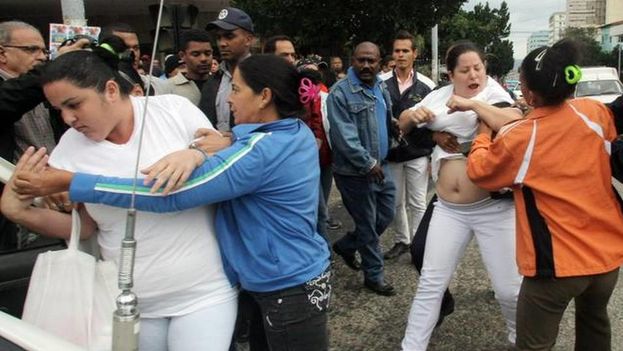
Arrest of dissidents in Cuba (Ernesto Mastrascusa EFE)

Reinaldo Escobar, Havana, 1 June 2015 – Once again the general-president, giving the impression that he invites criticism, steps on the brakes. He recognizes that it is important that everyone bring their opinions, but qualifies that it must be done “in the appropriate place, the opportune moment, and in the correct ways.”

That he has repeated it this Friday at the most recent Council of Ministers does not matter. That idea has been crushed in Parliament, the Party Congress, and at every opportunity that presents itself, while he warns in passing that he speaks of constructive criticism.

Everything indicates that by constructive criticism Raul Castro understands that which points out errors but does not discuss the theoretical basis that underlies his program, or better yet, the criticism that paves the way chosen by the criticized. continue reading

Under this logic, Karl Marx’s “Capital” is not constructive criticism, nor would be — saving the insurmountable differences –“History Will Absolve Me,” authored by his brother. However, both texts propose or suggest solutions to identified problems, which is the indispensable condition for a critical observation to merit the adjective ‘constructive.’

A critical allusion qualifies as destructive when it rages against those who do bad things, without giving them the opportunity to improve anything because they are considered unable to rectify it or have the deliberate intention to carry out evil deeds. Something very distinct from undertaking noble deeds in the incorrect way. To quote that memorable epithet that so many politicians deserve: “He did good and he did bad. The good he did badly, the bad he did well.”

When Castro mentions “the appropriate place” surely he is referring to Party meetings, directors’ councils, accountability assemblies or the pages of the newspaper Granma, where a team of censors decides what can be published.

Raul Castro understands constructive criticism to be that which points out errors but does not discuss the theoretical basis that underlies his program

They have not classified as appropriate places Fifth Avenue in Miramar, where every Sunday the Ladies and White parade and are repressed, nor the streets of Santiago de Cuba, where activists from the Patriotic Union of Cuba carry their signs of protest, much less the Plaza of the Revolution, where the artist Tanis Bruguera tried to lend a microphone to all who wanted to say something, or Central Park where the graffiti artist El Sexto wanted to drop off two tattooed pigs.

The opportune moment must be when, from the powers-that-be, a special permit is issued, as happened with those democratization assemblies in the ‘70s and in the preliminaries of the 4th Party Congress in 1994, or more recently when the population was authorized to offer opinions on the 6th Party Congress Guidelines.

The correct way is easy to imagine, initiating the action with due reverence. If we’re talking about racism, the harsh conditions of agricultural work or the mistreatment of women, we have to start by recalling everything the Revolution has done for the benefit of the injured. And if it’s about criticizing the deficiencies in education and healthcare, it is obligatory to preface it by stating that these are the jewels in the crown, free and available to all.

With critiques like these praise is not necessary.

Political Prisoner Dies / Angel Santiesteban

Ángel Santiesteban-Prats, Border Prison Unit, Havana, 13 April 2015 — Máximo Pradera Valdés has died without completing his lengthy (30 years) sentence. According to the account I heard, he unexpectedly suffered a massive heart attack while visiting with his family, enjoying their pass granted by the prison authorities.

A few months ago Máximo sent me a message: “Tell him that I’m his friend.” I responded, “Vice versa and take care.”

I know that he smoked too much. At least Máximo is now free. It’s a shame that he couldn’t see his country free from the hands of the Castros, whom he hated with all the strength of his soul.

Rest in peace, dear Máximo.

Ángel Santiesteban-Prats

April 13, 2015, Border Prison Unit, Havana

14 Minutes that Shook the Revolution / Cubanet, Victor Manuel Dominguez

text
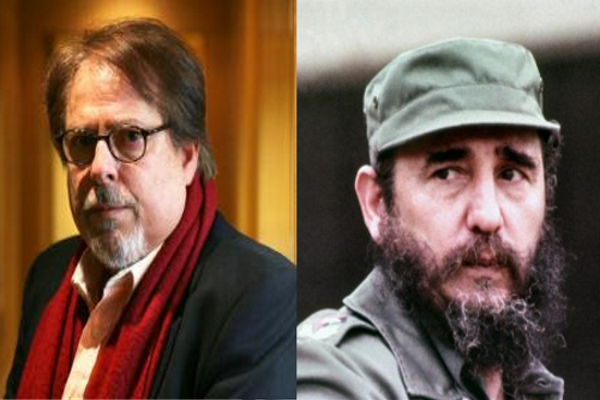
Orlando Jimenez Leal and Fidel Castro

Cubanet, Victor Manuel Dominguez, Havana, 29 May 2015 – “P.M.,” that short documentary made by Orlando Jimenez Leal and Saba Cabrera Infante, was the beginning of the end of freedom of expression in Cuban Culture. Conceived in the beginning as a four-minute report that would establish a parallel between the militants who installed canons on the Havana Malecon and the people who entertained themselves in bars during the days previous to the Bay of Pigs Invasion, the film was banned for being subversive.

According to his own words Jimenez Leal wanted to reflect the character of the Cuban who tries to reconcile, at any cost, “his historical responsibility” with the rumba. It was a kind of tribute to the popular wit that occurred when, instead of Fidel Castro’s official slogan of “Homeland or Death,” a mixed-race woman in a bar one night was heard to say, while she was undulating, “Why not ‘Homeland or Minor Injuries’?”

The director of television’s Channel 2 catalogued P.M. as controversial. Surprised by the response, Jimenez Leal decided to show it to Saba Cabrera Infante, and together they turned it into the 14-minute short that shook the Revolution. continue reading

From his house in Miami, the filmmaker told this reporter from Cubanet, “I proposed to make a short film that was not political, but a simple poem to the night. It would be called Post Meridien or, more simply, P.M.”

Subject to censorship in May 1961, P.M. drew the ire of neoStalinists, such as Alfredo Guevara and Mirta Aguirre, who had emerged as staunch defenders of the Revolution. Both unleashed a war against the movie that, after protests, applause and rejections, led to several meetings until, on June 30, Fidel Castro spoke his Words to the Intellectuals, “Within the Revolution, everything; outside the Revolution, nothing.”

“At that moment I was shocked,” Jimenez Leal confessed, “I saw nothing subversive in the film. I thought all artistic expression was itself revolutionary. How, then, could a little film provoke anyone? But I thought it was a temporary state of emergency. What I didn’t suspect is that Cuba would be in a state of ‘temporary emergency’ my whole life.”

Since then phrases like “temporary emergency,” “it’s not the historical moment,” or “the dirty laundry is washed at home,” were the arguments to censor works of art and literature considered “outside the Revolution.” This exclusionary mark constituted a crime that, right up to our time, has condemned more than a few creators to ostracism, prison and exile.

Critical subjects, due to their sexual orientation or religion, skin color, or political orientation against the regime, among the other deadly sins of Cuban artists and writers, were and are put on a black list of creators outside the temple of the Revolution. Many authors and works remain outside the cultural heritage of the nation.

Weren’t the writers José Mario Rodriguez, Ana Maria Simo, Manolito Ballagas Jose Lorenzo Fuentes, Lina de Feria, Heberto Padilla, Maria Elena Cruz Varela and Raul Rivero, just to mention the most famous, imprisoned for being critical subjects? Aren’t the members of Arte Calle (Street Art), the groups Paideia, Puré and Cacharro marginalized or forced into exile?

Currently imprisoned is the writer Ángel Santiesteban, author of the blog The Children Nobody Wanted, and winner of the Julian del Casal, Alejo Carpentier and Casa de las Americas prizes, among other national and international level awards. The graffiti artist Danilo Maldonado, “El Sexto” is also in prison for painting two piglets green and naming them Raul and Fidel.

Tania Bruguera has been arrested for her performance of Tatlin’s Whisper, they’ve taken her passport and accused her of committing the crime on contempt. Gustavo Perez Silverio had his contract as a professor of the Faculty of Socio-Cultural Studies cancelled at the University of Santa Clara, they closed a radial space, and he is being expelled as a researcher of dance and theater for being critical of the revolution .

With these thunders no one sleeps. Unless the name of someone who questions the banning of a literary work or the imprisonment of an author in Tahiti, the staging of a performance in Peru, or the painting of graffiti on a wall in Kandahar is criticized. The rest is blah blah blah, posturing, a heap of rubbish. Nevertheless, the spokespeople call to criticize.

There is no one like a Cuban intellectual for emitting nonsense, promising loyalties, arming a new discourse about another erasure and hiding the past histories, one within the other, like nubile matryoshka dolls at the door of a black market of opinions, or a brothel of ideas on Arbat Street. His eloquence is proverbial, his hands large, his tongue a medieval gallows.

So it doesn’t surprise me that the gentlemen Abel Prieto and Julian Gonzalez, cultural advisor to the Cuban president and Minister of Culture respectively, made from the May Festival – an art, literature and political revel that takes place every year on Holguin – a call for the development of a critical subject in every young creator in Cuba.

Faithful to its strategy of hiding under the carpet of a false reformism the remnants of the freedom of expression, erased by a discourse preceded by a pistol whipping – which still resounds in the trough of the intellectuality – on a table in the National Library, the “neo-seniles” trainers of youth try out a new farce on the national amnesia.

The modeling clay is ready, the model as well, it just needs the basic revolutionary ingredients added, ranging from a overdose of political unconditionality, high levels of ideological pomposity and a pinch of the salt of national identity, until the perfect touch of a mix smelling of banners, the altarpiece and the people. The critical subject is ready to act.

victor-manuel-dominguez.thumbnailVictor Manuel Dominguez

Freelance journalist. Resides in Central Havana. vicmadominguez55@gmail.com


53 Ladies in White Arrested in Havana /14ymedio

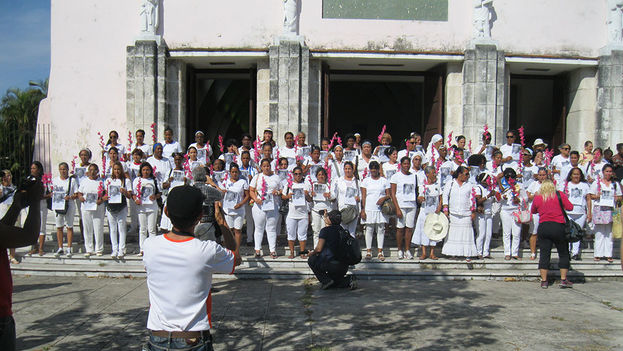
Ladies in White in front of Santa Rita church in Havana. (File Photo / Agustin Lopez Canino)

14ymedio bigger14ymedio, Havana, 31 May 2015 – This Sunday the Ladies in White Movement experienced its eighth consecutive Sunday of repression in Havana, resulting in the rest of 53 of them. Some of the 25 activists who participated with the women in their traditional Sunday pilgrimage were arrested near the Church of Santa Rita in the capital municipality of Playa.

According to several witnesses, 53 Ladies in White and 25 activists were arrested at the exit of the parish and taken to a destination still unknown. At least seven women had been prevented from arriving to the place and several dissidents reported threats by State Security since Saturday, warning them not to attend the pilgrimage.

Among the activists arrested was Juan Angel Moya, a former prisoner of the Black Spring of 2003, and Antonio Gonzalez Rodiles, leader of the opposition group Estado de Sats.

Iriades Hernández Aguilera of the Patriotic Union of Cuba informed 14ymedio that no arrests of activists of the organization were reported in the province of Santiago de Cuba, although a heavy guard was seen around the headquarters of the organization. Our correspondent in Pinar del Río, Juan Carlos Fernandez, reported that three Ladies in White were able to attend Sunday mass.

In the province of Matanzas, the activist Sayli Navarro confirmed that at least 38 Ladies in White across the province made it to their respective parishes without difficulties.