Another Stripe for the Tiger / Angel Santiesteban

Angel Santiesteban, 17 May 2015 — The latest report from the Inter-American Commission on Human Rights, confirmed the permanence of Cuba and Venezuela in the “black list” because of violations of those rights “has not changed”.

This violation situation has remained in Cuba for decades without any particular interest shown in resolving it, because to do so would mean respect for freedom, a matter that goes in the opposite direction to its totalitarian process, therefore they will continue to ignore the “blacklist “and as many penalties of that nature as are issued.

Instead, the regime does not want to stay on the US government list of terrorist countries or countries that support terrorism, and in this particular case, Raul Castro struggles and shows a remarkable interest in Cuba being removed from that category. But such aspiration it is not because of a sudden shame, but because it was indispensable to ensure his permanence and that of his heirs in power, as only by Cuba being removed from the list, and through trading with the United States in order to get the hard currency needed for the ailing national economy and thus ensure that continuity. continue reading

Murdered Cuban Dissident 

Both sanctions, the Inter-American Commission of Human Rights, and the US State Department, are as serious as they can be for what they represent, but it is only the first one, because it does not carries penalties, it is bearable by the level of the Cuban government shamelessness; the second one, however, it has led to unbearable practical consequences today.

It should be added that the dictatorship was resentful in its core with the common position of the European Union, which together with the United States Department of State position, brought to its knees the challenging attitude, pride and arrogance of the Castro brothers after that extreme (human rights) violation such as the “Black Spring”, that sent to prison 75 dissidents with the malevolent idea — in the future — of exchanging them for five spies who were serving sentences in The United States, which the whole world rejected generally and categorically.

The strongest blows dealt to the Cuban dictatorship were, among others, the repudiation of the downing of the “Brothers to the Rescue” plane and the execution of innocent young people who attempted to reach Miami in a hijacked tugboat.

My question is: What has changed within the Castros’ dictatorship to no longer be considered a violator of human rights, nor a country that supports terrorism; we all know that if is not an (active) sponsor as it would want to be, it is precisely because of the economic sanctions.

As the proverb says in Cuba, “It would be a horse of another color” if the economy improved. It would re-awaken the hegemonic dreams that have never been forgotten but postponed until better times — in their precise, focused and not so foolish quest to legitimize their “anti-imperialist” front, and overtake the United States — their most powerful enemy ideologically — as the number one economy worldwide, if they have support from Russia, China and Venezuelan oil.

I am confident that President Obama and his team of advisers know it very well, and also that they know how to play the political “chess match” where the freedom of Cuba and its fate are decided and, why not, the fate of the United States by either sustaining or eradicating a “cancer” from its geographical hemisphere.

17 May, 2015

Border Control Prison.

Havana, Cuba

 Translated by Rafael

Art Is A Bridge That Unites Miami And Havana / Juan Juan Almeida

Juan Juan Almeida, 1 June 2015 —  In 1984, at the suggestion of Armando Hart and Marcia Leiseca, Lilian Llanes, then the director of the Wilfredo Lam Center, the Biennial of Havana was created, and since then, the dialogue of the Revolution with Cuban culture has seen itself obligated to change, passing from an intense tone to a prudent one, and it’s truly regretful that our opposition hasn’t ever managed to capture the attention of this brotherhood.

The Government knows that no respectable social movement exists without artists in the vanguard, and it also knows that the Biennial is the place where artists get together to promote art.

What’s interesting is that this cultural rendezvous, the Twelfth Biennial, in addition to converting Havana into a world center for contemporary visual arts, and invading Havana with an artillery of paintings, regiments of video art, battalions of sculptures, squadrons of installations and platoons of performance art, is creating a new manner of communication and collaboration among artists residing on the Island and in Miami. continue reading

It’s good to know that the works of Manuel Mendive, Arles de Río, Roberto Fabelo, Rafael Pérez, Osmany (Lolo) Betancourt, Eduardo Abella and Luis Camejo, who these days get the attention of everyone on the Havana Malecón and other seats of the Biennial, were made in Miami, in the studio-casting ASU Bronze (Art & Sculpture Unlimited).

The question is: Why is it practically impossible in Cuba for drawings and sketches of plastic artists to materialize in the art of casting?

There’s a surplus of talent in Cuba. But the quality of production work in other places, the shortage of materials and inefficiency of the State, plus the fatigue from facing the constant complexity of everything associated with the production of a work in Cuba make the elaboration of a piece on the Island an exhausting process that doesn’t make it easy for artists to organize to fulfill commitments or establish deadlines for exhibitions.

Unfortunately for them (the artists) and, hopefully, new entrepreneurs will take note, there is only one business in all of Cuba that is dedicated to these requirements. To cast art is complicated: you need specific machinery, tools that are fabricated for a determined work, special instruments, access to raw material and other gear to complete the structure. Nor does there exist in the country a photography laboratory capable of offering a wide range of services that include printing on metal, wood or methacrylate.

Today Cuban artists make magnificent art that they try to show to the world, but when they leave Cuba and face the mega-exhibitions in New York or Paris – to mention only two examples – they find that the works exhibited have a deadline that they can’t meet on the Island.

To introduce works in international circuits, each time more demanding, requires fulfilling parameters and patrons of artistic production who they can only meet in workshops like the Factum Arte in Spain, which is dedicated to producing art for artists.

Then the Art & Sculpture Unlimited (ASU Bronze) appeared in Miami, which, in addition to being geographically and operationally closer to Cubans, offers solutions, accessible prices and competent completion. It counts on the exquisite supervision of Lázaro Valdés, an excellent sculptor who, by being educated in Cuba, understands perfectly the language of his profession, his nation and his generation.

Author: Juan Juan Almeida

Licensed in Penal Science. Analyst, writer. Awarded a prize in a competition of short stories in Argentina. In 2009, published “Memories of an Unknown Cuban Guerrilla,” a nonfiction work where he satirizes the decadence of the upper elite in Cuba.

juanjal@yahoo.com

Translated by Regina Anavy


The Siege of Tania Bruguera Is Lifted / 14ymedio

artista-Tania-Bruguera-Yania-Suarez_CYMIMA20150522_0011_13
The artist Tania Bruguera at the front door of her home. (Yania Suárez)

14ymedio bigger14ymedio, Havana, 29 June 2015 — Last Friday, June 26th, a police official paid a visit to Tania Bruguera to inform her that the charges against her were being temporarily lifted. The artist refused to sign the offer, and demanded that the charges be permanently lifted, without any restrictions on her returning to her own country.

This information was made public by a message sent through the #yotambienexijo (“I also demand”) platform nearly six months after Bruguera was detained while preparing to give a performance in Havana’s Plaza de la Revolución. At the time of her arrest on December 30th, the authorities also confiscated her passport, without which she cannot leave the country.

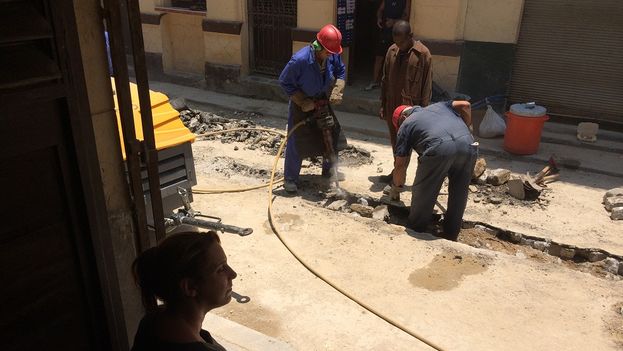
Bruguera decided to launch the Hannah Arendt Artivist Institute during the Havana Biennial. For more than one hundred consecutive hours, she led the reading, analysis, and discussion of Arendt’s The Origins of Totalitarianism. The event was ignored due to relentless police pressure, a very noisy street repair right in front of the artist’s home, and the subsequent arrest of Bruguera and several companions.

In the text published last Monday on the #yotambienexijo platform, the artist explained that the deal offered her “is unacceptable blackmail, whose intention is to control my art and silence me as a citizen.” Meanwhile, she is suing the Cuban Ministries of Culture and of the Interior for damages incurred during last December’s events.

Links to #yotambienexijo sites:
Restaging of Bruguera’s Tatlin’s Whisper 6 in Times Square in NYC
Twitter
Facebook

Translated by José Badué

Cuban Professionals do Business Under the Table / Ivan Garcia

La-visita-de-Rihanna-_ab-620x330Ivan Garcia, 28 June 2015 — Already by noon, Óscar has downloaded two terabytes of audiovisual material from the Internet. Taking advantage of his lunch hour some place nearby, he hands over the flash drive to the person who is in charge of loading the “weekly packet,” a compendium of documentaries, serials, soap operas and sports, which later will circulate clandestinely throughout the Island at the speed of light.

Óscar has worked for a decade in a State organization where he can capture the television satellite signal. “They don’t only hack private businesses. The State is a big pirate; without paying for authors’ rights, under the pretext of the blockade (the embargo), it transmits U.S. programs on public television. I also take advantage of this and sell audiovisuals under the table, and a guy pays me 40 CUCs for two terabytes.” continue reading

Valeria, surreptitiously, also is involved in piracy. “I work in a center where they send the international cable signal to tourist centers. Sometimes they ask me to upload a series or the last part of the NBA play-offs. They pay me well and it’s something I can do without having problems.”

The powerful State control implemented by the olive-green autocracy has for 56 years found multiple fissures with the arrival of new technologies. And like dust, censured news and MLB games with Cuban baseball players spread throughout Cuba.

These information leaks come from anonymous professionals who have set up small businesses that let them get some extra money, five times more than their laughable salaries.

Rogelio works for an Internet distributor in Havana. During the day he uploads Android and Windows applications for mobile telephones, tablets and computers, which he later sells to the owner of a repair workshop for computer equipment.

Taking advantage of the high volume of calls to Florida, some have managed to divert technologies and software from ETECSA, the State telecommunications monopoly, and they have set up telephone booths in their homes for international calls, at 25 cents for one minute, 60% cheaper than what the State offers.

Frequently, forces joined with State Security and the Ministry of Communications and Computer Information unleash operatives in order to dismantle parallel Wi-Fi networks, Internet connections and clandestine international telephone calls.

For every network that is illegal, two new ones show up quickly. “It’s like cutting the head off a snake; several more grow.” As long as the Government controls, prohibits and over-prices the Internet and international calls, clandestine networks will exist,” argues Miguel, who, after several years of designing parallel networks, has become a real expert at camouflaging cables, illegal Wi-Fi connections and satellite television signals.

Orlando, an economist, considers that in addition to the absurd prohibitions typical of closed societies, the Government laws that prevent professionals from doing private work have opened a discrete revolving door that is being used to make money during the work day.

“It happens everywhere. In a hospital, a nurse or a doctor steals medications and sells them on the black market. Or a computer technician uses his work computer to create a web site for the owner of a particular business,” explains the economist.

It’s not news that some doctors consult in their own homes with trusted patients who pay them under the table. “A mutual trust is created. The doctor can take care of you personally. He writes a prescription and gets the medication for you if it’s not in a pharmacy. Or he gives you an exam that you would normally have to wait months for. People give them 20 or 25 CUCs, more if it’s a serious illness. Silently, we have passed from the family doctor created by Fidel Castro, already in low supply, to the private doctor,” says Luís, who goes to a doctor outside the hospital.

For the last six years, Norma takes her son to a dentistry professor. “For each consult, I discreetly give her 20 CUCs. First, it’s the attention. And while they don’t have anaesthetics and equipment in the dental clinics, when you pay a dentist, everything appears as if by magic.”

The low salaries of primary and secondary school teachers are the genesis of the explosion in furtive tutors. Frequently the teachers who give classes during the day, in the afternoon or nights, for 5 CUCs a month, tutor primary or secondary school students in their homes.

“Families that can do it pay for tutoring for their kids. It’s not easy to suspend a kid who is tutored by an active teacher. There are school directors who also are tutors. The lack of money forces them to do it,” says the mother of a child who attends these sessions.”

Cases have been brought to light in Havana of notorious frauds where professors and directors sell exams at prices that fluctuate between 15 and 25 CUCs. Now the fraud is more subtle.

The day before the test, the teacher whispers it into the ears of the students she tutors, so they can pass.

Iván García

Photo: While she rode in a convertible along the Malecón, many Cubans were able to photograph the singer Rihanna (b. Barbados, 1988) with their cell phones. At the beginning of June 2015, Rihanna was in Havana to do a fashion shoot and make a video. Owing to the increase in smartphones, laptops and tablets in Cuba, there is a lot of business under the table for the repair of these devices. Taken from the magazine Trabajadores (Workers).

Translated by Regina Anavy

Cuban Police Arrest More Than 220 Dissidents, According To Activists / Hablemos Press, Roberto de Jesús Guerra

The most arrests took place on Sunday in Havana, Cienfuegos and Santiago de Cuba

Hablemos Press, Roberto de Jesús Guerra Peréz, Havana, 29 June 2015 — Offices of the National Police, the Department of State Security, and other members of the Interior Ministry arrested at least 226 Cuban activists and dissidents this past Sunday, 28 June, 2015.

Police operations were carried out in various provinces of the country to keep activists and opposition members from attending Mass.

Among those arrested in Havana were Berta Soler, leader of the Ladies in White Movement, Antonio G. Rodiles, director of Estado de SATS; José Díaz, of Opponents for a New Republic Movement; photographer Claudio Fuentes; and several of the former political prisoners who were released in January 2015. continue reading

In Havana, the arrests of various members of the Ladies in White and others of the opposition took place as these individuals were departing their residences early in the morning, and they remained surrounded by police officers throughout the day.

Besides Soler, Ladies in White executive committee members María Cristina Labrada Barona and Lismeri Quintana Ávila were among these detainees, along with eight other women.

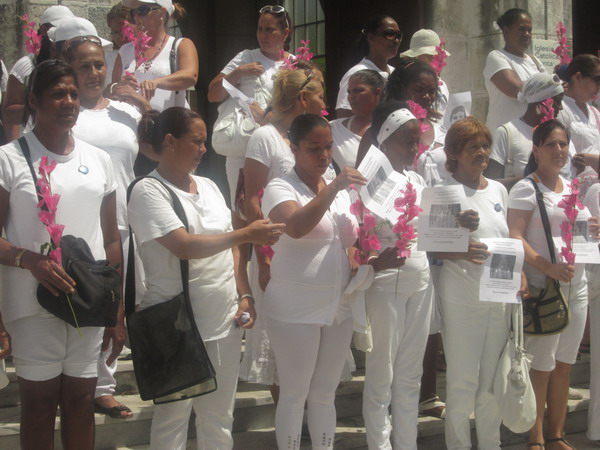
Another 39 arrests of women activists took place in the area around Santa Rita Church, after the women completed their customary march along 5th Avenue in the Miramar district of Playa municipality, and gathered in Gandhi Park (adjacent to the church) to review the week’s activities. In addition, approximately another 41 activists and opponents–men who accompany the Ladies on their march–were arrested in the capital.

2Algunos de los activistas y opositoresDozens of Interior Ministry agents blocked the streets around St. Rita Church to arrest the Ladies and other dissidents, according to the activists.

The Lady in White Aidé Gallardo Salazar was struck and dragged by female officers. “They hit me on the head and face, and they tried to asphyxiate me,” Gallardo averred.

Other arrests of Ladies in White occurred in these provinces: Holguín (4); Bayamo-Granma (2); and Aguada de Pasajero in Cienfuegos (9). In the last province, additionally, “17 men who accompanied the Ladies were arrested,” according to activist and former political prisoner Iván Hernández Carrillo.

The independent reporter Agustín López Canino also was arrested upon exiting his home in the El Globo district, located on the outskirts of Havana.

“I will continue going there to St. Rita for as long as they’ll let me,” said López Canino when interviewed. “What I do is take down the facts and forward them to various media.”

He adds that, “The repression against the opposition movement has increased extraordinarily within the last six months and cannot be allowed to go on without attention focused on it.”

The former political prisoners Ramón Alejandro Muñoz, Eugenio Hernández Hernández, Ángel Figueredo Castellón, Mario Alberto Hernández, and Rolando Reyes Rabanal were also arrested in Havana.

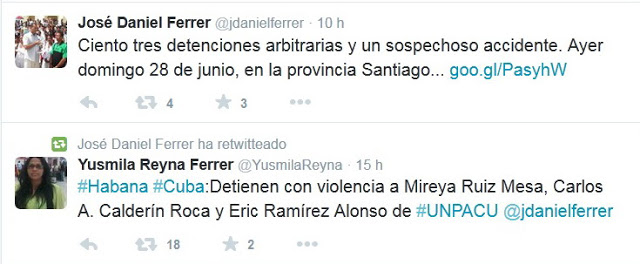
The Patriotic Union of Cuba (UNPACU), headquartered in Santiago de Cuba, reported the arrests of 103 of its members when they attempted to travel to the village of El Cobre to attend Mass.

3Ferrer
José Daniel Ferrer: 103 arbitrary arrests and a suspicious accident. Yesterday Sunday 28 June, in Santiago province. // Yusmila Reyna Ferrer: #Havana #Cuba: Mireya Ruiz Mesa, Carlos A. Calderín Roca, and Eric Ramírez Alonso of #UNPACU@jdanielferrer are violently arrested.

The agents used violence to detain the opponents, who were transported to police stations and military bases, according to activist sources.

Ladies in White affirm that, “The regime wants to destroy the opposition, but we are prepared to give our lives for the freedom of the political prisoners,” stated Ibón Lemos y Mayelín Peña.

Soler attests that the repression increased 11 Sundays ago, ever since the Ladies in White initiated a new campaign to demand the release of political prisoners, among them: the writer Ángel Santiesteban Prats, the artist Danilo Maldonado Machado (“El Sexto”); and the dissidents Santiago Roberto Montes de Oca, René Rouco Machín, Osvaldo Rodríguez Acosta, Yosvani Melchor Rodríguez, Rolando Joaquín Guerra Pérez, Eugenio Ariel Arzuaga Peña, Yoelkis Rosabal–in total, more than 50 individuals.

The reports received at Hablemos Press included figures totaling 226 opponents arrested across the Island on Sunday, although the actual number may be greater.

Translated By: Alicia Barraqué Ellison

Diary of an Alcoholic / 14ymedio, Hector Reyes

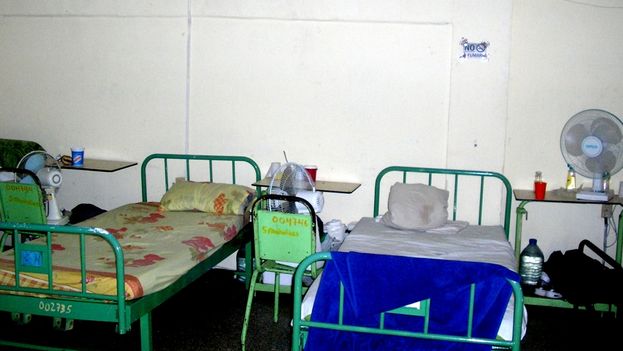
Patients’ beds in the rehab ward of Santa Clara Psychiatric Hospital (Photo: Héctor Reyes)

14ymedio bigger14ymedio, Hector Reyes, Santa Clara, 13 June 2015 — His story starts with a bottle and ends in a psychiatric ward. More precisely, it ends in the rehab ward of Santa Clara Psychiatric Hospital. With the help of pills and shots, Néstor will try staying for 21 days in order to escape alcoholism’s downward spiral.

The room where the young man is hospitalized does not have a refrigerator, or a television, or lockers to store his belongings. It has only one bathroom without water. Once in a while, one of the six men confined in that small space with only a one working fan, asks out loud “Why?” but nobody in that “cage” answers him. continue reading

Routine is part of the treatment. Wake up, take medications, doze off until breakfast, wait for the meeting with the therapist, snack time, lunch, and more medications. Everyday is the same for three weeks in order to prevent any attempt to fill in the hours with rum and hard liquor. The drugs used to combat addiction range from Carbamazepine to one dose of dextrose per day.

Treatment also requires isolation. Psychiatric patients have the right to freely visit their homes, but alcoholics can only leave the premises if accompanied by a medical staff member. Roque Tejera, another patient hospitalized in that same room believes that being locked up and medicated seems to help. Meanwhile, from a bed at the far side of the room, Lian Morales says that psychotherapy is what gives him the most strength not to relapse.

“I’ve been here six months, and every time I get out, I go back to getting drunk,” explained Orly Ferrer, as he shooed away the flies buzzing all over the room. His story is corroborated by the testimony of doctors and nurses who have seen many patients promise not to drink anymore, and then end up hitting the bars.

Alcoholism ranks among the ten top causes of death in Cuba, and according to official statistics, 45.2% of the population above fifteen years of age consumes alcohol, especially those between 25 and 42.

Alcoholism ranks among the ten top causes of death in Cuba, and according to official statistics, 45.2% of the population above fifteen years of age consumes alcohol

A few months ago, psychiatric expert Dr. Carmen Beatriz Borrego Calzadilla told the official press that the consumption of alcohol is most prevalent among the youth. The health professional stated: “Among adolescents, the consumption of alcohol is often associated with self-determination, fun, entertainment, and modernity.”

Some enter rehab because of family pressure, from families undone by the ravages of alcohol and violence. Others, such as Néstor, sought medical advice in order to be admitted to rehab after a disastrous drunken spree. The Psychiatric Hospital’s emergency room policy states that if a patient arrives on his own will, he will be admitted, if there is a bed available.

They come because they have consumed everything, from rum bought with convertible pesos to homemade concoctions. Noel Ponce, another alcoholic in rehab, says that one of his methods consists of pouring concentrated honey in a sealed tank with a valve. He explained: “You attach a coil to it and heat it up until it bubbles and secretes alcohol.”

Alcoholics from the lowest economic strata, such as retirees and the unemployed, rely on all types of moonshine to quench their daily thirst for alcohol. For many, even the mouthwash available at pharmacies ends up being a way of getting plastered.

Alcoholism is rarely discussed in Cuba, and when the domestic media does focus on it, it almost always does so superficially. The majority of television spots on this issue emphasize its connection to traffic accidents. Programs with a more psychological bent, such as Vale la pena (It’s worth it), attack consumption without mentioning the reasons behind it.

Alcoholism is rarely discussed in Cuba, and when the domestic media does focus on it, it almost always does so superficially

In many Cuban television series and movies there is often an alcoholic, a funny character zigzagging as he urinates from one lamppost to the other. Conversely, the documentary Havana Glue tackles the situation in all its extent and gravity. This movie, directed by the young filmmaker Lupe Alfonso, takes in the opinions of artists, intellectuals, and the average citizen about the consumption of alcohol in Cuban society. It has yet to be broadcast on national television.

In order to help the patients out of the situation they find themselves in when they enter the rehab ward, doctors also recommend physical exercise. Santa Clara Psychiatric Hospital has a room fitted with exercise machines that improve physical and mental health, apart from keeping the patients busy. One of the room’s attendants said: “This space is too small. They should give us the space used for the emergency room.” Due to lack of space, they cannot use the treadmill or the rowing machine.

The other part is made up of psychotherapy, based on the approach of Alcoholics Anonymous, a program that began in 1935 with a New York businessman who began talking to other drinkers about his struggle with sobriety. Today there are more than 100,000 AA groups in about 150 countries.

“Personally, psychotherapy overwhelms me, it depresses me,” commented one of the patients who shares the room with Néstor. Some of the stories shared during sessions raise important issues, while others are heartbreaking or hilarious. The volume increases as the minutes go by and the patients vent.

Since the medical authorities refuse to release statistics, the weight of the problem in rural areas cannot be measured. Six young rural men have just ended up in this small, hot ward of Santa Clara Psychiatric Hospital. When they get out of here, they will return to their small towns, where due to a lack of recreational options, the bottle has become an inseparable companion of social interactions.

Translated by José Badué

Without Freedom, Without Justice, Without Law / Amir Valle and Elisa Tabakman

New Violations of Ángel Santiesteban’s Rights

Amir Valle and Elisa Tabakman, 28 June, 2015 — Today, June 28, 2015, Angel Santiesteban Prats should have been released on parole after having served exactly half of his unjust sentence. In fact, if they had not already violated his rights, he should have been free as of April 28, because as provided by law, for each year served in prison one month is credited against the total sentence.

When they violated his right to the two-month reduction, we denounced it here, and correctly explained that they did it to avoid granting him freedom. And we assumed, incorrectly, that they would release him on June 28; if they did not, it would be a public and obvious violation of their own laws. continue reading

On that occasion, we also reiterated the complaint about another blatant breach of the law: the silence they have maintained about his appeal for revision of judgment, filed on July 4, 2013, and approved in the final months of last year when, under pressure from international agencies, they had to stop postponing it.

But because the dictatorship does not act if it will not benefit, even though the appeal was approved, to date they have not undertaken the review. If the regime had any proof about the guilt of Angel Santiesteban, would they fear having to review the trial with all of the guarantees violated the first time?

Ángel was charged and convicted of a common crime for which they never provided a shred of evidence. They convicted him only on the basis of graphoanalysis—the height and angle of his handwriting. Ever since he entered prison he has been treated as a political prisoner.

They have subjected him to physical and psychological torture by officers of the political police, who constantly tried to intimidate him; they located violent prisoners next to him to provoke him; and they placed other inmates to spy on him in exchange for certain benefits. They have violated all of his prisoner rights (family passes, visits), they have threatened him . . . In short, he has had to suffer these and all the other atrocities that, as we well know, he and all political prisoners are victims of.

Three weeks ago, as we also reported, he was transferred twice to the barracks at Villa Marista in the span of four days. These “rides” as we learned later, had no purpose other than intimidating him and making him listen, ad nauseum, to threats from two Interior Ministry officers.

They told him: “Why should we free you if you’re going to meet some Sunday with the Ladies in White and then we’ll bring you right back to prison.” At this point, we believe that they prefer to save themselves a ride in a patrol car to take him back to prison.

Angel remains the only “common criminal” who, on repeated occasions, the political police officers have offered freedom in exchange for renouncing his political position, demanding that he give that renunciation in videotaped testimony.

He is also the only “common criminal” they have threatened to return to jail if he attended the marches of the Ladies in White. He is also the only “common criminal” that a known government official (while pointing a gun at his head) predicted would be sentenced to five years, one month before the Tribunal delivered the sentence.

Knowing these circumstances, and believing that all the facts clearly indicate that Angel is a political prisoner, we have received messages of concern and astonishment from hundreds of readers of this blog, who ask us one question:

If Ángel is one of the most internationally recognized Cuban prisoners, is one of the “100 Heroes of Communication” of the Reporters Without Borders, and is supported by intellectual institutions around the world, including parliamentarians from the European Union, why is it that the relevant organizations of the Cuban opposition, charged with making such allegations internationally, have never included him in their lists of political prisoners?

Many of these messages have been referred directly to the monthly reports on political prisoners sent from the island by the Cuban Commission for Human Rights and National Reconciliation, headed by Elizardo Sánchez Santa Cruz-Pacheco.

Their concern is logical: although the circumstances of Ángel’s imprisonment are well known internationally, with across-the-board recognition that he was convicted for his political position, he is not included in those lists because the opposition’s lists rely on the version of Raul Castro’s dictatorship (which pretends to consider Ángel a common prisoner).

But at the same time this prevents Ángel from benefiting from any amnesty, as promoted in the talks between Cuba and the United States since December 17, 2014, and as already rumored may be possible before the visit of Pope Francis.

As we cannot give an answer, we hereby officially put that question to Elizardo Sánchez Santa Cruz-Pacheco and the Cuban Commission for Human Rights and National Reconciliation.

Amir Valle
Literary representative of Ángel Santiesteban

Elisa Tabakman
Editor ofÁngel’s blog, The Children Nobody Wanted

The Allure of the Forbidden / Rebeca Monzo

Rebeca Monzo, 27 June 2015 — Strolling through the streets of Havana, it is odd to see the profusion of American symbols on clothing, flags, decals, handbags and other items.

While walking in the vicinity of Yara cinema in Vedado recently, I happened to notice with some amazement a cart selling slushies. Such carts are not allowed to park for more than a minute. They must be in constant motion or risk getting a fine, a stupid rule since it requires customers to run along behind the vendor. At any rate, this same cart was sporting two American flags of considerable size on both its front sides. Too bad I did not have a camera to capture the image. continue reading

Young people of both sexes often wear shirts, tights and shorts with the design of this flag. Even infants are dressed in baby clothes decorated with the Stars and Stripes, which incidentally, is a rather attractive design.

Our media outlets never tire of highlighting news stories by criticizing and even misinforming the Cuban people about events in the U.S., which are often similar to events happening in our own backyard but which are never discussed. To think of all the “incitement of hatred” over the years against this country, with which the government now wants to reestablish relations because it finds itself “with a noose around its neck” economically.

The only thing all this negative propaganda has managed to achieve is a result opposite of what was intended, as more and more people of all ages — especially young people — prefer to risk their lives fleeing the country by crossing the Florida Straits in flimsy boats.

Similarly, an ever-growing number of Cuban doctors now use medical missions in other countries as a springboard to the United States. The children and relatives of senior leaders are also following this path, though they make the journey to the same destination by plane, demonstrating once again that the forbidden never loses its allure.

Inventory of Differences / 14ymedio, Reinaldo Escobar

Talk about the lack of unity within the Cuban opposition has already become commonplace. (Marc Gautier / Flickr / CC)

14ymedio bigger14ymedio, Reinaldo Escobar, 26 June 2015 – To talk about a lack of unity within the Cuban opposition has already become commonplace. Among the causes of these lamentable circumstances are enumerated some peculiarities rooted in the greatest depths of our history, whose paradigmatic example is warlordism.

However, there are also rational reasons because opponents gather in separate airtight rooms. First of all, in political vocations. Liberals, socialists, Christian democrats, anarchists, social democrats and other less profiled denominations assume positions about certain topics that can become irreconcilable.

The mere fact of recognizing these nuances sparks commentary from all sides that the most important thing is to dislodge the tyrants from power and that such minutiae can wait until democracy is achieved. But it is not enough to make the immense sacrifice of overlooking future programmatic differences. The spokes in the wheel, the weights, the headwinds, the points of honor that hinder or prevent reaching agreement usually arise from unexpected places.

Here are the most common obstacles to consensus: continue reading

The Cuba-US Dispute

Before December 17, 2014 the discussion centered on whether or not the US economic restrictions toward the island should be maintained, what some call “the blockade” and others “the embargo.” The mere choice of one of these words has prevented prestigious leaders from signing a collective declarationen masse. On this plane we also find the issue of Americans traveling to the island, the reopening of embassies and eventual normalization.

Some are betting that the rigidity of the Cuban system cannot be maintained in an environment of good economic and diplomatic relations with the neighbor to the north. Others believe that the commercial interests of the United States could take precedence over human rights and in the end would award the Cuban Government the benefit of undeserved legitimacy.

The recognition of the reforms made by the Government

Between those who think that, “As long as what has to change isn’t changed, nothing has changed here,” and those who believe that “In this house of cards the slightest movement could lead to the collapse,” there is a large gradation.

This has led some to consider self-employed people as accomplices to the dictatorship, because with the payment of their taxes and their growing habits of consumption they sustain the dictatorship. While others see them as the most dynamic part of the population, who by empowering themselves economically could point the way to political emancipation in defense of the middle class.

The reluctance at every step of the reforms, adjustments, or whatever they prefer to call them, awakes in some the suspicions that it is all about an operation of recycling to maintain themselves in power – a fraudulent Change – and in others hopes that behind every little change there could be lurking a tropical Boris Yeltsin.

In the event that the announced but not yet proclaimed legislation opened the tiniest crack for the participation of the opponents, the divisions would become more pronounced

The attitude toward elections

Not going to vote, voiding or leaving the ballet blank and, more recently, casting one’s vote in favor of a lesser evil or for some malcontent who has managed to get past the controls, are the different attitudes with which some want to demonstrate their disagreement.

The Government’s announcement that it will formulate a new Electoral Law has given the issue new scope for disagreements, as there are those who believe it makes sense to disseminate proposals that could open a space to something like a multiparty system; on the other hand, those who see in the new law another maneuver by the regime to buy time or who call for an independent plebiscite.

In the event that the announced but not yet proclaimed legislation opens the tiniest crack for the participation of the opponents, the divisions would become more pronounced between those who accept involving themselves in the hard-fought elections, and those who consider participation in them as something that gives the game to the dictatorship, and even as a betrayal.

In the street or indoors

Although a consensus is seen in the opposition for the renunciation of violent methods, especially weapons or terrorism, there is a clear difference between those who have chosen to express their differences by going out into the streets, and those who express their critiques through documents, programs or opinion columns. From both sides there are sincere calls to weigh as valid the methods chosen by each grouping or individual, but still, in isolation, expressions appear that label a posture as uselessly provocative proposals of victims, and another as a convenient methodology, free of risk and displaying little solidarity with those who dare to receive beatings.

We are not willing to easily give way before a semantic dilemma; we all agree that it would be easy for the other to accept our terminology

Terminology

I have left for the end an element that affects the text that I am writing. The difference between use the labels Government or the authorities, and others who use the terms regime, dictatorship or tyranny, is perhaps one of the most frequent differences in the opposition endeavor. Other incompatible binomials enter there, like the already mentioned embargo-blockade, or election-voting reforms-cosmetic changes, exile-diaspora, not to mention how difficult it is to classify someone as an opponent, dissident, activist, or independent journalist.

To this is added the generational definitions, which mark a dividing line between those who have spent “more than thirty years in the opposition,” and the recent arrivals; or the contrast between having suffered a prison sentence versus having been detained for only a few hours.

We Cubans depend too much on orality, and are not willing to easily give way before a semantic dilemma. Moreover, we all agree that it would be easy for the other to accept our terminology.

Of course this is an incomplete inventory, I could have mentioned the way in which the role of the churches is seen in the problematic Cuban politics; the choice between remaining on the island and leaving for exile; the relentless pursuit of “doing something” or the patient resignation that time and biology will do its work; with or without dialog with the Government; resisting arrest or letting them take you prisoner; accepting financing from foreign organizations or rejecting it on principle; attending a government-sponsored “Rendering of Accounts” to channel complaints, or not attending to deny its legitimacy; going abroad to participate in events or declining invitations to not miss even a minute of the main struggle, and so on, until we run out of imagination in choosing the very colors of our arrogant identity.

Profile of a Father / Mario Lleonart

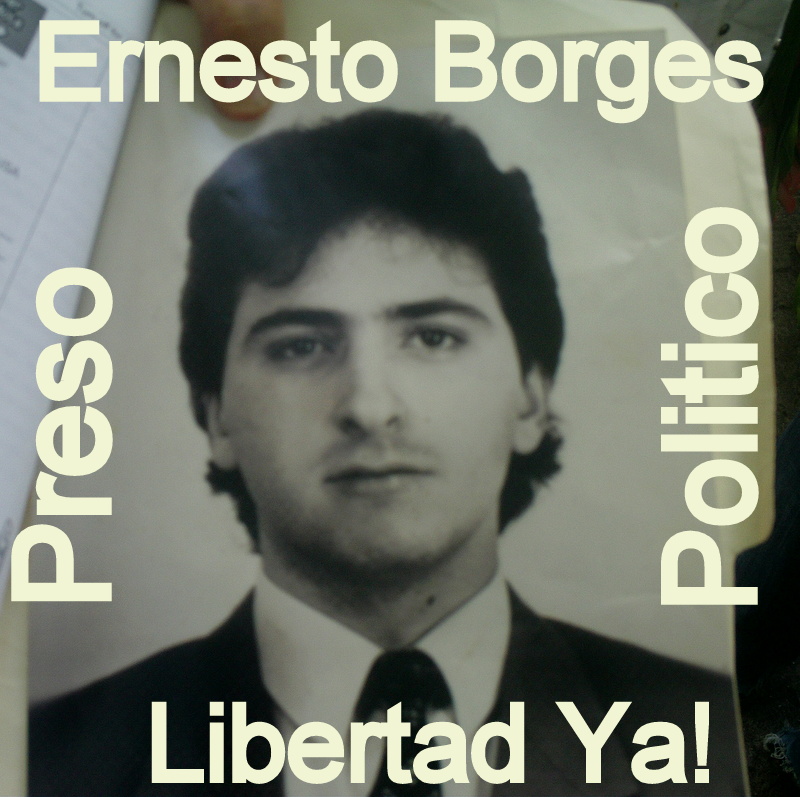
Right about now, on this Father’s Day, Raúl Borges Álvarez is surely living something similar to what he has been suffering for 17 years, petitioning the prison where one of his two sons is held which will not even concede the possibility of letting him out on parole, to which he is entitled by law — all because of blasted politics!

At Havana’s Santa Rita Church — as at various other churches across the country — mothers, sisters, daughters and friends of many other political prisoners penalized for political differences attempt to gather each Sunday to attend Mass and later march, each holding a gladiolus. According to the latest statistics from the Cuban Commission for Human Rights and National Reconciliation (CCDHRN), there are around 71 prisoners on the known list. The women who march for them are known as the Ladies in White. continue reading

Other equally brave women known as the “Women Citizens for Democracy” do this at other locations. But Raúl Borges, like other fathers, brothers and friends, will not stand by inert before the valor of these women, and intends to join them in demonstrating his indignation, too.

The last 11 Sundays have been like a battle, with entire brigades sent to counterract these civil and peaceful forces, attacking them as if they were common criminals who must be suppressed. It has not been easy for Raúl. Besides being in his seventies, barely a few years ago he underwent two complicated operations — open-heart surgery on 31 August 2010, and a procedure for a peripheral cerebral infarction, in March 2012.

But none of this is more grave for him than the unjust imprisonment of his son, for which–besides everything else he does all the time–Raúl will do everything possible to join those hundreds of other persons who, all over the country, will demand the freedom of prisoners like his son, Ernesto Borges Pérez.

Neither his age nor physical condition will keep Raúl from trying to break through the lines of guards that start to form as of Thursday or Friday, and later, if he succeeds, he will not be ashamed to be thrown, like so many others, in the back of a truck or a bus headed for jail cells or to a remote and isolated spot where he would be put out to find his own way home, nor to be shackled and beaten, with no care as to whether the chosen target for the punch is his scarred chest–as it was four Sundays ago.

But a father’s love is not to be disdained next to that of a mother, for all the insistence by some that anyone can be a father, but a mother can only be one. Raúl is the refutation of this erroneous suggestion. And in the love of a father determined to do whatever it takes to gain the freedom of a son who is considered to be unjustly imprisoned, those who try to subdue civilian forces through violence will find an irresistible force, no matter how aggravated the confrontation may be.

None other than a Cuban State Security agent admitted as much to César, Raúl’s other son, when he warned him that he could not be responsible for the life of César’s stubborn father. “But,” the agent acknowledged, “were I in his place, I would do the same.”

Translator: Alicia Barraqué Ellison

21 June 2015

Juan Abreu: “Executions in Cuba Are an Untold Story” / 14ymedio, Yaiza Santos

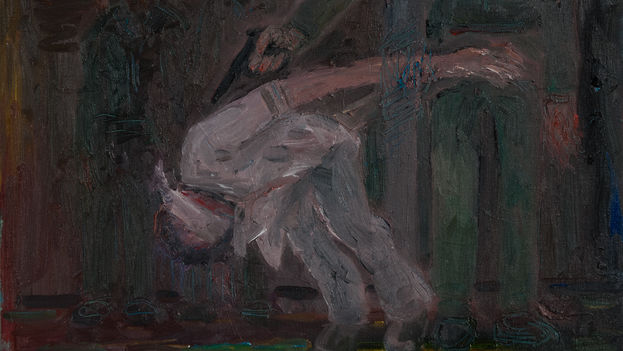
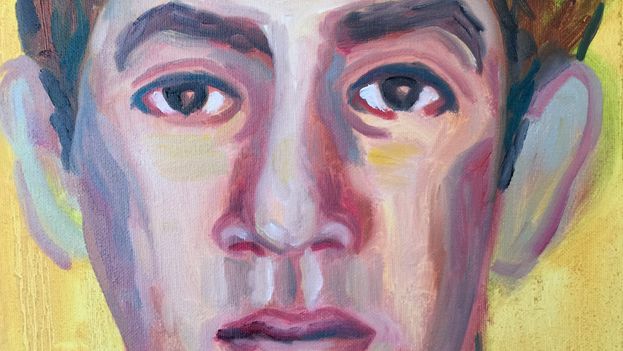
Juan Abreu: ‘1959. Fall from Grace,’ fragment (oil on canvas, 38 x 46 cm)

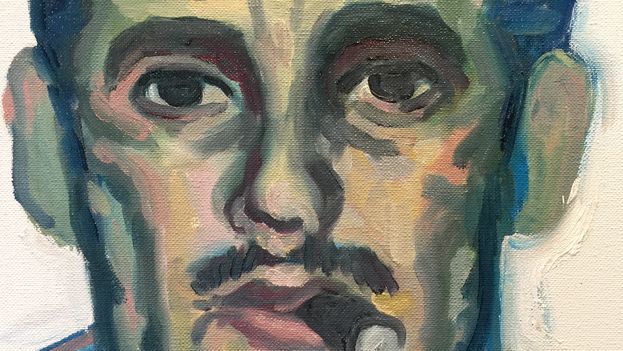
14ymedio bigger14ymedio, Yaiza Santos, Mexico, 27 June 2015 – Painter and writer Juan Abreu (b. Havana, 1952) has taken on the inordinate task of painting, one by one, all those executed by the Castro regime. The work in progress is entitled 1959 but encompasses 2003, the year in which Lorenzo Capello, Barbaro Sevilla and Jorge Martinez were sentenced to death in a summary trial, accused of “acts of terrorism” after trying to reroute a passenger ferry to escape to the United States. They were the last executed by the Cuban government. “Let it be known,” says Abreu.

The project emerged, he says, recently, by chance: “I was doing some paintings that had to do with the firing squads in Cuba, because I was struck by the character, the loner that they are going to kill. I had seen some paintings by Marlene Dumas of Palestinians and then I approached the subject. When I started researching, suddenly the faces of all these people began to appear. I began to look at the faces and read, and suddenly I realized that I was going to have to paint this. Not only as a kind of pictorial adventure, which it is, because of the quantity of portraits and the complexity of the genre, but also because it seems to me that I have a certain moral responsibility.” continue reading

Juan Abreu: ‘1959. Carlos Baez’ (born in 1937, shot in 1965), fragment (oil on canvas, 27 x 35 cm)

Of the executions in Cuba, he continues, “It is an untold story. Not only untold, but also they have tried to hide it, and when they have spoken of it, the effort has always been to discredit the protagonists, branded as outlaws or murderers. These accusations lack any kind of historical evidence. They were people who rebelled, the same as Fidel Castro rebelled against Batista, they rebelled against Fidel Castro.”

The death penalty, explains Abreu, was not contemplated in the 1940 Constitution which the Revolution originally claimed it would restore: “They [the Castro regime] imposed it. The trials completely lacked any kind of safeguard. Sometimes even the lawyer spoke worse of the condemned than the prosecutor did. They were Soviet-style trials: you already knew you were guilty as soon as they caught you; you knew that they were going to kill you or put you in jail for thirty years.”

In order to gather as much information as possible, he contacted some of the few people who have devoted themselves to the topic in the United States, like Maria Werlau, from the Cuba Archive, or Luis Gonzales Infante, a former political prisoner who sent Abreu his book Rostros/Faces, where he compiles names and photos of those dead by execution, from hunger strike or in combat during the El Escambray uprising, those seven years that historians like Rafael Rojas consider a civil war and that Fidel Castro called a “fight against bandits.”

Evilio-Abreu-Gonzalez-Oil-cmsJPG_CYMIMA20150625_0014_16

Other documents he has found easily on the Internet, like videos from the period and photographs from the free press that still existed in Cuba when the Revolution triumphed. Hence, the executions of Enrique Despaigne, doubled over by two shots at the edge of a ditch, or Cornelio Rojas, whose hat flew together with his brains against the execution wall. Abreu confesses that what impacted him most was “the gruesomeness and cruelty” of some of the cases.

Like that of Antonio Chao Flores, who at 16 years of age fought against Batista – the magazine Bohemia had him on its cover as a hero of the Revolution – and at 18 years of age he fought against Castro, and was required to drag himself from his cell in the La Cabana fortress to the execution wall without the leg he had lost in combat because the guard took his crutches from him. “It is from the savagery of the system’s punishment mechanism that one feels fury that all this that has happened has been forgotten. If I was Chilean or Argentinean, this would immediately demand attention.”

Abreu says that the project is becoming gigantic and that he cannot stop. For now, he has painted some twenty of the 6,000 total that he estimates were executed in Cuba in that almost half-century. Via a Youtube video [see below] he seeks photographs from all who may be aware of any victim.

No one has answered him from Cuba – “There, to have a relative who was a prisoner or who had been shot, was anathema, because of the amount of false propaganda against them” – but people have answered him from the United States. For example, one sent him the photograph of her neighbor in Cuba, whom she knew from childhood, who used to greet her kindly and whom she eventually learned was made a prisoner and executed. It was when media control was complete, and an absolute silence, when propaganda was not served, covered these kinds of cases.

“The death penalty in Cuba has always been used as a means of social threat. When they ask me, “But why has the regime lasted so long?” I answer: It has lasted for many reasons, but among them because it is a system that kills. You know that they will kill you. And there is no safeguard: There is no judge or lawyer who can defend you, and if they decide that you have to be killed, they will kill you. And if you do anything against the system, they will kill you. Death is a very effective deterrent.”

Juan Abreu: ‘1959. Man Alone,’ fragment (oil on canvas, 35 x 27 cm, collection of Carles Enrich)

Forged by the generation of his friends Reinaldo Arenas and Rene Ariza, Abreu says that “kind of strange fury” that he feels about Cuba has not abandoned him since he left the Island with the Mariel Boatlift, and that after so many years, he has decided to stop fighting it. “Towards Reinaldo (Arenas), for example, it seemed to me a great betrayal. In our last conversation, two or three days before he killed himself, we were talking about that precisely, and he told me, ‘Up to the last minute. Our war with those people is to the last breath of life.’ It surprised me a little why he was saying that to me, but of course, he already had his plans. Maybe I like lost causes, but I will continue infuriated.”

By way of poetic revenge, he hopes that his project 1959 – which he calls “completely insane” – ends up one day in a museum. “Because a hundred years from now, when no one remembers who Fidel Castro was, these paintings will be here and people will say, ‘And what about these, so pretty?’ And that, truthfully, is very comforting.”

Translated by Mary Lou Keel

https://www.youtube.com/watch?v=BDmzdQFbBtE#t=101

“Literature Does Not Matter. Many Other Things In Cuba Matter More” / 14ymedio, Yaiza Santos

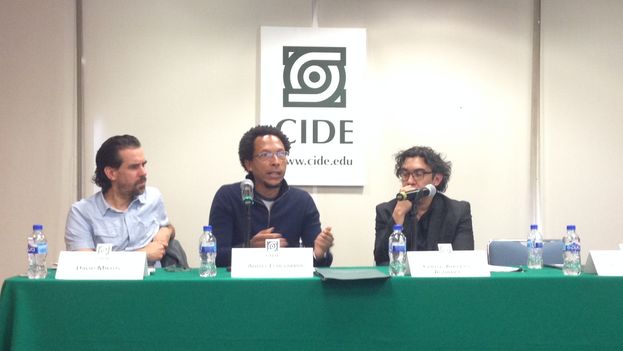
David Miklos, Ahmel Echevarría and Carlos Alberto Aguilera inthe meeting organized by CIDE in Mexico City. (14ymedio)

14ymedio bigger14ymedio, Yaiza Santos, Mexico, 22 June 2015 – The Center for Economic Research and Teaching (CIDE) in Mexico City organized from 16 to 18 June, the meeting “Poetics of the Present: Narrating Cuba 1956 to 2015,” opened by critic Christopher Domínguez Michael and closed by the journalist Homero Campa. It was a meeting between young writers living on the island and intellectuals of the same generation living in exile.

The first group included the narrators Jorge Enrique Lage and Ahmel Echevarria, members of what has been called “Generation Zero” of Cuban literature; for the second there was Walfrido Dorta, a researcher of the City University of New York,Waldo Perez Cino, an editor living in Leiden (Netherlands), and the poet, novelist and essayist Carlos Alberto Aguilera, co-founder of the journal Diaspora(s), who is currently living in Prague.

At the end of the session, in which  the Mexican writer David Miklos and the Cuban historian living in Mexico Rafael Rojas also participated, 14ymedio spoke with five special guests. Their answers are a sample of the different approaches and fruitful dialogue that took place during those three days. continue reading

14ymedio, Yaiza Santos. In a society where the free market exists, the relationship between writers and readers can clearly be seen, for example, in how many books are sold. Those of you on the island, how do you observe your relationship with your readers?

Jorge Enrique Lage. I don’t observe. But it is because there is no physical media in Cuba, no space for criticism. There is no infrastructure that allows you to think in those terms: has my book sold, how successful has it been… I don’t expect criticism, and the feedback with readers comes when you talk to them. But reading reviews or knowing that all the books sold in a bookstore, I’m oblivious.

Nor do I care. Because the problem of lack of space is critical, but not for literature. Literature doesn’t matter. It is critical for everything else. Lacking space for journalism, truthful journalism, current commentaries on politics and economics. And when there is space for all that, it will at some point include space for literary criticism.

Ahmel Echevarria. I think this relationship is mostly displayed in the presentation of a book, and a literary activity or simply in a party with friends, because I don’t believe that at the level of the State – well, to call it the State is to say everything, because everything belongs to the State – there are devices that are analyzing that.

When the book fair is analyzed statistically, there are numbers that I’m not very sure reflect what actually happens: there are a number of people attending the book fair, but in reality, of those hundreds or thousands of people, how many people are consuming literature? So, like Jorge, I don’t expect this statistic for me. What interests me in thinking about literature, making literature, is having fun, talking with friends, and the rest, if it comes it comes.

Question. Has nothing changed with the digital landscape? I think, for example, that you, some on the island, some outside, as has been mentioned in this symposium, keep in touch via the Internet.

Carlos Alberto Aguilera. It is that one doesn’t write for the readers. Who are the readers? The readers don’t exist. I’m not saying that a reader doesn’t exist, that head that can connect with your literature and in some way is going to understand it or recycle it, or do something with it.

This happens in very determined micro-communities. But they are not the readers. There is no way to write for the readers: it is too large a mass, too heterogeneous. If my book can sell or not, it’s not a question for me: it’s a question for the publisher. It doesn’t interest me, and it has never been a constraint to the way I write.

“That what we call Cuban literature, the less Cuban it is, and the less literature as an institution is, the better.”

Waldo Pérez Cino. I agree totally with Aguilera, but invert the point of view: he says for an author, the readers don’t exist, but for the readers, the authors do exist. And from this point of view, the Internet has produced a kind of de-territorialization, of circulation of the book, of circulation of texts, and of the way the visibility of authors circulates. What Carlos said is true, but if you look at it in reverse, effectively there is a chance for the readers, for those potential readers, who even when they have not read a particular author, they can identify a name, a mark of style or an attachment. Thirty years ago, it would probably have been impossible to circulate references to as many authors as today.

Walfrido Dorta. Look, right now I’m reading the last column of Gilberto Padilla in On Cuba, which is just about online literature and the phenomena of literature produced starting only from what the reader asks for. A model totally opposite to that offered by Aguilera. Padilla speaks of those teenagers who write novelas in installments and continue with what their readers are asking for. With this, clearly, online literature is moving in diametrically opposed patterns.

Question. What specific thing would you like to happen tomorrow, for example, to improve the state of Cuban literature?

Carlos Alberto Aguilera. Which was totally destroyed. Seriously. I think that what we call Cuban literature, the less Cuban it is, and the less literature as an institution is, the better.

Walfrido Dorta. That there would be independent publishers. That the State not be the only source of any kind of initiative. That will greatly threaten the state of things. Beyond that, improving writing, and in terms of intellectual networks, this is the first thing that will have to fade into the past.

Jorge Enrique Lage. I would not ask for anything. Literature is one of the centers of my life, but in Cuba there are so many things lacking, that to ask something for literature would be irresponsible. Literature doesn’t matter. Many other things in Cuba matter now, and we are talking of thousands, millions of people, for whom literature in their lives means nothing and they need so many other things.

So I would separate Cuban literature in relation to the “Change” [in the Cuban political system]. I see it as two separate spheres: although at some point they connect, but literature has nothing to do with the Change. The Change is for other reasons, other needs.

In Cuba, many things other than literature matter now, there are millions of people for whom literature in their lives means nothing and they need so many other things.

Ahmel Echevarria. For me, if anything, that they fix the streets.

Waldo Pérez Cino. I think that for literature, neither for the Cuban nor the Icelander, you cannot do anything institutionally. Literature is what is, or it is not what it is not, period. It exists to the extent that it is written, and that it is produced. What could be done, perhaps, is for distribution (or circulation, although that’s used more for periodicals than books), but, well, that would not be for literature. And much less for literature marked with a national seal.

Question. For those who live outside Cuba, do you see yourselves returning to Cuba, living in Cuba, working in Cuba, at some point?

Walfrido Dorta. No, not right now. But to throw stones at yourself is irresponsible and uncertain, then I don’t know. One has very fresh in one’s mind the limitations, the traumas, and the impediments that are still there; they weigh heavily when it comes time to decide.

Waldo Pérez Cino. In my case, at least, a “final” return, to use a Cuban government adjective – “final” exit – no, I don’t see it at all. But I can perfectly imagine, not now, but indeed in the future, a kind of coming and going, of in some way being in Cuba, of spending seasons in Cuba and seasons outside.

Walfrido Dorta. When one hears the question, you think now about the “final,” which was my answer. Coming and going, yes, I see it, clearly. Because for example, if one chooses an academic career in the United States, the links with Cuban institutions are almost inevitable.

Carlos Alberto Aguilera. If you are talking about something final, it is not a question I ask myself, and it is not something final… I have never been back, and I have refused to be published inside Cuba, even in journals I admire, such as “La Noria,” as long as there is this regime. And it is a personal question. If I see myself returning to Cuba, coming and going, I think I would only go to Cuba if the worst happens – my mom lives in Cuba – otherwise, no.


The Secret To Good Frijoles Negros / Regina Coyula

Regina Coyula, 19 June 2015 — Indispensable to any feast, everyone adds his or her own secret ingredient to the basic recipe for tomato-less sofrito*: the proportion of cumin, the cooking time over a low flame to congeal the bean, the sprinkle of dry wine, the pinch of sugar–in short, there are as many secrets as there are recipes.

I love black beans but, when in Barcelona I was invited to lunch at the Frijoles Negros Restaurant, I was alarmed: It didn’t seem proper to travel so far to eat what is routine fare here. However, Jorge, my nice host, managed set my mind at ease.

A semi-hidden location at No. 146 Carrer de Bruc street, almost at the corner with the busy Avenue Diagonal, houses this exquisitely designed spot that in no way recalls the accompanying themes of Cuban cuisine. White is the predominant color, with black/gray and red touches here and there, reproductions of Xavier Cugat posters, and that’s it. continue reading

But the food, which is what makes one return to a restaurant–or not, even when it boasts Picasso originals–is very good. Without trying to come off as a gourmet, I very much enjoyed the mix of dishes from international cuisine with a wink towards Cuban flavors, and vice versa. Thus the domestic salad of lettuce and tomato is enhanced by cut-up strawberry, and the very aristocratic salmon shares the billing with yucca and mojo [a garlic-and-sour-orange-based sauce or marinade].

The complement is a wait staff who are attentive at just the right degree to make you feel good.

The culprit of all this is Juan Carlos Puig Bretons, a Cuban of Catalan heritage with ideas to spare. In the evenings, live jam sessions and, if I’m not mistaken, the place even serves (or will serve) as a discotheque on weekends.

The longing in Juan Carlos flirts with opening a place in Cuba, now that he’s told that this can be done, but he hasn’t decided yet. Many requirements and few guarantees make him feel cautious, and so he waits. Besides, he is still quite involved in Frijoles Negros, his work-in-progress.

Now you know, the secret of good black beans lies not only in the cooking time.

As a conversation piece, I leave you with a little-known recipe–let’s see if Juan Carlos will dare to include it in his fusion cuisine.

Black Beans a la Menocal

(from La Cocina en el Hogar [The Kitchen in the Home] by Dr. Dolores Alfonso)

1.5 cups black beans

30 medium tomatos, peeled and seeded

3 onions

1 cup oil

1 bay leaf

5 tsp sugar

4 garlic cloves

4 liters water

1 large bell pepper

Salt and pepper

Cook the beans in the water with the bay leaf. When softened, add salt and the sofrito made from the onion, bell pepper, tomatoes, garlic and pepper. Later add the sugar and let simmer over a low flame until they thicken. They are left to rest for one day and reheated at serving time.

Yields 6 servings of 396 calories each.

Translated by: Alicia Barraqué Ellison, among others

Translator’s notes:

*Sofrito is a stir-fry of aromatic vegetables, herbs and spices used as the base for many Cuban dishes. It may or may not include tomato.

Politicians by Decree and Illiterate by Submission / Cubanet, Victor Manuel Dominguez

20080405035345-raulcubanet square logoCubanet.org, Victor Manuel Dominguez, Havana, 24 June 2015 – Abel Prieto rides again. Not as the author of two little novels whose names I cannot remember. Nor as the ex-president of a union of writers and authors more sold to the powers-that-be than self-help books at the Havana book fair, or reproductions of “Still Life with the Leader” at an art exposition committed to who knows what.

Never ever as that ex-minister of culture, with long hair and little sense, who declared that poets like Raul Rivera could be jailed, but they would not show up shot in the head at the edge of some ditch. Now, such a sad political figure, he rides as the cultural adviser to the Cuban president.

Other “Kultural Pajes”

As the Spanish writer Arturo Perez Reverte said in his article “Kultural Pajes” from the book With Intent to Offend, “The more illiterate the politicians are – in Spain those two words almost always are synonymous – the more they like to appear in the cultural pages of the newspapers.” continue reading

It happens here in Cuba, too. The difference is that here the lines fuse, and writers and artists are declared politicians by decree and illiterate by submission. Our politician-intellectuals also write or “sing” to the authorities, who sign a document to send innocents to the execution wall.

Therefore, Abel Prieto’s words to the Spanish daily El Pais are not strange although they are cynical: “The idea that we live in a regime that controls everything that the citizen consumes is a lie, an untenable caricature in this interconnected world.”

Saying that in a nation where the citizens are only interconnected, against their will, to registration offices, personnel files, surveillance centers, State Security and Interior Ministry monitoring and control departments or crime laboratories is a bluff.

The assertion that Cubans are at a high level of international connectedness would be pathetic, if it were not insulting, when we have not yet even overcome the barrier between the produce market and the stove, and they censor films, prohibit books, and pursue and seize antennas across the length and breadth of the country.

The Dark Object of Desire

According to Abel Prieto in El Pais, “We are not going to prohibit things. Prohibition makes the forbidden fruit attractive, the dark object of desire.” We had and have enough experience. From the prohibitions on listening to the Beatles or writing to a relative abroad to access to the internet.

Apparently among the secret guidelines issued by the Communist Party to its cadres in order to mend the nation is the obligatory reading of the poem Man’s Statutes by the Brazilian Thiago de Melo which in one of its verses he says: “Prohibiting is prohibited.” In Cuba only outwardly?

The reality is that Abel contradicts himself. While on one hand he assures that we are not going to prohibit, on the other he says that “we are never going to allow the market to dictate our cultural policy,” when everything is sold, from Lennon’s spectacles and Che’s beret to the sheet music of the National Anthem.

The strategic shield against cultural penetration designed by Abel (under the guidance of Cain: the State) is that it works against banality and frivolity so that people learn to differentiate, apparently, among the “exquisite” passages by Baby Lores about Fidel and the subversive themes of the Cuban rappers Los Aldeanos* (The Villagers).

Which is to say that, disguised as a demand for quality, absolute control of what citizens consume continues. They will not prohibit them, they will only give them the option, for the good of their cultural appreciation level, of seeing or hearing what the Cuban Minister of Culture, assisted by the Minister of the Interior, schedules.

Among Abel’s proposals against banality and frivolity is a “weekly packet” that includes films like The Maltese Falcon and Gandhi, the new Latin-American cinema, Kenneth Branagh’s Hamlet, and a symphonic cocktail by Silvio Rodriguez with the Small Daylight Serenade, that delusional song about “I live in a free country/which can only be free…”

Also to be enjoyed are films by Woody Allen and other offerings that combine “things with cultural density and entertainment material” far from racism and violence, as if in the films about mambises – Cuba’s independence fighters of the wars of independence — the guerrillas and international soldiers fight with cakes, and meringue is spilled instead of blood.

The dark desire for total control by the State is intact. Beyond the linguistic juggling that government spokesmen perform within and outside of Cuba. And without denying a minimal (fortuitous) breach in what is consumed, we still are very far from choosing freely what we desire.

When Abel wonders, in his interview with El Pais, “What are we going to do with Don Quixote?” perhaps Marino Murillo and the company answer him: Send him to run an agricultural cooperative, assisted by Sancho and Rocinante. Or, even better, have him manage the little restaurant La Dulcinea on Trinket Island.

victor-manuel-dominguez.thumbnailAbout the Author

Victor Manuel Dominguez is an independent journalist. He lives in Central Havana.


*Translator’s note: Lyrics to the Los Aldeanos rap video linked to are available here (in Spanish)

Translated by Mary Lou Keel

National Strategy For The Development Of The Infrastructure For Broadband Connectivity In Cuba / Republic of Cuba, Ministry of Communications

internet-en-cubaThe document below was obtained and circulated by Juan Juan Almeida.

Following are the first few paragraphs of the document, followed by a downloadable PDF of the entire document.

NATIONAL STRATEGY FOR THE DEVELOPMENT OF THE INFRASTRUCTURE FOR BROADBAND CONNECTIVITY IN CUBA

(Source: Republic of Cuba, Ministry of Communications)

EXECUTIVE SUMMARY

JUNE 2015

INTRODUCTION

The project of National Strategy for the Development of the Infrastructure for Broadband Connectivity in Cuba “constitutes the policy line to follow for the development of the infrastructure that will serve as support for the implementation of an integral policy for perfecting computer access in Cuban society.”

The fundamental objective of the National Strategy is to organize, regulate and trace the lines for the integral development of Broadband in Cuba. Consequently, it will serve as a guide for national entities and the population, in the development, exploration and utilization of communication services. The range of the objectives, features and goals of this strategy will be put into place in the period of 2015 to 2020, in the framework of a projection up to the year 2030.

The vision of this work is to augment the impact of telecommunications/information and communications technology (ICT) on the transformation and modernization of the Cuban economy and society, through the efficacious and intensive use of new technologies for the population, the business sector and the institutions of the State and the Government, within the scope of reasonable security.

The entire document can be downloaded here.

Many thanks to Regina Anavy for her translation of it.

Site manager’s note: Through some confusion (normal in dealing with communications from a country with a terrible communications infrastructure), it is not clear whether the document distributed by Carlos Alberto Perez (which was mentioned in an earlier version of this post) is the same as that provided by Juan Juan Almeida. The one Regina translated is the one provided by Juan Juan. Hence this post has been corrected to reflect that.