The Dictatorship Doesn’t Stop: Angel Santiesteban Transferred to Villa Marista

Posted by the editor of Angel’s blog

For the second time in four days, Ánge Santiesteban-Prats has been moved in the morning to the sinister facilities known as Villa Marista, the central prison of State Security in Cuba. So far, his family members still have no information on the reasons for this and why he has not been returned to Guardafronteras Prison where, as has been demonstrated, he is serving five years in prison after a rigged trial by the political police.

Saturday June 6 he was also taken to Villa Marista and also for unknown reasons. continue reading

We fear that it is in retaliation for the recent publication of a post where Angel denounced, along with other sensitive issues, the slavery imposed on some prisoners in the Castro penitentiaries.

We remember that Angel should have been paroled on April 28, but they again violated his rights, stripping him of days he had been credited with for a year in order to keep him locked up.

We also recall that the dictatorship still does not know how to handle the appeal he filed of the July 4, 2013 trial.

Once again we hold Raul Castro responsible for the life and safety of Ángel Santiesteban.

The Editor

9 June 2015

Cuba, Remittances, and Scrooge McDuck / Ivan Garcia

Rico-McPato-_ab-620x330Ivan Garcia, 10 June 2015 — A week before her Miami relatives landed in Havana, Milena hired a crew to paint the interior and the facade of her home in the bucolic Casino Deportivo neighborhood.

After two coats of paint and minor touch-ups on the walls, they did a thorough cleaning, and just above the door they placed a chain made of silver paper with a Welcome Home sign.

“My cousins haven’t come to Cuba for twenty years. We want to give them a reception in style. Thanks to the little money that they’ve sent us, we fixed up the entire house,” says Milena.

It’s understood in every other country that the host pays for the entertainment. But Cuba is a different story. For Gisela, a hairdresser, having relatives abroad is more than a blessing. continue reading

“I was able to start my business with the dollars that my daughter provided me. Everything I have—a 42-inch-flat-screen, a computer, a mobile phone, and air conditioning—I bought with the money she sent. Sometimes I’m assailed by a doubt: what if we Cubans didn’t have family outside?” Gisela wonders.

Well, they would fare very badly. Take for example Felix, a six-foot tall Afro-Cuban. He has no relatives abroad and has only seen euros and dollars in the movies on Saturday night.

He is the father of four children who barely gets by doing informal masonry work. “I don’t receive remittances and nobody sends me food parcels, clothing, or medicine. I have to fend for myself,” he says frankly, while drinking cheap beer in a dirty state-owned bar on October 10th Road.

Citizens like Felix are in the minority. According to some analysts, slightly more than 60% of all Cubans have a relative or friend abroad who regularly sends money or packages.

The average person calls this kind of help “throwing a Hail Mary.” In a nation where the average monthly wage is $23 (you would need six lifetimes to pay for a car, and repairing or furnishing a house is a true luxury) it is not reprehensible that migrants help their poor relatives on the island.

What is alarming is the brazenness. At the first opportunity, a large segment of Cubans send tweets, emails, or collect calls, urgently pleading for money from their relatives in exile.

“What nerve. Every month I sent a hundred dollars to an aunt and two cousins. When I could, I provided them household necessities. But a while back, my relatives started asking me for more money, using any pretext—to celebrate a daughter’s fifteenth birthday or to buy a toilet. In Cuba they think that the Cubans who live abroad are rich. I have to break my back working just to make a decent living,” said a Havanan living in Florida.

Aquino, a truck driver from Pinar de Rio who lives in New York, describes his experience. “I went twelve years without visiting my family. Truthfully, most Cubans ’throw it in your face’ (are inconsiderate). All they want to do is talk about their problems and ask you for money and things. I gave my niece a mobile phone and she disrespectfully told me that it was already an old model, that she likes the Samsung Galaxy. Young people don’t want just any cell phone or tablet, they want the latest model. They’re ungrateful,” he says.

The culture of hustling goes beyond prostitution. Many Cubans are convinced that their relatives are rolling in dough. So it is therefore OK to ask for whatever they want. Some make small requests: disposable diapers or jeans. Others believe that their family member is a real life version of Scrooge McDuck.

And they make plans at the expense of relatives living abroad. “Look what my nephew came up with. He wanted me to give him ten or twelve thousand dollars to buy an almendrón (classic American car) and turn it into a taxi. It’s amazing the number of people in Cuba who are clueless. They don’t know that almost all Cubans living abroad work two or three jobs to be able to pay the rent and debts. They aren’t satisfied with anything. They always want more without lifting a finger,” says Osvaldo, who lives in Tampa.

A considerable part of Castro’s military-controlled economy is designed to be borne by Cuban emigrants. The prices in the shops have unbelievable taxes aimed at capturing foreign currency. And the airport and postal tariffs could cause heart attacks.

The State and many Cubans milk their families like cows. And if they previously begged them for food, clothing, toiletries, and medicines, they now want them to pay absurd charges for everything from passport renewals to cell phone recharges. Not to mention pleas for next-generation smartphones, usually used as status symbols.

Natasha, employed in a commercial office of ETECSA, says that “80% of the money for recharging hours on cell phones in Cuba is paid for by relatives or friends living in other countries. ETECSA is one of the agencies that benefits most from the former gusanos (worms),” she says wryly.

More than one Cuban living abroad has asked when and how their relatives became leeches, sucking on the wallets of their families in other countries.

“One answer could be because of the perennial shortages suffered by the Cuban people for 56 years. But the real answer is Fidel Castro. He is guilty of perverting the Cuban people, creating the mindset of squeezing the exiles. In 1980 he invented the acts of repudiation against those who left from Mariel, calling them scum and saying he was glad they were getting the hell out. They’re not going to screw me over any more with such perversion. I wouldn’t think about returning to Cuba,” said an obviously upset Cuban American visiting Havana.

The economic disaster and cyclical hardships created by the Castro regime have spawned a breed of beggars. And scoundrels. By day they pretend to support the government and by night they make a call to Miami. After telling their tale of woe, they ask for money or things. It’s the easiest thing.

Relations / Fernando Damaso

Last December 17, we Cubans received the pleasing news that diplomatic relations would be reestablished between the governments of Cuba and the United States, after more than 50 years of non-existence, lived in a hostile and confrontational climate. Many of us thought that, finally, common sense had prevailed, and that both governments had derived lessons from their errors, so as not to repeat them.

Soon enough, however, the alarms went off. Cuban leaders and functionaries continued using the same obsolete language from the “Cold War” years; aggressive declarations were made; illogical and improvised demands were raised; alignment with totalitarian governments was tightened; and support for extremist organizations and movements was increased. continue reading

As if this weren’t enough, it was assumed to be a duty of all Cubans to side with the inept Venezuelan government, and its even more inept president, in an attitude of brazen interference in that country’s internal affairs: demonizing and declaring war on its opposition, taking an active part on the side of the authorities, disregarding that in the last elections, the “Chavistas” (followers of Hugo Chavez, and now his handpicked heir Nicolas Maduro) won by a margin of 300,000 votes in a country divided almost down the middle, where the wishes of those who are not in accord with the government are as valid as those of the government and its supporters. The Venezuelan authorities seem to have forgotten that they should govern for all Venezuelans, and not for just a portion of them–which seems to be a common evil in our lands.

This surge in the political fire does not help the goal of reestablishing respectful relations. Once again, the Cuban authorities forget that they should represent first the interests of the Cuban people, and not those of certain political groups in other countries who have similar ideologies. Let us hope that in the upcoming dialogues of the 21st, all of this is kept in mind.

Translated by: Alicia Barraqué Ellison

18 May 2015

Anti-U.S. References Erased From a Santa Clara Mural / 14ymedio, Jose Gabriel Barrenchea

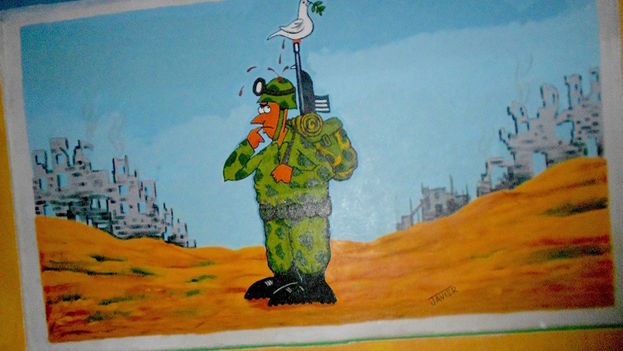
One section of the mural

14ymedio bigger14ymedio, Jose Gabriel Barrenchea, Santa Clara, 9 June 2015 — After months of work, the new cartoon mural in the City of Santa Clara’s Intercity Bus Terminal has been completed. This painting replaces an earlier one, but with two significant elements missing. It does not include any component from the hand of Pedro Méndez, the renown cartoonist from the comics supplement Melaíto*, and all references to the United States – which were abundant in the previous painting – are gone.

Méndez was not able to contribute due to health issues, while the absence of negative references about our neighbor to the North seems to be related to the new era that began last December 17th with the announcement of reestablishment of relations between the White House and the Plaza of the Revolution. Both circumstances have combined and noticeably influenced the final results. continue reading

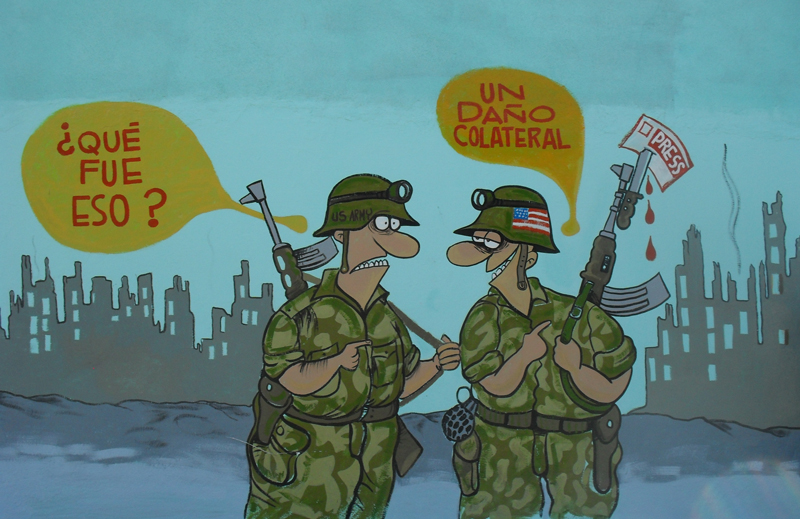
No one would ever dream that Méndez, an avowed enemy of the yanquis and the artist behind the anti-U.S. images on the painting that was replaced, would now be willing to work on a mural whose artists were clearly prohibited from making even a veiled criticism of the neighbor to the North. “There better not be any flags on the military uniforms!” was the order of the cultural authorities to the artists and sign makers who undertook the project.

The reasons behind replacing the old mural are not clear either. It is true that the wall on which the mural hung was in a deplorable state. Rumor had it that intelligence agent Gerardo Hernández Nordelo would surely display his own drawings on that wall, but that has not happened. Still, it may. In the next few months they may decide to fill the space they left blank, before graffiti artists get to it first.

*Translator’s Note: Part of Vanguardia, the Communist Party newspaper of Villa Clara Province.

Translated by José Badué

— Supplement to 14ymedio article: Photos of sections of the old mural —

Source: http://www.drawn-tripping.com/
What's that? Collateral damage. (Source: http://www.drawn-tripping.com/)
What’s that? Collateral damage. (Source: http://www.drawn-tripping.com/)

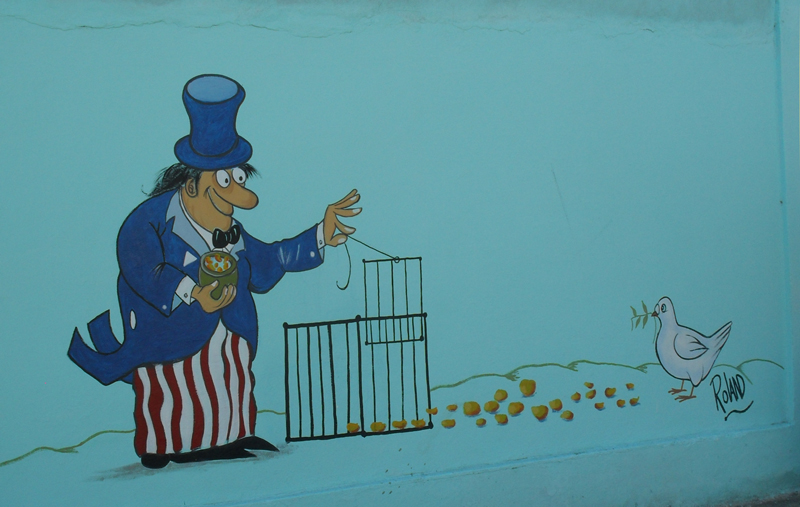
(source: http://www.drawn-tripping.com/)

Slavery, Exploitation and Conformity / Hablamos Press, Eduardo Herrera

Dr. Eduardo Enrique Herrera

Hablamos Press, Dr. Eduardo Herrera, Havana, 9 June 2015 — It is said that in times of slavery slaves were mistreated and were not free. But the gentlemen slave owners were responsible for feeding and clothing them, providing them healthcare—even for teaching them to read and write, and caring for their small children and pregnant women. The gentlemen slave owners who did this were better regarded by society.

It is also said that the abolition of slavery was a business decision because the time came when the masters could no longer finance all the costs associated with holding slaves. They decided to free them, then employ and pay them, turning the slaves into salaried workers. This way, although the pay was meager, these exploiters were technically complying with abolition, even though they continued being exploiters. continue reading

On a daily basis, I converse with many Cubans who, when we speak of the country’s situation, agree with me that it is very dire. The majority complain that salaries are inadequate, even for providing decent nutrition. Working conditions and the state of their dwellings are deplorable. The lack of products and other items essential to life in this modern era is ever more notable, in addition to the lack of freedom.

But most of them say, “Why should I do anything if nothing gets resolved? I can’t change things by myself. The best option is to try to leave the country.” Others, more committed to the government, argue that “there are many problems, but we will get better, always, with the historic momentum of the Revolution leading the way” — without acknowledging that the revolutionary government has been in power for more than 55 years, and we have almost frozen in time.

All of these pessimistic and submissive behaviors make me think of the history of slavery, when the majority of those in bondage shrank from confronting the slave owners out of fear of punishment and death. They would try to escape, they flattered their masters so as to obtain benefits, and even when they were freed, many preferred to remain in servitude.

Although some came out and fought against slavery, the majority adapted to the slaveholding method of exploitation. Today in Cuba, many have adapted to the regime by trying to subsist however they can, but without claiming the rights that appertain to them. It makes me think that when one lives so long in the condition of slavery, it is difficult to recognize, and demand, the freedom that belongs to us from birth.

Translated by Alicia Barraqué Ellison

Cuba: Capitalism has Won the War / Miriam Celaya

jovenes1cubanet square logoCubanet, Miriam Celaya, Havana, 8 June 2015 — In the beginning, there were the cassettes, first the ones we viewed on ancient Betamax equipment, and a bit later on VHS. In those dark years in the 90’s, the illegal dealers, better known as “messengers” would arrive with their backpacks, pedaling their inseparable bikes, from customer to customer. They charged of 5 or 10 Cuban pesos rent per cassette, depending how many movies were on each tape and the quality of the recording.

Video equipment was not readily available among Cubans, so the happy owner of one of these was not only privileged, but he would become the host of friends and nearby neighbors who eluded the harsh reality of the so-called “Special Period,” taking refuge in some colorful Hollywood product or another, usually recorded by the even more restricted group –favored among the favored- who owned a DIRECTV antenna.

Sharing a show or a movie was also a matter of affinity and solidarity at a time when almost all Cubans suffered the brunt of an economic crisis which, in the same way as the system that generated it, seemed to have no end. So some fellow invitees would agree to rotate the expense for renting the cassettes or contribute some snack to improve the get together, such as tea or coffee or another beverage, duly accompanied by roasted chickpeas. continue reading

The messenger, meanwhile, had to have sufficient intuitiveness and training to sort out certain obstacles.  His was an illicit occupation, so the risk of an envious denouncement on the part of a member of the CDR [Committee for the Defense of the Revolution] or police harassment.  Law enforcement officials would hunt down the messengers to confiscate the tapes and later resell them on the black market to another messenger or the owner of some video store, which was also illegal. Thus, the circle was complete.

The authorities had arranged a police hunt to end this practice, which favored “the imperialism’s ideological penetration” in the Cuban population, and affected “especially the young.” In workplaces–in particular those involved in social sciences and research–the battle against the subtle enemy propaganda was an essential point in the guidelines of the nuclei of the Cuban Communist Party (PCC) and the administrative and syndicate leadership, though many of the leaders themselves and almost all of the workers were regular users of the “venomous” product.

Thus, while during working hours the system’s bureaucrats railed against “track two,” the official label for the “ideological war” of the US government against Cuba, on the domestic front the consumption of the demonized product was growing exponentially. Without a doubt, the same “black” propaganda that the government whipped up against foreign shows and movies only managed to interest the audience in favor of its consumption. The olive-green battle against Yankee influence was doomed to failure.

The “antenna” and DVD’s, imperialist agents of the “zero years”

With the arrival of the twenty-first century and of new informational and communication technologies, video-cassettes were falling into obsolescence, even on this backward and un-computerized island.

During the last few years of the previous decade, DVD technology made its entrance, supplanting old video equipment and favoring the proliferation of CD’s“burned” in some living room, and distributed the same way by a whole army of messengers. The use of satellite dishes proliferated, and their owners rented out their networks to the homes in their vicinity which were able to pay for the use of those services.

Although limited to the preferences of the owner’s shows, the system expanded rapidly in the capital and main cities with large population concentrations, which made it difficult for the repressive forces to detect and confiscate the equipment.

On the other hand, the more technology moved forward, the more difficult the struggle against it. It was no longer about pursuing messengers fleeing on bikes through the maze of streets, but it was necessary to mobilize specialized resources, personnel and equipment, in addition to police patrols that needed to take part in confiscating equipment and arresting offenders.

Such deployment of repressive forces carrying out their duties on one block allowed for entertainment dealers to dismantle equipment in the surrounding areas, stowing it in secure sites. Soon Cubans learned to identify the minivan with the signage “Radio Cuba” that headed the police delegation, and soon the owners of the antennas also had their own informants at the police station, who, through bribes, would warn them ahead of time about the confiscating operations. At any rate, each piece of seized equipment was like a Greek war victory dance for the authorities, taking into account the cost of the operation and the meagerness of the harvest.

The government would score another embarrassing defeat against resources dictated by popular fancy and the experience of half a century of survival in the midst of ploys and unlawfulness.

The Internet, the devil incarnate

With that stubbornness of the mentally castrated, today’s official lackeys pull out their hair and rend their garments before the evidence of the inevitable: the preference of the overwhelming majority of Cubans for the cultural products of “savage capitalism.”. The illegal vessel that now often lands on a weekly basis in Cuban homes is the so-called “package” which has broken all records set by its predecessors’ audiences.

Today, it is almost impossible not to hear from a neighboring home the sounds of regular foreign TV. The package has invaded national domestic life to such an extent that Cuban TV has become an almost furtive intruder amidst an empire of consumption of smuggled audiovisual materials.

An external hard drive is all it takes to transport terabytes of capitalist entertainment and culture that is broadcast in “socialist” Cuban homes at affordable prices, between 25 and 30 Cuban pesos, to break through the grayness of State TV programming.

However, the appointed censors, with that infinite vanity that makes them believe they are arbiters of what should be the general taste and the managers of what each Cuban on the Island should culturally consume, labels as “banality” peoples’ tastes favoring a soap opera from wherever over Cuban TV’s La Mesa Redonda (The Roundtable) and knowing by heart each new series that airs, every movie that comes out, and what Alexis Valdés newest joke is, in addition to a host of musical talents and of the most diverse foreign shows, including cartoons and a great variety of kids programming that fills in the gaps, the blandness, and the poor quality of Cuban TV programming dedicated to children.

Much to the despair of frustrated cultural bureaucrats, the antenna has now been enriched by the undisputed power of the Internet, that “runaway horse,” shortening the time between what is produced and what is consumed in the cultural field, in addition to allowing coherent news updates outside the government system.

A lost war

In this vein, it is not surprising that the official cymbals and trumpets have summoned their cultural curators and their rusty institutions to fight yet another battle against Yankee penetration, as if this was not already a fait accompli. The cultured officials, like vestal virgins, are outraged with the surrender of the former warrior people to the seductive charms of the consumer society.

With their characteristic lack of creativity, the ever-killjoys have launched their own strategy: “backpack” — a ridiculous parody of the “package” — whose most eloquent proof of modernization is the inclusion, among their offerings, of Cuban TV series that made history with the national audience in the ’80s: ” En Silencio ha Tenido que Ser” [It’s had to be in Silence], “Julito el Pescador” [Little Julio the Fisherman] or “Algo Más que Soñar” [Something Else to Dream About]. And they still expect to be taken seriously.

The truth is that, as technology makes strides and its messengers refine their strategies of survival to escape official controls and sell their products, repression –just like the system it represents — continues to be tied to the same methods of surveillance and prosecution typical of the Cold War era. They remain anchored to a past that will not return.

By now it is obvious that Cubans like a colorful world that arrives each week in the package more than the promise of eternal poverty that everyday life throws at them. The socialist mirage that mobilized us decades ago has died a natural death: it suffocated, submerged in its own failure. The date that today excites humble Cubans is with capitalism, even if, for the moment, it’s only through their TV screens.

Translated by Norma Whiting

Havana, Between the Scarcity of Water and the Rains / Ivan Garcia

Cargando-agua-en-La-Habana1-_ab-620x330

Iván García, 8 June 2015 — This is the current scenario. About 60,000 families receive their drinking water by tanker trucks. 60% of the water distributed is lost due to breakdowns in the hydraulic system. 20% of that water is wasted due to leaks within homes. Havana Water, the city’s water utility, and state industries are responsible for losing 80%.

Water is pumped in the neighborhoods on alternate days. In remote districts of the city, the supply may be provided every four days. Water scarcity causes many families to improvise to collect the precious liquid.

Substandard water storage is the leading cause of epidemics like dengue fever or chikungunya, which cause dozens of deaths every year. Or the outbreak of cholera, a disease that had been eradicated in Cuba since the early twentieth century. continue reading

Neglect and deterioration of public sewers cause flooding in the city with even light rains. In other bad news, which the regime can’t be blamed for, 63% of the country is affected by drought, with reservoirs in a critical state at only 39% capacity.

According to the engineer Antonio Castillo, deputy director of operations at Aguas de Havana, the situation is unsustainable in the medium and long term. “The supply basins are like bank accounts. If you invest, but you withdraw more than you deposit, you have less each time, and if you stop saving, one day you won’t have any money. The same thing happens with water,” he told the official press.

The lethal combination of leaks, bad workmanship, lack of foresight, and drought, has placed a red asterisk by water, not only in Havana, but also in the rest of the country.

If you walk at night in some Havana neighborhoods, you will see how water is wasted by broken pipes. At Espadero and Figueroa, in Reparto Sevillano, thousands of gallons of water are lost through leaks in the public networks. At the corner of October 10 Road and San Francisco, in Lawton, the street becomes a river.

On January 17, 2000, the National Institute of Water Resources and the Water Group of Barcelona, created Havana Water, a joint venture company. What does Havana Water do? Little or nothing. The neighbors are tired of complaining to the water system.

“One morning they come and make a sloppy repair that in a few hours is damaged again. They argue that because of the poor condition of the networks, the water pressure bursts many old pipes. All the specialists are experts at diagnosing the problem, but not at fixing it,” said Augusto, a resident of October 10th and San Francisco.

Not far away, in the building where Hiram lives on Carmen Street, also in Lawton, the tank overflows and an appreciable amount of water is wasted because they don’t have a single float.

“In multi-family buildings, painting the exterior, maintaining the water pump, and repairing the facade are supposed to be the responsibility of the state. But state agencies don’t lift a finger, so the residents have to manage everything,” notes Hiram.

Havana Water is replacing thousands of kilometers of pipes at a snail’s pace, but the poor quality of work has aggravated some within the populace. In Old Havana the water supply network is currently being replaced. It is scheduled to be completed in 2017 at a cost of more than $64 million.

The slow pace of work has led to the closure of many roads, turning the crowded streets into an obstacle course. Thoughtless people also throw garbage into the trenches, creating a foul stench that pervades the area.

But the ones who are worse off are those living in low-lying areas of the capital. In addition to water shortages, they live on the razor’s edge every time a rainstorm assaults Havana.

“I pray every time there’s bad weather. Over here everything floods. And with the rains of April 29th, because of the flooding, hundreds of families lost their belongings,” says Reinerio, a neighbor in Jesús María, a poor area in the old part of the city.

More than a month has passed since those rains and the state institutions have only given mattresses to the victims. “Nothing is free. They sell the mattresses for 900 pesos (about 45 dollars) on credit. They won’t replace refrigerators, televisions, or other ruined appliances. People are very disgusted with the government, because of the little help provided to families who have nothing and no place to go,” says Felicia, a housewife.

And there is no solution in sight. As I said at the beginning, it is a combination of factors. State negligence causes 60% of the water to be lost. The empty wallets of a large segment of the Cuban people prevent them from repairing the water system in their homes.

Many poor families live in constant fear of the rains, and now the hurricane season (June 1 to November 30). Add to the fury of nature the regime’s mismanagement. They are surrounded. And defenseless.

Letter from a Cuban-Spaniard to Pablo Iglesias / 14ymedio

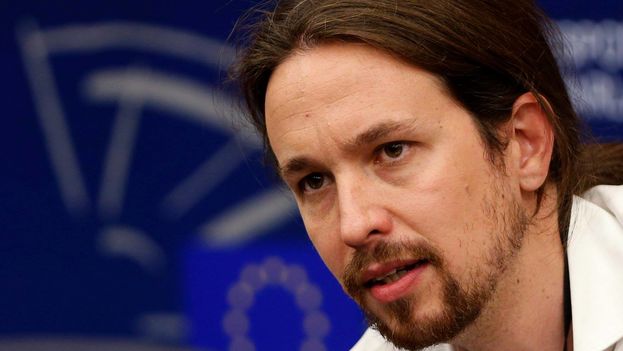
Pablo Iglesias, Secretary-General and founder of the Spanish Podemos party and Member of the European Parliament. (Facebook)

14ymedio bigger14ymedio, 22 May 2015 — I am a Cuban of Spanish descent. I was born in Havana exactly fourteen years after Franco’s death, ten years after the Spanish Constitution of 1978 was ratified, and one year before the fall of the Berlin Wall.

My grandparents, most of them from the Spain’s Galicia region, could be considered victims of the Franco régime. Although they were not killed or tortured, they did suffer the consequences of a civil war. Like so many others, they had to leave it all behind and emigrate to Cuba, fleeing the poverty and social instability inflicted on Spain by the Franco régime and its brand of Fascism. In other words, my grandparents had neither future nor freedom in Spain. Meanwhile, the countries of the Western Hemisphere were rich lands, far from the devastation of the war in Spain and Europe, with growing industries and opportunities for all.

Cuba was under the rule of the dictatorship of Fulgencio Batista. His régime respected the rights of trade and commerce, turning the Island into a prosperous country welcoming of immigrants. Despite this, Batista’s régime, like all dictatorships, was corrupt. That, coupled with political instability, awoke an enormous discontent throughout Cuban society. The Cuban Constitution of 1940, one of the most progressive of its time – not only in the Western Hemisphere, but in the entire world – had been forgotten and still today has not been recovered. continue reading

It was this discontent that awoke sympathy and support among the Cuban people for a young lawyer, the son of Galician immigrants. Eloquent and with a utopic discourse, he initially displayed a friendly face to the people, but later, with his Marxist-Leninist ideas, he became the protagonist of one of the most long-lasting dictatorships in the Western Hemisphere. He is also the one most responsible for the impoverishment of Cuba and its people.

As a Cuban, I am alarmed to see this same discontent and instability in today’s Spanish society, in the context of an imperfect democracy, but a democracy nonetheless. 

As a Cuban, I am alarmed to see this same discontent and instability in today’s Spanish society, in the context of an imperfect democracy, but a democracy nonetheless. So are we doomed to repeat history?

Due to the twists and turns of life and history, as the grandson of Spanish immigrants who fled Franco’s régime, it was I who had to emigrate to Spain when I was 19 years old, as my father did before me. The same reasons that drove my grandparents from Spain drove me from Cuba, but with a few distinct nuances. The man ruling Cuba with an iron fist is a Comandante, not a general. His last name is Castro, not Franco. Fascism did not force me to immigrate, Communism did.

Allow me to be perfectly clear with respect to this: if a person, with a family history like mine wants to do something constructive with his life, what he is searching and wishing for is to leave the obsolete ideologies of the past century on the wayside. What that person wants is to file away vengeance, hatred, and anger, although it may be hard to do so (and believe me, it has been very hard for me), and use reason and emotion as instruments of rebuilding and unity, not destruction and divisiveness.

You are right about many things, and I must admit that you are an excellent photographer of the reality in Spain. You know like no one else how to channel the disconnect in the society, to put a name on this discontent and to transform it into votes for your political movement. Although I consider your arrival on the Spanish political landscape as positive and healthy for a democracy, I also see in you obsolete and erroneous ideas of struggles, of resentment and of promulgating a supposed social justice that, believe me, by this path will never come to pass. History – my history – has proven it to be so.

I recognize in your discourse the entire battery of slogans that I listened to for hours and hours under the Caribbean sun.

I recognize in your discourse the entire battery of slogans that I listened to for hours and hours under the Caribbean sun. Those slogans about equality and struggle sound very good to those who do not understand their effects (among them yourself) but once the stage was dismantled they left us — 11 million Cubans on the island — with fears, dreams, exhaustion, a longing for that son or father who left, a ration book and daily blackouts lasting hours. This is similar to what is happening now in Venezuela (imported from Cuba), a model I have heard you say you envy.

Do not think this letter is an attack, it is not. If it just makes you and many others reflect, it will have achieved its goal. Allow me to share my political viewpoint with you, to avoid my being labeled or being accused of being a product of a powerful caste, the bourgeoisie, or some other powerful entity. I, and only I, will clarify what my politics are. I am neither of the right nor the left, I say it without meaning it to sound like the political slogan so often used these days. I consider myself liberal, progressive, and a social democrat.

I am a liberal because liberalism defends the supremacy of individual rights, irrespective of race, gender, or nationality. Respect for the rights of the individual is respect for his or her freedom, and guaranteeing the rights of all, which inevitably leads to the rule of law. I want a State that functions and allows me to function, that enforces the law, that rewards hard work, and that permits me the necessary freedom to build my own future without paternalistic subsidies, nor bureaucracy, nor a pointless civil service.

I am a social democrat because I sincerely believe that all future civilized societies should be cognizant of and apply the art of peaceful coexistence and should have a humanist and social character, without forsaking sustainable commercial projects that generate wealth. On the other hand, I consider myself a progressive because I believe that an imposed yoke, of whatever kind and wherever it comes from, is always expendable, and religions are not an exception. Because education should be secular and free of political indoctrination, because no State or divine being should tell a woman what she can do with her body, because I share the joy allotted to a community such as gays and lesbians when their right to marriage and adoption are recognized.

I thank you for your time, and I hope you will know how make a positive contribution and help unify all of us in the quest for a better future. In your hands, and in everyone’s hands, within our diversity, there is the possibility to either pass into history as those who gave a country the tools to renew such a hard-won and much-needed democracy, or as those doomed once more to repeat it.

I apologize for my anonymity. Personal and family reasons in relation to Cuba require it.

Bidding you a cordial farewell, I wish you the best.

(signed)

Just another citizen.

President of Cienfuegos Government Falls in Police Raid / Juan Juan Almeida

He confused having a political position with autonomy and freedom, used the Internet service to call his daughter who resides in Canada, was summoned for it, and had to pay the price for believing in the future.

Eduardo Walfrido Coll Rodríguez, known as Eddy Coll, President of the Municipal Assembly of People’s Power in Cienfuegos, is one of those rare men who, occupying a certain medium rank, and possessing leadership skills to spare, accepts the word “change,” listens to the voice of an exhausted nation and, from a government position, defends and identifies with the people’s priorities. continue reading

He is known for the effort he puts forth when an issue concerns helping others, and for his perseverance in battling against bureaucratic pettiness. Perhaps because of this, he was only summoned, and not expelled from his post. Let’s review step by step.

In Cuba, the government provides resident foreigners (via ENET and its various plans) an option that it does not offer its own citizens: to legally contract with an Internet service and associate it with the telephone numbers of their domiciles.

To ignore this difference is not a good sign; but this particular type of apartheid opened a commercial breach used by some Cubans to purchase Internet service from foreigners, and turn their own computers into telephone switchboards.

This appears to be a good business, and produces significant savings for customers. Tariffs imposed by the Telecommunications Company of Cuba (ETECSA) fluctuate between 1.00 and 1.20 CUCs per minute, depending on the geographic zone with which a connection is being made. The parallel network for international calling offers an identical service at .20 or .25 CUC cents per minute.

I should point out that, according to unofficial data, the volume of calls out of Cuba via the Internet does not impact ETECSA’s revenue–but does impact the interests of the Interior Ministry (MININT) which, because it cannot monitor those calls, has circulated a resolution that punishes this activity with a decommission of the telephone line, and places its proprietors at the disposition of the court.

To enforce this regulation, ETECSA is constantly monitoring ENET users’ connection times and–if it detects a notable increase in usage on one of its lines–ETECSA will presume the existence of a business arrangement, and will alert MININT, which organizes the shutdown.

So, as if the “new economic model” were to also involve being implacable towards family communication, Eddy Coll was caught in one of these roundups, reprimanded for using the resources of the State for personal benefit, for visiting the clandestine cyber-café, nicknamed “the telephone booth,” of his neighbor, Lisette, and calling his daughter in Canada.

Some individuals who have a knack for staging events showed their solidarity [with the government] when they learned of the reprimand, and supported it as a warning. At this point, what’s the use? But it’s not surprising. What kind of legacy can we expect from a country that we can only view through the lens of folly? From a small nation which (according to what I’ve heard) has an Islamist terrorist living a pleasant life in Havana–in Siboney, to be exact–and that soon will be removed from the list of state sponsors of terrorism? Inconceivable, yes; but that’s another story.

Translated by: Alicia Barraqué Ellison and others

5 May 2015

One Year and Already Walking with Solid Steps

Rebeca Monzo, 22 May 2015 — A little over a year ago our friends Reinaldo and Yoani came for a visit to tell us that, finally, the long-cherished dream of starting an independent newspaper was about to be realized and to ask us if we would be interested in contributing articles.

Why such an unusual name for a newspaper? I’ll tell you: The number fourteen refers to the floor on which they live, Y stands for Yoani, who came up with the idea, and medio is a reference to communication media.*

We, along with others, enthusiastically began making our modest contribution and the dream quickly came true. On May 21, 2014 the first issue of the digital daily 14ymedio was published.

Yesterday, we all gathered at the newspaper’s headquarters: the founders, the staff and the contributors. We had a delightful evening of conversations and discussions in which the main course consisted of new suggestions and ideas to further improve 14ymedio.com.

HAPPY FIRST ANNIVERSARY!

*Translator’s note: The title is a play on words. In Spanish, 14 y medio literally means fourteen and a half. The word medio can mean either half of something or medium, as in the medium of television.

Information is Power / Rebeca Monzo

Rebeca Monzo, 19 May 2015 — The year was 1985. I was still working at a state agency, like everyone in our country, and there was talk in the Cuban media about an “enemy” radio broadcast that had been named, improperly, Radio Martí. This generated fierce government propaganda against it, above all, for having baptized it with the name of the “Apostle,” (as Cubans call José Martí) which the Cuban misgovernment feels it owns absolutely.

As could be expected, like all human beings we relish forbidden fruit, especially in the case of a source of information whose censorship is imposed by a totalitarian regime. My curiosity grew and I gave myself the task of finding a formula for reaching it. continue reading

Availing myself of an old shortwave radio I had been given (its sale in stores was forbidden), I succeeded, crossing the dial from one extreme to the other over and over again, finding the outlawed station right next to the famous Radio Rebelde (Rebel Radio), which inflicted intolerable interference on Radio Martí. But in my persistence I managed to discover that, by gently moving the device to one side or the other, I could capture quite clearly the forbidden voice.

From that glorious moment, my life changed. I became aware of what was happening inside and outside our borders. But above all, I was happy to leave behind the manipulative official rhetoric.

Because it was very difficult for me not to occasionally drop a controversial comment at my then workplace, influenced of course by this new source of information, I soon found myself in the administration’s spotlight. So in 1986 I decided to quit my office job and devote myself entirely to my artistic work as a way of life.

Imagine my surprise and excitement when one day, as I was working in my studio with my ear glued to my favorite radio station, listening to an interview they were doing about an SIP (Inter American Press Association) event, I heard the unmistakable voice of a much-beloved family member, whom I had not had any contact with for 26 years. Despite the difficulties and intolerable interference, I became a faithful follower of this radio station, which opened a new window to the world of information.

My sincere congratulations on your 30th anniversary of this great collective work, which over the years has made a recognized and valuable contribution, after providing information to all Cuban citizens, because even though it does not reach many, those who do manage to connect are responsible for disseminating it, changing the single view provided by the island’s official media.

Check the Air in the Tube / Rebeca Monzo

Rebeca Monzo, 4 June 2015 — One evening at the beginning of the “Special Period,” when I was meeting with friends at home, I told them to drink lemongrass tea, because coffee would now become scarce: “What I most regret is not the wretched goods that will be coming, but what wretches we are going to become,” speaking in general terms of course.

Unfortunately this has happened, and on a gradually increasing scale we have thievery, deception, fraud, double standards, and many other social vices.

Right now corruption cases on the island are alarming, at all levels: stealing and selling exam answers and graduation certificates, selling jobs, falsifying payrolls, and many others. Not to mention joint ventures, where the scams and their dividends reach into the millions. continue reading

One that now has my attention is particularly painful, involving medications, because it plays dirty with the health of the population.

The daily Granma published a complaint on Friday May 29th, on page 11 (national edition) in the Letters section, from Yasser Huete, a citizen from Artemisa, who asserts that tubes of Tolnaftato (an anti-fungal skin cream) from the Roberto Escudero Laboratories, located at 20th of May Street, in Cerro, Havana, are more than 50% filled with air.

He claims that he ran a test by buying two tubes and emptying one of them, then weighing it, and the resulting difference was 48.6 grams, when the weight printed on the tube is 100 grams. He went to the pharmacy where he had bought them to complain, and the employee who waited on him said they had already received several complaints like this from other citizens involving the same laboratory, which means, according to the affected chronic patient who made the complaint, that he has to “do more with less.”

Independent Groups to Hold Gay Pride Walk / 14ymedio

PaseoLGBT1
Previous year’s Gay Pride Walk on Havana’s Prado (Orlando Luis Pardo Lazo)

14ymedio bigger14ymedio, Havana, 9 June 2015 – This coming June 28 Havana’s centrally located Prado will again be the scene of the Gay Pride Walk organized each year by the independent LGTBI community. The call has been launched by several independent groups, among them the projects Puertas Abiertas (Open Doors), Shui Tuix, the Foundation for LGBTI rights, Divina Esperanza (Divine Hope), and Arcoíris Libre de Cuba (Free Rainbow of Cuba), according to information provided to 14ymedio by Navid Fernandez Cabrera, one of the organizers

It is expected that the participants will gather starting at ten in the morning in front of Havana’s Capitol building, and advance along the Prado toward the sea. There, waiting for them, will be some puppeteers to present a show with “muppets.” All along this pedestrian avenue there will be a free distribution of condoms and informational handouts to facilitate an exchange with the people passing through the busy place, explained Fernandez Cabrera.

The members of the Latin American Rural Women’s Front (Flamur) will support the activity with messages concerning No Violence Against Women. At the end of the parade where the Prado and the Malecón meet, a statement will be read in the presence of various projects and accompanying representatives of the LGBTI communities of Pinar del Rio, Matanzas and Santiago de Cuba.

The first of these events occurred in 2011 and since then the walk has been scheduled to mark International Gay Pride Day or on a weekend day close to that date. The National Center for Sex Education (Cenesex) headed by Mariela Castro has chosen, for its part, 17 May as the established Cuban Day Against Homophobia and Transphobia.

Women Before Their Time / Cubanet, Luis Cino Alvarez

jovenes

On May 17, on the Sunday television program Passage to the Unknown, the journalist and host Reinaldo Taladrid, and guest psychologist Patricia Ares, addressed the issue of gender training received unconsciously by many girls. Training them, from very early days, to be future frivolous objects of erotic pleasure.

The phenomenon of the eroticism of childhood, although it happens worldwide for various reasons, has reached alarming proportions in Cuba.

For some years, it has become common for many parents to dress their daughters as if they were harlots in miniature. To demonstrate how precocious they are, in whatever party there may be, they are encouraged to wiggle, and to shake their rear ends – which still haven’t developed – more than all the rest. The more lasciviously the better, shaking to the most obscene reggaton. continue reading

Not to mention the expensive photos and videos of girls’ quinceañeras – their fifteenth birthdays – in which they change into several outfits rented for the occasion, little girls portrayed nearly naked, wrapped in towels or the briefest thongs, with eyes rolled back and tongues hanging out, in poses that are more suitable for porn stars than quinceañeras.

Taladrid and Dr. Ares, worried about the way in which many parents are violating the developmental stages of their daughters, commented on the increased “adultization” of childhood and the “infantilization” of adulthood. Both blame the problem of macho sexism that afflicts us on the harmful influences of our capitalist consumer society, globalization, Barbie dolls, reggaeton, indiscriminate cultural consumption, the “weekly packet,” and video-clips of Katy Perry, Lady Gaga, Beyonce and Shakira.

The journalist and psychologist also may have spoken not only of sexy clothes – practically those of harlots – the suggestive dances in the parties at home and also at school celebrations, almost always encouraged by the teachers themselves; but also how many mothers and fathers encourage their daughters and sons to ask family and friends living abroad for gifts of every kind, and money, a lot of money, when they come to visit Cuba.

What matters less to these parents is the development of values in their children. Spirituality, values, not behaving so as to be able to buy things in the hard currency stores. Who doesn’t regret it when they see their offspring turned into female and male prostitutes.

There are too many Cuban parents, who in the midst of the national disaster, are turning their girls and boys into adults before their time. What is even more serious, are those who turn into the worst class of adults: materialists, hedonists, self-serving,cynical, amoral. They shall inherit our kingdom of lies and wreckage. Amen.


Decrepit Cuba / Orlando Luis Pardo Lazo


Orlando Luis Pardo Lazo, 15 May 2015 — Cuba’s sun beats down on everything. Shrinking the eyes. Crushing the skin. Dehydrating us, making us seem older than we have always been.

And it’s not only Cuba’s sun. It is Miami’s sun, too. Which is indistinguishable with so much uncivil barbarity.

Below that continuous light without gaps, which flattens out forms and extinguishes colors, we Cubans have very little to do. That excessive luminosity is called Castroism, and it existed before and will exist after Castro. continue reading

There are no hues, there is no texture nor context. Nothing is subtle or mysterious. Everything is body and corpse. Cuba like a great Castroite caiman, from San Antonio to Maisí (that is to say, between Maceo and Martí: the violence that decapitates and the violence of the demagogue).

From that country without shadows is what we Cubans escape. From its history of eternal day, without nights in which to be oneself. With no space for pleasure, understood as freedom and not as animalism. That is why there is no possible return to an Island without imagination, where everything is factual yet fictitious, where our life passes us by in a kind of restless sleep yet it is impossible to dream.

Cuba has no State and has no God. In its midst, there does not yet exist the first Cuban man who will survive that oversaturated absence of light. (When one is born, they assassinate him in the plain light of day.) To speak of hope in Cuba is to spit upon the remnants of our intelligence, and even upon that instinct for self-preservation that disguises our cowardice as dignity.

He who respects his love will leave Cuba immediately. To love in Cuba is to betray love.

Go, Cubano. Go, Cubana. For you. For him, for her, for love.

Do not perpetuate with your pathos that Cuba that is only body and corpse with no heart.

Translated by: Alicia Barraqué Ellison