
“I feel like a war reporter” / 14ymedio, Luz Escobar

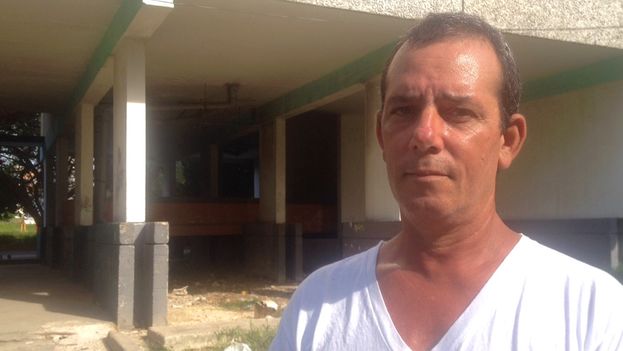
Lazaro Yuri Valle Roca. (14ymedio)

14ymedio bigger14ymedio, Luz Escobar, Havana, 20 June 2015 — A couple of weeks ago, the neighbors crowded onto the ground floor of a twelve-story building near Tulipan Street. “He committed suicide … They say he hanged himself with his own belt,” ran the rumor among them, while pointing to the apartment marked with number 1. The police presence in the area and patrols around the site confirmed that something had happened.

Some men in civilian clothes who were a part of the operation detailed it for the curious, “He was the nephew of Vladimiro Roca.” The information would take hours to be refuted, and many still don’t understand that the false suicide hid a raid to keep Lazaro Yuri Valle Roca from going out to do his work as an independent journalist. The bad taste with which the political police handled the matter, lying about the death of a man, competes in this case with the abuse of his rights. continue reading

Last Saturday, the reporter and activist sent a letter to representatives of the Inter American Press Association and Reporters Without Borders. It not only condemned the repression suffered by him, but also that against the “Ladies in White, opposition activists, journalists, bloggers, independent journalists and photojournalists committed to the struggle for civil rights.”

Friday, 14ymedio spoke with Valle Roca at his home to learn the details of his situation and the reasons that led him to write that letter.

14ymedio/Luz Escobar. When did the harassment against you begin?

Lazaro Yuri Valle Roca. Starting from when I begin to cover the news about the Ladies in White and I captured on video the arrests and beatings they received every Sunday. Starting from that moment I have been subjected to beatings, they have beat me on the legs and one time they fractured a rib. And State Security officials have told me very clearly, we do not want you to go to go to Santa Rita Church anymore, we do not want to see published any more images or recordings under your name, YuriTv, we don’t want you to put anything else on YouTube.”

14ymedio/Ruiz. The worst moment?

Valle Roca. On May 9, they threw me in a car here at Avenues 26 and 41. It was about ten at night. I had gone out to buy cigarettes. Later was the eighth Sunday of repression for the Ladies in White, who woke up in my apartment surrounded. From two in the morning there were police there and they justified their presence by telling the neighbors I had hanged myself. In reality, I was inside the house with two Ladies in White, as it was easier to get to Santa Rita Church from here. So we were going to go together.

14ymedio/Ruiz. Was it very hard to hear the news of your “own death” from the mouths of others?

Valle Roca. I see that as the story of “a death foretold.” I found out because the journalist Reinaldo Escobar called to ask what was going on. He said he was concerned because he had got the news from someone who passed by and asked. After the statements I gave him, then Radio Martí also called me and countless people, but it was all false.

14ymedio/Ruiz. And last Sunday you were again a victim of repression?

Valle Roca. The political police intercepted me on 28th Street between 7th and 9th in Playa. It was a very spectacular arrest; without explaining the reasons, I was immobilized, handcuffed and they threw me back of the car. After several turns they took me out in Coyula Park and put me in another car with four other men. When I figured out where I was I was in Villa Marista [a State Security prison]. Where I was warned by a senior official, and finally they took me in a car to a deserted grassy area.

He put the gun to my head and then kicked me in the side and told me, “You already know what’s going to happen to you.”

The one on my right got out, opened the door and drew his weapon. He put the gun to my head and then kicked me in the side and told me, “You already know what’s going to happen to you.” They got in the car and from there threw me my cellphone and backpack. I got out and tried to orient myself until I managed to reach Via Blanca where, thank God, a truck stopped for me. The driver asked if I’d been left stranded and I made up a story about having been assaulted, I thought if I told him the truth he would be afraid. He left me off near Sports City.

14ymedio/Ruiz. How did the idea come up to write a letter?

Valle Roca. I didn’t do it for me but for all my fellow journalists who are suffering the same thing. For example, for Enrique Díaz and Vladimir Turró Páez who are also being threatened with death. We want to document all these allegations of threats on video, a video with all the journalists who are in danger. Journalists in similar situations include Agustín López Canino, Juan González Febles, Luis Serafin, Rubén Dario Garcia and Angel Moya, who make videos and also bring to light a lot of information about the Ladies in White. It’s for all of them that I wrote the letter.

14ymedio/Ruiz. Has the repression limited the work of independent journalists?

Valle Roca. Not at all, we continue working. They believe they’ve discredited us a little, but we continue denouncing what goes on. When I can’t leave my house, I report by phone, and Antonio Gonzalez Rodiles is also collecting testimonies. Of course, sometimes they affect us because they take our cameras or phones and they erase all the recorded contents, but we continue to work.

They believe they’ve discredited us a little, but we continue denouncing what goes on

14ymedio/Ruiz. What journalistic techniques do you use in your work?

Valle Roca. Especially photography and video. I film and shot photos with my cellphone. Then I have to edit and convert them for uploading. I edit them in Adobe Premier.

14ymedio/Ruiz. What reaction do you expect to your letter?

Valle Roca. That solidarity with reporters will increase and that there will be a statement to help us to continue to make known what is happening and that a commitment on the part of the government is achieved. I feel as if I were a war reporter, under constant threat.

14ymedio/Ruiz. Do all your neighbors now know that the suicide story was a lie?

Valle Roca. They have been very supportive. With our humor, we Cubans can laugh at anything. Now in the neighborhood they call me “the hanged man.” That Sunday on the underground lottery played in our area the numbers that came up were 79, which is exactly “hanged man,” and 7 which is “shit and police.

Computerization The Old-Fashioned Way / Dimas Castellanos

The Information Society (IS) is an effect of a process of convergence among technological advances, the democratization of information, and communications, which erupted in the 1980s with such force that it caused the United Nations to call a world summit on information, which took place in the Swiss city of Geneva in 2003. At this summit, a Declaration of Principles and a Plan of Action were adopted, whose principal beneficiaries are individual persons who have the training for intelligent and creative use of modern technologies, without which social and cultural progress would be impossible.

Among the demands of the new information technologies, arising from their transformative character, is the need for immediacy when introducing them. One peculiarity that distinguished Cuba since the colonial period: the steam engine, patented in 1769, was introduced into Cuban sugar production almost immediately. The railroad, inaugurated in 1825, linked together the towns of Havana and Bejucal in 1837. The telegraph, which sent the first long-distance message in 1844, initiated its first line in Cuba nine years later.

continue reading

The telephone, which premiered its first service in 1877, came to Cuba in 1881. The electric light bulb, which in 1879 was enjoyed in only a few important cities in the world, by 1889 was being utilized in Havana, Cárdenas and Puerto Príncipe, and in theaters such as Payret and Tacón. The motion picture, patented in 1895, was exhibited in Havana in 1897. Radio, which commenced in 1920, was launched in 1922 in Cuba. Television, almost parallel with the United States, began broadcasting from the first Cuban station in 1950. While the Internet began officially in Cuba in 1996, more than 10 years after it was in use in other latitudes.

This past February, the First Vice President of the Council of State, Miguel Díaz-Canel Bermúdez, at the closing of the first National Computerization and Cybersecurity Workshop, set forth some issues regarding the Information Society that call for discussion, debate and consensus.

1. Internet access implies at the same time challenges and opportunities, and constitutes an action necessary for the development of society under current  conditions.

If the Information Society is distinguished by the generalized and efficient use of modern technologies in the era of globalization, when information has transformed the raw material of all activity and of each person, nobody could deny that, besides being necessary, it contains challenges and opportunities that must be faced. Regarding this thesis there cannot be disagreement.

2. Its access strategy should become a fundamental weapon of the Revolutionaries to achieve social participation in constructing the project for society that we want, starting from an integral design of the country. And I add that the usage strategy of this tool must be lead by the Party and should involve all institutions, and society, to achieve the fullest use of its potentialities in service of national development.

If we start from the premise that it is a necessity for all, then Internet access strategy cannot become a fundamental weapon of the Revolutionaries, but rather of all, because the Revolutionaries are only one part. And the project for society that we want (if that “we want” includes everyone) has to be agreed-upon by all.

Therefore that inclusive stragegy should not and and cannot be led by a party, which, as its meaning indicates, represents a “part,” whereas development is incumbent on all, not only on the Revolutionaries and the members of a party. This statement contradicts another part of the speech in which Díaz-Canel said that “we need to distinguish ourselves by a computerization with all, and for the good of all.”

3. Regulations and rules that govern access to the Internet and its use, should be coherent with current legislation, and align with the general principles of the Constitution and other laws, and adjust to the changing needs of social development.

Rather, besides being led by the Party and being a fundamental weapon of revolutionaries, Internet use should be coherent with the general principles of the Consitution and other laws. Here, the contradiction is so flagrant that it becomes inadmissible.

A phenomenon as modern and changing as the Information Society cannot be subordinate to a Constitution that urgently calls for profound reform, unless the purpose be that computerization should face the same fate as other projects in the country that remain stagnant.

The argument should be the opposite: the changes implied by an information society obligate us to reform a constitution that for a long time now has not met the needs of development, above all with regard to citizens’ rights and liberties, which constitute an unavoidable need of the Information Society, and which in the current Constitution are subordinate to one ideology and one party.

The preceding material demonstrates that the Information Society inescapably implies the respect for and complete defense of human rights, the recognition of their universaility, indivisibility and interrelation, and democratic access to the infrastructure and services of information technologies.

Díaz-Canel’s speech was uttered two decades after the official start of the Internet. It also came after President Barack Obama stated that Cuba has one of the lowest rates of Internet access in the world, that the cost of telecommunications in Cuba is exorbitatantly high, and that the services offered are extremely limited.

Among measures intended to empower the Cuban people, President Obama listed the need to increase Cuba’s access to communications and its capacity to freely communicate, and so would authorize the commercial export of equipment to improve the capacity of Cubans to communicate, including the sale of communication devices and articles to establish and update related systems.

The delay in introducing these measures has been accompanied by restrictions that seek to ensure that information obtained online corresponds with the Revolutionary ethic, and will not endanger national security.

In 1996, Decree 2091 was issued, whose articles state that the basis of Internet access policies will prioritize the connectivity of legal persons and those institutions of greatest relevance to the life and development of the country; that to guarantee fulfillment of the principles laid down in the Decree, access to networked information services of global scope would be selective; and that direct access from the Republic of Cuba to global computer networks would have to be authorized by the Interministerial Commission created by the Decree. [1]

Later, in 2003, Resolution 1802 resolved: Charge the Telecommunications Company of Cuba to employ all technical means necessary to detect and impede access to Internet navigation services via telephone lines that operate in national, non-convertible currency, starting as of 1 January 2004. [2]

The creation of the Information Society is incompatible with the priority of the Revolutionaries, with subordination to ideologies, and with a Constitution that endorses these restrictions. The contradiction is there: either the demands of modernity are assumed, or we run the risk of continuing to widen the information gap in the country and of Cubans in relation to the rest of the world.

The full use of the possibilities offered by the new information technolgies to foment online access that is free and autonomous, rich and diversified, plural and thematic, interactive and personalized, is a necessity. Especially in the era in which the diffference among levels of development is measured in terms of Internet connectivity. Simply put, computerization the old-fashioned way must be uprooted.

Footnotes:

1. Decree 209 of the Executive Committee of the Council of Ministers on Access from the Republic of Cuba to Global Computer Networks; 14 June, 1996.

2. Resolution 180/2003, dated 31 December, 2003, of the Ministry of Computer Science and Communications.

Originally published in Diario de Cuba

Translated by: Alicia Barraqué Ellison

27 March 2015

Poetry Saves Me / Luis Felipe Rojas

Luis Felipe Rojas, 3 June 2015 — Once again I am publishing, in liberty, a poetry book: “Machine for erasing humanity” (EriginalBooks, 2015). It confirms that poetry removes the restraints on my life.

I don’t believe that poetry is the “Cinderella” of literary genres. Poetry is the act that leaves the public breathless, the vehicle that sustains the millennial spectacle of lyrics, and it’s outside all logic of the contemporary market. I continue believing in the bard, the troubadour, whom the tribe awaits for news of the shore beyond the river.

Today I feel the joy of sharing with you my sixth book of poetry, my second in the land of liberty, after the generous hands of Armando Añel and Idabel Rosales opened the doors for me in 2013 with “Feeding the dogfight” in Neo Club Editions. On this occasion I am in the hands of the excellent illustrator, Nilo Julián Gonzán Preval, whose magic you may verify throughout the book. Nilo illustrated the first issue of the review Bifronte in 2005: Thanks again, my brother! continue reading

It’s the first time that I worked together with Marlene Moleón and Eriginal Books, and I can only be grateful for their counsel on this road that we just began today. The suggestion that Ernesto Valdes lay out the book was primordial. Thank you both.

Luis Felipe Rojas Rosabal, born in San Germán, Holguín, 1971, has published the poetry books Secrets of Monk Louis (Holguín Editions, 2001), Sewer Animal (Ácana, 2005), Songs of bad living (Loynaz, 2005), Obverse of the beloved beast (April, 2006) and Feeding the dogfight (NeoClub, 2013). For his dissident actions he was censored and repudiated by the authorities of his country, where he worked as an independent journalist. He is the author of the blog, Crossing the Barbed Wire. He works for Martí News.

About the illustrator: Nílo Julián González Preval was born in Havana, 1967. Cartoonist. Poet. Painter. Manager of public events. Twelve personal exhibitions, 36 collective exhibitions, 4 individual and several collective awards, more than 200 illustrations published nationally and internationally. Photographer. Artisan. Sculptor. More than 20 personal readings of short stories and poetry. His poems have been published in reviews and newspapers in Cuba and in the world. Director of art and actor in the group OMNI. Cultural promoter in his community. Director of the project of social community intervention, Community Gallery. He is the founder of the group OMNI-Zona Franca, which has carried out more than 200 performances and public, collective and individual actions.

On Friday, June 26, I await you in the salon, The Word Corner, a type of literary cave that the poet Joaquín Galvez has put together for lovers of the arts. The gathering will be in the Café Demetrio, 300 Alhambra Circle, Coral Gables, Miami, FL 33134. The presentation will be at 7:00 p.m.

Translated by Regina Anavy

Forwarded: A Very Good Article! (forwarded Tuesday night) / Rebeca Monzo

From: Vera Pravdova [mailto:verap@enet.cu]

Sent: Thursday, June 18, 2015, 4:56 p.m.

To: abetancourt@cubarte.cult.cu

Re: A very good article! (forwarded Tuesday night)

Hello friends:

I’m forwarding you these two articles (Alpizar, Ravsberg) with the intention of distributing them to as many people as possible, since we should immediately demand the enforcement of laws protecting plants and animals, the urgent creation of new laws in this area, and the imposition of severe punishments on all violators. continue reading

Vera

Colleagues, can anyone disagree with the ideas expressed in this article? Unfortunately, there are no laws in our country protecting animals from abuse, as there are in other countries.

Consider why:

In the countries where such laws exist there are parliaments. Parliaments legislate, making the laws. And parliaments are composed of deputies.

Those deputies were chosen in elections and have commitments to those who elected them. These laws exist because the deputies proposed and approved them, and thus the officials are obligated to abide by them. These laws exist because the deputies in those countries know that they must fulfill their commitments to the voters.

Having commitments to voters does not mean that they are only accountable for their promises. The elected members, above all, have to respond to the concerns and demands of the voters, even in an electoral system such as ours, where there are no pre-election promises.

Because they were elected and have commitments to their constituents, those deputies don’t wait around until some minister or official proposes a law to approve it, as happens in our system (I say “approve” speaking of us, because I don’t remember any case where our deputies have rejected a proposal by the government, as does happen in other countries).

Those deputies initiate legislation, as delegated to them by the Constitution, the supreme law of a nation, which no official, minister, or even president can ignore, upon pain of dismissal.

Our Constitution also gives to the deputies, as representatives of the people, the legislative initiative. But I have not the slightest recollection of any law that arose at the initiative of our deputies.

(But I do have infinite memories of officials at all levels violating the Constitution, without any deputy, who is sworn to defend it, ever confronting them. But I digress.)

It is simply time for us to demand that Cuban deputies exercise the legislative initiative in the National Assembly. They are required to listen to us and comply with our mandate. Just as we have the right not to vote for them if they do not carry out that for which they were elected, including initiating laws.

We have no reason to follow this or that official around trying in vain to get his attention. The official doesn’t answer to us, but to his boss. The deputy, however, does answer to us; we are the ones who elected him. We should demand this of him (which we don’t).

To begin with, we should get in touch with our deputies, who were elected by our neighborhoods, and demand that they satisfy that for which they were elected, or we will withdraw our support. It is all too common in the city for us not to know who our deputies are or how to contact them directly: they are just three names that we’ve been told to vote for (because they are all worthy).

But we, the members of UNEAC (National Union of Writers and Artists of Cuba), have deputies that we know, who belong to the organization, our colleagues, who represent the intellectual sector in the National Assembly.

So in all of our meetings let us demand that these deputies fulfill what they were elected for. And let us be clear: If you do not represent us you have no reason to stand for election on our behalf.

Let us demand that the deputies who represent UNEAC propose at the next session of the National Assembly not merely the law on protection of animals that is so justly sought.

Let us also demand that they submit to the next Assembly the Film Act, the Consumer Protection Act, the amendment to the Law on Associations  . . . and many other legal instruments that our country needs urgently to create or revise.

And that they meet with us (when I say us I don’t mean only the National Council of UNEAC) before going to the National Assembly, to take note of our ideas, as people who work and think like we do, and take to the Assembly our concerns and proposals about the short and long-term future of our country.

Including, of course, the concern that many have expressed about the idea of filling Cuba with golf courses, a threat to our ecology and, in the not very long term, to our economy.

Other members of other sectors of the population should do the same with the deputies these agencies put forward for election, but that’s their business. We at UNEAC are obligated and able to work on legislative initiatives for the deputies we elect to present on behalf of our industry. Or to not re-elect them.

For now, why don’t we make a list of the current deputies put forward by UNEAC?

Let’s start there and write (everyone!) to their electronic addresses, sending our proposals, so no one can say they were unaware of them.

Let’s also push for the deputies of the arts sector to meet with us to talk face-to-face about the country’s problems.

Undoubtedly some of you smiled and thought that what I have written is pure idealism, but … does anyone have a better idea? Let’s try this. Demand that our deputies submit our ideas to the National Assembly. These are not parochial ideas, they relate to everyone.

Cordially,

Alpízar

18 June 2015

Twitter Intends A Stronger Presence In Cuba / 14ymedio

Mobile app icons (CC)

14ymedio bigger14ymedio, Havana, 17 June 2015 — The microblogging service Twitter has expressed interest to the Cuban government in expanding access to the service from the Island, the US magazine Politico reported Wednesday. Given the lack of infrastructure in the country and the lack of Internet connections, the California-based firm asks that in the short-term Cubans can begin to tweet through text messages, from a local number also known as a “short code.”

The company’s public policy director Colin Crowell met with staff from the Cuban Interests Section in Washington DC to discuss the matter. “Cuba is one of the few places in the world where we don’t have an agreement so that users can tweet through text messages (SMS),” explains Crowell. As of now it is only possible to tweet through the service’s international numbers, at a cost of 0.60 CUC for each tweet. continue reading

The small but intense community of independent tweeters on the Island, comprising a little fewer than two hundred people, has spent years demanding that facilities be offered for publication via text messages.

Cuba officials, according to Crowell, are open to the change. Although there is not yet a date for a meeting on the Island to formalize the agreement, Twitter management hopes that the negotiations will take place “as soon as possible.”

Following the announcement of the restoration of diplomatic relations between Havana and Washington last December, several technology companies are sounding out the terrain to gain a foothold on the island.

According to several US media, Google presented a proposal to the Cuban Government to participate in the infrastructure on the Island. Representatives of the company, on a business trip in Havana this week, however, did not confirm the news.

Twitter stresses that there a strong interest among users on issues tied to the Island, both among Cubans in exile as well as in the hemisphere in general. “We want to do everything we can to increase the possibilities for Cubans to make their voices heard,” added Crowell. “We would love to have more Cuban voices on our platform.”

Human Rights Group Estimates At Least 71 Political Prisoners In Cuba / EFE (14ymedio)

14ymedio biggerEFE (via 14ymedio), 19 June 2015 – The dissident group Cuban Commission for Human Rights and National Reconciliation (CCDHRN) estimates that there are at least 71 people imprisoned on the Island for “political reasons or through politically directed procedures,” almost half the number documented a year ago.

The organizations says that the total prison population in Cuba is between 60,000 and 70,000 people, the highest number in Latin America on a per capita basis, given the 11 million inhabitants of the country, and they suggest there may be more imprisoned on political grounds.

The statement, signed by CCDHRN spokesperson Elizardo Sanchez, acknowledged that the number of prisoners of conscience in Cuba has decreased and is now far from the 15,000 of 50 years ago; but warns of the risk that these data may change. continue reading

“The risk of increasing the number of such prisoners remains dormant since the regime continues to criminalize the exercise of all civil and political rights and other fundamental rights through an archaic Penal Code which, in its origins, was a mere copy, quasi-plagiarized, of that of the former Soviet Union,” Sanchez said.

The organization denounces the fact that many political prisoners are in jail under the legal concept of pre-criminal social dangerousness, an “unlawful monstrosity” according to the CCDHRN, which indicates that the people interned “are essentially innocent” and that the actions imputed to them do not constitute crimes, but are based on a “simple police presumption.”

“The risk of increasing the number of such prisoners remains dormant since the regime continues to criminalize the exercise of all civil and political rights”

This presumption by the authorities leads to “very summary trials, in which there is no need for proof through oral or material evidence or documentation of any other kind.”

The CCDHRN also recalls the case of the eleven former prisoners of conscience from the Group of 75 — imprisoned during the crackdown of the Black Spring of 2003 – released on parole but prevented from leaving the country.

They also demand the release “on humanitarian grounds” of 21 prisoners for “crimes against the state” carrying between 12 and 23 years in prison in “extreme conditions.”

The CCDHRN is the only organization in Cuba that undertakes a counting of political prisoners in the country; although they admit that counting an exhaustive list is very difficult because the Cuban government is “closed and opaque” and only “a handful of senior officials know the exact numbers.”

The Government of Cuba considers the dissidents “counter-revolutionaries” and “mercenaries.”

Lost Values / 14ymedio, Fernando Damaso

Acto-Foro-Sociedad-Civil-Panama_CYMIMA20150408_0013_16
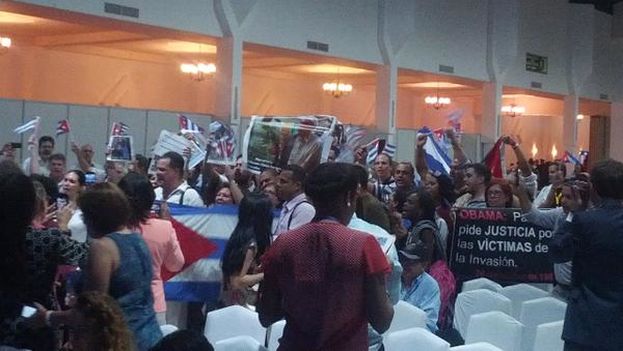
Act of repudiation in the Civil Society Forum at the Americas Summit in Panama

14ymedio bigger14ymedio, Fernando Damaso, Havana, 16 June 2014 — The theme of the loss of values ​​and their restoration in Cuban society has become an obsession for government authorities, but everything moves more along the line of speeches, staged scenes and slogans, rather than in a serious search for the causes and the application of effective measures to help change the situation.

In the much vilified Republican era there prevailed ethical and moral values among the majority of Cubans that no distortion of history can deny. Honesty, respect, dignity, the value of one’s word, honor, social discipline, education, treating people well and many others were passed along by the family, school and society. There were inculcated in individuals from the time they were small and became natural attributes of Cubans of that time, regardless of age or social background. There were also those who ignored them, but they were few and constantly faced public opinion and rejection. continue reading

To now attribute the loss of these values to the dazzle for many of the consumer society is the wrong approach to the problem

This situation was inherited by the new regime established as of 1959. For some years they were maintained but with the passage of time, the dispersion of the family, the decline in educational requirements, and the repetition of empty speeches, a dent was made in the values. To this is added the failure to keep many promises, the deterioration of the economy, wages and miserable pensions and the loss of credibility among the leaders. All this eroded the values that had characterized Cubans during the colonial and Republican eras.

To now attribute the loss of these values to the dazzle for many of the consumer society is the wrong approach to the problem. During the Republican era we were much more consumer oriented than right now, because we had the economic resources to be so, and always maintained it.

Material misery engenders moral misery. That is the principal cause of the loss of values. As the material misery of Cubans increased, due to a broken economic system, not only incapable of producing wealth but even of producing the necessities for a decent living, the premise of “every man for himself” was imposed.

It is not with empty words, roundtables, workshops, conferences and other bureaucratic inventions, nor with the forced signing of ethic codes, that the lost values are restored, but with concrete, effective and deep economic measures that will lift the country out of the crisis in which it finds itself, and where Cubans can again live as citizens and even dream. These measures must be accompanied by social and political changes where citizenship again acquires its real value, which never should have been stripped away.

Until this happens, everything will be a waste of time.

Cuba Offers English Exams Required for Universities in the United States / 14ymedio

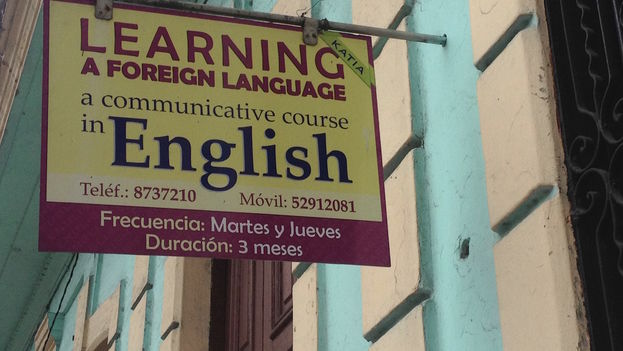
Private English classes in Cuba (14ymedio)

14ymedio bigger14ymedio, 18 June 2015 – For the first time Cuba will be the site of two English exams needed for admission to most universities in the United States, according to a report this Wednesday in the Wall Street Journal.

Four Cuban students will take the Test of English as a Foreign Language in Havana on Saturday, June 27. The qualification is a world standard for the admission of non-Anglophone students to universities in the United States, the United Kingdom and Australia, among other countries. continue reading

The organization providing the test, the Educational Testing Service, has also announced plans to offer the Graduate Record Exam (GRE), an entrance exam required by many American universities for admission to graduate studies, despite the logistical obstacles stemming from the lack of technological infrastructure and financing in the country. This latter test will be given in October.

According to José Santiago, head of the GRE exam for the Educational Testing Service, this testing schedule reflects the interests of American universities in enrolling Cuban students after the reestablishment of diplomatic relations between Washington and Havana.

For now, no additional testing dates are scheduled on the Island. “There are still many issues to resolve,” explains Santiago, adding that he is working with two Cuban universities to turn their computer classrooms into sites for the official exams.

Students who want to take the tests confront several obstacles, including paying by credit card and the poor quality of the equipment for the listening tests.

Operation Miracle, Not Available to Cubans / 14ymedio, Fernando Donate Ochoa

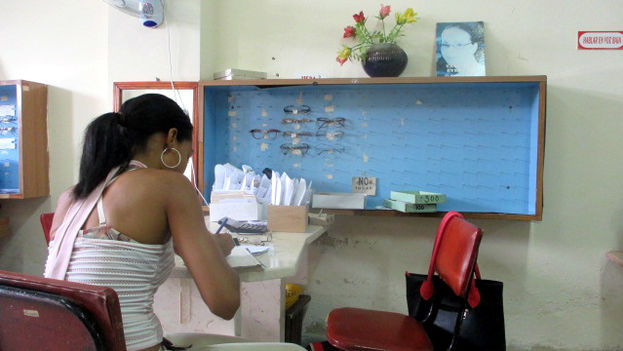
In the opticians on Martí Street in the provincial capital, the supply of frames is as low as in the rest of the province (Fernando Donate / 14ymedio)

14ymedio bigger14ymedio, Fernando Donate Ochoa, Holguin, 19 June 2015 — Operation Miracle has as its objective to return vision to or cure any ophthalmological problem for low-income citizens of poor countries. The humanitarian project was started in mid-2004 under the leadership of the governments of Cuba and Venezuela, and thanks to it about a million patients have been operated on every year. However, this medical service has not been as successful inside Cuba as it has been abroad.

The surgical waiting list extends more than 30 days in the Ophthalmology Center at the Lucia Iniguez Landin Clinical Surgical Teaching Hospital in the city of Holguin. The departure of professionals to other sectors and the exodus caused by international medical missions have contributed to the increase in service deficiencies. To this is added the lack of surgical instruments and difficulties with the air conditioning in operating rooms, sources from local hospital officials explained to 14ymedio. continue reading

Supply problems for frames and lenses in the eyeglass industry don’t help to improve the eyecare situation in Holguin, with the Provincial Company of Pharmacy and Optics continuing to experience problems since last year. The eyeglass frames that can be seen in Holguin establishments are few, outdated and uncomfortable, leading most customers to reject them.

The situation has reached the extreme that, on occasion, the customer is asked to bring their own frames to hold the lenses

The problem affects not only the four opticians of the capital city. According to Caridad Garcia, a worker at one of the establishments on centrally located Martí Street, the shortage extends to the other ten opticians in the province.

The situation has reached the extreme that, on occasion, the customer is asked to bring their own frames to hold the lenses. However, there are also delays with the graduated glass, because the lens grinding workshop lacks the specialized personnel needed, and the equipment frequently breaks down, having been in use for 20 years without renovations.

The National Directorate of Public Health has reported that the country does not have sufficient resources to meet demand, a fact for which there does not appear to be a short or medium term solution.

Currently, 4,405 Holguin health professionals are serving on international missions spread across 45 countries.

WiFi is Extended Throughout Cuba / 14ymedio

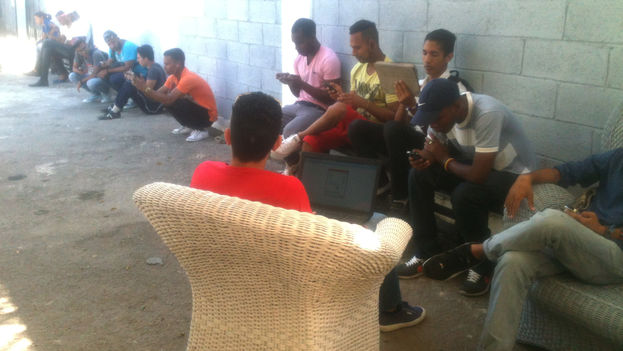
The area outside Kcho's Romerillo Studio has become a meeting point for those seeking wifi. (14ymedio)
The area outside Kcho’s Romerillo Studio has become a meeting point for those seeking wifi. (14ymedio)

14ymedio bigger14ymedio, Havana, 19 June 2015 — “It’s never too late if the WiFi is good,” the officials of the Cuban Telecommuniations Company (Etecsa) might say, announcing the opening in the coming weeks of 35 Internet browsing rooms with WiFi technology in public spaces throughout the country. The information was published this Thursday in the newspaper Juventud Rebelde (Rebel Youth) and comes just when people’s demand for connectivity has reached a point that makes it hard for the authorities of the sector to ignore it.

Luis Manuel Díaz Naranjo, Director of Communications for Etecsa, told the official press that the service will be implemented at the beginning of July, as the company is still engaged “in working on adjustments to the heart of the center that will operate this kind of wireless network technology.” continue reading

Wireless networks will be accessible in the locations under the name of WIFI_ETECSA, like those already operating under this name in the international terminal of Havana’s Jose Marti Airport, and in several hotels in the country. All those who have an account – temporary or permanent – with Etesca’s Nauta service will be able to access it through cellphones, personal computers, tablets or other technological devices with wireless signal receivers.

Another welcome announcement has been the reduction in price for an hour of navigation time, which as of July 1st will be 2 CUC versus the current 4.50 CUC, although in recent months reloads have been offered at half that price. Diaz Naranjo acknowledged, however, that “it is still not the target price,” in a country where the average monthly salary doesn’t exceed the equivalent of 30 CUC.

The official clarified that it is not a new service, but “a new method of access” for what is offered today in Etecsa’s public navigation rooms and at the Computing and Electronics Youth Clubs.

In the interview, Diaz Naranjo specified that the connection speed could reach 1 megabyte per user and that the number of people who can navigate at the same time could vary between 50 and 100, according to the size of the area included in the wireless network.


The 35 places that will implement this WiFi signal in Havana are: La Rampa, from the Malecon to Yara Cinema; La Lisa park located on Avenue 51; Fe del Valle park, on Galiano and San Rafael; the Marianao Amphitheater; and the Paseo de la Villa Panamerica. In Pinar del Rio: Independencia and Roberto Amarán parks. Artemisa: Boulevard and de la Iglesia park. Mayabeque: Guines Park and Boulevard de San Jose. Matanzas: Liberty and Peñas Altas parks. Villa Clara: Leoncio Vidal and Remedios parks.

The city of Cienfuegos will have wireless navigation in Martí Park and Rápido Punta Gorda. Sancti Spíritus: Céspedes, de Trinidad, and Serafín Sánchez parks. Ciego de Ávila: Martí and Morón parks. Camagüey: Agramonte Park and Plaza del Gallo. Las Tunas: Plaza Martiana and Tanque de Buena Vista. Holguín: Calixto García and Julio Grave de Peralta parks. Granma: Boulevards Bayamo and Manzanillo. Santiago de Cuba: Céspedes, Ferreiro and Plaza de Marte parks. Guantánamo: Martí Park and Baracoa Central Park. Isla de la Juventud: Boulevard Nueva Gerona.

Etecsa also plans to make adjustments to the Enet and Nauta email platforms, which today have more than 800,000 users across the country. The email service will be interrupted in the early morning of June 23, which has triggered speculations among the public about the possibility of the coming of mobile connections to the web.

In a call to the service number 118, an operator explained to this newspaper that the reason for the planned suspension on the 23rd was for transferring the platform, which is moving “from its current site in the capital’s Cubanacan neighborhood, to another located in Fontanar.”

For some weeks, in the early morning hours, users accessing Nauta service from their cellphones could experience a change in the message access protocols such as IMAP and POP. During the hours of lower traffic, the directions for downloading emails will appear redirected to the Enet service, an Internet connection option for foreigners, businesses and foreign press correspondents residing on the Island.

In recent days two directors from the Google giant, Bret Perlmutter, of Google Ideas, and Brehanna Zwart, of Google Access and Energy, have been in Cuba. Several American publications announced last week that the company had made a proposal to the Cuban government to participate in the Island’s connectivity infrastructure.

Almendrón Stories / 14ymedio, Lilianne Ruiz

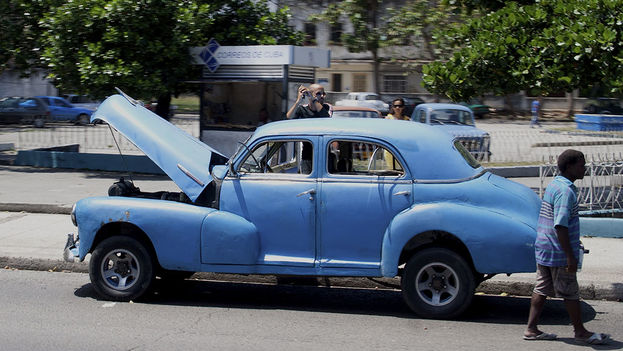
The almendrones that abound in Havana retain the original body but the mechanical part is almost always modern. (Lilianne Ruiz / 14ymedio)

14ymedio bigger14ymedio, Lilianne Ruiz, Havana, 17 June 2015 — Noisy and filthy, with an air of Hollywood films of the 50s, they often evoke the words of Galileo: “And yet it moves.” The almendrones*, pre-1959 cars that abound in Havana, retain their original bodies but the mechanical parts are almost always modern.

A 1954 Ford may contain a Hyundai gas engine designed for minibus, a Mitsubishi transmission, a Toyota differential, Suzuki Vitara hydraulic steering, a Peugeot dashboard, Moskovich disk brakes from the Soviet era, a Mercedes Benz master cylinder, with the chassis and grill original to the make.

This combination means that the spherical steering system might not last three months with Havana’s potholes, or the emergency brakes may not work well. It’s a violation of the laws of physics and engineers if the weight of the car doesn’t match the brake system. Still and all, we have the perception that 90% of the cars circulating in the Cuban capital are almendrones. continue reading

These vehicles pass from hand to hand. Many of the Cubans who today have an almendrón, acquired it thanks to financial help from relatives abroad. In the informal market, the prices of these cars are over 10,000 CUC. The private taxi drivers, driving taxis with fixed rates of 10 and 20 Cuban pesos (CUP), have predetermined routes from the city center to various points on the periphery.

In order for the cars to be able to circulate, they must be inspected at the Automotive Technical Review Company, popularly known by drivers as the “somatón.” And, either because the almendrones always have some technical failure, or because they are what they are, the drivers agree that to “get” a favorable report that allows them to continue to operate they have to pay between 30 and 50 Cuban convertible pesos (CUC).

Maykel Perdomo is 32 and drives a ’54 Plymouth. “It is understandable and necessary to have these controls,” he says after lowering the volume on the reggaeton coming from the domestic speakers anchored above the rear seat. “What is not logical is the level of corruption and that the demands are so high when there is no appropriate market to buy spare parts,” he adds.

Drivers agree that to “get” a favorable report that allows them to continue to operate they have to pay between 30 and 50 CUC

All maintenance and parts replacement is done in the informal market. In State shops there is no good access to spare parts and to get them requires a network of contacts in State companies such as Rent-a-Car, where they sell some “under the table.” If you have the money to pay it’s possible you can find what you need there. “The people who work at Rent-a-Car don’t live on their wages. They divert whatever and sell it. Normally there are parts there to meet the needs of the cars rented to tourists,” he continued.

But there are also machinists in clandestine workshops who are dedicated to retooling parts for these antiques. “When an original piece breaks you have to create it, you can’t replace it. You have to go to a machinist to do it for you. It’s very expensive and often the piece doesn’t fit and you have to return it.”

The same thing happens with fuel. The vast majority of the almendrones used as rental cars have been re-engineered to work with oil. Oil-burning engines are offered by the State and can cost some 7,000 CUC, but they don’t come with a guarantee.

Nor is there any wholesale market to buy fuel at a lower price. In the State’s CUPET gas stations, a liter of oil costs 1.10 CUC. The almendrón drivers prefer to buy it from truck drivers or bus drivers, who sell it illegally at half the price. “If you buy oil from CUPET, you have to raise the price of a ride.”

Oil-burning engines are offered by the State and can cost some 7,000 CUC, but they don’t come with a guarantee.

All this clandestine trade creates a gap in the revenue and expense ledgers. The drivers can’t declare buying anything on the illegal circuit, and so they leave blank the spaces where they should declare expenses. “On the black market you don’t receive any proof and it’s also illegal. If you tell, you’d be confessing to a crime. Then, you’re also forced to underreport your income, balancing the expenses you can’t declare,” the driver says.

The National Tax Administration Office (ONAT) makes a calculated estimate of what each carrier should have earned. Based on that estimate it can impose very high fines if it believes that the self-employed worker hasn’t told the whole truth. “It’s completely arbitrary because there are a lot of days that you can’t go to work because the car is broken, or you have personal problems, or you just want to take a day off. If one day you make 1,000 CUP it doesn’t mean that every day of the month is going to be the same. Without proof that you’re lying when it’s time to declare, they can impose a fine,” he laments.

The almendrón of Thomas Qunitana, who is also a driver, was broken down more than it was running, although he didn’t, because of this, fail to pay his taxes. One day, however, he had to recognize he couldn’t make it and returned his license. After a year and a half without working as a driver for hire, ONAT communicated to him that he had to pay a fine of around 60,000 CUP (about $2,400US) for having underdeclared his income. “They told me they had a right to do this for five years. If you turn in your license you have to keep all the papers of when you were working for the whole time,” said Qunitana, who had to hire a lawyer to try to free himself from the fine, a process he is still engaged in.

But there is another problem. If a self-employed worker earns more than 2,000 CUC a year, he or she enters a higher tax bracket, and has to pay 50% to the State

A policeman told him he was speeding. In exchange for not fining him, he asked for 10 CUC and the shorts he was wearing

Monthly, the drivers also have to pay three other types of contributions to the treasury: a monthly tax on the declaration of personal income of 10%, another for social security that has to be paid every three months, and a fixed tax. This last, in the municipality of Plaza of the Revolution, increased from 450 CUP to 800 CUP from May 2013 to March 2014.

“When you ask why they raised a flat tax, they don’t give you a logical argument. But it happens that, even though it increases, we self-employed don’t see any improvement in public services or in social security. Nor do we see a wholesale market where we can buy parts or fuel, nor improvements in the ate of the roads, nor credit facilities so we can make investments,” Quintana lists.

The drivers have to renew their operating license every year, which also means coming up with 500 CUP. In addition, there are other amounts they are forced to pay: those demanded by corrupt cops. Maykel Perdomo remembers a day when a uniformed cop stopped him while he was driving and said he was speeding. In exchange for not fining him, he asked for 10 CUC and even the shorts he was wearing. “When they behave like this, what recourse do we have? When you go to another regiment in the system, they are plugged into each other.”

To recover the initial investment in an almendrón within two or three years is impossible, but there is also the risk of losing everything. “If you crash the almendrón it’s going to cost you 16,000 CUC, you have a year of paying taxes with all those expenses that are massive and the State insurance company can’t cover everything, you’re going to go bankrupt,” concludes Perdomo.

*Translator’s note: “Almendron” derives from the Spanish word for “almond”; the use of this sobriquet comes from the shape of the cars.

Rene Vazquez Diaz: Cuban Forgettings / Intellectual Debate

See here for background information on this series of posts.

René Vázquez Díaz, Sweden, 2007 — Last year, during a period of several months, personalities committed to the politics of cultural repression during the 1970s were interviewed on various Cuban television programs. The reappearance on the small screen of odious characters who call to mind the ferocity of mechanisms geared against creativity, art and human dignity, culminated this past 5 January with a five-minute interview of Mr. Luís Pavón Tamayo, who led the National Cultural Council between 1971 and 1976, and who the majority of Cuban writers believed was physically and politically deceased. continue reading

Opaque, astute and without scruples, Pavón was a powerful official who implemented a dogmatic political culture and who shamelessly condemned homosexuals, plunging intellectual life into what came to be known as “The Five Grey Years,” and condemned to ostracism first-rate writers like Antón Arrufat, Pablo Armando Fernández and César López. These individuals have all been recognized for the mark of creativity and beauty that they have left on Cuban culture.

In all countries there are issues of national importance about which, for long periods of time, silence is kept by tacit agreement. In Sweden, it has been the vigilance and surveillance carried out by the secret police on so-called “security risks,” which eventually affected more than 300,000 persons, many of whose work lives were ruined.

In France, it is the outrages of the genocidal war in Algeria. In Spain, it is the silence regarding Franco regime figures at all levels, from low-life torturers to businessmen and personages such as Fraga, whose television appearances never provoke revulsion in Spain.

Upon understanding that Pavón’s surprising reappearance entailed his public rehabilitation–and also a regressive movement in which Cuban intellectual life would lose a space for activism that had been steadily growing–numerous intellectuals freely and indignantly protested. Immediately, meetings were called of the Writers Union, the Institute of Radio & Television, and the Ministry of Culture.

Soon it was seen that this was not about a conspiracy, nor an attempted institutional coup to revive those bygone times of the Pavonato.* Nor was it about trying to damage the current politics, represented by the Minister of Culture Abel Prieto, and the majority of the intellectual community on the Island. But the emerging controversy offers some history lessons.

The first is that there needs to be a rigorous study of that period, and that in Cuba there are still functionaries who remain nostalgic for dogmatism and obstinacy. With sectarian spirit and a notable ahistoric sensibility, and taking advantage of the lack of culture inherent in the little world of television around the globe, somebody wanted to try out the possibility of taking a stab at current cultural politics. The sword was a wooden one. The reaction on the part of the intelligentsia and the authorities demonstrated that this past has no possibility of returning.

Another lesson is that the intellectuals who live and work in Cuba are involved in a productive process of changes, and appear to have much to defend. Their protestation, open and constructive, arose from the territory of responsibility, and a feeling that their dignity had been wounded, along with the dignity of the Nation. In turn, the reactions of many exiles were characterized by an exercise in selective forgetting, which drags them down to writing from the territory of revenge or of gratuitous mockery. One wrote that there exists an amnesia of the past and of the present; another said that the 1970s were a decade of horror. This requires a separate analysis, to contextualize the horror and open the shutters of amnesia about the past and the present.

How did that decade start out? On 17 April 1970, a group of Cuban exiles, armed and financed by the US, disembarked 22km from the city of Baracoa, killed four soldiers and gravely wounded two others. On 10 May, another group of exiles attacked two ships from the Caibarién Fishing Cooperative and kidnapped 11 crewmembers, who were left to their fate on a small island in the Bahamas.

On 12 July 1971, the same year as the Padilla case and the Education and Culture Congress, a group of exiles declared themselves the perpetrators, in Miami, of a terrorist act in Guantánamo that caused a railroad catastrophe, with a death toll of four Cubans and 17 others injured. In October, an armed motorboat from Miami attacked the small town of Boca de Samá. They killed the citizens Lidio Rivaflecha and Ramón Siam Portelles; there were four others gravely injured, two of them minors.

On 4 April 1972, the same year that I went to Poland to study naval engineering, a plastic bomb went off in the Cuban Commercial Office in Montreal. The employee Sergio Pérez del Castillo was blown to bits, and the so-called “Young Cubans Association” in Miami claimed responsibility. On 3 August of the following year, a member of the terrorist gang “Acción Cubana” [Cuban Action] died in Abrainville, near Paris, when a bomb he was preparing to fling at the Cuban embassy in Paris detonated in his hands. The explosion totally destroyed six rooms of the hotel where he was staying.

On 13 February 1974, a postal package addressed to the Cuban embassy in Madrid exploded in the La Cibeles central office, injuring an employee. On 22 April 1976, a highly destructive bomb was set off in the Cuban embassy in Lisbon and killed the functionaries Efrén Monteagudo y Adriana Corcho. On 9 July of that same year, a bomb that had been placed in a suitcase that was about to be transferred onto a Cubana de Aviación plane in Kingston, Jamaica, exploded on the ground because of a delay in the flight’s departure, thus preventing, by pure chance, the plane blowing up in full flight.

How did The Five Grey Years end? Stained in blood. On 6 October 1976, the Cubana de Aviación CUT-1201 plane blew up during a regularly-scheduled flight between Barbados and Havana, killing 57 Cubans, 11 Guyanese, and 5 Koreans–73 persons total–in the first terrorist attack on civil aviation in modern times. [Luis] Posada Carriles, the terrorist responsible for that monstrous act and much more, today enjoys absolute impunity in the US, while none of the Cubans who write for the US-financed media have called for his extradition.

That era of horror cannot be analyzed with a sense of civic responsibility that is relativistic, opportunistic and selective–as the majority of Cuban exiles have done who say that they sleep with a clear conscience, while they write for a magazine such as Encuentro, which is financed by the same State that sponsors the horror of the so-called Commission for Assistance to a Free Cuba. The dangerousness of this document should unite all of us Cubans, independent of the position we hold regarding the Revolution, in a common humane and ethical effort to ensure a peaceful future for our compatriots.

With that project, which is counter to international law and the dignity of Cuba as a nation, the US State Department is codifying the future of the Island and secretly preparing a period of post-Castro violence, during which it will be necessary to “prepare to keep all schools open during the emergency phase of the transition, so that children and adolescents will be off the streets during that unstable time.”

What instability are they talking about? Cuban exiles will be able to claim their properties and displace the residents who today own their houses, or charge them rent and even raise it. The US will require its transitional government to shutter existing security agencies, and quickly process officials of “the previous regime” who appear on a long list of functionaries against whom they will seek “revenge.”

Because such measures (according to the report) could provoke violence and social disturbances, “the internal food supply, transportation, infrastructure and warehouse systems,” according to the State Department, “could be interrupted by the chaos that results from a power vacuum.” But, because the transfer of power would have already occurred, and because there would be no chaos or power vacuum because no Cuban wants this, Washington has announced that there is a secret addendum** to the plan that sets forth a plan to manufacture that chaos.

I propose that this secret addendum be entitled, “The Horror Clause.” For, not only is it enough to appoint an espionage mission against Cuba, and a proconsul named Caleb McCarry who, with full authority (granted by a foreign power!), will direct the reconquest of Cuba. They also have in hand that secret plan, which cannot entail anything other than a military intervention against the people of Cuba.

To disregard these facts while analyzing the difficulties and outrageousness of that [Five Grey Years] era and the one we’re living in today–speaking of Cuba as if it were not a country exposed like none other to criminal policies such as the blockade [embargo] and the Helms-Burton Act–is a way of reproducing the propaganda that the US promotes to justify its aggressions. But it will never be the honest exercise in historical introspection which we Cubans need, within and outside of Cuba.

René Vázquez Díaz, Sweden

Translator’s Notes:
*”Pavonato” is Cuban slang coined to refer to Pavón’s years at the helm of Cuba’s National Council of Culture in the 1970s.
**Former US Diplomat in Havana Wayne Smith uses the term “secret annex” to refer to this.

Translated by: Alicia Barraqué Ellison and others.

Che Guevara, the Commercial Fetish / 14ymedio, Hector Dario Reyes

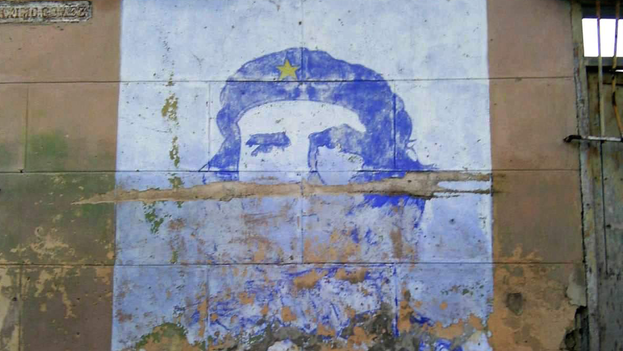
The murals with the Argentinean’s face cannot escape the wear and tear of a reality that little resembles what he planned
The murals with the Argentinean’s face cannot escape the wear and tear of a reality that little resembles what he planned (Silvia Corbelle/14ymedio)

14ymedio bigger14ymedio, Hector Dario Reyes, Santa Clara, 15 June 2015 – “He was a man surrounded by good photographers,” is how a clever self-employed tour guide describes Ernesto Guevara to his clients in the streets of Santa Clara. The man lives by showing the face of the Argentine and telling of his hyperbolic exploits. This Sunday he has had good profits, taking advantage of the 87th anniversary of the birth of one who long ago stopped being a hero and turned into a fetish.

With the passage of the years, the plundering of the guerrilla’s image and the commercialization of his likeness have been imposed on this island. “Santa Clara, the city of Marta and of Che,” says the motto of the provincial capital, although Guevara was not born here. The Villa Clara capital tries to extract a return from the cheesiest ornaments with his name, and the whole tourist network is fed with some bit of his story.

Canek Sanchez Guevara, recently deceased musician and writer and grandson of the Cuban revolutionary commander, hated the t-shirts and pictures of his grandfather. “There is one that unifies his face with that of Christ that is really degrading,” he told his friends. continue reading

Since his death in 1967 and when the Havana photographer Korda gave his mage to an Italian publicist, international trade has encouraged a Che-rebel pseudo-fashion. Although t-shirts with his face abound in stores all over the world, it is in Cuba where that image of beret and jacket has profited most. As with other excesses so characteristic of our idiosyncrasy, in this also we overdid it.

“Here in this city can be found almost all the ways of remembering him that would have annoyed him.”

In Santa Clara there is even a Mate House, home of a historian who collects those traditional Argentinean accessories used for drinking the beverage extracted from the herb of the same name. “I began with the first mates, and when I had many, I placed them decoratively, then I put the image of Che Guevara on the door,” says the man who made a killing from then on. “My objective is to collect them and for people to come to see the display and drink the mate,” is how he explains his publicity strategy.

“Cuba commercializes Che,” says an alert tourist. From berets to bad songs, allegorical t-shirts, bags, bad oil paintings and ashtrays where tobacco is put out right in that face with the majestic gaze. Everyone wants to take advantage of the Argentine. From government institutions and artists to prostitutes or old men who exchange three peso bills with his image for one convertible peso. Che Guevara has become a bargaining chip.

“Santa Clara bases its tourism on the remains of the guerrilla,” the tour guide says ironically. “Here in this city can be found almost all the ways of remembering him that would have annoyed him.”

Another of his grandchildren organizes, in his name, motorcycle tours of the Island on nothing less than Harley-Davidsons. “In memory of the trip through Latin America on the Ponderosa,” he explains to interested clients. Although everyone knows that he made that historic journey “on a Norton 500,” wryly reminds a mechanic who has his garage a few meters from the sculpture complex where official propaganda asserts that the remains of the politico together with 29 of his companions are found.

In Santa Clara his image swarms in the Artex premises like a provincially manufactured product. “The myth is not sold, it is collected with the image,” says a local, tired of stumbling over that gaze everywhere.

Billboards and walls show phrases and drawings that sometimes do not match his face or were not even uttered by him

Opposite the monument to the armored train, a kiosk overflowing with t-shirts, berets, and postcards. A kilometer further, another statue of the guerrilla stands across from the headquarters of the Provincial Party Committee. They receive many foreigners there, who frequently place flower bouquets at the feet of the statue, “because the guidebook says so,” says a Canadian with the look of one who blindly follows to the letter everything that those travel books say.

Another line of exploitation, less profitable but equally petty, is the use of Guevara’s image for ideological purposes. Billboards and walls show phrases and drawings that sometimes do not match his face or were not even uttered by him, but the purpose is to show that his myth and his ideology are believed in.

Che is not only used in the revolutionary exhibition plan, but also to hide some things. Like in the Santa Clara mausoleum, where a giant fence across from the monument prevents foreigners from seeing the marginality of the neighborhood that surrounds Revolution Plaza. His eyes are directed there from the main sculpture; so that, as a popular saying recites, “In Santa Clara, Che watches the poor.”

Translated by MLK

“Cuba Speaks Up” For the Nation / Rosa Maria Rodriguez

Rosa Maria Rodriguez, 3 March 2015 — The Civic Project “Cuba Speaks Up” is a reality. On February 19th we completed the pilot phase of the survey entitled Doxa and we are already starting the final field work. This study, for us as much consultative and participatory as observational—as usual with polls—will give us the measure of the state of opinion in a diverse segment of the population in relation to various topics of interest, and with the results we will develop a sociopolitical program more democratic, authentically representing citizens and largely supported by the popular will. continue reading

In the pilot study we surveyed 85 fellow countrymen in the provinces of Matanzas, Camagüey and Havana. We hope that soon, as we anticipated when we conceived and designed this initiative, we can extend this survey throughout the Cuban archipelago.

This purposeful design, which we presented as a draft during our trip to Mexico from December 1 through 5, 2014—when we were invited to a joint event of the Christian Democratic Organization of America and the Konrad Adenauer Foundation—was born from our clear democratic vocation and the recognition and respect of all Cubans, wherever they are.

We who are dedicated to politics usually draft proposals based on what we think the people need, and then ask the people to support us. With this project we want, in modesty, to reverse the procedure and truly empower citizens. To consult them and take into account their views, in order to prepare a political platform of consensus.

The recently concluded first phase provided us a successful interaction and social feedback, which have put into perspective the need to “open” some points of “Doxa A” for carrying out further surveys and covering as far as possible all the basic themes to consider in an inclusive and participatory political project.

What do we Cubans really want? Why not ask us? Since the power there are precedents—very  few in fifty-six years—of polling society manipulated by the authorities. Such procedures prevented those consultations from being taken seriously by international observers and by the people themselves, while further lowering social self-esteem and creating in the population a disinterest in and even a rejection of these topics that by now have become chronic.

So far, we have looked unsuccessfully for a place to host an online version of the doxa, but once we get to publish it, we will present here the address of the place where, if you are Cuban, at least sixteen years old, and want to stop being a passive spectator by becoming a protagonist of your national history, participating freely and democratically, filling out the survey and letting us know your opinions. If you have any questions about “Cuba Speaks Up” you can write to cubaopina2015@gmail.com and by return mail we will try to clarify any doubts. Please join!

If you are interested, you can download the documents from the Civic Project “Cuba Speaks Up” below:

Cuba speaks background

Cuba Speaks Survey

Busy Taking a Survey: The Reason for My Absence / Rosa Maria Rodriguez

Rosa Maria Rodriguez Torrado, 13 May 2015 — The last few months my energies have been spent doing face-to-face surveys in the streets along with other members of the Cuban Democratic Project. As I mentioned, I have been busily involved with Cuba Opina (Cuba Believes), which is ready to release the results of its first poll. I treked through areas of the national park as well as through a goodly number of gardens and neighborhoods in the capital, soliciting and obtaining citizens’ opinions. continue reading

This endeavor has not been easy, neither in Havana nor in other provinces — it is easier to travel abroad if you have an American visa in your passport than it is to go to Santiago de Cuba — given the hostility we encountered from some of the people we approached.

To solicit responses, a questionnaire was specially developed for the first investigation, called “Doxa A.” Ambitious in our vision, we decided to consult citizens of all social classes along the width and breadth of the Cuban archipelago. But the lack of resources forced us to delay our activities as we approached “the finish line” and to significantly reduce the number of citizens being polled.

This first study consumed precious time — delaying us by a month — because we followed the recommendations of sociological studies downloaded from the internet, which advised conducting a “pilot study” first.

This involved surveying the field of the respondents — the sampling size — to check the wording, understanding and the viability of the basic questionnaire (the doxa), correct the shortcomings and errors it is likely to have and avoid the mistakes inherent in the information collected.

This meant the sociopolitical conditions in Cuba imposed an additional burden on the project and involved twice as much effort. Therefore, we agreed that future civic research projects by Cuba Opina would not involve such trials or tests.

We know that behind every dictatorship is a frightened and divided society. I am referring to the divisions within society itself, which requires citizens to feign political loyalty. It is a society which causes people to look with suspicion on acquaintences and strangers alike, on those who sell beef under the table, on those who rummage through trash, on neighbors and even on one’s own mother.

After fifty-six years of totalitarianism, Cuban society is one in which loved ones — people to whom we were close — are struck from our list of friends because of political differences. Families are divided over the same issues to the point that, in search of freedom, the distances become not only ethical but geographic.

The doors of more than a few friends and acquaintances stayed closed or were slammed shut — doors which under normal circumstances would have been opened wide — with the plea of “Don’t complicate my life, Rosita.”

There were excuses such as, “It’s not me; it’s my son who wants to go to university,” or “He’s hoping to travel out of the country,” or “Damn, Rosy, I’m waiting for them to send me on a mission overseas.”

Though the state “ships them” overseas (exploiting them in the process), this is perhaps the  only way that many Cuban professionals from a variety of fields can resolve their personal and families’ financial problems. These and other fear-based responses are symptoms of a socio-political, economic and cultural panic.

The regime has sowed terror since its inception, which the international community was recently able to witness at the stormy Summit of the Americas in Panama last month when the government’s attempt to sabotage a parallel event organized by civil society groups failed.

It did, however, demonstrate the high price it charges some acolytes for the privileges they receive. It extorts them in order to later crudely use and abuse them, like trained pawns, in a political chess game in which it discredits, threatens and verbally assaults those who dissent from a government forced on them more than half a century ago. This is not just verbal vandalism; it is a violation of the rights of its own followers.

On the occasion of the conclusion and tabulation of Doxa A, we call upon Cubans visiting this blog to respond by May 18 to the eighteen-item questionnaire to be found in the link below. We also request that you forward the URL of this survey to your compatriots so that they might also contribute their opinions.

We are now in the final push to complete this poll but, in prioritizing tasks at Cuba Opina, we neglected to provide the interaction and promotion that an internet project such as this should have. As a result, the number of people who have completed the online questionnaire is low.

We, therefore, politely ask for your support, which means simultaneously recognizing and respecting your sovereign right to express yourself in this and subsequent polls. Do think about participating; think and express yourself by participating! Thank you in advance.

On-line survey (in Spanish) is available here.