The Flight of Ballplayers Is Destroying Cuban Baseball / Ivan Garcia

Yasmany-Tomás-_ab-620x330Iván García, 15 June 2015 — One rainy fall afternoon in 2013, a children’s coach warned me that if apathy, corruption, and bad work continued, within five years baseball could become an exotic sport for collectors and the nostalgic.

Sitting in the concrete stands in the small baseball field at Thomas Alva Edison School, in the La Vibora neighborhood of Havana, the trainer made a prediction that I thought was exaggerated.

Baseball was his passion. From age ten he had been involved in the selection process for building national teams. A serious injury ended his playing career. He graduated with a degree in physical education, and had trained and coached school teams in the 10th of October neighborhood with remarkable success. But he didn’t like what he saw. continue reading

“The Municipal Baseball Commission doesn’t give anything. Let alone pay me a salary. Only when we became champions did they come up with a box of sandwiches for the boys’ snack. The coaches and parents do everything. Weed the field and patch it, get balls, gloves and bats. And pay for making uniforms. Many parents do it for two reasons: if your son doesn’t show up here, he’s off in the street with its harmful consequences: drugs, prostitution, and gangs engaged in stealing. If by his talent he is able to succeed, then the strategy is to leave Cuba and to join any professional league in the Caribbean or the United States,” explained the coach.

Sadly he told me how many children he had trained who at age 15 or 16 left the country with their parents. “In eighteen months, more than 20 young players left the country. It’s a tragedy. If we stay on this road, baseball will become just another game. Football [soccer] will surpass it. These people (the directors) are killing the national sport,” he said sadly.

I must confess I was a bit more optimistic. I thought the steady leak would lessen after the regime authorized players to sign with foreign clubs.

I guessed that the Asian professional leagues would hire a couple dozen players, who then wouldn’t be forced to risk their lives to leave their homeland.

But the apathy among the federation officials has been like a containment dike. Two years later, only three players have been recruited in Japan. And four in an independent league in Quebec, Canada.

Already this season, after a group of scouts from Japan and other Asian leagues visited Cuba, there was speculation that they would recruit around a dozen baseball players.

But negotiations didn’t flow. You might think that Asian clubs aren’t interested in Cuban raw material. I don’t believe it. A more selective league like MLB has signed more than 40 Cuban players who left in the past two years.

National commissioner Heriberto Suárez himself acknowledged that in the past two years around 60 players have fled. And he came up short. A few days later, another group of players escaped the island.

All categories are represented: little league, youth, and adults. No second-rate players leave. No way. It’s the most talented who aspire to play in the best baseball in the world.

And the news is not which ballplayer has left, but which one hasn’t gone yet. Established stars like José Abreu, Rusney Thomas Castillo, or Yasmany Tomás are easy picks.

But the stampede has been joined by promising players like Joan Moncada, Yusnier Díaz and recently two of the best pitchers, Cionel Pérez and Norge Luis Ruiz.

Every day there’s a new rumor. The absence of big stars was notable at the old Del Cerro Stadium during preselection training looking toward the Pan American Games.

And among the standouts, fans are betting on predictions of how much longer they will remain in Cuba. The disastrous policy on contracts doesn’t only affect baseball.

Arturo Dispé, a talented young soccer player, said in a radio interview that he lost the opportunity to try out for a second division club in France because he didn’t get permission from the local federation.

Dispé had paid for a plane ticket to travel to the club at the end of the month. But the mandarins of Cuban football decided to include him on the national team that will play a “friendly” game with the New York Cosmos on June 2.

In front of the microphone the boy tried not to be pessimistic. “I hope to have another opportunity,” he said. Not everyone thinks alike. Maybe the managers of sports and the nation, accustomed to governing without an expiration date, forget that the life of a high performance athlete is fleeting.

General Raul Castro, with his timid economic reforms of coffee without milk, and his favorite slogan, “slowly but surely,” has managed to win over politicians and entrepreneurs from the United States and other countries through liberal feints and fakes. Not so the ballplayers. Slowly and surely, they are jumping the fence.

Photo: Yasmany Tomás (born Havana, 1990) now plays for the Arizona Diamondbacks. His six-year contract is worth 68.5 million dollars. Taken from “Cuban Play”

Homage to Oswaldo Paya / Angel Santiesteban

Ángel Santiesteban-Prats, 17 May 2015 — Any good Cuban should visit the tomb of Oswaldo Payá Sardiñas, one of the greatest defenders of liberty and justice in the history of Cuba. His name is inscribed, in its own right, in the pantheon of Cuban heroes. I even heard the national intellectuals mention his name with respect, sometimes with fear. They always accepted, even though they were “official,” his intelligence, valor and honesty in his political demands for Cuban citizens. continue reading

Even today my hands can feel the clapping when they received his remains in the little church in Cerro, which Payá used to attend. The injustice of his assassination and that of Harold Cepero summoned all the dissident factions. The grief was generalized. I spoke with men and women, citizens of the people, who had no contact with the dissident movement, nor with officialdom, and who in some way felt the need to express their repulsion at the government, and their solidarity with his family.

We all remember that we were monitored and persecuted in those ill-fated hours, as well as beaten and captured at the exit of the burial. We traveled to the cemetery together with the great poet and exalted Cuban, Rafael Alcides.

I will not forget the pain of his widow, his daughter and sons. We shall never be able to explain to them how that vile assassination could happen. But the people who crowded against the walls of the church joined the family in their sorrow.

Although the dictatorship took his body away from us, it returned him larger, with the ability to remain in our minds and hearts eternally. His death made us stronger and, above all, deepened our need for freedom.

May my voice and moral support accompany his family.

Ángel Santiesteban-Prats

May 17, 2015, Border Prison Unit, Havana

Translated by Regina Anavy

The Code of Ethics Makes a Comeback / Fernando Damaso

Fernando Damaso, 11 June 2015 — It seems that recently we have seen a return to the “code of ethics,” that peculiar document that some years ago we, as public officials, had to sign in the presence of a manager who was later sacked for, among other things, “ethical lapses.”

This age-old document has made a comeback at the Attorney General’s Office, where it was signed by new employees, and at the offices of the Comptroller General of the Republic, where more than 300 workers signed a document “that should govern the behavior and the work of these officials.” continue reading

In the latter case, the act marked the conclusion of a “Day for the Promotion of Ethical Values,” a project which the comptroller had been working on for more than a month. What was striking about both events was the presence of an unsuccessful former spy — now repackaged as a hero, poet and painter — expounding on the subject of ethics.

I feel like I am living in George Orwell’s novel 1984 or in Gabriel Garcia Marquez’ mythical Macondo.

At this point , anyone who thinks that “the game” — forcing workers and officials to sign this sort of document — will solve the serious problems of  a lack of honesty, transparency and industriousness, loss of values, corruption, diversion of funds, bribery and many other issues that afflict Cuban society is a person with his head in the clouds, someone who is far removed from reality.

The same mistake is being made once again: trying to remedy through bureaucratic measures the symptoms of profound, long-term problems that are the logical byproducts of a failed ideology, policy and economy.

Google Suggests That Cuba Jump Directly to Mobile Connections / 14ymedio

Google logo
Google logo

14ymedio biggerGoogle suggests that Cuba jump directly to mobile phones and tablets without passing through the stage of wired connections, according to comments made this Monday by a representative of the firm to OnCuba.

Two Google directors, Brett Perlmutter, of Google Ideas, and Brehanna Zwart, of Google Access & Energy, traveled to Havana in a business delegation just days after the Cuban government’s strategy to connect at least 50% of the households in the Island to the Internet by 2020 was leaked.

“Cuba has a great opportunity to jump right into mobile infrastructure without going all the way through hardwiring, as African countries are doing,” Perlmutter told OnCuba.

Company representatives would not confirm to the magazine if Google presented a proposal to the Cuban government to participate in the infrastructure, as several US publications reported last weekend.

Family Wounds / Angel Santiesteban

Ángel Santiesteban-Prats, 14 May 2015 –– There are sorrows that always are remembered, that seem to have happened yesterday. At the beginning of the century, my younger sister and her husband were already involved in the dissident movement, receiving blows left and right. Every weekend they were thrown into prison. There was a time when to invite them to a meeting meant that everyone there would be beaten up. Sometimes they were used to mislead the political police to go in the opposite direction of where the meeting would really be held. The dissident movement itself suggested that they leave the country; they were liable to be sanctioned for years, and that would harm their three young daughters. continue reading

Fridays, after school, they left the girls with me and left for the Struggle. Sunday night, when they didn’t return, that was proof that they had been detained. They would appear Monday or Tuesday, weighing several pounds less, and with the dirt and the typical odor that adheres to someone in prison. They picked up the girls and barely talked about what happened, although they didn’t need to.

The sadness, humiliation and resignation to the fact that this would not be the last time escaped from the children’s eyes like a pack of rabid dogs. The saddest was the youngest girl, named Maria. She was about four, skinny as a stick, and barely saw a patrol car or a uniformed police officer that she didn’t start trembling and ask that they not prey on her or her parents.

The day they went to the interview in the United States Interest Section, they had to talk with her several times before she would enter the building. Now that she is in the United States, she still has that fear of patrol cars and police officers. Her sisters, older by a few years, threaten her with “calling the police” if she doesn’t pick up her toys, so that Maria will cooperate and immediately do what they ask.

Thank God, Maria is today a free girl, away from the wrath of the Castro dictators.

Ángel Santiesteban-Prats

May 14, 2015, Border Prison Unit, Havana

Translated by Regina Anavy


Dissidents Have No Leadership Among Ordinary Cubans / Ivan Garcia

Emisora-Mil-Diez-La-Habana-años-40-1-_ab-620x330Ivan Garcia,25 May 2015 — Cubans are not as uninformed as you think. Everyone knows that the Internet is a luxury. According to the latest report from the International Telecommunications Union (ITU), broadband is almost nonexistent, with a penetration of less than 1%, and only 3.4% of households had internet access in 2013.

Less than 15% of Cubans have computers. Although ETECSA recently announced that the number of mobile phone users had passed 3 million, Cuba remains behind in Latin America, with only 17.7 users per hundred inhabitants and no 3G technology or smart phones. continue reading

According to the Census of Population and Housing, over 93% of households have one or more televisions and 100% have radios. The state controls information flow with an iron fist, and Radio Martí, the Miami-based broadcaster that provides feedback about the spectrum of opposition within Cuba, is electronically jammed, making it inaudible in many areas of the country.

So based on statistics, it would seem difficult for Cubans living in difficult times to inform themselves. But the numbers obscure the data. The devil is in the details.

In a personal survey of 50 people of both sexes, between 17 and 80 years of age, 85% had frequent or occasionally access to an illegal cable antenna, or rent the “package,” a clandestine audiovisual compendium circulating in Cuba, or have read articles by independent journalists in the Journal of Cuba, El Nuevo Herald, and Journal of the Americas, outlining critical analysis against the Castro regime.

If you navigate by Facebook, you’ll be amazed at the high number of Cubans who log in, even though an hour of Internet time costs a third of the minimum monthly wage.

Leyanis, a young woman with silicone breast and hip implants, spends about 40 CUCs a month on social networks. “My monthly salary as a food-packaging technician is 500 pesos (about $22). But in the underground economy, like many other Cubans, I ’score’ extra money. I use my Facebook account to contact friends living abroad. Political news doesn’t interest me. ”

Countless prostitutes access the internet to promote themselves or try to hook up with a foreigner. When you ask them about dissident leaders or inquire if they are aware of some opposition project, they respond with a forced smile.

“Antonio Rodiles, Laritza Diversent, Manuel Cuesta Morúa? I don’t know who they are, I’ve never heard of them,” admits Camila, a hundred-dollar-a-night prostitute who owns an iPhone 6, has two computers at home, and connects to the Internet three times a week.

28 of the 50 respondents remembered hearing something vague in passing about the Ladies in White, or Elizardo Sanchez, or Yoani Sanchez, usually in the pejorative terms used by the official press.

There is a great contradiction. When you talk with any Cuban, not less than 80% of them acknowledge that the system is shot, the economy does not function. And if they could, they would temporarily or permanently leave Cuba. Their favorite destination, paradoxically, is the United States, the enemy for 56 years of the olive-green autocrats.

The less glamorous dissidents, like Hildebrando Chaviano or Yuniel Lopez, elected in their neighborhoods to aspire to be municipal delegates of the National Assembly of People’s Power, thanks to their work in the community, have created strong links with their neighbors. Human-rights activists in the mold of Sonia Garro or the independent journalist Luis Cino, are respected by their neighbors, who nevertheless keep their distance out of fear.

Local dissidents still have not found the formula for connecting with the average hurting Cubans. They have failed to capitalize on popular anger.

It is very easy to avoid pointing the finger of guilt at citizen fear or repression at that distance. True, there is fear and repression. But opponents on the island have no legal means of communication that allows them to disclose their political projects. Nor they have editorial spaces on radio and television.

Since May 16, 1938, the Popular Socialist Party, the Communist Party at the time, had its own press organ. It was called “Today” and except for the years when it was closed by the government in power, it was printed until October 3, 1965. In the 40s it also had a radio station, 1010 or Mil Diez. And besides books, it published magazines such as Noonday and Dialectics.

Now dissidents can only meet in the rooms of their own homes, and when they decide to hold a peaceful action on the street or in a park, they are repressed, beaten, and arrested.

While the best-known dissidents travel halfway around the world and participate in international forums and events, in Cuba they are nearly invisible and their leadership is nil.

Of the 50 respondents, 46 were unaware of dissident projects like Manuel Cuesta Morúa’s Citizen Hour, or the Campaign for Another Cuba led by Antonio Rodiles, which calls for ratifying the UN Covenants on civil, political, economic, social and cultural rights that the regime signed in 2008.

Both projects seek to empower civil society and the ordinary Cuban who watches the game from the stands. But they have not yet succeeded.

Iván García

Photo: Taken from Wikipedia. The station Mil Diez (Radio 1010), “the radio station of the people” was founded thanks to a popular collection of 75,000 pesos. It moved to 314 Queen Street, in the heart of Havana. It aired for the first time on April 1, 1943 and the last time on March 12, 1948, when it was closed by the government of Ramon Grau San Martin. During its five years of existence, it was not only a propaganda vehicle of the PSP, but also a means of cultural dissemination. It helped launch various styles of music, such as Cuban jazz, danzón and the tango.

The following performed on Mil Diez: Benny Moré, the Matamoros Trio, Celia Cruz, Bebo Valdés, Olga Guillot, Elena Burke, Omara Portuondo, César Portillo de la Luz, José Antonio Méndez, Leonel Bravet, Aurora Lincheta, Miguel de Gonzalo, Pepe Reyes, Olga Rivero, Pacho Alonso, Frank Emilio, Barbarito Diez, Myriam Acevedo, Zoila Gálvez, María Cervantes, Alba Marina, Miguelito Valdés, Chano Pozo, Manteca, Orlando Guerra (Cascarita), the orchestras Casino de la Playa and Arcaño and his Marvesl with Arsenio Rodríguez, Félix Guerrero, Roberto Valdés Arnau y Rey Díaz Calvet, among others. The director of the station orchestra was Enrique González Mantici, and the musical director of Mil Diez was the incomparable Adolfo Guzmán. Among its announcers were two of the best of Cuba: Ibrahim Urbino and Manolo Ortega. (Tania Quintero)

A Reality / Fernando Damaso

Fernando Damaso, 1 June 2015 — The reestablishment of relations of all types (not just diplomatic) is a reality being constructed step by step, in accordance with the situation at each moment of each party implicated in it. For some, the process is going very slowly, and for others, it is proceeding at the only pace it can. Getting Cubans to agree on anything has always been difficult. Regardless, this thing is happening, and to deny it would be absurd. Besides, I don’t believe that, even given aggressive statements and temporary hysterics, there is any going backward.

What is important now? To work at shaping the new civil society, unifying the dispersed remains of the one that was destroyed, transforming the totalitarian-governmental into the independent-democratic, and incorporating into it the new components that have arisen this century. continue reading

Only a true civil society, wherein all the nation’s subjects, without exclusions of any kind, will be able to ensure the establishment of a government “with all and for the good of all,” as José Martí* advised, and allow the development of productive forces and of the country, where everyone–regardless of how they think–contributes his/her best for the good of Cuba.

The task is not simple, for it demands sowing and cultivating our citizenry’s lost public-spiritidness, and uprooting our screaming fanaticism and double standard, as well as the dogmatisms and extremisms, which have so harmed us.

Translated by:  Alicia Barraqué Ellison

Translator’s Notes:

*The author is quoting from a speech by Jose Martí, “Con todos y para el bien de todos,” given on 26 November, 1891, in Tampa, Florida.  

Coexistence Magazine Calls on “Cuba to open itself to all Cubans” / 14ymedio

Cover of Issue 45 of the magazine Convivencia

14ymedio bigger14ymedio, Havana, 13 June 2105 – With the constancy of water dripping on a stone, number 45 of the magazine Convivencia (Coexistence) for the months of May and June has come out. Published from the Cuba’s westernmost province, the publication comes with a resounding editorial dedicated to the coming visit of Pope Francisco I to Cuba. With the premise, “Let Cuba open itself to all Cubans!” the text recalls the message of John Paul II when he touched Cuban soil in 1998.

In its usual cultural space, dedicated to art and literature, Convivencia offers an excellent gallery, this time with the cartography of Lucy Blanco Perez, while Maikel Iglesias contributed the narrative Diary of a Poet in Vueltabajo. Mines of Matahambre, One Day After the Peace (II), and Jose H. Garrido along with Hilda E Mateau published several of his poems. continue reading

In his usual cultural space dedicated to art and literature, Coexistence offers excellent gallery, this time with Lucy Blanco Pérez Carbografías while Maikel Iglesias from the narrative brings the Diary of a poet in Vueltabajo . Mine Matahambre a Day after Peace (II) and Joseph H. Garrido with Hilda E. Mateu published several of his poems.

This edition continues the approach to the work of great thinkers and presents Cuban Gertrudis Gómez de Avellaneda

This edition continues the approach to the work of great thinkers and presents Cuban Gertrudis Gómez de Avellaneda, under the signature of Hector Maseda Gutierrez. A review by one of the most outstanding figures of Cuban literature and thought.

Pedro Campos, meanwhile, is the author of an article that appeared in this issue under the title “For All The Rights of All Cubans,” and Yoandy Izquierdo

Toledo addresses the issue of “Ethics of Care” while Dagoberto Valdes, director of the publication contributes, “Manichaeism, Demonization and Paranoia: The Last Resources of Totalitarianism.”

The much appreciated Public Debate brings two texts, as always controversial, “My Call To Wake Up 20 Years Later,” by Pedro Medina, and “Transition in Cuba and Negotiation as a Means of Conflict Resolution,” by Jorge Ignacio Guillen. On the subject of economic there is an analysis by José A. Quintana on prices, wages and inflation.

Other documents, notices and recent news complement this 45th issue of Convivencia.

Holguin Besieged by Dengue Fever Mosquito / 14ymedio, Fernando Donate Ochoa

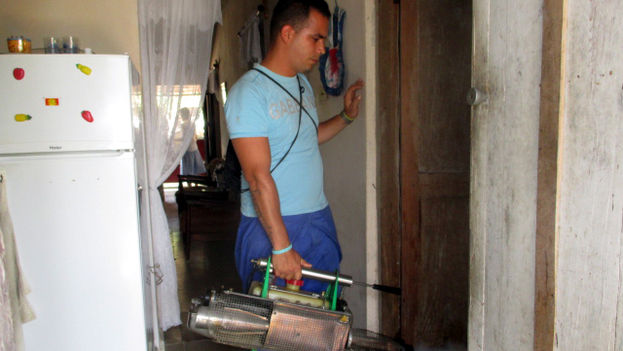
An operator fumigating a house in Holguin City (14ymedio)

14ymedio bigger14ymedio, Fernando Donate Ochoa, Holguin, 15 June 2015 — An undesirable presence has been constant these days in the province of Holguin. A severe drought has been followed by the longed-for rains and with the torrential downpours outbreaks of the mosquito Aedes aegypti increase. According to local press, some 30,000 Holguinn residents are exposed to Dengue Fever, transmitted by this insect.

In this battle the local government has invested over 1.5 billion pesos, without obtaining the expected results, as shown by the data provided by the Department of Hygiene and Epidemiology. Officials say that the vector has crossed the boundaries of 26 de Julio, Pueblo Nuevo, Hilda Torres and Harlem neighborhoods, and arrived in Libertad, Alcides Pino, Palomo, Nuevo Llano and Centro Ciudad Norte, where a wide perimeter takes in the area between Frexes, Carretera to Gibara Streets, Capitan Urbino Avenue and 31st of Vista Alegre, with the appearance of Dengue Fever in all of them. continue reading

It is predicted that in June and July, months that favor the undesirable vector because of the climate and the rain, transmission could trigger an epidemic of patients appearing with Hemorrhagic Dengue Fever. The complicated situation has forced the health authorities to intensify the work of control, but there continues to be a deficit of 300 operators to support fumigation inside homes and other places.

Given the seriousness of the situation, the Municipal Health leadership has asked different state institutions for a workforce, but the answer has not been as expected.

It is predicted that in June and July the climate and rain could trigger the onset of patients with Hemorrhagic Dengue Fever

Yendri Bermúdez Estupiñán, a former operative of the anti-vector campaign, told 14ymedio that the work is every day, working more than 8 hours, most of the time carrying fumigation equipment weighing 65 pounds, and exposed to poisons through working with the cypermethrin, a chemical used to control mosquitoes.

He also complains that the lunch, guaranteed daily, is small and of low quality. The salary of 625 Cuban pesos a month (about $25 US), isn’t enough to maintain a stable workforce in the sector.

As a last resort, the municipal authorities have asked for help from the Revolutionary Armed Forces, which mobilized a weekly rotation of more than one hundred soldiers, according to what Julio Cesar Velazquez Garcia, head of the Provincial Health Vector Control Department, told local TV.

Beef, Only for the Privileged / Cubanet, Roberto Jesús Quiñones Haces

La-Ternera-2-Foto
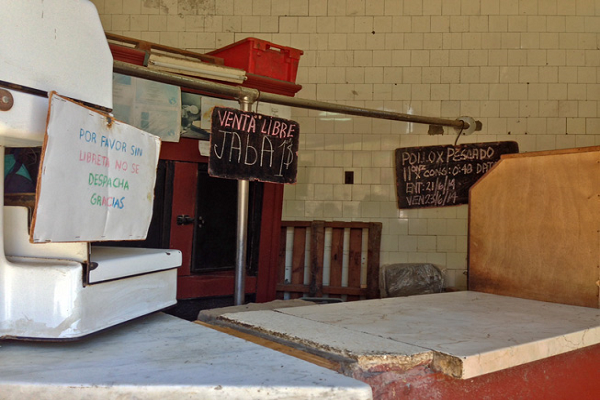
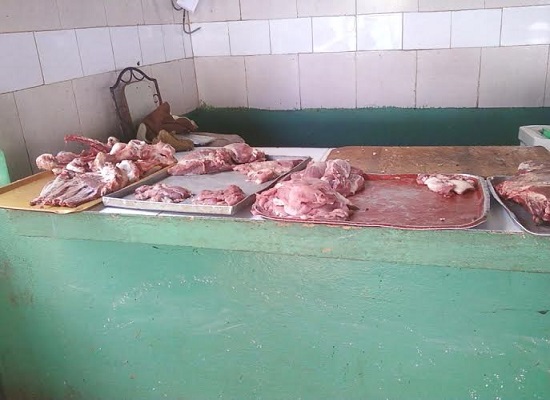
Cuban butcher shop (photo from the internet)

cubanet square logoCubanet.org, Roberto Jesus Quinones Haces, Guantanamo, 12 June 2015 – Among the list of prohibitions imposed on Cubans from 1959 until today is freely fishing, having a boat and wandering around the island or giving our children an education in non-state schools, among others. Until recently it was forbidden to stay in a hotel, sell cars acquired after 1959, sell housing, leave the country without permission from the government, possess foreign currency and buy in stores for tourists and foreign technicians.

Another unusual prohibition that we Cubans have is that the slaughter of large livestock and the consumption of their meat is penalized with harsh jail sentences. For more than 25 years eating a beefsteak has become the dream of the great majority of Cubans. Here, the only ones who can are the leaders, tourists and those with the money to buy it in the currency stores, or those with enough bravery – and also the contacts – to buy it illegally. Not even in the most distinguished restaurant does there appear the longed-for filet. continue reading

A purely Cuban – and revolutionary! – ban

The crime of Theft and Illegal Slaughter of Large Livestock is perhaps unique in the history of international jurisprudence. It had its precedent in the 1962 Law 1018 which last March turned 53 years old and by which cattle owners are obliged to sell their meat exclusively to the state, prohibiting them from consuming it.

In his book, “In Kind Crimes,” Dr. Jose A. Grillo Longoria asserted that before 1959 a great percentage of Cubans could not consume beef and that this law would guarantee that all residents of the country could eat it regularly. For such reason, the distinguished professor of Criminal Law warranted that the state’s efforts to increase the production of milk and beef would be useless if it benignly repressed those who slaughtered those animals irresponsibly or because of a desire for profit.

When he wrote that he knew, because of his age, that in Cuba there had always been milk and meat, even in the worst droughts. From living one could realize that this incomprehensible decision has been the main reason that the Cuban cattle population has decreased continuously from 1962 to today.

Today the number of Cubans, including children, who cannot drink a simple glass of milk as well as those who have not tasted a little piece of beef in years, is much higher. It would prove that the cruel sanctions that he defended have not managed to stop the commission of a crime invented by the bearded ones, the implementation of which has caused thousands of Cubans to rough it in jails, sentenced to thirty and even more than fifty years for having butchered a head of cattle.

The Guantanamo slaughterhouse is militarized

Unable to kill their own cattle, to eat its meat in restaurants, or to acquire it in currency stores due to its high prices, the great majority of Cubans have to go to the black market, supplied by butchers and slaughterhouse workers, in order to be able to eat a steak. In the wholesale network a kilogram costs 10 CUC, more than 50% of the average monthly salary.

carnicero-1
Archive photo

According to a source whose identity we withhold since he works in the Guantanamo Slaughterhouse, the manager there is Mr. Gustavo Osorio, a retired colonel of the Armed Services, who believes himself still to be in a military camp based on the methods he uses against his workers.

As members of his team he has named Lioel Cantillo Pelegrin, an ex-police officer who is chief of the slaughter area and Feliberto Espinola, another ex-police officer who occupies the job of Maintenance Chief.

As if that were not enough, Major Liranza, member of the economic police, continually visits the slaughterhouse and together with those mentioned above, carries out suppressive checks of the work stations without these being part of his job. As a result of these actions, worker Manuel Reyes Calderin was surprised last week with 10 pounds of meat in his clothes, which cost him two days locked in a prison cell, the loss of his job and a pending trial.

A steak, which together with some fried plantains and a serving of beans and rice cost some 25 cents before 1959, now joins the long list of scarcities in Cuban homes. Add to that also that risking the great pleasure can involve a solid blow of many years confinement.

And like everything that happens in Cuba, the fault is not with our leaders but with others. In this case it’s the cow’s fault because they do not want to fatten up, increase their offspring or give us milk. Oh, and I forgot it, also the embargo’s fault!

Roberto Jesús Quiñones Haces

Translated by MLK

Easterners in Havana: An Exodus Hushed Up by the Cuban Regime / Ivan Garcia

Terminal-de-Trenes-de-La-Habana-_ab-620x330Ivan Garcia, 30 May 2015 — One hot and boring night, drinking a tear-inducing moonshine, Yosvany and a group of friends in a remote sugar-workers’ town in Yateras, Guantanamo province, more than a 600 miles east of Havana, made plans to relocate to the capital to try to change their future.

“The village where we lived isn’t even on the map. It’s in a mountainous region and there the routine for most young people is drinking alcohol, breaking horses, and going to bed early. The school dropout rate is high and many girls as young as 14 or 15 are already mothers. This hamlet is the closest thing to hell,” says Yosvany, seated on his bicycle-taxi.

Two days later, Yosvany and his partners took a train to the capital. After 22 hours of travel, including police checkpoints where they were searched for cheese, coffee or marijuana, they arrived at the supposed El Dorado. continue reading

“I had only seen Havana on television. I’d never seen so many cars or tall buildings, like the FOCSA or the Habana Libre hotel. The first pictures I sent my parents were in front of the El Capitolio, like all the peasants, and drinking beer from a can in a Havana bar. It’s true that the city is grimy and dilapidated, but compared to the eastern provinces, it’s Miami,” he says.

Like Yosvany, there are hundreds of easterners in Havana. In an unfriendly euphemism of official jargon, they are labeled a “floating population.” According to the last National Census of Population and Housing, half a million fellow citizens live in the city in true legal limbo.

Since 1997 a shameful Legislative Decree (number 217) has been in place that prohibits anyone not born in the capital from settling in it. Apartheid in its purest form.

While the campaigns of Cuban dissidents pound away against the arbitrary excesses of power, the repression of those who think differently, and the flagrant violations of political rights, this infamous legislation gets a pass.

An example. The spurious Law 88, which imposes a 20-year prison term on dissident journalists or human rights activists, remains on the books, but is not enforced. Quite the opposite occurs with Legislative Decree 217.

If you walk around in the shanty towns on the outskirts of Havana, crowded with filthy hovels made of aluminum and cardboard, without electricity or sanitation, you can find out what it means to live being hounded by a law.

These families live in no man’s land, in an undefined status. For them bureaucratic records do not exist. They are not listed in the Civil Registry or in the OFICODA, the organization that implements the rationing of housing.

14 years ago, Magda came from Mayari, in Granma province, 500 miles from the capital. Her life is comparable to that of a gypsy. “My three children are illegals at school. I’m in the paperwork to legalize a room I built in San Miguel del Padron. We don’t have a ration book to buy the official basic food basket and we can’t get work because we’re undocumented.”

Thanks to the underground economy, Magda earns money that she couldn’t even dream of in her province. “My husband collects money for the ’bolita’ (illegal lottery), and together with some friends we put on a cockfight every weekend. Every month that business earns you good money. I sell what shows up, from ground-peanut bars to bath sponges. Easterners are fighters by nature. We do jobs that Havanans avoid.”

Police harassment of the illegal Easterners is constant. In the overcrowded neighborhoods of Old Havana, police officers dressed in black with German shepherds are on the lookout.

“They look like Nazis. They’ve sent me back to Santiago three times. But I managed to return. There it’s really hard. The “empty pockets” and the people don’t have the means to thrive. In the capital opportunity abounds. There are lots of under-the-table businesses,” says Ernesto, an industrial technician who spent six years living illegally in Havana.

According to Ernesto, the police are the most dangerous. “Almost all of them are Easterners, but they won’t leave their fellow countrymen alone. But because there’s so much corruption, you can take care of it with money. The other problem is that many Havanans see us as intruders, saying we’ve come to take their jobs. They call us ’Palestinians’ and have given us a reputation as drunks and snitches.”

One afternoon in 2009, Ernesto decided to burn all his bridges. He sold his house in the Chicharrones slum in Santiago de Cuba, and put up a covered corral on the outskirts of Havana where he breeds more than 50 pigs.

“I make my living selling pigs. I fatten them with feed bought in state warehouses and scraps that are available from school cafeterias. The headache is the police, who will not let you live. To be a paperless easterner in Havana is to live in constant fear. Apparently Fidel and Raul don’t remember that they are easterners too,” he says.

In every municipality of Havana, illegal eastern refugees survive underground. However they can. Driving a bicycle taxi, raising pigs, or prostituting themselves. Always on the razor’s edge.

Iván García

Photo: Havana Train Terminal, arrival point for most Cubans arriving from the eastern provinces. Despite the existence of a decree-law prohibiting it, they are moving to the capital in search of a better future for themselves and their families. Taken from the blog La Santanilla.

The Landscape Before the Storm / Yoani Sanchez

The headquarters of the State phone company ETECSA in Havana. (14ymedio)

14ymedio bigger14ymedio, Generation Y, Yoani Sanchez, 15 June 2015 – Before the downpour there is a scent that crosses the city. It is the premonition of water, the anticipation of the cloudburst. The birds fly to their nests and the most cautious seek a doorway where they can shelter until the rain passes. This impression of something approaching is being felt lately about a possible opening of Internet connectivity for all Cubans. There is nothing concrete to point to confirm our massive entry into cyberspace, but the gusts of impatience can be felt in the air.

The topic of the web of networks has reached significant prominence in the official discourse of the last half year. Barack Obama’s administration had to “make a move” to wake up the bureaucrats in the Ministry of Information and Communications, who are trained to go on the defensive. With the January 16th implementation of a package of flexibility measures, outstanding among them links to the sector of new technologies and connectivity, the White House has set more than one person scuttling on this island. continue reading

Four years after the installation of the fiber optic cable between Cuba and Venezuela, it seems that officialdom can no longer justify why we are among the countries with the least connectivity on the entire planet. On the other hand, American companies such as Verizon or AT&T, breathing down the neck of Cuba’s ETECSA phone company, are working as a catalyst to implement a data service that allows the Cuban telephone monopoly to hold on to the national market.

Conveniently, a document was leaked that puts into writing the national strategy for the development of broadband connectivity infrastructure in Cuba

The lesson of Isabel Dos Santos, the richest woman in Africa and the daughter of the Angolan president, should be keeping the dauphins of power in Cuba awake right now. They know that whoever gets a slice of the telephone and communications market will have a guaranteed fortune exceeding a lot of zeros. However, they are also aware that a company of this type requires agreements, roaming contracts, favorable rate packages, attractive offers for users. In the world we live in it can be summed up in one word: connectivity.

This reality is denied by the ideological outbursts, in the style of Abel Prieto when he claimed that he will give “free and open access to the Internet, and not to those who have money, but to those who need it to support their studies and research.” Mobile phone service alone shows that in the battle between politics and the market the latter comes out the winner. Cubacel users – save those who receive the privilege because they work for State Security or other strategic sectors – pay for it in convertible pesos. To purchase a cellphone requires the harsh practice of money in your wallet, not fidelity to any idea.

A few days ago, conveniently, a document was leaked that puts into writing the national strategy for the development of broadband connectivity infrastructure in Cuba. Despite the enthusiasm with which the text was received by those thirsting for the Internet, the deadlines proposed by the program are, at the very least, unconsidered. It talks about “reaching no less than 50% of households with access to broadband Internet by 2020,” while two years ago it was expected to have 100% connectivity “in Party organizations at the national, provincial and municipal levels, in State agencies, and in the Central Administrative Organs of the State.” It is not unlikely that right now there are people who are joining the Cuban Communist Party (PCC) in order to attain access to the vast World Wide Web.

It is not unlikely that right now there are people who are joining the Cuban Communist Party (PCC) in order to attain access to the vast World Wide Web.

On the other hand, Brett Perlmutter, director of Google Ideas, is visiting Cuba this week. His presence has been explained to the media as an exploration to “bring better Internet access to the Island.” According to a State Department official who asked to remain anonymous, “Google has made a proposal to the Cuban Government to help with the connectivity of the population,” adding, “we don’t know what they have proposed, but they have proposed something.”

Beyond what Google achieves, between official suspicion and postponements by Cuban functionaries, his presence on the Island reinforces the sense of urgency. He transmits to the Cuban Government the impression that its closing the doors to the sea of kilobytes not only is not working, but is under threat of being swept away from abroad and from within. Helium balloons, mini-satellites, WiFi antennas made from Pringles bags, clandestine wireless networks that share content, and even the irreverent weekly “Packet” of audiovisuals, are jeopardizing a structure designed for censorship, but inefficient in managing an opening.

There is a smell of rain these days. A gust of damp certitude that is wafting the bird of the Internet our way.

US Helps Raul Castro To Maintain Stability In Cuba / 14ymedio, Pedro Campos

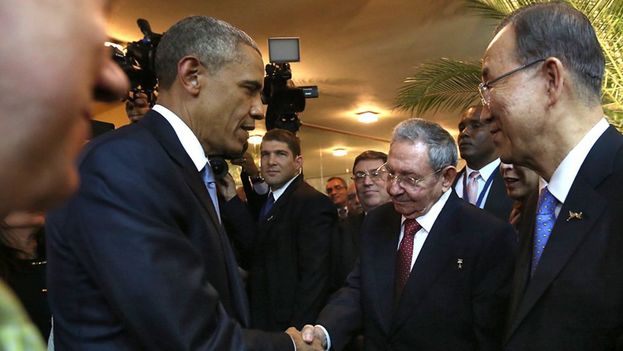
Barack Obama and Raul Castro shake hands at the opening of the Americas Summit

14ymedio bigger14ymedio, Pedro Campos, Havana, 10 June 2015 — Even when senior officials of the Obama administration and the president himself have said the new US policy toward Cuba is not intended to change the regime, the propagandists of the Caribbean Stalinism insist that this remains the real pretension of the United States.

Of course the intention is to say that nothing has changed and continue raising the smoke screen of the blockade of the “enemy’s” plans to continue to try to hide the true causes of the economic disaster and justify the lack of democracy and the repression of difference.

It is elementary that the United States would like a free market economy regime, with a government that helps it to preserve its interests on the Island and in the region. But to accomplish this it can’t subvert the Cuban government.

However, from there to trying to impose a government of its will, in the new international conditions, goes a long way, because they know full well that a deliberate attempt in this sense would be met with great resistance in the country and the region. Besides, why fall into dangerous adventures, if via other “intelligent” ways you can get the same results? continue reading

No. Today the objective of the United States is not to “destroy the Revolution.” The “revolutionaries” in power have been changed with this, as Fidel Castro himself said on 5 November 02005 at the University of Havana. He and his group prevented, first, the triumph of the democratic revolution in 1959-1960 and later, in the name of the Revolution, Socialism and the working class have avoided the Socialist transformations.

In Cuba we’ve had neither a democratic revolution nor a socialist revolution.

In Cuba we’ve had neither a democratic revolution nor a socialist revolution.

The United States watched the transition of the centralized “socialist” economies in the Soviet Union, Eastern Europe, China and Vietnam, to more or less free markets, in the hands of many of their own former leaders. Boris Yeltsin, former member of the Politburo of the USSR Communist Party, or Deng Xiaoping, also a member of the Politburo of the Communist Party in China, and others of a similar style.

With this disaster it became clear that “State Socialism” never ends, because its inconsistencies between socialist ends and capitalist measures (working for wages and the centralization of property), sooner or later, move the economy in a natural way toward private capitalism.

This is the result of not having socialized the economy nor democratized political power, i.e. delivered real power – economic and governance – to the workers and the people.

Previously, the objectives pursued by the United States in Cuba were to avoid the consolidation of a “socialist” regime, its eventual reversal and to avoid its spread in the region. But with the fall of international support the Castro regime fell into crisis, ending the export of the Revolution and no one on the continent is excited about following the Cuban model.

With these goals, without any invasion, and demonstrating the endogenous unviability of the Cuban State socialist model (neither socialist nor Cuban), the United States believed that its implosion would be the matter of a short time. It didn’t understand until today that, despite its inconsistencies and economic deficits, the “confrontation with imperialism,” the support from Venezuela, the hyper-exploitation of those who work for the State, the permanence of the historic leader and some populist measures brought certain reserves of time to the “Castro experiment.”

With the fall of international support the “Castro experiment” fell into crisis, ending the export of the Revolution and no one on the continent is excited about following the Cuban model

In parallel, starting from 1994, concern was growing among the American “establishment” over the complicated internal crisis that was generating another rafter migration crisis, converting Cuba into a failed state, and leading the United States to have to engage in some kind of intervention. This definitely put US strategic interests in the region at risk.

This was no longer defined by the Intelligence Community, as expressed by different representatives, when the transmission of power in Cuba from Fidel Castro to his brother became clear. They then specified that a government in military hands, like those of Raul Castro, suited their purposes of realizing a peaceful economic and political transition in Cuba.

It was at that time that the United States began to understand the political futility of the blockade-embargo and to delineate a new policy. Obama was not yet president.

Once power was transmitted to Raul, and with a different administration in Washington, a new intention became clearer: to help the General’s Government ease the internal economic situation to avoid this dangerous crisis and, of course, to take advantage of the opportunities offered by the “opening” for foreign capital and the established of all the ties and commitments permissible to be as close as possible to the Cuban government

And this is what, in the first instance, explains the policy change that had antecedents even in the Bush administration, when food imports were allowed and talks were held on commitments about migratory problems.

The policy change had a history even in the Bush administration, when food imports are allowed and talks on migration issues and commitments were made

Another key element in this new projection is that the unnecessary extension of the absurd blockade-embargo became a boomerang for US foreign policy, particularly in Latin America. Mending its relations with Cuba would seem to be a precondition to reverse this situation and create a more favorable environment for the expansion of political and economic relations in the region in the face of the Chinese and Russian offensive.

We must not forget that the Free Trade Area of the Americas (FTAA), with which the United States tried to create an economic zone on the continent to try to preserve the extra-continental competition, was sabotaged by the initiative of Fidel Castro with the support of Hugo Chavez.

With “normalization,” the United States aims to neutralize the extreme anti-imperialism of the “historic leadership,” which has brought it so many problems around the world.

Part of the new policy is the continuation of the Cuban Adjustment Act, a permanent escape valve for the dissatisfied, now with more opportunities to skip the country with the new migratory law; clearly there is a need to get the growing discontent — generated by the “update” itself — off the Island.

A sign of discontent? An old man in the neighborhood, 80 years old, loyal to Fidel, and upset because the ration book offers almost nothing, and his pension doesn’t stretch far enough, told me, “If Fidel knew that Raul took the food away from the people, he would have him shot. End of story.”

Certainly, a major relief would be political changes that ease the internal tensions. But the United States knows that this part is the responsibility of Cubans.

With the “normalization” US aims to neutralize the extreme anti-imperialism of the “historical leadership” which has brought it so many problems around the world

To the Stalinist extreme, deep in the structures of the Communist Party and for the purposes of its intransigent anti-imperialist image, it is not convenient to accept that the strategic objective of the United States in Cuba is the stability to avoid a crisis, nor that supporting Raul Castro’s government is a part of the tactic to accomplish that.

Such an approach would undermine the “confrontation with imperialism,” the Party’s propaganda and the philosophy of the “citadel under siege” that tries to justify the internal repression of the dissidence and those who think differently, as well as the democratic deficit of the “model” (a model of what should not be done in the name of socialism).

The real purpose of the “update” is no longer to build “socialism,” but to go from the monopolistic capitalism of the State to the restoration of private capitalism, but under the control of the senior bureaucracy in alliance with big foreign capital.

Number of Self-employed in Cuba Exceeds Half a Million / 14ymedio

A self-employed person in the food industry (Photo Silvia Corbelle)

14ymedio bigger14ymedio, Havana, 13 June 2015 — At the conclusion of the month of May, the number of self-employed persons in Cuba had risen to 504,613, as shown in a report from the Ministry of Labor and Social Security (MLSS) published Saturday. Of these, at least 17 percent combine their work in the private sector with a government job.

The document also notes that among people with a license to practice an occupation on their own, there are some 155,605 young people, a number that grew by 7,912 during the first quarter of the current year. continue reading

Moreover, some 154,756 women are self-employed, while 62,043 retired people have chosen to re-enter working life through this non-State form of employment.

The report also reveals that the provinces of Havana, Matanzas, Villa Clara, Camaguey, Holguin and Santiago de Cuba lead the rest of the country, accounting for 66 percent of workers engaged in these occupations.

The most common activities are still making and selling food, transport of cargo and passengers, renting of housing, rooms and spaces, telecommunications agent, and contract workers, the latter associated primarily with the first two listed activities.

The expansion of the process of self-employment began in October 2010 and the promising initial growth has been overtaken in the last year by a slower increase. Self-employed people complain about the high taxes, the lack of a wholesale market, excessive restrictions on what they are allowed to do, and the lack of permits to import raw materials.