Juan Juan Almeida, 3 June 2015 — According to official figures, cancer, cerebrovascular illnesses, diabetes and chronic respiratory conditions represent 67.7 percent of the total deaths in 2014 in Cuba. But they leave out the exact number of accidents and suicides.
Juan Juan Almeida, 3 June 2015 — The 2015 Congress on Soil begins today, June 3, in the Convention Palace in the capital. Experts from more than 20 countries will discuss the sustainable management of this vital resource for food security. But if more than 40 percent of the arable surface in Cuba remains idle, what can Cuba contribute to this meeting?
“This too shall pass.” Photo courtesy of Lia Vallares
Havana, May 28, 2015
Dear brother in the arts and in the fight, Danilo Maldonado (El Sexto):
I received with joy the news that you were honored for your creative dissent by the Human Rights Foundation (HRF) with the important 2015 Vaclav Havel Prize.
I was excited for three reasons: first, you’re a Cuban artist; second, you maintain a dissenting attitude, both in your artwork and your social activism; and third, you find yourself serving an unjust imprisonment.
Photo courtesy of Lia Villares
After several attempts to arrest you, in that stubborn resolve of the dictatorship to silence those of us who express ourselves freely, they did it while you were traveling in a taxi carrying two live pigs, each painted green, on which you had written in red letters two names too important for the repressors: “Fidel” on the body of one and “Raul” on the other. continue reading
Like you I could not foresee the maneuver that they would finally get me with, after several tries and four years of cooking up the alleged crime of gender-based violence that they hung on me. They had also tried that with you because they know the general rejection that sex abuse produces and by that method they seek to torpedo international solidarity toward those who think differently on this island. International public opinion is their main objective, knowing that they won’t have problems with native artists: most will abide by the ruling order. In the end, two pigs were the excuse to lock you up.
I guess the dictator should take pleasure knowing you are now behind bars. But the same thing will happen as in my case: never before has our creative work been so free and fruitful and profound.
I also recently learned that when the award was received on your behalf by the artist and dissident Lia Villares, she announced your decision to dedicate the award to our worthy Ladies in White and to me, a gesture for which I humbly thank you.
Your solidarity, at a time when you suffer unjust imprisonment as much as I do, doubly fills me with pride because, besides in dedicating it to me you have placed my name beside those worthy women who seek justice relentlessly, despite the beatings and arrests they suffer Sunday after Sunday, without which their forces would fade and their demands, through repetition, would lose a bit of humanism and justice.
The totalitarian regime does not worry that the world checks on its injustices, nor care that it appears ridiculous before international human rights organizations, because they are dictators, unfortunately. Understanding their dictatorial and inhuman essence helps us explain and then project into our works art all their aberrations.
I know your human worth and your courage in facing the black bird that has perched over your life seeking to trample your rights. I pray for you every day, that your heart will not wilt as you experience firsthand the abuse and humiliation that men who suffer captivity are subjected to in this country, and I hope that, on the contrary, you will be filled with hope and your work will be nourished with justice and humanity. May God protect you.
Take care of yourself and receive the brotherly embrace of Angel Santiesteban-Prats
Regina Coyula, 22 June 2015 — Today on the morning TV news I saw the live broadcast of the flag-waving ceremony by the delegation attending the Pan American Games in Canada. I am suspicious of those athletes who compete for the Fatherland, Socialism, the Five Heroes, Honor, etc., but not for something as normal and natural as winning a medal. The event was like carbon copy of the speeches and events of thirty years ago.
Cuba, with a smaller-than-normal delegation, aspires to finish second among the countries. While the camera panned the athletes in a formation more military ceremony than sports, I wondered skeptically which faces would not return, victims of the siren song of professional sports or the Cuban Adjustment Act.
Juan Juan Almeida,8 June 2015 — In an admirable surge of ratification in the most pure tradition of sovereignty, out of an infinite commitment of respect for human rights and in support of the Cuban people, this past June 3, on the birthday of Raúl Castro, the U.S. House of Representatives approved the prohibition of exports to the Cuban military.
I assume, without the least reluctance, that the General took it as an excellent gift. That measure won’t affect the ruling class at all; it will only shatter, even more, the agonizing economy of Cubans who don’t have sufficient resources to reach the end of the month. As my grandmother said, “What’s just is not only what suits the ones who dictate the sentence.”
Relying on memories etched by force and in the authority granted to me by the experience of having lived in the monster and knowing it, I can guarantee that in terms of effectiveness, this recently approved statute will not even begin to make a dent in the pentagram of Cuban authority.
To stop exporting American products to institutions directed by the Cuban military implies not selling anything to Cuba. And if the idea is to stop exporting in order to augment the discontent and provoke a hoped-for social conflict, we are more out of place than a piraña on the high seas.
The CIA, congressmen, think-tanks, analysts, scholars and advisors should come back to earth and understand for once that the civil-military parallelism with its commercial and banking tentacles in several places in the world, which for years sided with Fidel and Raúl, has ceased to exist.
Since 2009, when the GAE (Business Administration Group, S.A.) appropriated CIMEX (Cuba Import-Export, S.A.), they made Colonel Héctor Oroza Busutil president and arranged that the Center of Purchasing and National Imports would remain under the orders of Tecnoimport (which is not a fake business – its central offices are in the Marina Building, Ave. del Puerto, No. 102, between Justiz and Obrapía, Old Havana).
It seized, among other things, the last civilian redoubt divesting itself of the Panamerican Shops, the Servi-Cupet (service centers), the El Rápido cafeterias, the Video centers and the photo shops, Photoservice, the Commercal Centers, the shipping company, Zelcom (which includes the free zone, the industrial parks and the storage services in bond), the International Group of Tour Operators and the tour company Havanatur, the services of Rent a Car and taxis, Black Coral (jewelry), Contex (design and production of uniforms and fashion collections), Coinage of Money, the Customs agency, Images (publicity and production of videos), Ecuse (repair and maintenance of automotive equipment and construction of property), the Estate Agent, the Center of Credit Cards and financial services, the BFI (International Finance Bank), Cubapacks (messaging, parcels and catalog sales), Abdala (recording studios, record labels and music editing) and the division that manages all the trademarks and patents.
The same thing happened in Habaguanex, in the system of self-employment and in all the ministries and institutions, be they governmental or not. In all of them there are colonels and generals dressed like CEOs with clothing from Anderson & Sheppard.
You only have to look to see that the social, economic, financial, business and institutional structure today is under the control of the military and/or the families of the legendary leaders of the Cuban Revolution, who paradoxically fake their ideological positions but in reality are more committed to their generation and their own desires than to their loyalty to Raúl.
Without a doubt, with this measure they will entrench themselves, and it will help them reorganize the rank and file that is already divided and with serious internal conflicts. I am sure that other ways exist, including better ways of making this ruling class implode, from the inside, without having to affect the Cuban people.
14ymedio, Eliecer Avila, Havana, 21 June 2015 – When we are children we have an idyllic idea of who our father is. We see him as an invincible guardian, strong, fair, who feels no fear and protects us from all the dangers ahead of us in the world.
With the passing of time, two things can happen. One, you discover with disappointment a weak man, full of shortcomings, irresponsible and fearful who can’t even think, speak or act for himself. And to make it worse, he induces you to do the same, to fake it, to lie for the supposed “benefit of family tranquility.”
The other possibility is that on growing up you can verify that your father is actually what you always believed him to be.
I my case, I feel a profound happiness, because the second is what happened to me. Despite discovering, sometimes with a certain pain, that my father was not perfect, he wasn’t infallible and free of all failures, nor was he a stranger to fear and doubt. Today I can say he is a brave man, powerful in his word and his gaze. Firm in his support for me in the most difficult moments without failing to alert me about every aspect that he thinks I should consider.
Neither one of us can replace the other’s role in our lives. He cannot assume responsibility for and the cost of my actions, nor can I do so for his. But it is always an invaluable guarantee to know that he is there, watching with an experienced eye, supporting the trunk of the family tree so that it will grow straight. Ready to fight any plague or ruthless woodsman eager to cut me down from envy or malice.
It is my job to keep going and hopefully act so that my children will feel the same security I felt. I know that it will be difficult if I want to be his equal. But I intend to try, because I want to form with my own hands brave and free people, who not only belong to the future, but who will help to conquer and build it.
Today I congratulate all the fathers in the world. Especially those who, like mine, deserve to be congratulated.
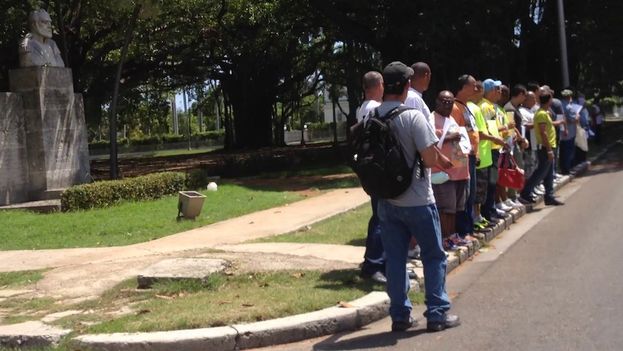
Activists supporting the Ladies in White Sunday on 5th Avenue. (Luz Escobar / 14ymedio)
14ymedio, Havana, 21 June 2015 – During the day, this Sunday, the Ladies and White held their traditional peregrination along Fifth Avenue in the vicinity of Santa Rita Church. Unlike the previous ten occasions, today no arrests were reported after the march, although at least 5 women belonging to the movement and 7 activists were detained to keep them from getting to the site.
In total, some 50 Ladies in White managed to get to the church and were accompanied on this occasion by 27 activists and independent journalists. Berta Soler confirmed to this newspaper that “there were no arrests after the Mass,” and that this Sunday they only “marched down Fifth Avenue, with the gladioli and the photos of the faces of the political prisoners,” but “out of respect for Father’s Day, after we finished each of us went to our own homes.”
Independent journalist Yuri Lazaro Valle Roca also reported to 14ymedio that there were no acts of repudiation nor the violent arrests that had characterized the previous Sundays.
Although there was a visible police operation in the area, the repressive forces did not proceed to arrest those who made it there.
I am startled at the idea that the Cuban spies captured in the United States were at one time kept isolated, and that odes are written about this, as if it were an unheard of injustice.
Ariel Sigler, political prisoner released from Cuba, on arrival in Miami
I don’t want to make comparisons, but the five spies were sentenced with proof for crimes of espionage, while Cubans opposing the totalitarian regime are innocent, because exercising the right to a political opinion, a meeting, free association and demonstrating are rights recognized under the Magna Carta of the UN as being fundamental.
Cuban opposition prisoners are incarcerated in dark and dirty dungeons, witnesses to their suffering. They are exposed to constant torture, in some cases while sick – with tuberculosis or dengue fever – from the humidity, the lack of hygiene and the precarious nourishment.
I even remember the five spies complaining because they were served chicken more than once a week in the U.S. prison, while in a Cuban prison that repetition would be a motive for a party. Here in the prisons of the dictatorship, some Fridays, like a holiday, they deliver a quarter of a quarter of a chicken, if you can call it that.
All you had to do was look at the photos of the five spies when they returned to Cuba to understand how they had been treated compared to the penal population on the Island.
In my case, and if I mention it it’s only with the goal of denouncing the dictatorship, they have confined me for nine months in a few square meters, after one and a half years of violating my right — according to the penalty that they unjustly imposed on me — to the same regulation pass they award to assassins, rapists, international drug traffickers and pederasts, among other dangerous criminals. As the opposition independent journalist, Lilianne Ruiz, told me recently, my captors couldn’t tolerate the fact that I had resisted without bowing down to them.
I don’t believe that the nations making up the UN today refuse to support a referendum demanding that Cuba “respect the freedom of the opposition.” Presented like that, very few presidents of the leftist Latin American mafia and others in the rest of the world who second their dictatorships would dare to deny us that right
I repeat — history will show I am right — that President Obama is committing a grave error in strengthening the totalitarian regime, and this will be a stain on his record in the matter of international politics that he will carry with him.
But we are victims of the powers that be, and there is nothing we can do but continue to hope for that democracy, which we will never renounce.
Hablemos Press, Eduardo Herrera Duran, Havana, 19 June 2015 — While conversing with a friend, he tells me that his friend told him, “You are speaking with an enemy of the Revolution.” My friend confessed to me that he really does not know who the true enemy is, if it is I, or those who label me that way.
Labels such as these — counterrevolutionary, worm, salaried employee of the empire — and others, are used contemptuously about anyone who expresses a view contrary to the Cuban government. A regime that has been in power for more than 56 years without rule of law and with only one party, controls everything!
Since 1959, the so-called Revolutionary government took power and began fomenting hatred against anyone who was not in favor of it. This divisiveness took over everyone, even affecting families in which some members were not sympathizers of the regime.
Thus did hatred grow, and the rejection of other Cubans who criticize the government and its followers. These Cubans have the right to differing thoughts and opinions, without having their patriotism called into question. Citizens throughout the world, even if they think differently, have the same right.
I see how mistreated are people on the Island who oppose the regime. We have as an example the beatings inflicted on the Ladies in White, and other opposition members, who have their own opinions and express them with courage.
Individuals like them, who demand the reestablishment of true democracy in Cuba — despite the abuse and indifference they endure from many other Cubans — wage an open struggle.
There needs to be a true evaluation of who are the so-called enemies.
Those who join with the government and defend its continuation in power do not consider the miserable salaries and poor living conditions of the great majority of the population.
Despite the propaganda machine claiming that education and health care are “free,” we pay a high cost for them.
Those who call us enemies should stop and think: Who, really, are the enemies?
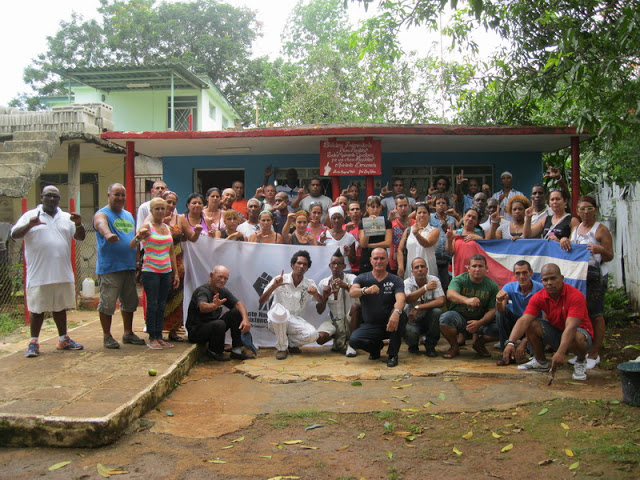
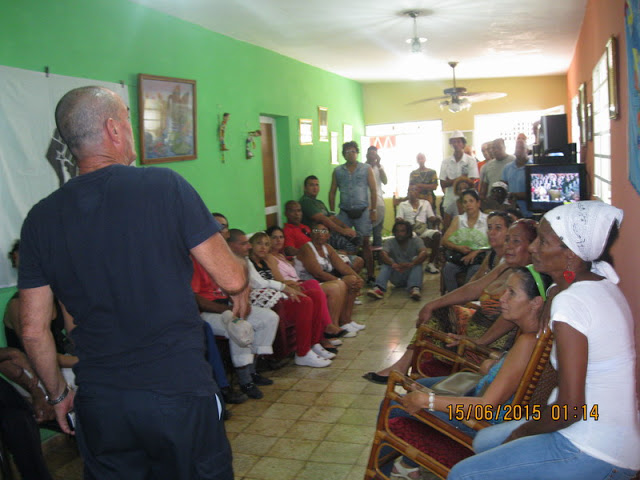
The purpose of the meeting was to show audiovisuals of various struggles
Hablemos Press, Lisbán Hernández Sánchez, Havana, 19 June 2015 — Despite a show of force, Cuban police did not arrest activists of four different opposition groups who on June 15 took part in an audiovisual workshop.
For the activists, it was strange that there were no reported detentions, as has occurred on other occasions with a smaller number of participants.
The activists attending the meeting were from the Opposition Movement for a New Republic (MONR), the Democracy Movement (MD), the National Resistance Front (FNR), and the Patriotic Union of Cuba (UNPACU). continue reading
The meeting took place at No. 18406 5th Street, between 184th and Final Streets in the Porvenir suburb, Rancho Boyeros municipality, Havana, where police have arrested dozens of dissidents for attending meetings.
“The audiovisual workshop that took place here in my house, headquarters of our organization, was for the purpose of discussing some documentaries, among them, The Art of War,” said José Díaz, MONR director.
The documentary “shows various strategies for different forms of the struggle,” he added.
According to a note from the organizers of the event, some 47 activists were able to arrive at the organization headquarters, despite the ostentatious police presence in the area.
“Agents of the National Police and the Department of State Security, along with Rapid Response Brigades, were trying to impede the arrival of activists to this event,” explained Mario Alberto Hernández of MONR, affirming that “no arrests have been reported.”
On 14 June, police arrested more than 70 dissidents who were exiting St. Rita Church, alleging that they would carry out protests. During the attack, police beat various women, including the artist Tania Bruguera, and Ada María López Canino of the Ladies in White.
DiariodeCuba.com, Vladimier Ortiz Suarez, Havana, 21 June 2015 — The human rights activist Rolando Perez Morera Yusef was released on Thursday after 46 days on hunger strike to protest his imprisonment.
Pérez Morera, 37, is in very deplorable state of health. Despite being released, his freedom is not complete as they have imposed a fine of one thousand dollars and he continues to await trial. continue reading
The activist was arrested on May 2 in San Antonio de los Baños, Artemisa, while collecting signatures in support of the Emilia Project, which is led by Oscar Elias Biscet, former political prisoner of the Group of 75; the Project seeks the establishment of a rule of law in Cuba.
According to Pérez Morera’s version, he was led into the interior of the house of the head of the political police of the town, and then charged with “violation of domicile.”
The regime opponent was later transferred to the police station of San Cristobal, in the province of Pinar del Rio, where he began his hunger strike.
The authorities have changed the accusation of “violation of domicile,” and are now accusing him of a “crime against State Security.”
In these types of “crimes” the regime typically includes those actions it deems “enemy propaganda.”
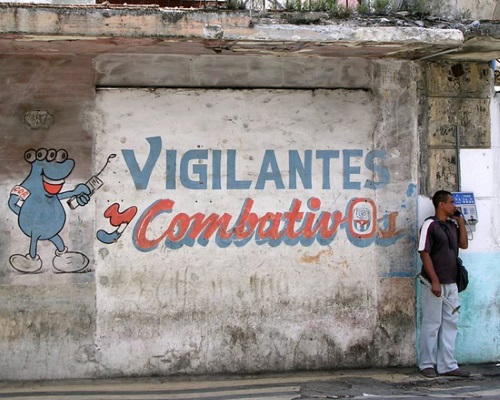
“Combative vigilants.” Sign about the CDR (photo from the internet)
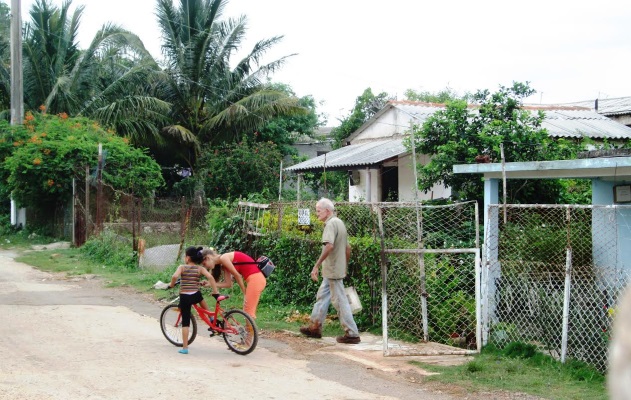
Cubanet.org, Camilo Ernesto Olivera Peidro, 18 June 2015 – An old man is going out of his house in the little village named Henequen Viejo, near the Port of Mariel. Everyone there knows him as Alfonso. In reality, his name is Idelfonso Estevez. At first glance he seems like an old man like so many others.
However, the village’s inhabitants and his closest family members fear and hate him. Alfonso is not surrounded by the protective affection of his fellow man. The local members of the Ministry of the Interior (MININT) take care of him. He is one of their most notorious “snitches.”
His story began years ago. He belonged to a group known as the “Guarapitos”: Alfonso, Jesus, El Viola, Camilo and Titico Borrego. They formed a group of auxiliaries in service to MININT at the beginning of the 1970’s. They dedicated themselves to watching everyone in Henequen Viejo. They gave away those who opposed the regime or anyone who annoyed them. They turned the area into a stronghold of terror. continue reading
When the property seizures began in the early months of 1959, the “Guarapitos” proposed ravaging a farm named La Francesa belonging to Pedro “Pepin” Carbonell and his family. The “Guarapitos” arrived and confiscated the largest cattle and slaughtered them for their consumption. No one could touch them. It was futile to try to denounce them to the authorities. They were protected by being efficient tools of Revolutionary terror.
Later other individuals joined the group with the same vocation of informing. Among them were Faustino Sanchez, Lucas Cabrera Lugo (Tatico) and Benito Mirabal.
Benito Mirabal and the Fisherman
They nicknamed Benito Mariabal “Moustache.” For years, he was one of the most prominent snitching characters in the region. He denounced people trying to leave the country and also reported street vendors. He was sent by State Security officers to watch, day and night, those named as dissidents.
In the last years of his life a rare disease attacked his legs. The doctors diagnosed it as gaseous gangrene, and they had to amputate them.
While Benito was hospitalized, the fisherman residing in the area, friends of his family, brought good and fresh fish for his nourishment. Several of them used to and do make their living from what they catch at sea.
Sometime after having recovered, Moustache Mirabal asked one of his grandsons to take him, in his wheelchair, to the nearest guard post. Once there, he denounced those same fishermen who had fed him. He accused them of illegal fishing. Several of the fishermen lost their licenses, had their boats confiscated or were fined.
Idelfonso Estevez (Alfonso), active snitch. Henequen Mariel (photo courtesy of the author)
Alfonso is capable of snitching even on his mother if she were resurrected
Certainly Idelfonso Estevez may seem like just another old man when he goes out of his house. But right now he is known as the “greatest trumpet” (biggest informer) in Henequen Viejo.
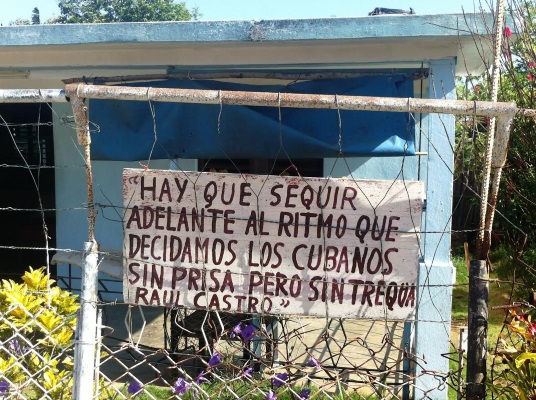
So that no one may doubt his unlimited commitment to the regime, he has placed on the fence around his house several pro-government signs. One of them alludes to a sentence of Raul Castro and the other advertises the “process” (sic) for strengthening the Committee in Defense of the Revolution (CDR).
“We must advance at the pace we Cubans decide, without haste but without pause.” Signs on the yard fence at the house of Idelfonso Estevez (photo by the author)
A family source who asked to remain anonymous told us that during the Special Period, this man’s refrigerator was all eaten away with salt residue, and he needed it fixed. A nephew, who did this kind of work informally, restored it for him at no charge. Two blocks away lived Ricardo, brother of Idelfonso. He had a little chain saw with which he did carpenter work. Neighbors commissioned broomsticks, knife handles, and things of that sort.
Two weeks later there appeared in the area two inspectors. They came checking on who had private jobs without being licensed and paying taxes. They went to see Idelfonso, and he, without thinking twice, denounced his nephew and his brother. Idelfonso, “The Guarapitos” and all the guys that are like him, would “snitch” even on his mother if she were resurrected, he said.
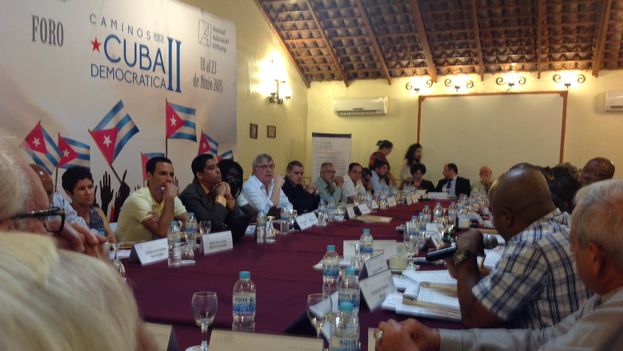
Conference participants gathered in Mexico. (14ymedio)
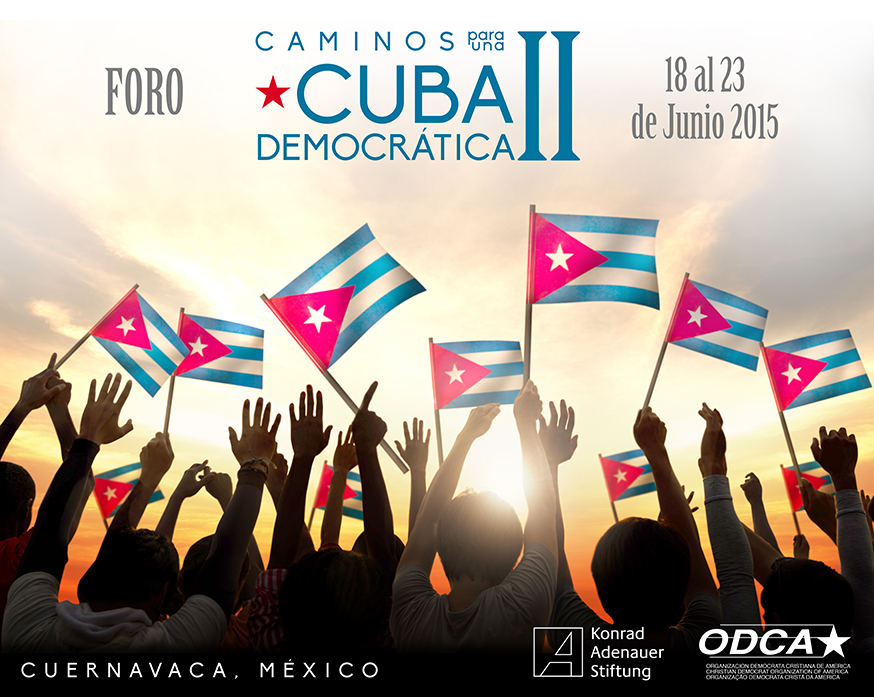
14ymedio, 20 June 2015 — The second edition of the event Roads for a Democratic Cuba is taking place in Mexico from 18 to 23 June 2015 under the auspices of the Konrad Adenauer Foundation and the Christian Democrat Organization of America (ODCA). Participating in this meeting are dozens of political activists and civil society leaders of the Island and the Diaspora. The event will continue through the weekend and until next Tuesday.
Among the topics discussed on the first day is the impact on the Island of everything related to the talks between the governments of Cuba and the United States for the purpose of restoring diplomatic relations. Other areas to be discussed are the options of the opposition, various proposals before a new Cuban Electoral Law and ways to strengthen Cuban civil society. continue reading
Among the participants from the island are Dagoberto Valdes, Manuel Cuesta Morua, Vladimiro Roca, Laritza Diversent, Juan Antonio Madrazo, Juan Carlos Gonzalez Leiva, Wilfredo Vallin, Rolando Rodriguez Lobaina, Rosa Maria Rodriguez, Rafael León Rodríguez, Guillermo Fariñas and Boris Gonzalez Arenas.
The first meeting of the event was held last December 2014 in the Mexican capital. At that meeting they talked about the diversity of peaceful means to fight for democracy, the role of exile and the importance of identifying the minimum points of consensus to move forward, if not in the desired unity, at least in arranging purposes.
Fernando Damaso, 18 June 2015 — I have written different posts and articles on the issue of movie theaters and the loss of them in the city of Havana. I return to it again now, motivated by a report on the current situation in the country, which appeared in the newspaper “Granma,” although in these lines I will only refer to those in the capital.
According to the official interviewed, the head of the Provincial Department of Cinema in Havana, “The city came to have 159 movie theaters, of which 42 remain, 13 of these are open and 29 are closed. Eight of the open ones have construction problems, and the 29 closed ones will be transferred to cultural institutions because they are not going to be used as movie theaters… Under a policy of the Ministry of Culture,” according to the official, “only 13 movie theaters will remain.” continue reading
The ordeal of the movie theaters started when they were expropriated from their owners and transferred to administrators at the Institute of Cinematographic Art and Industry (ICAIC), which, although it tried to maintain them in good condition, didn’t have the resources to do so.
However, the finishing blow came when, in 1976, they were transferred to the administration of the organs of People’s Power. Suffice it to say that in 1980 the last five-year plan for maintenance and construction was undertaken, a whopping 35 years ago. Starting then, apathy took hold of them, condemning them to their rapid disappearance.
Thirteen movie theaters is a ridiculously low number for a city with more than two million inhabitants and still more ridiculous is the Ministry of Culture assuming the right to decide that in the city there are only these, a bureaucratic decision taken, as usual, without considering the opinions of the affected citizens.
Now, according to the official, the ICAIC concerns itself with the movie theaters of the so-called Project 23 — 12 y 23, Chaplin, Riviera, Yara, La Rampa, and the multiplex Infanta –and the People’s Power is in charge of the rest, this latter with a budget of 313,100 CUP (Cuban pesos, about $12,500 US), for their repair and maintenance, which is insufficient.
Of these, the Riviera, of Project 23, is closed for repairs, and the Acapulco, belonging to the People’s Power, is closed for technical problems, according to a sign that has been posted for some time in the box office.
Everything points to the passing away of the golden era when movie theaters abounded in the city, and even in the neighborhoods and areas most distant from the center. Now you can look for movies on TV, in the “weekly packet” or on DVDs bought from the self-employed, and forget about “the darkened room” and what it represented for many generations of Cubans!
Venezuelan president and former bus driver Nicolas Maduro showing off his driving skills
Ángel Santiesteban-Prats, 14 April 2015 — Venezuela’s “Chavista” government with its dictator Nicolas Maduro at the head, continues haranguing people with the same populist momentum as if it were the first day, when in fact it has been in power for over a decade.
Venezuela risks the same fate as Cuba, where — almost sixty years later — they are still asking for the same sacrifice from three generations of victims who — forced or from fear — have pretended to be Revolutionaries and support the Government.
It’s a shame that a country with vast natural resources, today is a battered and devastated economy. Maduro, at the head of the disaster, destroys the country as a likeness of himself, lacking personality, intelligence and common sense.
If he thought driving a country was like steering a bus, he should have understood that they are very different things.
Ángel Santiesteban-Prats, Border Prison Unit, Havana
 Juan Juan Almeida, 3 June 2015 — According to official figures, cancer, cerebrovascular illnesses, diabetes and chronic respiratory conditions represent 67.7 percent of the total deaths in 2014 in Cuba. But they leave out the exact number of accidents and suicides.