Human Development in a Country without Freedom? / Cubanet, Jose Hugo Fernandez

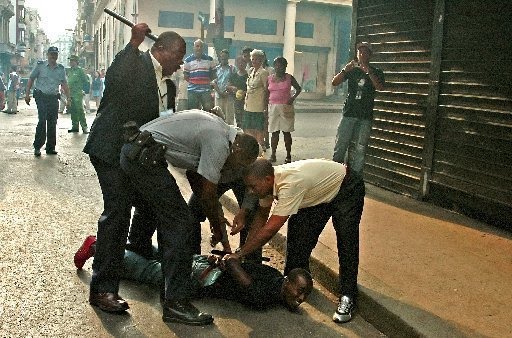
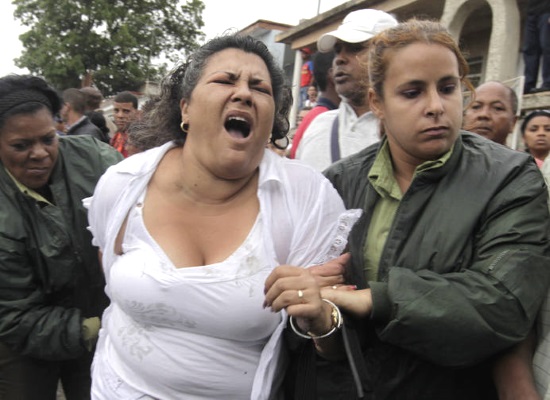
represion-1

The regime has dedicated itself to sugarcoating the pill for organizations like the UN, UNESCO and UNICEF

cubanet square logoCubanet.org, Jose Hugo Fernandez, Havana, 23 June 2015 – Recently, during a conference at the University of Puerto Rico, I was astonished to hear how a teacher cited Cuba as such an example of Human Development for the Caribbean region and the whole continent. No political deliberation was evident in her statements. She simply appealed to statistics and reports by international institutions, apparently trusting completely in the reputation of the issuer, and without reference to other more vital sources for comparison. The thing is that it made me feel ashamed somehow of representing my country under circumstances in which perhaps I should have felt proud.

The cynical compromise, well structured and promptly placed in orbit, can become a historical fact. Machiavelli had it right, more than five centuries ago, so how much better will our chiefs, his gifted students, have learned it, even if they act much more savagely. continue reading

After shredding almost all basis for Human Development on our little island, this regime has dedicated itself, with cold and careful patience, to sugarcoating the pill for prestigious organizations like the UN, UNESCO and UNICEF (and, through them, the international academic sphere, particularly that of the European Union), in order to round off the massacre, making the civilized world believe that its dictatorship – ingrown and even wild in more than one respect – represents a revolutionary project of humanistic and emancipating character.

It will fall to historians and sociologists or anthropologists and maybe to the psychiatrists of the future to explain how, by what devices of insane policy or under what kind of deception, they managed to win the upper hand. But what is certain is that last year Cuba occupied 44th place among the world’s countries with the best Human Development indices, and it is among the best in the Caribbean. One does not know whether to laugh or to cry in the face of that piece of information, but so it appears in the most serious records, those which inevitably serve as reference as much for the naïve and dandruff-covered “experts” as for the clever accomplices.

Although it is more, it should be pointed out that, as conceived by the UN itself, the Human Development of each nation is measured, above all, by the chance the bulk of its inhabitants live a life that meets their expectations and that permits them to develop all their potential as human beings.

And so we have a country where the only dream of the young is to flee, even risking life, in search of material and spiritual growth. Or where old people constitute a burden that no one can tackle and that, therefore, moves no one, including the State. Or where citizens are excluded, harassed, jailed for their political ideas. Or where work has lost its function as the sustenance for family existence and the essence of national progress… That country now ranks as a paradigm of Human Development.

A couple of years ago, the vice minister of foreign relations for Cuba, Abelardo Moreno, blatantly lied in testimony before the Universal Periodic Review (EPU) of the United Nations Human Rights Council that his government has recognized in its laws the indivisibility and interdependence of all human, political, social and economic rights.

He also said, just like that, that the decrepit dictatorship that he was representing had submitted to the EPU “without discrimination, without double standards and without selectivity.”

The strange thing, I insist, is not that he would say it but that there and everywhere he was believed without it occurring to anyone to undertake onsite and in depth verification which, as we know, is fundamental for the most basic scientific conclusions.

In the end, it is not my purpose to bore my dear readers with more small talk about the same thing. So it is that I merely set forth some other parameters that are used as a guide for measuring the Human Development of a country:

Respect for human rights. A solid economy based on cutting edge technology to make it work. Civil society and autonomous and empowered democratic institutions. Equality between people, regardless of any prejudice. End of discrimination on the basis of sex, race, ethnic, class or religious origin. Freedom of thought and of expression. Elimination of fear of threats to personal security, arbitrary detention and other violent acts for political reasons. Elimination of misery. Freedom to develop and fully achieve the potential of each individual. Elimination of injustice and violations of the law by the state. Opportunities and guarantees of decent work without exploitation.

Those who take the trouble of weighing these parameters, they will tell me now if Cuba practices only one of them to sustain its Human Development trick. As for the rest, as Jesus Christ would say, he who wants to understand does understand.

About the Author

jhfernandez.thumbnailJose Hugo Fernandez is the author of, among other works, the novels The Clan of the Suicides, The Crimes of Aurika, The Butterflies Don’t Flutter on Saturdays and The Parabola of Belen with the Pastors, as well as two books of stories, The Island of the Black Blackbirds and I Who Was the Streetcar of Desire, and the book of articles Silhouette Against the Wall. He lives in Havana where he has worked as an independent journalist since 1993.

Translated by MLK
The Reestablishment of Civil Society: An Unavoidable Necessity / Dimas Castellanos

Dimas Castellanos, 10 April 2015 — If by “civil society” we mean a group of autonomous associations, public spaces, rights, and liberties by which citizens exchange opinions, make decisions and participate in political, economic and social matters that interest them–with no more authorization than what emanates from the laws of the land–then we need to agree that this institution existed in Cuba since colonial times, developed during the Republic, disappeared after 1959, and is now in a process of resurgence.

Early Existence

Starting in the first half of the 19th century, illustrious figures such as Father Félix Varela, who called the constitutional studies program at the San Carlos seminary a “curriculum of liberty and the rights of man” and strove to provide an education in virtues; José Antonio Saco, who from the Revista Bimestre Cubana (Cuban Bimonthly Magazine) generated debates that fostered civic consciousness; Domingo Delmonte who, when this medium and other spaces were closed down, found in conversational gatherings a way of continuing the debates without official authorization; and José de la Luz y Caballero, who devoted himself to civic education as a premise of social change, with their labors forged the field for citizen participation. continue reading

Upon this ground, in 1878–when Spain, in compliance with Pact of Zanjón, granted Cuba freedom of the press, assembly and association–there sprouted Cuban civil society: political parties, newspapers, labor unions, societies of blacks, fraternal organizations, and other diverse groups.

Development

With the birth of the Republic in 1902, civil society, having spread throughout the country, took part in the struggles of labor unions, peasants, and students, and in the intelligentsia’s debates conducted via the print press, radio, and television, about the problems afflicting the nation.

The importance of civil society was highlighted by Fidel Castro during his trial for the assault on the Moncada Barracks in 1953, when–referring to the limitations suffered by civil society with Fulgencio Batista’s coup d’etat in 1952–he said, “There once was a Republic. It had its Constitution, its laws, its liberties; a President, Congress and Courts; everyone could assemble, associate, speak and write with full liberty. The government did not satisfy the people, but the people could change the government, and there were only a few days left to do so. There was public opinion that was respected and heeded, and all problems of common interest were freely discussed. There were political parties, educational hours on radio, debate programs on television, public acts, and the people could sense enthusiasm.”

Disappearance

Having become a source of law, the 1959 Revolution–instead of fully reestablishing the Constitution of 1940–substituted it (without public consultation) with the Fundamental Law of the Cuban State*, and thus began a fatal process for Cuban society: the concentration of power, the elimination of private property, and the dismantling of civil society.

The organizations that fought against the Batista government were merged into the Integrated Revolutionary Organizations, which in 1963 became the United Party of the Cuban Socialist Revolution, and later, in October, 1965, the Communist Party of Cuba (PCC).

The diverse youth movement disappeared to give way, first, to the Young Rebels Association and, later, the Communist Youth Union. Women’s organizations of all types became the Federation of Cuban Woman. The associations of university students became the University Students Federation, and the pre-university-level ones became the Union of Secondary-School Students.

The labor movement was taken over, while the principle of university autonomy, endorsed in Article 53 of the Constitution of 1940, disappeared under the University Reform of 1962.

Organizations of employers met the same fate. The Landowners Association of Cuba, the Association of Settlers of Cuba, the Tobacco Harvesters, and the National Peasants Association, were substituted by the National Settlers Association, which was later renamed the National Association of Small Farmers.

The print, radio and television media, the enormous network of cinemas, the publishing domain, and cultural institutions were limited to the boundary set by the regime, with the intervention of the Chief of the Revolution during the 1961 Cultural Congress, when he asked, “What are the rights of the Revolutionary and non-Revolutionary writers and artists?” and he answered himself thus, “Within the Revolution, everything; against the Revolution, no right.” And there would be no exception to the law for artists and writers. This is a general principle for all citizens.

The organizations that made up civil society before its dismantling were not subordinate to the State nor to the administration in power at a given time. They were autonomous, a necessary condition without which they would have been unable to carry out the role they played in the Republic.

The subordination took practical shape with the adoption of the Constitution of 1976. Article 5 stipulates that the Communist Party is the supreme driving force of the society and the State.

Accordingly, Article 53 [1] recognizes freedom of speech and of the press insofar as these conform to the aims of the socialist society, and Article 62 provides that none of the liberties accorded to the citizens can be exercised against what is established in the Constitution and the nation’s laws, nor against the existence and aims of the Socialist State.

The resurgence of a civil society movement emerges from the stagnation and regression in the economy; from the generalization of corruption caused by the inadequacy of wages; from the growing exodus of Cubans and the aging of the population due to the diaspora, and the reluctance of Cuban women to bear children in those conditions; to the point of bringing the country to a dilemma: either change, or erupt in violence.

It demonstrates that the structural crisis in which Cuba is immersed has its root cause in the absence of fundamental liberties, in the decimation of autonomous civil society, and the non-participation of the citizen.

Even so, during the process normalizing relations with the United States — and on the eve of Cuba’s participation for the first time in the Summit of the Americas, which will take place in Panama [April 2015] — the Cuban Government, instead of recognizing the role parallel to the State’s that corresponds to an autonomous civil society, insists on proving the obsolete, absurd and unprovable: that any association that does not respond to the objectives of the Communist Party is an external creation and its members are paid operatives of the Enemy.

During the Third Summit of the Community of Latin American and Caribbean States (CELAC), in Costa Rica, on 28 January 2015, Cuban President Raúl Castro asserted that the US counterpart should not try to relate to Cuban society as though there is no sovereign government in Cuba. A retrograde statement intended to continue denying the existence of civil society sectors that are not under Government control.

And during the Ninth Extraordinary Summit of the Bolivarian Alliance for the Peoples of Our America (ALBA), which took place on 17 March in Venezuela, Castro reiterated that “Cuban civil society will be the voice of the voiceless, and will unmask the mercenaries who will present themselves as being the civil society, as well as their sponsors.”

In accordance with the conduct, the Party and the State have in recent days mobilized hundreds of official associations in the “Forum for Civil Society of the Seventh Summit of the Americas,” and in the forum, “Youth and the Americas We Desire,” among other events, to defend an indefensible past, without understanding nor accepting that, even in these official associations, as was evidenced in the above-mentioned events, voices were heard declaring that it was necessary to create an atmosphere conducive to debate, and create sites where the views of civil society can be confronted, so as to derive a collective interpretation of the country’s issues.

Normalizing relations with the US will not be enough to pull the country out of crisis if it is not accompanied by the reestablishment of fundamental liberties. There should be no doubt that these relations will contribute to citizen empowerment and to the reestablishment of autonomous civil society and of citizenship.

[1] Article 53 reads, “The University of Havana is autonomous and is governed according to its Statutes, and to the Law to which they should conform.”

From Diario de Cuba

Translated by: Alicia Barraqué Ellison

*Translator’s Note: Also referred to as “The Fundamental Law of the Cuban Revolution”

Nearly 2,800 Cubans Have Tried To Reach The US Coast Since October / 14ymedio

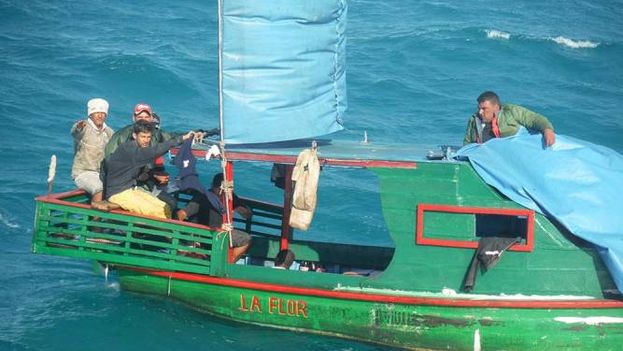
Cuban boat people rescued by the Mexican Navy. (Secretariat of the Navy of Mexico)

14ymedio bigger14ymedio, 23 June 2015 — A total of 2,796 Cubans have tried to or have arrived in the United States by the maritime route in the first eight months of the 2015 fiscal year, according to figures from the US Coast Guard (USCG) published by Martí Noticias.

The statistics, covering the time between October 1, 2014 and June 22, 2015, equals 76% of the number of Cubans who tried in the previous fiscal year (3,677) and includes operations of interception and disruption conducted in the Strait Florida, the Caribbean and the Atlantic, and the so-called “dry feet” that touched American soil. continue reading

The figure, published by Martí Noticias is an increase of 84 people compared to those reported by the by the USCG on June 18, when the repatriation of 32 rafters intercepted between June 6 and 10 was reported.

Back in October, the Coast Guard demonstrated concern about the increase in Cuban rafters arriving on the coast of Florida, which some Miami voices call a “silent exodus.”

A total of 3,940 migrants were intercepted at sea or managed to touch land in the 2013/2014 fiscal year, double those recorded in 2012 (2,129 Cubans) and even higher with respect to those of prior years: 2011 (1,870 Cubans), 2010 (1,976 Cubans) and 2009 (1.740 Cubans).

However, in fiscal years 2007 and 2008 a total of 7,866 Cubans and 5,766, respectively, attempting to arrive by sea to the United States, much higher than the figures of the last fiscal year.

Repressors Salaries Have Been Doubled / Angel Santiesteban

Ángel Santiesteban-Prats, 6 June 2015 — In essence, the President of a country should not serve another function but, first of all, manage the assets of people with ethics, fairness and the highest honesty, and never, ever should he believe that the state treasury can be used in his own benefit, directly or indirectly.

And I think that here lies, as we all know, the lousy management of the Castro brothers, especially Fidel, who once he “left” power, handed — in terminal phase and in countdown, even though with an “IV serum in vein” from Venezuela — to his brother Raul, the current dictator.

Recently I learned that in the Interior Ministry (do not know if in the Armed Forces as well), an effort has begun to double the salaries of the soldiers who have the merits that apply to such a reward, called Order 19th. It strikes me that, specifically, the repressive forces are being rewarded, and makes me think they are buying the “loyalty” of their members. continue reading

According to what guards who work directly with me told me, I knew they were prioritized among their units. Surely, the vast majority of readers will agree with me that those working in public health, education, agriculture, food and industry ministries or culture ministry, deserve more such benefit; but above all, pregnant women, elderly and low-income families deserve it.

However, agents of the repressive power — those thugs running the chain of injustice and abuse — are indispensable(for the regime, and therefore, the ones rewarded on top of their already high salary, compared with the average wage, and the ongoing perks such as affordable homes, most of which being built nowadays are given to them. They are also given appliances, furniture, clothes and food at low prices, not to mention vacations with their families, in areas only reserved for tourists, and so on.

Ultimately, after rewarding the aforementioned fields, which are directly in charge of the welfare of the people, I would agree that a raise for the police force around the country was needed if it was a force that responded in strict compliance with the law, always in favor the people, specially fighting against the proliferation of drugs, crime and rigor every society needs.

It is way different, rewarding those who, taking orders from a Dictatorship, abuse women as Ladies in White, who every Sunday are beaten, humiliated and imprisoned.

It is curious that this directive comes in the wake of talks between Cuba and the United States, and the European Union. I always say that the only thing these talks will achieve is to strengthen the dictatorship, and will give more economic resources to the regime to hold on to power and harden the totalitarian control, and they are already showing that.

Once they killed us with the money of the socialist era; then, they have continued doing so, thanks to Venezuelan oil. But soon it will be the economy sustained and supported by North America and the European Union financing these crimes.

Every time the people of Cuba are left more alone. Is it true or is just one of my bad impression?

Border Prison Unit, Havana

Translated by: Rafael

Cuba Aims It Will Have 110,000 Tourist Rooms For 2030 / 14ymedio

Tourists in Havana. (14ymedio)

14ymedio bigger14ymedio, Havana, 23 June 2015 – Those who want to reserve a room today in a hotel in Varadero, Cayo Coco or other tourist areas hear frequent warnings of “it’s full” or “there are few rooms.” The increase in international tourism in the first quarter of the year, coupled with greater summer season demand by Cubans on the island, is forcing authorities in the tourist industry to plan an increase in lodging that could reach 110,000 rooms by 2030.

Experts gathered in Havana at the 10th International Seminar on Journalism and Tourism, being held at the Jose Marti International Journalism Institute, also addressed the importance of foreign investment in the sector. continue reading

At the meeting on Monday, the Ministry of Tourism’s business director, Jose Daniel Alonso, delved into the details of “The 101 new business opportunities for the expansion and diversification of infrastructure,” in hotels, included in the portfolio of opportunities directed to foreign investors, according to the official press.

Alonzo stressed the strengthening of investments in the southern area of Cienfuegos-Trinidad, north of Camaguey, Las Tunas and Holguin, although he did not rule out the possibility of making investments in other regions. The official said that by 2020 it is expected that 85,000 rooms will be completed and by 2030 the projected number is 110,000.

The facilities for deep sea diving and nautical recreation, as well as city tours and nature tourism are among the options Alonso described with “great untapped potential.” He also addressed real estate investment associated with tourism, which with the implementation of 13 projects expected by 2020, all of them under the new regulations of the Foreign Investment Act.

The event was attended by 70 industry professionals from 12 countries, including the United States, Ecuador, Colombia, Italy, Panama, Chile, Peru, Uruguay, El Salvador, Nicaragua and Honduras. This seminar is held annually under the auspices of the Cuban Journalists Union and with the participation of the tourist press circle.

Cuban Customs Detected 29 Drug Cases So Far This Year / 14ymedio

Watching a report broadcast by the main news about the work against drugs at customs.

14ymedio, Orlando Palma, Havana, 25 June 2015 — The General Customs of the Republic (AGR) has detected 29 drug cases since early this year, as published on Thursday in the newspaper Juventud Rebelde (Rebel Youth). In the past six months, according to official media, they have seized about 51 kilos combined of cocaine, marijuana, hashish and synthetic cannabinoids.

The most common practice for introducing substances into the country is hiding them inside flashlights, cars and spare parts, swivel chairs, TV screens, soap, screws, boxes of food, religious objects, shoes and other articles. continue reading

Among the cases detected, in at least 23 of them the narcotics was in supposed gift packages, according to the traffickers. However, Customs clarifies that saying that the article in which the drugs are hidden “belongs to a friend, or someone who paid them to deliver it to their family, does not exonerate the passenger from the responsibility enshrined in Cuban law, which is intransigent before the importing of drugs and psychotropic substances.”

Customs also has detected attempts to take large amounts of Cuban medications out of the country, as well as smuggling of cash and precious metals. Since January, they have uncovered 293 cases of taking out tobacco, raw materials and cigars. Also high are attempts to take protected wildlife species out of the island.

The drugs are often hidden inside flashlights, cars, religious objects. shoes or other items

At a press conference, José Luis Muñoz Toca, Customs Technical Director specified that as of May 31, there were 73 cases involving arms smuggling. In addition, “We also detected media and equipment hidden in suitcases intended to support subversion activities in the country,” the official explained, without giving details of the nature of goods confiscated.

More streamlined customs procedures

Cuban Customs’ most pressing objective is arm itself with international standards before the eventual avalanche of tourism expected from the normalization of relations with the United States.

Without referring directly to this issue, the head of the AGR, Pedro Miguel Perez Betancourt emphasized that among the key priorities is to satisfy all passengers and that the Customs service performed at the border is exercised “Within the frame and law conferred by law for any processing, operation or baggage screening.”

The official said that efficiency in the offices has improved and that, “The time spent in customs procedures at airports has decreased considerably, from 45 minutes in 2011 to 25 minutes in 2015.”

Among the difficulties faced by Customs is corruption, because employees are constantly submitted to the pressures of bribery. Concern about maintaining the integrity of the employees in the airport terminals is most intense in regards to drug trafficking cases.
The officials explained that they are trying to do a better job on three parallel tracks: improving technological capabilities, the professional development of the workers and a greater degree of rigor in the controls on the part of the leadership.

Implementation of clearance by weight to reduce the number of times luggage is opened and implementing a new automated clearance system is still being tested and could reduce the time per passenger.

Muñoz Toca, director of Technical Customs, said they have reduced procedural errors and stressed that, “Most of the complaints and disagreements arise from delays in clearance and inappropriate behavior of employees at that time.”

According to officials, most complaints stems from the delays that arise from delays in clearance and inappropriate behavior of employees

He added that the complaint system has been perfected. “Today international airports have offices for reception and processing of complaints with groups to investigate and clarify the complaints and a subsequent evaluation in the legal commissions,” he explained.

He also addressed the commitment of Customs to, “Simplify and streamline procedures starting with the introduction of new control techniques and information technology which should contribute to supporting the commercial management of the country.”

At the press conference, no reference was made to the repeated complaints of the harassment to which civil society activists and political opposition leaders are subjected to, in a selective way, usually being minutely searched and having equipment and documentation seized on their return to the island.

Eight UNPACU Activists Who Recorded A Video Remain Detained / 14ymedio


14ymedio bigger14ymedio, Santiago de Cuba, 24 June 2015 — Eight of the 15 Patriotic Union of Cuba (UNPACU) activists from the Altamira neighborhood in Santiago de Cuba who were arrested Monday while filming an independent video remain in jail, the leader of the organization, José Daniel Ferrer, said Wednesday/

In a telephone call with 14ymedio, Ferrer said that among those still detained include singer Omar Sayud Taquechel, Fernando Vazquez Guerra and Romualdo del Risco Martin, who continue to refuse food at the police station known as Micro 9. In another detention center in the city, commonly called “the motorized,” Héctor Velázquez Gómez, José Roberto Núñez, David Fernández Cardoso, Anibal Ribeaux Figueredo and Franklin Álvarez Fernández are in jail.

A video posted on UNPACU’s YouTube channel, with hundreds of visitors so far, caught the moment when security forces violently fell on young people who were involved in filming on a Santiago street while carrying a flag Cuban.

Different Methods, Same Objective: To Annihilate the Opposition / Angel Santiesteban

Guillermo Fariñas in center of photo with crutch.

Guillermo Fariñas, targeted by State Security

Ángel Santiesteban-Prats, June 3, 2015 — No “disinterested” person would say that the encounter by José Alberto Botell, the aggressor, with Guillermo Fariñas and his companions was casual, of a personal nature, or even an ordinary attempted mugging.

On the contrary, we know that the government is committed to eliminating its opponents. It is obvious that the attack was thought out, planned, and strategically arranged.

The perpetrator must have been extorted, as State Security commonly does, to induce him to commit such a crime. They must have promised him that they would forget some other crime that he had committed, maybe a worse one, if he carried out the order to kill Fariñas, and even then maybe he didn’t fully comply out of fear of being sacrificed later. continue reading

The attacker’s life is now in as much danger as Fariñas’s, because they don’t leave loose ends, witnesses who could some day be their own accusers. But they sent the “convict” to a camp or settlement, and he will not serve even half of his sentence; they maintain him with privileges and facilities far different than those of real prisoners.

Meanwhile, State Security will continue studying another strategy for killing Fariñas. Remember that they committed other assassination attempts against Oswaldo Payá before the “accident” that killed him.

There are pictures taken a week before the fateful day showing the condition of his minivan after a State truck hit it, purposely dragging him along an avenue, but without managing to accomplish the task of eliminating the opposition leader, and without concern that his family was inside the vehicle.

Despite the tremendous media fiasco resulting from the failed attempt to assassinate Guillermo Fariñas, the government has shown that it is resolved to get rid of its political opponents.

The Castro Regime Misogyny

On Sunday May 31, they again violently repressed the Ladies in White. Every day the dictatorship is busy letting the opposition know that it is willing to continue governing the country as if it were its private property, even if to accomplish this it has to murder, savagely beat, arrest, and falsely accuse those who try to prevent it.

Lady-in-White Yaqueline Bonne—who recently claimed that State Security proposed that she become an undercover agent in exchange for relaxed prison conditions for her son Yasser—has been physically punished, as if it were not enough that they sent her son from a settlement to a camp with harsher conditions.

The Cuban governors joke with increasing cynicism about talks with the United States and the European Union. Wishful thinking of improvements in human rights will die of heartbreak.

Ángel Santiesteban-Prats, June 3, 2015

Border Prison Unit, Havana

Domestic Tourism, the Faces of Deceit / Cubanet, Ernesto Perez Chang

Cuban guests can only observe foreigners enjoy yachting trips.  They are prohibited from this activity (photo by the author)
Cuban guests can only observe foreigners enjoy yachting trips. They are prohibited from this activity (photo by the author)

cubanet square logoCubanet.org, Ernesto Perez Chang, Havana, 16 June 2015 — To judge by the avalanche of television programs that in recent weeks have been dedicated to so-called “domestic tourism,” in Cuba all families have adequate income to become a major market for the island’s hotel groups and resorts.

Several Round Tables with the participation of ministers, vice-ministers, and company heads, all tied to the tourism sector, plus extensive reports on the Cuban Television National News detail the offers for this summer, present promotional campaigns in hotels and shopping centers and exhort the “Cuban family” to make reservations as soon as possible due to high demand.

The propagandistic marathon gives the sense that the economies within our homes are booming and that this country, replete with multitudes living below the poverty line, only exists in “enemy propaganda.” continue reading

As anyone can find out if he wants to, within those same tourist centers “open to everyone,” it is difficult to find guests from our own backyard. Nevertheless, at the doors of the hotels one can collect statements from people who not even in their dreams are permitted the fantasy of “vacationing” on equal terms with foreigners.

Although many may seem to be indigent or to owe their poverty to a slight entrepreneurial spirit, talking with any of those vendors and hustlers who abound in the streets of Cuba can reveal to us that it is those same men and women, workers and professionals, who once believed in that perennial “sacrifice for the future” demanded by those same government officials who today, when speaking of vacations and complete availability in the midst of the daily miseries, inoculate them with a sense of personal failure.

Manolo, a street vendor with whom we spoke on a corner of Paseo del Prado tells us: “I worked my whole life, I was at the sugar harvest when needed, I was in all the mobilizations and I was in the vanguard for many years, and I have nothing. (…) My pension does not cover my needs, like almost everyone. How am I going to plan a vacation? Only one time, in 1983, could I go to a house on the beach in Guanabo, a week, and now I don’t even remember why it was. Vacations are for the rich, and in this country almost everyone is poor, so I don’t know what they’re talking about on television. Well, there they say anything. My son tells me that if I want to consume everything they talk about on the television, I have to put a basket underneath it, because they only exist on the news.”

Manolo’s experience is similar to that of thousands, maybe millions, of Cubans. Collecting testimony about the matter is not hard, and this makes it much more dramatic.

German, another old retiree who sells plastic bags in the streets of Old Havana, could give the impression that he wasted his time when young and that he did not exert himself to achieve greater welfare in his old age; however, like any decent Cuban he believed in work as the only source of prosperity and currently he feels cheated. Vacation in one of the tourist facilities promoted as a vacation destination by the government itself is a true luxury: “What do I do then? It is better not to even think of those things. (…) I never pay attention to what they say on television. They have their country and we, ours,” German tells me.

In cahoots with the journalists who lend themselves to hiding the true reality in a country where the word “vacation” has become empty of all meaning, government officials have the audacity to speak of “affordable prices,” of “overbooking” and “high demand” in a scenario where the entire year’s salary from an honest professional’s job is not high enough to even provide the enjoyment of one day in hotel in Cayo Coco or Varadero, two of the destinations that, according to the official press and the highest tourism authorities in Cuba, “are among the most in demand by the domestic tourist for the coming months of July and August, a time when Cubans comprise 45 percent of those vacationing.” The statistics from MINTUR, contrasted with Cubans’ hard day-to-day reality, are offensive.

A brief visit to any of the internet pages where businesses like Cubanacan or Islazul promote their summer products, aimed at the “domestic market,” show how “cheap” the offers can be even for those same official reporters who barely receive more than 20 dollars for their work.

A basic room in a low or medium level hotel costs, for only one person, between 25 and 70 dollars per night, without counting that the so-called “domestic tourist” does not receive the same treatment as a foreign visitor so that there exist payment and service options totally closed to Cubans. For example, outings on yachts or any motor boat are off limits for even the few Cubans with enough purchasing power (and who, of course, are not relatives of high military officers or leaders); so are those vacation packages that include underwater fishing or big game hunting in preserves devoted only to the country’s upper echelons.

Doctors and health specialists who return from missions abroad where they are paid in dollars, people who live on considerable remittances from relatives in exile, prostitutes, smugglers and corrupt leaders make up that mass of citizens favored by the changes in the policy of access to tourist facilities. A minority that the Cuban government insists on turning into the best face of that capitalist-socialism and into a shield in order to hide the accumulation of lies that constitutes that old populist discourse that, in current circumstances, no longer is suitable but that constituted that sad and skinny losing horse called the “Cuban Revolution” on which they obliged us to bet in a race they always knew was lost.

Click here for the author page for Ernesto Perez Chang

Translated by MLK

Access to International Banks: Cuba’s True Objective in These Negotiations / Juan Juan Almeida

Josefina Vidal, Cuban negotiator

Juan Juan Almeida, 25 May 2015– For many, it was a surprise that the United States and Cuba should conclude its new round of negotiations without achieving the expected agreement, the reopening of new embassies–more so when both delegations described the recently concluded meeting as “respectful, professional, and highly productive.”

Thus does the Island’s government operate; it maneuvers with painstaking craftiness any process that entails sociopolitical transcendence for the country.

I hope (although at times I doubt it) that the US State Department and US authorities involved in these proceedings clearly understand that not Josefina Vidal–member of the Central Committee of the Cuban Communist Party and director for the Cuban Ministry of Foreign Relations director for relations with the United States–nor José Ramón Cabañas, chief of the Cuban Interests Section in Washington, nor any other member of the Cuban delegation, have decision-making authority. They are simply employees who have been given precise instructions: explore the actions and reactions of their counterparts, buy time, maximize media coverage (which they easily do because all media around the world are covering the big story), and show toughness. continue reading

For the Cuban government–sorry, for the 7 or 8 individuals who today comprise the center of power–reestablishing relations with the US is simply the “rice” in the chicken-and-rice pot. The compass of this process–the “chicken” of this meal–is directed towards two goals: removing Cuba from the list of state sponsors of terrorism, and press for the end of the “Embargo.” All the rest is just part of the same theater showcasing well-rehearsed acting.

It is not hard to understand that to remove Cuba from that list will unleash an immediate effect on the banking institutions, which will cease to view the largest of the Antilles through the “anti-terrorist lens” and, concurrently, erase the shock of receiving a sanction for doing business with Cuba.

I cannot state with certainty that as of today our country conforms to the definition of a state that sponsors or supports terrorism. Although I have heard Fidel and Raúl denounce terrorist acts such as that visited on Charlie Hebdo;  and a high ranking Cuban military officer describe how a representative of these terrorist groups lives a comfortable and relaxed life, very near to the residence of the Spanish ambassador; and a good friend recount an amusing anecdote in which one day, through no fault of his own, he found himself turned into a gift to the Middle East, where he was presented to a group of Islamic leaders with hyper-radical tendencies who, through an interpreter, wanted to know personal stories about his father who, even in death, continues to be an icon of history, hysteria and schizophrenia.

The end of the Embargo will open to the country the doors to credit and funding and, with them, the real possibility of buying and exporting weapons, services, information, medical personnel, medicines, or any other product–harmful or not to world peace.

I have no doubt that Cuba will emerge from this controversy in a ready mode, will reestablish its relations with the US, and, if the wind continues to blow in the same direction, the Embargo will be lifted. Is this right? I do not believe so, but I learned to be pragmatic because, as my grandmother used to say after lighting up the same cigar butt for the fourth time, “In this world there is no justice, God forgives everyone.”

Translated by: Alicia Barraqué Ellison

The Church That Is Oblivious to Reality / Angel Santiesteban

Archbishop Oscar Arnulfo Romero. Photo courtesy Radio Onu

Ángel Santiesteban-Prats, 23 May 2015 — The beatification of Father Arnulfo Romero is the mirror where, for El Salvador, Latin America, and the world, the pastors of God should look and reflect, in order to attend the spiritual and material needs of their flock, which simply means remaining alongside the aspirations and suffering of their people, as an intrinsic part of the Church.

The churches, especially the Catholic Church, perhaps the least swayed by dictatorial government—should accept pain as Christ showed us. I also feel it is the duty and obligation of intellectuals through their works to examine, discuss, and make suggestions regarding the disputes that concern the populace. If the Church, the intellectuals, and the opposition politicians join forces, the totalitarian power would not abuse nor run over the most basic rights of Cubans.

You cannot count on the pastors of the Christian and Protestant churches; most have acquired wealth like the new rich in these times of crisis, or they are silent out of fear of losing their property and being removed from their congregations. continue reading

The Catholic Church—beginning with the most glaring examples, Cardinal Jaime Ortega and the national curia—has turned its back on its people, humbling themselves before, and agreeing with every scheme of, the military that misgoverns the nation.

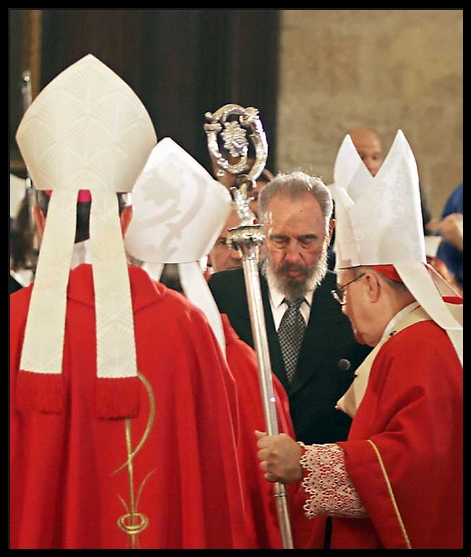
Fidel Castro with Catholic hierarchy (taken from Internet)

What image does the Church present when it defends the dictatorship and covers up its misdeeds, to the point of becoming an accomplice? When has the top Church hierarchy called on the tyrants (or presidents, as they prefer to call them) to defend the people from their injustices?

What credibility does the Church have if it is unable to raise its voice to protect the brave and peaceful Ladies in White, who—Sunday after Sunday—are harassed, beaten, and jailed right under their noses, just opposite the church of Santa Rita, where they punctually attend mass?

What good are the words of the Bible if the actions of the Church nullify the noble deeds they profess and advocate?

Raul Castro with Cardinal Jaime Ortega

We do not want a bishop to be assassinated, as in the case of the Blessed Romero; but we do need a bishop who is as close to God as to his oppressed people, and who will confront injustice—barefoot, sweaty, with patched, faded clothes, and above all, with that light in his eyes that covers and guides his flock like a protective mantle.

Hopefully the day is coming when we will feel that the Church is an extension of the people, and vice versa, and that its temples are our houses, and we no longer encounter the feeling of alienation and distance that has invaded us for some time, seeing them with their expensive, spotless vestments, their rosy skin shielded from the sun’s rays with creams, in their air-conditioned offices, or observing their people from behind the windows of their automobiles.

At times, we’ve confused their speeches with the Party line, because they never utter even a faintly critical word or suggestion to seek a necessary and urgent change in Cuban society.

I don’t know who the candidates are to replace the current Cardinal, who is already past retirement age. Hopefully it will be one of the righteous, who is rooted in the people and does not fear the tyrant.

I can never forget Bishop Siro (from Pinar del Rio, now retired) who always accompanied his flock, his people, without fear of consequences, adding noble pages to the history that we who barely live in freedom will one day collect, and which for now we keep in our affections.

I understand that in some way Father Conrado is a disciple of Bishop Siro, or of the Blessed Romero, who in their own times and in their own ways were not afraid of attacks by the hitmen of the dictators and of the Church itself, which squelches any rebellion by its ministers.

We dream that the Church wins and regains its place in society—especially among young people, who so badly need its ancient wisdom, its fellowship, light, and love—and that some intellectuals accompany us.

 Ángel Santiesteban-Prats

May 23, 2015, Border Prison Unit, Havana

Cuba: Private Sector Entrepreneurs Feel Smothered by the Government / Ivan Garcia

Havana seller of

Iván García, 17 June 2015 — Amid spider webs and musty smells, in a corner of his garage where things that no longer work go to retire, Leonardo has stacked molds for making candies and desserts.

There are also three rolling pins, an electric oven outfitted with parts lifted from a state-owned factory, two chrome sandwich makers and a microwave still in its original box. Everything is now for sale.

“I didn’t realize what I was myself getting into. A relative of my wife who lives in Miami gave us $5,000 in 2012 to start a business selling pizzas, desserts and lunches on our front porch. We had to close last year because of losses. I still owe $1,500. I was never able to make the numbers add up,” says Leonardo. continue reading

Just as in sports, in any given field of business there are winners and losers. Leonardo’s frustrations stem from the Machiavellian system for private businesses designed by Cuba’s military strongmen.

They tolerate private businesses but they do not love them. The conservative state sector continues to view them as potential criminals. They are considered dangerous types. Restrictions such as high taxes, excessive regulation and corrupt inspectors make doing business an expensive proposition.

“First, the government’s rules make it very difficult to generate profits. Secondly, there is ignorance. They know absolutely nothing about marketing or publicity. The only ones who do well are those who have access to government funds or good contacts in the black market,” argues Leonardo.

According to statistics from the ONAT (National Tax Administration Office), close to seventy thousand people in recent years have forfeited their private business licenses. But if you were to ask the owners of those businesses, 90% say they are just getting by.

“You live better than working for the state. The fact is you have to work like a dog. I drive a cooperative taxi for twelve or thirteen hours a day. I earn 550 to 700 pesos a day, but the high cost of living and inflation eat up all my earnings. With what I make on the side, I can buy food for my family and own a car in good condition,” says a Havana taxi driver.

The most profitable businesses are in food, lodging and taxis. Armando, the owner of a private bar in the town of 10 de Octubre, claims that only a few have been able to make a lot of money.

“There are some who are probably millionaires, like the artists Kcho and Colomé Ibarra, the son of the interior minister. Because of their relationships with people in power, they have a clear path. Others succeed through talent, such as the owner of La Guarida or La Fontana. But most have to rely on illegalities and tricks to get ahead,” says Armando.

Nevertheless, one can detect among small business owners the emergence of a future middle class. On June 6 several travel agencies were introducing a special all-inclusive summer rate at the Havana Libre hotel.

“There was a line and most of the people in it were Cubans,” notes a public relations agent for the military-run Gaviota hotel chain. “It’s widely believed that many overseas relatives are paying for these stays in tourist resorts. But I’ve noticed that there has been a tremendous increase in the number of Cubans paying for these vacations out of their own pockets. A couple of years ago they were spending a weekend in two and three-star hotels. But now they prefer week-long stays in high-end hotels.”

From the end of 2008 — when Raul Castro decided to put an end to tourism apartheid — until 2014, roughly 127,000 Cuban tourists spent their vacations in tourist hotels across the island, spending more than ten million convertible pesos. And the numbers keep growing.

While thousands of overburdened senior citizens sell peanuts, periodicals and cigars on Havana’s streets — making a few pesos that barely allows them to eat — an elite group of private sector entrepreneurs makes money hand over fist.

Meanwhile, fear and distrust continue. Very few have faith in the banking system or in the rules of the game created by the regime.

In 2014 only 658 cuentapropistas — the government’s term for self-employed  workers — applied for loans through state banking branches. Seventy-five were from Havana and the remaining 538 were from the rest of the country according to the magazine Bohemia. This represents 0.1% of the more than four-hundred thousand registered private sector workers.

The total loan amount comes to only 13,000,000 pesos (some $520,000 US). According to conservative estimates by Onelio, an economist, the amount of capital flowing to private businesses exceeds $3,000,000.

“Investments in high-end private restaurants and luxury home rentals start at $20,000. My theory is that part of this money comes from the exile community but the sources of the rest are sketchy. It could be from workplace theft, white collar crime, high-level political corruption or Medicare fraud in the United States. The money might later be laundered through private businesses in Cuba,” he speculates.

Behind the glamor and success of private restaurants where stars like Rihana and Beyoncé or U.S. senators passing through Havana dine, there are thousands of businesses on the verge of collapse.

The roadmap drafted by Obama on December 17 opened up a new political landscape between Cuba and the United States. Six months later, however, the proposals that were supposed to benefit the owners of private businesses are still a mirage.

The Castro dictatorship has not enacted a law allowing private farmers and entrepreneurs access to microcredit or to imported foodstuffs and other goods. These businesspeople must then try their luck with loans from relatives living abroad and must work more than twelve hours a day to try to achieve minimal gains.

For entrepreneurs like Leonardo things did not go well. Four years after opening a cafe with high hopes, he had to close due to losses. He has not been able to sell off the equipment he bought for the business, even at reduced prices. And he still owes money to a relative in Miami.


Emigrating in the Third Age / 14ymedio, Yoani Sanchez

An old man. (Silvia Corbelle)

14ymedio biggerGeneration Y, Yoani Sanchez, 23 June 2015 – The building where I live is like a diminutive Cuba, where the larger country appears represented with its vicissitudes and hopes. Fourteen stories that at times offer a biopsy of reality or a representative fragment of life outside. For years, the emigration of young people has marked the life of this ugly concrete block, constructed 30 years ago by some optimistic microbrigadistas* in order to put a roof over their children’s heads. The majority of these children, now men and women, do not live on the island today. However, the exodus has also spread to a worrying extent among those of the third age.

A few weeks ago in the hallway I stumbled upon a neighbor whose children left some time ago for the country to the north. Between postcards at Christmas, visits every now and then and nostalgia, the family has tried to overcome separation and the pain of absence. The man of the family, now retired and almost 70, commented to me that he was selling his apartment. “I’m leaving,” he said, smiling from ear to ear. Another retiree who overheard, spat out derisively, “You’re nuts! Why are you leaving if all that’s left to you are ‘two shaves,’?” alluding to the possible brevity of the existence ahead of him. continue reading

Not to be outdone, the mocked one replied, “Yes, it’s true, all that’s left for me is ‘two shaves,’ but I want them to be with a Gillette.” With a pension of barely 20 CUC a month, a home that every day shows the passage of time and the lack of resources to repair it, the future emigrant won’t be stopped by gray hairs or old age. What is making so many seniors choose to relocate abroad despite age, health and the uprooting of their lives? They also feel the lack of opportunities, the day-to-day difficulties, and – most significantly – end up concluding that the social project to which they gave their youth has defrauded and abandoned them.

They feel the lack of opportunities and the day-to-day difficulties, and have ended up concluding that the social project to which they gave their youth has defrauded and abandoned them

“All I want is a peaceful old age, without having to stand in line all the time,” the determined old man explained to me. For him, his country is synonymous with shortages, problems getting food, an old age of racing to get potatoes and fighting against those who want to get ahead of him in the line to buy eggs. The apartment he built with his own hands for the enjoyment of his children now has peeling walls and a clogged toilet. “With my pension I can’t arrange to get things fixed,” he detailed.

Even the elderly are packing their suitcases on this island… and from the scale model that is this Yugoslav-style building, old people are also saying goodbye.

* Translator’s note:
For more information about microbrigades see page 26 of this report by Cuban architect Mario Coyula.

Why The Beatings? / Mario Lleonart

Mario Lleonart, 5 June 2015 — Beatings of peaceful demonstrators in Havana have been in the news for eight consecutive Sundays. In one of the first rounds, the son of the labor leader Jesús Menéndez was dragged for several yards along the ground with no concern for his advanced age.

On the seventh Sunday, between beatings and more beatings, it was obvious that another attempt was made to kill Raúl Borges Alvarez, this time with a sure blow to the chest–no matter (or, actually, because of) his having undergone heart surgery. continue reading

Even so, with respect to Raúl, officials from State Security warned his son, Ernesto, in prison, and his other son, Cesar, on the street, about the the possibility of Raúl’s imminent demise from his additional ailment of “chronic pancreatitis”–the same condition that killed Juan Wilfredo Soto García on 8 May 2011, following a beating by police three days earlier–because of course death can be a natural consequence of a beating, especially if one has prior health problems, and it is well known that the area of the pancreas is another preferred target of the attackers.

Some of us had hoped, following the announcement about normalizing relations between the US and Cuba, that there would be a stop to–or at least a lessening of–the beatings, but we now know that what is happening is precisely the opposite.

It would seem that the beast is feeling mightier and able to strike with impunity. This is borne out by the 641 arrests in May, the highest number of detentions of dissidents in the last 10 months, and which always, in some fashion, involve violence.

During the beatings and acts of repudiation against the Ladies in White, the political authorities have not hesitated to shamelessly transport the tormentors on buses that were brought to Cuba by the “Pastors for Peace” Caravan–an unintended purpose for these vehicles, we assume.

Experiences such as the recent Seventh Summit of the Americas in Panama show that the regime that is an expert in beatings is willing to export this modality of intolerance to whichever location in the world will receive it. The international community can confirm that the system which, for survival’s sake, accedes to dialogue with its historical enemy, with the world power, with the “empire,” is not ready to do the same with its own people–and even less so if the issue is about accepting differences of opinion. It’s through strikes and blows that it tends to resolve any matter with its citizens.

The worst part is that many in the population have assimilated this modus operandi learned from Papa State, and it is thus that they prefer to resolve any problem, with or without reason: by hitting.

Any male or female citizen in Cuba, however peaceful he or she may be, is exposed to the blows that come directly from the State, or from any of its many Frankensteins, its “New Men” as evoked by Guevara, who prefer to use their neighbors as punching bags before resolving differences through dialogue.

Blows abound when words–and especially reasons–are scarce.

Translated by: Alicia Barraqué Ellison

Ground Turkey / Fernando Damaso

Fernando Damaso, 21 June 2015 — When a country’s Minister of Finance and Pricing devotes part of his time to setting the value of ground turkey according to the percentage of fat it contains, and to reducing by 10 cents per Convertible Peso (CUC) the price of imported rugs–besides having to publish this in the Official Gazette and get a journalist to write an article about it–it makes me feel like I am living in Macondo, the hallucinatory town in One Hundred Years of Solitude, the novel by Gabriel García Márquez, where the most absurd things would occur.

Despite its questionable record, I thought that this governmental agency was a bit more serious, and that it occupied itself with more important matters. Besides, in this adjustment of the price of ground turkey, the consumer loses: what used to cost 1.10 CUC for the meat with less fat, now costs 1.70 CUC. That is, within this adjustment there was what we call a bola escondida [i.e. a “hidden ball,” which means to succeed through subterfuge], which, as was to be expected, the journalist does not mention in his article.

There is no doubt: our official press, generally dense, tiresome and repetitive political rants, at times, with help from governmental agencies, can turn out to be even humorous.

Best Wishes to All Fathers on Their Day!

Translator: Alicia Barraqué Ellison