Fidel Castro’s Former Bodyguard Juan Reinaldo Sanchez Dies / 14ymedio

The cover of Juan Reinaldo Sanchez's book, "The Secret Life of Fidel Castro"
The cover of Juan Reinaldo Sanchez’s book, “The Secret Life of Fidel Castro”

14ymedio bigger14ymedio, Havana, 26 May 2015 – Juan Reinaldo Sanchez, Fidel Castro’s bodyguard between 1977 and 1994, died from lung cancer on Tuesday in Miami. The author of the tell-all book The Hidden Life of Fidel Castro, written in collaboration with the journalist Axel Gflden, had left the Island in 2008.

Sanchez, who belonged to the former presidents personal security force with the rank of lieutenant colonel, was the only member of the guard to flee Cuba. After asking for early retirement, he spent two years in prison.

In his book, the former bodyguard told of the luxurious life of Fidel Castro, revealing that he owned yachts and some twenty residences scattered throughout the Island.

“True Intentions”: Brief Sketch of a Long Relationship / 14ymedio, Miriam Celaya

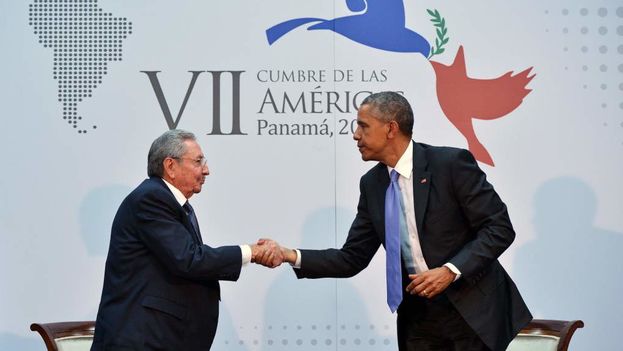
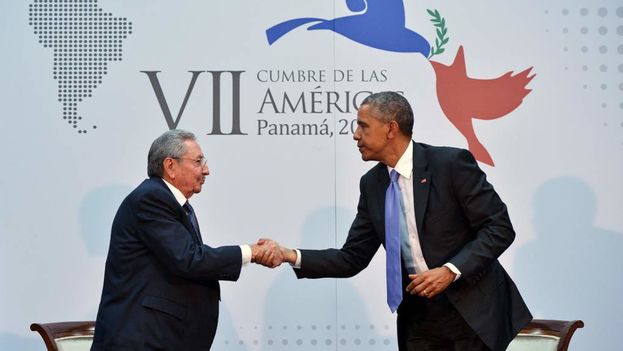
Raul Castro with Barack Obama at a press conference at the Summit of the Americas

14ymedio bigger14ymedio, Miriam Celaya, Havana, 14 May 2015 — Few sentences of the Cuban official discourse have been as well-worn as one that refers to “the true intentions” hiding behind the actions of the US government.

This explains the discomfort that the “Paused General*” feels about the American Interests Section in Havana teaching courses to independent journalists or when they hold teleconferences about digital journalism, among other activities. These “illegal activities” that the US government promotes through its Havana Section even award certificates of studies to its graduates. Because “the true intentions” of the government of that country is for these journalists to undermine the strength and ideological unity of our people, piercing it with the intimidating US influence. continue reading

Beyond the blatant disregard of those studying under the auspices of the US government, the “Emerging President*”, a graduate of who-knows-where, does not seem to rely too much on the strength of his media monopoly or in its capacity to influence the masses despite the proven loyalty of its hired scribes. For this reason he “is worried” – his own words – about this exchange of journalism courses and conferences that run outside the classrooms, so strictly controlled by the government, where many graduates get more credit for their demonstrations of loyalty to the regime than for their academic achievements or their talents.

Brief historical look at the “harmful” American influence in Cuba

An article appearing on the last page of the newsaper Granma (The Teachers’ Lessons, Ronald Suárez Rivas, Wednesday May 13, 2015) supports what is already emerging as a new ideological crusade against American “penetration,” so crucial at this time when the government of the Island strives to make peace with its historic enemy.

The work in question goes back more than 115 years ago when, as part of the US intervention in Cuba, after the end of the war of independence from 1895 to 1898, the US government took the initiative to “contribute to training a group of Cuban teachers, and, as if it had been against their will, they “were taken” to the United States.

But, of course, collaborating in the field of education was not “the true intentions” of the northern government, but “one of Washington’s first concrete actions in the ideological field, intended to directly influence the Cuban people” according to the words of a local historian, quoted by the Granma scribe.

In an effort to rewrite history to suit the Castro-ocracy, important details have been omitted that show that the US influence in Cuba was not all absolutely negative

Obviously, in their wish to rewrite Cuba’s history according to the Castro-ocracy’s taste, both the journalist and the official historian omit some important details recorded by renowned writers and other personalities of the time, documented in the Cuban National Archives, showing that the US influence on the Island had already penetrated deeply, long before the military intervention in the Spanish-Cuban-American war took place. Documents, that, in addition, show that the US intervention was not an absolutely negative event.

An event should be mentioned that, at the time, marked the sensibility of the Cuban people in a special way, and earned the gratitude and affection of the poorest sectors: the assistance provided by the US government to the victims of the Reconcentración de Weyler** (1896-1898).

In early January 1898, at the request of the then president William McKinley, Clara Barton, president of the American Red Cross arrived in Cuba to organize the relief to the reconcentrados. She and the US consul in Havana, with the help of Bishop Santander, toured various towns and cities on the Island and were responsible for the coordination and distribution of food, clothing and medicine that began arriving by sea at the port of Havana, thanks to the solidarity bridge established by a Central Committee on Relief, spontaneously organized by the American people.

The philanthropy demonstrated by the Americans had the additional benefit of raising the awareness of the wealthy sectors on the Island of Cuba, which until then had remained indifferent to the scenes of death and desolation caused by the colonial government and intensified by the incendiary torch of the mambises***, both of which had ruined the Cuban countryside, seriously damaging food production.

It was then that some societies and leading Cuban personalities of the era began organizing fund raisers through dances, opera and theater events, raffles, bullfights, book sales and other activities in order to help the reconcentrados and charitable institutions responsible for helping the poorer sectors, suffering from hunger and epidemics due to their lack of resources.

The philanthropy demonstrated by the Americans had the additional benefit of raising the awareness of the wealthy sectors on the Island.

It is true that the US naval blockade, which began on April 22,1898 and ended on August 14th of that year, temporarily worsened the shortages and general poverty. However, just two months after the war’s end, the tireless Clara Barton was able to restart the bridge of essential help – interrupted since the beginning of the naval blockade — which this time would also be enough to provide help to the insurgent mambises, still camped out in rural villages.

The previous month, a flotilla from the US had already been established, responsible for at least partially supplying food to the markets. Though not enough, the aid from the US was the assistance that reached the Cuban people when they needed it the most.

Later on, the work of Clara Barton in Cuba were aimed at creating the basis for what eventually became the Cuban Red Cross and the first health system through the Casas de Socorro (Free emergency clinics) caring for the poor sectors.  Also under the hand of the occupying American army, important sanitation work took place, the engineering work of planning the new sewer and paving systems were started (its construction began in 1908 and ended in 1913), sanitary facilities were established, and the improvement of the aqueduct commenced.

The “Paused General’s” concern for the danger of US influence on Cubans through independent journalism is untimely

The list of benefits derived from the relationship between Cuba and the United States, going back to the history of our nation, would be too long to finish in one article. Suffice it to note that many poor families in Cuba in recent decades would not be able to survive shortages or escape extreme poverty if it were not for the remittances and aid arriving from that country, to which most Cubans looking for a promising future emigrate.

Beyond “the true intentions” of our powerful Northern neighbor, the “Paused General’s” concern over the danger of the biasing effect of the United States on Cuba through independent journalism is, at the very least, untimely. In reality, Cuba and the US never had more mutual interaction than in the last half a century, and perhaps never before did Cubans count on, with so much hope the prosperity that has always arrived from that country, and now, even more than ever, with over two million Cubans living on its soil. And it can be said, without a doubt, that this all took place thanks to the Cuban Revolution.

Translator’s notes:

*”Without haste, but without pause” has been a catch phrase for Raul Castro, in speaking of economic reforms in Cuba. “Emerging President” is a reference to a former program to fill classrooms lacking ‘regular’ teachers with “emerging teachers” – teenagers with hardly any training.

**Valeriano Weyler y Nicolau, Marquis of Tenerife, Duke of Rubí, Grandee of Spain was a Spanish general and Governor General of the Philippines and Cuba whose Weyler Reconcentration policy was responsible for the deaths of hundreds of thousands of Cubans and for the almost complete destruction of the countryside.

***Mambises (plural of mambí) refers to Cuban independence and Filipino guerrillas, who in the nineteenth century took part in the wars for the independence of Cuba and the Philippines against Spain.

Translated by Norma Whiting
They Murdered My Son in the Streets of Camaguey / 14ymedio, Pedro Armando Junco

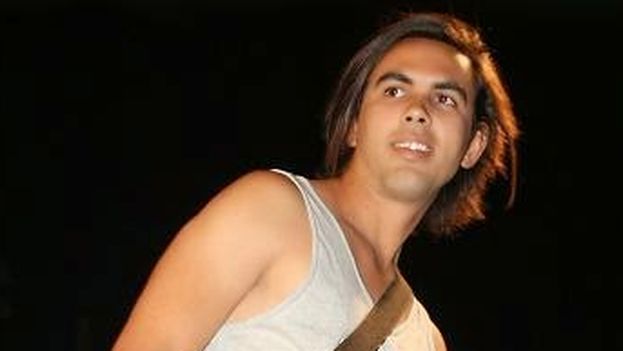
Mandy Junco killed last Saturday in Camaguey.  (Pedro Junco, Fury of the Winds blog)
Mandy Junco killed last Saturday in Camaguey. (Pedro Junco, Fury of the Winds blog)

14ymedio bigger14ymedio, Pedro Armando Junco, Camaguey, 22 May 2015 – Pedro Armando Junco Torres, alias “Mandy,” 28 years of age, was stabbed to death in Camaguey in the early morning of Saturday, May 16, a day before the beginning of the rock festival Sounds of the City. Mandy would have participated in it as guitarist and leader of the band Strike Back. His father, writer Pedro Junco, Thursday posted on his blog, The Fury of the Winds, this open letter in which he asks for “true justice.”

They Murdered my Son on the Streets of Camaguey

By Pedro Armando Junco

It is very difficult for me to write. All you mothers and fathers who read these lines, put yourselves in my place. Just for a minute think that it was your son who was stabbed to death in the street at the hands of four killers who did not even know him, who did not even do it to steal from him or to settle accounts. They think that the motivation was to kill, the pleasure of killing. Put yourself there for only one minute and then assimilate what you have felt in your hearts. That is what I am enduring and will endure until the end of my existence. continue reading

I write in order to thank so many people who, in and out of the country, have been at my side recently: the cruelest moments that I have suffered in my long existence. I also do it for so many friends who have not yet heard the news.

Saturday May 16, between 2:40 and 3:00 in the morning, my 28-year-old son: young, beautiful, intelligent, good, was surprised by a foursome of sadistic killers who, for no other purpose than to stab, riddled him with blows and knife wounds. The pathologists found 46 contusions on the body of my beloved Mandy. He was a joyful rocker, always smiling. He had no enemies. He was adored by the most beautiful young women in the city. He was returning from a rock festival, in which he was supposed to participate as a guitarist with his group the following night. Minutes before his murder he spoke with friends about his projects, about the successes he had already achieved and hoped to surpass with each new day, since he was already a professional musician.

I want to put in writing what I feel at this moment. As I said yesterday to a priest, I am angry with God. And I ask him: Lord Almighty, where were you then that you permitted such an injustice? Perhaps you were sleeping so that you did not run to his aid? What debts did we owe you? I believe in you, God Almighty, because you are evident to me, but I doubt your kindness and your justice.

To those who govern my country and dictate the laws; to the members of the courts that say they do justice: how long must one wait before terrifying events like this one receive exemplary punishments? The perpetrators of bloody events go to jails like they were on scholarships, and inside they are trained like graduates, they enjoy monthly visits with their women, they enjoy regular furloughs, and at half their sentence, if they have behaved well, they are granted “conditional” liberty, which many take advantage of to kill with impunity, because now in Cuba the death penalty is not used.

The city of Camaguey is electrified by this event. My son was the third victim of the gang which, that morning, carried out the crime spree. Cases like this emerge almost daily on our streets; but the press, muzzled, is not empowered to disseminate them. And to hide the truth is the most sordid way to lie.

The dismay that overwhelms me will not leave me for as long as I exist. But from now on I will fight with all my strength so that the streets of our city will be truly safe for our young people, whose parents today, horrified, corral them at home. Today it is my turn. Tomorrow the victim might be your child.

Let us demand true justice. Exemplary punishment.

I have been a zealous defender of the right to life. But if the use of the maximum penalty is necessary to save innocent people, then use it.

Translated by MLK

“If I had someone to sponsor* me…” / Cubanet, Rafael Alcides

colasss

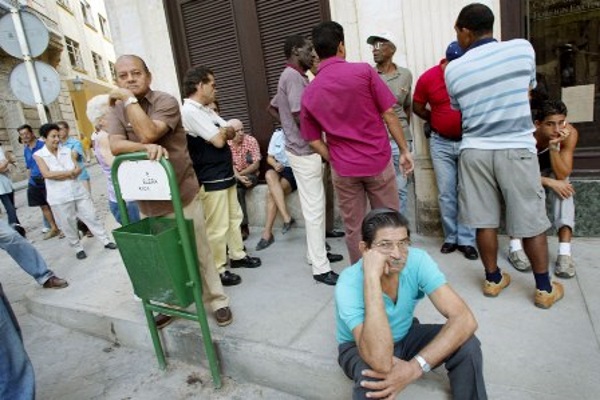
cubanet square logoCubanet, Rafael Alcides, Havana, 19 May 2015 – This morning I woke up pessimistic. There was no milk in the house, and the kind they sell at the “shopping” [hard-currency* store] is priced out of reach for anyone who is not an executive at a firm or who does not have relatives out there who love him very much and are well-off.** But at the bakery where I purchase the bread allotted to me via the libreta [ration book], I ran into somebody who today was more pessimistic than I am. He is a retired teacher and, without taking into account his age, one of those characters who pride themselves on being well informed told him that the ration book is about to be discontinued, that in fact it would be eliminated before August.

The teacher understands that this book weighs heavily in the pocket of the government, but he also thinks that instead of taking it away, the government should make it selective. Neither the powerful musician, nor the executive, nor he who receives remittances from abroad, nor any other characters of the New Bourgeoisie, need the ration book. The teacher, however, retired on a pension of nine dollars per month (that is, less than 30 cents a day), and with no one abroad—what would he do without this small assistance? There are just four little items that the ration book now subsidizes, but these four little items keep him from begging in the streets. The teacher spoke to me very badly of the Revolution, to which he had dedicated his life. continue reading

To console him, and because I don’t believe that, for now, the government intends to abolish the ration book—a costly burden, yes, but an even greater psychological benefit—I advised him to relax. “Don’t believe in rumors,” I told him.

“This was the only life I had,” he replied.

I let him vent.

Have you considered leaving the country?” I asked him.

He sighed heavily.

“If I had someone to sponsor me*…”

I purchased my three little rolls of 20-something grams each, and perhaps because an evil shared among many is easier to bear, I returned home feeling better. On the way back I compared the disenchantment of this teacher—a fragile but dynamic man who used to dress in his militia uniform festooned with all his decorations—with the latest hobby of a certain neighbor. This is a widowed doctor who grew old dreaming of leaving the country, and who, now that he could do so without major paperwork and without losing the house he inherited from his elders, refuses to go. Neither his children nor his nieces and nephews (all of whom are abroad) are able to persuade him otherwise. Of these, one who was visiting in January, told me, grinning, “Imagine, with the remittances we send him, he’s living like a king, with a maid, lots of Viagra, and three, 20-something doctor-girlfriends to keep him busy.”

They seemed to be saying—that disenchanted teacher who wouldn’t know how to live without the ration book, and that doctor who has discovered that, with money, even being widowed and very elderly one can be happy—that the Cuban exodus would not have been so massive had the socialist government been able to provide a privation-free life for the citizen. However, the end of Pinochet, even though he left Chile off the charts in terms of a First-World standard of living, or of Franco, despite the vertiginous development achieved by Spain during the Generalísimo‘s last two decades, demonstrate that the issue is not just an economic one. As I read somewhere once, without freedom there is no lasting splendor. Nor is there ground that can withstand the cathedral placed upon it.

It has always been thus. Rome, once the ruler of the world, that mighty Rome of patricians and slaves where, moreover, the Christian was persecuted, eventually disappeared. A comparable lack of freedom ended Spanish colonial domination of lands in Our America, as well as the English, Portuguese and French. Vanished from that former America were Juan Manuel de Rosas, and Gaspar Rodríguez Francia, and Rufino Barrios and Porfirio Díaz and Gerardo Machado. In the America of my time, that America from when I was young, we saw the last of Trujillo with his braided uniform, and Somoza, and Stroessner, and Pérez Jiménez, and the Brazilian Joao Goulart, and Cuba’s Batista…

In recent times, following the fall of the Berlin Wall, the world has continued lightening up. No longer are there even Hussein, Milosevic, Gaddafi, nor now, finally, that odious fellow in Yemen. With efficiency, in each of these cases, the lack of liberty—that secret gift of the oppressed—has done its fatal deed.

I do not surrender, and therefore do not give up the dream that today or tomorrow—that is, sooner or later (and these things almost always happen when one least expects them)—I and others like me, who number 11 million, including the glum teacher from this morning, will see solutions to our problems putting food on the table—as well as the slum housing, our city falling apart, and everything else that we know too well.

Translated by: Alicia Barraqué Ellison

Translator’s Notes:
* To obtain a visa to immigrate to the U.S., a Cuban national must have a sponsor. This page from the U.S. Interests Section in Havana explains.
** Cuba has two currencies: Cuban pesos, also called moneda nacional (national money), abbreviated CUP; and Cuban convertible pesos, abbreviated CUC. In theory CUCs are a hard currency, but in fact, it is illegal to take them out of Cuba and they are not exchangeable in other countries. Cubans receive their wages and pensions primarily in CUPs, with wages roughly the equivalent of about $20 US per month, and pensions considerably less. The CUC is pegged 1-to-1 to the American dollar, but exchange fees make it more expensive. The CUP trades to the CUC at about 24-to-1. See here a concise description of Cuba’s dual-currency system and an announced plan to unify it.
*** The average Cuban citizen relies on “remittances”—material help—from relatives abroad. A Cuban blogger explains it here.

About the Author

461.thumbnailRafael Alcides was born in Barrancas, municipal district of Bayamo (Cuba) in 1933. A poet and storyteller, he was a master baker in his teen years. He has worked as a farmhand, cane cutter, logger, wrecking crew cook, and manager of a sundries store in a cane-cutters’ outpost. In Havana in the 1950s he worked variously as a mason, broad-brush painter, exterminator, insurance agent, and door-to-door salesman. In 1959 he was the chief information officer for the Department of Latin American Affairs in the Ministry of Foreign Relations, and spokesman of this agency in a daily television program in which he hosted and interviewed foreign political personalities. He was chief press officer and director of Cultural Affairs in the Revolutionary Delegation of the National Capitol.

Among his most recently-published titles are the poetry collections, GMT(2009), For an Easter Bush (2011), Travel Log (2011), Anthologies, in Collaboration with Jaime Londoño (2013), Conversations with God(2014), the journalistic Memories of the Future (2011), the multi-part novel, Ciro’s Ring (2011), and the story collection, A Fairy Tale That Ends Badly (2014).

As of 1993, he had been employed by the Cuban Institute of Radio & Television for more than 30 years as a scriptwriter, announcer, director and literary commentator when, at that time, he ceased all publishing and literary work in collaboration with the regime in Cuba. As a participant in numerous international literary events, Rafael Alcides has given conferences and lectures in countries in Central and South America, Europe, and the Middle East. His texts have been translated into many languages. He was honored with two Premios de la Crítica, and a third for a novel co-written with another author. In 2011 he received the Café Bretón & Bodegas Olarra de Prosa Española prize.

Museo Nacional de Bellas Artes Denies Entry to Tania Bruguera / Diario de Cuba

Tania Bruguera
Tania Bruguera

diariodecubalogoDiario de Cuba, Havana, 24 May 2015 – This Saturday the Museo National de Bellas Artes (National Museum of Fine Arts) denied entry to the artist Tania Bruguera, who had been invited to the opening of an exposition by the painter Tomas Sanchez.

Deborah Bruguera, the artist’s sister, reported on her Facebook site that the justificiation “was that the Museum reserves the right of admission.”

Diario de Cuba received a recording of the conversation between Bruguera and a museum official charged with communicating to her the prohibition of entering. continue reading

The artist demanded “logical reasons” and no just that the communication “is an order.”

“I am a Cuban citizen who has the right to know why I am not permitted to enter a place,” Bruguera stated.

“Fine, we have arguments that you have caused certain difficulties at other expositions of the Biennial,” the official responded.

Bruguera rejected this accusation. “In what expositions, because I haven’t been to any. I have been in my house, this is the first and only time since the Havana Biennial started that I have left my house,” where she was “staging her performance,” she replied.

With regards to the invitation from Tomas Sanchez, the official affirmed that it was “not applicable” and that those who decided who could or could not enter a cultural institution are responsible.

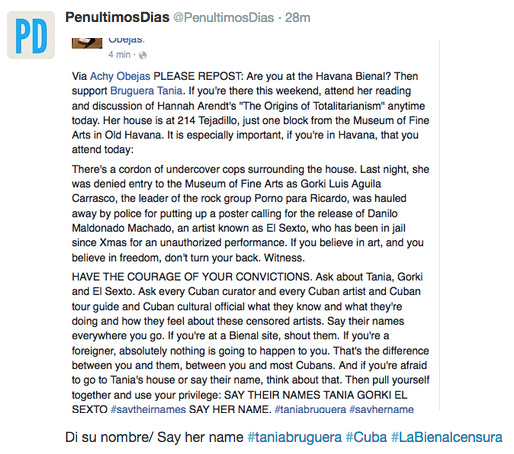
Last Wednesday Bruguera began a performance in her house consisting of 100 hours of reading the book “The Origins of Totalitarianism” by Hannah Arendt.

Since Friday, the regime hijacked the reading with loud noises caused by supposed Electric Company repair work, sending workers to break up the street in front of her house.

Gorki Aguila Arrested in Front of the Museo de Bellas Artes in Havana / Diario de Cuba

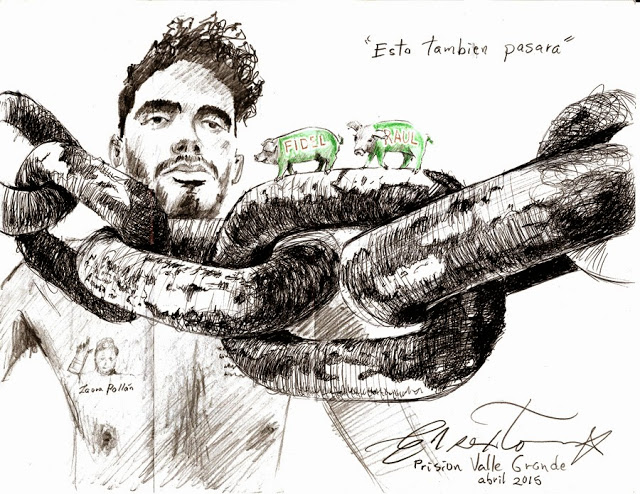
"This too shall pass"
“This too shall pass” (Danilo’s artwork from prison)

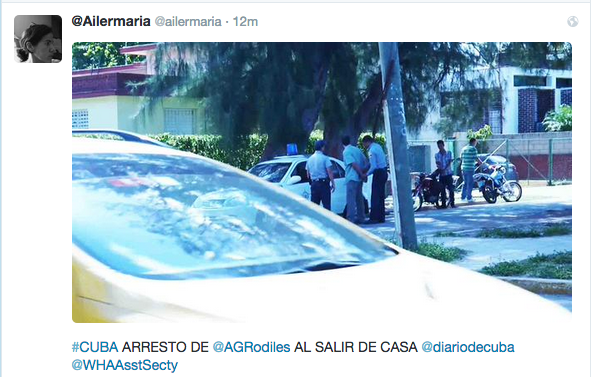
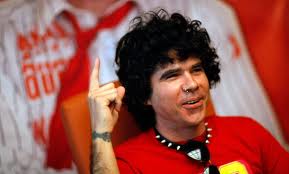
diariodecubalogoDiario de Cuba, Havana, 24 May 2015 – The musician Gorki Águila, leader of the band Porno para Ricardo, was arrested by State Security agents on Saturday night in front of the Museo de Bellas Artes in Havana.

Gorki Aguila
Gorki Aguila

Águila went to hold up a sign on the outside wall of the museum with the word “Libertad” (Freedom) and the image of the graffiti artist Danilo Maldonado, known as El Sexto, imprisoned since last 25 December, when he allegedly went to Havana’s Central Park with two piglets named “Fidel” and “Raúl,” to stage a performance.

After Águila’s action, recognized repressors from State Security’s Section 21, posted in the area, approached the musician and forced him into a car. Meanwhile, Águila shouted demands for “Freedom for Danilo!”

The repressors were in the area because of the inauguration of a show that presumably was going to be attended by the artist Tania Bruguera, now retained on the Island without her passport because of an attempt to stage her performance Tatlin’s Whisper in the Plaza of the Revolution last 30 December.

This coming Wednesday, 27 May, the Oslo Freedom Forum, a principal world event dedicated to human rights, awarded El Sexto the Prize for Creative Dissidence.

What the Wind Left Behind* / Cubanet, Rafael Alcides

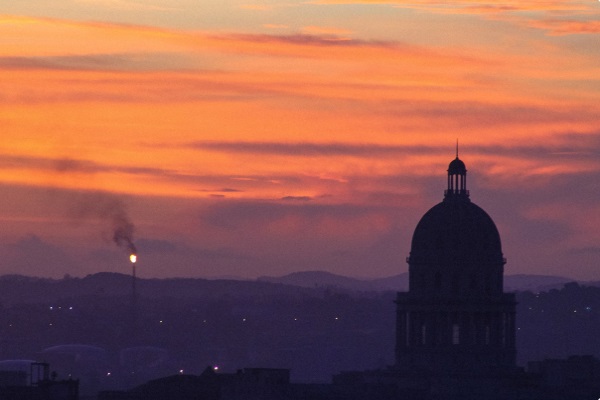
Dawn in Havana
Dawn in Havana

cubanet square logoCubanet, Rafael Alcides, Havana, 10 April 2015 – Havana sixty years ago was a pretty city—clean, young and with no thieves of any consequence in the neighborhood. Around 9:00 at night the garbage truck would make its rounds. It was a regular truck, not one of those modern-day versions that look like interplanetary spaceships. It carried four workmen—two standing and holding on to the rear of the truck, flanking it—the other two at the top. Upon hearing the bell signaling the truck’s approach, the neighbors would hastily place the garbage can at the door, the two men from the rear would toss it with great flair to the ones at the top of the truck, those men would fling it back with equal style, and the can would be placed once again by the door. It was painful to watch them do this work that would cause the street to be enveloped in the stench of rotten melons. However, these men, with the elegance and precision with which they went about their task, made it seem like they were playing an individual basketball game. How many of these vehicles the city possessed, I don’t know, but your neighborhood truck would show up every night, through rain, a cold snap, or the coming of a hurricane.

This was not all.

In the afternoons, a crop duster would fly overhead, fumigating against flies and mosquitoes, and at dawn, Havana smelled clean. Overnight, its streets had been washed down and whisked with the metal brush that was applied between the road and the sidewalk by a powerful machine. The sewer manholes had their covers, the sanitation system was inspected every week, power outages were unknown, and Havana gave the impression of a city inhabited by people who had never done harm to anyone and therefore could live without fear, despite this being a time when the din of sudden gunfire was commonly heard along with the eruption of firecrackers. In the residential neighborhoods open planting beds were common, and in the traditional El Vedado neighborhood, the little foot-and-a-half high wall was established by municipal ordinance. continue reading

Not even the multimillionaire Sarrá** was allowed to hide his mansion behind the sinister metal sheeting so reminiscent of the Nazi crematoria, so in-vogue today among the nascent New Man of the Havana bourgeoisie, with the addition of a pair of large dogs prowling the yard, fierce as lions—whose daily upkeep costs as much as a doctor’s retirement—plus the requisite car alarm. Even regular Joe Schmoes who once had to sell their toilets just to survive have assumed a “bunker mentality,” securing their doors and windows with iron grilles.

It is true that in that Havana prior to the advent of The New Man, the car would slumber near the front door and awaken with its four tires, battery, radio and windshields intact. The petty thief of those days didn’t venture beyond the occasional shirt or boxer shorts fished through a window with a wire coat hanger hooked to the end of a broomstick. You would open the door upon awakening in the morning, and there would be the milk bottle and bread sack that had been left on your stoop. It is also true that, day or night, a generally friendly foot cop (the mean ones were in the squad cars) would guard the block with monastic devotion, he would stop to chat with the neighbors and, where least expected, there he would be, with his whistle and club. The night patrols of the Committees for the Defense of the Revolution (CDRs) have not been able to take their place.

Back then Havana had a slum neighborhood called, “Las Yaguas.” Today it has dozens. The lack of employment had stimulated the presence of door-to-door salesmen and street vendors, persons generally lacking much education. This army’s ranks have increased a hundredfold, and now includes the university professional who in his free time will come to sell you ham, powdered milk, and olive oil. Even the vendor of bleach and brooms, which he lugs on his shoulders, is a high school graduate or mid-grade technician. Amongst female and male prostitutes, a doctoral degree is not uncommon.

It is appalling to see so much bad taste on display in today’s Havana; to see the ruins that make some of its central areas reminiscent of the London depicted in the RKO Pathé newsreels at end of the Second World War; to feel the funereal shudder of buildings that haven’t been painted in years; to contemplate the orthopedics present in a storefront converted into jerry-built housing by a bricklayer without resources; to walk through the streets at dark with the fear of being flattened by a falling balcony. Yes, we have things now that we didn’t have before. The infant mortality rate has been reduced to insignificance, and the embargo continues. But, Ladies and Gentlemen, 56 years have passed, not two or three. Fifty-six: the age of the Republic that is gone with the wind.

About the Author

rafael461.thumbnailRafael Alcides was born in Barrancas, municipal district of Bayamo (Cuba) in 1933. A poet and storyteller, he was a master baker in his teen years. He has worked as a farmhand, cane cutter, logger, wrecking crew cook, and manager of a sundries store in a cane-cutters’ outpost. In Havana in the 1950s he worked variously as a mason, broad-brush painter, exterminator, insurance agent, and door-to-door salesman. In 1959 he was the chief information officer for the Department of Latin American Affairs in the Ministry of Foreign Relations, and spokesman of this agency in a daily television program in which he hosted and interviewed foreign political personalities. He was chief press officer and director of Cultural Affairs in the Revolutionary Delegation of the National Capitol.

Among his most recently-published titles are the poetry collections, GMT(2009), For an Easter Bush (2011), Travel Log (2011), Anthologies, in Collaboration with Jaime Londoño (2013), Conversations with God(2014), the journalistic Memories of the Future (2011), the multi-part novel, Ciro’s Ring (2011), and the story collection, A Fairy Tale That Ends Badly (2014).

As of 1993, he had been employed by the Cuban Institute of Radio & Television for more than 30 years as a scriptwriter, announcer, director and literary commentator when, at that time, he ceased all publishing and literary work in collaboration with regime in Cuba. As a participant in numerous international literary events, Rafael Alcides has given conferences and lectures in countries in Central and South America, Europe, and the Middle East. His texts have been translated into many languages. He was honored with two Premios de la Crítica, and a third for a novel co-written with another author. In 2011 he received theCafé Bretón & Bodegas Olarra de Prosa Española prize.

Translator’s Notes:
*The author is likely making a play on the title of the novel, Gone With the Wind, by Margaret Mitchell, which is translated into Spanish as, “Lo Que el Viento Se Llevó” – literally, “What the Wind Swept Away.”
**The Sarrá family was prominent in the pharmaceutical industry in pre-1959 Havana.

Translated by: Alicia Barraqué Ellison

One Year, Despite Censorship / 14ymedio

14ymedio bigger14ymedio, Havana, 21 May 2015 – The greatest satisfaction we have experienced in this first year of work has been reporting every day and doing it with our own voice with independent judgment, and without compromising with third parties. Having weathered the technological censorship that our digital site has suffered from its birth also fills us with joy. 14ymedio has been blocked on the Island since the first day and continues blocked on the servers that offer Internet access to the population, both in the State-run Nauta Internet rooms as well as in the hotels, but we know that Cubans read us via other ways.

We regret the news stories that have escaped us, not for lack of attention or for not having access to sources. Each fault committed hurts us, but we have learned more from mistakes than from successes. continue reading

In this time we have had the opportunity to interview the majority of the protagonists of Cuban civil society: artists, entrepreneurs of the Island, the diaspora and other foreign personalities interested in the destinies of Cuba. We follow the step-by-step process of détente between the governments of Cuba and United States, as well as the dialogs with the European Union, without ever ceasing to report the abuses against the Ladies in White, the arbitrary detentions of peaceful opponents, and the events seeking unity. We relate people’s catastrophes and fiestas, their tears and laughter. We have ceded space to optimism and to despair.

Our ambition is to become an indispensable reference for everyone who wants to know what is happening in Cuba and also what might happen. Exposing the scenarios, discussing the variables, but also making know the price of malanga, pork or onions and, in addition what they are presenting at the La Zorra Club, or El Cuervo, or the Lark Marx Theater, or El Mejunje. Exposing an invasion of African snails, the fall into disgrace of an untouchable official, or the murder of a transsexual.

Both the 14ymedio team in Havana, as well as our collaborators in the provinces, are learning on the fly. It is true that we have the experience of others on other alternative media before ours, here in Cuba and abroad, who have traveled this path that we are embarked upon, sometimes following in their footsteps and others taking shortcuts or looking for other ways to accelerate the pace.

We boast that we are not only trying to do journalism without partisanship and with professionalism, but also have dabbled in entrepreneurship from the field of information, with the intention that 14ymedio will be a self-sustaining newspaper with a solid economic model. We have not received one cent from governments, political parties or programs in support of democracy. Our newspaper is a business created with the financial support of 15 small private investors, most of them living in Europe, who believe in the project and are betting on change in Cuba.

Our fundamental objective is to maintain the editorial independence that allows us to report on all topics and to criticize any public figure. We take responsibility for everything we publish.

For the immediate future we intend to reach a larger number of Cubans on the Island. Launching an electronic newsletter for readers without access to the Internet is an urgent need we are working on. Applications for iOS and Android that allow our content to be downloaded and read offline must also be on our list in the coming months.

We intend to improve the refresh rate, but without turning our media into one of those “news factories” where the content is measured more by the speed with which it appears on the front page than by its quality. This is an infirmity of modern journalism and we do not want to contribute to the ailment. We want to immerse ourselves in data and research, strengthen our reach on social networks, and delve into genres such as reporting and chronicles, which also figure in our purposes.

The use of audiovisual resources and a clear commitment to innovation will mark our next steps. But above all the commitments, we want to assure our readers that by the next anniversary we will have more reasons for pride. We will continue to do journalism every day, with more professionalism and responsibility toward this society so in need of the oxygen of information.

Cuba and the United States Don’t Agree on a Date for Opening Embassies / 14ymedio

The US delegation in the 4th round of negotiations (Twitter)

14ymedio bigger14ymedio, Havana, 22 May 2015 — The fourth round of negotiations between Cuba and the United States to reestablish diplomatic relations ended this Friday without a date for the opening of embassies.

The chief of the US delegation, Robert Jacobsen, confirmed in a press conference in Washington does not believe there will be a fifth round of negotiations. For her part, the director general for the United States in the Cuban Foreign Ministry, Josefina Vidal assured that they would continue working on the issue in the “coming weeks.” continue reading

After a two day meeting between the delegations of both countries, Vidal said that the two sides had “continue to advance” on pending issues and highlighted the “professional and respectful climate” of the meeting.

“Both delegations agree to continue the exchanges about aspects relative to the working of the diplomatic missions,” explained the chief of the Cuban delegation shortly after the Havana Government announced in a communication that there was no progress in the reopening of the embassies and that it will take more meetings.

Jacobson expressed her optimism about the advance toward normalization of diplomatic ties and characterized the meeting of the last two days as “hugely productive,” although she recognized that “it is not an easy task due to the complicated history of relations” between the two countries.

In the talks they also addressed matters of civil aviation, human trafficking, fraud and maritime issues. Vidal affirmed that in the upcoming negotiations there would also be an exchange of information on justice and policing, and health and medicine issues.


So Many Lists Having Nothing to Do With Obama / 14ymedio, Reinaldo Escobar

Raúl Castro with Barack Obama at a press conference during the Summit of the Americas.

14ymedio bigger14ymedio, Reinaldo Escobar, Havana, 27 April 2015 — A few days back, a commentator on Cuban state television found it “interesting” that Republican Congresswoman Ileana Ros-Lehtinan, speaking on behalf of her party, said there would be no opposition in the U.S. Congress to removing Cuba from the list of state sponsors of terror.

This time, the Cuban-American Congresswoman was not disparaged as a “wild wolf,” as the official media christened her back in the days of the campaign for the return of the little boy rafter Elián González to Cuba. If everything goes according to plan, on May 30th, after the 45 days required for the U.S. Congress to ratify the President’s recommendation, Cuba’s name will be erased from the list. continue reading

According to an explanation given by Miguel Díaz-Canel, Cuba’s vice-president, in an interview on April 19th, the significance of Cuba no longer appearing on the list is that from then on the country will be able to qualify for bank loans, as well as undertake other financial activities hitherto denied to it.

Still, will this signal an end to the commercial problems that cripple our imports and trade with the rest of the world?

The removal of Cuba from this list does not automatically mean that it definitely will be included among the countries taken seriously into account when it comes to negotiations, investments, partnerships, and qualifying for loans. Additionally, it does not mean that Cuba would immediately join the ranks of nations attractive to investors and international financial entities. Cuba’s name appears on other negative assessments from which it would be very difficult to erase its name in the short or medium-term.

In the repertoire of nations representing a high risk for investors, Cuba sadly occupies a distinguished spot. It is listed together with countries where it is least recommended to do business. Whether or not Cuba remains on these lists does not depend on Obama’s goodwill. It depends on Cuba complying with specific requirements established by financial entities whose assessments are universally accepted.

Additionally, among countries that tend not to pay their bills, Cuba has earned a notorious standing after decades of not meeting its financial obligations and owing large sums of money to member states of The Paris Club as well as to several others. At the end of the 1980’s, Cuba led the Latin American movement in support of not repaying foreign debts, thus endearing it to the worldwide left, but also earning the country a very negative reputation among those who invest or lend their money.

Cuba’s bad reputation regarding private property has also landed it on several other lists that frighten businesspeople and discourage foreign firms. This is due especially to the official Cuban discourse, which for over half a century has shown contempt towards private ownership of the means of production.

The memories of the massive confiscation of companies, newspapers, sugar mills, and small businesses are still very fresh in the sharp minds of businessmen who do not want to risk their investments, as happened during the Revolutionary Offensive of 1968.*

Additionally, how can Cuba be removed from the list of countries that do not allow independent trade unions, nor freedom of association and expression? Would it be possible, as if by magic, for Cuba to be removed from the list of countries that do not duly protect property owners nor shield them ideological whims without a real reform of its penal code?

Seeing we are no longer on the list of sponsors of terrorism, the Cuban government now seems to be hoping that investments and loans offers will be forthcoming overnight. No matter how paradoxical it may sound, these illusions rest on the government’s presumption that those who may be interested in doing business with the Island are cynics lacking any corporate ethics.

The Cuban authorities will then welcome unscrupulous sweatshops owners, the most heartless of loan sharks, and others who exploit workers who do not have the right to protest and cannot find a decent place to call home.

On what list will Cuba end up then?

*Translators note: In a speech delivered on March 13, 1968, Fidel Castro launched a “revolutionary offensive that would do away with the urban petite bourgeoisie.” By the end of the year the government had confiscated 55,636 small businesses (mostly family-owned and with no more than two employees, ranging from grocery stores to shoe shining stalls) that had survived the first waves of confiscations of the early years of the régime. This move marked the end of private enterprise in Cuba.

Translated by José Badué