Silence and Poetry in Rafael Alcides / Miguel Iturria Savon

Yesterday the Cuban poet Rafael Alcides Perez turned 80; he remains in Havana as a poor, strong and gentle grandfather; lucid amid the social madness and literary closure, oblivious to personal egos and tribal tantrums. He knew fame and tasted applause from his younger years, when he joined in the swarm of those poets of the intimate and innovative generation of the ’50s, who transitioned from the estrangement and apathy during the dictatorship of Fulgencio Batista to the euphoria by the Revolution led by Fidel Castro, which shook the foundations of the nation and imposed exile and silence.

Rafael Alcides leaves a lasting impression on those who know him personally. Admiration grows if you read his poems before hearing his voice booming with rhythm. The poet seduces his listeners with the cascading flow of his images and metaphors, resonant and profound like the simplicity that animates his actions.

He, who for decades has declined to publish in Cuba, knows that his name carries weight in the memory of his book and some magazines that collect his most transcendent verses. The author of Thanked Like a Dog was excommunicated from the official poetry sanctuary and sanctified by writers and poetry lovers. His name barely circulates on the island, where his books are a rarity in antiquarian portals, personal libraries and catalogs of the National Library.

From Spain I join the tribute paid by the intimates of the octogenarian writer, still engaged in the creative task. Within a few years, when some publisher takes on the rescue of his poetry and novels, new readers will have in their hands, “Mountain Smoke,” “Gypsy,” “Travel Notebook,” “The Wooden Leg,” “Memories of the Future,” “Night in Memory,” “And they die, and they return, and they die,” as well as “Nobody” — his penultimate poem collection — and the controversial stories, “Contracastro,” and “The Return of the Dead.”

10 June 2013

Android and the Ingenuity of the Bright / Yoani Sanchez

1371214999_9042091632_6ddba70e78

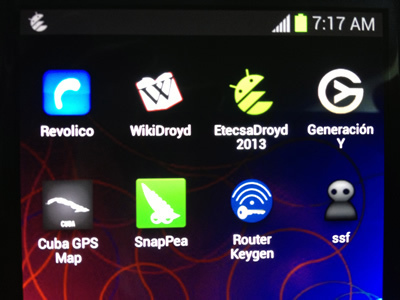
They have graduated from the University of Computer Science or from some other engineering school, but they make an independent living. They are the new developers of applications for Android who are thriving in Cuba. From their keyboards a popular app has emerge with a database leaked from ETESCA, the State phone company called — most appropriately — ETECSA-Droyd. Simply installing it on your cellphone allows you to see the name, address, and even the birthdate of the person calling you. Nobody escapes scrutiny. At your fingertips you have information about a minister, an ousted officials, and the children of the General-President himself. Marvels of the underground, in a country where the forbidden is more and more mixed with the desired and the possible.

Among these young digital natives, the best programmers already have contracts with companies in other countries. They work from home in Havana, Camaguey or any other province, but the final product goes to Tokyo or Paris. These are the most successful. The great majority, in order to obtain this so dreamed of long-distance work, first have to go through a long stage of installing capabilities, at retail, in the telephones of national users. If they’re lucky, one day a tourist may show up who needs their iPhone or Samsung Galaxy repaired. It’s a chance to show off their technological talent and entice the foreign visitor into a partnership agreement or even to get an invitation to go work in another country.

The path of these geniuses can also come with serious setbacks. Cuban courts, in recent months, have tried several people involved in the business of cellphones and software for Smartphones. Julio, one of those arrested, was caught with a cargo of HTC phones, and GPS for cars, as well as a workshop to create new versions of applications, among them the illegal ETECSA-Droyd. He is now awaiting trial and a good part of what he earned with his computer talent will go to pay an attorney. Digital crimes are no longer just things in foreign film scripts. Hacking, posting a website, testing tools that steal WiFi passwords, have become a source of amusement for some young people with talents in coding and programming languages. The new technologies add to the illegal market, that area of our lives so primitive — almost medieval — but also so sophisticated and innovative.

14 June 2013

The Philosophy of Marti versus the Totalitarian Model

Published in the second edition of Cuadernos de Pensamiento Plural, April 2013.

People cannot live without history. On the 160th anniversary of the birth José Martí, “the crowning figure of Cuban political thought,” his ideas, instead of being used to solve the serious social problems that afflict Cuban society, continue to be manipulated in order to validate a failed social model whose goal was to increase production while ignoring basic economic laws such as respect for fundamental rights and freedoms.

The process began on February 19, 1959 when, just days after assuming the post of Prime Minister, Fidel Castro — in one of his typical fits of volunteerism — stated that he would significantly increase agricultural production and double the consumption capacity of the rural population. He added that “Cuba would sweep away its horrific rate of chronic unemployment, achieving for the people a higher standard of living than any country in the world.” However, the dismantling of civil society, the suspension of civil liberties and the process of economic nationalization led to stagnation and international isolation, to discontent and hopelessness among the citizenry, to apathy, corruption and mass exodus.

Since the early years of revolutionary government this process has had two co-existing pathways to a socialist economy. One is the Economic Calculation in which businesses operating under a state plan enjoy a certain level of independence and self-financing. Employment decisions are based more on financial concerns than moral ones. The other is the System of Budgetary Financing, characterized by greater centralization, a high degree of subjectivity and a preference for the use of moral incentives over financial ones. For decades these two pathways have alternated with an exacerbating volunteerism. This phenomenon can be summarized in the six examples that follow.

1. Between 1962 and 1965 the Economic Calculation system was applied to agricultural businesses, although not in a comprehensive way. For example, self-financing, one of its cardinal features, was not applied, which led to businesses having to turn to the government for funding. During this period the leader of the revolution ignored planning guidelines and allocated large resources to develop his own initiatives such as the Agrupación Básica del Cauto, an agricultural project made up several western municipalities headquartered in the city of Bayamo.

 2. In 1967 more rational standards were instituted. The System of Budgetary Financing was introduced, though with restrictions. It was called the New System of Economic Accounting. Its introduction led to the disappearance of the Ministry of Finance, the state budget, methods for billing and payment, and salary scales.

To develop the “new man,” a work schedule was introduced based on conscience and the extreme use of moral incentives. One of its failed attempts was the conversion of the Isle of Pines into Cuba’s first communist territory.

Later, the Revolutionary Offensive of 1968 did away with the last 56,000 small commercial businesses and private service providers which had managed to survive nationalization. This period reached its climax with the crazed attempt to produce ten millions tons of sugar, an effort which deformed the entire economy.

The mistakes made then were acknowledged in a report to the First Congress of the Cuban Communist Party in 1975 during which Fidel Castro said he had made the least correct decision by developing a new methodology. “We wanted to establish our own methods through the New System of Economic Accounting, which was preceded by the eradication of mercantile categories and the elimination of billing and payment practices between state enterprises.”

3. In 1972 Cuba gained entry to the Council for Mutual Economic Assistance, or Comecon, and in 1975 introduced the System of Economic Management and Planning (whose Spanish acronym was SDPE). It combined state planning, top-down management and rejection of the market. The SPDE was doomed to failure from the start since the Soviet experience had already demonstrated that efficiency in a planned economy was dependent on decentralization and the introduction of market forces.

The most daring initiative from this period was the opening of the Free Peasant Market (Mercado Libre Campesino or MLC) which began operations in 1980. It allowed small producers to sell their surpluses based on supply and demand, “after fulfilling their commitments to the state,” and to hire contract workers. It also allowed for self-employment in forty-eight activities.

In 1986, due to the influence of perestroika in the USSR, the reform experiment was interrupted. In a rush to reject the laws of economics, the Cuban leader decreed that in the area of production we would have to use economic tools to augment political and revolutionary work. This led to his replacing the Central Planning Board and its directors with the Support Group. The MLCs were closed and replaced with state agricultural enterprises. Economic decision-making was recentralized.

The Process of Rectification of Mistakes and Negative Tendencies began based on the argument that negative phenomena were appearing which threatened “the process of building socialism.” There was a return to subsidies for inefficient state enterprises. In the context of this counter-reform there emerged a slogan: “Now We Will Really Build Socialism.” Later, the collapse of the Soviet Union and the loss of subsidies which it had granted to Cuba, combined with the domestic counter-reforms, would lead to a steep drop in the nation’s GDP.

4. The above-mentioned disaster led to a deep crisis which the government termed the Special Period. In response a package of reforms was introduced between 1995 and 2003 that permitted the sale of food in homes, and snacks, soft drinks and ice cream on the street. It also made possible the existence of workshops and small studios, foreign investment, the reopening of the MLC’s (now termed Agricultural Markets), and the opening of a market for industrial products.

The dollar could circulate freely and legally, foreign commerce was decentralized, free trade zones were opened and UBPCs (so-called co-operatives set up by the state) were created. During this period the System of Corporate Perfection continued to be applied, though in a selective way, to those military-run businesses which had been experimenting with it for several years.

5. Although the reforms of the previous period generated good results, they were put on hold in 2004 in yet another return to centralization and a limitation on the role of the market. The Battle of Ideas, initiated by Fidel Castro, was adopted as a method for fighting administrative corruption, the siphoning of state resources and illicit personal enrichment — evils of the socialist economic model that were blamed on the market. As a result the issuance of new business licences was limited, taxes were increased and foreign investment was reconsidered. This shift was linked to closer relations with Venezuela, a country which supplied petroleum at cut-rate prices in exchange for services. The magnitude of this trade, which made up for the loss of Soviet subsidies, replaced sugar, nickel and manufacturing as the top export sectors.

6. The beginning of the current period began with the transfer of power from the First Secretary of the Cuban Communist Party, Fidel Castro — who also served as President of the Council of Ministers, President of the Council of State and Commander-in-Chief — to Army General Raul Castro. In the absence of civic forces with the ability to influence the course of events, the transfer took place within the existing power structure, which determined the character, sequence, depth, direction and speed of change. Raul Castro, faced with an extremely complex national and international scenario, began a period marked by speculation, aspiration and hope.

With the goal of introducing some rationality to the Cuban economic model while at the same time ignoring the role of the market in relation to property and individual liberty, Raul Castro began by getting rid of methods and plans which relied on the volunteerism that was part of the Battle of Ideas. He announced the introduction of structural and conceptual changes outlined in a basic reform plan.

These included: 1) building a strong and efficient agricultural sector capable of providing food for the population and reducing imports, 2) making people feel the need to work in order to survive, 3) strongly rejecting illegalities and other signs of corruption, 4) reducing workplace staffing, whose redundancies exceeded one million and 5) encouraging self-employment as a way to absorb the surplus workforce.

The most important aspect of this basic plan was a provision to lease out idle farm land. It was an insufficient and contradictory measure since it acknowledged the inability of the state to produce while identifying food production as a national security problem, but kept property in the hands of the state, reducing producers to nothing more than tenants. Although the changes were too little and too late, they nevertheless marked a shift after decades of stagnation.

Attempts at reform were hindered by a kind of power sharing agreement in which all important decisions were made only after the new president had consulted with his brother, who was opposed to change. The critical point in this arrangement came in mid-2011 when Fidel Castro, in repeated appearances before the National Assembly on and before August 7, expressed his concerns about an “imminent” nuclear war.

During his final appearance he referred to President Barack Obama, who would presumably order the commencement of this holocaust, stating that perhaps he would not would give the order if we could persuade him otherwise. In contrast, on August 1, 2011 at a session of the National Assembly Raul Castro announced the expansion of self-employment, including the right to hire employees, something unprecedented in Cuba. And on August 13, Fidel Castro’s birthday, the release of six more political prisoners was announced.

The key features of the basic program were “outlined in the Guidelines of Economic and Social Policy.” Approved by the Sixth Cuban Communist Party Congress, they were constrained by the system of socialist planning and state-owned enterprise, which remained the principal means for economic development. In addition to these constraints the inherent contradictions and inconsistencies of the reforms became clear during fifteen provincial party conferences held after the party congress.

During these conferences the party’s second secretary, José Ramón Machado Ventura, reiterated certain ideas, saying, “We have to know beforehand what every producer is going to plant and harvest,” adding, “We must demand this of those who do not make the land productive.”

Decrees were issued to make sure the economy remained under state and party control. Finally, between June 11 and June, 2012 eight short pieces by Fidel Castro appeared in the official press. Nebulous and out of touch with Cuban reality, they marked the end of the period of power sharing. Only then and not before could one speak of the government of Raúl Castro.

During a session in July 2012 of the National Assembly, the president of the Council of State returned to decrees issued in a report to the Sixth Congress. Several days later in Guantánamo he once again took up the subject of a willingness to improve relations with the United States and on July 30 he led a parade on Martyr’s Day in Santiago de Cuba, which marked the real beginning of his rule.

Since then his time as head of government has had, on balance, the following results:

1. Agricultural production fell 4.2% in 2010. In 2011 GDP grew less than expected. Food imports increased by 1.5 billion in 2010 and 1.7 million in 2011. Sales decreased 19.4% compared to 2010 and retail prices increased 19.8%. Meanwhile the average nominal monthly salary increased only 2.2%, leading to a worsening situation for workers. Yields from sugar harvests were comparable to those at the beginning of the 20th century. This included the 2011-2012 harvest, which was forecast to 1,450,000 tons of sugar, but which failed to meet either its target amount or target date.

2. Criminal activity, as evidenced by the number of completed and pending criminal procedures, grew to such a degree that corruption and economic inefficiency became national security problems.

3. The limitations imposed on self-employment prevented this sector from absorbing as many state workers as anticipated. Of some 400,000 self-employed workers, more than 330,000 lacked work experience or were retirees, which meant that less than 17% of state employees were absorbed into the private sector.

Among the multiple reasons for these failures was the attempt to overcome a structural crisis by applying partial measures. There was also a lack of political willingness to allow diverse forms of property ownership, the formation of a middle class or to alter the unsatisfactory state of civil rights.

The First Conference of the Cuban Communist Party, held in January 2012, once again did not address these basic issues. More recently President Hugo Chavez’ illness has threatened the huge subsidies that Cuba receives from Venezuela, which means the authorities will have to introduce more energetic, profound and comprehensive reforms. Regardless of what happens in Venezuela, nothing will be be the same without Chavez.

The most recent measures reflect this. Non-agricultural cooperatives have been created with greater autonomy than their predecessors. A new emigration policy has relaxed absurd prohibitions on freedom of movement. Tariffs on cell phones have been reduced, a move which will lead to increased communication.

The amount of live programming from Telesur has greatly increased, weakening the official media’s monolithic control and its attempts at disinformation. Coverage of professional sports such as basketball and baseball on Cuban television — something unheard of until now — has been introduced.

Information has been released on the first tests of the fiber optic cable intended to normalize electronic communications, breaking the government’s extended silence on this issue. The timing of these decisions suggests they are a response to issues that will arise upon the impending demise of President Hugo Chavez and the subsequent need to improve relations with the United States and the European Union.

These steps point in the direction of change. However, as long as the provisions of the Universal Declaration of Human Rights, the Convention on Civil and Political Rights and the Convention on Economic, Social and Cultural Rights are not adopted as legal foundations for citizens’ rights, one cannot properly speak of a true political willingness for change.

The relevance of Marti’s philosophy

Is there some relationship between the José Martí’s ideas regarding the party, freedom and democracy, Cuban political participation, and small and medium-slzed property on the one hand, and the current state of Cuban society on the other?

After analyzing the causes for the failure of the Ten Year’s War, Martí conceived the Revolutionary Party of Cuba (PRC) as a tool for organizing, controlling and creating a conscience for developing the nation and defining the republic. He believed that winning immediate independence would plant the seeds of permanent independence. On April 1, 1893 he said in New York, “The greatness of the Revolutionary Party is this: In order to found the Republic, it has begun with a republic. This is its strength: In the work of everyone, it gives rights to everyone. It is an idea that we must take to Cuba, not a person…”

And in the statutes of the PRC he defines it as follows: The party “does not propose to perpetuate in the Cuban Republic the authoritarian spirit and bureaucratic composition of a colony through new forms or alterations that are more superficial than essential. Rather, it proposes to establish, through the honest and cordial exercise of legitimate human abilities, a new people and true democracy, capable of overcoming, through the discipline of real work and a balance of social forces, the dangers of sudden democracy in a society designed for slavery.”

In regard to other things we currently lack such as freedom and democracy, he wrote, “Let us close the path to a republic that is not prepared to provide dignified means to human decency, for the good and prosperity of all Cubans…”

In 1891 he said, “Of the things for my homeland that I would prefer to have, it would be a good for everyone, a fundamental good that would be the basis and beginning of all others, and without which the others would be false and uncertain. This would be the good that I would prefer: I want the first law of our republic to be the cult of Cubans for the full dignity of Man.”

In New York on October 10, 1889 he stated, “Everything in my homeland is common property, and the free and inalienable object for action and philosophy of all who have been born in Cuba. The homeland is the happiness of everyone, and the pain of everyone, and the sky for everyone, and not the fiefdom or chaplaincy of anyone. And public things in which one group or party of Cubans puts its hands with the same undeniable right with which we put them, these are not theirs alone. And privileged property, through subtle virtue and unnatural character, is ours as well as theirs…”

And in a letter to José Dolores Poyo from December, 1891 he wrote, “It is my dream that every Cuban shall be an entirely free political man.”

In reference to Cubans’ participation in political matters, he stated on February 17, 1892, “I will show them those workshops where men practice politics, dealing with real life instead books, which is  the study of the public interest, in work that cleanses it and moderates it and in the truth that places it on solid ground.”

On the third anniversary of the PRC he returned to this subject: “A people is not the will of one man, no matter how pure he may be, nor the puerile determination to effect in one human group the naive ideal of a celestial spirit, a blind graduate of the unsteady university of the clouds… A people is a composition of many wills, vile or pure, honest or stern, constrained by timidity or precipitated by ignorance.”

On a subject as vital for its social function as property, José Martí said, “Rich is a nation with many small property owners. A people with a few rich men is not rich, but rather one in which everyone has a bit of wealth. In political economics and good governance its distribution is beneficial.”

Conclusions

Martí’s philosophies retain their relevance not only because they were advanced in his lifetime or because they have stood the test of time, but also because, in terms of rights and freedoms, Cuba has regressed to the 19th century in which Martí lived.

Martí imagined the Republic as a path to destiny. In contrast he imagined the Party as a tactical necessity in a larger strategy, not as a way to represent one social class, or to have electoral goals, or to dominate other parties or prohibit their existence, or to annul voter participation, or to declare that the street and the university belong to the revolutionary, much less to repress those who have every right to think differently.

For Martí the republic, by its very nature, had to be inclusive. It had to be a Cuban-born state of equal rights for all, a place of free expression, and for the good and prosperity of all, a republic where every Cuban could be an entirely free man. For such elevated goals he dreamed, thought, fought and died so that the First Law of the Republic might be the full dignity of Man.

Therefore, since the socialist model has failed, Martí’s philosophy — one which is both historical and current — serves as a valid point of reference which we should use to overcome the stagnation in which we find ourselves. That would be the best and most poignant homage to him on anniversaries to come.

24 April 2013

Of Princes and Beggers 1 / Rafael León Rodríguez

From http://www.todocoleccion.net/

My neighbor is a retired woman of the ’third age.’ Her last fixed job was at a tourist hotel on the beach. Now, despite the infirmities of old age, diabetes, and the orthopedic disorders she suffers from, she collects discarded aluminum cans on the beach try to balance her basic expenses with her income. Empty cans of soft drinks, canned beer and malts, abandoned and thrown everywhere, are the object of her search and collection for which she uses a small two-wheeled contraption and a sack of plastic fibers; she bends over, picks up the container, then places it in her sack and walks on, this is the routine of her new job.

The Raw Material Recovery Business pays eight Cuban pesos for every kilogram of aluminum, which is 72 empty cans. So to collect 24 Cuban pesos, one dollar or Cuban Convertible Pesos (CUC) — which is the same — she needs 216 cans, which is a very serious task for someone approaching old age. Ah! But not only that, she’s required to crush the cans in order to sell them to the raw materials place, so my neighbor, which is a stone that she has to take between both hands for lack of a better took, crushes them one by one on the balcony of her house. But what is surprising is that she is happy in her new deal, because it allows her to survive.

To work most of your useful life, providing goods and services, contributing to retirement funds, and then have these payments be symbolic, is widespread in our everyday labor market. You only hear or read about it in the media when they are talking about other countries, with regards to our own they remain silent, becoming silent accomplices, and as payment, they are the potential victims in the future. When we see old people in our environment searching the garbage cans, looking for something; when we see them selling trinkets or grocery bags in the corners, we should have the courage, all of us, to speak out and to demand attention to this injustice.

13 June 2013

High Statistical Indices / Rebeca Monzo

Talking with some Colombian teachers were sightseeing in “my world,” they mentioned to me the magnificent statistical indices that we had in education and health. I, of course, I clarified that these figures were released by the government, unchallenged by any counterpart within the country, which allowed it to present them as unquestionable.

I explained to them, from my own experience when working in central agencies, how these figures were manipulated and made to respond to politics and not to reality. That despite having honest data issued by the various ministries, they were adjusted according to the guidelines from “above”, a euphemism by which they call the “high command” that is the maximum leader.

With regards to education, I informed them about some fairly common crimes  perpetrated by students and teachers from different schools, such as fraud, extortion, selling tests and even drug possession and distribution, as well someone related by blood. I explained that, as nothing is reported in the media, the sole owner of this being the State, it seems as if they never happened. Everything is handled with great secrecy, despite which, they reach the population via the students themselves, children of neighbors and friends.

I also offered them some related experiences, very stressful situations with respect to hospitals and health clinics, such as that of poisoning by a careless Fajardo hospital employee a few years ago, which led to the death of seven patients. Or our neighbor Carlos, who died on a table in the April 19 Polyclinic , waiting to be treated by a doctor or other health professional, to name a few examples.

I also explained about the long “wait lists” to have surgery, unless a doctor was a relative or close friend, who could deal with “moving your paperwork along.” All this, not to mention that most prescription drugs are unavailable or can be acquired only in hard currency at certain pharmacies or on the black market.

The sad thing about all these situations, which occur of course in some other countries, not just ours, is that here there is no life insurance, victims of medical errors are not compensated, and worst of all is that by failing to reflect these events in press or in reports issued by the health center, it appears that none of this happens. Therefore, our statistical indices for higher education and health are the best in the region.

12 June 2013

National Values / Fernando Damaso

Photo: Peter Deel

When the state-run media writes or talks about education in Cuba, they always start with the obligatory preamble, discussing how bad things are in the rest of the world, including in so-called first-world countries. They then go on to discuss the encouraging situation in Cuba, where students are guaranteed free education as well as health care, nutrition and other basic services. Those of us who suffer under Cuban socialism, however, know that things are not quite so simple.

If, in the early days — and I’m referring only to education — taking advantage of the  facilities, the physical foundations and the existing licensed teachers, it was of high quality, the fact is that very soon, with the advent of failed educational experiments and other changes, the quality began to decline. Schools for teachers were closed, replaced by training in inhospitable environments in an effort to strengthen revolutionary commitment. Quick courses were taught in short time spans. Poorly trained personnel were allowed into the system. Televised courses replaced teachers in classrooms. The schools in the countryside program was introduced. As a result of these and other changes, a large percentage of good teachers are now at retirement age. Competent newcomers do not exist and replacements are not foreseen given the lack of interest among young people, who are attracted by the greater incentives and better working conditions offered by other professions.

In addition to its well-known and difficult material and pedagogical problems, the Cuban educational system has not been able to train the citizens the country needs and will need over the short and medium term. An attempt to emphasize politics and ideology at the expense of education has distorted Cuban teaching, which had always enjoyed respect since the era of Félix Varela, José de la Luz y Caballero, Martí, Varona and many others. This has led to a critical loss of values, which is palpable on a daily basis in the streets of our cities and towns, and which is shared equally by different generations. The teacher-student-parent relationship has been broken for many years, abrogated by the state monopoly on education. Trying to restore it now is no easy task, especially when, instead of emphasizing the formation of citizens, there is an ongoing emphasis on the formation of “patriots,” which is understood to mean those who are loyal to “the model.” They are trying to rescue the “system of revolutionary values” when in reality what they should be trying to rescue is the system of national values, which are much more important and significant than the former.

In a social scenario of absurd and archaic constraints imposed by those in power, there is little that teachers can do (if they act as such and not as mere transmitters of a failed ideology in which even they themselves do not believe). The same is true for parents and the rest of the family, who are also obligated to engage in a double standard, known as the “dual morality,” which is really a lack thereof. Faced with this reality and trapped in the middle of a tense situation, the only path left for a student is escape, either through alcohol, drugs, exodus, or through individual or group rebellion as part of one of the many current urban tribes (such as emos, rockers, rappers, reparteros* or skaters).

I feel that, rather than organizing and staging large events to show the world the “achievements of Cuban education,” efforts and resources should be spent on addressing the real situation, which endangers the national identity and directly threatens the country and its very existence.

*Translator’s note: Followers and fans of reggaeton music.

11 June 2013

Few Easily Renounce the Title of King to Turn Themselves into a Begger / Angel Santiesteban

My cherished boy, my beloved Chinito:

I can barely write to you for lack of energy. Now I find some strength that I will put to paper with words that as you know are moist and full of love. I am well, working as always in the same place, the one you know, with the same good people. I am evermore proud of you since few renounce so easily the title of King to turn themselves into a Beggar. My motherly egoism prefers the former for you, but I have to accept your decision which could be no other as your integrity, honesty and values won’t allow it because you were educated under the principles of José Martí.

I support you in everything as long as you live, and if I don’t reach the end with you, I entrust you to the care of Ana. But I am going to remain optimistic. I think that soon your innocence will be proven and corroborated as your accusers attempt to hide the truth, to try to seal your mouth, which they have been unable to do because your friends won’t allow it, nor your family, nor the intellectuals with a conscience, nor any advocate of justice.

Your echo transcends all limits. I don’t understand how they can be so foolish, as they try to drown your voice it reaches yet even further! It’s not so easy to hide a truth as big as that which you so valiantly scream out to the universe. They fail to realize that your words are everywhere, that the more they lock you up, the more they hide you, the more your words and truth resonate. That even while we hear and receive nothing from you, your screams are stronger, your voice is heard more clearly and the world becomes more interested.

At this time you have more followers than when you where in the La Lima prison camp. Since many knew you were all right, although innocent, they wouldn’t worry then as much for you. But now they are lions roaring for your life, for your freedom. As such, my beloved child, your accusers are more damaged than you.

Don’t worry, to suffer is inevitable and necessary to be a better person. Suffering helps you understand your fellow brothers and sisters so that then, as you have been doing until now in your books, you can transmit the feelings of our oppressed countrymen.

I love you dearly, as always or more. I am almost with you there, in that cell or chamber; you must hear when I breathe and my heart stirs. And I am your angel, because those books you didn’t know where they came from, were mine; I always loved reading. Now I prefer to read yours.

I send you a strong hug, like the one from that night at the shore of the sea, when we said goodbye without knowing if one day we’d see each other again. I still feel it, its bond unweakened, keeping us together, as together as that dark night when you let me go, with pain, towards liberty.

I love you very much.

A thousand kisses,

Your Mary

Note from the editors: this letter was written by María to her brother Angel Santiesteban-Prats. It has been published in the blog at the request of Angel.

Translated by: Ylena Zamora-Vargas

11 June 2013

The Man Who Gives Color to Cuban Activism / Luis Felipe Rojas

Poster by Rolando Pulido

That poster in support of Orlando Zapata, Antonio Rodiles or Yoani Sánchez, which you are about to “Like” on Facebook and share with your friends, was designed by a man from Cienfuegos who lives in New York. Rolando Pulido came to the United States twenty years ago and since then has worked as a sign-painter and graphic artist in the Big Apple. Passionate about the cause of freedom and democracy in Cuba, he has created more than 500 posters to promote various causes of Cuban civil society,  events and campaigns to gain the release of prisoners. His activism has put color and motif on many Cuban spaces on social networks.

Luis Felipe Rojas: The digital siteCapitol Hill Cubanshas just implemented a campaign for free access to internet for all Cubans, #FreeTheCuban11Million and you have made the poster. What inspired you this time?

Rolando Pulido

Rolando Pulido

Rolando Pulido: This was a campaign that my friend Mauricio Clavel, who maintains the blog Capitol Hill Cubans, gave birth to in Washington DC. He gave me the idea and I was immediately fascinated, it seemed a tremendous idea, one we could do a lot with, and I made this graphic immediately. It was released yesterday to a huge response.

It is a campaign that we’re launching more from Twitter. Is to free the 11 million Cubans who do not have Internet. It’s a campaign countering the one for the five spies, in which the Cuban government has spent a fortune, a tone of energy and immense resources. Right now in Washington DC there is a large group of people calling on the U.S. Government to release the “Cuban Five,” they have enthralled all those people. I think it’s time to turn the tables on them. So instead of Free Five Cubans, we have #FreeTheCuban11Million.

Look, what we are doing is advertising, they counter the advertising based on lies, on things that are not true. We have a pretty big media campaign, but in favor of the democratization of Cuba, on behalf of the freedom of our country. This is a tool that works well if you know how to use it, especially if you have the truth and you have so many millions of people who understand that and support you.

In this time of the digital era, graphics and other arts are part of an ever wider river, are you afraid that your art will be lost?

Not at all, I do this especially for Facebook, for a community looking for these things. I do it there, because to navigate in that sea, and to travel far, because it’s a message I want to give to you through the graphics. I have no fear, because the vast sea has many Cuban ports, and until then will offer my posters.

You have led several campaigns, which do you think has been the most successful for you?

No doubt it was the first, in 2009, with a friend I called for a virtual prayer for Orlando Zapata when he was involved in his hunger strike. We prepared, we launched it and right there I realized the number of Cubans everywhere who want to help, from every corner. Since then I have made over 500 posters because I came to the United States working as a sign painter, but new technological tools have allowed me to do other things.

Facebook has been blamed in a thousand ways. However, we have seen campaigns that have come to fruition, you are on the same path, what do you think?

I see everything as a great campaign that we are all conducting for the freedom of Cuba. There are others, I am not alone, many people in the world are doing something, we are creating events together, doing all sorts of things, but we are more united than ever thanks to the new technologies and tools like Facebook and Twitter.

And right now, what is your latest project?

In a few hours or maybe tomorrow I will release a poster because Ignacio Estrada Cepero and Wendy Iriepa want to come to the United States to promote the rights of LGBT people in Cuba. They are very active within the island and it is necessary that their voice is heard around the world, they have very interesting things to say and we have to listen. We will release the poster, to see if it can help raise funds for the trip of these two beautiful people who will say and tell us things that happen in Cuba and we must help them.

7 June 2013

It Seems Cuba is Saying Goodbye to Beef / Ignacio Estrada

By Ignacio Estrada

Havana, Cuba: For decades Cubans have seem themselves constrained with it comes to putting beef on the table. A type of meet that causes stage fright in those who have never imagined themselves on a stage.

To date, no one knows why they are doing what the popular voice continues to pass from mouth to mouth: the final goodbye to red meat. The truth is that after the triumph of the ill-fated Revolution of 1959, this meat could only be enjoyed onthe tables of those in the highest economic echelons, or at the very least, who are members of the clan in power in the Cuban State.

It was our apostle José Martí who said in one of his poems … children are born to be happy … but maybe this can only be in Cuba until an age of somewhere between seven and nine years, after which they are stripped of dairy products and beef. Products only delivered back to them in old age or after acquiring any chronic disease and a medical prescription.

According to what the butchers themselves have commented, beef can now be purchased only on the black market or in the network that works on hard currency, the CUC; as of now those who had received this product get only poultry (chicken).

A situation that has led everyone to complaining and even quoting that the Bolivian President Evo Morales said in a television appearance where he claimed that  it is the chicken, carrier of female cells, that alter the system in men, causing them to become homosexual.

I don’t know what will happen if this comment becomes reality. I think and have talked to some colleagues about the unfair crime of Theft and Slaughter of Cattle, Receiving Their Meat and The Sale of It, which is considered an Attack on the Cuban Economy, a crime that has put thousands of innocent people behind bars. And that in a country that does not practice the Hindu religion where the cow becomes a sacred animal, something inexplicable.

What is laughable is that the animal whose meat is called Red Gold, is only forbidden for the lower class and for families who rely entirely on their basic wages. While a group that criticizes us may continue to acquire meat thanks to remittances received from family and friends from abroad. Now there are those who enjoy impunity, and knowing that an entire people is denied this product they will continue to put it on their tables along with other delicacies that only they can enjoy.

As comments have corroborated, over the past two months they have been giving us only chicken, instead of beef. A fact that is already making many think that if this is truly Cubans’ last farewell to beef, from fear many don’t even mention its name but rather call it, “Tilapia from the Pasture.”

10 June 2013

Gay Pride Day in Cuba / Ignacio Estrada

By Ignacio Estrada

Havana, Cuba – For the third consecutive year the community of Lesbian, Gay, Bisexual and Transsexual in the island will join the initiative to hold a new Gay Pride Day 2013.

The celebration extends throughout June and close with renowned Gay Pride Walk taking place on Saturday June 29. During the entire celebration participating organizations will advocate for equal marriage in the nation. The name for this initiative is: Equal Marriage Cuba Now Is The Time.

The organizations launching their call are recognized for their rebellious stance to the National Center for Sex Education (CENESEX) led by Mariela Castro. An offician institution that wants to  manipulate the Cuban community (LGBT) to achieve political benefits for government campaigns. Forgetting an agenda that focuses on the fundamental rights of this community and its main demands.

The scheduled Days contemplate public debates, educational lectures, and video discussions among other initiatives. Some of the organizations that have joined the big celebration of Pride in Being Gay in the Cuban nations are: The Observatory for LGBT rights in Cuba, The Cuban Platform for LGBT Rights, The Shui Tuix Project, The Cuban League Against AIDS and The Open Doors Foundation among others.

This day is dedicated, as every year, to remembering what happened at Stonewall in 1969. Events where, for the first time in history, there was a demand for the rights of the LGBT community. A date on which only the independent  Cuban LGBT community adds to its commemoration unlike CENESEX.

The Closing Ceremones of the Gay Pride Day 2013 in Cuba, will be held Saturday June 29 with a concentration of the Cuban LGBT community on the steps of the Capitol building in Havana and then we will travel together along the Paseo del Prado to the Malecon. A celebration that has become the preferred one among a  constantly growing number.

Something that has not been lacking in this day of Gay Pride 2013 is the collaboration of countless friends of Cuba, who have sent their solidarity and unmatched cooperation, among them the Cuban graphic designer Rolando Pulido.

10 June 2013

Call to 7th Annual Gay Pride Walk in Havana, 2013 / Wendy Iriepa and Ignacio Estrada

The Cuban Community of Lesbian, Gay, Bisexual and Transsexual (LGBT) invites interested parties to participate on Saturday, June 29 at 3:00 pm to gather on the steps of the Capitol of Havana. We will then walk together from the Capitol retaking the Paseo del Prado and finishing the walk at Prado and Malecon.

June 29 is the date when we will be remembering the Stonewall Events of 1969, a prelude to the claim for the rights of the LGBT community. The Cuban community’s efforts are not isolated from what we wanted to conquer in decades past.

When we are walking every inch of the Havana arterials on Saturday June 29th, we will be feeling the pride of being members of a community that today demands legalization of Equal Marriage on our Island. A demand that unites us and that we are identifying with this commemoration.

Cuba Marriage Equality Now is the Time is an initiative that joins the thinking and feeling of the entire Cuban LGBT community.

We are calling on you to join our big celebration where stigma and marginalization are put to one side, where your religious beliefs, your race and identity politics are not reasons to isolate yourself from our community.

We will all walk and we invite everyone in solidarity with our cause to make this day a day of celebration for all, where the only thing we want are the rights of our community to continue to be proudly different.

So let’s all walk on Saturday, June 29 at 3:00 PM with Pride in Our Differences.

Coordinating Team of the Event

10 June 2013

The General on His Birthday / Juan Juan Almeida

During his term in office General Raul Castro has raised doubts and caused confusion. It seems ridiculous to think that a politician, whoever he might be, does not want to fix his country, but to hold onto power. Another oddity is that he wants to but cannot hold back the hands of time in order to forestall the arrival of a future that will inevitably arrive. Or that he prefers to promote illusory (and illusionistic) stimulus measures which in turn stimulate the old “save what you can” mentality and popular discontent.

Today, June 3, was his eighty-first birthday, which he has the strange habit of wanting to celebrate with his family. At this point I am not sure if the series of reforms the general has undertaken since he was crowned President of Cuba should be categorized as a success or a failure.

It would be unfair to deny his efforts at removing obstacles to the state by eliminating a large part of the unproductive state workforce. His measures in this regard, however, were aimed at generating publicity. Actual decentralization has been insignificant. They were intended to strengthen certain market forces. More importantly, they were aimed at transferring key decision making authority to friends and family members whom he considered “honest,” an effort that was conveniently thwarted by “discreet” loyalists.

For a long time the octogenarian soldier has deceived us by repeating like a parrot the claim that businesses run by the armed forces ministry were better organized and more productive, that militarizing the business sector would clean up an indifferent workforce and reduce corruption.

Such an enormous lie could not yield results. It was only an account transfer, a restructuring of power. On the Cuban asteroid many people know that military-run businesses, while listed on the payroll of the Revolutionary Armed Forces and run from the top down, do not operate based on reality – not in a social context much less in a physical one.

Do they generate benefits and produce goods and services? Yes, but only as a result of blind obedience (or exploitation or abuse or whatever you want to call it) from soldiers and recruits who work day after day without pay.

Economic production, with its many redundancies, barely covers its own production costs. As a result the militarization of the already disastrous spider web of Cuban businesses has caused the country to ascend structurally and economically to stratospheric levels of incomparable incompetence.

It is obvious that the General is no economist or anything else but a sadist, crook, manipulator and perfectionist. This simple reason explains why he controls the press, knowing they are not really journalists but historians, the cornerstones of glasnost.

It was Raul who, without renouncing intimidation as a means of repression, allowed explicit and growing criticism as means of catharsis and a way to encourage people to openly examine problems in order to correct them. Fair enough, but I do not know if talking about them is enough to correct them. Catharsis can relieve spiritual pain, but it does not change a system.

Many want to use complicate theories to explain why Raul tried this. Some have come to call it “Basic Thrust,” a reference to his relaxation of the old emigration law. This is why today we can embrace so many opponents, non-conformists and dissidents, who can now leave Cuba and return with demonstrable ease.

It is not a puzzle. The answer is so simple that my grandmother used to repeat it to me as a child: “The best place to corral a tree so that it does not feel like a prisoner is in a forest.

10 June 2013

Venezuela: Maduro Digs In / Ivan Garcia

The PSUV (Partido Socialista Unido de Venezuela) brothers have divided the country into two trenches. Their followers — in petrocasas (mass-produced small houses) and medical practices painted in red and white with images of Chavez hanging from the roof — if they show absolute loyalty, gain the right to a position as a minor official, where they can earn thousands of bolivars extra.

Those who are against — half the Venezuelan population — are treated as enemies. Nicolás Maduro is governing in virtually a state of siege. The army in the streets. And his comrades turn up in Parliament with gauntlets hidden in their pockets in case they need to hit their opponents.

Maduro has drawn the short straw. The man has a short fuse. He has little room to manoeuvre. As a statesman, he leaves a lot to be desired. His public speaking is a disaster.

He pulls three or four phrases out of the drawer and repeats them to the point of tedium about his love for Hugo Chávez . It doesn’t look as if the old Caracas bus driver is able to more Venezuela forward with his government drawn from the street, where only his own followers turn up.

A country is not a party. You should govern for everybody. Listen to the others. And respect their opinions in the parliament. Many people believe that the advice that Fidel Castro is whispering from Havana is seeking to polarise and radicalise a Bolivarian revolution which is deflating.

That’s how Castro governed in Cuba. The bearded guerilla humiliated the priests and any religion which was not Marxist. He nationalised all property. And provided an air bridge which allowed his enemies and the middle class to flee to Miami. But that was in the time of the cold war.

In the 21st century, to put together an almost scientific autocracy, with a parliament in the Cuban style in which they vote unanimously, is impossible. Following Castro’s strategies is the shortest route for the PSUV to dig its political grave. For many reasons. One of them: Castro’s government is a monument to inefficiency.

It survives on exile dollars and passing the collection box in Venezuela. Productivity is at rock bottom. Salaries are laughable. The infrastructure is dysfunctional. Even the much-trumpeted successes of the revolution in public health, education and sport are going backwards.

Politically, guaranteeing basic rights and employment while sacrificing liberties will never be worthwhile. Those rights and duties which a modern state must fulfil. Without asking for votes in exchange.

Maduro isn’t Chávez. The man from Barinas had charisma. Ability to manoeuvre, and, in spite of his major screw-ups, with his oratory he was able to convince his supporters.

Maduro creates distrust even in typical Chavistas. The position of President is too big for him. Rushing forward is not the right decision.

Whipping up the political differences between Venezuelans is putting out a fire with gasoline. Entrenching himself in institutions which respond to the interests of his party is not the correct solution.

He should offer political breathing room and participation to the opposition. It represents 50% of the electorate. It’s not a small thing. If you could grade Maduro’s performance in his first month of government on a scale of one to ten, he would get a zero.

As President he has not been up to scratch.

Iván García

Translated by GH

4 June 2013

Father Conrado’s Last Mass at Santa Teresita / Reinaldo Escobar

Minutes before officiating his last Mass in St. Teresita Church in Santiago de Cuba Father Jose Conrado went to visit the Sanctuary of El Cobre. There, at the foot of the Virgin of Charity, on his knees, he prayed silently. Then he stood up, sang and prayed to the patron saint of Cuba. Noticeably moved, with tears in his voice, he begged for his sheep, for the priests that will substitute for him in his church, and for the people of Cuba. It was almost six in the evening and the temple was practically empty.

We are used to seeing a priest in his role as emissary of God to the faithful, teaching the Gospel, hearing confessions and forgiving our sins. This Friday on the verge of abandoning the congregation he was responsible for for almost fifteen years, Father Jose Conrado was our ambassador to the Virgin. Not even lacking absolute faith could anyone could be oblivious to the emotions that vibrated at the altar. Joseph Conrad pleaded for us all. I have no doubt, we were heard.

10 June 2013