The “Cuban Model” of INTERNET / Walfredo Lopez

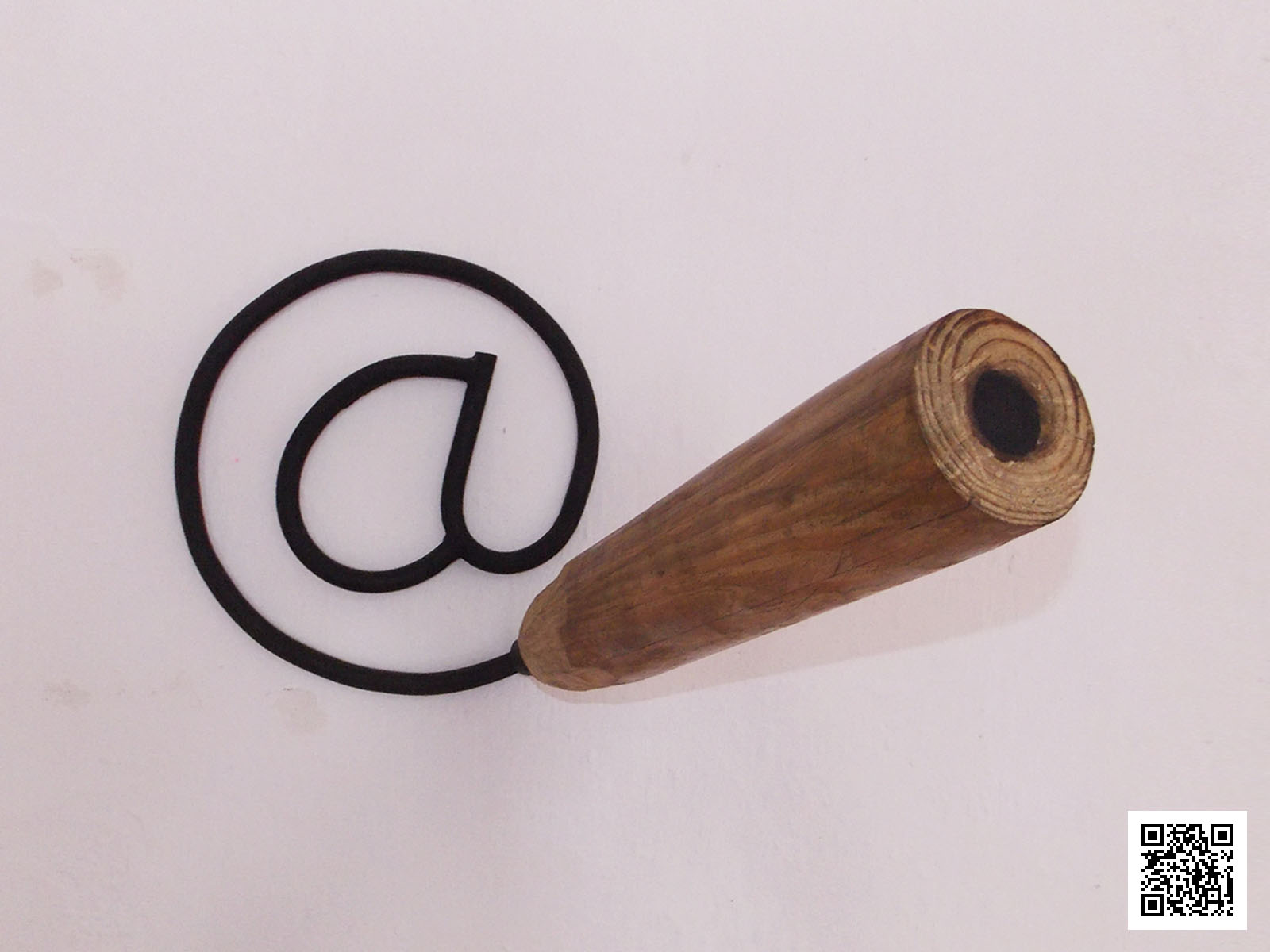
arroba. com (Diptych) by G. R. Malberti Photo: W.L.R

When the new law of “expansion” of INTERNET service goes into effect tomorrow, 11 million Cubans will be able to go to cybercafes and pay $4.50 USD (115 Cuban pesos) per hour to surf cyberspace. I’m sure that with the average salary of 400 Cuban pesos a month, very few will do so, which will make the current digital breach between Cubans and the rest of the world wider and deeper.

But what those who can pass the first hurdle of price and seat themselves in front of one of the 334 computers available (nationwide) in the new State business probably don’t know is that they will be paying to enter one of the most sophisticated, invisible and exotic government machines for the control of the INTERNET that has ever existed. This is what I like to call the “Cuban Model” of INTERNET.

It’s quite possible that the new clients of “Nauta” (as the government telecommunications company ETECSA calls its cybercafes), will be nervous because while they type in their user names and passwords in social networks, review their email and visit online news sites outside of Cuba, a “cybercafe caretaker” or a camera will be very nearby, but that is pure distraction. continue reading

The reality is that from the moment they open the door of the cybercafe they will be inside the “Cuban Model” of INTERNET. Many are unaware that not only does the Cuban government own and have total control over all the Cuban cybercafes and computers where ETECSA’s new customers will type in their private information. The government also owns and controls the famous ALBA 1 fiber optic cable which connects the island to the world wide web, and all the satellite antennas that since 1996 have had the same function, and is the only provider of INTERNET (ISP) services, NAP, DNS, nodes, firewalls, proxies, routers, modems, switches, access points, hotspots, antennas, radio frequencies, NIC, IP, domains, .cu, hosting, telephone posts and wires, TIC services companies and computer stores.

But just when many think it’s too much, there begins the black list of dark forces that work in parallel doing their dirty work: web administrators, computer engineers, political police, cyber police, business security services, agencies of control and supervision, national security laws, gag laws, information security laws, price control laws, armies of trolls, pro-government bloggers, online news sites, television channels, radio stations, newspapers, etc.

While around world many governments and businesses promote free WiFi. While 4G becomes a standard. While every day 3 billion people connect to the INTERNET and a billion of them do it through their mobile phones. While the courts uphold data protection laws. While cyber-activists fight to maintain free, open and neutral INTERNET. While internauts battle laws like SOPA, PIPA, SINDE and HADOPI. Still today, more than 15 years after the arrival of the INTERNET to Cuba, 99% of the 11 million Cubans who live on the island are trying to get on the world wide web for the first time. It must be because Cuba, Cubans and the “Cuban model” of INTERNET don’t resemble anyone’s.

Wilfredo Lopez R., Havana, Cuba

3 June 2013

Cuba Will See Itself Forced to Open Amateur Sports to Professionalism / Anddy Sierra Alvarez

With the decline of sports facilities on the island, the Cuban government it taking drastic measures in order to keep sports alive, based on already failed communist ideals. A situation that corners the Castro government so that for once, it will open the doors to professionalism.

Havana province has the majority of high-performance sports facilities, which over time have lost the competitive fundamentals critical to the development of Cuban sports.

Some reference installations

East Havana, an area of the capital, benefited by being the site of the Pan American Games in 1991, with the construction of the “Villa Panamericana” (a sports complex that includes facilities such as the Velodrome (Cycling), athletics, tennis, pools etc). Currently it is here that we find the only stadium of athletics (Olympic) “still not over” that can be used for international competitions. The stadium provides high performance athletes — world champions or finalists, Panamericans, Central Americans — “comfortable rooms” located in the same building, where the bed can injure you or the ceiling can give you a shower in rainy weather.

“Bare Hill” as the capital residents know it, is the ESFAAR, Training School of High Performance Athletes. From the street people can see its damaged structure and contemplate the broken windows during practices for volleyball, basketball, fencing, boxing and other sports. continue reading

There is also the National School of Gymnastics, the youngest building, whose construction is the ongoing work of INDER, the National Sports Institute. Proof of this was the concrete sign that read 2000 for the start date and with completion date of 2004. Later they changed to 2006, until they decided to remove the information. Currently it is a facility that has not been fully completed.

Athletes are subjected to exploitation

The sacrifices of the athletes are part of the sporting life, but working without any recognition is essential affectation of the human stimulus that Cuban athletes lack.

All athletes who have deserted from the island have done so with the aim to seek prosperity in the future. Something they are denied in Cuba totalitarian and comprehensive political ideals, that take into account political fear. Individual enrichment is alien to the Castro supporting group, which would do anything to maintain power and which they have managed to do.

Many athletes comment on their poor earnings and mocking the government offers: “Crumbs they give us in return for great effort,” said an anonymous junior athlete.

They either open the doors to professional sports, or simply lose their best athletes

There are many dangers, loss of facilities such as EIDE (the Jose Marti Sports Initiation School) closed for lack of capital, ESPA (the Manual Permuy Senior School Athletic Improvement) closed for the same reason.

Stadiums and sports centers are in very bad condition, the only thing the government cares about is everything having to do with baseball for its political strategy. In short, if no measures are taken to slacken the reins over baseball and combat sports (boxing) and let the athletes be recruited by clubs, everything will go over the cliff. A situation that the government itself has created.

27 May 2013

State Negligence Kills Mother and Daughter in Trinidad When Their House Collapses / CID

Dos crucesIn the early hours of Sunday June 2, a tragedy visited a humble Cuban family. Luisa M. Isnaga Medinas, a young mother, and her daughter Idaisil Rivero Medina, age 12, died when their house collapsed in Trinidad.

The family lived at 460 Antonio Maceo Street between Rosario and Simon Bolivar, just two blocks from the tourist center where thousands of foreigners go to visit the World Heritage city, while the homes of the townspeople are in deplorable conditions.

The neighbors confirmed the numerous complaints made by the family to the People’s Power asking for help with repairs, because it was an old house with another on the second floor. Property repair inspectors were to do the assessment but it was not resolved. Instead they indicated that those who were living there living who had to do the repair because they had no resources to give them.

While all this was happening the regime installed an expensive and sophisticated system of video camera surveillance. In the face of the tragedy the locals wonder “why are they spending thousands of dollars to monitor the poor, while our houses are collapsing.”

Reported by Rene Lozano Maidin Carter and
Ombudsman of Cuba (CID)

3 June 2013

ETECSA, Internet and Cuban Society / Anddy Sierra Alvarez

Some 0.004% of the Cuban population will connect to the Web.

Starting on June 4, 2013, 472 people (maximum) will be the daily human traffic going to a NAUTA Internet cafe, approximately 0.004% of the Cuban population.

The state-owned telephone company, ETECSA, is expanding its Internet services to the “population” — 472 is the maximum that can be served daily. The navigation speed will be 2 Mbps (megabytes per second) which is equivalent to 2 mil, 48 Kbps (Kilobytes per second), a speed faster than the 50 Kb on telephone connections and better than the satellite connections can reach speeds on the Island of up to 300 Kbps.

According to the article published in the newspaper Granma, 118 rooms will be opened, more than the 99 previously. The internet rooms will be identified with the NAUTA stamp with which ETECSA is commercializing its navigation services in the country.

All this has arisen with of the activation of the fiber optic cable obtained from the Cuba-Venezuela economic agreements. Which brings a space of freedom to the “supervised” world wide web. Where the majority of users will be human rights defenders on the Island. Thus the government is certain to control the population’s use of this technology.

One measure that has come to light is the prohibition on voice traffic. But it reflects the free navigation as well as the ups and downloads with equal status. The cost will drop to 3 CUC (over $3 U.S.) equivalent to 75 Cuban pesos.

The Cuban population has unreasonably delayed access to technology, where all these technological changes itself bring social blockade. The aging of the population will be a critical factor, as older people will show little interest to the coming changes as reflected the inability of people to navigate cyberspace.

3 June 2013

The Return / Yoani Sanchez

la-maleta-de-viaje-de-yoani-sanchez1-450x600My suitcase is parked in a corner, the tiny gifts that traveled inside it already in the hands of friends and relatives. The anecdotes — for their part — will need more time, because there are so many I could spend the rest of my life parsing their details. I’m back now. Beginning to feel the peculiarities of a Cuba that in my three months absence has barely changed. The number of uniforms was the first thing that jumped out at me: soldiers, customs, police… why do you see so many uniforms simply on landing at José Martí Airport? Why is there this feeling of so few civilians and so many soldiers? After the dimmed lights of the halls, the none too friendly question of a supposed doctor interested to know if I had been in Africa. Where are you coming from, honey? She jerked her head around noticing my blue passport with the shield of the republic on its cover.

Outside, a group of colleagues and family waited for me. The embrace of my son, the most cherished. Then having again entered my own space and the unique pace at which life transpires here. Catching up with the stories, events in the neighborhood, the city and the country. I’m back. With an energy that the daily stumbling blocks try to cut short, but with enough left over to undertake new projects. One stage of my life is ending and another is emerging. I have seen the solidarity, I have felt it and now I also have the duty to tell my compatriots on the Island that we are not alone.

I have brought so many good memories: the sea in Lima, the Templo Mayor in Mexico City, the Freedom Tower in Miami, the beauty of Rio de Janeiro, the affection of so many friends in Italy, Madrid with its Museo del Prado and its Cibeles Plaza, Amsterdam and the canals running through it, Stockholm and the cyber-activists from the whole world I met there, Berlin and the graffiti that covers what was once a wall dividing Germany, Oslo surrounded by green, New York that never sleeps, Geneva with its diplomats and the United Nations headquarters, Gdansk laden with recent history, and Prague, beautiful, unique. All these places, with their lights and shadows, their grave problems and their moments for leisure and laughter, I have brought with me to Havana.

I am back and I am not the same person. Something of each place where I was stayed with me, and the hugs and words of encouragement I received are here today, with me.

3 June 2013

A Pawn to Distract You / Alexis Romay

Editor’s note: This article was originally published at time of Luis Pavón Tamayo’s reappearance on Cuba Television in 2007, and was translated to post here on the occasion of his recent death.

On more than a few occasions, those who analyze Cuba and even those directly engaged in the country, compare it to a game of chess. This practice has given us quotations that make clear our condition as mere pieces (and, thus, expendable) on a giant political chessboard. It is quite possible that those with good memories still recall the invitation that Spanish President José María Aznar offered to Fidel Castro at the end of the ‘90s: “Your move.” In that game —it pains me to remember— white won.

Understandably, the fascinating world of the sixty-four squares and its apparent simplicity —where things really are black and white— invites us to use its terminology to describe or simplify complex situations; however, I fear that those who make use of this shortcut perhaps do so in search of a quick and easy metaphor to create an image, while lacking a thorough understanding of the game.

There are several chess tactics that have always been present in the actions of the Cuban regime. And they have resurfaced with tenacity since it has been classified as a State secret that the royal intestine —Fidel’s— had a blockage.

For example, a little less than a month ago, in response to the Pavón affair —where Luis Pavón, a dark censor of “the five gray years,” was resuscitated on Cuban television after three decades of well-deserved oblivion and where, in response, a group of intellectuals on the island and in exile spoke out against him— a friend of mine asked what I thought about it all. To her utter amazement, I replied: “It’s a distraction,” a chess tactic in which an enemy piece placed in an important position is “distracted.”

Once a piece is “distracted,” it is possible to exploit the new scenario attacking other vital elements of the position of the adversary. Usually the job of the “distracted” piece is to protect another. Once it is “distracted” from its function it leaves the other piece unprotected and, therefore, vulnerable. This occurs with great frequency in chess. The same happens in politics.

In Cuba, the tactic of distraction is used systematically by the government in order to avoid reality. These distractions make it possible not to have to pay attention to what is urgent: the poor state of the national economy, the discontent of the population given the lack of resources, the lack of civil liberties and economic freedoms, the eternal repression and the right of Cubans to be aware of the health of the Chess Player in Chief.

Distractions on the island’s most recent chessboard are: the embargo (the champions of euphemism call it the Blockade), the child rafter Elian Gonzalez, the Five Heroes imprisoned by the empire, the government’s response to the Varela Project which does not mention the Varela Project, the Battle of Ideas (?!), the dismissal of several figures of the Castro elite, the plan to distribute rice cookers, the embargo yet again, the Pavón affair mentioned above, and the subsequent and much awaited declaration of the National Union of Writers and Artists of Cuba (UNEAC). This latter —in line with the amendment to the Cuban Socialist Constitution (2002) which declared Socialism irrevocable— says that “the political culture which is undogmatic, creative and participatory, consistent with the thinking of José Martí and with Fidel and Raúl (sic), founded with the ‘Words to the Intellectuals,’ is irreversible.”

Esteemed members of UNEAC: please be precise. What’s really irreversible in our recent history is the endless number of executions whose blood has forever stained the walls of La Cabaña and, incidentally, the Cuban soul; the irreversible is the political imprisonment of thousands of compatriots simply for disagreeing with the government; the irreversible is the Mariel boatlift; those who fell in the wars in Africa, the Maleconazo, the thousands of boat people who never touched land; the irreversible is the massacre of Canímar River, the massacre of the tugboat “13 de Marzo,” the death in exile of hundreds of thousands of Cubans; the irreversible is that in the quest to escape the island a group of suicides crossed the Caribbean Sea in a 1950s Chevrolet; the irreversible is for a woman to have sent herself to the United States in a DHL box so as not to have to live in the much hyped proletarian paradise. The irreversible is what is irreversible.

To paraphrase José Martí, our poet: “I lived in fear and I know its entrails.” And so, I do not pretend to judge those from Cuba who have raised their voices against the consequence of censorship —the pawn Pavón— nor does it interested me to criticize my compatriots in exile who admonish those on the island for not even mentioning in passing the cause —the king, now castled and one move away from losing the championship game. What I do care about is pointing out that the resuscitation of the old censor is once again designed to divert attention toward the unimportant.

I think the debate is healthy (and it is something that Cubans need to exercise), but I refuse to participate in an exchange about events that happened thirty years ago when, at the moment, as I write my chess-infused note, the number of prisoners of conscience in Cuba totals almost three hundred people.

We mustn’t forget that the so-called “five gray years” embarked on by Luis Pavón and against which a mass of intellectuals on the island have protested, are no more than a fraction of the five decades of our Iron Age, a period which, according to the dictionary of the Spanish Royal Academy is defined as: (1) Among the poets, a time in which all virtues fled from the land and all vices began to reign. (2) A wretched time.

Friends and detractors on both shores: beyond wearing ourselves out with talk and disagreements, there is nothing we can do about the past. Furthermore, there is still much to do for the present. When we have solved the problems of these —still gray—days, I propose an exhaustive review of the darkest passages of the last half century to prevent them from repeating themselves, like Borges’ fictions. Until then, I don’t know about you, but I promise not to be distracted and not take any loose pawn sent my way by the Machiavellian chess machine that is the Cuban regime.

 ***

Originally published in Letras Libres in March, 2007:
Eliminating the (Real) Blockade

tex
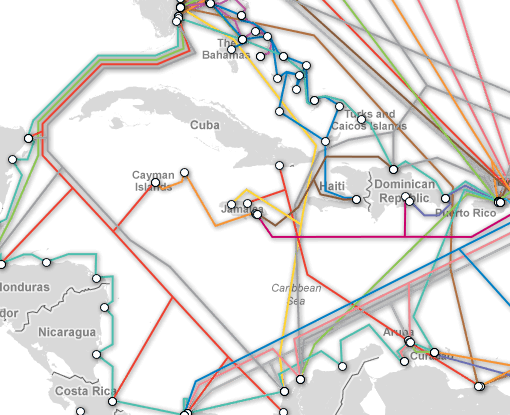
The map shows a portion of the world with the fiber optical cables that give people to access the Internet. Cuba appears isolated in it, blockaded in a trip straight to past at the whim of its rulers.

In 2009 a report published by EFE news agency noted that “A communications company in Miami (Florida) will install a fiber optic submarine cable to link to U.S. and Cuba, which ‘will be the first of its kind ‘.”

The report detailed that the company, TeleCuba Communications Inc., based in Miami, has been authorized to do so by the U.S. Government and that the cable service would start operating from 2011.

But as always Cuba rejected the offer saying everything was already ready for Venezuela to provide the service.

The laying of the cable, roughly 100 miles, which would cost approximately 18 million dollars if it came from Miami to the island “would be much more than just a standard commercial cable,” according to what the entrepreneurs — who never received the Cuban Government;s authorization for installation — said at the time.

This, a good saying from José Martí in one of his poems … “time passed … and an eagle passed over the sea.”

A few days ago the government of the island made announcements in the Gazette of Cuba in relation to some “little permissions to access the Internet” and once again the theme was picked up by news agencies and newspapers, reporting on the opening of a few centers where, under surveillance and at a high price, “some Cubans” could connect to the Internet. They all found it interesting because they believe that “change is coming.”

And are Cubans traveling the world after changes in the measures for permits to travel?

Translated from the blog La frontera transparente (The Transparent Frontier)

2 June 2013

Cuba: Internet, in Slow Motion and Hard Currency / Ivan Garcia

Cuba-Internet-150x150Facing the India fountain, next to Fraternity Park and close to the Capitol, in the center of Havana, is nestled the Hotel Saratoga.

Its ancient facade, painted lime green, has an architecture of curved arches and tall columns. The interior is a modern frame with iron structures and plasterboard. According to the relaxed norms of Cuban hospitality, the Saratoga is a 5 star hotel.

Like almost all hotels, has an Internet cafe. Going up a wide staircase with iron railings, after crossing the piano bar in a small room and pool, one can connect to the internet.

If you have a tablet (iPad), laptop or smartphone, you can do it from anywhere in the hotel, thanks to a wireless network. Otherwise, the Saratoga has three computers. The speed of transmission is a maddeningly slow.

Opening a Yahoo email can take up to 6 minutes. Forget Gmail. The connection runs at 100 kilobytes. Downloading videos and photos that exceed a megabyte is not advisable.

The service is too expensive, even for a foreigner. Half an hour for 6 CUC (over $6 US). One hour for 10. Two hours for 15. In the same hotel where a month and a half ago the singers Beyonce and Jay-Z stayed, the internet works in slow motion.

In 2010 the Castro government, opting for a full ’digital sovereignty’, decided to open its wallet to the investment and together with Venezuela and Jamaica, financed a submarine cable of several thousand kilometers. Its birthplace was the Venezuelan region of La Guaira and termination, Siboney Beach in the eastern province of Santiago de Cuba, about 550 miles from Havana.

Little is known about the cable. It is a kind of ’ALBANET’, with filters and control mechanisms. Behind the famous cable there is an Olympic framework of corruption.

Some put out their hands along the way and lost several million dollars. It’s rumored — in Cuba the rumors are more reliable than the news from the official press — that several people could go to jail.

State media reported euphorically that when the cable is connected, the  data transmission speed would be multiplied by 300. While technical issues are resolved, 97% of the Cuban population still sees the Internet as the stuff of science fiction.

In its absence, a USB flash drive serves as transmitter of information for those computers not connected to the network. The regime considers the internet a ’hegemonic control tool of U.S. imperialism’.

Since the island links to the information superhighway via satellite, the tropical ’think tanks’ wear themselves out trying to design and effective cyber police that can tame the democratic worldwide web.

So far they have not succeeded. What they have achieved is to block sites deemed ’subversive’ and in the workplaces ’big brother’ is watching the footsteps of those disobedient people who decide to take a look at a digital newspaper from Miami or Madrid.

In ETECSA, the State telecommunications company, staff with access to the web had to sign a statement agreeing not to read ’enemy pages or visit pornographic sites’.

Nor may they have international email account (Yahoo, Hotmail, Gmail). Zero Twitter, Facebook or other social networks. But in such closed societies, people applaud a speech with the same emphasis that they blatantly steal from their job or violate established rules.

Raisa, 24, has never surfed internet. That has not stopped the girl from having a Facebook account and a page where she advertises herself as a photographer for weddings and quinceañeras — girls’ 15th birthday parties.

All thanks to a computer savvy friend, charged with editing and updating her site. And those who have State accounts on the internet don’t miss a trick. They sell access for 2 CUC an hour.

But I don’t recommend it. At its best, the connection is 50k. It can take you up to 30 minutes to get to the online edition of the Journal of The Americas.

Even though the Castro regime has established a drips-and-drabs internet, some censored information reaches the average Cuban. Late, of course.

Ivan Garcia

Photo: Several people access internet in a room in Havana. Taken from Infolatam.

1 June 2013

Welcome Home Yoani Sanchez / Wendy Iriepa and Ignacio Estrada

Cuba should know: Yoani Sanchez, creator of the blog Generation Y, has returned to Cuba. A pure Cuban woman. As sweet as our delicious sugar cane and with some ideals as lofty as our Royal Palms.

Welcome home, not only to your family and hearth, but to a nation that saw your birth and that today sees in you one of its most illustrious daughters.

31 May 2013

Forgiveness or Justice / Juan Juan Almeida

The Ladies in White under attack by State Security and their mob

The dictators and their henchmen, as a rule, are extravagant, autocratic, narcissistic, hypochondriac, provocative, enigmatic and disturbing individuals. Because of this, and more, anyone who grew up in any of the links in the chain of a dictatorial regime, shares a psychosocial trauma that is difficult to cure.

Government violence starts to weaken the welfare state with the constant exercise of its own virtuosity to impose terror and creates uncertainty under the umbrella of authority. This validates the power and leaves citizens without any real possibility of using an internal or external entity to defend their rights. It is called — according to some scholars – legal helplessness.

Scientifically it has been shown that this damage affects all people regardless of social class to which each individual belongs. And it affects not only the psychological and family level, but also damnifies cultural and educational development.

I do not believe in left nor right; but that all dictatorships possess as their only ideology the practice of supremacy, and imposition of their rule to the extent that society ends up adopting passivity, submission and resignation as a natural phenomenon.

Totalitarianism, with absolute certainty is sexist, the  rules legally and reigns over the woman by whatever means.

I think many know the repeated humiliation of Cuba’s Ladies in White. But there is so much more; for example, Cuba’s psychiatric hospitals are stuffed with very descriptive records of horrific sexual assault by the authority, which not confronted legally, damages not only the body memory of each female victim, but also the shock becomes irreparable, and is extended to the children.

Countless women who have been affected in their individuality, in their environment, in their family, social and ethical surroundings. Hate, in these cases (without referring to the many mothers who have lost children in the sea), is a sensible and even necessary emotion.

Compelling reason forces me to believe that in order to discuss the future of Cuba and its transition, we should first be self-sufficient and unburden ourselves of the disguise, and with it, the desire to please.

I don’t know about others, but to me, I respect the view of those who are anxious to figure out how to outline a common moral discourse that encourages citizen exaltation; it sounds naive, false, ridiculous and even childish tome to hear them speak of Forgiveness as if this were an elegant, civilized and pragmatic response to State violence.

I wonder how could Forgiveness, by itself — if it could — not be the starting point for another period of violence, or how this same absolution could achieve the reconciliation of a society that for years seen their children confronted like bands of enemies.

I have read, and lately I hear with reiterated frequency, several formulas and examples, but I only trust two old tools that have historically proven to be more reliable than revenge, and more effective than tolerance: The law and justice.

1 June 2013

Curiosities in Revolico.com / Regina Coyula

Exchanging Marriage for a House. Read this please!!!

Date: Thursday, May 23, 2013, 3:43 PM

Sir: For people like you who make fraudulent marriages or use Canadian citizens to come to this country and then let them ship out, the image of Cubans in this country is falling so low. More and more Cubans are seen here as social climbers, ruthless, without values or scruples and it is for acts like this. You know that if the Ministry of Immigration finds out what you are doing not  will the person will not get a visa and be blacklisted but you can lose your status here? (Which obviously would not be a loss for this country).

On the other hand your announcement is very good especially when talking about the benefits of this country, yet in it you do not talk about the new Canadian law which, from October 26, , requires that spouses MUST live in a legitimate relationship for a minimum period of two years after obtaining residency, or they can lose their status and you can lose yours too. Here is the link to Immigration Canada where this law is.

Since you speak so clearly in your ad you should touch on the point that does not seem fair to the person who accepts this not tell them all the pros and cons.

I am not writing this to upset you, but to get you to do a little reflection, as you have shown yourself a bit aggressive in your writing and this isn’t a good way to think things through.

I must say that I totally agree with you that the marketers in Cuba don’t have their feet firmly on the ground and are not aware of the reality in which they live, asking these amounts beyond all logic. But what you propose is a fraud from every point of view (for the Canadian government who opened the doors of their country and to the Cuban citizen to whom you didn’t speak clearly about things here).

From your message I can deduce that you’re doing very well here so I think that instead of this you can gather a certain amount and negotiate a fair price, in the end according to you one achieves here everything he wants.

Regards

(I didn’t find the classified ad that gives rise to this answer, but I can imagine it. NOTE from Regina)

27 May 2013

Cubans Prefer Shortcuts to Get on the Web / Luis Felipe Rojas

Cuba’s Ministry of Communications has announced the opening of a hundred Internet cybercafes throughout the whole country for June 4. The official press informs us there will be a doubling of the navigation capacity and a reduction of 1.50 CUC in the price per hour (to 4.50 CUC, or a little more than $4.50 US), if we compare it to the previous 6 CUC per hour it cost for an access card.

With the implementation of the 118 centers, government officials announced an increase to more than 334 computers with internet access. This is a ridiculous figure when taking into account that about 68,000 specialists  from the Ministry of Health use email and the Internet, who in turn sell it “under the table” at prices ranging between 30 and 60 CUC per month. The same applies to journalists, intellectuals and other employees of ministries and state enterprises that have access to the Internet from their homes and who, with this practice, earn extra money while helping to scale up access to the network among Cubans.

For the small business owner in Cuba is still more profitable to rent email accounts and Internet service “under the table” in the interstices of the black market. At the distance of a click or a discreet phone call it’s possible to have sixty or ninety hours a month, according to their needs. Use of public Internet sites for businesses such as real estate, sales of various items, and rooms rentals is infrequent. A domestic connection remains the ideal way.

Illegal Internet cafes, which operate at rates between 1 and 2 CUC per hour, will not be affected by this measure that is announced as one more reform of the Revolution, because payment rates, although they have fallen by a third, will still be prohibitive for most people, if we consider that the minimum wage is about 220 Cuban pesos per month and a connection card cost 112 Cuban pesos for an hour.

Email service is commonly used for messaging with family and friends abroad, in these rooms you can see the long lines of girls waiting for their turn to communicate with their foreign boyfriends or suitors. Those who want to have a more secure communication, rarely use the email service sold by the State.

Another innovation is the implementation of the e-mail “@nauta” with international reach with storage capacity of up to 50MB.

In the flood of information coming from the main official newspapers, nothing appears about about the restrictions on sites opposing government policies. Magazines and newspapers showing the daily life of the Cuban reality are sometimes censored by the controllers of the national servers.

The famous “Operation Truth,” where restless kids from Computer Science University launch daily attacks on the social networks in search of new dreamers with the revolutionary project, has sharpened its weapons.

For over five years the “Hermanos Saiz” Association offered young artists and writers the possibility of a fixed line, computer, and a fee to pay the telephone bill in exchange for “combatting” inconvenient intellectuals, wandering daily through the social forums to convince Internet users around the world of the revolutionary benefits and to submit a monthly report of their cybernetic fidelity.

With proceeds from one 11-hour session, the 118 Internet rooms should report an average of half a million CUC at least, assuming a massive influx to the connection spots, but with the rising cost of everyday life, connecting to the Web is still a luxury that few can afford if they use only the services the State provides.

30 May 2013