The Cannes Film Festival Closes / Miguel Iturria Savon

I have visited the Spanish Mediterranean but Cannes is, for me, a futuristic city approximated by its famous international film festival. The 66th ceremony closed with awards presented by Steven Spielberg, president of the jury that awarded the Grand Prix to the film Inside Llewyn Davis, from the Coen brothers, and the Palm D’or to The Life of Adele, from director Abdellatif Kechiche—a Tunisian living in France. Mexican Amat Escalante was regaled as best director and the awards for best actor and actress went to Berenice Bejo of The Past, and Bruce Dern (Nebraska)  followed closely by the memorable Michael Douglas, largely applauded for his convincing portrayal of Liberace in Behind the Candelabra.

Before the Cannes Jury vote, as controversial as always, the name of the coastal Southern France city resounded in European television and newspapers by stealing the jewel that should have lit the female stars. They compensated the loss with their elegant and costly dresses on the red carpet inhabited by reporters and tourists; in addition to the critics’ claims, actors, directors, and producers, as attentive to the impact of their work as they are to the leading ladies’ glamour.

Judging from the critics and the comments posted on Twitter, Facebook and other social media, the film The Life of Adele, interpreted by French actresses Adéle Exarchopoulos and Léa Seydoux, could have taken the grand prize. According to Carlos Boyeros, this film “is an intimate prodigy that searches for art for three hours in the feelings of a woman whom we follow throughout a decade of her existence…” Others, without ignoring the value of the piece, realize that the theme as well as the excessive sex scenes between the women is simply more of the same and harmonizes with the increasing protagonism of gays in Europe.

Among the numerous films presented and recognized in Cannes were the Japanese Like Father Like Son, directed by Herokaza-Kore-eda and The Past, from the Iranian filmaker Asghar Farhadi, author of the celebrated A Separation.

Translated by: Alexis Rhyner

27 May 2013

Fear and Loathing in LASA / Orlando Luis Pardo Lazo

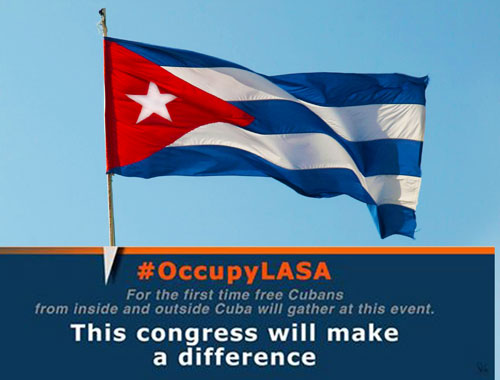
Poster by Rolando Pulido

After three months moving from coast to coast of the United States like an off-balance electron, finally I receive a little from dirty faces, the smell of croquette and military comemierduría (“crap eating”). I deserved it: I already missed my homeland so much…

Welcome to LASA 2013, Cubans.

Indeed, also after three months meeting there at the University of Havana, as if they weren’t a delegation but a Fidelista fascio about to enter combat, I saw myself finally trapped once again in our country. Like Chacumbele I killed myself. The scaffold is just like…

I squeezed into LASA 2013, thanks to the readers of my PayPal, who paid so that I’d be the final member of the Cuba Section of its XXXI Congress, in Washington DC. All my friends warned, in Spanish and in English: “Don’t appear in this lair, do not present yourself to this insipid isle of ideologists of inertial idiocracy (the alliteration is mine, it’s beyond my control), better to continue as “homeless” with your little columns, photos, chats, fiction and anthologies, better you flee from our history while the post-Communist string in this other country lasts for you.”

But eventually curiosity gnawed at me. And I had to insert myself into the dimly lit little classroom with the halitosis of the hysterically baked left in the USA (someone would have to present a PhD on why those who “defend Cuba” never get good dental insurance).

There inside, at seven in the evening, from the near and the far of America, I discovered a troop of Cuban economists, technocrats that the system uses and discards every five years, and an elite team of security people in their guayaberas, the de rigueur shirts of the diplomats, whose executioner muscles from the Cuban streets I recognized right away, just like their totalitarian moron crewcuts. I realized that I was in the capital of imperialism and had gotten myself, by my own taste, in a Castro box, where the only thing that occurs to them is just what happened: an act of repudiation (revolutionary imagination is very common; the government is insolvent in everything except in the organization of hatred as a source of governance).

The prestigious Cubanologist Ted Henken of Baruch College in New York, an academic coerced years ago at an airport in Cuba and expelled from the island by an anonymous big-mouth, was the victim of the revenge. It occurred to the charismatic Yuma to become publicly interested in the fate of the Cuban colleague Omar Everleny Pérez, evangelist of the fraudulent-change of the Raulista reforms, recently ousted from the Center for the Study of the Cuban Economy, with the extra bonus of preventing him from traveling to LASA 2013, despite the fact that his speech “Direct Foreign Investment in Cuba: possibilities and challenges” was still included in the official program. (A colleague justified his absence by claiming that Omar Everlany was happy, and that he had entrusted to him to witness that no one mention his name in the USA).

The reply to Uncle Ted was with throats trembling with anger and raised index fingers (was it in homage to the former Chief Economist?) that were pointing like lightning rods to the ceiling of the Marriot Wardman Park Hotel. They denigrated the poor poster of the Cuban-New-Yorker designer Rolando Pulido, which was one key of hope to undo so much closure (they had crapped themselves from fear with the #OccupyLASA hashtag, because, as specialists in boycott and sabotage, they are well aware that “from saying to doing is no stretch”).

So then, with their brand-new USA visas like a rapid response medal in their passports, they took shifts passing around the “microphone of dignity ”: Carlos Alzugaray (LOUD SPORTING APPLAUSE — like at a baseball game), Juan Triana (LOUD SPORTING APPLAUSE), Jorge Mario Sánchez (LOUD SPORTING APPLAUSE), and some other native, likewise the Canadian John Kirk (LOUD SPORTING APPLAUSE), while from the stalls Miguel Barnet smiled in sinuous satisfaction (OVATION). Mission accomplished, comedians! (CURTAIN)

I wanted to make up a little American Airlines bag with the brochure of the 5 Heroes, that they gave me upon entering the room (more a call to launch a public scandal in front of the White House) and barf into it the simulacrum of coffee that is consumed here.

I already had forgotten the rudeness, the authoritarianism, the illustrious mediocrity, the “mustaches” of sub-socialist soup, the copper complexion and the accompanying tummy, the sparse clothing, the self-victimization due to the “conditions of the American blockade” (even a petal from a free flower hurts them, these “poor-little-me” types, because surely it is a part of a multimillion-dollar campaign to damage the “savior of children” image of the revolution: and here sneaking around right in the open was the activist Frank Calzón of the Center For A Free Cuba, to prove it). My soul had forgotten the cold scar left by the the implicit terror when they shout at you, and you know full well that they drive a red Russian Lada, which is the end of the rabble rousing and the beginning of the crime in a gutter in Bayamo or Baltimore.

Fuck. I’m glad that the LASA 2013 congress is over. Go fuck yourselves, I repeat, so you can get over with excommunicating me and no other American institution will remember me. What a relief.

For dessert, two female acolytes from Havana’s Superior Institute of Art went about stalking us Cubans who didn’t belong to the official delegation. I was about to denounce them to the hotel guards. Ugly like only they are, Communists with the strength of celibacy. But then I figured that hotel security was being paid off by them. It would be the same as typing in a password in the computers of the event, it would have been a suicide. Like living in the United States is the best way to come into the range of that clan, which begins with the Cuban Academy and ends in the catacombs (so that later those same scavengers of academia study my work and charge for their cretinous summer courses and travel to Cuba before the season of The Fall).

You have to leave the country, comrades. Leave that nightmare of a country. Leave this paradise of a country. You have to emigrate truly, it’s not enough to make intelligent faces or impart their spiels in any public or private Made in USA university. We cannot allow ourselves the luxury of triumph, that would be our most degrading defeat. We must continue to the north, comrades of the pack, always further north like a pack of wolves of boreal adventure. The view of the implausible glass star that does not move in the pole, mirage of barbaric light, midnight sun, body which crystallizes into a corpse but is not corrupted. We must tread the lost steps on the fossilized snow where nobody has ever pronounced the word “Fidel.”

Return to Cuba, now, you despots and unlucky ones. And wait for me, since in my flight toward the antipodes I am always going to return.

Orlando Luis Pardo Lazo

From Washington DC

Poster by Rolando Pulido
Translated from: Penultimosdias.com

6 June 2013

The Latin American Council of Churches (CLAI) left us with a bitter taste / Mario Lleonart

The VI Assembly of the Latin American Council of Churches (CLAI) came to an end, and this entity of Latin American churches missed out on the opportunity to make history in Cuba, adopting a genuinely prophetic position. Instead, the Assembly let itself be manipulated by the Cuban Council of Churches (CIC), which obviously is used by the regime. How sad!

Translated by Chabeli

29 May 2013

Olive Green High Society / Ivan Garcia

103031308-300x164They have few reasons to envy of their capitalist counterparts. The differences between them are ones of rhetoric and philosophy. The anti-capitalist islanders having studied Marxist manuals and speak on behalf of the poor.

But many are living at full throttle. At the workplace they wear sweltering uniforms designed by some sadistic tailor from the former Soviet Union. Twenty-five years ago they used to get around in Russian-made Ladas with capitalist tires and stereo systems. They called attention to themselves.

The top officials were untouchable. Officers used to place their caps in the rear of their vehicles so that police would not stop them for traffic violations. Laws were for other people to obey.

The only ones who could dismiss them, punish them, jail them (or shoot them) were the Castros. They lived in the former residences of Havana’s upper and middle classes in the Siboney, Miramar, Nuevo Vedado, Fontanar or Casino Deportivo neighborhoods.

They had more than one car and houses with Ikea furniture, electric kitchens, “made in USA” refrigerators, Sony televisions, South Korean air conditioners and Philips audio equipment.

They enjoyed three succulent meals a day and once a week they read articles from the western press that had been condensed for the directors of the Department of Revolutionary Orientation or the Communist Party. For vacations they travelled  to one of the USSR’s Baltic republics or strolled carefree through Prague’s Wenceslas Square. And they went to Varadero whenever they felt like it.

The drank Czech beer and Yankee whiskey. They smoked cigars for export and carried American dollars in their wallets back when doing so was forbidden. Ministers and military brass were fond of dressing up like Madrid’s posh elite or New York’s jet set, with Levi’s 501 jeans and polarized Ray-Ban sunglasses.

In the difficult years of the “Special Period,” while the masses whom they lauded suffered from hunger, became ill from malnutrition, put up with blackouts lasting twelve hours and got around on bicycles, the revolutionary upper class maintained its same lifestyle. They had electrical generators in their homes, celebrated with loud parties and never had to put up with the lousy food — ground beef from soy, meat paste and Cerelac — devised by Fidel Castro for the average Cuban.

In the 21st century they have become successful entrepreneurs. The various businesses established with capitalist partners as well as the “industry” which arose after the increase in remittances sent by Cubans living overseas nourish members of the armed forces and interior ministry.

An absurd captive market, which forces Cubans to pay for everything from a bottle of cooking oil to a ventilator in another currency, is managed by a holding company set up by the military.

Meanwhile, the number of maneuvers intended to counter a supposed Yankee invasion have diminished. Aging Russian armaments, built in the 1980s when the government was mobilizing the population for “imminent enemy aggression,” lie rusting in underground bunkers.

Today the new Creole upper class is betting on the world of business. It advises Venezuelan comrades and secures positions in European embassies. The old Russian Ladas are no longer fashionable. Now they show off with Audis and Hummers.

Cuban baseball bores them. They prefer to watch Big League games, championship football matches and NBA playoffs live on satellite. The like to play golf or go hunting in exclusive game reserves. They dine as though they lived in London or Paris. They have internet access at home and use Skype for video conferencing or for chatting with their children in Florida.

Offspring of the nouveau riche have studied or are studying at universities in the United States or Europe. Others, more in tune with the times than their fathers, prefer to live in exile.

At night this elite bourgeoisie dines at Havana’s finest restaurants and frequents its hottest nightclubs. They dress in designer clothes, perhaps made in dismal garment factories in Bangladesh. They sport French perfume and Swiss watches. By day they take part in revolutionary actions while wearing white guayaberas.

They demand productivity and sacrifice, speak of a prosperous and sustainable socialism, condemn Yankee imperialism and ask that the people work with them to end rampant corruption. This new Cuban upper class loves to foment revolution from the soap box.

Photo: Banquet and show from the XV Festival del Habano 2013, which took in more than a million dollars. These festivals has been taking place in the Cuban capital since 1994 and bring together hundreds of celebrities, specialists and cigar lovers from all over the world. Parents and children from communist military high society regularly attend these exclusive, opulent events. From Diario de Yucatán.

Iván García

16 June 2013

The Origin of Poverty / Ignacio Estrada

Julio César Solér Baró

Blogs at Misceláneas de Cuba

Claiming that the origins of poverty stem from politics is an insult.

Poverty has no roots in the wings of determined politicss and departing from the vast hunger created by the right-winged governments in the world, here, nonetheless, you have the example of the what the left has done for more than 70 years in Europe and the West; that which they continue to do in Cuba and North Korea, that what they did in Angola, Monzambique, Ethiopia, Combodia, Vietnam, Maoist China, Laos, Kampuchea and that which has been occurring in Venezuela.

The origin of poverty is segregation, in other words, the policies that create different kinds of development. This is fundamentally administrative rather than ideological.

The left had its opportunity to kick the “whores” to the street and take away their need for “sex” and there is the story: They did not accomplish this, Cuba, my country is a living example where the people have always died from hunger under the Castros and their damned Leftists, remember “Palo Cagao” and the “Island of Dust” in the “Marianao” where I discovered in my own flesh the acid and so many lies. We went to “free” school, voluntarily abandoning our souls and free will only to realize that in the exile of what we learned there that the rest of the world doesn’t give a damn, that we have to live this revalidating subjects and colliding with the 40-odd years with these basic subjects from which Marxism robbed all of its class hours in our 20s.

The origin of poverty, at the same time the origin of violence, is segregation. The latter is understood as the politics that create different kinds of development, the last being access to social well-being in a determined context, having today’s standard: The Universal Declaration of Human Rights.

Translated by: Alexis Rhyner

14 June 2013

Looking for a Lost Pill / Yoani Sanchez

Photo taken from http://habanero2000.wordpress.com/2011/10/17/ansioliticos-en-la-habana/

The piece of paper was left under the door, but he only found it the other day. The list was written in rough handwriting, with spelling that exchanged “R’s” for “L’s” and some “B’s” for “V’s.” But he understood everything. Diazepam continues at 10 pesos for a dozen pills and should be delivered within a day, at least for the next month. Paracetamol is also available, so next to the name of that medicine he put the number two. This time he didn’t need alcohol, but Nystatin cream is a yes so he marked it. His son, restless by nature, could also use some meprobamate so he also wrote down the number for a several week supply. This dealer was reliable, he’d never been cheated, all the medications were good quality and some were even imported. More than once he’d bought the sealed jars that said, “Sale prohibited, free distribution only.”

The business of medications and other medical supplies is growing every day. A stethoscope on the black market costs the salary of two working days; a Salbutamol spray for asthmatics costs the wages of an entire work day. Given the undersupplied State pharmacies, patients and their families can’t sit around with their arms crossed. A roll of tape costs around 10 pesos in national currency, the same price as a glass thermometer. You can break the law or continue diagnosing fever with a hand to the forehead. The danger, however, comes not only from violating the law. In reality, many customers self-medicate or consume pills that no doctor has prescribed for them. Given the clandestine seller, it’s not necessary to show a prescription and he never questions what the client is going to do with the pills or syrups.

Despite the successive sweeps against drug smuggling, the phenomenon seems to increase rather than decrease. In the Havana area of Puentes Grandes an old trash bin turned into a pharmaceutical warehouse is the emblem of the government strategies and failures to prevent illicit sales. The police are incapable of eradicating the situation, because the diversion of medications is carried out from grocers, pharmacy technicians, nurses, doctors, even hospital directors. The greatest demands are centered around analgesics, anti-inflammatories, antidepressants, syringes, cotton and painkiller creams. The illegal drug market also goes along with adulteration and counterfeiting.

Some small white pills, costing three times their official value, can end the problem, or be the start of others, more serious.

19 June 2013

Occupy LASA / Orlando Luis Pardo Lazo

texttttttt
The 31st Conference of the Latin American Studies Association marked the first time that free Cubans from both in and outside of the island were permitted to attend. Photo: via penultimosdias and Wikimedia Commons.

From Sampsonia Way Magazine.

For many years academic study of Latin America in the US has rested on a form of political leftism that brushes aside anyone who won’t comply with the Cuban revolution’s orders. As a result, many intellectuals on the Island have been excluded from Latin American professorships just for having lived in exile after suffering repression in our country.

The Congresses of the Latin American Studies Association (LASA) have by no means been free of ideological apartheid. Not only does the Cuban delegation include only those names that have been authorized by the Cuban government, but their speeches, which are officially approved by a national board, never contradict the propagandist revolutionary rhetoric.

However, the XXXI International Congress of the LASA in Washington DC (May 29 – June 1, 2013) was an exception to these rules. Various Cuban human rights activists, now traveling the world following the scrapping of Exit Permits, registered for the conference online as a hash-tag spread through social networks: #OccupyLASA.

Perhaps in response, some pro-government professors from the University of Havana (Juan Triana, Jorge Mario Sánchez, and Carlos Alzugaray, together with North American colleagues such as John Kirk of Dalhousie University, plus Cuban diplomats and security personnel from the Consulate) engaged in an “act of protest” against researcher Ted Henken of Baruch College (New York), simply because Henken had asked about the economist Omar Everleny Pérez, who had been dismissed from his position in Cuba without explanation and prohibited from traveling despite being part of the LASA program.

Nevertheless, panels on topics such as “Afro-descendant Populations in the Cuban Nation,” included the critical voices of Manuel Cuesta Morúa, Juan Antonio Madrazo, Leonardo Calvo, and Rafael Campoamor, who used theory and practice to question the anti-democratic character of the Havana regime and the prospect of a democratizing transition.

Such topics were unheard-of at LASA for decades, which is why 2013 was the beginning of a new story: From now on the Congress will have to be less of a complicit ghetto for ideological dreamers and must reflect the intellectual whole of our nation.

12 June 2013

Go to Sampsonia Way Magazine to read OLPL’s new column there on a regular basis.

Interview with Rosa Maria Paya / Lilianne Ruiz, Rosa Maria Paya

Harold Cepero, center, and Rosa Maria Paya, right.

By Lilianne Ruíz

HAVANA, Cuba, May, www.cubanet.org.- Rosa María Payá, daughter of the late leader of the Christian Liberation Movement, returned to Cuba after finishing a tour with the main objective of promoting an international investigation to clarify the circumstances that led to the tragedy on July 22, 2012 that killed Oswaldo Paya and Harold Cepero.

The daughter of Oswaldo Paya and Ofelia Acevedo agreed to an interview for Cubanet. Having captivated the public through the media, she insists that neither his undisputed leadership nor she herself that is the most important thing. To discover whether or not there was government responsibility in the events of July 22, 2012, would end with a cycle of violence and impunity for State Security, and the alleged immunity of the authorities to the consequences of the systematic violation of the human rights of all Cubans.

Lilianne Ruiz: What is the situation of the demand to international organizations that they investigate the Payá case?

Rosa María Payá: In the Universal Periodic Review report, there was a statement on the matter. We presented the case to the Rapporteur on Extrajudicial Crimes of the United Nations Human Rights Council, headed by the High Commissioner Navi Pillay. A few days later, the Special Rapporteur answered us saying that they accepted the case and are in contact with the parties. In fact, I think the words that they used in contact with the families of the victims, which implies a judgment about what happened. Beyond that, the United Nations has its mechanisms of action, directly with the government of the country, of sending a request for information or of sending emergency measures, not all of which are public. What we do know is that they are working on the case.

I asked Mrs. Navy this question directly because after the speech to the Human Rights Council — in that two minute speech, I was interrupted by seven countries with “human rights standards,” including Cuba, Russia, Belarus — after that there was a plenum with the High Commissioner, and I was able to directly ask her the question of whether she knew about the case (i.e., the request for an international investigation) and she gave me her condolences, told me they knew about the case and put me in touch with the Rapporteur on Extrajudicial crimes; and that’s when we presented demand, and a few days later they responded by saying that they have the case. It is a process. I’m not saying they are doing an international investigation, I’m just saying what they said: they are working on the case with the United Nations mechanisms, not all of which are public.

How did your speech before the United Nations Human Rights Council go?

RMP: During the Human Rights Council there are some weeks when NGOs can speak. There was an NGO called U.N. Watch who gave their time to me. I had two minutes at the Human Rights Council, and when it came time for my speech I hadn’t been speaking for thirty seconds when “Cuba” started to make noise and demand the floor. The president, of course, stopped me, and gave the floor to the representative from the Cuban mission to the U.N. I can’t find the exact words, but the tone was the same threats as always, “How is it that this mercenary can come before the United Nations Human Rights Council?” They asked that I not be allowed to speak, that I not be allowed to finish the two minutes.

I believe that later the United States got up and said something like, “Fine, in any event, we all have the right to speak. We are going to listen to what she has to say.” The United States sat down and the following began to stand up consecutively: China, Russia, Belarus, Pakistan, Nicaragua, I don’t remember which other countries who say they are “standard bearers of Human Rights,” standing up to support “Cuba,” to say, “just to support Cuba’s motion.” But fine, after the last one sat down, the president turned to give me the floor and I could finish.

At this Council they listen to all kinds of things, every day that it lasts — from the slaves of Mauritania, to torture in Iran, and most of the countries don’t react against the Human Rights activists who are talking there. This reaction, apparently planned — because they would have had to talk with China, Pakistan, Russia, Belarus, Nicaragua, because they jumped up at this moment and supported “Cuba” — also indicated their arrogance, their inability to deal with the truth. What we were asking for there was an investigation, we were asking for a plebiscite. We were not accusing anyone, on the contrary, we were proposing a dialogue.

What can you tell us about your interview with Angel Carromero?

RMP: Well, I talked with him upon arriving from the airport. I arrived from the airport — I was very tired, I was going to go to sleep — and he was at my house. My cousin’s house. He was very close, very coherent, very rational; he explained everything to me. He wanted to explain everything to me step by step, what had happened. He was angry at how he had been treated in Cuba, at how he had been treated in Spain, about the things that they continued doing, the attitude of the press. I say angry because he was frustrated that what had come out was not the truth, and with regards to his own situation, he was being treated as guilty though he was innocent. continue reading

But he was still very rational and very consistent, and also very calm in explaining the facts in a coordinated and accurate way. There were even times when he told me “I don’t remember; what you’re asking me I do not remember exactly. Sometimes I have lapses. They drugged me.” That is, he did not invent anything, and was very accurate. Even when I sometimes theorized, he said, “That I do not know.” And so everything that we said was exactly what we had knowledge of. We have never made up versions of what happened. We have given facts that we have been able to confirm.

He was very willing to support us in everything, and convinced that what he said was the truth and that he would tell the truth where he had to. He spoke to the press when he decided to, and in the way he decided. Some sectors of the Spanish press were at times hostile to him. Maybe that’s why he decided to start by other means. But I think it was also a sum of circumstances: at the time he had decided to speak, the Washington Post asked for an interview. He did it the way he wanted. He told me he was going to do it, and I asked him to do it, too. But perhaps more importantly he was ready, as he put it, to take part in any legal proceedings as a witness, stating the facts of his experience.

How do you interpret the behavior of the Spanish government?

RMP: We tried to see everyone in Spain, to explain to everyone what had happened, because we were asking for support for an investigation, a cause that we know is very just, and that also has much to do with Spain, because two of those involved are Spanish citizens. One of them is my father and the other is Angel Carromero.

To me, the attitude of the government has proven lacking, because of the fact that Angel Carromero is innocent, and the government knows it, because the same text messages that I know about are in the hands of the Spanish government. Yet he is still treated as guilty in a free country where there is knowledge of his innocence. We disagree with this and object to it, and have said so explicitly. I told this to Minister (of Foreign Affairs) García-Margallo who responded that he will not interfere with our efforts to achieve this international investigation.

Have you received indications of support from other politicians and European parliamentarians?

RMP: I met with many politicians in Spain, of various stripes. The PSOE (Spanish Socialist Workers Party) did not want to meet with us, and also sent an offensive letter saying that I was using an accident for political purposes. Which was quite deplorable, but in any case the decision not to meet with us was theirs.

But with the exception of the representatives of the PSOE, I have met with leaders of the PP (Peoples Party), the UPyD (Union, Progress, and Democracy), and the CiU (Convergence and Union) parties. Everyone has been supportive and in fact are committed to supporting the international investigation. Many were already committed to supporting human rights in Cuba.

Apart from this attitude of government officials, all the politicians I met with in Spain, from José María Aznar, Esperanza Aguirre, Rosa Diez, Duran i Lleida, or Mr. Vidal-Quadras, a PP member of the European Parliament — as all the European People’s Party deputies, who are 280 of the entire Union — had an  attitude of commitment and solidarity with the international investigation, with the holding of the plebiscite, and with human rights in Cuba. And not only Popular Group MEPs. I also talked with independent MEPs, one of whom is Mr. Sosa Wagner of UPyD, who is one of those promoting a declaration requiring an international investigation as a pronouncement of the European Parliament. There are several mechanisms within the European Parliament taking place at this time, with the goal of a statement that demands an international investigation regarding the death of my father and Harold. My father was awarded the Sakharov Prize by the European Parliament, so it makes sense that the European Parliament is not silent.

I also met with the Swedish Foreign Minister and the Norwegian Minister of Foreign Affairs. Their positions have been in solidarity with the international investigation and with human rights within Cuba.

Where can we read the speech to the European People’s Party? Do you want to comment for us on the points raised?

RMP: I made a speech on the floor of the parliamentary group, which was most of the deputies. I read from my notebook, but I transcribed it and sent it for publication on the blog www.rosamaríapaya.org.

At this juncture, when the EU is in negotiations to reach an economic agreement with Cuba, we simply say that the Common Position requires respect for human rights and makes it a condition for the normalization of relations.

We believe that respect for human rights must be measurable and concrete. To simply say “respect for human rights” can be too general. For example, the Cuban government releases the 75, and imprisons another group. But it sells it as a process of change or openness. The same way it selling these reforms. Just as it let me out of the country and says it is because it is changing when it is not real, when in fact Cubans are not able to decide. But it also plays it as a card to show to the European Union and say, “Look, there is respect for human rights in Cuba.”

The proposal in the European Union is: “The signs of respect for human rights in Cuba cannot come from the government; that is, they cannot come only from the government; they must first come from the demands of the Cuban people in exercising their rights.”

Until now, the only demand that is, in fact, a demand from the Cuban people under the law, is the holding of a plebiscite on the Varela Project. If the Cuban government undertakes a plebiscite, if it asks the people, if it meets its own law, its own constitution, and responds to this popular demand, this can be a sign that a process of democratization has begun in Cuba. Until that happens, it cannot be said — because it would not be true — that there is a democratic change in Cuba that would justify such a normalization.

We are not opposed to trade between the EU and Cuba. We are against trade  made at the expense of the rights of Cubans. That is, trade must actually be with Cuba, with all the Cuban people, and not just with the government. And that is the proposal: support the demands that effectively come from the people. The “respect for human rights” that you decided to place when you wrote the Common Position can only be measurable if it responds to the demands that are born from the same people. So far these demands are specified in the plebiscite of the Varela Project. The opposition has more strategies, they are the demands of The Way of the People. But as a first step, we would not even say we support the opposition, we say we support the demands that come from people.

Will your public appearances be limited to promoting the international investigation into the case?

RMP: I think it has been quite explicit during these past two months: we as a family and as a movement have the goal of achieving this international investigation. Because we deserve to know the truth, because the people of Cuba deserve to know the truth. It is fair to all Cubans. But also because as a political movement we are looking for a transition that permits national reconciliation, and this requires the recognition of all truth. If not, there can be no reconciliation and no real transition, at least not the kind we’re looking for.

In addition, our efforts for an international investigation was what we were talking about before: we want to know what happened. But we also want to avoid it happening again. And somehow you have to break that feeling of impunity that the State Security of the Cuban government has now. And we believe that an international investigation, with legal consequences for the Cuban government, is a way to break this impunity. And we did not stop there. We asked for precautionary measures. One of them has been for Yosvany Melchor. This is the only one they’re responded to, so far. That is, it has now been ordered.

The Interamerican Commission on Human Rights has recognized a precautionary measure that protects Yosvany Melchor who is a prisoner of the Movement, a prisoner so unique because he is not part of the Movement, the one who is part of the Movement is his mother, Rosa Maria Rodriguez Gil.  Three years ago, State Security went to see her and told her that if she did not collaborate with them and if she did not distance herself from the Movement her son was going to pay the consequences.  Two days later, her son was jailed and then accused of nothing less than human trafficking, with a contrived trial in which the principal witness said he was not familiar with Yosvany, that he had met him a day earlier in jail when they put them together.

And even so, that witness, who was also one of those implicated in the event, is at home and Yosvany was given 12 years in maximum security prison. He has spent three years.  A boy who is now thirty years old and has committed no crime, only because of being the son of Rosa María who is a courageous woman who said to  State Security:  “I am not going to betray who I am.”  And so, the Interamerican Commission has now expressed itself in that regard. There are other precautions underway and also in process is the demand that we will present the week of April 20 seeking an international investigation of the case. They told us that the process was a little long, right now it is being studied. It is still too soon to give a verdict, we know that it is going to be a long process.

Is Rosa Maria Paya going to assume leadership of the Christian Liberation Movement?

RMP: For more than two years I officially have formed part of the Movement, but in any event the whole family is implicated in cases like these. My brothers and I, although we may not be part of the Movement, in some way we collaborate or are influenced by the political work of my father. I am not the leader of the Movement. The Christian Liberation Movement has a Coordinating Council. In these moments, because of the circumstances and also because of my decisions, it is possible that my face may be more visible. But in any case my face is not important. The important thing is the message, and the message of the Movement at this moment, and for the majority of the opposition, has agreed on the demands of the Way of the People.

Recently, the Eastern Democratic Alliance has joined the platform of the Way of the People, which coordinates the Christian Liberation Movement. Could this platform of change successfully unify, and therefore strengthen, the internal opposition?

RMP: None of the legal tools in which we work can be carried out alone. We are talking about the Varela Project, the Heredia Project that right now is in process of gathering signatures. Many organizations in Cuba that are not the Christian Liberation Movement collaborate. In a unique way the demand for a plebiscite:  the plebiscite on the Varela Project. We believe that the conditions are favorable, in the first place because it is necessary.  We have spent more than 10 years and 25 thousand Cubans are demanding a plebiscite, and the National Assembly is obliged to respond. It is obliged to hold the plebiscite because the legal petition was signed by more than 10 thousand citizens, and this by the Constitution is the same as an answer, that in the case of the Varela Project translates into a question of citizenship, in a referendum, in a plebiscite that they so far refuse to hold.

I believe that we are at a point at which we have common demands, that most of the opposition has signed.  A very diverse majority, because there are all colors in the Way of the People.  We are also talking about demands that are popularly supported.

Ten years ago the strategy of the Cuban government was to incarcerate the 75 and change the Constitution; in some way it worked to confuse people, frightening and changing a little the priorities of the opposition, which were converted to getting the 75 from the jail and not to achieve a plebiscite.  In those moments we believe it is now necessary, now the 75 are out of jail but more than anything the Cuban people now need these changes in a concrete way.

Do you believe the reforms of Raul Castro may drive change towards the freedom and democracy that so many desire?

RMP: The government’s strategy in these recent years has been to sell an image of openness.  Using these reforms but also using some publications, using all its marketing apparatus, using its advocacy; selling the picture of change without changing.  Making reforms that do not guarantee rights although they touch on important points for Cubans like the entry into and exit from the country.

But in each case the reforms are designed in such a way as to also become a mechanism of control of the Cubans; because they are not a right, they are a concession by the government.  And Cubans, whether they read the law or not, have that perception.  That is to say, from the one with a café to the person who seeks a passport he knows that he is asking permission, not exercising a right.  And he also knows that when he gets the passport or when he sells peanuts, it is a privilege because he can do it. And as he has a privilege he does not want to lose it.

And how are privileges lost in Cuba?  By mixing in politics, demanding rights.  As is the case of a girl named Madelaine Escobar who is a member of the Movement in Holguin.  She has a café.  Twice they have withdrawn her license.  Each time she has protested, and she protests so much that she ends up in the Police Station, all the questions that they ask her are of the type: How many members are in the Christian Liberation Movement? How many signatures from the Heredia Project? Not one regarding why they took the license. This is illustrative of how each of these reforms is converted also into a measure of control by the Cuban government.  And I understand that the international community does not see it the same way because they don’t know these mechanisms.

Supposedly businessmen form part of Civil Society, and an important part, but for the business to be free, first you have to be a free person. In Cuba there are no free people nor are there free businesses. There are concessions, which they give to some people, but besides some people who are more privileged than before, because who has 50 thousand dollars in Cuba in order to start up a “Paladar,” a private restaurant? The cases that we are familiar with are people from the government. And in each case, instead of forming free Civil Society — that is, people capable of influence in a medium, of adding ideas, of generating changes, of being agents of development — it constructs privileged people with fear of losing their privileges.

It is difficult to understand the complete picture, but it is a reality that is happening in Cuba. These reforms, in the law do not recognize the rights of people, and in practice they function as mechanisms of control by the government that also guarantee its absolute power. And they are sold, to the international community, as a process of false opening and that also comes accompanied by an increase in evident repression. In recent years, arbitrary detentions, beating, intimidation, threats have increased. They have increased for the members of the Christian Liberation Movement, independent journalists, Ladies in White, members of other organizations.  It is reality that repression is now greater, at the same time that they sell these reforms as a process of opening; with the intention of cleansing the image of the Cuban government, with the intention also of doing business with the European Union, the exiles in the United States, with Latin America.

We cannot be absolute, certainly one sector of society has benefited, at least it has increased the number of people who have access to those privileges — which should not be privileges because they are rights.  In any case it is a strategy of the Cuban government for the exterior; it is not a commitment to the well being, development and democracy of the Cuban people. For Cubans there is no real change, there are no rights, there is no possibility of self management. Before this lack of options that represents the Cuban government for the Cubans, before that absence of offers and that increase in repression, the oppositions rises with the Way of the People.

Is Project Varela alive?

RMP: Project Varela has more than 25 thousand signatures with picture identification in the National Assembly; but by having so many more sympathizers, it has many more signatures. The process of verification is so complex that they cannot deliver them all. Because each signature that arrives at the National Assembly is a signature gathered and then verified and then acknowledged, before being delivered to the Assembly.

Project Varela has a series of steps. The first was the presentation in the National Assembly, the second was the presentation of the signatures that guarantee the initiative; and the third was a response that has not arrived. And that response is holding a plebiscite. After there is a plebiscite, there will be another step, the elections. There was a split regarding the intensity of the demand for the plebiscite. By a government strategy, which was to incarcerate the leaders of Project Varela. And well, it is all a marketing strategy, that evidently affected the development of the Project. But what is a fact is that the rights Cubans are demanding through the Varela Project, are rights they still do not have. What is a fact is that the government is violating its constitution because it has not held a plebiscite.

Therefore, what it is about is the holding of a plebiscite.  And now it is about that the government is trying a false transition. Now it is about that Cubans have a level of higher awareness about what is happening. There is an awakening of solidarity and understanding with the Democratic Cuban Movement, inside and outside of the country, through which we are all making the same demands. There is a preliminary step in which we find ourselves that happens by the recognition of rights. Cubans of course want to eat better, they want to enter and leave the country; of course they want to live better. But Cubans also understand that for that we need rights. We need self management, because we have the capacity, the imagination, and we are sufficiently hard working to design the prosperous and happy country that we want. And we understand that for that we need rights.

With a dictatorial government that does not permit you self management, well you simply cannot be happy in your country. You do not have all the means that you need for the search for human happiness and not survival. That’s why this is the moment to have a plebiscite. This is also the moment because we may be in a time of false transition. We are in danger of becoming Russia or China or any other aberration that you might think of: a change without rights, is not a change. It is also the moment for the international community to react on the basis of the demands of the Cuban people, and not on the basis of signals sent by the government.

In Cuba there have been no free elections for 60 years, therefore, the Cuban government is not legitimate. That does not mean it has no authority. The dialogue that we are proposing takes into account the Cuban government. Why does it take it into account?  Because the Cuban government is the authority. Legitimate or not, it is. And what we cannot do is divorce ourselves from reality.

The Way of the People is much wider, the transition is much wider. The Varela Project is one step inside the Way of the People. Although it appeared before: the Varela Project is a legal, concrete tool; that of course has great implications: political, social, for the life of Cubans. But it is a first step. The Way of the People is the platform that solidifies all the efforts of its actors, that are the major part of the opposition of the Democratic Cuban Movement, inside and outside of Cuba, for a peaceful transition and for changes in Cuba.  Somehow it orders them, but in any event it is not written in stone.

It is here to concentrate the unity of the Cuban Democratic Movement in terms of its objectives.  And it is also here to serve a little as a road map, but a road map that can be transformed, modified, enriched as needed, also on the basis of proposals that are put forward. One of the strategies that the Way of the People proposes is the promotion of legal changes that guarantee rights. That’s why the Varela Project may be added to the Way of the People, as other initiatives that claim the same rights may be added. The Heredia Project, like Project Varela, is an initiative of legal change.  That is to say, the Cuban Constitution gives the possibility to the citizens of making legal proposals and presenting them to the National Assembly. What does the Constitution also say? That if the legal proposal is supported by more than 10 thousand citizens with the right to vote, something that in Cuba is acquired with photo identity, then in this case a plebiscite is held. To ask the people: Do you want or do you not want these legal changes that Project Varela is proposing?

Project Heredia is guided by the same legal strategy; taking the Constitution into account, it proposes a change in the law. Project Varela has five points: freedom of expression, freedom of association, liberation of political prisoners, the possibility of having private businesses, and free elections. Each of these points corresponds to few legal proposals, that have also been enriched with the presentation of laws; for example, in the National Assembly there is an Amnesty law that is presented in the thinking of the Varela Project’s point that speaks to the liberation of political prisoners, as will be presented a Law of Association, as the Varela Project contains a small Electoral Law that can also be expanded because Cuban electoral law is a joke in bad taste.

Project Heredia has a series of chapters that may go to more daily needs of Cubans, like: freely exiting and entering the country, free access to the internet, free movement, in other words, that we Cubans cannot be called “illegals” inside our own country, that they end domestic deportations; also like the recognition of citizenship rights of people who are in exile, and their children, who are as Cuban as those who live in Cuba. They also have in mind some fears of Cubans, as is the case with what is going to happen with property in Cuba at the time of the transition. Project Heredia proposes that the properties that have a social use, or people’s homes, be respected. Because Cuba changes, I cannot take from you the house where you maybe lived for 20 years, although initially it may not have been yours. It is a measure that of course implies waiver and generosity.

It is also a fact that the government in transition has no money for repairing the damage or compensating for 54 years of theft by the Cuban government. So there are some waivers that we must make, and that is one of them. There are points about which we have to be very clear, and one of them is that no family will have to leave its home just because Cuba changes. But there is one very curious thing: Project Heredia as proposed by law is delivered in the year 2007; after the year 2008 a series of reforms begins, and these reforms are touching almost one by one the points of Project Heredia.

Namely, that they partially fulfill what Project Heredia says, but avoid delivering rights to Cubans as demanded by Project Heredia. They implement migratory reform in which they can say yes: they repealed the exit permit, but that does not mean that Cubans do not have to seek permission to leave because they have to seek permission to get a passport; that if Project Heredia is accomplished, these requirements would be illgal because it is planned that there will not exist a conditional right to be human beings, to be children of God, to freely enter and leave the country.

That is to say, in Chile, Chileans could enter and exit the country, they could have businesses, they could buy cars; the Spanish, they could do they same with Franco and at any rate they held a plebiscite and that led to a transition.  Because we human beings need all rights; and we need — besides food — liberty.

Have you received sufficient support from the Catholic Church in Cuba?

RMP: I believe you have to differentiate what is the Catholic church: The Catholic Church is also me and it is you. To differentiate what is the Church from a certain sector of the ecclesiastical hierarchy, that we understand that they have positions that are almost complicit with this Fraudulent Change.

The reality that I have experienced with regards to priests, nuns, laity, who have lived as Cuban people, that have suffered with the Cuban people, and they have the same desires for change as the Cuban people, of solidarity, of accompaniment; shelter, understanding, and that also is the Church in Cuba. I can tell you that the Ladies in White — when they came to see their husbands: those who lived in Las Tunas to Pinar del Rio; and those who lived in Pinar del Rio to Santiago de Cuba — they stayed in the home of nuns and priests all over the island. That is, it has been the Catholic Church standing with my family, and also with activists for human rights in Cuba, that is what I have experienced.

It has been something fundamental for me, and it is something that deserves to be recognized. As we also see a certain divorce from reality that may not be the intention, but is what can be interpreted also from certain positions that some publications in the Havana hierarchy have taken, that suggest complicity, or at least a communion, with this strategy of Fraudulent Fraud by the Cuban government.

How has the behavior of the authorities been on your return to Cuba?

RMP: Right away you notice that there is tension in their faces, that they know what is happening, but their response was: “Welcome.” And everything was very quick in the airport. They have been, of course, watching us, stalking us in a less evident way. Two members of an organization showed up very quickly. We agreed to the appointment by telephone. One of them sat in the living room to converse with me, and as he had come by motorcycle, the other boy who came with him stayed outside. A short while into the conversation we have a patrolman at the door asking for documents of the two, and asking for the motorcyclist’s papers. Something totally artificial because patrolmen don’t go through backstreets asking for documents.

But there was a threat on a blog. . .

RMP: On the Cuban Herald blog, of the many that the Cuban government has in order to send its messages in a way “not so official.”  Although we are familiar with and know how official they are. A threat as concrete as: “We are going to put you in prison.”  But always with the same style, with that style reminiscent of criminality. That is to say, within the law, within the right, you do not threaten; you say things concretely. It’s like what happened in the United Nations: “This mercenary that has dared to come here;” it’s not spoken that way.

The authorities should not speak this way. Here they let you see, even using the law, an undertone of criminality, of impunity. Of course it is a direct threat and against me personally and against my mother. What they do not dare to do now by phone, what they have decided now not to do directly, they do publicly; using the unjust law that they have, the law that in many senses is criminal because it is not based on rights but on the repression of rights.

From Cubanet, March 31, 2013

Translated by mlk.

Who’s Watching? / Yoani Sanchez

1371495800_9069522070_4bfcefca7c_o

His own neighbor watches him. No one has confirmed it, he hasn’t read it any report, and he doesn’t have any friends in the police who have warned him. He’s simply not stupid. Whenever he opens the gate to his house, a white head peers out from next door. For every five times that he comes and goes, at least three times he runs into the old man who lives in the next apartment pretending to water the plants in the passage. The pots are overflowing, but the improvised watcher continues to add more and more water. Also he asks questions, a lot of questions, on the most imponderable topics: Um… what you have in that bag, where did you buy it? It’s been some time since you visited your mother-in-law, right? So he has his own private informer, an intelligence cell — of just one member — focused on his existence.

The informing neighbor spent Father’s Day alone. None of his children came by to celebrate with him. The truth is, no one ever visits him, other than two men with military haircuts. Because the old man is reputed to be someone whom even his own family doesn’t support. He is “more alone than the stroke of one,” say the other residents in the crumbling building. In the middle of the afternoon the watched knocked on the door of the watcher to give him a piece of cake. “So you can try it, my daughters brought it”… he said, savoring the victory of feeling satisfied and visited. A short flash of guilt shone from the eyes of the nosy one. By nightfall he was already back at his post, checking who entered and left the adjoining home.

In an unwritten, but very frequent, formula, most of the people involved in the betrayal of other Cubans also exhibit a great frustration in their personal lives. Not that every unhappy person becomes an informant for State Security, but failure is a breeding ground that the recruiters of informers take advantage of. With these individuals they develop shock troops willing to destroy others. In the neighborhoods, the extremists tend to be those with the most disastrous family and emotional lives. It’s not a rule… that’s clear… but it’s true more often than not!

To his neighbor, retired, resentful and alone, they have assigned the task to watch him. They have given him power over his life, an ascendancy that he enjoys and savors every day. The power to ruin smiles, to write reports that one day will haul off to prison this unbearably happy father and husband who lives on the other side of the wall.

17 June 2013

A Shameful Stab in the Back for Angel Santiesteban from UNEAC / Amir Valle, Angel Santiesteban

The writer Angel Santiesteban Prats and his son Eduardo Ángel some years ago.

By Amir Valle

The strategy of UNEAC and certain “disinformed” writers against Ángel Santiesteban

One more shame falls on the Writers and Artists Union of Cuba. This time, the shame is a dirty attack, manipulative and disloyal, against Ángel Santiesteban.

I read it in the blog “The Unknown Island,” by the Cuban essayist and journalist Enrique Ubieta, and it appears to be signed in principle by eight women, among whom we find some of the writers most admired for their work. But more than these signatures, what catches my attention is their taking advantage of the accusation against Angel Santiesteban to call for a struggle against violence toward women and to initiate with this article (embarrassingly manipulative) a campaign to collect signatures.

It is, in short, another step in the campaign to criminalize Ángel Santiesteban.

The initial question that I pose to the signatories is this: The person or persons who have hatched this campaign, have they had the decency to give you access to the documents that both the prosecutor and the attorney used in the trial? I, from Germany, only had to ask that they send me everything by email, and it was enough for me to read both files: Prosecution and Defense, to add my name to the call that we, his colleagues and friends, have made internationally in support of someone like Ángel Santiesteban.

I write these words from the deep respect that I feel for women, whom as a Christian I consider the most perfect creation of God. I have demonstrated this in my life and my professional career. Just this March 8, when you signed this document, I marked 16 years of marriage with a woman I consider responsible for all the good things I’ve done since I’ve known her.

And just as you were signing, I gave a lecture on literature written by women in Cuba, in which, of course, I mentioned some of you, proud of having been a witness to one of the most solid literatures written by women in the Spanish language, and, moreover, proud, until today, of being the only Cuban writer who decided one day to discover, promote and include in four anthologies the work of these Cuban women writers. As you surely know, I’m proud to say that many of the most important women writers in Cuba today saw their first stories published in my anthologies.

The lie is lame

“The truth always catches up with the lie, now matter how much it runs.”

I believe in that maxim. I know the mechanism for soliciting this type of signature: They ask you to sign against something or someone without putting all the real cards on the table; they want you to come out against something or someone only explaining to you the official version, the part of the facts that suits them. For that reason I have decided to write to you (and to those who want to read this article), inviting them (inviting everyone), to respond with dignity and integrity to these questions.

A brief introduction

I am one of the few people who can witness directly from the beginning the relationship between Ángel Santiesteban and Kenia Rodríguez, the mother of Eduardito, this boy they both conceived.

At that time, I lived in Ángel’s house and was very close to the beginning of this love story, diverted today, sadly, into hatred. I remember that Ángel brought only virtue and a better life from the beginning of their relationship. Kenia worked in a Chinese restaurant, and thanks to Ángel’s tenacity, she managed to start a UNEAC course in theater production. Years later I saw Kenia traveling abroad, accompanying Ángel on cultural trips.

Now Kenia is the complainant in the case for which he has been sentenced. I don’t know what little bird whispered in Kenia’s ear that made her, two and a half years after their separation as a couple, decide to initiate a series of personal accusations “oddly and coincidentally” just after Angel opened his blog, “The Children Nobody Wanted,” and his former wife began a steady love affair with a well-known artist. It would be good to note that Kenia, even acknowledging publicly that Ángel was an excellent father, forbade any relationship between the boy Eduardo and his father. Now it is known that, in secret from his mother, Eduardo sought out his father when he was barely 15-years-old.

Knowing Kenia as I do, I would like to make an appeal to her conscience so that she will see the light, so she will tell and defend the truth, without lending herself to any guy’s manipulations, above all for the well-being of the son that was born from this love; I call on the courts to reopen a case that, as the defense attorney showed, should be legally annulled because of the great quantity of procedural and judicial irregularities committed; and I call on the decency of those who have launched from their offices or those who have naively joined the campaign of criminalization without assessing the pure truth of the facts.

From my point of view, I noticed in the whole trial against Ángel Santeisteban sufficient evidence to strongly affirm that it’s a matter of an absurd and crude strategy by State Security to silence his voice. They are afraid of the impact that his criticisms could have, coming from a writer of his courage and reknown.

If I could find one single factor of merit that demonstrates Angel’s guilt in the crimes attributed to him, I never would have raised my voice in the way I did. I have even written that if Angel is guilty of something, he should be condemnded for that. But what we have seen, in the police work as well as in the judicial process, is so full of fraud, irregularities, violations and attempts at corruption and lies against Angel, that surely we can raise our voices to denounce this outrage.

We have rallied prestigious institutions (the majority of them not political) to take up our defense. And we have done it with proof in hand. I therefore encourage anyone who reads this article to offer answers substantiated by the truth to the following questions:

Why weren’t the complaints consistent from the beginning, and why did it take more than a month between the first and the last act, when according to the complaint it was a matter of a sequence of facts that occurred the same day? One month later did Kenia remember details that were supposed to be certain, that remained in her memory?

Why did the complainant present the medical certificate with a date previous to that of the complaint?

Why did the doctor, who supposedly signed the warrant, according to the declaration that is on record in the investigative file, not remember having attended her nor even remember the case?

Why did the complainant lie on the day of the trial, asserting that she was taken to the hospital, accompanied by the police, after making the complaint, if the date of the warrant shows that it was prepared one day before?

Why did the Provincial Court accept these lies, in spite of the attorney’s claim in the closing statement of the oral hearing? Why did the Supreme Court, which is supposed to be the petitioner in charge of ensuring the facts, not see that these violations didn’t occur?

Why, as was verified later, did Mayor Pablo, Chief of the heads of the Plaza Municipality sectors, who was involved in a love affair with the complainant, pressure the prosecution witness to not recant, and for what motive did he advise Kenia Rodriguez, according to the same informer, to confess before Angel and his son?

Why was the case file reopened after having been archived upon determining that there was no cause to send it to the Prosecutor and open a lawsuit?

Why reopen a file when never before did they take Kenia’s accusations seriously (performing only the bureaucratic process of listening to her), upon the evidence, according to the investigator’s own words, of Kenia’s nervous disorder and the constant sham and inconsistencies in her declarations? Why did the complainant commit blunders when referring to them?

If there aren’t political reasons, why try to convert a man considered an exemplary citizen and a distinguished writer into a public monster at the moment he decides to publish criticisms about the Cuban political reality through his blog? Why does this campaign of criminalization coincide so well with his being marginalized in the national culture?

Why was the file forgotten (archived) just until the invitation from the First Festival of the Word in Puerto Rico arrived, where Ángel Santiesteban would participate together with a group of intellectuals (from the Left, but with positions critical toward the political reality in Cuba)? Why did they “casually” cite him with urgency and decide to impose on him a bail of $1,000 pesos, thereby preventing his participation in the said event, which has international prestige in literary circles? Why, just at the moment when the international impact of his blog would grow and just when he would enjoy the promotion of his work and critical labor as a blogger in an international festival did they decide to impose on him the precautionary measure?

Why did they send the case investigator (yes, the same person who had archived the file) on a different tack, and mysteriously extract the file to take it to another police unit with another investigator? Why did this investigator reopen everything trying to implicate Santiesteban during three years, without being able to find the least glimmer of evidence that would tie him to the facts? What obliged this investigator to pressure, blackmail and harass the witnesses, investigating them in their neighborhoods and spreading the rumor that the neighbors might be implicated in the murder of a foreigner? Why, as these witnesses confessed, were they pressured to give up their decision to testify in favor of Angel?

Why did they wait three and one-half years to have the oral hearing? Why after setting it for the day of April 3, 2009, did they suspend the hearing? Why did they violate in such a flagrant manner the Penal Code that establishes that once a date is ratified and the parties notified, the matter can’t be suspended and they can’t return to an investigation, except if new evidence comes up in the same oral hearing that the Court needs to investigate? Did they not understand that no elements existed to judge the accused and sanction him, as they finally did? Did they understand that it was too obvious that they were committing an unwise injustice and, later, if they didn’t prepare well, they wouldn’t be able to justify the punishment for lack of evidence?

Why did the file travel several times to the Provincial Court after being dismissed each and every one of these times?

Why did they have to threaten the first attorney, as she herself admitted, obliging Angel to look for another legal representative who would not let himself be pressured?

Why did the Prosecutor, police and the complainant (in my opinion encouraged by the impunity they felt at being supported by State Security) set up a false “witness” who, thanks to the astuteness of Santiesteban’s friends, they were able to unmask? Why did the judges not throw out a case obviously invented, before the overwhelming evidence of this video where the false witness relates the pressure he received from the police to declare himself against Santiesteban? Why did Kenia, if she knew the truth, need to bribe the witness, as he could compromise himself in the video where the same witness exhibits the gifts he received as a bribe?

Why, from the time that Santiesteban said he knew about the video (authenticated as real and valid by an experienced official), did the Prosecutor find himself obligated to withdraw these crude accusations that, among other things, were accumulating the exorbitant sum of 54 years in prison for the extensive and fastidious list of false accusations? Why, upon seeing them discovered so clearly, did they have to dismiss the 15 years the Prosecutor was requesting as punishment for all the supposed crimes?

Why starting from this moment, instead of annulling the case because of the amount of irregularities (perjury of the claimant and demonstration of her intention to harm Angel at all cost) did they decide to return the file to the investigative phase, to readjust it and continue with their malevolent plan? Why and for whom did they study it for several months in the police unit, and later in the Provincial Prosecutor’s office?

Important and suspect: Why was the file requested from the General Prosecutor of the Republic?

Something else important and suspect: Why did the file record, in a note signed and sealed by the police investigator, “Urgent Interest of the Minister”? Why was a supposed case of “domestic violence” handled at the highest level of the Ministry of the Interior?

Still more important and more suspect: If there were no political plot behind all this, why was the file sent from the General Prosecutor to the General Headquarters of State Security in Villa Marista, according to what Santiesteban’s attorney was told in the same General Prosecutor’s office? Why, if the General Prosecutor of the Republic said that the file was in Villa Marista, when the defense attorney presented himself at Villa Marista, did they deny that the file was there? What did they have to hide?

Why did the Investigator continue with this false report, if, in spite of his bold attempt to implicate Santiesteban, he could not manage to set a trap?

Why did the Prosecutor, beginning with the aforementioned video of the false testimony, feel obligated to withdraw the complaints, leaving only the minor offenses: “home invasion and injuries”? Why did they keep these accusations, if the same video had already proven that Kenia Rodriguez was lying, for which she could be prosecuted for the crime of perjury, which was not done?

If it was a matter of a supposed ordinary crime, why did they hold the trial in the Main Hall of State Security, in the special headquarters in Carmen and Juan Delgado? Why were members of State Security posted outside? Why, as many witnesses could substantiate, were buses distributed “with veterans and enthusiastic people who spontaneously agree to defend their revolution”?

Why did the Court put Santiesteban in the totally indefensible position of not being able to call his own witnesses? Why, in return, did it keep the flimsy prosecution “witnesses”, all of them State functionaries and soldiers, obviously conspiring to try to give some credibility to the sanction, which, surely, had already been handed down?

How is it possible that a court can accept as convincing truth the testimony of the handwriting expert who stated that Angel was guilty because of the “size and inclination of his writing”, when the defense lawyer demonstrated scientifically and legally that handwriting, according to international norms, cannot ever be considered a conclusive truth?

Why did the Court reject the defense attorney’s testimony that, thanks to his friendship with the complainant, he could affirm that Kenia Rodriguez had told him on several occasions of her intentions to cause harm to the father of her son, meaning to Angel? Why also did they not take into account the declarations of the boy’s teacher (the Director of his school, considered a dependable person), who stated that the child confessed to him that his mother obliged him to lie about his father to damage his public image? Why also, “curiously” did they throw out the statements of three other witnesses, who showed that Angel Santiesteban was somewhere else just at the time that Kenia, supposedly, was being abused by him?

Why did the professionals, who attended the oral hearing–the lawyers, ex-prosecutors, intellectuals–after hearing the parties, agree that Angel was innocent and should be absolved, that absolutely nothing was presented that would incriminate him, except the declaration of the Lieutenant Colonel (the handwriting expert), who stated that he was guilty because of his inclined handwriting?

It’s enough to appeal to a little decency, a small quota of ethics, in order to conclude, before these terrible irregularities, that all this, even though it appears to be a joke, is a stifling and hallucinatory sin.

But if they weren’t enough, I want answers to some more questions:

Important proof of infamy: Why did the State Security official known as Camilo, after beating up Angel Santiesteban, November 8, 2012, tell him, ”Aren’t the five years years we’re going to toss at you enough?”? In front of a witness, Eugenio Leal, Angel said, “Some day you will pay for your abuse,” and Camilo responded, “When I pay, you already will have.” How could Angel Santiesteban, thanks to agent Camilo, alert the international community about his sentence one month before the Court sentenced him?

Why was the sentence excessive, as the defense showed in the appeal, if the court recognizes Santiesteban as a citizen who is distinguished by his intellectual work, nationally and internationally, and there are no prior offenses, circumstances that, according to Cuban legislation, are attenuating, which could drastically reduce any sentence?

Why do multiple cases exist in this same Court, processed for the same supposed crime, sometimes with weapons involved and with people with a full criminal history, and in none of the cases did the sentences come close to five years’ deprivation of liberty?

Why, again “curiously”, did the Court make a mistake in the second clause, which added one more year to the sentence? Why wasn’t this annulled, as established by law for this type of procedural “error”?

Why did the Superior Court, which had a decent opportunity to amend the scope of this injustice, catalogue as “without place” (meaning, they didn’t accept it) the diligently-researched file presented by the lawer as a Cause for Appeal, in the face of the enormous list of irregularities committed in this case?

I have many other questions. I only ask whoever reads this article that they don’t judge without having the evidence. To the present and future signatories of this call for signatures, “Zero Tolerance for Violence against Women”, that UNEAC now brandishes, deceitfully, taking advantage of Angel Santiesteban’s case, I now remember that in the history of our country, we intellectuals have been participants in many injustices simply by not searching for the truth and by conforming ourselves to what our government officials tell us.

I, convinced by the evidence of Angel’s innocence, continue asking these questions. I don’t expect them to be answered, although perhaps they should be.

Why did Kenia Rodriguez, the supposed victim, if she were convinced of the solidity of her accusations, tell her son that she conceived him with Angel’s love, and “that I never thought to bring a lawsuit”?

Why and who, again “casually”, decided and authorized that they wait until the International Book Fair in Havana conclude to emprison the writer Angel Santiesteban if the sentence was already handed down?

Why does Angel Santiesteban now not falter, if he is an intelligent and humble man, who other times has seen fit to publicly recognize the mistakes in his personal and professional life?

Why does he feel so proud to find himself in prison?

Why has he decided to give State Security a lesson in principles and loyalty to his ideas, reminding them with his performance and his writings that this move against him is simply a punishment, an underhanded message about power against Cuban intellectuals and the martyrdom that those who decide to rebel against the establishment can suffer?

They do what they can do against Angel, and I am certain that History will reclaim him some time as one of the cleanest, most transparent intellectuals and brave fighters of his time inside Cuba in these so-convulsed times that we Cubans live in. I know him with his virtues and his defects. I feel proud to be a member of his generation of writers; I am filled with pride at his brotherhood, and I feel proud to be the friend of one of these Cubans who, from the island, fights so that all of us can have the right to think with our own heads, have our differences respected, express our criticisms and nonconforming politics, without being catalogued by the government with the classic, trite, derogatory labels that up to today they have used, those who defend totalitarian thought, which, happily, each day that passes, has more cracks in Cuba.

Published under “Personal Thoughts”, Amir Valle’s blog.

 Translated by Regina Anavy 

Spanish post
9 March 2013

The Embargo or the Never Ending Story / Rebeca Monzo

In recent days many of us have been having friendly conversations and discussions about the famous embargo. Some are in favor of lifting it, others for keeping it in place.

What seems to have been forgotten by everyone, or almost everyone, is the actual reason for its existence. Faulty memories and the many decades of its enforcement have sometimes caused us to forget why it was originally imposed by the U.S. government.

Very often we cite the embargo as the reason for all our troubles. I do not see it this way. The real cause of our problems lies with ourselves. It is always easier to blame one thing or another, even though we have had five decades to create mechanisms to counteract its effects, yet have not done so.

What most people do not realize, because the media never mentions it, is that at the time this measure was imposed as a response by the U.S. government to the interference in and appropriation of American businesses and properties on the island by the “revolutionary government” without any sort of compensation, just as it had done with the assets of thousands of Cubans.

Over the years the embargo has clearly been loosened, or “softened” as they like to say. Because of a strong hurricane that caused much damage in all of Cuba’s provinces, several years ago the United States lifted the restrictions on the export of food and medicine with the goal of helping the island’s population. But everyone knows that most of this food ended up for sale in hard currency stores. The same thing happened with medicine, which can only be obtained in certain pharmacies for hard currency, and not the currency in which the Cubans’ salaries and pensions are paid. Similarly, cultural exchanges have been reinstated which previously had been suspended due to the summary execution of three adolescents who tried to commandeer a ferry boat in Havana’s harbor a decade ago. This exchange remains ongoing.

During all these years the island’s government has given no indication that it might demonstrate a sincere willingness to have the embargo lifted. As we all know quite well that, on those occasions when a possible lifting is discernible, the Cuban government has responded with extreme actions such as the shooting down of aircraft operated by Brothers to the Rescue. Such actions make it clear that the “blockade,” as it referred to in official circles, is no more than a fig leaf to cover up its inefficient economic policies.

I am of the opinion that, in order to arrive at fair agreement, both parties have to come to the table with two “suitcases” — one to give and one to receive. Until that happens, this matter will go on interminably, like the old “story that never ends.”

15 June 2013

An Archaic Concept / Fernando Damaso

Archived image

It’s worth noting that, in most of the programmatic documents of the Old and the New Left, the concept that “the workers and peasants constitute the principal movers of society, together with the participation of other of its leaders” remains unalterable. This concept that, perhaps, in the epoch of utopian socialism might be valid, owing to its being a simple, theoretical proposal without any basis in experience, today and for much time, has been totally absurd.

The nascent French bourgeoisie used the malaise of the masses to unleash and guide the French Revolution, using them as a shock force for violent confrontations, but reserving for itself the role of leading. The Russian political agitators, nominating themselves as “professional revolutionaries,” did the same thing with the workers, peasants and soldiers, unleashing the October Revolution, but reserving for themselves the exercise of power. Neither Robespierre, Danton, Marat, Desmoulins and others in the first case, nor Lenin, Trotsky and Stalin in the second, were workers or peasants. In the Cuban Revolution something else happened: None of the principal leaders was a worker or peasant; rather they belonged to the middle class and the petit bourgeoisie, being principally professionals and students. The workers and peasants simply constituted masses to be used.

If we are realists, we must accept that, in the end, Leonardo da Vinci, Pasteur, Ford, Edison, the Wright Brothers, Bill Gates and many others, to mention only a few in the field of science, have brought more to human development and society than all the workers and peasants put together in their respective countries as well as in the world. From the appropriation of fire up to the invention of the wheel, printing, the steam engine, the internal combustion motor, electricity, the use of the atom, computers, the Internet and everything that amazes us today, it’s been the talent of brilliant people who with their work and tenacity have played the role of being the true moving forces of society. The principal merit of bringing development to society belongs to them and not to generic workers and peasants. This has been repeated in medicine, the arts, architecture, transport, communications and in many other spheres of human activity.

To pretend to eternally bestow this honor on workers and peasants, without taking into account the process of continual change, in addition to being dogmatic is unreal, and forms part of the archaic concepts that still prevail in part of the thinking of the current Left. It’s about time that the hammer and sickle were replaced with the combine and programmable robotic lathes.

Translated by Regina Anavy

15 June 2013

FARC Money Laundering in Cuba / Juan Juan Almeida

On May 26, 2013 in Havana’s convention center it was announced that the parties involved in peace talks between the Colombian government and the FARC guerrilla group had reached an agreement on agrarian issues, the first of five to be negotiated.

Land and its use has been a not insignificant factor and one of the fundamental causes of a conflict that has claimed many lives. According to the document the accord should in theory bring about the much hoped-for beginning of a new series of changes in the rural and agrarian situation in Colombia.

The announcement of the agreement was applauded and witnessed by representatives from Cuba and Norway, which serve as the guarantor countries, as well as Venezuela and Chile, which act as observers. What is unusual in all of this is that none of the parties involved in the peace process has confirmed that any of the basic issues has been definitively resolved. “Nothing has been agreed to until everything has been agreed to” is another way of saying that “nothing is agreed to.”

With this discreet semantic manipulation, thus ended the ninth in a series of conversations which will resume tomorrow, June 11, to discuss other critical issues such as the FARC’s participation in Colombia’s political life. It is a clever way to rechristen this band of eccentric misfits and iconoclasts, who want to be viewed as having become real partners in peace and admired luminaries trying to avoid going to prison (which is where they belong) by signing an accord which will allow them to enter Congress.

Ultimately, there is always something that must be sacrificed. I understand that, when one negotiates and struggles to secure mutual benefits and results conducive to national harmony, it is often advantageous to allow certain illegitimate values to triumph over some ethical, moral and even democratic principles.

The Cuban delegation understood this well. Inspired by the old fable about kissing a frog, it decided to bet on the miraculous possibility that these obscene guajacones (guerrilla outlaws) might become beautiful princesses, honorable officials, effective parliamentarians or grand heads of state.

The government in Havana was tripping over itself to not only to sell itself as a defender of regional peace, but also to try to profit from some democratic voices calling for a swift solution to the prolonged conflict. Lastly and most importantly, however, it wanted to make a lot of money.

Yes, you read that right: a lot of money. A significant part of the two million dollars that the FARC raised carrying out “nomological and nomothetical” operations such as kidnapping and drug trafficking is now safely hidden away and is reporting good returns. It was washed, rinsed and well ironed through the purchase of modern equipment and sophisticated instrumentation for humanitarian use in Cuban hospitals such as CIMEQ* and the Cira García Clinic.* It has also been invested as part of the Cuban contribution to joint ventures that the island maintains with industrial consortia and large hotel chains headquartered inside and outside Cuba.

Unlike Antoine de Saint-Exupéry, French aviator and author of the book The Little Prince, what is essential to the revolutionary government is not invisible to the eye; it is cash.

Translator’s note: CIMEQ is a hospital that treats high-ranking government officials and military officers, their families and foreign dignitaries. Patients at the Cira García Clinic, which caters to foreign health tourists, are overwhelmingly from overseas. Its most sought-after service is plastic surgery.

13 June 2013

With our children, NO! / Yoani Sanchez

text....
Canadian James McTurk convicted of child abuse in Cuba. Photo: The Star.

Just three weeks ago several of us Cuban activists visited Stockholm to participate in the Internet Freedom Forum. The highlights of our stay there were not only during the sessions of the technology event, but also throughout the program of parallel activities. It was extremely interesting to visit ECPAT, an NGO that focuses on the fight against pornography, prostitution and child trafficking. As often happens, the explanation of its work led us to reflect on the impact of such reprehensible incidents on the Cuban reality as well. The first thing that caught my eye was the absence of an entity or NGO that is dedicated specifically to that topic on the island, at least as far as the public knows, but there is no doubt that before the Universal Periodic Review at the United Nations some official group has designated itself advocate for victims of sexual predators.

If the wall of the Malecón could speak… it would tell us of all those young people between 16 and 18 who offer their bodies to tourists for a few dollars. Although there are even more children in the meat trade, it is at that age that the lack of legal protection is total, because under the law prevailing in Cuba they are considered adults. As a result, they are left out of any statistics and, in consequence, of any prevention and protection program offered by international agencies such as UNICEF. Cases of forced teen sex by stepfathers, uncles, older siblings or close relatives abound in Cuban towns. A girl of twelve, thirteen or fourteen pregnant by an adult, is perceived as common especially in rural areas of the country. Not to mention that carnal relations between teachers and students in junior and senior high schools have become a normal part of our existence.

Recently the Canadian James McTurk was convicted in Toronto for several sexual offenses against children in Cuba, including some as young as three. The story has not been published in the national media, but the predator was in our country 31 times between 2009 and 2012. It’s not credible that immigration authorities so skilled in detecting whether Cubans can enter their own country, and customs officials trained to find a laptop or a mobile phone on luggage, didn’t realized that something was wrong with that man. It is also sad that, given this is one of the evils that afflict our society, a group of alarmed parents is not even allowed to form a group of citizens to denounce pedophiles and to support solidarity for the victims of these criminals. Amid so many social issues that are touching the emerging civil society of this island, such as the dual currency, low wages, and the need for political and party reform, it is also urgent to tackle such a sensitive problem. We must say to all these foreign and domestic abusers, “With our children, NO!”

16 June 2013

Prison Diary XXVIII. The Works of Servando Cabrera Declared National Patrimony Too Late / Angel Santiesteban

A few years ago, I published several posts calling on the conscience of the intellectuals who were working as State officials not to continue online auctions of Cuban cultural heritage with its diverse wealth. Among those I mentioned were the work of Cuban painter Servando Cabrera Moreno (1923 -1981), one of the great masters of the national art which they were decimating without the least scruples.

I cited the names of worthy intellectuals who were representing cultural institutions they directed and who were bleeding our arts, such as La Casa de las Americas.

Unfortunately, the committed an act of omission by not confronting the interests of the States, which controls the designs of the country, although the selling of the greatest worth of any nation — its culture — is an act worthy of a pirate.

It is a shame that the intellectuals have remained silent for more than half a century and only express themselves after consulting and getting approval from the regime, despite knowing that otherwise, today they would be in the same bed as me, in this stinking prison.

In any event, I’m glad that the museum dedicated to the painter can gather what is left of his work, it having been plundered for years. And it also makes me happy that those who then stood silently by and criticized my honest stand to defend what belongs to us as our own right — although this has contributed to my being here today — now come and celebrate the news.

I will continue to raise my voice to unite consciences until the Havana Auction that sells the work of artists — as happens every year — ceases.

Ángel Santiesteban-Prats
Prison 1580, June 2013

9 June 2013