Throwing Out the Sofa* / Juan Juan Almeida

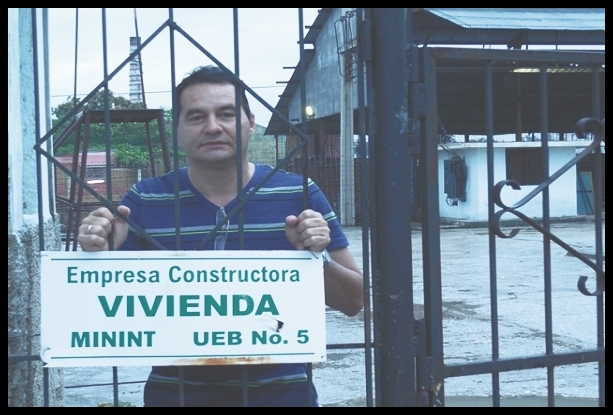
Guamajal-Hombre prison, in Santa Clara province, was put under quarantine because of several cases of dengue fever. The warden of the penitentiary has suspended family and conjugal visits. Undoubtedly they want total isolation so that the information does not get out.

The solution is evacuation because according to the inmates themselves, under the buildings there are piles of feces and urine, due to the old sewers which have never been repaired. This doesn’t matter because what’s important is comments and opinion; inmate health doesn’t matter at all. Excuse the obvious.

*Translator’s note: A common expression from an old Cuban joke, told briefly in the last paragraph here.

15 May 2014

Prostitution: Made in Cuba? / Angel Santiesteban

Mariela Castro. Photo: EFE

The news spread through the international media, except for Cubans, of course, because it pertained to the “secret,” a word that in the last days, after the congress of journalists, has been fashionable. To top it off, they were the same political leaders who tried to blame the communicators for informing without their consent, and even more, without their will.

What’s certain is that in Ecuador they have discovered a network of trafficking of Cuban women, who — deceived by the dream of getting to Miami — were taken off the island and later obligated to sell their bodies in a chain of brothels. continue reading

Fate again mocks these women, who prostitute themselves in Cuba in exchange for almost nothing. The majority are cheap, who work on the dark corners of the barrios. A few make it to the big leagues, which is access to tourism.

Always victims — be it in Havana or in Quito — the Cuban government should influence their legal situations, and shouldn’t make expatriation mandatory for them. In particular, it’s Mariela Castro, from Cenesex, who should take care of the fate of these young women, those who suffer and pay for the social whims imposed, first by her uncle, Fidel, and now by her father, Raul. To be saddled with their last name is a stigma that would take several generations to clean.

Ángel Santiesteban-Prats

Lawton Prison Settlement. April 2014.

Have Amnesty International declare the dissident Cuban, Angel Santiesteban, a prisoner of conscience. Sign here.

Translated by Regina Anavy

13 May 2014

Open Letter to Leopoldo Lopez / Angel Santiesteban

Dear Leopoldo, my brother in struggle,

I write to you from another prison, in Havana, in the claws of the brother dictators Fidel and Raúl Castro.

First of all, I want to send you my moral support. Right now, you need it more than I do, since your country is hanging on by a thread to becoming a totalitarian state like ours, from which we have been suffering for more than half a century.

I admire your upright position in defense of your ideals and dreams for a free country where democracy governs and justice and the rule of law reign supreme.

I have your wife and children in my prayers so that God protects them and maintains the courage with which they support you unconditionally, and so that He returns you soon to your home, next to them, from whom they never should have separated you. continue reading

I am filled with emotion at the solidarity of the deputy, Maria Corina Machado, meanly stripped of the office that the people assigned to her, and of the governor Henrique Capriles, who together with millions of his compatriots has not forgotten you, nor left you alone. This support — that you certainly deserve, for your ideals and the way in which you defend them — perhaps tomorrow can be intended for them, because the government of the puppet Nicolas Maduro, like that of Cuba, doesn’t pardon or forget those who raise their voices against his regime and its abuses.

Many Cubans, by the corresponding share of responsibility that touches us, feel ashamed of the Cuban government that, without hiding in the wings, orders and manipulates Venezuela’s plans, because their interest — it’s no secret — is born from their thirst for oil, their need to count on Venezuelan oil to stay in power.

As on our island, they already have devastated everything, from the economy up to human values. Now – by the death of your people – they have thrown their sharp fangs over your country. They are vampires of fuel, opportunistic parasites who act like those terrible mutant viruses that risk everything up to the end, hanging on to the body of the chosen victim.

In the same way that they harm your country –and it is part of your demands and claims — they continue oppressing us. Clearly, if you can’t contain and avoid the permanence of the Chavistas in power, your nation will be submiited to the biggest misery that you could ever imagine, and will suffocate itself more each day, submitting to an empire of injustices and constant repression.

I pray to God that you stay healthy so that your social light doesn’t go out, and you continue setting an example for those millions of compatriots who today are already struggling for their future, an example also for those of us who observe, expectantly, from the rest of the world, the struggle of the worthy Venezuelan people for their freedom.

Hopefully we can soon raise a glass for the freedom of our people. The dreams that we share today are the seeds of what we will later call reality.

Receive my hug and admiration for surrendering your freedom in the urgent demand we all have.

Ángel Santiesteban-Prats

Lawton Prison Settlement. May 2014.

Have Amnesty International declare the dissident Cuban Angel Santiesteban a prisoner of conscience.

To sign the petition follow the link.

 Translated by Anonymous and Regina Anavy.

9 May 2014

Leaving / Orlando Luis Pardo Lazo

At 7 past 7 in the morning of 5 March 2013, yesterday, I left my wooden house where I had lived all my life, to go to José Martí airport. I spent the whole night copying things on a few flashdrives. And deleting evidence of my ever-more-obvious work as a dissident and counter-revolutionary.

Of course I copied texts, which don’t take up much space, of which I had thousands, mine and other peoples’. I copied photos, which do take up a lot of space and aren’t worth the trouble. I copied what I could in those pendrives which would constitute all my work from that Tuesday onwards. Those gigabytes will be my oblivion and my eternity. My portable homeland, my body, my lack of spirit. My illusion that the journey was not true.  I did not want the journey to become true with the passage of time. But it did. Better that way.

I left everything I loved on top of my bedsheets. My mother still hasn’t changed the bed clothes, she tells me every so often on the phone: a white and yellow bedcover, knitted in 1934 by my paternal grandmother, the Andalucian lady who was born at the end of the 19th century. continue reading

I donated the Vaio i7, one of the fastest ones, outside the Council of State. I left the Canon 7D camera, also given by generous anonymous hands that turned out to be from Washington DC, where I am now writing this page, in the Rosslyn subway station, which, for some reason, seems to me indistinguishable from the Focsa building.

I left the pictures of the girls I loved, some of them naked, all of them so helpless (none of them was a woman, much less, my wife). I left the insidiously annotated books, which are not to fall into the hands of the State Security. Especially Paradiso, where I save a small novel annotated on the margin of Cuban Letters and Cintio Vitier’s menopausal prologue.

At the airport, the same killers that put me in jail three times took my passport and held me alone in a room for over an hour. Based on the time, I thought the plane to Miami had taken off without me, and I left the terminal area. I told this hatefully to Radio Martí. On the sidewalk, my 77-year-old mom was crying. But Silvia came to me and told me, “Fuck it Landy, go in there only come out if they’re taking you to jail”.

And I went back in, jumping the security barriers as if nothing would happen. A scene from, I believe, Basquiat came to my mind. Until a black man wearing a uniform ran to me and took an object out of his front pocket. I thought it was a gun, and I swear to God I did not care. But it turned out to be just my passport. The man wearing olive green asked me for forgiveness and said there was “an error in the database”.

It turned out that they had delayed the flight for three hours (these Miami charter companies are 100% Castro’s police). Minutes later, at the Miami airport, they called me out of the line with loudspeakers, my name was a “priority case” (and no, don’t even tell me about the “Americans”; in fact I myself am one more American).

Hugo Chavez was just now dying in Venezuela. Nicolas Madura was crying on Miami’s flat screen TVs. My night would soon end with Pedro Sevcec, who immediately asked me the same question State Security asked me in Havana: What did you do to the Cuban flag?

The next day I was in Manhattan, which is the spitting image of Havana but just huge. And the next day I was in DC. The only thing I can’t stand is that every night I have the same recurrent dream about Cuba, which I am not going to tell you about.

 Orlando Luis Pardo Lazo

In USA

7 May 2014

From Penultimos Dias

Translated by GH

Reconnecting with Carlos III / Rebeca Monzo

In spite of its title, the subject of this post is not historical but rather “hysterical.”

They once tried unsuccessfully to change the name of Carlos III Avenue to Salvador Allende Avenue, going so far as to remove the statue of the Spanish king who lent his name to this important Havana artery, which begins at Belascoaín Street and ends at Independence Avenue (also known as Rancho Boyeros Avenue). An important market named after the famous avenue is located here. Built in the 1950s, it later became a shopping mall made up of a collection of small stores.

Upon returning to “my planet,” I went looking for some items that are becoming difficult to find in the hard currency stores, figuring I could probably find them here. While going about my task, I suddenly noticed a married couple talking loudly with the obvious intention of being overheard. They were debating the subject of food shortages. A group of people quickly began forming around them, made up of those who happened to be there at the time. The wife, a woman of advanced years, began directing her comments to the youngest of those present.

“Do you have a dentures?” she asked them, to which those being queried answered affirmatively. Then, turning once again to the larger group, she said, “Well, considering how old you all seem to be, I imagine they stopped giving you milk when you were six and quite possibly none of you has ever chomped down on a good steak.”

13 May 2014

Tell History Well / Fernando Damaso

From the archive

The spiritual body of a nation is formed by the ideas and thinking of its different members, with their philosophical, political, economic, social, moral, artistic, religious and other concepts. Everyone, to a greater or lesser extent, participates in building it. To choose some and reject others is an evil practice which, in the end, damages the outcome.

For years our authorities, taking advantage of granting themselves absolute power for far too long, have shaped the body in accordance with their interests of every kind. To do this, helped by the intellectuals close to them, they have accredited and discredited historic facts and personages, presenting them positively or negatively. They have also, in their work, mutilated or manipulated them at their convenience. The most dramatic case is that of Jose Marti, who has been exalted in everything that serves or can serve the authorities, and ignored otherwise. Thus, some of his thoughts are present, and others forgotten.

History is important, not only to know what happened and how it happened, but also to understand the present and know the future. Its richness doesn’t belong only to the past, but it also is reevaluated in the present and in the future. This it is essential to rewrite it objectively, without political or ideological constraints, and to place everyone, with their actions and works, in their corresponding place. Everyone, without exclusions, in one form or another, has contributed to shaping the spiritual body of the Nation, around which everything else has been created.

13 May 2014

14ymedio / Yoani Sanchez

Yesterday I was arguing with a friend about the importance of journalism in the current Cuban situation. He wanted to convince me to join his opposition party and I reminded him that a reporter should not have any kind of militancy. It was an affectionate conversation, peppered with jokes, but one which made clear the different positions that must be taken by a reporter versus a politician.

Now here I am, remembering the conversation of a few hours ago and posting on my personal blog the face and name of a shared dream. A medium that we hope will support and accompany the necessary transition that is going to take place in our country. A space dedicated to narrating a reality where there are people like my friend, but also other people who applaud the current system, out of conviction, opportunism or fear. A space to report on Cuba from within Cuba.

It will be a difficult road. In recent weeks we have seen a preview of how official propaganda will demonize us for creating this medium. Already, in fact, several people on our work team have received the first warning calls from State Security. However, we have no reason to be hesitant. 14ymedio emerges with nothing to hide. Information regarding its editorial approach, ethics and financial commitments will be available on our web page which will go live on May 21. Although we had hoped to have it working today, I have to admit that technology is, at times, extremely capricious.

For those who are wondering why this name, so unique and different, the fact is that we originate from the fourteenth floor in the fourteenth year. In addition, it includes the “Y” that has accompanied me all these years, and the word “media” with all its journalistic connotations. We wanted to shy away from appropriating the name of Cuba for use on our masthead, and instead we have chosen the most universal of codes: numbers.

Now, all that’s missing is that it pleases you, generates debate, and provides you with information. Thanks in advance!

14 May 2014

The BBC Hires Translating Cuba Blogger Regina Coyula!

Malecón de La Habana

Translated from BBC Mundo:

Bienvenido Voces desde Cuba, el nuevo blog de BBC Mundo

[Welcome “Voices from Cuba,” BBC Mundo’s new blog]

The deed is done. Today the blog about Cuba that we’ve been talking about for some weeks is born; a new space shared by many voices, of different generations and with different political viewpoints.

In “Voices from Cuba” you will find stories that present the reality of the island beyond the headlines of the international press.

And as we have been promising, both those believe in the Revolution as well as those who criticize it. The country of the new private businesses and of the activists. The island  where a Communist Party and an increasingly unequal society converge.

The writer Leonardo Padura, opposition blogger Regina Coyula, the government journalist Yuris Nórido and the young entrepreneur Alejandro Rodriguez are the first to participate and are the headline team of this new blog. But we will also have guest bloggers.

The idea is to reflect the daily life of Cuba and Cubans, people’s feelings, from an individual prism in a plural space, where differences of opinion are respected.

Obviously, the bloggers will choose their own topics and those who wish to can respond to the entries of the other collaborators.

Like all material published in the BBC, the opinions must be backed up with verifiable data. They cannot offend, defame or incite to violence, and  to any accusation the right of reply will be offered.

But enough with the introduction, we present you the new Voices from Cuba, in their own words and in the order in which they will appear. The first entry will be on Thursday.

Hernando Álvarez, BBC Mundo, @alvarezhdo

(Site manager’s note: We don’t usually translate the BBC, but this is a momentous day and a huge achievement for our beloved blogger Regina Coyula. Congratulations to Regina and to the BBC for setting out to present the news from Cuba in the voices of Cubans on the Island.)

13 May 2014


Saga of the Official “Journalist,” “Admitted Terrorists,” and a Cat / Miriam Celaya

Reading a newly released item this Thursday, May 8th, on page 4 of the newspaper Juventud Rebelde (Terrorism, the True Face of Zunzuneo, by Amaury del Valle), brought to mind a lively flamenco-rumba that a Spanish singer made popular on the radio in the decade between 1970 and 1980. Perhaps some 50-something readers might remember its funny lyrics, about an individual who was upset because someone had called him “a cat”, which he considered an insult because “cats eat mice, mice eat cheese, cheese comes from milk, milk comes from a cow, a cow has two horns, Oh, oh, oh, I’ll kill him!” Cuckold (horned) was for him the true meaning hiding behind the nickname “cat” He was obviously being labeled cuckold, hence he made the association between such opposing ideas as a cat and a cow’s horns.

However, the newspaper article I referred to faithfully mimics the attitude of the song’s cuckold: it associates. Without doubt, the presence and intentions of the four suspected terrorists from Miami recently arrested in Cuba, with the networks Zunzuneo and Piramideo, which have engendered so much talk these few weeks. So, Zunzuneo and Piramideo are as “terrorists” as the four delinquents who were captured. In fact, the idea is not so far-fetched; the Cuban regime feels real terror in the face of information and the new communication technologies. continue reading

In order to understand how the author of the article arrived at such a brilliant conclusion — going forward I will refer to him by his initials, AV — it is necessary to undertake a scholarly effort not as entertaining as the song I remember, that is, we have to read and analyze the article so we can understand how AV’s stretched his imagination so he can have an ending like that of the cat and the horns.

AV recounts the events, following with the logic that Cubans must take as the only and unquestionable truth. He doesn’t need to offer any proof, the official lies are enough. No trial is necessary, the “confession” of guilt and the official testimony are more than enough. It doesn’t matter if they do it in a more crudely and in an increasingly worse way.

As stated, the four captured terrorists came “with a dangerous plan that had been brewing for over a year” and “slipped into the country” with the intention to attack military installations”. They intended to “provoke violent actions and sow chaos” to create “social unrest”.

It would seem that the offenders’ entry must have been illegal, given that no one can “slip in” by way of an airport gate, with all the controls at customs, borders and all the other security measures that exist. It is also unclear what danger could result from a terrorist plot against military installations, since in Cuba, according to the General-President himself, we enjoy military invulnerability. In any case, it would be a suicide attack, right? Finally, it is not clear how four wretched terrorists could possibly be able to provoke violent actions, chaos or subversion against millions of “revolutionary” Cubans. Undoubtedly, this time the creators of the myth have gone a bit far.

Following AV’s saga, the four bad guys were caught under the coaching of three other terrorists, also Miami residents with a long pedigree of actions against Cuba, who are — in turn — friends of the worst one of them, Posada Carriles (one of the subjects who has offered the most in practice towards the ideology and strategies of the power of the Castros for decades).

From that point, AV starts a long narration of Posada Carriles’ long terrorist sheet and all his avatars between 1973 and the present, and he also takes a tour of Magriñá’s actions. They — we are told– were the ones who “encouraged and financed” these four dunces who were just captured here.

And how does all this relate to Zunzuneo and Piramideo? Because, as AV states, “It’s too coincidental that the idea of perpetrating terrorist attacks that result in violent actions are precisely the plans that have been orchestrated in other regions of the world”. As if Cuba had the same geo-political, economic or strategic importance as that of Syria, the Ukraine and Venezuela.

AV also notes that, “It is very curious that these terrorist plans have been organized when there already existed, along the same lines, other secret plans which have already been uncovered, such as USAID and various U.S. agencies, to use modern technologies like the internet, e-mail, and cellular phone text messages, which would be used to organize supposed support networks to be mobilized in case of social upheaval.” The “empire” is an essential ingredient in the Castro’s sour soup.

AV concludes that the actions that the detainees planned against Cuban military facilities “are very similar” to the objectives pursued by the Zunzuneo and Piramideo networks, thus creating “a false statement of opinion about the Cuban reality”. With this, AV considered as “proven” the “progression of the plans orchestrated against Cuba”. In both cases, ultimately aimed at justifying “foreign military action” in our country (??!!). Pure terrorism.

And for this complicated concoction to be complete, AV’s exorcism could not lack the mention of the “violent opposition” in Venezuela, like Leopoldo López and María Corina Machado, as well as “the irrelevant mercenaries advocating panic and death in Cuba”. Mission accomplished, AV. You took pains, and you sure earned a week’s bonus at the People’s Camping.

In conclusion, the matter does not have, not even close, the joke of the cat I mentioned at the beginning of this posting. It really isn’t funny at all. It is clear that the government, through its mouthpieces, has started a phase to “soften” public opinion, which usually precedes raids against dissident sectors and general worsening of the repression within the Island.

Because, as conspiracy theories go, we have to remember that the Castro regime and its sympathizers work the same as old marriages, and after such a prolonged coexistence many things are predictable. So it is a suspicious coincidence that, with such a difficult stretch that the Cuban economy is undergoing, with the growing social discontent and disillusionment, with the increasing exodus, deteriorating social services, lack of liquidity, the regime’s desperate need for foreign exchange and other clouds that darken the environment, a new “saving enemy aggression” has appeared on the Castro’s political horizon, useful to justify nationalist entrenchments and repression.

Neither does the worsening of mobile services seem to be a coincidence, despite the excuses offered by the (military) state enterprise in charge of those markets, or the fact that this pidgin article gets published in the official press just after the recent announcement made by blogger Yoani Sánchez of the impending debut of her digital newspaper. It must be uncomfortable for the olive green hosts that a new means of digital independent media is surfacing on the Island, just as more Cubans are getting access to mobile phone service with text messages and e-mail. It is a good idea to keep alert; the Castro-dogs must already be plotting what would be the most expeditious way to silence the criticizing voices within Cuba.

In any case, there are too many theories and guesses about the advocates of this old, outdated system, but nothing is going to save a system that has proved its inefficiency. Imaginary or real terrorists might not be the ones that will spoil the Castros’ rule, and their loyal servants will be surprised in the new Cuba, which we will have one day, who will truly be their masters.

But, as with cheating in a marriage, it is better that the cuckold himself learns of the deception, so I take the opportunity to send a personal message to the writer at Juventud (young?) Rebelde (rebel?) Amaury, you are a real cat!

Translated by Norma Whiting

9 May 2014

Does D.C. Stand for “Donate to Castro?” / Orlando Luis Pardo Lazo

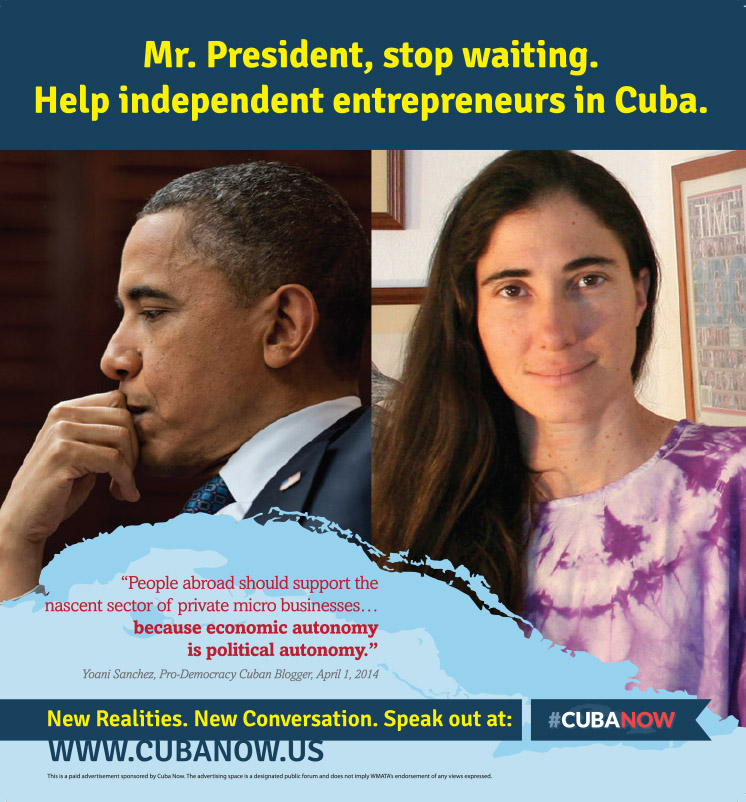
#Cubanow advertisement

Snoozing on the Washington, D.C. subway early one morning with my dreams still flitting between Franz Kafka and Stephen King after a evening filled with nightmares of State Security bursting into the apartment I’m staying in—which is near to where they shot The Exorcist—I finally wake up when I see the CubaNow banners through the train’s windows.

CubaNow is a media campaign run by a group of young Cuban-Americans who prefer not to disclose the source of their funding. Their secrecy echoes the recent scandal of USAID’s not “undercover” but “discrete” operations with the ZunZuneo project, an SMS network designed to work in Cuba. Their secrecy is also a reminder of the opacity with which the Havana government operates, in its domestic matters that ought to be in public view, as well as its smuggling of weapons on civilian ships, and its spies in the United States disguised as scholars, entrepreneurs, and even Pentagon analysts.

It’s curious how similar the political propaganda is starting to look in the capital cities of those two once irreconcilable enemies. continue reading

Perhaps CubaNow is a part of the pressures that President Obama needs to feel before he takes each controversial step, even though his administration has already shown enough signs of goodwill towards Castro’s Cuba, as these banners implicitly recognize. For their part, the leaders over in the Plaza de la Revolución have always rejected any rapprochement that does not fit with their monolithic model for continued power.

“It’s time to try something new,” suggest the CubaNow banners. Also, “It’s time to bring the discussion of politics between the United States and Cuba into the 21st century.” Then they add a quote from the blogger and famous Cuban dissident Yoani Sánchez, plus a photo that I took of her.

As far as I know, we were never asked whether we wanted to lend our support to this campaign. As compensation, CubaNow ought to do a better job of launching itself in today’s Cuba, where the people need something more than economic concessions, in a denaturalized nation that has lived for 55 years under a single press, a single party, and a single person.

From Sampsonia Way Magazine

12 May 2014

Repression by Episodes / Yoani Sanchez

Photo from http://www.ojocientifico.com/

What does the insect caught in the web feel as it watches its predator approach? What are its thoughts in the seconds between the anticipation of the attack and death? It must be a lot like the days in which a repressive trap is built around an individual, a group, a society. Similar to that script that builds the justifications for a blow, molding public opinion, filling in the archive that will later be presented to the press or the courts.

The current strategy against the Cuban opposition resembles the slow creep of the spider’s legs toward its victim.

We are living in a soap opera episode-by-episode, an attempt to demonize technologies and the dissidence, who knows if to repeat those dark days of the Black Spring of March 2003. The blow approaches, in the insistence in which the press repeats certain refrains, its obsession with themes like Zunzuneo and trying to link it with the violence of four supposed terrorists recently discovered in the country. Like in a bad TV show, the threads are showing in the tying together of mobile phones, Twitter, death and war. Fortunately these soap operas barely work any more on a Cuban public too focused on their daily needs, overwhelmed by material shortages, saturated with ideology and obsessed more with escapism than with civic consciousness.

The trap is almost set. Will it be used? Who knows. But there’s not much that can be done to stop it, except to denounce it. At the end of the story the spider is always bigger, stronger, more imposing.

12 May 2014

Looking for the Origin / Fernando Damaso

Photo: Rebeca

There is constant talk and articles about the need to rescue values, the good habits, and eradicate social indiscipline and rudeness. It’s true and should be done, but no one talks or writes about the real origins: the loss of civility and morals.

Most citizens, in the early months of the political, economic and social experiment, accepted and even applauded that the right to elect our leaders every four years was removed, as was the right to publicly state an opinion, to have parties and political organizations, to educate our children according to our desires, and, something terrible, they allowed someone, like a feudal lord from another eta, to decide who was Cuban and who wasn’t, which partitioned the nation and is a national shame. continue reading

In addition, the state banished what they called bourgeois values and put in their place a double standard, awarding mediocrity, unconditional support, betrayal, jealousy, envy, rudeness, lack of respect, citizen violence and other evils.

Time has passed and they are trying to forget these barbarities, suggesting, without asking forgiveness, a clean slate, as if it never happened and affected the fabric of our society, but the facts are there. It’s a pity that our ruling historians dare not address them.

You always reap what you sow. A generation that lost civic and moral values and was left fanatic and vulgar, passed it on to their children and they to theirs, in a continuous chain of all these evils. Here are the results.

They suggest that the family and school are crucial to the rescue of the missing values, but what is lacking is a different family, where the members practice civility and morality, rather than the fractured current one, accustomed to putting the individual first, far from social and national interests, although they attend the rallies, vote unanimously for everything put in front of them and even participate, with enthusiasm, in the massive parades. It is, simply, their way of not looking for problems and solving their own.

9 May 2014