Díaz-Canel replied that “not a single offensive action” against his neighbor’s national security “has ever come” from his country.
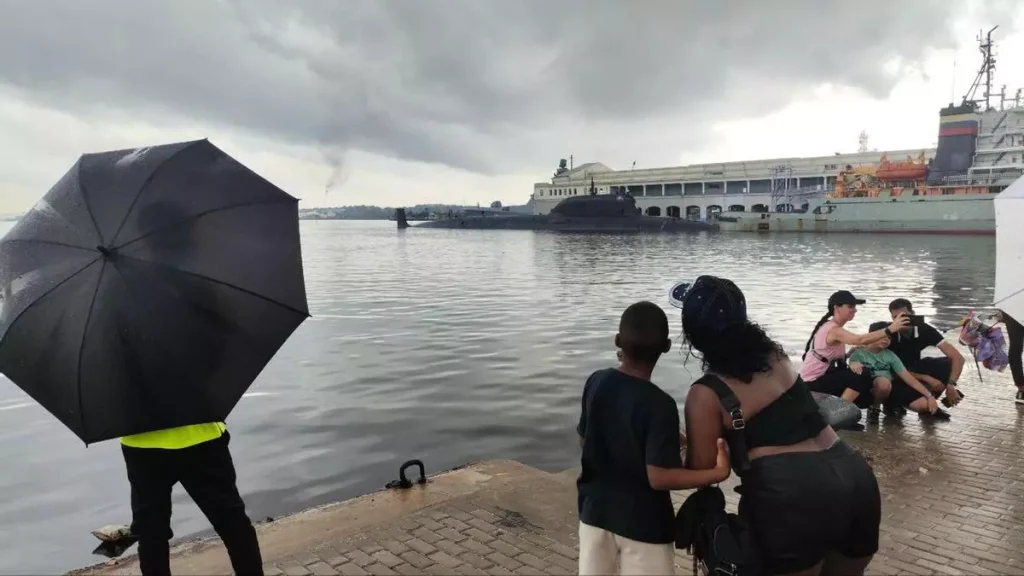
 Agencies/14ymedio, Washington / Madrid, May 13, 2026 – U.S. Defense Secretary Pete Hegseth stated this Tuesday that Cuba represents a threat to U.S. national security because, among other reasons, Russian military vessels — including a nuclear-powered submarine — have repeatedly docked at ports on the Island.
During a hearing before the House Armed Services Committee, which was marked by warnings about alleged Russian intelligence operations — and suggestions that China could be doing the same — with Cuba providing logistical support, Republican Congressman Mario Díaz-Balart asked Hegseth whether Russian military ships had used Cuban territory.
“That’s correct,” Hegseth replied, adding that Washington has long considered it “highly problematic” for “a foreign adversary to use that kind of location,” so close to the United States.
Washington considers it “highly problematic” for “a foreign adversary to use that kind of location,” so close to the United States.
Later on, Díaz-Balart directly asked the Pentagon chief whether he considers the Cuban Government a threat to U.S. national security, and Hegseth answered: “yes,” in one of the toughest exchanges of the hearing.
The hearing focused mainly on the defense and national security priorities of President Donald Trump’s administration, but it drifted toward questions about the growing cooperation between Cuba, Russia, and China, as well as alleged intelligence activities and foreign military presence on the Island, located about 150 kilometers from the U.S. coast.
In what appeared to be a response, Cuban President Miguel Díaz-Canel said this Tuesday that “not a single offensive action” against the national security of the United States “has ever come” from his country, adding that the Island “does not threaten or challenge,” but “does not fear either.”
“In more than six decades of socialist Revolution, ninety miles (about 145 kilometers) from the United States, not a single offensive action against that country’s national security has ever come from this territory,” the Cuban leader stressed in a social media post in which he also underlined that “Cuba does not threaten or challenge, but neither does it fear.”
By saying “never,” the Cuban leader ignores the many pieces of evidence regarding training camps inside the Island and the delivery of weapons to dozens of guerrilla groups seeking to overthrow governments allied with Washington in Latin America, groups that did not hesitate to kidnap and kill several U.S. diplomats. In addition, Havana offered its territorial waters to Colombian cartels to facilitate cocaine shipments into the United States. It also granted asylum to terrorists wanted by the FBI.
Nevertheless, Díaz-Canel insisted that “every day a new threat comes from the United States toward Cuba,” and that the Island has been subjected to “countless offensive actions concocted” in Washington that have left “thousands of Cubans injured or dead.” The Cuban leader described as “incoherent” and “fantastical” the idea of labeling his country a “threat” while, he claimed, “additional coercive measures are being decreed and its Government is accused of being incapable of minimally sustaining its economy.”
“It is all part of a narrative being built in order to continue suffocating the Cuban people, as well as escalating toward a conflict that could have unimaginable consequences for our peoples and the region,” the leader reflected, referring to Washington’s measures affecting strategic sectors such as energy, mining, and financial services.
Along the same lines, Díaz-Canel said it has been “proven,” “documented,” and even “acknowledged by international organizations and U.S. agencies from previous administrations” that his country “has contributed to preserving U.S. security in the fight against different kinds of transnational crime.”
“Cuba has had to work all this time to confront with firmness and calm the threats coming from the United States, and that is how we will continue to the very end,” he concluded.
“Cuba has had to work all this time to confront with firmness and calm the threats coming from the United States, and that is how we will continue to the very end.”
That same Tuesday, the occupant of the White House said before leaving for Beijing that Cuba “is asking for help” and that both countries “are going to talk,” without giving further details. All this comes amid his repeated and habitual threats against the Havana authorities, including the possibility of a military offensive.
Fifteen days ago, Senate Republicans once again blocked a Democratic initiative seeking to limit Trump’s war powers regarding Cuba. Even so, more and more Republicans are opposing an armed solution that could further damage the party’s chances in the November elections.
Last week, in an interview with Fox News, Secretary of State Marco Rubio hinted at the Trump administration’s displeasure over the use of Cuban territory by its adversaries and described their operations, 90 nautical miles off the coast of Florida, as a threat.
Translated by GH
______________________
COLLABORATE WITH OUR WORK: The 14ymedio team is committed to practicing serious journalism that reflects Cuba’s reality in all its depth. Thank you for joining us on this long journey. We invite you to continue supporting us by becoming a member of 14ymedio now. Together we can continue transforming journalism in Cuba.