Our Dead Are Raising Their Eyelids / Orlando Luis Pardo Lazo

Orlando Luis Pardo Lazo, 22 January 2015

It’s true. Although I still don’t believe it.

But they’ve told me it in all the families I’ve visited since I’ve been out of my country. That’s what families are, a mausoleum. They don’t lie. There is no Cuban family which is not our death memory.

That’s how it is. We Cubans die in the family. That’s the saddest part of dying. Not dying as such, which doesn’t bother the person dying, but the horror of imposing on exactly those people who loved us while we were alive. People should go and die among strangers. Get lost, and that’s it. That’s why I went to the United States. That’s why I didn’t die in Havana, in spite of the fact death whispered “Orlando” in my ear every morning where I lived. continue reading

But it’s true. At first I panicked when I knew that somebody was going to tell me the same thing again. Without, of course, coming to any agreement, without ever having been in contact with each other. So, I only wanted to grab the phone, call my house and cry.

Little by little I was thinking more about it. I calmed down. From fear of the mystery to admiration of the secret sense of a non-existent nation: Cuba. The stories repeat themselves. Every Cuban family can remember one, two, three, ten cases. In every Cuban family the same sparkle in the eyes, and the trembling of the hands of the person telling me about it. And maybe too many generations have passed. We are now in exile, without guides, and with no turning back. That’s to say, we are an empty space. We all now have a memory at home of one of us who died without love, without a home, without Cuba.

They have told me it in Spanish and English. In Hialeah, which is La Lisa del Norte, and in Fairbanks, Alaska, where no other Cuban has ever been. Two details are always included:

1) In exile you don’t die at any old time. You die at night, which is when our country is reflected in the sky and indirectly under the breastbone, and because of that it is easy to see it more closely than when we are there.

2) When a Cuban goes away to die far from Cuba, he has a very intense moment of lucidity. And of youth. He stops being the scornful and cruel adult which he has always been, and gets back then an aura of the angel which he never has stopped being. We become good at the precise moment when we can no longer do any good. And every family tells me, in almost the very same words, irrespective of the level of education or intellectual pretentiousness, that the distant Cuban, before he dies, always pronounces the name of Cuba.

Can you believe it? It’s amazing. A destroyed people, degraded, dispersed, unable to recognise each other. And at the time which is no time, totally stretched out on the beloved bed to create the following Cubans, who will later cuddle them while they grow between great big pillows which save them from the shortages in Cuba, collapsed on the edge of the tomb, watched without a goodbye by our people  where everything comes together into a death rattle. And we breath out this elemental pair of syllables: Cuba.

I have never read this before revealing it here. I owe this evidence to the Cuban people, we owe it to them.  And it’s a perverse word which I detest as a killer of men. But after knowing how we will all die without Cuba, including you and me, I think we deserve to be some kind of a people. The nocturnal imaginary nation, hollow, like the human heart. The family remembering those who are going to die by themselves and neverthless with a chorus of Cuba, Cuba, Cuba.

Don’t let me say goodbye to you. What with death and everything, I still love you.

Translated by GH

Rise and Fall of a Diocese / 14ymedio, Juan Carlos Fernandez

Extension of the Diocese of Pinar del Río. (Juan Carlos Fernández / 14ymedio)

14ymedio bigger14ymedio, Juan Carlos Fernandez, Pinar del Rio, 26 March 2015 – “How much everything has changed! How gorgeous the Cathedral is with those add-ons!” exclaimed a Catholic layman on returning to visit his native Pinar del Rio after three decades of exile.

The improvement of the infrastructure of the diocese, which started with the arrival of Archbishop Monsignor Jorge Enrique Serpa, is impressive. The construction work was fast-tracked and the traditional problems with permits disappeared. The cost of the strategy to sustain it, however, will be difficult to sustain.

Cardinal Jaime Ortega and Archbishop Serpa together undertook the task, which happened to please the Cuban authorities, removing part of the secular activity of the diocese to achieve, in exchange, benefits. continue reading

When in January 2007, Monsignor José Siro González Bacallao made official Serpa’s assumption of the Diocese, a new chapter began in the pastoral, religious and social life of the local church.

The appointment coincided with a rapprochement between the authorities and part of the Catholic hierarchy, led by the Archbishop of Havana, Jaime Ortega y Alamino. This improvement in relations culminated in the visit to Cuba of Benedict XVI, in March 2012, and the release from prison of a large group of political prisoners of the 2003 Black Spring.

The Conference of Catholic Bishops of Cuba also paved the way to understanding. The two bishops most uncomfortable for the Government were about to retire for reasons of age. In Santiago de Cuba, Pedro Meurice, old and sick ceded his episcopate to his disciple, Dionisio García. At the other end of the island, José Siro retired to Mantua and left the way open for the pact.

Since the inauguration of the new bishop in Pinar del Rio, it took just three months to begin the dismantling of all the works that were considered an obstacle to improving relations with the government.

It took just three months to begin the dismantling of all the works that were considered an obstacle to improving relations with the government

The members of the editorial board of the Church magazine Vitral were forced out, and the training center and publisher were dismantled. They also dissolved the Brotherhood of Assistance to Prisoners and Their Families, the Youth Ministry, the Catholic Commission for Culture and the Diocesan Council of Laity. Thus, the lay members left the structure of the Pinar del Rio Church.

When Monsignor Serpa took over, after 20 years serving in the Bogota Archdiocese, the Pinar del Rio Diocese had only 17 priests, fewer than 30 nuns, and a large group of committed lay people. The churches were deteriorated and the difficulties in obtaining permission for restoration were notable.

Now, for the first time in more than fifty years, all the parishes have priests, the number of members by religious congregation has grown, and the entry and establishment of other orders, among them the Brigidine Sisters, have been extended from Havana.

Management has been allowed, in addition to restoring the Cathedral, to enlarge the parish house and the construction of a complex of classrooms for catechisms and meetings. The Church has been able to buy a site for Caritas located in the center of the city, less than a block from the provincial headquarters of the Communist Party.

In addition, in just eight years Sandino is the first captive people to have a temple, one of the greatest diplomatic achievements in the last 25 years of the authorities insistently denying Siro permission. The return of the religious processions in all the dioceses is also a noted achievement of Serpa.

But the negative consequences of his mandate have also been felt. The bishop complains of a lack of motivation and commitment among the faithful, including to make donations. On the other hand, the social commitment is almost zero and the pastoral is ecclesial – more severe than the so-called clerical. Except for the Bishop, there is no presence of Church members in any social environment.

“The loss of moral authority is not achieved overnight,” whispers a Pinar del Rio Catholic. “Rebuilding costs far more than any new temple,” says the layman.

The legacy the current bishop will leave when he retires, at age 75, will be a magnificent architectural infrastructure that will not need to be touched for a while. The challenge will be re-form, articulate and prepare the Church formed by laymen which was dismantled.

Leave Me a Comment at the Entrance and We Will Win This Contest / Orlando Luis Pardo Lazo

Orlando Luis Pardo Lazo, 10 March 2015 — Every morning we would lose ourselves amid the skyscrapers until we find ours. That one. The one with the artificial rain that would fall, even in the driest months of the city. She likes then to take a pause in our route. She would let go my hand and draw near to the false marble facades, until she would start getting wet almost without realizing it, from imaginary drops that would evaporate before reaching the asphalt. Imaginary but, even so, they would wet her in a dance that was greatly erotic and somewhat erratic.

Her liquid hair, her transparent garb, in the megalopolis of limousines and suits. I would lag a bit behind. I did not want to interfere with those little mornings in liberty. They lasted so little, it was only an instant. Far from Cuba, far from the Revolution. Oh not so far. Because once, upon the end of an October of overcast skies and recurrent cyclones, it was raining for real in Manhattan. She said to me, “You smell it, too, right? Today is not New York, but rather Havana.” And she went out from under our umbrella, a grave bumbershoot more appropriate to those scenes of cemeteries at the end of the North American films of our childhood.

Far from the “long island” [Cuba], so close to Long Island. She told me, “One day we are going to be like those imaginary drops that never fall. And another day it will be we who fall amid a tired rainstorm.” I just walked behind during the rest of that morning. I knew that she would never forgive me seeing her mix the rain with her foreign-city tears.

Translated by: Alicia Barraqué Ellison

Cultural Crime / Rebeca Monzo

Celia Cruz

Rebeca Monzo, 27 March 2015 — For the last few years I have been tuning-in to a program broadcast on Sundays, from 6 to 9am, on the Cuban Radio station Radio Rebelde, ironically titled, “Memories.”

Because I love good Cuban music of all eras, I am a faithful listener of this program, and I also take the opportunity to dance a little, as a means of morning exercise. I must, I confess, bite the bullet to ignore the tedious sermons (“….had to travel thousands of kilometers to buy the molds….when the island was blockaded….”) and which year after year they play on the air lest, as they say, we forget.

What this program keeps quiet about is that it has been the Revolutionary government itself which has subjected its people to a criminal cultural blockade, depriving more than three generations of our best musicians and singers, for the sole fact of their having emigrated after 1959 continue reading

— or who being on tour outside the country, never returned, as in the case of our great musician and composer Ernesto Lecuona, whose name was forbidden from being mentioned on the radio until 1989 or 1990.

Also silenced (and still so today) were a good number of musicians and singers, such as Celia Cruz — and Olga Guillot, who, for the first time, the program hosts dared to mention last month and to play one of her renditions.

They also seem to forget that The Beatles not only were prohibited, but that their records were hunted down, and those of us who owned any had to carry them inside other sleeves to keep them from being confiscated — and that now not only is there a sculpture of John Lennon in a centrally-located Havana park, but the old Atelier nightclub has been re-christened El Submarino Amarillo [“The Yellow Submarine”]. My generation cannot forget that if we wanted to listen to their music, we had to do so at low volume and under lock and key inside the house.

I believe that the moment has come, if we are to be current with these times (and with the timid attempts by the government to reestablish negotiations with the country that has always depicted us as Public Enemy Number One) to change that old aggressive and pejorative language, and address those great Cuban artists who opted for full individual liberty and left the country in search of broad cultural horizons.

I suggest to the program director, the whole team, and especially to the scriptwriter, that they break once and for all with those atavisms and finally broadcast those voices, silenced throughout so many years, as well as provide information about their interpreters, so as to stop damaging our musical culture.

Note: This article was published in the digital daily 14ymedio.com

Translated by: Alicia Barraqué Ellison


Will the mattress arrive before the baby turns a year old? / 14ymedio, Yosmany Mayeta

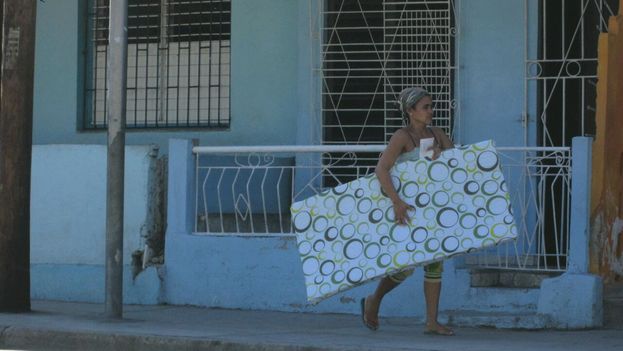
Woman with a mattress (Yosmany Mayeta)

14ymedio bigger14ymedio, Yosmany Mayeta Labrada, Santiago de Cuba, 28 March 2015 — The Gonzalez family baby slept her first weeks in a plastic tub lined with sheets and blankets. She could not use the crib because her parents did not manage to buy the mattress that is assigned by the Santiago de Cuba ration market to expectant mothers.

Shortages of the product and delays in its arrival to those in need create discomfort and situations like that of this baby in homes all over the country but with greater severity in the eastern region.

Outside of some stores intended for that purpose there are long lines of pregnant women and their families to buy the so-called “module basket” that is given at a subsidized price to each mother. The prices in the free market are unaffordable for a good many families. They need at least 50 convertible pesos (CUC) in order to get a mattress in the hard currency market, while the average monthly salary does not exceed 20 CUC. continue reading

Many of these mothers will celebrate the first birthdays of their children without the children having been able to enjoy a crib with a mattress. Such is the case of one young woman who preferred to remain anonymous and who was waiting this Wednesday in the line of the El Atardecer industrial products store. Her daughter is about to turn a year old, but she still has to sleep in a crib with an old mat repaired many times and that was loaned to her by a relative.

Yamile Fonseca, resident of the Nuevo Van Van area, had a little more luck and says that “almost when the ration book was expiring I could buy the mattress, but that was a pure pain and a line that no one could stand.” Others simply give up and resort to the illicit market or inherit part of the “basket” items from a sister or a cousin.

Beatriz Mena, clerk at an Industrial store, says that “they have only brought the product twice” to the store where she works. In those cases “they have sold to those mothers whose basket ration book is expiring and whose babies are turning a year old,” the others have had to wait until they are resupplied, she said.

When the product arrives at one of the commercial units devoted to that purpose, then the drama becomes the line. Jose Bonne, father of a 10-month old girl, staked out the front of the Industrial this Tuesday from four in the morning in order to be able to be one of the first. “When I arrived there were already more than ten people who, since earlier hours, were marking their place in line in order not to be left without the mattress.”

The manager of the store in the Altamira suburb said that “it has come to the unit on several occasions but the ones who have not bought are still more than those who have left with the product.” The lady says that “the mattresses that they leave are very few, and we have a great number of pregnant and newly post-partum women and the demand outstrips the quantities supplied.

Another person, who preferred not to give his name, says that “when the mattresses arrive at the industrial products stores, now the clerks in cahoots with the management get most of them, which are sold to those whose turn has not come up, but who pay extra money and so acquire them ahead of time.”

For her part, Yelaine Suarez said that when the mattresses arrive in the commission stores there are people who dedicate themselves to the sale of places in line for the amount of ten convertible pesos. “It is unfair to see how they take advantage of the opportunity in order to do things like that.

Cuban women point to economic problems and difficulties in materially supporting a baby as among the main causes for the low birth rate that the country is now experiencing; the Total Fertility Rate fell in 2012 to the worrying figure of 1.69 children per woman.

David Fernandez, resident of Alturas de Versalles, says that in the Altamira store they got crib mattresses at 300 pesos national currency, sold off the ration book. The resident of the place asks how it is possible that there are stocks for that but not for those women who have the “basket” ration book.

The complaints come and go and many babies keep waiting to sleep in a crib with a mattress. Meanwhile, their parents improvise a little bed and take turns standing in line in front of the store.

Translated by MLK

A Leader Of Civil Society, A Real Story Without A Moral / Reinaldo Escobar

Desde Aqui, Reinaldo Escobar, Havana, 27 March 2015 — On a cold November morning in the late eighties, some two hundred of us were trying to come to an agreement to organize a line to buy interprovincial bus tickets at an agency in Havana’s Playa municipality. As usually happens in these cases, the line had two heads, both justifying themselves with loud protestations of their indisputable evidence of having arrived first.

The vast majority of those gathered there were trying to spend Christmas in some province. For inexplicable reasons, two parallel lists had been drawn up, both established at different times. At that time – and to some extent still – the police prohibited these lists, so it wasn’t possible to appeal to the police authority to establish some order in such a confusing situation. continue reading

At six in the morning, two hours from when ticket sales would commence, an angry Hercules type said that if there was no agreement he would be the first to buy a ticket, and he looked around to see if anyone disagreed. From the shadows, a man in his forties made a call for sanity. He was not of robust build and barely five feet tall, but he had a strong voice and seemed to be supported by the conviction that reason, well exposed, always has a chance of prevailing.

Doing his best to hide his obvious nervousness, he yelled as loud as he could, “Pay attention, please!” and calling on some hidden courage to invest himself with some authority, he invited both lines to stand one beside the other. Once that was achieved, he offered the magic formula. “What we have to do here is interweave ourselves.”

His leadership “burned” for the good of others, in an altruistic gesture showing that the most important thing was not “to shine, but to let there be light.”

The solution meant that everyone was further back in the line from where they considered themselves, such that if you were number 10 in one of the lines, now you were number 20. With unusual precision, the spontaneous organizer drew up and handed out numbers* on paper with his signature. Amid protests and agreements, acceptances and rejections of all kinds, the long line was happily established.

I got my ticket to Camagüey, Hercules was at the end and I never knew what became of him. The serene promoter of harmony was two places ahead of me, but he didn’t manage to get tickets to Santiago de Cuba. The natural authority he had displayed had not resulted in his personal gain, just assured him a place in line. His leadership “burned” for the good of others, in an altruistic gesture showing that the most important thing was not “to shine, but to let there be light.”

*Translator’s note: Lines in Cuba generally form by each person asking, as they arrive, “who’s last” and then noting who they are behind. In this way, people don’t actually have to stand in their place in line for what can be hours and hours of waiting. 

Suspended or Censored? / Cubanet, Miriam Celaya

14Ymedio
The members of the Taliban of the Cuban official web Reflejos, offended by the presence of an independent site like 14Ymedio should be celebrating: after a week of putting up with such dangerous neighbors, it withdrew the Yoani Sanchez’s daily from its platform. Authorities have demonstrated their inability to stand the test of freedom of the press.

cubanet square logo Cubanet, Miriam Celaya, MIAMI, Florida, 27 March 2015 — The members of the Taliban of Reflejos, the Cuban government-sponsored website, offended by the presence of an independent site like 14Ymedio should be celebrating. After a week of putting up with such dangerous neighbors, the authorities gave censure the all clear, in virtue of which 14ymedio has been “suspended or mothballed” because, in this era of technology and communications, euphemisms are also updated — it will no longer be able to be viewed on a platform which describes itself as “inclusive”.

Thus, while 14ymedio, the digital newspaper, launched from Cuba and in which several independent journalists on the Island collaborate or are involved, has demonstrated its ability to make use of any possible opening that facilitates access to its pages by Cubans from within Cuba, the authorities have shown their inability to stand the test of freedom of the press and differing opinions, particularly when participants have the moral authority of having experienced, on a daily and firsthand basis, the realities they narrate, report, or comment on. continue reading

We must acknowledge, however, that the kids from “Reflejos” demonstrated, in addition to their “revolutionary intransigence” and their combative ability — taking into account that they are soldiers and spend their existence fighting symbolic battles — exemplary discipline to obediently follow the chain of command, which also brings to the surface their peculiar concept of autonomy and decision-power to manage their own website. And they still call themselves “free”.

Mercenaries at the service of the dictatorship?

Not necessarily. Or not all of them, for there are always useful idiots. It is known that the piñata of official patronage has its gradations, is limited, and extremely fickle. Today they take notice, tomorrow they won’t, as befits a system that has established its existence (not its success, as some claim) on the standardization of mediocrity. That’s the reason fidelity tends to substitute for talent in Cuba, and thinking is not only a heavy burden, but a dangerous pastime.

So let’s not be too hard on the little Talibans. Perhaps the hosts of “Reflections” are only members of a declining sect, worshipers of a regime that soon will leave them very disappointed.

For now, we can imagine the meetings that had to be stirred up at all levels and with “all factors” to analyze what measures would be taken against the counterrevolutionary intruders until the anointed “at the top” gave the censorship order… that is, the “suspension.” The truth is that those who control the dominion could not even decide for themselves, hence 14ymedio survived for a whole week on the official website. It is axiomatic that absence of freedom is so rooted in Cuba that the more loyal you are to the authorities, the harder the authorities enslave you.

But censorship is not only applied against 14ymedio, but also against freedom of access to the same privileged members of the sect who have the ability to establish a blog and a certain level of access to some websites that are tolerated by the government. Who knows if, at this point, some of the more novice and restless slaves, or the lesser bilious readers, might be wondering whether it would be more effective to destroy the internal counterrevolution by allowing Cubans to access our sites, to discover for themselves the lies that the vile “mercenaries” at the service of a foreign power – who inexplicably continue to exercise journalism — are trying to pull the wool over their eyes, most likely with the malicious intent of surrendering the country to imperialism; which is just, more or less, the work that the General-President is involved in with all his might.

Note: Miriam Celaya, a freelance Cuban journalist based in Havana, is visiting Miami.

Translated by Norma Whiting

Web Platform Reflejos Closes the ‘14ymedio’ Blog / 14ymedio

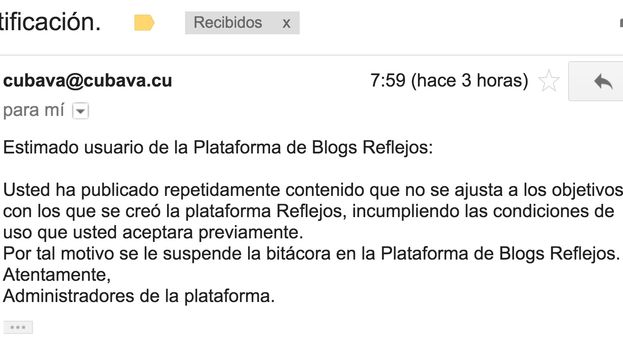
"Esteemed user of the Platform "Blogs Reflejos": You have repeatedly published content that is not in keeping with the objectives of the platform Reflejos, not complying with the conditions you previously accepted. For that reason the blog is suspended...
“Esteemed user of the Platform “Blogs Reflejos”: You have repeatedly published content that is not in keeping with the objectives of the platform Reflejos, not complying with the conditions you previously accepted. For that reason the blog is suspended…”

14ymedio bigger14ymedio, Havana, 27 March 2015 – The new Cuban blog platform, Reflejos, has decided to close the 14ymedio blog for “repeatedly publishing content that does not conform to the objectives with which the platform was created,” according to an email sent this Friday by the administrators.

The daily is accused of “failing to meet [the site’s] the conditions of use” with no other details. Nevertheless, when it was launched March 18, Kirenia Fagundo Garcia, a consultant on Reflejos, explained that there were no “restrictions as far as topics addressed on the blogs and users interested in the service.”

The blog opened by this daily on the digital platform was designed to bring its contents to Cuban readers since our site has been blocked on the Island’s servers since its creation in May of 2014.

During the few days in which it was active, the blog published a varied group of texts that ranged from culture to recipes to opinion columns. Neither verbal violence nor personal attacks were used, and the majority of commenters were internet users very interested in the topics that the posts covered.

The 14ymedio blog has been the object of many criticisms by bloggers associated with the Cuban government. At the beginning of this week, the official site for CubaSí news lamented the presence of “mercenaries in service of the US” on Reflejos. The writer of the article, M. H. Lagarde, accused 14ymedio in wrathful terms of having “contaminated” the platform with “counter-revolutionary propaganda.”

The digital platform is part of the Cuba Va project of the Computer and Electronic Youth Club. Set up on the free content manager WordPress, it has several technological deficiencies such as slow operation, low storage capacity (barely 250 megabytes per blog) and problems with the image upload tool. Nevertheless, in spite of these technical difficulties, we had managed to create a functional “mirror” of 14ymedio, on a service that calls itself Reflejos (Reflections) and that was announced from the beginning as a space for the blogs of the Cuban family.

Translated by MLK

Polarization and civil society / 14ymedio, Yoani Sanchez

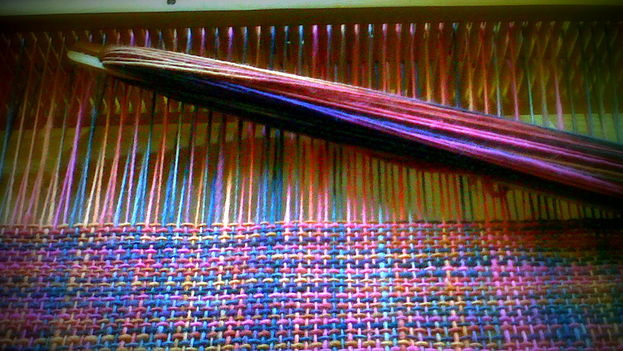
telar_CYMIMA20150326_0009_13
14ymedio bigger 14ymedio, Yoani Sanchez, Havana, 26 March 2015 – The family of Yamila, age 41, is a sample of Cuban society. The father is a member of the Communist Party, the mother a Catholic who never embraced the Revolutionary Process, there is a brother in Miami and she herself is working for a joint venture where she earns convertible pesos. When they sit down to eat, they discuss the high price of food, the low salaries, how boring the telenovela is, or how late the remittances from the emigrants are this month.

For decades the ideological fire has stirred no passions in Yamila’s living room. The father is increasingly tempered in his political views; the mother prays, while buying in the illegal market; the relative who lives on the other shore and comes every now and then on vacation is an obliging forty-something who saves every cent to bring them a flat screen TV. These are the daily problems that concern them and hold them together. The struggle to survive makes them set aside any differences.

This microcosm of the Cuban family today has a lot to teach those who, from polarized positions, try to say what civil society is and isn’t, continue reading

try to put limits and Manichean labels on the diversity of phenomena that make up our reality. Any definition of the framework of this complex tapestry that makes up a society should be constructed with the objective of recognizing all of its parts and the right of each to exist.

Branding some as regime supporters and others as traitors only deepens the social distances and delays the necessary transformation that this country needs to experience.  

Branding some as regime supporters and others as traitors only deepens the social distances and delays the necessary transformation that this country needs to experience. In the current social fabric there are identifiable strands that have to be considered and that no snip of intolerance should exclude. If we are aware of our responsibility in this process of inclusion, then we will try not to arbitrarily cut off any part of the fabric.

The issue heats up as we approach the Americas Summit in Panama, where both the Government and the opposition are ready to present their own versions of Cuban civil society. All indications are that, despite conciliatory longings on the part of the Panamanian organizers, this platform is only going to hear a skewed version from each side, not the so necessary discourse of respect for the other and for plurality that the Cuban nation needs at this moment.

While it is true that the so-called mass organizations such as the Federation of Cuban Women (FMC), the National Association of Small Farmers (ANAP) and the Committees for the Defense of the Revolution (CDR) behave in the ideological arena like transmission poles from the powers-that-be, it also needs to be borne in mind that each of them encompasses a large number of Cubans – whether as an automatic response, the inability to choose other options, fear, or true complacency – and every one of our families is made up, for the most part, by members of these organizations. To ignore them is to amputate a part of our reality.

To disqualify, per se, a person because they are a part of the FMC, the CDR or the ANAP, for example, becomes an act of sectarianism and eliminates from the national discussion an essential area of the citizenry. Among them are some very capable people from the professional point of view, who will be part of those supporting the economic, social and legal reconstruction of Cuba. Many of them will be at the Panama Summit – subsidized by the Cuban Government and chosen for ideological reasons – with proposals that should be heard.

Panama could be the moment when Cuban civil society meets and understands that no child of this land should be excluded from the national debate. 

Sociologists, economists, intellectuals and Cuban academics will bring solidly supported studies that address the core theme of the meeting: Prosperity with Equity: The challenge of cooperation in the Americas. Instead of rejecting them because they come with directives to convert the event into trench warfare, it would be very healthy to interact with them and their proposals with respect. Panama could be the moment when Cuban civil society meets and understands that no child of this land should be excluded from the national debate.

On the other hand, the Cuban government official campaign has already begun to vent its venom on dissident figures and groups, the opposition and independent journalism which will also attend the event in April. Those attacks are not directed at damaging the self-esteem of the activists, already used to the verbal violence constantly directed at them, but rather to avoid any possible dialogue between this part of our civil society with that part recognized as closest to the Government, the one that defends the current state of affairs on the island.

Non-government attendees will travel, for the most part, with tickets and accommodation paid for by foreign institutions and entities, given the material poverty they experience from their situation of illegality. However, the selection process for those who will attend, incarnated that part of Cuba that has lacked internal democracy and a necessary transparency. Driven by improvisation and material precariousness, these representative should know that they will also be evaluated for the ideas and proposals they bring, not just for anecdotes about the pain and repression they have experienced.

If the dissidence wants to show its adulthood, it must communicate in Panama that it has a plan for the future and not only that it knows who to survive under the heroic status of being a persecuted group

If the dissidence wants to show its adulthood, it must communicate in Panama that it has a plan for the future and not only that it knows who to survive under the heroic status of being a persecuted group, but also that it knows how to engage in politics in an intelligent, measured and thoughtful way for the wellbeing of all Cubans. Its agenda should include not only calls for respect for human rights and a framework for individual and collective freedoms, but must also address the most pressing everyday problems of the citizens they want to represent.

It is also important for this other share of Cuban civil society that does not feel recognized in the mass organizations, nor in the opposition parties, understand that their role is to be a bridge, not an island. Pointing fingers at both sides from the moral stature of those who are neither “subsidized by the Cuban Government” nor “employees of the empire,” only adds more fuel to the fire of distrust.

The small private sector that is trying to prosper on the island, the sectors tied to the Catholic Church and other denominations, the academics who have tried at all costs to maintain an independent view in their analysis, and those groups who defend the rights of minorities, working for female emancipation, independence for artists and filmmakers, or an end to racial discrimination, all should know that it is not helpful to sit on the fence watching the confrontation between the two poles. They have a responsibility to modulate and form a part of the tapestry, not snip away at it or remain outside the conflict.

At Yamila’s dinner table everyone wants to live his or her life, have his or her own autonomy. They have managed it, in the shelter of their home and the understanding that comes from family ties. Can we reach it as a nation?

Two Types of Dissidence, Two Policies / Angel Santiesteban

Angel Santiesteban, 25 March 2015 — For the first time in the history of the violations against the Cuban dissidence by the political police of the totalitarian Regime, there are two lines of thought: one subdued and the other more severe.

Those in the opposition who have publicly supported the intention of the governments of the United States and Cuba to reconstruct diplomatic relations have had their rights respected to travel abroad, reunite, publish, etc.

But those who openly oppose the reestablishment of diplomatic relations, unless the Cuban Government respects human rights and frees the political prisoners, have been detained and had their passports take away, like the plastic artist Tania Bruguera, who was visiting the country, so that she now finds herself held hostage, and the activists Antonio Rodiles and Ailer Gonzales. continue reading

The Ladies in White, together with their leader, Berta Soler, and one of the 75 prisoners of the Black Spring, Angel Moya, Antonio Rodiles, Ailer Gonzalez, Claudio Fuentes and Tania Bruguera, among others, were captured, some for several days, and, coincidentally, have all opposed the reestablishment of relations.

It’s painful that this distance exists between both factions, which, when united, have suffered so much abuse from the dictatorship. Some who accept relations keep quiet about the abuses committed toward those who think differently.

In a certain way, they have to recognize that silence converts them into accomplices of the Regime. We can’t forget that in different ways, thinking from parallel paths, is precisely what transforms us in dissidence, because we came fleeing from belonging to that mob that accedes to the call of the Dictator, which sometimes, even in an indirect way, can manipulate us in its favor.

Although we think that others are wrong, we should defend their right to be so. There is no one dissidence that is bland and another that is extreme, only degrees that are necessary and that strive for the same thing.

Ángel Santiesteban-Prats

Unidad de Guardafronteras Prison, Havana. March 2015.

Translated by Regina Anavy


And where did that glass of milk go? / 14ymedio, Orlando Palma

vaso-leche-CC_CYMIMA20150325_0030_16
14ymedio bigger 14ymedio, Orlando Palmo, Havana, 25 March 2015 — The newspaper Granma published Wednesday a comprehensive report on milk production in the province of Camagüey. This scenario is grim and confirms the downward trend in terms of delivery of this precious food. Since 2012, Camagüey’s milk production and sales to the industry have declined, both in the cooperative and private sectors.

Although in the last five paragraphs it outlined with moderate optimism the possibilities of the sector recovery program, a reading of the article, signed by journalist Miguel Febles, reveals a problem that extends across many sectors of the economy, which can be summed up in the affirmation that the bureaucracy continues to be the heaviest weight dragging down food production in Cuba.

In short, the problem is that farmers must deliver the milk they produce to a pre-determined collection center. There samples are taken to assess the quality of each delivery, which is tied to the price of the product. However, instead of paying everyone according to the quality of food they bring to the center, the quality is averaged across all deliveries and the price paid to the farmer is derived from that average. The result is to demotivate improvements in quality.

Milk production in Cuba only covers 50% of domestic demand, so the country needs to import half of the milk consumed 

One of those interviewed, Alexis Gil Perez, director general of the Provincial Dairy Company, explains that the contracts are not with individual farmers but with “the productive base.” Gil Perez argues that this does not violate any procedure. “If there are opinions or dissatisfactions, we would have to revise the documents that govern the activity, and this decision can only be taken at the national level,” he adds. “Meanwhile, we must comply with the established provisions. It is not within my powers to vary the range of what we pay for milk.”

In a ceremony held in Camagüey on 26 July 2007 (commemorating the rebel attack on the Moncada Baracks), General Raul Castro said that every Cuban would be able to drink a glass of milk. Nearly eight years after that desire failed, the immediate proposal is not even to improve the distribution of what is collected, but to stop the decline in milk production observed in that province since 2012.

Milk production in Cuba only covers 50% of domestic demand, so the country needs to import half of the milk consumed. Its distribution is controlled by the government and private companies are forbidden from trading in milk products, even in the farmer’s markets.


Kuwait invests $ 21 million in hydraulic networks Havana / 14ymedio

14ymedio bigger14ymedio, Havana, 26 March 2015 — The Kuwait Fund for Arab Economic Development awarded $21 million for the rehabilitation of water supply and sewer networks in Havana, as reported Thursday in the official media. With the signing of three agreements Wednesday, the second phase of the project gets underway; the project began in 2012 when the Fund awarded a credit to work on water resources in the capital.

The total amount of Kuwaiti aid for rehabilitation of networks amounts to $52 million in the last three years. It is expected that the works will be completed in all of the capital’s municipalities within 14 years.

The Cuban side at the time of the signing of the agreements was headed by Minister of Foreign Trade and Foreign Investment, Rodrigo Malmierca, while the general director of fund development, Abdulwahab Al-Bader, represented Kuwait.

“This is the fourth time we concluded agreements with the island and we are committed to continuing to provide credit to support works of such magnitude,” said Al-Bader. He added that his institution is ready to support the third stage of the capital rehabilitation and also evaluate the potential to contribute financially to other projects related to renewable energies.

The situation of hydraulic networks in Havana is a source of constant complaints from the population and heavy loss of water due to leaks and breaks. It is estimated that over 50% of the water pumped in the country is lost due to poor distribution infrastructure.

Cuba: Artist imprisoned for painting the names "Fidel" and "Raul" on two piglets / Laritza Diversent

After 90 days of imprisonment, there is no formal accusation against the artist, Danilo Maldonado.

Laritza Diversent, Havana, 25 March 2015 — Authorities are still imprisoning the artist, Danilo Maldonado, known as “El Sexto” (The Sixth), who was detained arbitrarily by the police.

Maldonado, 31 years old, is an urban artist and painter who finds himself accused of “aggravated contempt,” a charge that the Cuban State uses to incarcerate people who are critical of the Government. He presently is serving 90 days in preventive custody in Valle Grande, on the outskirts of the Capital.

On the afternoon of December 25, 2014, Maldonado staged a “show” in a spot in the city of Havana, when he was detained by police operatives. They arrested him for having two piglets in a sack. One was painted on the back with the name “Fidel,” and the other, with the name “Raul.”

Both names are common; however, the authorities assumed that they disrespected the Castro brothers, and they could impose on him a sanction of between one and three years of prison. continue reading

Cubalex presented an appeal before the Havana tribunal for the authorities to explain the motive for the detention, a recourse that was denied.

The prosecutor didn’t even formally present the accusation before the tribunal. Maldonado’s lawyer asked the authorities several times to allow him to await trial in liberty, which request was also denied.

In Cuban law, the crime of “contempt” is an amplified term that includes defamation or insults toward other Government employees, and it carries aggravated penalties when it is committed against the Head of State. The Inter-American Commission of Human Rights has said that this type of rule goes against freedom of expression and the free demonstration of ideas and opinions, which do not justify the imposition of sanctions.

Let’s not forget that all those people who exercise public office or are important statesman, like the Heads of State or the Government, can be legitimate objects of criticism or political opposition. Freedom of expression should take place without inhibition in the public debate about Government officials.

Let’s ask the Cuban State to guarantee and respect Danilo Maldonado’s right to freedom of expression, without restrictions. Furthermore, let’s ask the international community to speak up for his freedom and his right to a fair trial.

About Cubalex:

Cubalex, the Center of Legal Information, is located in Havana, Cuba. We are a non-profit organization founded in 2010, not recognized by the Cuban State. We offer free legal advice on housing, migration, inheritance, criminal appeals, constitutional procedures and defending civil and political rights, in the national and international arena, to Cuban citizens or foreigners who request our services.

If you want a consultation, you can find us through our email: centrocubalex@gmail.com;

or by telephone:  (537) 7 647-226 or  (+535)-241-5948

Translated by Regina Anavy

The Day Peace Broke Out / Yoani Sanchez

Generation Y*, Yoani Sanchez, 25 March 2015 – “Peace broke out!” the old teacher was heard to say, on the day that Barack Obama and Raul Castro reported the reestablishment of relations between Cuba and the United States. The phrase captured the symbolism of a moment that had all the connotations of an armistice reached after a long war.

Three months after that December 17th, the soldiers of the finished contest don’t know whether to lay down their arms, offer them to the enemy, or reproach the Government for so many decades of a useless conflagration. Everyone experiences the ceasefire in his or her own way, but the indelible timestamp is already established in the history of the Island. Children born in recent weeks will study the conflict with our neighbor to the north in textbooks, not experience it every day as the center of ideological propaganda. That is a big difference. Even the stars-and-stripes flag has been flying over Havana lately, without the Revolutionary fire that made it burn on the pyre of some anti-imperialist act.

For millions of people in the world, this is a chapter that puts an end to the last vestige of the Cold War, but for Cubans it is a question still unresolved. Reality moves more slowly than the headlines triggered by an agreement between David and Goliath, because the effects of the new diplomatic mood have not yet been noticed on our plates, in our wallets, nor in the expansion of civil liberties. continue reading

We live between two speeds, beating on two different wave frequencies. On the one hand, the slow routine of a country stuck in the 20th Century, and on the other, the rush that seems disposed to mark the whole process of the giant of the north. The measures approved this last 16 January, which relax the sending of remittances, trips to the island, the collaboration in telecommunications and many other sectors, suggest the idea that the Obama Administration seems willing to continue making offerings to the opposing force. Obliging it to hoist the discrete white flag of material and economic convenience.

The feeling that everything can be accelerated has made some within Cuba reevaluate the price per square foot of their homes, others predict where the first Apple Store will open in Havana, and not a few begin to glimpse the silhouette of a ferry linking the island with Florida. The illusions, however, have not stopped the flow of emigrants. “Why should I wait for the yumas to get here, if I can go and meet them there?” a young man said mischievously, as he waited in line for a family reunification visa outside the United States consulate in the Cuban capital at the end of January .

The fear that the Cuban Adjustment Act, which was passed by the U.S. Congress in 1966 and offers considerable emigration benefits to Cubans, will be repealed has multiplied illegal migration. Those who don’t want to leave, are preparing to take advantage of the new scenario.

A few years ago emigration fever led thousands of compatriots to dust off their Spanish ancestors in hopes of obtaining a European Union passport, and now those who have family in the United States sense an advantage in the race for Cuba’s future. From there can come not only the longed-for economic relief, many think, but also the necessary political opening. Lacking a popular rebellion to force changes in the system, Cubans pin their hopes on conditioned transformations from outside. One of the ironies of life in a country whose political discourse has so strongly supported national sovereignty.

Those who have more problems dealing with what happened are those whose lives and energies revolved around the conflict. The most recalcitrant members of the Communist Party feel that Raul Castro has betrayed them. Eighteen months of secret conversations with the adversary is too much time for those stigmatized by a colleague in their workplace because they have a brother living in Miami or because they like American music.

Just outside the United States Interest Section in Havana (SINA), the government has not replaced those ugly black flags that used to fly between the anxious gazes of Cubans and the well-guarded building. No one can even pinpoint the moment in which the billboard boasting, “Gentlemen Imperialists, we are absolutely unafraid of you” was taken down. Even TV programming has a vacuum, now that the presenters don’t have to dedicate long minutes lambasting Obama and the White House.

Miriam, one of the independent journalists who is slammed by government television, wonders if now they are no longer demonizing anyone because of the rapprochement with American diplomats, or in order to cross the feared – but seductive – SINA threshold. Many wonder the same after seeing Cuban officials, like Josefina Vidal, smiling at Roberto Jacobson, U.S. Assistant Secretary of State for the Western Hemisphere.

In a house in the Cerro neighborhood where they have opened a pizza stand, a man in his 50s turned off the radio so he didn’t have to listen to Raul Castro’s speech on that Wednesday. He clicked his tongue angrily and shouted at his wife, “Look out, afterwards we get screwed!” Santiago, as he is called, couldn’t graduate as a doctor because his whole family left in the Mariel Boatlift in 1980 and he was declared “unreliable.” Although, since the mid-nineties he’s back in touch with his exiled siblings, he still feels uncomfortable because now what was previously forbidden is applauded.

Twenty-four hours after that historic announcement, all around the capital’s Fraternity Park it was like an anthill. Old American cars that operate as collective taxis in Havana converged there. The owner of a 1954 Chevrolet pontificated on a corner that now “the prices of these cars are going to go through the roof.” Surely, the man concluded, “The yumas are going to buy this junk like it’s a museum piece.” A country “for sale” waiting for the deep pockets of those who, until yesterday, were rivals.

This feeling that the U.S. will save the island from economic hardships and chronic shortages underpins an illusion clung to by millions of Cubans. We have gone from Yankee go home! to Yankee welcome!

The blacker official propaganda painted the panorama in the U.S., the more it helped to foster interest in that country. Every attempt to provoke rejection of the powerful neighbor brought its share of fascination. Among the youngest citizens this feeling has grown in recent years, supported also by the entry into the country of audiovisual and musical productions that celebrate the American way of life. “Sometimes, to annoy my grandfather, I put on this scarf with the United States flag,” confesses Brandon, a teenager who greets the dawn on weekends sitting on some bench on G Street. All around him, a fauna of emos, rockers, frikis, and even vampire imitators, who gather to talk loud and sing together. For many of them, their dreams seem closer to materializing after the embrace between the White House and the Plaza of the Revolution.

“We have a group of Dota 2 players,” says Brandon about his favorite pastime, a videogame that’s causing a furor in Cuba. He and his colleagues spent months preparing for a national tournament, but after 17 December they have begun to dream big. “The international championship is in Seattle in August, so now maybe we can participate.” Last year, the Chinese team was crowned champion, so the Cuban gamers haven’t lost hope.

The first Netflix user in Cuba was a foreigner, a European diplomat who rushed to get an account on the well-known streaming service, just to know if it was possible. It costs him just $7.99 a month, but the broadband necessary to reproduce video required him to pay the Cuban Telecommunications Company another $380.00 a month for an Internet connection. Now in his mansion he enjoys the most expensive Netflix in the world.

Baseball games with major league teams; famous rock bands coming to the island; Mastercards that work in ATMs all over the country; telecommunications companies that establish direct calls to the US; Colorado farmers willing to invest in the troubles of Cuban peasants; made in USA TV presenters who come to film their shows in the streets of Havana; and attractive models – weighed down by their own scandals – taking selfies with Fidel Castro’s firstborn. Cuba is changing at the speed of a tortoise that flies by clinging to the legs of an eagle.

Despite everything, the Plaza of the Revolution does not want to acknowledge its failure and has surrounded the reestablishment of relations with the United States with an aura of victory. It claims to have won through surviving for more than five decades, but the truth is that it has lost the most important of its battles. It doesn’t matter that the defeat is now masked with cocky phrases and boasts of having everything under control; as a jaded Santiaguan says, “After so much swimming they’ve ended up drowning on the shore.” Seeking that image of control, Raul Castro has not reduced the repression against dissidents, which in February reached the figure of 492 arbitrary arrests. The Castro regime extends a hand to the White House, while keeping its boot pressed on the non-conformists in its own backyard.

However, the disproportion of the negotiating forces between the two governments has been noted, even in popular jokes. “Did you know that the United States and Cuba broke off relations again?” one of the incautious mocked in December. Before an incredulous, “Noooo?!” the jokester responds with a straight face: “Yes, Obama was upset because Raul called him collect.” There is all the material poverty of our nation contained in that phrase.

While no one believes that the Castro regime will end up crushed by McDonald’s and Starbucks, the official propaganda occasionally revives a cardboard anti-imperialism that no longer convinces anyone. Like that in Raul Castro’s bombastic speech at the 3rd CELAC Summit in Costa Rica, in which he made tough demands for the reestablishment of relations with Washington. Pure fanfare. Or like Fidel Castro’s latest message to Nicolas Maduro, offering him support “against the brutal plans of the U.S. Government.” Or like the calls to defend the Revolution, “before the enemy that tries new methods of subversion.”

The truth is that on December 17 — St. Lazarus Day — diplomacy, chance and even the venerated saint of miracles addressed the country’s wounds. We needed a half century of painfully crawling along the asphalt of confrontation on our knees to bring us a little of the balm of understanding. Nothing is resolved yet, and the whole process for the truce is precarious and slow, but on that December 17th the ceasefire arrived for millions of Cubans who had only known the trenches.

*Translator’s note: This is the longer version of this article originally published in El País Semanal.

EU Diplomat Federica Mogherini: ‘There is no distancing from civil society’ / 14ymedio

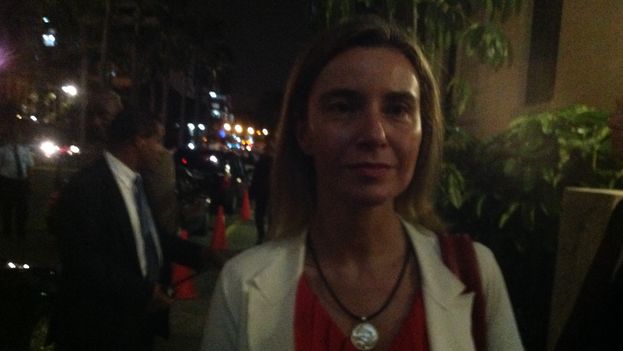
Federica Mogherini, just outside the press conference where a reporter from 14ymedio was not allowed to enter

14ymedio bigger14ymedio, Havana, 24 March 2015 – On Tuesday afternoon the European Union’s High Representative for Foreign Affairs and Security Policy, Federica Mogherini, held a press conference for Cuban official media and foreign correspondents in Havana. According to the representative, Cuba and the European Union aspire to reach an agreement on political dialog and cooperation before the end of the year.

At the press conference, held in the Taganana Room at the Hotel Nacional, independent Cuban media were not allowed to enter. However, despite the restrictions, a 14ymedio reporter managed to get some statements from the official as she left the location.

Thanks to the collaboration of Herman Portocarero, European Union Ambassador to Cuba, this newspaper was able to have brief contact with Mogherini at the end of the press conference. continue reading

The official regretted the incident that blocked journalist Reinaldo Escobar from entering the area of the press conference and agreed to answer some brief questions.

In its questions, 14ymedio, recalled that during the rift between the Cuban authorities and the European leaders there was increased contact with alternative civil society, whose representatives have been received in several European Chancelleries. Thus, it’s worth asking, “Does the current approach of the European Union to the Cuban government mean that this relationship with civil society will be reduced or eliminated?”

Mogherini replied, “No, there is no distancing from Civil Society. The Europeans, the European Union, always talk with civil society, with every civil society.” To which this newspaper asked if she thought that relations between Cuba and the European Union were improving. The European head of diplomacy said, “I believe it is advancing.”

The issue of the United Nations Human Rights covenants that the Cuban government has signed but not ratified was also a subject of questions. Mogherini responded that, “The subject was discussed, but I cannot speak to it. I can’t speak on behalf of the Cuban government.”

Mogherini made an official visit to Cuba this Tuesday, the first for a European Union High Representative for Foreign Affairs to the island, to advance the dialogue seeking a normalization of relations between Brussels and Havana.

Cuba is the only Latin American country with which the European bloc does not have a bilateral agreement. Since 1996 relations have been determined by the “Common Position” which has conditioned ties with Havana to advances in democracy and human rights in Cuba.