Diplomacy, yes. Democracy, what for? / Orlando Luis Pardo Lazo

The potential complications 
of the renewed diplomatic relations
between the U.S. and Cuba.
Orlando Luis Pardo Lazo

It was about time. Uber taxi drives agree. Academics agree. Minority leaders agree. American social activists agree. Radio, TV and press editors agree. Even comedians agree. It’s the only point of consensus in the polarized US politics. No need to argue anymore. The left was right and the right was wrong. Time to move forward. At least in this issue: Yes, We Can (a cloned slogan from the socialist Sí Se Puede in the posters and parades of La Habana). After 50-plus years of US diplomatic stalemate and economic sanctions against Cuba, with Fidel Castro almost a nonagenarian and his brother Raul to step down from presidency in 2018, the road to transitions on the Island, as in 1898, starts in Washington, DC.

A secret agenda had been held for 18 months, unbeknownst to the US Congress and the Cuban Parliament, but sanctified by the first Latin American pope. In a reenactment of the US-China ping-pong engagement, even the sperm of a Castro’s spy was gently exported from a US federal prison to beget a new life in Revolution Square. The long-sought family reunification as the libidinous metaphor of the national reconciliation about to come. continue reading

The climactic hallmark was on December 17th, as a fulfilled promise on the day of San Lázaro Babalú Ayé, with two simultaneous speeches running in parallel windows of millions of web-connected computers all around the world except in Cuba: in one, the democratically-elected American president Barack Obama; in the other, the dynastically-appointed Cuban general Raul Castro. The former wearing the civil elegance of his suit and a hi-tech reading device; the latter in military uniform, rescuing a picture from his violent years before the Revolution in the fabulous fifties, and reading from pile of paper. Quite a pluribus duo, without liberty but with diplomacy for all.

Calls immediately exhausted the batteries of my Chinese mobile. Everybody rushed for a quote about the end of the Castrozoic Cold War Era. Only The New York Times was involved enough as to bet on a series of op-eds published weeks in advance (by the way, for over a decade now they also have prêt-à-porter the obituary of Fidel Castro by Anthony De Palma). Some American Cubanologists, like Peter Kornbluh and David E. Guggenheim were conveniently located on the Island that noon. The popular reaction was overwhelming, they claimed. Tears should have come to my eyes, according to the emotional interrogation imposed to me until my smartphone was silenced.

A silence that lasts until today.

Barack Obama told the truth in his allocution: “The United States will reestablish an embassy in Havana, and high-ranking officials will visit Cuba.” Raul Castro lied with impassive impunity: “We have also agreed to renew diplomatic relations.” But this is still not the case.

It’s too early to pretend to demonstrate my skepticism. Or cynicism. As a good Castro subject I know that time on the Island means not money, but more system’s status quo. To keep begging for US bank credits, the Revolution first needs to buy time. This is what biopolitics is all about. A family fighting to secure a second Castro generation in complete control after Fidel’s and Raul’s eventual deaths. Necropolitics.

Obama’s hope was to reopen an embassy in Havana ahead of the Americas summit on April 10th, as he declared to Reuters on March 2nd. In fact, the US Interests Section in Havana has been for years the largest diplomatic mission in Cuba, and no special budget needs to be considered to reestablish the formal status lost in 1961.

Yet, Castro’s hope might be to push back the US engagement to an intolerable limit of stagnation. Havana insists now that the term “normalization” will remain an absurdity while the US keeps Cuba on the list of states that sponsor terrorism. A list currently under expedited revision, as to the State Department to please the Cuban demands. The Democratic White House cannot afford to welcome a Republican president without having its job done —with or without Gitmo, for or against Radio Martí, plus or less the billions requested by Cuba as a historical compensation for decades of US embargo.

As the good-spirited Assistant Secretary of State for Western Hemisphere Affairs Roberta Jacobson flies to and from Havana, she’s been forced to smile for a selfie with Josefina Vidal and Gustavo Machín, her counterparts of the Cuban foreign ministry. Technically, her company is sign of prepotency in the time of appeasement, since in November 2002 Machín was expelled from the US in retaliation for the Ana Belen Montes case —a Castro top-level spy at the Pentagon— while in May 2003 Vidal voluntarily left the US, when her husband Jose Anselmo Lopez Perera —First Secretary of the Cuban consulate in DC— was also expelled for espionage.

After the mass media catharsis of the first round of talks last January, the third one ended in a hermetic “professional atmosphere” according to the Cuban official report, as abruptly as it was announced, and “with no breakthrough on sticking points in an atmosphere of rising tension over Venezuela”, as recognized with concern by the The New York Times.

The State Department spokeswoman Jen Psaki declined to explain why she announced “positive and constructive” progress in the discussions. She has now renounced to setting any “timeline or a deadline.” Again, totalitarianism is as much about tyranny as about manipulation of time.

The last speech of Raul Castro in Caracas in support of the regime of Nicolás Maduro came as an ice bucket water challenge: “The United States should understand once and for all that it is impossible to seduce or buy Cuba nor intimidate Venezuela” [APPLAUSE] and “we won’t concede one iota in the defense of our sovereignty and independence, nor tolerate any interference or conditioning in our internal affairs” [OVATION]. With their monologic belligerency in the Summit of the Americas in Panama, they will “expose the mercenaries who present themselves as Cuban civil society as well as their employers.”

I won’t travel to Panama this time, but I am worried of what could happen to my colleague and friends there, faces with the para-civil society that the regime is organizing as platoons of governmental NGOs, as we all know that on this Island to “expose the mercenaries” means routine repression by the political police: family harassment (Omni Zona Franca Community Poetry Festival), censorship (Hip Hop Rotilla Annual Festival), defamation (independent blogger Ernesto Morales), job dismissal (intellectual Boris Gonzalez Arenas), imprisonment for years with or without charges or trial (Sonia Garro), not paramilitary but paracivil beatings (Roberto de Jesus Guerra, director of Hablemos Press free-lance agency), temporary or permanent invalidation of travel documents (activist Antonio Rodiles and performer artist Tania Bruguera), repudiation mobs with or without throwing red paint (Mercedes La Guardia Hernandez) or tar (Digna Rodríguez Ibañez) on the dissidents, most of the time women —despite pro-Revolution feminists worldwide— and Afro Cubans —despite pro-Castro race activists worldwide, and selective extrajudicial killing (Oswaldo Payá and Harold Cepero from the Christian Liberation Movement in July 2012).

Besides, after the nth resurrection of Fidel Castro last month he left an untimely text for the record: against “the eccentric politics” and “brutal plans of US government” Cubans and Venezuelans are united and “ready to shed the last drop of their blood for their country”. It was not only the senile nightmare of a García-Márquez caudillo, because a Cuban government official note denounced the executive order to consider Venezuela a US national security threat as an “arbitrary, interventionist and aggressive” move from President Obama.

Maybe we’ll see in Cuba the masquerade of new investments and markets and local licenses for businesses and more access to the internet and even an electoral reform after the migratory reform, but each and every one understood as concessions, with no fundamental freedoms guaranteed as long as one and only one Communist Party keeps monopolizing all political life, with State Security from the Ministry of the Interior as the real source of governance of a model based on coercion more than in a responsible citizenry, able to self-organize to participate in life after Fidel.

Is the Cuban self-transition from dictatorship to dictatocracy under way with the US as a new geopolitical ally? Time will tell. It will not be the first example of authoritarian regimes mutating into Socialist State capitalism for the sake of regional stability. As the assassinated leader Oswaldo Payá stated many times, we Cubans have the right to have all of our rights recognized beyond any dispute or complicity among power elites. Why what has been good for Americans since the Eighteenth Century is not good for Cubans today? Is it too impolite to peacefully demand that the Cuban people be consulted in a free and safe referendum about the destiny of our nation?

Democracies seem guilty of their duty to foster democracy worldwide, but Castroism is more than proud to Castrify democratic countries and still play the victim. Anyway, even if this is a small step for democracy, it’s also a giant leap against decency, since Cuban sovereignty is sequestered by a government that cannot be held accountable by our own people. Maybe this is another victory for The End of History: from our War against Spain to the anti-Imperialist Revolution, the growing “Common Marketization” of international relations is what really counts at the end.

Certainly it is good news for America that the cry of “Yankees, come home” echoes for the first time in our continent. In fact, as we keep on leaving in migratory waves to the US —both legal and illegal— Cubans are making space for Americans to reforest the Island. Since the nuclear missile crisis of October 1962, these “human missiles” have been used as a pressuring position by Havana in its undiplomatic relations with Washington, DC, at least while the Cuban Adjustment Act, which privileges Cubans to apply for a permanent resident status after one year and a day in America, remains in place.

Unfortunately we Cubans got accustomed to voting with our feet in a sort of pedestrian’s plebiscite. Let’s see what the US embassy will imply in terms of profits and principles for the labyrinth of Cuban liberty.

31 March 2015

Cuba: Dreams and realities before and after the Summit of the Americas / Juan Juan Almeida

1427850192_cumbre-panama -- JJNow that the beginning of the VII Summit of the Americas in Panama is upon us I think I understand why there are so many expectations. I studied in the former USSR and I know that many optimists are living in a sort of suspense similar to that of Moscow in 1985, when Mikhail Gorbachev and Ronald Reagan were going to meet, for the first time, in Geneva.
Although many have forgotten due to the monumental act put up by the translator who hoarded the headlines, Barack Obama and Raúl Castro met for the first time during the funeral of Nelson Mandela in South Africa.

Today, some think that we are making progress and others that we are on the verge of a “nervous breakdown”. The truth is that all Cubans will listen to the speeches of both leaders and will pay attention to the small details that we will only be able to see during their handshake. continue reading

To Panama will go part of Cuba’s opposition and Cubans in exile. But I think the preferred topic to speak of will be the hundred, maybe more, of actors, students, intellectuals, artists, farmers, private vendors, members of cooperatives, businessmen and academics who, also as representatives of Cuba’s civil society, were zealously selected to travel to said Summit and to dramatize an entire spectacle with a gelatinous dynamic. In this spectacle we will see one or two desertions and special acts with tones that are sentimental, democratic, multiracial, polytheistic, progressive and pluralistic.

This is what the ex Minister of Culture and current presidential adviser Abel Prieto anticpated when he said on March 17 that “the Cubans who attend the Summit in Panama have to be prepared to confront the stereotypes created around the idea that Cuba has a monolithic society.”

The story will begin when upon the end of the Summit, Cubans return to the island to confront the real scenario with the new changes in everyday life. Venezuela cut by more than half the amount of oil it sends to Cuba and although it is logical to understand that Havana and Caracas, so long as they maintain inscrutability and motivate speculation are keeping quiet, one only has to turn the page to see that there is no objective possibility for Venezuela to continue to subsidize oil while facing its own extreme difficulties.

An even worse case is Brazil; the exploration of oilfields below the ocean would provide an income of millions of euros. Based on this there were agreements signed and commitments made, Brazilian oil will be the “goal of the future” but the fall in crude oil prices and the recent scandal related to Petrobas, sank the South American giant into the worst of its crises and into a political paralysis that will have its consequences in Cuba and on the Port of Mariel megaproject which is suddenly halted due to a lack of capital.

Cuba’s medical delegations abroad will continue because the government will use the military’s budget in order to not alter any precepts. But the return of electricity blackouts, in the present circumstances in the island, where everyone likes to play at leading and democracy, will force replacing the decadent debate of the “lefts and rights” for the need to choose between “politics and economics”.

Doubtlessly, that does erode the government’s strength and will force it to retreat to allow new alternatives for the development of the citizenry, which will resourcefully find the legal and/or natural mechanisms to improve the wellbeing of self, family and nation. In that order, because the reverse is called utopia.

Translated by: P.V.M.

The Mariel Exodus: State Terrorism / Cubanet, Roberto Jesus Quinones

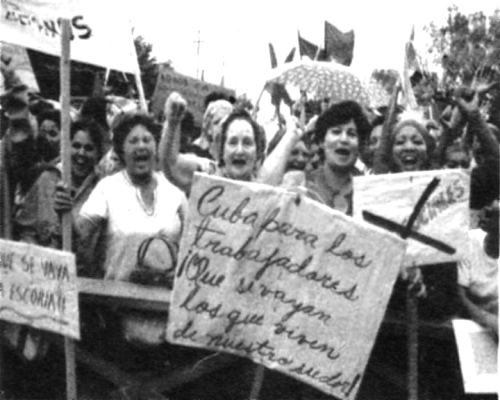
Posters from acts of repudiation during the Mariel Boatlift (1980)

Against the “scum,” acts of repudiation, beatings and humiliations. Against Florida, an invasion of the unemployed

Cubanet.org, Roberto Jesus Quinones Haces, Guantanamo, 1 April 2015 – On the first of April 1980 a bus was driven through the entrance to the Peruvian embassy in Havana; its occupants entered and sought political asylum. Unfortunately, the non-commissioned officer of the PNR (National Revolutionary Police), Pedro Ortiz Cabrera, lost his life in the event. The event was followed by others extremely traumatic for many Cubans due to their violence. All would be indelibly recorded in the nation’s collective memory and would reveal the terrorist nature of the Cuban regime.

Fidel Castro demanded that the Peruvian government immediately hand over the people who had forcibly entered the diplomatic headquarters. To have pleased him, long jail sentences and execution by firing squad undoubtedly would have been the sanctions applied. But the government of Peru did not agree, and the Cuban regime adopted a measure that, like the others taken in those days, made it seem to their proxies that the ball had been placed in the opponent’s court.

The Measures Taken by Fidel

Fidel Castro ordered the withdrawal of protection and monitoring from around the diplomatic headquarters, inciting all Cubans who wanted to emigrate to enter it. Very soon, thousands of people from all the cities and towns of the country crammed into the place turning it into a tangible reservoir of the discontent that now was sapping society. continue reading

Cuba for the workers. Those who live on our sweat, let them go.
Mariel Boatlift act of Repudiation. “Cuba for the workers. Those who live on our sweat, let them go.” (Left side: “Let the scum go”)

The increase in the number of countrymen who wanted to emigrate was made evident, and the government, with the objective of discouraging the exits that it had sponsored, made terror its deterrent method par excellence. It was the first time that acts of repudiation were applied on the Cuban public stage. The beatings and humiliations abounded everywhere. The masses, encouraged by powerful groups and directed by individuals of doubtful social behavior, violated the most basic norms of respect for human dignity, and the country lived through several weeks of fascist practices that kept it on edge until the international community strongly protested.

The government demanded the refugees in the embassy and all those who desired to emigrate to present themselves at their places of employment or study in order to be given leave. The unemployed had to seek the document from the CDRs (Committees in Defense of the Revolution). That was the indispensable requisite in order to obtain the exit permit, and it would allow the mobs to intercept the petitioners in order to attack them.

Another Shameless Political Action

Some years had to pass to have access to other reports and above all to read and listen to the irrefutable testimonies on Radio Marti and right here, in order to understand the magnitude of the events and the perversity of the government in those demeaning days of our history.

With the single purpose of getting the advantage in a confrontation where he would always be seen as the victim due to the political, military, economic and moral grandeur of the opponent, Fidel Castro took dangerous offenders from the jails and put them in the embassy in order to create chaos, and then he demanded that the boats that came in search of relatives take these people as well. Together with them travelled not a few mentally ill, it was later learned.

It was a clever move, but of ephemeral value and revealing of the unethical essence of the regime whose immediate objective was to discredit the new emigrants, whom the government elite called “scum.” But also it tried to clean out the Cuban jails and export to the US potential disruptive social elements that Hollywood would portray in popular films like Scarface.

Time Relentlessly Passed

Thirty-five years after these events — which came to be known in the United States as the Mariel Boatlift — many of the Cubans who were catalogued as “scum,” thanks to their honest work and a society that is not perfect but that does guarantee all human liberties, enjoy a life in the US where maybe nostalgia for the home country occupies an important place, but one in which they live according to their way of thinking, with dignity.

Act of repudiation against the Ladies in White in recent times.

The Mariel Boatlift was not a success of the Castro regime; to the contrary. One highly placed leader from that time, Carlos Rafael Rodriguez, admitted to a Mexican magazine that the Revolution had nothing to be proud of with respect to what happened. It is rumored that it was the catalyst for the suicide of Haydee Santamaria and the object of analysis in the farewell letter that Osvaldo Dorticos wrote to Fidel Catro before dying from another gunshot. It was a Pyrrhic victory that very soon lost the artificial shine of the trappings that the Castro regime figureheads dished out in order to praise the supposed genius of the leader. His abuses, still unpunished crimes and inequities were unmasked to reveal the fascist essence of the methods used by the mobs encouraged and supported by the police and political leaders.

Since then the acts of repudiation against officially disfavored diplomatic headquarters and the peaceful opposition, especially the extraordinary Ladies in White and the brave members of the Patriotic Union of Cuba (UNPACU), are still practiced in the streets and before the homes of those harassed.

This, together with repression and constant vigilance by the state security forces as well as the government’s refusal to respect political and fundamental civil rights, shows that state terrorism is a practice entrenched in the Castro regime. The Americans should not forget it, especially now when, behind the abundant dividends, they try to remove Cuba from the list of state sponsors of terrorism.

About the author

jesus-quinones-haces.thumbnailRoberto Jesus Quinones Haces was born in the city of Cienfuegos September 20, 1957. Law graduate. He was sentenced in 1999 in an unfair and illegal way to eight years incarceration and since then has been prohibited from practicing as a lawyer. He has published the books of poetry “The Flight of the Deer” (1995 Editorial Oriente), “Written from jail” (2001, Ediciones Vitral), “The Folds of Dawn” (2008, Editorial Oriente) and “The Water of Life” (2008 Editorial El Mar y La Montana). He got the Vitral Grand Prize for Poetry in 2001 for his book “Written from Jail” as well as Mention and Special Recognition by the Nosside Juried International Poetry Competition in 2006 and 2008, respectively. His poems appear in the UNEAC Anthology of 1994, in the Nosside Competition Anthology of 2006 and in the selected ten-line stanzas “This Jail of Pure Air” produced by Waldo Gonzalez in 2009.

Translated by MLK

The Curse of the Cursed / Yoani Sanchez

GY - sello-denegacion-entrada-pasaporte-artista_CYMIMA20150327_0011_18

Generation Y, Yoani Sanchez, Havana, 1 April 2015 – Imagine that after a flight of more than nine hours, you arrive at your destination but they don’t let you get off the plane. Your legs are numb from the journey, your relatives are waiting for you out there, your suitcases are full of gifts for friends… but an immigration official informs you that you will not be allowed to enter the country of your birth. You have to stay in your seat, tired and frustrated, while they clean the plane for the next passengers. In the time you wait for it to return to the airport from whence you came, you can’t stop asking yourself, “How could this happen to me in my own country?”

That nightmare, was just experienced by the artist Aldo (Maldito) Menendez – whose nickname means “cursed” – as he tried to visit Cuba to participate in the Cervantes Alternate Lives Festival of Camagüey (FIVAC). The Cuban consulate in Spain had already warned him that he was not welcome on the Island and had even stamped his passport with an authoritarian “annulled” on the so-called “empowerment” that Cuban emigrants need to enter their own country. But… the truly Maldito was not satisfied and wanted to experience firsthand whether they really wouldn’t let him cross the border. continue reading

Like any artist, Maldito is daring and irreverent. His works are provocative and even the title of his blog, Castor Jaboa, is an anagram* which, when we reorder its letters, delivers its message loud and clear. However, beyond his art, this young man who studied at the San Alejandro National Academy of Fine Arts in Havana, is a real cubanazo** who boasts the talent, mischievousness and the humor that so characterizes us. So how is it possible that, for political reasons, he is prevented from being in the place where he’s from, the site from which flows much of his art and his world of reference?

Maldito’s is not a new story, but that is no reason why we should get used to such abuse, nor cease to denounce it. After more than two years of immigration reform, its implementation has not eliminated the blackmail that Cuban emigrants are subjected to in order to enter the Island. The punishment of those who criticize the Cuban government from their residence abroad remains a denial of their right to return.

A few, protected by their power, decide who can once again walk these streets, embrace their friends, be in the house where they spent their childhood. And they do it from the arrogance of believing that they, with their ideology and their military uniforms, represent the essence of Cuba, when in realty they only manage to deform it, to restrict it… to kill it.

Translator’s notes:
*Castor Jaboa is an anagram for Abajo Castro — Down with Castro.
**A cubanazo is a boisterous, shamelessly stereotypical Cuban man (a woman would be a cubanaza) who dresses, walks, speaks and thinks in uniquely Cuban ways.


Betting Cuba’s Future on Alejandro or Mariela Castro / Juan Juan Almeida

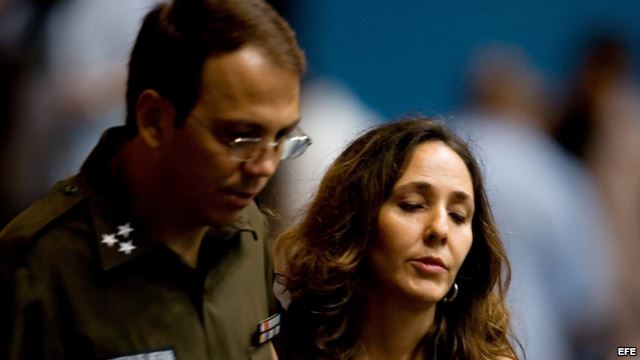
Siblings: Alejandro and Mariela Castro Espin

Juan Juan Almeida, 27 March 2015 — With the approach of the next congress of the Cuban Communist Party, scheduled for 2016, some analysts are adhering to a prudent logic by predicting that Alejandro Castro Espin will be included on the list of possible successors to the Cuban throne.

They cling to this notion with amazing aplomb. But the prospect of Alejandro being included in any list of possible successors is likely to dissipate even before it can happen. Very intelligent people often make the mistake of advancing elaborate theories such as this by standing back and looking at the surface but mistaking the spots of a Dalmatian with those of a Holstein.

Clearly, Alejandro has managed to hone the proverbial skill of political oratory. He acts as a government spokesperson and, what he does not know, he makes up. His peculiar gift for being able to memorize and recite the complete works of Lenin can be astonishing. He is one of the most powerful people in Cuba today and has a hand in important national decision-making. But he is forever caught between the image of a hero and the verses of the Iliad, which ominously conflate modern-day Havana with an epic Greek saga. continue reading

Alejandro is not a member of the Secretariat nor the Politburo nor the Central Committee nor the National Assembly. Nor does he represent (or claim to represent) any major social group. This is why I believe his sister Mariela is better poised to compete for the same office.

Alejandro wrote a book, The United States: The Price of Power, translations of which we can find in several languages. But, although available, it remains practically invisible, having failed to garner the respect of artists and intellectuals who, among other things, know that the author of this indigestible work is really Juan Francisco Arias Fernandez, also known as Paquito, his faithful squire.

Yes, Alejandro is a military man. He is also cold, calculating and ambitious. But he lacks influence with the military’s commanders. Some of them, the oldest officers, formed their ties during the battles in the Sierra Maestra. Others, the mid-level officers, did so during Cuba’s wars in Nicaragua, Ethiopia and/or Angola. The rest, those comfortable in the wheeling and dealing of the marketplace of influence, belong to a group none of whose members would consider jeopardizing a profitable present by clinging to a past that has no future.

Vilma and Raul’s son does not fit into any of the Castro categories. Though he did pass through Angola, he did not take part in the war. After a shooting accident during training practice in Luanda, he returned to Havana and was decorated as though he had been wounded in battle, something that remains a source of jokes even today.

Of course, they can handpick him. They can make him president or field marshal. Even Raul knows that appointing Alejandro would establish a precedent that would withstand the culture of silence and the fear of the Cuban people. But it would amount to a slap in the face to the intelligentsia, and would turn a hierarchical structure like the military into a tinderbox and every general into a lighted match.

Bets are only made when the chips are on the table. To put it simply, Alejandro is someone who will remain relevant only as long as Raul Castro is alive.

An Anachronistic May Day / 14ymedio, Reinaldo Escobar

14ymedio bigger14ymedio, Reinaldo Escobar, Havana, 30 March 2015 – A compendium of bows to the official discourse has served the Secretariat of the Cuban National Workers Center (CTC) to tailor its now traditional Call for the May Day celebration. Under the central motto “United in the Construction of Socialism” a call has gone out to fulfill production commitments, to implement the Party’s Sixth Congress Guidelines, to replace imports, achieve savings, make plans for exports, and all the interests of the State boss, along with a vast anthology of Revolutionary slogans and verses.

The tribute to martyrs and heroes is not lacking, nor is solidarity with Venezuela, nor greetings to the World Federation of Trade Unions on its 70th years of life, nor evocation of the memorable definition of the concept of Revolution, expressed by Fidel Castro fifteen years ago during a celebration on International Workers Day. continue reading

An entire paragraph is dedicated to the present “international political concept,” emphasizing the maintenance of the “genocidal economic, commercial and financial blockade; the unjust inclusion on the list of countries sponsoring terrorism, and the occupation of the territory where the naval base sits in Guantanamo.” Curiously, the issue of the reestablishment and presumably normalization of relations between the two countries is restricted to “a new approach of the United States Government toward Cuba,” as if the Cuban side had played a passive role in this process and lacked a new approach in its strategy.

Absent from the message was any idea that could be interpreted as a claim, a demand for improvements in working class wages, living standards and working conditions. Not one word about the thousands of self-employed workers and entrepreneurs who today lack any kind of autonomous organization, no allusion to the double exploitation suffered by those who work for joint ventures or foreign firms, much less to the extortion suffered by Cuban collaborators abroad.

At the end of the day, the Call is an almost unnecessary formality. Through the country’s plazas, streets, villages and bateyes hundreds of thousands, perhaps millions, of Cubans will march waving their officially-permitted flags and placards. Not a single detail will deviate from the established script. Order, discipline and even enthusiasm will reign in the parade.

The Censors Talk about Censorship / 14ymedio, Victor Ariel Gonzalez

14ymedio bigger14ymedio, Victor Ariel Gonzalez, Havana, 30 March 2015 — The Surprised Pupil is a program whose first mistake is the name. With quite mediocre staging, presentation and content, really this television program has nothing surprising to see. But to hear, maybe some viewer or another was hoping that its most recent on-air output would tackle seriously a very thorny topic: censorship.

However, that viewer with high expectations was soon disappointed. Censorship is a problem that affects every Cuban producer today, but The Pupil did not worry about that. It was foreign censorship, that which nations supposedly suffer “under the dominion of big corporations,” that occupied the program.

There was even a segment dedicated to McCarthyism, that period of “repressive delirium” in the United States in which “great artists lived through times of accusations, interrogations, trials and torture,” said the program’s host. Not even hinted at were the anti-intellectual raids undertaken by the Cuban government, those whose spirit was defined by Fidel Castro in his phrase reminiscent of Mussolini: “Within the Revolution everything, outside the Revolution nothing.” continue reading

It would be too much to ask that they openly address chapters as regrettable as the Military Units to Aid Production (UMAP), the university purification processes, or the repudiation rallies. Or to remember how less than 40 years ago listening to The Beatles could lead to suspicion. Those pages of the national history have been forgotten by the official media.

If, after all, few know who Cabrera Infante, Reinaldo Arenas or Heberto Padilla were; and if the ghosts of Pinero or Lezama Lima have suffered exorcisms of posthumous atonement, then what sense does it make to speak of censorship in Cuba?

Maybe none for those guests who lent their words to The Surprised Pupil. They used, for example, statements by the actor Enrique Molina to a Spanish speaking chain for a digression about the financing of projects. As “there exists no state budget for filmmaking, [Cuban] directors have to seek financing abroad,” said he who played Silvestre Canizo on the popular soap opera Tierra Brava.

Molina, who obviously does not have any intention of demanding anything from the Ministry of Culture, blamed the lack of money on the lack of foreign producers “with good intentions and honesty” who seek something different than reflecting “the ugly things of Havana” or “everything challenging the politics of the country.” That, together with the difficulties that the “blockade” involves in bringing Cuban cinema abroad, constitutes censorship for this artist.

For the musician Fidel Diaz Castro, “the censors of the contemporary world have turned into diplomats” because they say: “My fellow, I would like to place your work, but that doesn’t sell.” Here he referred to the censorship imposed by marketplace preferences, although it could well be an attempt to justify his own incompetence.

Another of the guests was Iroel Sanchez, a key figure in the official blogosphere in a country without the Internet. The blogger spoke of a documentary that criticizes the media groups owned by financial conglomerates. “In the United States one can speak ill of a Democratic or a Republican president,” said Sanchez, “but (…) you cannot speak badly of the owners of those big finance groups that control the means of communication.”

Iroel Sanchez did not cite the example in which the governing party and the owner of the means of communication are the same. This is precisely the Cuban case where the Communist Party is the exclusive owner of the country’s media.

The common denominator throughout The Pupil was the American topic. Judging by the final message, there persists in that country a fierce repression of transnational reach. And as Cuban television said it, doubting it is strictly prohibited. There was no time to mention those on the Island who seek to issue a critical judgment outside of the given guidelines. Is that also the fault of an external enemy?

The Surprised Pupil is indeed very badly named. The greater error is having conceived as a surprise, and not as an insult, that the official discourse goes unpunished yet again. That is what happens when censors have no one to censor them.

Translated by MLK

Breaking the Bank: Fifteenth Birthday Parties in Cuba / Ivan Garcia

Fotos-y-Videos-para-Quinces-bachecubano-620-_mn-620x330Ivan Garcia, 28 February 2015 — Fourteen-year-old Yanisbel has one hot meal a day and the roof of her house leaks but her mother and grandparents have been saving for a decade to stage a traditional quinceañera, a celebration of her fifteenth birthday.

“All the women in my family celebrated their fifteenth birthdays,” says her mother. “My daughter should too. Maybe we won’t be able to throw a blow-out party. We don’t have relatives in government or in Miami but at least we’ll have photos taken, buy her three new outfits and throw a little party for her school friends.”

Yanisbel’s grandparents sell prepared lunches and milk caramels. They keep some of their earnings in a ceramic jar. “Fifteenth birthday parties get more expensive every day. An album of one photo session and a video is going to cost us 200 CUC. Then there are the costs for the dress, the buffet and beverages for the party. More than 600 chavitos (convertible pesos) in total,” her grandfather explains. “That’s the equivalent of five-years’ worth of pension for a retired person.” continue reading

South of the capital in the town of Casino Deportivo, Jennifer’s family will celebrate her birthday in high style. Accompanied by her parents, Jennifer visits the studio of a well-known photographer. Seated on a high bench, surrounded by strong lighting, a mirror and a white hat, she poses as if she were a model.

After a light dinner and a bath, she waits with her parents and boyfriend for a video to be shot. On the eve of the party she goes shopping with her mother and two girlfriends at a boutique in Miramar.

The climax is a four-night stay at a five-star Cayo Coco hotel in Ciego de Avila six hours by car from Havana. “The hotel and clothing expenses are being paid for by relatives who live in Miami. They’re flying to Cuba on the day of the party,” says Jennifer’s father, a mid-level bureaucrat at a state enterprise.

When asked about the costs, the father waves his hand and smiles. “What can I say? It’s a family secret. We have been putting away money since she was born. I stopped counting after about two-thousand convertible pesos.”

While Jennifer looks forward to the celebration, Octavio — an assistant bricklayer whose daughter’s fifteenth birthday is twenty days away — does not have a bank account or a wad of cash stashed under the mattress. “I will think of something. I plan on buying some new clothes and taking some pictures. Maybe I’ll pawn the TV or the fridge. I don’t know,” says Octavio as he waits in line at a bakery.

A photo session with the subject dressed like an actress and a DVD with photomontages ranges from 120 to 350 CUC. Poor girls like Ileana cannot celebrate their fifteenth birthdays by going out on the town with their friends. “But I do have a photo album and my parents gave me a pair of high-heeled shoes,” she notes.

Yamila, a sociologist, believes fifteenth birthday parties like this are a long-standing tradition in Cuba. “I cannot pinpoint exactly when this Latin American custom melded with the European tradition of ballroom dances,” she says. “In Spain, when a boy reached adolescence, they would put a goat in a sack and throw it off the top of a bell tower. I don’t know if they still do that but every July 7 on the Feast of San Fermin people in Pamplona run through the streets with bulls.”

She explains that in the United States the president even spares the life of turkey on Thanksgiving. “Every country has its customs and traditions. Purists in Cuba look upon fifteenth birthday parties as being tacky, extravagant wastes of money. But in the popular imagination they remain cherished events,” the sociologist points out.

A profitable private-sector industry has grown up on the island around these celebrations. Pablo, a professional photographer, alternates his time between working for a foreign press agency and shooting fifteenth birthday parties. “If you are a high-caliber photographer, you can make good money. Thanks to weddings and quinceañeras, I have been able to buy a 1956 Cadillac in good condition and spend a few days in Varadero every year. I find these parties cheesy but, as long as they pay well, long live the fifteenths.

Cuba’s fifteenth birthday celebrations have crossed the Florida Straits and have taken root among the hundreds of thousands of compatriots living there. Although many families have little to eat and live in poverty, the arrival of girl’s fifteenth birthday is an important event. Some people like Jennifer’s parents can afford to break the bank.

What remains after the tragedy / Yoani Sanchez

The location in the Alps where the remains of the Germanwing plane are strewn (Ministry of the Interior)

Generation Y, Yoani Sanchez, 30 March 2015 — There are clothes scattered across the mountains, open suitcases, children’s dolls that will never be played with again. Things that belonged to people who until recently were alive and of whom barely a memory is left, a trail of goods that will be sorted and conveyed to the families of the victims. The tragedy of Germanwings A320, crashed in the French Alps, makes me reflect, like many others, on the brief second that separates us from death. A suicidal leader, a madman at the helm, a war unleashed by others … a thousand and one ways to die that life brings us.

One evening in 1985 my family sat around the set table, waiting for Grandma. She never came, because two drunks in the middle of a brawl fatally wounded her in a nearby café. Her plate remained on the table. Cold, alone, with the spoon to its side and a glass of water making a wet round mark on the wood. continue reading

Afterwards there were her shoes, the wallet where she treasured her money and a nutmeg. Her clothes hanging in the wardrobe along with some photos from her youth that we never got to ask her about where they’d been taken.

The things the dead leave us are sometimes more difficult to deal with than the memories themselves. What to do with that note they wrote before leaving home to remember to buy eggs, salt and a little oil? Their drawers, the sheets they slept on their last night, the cookies they liked so much? How to quiet the way the comb speaks, still with their hair, the Facebook account in which they recorded their last “like” or that red circle on the calendar that marked their birthday?

The things the dead leave us have their own voice. They remind us every time we look at them that in that fabric, wielding that pen, or looking into that mirror, until yesterday, had been someone who breathed and whom we loved.

“You have to hear every silly thing in this country!” / Cubanet, Orlando Freire Santana

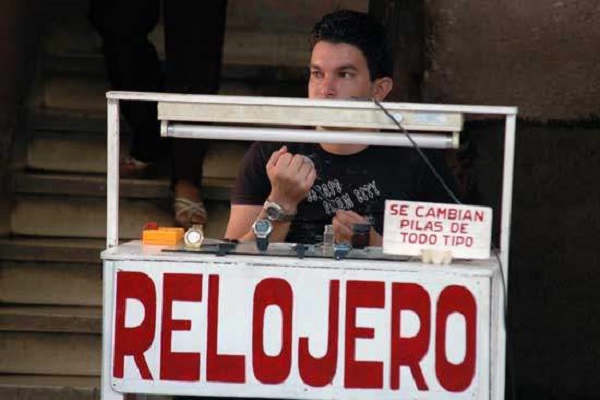
Self-employed watch repairer. “We change every kind of battery” Cuba_archivo

A letter published in the official Granma by one its readers asks the State to limit the prices charged by the self-employed in order to protect “the working people from abusive prices”

cubanet square logoCubanet.org, Orlando Freire Santana, Havana, 27 March 2015 – Notwithstanding the image that the Castro regime strives to present about small, private enterprise, in the sense of having expanded this activity as part of the economic transformations that are taking place on the island, the truth is that the non-state sector of the economy faces more than a few obstacles.

High taxes, lack of a wholesale market where supplies and raw materials can be acquired, the lack of recognition by the authorities of the total costs that private businesses incur, as well as the excess of audits of Sworn Personal Income Statements, among others, are some of the daily hurdles that stand in the way of the self-employed.

Last Friday, March 20, the newspaper Granma published two works that contain “recommendations” that could obstruct or kill self-employment. The first of these, “Money Well Paid?” is a report about the payments by state entities to self-employed workers in the Holguin province. continue reading

The very title of the report – with that question mark included – already allows a glimpse of the distrust of those kinds of transactions, that in the past year reached 36 million pesos. The Holguin authorities insist that state entities must exhaust all options that the providers from the government sector offer when acquiring goods or services. And only lastly to approach the self-employed workers.

The state payments to the self-employed in the referenced territory, with a view to exhaustive control, must pass through a bureaucratic structure that includes the Government Central Auditor Unit, the Commission of Charges and Payments, and the Provincial Administration Council. And by the way, what becomes of the highly vaunted “entrepreneurial autonomy” if the entrepreneurs can barely decide from whom to buy what they need?

The other material featured in Granma is the letter from a reader, “For the excessive desire to obtain greater riches,” in which he complains of the prices charged by the self-employed who entertain children in the Palmira township in Cienfuegos. In addition to that specific situation, the writer of the missive extends his criticism to all the self-employed and says in one paragraph: “I think that the Administration Councils, municipal as well as provincial, must control the prices of the offerings by the self-employed, protecting the working people from abusive prices and giving those people a legal foundation on which to demand their rights.”

It should be emphasized that an opinion of this kind, appearing in an official organ of the Communist Party, cannot be underestimated in any way. So began the attacks against the self-employed who sold home products, to those who were called “retailers.” In the end, that activity was prohibited, and many self-employed who used to hold those licenses lost them and were left unemployed.

When I commented to a café owner in my neighborhood about the Granma reader’s letter, the man reacted indignantly: “Don’t tell me…self-employed prices are abusive…Listen to me, abusive is the tax that I pay, which they have raised on me three times; abusive is that I spend more than 50% of my revenues on buying everything that I need to work, and the people from ONAT [the State tax collector] only recognize 25% as expense; and abusive was the fine that they imposed on me last year, of several thousand pesos, when they deemed that I had under-reported personal income. You have to hear every silly thing in this country!”

About the Author

orlando-freire-santana.thumbnailOrlando Freire. Matanzas, 1959. Graduate in Economics. He has published the book of essays, The Evidence of Our Time, Vitral Prize 2005, and the novel The Blood of Liberty, Franz Kafka Novels From the Drawer Prize, 2008. He also earned Essay and Story prizes from the magazine The Universal Dissident, and the Essay Prize from the magazine New Word.

Translated by MLK

No blogger, no Obama / Orlando Luis Pardo Lazo

No blogger, no cry.

Orlando Luis Pardo Lazo

In the beginning was the Blog. 2 But blogs were formless and empty. 3 Repression was all over the blogosphere. 4 And the citizens saw the blogs were good. 5 So that lacking other channels of expression, the Cuban civil society occupied blogosphere as a tool for dissent. 6 Won’t you help to share these blogs of freedom? 7 Redemption blogs, redemption blogs to emancipate ourselves from the State.

As early as in the summer of 2005, I opened a blog for publishing a literary and opinion magazine that three Cuban writers decide to edit in Havana: Cacharro(s) —in English, Junk(s).

Lizabel Monica, Jorge Alberto Aguiar and I were posting our texts in cyberspace, hoping for a reader abroad to save us from the silence within. We couldn’t imagine that in a couple of years our initial experiment was to be ignored in the history of Cuban blogosphere, when our efforts to escape not only censorship, but also the mass media mediocrity of the Revolution, were displaced by new voices with high public impact both from the cultural and political fields.

This happened when the Consenso —Consensus— digital magazine became ContodosWith All— and opened the website Desdecuba.com, directed by Reinaldo Escobar, Manuel Cuesta Morúa, Miriam Celaya, Dimas Castellanos, among others, including a webmaster who, in April 2007, started a very simple WordPress blog called Generation Y. The trademark Yoani Sánchez was born, as well as the first virtual revolution in the time of Castro.

This was the genesis of an independent movement of citizen journalism which challenged the lack of transparency of the public sphere in Cuba, a country still without private Internet today.

Cuban top-level intelligence commanders like Ramiro Valdes have stated that the Internet is a “wild horse” that “must be tamed” before offering it to the people. After many promises and postpositions, including a submarine fiber-optic cable that connects us with Venezuela since 2011, Cubans are still waiting for a miracle.cu, although continue reading

the vice-president Miguel Diaz Canel has warned our press not to be objective but “loyal to Fidel, Raul, and the Revolution”, while Fidel himself determined that the “internet is a revolutionary tool”.

Elaine Diaz, blogger of La Polemica Digital —The Digital Polemics— known as critical of certain official measures, but at the same time a professor of journalism at Havana University and now a Nieman Fellow at Harvard University, in her degree thesis about the Cuban blogosphere “scientifically” established in terms of topics and chronology that none of the renowned dissident bloggers were pioneers at all, thus diluting this phenomenon in an ocean of other blogs practically discovered by her, up to nearly 3,000 today, which outnumbers by far the dozens of local independent bloggers.

Diaz quotes only those blogs that can be quoted in Cuba without risking her research position, like Patria y Humanidad —Homeland and Mankind— since 2006 administered by Luis Sexto, a winner of the National Journalism Prize; and La Isla y la Espina —The Island and the Thorn— since 2007 administered by Reinaldo Cedeño, both defined as open to “foreign authors” and to “hot heated debates” but, of course, within the temperature limits of political discipline on the Island.

Diaz recognizes that the Union of Cuban Journalists (UPEC) and no less than the Ideological Department of the Central Committee of the Cuban Communist Party, authorized more than 1,000 official journalists to open blogs from their workplaces or privileged home connections, in order to —as Milena Recio wrote in her article “Cuban blogs: an entrenched identity”— reproduce in cyberspace the same battlefield logic of the street propaganda, to “counteract the distorted and opposite speeches from hegemonic mass media” against the Revolution.

The very Code of Ethics of UPEC rejects “hyper-criticism” in its article 7, while in articles 8 and 9 reminds their members to “maintain a social and moral behavior in accordance with the principles and norms of our society […] to promote the best of our national values and the constant improvement of our socialist society”. And after paternalism comes a large list of punishments, which includes imprisonment, as happened to a journalist from the Communist Party newspaper Granma, Jose Antonio Torres, accused of espionage after one of his official reports.

Diaz also proposes the “emancipatory and anti-capitalist usefulness of the new media and technology” in Cuba, and the need of “virtual symbols” for a country where it is “possible” the “horizontal dialogue”, beyond power hierarchies and all kinds of social exclusion: by race, by gender, by sexual preference, by economic status, etc. Although she omits to mention the cause of all discriminations in Cuba: the political intolerance and hate speech of the revolutionary government, summarized by Fidel Castro in his speech to Cuban intellectuals in 1961: “Within the Revolution, everything; against the Revolution, nothing.”

Recently, this “dialogue” approach has been updated by the web Cuba Posible of Lenier Gonzalez and Roberto Veiga, former editors of a Catholic Church magazine that published some civil debates, where certain civil society activists managed to participate. Cuba Posible claims for the complicit concept of “loyal opposition” to the regime, if critics are to be considered legitimate. Besides, Gonzalez and Veiga urge the Cuban dissidence to commit suicide and stop all the support they receive from foreign NGOs, despite the detail that they both defended this viewpoint from Washington DC, invited in January 2015 by a compendium of US pro-Castro NGOs, like the Cuba Research Center of Philip Peters.

During the last decade, the Cuban alternative blogosphere has expanded and contracted like the cycles of a claustrophobic universe. Its main communication strategies and activists have renovated only to remain identical.

With my blog of fictionalized chronicles Lunes de Post-Revolution —Post Revolution Mondays— and my photoblog Boring Home Utopics, I have witnessed most of this Cuban digital e-volution, with its pro-human rights achievements and, unfortunately, with today´s drawbacks in front of a State involved in a self-transition to capitalism without capitalists, but with accomplices of Castros’ agenda.

Most of free-lance Cubans’ blogs are linked in the websites HavanaTimes.org and VocesCubanas.com, where can be found the famous Generation Y of Yoani Sanchez, blogs from visual artists like the graffiti performer Danilo Maldonado El Sexto (in jail since last December) and the photographer Claudio Fuentes, blogs dedicated to new media and technologies like the one by Walfrido Lopez, blogs from independent lawyers to give legal advice like the unregistered Cuban Juridical Association of Wilfredo Vallin, blogs from religious leaders like the Baptist minister Mario Felix Lleonart, blogs of digital publications like Plural Thinking NotebooksNotebooks for the Transition, and the magazine Voices edited by me, community participation initiatives like Pais de Pixeles photo-contest, blogs of filmed debate projects which then are uploaded to the web to impact on public opinion, like Razones Ciudadanas/Citizens’ Quests.

Thanks to the volunteer amateur projects TranslatingCuba.com and HemosOido.com many of these blogs are distributed beyond geographical isolation and the barriers of language.

Mainly in Havana, much closer to the www than Cuban pre-technological countryside, events have been held to shift from the cyberspace to citizen mobilization, like the Blogger Academy where we teach the technical rudiments of self-publication, as well as the primitive option of tweeting by an international SMS sent from the Island, as local mobiles have no internet service in Cuba. Other events also held in private houses, like the two annual editions of Click Festival 2012 and 2013, had the privilege to count on international experts on blogs, and consequently they were stigmatized by the governmental blogosphere as being part of a subversive conspiracy to disrupt social stability.

Indeed, cyber-bullying is the less brutal answer of Castro’s political police to Cubans exercising our right to freedom of expression.

Two inflexion points in this abusive battle of the government against their own citizenry, occurred in 2011. First, the Cuban TV showed a weekly series on Cyber-mercenaries where all independent activists were severely threatened to be prosecuted (coincidentally, Elaine Diaz was used an example of blogging correctly). Then a suspicious video leak occurred from State Security, where an officer later identified by the social media as Eduardo “Tato” Fontes Suarez, delivers a conference for the Ministry of the Interior to teach them how to manipulate the internet in the era of an American president “much worse the Bush”, implementing a clone blogosphere to reproduce Cuban official press and saturate the web with convenient contents. This includes the logic of creating authorized local versions of Wikipedia (like Ecured), Facebook (like La Tendedera), Twitter (like El Pitazo), etc.

This should remind us of the theories of Evgeny Morozov on how disappointing is the excess of web optimism, because repressors also learn how to take advantage of the interconnected world to channelize and control social discontent to their own convenience.

Unfortunately, after the 2013 migratory reform that for the first time in decades allowed Cubans to travel abroad without the humiliating “exit permit” or “definitive departure”, international recognition of Cuban civil society leadership has meant a national weakening of our networks and the dispersion of our already limited impact on the Island.

All the peaceful movements and prominent personalities of Cuban civil society, that in the good old days of 2008-2011 seemed about to integrate in a unified opposition front with political implications, are now splintered in their respective personal initiatives among themselves. The more successful their international projections, the more isolated among themselves are their national projects. We Cubans are still lacking a culture of open polemics and understanding of differences. After more than half a century, Castroism has castrified even their opponents.

Here are some sad examples, as they all are my dear friends and have been fighting quite a long time for a better future in Cuba:

The Ladies in White split one more time, in a fractal procedure that keeps the movement stagnated in number of members, and with an exponential increase of refugees fleeing to the US. Once in exile, most Cuban dissidents quit social activism or, in the best cases, end up as secretaries in Cuban American NGOs. The legacy of their founding leader Laura Pollán is at risk for the benefit of the Ministry of the Interior, now that their new leader Berta Soler carried out a shameful repudiation against one of its former members, and then had to hold a referendum to ratify her life-long leadership. But Soler was expelled anyway by the daughter of Laura Pollán from her home headquarters in Neptuno Street in Central Havana, where Laura Pollán junior expects to direct a new foundation that will monopolize exclusive use of her mother’s name.

The Christian Liberation Movement (MCL) is headless after the 2012 extrajudicial killing in Cuba of their leaders Oswaldo Payá and Harold Cepero. Internal rearrangements have displaced from any position even the daughter and the widow of Oswaldo Payá, in a dispute for the redemptive legacy of the martyr, as well as the strategies that should be implemented by this now virtually an exiled movement.

The Cuban Patriotic Union (UNPACU) always has nearly half of their activists in jail. On one hand, UNPACU fostered the creation of an independent branch that broke out of the Ladies in White, the Lady Citizens for Democracy. On the other hand, they are obsessed with detecting and denouncing —and sometimes converting to the cause of freedom— Castro’s secret agents, like the infamous case of Ernesto Vera, but they lack a citizen mobilization strategy beyond their self-extinguishable street protests, partly because the Cuban people are unfortunately unmovable.

The Somos Mas movement launched by Eliécer Avila relies only on his face and voice as a charismatic character, once himself a digital soldier that conducted the Operation Truth at the University of Information Sciences (UCI), a platoon of trolls devoted to defaming activists worldwide, distorting online forums and surveys dealing with Cuba, and hacking websites that expose the violations and fallacies of continental Castroism.

The bitter debate of mutual distrust and discredit between those close to blogger Yoani Sanchez and her brand-new 14yMedio.com digital outlet —prone to take advantage of the US-Cuba new engagement to push the limits of censorship in Cuba—, and other previous digital citizen journalists, like the staff of Primavera Digital (who in turn last year publicly despised their Swedish funding partners), and also with the well-known Antonio Rodiles from the very active audiovisual discussion project Estado de Sats, who practically accused 14yMedio and colleagues of collaborating with the regime’s surviving agenda of allowing foreign investments with no guarantee for human rights, in a Putin-like or Chinese or Vietnamese or Burma post-totalitarian model.

On the official part, in the monolithic digital headquarter of Cubadebate, general Raul Castro with his speech at the ALBA Summit in Caracas this month, and many other op-eds published in tandem, has warned that the “international ultraconservative right” is again deploying its “mass media weapons” to use the “concept of civil society in order to attack all the progressive governments from the hemispheric left, with the purpose to deceive and manipulate all the peoples of the world.”

Cubadebate has even announced the popular repudiation that Cuban dissidents —namely, “mercenaries”— will receive in the Summit of the Americas in Panama next week, because we all are “conceived, paid and directed as drones from the US and the EU, through NGOs supposedly for the promotion of human rights, but in fact having met with confessed terrorists like Luis Posada Carriles in Miami, and besides being directly financed by secret institutions of the American imperialism, including the Pentagon and the CIA”.

In March 2015 the Castro regime still proudly calls Cuban social activist leaders “Washington’s puppets, in the line of the dictators Fulgencio Batista in Cuba, Carlos Andrés Pérez in Venezuela, and Augusto Pinochet in Chile, whose mission if ever we attain power is to surrender the wealth of our nation to the US monopolies”, and a white elite that cares not about the “black, aboriginal, farmer and workers minorities”.

Although, paradoxically, it was Fidel Castro who dollarized the Cuban economy for over 20 years now, while his brother Raul Castro is demanding financial credit from American banks and corporations. Furthermore, Afro Cubans suffer much more than other dissidents in Cuba in the hands of the mostly white State Security top-officers, who assume that blacks owe more gratitude to them the rest of the Cuban people.

These are only some tragic examples:

The death of the Afro Cuban opposition activist Orlando Zapata Tamayo in a jail, after a long hunger strike in 2010 to stop torture against him. The 33 months that the Afro Cuban member of the Ladies in White Sonia Garro and her husband spent in prison without charges and with no trial. The harassment and beatings against of Afro Cuban leader Jorge Luis Garcia (Antunez), usually prevented from stepping out of his own house in Placetas town. The arbitrary political police arrests, plus the temporary or permanent invalidation of the passports of Cuban Afro Cuban intellectuals and activists Manuel Cuesta Morúa and Ivan Hernandez Carrillo. The fascist-like mobs conducted by the government against the residences of Berta Soler and other Afro Cuban peaceful women of the Ladies in White, including throwing tar —yes, tar— with impunity against their bodies, like recently happened to Digna Rodríguez Ibañez. Or staining them by force with red paint to resemble human blood, like they did to Mercedes La Guardia Hernandez.

The White House and the remains of the US economic embargo should not ignore that a market economy is not a tropical liberation formula, since it has already been implemented by authoritarian systems as a tool for despotic control. The secret negotiations to appease our tired tyranny should remember that what has been good for free Americans since the Eighteenth Century is also good for Cubans citizens today.

The rationale that, after waiting for so long, Cuban democracy can wait a little longer is a discriminatory concept implicitly legitimized by the US press and academics in their search of a lost Latin American Left.

Maybe the hope of the White House is that the New Man will stop being a soldier and become the New Salesman, but bringing down the wall should mean more than opening up the wallet. In the urgency of Google, Amazon, Delta, Netflix, Coca-Cola, and even Bacardi to re-conquer their Pearl of the Antilles, they shouldn’t forget that we “Cubans have the right to have rights,” as preached by Oswaldo Payá before the gerontocracy and their international accomplices took his life.

In any case, according to the migratory statistics, Cubans are certainly making a lot of space for the Yankees to come home to our Island, as we keep escaping by legal or lethal means, in a kind of pedestrians’ plebiscite, voting with our fleeing feet instead of with electoral ballots.

For the funerals of Fidel, the commander-in-chief will have achieved all the glories of history —which is the mother of all horrors— but also the frantic farewell of his own people —almost one-fourth of our population. This migratory crisis is what the US is really trying to stop by stabilizing the Communist dynastic succession to the Castros 2.0 generation: namely, Alejandro and Mariela Castro Espin, among other relatives, whether dandies or despots, many of them holding high level positions in the Cuban establishment while receiving privileged visitor status in the US.

The hope would be in convoking a national referendum with international observers so that the Cuban people can freely and safely express our will for the first time since 1948. Otherwise, Cuba will become a Castro-centralized capitalist condominium, economically annexed to the US but with a hyper-nationalist speech to justify impunity on the Island.

Now President Barack Obama can choose to extend his helping hand to the oldest Latin American dictatorship. Or he can consider if the Cuban people deserves to endure our apartheid until the last of the Castros manages to remain in power without consulting anyone (except maybe Obama himself).

1 Fidelism 1959, the temperature at which fundamental freedoms burn. 2 As time blogs by. 3 As I lay blogging. 4 The blogger in the ryevolution. 5 From dictatorship to dictocracy. 5 Blogged the Raven: nevermore. 6 Castrobamacare as the measure of all things. 7Won’t you help to share these blogs of freedom? 8 Redemption blogs, redemption blogs to emancipate ourselves from the States.

29 March 2015

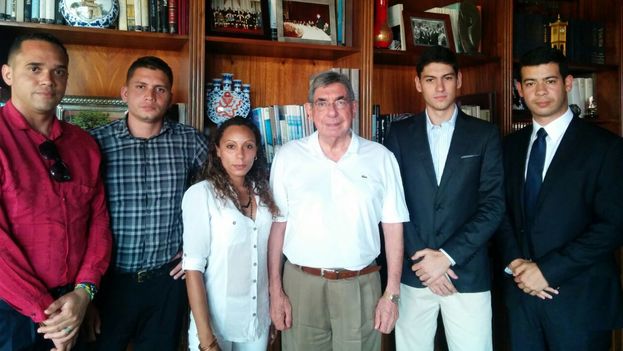
Oscar Arias meets with young Cubans and Venezuelans / 14ymedio, Eliecer Avila

Meeting of young Cubans and Venezuelans with Oscar Arias

14ymedio bigger14ymedio, Eliecer Avila, San Juan, Costa Rica, 29 March 2015 — To Costa Rica, that Latin American country recognized for its outstanding economic push, its democratic stability, and its role in the defense of human rights, a group of young Cubans and Venezuelans has come as guests of the National Liberation Party.

Undoubtedly among the Costa Rican politicians most prominent in recent years, Dr. Oscar Arias Sanchez stands out. He held the presidency for two terms, the first from 1986 to 1990, and the second started in 2006 and ended in 2010. Thus, a meeting with him was something not to be missed on the visit’s agenda.

The Arias administrations brought Costa Rica notable advances in different sectors. So much so, that for the most part his compatriots usually refer to him as the “best president” they ever had.

The successful mediation of several international conflicts, among them that of Nicaragua in the 1980s, also turned him into a global paradigm in defense of peace, for which he was honored with the prestigious Nobel Peace Prize in 1987.

On Saturday, the long awaited meeting with Arias took place at his home where he received a group of young Cubans and Venezuelans. The dialogue lasted more than an hour, during which the former president listened attentively to continue reading

their plans later shared his vision of the political landscape of the two nations. Also discussed was the current situation, and the challenges facing those working for democracy in both countries.

Arias criticized governments for generally “remaining silent” about what happens in Cuba and Venezuela “for fear of upsetting their respective Lefts.”

Addressing the Venezuelans, he asked them about the status of unity of the democratic forces and the personalities engaged in the struggle. José Javier Martínez, member of the Vente Venezuela movement, responded that, “Although there are some differences between the main opposition leaders, they disappear on the issue of respect for human rights.”

“It is on this point, above all, and in its defense that we are firmly united,” Martinez reaffirmed. The young man also took advantage of the occasion, to ask the former president for support for a motion that several MPs from different parties are trying to push through the Costa Rican legislature. The objective of the motion is to have the ambassador of this nation propose to the Organization of American States (OAS) that it discuss the situation of Venezuela in its main plenary session.

Arias also asked about the course of relations with the United States and what might be expected in this respect. Kirenia Yalit, Coordinator of the Roundtable of Cuban Youth, explained the different visions and postures of Cuban civil society toward this process and pointed out that, “We young people are not opposed to the opportunities that this these changes could bring to the benefit the people, but we will continue in our struggle to achieve the rights that we need to exercise, whether or not there is trade with the United States.”

Arias then speculated about the possibility of a Cuban Deng Xiaoping, who would reform the Cuban system from within the Communist Party, as happened in China.

To this Eliecer Avila, leader of Somos+ (We Are More) and a member of the Roundtable, responded that, “There is always that possibility, but we Cuban democrats do not see in China an applicable or desirable framework for our country.” The young man emphasized that, “We are able to build a much better model, one that in addition to economic growth also ensures the full exercise of civil and political freedoms, the only guarantees for a national reconciliation and lasting stability.”

The former President thanked the young people for the visit and reiterated his commitment to the democratic cause of both peoples. Which, he said, “Would always be addressed in my upcoming conferences, because I say what I think and do not speak just to get along with anyone.”

An Afternoon for Danilo (El Sexto) / 14ymedio, Luz Escobar

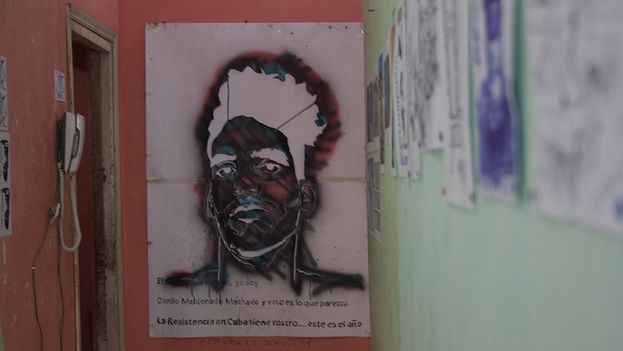
Danilo’s (El Sexto’s) works displayed on the walls of La Paja Records studio (Luz Escobar)
Danilo’s (El Sexto’s) works displayed on the walls of La Paja Recold studio (Luz Escobar)

14ymedio bigger14ymedio, Luz Escobar, 29 March 2015 – As part of the campaign to demand freedom for the artist Danilo Maldonado, known as “El Sexto,” several artistic activities took place this Saturday at la Paja Recold, the studio of the band Porno para Ricardo.

On the walls of the place were works by the graffiti artist who has been incarcerated since last December 25. El Sexto was arrested shortly before carrying out a performance that consisted of releasing in a public square two pigs with the names of “Fidel and Raul.” The crime that has been charged against him is contempt.

Several friends from all over the world and human rights organizations have demanded his immediate release. Yesterday’s activities joined those demands for his freedom. Among the most important moments of the afternoon was the performance by Tania Bruguera of The Whisper of Tatlin which opened the studio’s microphones to the fifty attendees of the encounter to ask for – in a minute each – Danilo Maldonado’s liberty. continue reading

The host band Porno para Ricardo, played the lead musical part with several songs from their repertoire. Subsequently rappers including El Opuesto, Maikel Extremo, Rapper Isaac and Lazaro Farise Noise appeared on stage. All demanded the release of the artist and demonstrated solidarity with his cause. Also a book was opened in order to gather signatures of support for the #FreeElSexto campaign. An option paralleling that already implemented on the digital platform Change.org and that is intended for those who do not have access to the Internet.

The artist Tania Bruguera told 14ymedio she had attended the event, “Because I think this is a case of the violation of the artist’s rights.” “It is not right that an artist who did not even carry out the work should be made a prisoner,” she stressed. Bruguera is precluded from leaving Cuba and is in the midst of legal proceedings because of events arising from her attempt to organize a performance last December 30 in the Plaza of the Revolution.

In spite of her delicate legal situation, the artist attended the event in order to offer her support to El Sexto’s cause. Because she says that “An artist that is in jail just for imagining a work and trying to make it, it is an injustice.” About the performance that the graffiti artist would have carried out, Bruguera points out that, “Public figures, whether politicians or celebrities, are likely to be criticized (…) they have to assume that people who do not have that power, they are able to make them aware of their discontent through humor and satire.”

Bruguera quipped that, “If they made prisoners of everyone who makes jokes about Fidel and Raul Castro, half the people would be incarcerated.” And she concluded, “The artist’s freedom lies in having the right to say symbolically whatever he wants.”

Gorki Aguila, meanwhile, explained that, “It is important that artists join together among themselves (…) art has an incredible power to summon.” El Sexto’s grandmother, attending the event, said that, “The right of a man to live as he wants to live must be respected, Danilo does not harm anyone, he respects everyone, but he also asks for respect for himself, that they let him do what he wants.”

With respect to the prison conditions in which this artist has lived, the grandmother says that, “He was sleeping on the floor for two months because for him, as for many other prisoners, there was no bed. They don’t let even an aspirin in. Danilo is chronically asthmatic, he had pneumonia, and they denied him antibiotics.”

The lady also told of the continuing threats by State Security to many of the invitees so that they would not go this Saturday to the tribute to El Sexto. The pressure included the visit of two officers to the home of Gorki Aguila in order to deliver to him a police citation that required him to appear at the police station that same afternoon. The musician refused to go on grounds that a citizen must be given at least 24 hours notice of such an action.

Lia Villares said that during the next Havana Biennial, which will get underway at the end of May, “We are going to do something.” The blogger anticipates that it will be, “A work by El Sexto that was not displayed here today.”

Translated by MLK


Our Dead Are Raising Their Eyelids / Orlando Luis Pardo Lazo

Orlando Luis Pardo Lazo, 22 January 2015

It’s true. Although I still don’t believe it.

But they’ve told me it in all the families I’ve visited since I’ve been out of my country. That’s what families are, a mausoleum. They don’t lie. There is no Cuban family which is not our death memory.

That’s how it is. We Cubans die in the family. That’s the saddest part of dying. Not dying as such, which doesn’t bother the person dying, but the horror of imposing on exactly those people who loved us while we were alive. People should go and die among strangers. Get lost, and that’s it. That’s why I went to the United States. That’s why I didn’t die in Havana, in spite of the fact death whispered “Orlando” in my ear every morning where I lived. continue reading

But it’s true. At first I panicked when I knew that somebody was going to tell me the same thing again. Without, of course, coming to any agreement, without ever having been in contact with each other. So, I only wanted to grab the phone, call my house and cry.

Little by little I was thinking more about it. I calmed down. From fear of the mystery to admiration of the secret sense of a non-existent nation: Cuba. The stories repeat themselves. Every Cuban family can remember one, two, three, ten cases. In every Cuban family the same sparkle in the eyes, and the trembling of the hands of the person telling me about it. And maybe too many generations have passed. We are now in exile, without guides, and with no turning back. That’s to say, we are an empty space. We all now have a memory at home of one of us who died without love, without a home, without Cuba.

They have told me it in Spanish and English. In Hialeah, which is La Lisa del Norte, and in Fairbanks, Alaska, where no other Cuban has ever been. Two details are always included:

1) In exile you don’t die at any old time. You die at night, which is when our country is reflected in the sky and indirectly under the breastbone, and because of that it is easy to see it more closely than when we are there.

2) When a Cuban goes away to die far from Cuba, he has a very intense moment of lucidity. And of youth. He stops being the scornful and cruel adult which he has always been, and gets back then an aura of the angel which he never has stopped being. We become good at the precise moment when we can no longer do any good. And every family tells me, in almost the very same words, irrespective of the level of education or intellectual pretentiousness, that the distant Cuban, before he dies, always pronounces the name of Cuba.

Can you believe it? It’s amazing. A destroyed people, degraded, dispersed, unable to recognise each other. And at the time which is no time, totally stretched out on the beloved bed to create the following Cubans, who will later cuddle them while they grow between great big pillows which save them from the shortages in Cuba, collapsed on the edge of the tomb, watched without a goodbye by our people  where everything comes together into a death rattle. And we breath out this elemental pair of syllables: Cuba.

I have never read this before revealing it here. I owe this evidence to the Cuban people, we owe it to them.  And it’s a perverse word which I detest as a killer of men. But after knowing how we will all die without Cuba, including you and me, I think we deserve to be some kind of a people. The nocturnal imaginary nation, hollow, like the human heart. The family remembering those who are going to die by themselves and neverthless with a chorus of Cuba, Cuba, Cuba.

Don’t let me say goodbye to you. What with death and everything, I still love you.

Translated by GH