With this murder, there have been 20 femicides in Cuba since January.
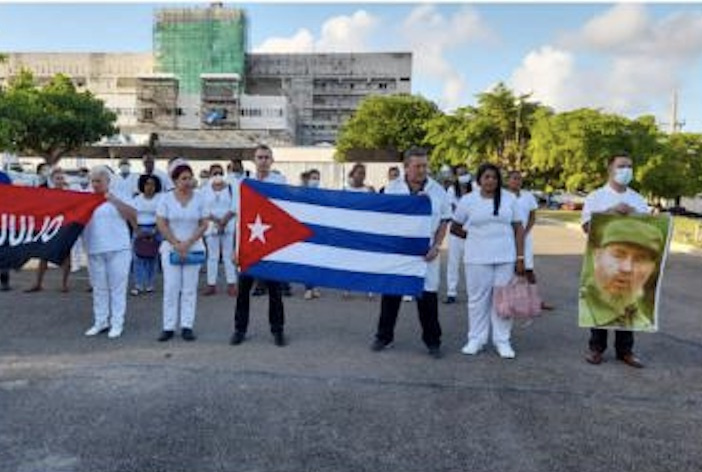
Neighbors claim that Kenia had been abused by her partner for years. Text of sign: Violence Leaves Mars, Ignoring it Leaves Femicides / YoSíTeCreo in Cuba
14ymedio, Juan Diego Rodríguez, Havana, 28 July 2025 — Kenia Rodríguez Mora, a resident of the Havana neighborhood of Luyanó and mother of a 7-year-old girl, is the latest victim of domestic violence recorded in Cuba. According to 14ymedio sources, on Sunday her partner, the child’s father, threw her from the roof of the home they shared on Rodríguez Street.
Although the news has not been confirmed by independent Cuban feminist associations, residents of Luyanó told this newspaper about the incident, which did not come as a surprise to those around them. “The man is an alcoholic and beat her constantly. They say the woman had been enduring the beatings for years until today, and that’s when he killed her,” says a woman living a few blocks away.
“The fight started last night, and in the morning he continued hitting her and threatening her,” continues the neighbor, who claims that Kenia ran up to hide on the roof, where the alleged murderer chased her and threw her off. Later, according to the story, he tried to take her to the hospital, but nothing could be done for her. continue reading
“The fight started last night, and in the morning he continued hitting her and threatening her,” continues the neighbor, who claims that Kenia ran up to hide on the roof, where the alleged murderer chased her and threw her off.
“I passed by there a while ago and there were two police officers,” says another resident. “The woman was very poor, she didn’t even have any clothes. She lived selling and begging,” he says. Another neighbor remembers Kenia frequently stopping by her house trying to earn some money or begging. “Terrible. She didn’t even weigh 100 pounds and was just over 5 feet tall,” she adds.
Reluctant to share much more, neighbors claim the alleged attacker was a very violent man feared in the neighborhood, as rumors suggest he had a history of murder. Witnesses say the police arrested the attacker, but they fear he will be released and return to the neighborhood.
With the murder of Rodríguez Mora—whose surname was provided by independent platforms when reporting the news—this year’s record of femicides compiled by this newspaper has risen to 20. Just this Sunday, the same day as the events, the death of 29-year-old Yailín Carrasco, at the hands of her partner, was confirmed in Cienfuegos on July 22. According to the Alas Tensas and Yo Sí Te Creo observatories in Cuba, the crime occurred “in front of at least one of the three surviving girls.”
Both associations made public the death of another woman murdered in the street in Holguín on July 13, Yailín Requejo, 41. In that case, the state press reported on the murder only to announce the arrest of the attacker last Tuesday. However, the woman, described as a “young wife,” was not identified, and it was stated that Requejo’s youngest daughter was seriously injured.
In 2024, 14ymedio recorded 52 murders due to gender-based violence based on independent records. According to figures from the Cuban Observatory on Gender Equality, a total of 76 gender-based murders in which the victims were over 15 years old were prosecuted in the country in 2024. The organization does not specify the dates on which the crimes were committed, but they most likely occurred in 2023 and 2024.
____________
COLLABORATE WITH OUR WORK: The 14ymedio team is committed to practicing serious journalism that reflects Cuba’s reality in all its depth. Thank you for joining us on this long journey. We invite you to continue supporting us by becoming a member of 14ymedio now. Together we can continue transforming journalism in Cuba.
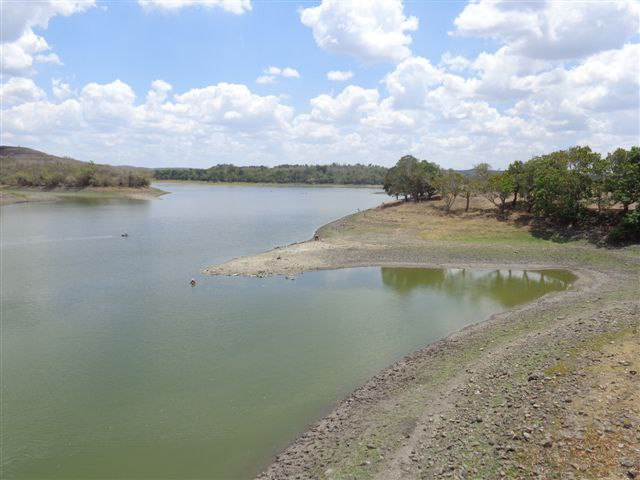
The lack of rainfall has led to an alarming reduction in reservoir levels.
Cacoyugüín Dam, in Holguín. / Trabajadores
14ymedio, Miguel Hernández, Holguín, 28 July 2025 — “The drought is already hitting us here. There are areas where the water supply hasn’t been rising or hasn’t been pumped for more than 20 days, and in some areas, like Loma del Caguayo in Hilda Torres, it’s been going on for two months,” says Raúl, a 38-year-old resident of Holguín who spoke with 14ymedio . The lack of water, coupled with prolonged blackouts, is deepening the crisis facing residents in eastern Cuba.
Raúl’s testimony reflects a critical reality in provinces such as Santiago de Cuba, Holguín, and Guantánamo, where the lack of rainfall has led to an alarming drop in reservoir levels and the partial collapse of the water supply systems.
According to official data, in Santiago de Cuba, more than 80% of the population depends on the Quintero System, which has seen its water intake drop to between 900 and 1,000 liters per second after the loss of key sources like Gota Blanca and the reduction in supply from Gilbert. “Only one of the system’s five pipelines is functioning… the water supply situation is very critical,” continue reading
acknowledged Ludmila Rodríguez Barroso, director of Aguas Santiago.
In Holguín, reservoirs and aquifers have reached “alarmingly low” levels.
In Holguín, where nearly 48% of the territory was experiencing meteorological drought at the end of March, reservoirs and aquifers have reached “alarmingly low” levels, according to Radio Angulo. The flow supplying the city has dropped from 1,189 to 880 liters per second, forcing severe rationing. Agricultural production, already deteriorating, has suffered a further decline due to the lack of irrigation, worsening food insecurity and raising prices in local markets.
In Guantánamo, the situation is no less dramatic: the La Yaya reservoir, the province’s main reservoir, is at 9% capacity, with barely one million cubic meters of usable water. This has forced the operation of only one of the Guantánamo canal’s pumping engines, particularly affecting southern communities such as Carreterita and La Jabilla. The provincial government announced emergency measures, such as water transfers from the Caribe District and the cleaning of diversion pipelines, while urging the population to maximize conservation.
Added to this water crisis is the impact of the deteriorating national electricity system. Junior González Núñez, first vice president of the OSDE Agua y Saneamiento (Water and Sanitation Department), admitted that “approximately 70% of service disruptions are linked to problems in the electrical system.” After blackouts, water takes between six and eight hours to reach homes, further prolonging distribution cycles and leaving entire neighborhoods without water for days.
Although the authorities have begun installing solar-powered pumping systems—with the import of 866 photovoltaic units—these measures are failing to reverse the water shortage or meet demand. In Santiago de Cuba, delivery cycles exceed 20 days, while in critical areas they have already reached 60 days.
The drought, which has plagued eastern Cuba for years, not only threatens domestic water supplies, but also agricultural production, the local economy, and public health. In the words of Raúl, a Holguín resident desperately facing dry pipes, “This isn’t just a lack of water: it’s hunger, heat, blackouts, and empty businesses… all of this together is crushing people here in the East.”
____________
COLLABORATE WITH OUR WORK: The 14ymedio team is committed to practicing serious journalism that reflects Cuba’s reality in all its depth. Thank you for joining us on this long journey. We invite you to continue supporting us by becoming a member of 14ymedio now. Together we can continue transforming journalism in Cuba.
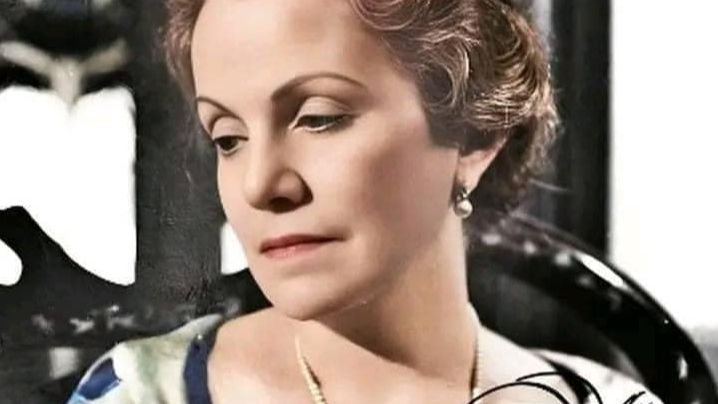
Betania Publishing offers the complete edition of the book, first published in 1991, as a free download.
Cuban writer Dulce María Loynaz, born in Havana on 10 December 1902, was awarded the Cervantes Prize in 1992.
14ymedio, 30 July 2025 , Madrid/ (Fragment)
IV
Like the first dawn of the world. That is it, and you have to adjust to that. But while the heart adjusts, it will be useless for you to fatigue me with eagerness.
I had a long night. Don’t you understand? You had it too, I won’t deny it. But you were dead and I was alive; you were dead and you rested in your own death like in a shoreless lake, like a child before birth in the still blood of its mother.
Meanwhile, I lived on, with eyes that wanted to pierce your darkness, bones that refused to stretch, and bitten flesh, pierced by black angels rebelling against God. You were dead, and I lived on, feeling the passing, the weight, the dregs of the night that had settled over me, incapable of dying or moving it! To move death. That was what I intended. To move the Unshakeable, the Blind, the Deaf, the Mute.
It was someone else who did it. He came, and the night became dawn, death became play, the world became a child.
He came and time stopped, opening the way for his smile like the waters of the Red Sea for our ancient Fathers.
All it took was a little crying, a little smiling, and everything was in place. Sweetly. Simply. Indolently.
______________
Editor’s Note: Betania Publishing—as a summer gift—is making the complete book by Dulce María Loynaz (Cervantes Prize winner, 1992) available to 14ymedio readers. You can download the PDF at this link.
____________
COLLABORATE WITH OUR WORK: The 14ymedio team is committed to practicing serious journalism that reflects Cuba’s reality in all its depth. Thank you for joining us on this long journey. We invite you to continue supporting us by becoming a member of 14ymedio now. Together we can continue transforming journalism in Cuba.
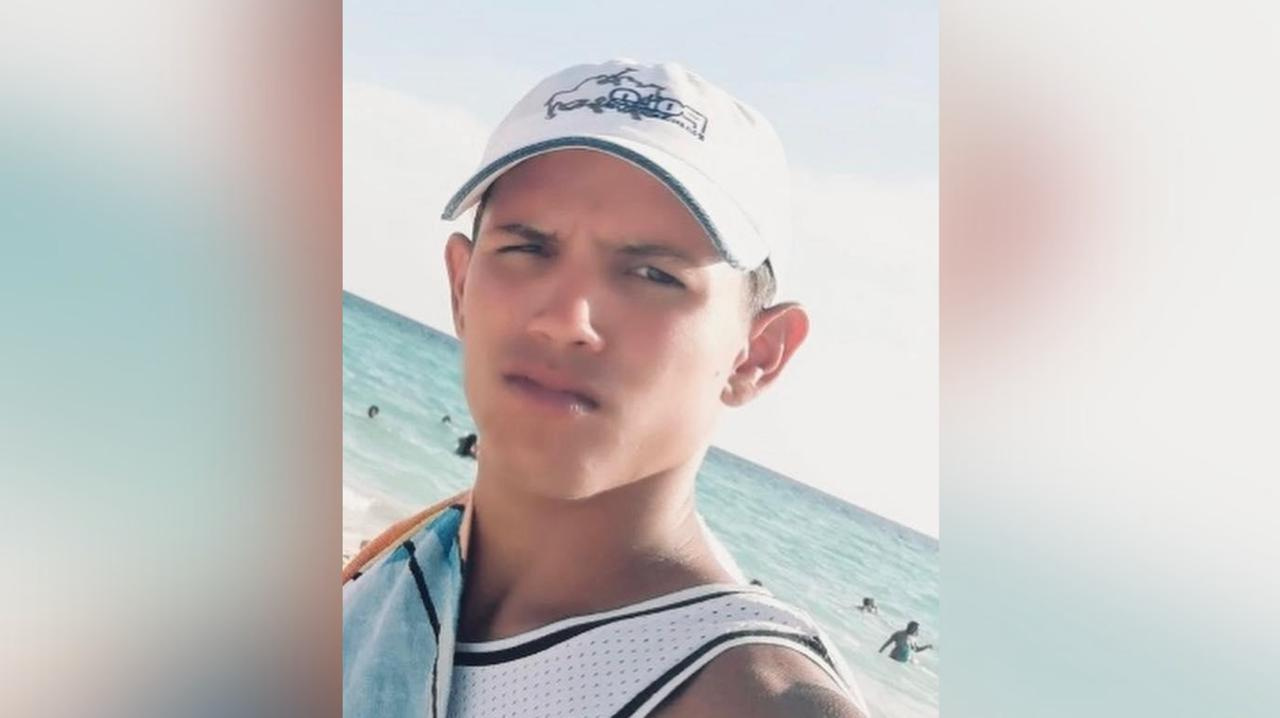
The young man, who is serving an 18-year sentence for sedition, loses the benefit of house arrest and returns to prison.
Marlon Brando Díaz was sentenced to 18 years in prison for sedition after protesting on 11 July 2021. / Facebook
14ymedio, Madrid, 1 August 2025 — The Cuban regime has revoked the release of 11J political prisoner Marlon Brando Díaz Oliva, who was under house arrest, a benefit granted to him in January of this year as part of the agreement between Washington and Havana brokered by the Vatican.
The information was released Thursday by the Madrid-based Cuban Observatory of Human Rights (OCDH). At this time, details regarding his return to prison are unknown, although sources close to the case told 14ymedio that Díaz Oliva had left his residence for a few minutes to make a purchase. The 23-year-old had been sentenced to 18 years in prison for sedition in 2022 and had served three years and six months of his sentence at the time of his return home.
Díaz Oliva was part of the large group arrested on 11 July 2021 at the corner of Toyo and La Güinera streets in Havana, and ultimately sentenced for the anti-government protests of that day. In six cases involving 128 people, the People’s Supreme Court issued sentences totaling 1,916 years. Most of the defendants were convicted of serious crimes such as sedition, with sentences reaching up to 30 years in prison. The High Court specified that those convicted were involved in “serious disturbances and acts of vandalism with the purpose of destabilizing public order, collective security, and citizen tranquility.”
“These revocations demonstrate that the release of political prisoners is nothing more than a temporary measure, lacking legal guarantees or continue reading
respect for fundamental rights,” the OCDH stated.
“These revocations demonstrate that the release of political prisoners is nothing more than a temporary measure, lacking legal guarantees or respect for fundamental rights.”
On January 14, Cuba announced it would release 553 people as a gesture to the Vatican for the jubilee year decreed by the late Pope Francis. The news came minutes after the Biden administration announced the island’s removal from its list of state sponsors of terrorism, a list it returned to a week later, the same day Donald Trump took office.
Havana argued that the releases were a unilateral and sovereign measure, but the coincidence revealed that it was an agreement facilitated by the Vatican. In March, with the process concluded, human rights organizations counted some 200 political prisoners who had benefited from the measure. The remainder of the 533, the majority, were common-law prisoners.
Supreme Court Vice President Maricela Sosa Ravelo then held that the beneficiaries must fulfill certain obligations, such as regularly appearing before a judge, continuing to comply with the additional sanctions, and assuming civil liability; otherwise, “there would be consequences.” “These benefits could be revoked if the released prisoners failed to comply with their obligations, and they would then return to the penitentiary to complete the remaining time on their sentences,” she explained.
“These benefits could be revoked if the released prisoners fail to comply with their obligations, and they would then return to the prison to complete the remaining sentence.”
Just a week after Pope Francis’s death in April, José Daniel Ferrer and Félix Navarro, two of the most well-known former prisoners, returned to prison for allegedly failing to comply with these conditions. Both had warned upon their release that they had no intention of complying with any of the regime’s demands.
In early June, the release of another political prisoner, Donaida Pérez Paseiro, a Yoruba priestess living in Placetas, was also revoked. The woman from Villa Clara had been sentenced to eight years in prison for “public disorder,” “disobedience,” “contempt,” and “assault,” also in the context of 11J. In her case, the court announced the suspension of her release, alleging “a breach of obligations, primarily related to the workplace, and failure to appear when summoned by the Enforcement Judge.”
The first case to be revoked was that of Jaime Alcide Firdó, released on January 18 and returned to prison in early April, allegedly for refusing to become a State Security informant. The 25-year-old was serving a seven-year prison sentence for sedition after participating in the 11 July protests in La Güinera.
____________
COLLABORATE WITH OUR WORK: The 14ymedio team is committed to practicing serious journalism that reflects Cuba’s reality in all its depth. Thank you for joining us on this long journey. We invite you to continue supporting us by becoming a member of 14ymedio now. Together we can continue transforming journalism in Cuba.
The official press claims there are surpluses in the agricultural sector due to the drop in travelers.
Economist Pedro Monreal believes that the government doesn’t care about hotels, but rather about the real estate business of renting them out.
The terrace of the Hotel Inglaterra in Havana, completely empty. / 14ymedio
14ymedio, Madrid, 1 August 2025 — María, taking advantage of a break on her way to work, was the only customer sitting on the terrace of the Hotel Inglaterra this week. “Look, the musicians are there, playing for no one, like every time I come by,” she quipped, stirring with a spoon the cappuccino she paid the waiter 300 pesos for.
The scene, unthinkable years ago, when tourism was still one of the few things going well on the island, has become commonplace in the new Cuba, where authorities have stopped pretending it is the engine of the economy to recognize that the moment is the worst “since the collapse of the Twin Towers in 2001, not counting the pandemic period,” as the minister in charge, Juan Carlos García Granda, said before Parliament last month.
Two weeks later, Cubadebate analyzes—in its own way—the catastrophic tourism data of the last year in a special issue and outlines a strategy to rectify the situation, which, it believes, must involve greater investment. “The modernization of tourism infrastructure appears to be another unavoidable priority. The implementation of targeted rehabilitation programs in key facilities—starting with the Varadero and hubs in the Keys —could significantly improve competitiveness without requiring huge investments,” the on-line report states.
The infrastructure improvements could include those García Granda suggested for airports, but several paragraphs in the text indicate that hotel investments are also being considered. “While Cuba struggles to maintain its hotel infrastructure, other countries in the region have invested massively in modernizing their offerings,” Cubadebate notes.
Among the infrastructure improvements could be those that García Granda advanced for airports
The data, however, indicate that the Havana regime has done nothing but relentlessly increase hotel capacity, inconsistent with the number of international travelers arriving. This Friday, Cuban economist Pedro Monreal published a post summarizing some alarming indicators. For example, in the case of Ciego de Ávila, the number of accommodations quadrupled in just two years (2020-2022). In Holguín and Havana, hotel continue reading
capacity also grew exponentially in 2024, by 26.3% and 28.4% respectively.
“The scale of tourist arrivals did not require expanding accommodation capacity during and after the pandemic. Increasing accommodation capacity in conditions of sustained low occupancy ruins the operational efficiency of tourism,” the expert argues. In his article, he analyzes other, more well-known data, such as the fact that a third of the country’s total investment was allocated to the tourist sector, where occupancy rates have not exceeded 30% in the last five years.
Monreal maintains that the regime’s obsession, more than with hotels, is with considering them an investment vehicle within a real estate business model that benefits the investing entities, which is, ultimately, the military corporation Gaesa, which leases its assets to international companies. This model, he asserts, also benefits “on a stable basis from ‘extra’ investment funds (via the state budget) and tax and customs advantages (derived from the International Economic Associations they establish)” and there is little room for optimism in this regard, as it is “shielded” by “political cronyism and corporate opacity.”
The Cubadebate article , which obviously doesn’t mention this vector, indicates that the lack of tourists is disastrous, both for the acquisition of foreign currency (approximately $2.3 billion directly and up to $8 billion if the indirect effect is included) and for other related sectors. Contradicting the ministers, who stated in Parliament that there are no travelers due to the food shortage, Cubadebate expresses something unusual.
“The agricultural sector, which allocates a significant volume of its production to supply the tourism industry, is now facing surpluses that have no alternative domestic market.”
“The agricultural sector, which allocates a significant volume of its production to supplying the tourism industry, is now facing surpluses that have no alternative domestic market,” it argues, also in stark contrast to the figures for agricultural production or the manufacturing industry, not to mention Cubans’ desire to see this unexpected surplus appear in their supermarkets. And as if the state had even more to spare, the outlet also notes that “the transportation sector, with a fleet of taxis and buses linked to tourism, is seeing its sustainability compromised.”
The text finds sui generis causes for the collapse of tourism on the island, which by June—with 1,680,304 visitors, 319,654 fewer than in 2024—has fallen by more than 20% compared to the previous year, a year that also was not very good. Among these causes, and leaving aside the impact of the “United States blockade,”* it mentions an alleged adverse international context which includes inflation, the (nonexistent) recession in Europe, and rising flight prices, which are harming tourism internationally.
Paradoxically, the World Tourism Organization has consistently reported improved figures annually since the end of the pandemic, and its forecasts for this year include growth of between 3% and 5%. Leading countries in the sector, such as Spain, revealed positive figures for the first quarter on August 1st. For example, the Canary Islands surpassed 80% hotel occupancy, while forecasts for August predict occupancy rates above 90% in regions such as Andalusia, the Balearic Islands, and Catalonia.
Meliá itself, a Balearic hotel group with major business in Cuba, can refute the alleged poor international context.
Meliá itself, a Balearic hotel group with significant business in Cuba, can refute the alleged poor international situation. Its first-semester figures show that the Island is precisely the dark spot in its finances. The company earned €991.1 million, 3.2% more than the same period last year, reduced its debt by more than €28 million, and increased its net profit by 72.4%, all thanks to the growth of all its destinations except Germany and Cuba.
The Island’s figures are grim and by far the worst of all the main locations: occupancy below 40% even with plunging prices—€80 on average, 10% less than the previous year—and a profit per room of €31.7 million. Despite this, in July the Hotel Bristol, formerly managed by Kempinski, reopened under Meliá management.
Given this situation and the loss of numerous visitors from both its main market – Canada – and its most promising – Russia, whose decline is attributed to sanctions stemming from the invasion of Ukraine, despite the fact that they have been in place for three years – the regime considers it positive that travelers from the United States are relatively stable, due to “the Cuban diaspora,” and that Mexico, Argentina, and Colombia are holding up, the latter a sign that there is “effectiveness in promotional campaigns specifically aimed at the South American public.”
______________
*Translator’s note: There is, in fact, no US ‘blockade’ on Cuba, but this continues to be the term the Cuban government prefers to apply to the ongoing US embargo. During the Cuban Missile Crisis the US ordered a Naval blockade (which it called a ‘quarantine’) on Cuba in 1962, between 22 October and 20 November of that year. The blockade was lifted when Russia agreed to remove its nuclear missiles from the Island. The embargo had been imposed earlier in February of the same year, and although modified from time to time, it is still in force.
____________
COLLABORATE WITH OUR WORK: The 14ymedio team is committed to practicing serious journalism that reflects Cuba’s reality in all its depth. Thank you for joining us on this long journey. We invite you to continue supporting us by becoming a member of 14ymedio now. Together we can continue transforming journalism in Cuba.
The first batch includes engines, tires, and batteries to perform “major repairs” on dozens of vehicles.
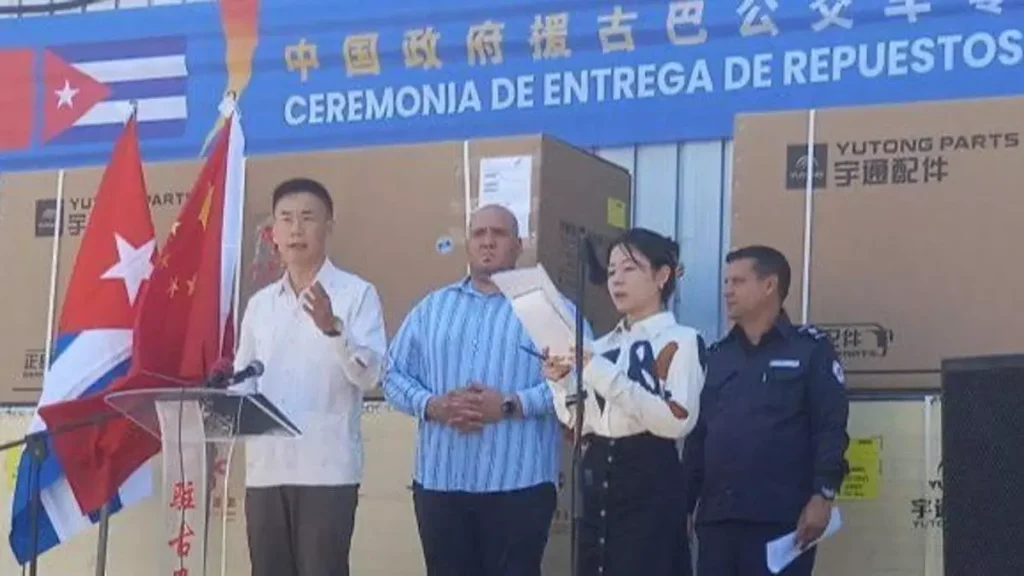
The Chinese ambassador with Cuban officials at the ceremony to present the pieces. / Cubadebate
14ymedio, Havana, 1 August 2025 — China continues to involve itself in the Cuban economy, providing resources that, while vital to Cuba, are practically crumbs compared to the scale of the crisis. The new collaboration, which adds to the decades the country has been sending vehicles to the island, especially the new Foton gazelles, includes the shipment of parts, components, and equipment to put into service buses for public transportation.
The first batch, the official press reported Friday, was delivered Thursday to the Evelio Prieto Bus Production Company—which has several vehicles parked, “dozens,” according to Xinhua —in Guanajay, Artemisa. The new buses arrived on the island through the China International Development Cooperation Agency.
The aid, the company executive explained, includes engines, tires, and batteries, and will be distributed among mechanical, electrical, and quality control work. As a final step, the interiors of the buses, some of which needed “major repairs,” will be reconditioned so that “they regain the capabilities with which they began operating.”
The idea, he added, is to repair up to five vehicles per month and, by the end of the year, deliver between 40 and 50. However, Cubadebate stated that Chinese aid could help repair up to 100 buses, although shipments remain to be made “which will gradually arrive in the country by sea.” continue reading
The island’s authorities, for their part, limited themselves to receiving the parts and applauding the good relations between the two countries.
The expected improvements in transportation—provided the necessary fuel is available to operate the buses—would primarily benefit the capital. This was stated during the aid delivery ceremony by Chinese ambassador Hua Xin, who emphasized that Beijing’s plan is to “inject new momentum into the Cuban capital’s transportation system.”
The island’s authorities, for their part, simply accepted the parts and applauded the good relations between the two countries, which will allow them to reestablish high-demand routes, “connecting hospitals, schools, and communities.”
The fact that almost all of the vehicles and parts arriving for public transportation are destined for the capital has already sparked controversy among Cubans in other provinces, who are demanding more attention from the authorities. Last June, when Transport Minister Eduardo Rodríguez Dávila announced the arrival of a fleet of Foton minibuses from China, internet users protested because the 100 vehicles were destined for Havana. In the face of public criticism, it was decided to keep only 50 in the capital city and distribute the other half to various provinces.
Although Havana’s population requires more vehicles, the transportation situation in the rest of the island is also precarious. During the reports from each ministry to Parliament last July, the Ministry of Transportation revealed alarming figures: in 2024, local bus services only met 35% of the transportation plan, failing to serve nearly 350 million passengers during that period.
The ministry acknowledged that of the 2,500 routes managed by provincial companies in the sector, 47% are paralyzed.
The ministry also recognized that of the 2,500 routes managed by provincial companies in the sector, 47% are paralyzed—mainly due to a lack of spare parts and fuel—and, of those that continue to operate, 90% only make two trips daily, one in the morning and one in the afternoon.
The ministry’s report also highlighted the worst conditions on rural routes and in hard-to-reach areas, with only 26% and 19% of the plan fulfilled, respectively. By 2025, 894 million passengers (68%) had been transported on the island through April, and 412 million were lost, 114 million fewer than the same period a year earlier.
On the other hand, the poor quality of Chinese vehicles is striking. As this newspaper recently reported, Foton vehicles are beginning to fail, just two months after entering service.
Chinese vehicles, including taxis, buses, and minibuses, are a significant part of the Transportation Department’s fleet. In the last 20 years alone, China sent more than 10,700 Yutong buses to the island. However, the limited transportation currently operating on the island falls far short of these figures, with no one able to clarify—whether due to quality or lack of resources—where the Chinese vehicles are.
____________
COLLABORATE WITH OUR WORK: The 14ymedio team is committed to practicing serious journalism that reflects Cuba’s reality in all its depth. Thank you for joining us on this long journey. We invite you to continue supporting us by becoming a member of 14ymedio now. Together we can continue transforming journalism in Cuba.
Cuba Archive asks Washington to suspend its $48 million aid until Kingston ends its agreements with Havana.
Cuban medical brigade in Jamaica. / Minrex
14ymedio, Madrid, 30 July 2025 — Replicating the work carried out with the international missions of Cuban doctors in the Bahamas, Cuba Archive has prepared a new report on the contracts signed for the same purpose between the governments of Cuba and Jamaica. The report, which once again documents the same pattern seen in all countries that maintain agreements with Havana, urges the United States to downgrade the ’pressure measure’ in its next annual report on human trafficking from a level 2 to 3.
Cuba Archive believes the Jamaican government is complicit with Cuba in what it considers a case of modern slavery and human trafficking, since doctors—and teachers, also an important part of the study—receive, as usual, a tiny fraction of what the state receives from Kingston. According to several collaborators, some clauses in the agreements, which are—again—not transparent, indicate that Jamaica agrees not to hire, directly, any Cuban specialist who “deserts” the mission, and in addition will cancel their work permits.
A medical specialist who works 268 hours a month (excluding shifts) receives only $3.70 per hour.
Several testimonies and documents obtained by the organization once again highlight these practices, which include the confiscation of passports, and the monitoring of movements and relationships with other people. In addition, there are “Stalinist-style disciplinary measures imposed by the brigade coordinators.” According to the report, a medical specialist working 268 hours a month (excluding shifts) receives only $3.70 per hour. continue reading
Jamaica, according to Cuba Archive, is cooperating with what it considers a flagrant violation of human rights, and therefore its officials should also be subject to US sanctions. The organization also recommends that the US condition its economic aid to the country on the end of its agreements with the Cuban government.
According to the document, Washington gave Kingston $65 million in 2022 and $48 million in 2024 “for security, development, health, education, communications, disaster response, and other purposes.” “Because money is fungible, the United States has, in effect, been paying for the Cuban brigades in Jamaica,” the document concludes.
The report is a lengthy document, nearly 50 pages long, that reviews the history of political relations between the two countries and the trajectory of the international missions organized by Cuba since the 1960s. It also delves into recent years, particularly since the pandemic, and details the alleged results achieved through this collaboration.
As of May 2019, Cuban healthcare professionals had treated 1,447,015 patients, performed 30,761 surgeries, and administered 73,331 vaccine doses. Health Minister Christopher Tufton said he was “very pleased with this collaboration,” referring specifically to the ophthalmology program, for which there is striking data. In October 2024, it was reported that, since September 2023, 22 professionals—17 of them Cuban—had performed 3,476 surgeries within the framework of this agreement. The estimate, emphasized by Archivo Cuba, is 13.8 interventions per day over the 251 working days of the year.
The investigation highlights the propagandistic nature of international missions, used for “political proselytism.”
The report emphasizes that, meanwhile, medical and educational efforts on the island are suffering a terrible setback due to a lack of doctors and funding, which refutes, they point out, the regime’s claims that the money earned from international missions is used to finance the “achievements of the Revolution.”
The investigation highlights the propaganda nature of international missions, used to engage in “political proselytism” and disseminate content favorable to the Cuban regime.
Last April, Cuba Archive published a similar report applicable to the agreements between Cuba and the Bahamas . A few weeks later, U.S. Secretary of State Marco Rubio warned that all officials involved in such contracts could be sanctioned by Washington, and during a tour of the Caribbean in early May, he warned several prime ministers in the region that this was one of his administration’s concerns.
Although the Bahamas maintained for several days that there was no slavery relationship in its agreements for hiring Cuban doctors and even noted that the US had used similar systems in the past, at the end of the month it finally stated that it was breaking its agreements and would proceed to hire the professionals individually and directly. However, Cuba Archive has also condemned this type of solution, believing that the Cuban state can pressure its doctors to engage in these types of agreements and transfer the salary difference to Havana.
____________
COLLABORATE WITH OUR WORK: The 14ymedio team is committed to practicing serious journalism that reflects Cuba’s reality in all its depth. Thank you for joining us on this long journey. We invite you to continue supporting us by becoming a member of 14ymedio now. Together we can continue transforming journalism in Cuba.
The theft of oil and liquefied gas is among the concerns of the authorities, who are unable to control it even by toughening the applicable crime.
State workers, who are familiar with the system, are accused of being the ones who steal the most resources. / 14ymedio
14ymedio, Madrid, 31 July 2025 — Cuban Prime Minister Manuel Marrero reiterated his warning in a meeting with authorities: Given the current situation in the country, fuel theft could be considered a crime of sabotage. The meeting addressed the results of the “confrontation” with the crime, whose figures, according to officials, are tending to decline but remain high. The most worrying are precisely those linked to the theft of oil and liquefied gas, and they originate from within: cases are increasing at service stations, and there are “diversions” in cylinders, according to the official press.
“It is unacceptable that today the country has a deficit in electricity generation capacity due to a lack of fuel, and at the same time we allow its theft,” Marrero declared. The Prime Minister argued that “the scarce amount of fuel” that the State can “afford and purchase” is allocated to electricity generation, making it essential to closely monitor “the minimum allocated to the economy” and “modify our approach in the face of indiscipline.”
The Prime Minister then noted that these offenses could be prosecuted as sabotage, one of the most serious crimes in the criminal code, with penalties of between four and ten years in prison. This warning is not new, as the criminal code specifically stipulates that it will be applied to anyone who “destroys, alters, damages, or harms” a long list of “means, resources, buildings, installations, or socioeconomic or military units,” among which energy sources are at the top of the list. continue reading
Fuel theft cases have recently been prosecuted as “sabotage.” One of the most notorious occurred last April, resulting in a seven-year sentence.
Recently fuel theft cases have come to be prosecuted as “sabotage.” One of the most notorious occurred last April, when a Ciego de Ávila court sentenced a generator worker to seven years in prison for stealing “30 liters of diesel.” Although the employee had no prior criminal record, the acts were considered to go beyond theft due to their “seriousness and harmful nature.” “The crime of sabotage affects the public good and the internal security of the State,” said the Prosecutor’s Office.
In February, the mayor of Manzanillo, Granma, was arrested along with other officials for por la izquierda [on the left] business dealings with oil intended for utilities and state-owned companies. The news was exclusive to 14ymedio, as the official press has not reported these events, and the criminal status of those arrested or what crimes they are charged with is unknown.
The crimes under which fuel theft was previously prosecuted were embezzlement or misappropriation (depending on whether or not it was committed by an official responsible for the property), theft or robbery (depending on whether or not force was used), and receiving stolen goods, in the case of fraudulent acquisition. This was explained in 2019 by Reinaldo Cruz Rivera, Deputy Attorney General of the Republic of Cuba, in a Cubadebate article dedicated to the incessant theft of this product.
The article indicated that in the first half of the year, there were 339 criminal proceedings for these crimes, and 117,463 liters of fuel of various types had been seized—85,823 liters of diesel and 21,016 liters of gasoline—causing damages estimated at 488,644 pesos. With this data, Cubadebate questioned whether the government’s decisions were effective. The 1987 penal code, which already had the same wording for sabotage, was in effect at the time, but it did not apply to fuel theft.
Marrero Cruz urged “determining and mitigating the causes and conditions that lead to indiscipline surrounding the sale of liquefied petroleum gas.”
At the recent meeting, Marrero Cruz called for increased surveillance—something that has been unsuccessfully proposed in numerous meetings—and urged “determining and mitigating the causes and conditions that lead to indiscipline surrounding the sale of liquefied petroleum gas,” although it is clear that the scarcity, if not the absence, of the product is what fuels the theft. Colonel Daniset González Sánchez specified that part of the responsibility stems from “the U.S. government’s policy of maximum pressure against the island, exaggerating the country’s situation to encourage subversive actions.”
Regarding other crimes, it was determined that insufficient action has been taken against officials, who are responsible for many economic crimes, which are the work of those “who operate from within institutions and know their vulnerabilities.” Burglaries have increased, as many citizens constantly report on social media, despite the fact that the overall number of violations has decreased, authorities indicated, without, as usual, providing data.
Crimes related to livestock also decreased, with the majority being thefts “since only 25% of cases show signs of slaughter.” Furthermore, “more than 200 prevention and response actions” were carried out in the drug sector, and although it is reported that “significant volumes of narcotics” were seized, the exact amount was not disclosed.
Reinaldo Cruz Rivera warned that many fines are imposed—again, without figures to support this—but very few are collected, which “encourages impunity.” He therefore called for “optimizing and supervising the operation of tax-paying entities, as well as collection offices, to prevent non-compliance,” without clarifying the plan to eventually proceed with defaulters.
____________
COLLABORATE WITH OUR WORK: The 14ymedio team is committed to practicing serious journalism that reflects Cuba’s reality in all its depth. Thank you for joining us on this long journey. We invite you to continue supporting us by becoming a member of 14ymedio now. Together we can continue transforming journalism in Cuba.
Tourists, mostly Canadians, have been transferred to other facilities in the northern cays.
Canadian tourists at the Sanctuary White Sands Hotel in Cayo Cruz, Camagüey. / Facebook/Dairon Castro
14ymedio, Havana, 29 July 2025 — All the hotels on Cayo Cruz, in Camagüey, Cuba are closed due to a lack of drinking water. The reason was a “breakdown in the main water line” at the tourist resort, according to Dairon Castro, social media manager of Sanctuary White Sands, one of the luxury establishments, who told foreign tourists who learned of the news over the weekend and inquired about its veracity.
Alexis Torres, marketing director for Iberostar Cuba, which has two hotels in the Camagüey tourist resort, reported on Sunday that both his property and nearby hotels “have experienced technical problems with the water supply,” and that work was underway “to resolve this as soon as possible.” He also said, without specifying the destinations, that guests had been transferred to nearby hotels “that maintain the same quality standards, ensuring they continue to enjoy their vacations.”
In other comments, several visitors, mostly Canadians, reported being transferred to hotels elsewhere in the northern cays, especially Cayo Coco. “All travelers will be transferred to other hotels this afternoon,” Amelie Prince advised guests of the Sanctuary White Sands on Friday. For those who had traveled with the Canadian airline Sunwing, she specified that they would be transferred to Luxury Cayo Guillermo.
“We could see this coming, because water had to be rationed more and more.”
“We could see this coming, because we had to ration water more and more,” a worker at one of the hotels in Cayo Cruz, who requested anonymity, told 14ymedio. “We employees are floored,” she continued, “because if there are no customers to tip us, it’s much harder to make ends meet with our salaries.”
Just last year, authorities boasted about work on the now-damaged pipeline —the installation of a 500-millimeter-diameter valve—that would allow for “improved water supply operations.”
Neither the official media nor the Ministry of Tourism have provided any information. In a call to a travel agency booking several accommodations, including the Sanctuary White Sands, they responded that they had no news of closure, either for that establishment or others. “So few customers go there, we don’t know anything,” commented the employee on the other end of the phone. continue reading
The latest update was from Dairon Castro, two days ago: “We continue to work intensively, day and night, to resolve the situation with the water supply at the Cayo Cruz hub as quickly as possible. Thank you all for your understanding, and we apologize for the inconvenience.” Repeated questions from travelers about to visit Cuba go unanswered.
“We continue to work intensively, day and night, to resolve the situation as quickly as possible.”
“I have guests who were supposed to arrive at Selection this Wednesday. Is there any chance it will reopen? And I’m arriving at Coral on the 6th with a group of 20 people… Should I try to relocate them?” France Fleury asked Alexis Torres of Iberostar on Tuesday. “Has the main water line break been fixed?” Francis Desjardins also asked yesterday about Sanctuary White Sands. Only other guests responded, not hotel managers: “Sunwing was still relocating guests yesterday, who were supposed to arrive at another hotel today.”
This incident adds to the long list of woes facing Cuban tourism facilities—including the poor condition of some airports—summarized by the minister himself, Juan Carlos García Granda, two weeks ago in the National Assembly. There he asserted that for tourism, “this has been the worst time since the collapse of the Twin Towers in 2001, not counting the pandemic period.”
The principal reason given by both García Granda and his colleagues from the Food Industry, Alberto López, and Agriculture, Ydael Pérez Brito, was that there is a current “inability” in production to meet tourism demand.
It was Fidel Castro’s visit to that cay in 1989 that marked the beginning of “the strategy for the development of tourism in that beautiful region.
Nor will the damage help relaunch Cayo Cruz, as the government intended in 2023, as one of the island’s “trendy destinations .” At that time, Alexis Torres himself told Prensa Latina that Iberostar, which operates hotels for the state-owned Gaviota group—owned by the military conglomerate Gaesa—intended to focus on Cayo Cruz and Cayo Paredón, between the provinces of Ciego de Ávila and Camagüey, which he defined as “cays that have remained in the image of clients and tour operators” and “more than 26 kilometers of beach, a lost oasis.”
In effect, the spectacular beaches of Cayo Cruz are praised by travelers on social media, despite the ecological disaster posed by the 43-kilometer causeway that connects it to the mainland built in the 1990s. According to one of the regular eulogies in the official press, it was Fidel Castro’s visit to the cay in 1989 that marked the beginning of “the strategy for the development of tourism in this beautiful region in the north of the province.”
There are several hotels in the area. In addition to the Sanctuary White Sands Resort and the Iberostar Selection Esmeralda and Coral Esmeralda hotels, there are also La Marina Plaza & Spa and Valentin Cayo Cruz.
____________
COLLABORATE WITH OUR WORK: The 14ymedio team is committed to practicing serious journalism that reflects Cuba’s reality in all its depth. Thank you for joining us on this long journey. We invite you to continue supporting us by becoming a member of 14ymedio now. Together we can continue transforming journalism in Cuba.
For a couple to eat with dignity in Havana, more than six average salaries are needed.
The basic food basket and the ration book are two concepts that barely touch each other today. / 14ymedio
14ymedio, Havana, 30 July 2025 — “The list doesn’t match the bill”—a stinging, resigned popular phrase—summarizes Cuba’s food tragedy better than any speech. And although the bureaucrats in power try to ignore it, any parent knows that the basic food basket (CBA) and the ration book are two concepts that barely touch each other today. A recent study by the Food Monitor Program makes it clear: for a couple to eat with dignity in Havana, more than six times the average salary is needed.
While the average national salary rose nominally from 4,648 pesos in 2023 to 6,506 in 2025—according to official figures—food prices soared much faster. Eggs, milk, chicken, or any basic product on the private market can devour an entire pension in a single fell swoop. Meanwhile, the ration book—that tired symbol of yesteryear—distributes less and less rice, bread, and sugar, and with unpredictable frequency. It’s no surprise that 96.6% of Cubans believe that subsidized products don’t meet their needs or tastes, and one in three rate them as “terrible.”
National agricultural production has fallen by 67% in recent years
Trying to calculate a CBA in Cuba is like playing dominoes with the pieces constantly changing value. Official consumption patterns are based on what is available, not what is needed. Bureaucratic statistics ignore the prices in informal markets, small businesses, and street vendors, who are currently the main source of supply. Added to this is a more striking fact: national agricultural production has fallen by 67% in recent years. As a result, fruits and vegetables have disappeared from most people’s menus.
The Food Monitor Program conducted a field study in Havana and Cienfuegos between the end of 2024 and the first half of 2025, monitoring prices, quality, and availability of 29 basic products distributed across eight groups. The analysis is based on a minimum monthly diet of 54,000 calories for women and 66,000 for men. It also adjusts for specific limitations, such as irregular access to water, electricity, and fuel. These factors increasingly determine what, how much, and how people cook.
In Havana, a minimum CBA for two people is around 41,735 pesos, equivalent to 6.41 average salaries.
The results show that, in Havana, a minimum CBA for two people is around 41,735 pesos—equivalent to 6.41 average salaries. In Cienfuegos, the figure drops slightly to 39,595 pesos, or 6.09 salaries. In other words, for two people to eat, they need the wallets of four other people. And that doesn’t include clothing, transportation, hygiene products, gas, or medicine. Just food. Hardly the bare minimum.
in parallel, cumulative inflation since 2021 has reached almost 191%, and real wages have plummeted by 35%. The subsidy model, sustained for decades as a social shield, has become unsustainable. The government itself has acknowledged that 80% of the ration book’s contents are imported, and maintaining its coverage is unviable. The solution? Shift the burden to the informal market, to remittances, to exiled families. What remains is a fragmented, unequal, and chaotic system: an “administrative capitalism” where everything must be paid for, and where nothing is enough.
Cumulative inflation since 2021 has already reached almost 191%.
In this context, the basic food basket ceases to be a technical instrument and becomes a mirror of failure. It reflects not only how much it costs to live, but also who can afford it. Eating decently in Cuba is increasingly a privilege.
The Food Monitor Program proposes thinking of the CBA not as a list of minimum products, but as an ethical threshold. A map of what should be possible. Because in Cuba, where food depends more on ingenuity than income, the basic food basket is not an economic calculation, but rather the x-ray of a fracture. And what it reveals is as clear as it is bitter: in today’s Cuba, dignity is rationed—like everything else—in impossible slices.
____________
COLLABORATE WITH OUR WORK: The 14ymedio team is committed to practicing serious journalism that reflects Cuba’s reality in all its depth. Thank you for joining us on this long journey. We invite you to continue supporting us by becoming a member of 14ymedio now. Together we can continue transforming journalism in Cuba.
“We have no concerns,” say Viñas Alonso and Kessel Linares.
The re-elected Sovereign Grand Commander of Freemasonry, José Ramón Viñas Alonso (center). / Facebook/Supreme Council of the 33rd Degree
14ymedio, Havana, 30 July 2025 — After attending a summons that turned into a police interrogation, the Sovereign Grand Commander of Freemasonry, José Ramón Viñas Alonso, and the elected Grand Master, Alberto Kessel Linares, were released with pending criminal proceedings. According to the former’s social media post after returning to his home, they were also “placed under restraint” as a precautionary measure and were subject to a movement restriction that allows them to leave their homes only to go to work.
According to Viñas, during his interrogation at the Costa and Diez de Octubre police station in Havana, authorities questioned his “many” trips abroad and asked him where he got his money. Ultimately, a criminal case was opened against him for “currency trafficking.”
“They are trying to tie me to a non-personal agreement, but one that the Board of Trustees unanimously agreed upon due to the need to cover various expenses in local currency at the care home and the lack of this currency. The exchange was agreed upon twice this year (with this exchange being carried out among the members of the Board of Trustees), where $100 was exchanged for local currency,” he explained. The authorities consider this to be trafficking, as the exchange was made on the “black market,” at 1 dollar for 370 pesos—as the institution did—and not in a bank at the exchange rate of 1 dollar for 120 pesos.
He also said that State Security informed him that this crime could result in a prison sentence of between two and five years.
“We have no concerns,” he said, referring to both his own and Kessel’s situations, “because as citizens, we don’t even have a single traffic ticket, and we know what’s being attempted with all of this. It will be what it will continue reading
be, but I declare our innocence to my brothers,” Viñas concluded.
State Security informed him that for this crime he could be punished with between two and five years in prison.
Under threat of freezing the organization’s bank accounts, Cuban authorities rejected Viñas’s reelection as leader of the Supreme Council and appointed babalawo Lázaro Cuesta as the candidate for the position. So far, the Supreme Council has shown no signs of experiencing a leadership crisis similar to the one the Grand Lodge is experiencing.
Few details are available regarding Kessel’s case, but they were shared by an anonymous source close to the Grand Lodge: he was also summoned to Picota station and accused of allegedly violating his movement restriction for having “passed near the Grand Lodge on Sunday, July 6 , when the Freemasons protested there.”
According to the independent media outlet, both Freemasons are prohibited from holding meetings at the Grand Lodge or the Supreme Council of the 33rd Degree. “All proceedings are being handled by State Security,” the source added.
Writer and Freemason Ángel Santiesteban denounced the summons to Kessel and Viñas on social media, and attributed the police investigations to another attempt by the Ministry of Justice and the regime to intervene in the fraternity’s affairs, something that Justice Minister Oscar Silvera had previously asserted was not happening.
The most recent Masonic crisis—the brotherhood has been the subject of heated controversy since at least 2023, with the departure of its Grand Master to Mexico—occurred at the beginning of July, when several members gathered at the Grand Lodge’s entrance to protest the decision to hold a session of its High Chamber, which they considered illegitimate.
The meeting had been called by Mayker Filema Duarte, who was removed from his position as Grand Master
The meeting had been called by Mayker Filema Duarte, who was “irrevocably” removed from his position as Grand Master in May, but under the protection of the Ministry of Justice he refuses to relinquish his leadership of the order.
“All the brothers who are here know that the spurious Upper House meeting will be held today, and we are here, once again, to let you know that what we did on May 25th is irrevocable,” said one of the Masons who made up the group, addressing the rest, in front of the doors of the Grand Lodge and referring to the last session of the body in May, where the decision was made to remove Filema.
The protest escalated when those inside the lodge tried to block the entry of the Masons, who forced their way in, claiming the lodge belonged to them.
The day before, Kessel, who was elected by the Masons to the position of Grand Master, and Victor Bravo Cabañas, elected Grand Secretary, had been summoned by the police to the Picota station for an interview, from which they emerged with warnings for having called on members of the fraternity to protest against the assembly of the Upper House.
A few days later, despite the arrests and warnings, the Ministry of Justice assured that it maintains a “historical relationship of closeness and respect” with the fraternity and that it does not interfere in its affairs.
Calls for Mayker Filema Duarte’s resignation have been frequent since he assumed the position of Grand Master following the departure of his predecessor, Mario Urquía Carreño, who was accused of stealing $19,000 from the Grand Lodge.
____________
COLLABORATE WITH OUR WORK: The 14ymedio team is committed to practicing serious journalism that reflects Cuba’s reality in all its depth. Thank you for joining us on this long journey. We invite you to continue supporting us by becoming a member of 14ymedio now. Together we can continue transforming journalism in Cuba.
Hanoi usesd the occasion of Deputy-Foreign Minister Gerardo Peñalver’s visit to call for “the removal of obstacles” to businesses in Cuba.
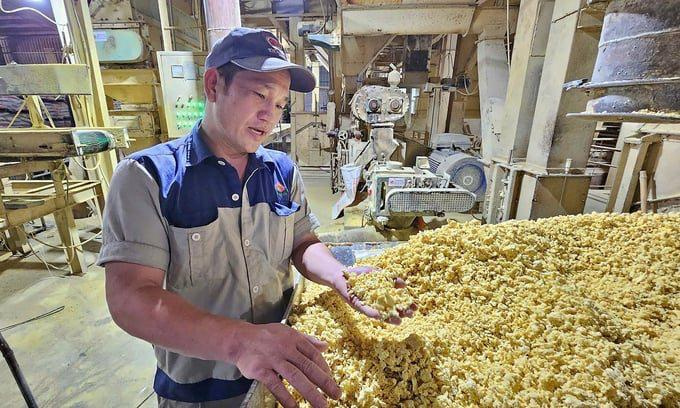
In addition to growing rice, Agri VMA also produces animal feed. / Bao Thang
14ymedio, Havana, July 24, 2025 — Behind the smiles, there were some recriminations at Wednesday’s meeting in Hanoi between Vietnamese Foreign Minister Bui Thanh Son and Cuban Deputy Foreign Minister Gerardo Peñalver. The friction between the two communist countries was reflected in a letter from Agri VMA — a Vietnamese company with operations in Mariel — to which 14ymedio had access.
The document, dated May 28, 2024, highlights the broad range of “difficulties and obstacles,”as the Vietnamese foreign minister put it, that his country’s companies face on the island. In a desperate plea for relief, Agri VMA wrote to three Cuban ministers, explaining the company’s urgent need to access funds frozen in an account at the state-owned International Finance Bank in order to transfer $300,000 to its parent company in Vietnam.
It was discovered in early 2025 that Cuba would freeze the bank accounts of foreign firms operating in the country
The Cuban government has been restricting this type of transaction since early 2025, when it was learned that it would freeze the accounts of foreign firms operating in the country — preventing them from repatriating their earnings — in exchange for certain compensations. However, the Agri VMA letter confirms that, in practice, Havana had been controlling its partners’ finances continue reading
long before then, preventing the company from making transfers without express authorization.
The letter was sent to Joaquín Alonso Vásquez, the minister of Economy and Planning, as well as to Ydael Pérez Brito and Oscar Pérez-Oliva Fraga. It stated that, Agri VMA needed the funds to “buy raw materials and guarantee the optimal continuation of our services.”
“As you well know, because of logistical issues, we had to reduce our production activity to 10% a few months ago due to a lack of raw materials. Maintaining stable and efficient production for both parties is our top priority. However, we understand that unforeseen circumstances or oversights can sometimes cause delays. With this in mind, we request your support and assistance,” reads the letter from Agri VMA.
“The transfer is vital since it allows us to maintain the high level of service that we strive to provide”
Company executives also reminded the minister that the firm is an important partner, “actively working since 2022 to produce animal feed in Cuba, with a plan to set up a factory with a production capacity of 30,000 tons of feed per year in the Mariel Special Development Zone.” After providing the necessary information for the transaction, the letter concludes: “The transfer is vital because it allows us to maintain the high level of service we strive to provide. We highly value the benefit we bring to the partnership and look forward to your help and support in resolving this matter.”
It is not known if the transfer was ultimately approved but it is clear that Havana has become much more careful in its dealings with this ally, its second largest trading partner in Asia after China, and the first in investments on the island. AgriVMA itself has been making headlines for its “successful” rice program. In January it became the first foreign company to be provided with farm land by the Cuban government.
However, Havana continues to feel pressure from Hanoi, as well as from companies already operating on the island, to provide more flexibility to foreign businesses. In June, Agri VMA requested more land from the government to expand its planting area. And unlike what it does with other foreign businesses, the government has allowed the company to hire Cuban employees directly rather than through a state-owned intermediary.
Vietnamese companies producing personal hygiene products have also set up shop in Cuba
In addition to agriculture, Vietnamese companies have set up personal hygiene, construction and fertilizer companies on the island. Both countries also recently announced they were looking for ways to partner in the renewable energy sector.
In an April interview with the official news outlet Vietnam Plus, the president of the Cuban Chamber of Commerce, Antonio Luis Carricarte Corona, stated that, while trade between the two countries has not returned to pre-pandemic levels, it has grown stronger. The key, he said, has been the diversification of businesses beyond the sale of rice, almost the only product that Cuba receives from Vietnam.
“Vietnam’s assistance will undoubtedly be essential in pork, chicken, and egg production as it has already been in aquaculture, where we have gained a great deal of experience from Vietnam, as well as in coffee, grain, and rice production,” Carricarte said.
China has criticized the Cuban leadership for its “unwillingness to decisively implement a market-oriented reform program”
In exchange, the Chamber of Commerce’s president offered Cuba’s experience in fields such as medicine and biotechnology. He also touted Cuba’s position as a potential launchpad for Vietnamese commerce into Latin America. “Cuba has excellent conditions for joint production and for facilitating access to the region . . . Products manufactured in Cuba in partnership with Vietnam can be certified as being from of Cuba and thus benefit from the more than twenty trade agreements we have with different countries. This would allow tariff-free entry of these products, providing additional advantages for Vietnam,” he explained.
Hanoi is also not the first US partner to criticize Havana’s lack of business flexibility. Late last year, a U.S. intelligence official told the Financial Times that, behind closed doors, China has criticized the Cuban leadership for its “unwillingness to decisively implement a market-oriented reform program despite the obvious dysfunction of the current situation.”
____________
COLLABORATE WITH OUR WORK: The 14ymedio team is committed to practicing serious journalism that reflects Cuba’s reality in all its depth. Thank you for joining us on this long journey. We invite you to continue supporting us by becoming a member of 14ymedio now. Together we can continue transforming journalism in Cuba.
What the public demands is professional integrity, and that is the least a journalist can and should offer them.
Unfortunately, rather than uncovering and exposing the truth, some people do their work to justify their own theories. / Pxhere
14ymedio, Federico Hernández Aguilar, San Salvador, 28 July 2025 — Referring to his fellow countryman, the priest and writer Benito Feijóo, Don Marcelino Menéndez y Pelayo, the most influential Spanish academic of his time, wrote with irony that he did not want “to do him the affront of calling him a journalist, although he has something of that in his worst moments.”
This fact is curious for two reasons: first, because it illustrates how much animosity the journalistic profession caused among Iberian intellectuals at the beginning of the 20th century—considered by many of them to be the devaluation of literature—and second, because Menéndez y Pelayo always enjoyed, while he was alive, what today we would call a “good press.”
Don Marcelino was far from imagining that journalism would become, by dint of demonstrating it, not only an unavoidable social power, capable of shaping culture, but also a primordial space for deciding the strengthening and even the permanence of democracies in the modern world.
The value of opinion, as well as the vehicles that transmit it, is unquestionable. In his immortal 1859 work, On Liberty, John Stuart Mill provides the classic liberal argument on the subject: “If an opinion were silenced, that opinion, so far as we know, might contain the truth. To deny it is to assume our own infallibility. In the second place, even if the silenced opinion were erroneous, it may well contain—and indeed frequently does contain—part of the truth; and as the general or dominant opinion on any subject is seldom the whole truth, it is only in the free clash of opposing continue reading
ideas that the opportunity arises of attaining the rest of the truth.”
Journalism in this era continues to face powerful enemies, from those who fill prisons with critical informants to those who silence opinions with more sophisticated methods.
Hence the importance of freedom of expression and its guarantees, as well as the struggle that people must wage to preserve it. Journalism in this era continues to face powerful enemies, from those who fill prisons with critical informants to those who silence opinions with more sophisticated methods, such as resorting to digital intimidation or paying for the disseminators of fake news.
The 1989 Nobel Prize winner for Literature, Camilo José Cela, without any gratuitous concessions, directed his wit toward a greater understanding of the journalistic profession, predicting success for communicators who aspired to “intellectual understanding and not a visceral feeling of events and situations,” in a constant (and healthy) review of their personal attitude toward reality. Considering the variety of circumstances that complicate the relationship between the news professional and the shifting terrain of facts, this reflection is timely.
Of course, the ways in which a media outlet, exercising its freedom, responds to the obligation to report truthfully differ. What should be uniform is the effort—not only constant, but growing—to achieve that minimum level of awareness and responsibility that should ideally underlie any honest search for the truth. It is there, in that small gap, where credibility is gained or lost.
Quoting Cela’s Dodecalogue again, it states: “Respect for the truth, the simple and immediate homage that must be paid to the truth day after day, must guide the steps of the journalist who aspires to play his role with dignity, grandeur, and effectiveness…” And indeed, the duty of editorial conscience to ask, amid the daily hustle and bustle, what criteria define what is considered to be in the public interest and how these criteria will be applied in the articulation of the news belongs to the realm of editorial conscience. And there, as in almost everything, the proposals are as diverse as the thoughts, experiences, and even prejudices.
The problem, many times, lies not in defining what truth is being told, but in how much truth is being ignored. What provokes distrust, for example, is the attitude of what I call the “journalist fly,” that type of news prowler who goes to the truth with the same avidity as flies in gardens: seeking only and exclusively the garbage. This coprophagous instinct doesn’t limit itself to “feeding” on rot; it presents it as the most emblematic thing in the surroundings. What’s questionable here isn’t the desire to talk about the filth that may be in a garden, but the attempt to turn that filth into the entire garden!
In highly controversial cases, partially exposing the truth can be as unethical as not exposing it at all. Depending on the scope of their story, a professional journalist knows that context is an inescapable duty.
In highly controversial cases, partially exposing the truth can be as unethical as not exposing it at all. Depending on the scope of their story, a professional journalist knows that context is an inescapable duty. And contextualizing means offering the public a true perspective of the garden before their eyes, presenting without exaggeration the distance between fragrant roses and excrement.
Hubert Beuve-Méry, founder of the newspaper Le Monde, once said: “In journalism, objectivity doesn’t exist; honesty does.” Unfortunately, rather than uncovering and exposing the truth, some people do their work to justify their own theories. In exchange for their attention or preference, however, what the public demands is professional integrity, and that is the least a journalist can and should offer.
If we delve into the complexities of human nature, it should come as no surprise that freedom of expression is one of the most vulnerable achievements of modern civilization. Despite this fragility, however, it must be emphasized that honest journalism, practiced courageously, may well be the last bastion of dying democracies.
____________
COLLABORATE WITH OUR WORK: The 14ymedio team is committed to practicing serious journalism that reflects Cuba’s reality in all its depth. Thank you for joining us on this long journey. We invite you to continue supporting us by becoming a member of 14ymedio now. Together we can continue transforming journalism in Cuba.
Haydée Santamaría committed suicide two days after the 27th anniversary of the Moncada Barracks attack. (Celso Rodríguez)
14ymedio, Reinaldo Escobar, Havana, 28 July 2020 [delayed translation] — Forty years ago today, Haydée Santamaría Cuadrado committed suicide.
Her self-immolation occurred two days after the 27th anniversary of the Moncada Barracks attack. That commemorative event was held in the plaza named after her brother, Abel Santamaría, in the province of Ciego de Ávila. It was also the birthday of Melba Hernández, the other woman linked to that attack.
The official version states that she died in the house she shared with her children as a result of a gunshot wound to the head. Despite being considered a heroine and a member of the Council of State and the Central Committee, her remains were not laid to rest in the Plaza de la Revolución, as they should have been, but rather in a funeral home in Vedado, Havana.
In the political code of those who rule in Cuba, suicides do not deserve to be honored, perhaps for this reason those who attended her funeral shared the feeling that they were committing an act of disobedience. continue reading
The reason for her decision is attributed to the fact that her physical and mental health was very deteriorated, as she had never been able to overcome the trauma of having lost her brother and her boyfriend in that action in Santiago de Cuba on July 26, 1953.
Her depression, almost permanent, was affected by what happened a few months earlier when the Peruvian Embassy was taken over by more than 10,000 Cubans who no longer wanted to live in Cuba.
Her depression, almost permanent, was affected by what happened a few months earlier when the Peruvian Embassy was taken over by more than 10,000 Cubans who no longer wanted to live in Cuba, and then more than 100,000 embarked through the port of Mariel for the United States. The infamous repudiation rallies, in which the protesters were humiliated and mistreated, must have seemed like an atrocity to her. Her colleagues at Casa de las Américas, which she chaired, noticed that she would spend weeks at a time without going to her office.
It’s hard to believe that in the final minutes of her life, Haydée Santamaría didn’t want to leave a written record of the profound reasons for her dramatic decision. It is significant that no one has ever dared to deny the existence of a letter that was most certainly addressed to Fidel Castro.
Cubans under fifty today are probably no longer interested in learning the content of a probable confession of disappointments. They barely care about knowing anything about the lives of those who dreamed of a utopia, much less the reasons they had for killing themselves. What does it matter, since today almost everyone is disappointed?
This disinterest, this neglect, is like the second death that awaits those who founded a project without a future. If that letter, which those of us who wanted to know about it never saw, is ever declassified, it will remain a historical curiosity… and it’s only been forty years.
____________
COLLABORATE WITH OUR WORK: The 14ymedio team is committed to practicing serious journalism that reflects Cuba’s reality in all its depth. Thank you for joining us on this long journey. We invite you to continue supporting us by becoming a member of 14ymedio now. Together we can continue transforming journalism in Cuba.
In 1980, the human stampede towards the Peruvian embassy left her stunned.
“That tall guy who dropped his cigarette ash all over the floor I had cleaned.” Haydée Santamaría 3rd from left. / Cubadebate
14ymedio, Yunior García Aguilera, Madrid, 28 July 2025 — Haydée Santamaría Cuadrado shot herself in the head on July 28, 1980, two days after the 27th anniversary of the Moncada barracks attack. It’s even said that the bullet could have been fired on the 26th itself, but the hairy men of the nomenclatura would never allow a suicide to spoil their celebration.
There were no honors in the Plaza. No national mourning was declared. Nor was there any mention of the weapon, the farewell note, or the most serious wound, that of disillusionment. She was bid farewell with a routine phrase in the official newspaper Granma: “after a prolonged physical and emotional illness.” A small feat for a founder of the Revolution, for one of the few “heroines” of a testosterone-doped process.
She was probably a Fidelista until the last minute of her life. In a sect, nothing is allowed but fanatically and unconditionally worshipping the leader. But there are also no second chances for a first impression. And when Yeyé — as she was called — met Fidel, she saw him as “that tall guy who left his cigarette ashes all over the floor I had cleaned.”
Dozens of women – including 14 mothers – who remain in Cuban prisons today could well remind their jailers of this fact.
It is well known that, after the failure of the Moncada attack, her brother and boyfriend—Abel Santamaría and Boris Luis Santa Coloma—were killed. What the official press doesn’t often repeat is that the cruel dictator Batista only sentenced her and Melba Hernández to seven months in prison. The dozens of women—including 14 mothers—who remain in Cuban prisons today for peacefully protesting against the regime might well remind their jailers of this fact.
When Haydée was released, she was sent to the United States to buy weapons from the mafia. Although she later confessed to feeling “terrified,” she did so without remorse. She also proudly recounted how she entered Cuba with her skirt full of fake pockets… and bullets. With a profound humanist vision, she also recounted her role in organizing attacks: “When someone had to plant a bomb during the struggle, and even in the underground, sometimes I was the one who had to decide who would do it […] I always chose the best, the one with the greatest conscience, the best human qualities, so that whoever it was wouldn’t get used to planting bombs, wouldn’t feel pleasure in planting them, so that it would always continue reading
hurt them.”
It is fair to recognize that she protected, as far as possible, some Cuban artists that the macho-Leninist sugar mill itself was trying to turn into guarapo
Perhaps it was her semi-illiteracy—she barely completed sixth grade—that allowed her to shine at the head of the Casa de las Américas. There she received Mario Benedetti, Cortázar, and Galeano. She protected those who wrote strangely, those who thought differently, as long as they didn’t challenge dogma too much. It is also fair to recognize that she protected, as much as possible, some Cuban artists whom the same macho-Leninist sugar mill was trying to turn into guarapo [sugarcane juice].
But by the late 1970s, Haydée no longer believed. She had learned to keep quiet inside. The repression was getting tougher; the culture was becoming more and more instrumental. And in April 1980, the human stampede toward the Peruvian embassy left her stunned. Cuba was beating those who left. Repudiation rallies were organized. Mobs shouted insults at the “worms” from the doors of the revolutionary vigilance committees.
Haydée broke down. She sent a letter to Fidel. She asked him to reflect. She denounced the violence in the streets. But she never received a reply.
Those who knew her say that her gaze was already hollow, that she spoke little, that she had lost hope.
She no longer attended meetings. She kept to herself in her home. She had been in a car accident shortly before. Those who knew her say her gaze was already hollow, that she spoke little, that she had lost hope. Until that July morning, she asked her driver to leave her alone. She closed the door. She took out the gun she had kept since her years in hiding. And fired.
Fidel didn’t utter a single public word. Nor did Raúl. Juan Almeida was the only one who dared to say it clearly: “In principle, we revolutionaries do not accept the decision to commit suicide. The lives of revolutionaries belong to the cause and the people. But those of us who knew her… knew that the wounds of Moncada had not healed.” It was an exception to the official silence.
Lamentably, the tragedy continued
Her two children, Celia Hart Santamaría and Abel Hart, died in a mysterious car accident.
Twenty-eight years later, on September 7, 2008, her two children, Celia and Abel Hart Santamaría, died in a mysterious car accident in Havana’s Miramar neighborhood. They were traveling in the same car. The vehicle crashed into a tree, and both died instantly. The official press reported the incident briefly. No in-depth investigation was conducted. Nor was there a memorial service.
After the accident, rumors began to swirl. Was it a real accident? A planned suicide? A desperate act in the face of ideological suffocation? There’s no proof. But the tragedy resonated like the echo of their mother’s gunshot.
The death of Haydée and her children are not isolated episodes. They are chapters in an emotional story that has never been told before. A story that doesn’t fit into school textbooks or official museums. It is the story of the human price of silence, of dogma… and of disillusionment.
____________
COLLABORATE WITH OUR WORK: The 14ymedio team is committed to practicing serious journalism that reflects Cuba’s reality in all its depth. Thank you for joining us on this long journey. We invite you to continue supporting us by becoming a member of 14ymedio now. Together we can continue transforming journalism in Cuba.

 14ymedio, Juan Diego Rodríguez, Havana, 28 July 2025 — Kenia Rodríguez Mora, a resident of the Havana neighborhood of Luyanó and mother of a 7-year-old girl, is the latest victim of domestic violence recorded in Cuba. According to 14ymedio sources, on Sunday her partner, the child’s father, threw her from the roof of the home they shared on Rodríguez Street.