The lack of rainfall has led to an alarming reduction in reservoir levels.
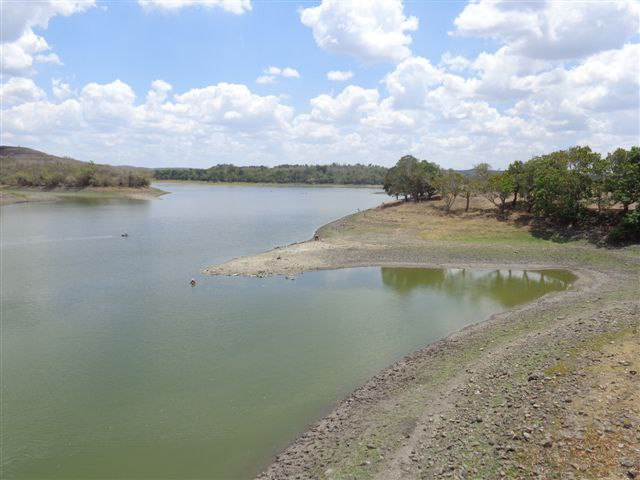
 14ymedio, Miguel Hernández, Holguín, 28 July 2025 — “The drought is already hitting us here. There are areas where the water supply hasn’t been rising or hasn’t been pumped for more than 20 days, and in some areas, like Loma del Caguayo in Hilda Torres, it’s been going on for two months,” says Raúl, a 38-year-old resident of Holguín who spoke with 14ymedio . The lack of water, coupled with prolonged blackouts, is deepening the crisis facing residents in eastern Cuba.
Raúl’s testimony reflects a critical reality in provinces such as Santiago de Cuba, Holguín, and Guantánamo, where the lack of rainfall has led to an alarming drop in reservoir levels and the partial collapse of the water supply systems.
According to official data, in Santiago de Cuba, more than 80% of the population depends on the Quintero System, which has seen its water intake drop to between 900 and 1,000 liters per second after the loss of key sources like Gota Blanca and the reduction in supply from Gilbert. “Only one of the system’s five pipelines is functioning… the water supply situation is very critical,” acknowledged Ludmila Rodríguez Barroso, director of Aguas Santiago.
In Holguín, reservoirs and aquifers have reached “alarmingly low” levels.
In Holguín, where nearly 48% of the territory was experiencing meteorological drought at the end of March, reservoirs and aquifers have reached “alarmingly low” levels, according to Radio Angulo. The flow supplying the city has dropped from 1,189 to 880 liters per second, forcing severe rationing. Agricultural production, already deteriorating, has suffered a further decline due to the lack of irrigation, worsening food insecurity and raising prices in local markets.
In Guantánamo, the situation is no less dramatic: the La Yaya reservoir, the province’s main reservoir, is at 9% capacity, with barely one million cubic meters of usable water. This has forced the operation of only one of the Guantánamo canal’s pumping engines, particularly affecting southern communities such as Carreterita and La Jabilla. The provincial government announced emergency measures, such as water transfers from the Caribe District and the cleaning of diversion pipelines, while urging the population to maximize conservation.
Added to this water crisis is the impact of the deteriorating national electricity system. Junior González Núñez, first vice president of the OSDE Agua y Saneamiento (Water and Sanitation Department), admitted that “approximately 70% of service disruptions are linked to problems in the electrical system.” After blackouts, water takes between six and eight hours to reach homes, further prolonging distribution cycles and leaving entire neighborhoods without water for days.
Although the authorities have begun installing solar-powered pumping systems—with the import of 866 photovoltaic units—these measures are failing to reverse the water shortage or meet demand. In Santiago de Cuba, delivery cycles exceed 20 days, while in critical areas they have already reached 60 days.
The drought, which has plagued eastern Cuba for years, not only threatens domestic water supplies, but also agricultural production, the local economy, and public health. In the words of Raúl, a Holguín resident desperately facing dry pipes, “This isn’t just a lack of water: it’s hunger, heat, blackouts, and empty businesses… all of this together is crushing people here in the East.”
____________
COLLABORATE WITH OUR WORK: The 14ymedio team is committed to practicing serious journalism that reflects Cuba’s reality in all its depth. Thank you for joining us on this long journey. We invite you to continue supporting us by becoming a member of 14ymedio now. Together we can continue transforming journalism in Cuba.