- The list of measures includes eliminating price caps, the ration book, the State’s monopoly over foreign trade, and the State’s monopoly on hiring personnel for foreign companies.
- Foreigners will be allowed to invest directly in the domestic private sector, without State intermediaries.

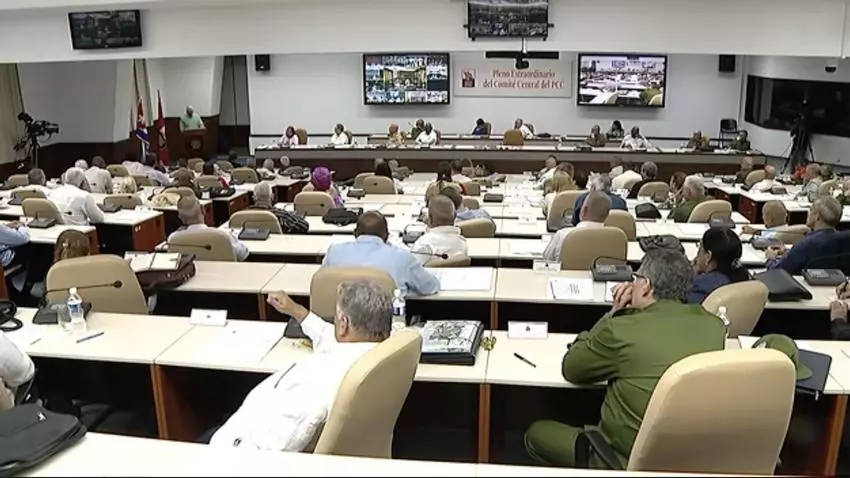
 14ymedio, Madrid, June 18, 2026 — Pending how and when it is implemented, the Cuban regime finally has proposals for real change. In a lengthy speech before the Central Committee of the Communist Party of Cuba, Miguel Díaz-Canel specified on Wednesday several proposals that break with previously untouchable dogmas, beginning with the general elimination of price controls.
“We are going to correct a policy that did not produce the expected results,” the president explained to an audience that did not hesitate to approve everything. “In practice, price caps failed to contain inflation. They often caused products to disappear, encouraged diversion to illegal markets, led to higher prices, reduced tax revenues, and created an impossible race between real prices and administrative decisions that always arrived too late.”
The list contains 23 areas of action and 176 proposals, many of them already known, as this newspaper had previously warned, but also others that, if implemented as announced, would contradict ideological orthodoxy.
The list contains 23 areas of action and 176 proposals, many of them already known, as this newspaper had previously warned, but also others that, if implemented as announced, would contradict ideological orthodoxy
Another of the major measures is allowing direct foreign investment in private companies. Since 2013, when it was first permitted, this type of financing had been reserved for the state sector. Díaz-Canel said it will now be facilitated “with clear rules on ownership, repatriation, reinvestment, and dispute resolution.” This is no minor detail, considering that just over a year ago panic spread among foreign companies when they were prohibited from repatriating foreign currency.
These investors are also finally seeing some of their other demands addressed, including the ability to hire personnel directly without using State employment agencies, which until now kept a large percentage of salaries paid in foreign currency and passed only a small portion on to workers in national currency. This had long been an aspiration, as diplomatic sources confirmed to 14ymedio no less than 10 years ago, stating that the system “hampered investors’ ability to directly select qualified personnel.” In addition, Díaz-Canel guaranteed that foreigners will no longer be told where to invest, based on the government’s business portfolio, but will instead be free to pursue their own initiatives.
Less novel is the renewed offer to Cuban Americans, who have already spent years being encouraged to invest in the Island and who will now divide between those who see an opportunity and those who refuse to participate in a project ultimately intended to “preserve the Revolution,” as Prime Minister Manuel Marrero said in a speech that contained little else of substance.
The substance was in the speech delivered by his superior, who outlined several other genuine reforms, though in less detail. Among them, he spoke of exchanging debt for assets, choosing his words carefully. The idea, common in many countries, would be to transfer ownership of properties, which could include hotels, mines, or other assets, to satisfy large debts the government cannot pay. He stressed, however, that this would be done “without permanently alienating ownership of those assets,” implying that the State could eventually recover them once the debt is settled. The qualification is ideologically significant, since the opposite could be viewed as a betrayal of Communist Party principles.
Another change, already announced by the president last Friday, is a review of the list of activities prohibited to the private sector. It remains to be seen how this will be implemented, but the main promise is to “comprehensively review the list with a clear principle: wherever possible, replace prohibition with responsible regulation.”
Plans also call for expanding the permitted activities of small and medium-sized private enterprises (mipymes) and eliminating bureaucratic burdens. Electronic invoicing, digital payments, and interoperable public registries will become mandatory “to combat tax evasion and corruption,” although this will not be feasible—something he did not mention—while internet connectivity and electricity remain in their current condition.
Díaz-Canel also addressed this issue, although there was less new information. Foreign companies supplying solar panels, batteries, and inverters will be allowed to enter the market directly, and additional taxes related to the sale, installation, and maintenance of these technologies will be eliminated. Solar-powered service stations will also be expanded through still-undisclosed mechanisms promoting foreign, cooperative, private, and State investment. “Expedited” licenses will be granted to operators and taxi drivers using electric vehicles, and tax exemptions will apply to parts for collective transportation vehicles powered by photovoltaic energy.
The president renewed Raúl Castro’s promise—Castro reportedly watched the meeting by videoconference and sent a message of approval through an intermediary—to eliminate universal subsidies distributed through the ration book and replace them with “direct support for vulnerable individuals”
The president renewed Raúl Castro’s promise—Castro reportedly watched the meeting by videoconference and sent a message of approval through an intermediary—to eliminate universal subsidies distributed through the ration book and replace them with “direct support for vulnerable individuals.” In addition, the private sector will be required to “sponsor social dining halls and nursing homes,” effectively transferring part of the State’s social responsibilities to private actors. This measure, if implemented, would represent a paradigm shift and a genuine break with the past, but it has been pending since the aging general first proposed it in 2008.
Díaz-Canel listed a series of additional measures, including one of major significance: ending the State monopoly over exports. Others had already been anticipated, including reforms concerning land ownership and the promotion of agricultural production, which were announced in the draft law expected to be approved in July; reducing the number of ministries; promoting municipal autonomy; and creating a Community Youth Network aimed at training, networking, improving neighborhood coexistence, and supporting local community groups.
The speech was heavily infused with political rhetoric. Díaz-Canel detailed what he described as the hostile policy of the United States, although he also admitted: “There are obstacles that do not come from abroad or from the embargo. There is slowness, bureaucracy, regulations that hinder those who want to produce, and decisions we have postponed. What depends on us, we must change ourselves, and we must change now.”
While maintaining the narrative of resisting pressure from Washington, the president said that the Cuban people would not be called upon merely “to resist. We are going to be called upon to create. To produce. To decide. To supervise. To prosper, and to transform.” Even so, he defended the legacy of Fidel Castro and made it very clear that all of the proposed changes are intended to defend the Revolution.
Translated by Regina Anavy
______________________
COLLABORATE WITH OUR WORK: The 14ymedio team is committed to practicing serious journalism that reflects Cuba’s reality in all its depth. Thank you for joining us on this long journey. We invite you to continue supporting us by becoming a member of 14ymedio now. Together we can continue transforming journalism in Cuba.